





Introduction
The shift from government-centered to collaborative governance has made philanthropic organizations significant actors in policy implementation rather than policymaking (Osborne, Reference Osborne2006). Although the government retains the main authority over policy design, philanthropic organizations have become prominent frontline service providers (Salamon, Reference Salamon1995). They translate policies into tangible services and deliver services directly to communities (AbouAssi et al., Reference AbouAssi, Chen, Grossman and Johnston2024; Brandsen & Pestoff, Reference Brandsen and Pestoff2006). Such delivery can be assessed across multiple dimensions, such as inputs, outputs, outcomes, and impacts (Maier et al., Reference Maier, Zheng, Brandtner and Cornips2025) and operationalized through the scope of services, the scale of operations, and beneficiary reach (Ebrahim & Rangan, Reference Ebrahim and Rangan2014; Sowa et al., Reference Sowa, Selden and Sandfort2004). China exemplifies this transformation well, where philanthropic organizations have been recognized as entities pursuing charitable activities under the 2016 Charity Law and have become significant actors in service implementation from social welfare to environmental protection while navigating intricate state–society relations (Teets, Reference Teets2013).
Although philanthropic organizations are oriented to serve the public benefit, they differ substantially in the extent of their public service delivery. Some implement large-scale programs serving a wide range of populations, while others operate smaller-scale initiatives serving specific communities (Hsu et al., Reference Hsu, Hsu and Hasmath2017). This variation manifests across several dimensions, such as the scope of services, operational scale, and reach of organizational activities (Herman & Renz, Reference Herman and Renz2008; Sowa et al., Reference Sowa, Selden and Sandfort2004). To explain it, it is necessary to explore how professional capacity and organizational resources jointly affect public service delivery of philanthropic organizations.
The existing literature views this phenomenon through two perspectives. The capacity perspective argues that professional capacity is essential for delivering services (Eisenhardt & Martin, Reference Eisenhardt, Martin and Helfat2017). Organizations with specialized knowledge can identify social problems, develop suitable interventions, and deliver high-quality services (AbouAssi & Bies, Reference AbouAssi and Bies2018). The resource perspective highlights the importance of financial endowments. It asserts that resource availability fundamentally shapes an organization’s ability to deliver services effectively and sustainably. Adequate resources constitute prerequisites for meaningful service delivery (Carroll & Stater, Reference Carroll and Stater2009; Chikoto-Schultz & Neely, Reference Chikoto-Schultz and Neely2016). Although the capacity and resource perspectives have largely evolved as separate lines of research, they have overlooked potential joint effects between capacity and resources, leading to incomplete explanations of why comparable organizations perform differently (Lecy & Searing, Reference Lecy and Searing2015).
We contend that the fragmentation of perspectives hides the complex reality of public service delivery, in which professional capacity and organizational resources work together through mechanisms that remain unclear when each perspective is examined separately. Our study makes two key contributions. First, we bridge the gap between capacity and resource perspectives by distinguishing between stock and flow resources. Financial scale measures stock resources, while annual income measures flow resources. This integrated perspective reveals how different resource types interact with professional capacity to influence public service delivery and highlights joint effects between professional capacity and organizational resources. Second, we analyze empirical data from diverse philanthropic organizations to understand how organizational features and regulatory frameworks shape capacity-resource dynamics in practice, especially by comparing public and nonpublic fundraising foundations.
We assess the integrated framework using panel data from 259 Shanghai philanthropic organizations from 2010 to 2022, with two-way fixed effects models and moderated-mediation tests. Shanghai’s advanced philanthropic sector provides a valuable empirical setting for examining these dynamics. The results show that professional capacity boosts public service delivery, which is both moderated and amplified by financial scale and partially mediated by annual income. The remainder of this article reviews relevant literature, develops hypotheses, presents methodology and findings, and discusses theoretical contributions and practical implications.
Literature review and research hypotheses
Philanthropic organizations and public service delivery
Philanthropic organizations refer to foundations, social associations, and private nonenterprise units, which operate independently with the goal of pursuing public benefit through charitable activities (Salamon & Anheier, Reference Salamon and Anheier1998). In China, these organizations are recognized and regulated under the 2016 Charity Law as charitable entities that pursue public benefit missions rather than private profit. Despite differences in fundraising authorization and organizational structure among these entities, they are all encompassed by the legislation (Han et al., Reference Han, Lee and Song2025; Sidel, Reference Sidel2025; Wang, Reference Wang2025).
Their central function is to deliver public services, meet societal needs, and promote public welfare (Osborne, Reference Osborne2006). In their collaboration with government, philanthropic organizations serve as policy implementers, deliver specialized services, and reach underserved populations (Salamon, Reference Salamon1995). Assessing their delivery performance requires attention to multiple dimensions, as service delivery extends beyond the range and scale of activities to include differences in how organizations engage and reach communities (Miller-Stevens et al., Reference Miller-Stevens, Benevento-Zahner, L’Esperance and Taylor2022; Sowa et al., Reference Sowa, Selden and Sandfort2004). This study operationalizes public service delivery along three dimensions: scope, reflecting the breadth of service delivery; scale, indicating the magnitude of resource commitment; and beneficiary reach, capturing the extent to which organizations serve their intended populations (Benjamin, Reference Benjamin2013).
In China, philanthropic organizations operate in an embedded mode (Hsu et al., Reference Hsu, Hsu and Hasmath2017). They integrate into government-led initiatives by delivering contracted services and engaging at the community level. Over the past two decades, organizations have shifted their focus from policy advocacy to direct service delivery (Yu et al., Reference Yu, Shen and Li2021; Zhang & Guo, Reference Zhang and Guo2021), which has led to the expansion of service delivery across diverse domains, from social welfare and elder care to education and environmental protection. This expansion has been reinforced by expanding government contracting arrangements and sector-wide professionalization (Dong & Lu, Reference Dong and Lu2021). The 2016 Charity Law sets specific performance thresholds that organizations must meet.
Recent research has advanced our understanding of these dynamics on several fronts. From the capacity perspective, cross-sectoral collaboration patterns vary by service category but consistently position nonprofits as service implementers (AbouAssi et al., Reference AbouAssi, Chen, Grossman and Johnston2024), while studies on managerial competence have examined how organizational capacities improve delivery outcomes (Hung et al., Reference Hung, Gazley and Guo2025; Lee & Hung, Reference Lee and Hung2022). From the resource perspective, studies on resource dependency have moved beyond basic diversification toward strategic portfolio management and intersectoral partnerships (Hung & Hager, Reference Hung and Hager2019), and other studies examine how resource endowments shape NGOs’ (nongovernmental organizations’) strategic positioning (Jackwerth-Rice et al., Reference Jackwerth-Rice, Koehrsen and Mattes2023). These contributions notwithstanding, capacity and resources have predominantly been examined in isolation, with limited attention to how they interact to shape public service delivery.
This fragmentation is particularly evident at the micro-organizational level, where existing studies have addressed resource diversification and managerial competence in government contracting (Frumkin & Keating, Reference Frumkin and Keating2011; Jing & Chen, Reference Jing and Chen2012), but lack frameworks that integrate organizational capacity with resource conditions. Why organizations operating under comparable institutional contexts achieve different levels of service delivery remains unclear. This theoretical gap leads to our research question: How do professional capacity and organizational resources jointly influence public service delivery through interactive mechanisms?
Organizational professional capacity and public service delivery
Professional capacity encompasses specific knowledge, skills, and experience that enable organizations to complete tasks effectively (Winter, Reference Winter2003). It is rooted in resource-based theory and organizational capacity theory and highlights how internal competencies generate competitive advantage. In philanthropic organizations, professional capacity denotes the essential organizational attribute for delivering high-quality services in complex settings like disaster relief and community development. It consists of technical expertise, managerial competence, strategic planning, and stakeholder engagement (Despard, Reference Despard2017).
Professional capacity enhances public service delivery through several pathways. Technical expertise establishes cognitive legitimacy, making organizations reliable service providers (AbouAssi & Bies, Reference AbouAssi and Bies2018). It strengthens their competitive position by identifying service needs more effectively, which enables a more strategic approach to service delivery that aligns with clients’ requirements (Suárez, Reference Suárez2011). It also fosters cross-sector communication by establishing shared knowledge bases and collaboration platforms through streamlined processes.
Contrasting with Western contexts that emphasize advocacy and pluralistic representation, China’s service delivery system prioritizes technically proficient and depoliticized engagement. Organizations seeking established delivery channels must demonstrate expertise, particularly when competing for government contracts (Jing & Gong, Reference Jing and Gong2012; Spires et al., Reference Spires, Tao and Chan2014). This environment has fostered what researchers characterize as “professionalization for legitimacy” strategies, whereby NGOs invest substantially in professional capacity and service quality to establish credibility under state supervision (Zhan & Tang, Reference Zhan and Tang2016). Based on this, we propose H1:
H1: Philanthropic organizations’ professional capacity has a significant positive effect on their public service delivery.
Moderating effect of financial scale
Financial scale encompasses an organization’s financial assets. It demonstrates its stability, steady growth, and capacity to handle economic challenges (Bowman et al., Reference Bowman, Tuckman and Young2012). The larger the assets, the safer the operations are. It also means greater capacity to take risks and stronger leverage to collaborate with others (AbouAssi, Reference AbouAssi2013).
In philanthropic organizations, financial scale dictates strategic decisions like expanding programs and allocating resources during downturns. Philanthropic organizations with substantial resources maintain professional staffing, uphold high standards, and create buffers against revenue volatility (Calabrese, Reference Calabrese2012). However, those with limited resources encounter operational instability and constrain their capacity to engage effectively in service delivery (Beck et al., Reference Beck, Harris and Neely2025; Wiepking & de Wit, Reference Wiepking and de Wit2024).
These dynamics are particularly salient in China, where financial scale enables organizations to navigate complex regulatory environments and political shifts. Philanthropic organizations with large assets have greater discretion to navigate state–society relations, invest in staff training, and sustain public engagement (Newland, Reference Newland2018). Meanwhile, financial scale can enhance professional capacity by hiring qualified staff and maintaining training programs, which can effectively translate expertise into public service delivery. Based on this, we propose H2:
H2: Financial scale significantly moderates the relationship between philanthropic organizations’ professional capacity and public service delivery.
Mediating effect of annual income
Annual income is different from financial scale because it represents flow resources, such as annual inflows from donations, service fees, and contracts. It reflects an organization’s capacity to mobilize resources in changing environments (Bowman et al., Reference Bowman, Tuckman and Young2012). Steady annual income can provide direct funding for program implementations, staff development, and sustainable operations.
For philanthropic organizations, annual income demonstrates external trust and market competitiveness in acquiring resources. Professional capacity enhances annual income acquisition by increasing fundraising efficiency, organizational credibility, and accountability (Ashley & Faulk, Reference Ashley and Faulk2010; Carroll & Stater, Reference Carroll and Stater2009). The higher the annual income, the greater the organizational autonomy and the expanded service delivery.
In China’s state-centered system, professional capacity is a prerequisite for securing government contracts and gaining public trust (Hasmath & Hsu, Reference Hasmath and Hsu2020; Jing, Reference Jing2018). Organizations with stronger professional capacity have preferential access to government procurement and attract more donors, leading to higher annual income (Faulk et al., Reference Faulk, McGinnis Johnson and Lecy2017; Spires et al., Reference Spires, Tao and Chan2014). This suggests that professional capacity increases funding, which in turn enables public service delivery (Zhan & Tang, Reference Zhan and Tang2016). Based on this, we propose H3:
H3: Annual income mediates the relationship between philanthropic organizations’ professional capacity and public service delivery.
Moderated mediation effect
The interaction between professional capacity and organizational resources is more than simple moderation or mediation. Financial scale may affect both the direct effect of professional capacity on public service delivery and the indirect effect through annual income.
The first path is that financial scale moderates the relationship between professional capacity and annual income. When organizations pursue higher annual income, financial scale underpins professional capacity. Well-capitalized organizations can apply sophisticated fundraising strategies (Kim, Reference Kim2015), manage revenue volatility more effectively (Chikoto-Schultz & Neely, Reference Chikoto-Schultz and Neely2016), and strengthen credibility by demonstrating stability to stakeholders (Burger & Owens, Reference Burger and Owens2010). These mechanisms amplify the impact of professional capacity on annual income acquisition (Calabrese, Reference Calabrese2012).
The second path is that financial scale moderates the relationship between annual income and public service delivery. Organizations with a larger financial scale can more easily convert extra annual income into service delivery, as they possess greater stability and infrastructure for rapid scaling (Mitchell & Calabrese, Reference Mitchell and Calabrese2019). Organizations with smaller financial scale exhibit weaker effects from annual income due to constraints on resource absorption and deployment (Garcia-Rodriguez & Romero-Merino, Reference Garcia-Rodriguez and Romero-Merino2020). Financially stable organizations can leverage incremental income more strategically and invest in long-term service improvements (Chen, Reference Chen2021).
Within China’s public service delivery system, this two-path moderation establishes foundations for moderated mediation effects. Financial scale may simultaneously moderate the direct effect of professional capacity on public service delivery and the indirect effect through annual income. Combined professional capacity and financial scale enable organizations to procure service contracts and carry out programs through higher annual income (Teets, Reference Teets2013), which demonstrates that stock resources can shape flow resources across multiple stages. Based on this, we propose H4:
H4: Financial scale moderates the indirect effect of professional capacity on public service delivery through annual income.
Figure 1 presents the theoretical framework of this study, illustrating the hypothesized relationships among professional capacity, financial scale, annual income, and public service delivery.
Proposed theoretical model.

Methodology
Data and samples
We studied registered philanthropic organizations in Shanghai from 2010 to 2022. Shanghai was chosen for its economic development, diversity of philanthropic organizations, maturity of philanthropy, and data availability. Data were drawn from the Shanghai Civil Affairs Bureau, the Shanghai Social Organization Public Service Platform (SSOPSP), annual reports, financial statements, and project archives. The unbalanced panel data consists of 259 organizations with 1992 observations and an average of 7.69 years per organization. The sample covers all philanthropic organizations that publish at least one annual report with data on the number of charitable projects, project expenditure, or the number of beneficiaries, so it represents publicly reporting organizations in Shanghai during this period. Although this study concentrates on a single city, Shanghai’s well-established regulatory infrastructure and transparent reporting practices make it a valuable case for studying public service delivery in China’s philanthropic sector (see Appendix 1).
The unbalanced panel mitigates selection bias and enhances external validity through incorporating organizations with varied lifespans (Baltagi, Reference Baltagi2021; Wooldridge, Reference Wooldridge2010). However, this method requires cautious interpretation as the observational nature precludes definitive causal inference, and potential attrition bias remains if organizational exit correlates with study variables (Baltagi, Reference Baltagi2021). Our two-way fixed effects models partially address unobserved confounders, yielding strong correlational evidence.
Data were manually coded from primary documents, such as annual reports and official filings, following a standardized protocol with clear indicator definitions, formatting rules, and unit conversions. For each organization-year, we extracted the number of charitable projects, project expenditure, and the number of beneficiaries. Trained assistants double-coded a random 10% subsample and achieved over 95% inter-coder agreement, resolving discrepancies through consensus. We excluded observations with more than 20% of fields missing and filled minor gaps by cross-referencing adjacent years or auxiliary documents.
Variables
Dependent variable: Public service delivery
We measured public service delivery using Principal Component Analysis based on three indicators from the Shanghai Civil Affairs Bureau: (1) the number of charitable projects, (2) project expenditure in natural logarithm, and (3) the number of beneficiaries in natural logarithm. This multidimensional measurement avoids the limitations of a single indicator while capturing the scope, scale, and beneficiary reach of organizational service delivery (Sowa et al., Reference Sowa, Selden and Sandfort2004).
These three indicators reflect different but complementary sides of public service delivery. The number of charitable projects captures the scope of service delivery. When organizations expand their service areas, the number of projects reflects the breadth of their delivery portfolio (LeRoux & Wright, Reference LeRoux and Wright2010). Project expenditure captures the scale of service delivery. Financial commitment to service is widely used as a proxy for operational magnitude in nonprofit research (Thomson, Reference Thomson2010). The number of beneficiaries captures beneficiary reach by measuring the population served, which scholars have identified as the most accessible indicator of an organization’s community-level influence (Harris et al., Reference Harris, Neely and Parsons2022). This measurement matches China’s performance-based governance system, where philanthropic organizations demonstrate legitimacy through the scope, scale, and beneficiary reach of service delivery.
As shown in Appendix 2.1, the first principal component has strong loadings on all indicators, ranging from −0.436 to −0.639, and explains 62.14% of total variance. To ensure that more activities correspond to higher scores, we reversed the signs of PC1 before normalizing to a 0–100 scale, following Nardo et al. (Reference Nardo, Saisana, Saltelli and Tarantola2005) (see Appendix 2.2). Organizations with fewer projects, lower expenditure, and fewer beneficiaries score around 10–15, while those with more projects, higher expenditure, and more beneficiaries score above 80.
Independent variable: Professional capacity
We measured professional capacity by calculating professional personnel from annual reports, which consists of staff with formal “Social Worker” qualification certificates and relevant professional technical titles. These staff directly affect the quality and impact of organizational services (Suárez, Reference Suárez2011) and reflect the level of specialized knowledge and technical competence in the organizations. We applied Z-score standardization to facilitate regression analysis, allowing coefficients to directly reflect the impact of changes in the standard deviation on the dependent variable.
Moderator: Financial scale
We used financial scale as the moderator, measured by net assets reported to the Shanghai Civil Affairs Bureau. We take the natural logarithm of net assets plus one, ln (net assets +1), to handle the skewed distribution and mitigate the effect of extreme values. Financial scale represents the stock of financial resources, which provides operational stability and strategic flexibility. It can potentially influence how professional capacity converts into public service delivery. Net assets capture the cumulative financial position of an organization, reflecting what Bowman (Reference Bowman2011) terms long-term financial resources, as distinct from short-term revenue flows. We also use Z-score standardization for this variable in regression.
Mediator: Annual income
We used annual income as the mediator, measured it with annual total income, and transformed it using ln (annual income +1) to handle the skewed distribution. Annual income represents the flow of financial resources, which shows organizational resource acquisition and social support. Compared to financial scale, annual income better reflects current resource flow and environmental adaptability (Bowman et al., Reference Bowman, Tuckman and Young2012). Organizations with higher professional capacity can gain more annual income through donations, grants, and contracts to support public service delivery. This follows the resource mobilization theory, which states that capacity can be converted into actionable resources to produce outcomes (McCarthy & Zald, Reference McCarthy and Zald1977). We also standardize this variable with Z-score for regression.
Control variables
We controlled four factors that may potentially influence public service delivery. We also collected this data from the annual reports of the Shanghai Civil Affairs Bureau and the SSOPSP. Organizational age is the number of years since registration and reflects the developmental stage (Guo, Reference Guo2007). Organizational type classifies philanthropic organizations into nonpublic fundraising foundations (0), public fundraising foundations (1), and other forms (2). Organizational size is calculated as the number of employees per million net assets, which adjusts for financial scale and reflects human resource intensity and efficiency (Lecy & Searing, Reference Lecy and Searing2015 ; Schmid, Reference Schmid2002). Professional capacity reflects qualified professional staff, but organizational size shows the overall workforce. Political connections are measured with six indicators of government–NGO linkages, such as board affiliations and collaborative programs, manually coded from public filings to reflect connections with state institutions (Deng & Kennedy, Reference Deng and Kennedy2010).
While relying on these sources presents limitations, we reduce risks by cross-verifying data across multiple years and supplementing automated extraction with manual coding for complex variables (see Appendix 1).
Modeling strategy
We used two-way fixed effects models to test hypotheses regarding professional capacity, financial scale, annual income, and public service delivery. Model specification tests indicated significant individual effects in the BP-LM test, supporting the use of random effects model over pooled OLS. The Hausman test further indicated a preference for fixed effects over random effects (see Appendix 4.1). We estimated four sequential models: the baseline model examines the direct effect of professional capacity on public service delivery (see Appendix 4.2); the moderation model introduces financial scale as a moderator through an interaction term between professional capacity and financial scale (see Appendix 4.3); the mediation model evaluates annual income as a mediator using Baron and Kenny’s (Reference Baron and Kenny1986) causal-step approach, supplemented by bootstrap analysis with 5000 resamples (see Appendixes 4.4 and 6.2); and the moderated mediation model incorporates both the moderation and mediation pathways (see Appendix 4.5). The two-way fixed effects models control for time-invariant organizational heterogeneity and temporal shocks. This specification improves internal validity by accounting for unobserved, time-invariant organizational characteristics that may jointly affect professional capacity and public service delivery.
Robustness tests
We conducted four robustness tests. First, we replaced the dependent variable with three components. Second, we swapped the moderator and mediator, treating financial scale as the mediator and annual income as the moderator. Third, we ran sub-sample tests by splitting organizations into different types to assess the consistency of results across categories. Finally, we conducted an event-time analysis surrounding the 2016 Charity Law to examine whether policy changes were associated with shifts in public service delivery.
Results
Correlation analysis
Table 1 reports the Pearson correlation matrix for the main variables. Public service delivery positively correlates with professional capacity (r = 0.409, p < 0.01), financial scale (r = 0.590, p < 0.01), and annual income (r = 0.581, p < 0.01). Professional capacity also correlates with financial scale (r = 0.379, p < 0.01) and annual income (r = 0.320, p < 0.01), providing preliminary support for hypothesized relationships. The indicators measuring public service delivery, the number of charitable projects, project expenditure, and the number of beneficiaries are strongly correlated with the composite index (r = 0.595, 0.864, and 0.874; all p < 0.01), which confirms the validity of the measurement. Control variables, including organizational age, type, size, and political connections, also have positive correlations with public service delivery. Variance inflation factor (VIF) values below 3 indicate multicollinearity is not a concern (see Appendix 3.2).
Pearson correlation coefficients

Table 1 Long description
The table presents Pearson correlation coefficients for eleven variables. The variables are: public service delivery, the number of charitable projects, project expenditure, the number of beneficiaries, professional capacity, financial scale, annual income, organizational size, organizational type, organizational age, and political connection.
Key correlations include:
* Public service delivery shows strong positive correlations with the number of beneficiaries (0.874), project expenditure (0.864), and the number of charitable projects (0.595).
* The number of charitable projects correlates positively with annual income (0.468) and professional capacity (0.411).
* Project expenditure is highly correlated with the number of beneficiaries (0.662) and financial scale (0.519).
* Organizational size is the only variable showing consistent negative correlations, notably with professional capacity (-0.274), financial scale (-0.172), and public service delivery (-0.108).
* Professional capacity is strongly linked to financial scale (0.638) and organizational age (0.556).
* Political connection has its strongest positive correlation with organizational age (0.444).
Statistical significance is indicated by asterisks: three asterisks for p < 0.01, two for p < 0.05, and one for p < 0.1. Most reported values are significant at the p < 0.01 level.
Note: *p < 0.1, **p < 0.05, ***p < 0.01.
Baseline model (H1)
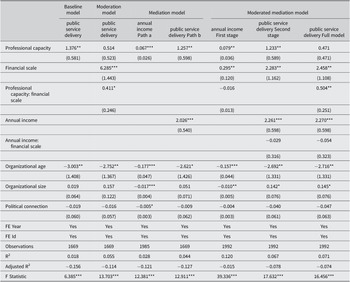
Table 2 shows the results of the baseline regression. Professional capacity demonstrates a significant positive effect on public service delivery (β = 1.376, p < 0.05). A one-unit increase in professional capacity is associated with a 1.376-unit rise in public service delivery, supporting H1 and indicating professional capacity can enhance public service delivery. Since public service delivery is scaled from 0 to 100, and the sample mean is 29.15 (SD = 12.03), this effect constitutes roughly a 4.7% increase relative to the mean, signifying a meaningful difference in practice.
Main model regression results

Table 2. Long description
The table presents regression results across seven columns: Baseline model (public service delivery), Moderation model (public service delivery), Mediation model (Path a: annual income and Path b: public service delivery), and Moderated mediation model (First stage: annual income, Second stage: public service delivery, and Full model: public service delivery).
Key variables and coefficients:
* Professional capacity: 1.376 super ** in baseline, 0.514 in moderation, 0.067 super *** in Path a, 1.257 super ** in Path b, 0.079 super ** in first stage, 1.233 super ** in second stage, and 0.471 in full model.
* Financial scale: 6.285 super *** in moderation, 0.295 super ** in first stage, 2.283 super ** in second stage, and 2.458 super ** in full model.
* Professional capacity interaction with financial scale: 0.411 super * in moderation and 0.504 super ** in full model.
* Annual income: 2.026 super *** in Path b, 2.261 super *** in second stage, and 2.270 super *** in full model.
* Annual income interaction with financial scale: -0.029 in second stage and -0.054 in full model.
* Organizational age: Negative coefficients across all models, ranging from -3.003 to -2.621, mostly significant at p < 0.05.
* Organizational size: Significant positive coefficients in second stage (0.142 super *) and full model (0.145 super *).
Model statistics:
* F E Year and F E Id: Yes for all models.
* Observations: Range from 1669 to 1992.
* R super 2: Range from 0.018 to 0.120.
* F Statistic: All models are significant at p < 0.01, with values ranging from 6.385 to 39.336.
Note: *p < 0.1, **p < 0.05, ***p < 0.01. Standard errors are robust to heteroskedasticity (HC1) and clustered at the group level.
For control variables, organizational age has a significant negative effect (β = −3.003, p < 0.05), which means that younger philanthropic organizations demonstrate higher public service delivery than older ones. Other control variables are not statistically significant. The overall model is statistically significant (F = 6.385, p < 0.01), confirming the appropriateness of the model specification.
Moderation (H2)
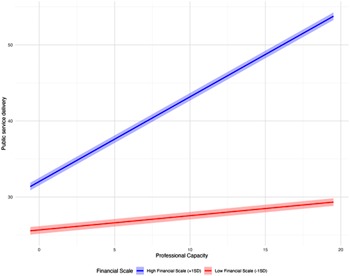
The moderation model (Table 2) indicates that financial scale positively affects public service delivery (β = 6.285, p < 0.01). The interaction term between professional capacity and financial scale is significantly positive (β = 0.411, p < 0.1). As Figure 2 depicts, the slope between professional capacity and public service delivery is steeper for organizations with larger financial scale, which suggests that financial scale positively impacts professional capacity and supports H2. The moderation model demonstrates greater explanatory power than the baseline model (F = 13.703, p < 0.01).
Moderating effect of financial scale.

Fig. 2 Long description
The x-axis is labeled Professional Capacity with values from 0 to 20. The y-axis is labeled Public service delivery with values from 30 to 50. Two linear trend lines with shaded confidence intervals are shown. The first line, representing High Financial Scale plus 1 S D, is blue and shows a steep positive linear increase. It starts at approximately y equals 31 when x is 0 and rises to approximately y equals 54 when x is 20. The second line, representing Low Financial Scale minus 1 S D, is red and shows a much flatter positive linear trend. It starts at approximately y equals 25 when x is 0 and rises only slightly to approximately y equals 29 when x is 20. The gap between the two lines widens significantly as Professional Capacity increases.
Mediation (H3)
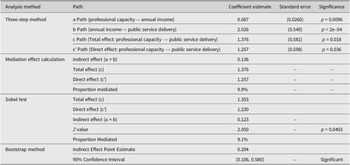
Table 3 reports the mediation effect analysis results. Professional capacity significantly affects public service delivery (c = 1.376, p < 0.05) and annual income (a = 0.067, p < 0.01). Annual income significantly predicts public service delivery when we control for professional capacity (b = 2.026, p < 0.01). The direct effect of professional capacity on public service delivery is significant but somewhat reduced (c’ = 1.257, p < 0.05). The indirect effect (a × b = 0.136) accounts for 9.9% of the total effect. Sobel test (Z = 2.050, p < 0.05) and bootstrap analysis (indirect effect = 0.294, 95% CI [0.106, 0.580]) confirm the robustness of these findings. Appendix 6.2 illustrates the bootstrap distribution of the indirect effect. These results partially support H3, indicating that annual income mediates the effect of professional capacity, though it accounts for only a modest proportion of the total effect.
Mediation effect analysis results

Table 3. Long description
The table is organized into five columns: Analysis method, Path, Coefficient estimate, Standard error, and Significance.
* Three-step method:
- a Path (professional capacity yields annual income): Coefficient 0.067, Standard error 0.0260, p equals 0.0096.
- b Path (annual income yields public service delivery): Coefficient 2.026, Standard error 0.540, p equals 2e-04.
- c Path (Total effect): Coefficient 1.376, Standard error 0.581, p equals 0.018.
- c prime Path (Direct effect): Coefficient 1.257, Standard error 0.598, p equals 0.036.
* Mediation effect calculation:
- Indirect effect (a times b): 0.136.
- Total effect (c): 1.376.
- Direct effect (c prime): 1.257.
- Proportion mediated: 9.9 percent.
* Sobel test:
- Total effect (c): 1.353.
- Direct effect (c prime): 1.230.
- Indirect effect (a times b): 0.123.
- Z value: 2.050, p equals 0.0403.
- Proportion Mediated: 9.1 percent.
* Bootstrap method:
- Indirect Effect Point Estimate: 0.294.
- 95 percent Confidence Interval: [0.106, 0.580], marked as Significant.
Note: *p < 0.1, **p < 0.05, ***p < 0.01, Bootstrap analysis based on 5000 resamples.
Moderated mediation (H4)
The last model tests whether financial scale moderates the indirect effect of professional capacity on public service delivery through annual income. While annual income significantly affects public service delivery (β = 2.270, p < 0.01), the interaction between annual income and financial scale is not significant (β = −0.054, p > 0.1). H4 is therefore not supported, which means that financial scale functions as a significant direct moderator (H2), but its moderating effect does not carry over to the indirect path through annual income.
Robustness tests
Robustness tests support core results. First, alternative dependent variables reveal heterogeneous effects of professional capacity, significantly positive for the number of charitable projects, weaker for the number of beneficiaries, and negligible for project expenditure. The moderating effect of financial scale is only significant for the number of charitable projects (see Appendix 5.1). Second, the role-swapping tests remain significant but exhibit weaker results, with lower overall model fit compared to the original specification (R 2 = 0.048 vs. 0.055; F = 11.946 vs. 13.703) (see Appendix 5.2). Third, sub-sample tests indicate that the moderating effect is statistically significant for nonpublic fundraising foundations (β = 1.716, p < 0.01), but not significant for public fundraising foundations. However, the difference between the two groups is not statistically significant (difference = −1.407, p = 0.088) (see Appendix_5.3). Finally, an event-time test around the 2016 Charity Law shows that public service delivery declined pre-law and rebounded thereafter, which points to a link between policy shift and public service delivery (see Appendix 6.1).
Figure 3 summarizes the main empirical findings: H1–H3 are supported, and H4 is not statistically significant.
Empirical results of the theoretical framework.

Discussion and implications
Theoretical contribution
This study examines the relationship between professional capacity and public service delivery in philanthropic organizations, focusing on mechanisms through which organizational resources operate. The results confirm that professional capacity has a significant positive impact on public service delivery, moderated by financial scale and partially mediated by annual income. The main contribution is that we integrate capacity and resource perspectives to explain how professional capacity and organizational resources jointly influence public service delivery.
We move beyond earlier research that examines either professional capacity or organizational resources separately by highlighting their interactions (Hong, Reference Hong2019; Meier et al., Reference Meier, Favero and Zhu2015). Our findings show that professional capacity has a limited impact on public service delivery and requires adequate resource support to fully realize its potential. Annual income as a mediator converts professional capacity into higher public service delivery and demonstrates the bridging role of resources in capacity building. This integrated perspective deepens our understanding of the heterogeneity in public service delivery among philanthropic organizations. Moreover, observed effect sizes suggest meaningful differences in practice. For instance, a standard deviation increase in professional capacity corresponds to a 1.370-point rise in public service delivery on a 0–100 scale, which is equivalent to nearly 5% of the sample mean, reflecting tangible gains in the number of charitable projects, project expenditure, and the number of beneficiaries.
Furthermore, the study distinguishes between stock and flow resources based on their different operational mechanisms. Financial scale primarily moderates the direct effect of professional capacity on public service delivery, while annual income works as a mediator and translates professional capacity into public service delivery. Robustness tests reveal that this distinction varies across organizational types. Nonpublic fundraising foundations have stronger moderating effects, and public fundraising foundations exhibit more pronounced mediating effects. This finding refines the applicability of resource–capacity interactions in the nonprofit sector, revealing the complexity between different organizational resources and professional capacity.
While these findings emerge from China’s institutional context of embedded service delivery, the framework integrating capacity and resource perspectives handles fundamental questions about how professional capacity and organizational resource jointly influence public service delivery. The differences between stock resources (financial scale) and flow resources (annual income), along with mechanisms through which professional capacity enhances public service delivery, offer insights with potential applicability across different contexts. This integrated perspective is particularly relevant for settings where NGOs must navigate complex regulatory environments and keep service quality high, regardless of whether these systems are authoritarian, corporatist, or democratic.
The synergy between organizational resources and professional capacity
The interaction effect between professional capacity and financial scale (β = 0.411, p < 0.01) reveals a public service delivery dilemma when resources are limited. The impact of professional capacity is stronger with more organizational resources. When the financial scale is larger, professional capacity shows a stronger positive relationship with public service delivery, whereas this relationship weakens considerably under the smaller financial scale. This suggests that financial resources buffer against uncertainty and provide a stable foundation for professional capacity to drive service delivery (Van den Bekerom et al., Reference Van den Bekerom, Torenvlied and Akkerman2016). Organizations with sufficient resources can invest in projects and expand services, whereas organizations with few resources struggle to mobilize expertise effectively. This underscores the dual necessity of professional capacity and financial resources for public service delivery.
An important and unexpected finding is that financial scale did not significantly moderate the indirect effect of professional capacity through annual income (β = −0.054, p > 0.1). This suggests that while financial scale is crucial for enabling organizations to translate professional capacity directly into public service delivery, it may not play a main role in creating more annual income. Organizations with high professional capacity have already maximized their fundraising capacity regardless of financial scale. This nuance indicates that financial scale serves more as a buffer for translating professional capacity into public service delivery, rather than as a driver of annual income generation.
The mediating mechanism where professional capacity enhances public service delivery by increasing annual income (β = 2.026, p < 0.01) further supports our integrated framework. Professional capacity contributes not only directly but also indirectly by improving resource acquisition through fundraising, program design, and stakeholder engagement. This highlights the dual role of professional capacity as both a direct driver of public service delivery and an indirect facilitator through higher annual income.
We describe this mediation as partial because the direct effect of professional capacity on public service delivery remains statistically significant even after including the indirect path through annual income. This interpretation matches established definitions of partial mediation, where both direct and indirect effects are significant and point in the same direction (Hayes, Reference Hayes2017). While we acknowledge that conceptual boundaries of partial mediation remain debated in the methodological literature, our empirical approach follows widely accepted practices in social science mediation analysis.
Practical implications
Our findings have several important implications for practice and policy. For organizational leaders, professional capacity requires sufficient resource support to be effective. Leaders should balance capacity building and resource acquisition so that professional capacity is backed by adequate financial resources. For nonpublic fundraising foundations, which demonstrate stronger moderating effects (β = 1.716 vs. 0.307), it is crucial to expand financial scale to better leverage professional capacity. Our findings show that investing in an additional standard deviation of professional capacity can improve public service delivery by ~5% of the sector’s average, translating into tangible improvements in service scope, delivery scale, and beneficiary reach.
For policymakers, a two-pronged strategy is recommended, namely promoting professional capacity building and improving resource support systems. Differentiated support systems should be developed for organizations with high professional capacity but limited resources to maximize their potential for public service delivery. For public fundraising foundations, they show stronger mediating effects, so policy design should tailor measures according to how different types of organizations depend on resources.
For funders and the public, when assessing nonprofit organizations, it is vital to evaluate the alignment between professional capacity and financial resources, rather than focusing on each dimension in isolation. Resource investments should be directed toward organizations where capacity and resources interact well, thereby optimizing social resource allocation. It is also important to recognize that the effects of professional capacity vary across different indicators, showing the strongest effects on the number of charitable projects while being relatively weaker on project expenditure. This suggests that evaluation systems should adopt multidimensional measurement standards.
Limitations and future research
Our study has several limitations. First, the unbalanced panel data restricts the accuracy of causal inference. Second, organizational resources are operationalized through financial dimensions, overlooking human capital, social networks, and other resources. Third, the measurement of professional capacity primarily relies on staffing levels, without fully considering qualitative dimensions like training quality. Fourth, the study primarily draws on standardized, government-regulated administrative records. While these provide consistent, verifiable data across organizations and years, they may omit informal practices or underreport aspects of public service delivery. Fifth, public service delivery is mainly measured through organizational outputs, which may not fully capture ultimate social impacts. Finally, the research focuses only on philanthropic organizations in China and requires cross-cultural validations of the findings’ generalizability.
Future research could proceed in four directions: first, employ quasi-experimental designs to strengthen causality; second, adopt more comprehensive measures of capacity, resources, and public service delivery, such as community impact assessments; third, incorporate qualitative evidence or survey-based data to complement standardized administrative records and capture organizational processes; finally, validate the applicability of the resource–capacity interaction framework in different institutional contexts.
Conclusion
This study examined how professional capacity and organizational resources jointly shape public service delivery of philanthropic organizations. Using panel data on 259 philanthropic organizations in Shanghai from 2010 to 2022, we find that professional capacity significantly enhances public service delivery, moderated by financial scale and partially mediated by annual income. Philanthropic organizations of different types exhibit distinct patterns. Public fundraising foundations show stronger mediating effects, while nonpublic fundraising foundations demonstrate more pronounced moderating effects.
Theoretically, we clarify that professional capacity represents internal competencies while organizational resources reflect external support conditions. These dimensions are different but interdependent. Professional capacity indicates what organizations can accomplish, while organizational resources determine how effectively they can sustain and expand public service delivery. Specifically, financial scale as stock resources amplifies the effect of professional capacity, while annual income as flow resources channels it into public service delivery. Our core contribution is to integrate capacity and resource perspectives, and we argue that the interaction is the best way to understand the heterogeneity in public service delivery, especially when distinguishing between stock and flow resources.
Practically, the findings suggest that the government should strengthen capacity building and resource support systems. Funders should allocate funding to organizations where professional capacity and financial resources complement each other. Philanthropic organizations should balance professional capacity building with resource acquisition. Future research should extend this framework by exploring qualitative dimensions of professional capacity, measures of public service delivery capturing broader social impacts, and cross-institutional comparisons across different regulatory contexts.
Supplementary material
The supplementary material for this article can be found at http://doi.org/10.1017/S0957876526000616.
Data availability statement
Data that support the findings of this study are available from the corresponding author upon reasonable request.
Acknowledgments
We thank the editors and anonymous reviewers for helpful comments and feedback.
Funding statement
This work was supported by the National Social Science Fund of China (grant no. 21BZZ066) and the China Scholarship Council (grant no. 202406140140).
Competing interests
The authors declare that they have no conflict of interest.
Ethical standard
This study did not involve human participants or animals; therefore, ethical approval was not required.




 Open access

