


Introduction
Corporate environmental investment (CEI), defined as a firm’s commitment of resources to environmental protection, serves as a reliable indicator of environmental responsibility and is critical for addressing environmental challenges (Li & Lu, Reference Li and Lu2016; Zhou, Arndt, Jiang, & Dai, Reference Zhou, Arndt, Jiang and Dai2021). However, firms in emerging markets are often reluctant to undertake substantial CEI, highlighting the crucial role of regulatory and social stakeholders in pressuring them to commit (Block, Sharma, & Benz, Reference Block, Sharma and Benz2024; Jiang, Wang, & Zhou, Reference Jiang, Wang and Zhou2023). Stakeholder theory posits that firms must incorporate stakeholders’ environmental demands into their practices to achieve superior performance (Jones, Harrison, & Felps, Reference Jones, Harrison and Felps2018; Liu, Guo, & Chi, Reference Liu, Guo and Chi2015). Yet, despite growing environmental awareness among stakeholders, polluting and irresponsible behaviors remain widespread, partially due to stakeholders’ limited capacity to monitor and enforce compliance (Li & Lu, Reference Li and Lu2016; Wei, Shen, Zhou, & Li, Reference Wei, Shen, Zhou and Li2017). Thus, enhancing stakeholders’ governance capabilities is fundamental to facilitating corporate environmental responsibility in emerging markets.
We suggest that city digitalization – a novel approach to improving socioeconomic infrastructure – can improve the governance capabilities of regulatory and social stakeholders. In recent years, many cities worldwide have embraced digital technologies to foster economic and social development (Hashem et al., Reference Hashem, Chang, Anuar, Adewole, Yaqoob, Gani, Ahmed and Chiroma2016; Zhang, Pan, Yu, & Liu, Reference Zhang, Pan, Yu and Liu2022). City digitalization is defined as the extent to which a city has implemented digital technologies to improve its governance, economic growth, and social infrastructure (Hashem et al., Reference Hashem, Chang, Anuar, Adewole, Yaqoob, Gani, Ahmed and Chiroma2016). Given their substantial benefits on information availability and transparency, recent research highlights the great potential of digital technologies to address environmental challenges, particularly in emerging markets (Chandy, Hassan, & Mukherji, Reference Chandy, Hassan and Mukherji2017; George, Merrill, & Schillebeeckx, Reference George, Merrill and Schillebeeckx2021). For instance, smart grids enable real-time monitoring and optimization of urban energy consumption, thereby reducing carbon emissions and industrial waste (Hashem et al., Reference Hashem, Chang, Anuar, Adewole, Yaqoob, Gani, Ahmed and Chiroma2016). City-wide air quality sensors deliver real-time environmental data to the public and policymakers, supporting timely responses to pollution and informed mitigation efforts (Zhang et al., Reference Zhang, Pan, Yu and Liu2022). Despite these promising developments, how a city’s digital development affects the environmental responsibility of local firms is under researched.
To address this research gap, we build on stakeholder theory and examine the impact of city digitalization on CEI in an emerging market – China. Prior research shows that digital technologies provide firms with an information advantage, thereby facilitating the development of new capabilities essential for strategic competitiveness (Luo, Reference Luo2022; Wu, Lou, & Hitt, Reference Wu, Lou and Hitt2019). We extend this logic to city digitalization and conceptualize that it enhances information availability and transparency across society and thus strengthens stakeholders’ capabilities to govern business activities. Therefore, we propose that, by enhancing information availability and connectivity, city digitalization improves regulatory and social stakeholder governance and, in turn, fosters CEI of local firms.
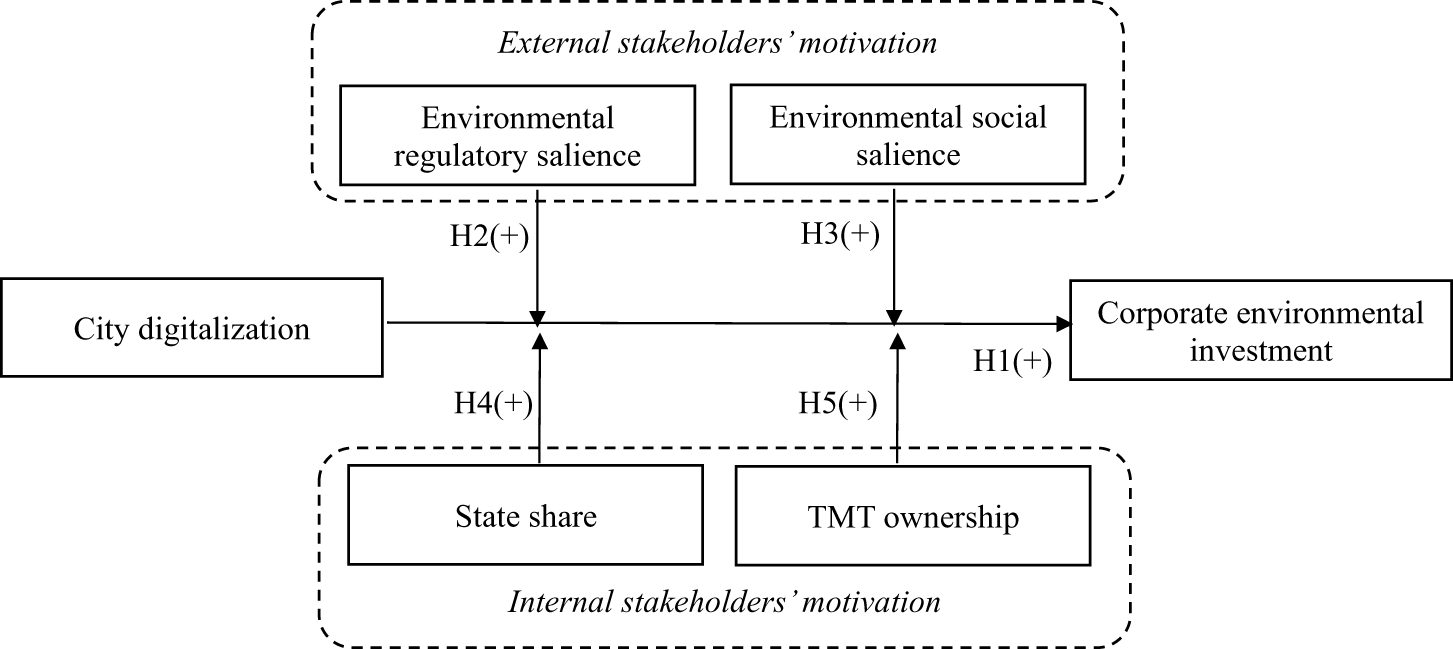
Stakeholder theory highlights that the efficacy of stakeholder governance capabilities hinges on two critical dimensions: external stakeholders’ motivation to utilize these capabilities and internal stakeholders’ motivation to accommodate such demands (Jones et al., Reference Jones, Harrison and Felps2018; Laplume, Sonpar, & Litz, Reference Laplume, Sonpar and Litz2008). Accordingly, we examine how the impact of city digitalization on CEI is contingent upon factors that reflect the motivations of external and internal stakeholders. External stakeholders’ motivation shapes their willingness to leverage digital-enabled capabilities to govern corporate environmental behaviors (Chandy et al., Reference Chandy, Hassan and Mukherji2017). Thus, we consider environmental regulatory salience (i.e., the extent to which regulatory stakeholders prioritize environmental protection on the political agenda in a city, Bao & Liu, Reference Bao and Liu2022) and environmental social salience (i.e., the level of environmental awareness among social stakeholders in a city, Coles, Heath, & Ringgenberg, Reference Coles, Heath and Ringgenberg2022). Moreover, internal stakeholders’ motivation affects firms’ compliance with environmental requirements imposed by digital-empowered governance capabilities (George et al., Reference George, Merrill and Schillebeeckx2021). Hence, we focus on state share (i.e., proportion of equity held by governments or their agencies, Zhou, Gao, & Zhao, Reference Zhou, Gao and Zhao2017) and top management team (TMT) ownership (i.e., proportion of equity held by TMT, Kock, Santaló, & Diestre, Reference Kock, Santaló and Diestre2012). Figure 1 depicts our conceptual model.
Conceptual framework

Figure 1 Long description
A diagram illustrating the impact of city digitalization on corporate environmental investment. City digitalization is linked to corporate environmental investment with a positive influence labeled H1. External stakeholders' motivation includes environmental regulatory salience and environmental social salience, both positively influencing corporate environmental investment through H2 and H3, respectively. Internal stakeholders' motivation comprises state share and TMT ownership, positively affecting corporate environmental investment through H4 and H5, respectively. The diagram is enclosed in dashed lines, categorizing external and internal stakeholders' motivations.
We empirically test our hypotheses using a panel dataset comprising a sample of Chinese listed firms operating in environmentally sensitive industries from 2014 through 2019. With strong support, our study makes three contributions. First, our study theorizes and validates stakeholder governance capabilities as the fundamental mechanism linking city digitalization to environmentally responsible practices of local firms. Second, our study contributes to environmental management research by highlighting city digitalization as a novel technological driver of corporate environmentalism. Third, our study enriches the digitalization literature by identifying the boundary conditions of city digitalization, addressing the call to explore the social value of digitalization (Chandy et al., Reference Chandy, Hassan and Mukherji2017; George et al., Reference George, Merrill and Schillebeeckx2021).
Theoretical Background and Hypotheses Development
Stakeholder Theory and CEI
CEI is pivotal to facilitate green technological development and improve corporate environmental performance (Li & Ramanathan, Reference Li and Ramanathan2020). However, firms in emerging markets are often reluctant to commit substantial CEI because environmental projects are risky, uncertain, and capital intensive (Berrone, Fosfuri, Gelabert, & Gomez‐Mejia, Reference Berrone, Fosfuri, Gelabert and Gomez‐Mejia2013). Firms may perceive a trade-off between long-run societal benefits and immediate economic gains (Dowell & Muthulingam, Reference Dowell and Muthulingam2017). This tension is particularly salient under resource constraints, as firms may prioritize growth opportunities by investing in initiatives that generate faster returns or are closely aligned with their core businesses (Jiang et al., Reference Jiang, Wang and Zhou2023).
Insomuch as firms’ lack of internal motivation, external stakeholder pressure is crucial for fostering CEI, making stakeholder theory a valuable framework for understanding corporate environmental protection practices (Block et al., Reference Block, Sharma and Benz2024; Kassinis & Vafeas, Reference Kassinis and Vafeas2006). Stakeholder theory emphasizes that the purpose of firms is to create and distribute value among a broad group of stakeholders (Donaldson & Preston, Reference Donaldson and Preston1995; Jones, Reference Jones1995). Stakeholders are defined as groups or individuals who can affect or are affected by a firm’s strategic outcomes (Freeman, Reference Freeman2010). Firms that address stakeholder interests are more likely to achieve superior performance and sustain competitive advantage (Garcia-Castro & Francoeur, Reference Garcia-Castro and Francoeur2016; Harrison, Bosse, & Phillips, Reference Harrison, Bosse and Phillips2010; Jones et al., Reference Jones, Harrison and Felps2018). In particular, firms are advised to prioritize salient stakeholders who possess power and present legitimate and urgent claims (Mitchell, Agle, & Wood, Reference Mitchell, Agle and Wood1997; Weitzner & Deutsch, Reference Weitzner and Deutsch2015).
Drawing on stakeholder theory, prior research highlights the critical role of regulatory and social stakeholders in promoting corporate environmental behaviors. First, firms are likely to invest in pollution treatment to comply with the requirements of regulatory stakeholders (e.g., environment-related judicial authorities and administrative bureaus). Non-compliant firms may face a range of disciplinary actions, including fines, operational suspensions, license revocations, or even forced shutdowns (Wang, Wijen, & Heugens, Reference Wang, Wijen and Heugens2018; Zhou et al., Reference Zhou, Arndt, Jiang and Dai2021). Second, firms may engage in environmental responsibility in response to demands from social stakeholders (e.g., customers, the media, communities, and the public) (Hu, Wu, & Ying, Reference Hu, Wu and Ying2022; Kassinis & Vafeas, Reference Kassinis and Vafeas2006). By addressing the environmental expectations of social stakeholders, firms can benefit from increased stakeholder trust and enhanced reputation (Ding, Liu, & Chang, Reference Ding, Liu and Chang2023; Liu et al., Reference Liu, Guo and Chi2015).
Despite rising stakeholder awareness of environmental protection, pollution and greenwashing remain pervasive in many emerging markets (Li & Lu, Reference Li and Lu2016; Wei et al., Reference Wei, Shen, Zhou and Li2017). We propose that external stakeholders often lack information needed to govern corporate environmental practices effectively. Regulatory stakeholders may face information deficits that constrain environmental monitoring and enforcement, which ‘may leave many legitimate authorities unable to hold organizations to any meaningful regulatory standard’ (George et al., Reference George, Merrill and Schillebeeckx2021: 1007). For instance, sporadic manual inspections by environmental enforcement agencies are costly and yield low detection rates (Chang, Huang, Li, Bo, & Kumar, Reference Chang, Huang, Li, Bo and Kumar2021). Social stakeholders likewise often lack timely information about corporate environmental behaviors, limiting their ability to identify environmentally irresponsible actors (Zhang et al., Reference Zhang, Pan, Yu and Liu2022), and they face constrained channels for whistleblowing and penalizing organizational malpractices (George et al., Reference George, Merrill and Schillebeeckx2021). As a result, strong external stakeholder governance capabilities are essential for improving corporate environmental practices. Building on this logic, we examine whether regional-level digitalization improves environmental governance capabilities of external stakeholders and, in turn, fosters CEI in emerging markets.
Furthermore, stakeholder theory suggests that firms’ responses to external stakeholder governance are contingent on how internal stakeholders prioritize external claims (Jones et al., Reference Jones, Harrison and Felps2018; Weitzner & Deutsch, Reference Weitzner and Deutsch2015). Internal stakeholders, particularly owners and top managers, serve as gatekeepers who evaluate external environmental demands and weigh them against competing stakeholder claims for strategic attention and resources (Tantalo & Priem, Reference Tantalo and Priem2016). These evaluations determine whether environmental issues are elevated to strategic priorities, as reflected in formal objectives and performance metrics (Yang, Wang, Zhou, & Jiang, Reference Yang, Wang, Zhou and Jiang2019). Internal stakeholders also shape implementation by mobilizing and allocating resources to translate external environmental expectations into substantive practices (Liu et al., Reference Liu, Guo and Chi2015). Accordingly, our study further investigates how internal stakeholders, reflected by ownership arrangements, moderate the impact of regional digitalization on CEI.
City Digitalization and CEI
Digital technologies encompass a range of emerging technologies that interconnect vast and dispersed information, communication, and computation systems, such as artificial intelligence, big data analytics, and cloud computing (Hanelt, Bohnsack, Marz, & Antunes Marante, Reference Hanelt, Bohnsack, Marz and Antunes Marante2021). Governments have increasing embraced digital technologies to build city infrastructure and foster economic growth (Zhang et al., Reference Zhang, Pan, Yu and Liu2022). City digitalization reflects the overall development of digital infrastructure in a prefecture-level city in terms of digital government, digital society, and digital economy (Hashem et al., Reference Hashem, Chang, Anuar, Adewole, Yaqoob, Gani, Ahmed and Chiroma2016). Digital government refers to the diversity and quality of a city’s digital government services (Jiménez, Hanoteau, & Barkemeyer, Reference Jiménez, Hanoteau and Barkemeyer2022). Digital society indicates the degree of social interaction on digital platforms (Coles et al., Reference Coles, Heath and Ringgenberg2022). Digital economy reflects the extent to which digital technologies integrate into traditional sectors (Ma & Zhu, Reference Ma and Zhu2022).
Given the information role of digital technologies, scholars highlight the potential of digital intelligence in addressing complex environmental challenges (Chandy et al., Reference Chandy, Hassan and Mukherji2017; George et al., Reference George, Merrill and Schillebeeckx2021; Singhal, Feng, Ganeshan, Sanders, & Shanthikumar, Reference Singhal, Feng, Ganeshan, Sanders and Shanthikumar2018). Despite these urgent calls, empirical studies remain limited, with only two notable exceptions (Chang et al., Reference Chang, Huang, Li, Bo and Kumar2021; Zhang et al., Reference Zhang, Pan, Yu and Liu2022). Chang et al. (Reference Chang, Huang, Li, Bo and Kumar2021) employ machine learning approaches to develop a predictive model that significantly improves the detection of firms violating environmental regulations. Zhang et al. (Reference Zhang, Pan, Yu and Liu2022) conduct a case study illustrating how governments in China develop data infrastructure and utilize big data analytics to assist in air pollution management. Extending this line of research, our study examines how the advancement of city digitalization affects the environmental responsibility of local firms.
We propose that city digitalization facilitates CEI for two major reasons. First, city digitalization compels firms to increase CEI by strengthening regulatory stakeholders’ ability to supervise corporate environmental impacts. Digital infrastructure enables the collection of large volumes of accurate and timely information on emissions and pollution, which facilitates real-time monitoring and broader oversight of corporate polluting behaviors by government authorities (Chandy et al., Reference Chandy, Hassan and Mukherji2017). Moreover, digital systems can generate accurate pollution forecasts and prescribe a variety of solutions for environmental governance, thereby enhancing the effectiveness of regulatory measures (Zhang et al., Reference Zhang, Pan, Yu and Liu2022). E-government infrastructure consolidates information across channels, departments, bureaus, and regions, enhancing administrative efficiency in detecting environmental violators (Chang et al., Reference Chang, Huang, Li, Bo and Kumar2021). As a result, city digitalization strengthens regulatory supervision and increases the likelihood and severity of penalties for noncompliant firms, thereby compelling them to increase CEI.
Second, city digitalization pressures firms to commit CEI by increasing social stakeholders’ ability to monitor corporate environmental activities. Digital systems and platforms allow real-time pollution broadcasting to the public, thus strengthening environmental awareness in society (Zhang et al., Reference Zhang, Pan, Yu and Liu2022). By facilitating information transparency and verification, digital infrastructure also makes corporate environmental behaviors more visible to a broader set of social stakeholders, enabling them to more effectively assess business integrity and identify irresponsible firms (George et al., Reference George, Merrill and Schillebeeckx2021). For instance, investors can verify a firm’s environmental credibility to support their investment decisions (Chang et al., Reference Chang, Huang, Li, Bo and Kumar2021). Moreover, digital platforms empower social stakeholders to hold firms accountable by reducing information barriers and facilitating broader participation in whistleblowing and reporting environmental malpractices (Yue, Wang, & Yang, Reference Yue, Wang and Yang2019), thereby pushing them to increase CEI. Thus, we predict that:
Hypothesis 1 (H1): City digitalization is positively related to CEI of local firms.
Boundary Conditions
Stakeholder theory suggests that the efficacy of stakeholder governance capabilities depends on the motivation of external stakeholders to exert influence and that of internal stakeholders to respond to external demands (Darnall, Henriques, & Sadorsky, Reference Darnall, Henriques and Sadorsky2010; Jones et al., Reference Jones, Harrison and Felps2018; Laplume et al., Reference Laplume, Sonpar and Litz2008). From the viewpoint of external stakeholders, their underlying motivation affects the extent to which they are willing to exercise their capabilities in fulfilling their governance role (Cordano, Frieze, & Ellis, Reference Cordano, Frieze and Ellis2004). The greater the salience these stakeholders attribute to environmental protection, the more likely they are to actively employ the informational functions of city digitalization to govern corporate environmental behaviors (George et al., Reference George, Merrill and Schillebeeckx2021; Hanelt, Busse, & Kolbe, Reference Hanelt, Busse and Kolbe2017). Accordingly, we examine the moderating effects of environmental regulatory salience and environmental social salience, which respectively reflect the environmental perceptions of two key external stakeholder groups: regulatory and social stakeholders.
From the perspective of internal stakeholders, their motivation determines how they perceive and incorporate external demands into strategic management (Henriques & Sadorsky, Reference Henriques and Sadorsky1999; Jones et al., Reference Jones, Harrison and Felps2018), which in turn alters the impact of city digitalization on CEI. Because shareholders and senior managers constitute two critical internal stakeholder groups in firms’ strategic decision-making, their ownership holdings significantly affect their incentives to pursue self-interested goals (Berrone & Gomez-Mejia, Reference Berrone and Gomez-Mejia2009; Kock et al., Reference Kock, Santaló and Diestre2012). As state share aligns firms with government priorities and TMT ownership links managers’ wealth with long-term firm value, they may shape firms’ responses to digital-enhanced environmental governance. Therefore, we investigate the moderating roles of state share and TMT ownership.
Environmental regulatory salience
When local governments prioritize environmental protection in their development agendas, regulatory stakeholders would strengthen legal enforcement against polluting firms (Bao & Liu, Reference Bao and Liu2022; Zhang, Yu, & Kong, Reference Zhang, Yu and Kong2019). Given the uneven economic development progress in emerging markets such as China, environmental regulatory salience varies across different regions within a nation (Wang et al., Reference Wang, Wijen and Heugens2018).
We predict that environmental regulatory salience strengthens the positive impact of city digitalization on CEI. First, when environmental regulatory salience is high, city digitalization may have a stronger impact on environmental supervision. In these regions, local governments often reinforce the coercive power of regulatory stakeholders by granting them greater authority to manage environmental impact (Zhang et al., Reference Zhang, Yu and Kong2019). Environmental regulators can leverage e-government infrastructure to coordinate information from other administrative agencies, such as police departments, procuratorates, bureaus of natural resources, and finance authorities (Chang et al., Reference Chang, Huang, Li, Bo and Kumar2021; Zhang et al., Reference Zhang, Yu and Kong2019). Such coordination enables more effective use of data to develop new supervisory measures and initiate united surveillance of pollution management (Zhang et al., Reference Zhang, Pan, Yu and Liu2022). As a result, city digitalization may play a more prominent role in strengthening regulatory governance, thereby compelling firms to increase CEI.
Second, high environmental regulatory salience strengthens city digitalization’s role in punishing corporate pollution. To achieve policy objectives, regulatory stakeholders would improve judicial standards for environmental cases. Consequently, polluters, subject to real-time monitoring and close inspection enabled by digitalization, face more timely and stringent regulatory enforcement (Chang et al., Reference Chang, Huang, Li, Bo and Kumar2021; Hu et al., Reference Hu, Wu and Ying2022). Regulatory stakeholders may also leverage digital government systems to encourage public participation in legal actions against polluters (Hu et al., Reference Hu, Wu and Ying2022), thereby expanding the reach of environmental enforcement and enhancing the impact of city digitalization on CEI. Therefore, we propose that:
Hypothesis 2 (H2): The positive impact of city digitalization on CEI is stronger in regions with higher levels of environmental regulatory salience.
Environmental social salience
Environmental social salience reflects the pressure and expectations imposed by social stakeholders on corporate environmental behaviors (Coles et al., Reference Coles, Heath and Ringgenberg2022). To maintain legitimacy and build a reputation critical for long-term survival, firms need to demonstrate credible environmental efforts (Kassinis & Vafeas, Reference Kassinis and Vafeas2006; Liu et al., Reference Liu, Guo and Chi2015).
We posit that environmental social salience strengthens the positive impact of city digitalization on CEI. First, in regions with high environmental social salience, city digitalization plays a more salient role in monitoring corporate environmental actions. As environmental concerns rise, citizens, communities, and the media actively search for and disseminate information about firms engaging in polluting behaviors through digital channels and platforms (Chandy et al., Reference Chandy, Hassan and Mukherji2017). The involvement of a broader set of social stakeholders allows digital systems to more effectively facilitate the initiation and diffusion of social norms and industry standards related to environmental practices (George et al., Reference George, Merrill and Schillebeeckx2021; Ma & Zhu, Reference Ma and Zhu2022), compelling underperforming firms to improve CEI.
Second, when environmental social salience is high, city digitalization more effectively facilitates collective actions against environmentally irresponsible firms. Effective deterrence through social monitoring requires collaboration among diverse parties, including customers, intermediaries, communities, and the general public, who can collectively hold firms accountable for their polluting behaviors (Kang & He, Reference Kang and He2018). With widespread environmental awareness, social stakeholders proactively utilize digital platforms and systems to mobilize public opinions and coordinate collective efforts, increasing penalties for polluting firms and strengthening the impact of city digitalization on CEI. Thus, we predict that:
Hypothesis 3 (H3): The positive impact of city digitalization on CEI is stronger in regions with higher levels of environmental social salience.
State share
State share reflects the extent of government influence in a firm’s governance structure and economic activities (Zhou et al., Reference Zhou, Gao and Zhao2017). As state share confers a state-affiliated identity, state-owned firms face strong pressure to echo the government’s call and address public expectations, including environmental protection (Jia, Huang, & Man Zhang, Reference Jia, Huang and Man Zhang2019; Wang, Heugens, & Wijen, Reference Wang, Heugens and Wijen2024).
We predict that the positive impact of city digitalization on CEI is stronger when state share is high. First, firms with higher state share are more motivated to align strategic decisions with governmental and societal environmental goals, which increases the efficacy of city digitalization in promoting CEI. State shareholders directly influence business operations by incorporating public policy priorities into firm strategies (Jia et al., Reference Jia, Huang and Man Zhang2019; Yang et al., Reference Yang, Wang, Zhou and Jiang2019). To maintain legitimacy and comply with mandates, these firms likely prioritize the environmental accountability driven by city digitalization, leading to a stronger impact on CEI.
Second, state share provides resource advantages that enables firms to respond timely to city digitalization-empowered stakeholder governance. State-affiliated firms often gain preferential access to financing, subsidies, and policy support for environmental protection projects (Li & Lu, Reference Li and Lu2016; Wang et al., Reference Wang, Wijen and Heugens2018). By reducing the costs and risks of environmental activities, these resources enhance firms’ capacity to meet digital-enhanced stakeholder demands, thereby strengthening the effect of city digitalization on CEI. Thus, we predict that:
Hypothesis 4 (H4): The positive impact of city digitalization on CEI is stronger in firms with higher levels of state share.
TMT ownership
TMT incentives are central governance mechanisms that significantly affect firms’ strategic choices (Kock et al., Reference Kock, Santaló and Diestre2012). As a means of equity-based managerial incentives, TMT ownership can affect the way managers respond to stakeholder demands and environmental performance in particular (Berrone & Gomez-Mejia, Reference Berrone and Gomez-Mejia2009; Walls, Berrone, & Phan, Reference Walls, Berrone and Phan2012).
We predict that TMT ownership may enhance the positive impact of city digitalization on CEI. First, TMT ownership aligns managerial interests with long-term value creation, increasing their strategic adaptiveness to city digitalization-driven stakeholder environmental governance. By aligning owner-manager incentives, equity-based ownership motivates managers to pursue long-term investments that enhance legitimacy and reputation (Barker & Mueller, Reference Barker and Mueller2002; Berrone & Gomez-Mejia, Reference Berrone and Gomez-Mejia2009). As a result, these managers are more likely to respond to external stakeholders’ pressures, enhancing the role of city digitalization on CEI.
Second, higher TMT ownership increases managers’ personal financial exposure to the costs of environmental irresponsibility, making them more likely to allocate substantive CEI in response to city digitalization-enabled stakeholder governance. Because city digitalization enhances external stakeholders’ capabilities to discipline firms through sanctions and activism that affect market valuation (Flammer, Reference Flammer2013; Marquis & Bird, Reference Marquis and Bird2018), TMT equity stakes intensifies managers’ financial risks from stakeholder punitive actions (Flammer, Hong, & Minor, Reference Flammer, Hong and Minor2019; Kock et al., Reference Kock, Santaló and Diestre2012). As a result, managers become more responsive to digital governance by allocating resources to implement substantive environmental initiatives, thereby increasing the impact of city digitalization on CEI. Therefore, we predict:
Hypothesis 5 (H5): The positive impact of city digitalization on CEI is stronger in firms with higher levels of TMT ownership.
Methods
Sample and Data Sources
Our sample includes Chinese A-share listed firms in environmentally sensitive industries from 2014 through 2019. We choose 2014 as the beginning year because data on our independent variable (i.e., city digitalization) are only available since then. We use 2019 as the end year due to the outbreak of the COVID-19 pandemic that significantly affects corporate investment behaviors. Following previous research (Chang, Li, & Lu, Reference Chang, Li and Lu2015; Li & Lu, Reference Li and Lu2016; Zhang et al., Reference Zhang, Yu and Kong2019), we focus on firms in environmentally sensitive industries as they bear strong environmental protection responsibility to reduce negative ecological footprints.Footnote 1 We lag explanatory variables by 1 year to reduce potential reverse causality. Thus, data on our independent, moderating, and control variables come from 2014 through 2018, and data on the dependent variable are from 2015 through 2019. After dropping observations with missing data, we obtain a sample of 9,809 firm-year observations for 2,358 firms.
We combine data from multiple datasets. First, we collect data on city digitalization from the China Digital Index Report (2015–2019) released by Tencent Research Institute, a leading internet research institute in China. Second, we manually collect CEI data from the annual reports of listed firms. Third, for moderators and controls, we collect data on environmental regulatory salience from the annual government work report and environmental social salience from the Baidu search index. Information on state share, TMT ownership, and control variables comes from the China Stock Market and Accounting Research (CSMAR) database. Fourth, for mediation tests, we collect the city-level Pollution Information Transparency Index (PITI) from the Institute of Public & Environmental Affairs, and firm-level environmental media coverage from the DataGo dataset. Fifth, for heterogeneous analyses, data on environmental courts come from the official websites of provincial people’s courts in China. We also obtain data on city-level environmental pollution from CSMAR and data on green finance development information from the National Bureau of Statistics of China, China Environmental Statistical Yearbook, and China City Statistical Yearbook.
Measures
Dependent variable: CEI
Following prior studies (Li & Lu, Reference Li and Lu2016; Zhang et al., Reference Zhang, Yu and Kong2019), we manually collect CEI data from the ‘major construction in progress’ and ‘construction in progress’ items in the balance sheet of listed firms’ annual reports, removing duplicate items. We select projects related to environmental protection (e.g., investments in pollution abatement and control, desulfurization projects, denitrification projects, sewage treatment, waste gas, dust, energy-saving, and greening projects). We measure CEI using the logarithm of aggregated environmental capital expenditures.
Independent variable: City digitalization
Following prior research (Shen, Zhou, & Luo, Reference Shen, Zhou and Luo2025), we measure city digitalization at the municipal level using the China Digital Index score (originally the ‘Internet+’ index), including three dimensions: digital government, digital society, and digital economy.Footnote 2 Digital government is calculated using data on activities of government’s WeChat public accounts, user activities, and accessibility, quality, and diversity of e-government services. Digital society is developed by using data from the two biggest social media platforms in China – WeChat and QQ, indicating the extent to which local people depend on digital platforms for social interactions and activities (e.g., news, videos, games). Digital economy is constructed based on the following factors: transactions of digital industries and Fintech services, cloud usage, and organizational activities on WeChat public accounts. Taken together, the aggregated index captures the extent of digital technology adoption across government, economic, and private sectors in a city, aligning with our conceptualization of city digitalization.Footnote 3
Moderators: Environmental regulatory salience
We measure city-level environmental regulatory salience by using the percentage of keywords related to environmental protection in a city government’s annual work report (Bao & Liu, Reference Bao and Liu2022). In China, local governments release annual work reports that summarize the previous year’s socioeconomic achievements and outline policy plans and development objectives for the year ahead. These annual reports are authoritative documents that articulate the strategic focus of local political agendas and guide policy implementation across government departments, bureaus, and agencies (Bao & Liu, Reference Bao and Liu2022). Prior research suggests that keyword frequency in such official reports serves as a valid proxy for local governments’ policy priorities and administrative emphasis (Chen, Kahn, Liu, & Wang, Reference Chen, Kahn, Liu and Wang2018; Ingram, Raman, & Wilson, Reference Ingram, Raman and Wilson1989). Thus, the frequency of environmental-related keywords reflects the levels of emphasis that local regulatory stakeholders place on environmental governance and protection.
Environmental social salience
We measure city-level environmental social salience by using the annual Baidu search index on environmental pollution. Prior studies show that online search behavior (e.g., Google search index) serves as a reliable proxy for public attention to economic, social, and cultural issues (Bernstein, Gustafson, & Lewis, Reference Bernstein, Gustafson and Lewis2019; Coles et al., Reference Coles, Heath and Ringgenberg2022). Pollution-related search volumes reflect public interest and awareness of environmental issues, indicating the intensity of social concern and engagement with pollution problems (Greenstone, He, Jia, & Liu, Reference Greenstone, He, Jia and Liu2022; Mccallum & Bury, Reference Mccallum and Bury2013; Pope, Peillex, El Ouadghiri, & Gomes, Reference Pope, Peillex, El Ouadghiri and Gomes2024). In mainland China, Baidu – the dominant search engine with the broadest user base – offers the most representative platform for gauging public interest. Moreover, Baidu search index provides timely, large-scale, and behaviorally grounded data that effectively captures collective attention dynamics. Accordingly, we consider the Baidu search index as an indicator of pressures and expectations that social stakeholders impose on local firms to improve environmental practices. The city-level annual Baidu Index is constructed from the volume of user search queries for ‘environmental pollution’ keywords, weighted and standardized using Baidu’s proprietary algorithm to reflect relative search intensity over time. As the Baidu index is reported daily at the city level, we calculate the annual index by averaging the daily values throughout the year.
State share
We measure state share by the percentage of shares directly held by state entities (Zhou et al., Reference Zhou, Gao and Zhao2017).
TMT ownership
We measure TMT ownership by the percentage of shares held by the firm’s TMT (e.g., CEO, CFO, and other top executives) (George, Wiklund, & Zahra, Reference George, Wiklund and Zahra2005; Kroll et al., Reference Kroll, Walters and Le2007).
Control variables
We control for several firm-, industry-, and city-level variables that may influence corporate environmental practices. At the firm level, we include CEO duality, coded as one if CEO and chairman are the same person and zero otherwise, to account for the discretion of CEOs in strategic decision-making such as CEI (Webb, Reference Webb2004). We control for firm size, measured by the natural logarithm of total assets, because larger firms may face stronger stakeholder pressure to make environmental investments (Zhang et al., Reference Zhang, Yu and Kong2019). We control for ROA (i.e., return on assets) because firms with better financial performance are more able to invest in environmental protection. We include environmental subsidy, measured as the logarithm of environmental protection subsidies a firm receives from the government (Wang et al., Reference Wang, Wijen and Heugens2018).
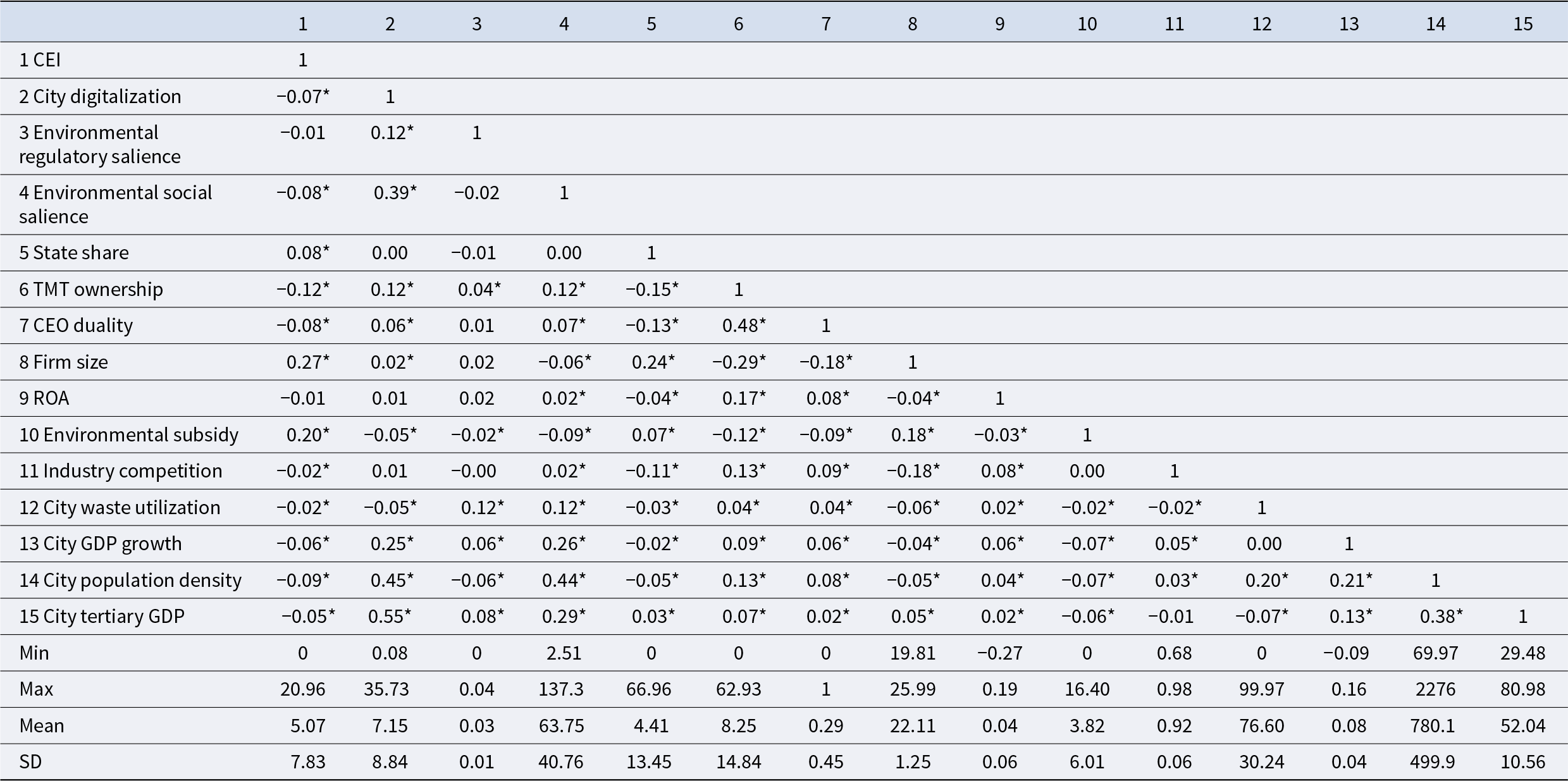
At the industry level, we control for industry competition measured by one minus Herfindahl–Hirschman Index, calculated as the sum of the squared sales revenue for all firms within the same industry (Zhou et al., Reference Zhou, Gao and Zhao2017). Thus, a higher value indicates more intense competition in an industry. At the city level, we include city waste utilization, measured by the utilization rate of industrial solid waste in a city, to control for the influence of regional environmental protection efforts on firms’ environmental behaviors (Chen, Chen, & Chu, Reference Chen, Chen and Chu2025). We incorporate city GDP growth rate to control for the influence of local economic development and industrialization. We include city population density, measured as the ratio of city total population to total city area, to control for the influence of population development. We include city tertiary GDP, measured as the proportion of a city’s tertiary industry GDP to the total GDP, to account for the influence of city development phase (Wang, Webber, Finlayson, & Barnett, Reference Wang, Webber, Finlayson and Barnett2008). We report their descriptive statistics and correlations in Table 1.
Descriptive statistics and correlations

Table 1 Long description
The table presents descriptive statistics and correlations among 15 variables, including CEI, city digitalization, and environmental factors. City tertiary GDP and city digitalization have the strongest positive correlation at 0.55, indicating a significant relationship. CEI and TMT ownership show a negative correlation of -0.12, suggesting an inverse relationship. The mean values range from 0.03 for environmental regulatory salience to 780.1 for city population density. Standard deviations indicate variability, with city population density having the highest at 499.9. The data highlights significant correlations, marked with an asterisk, which should be interpreted with caution due to potential confounding factors.
Notes: *p < 0.05 (two-tailed), N = 9,809
Estimation Method: Instrumental Variable Approach and Multilevel Modeling
To further deal with potential endogeneity, such as omitted variables that simultaneously affect city digitalization and CEI, we adopt a two-stage least squares approach in which the multilevel random coefficient modeling is used in the second stage regression. In the first stage, we estimate city digitalization by regressing it on the instrumental variables (IVs), along with all control variables, to obtain predicted values. Following the approach of Sun, Deng, and Wright (Reference Sun, Deng and Wright2021), for interaction terms, we conduct separate regressions in which each interaction is modeled using the instrument, its interactions with the moderators, as well as the moderators and controls themselves. The predicted values from these models were then used as independent variables and interaction terms in the second-stage regressions.
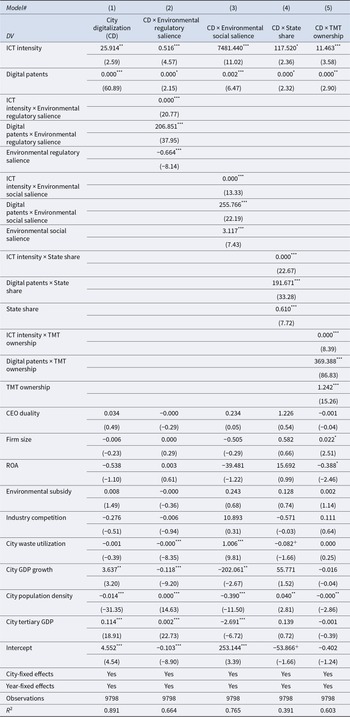
Semadeni, Withers, and Trevis Certo (Reference Semadeni, Withers and Trevis Certo2014: 3) suggest that ‘instrumental variables must fulfill two conditions: relevance and exogeneity’. Accordingly, we use two IVs for city digitalization. First, we adopt ICT intensity (i.e., the ratio of employment in the information and communications technology industry to the city population). Cities with larger ICT industry scales are better able to support digitalization development. Second, we use digital patents (i.e., the total number of digital patent applications submitted in each city). Digital patents capture a city’s capacity for innovation and technological development in digital domains, which supports broader digital adoption within the city. As expected, results show that ICT intensity (b = 25.914, p < 0.01) and digital patents (b = 0.000, p < 0.001) are significant predictors of city digitalization (Model 1 in Table A1), fulfilling the relevance condition. Regarding the exogeneity condition, city-level ICT intensity and digital patents are unlikely to affect a firm’s CEI.
We conduct three tests to assess the IV quality. First, we conduct a Hausman test to compare the IV model and non-IV model. The results show a p-value of 0.001, suggesting that IV model should be used. Second, we adopt a Bayesian test for under‐identification, suggesting that our equation is adequately identified. Third, we conduct a weak identification test and the Kleibergen–Paap Wald F‐statistic is 15.13 (above the cut‐off value of 10), which suggests IVs are strong. These results indicate that ICT intensity and digital patents are solid instruments for city digitalization. We present detailed results of the first-stage estimations in Appendix Table A1.
In the second stage regression, we use the multilevel modeling (MLM) random coefficient modeling (Guo, Reference Guo2017; Hough, Reference Hough2006; Misangyi, Elms, Greckhamer, & Lepine, Reference Misangyi, Elms, Greckhamer and Lepine2006). Our hypotheses partition lower-level outcomes into within-group (lower level) and between-group (higher level) variance, and effects of higher-level predictors on the between-group portion of lower-level outcomes reflect cross-level effects (Aguinis, Gottfredson, & Culpepper, Reference Aguinis, Gottfredson and Culpepper2013; Bliese, Reference Bliese, Drasgow and Schmitt2002; Kirkman, Chen, Farh, Chen, & Lowe, Reference Kirkman, Chen, Farh, Chen and Lowe2009). Our study includes variables measured at different levels of analysis, where low-level entities (i.e., firms) are nested within high-level collectives (i.e., industries or cities). As such, higher-level variables may covary with relevant lower-level outcomes, and firms located within the same city are likely to share more similar characteristics than those across different cities (Bliese & Hanges, Reference Bliese and Hanges2004). Consequently, dependence may occur ‘even if the variable of interest makes no reference to the group’ (Bliese, Reference Bliese2000: 358). Covariation between city-level variables and firm-level outcomes leads to gross prediction errors if analyzed using ordinary least squares regression (Bliese & Hanges, Reference Bliese and Hanges2004; Hox, Moerbeek, & Van de Schoot, Reference Hox, Moerbeek and Van de Schoot2017; Snijders & Bosker, Reference Snijders and Bosker2011).
To address this issue, the MLM analysis involves estimating two models that nest firm-level CEI observations over time within firms and cross-nest firms within cities. First, we estimate an unconditional (null) three-level model without predictors to partition the variance in CEI across time, firms, industries, and cities. Second, we estimate another model that includes year effects at the lowest level. The variance components from this second model are used to calculate relative effect sizes by dividing the variance attributable to cities, industries, and firms by the total variance derived from the unconditional model. The remaining difference, introduced by the inclusion of year effects, represents the year-level variance component (for detailed discussions of MLM, see Hough, Reference Hough2006; Misangyi et al., Reference Misangyi, Elms, Greckhamer and Lepine2006; Quigley & Graffin, Reference Quigley and Graffin2017). In our regression, we also include firm-fixed effects and year-fixed effects to account for the firm and time variances. By incorporating firm-fixed effects, our estimates are identified from within-firm temporal variation, which mitigates concerns that cross-city differences in the number of listed firms or industrial composition may bias the estimated effects (Breuer & DeHaan, Reference Breuer and DeHaan2024; Certo, Withers, & Semadeni, Reference Certo, Withers and Semadeni2017). We conduct the empirical analysis using STATA 17.
Results
Multilevel Random Coefficient Modeling Analysis
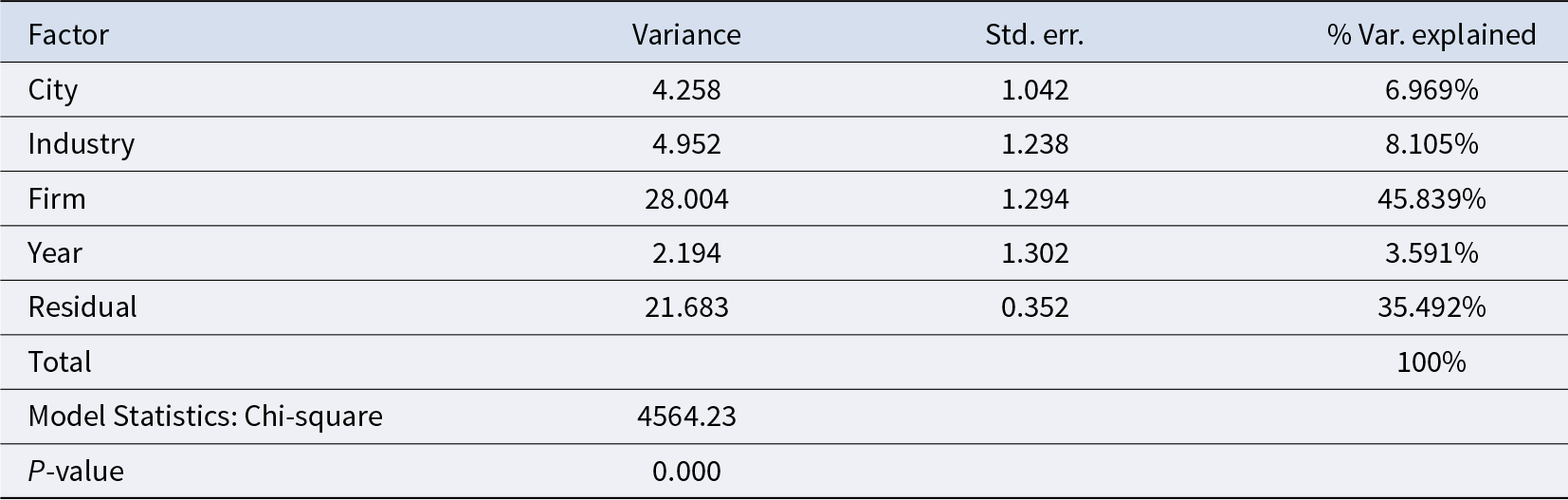
Table 2 presents the basic results of the multilevel random coefficient modeling, explaining the variance of CEI explained by different levels. According to Table 2, city effects account for 6.969% of the variance in CEI, industry effects explain 8.105%, firm effects account for 45.839%, year effects account for 3.591%, and the standard error contributes to 35.492% of the CEI variance. These results suggest that city-level characteristics play a significant role in explaining the variance in firm-level CEI.
HLM variance decomposition results

Table 2 Long description
The table presents variance decomposition results for hierarchical linear modeling, focusing on factors such as city, industry, firm, and year. Firm variance accounts for the largest share of the total variance at 45.839%, indicating its significant impact. Residual variance follows with 35.492%, suggesting unexplained variability. Industry and city variances contribute 8.105% and 6.969% respectively, while year variance is the smallest at 3.591%. The total variance is fully explained by these components. The model's chi-square statistic is 4564.23 with a p-value of zero, indicating statistical significance. These results highlight the dominant role of firm-level factors in the variance structure.
Notes: N = 9,809; City = 253, industries = 35; firm = 2,358.
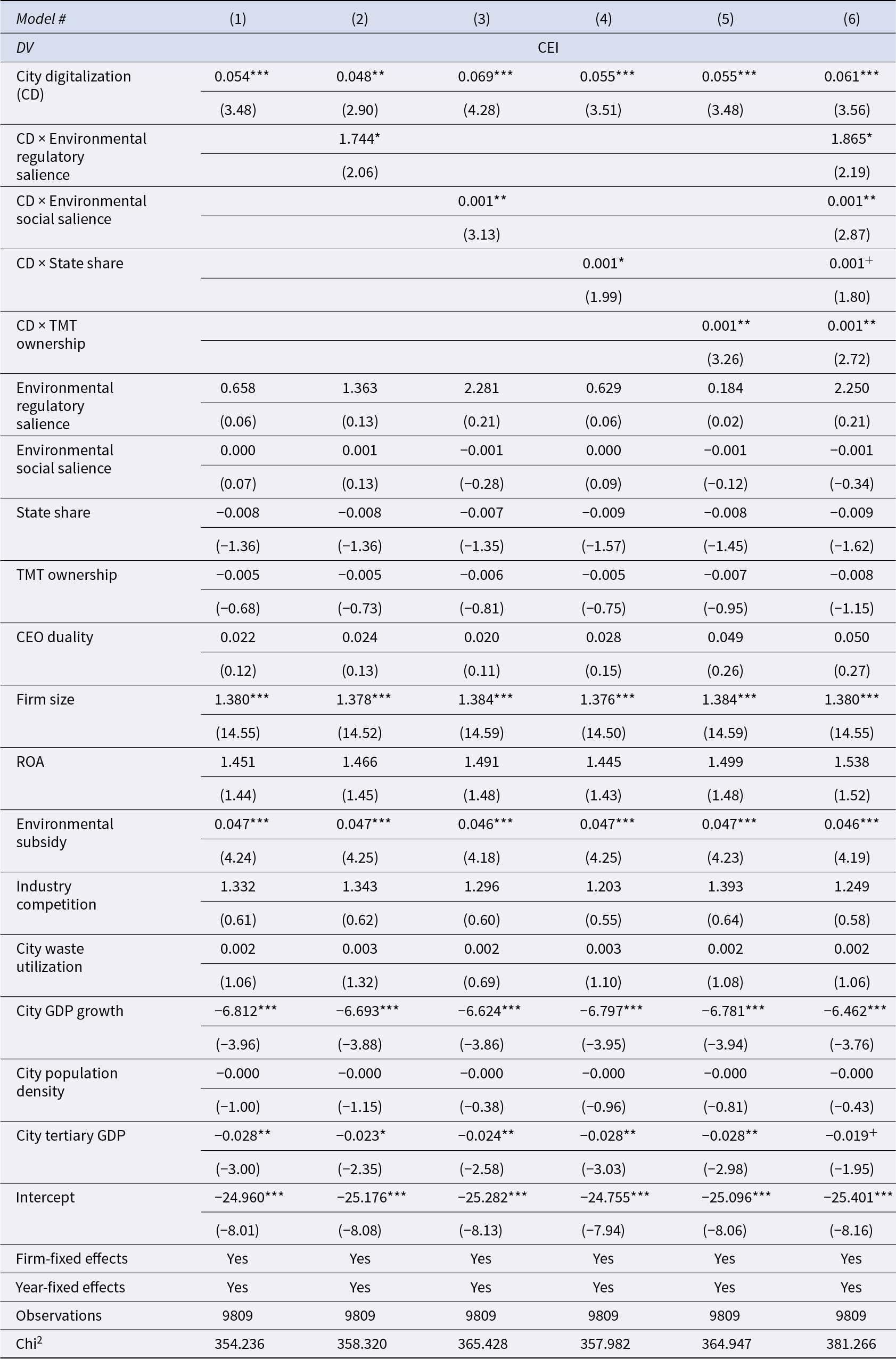
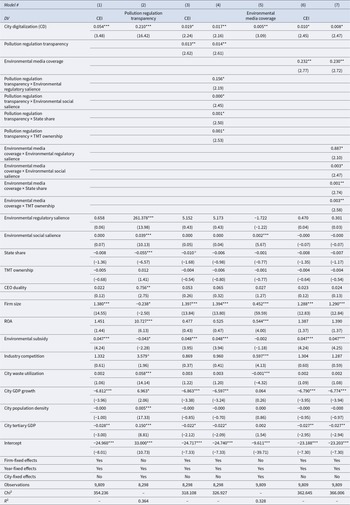
We report the coefficients of variables in multilevel random coefficient modeling analysis in Table 3. Model 1 includes independent variable, moderators, and control variables, Models 2–5 add the interaction terms in turn, and Model 6 is the full model. The values of variance inflation factors range from 1.64 to 2.43 across all models, much lower than the suggested cut-off value of 10, suggesting that multicollinearity is not a major concern in our models.
Multilevel random coefficient modeling analysis with instrumental variables: City digitalization and CEI

Table 3 Long description
The table presents a multilevel random coefficient modeling analysis examining the impact of city digitalization on the CEI, with various interaction terms and control variables. City digitalization consistently shows a significant positive effect on CEI across all models. Firm size and city GDP growth are also significant, with firm size positively and city GDP growth negatively affecting CEI. Interaction terms like city digitalization with environmental regulatory salience and TMT ownership show significant positive effects in some models. The analysis includes firm and year-fixed effects, with a consistent number of observations across models. The results suggest that city digitalization and firm characteristics play crucial roles in influencing CEI.
Notes: t statistics in parentheses. +p < 0.1, *p < 0.05, **p < 0.01, ***p < 0.001 (two-tailed).
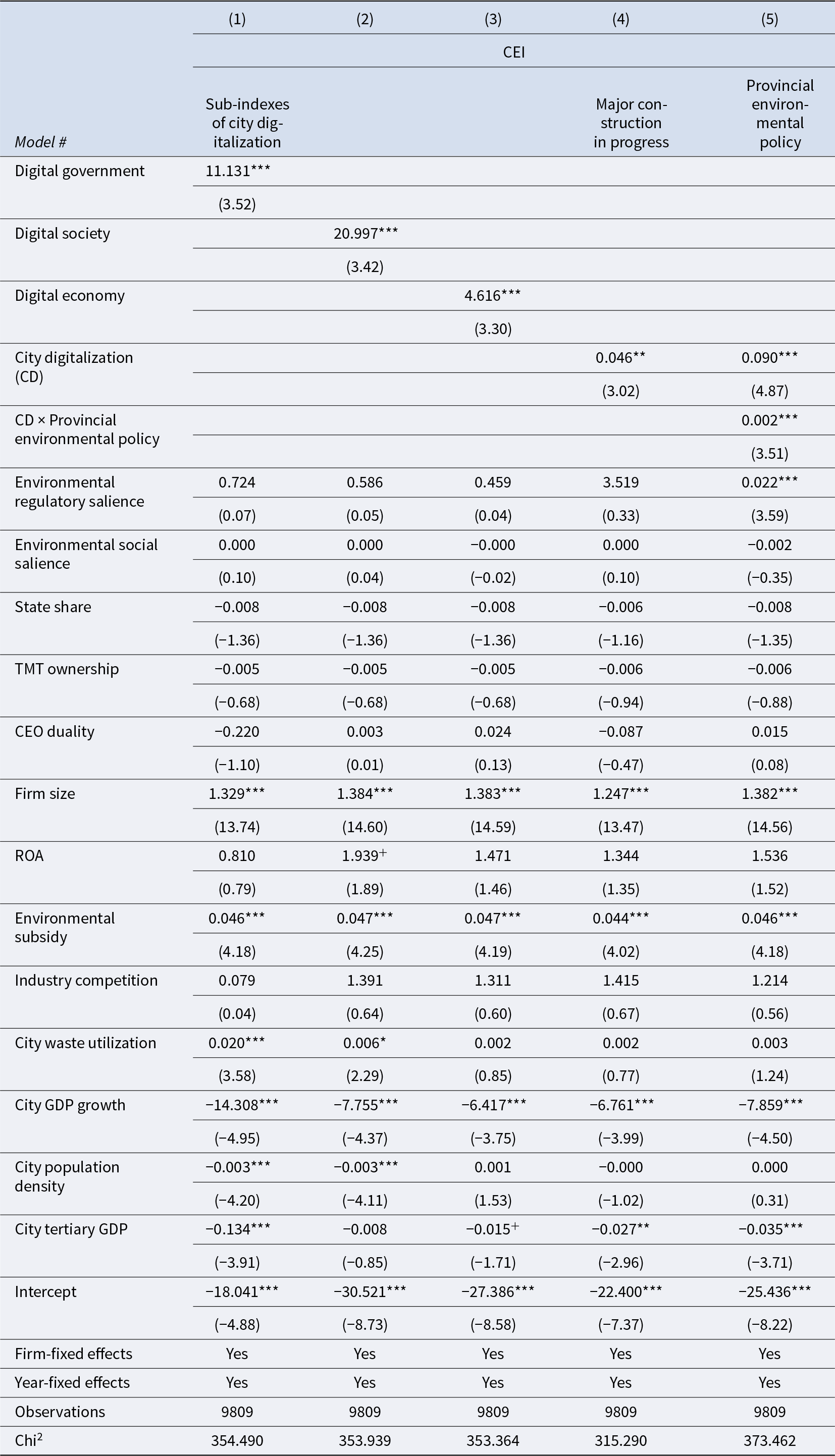
H1 predicts that city digitalization positively impacts CEI. The results of Model 1 in Table 3 show that the coefficient of city digitalization is positive and significant (b = 0.054, p < 0.001), supporting H1. We also find consistent results across Models 2–6. We calculate the effect size and find that one standard deviation (SD) increase in city digitalization leads to an increase of CEI by 36.49 million RMB.
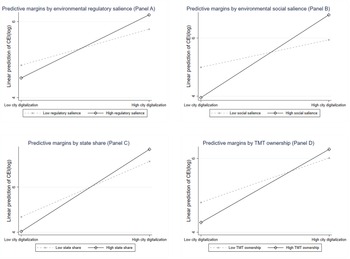
H2 predicts that the positive effect of city digitalization on CEI is stronger in cities with higher environmental regulatory salience. In line with H2, the interaction term between city digitalization and environmental regulatory salience is positive and significant (b = 1.744, p < 0.05, Model 2).Footnote 4 To facilitate the interpretation, we follow Aiken, West, and Reno (Reference Aiken, West and Reno1991) to plot the interaction effects in Figure 2. As shown in Panel A, city digitalization has a positive effect on CEI in cities with high environmental regulatory salience (i.e., Mean + 1SD) (b = 0.061, p < 0.001), while that effect becomes non-significant in cities with low environmental regulatory salience (i.e., Mean − 1SD) (b = 0.031, p > 0.1). One SD increase in city digitalization leads to 41.22 million RMB increase in CEI when environmental regulatory salience is high.
Decomposing the interaction effects

Figure 2 Long description
The image contains four graphs. Panel A shows predictive margins by environmental regulatory salience, with the x-axis labeled 'Low city digitalization' to 'High city digitalization' and the y-axis labeled 'Linear prediction of CEI'. Two lines are visible, one for low regulatory salience and one for high regulatory salience, both showing an upward trend. Panel B displays predictive margins by environmental social salience, with similar axis labels. Two lines represent low social salience and high social salience, with the high social salience line showing a steeper upward trend. Panel C illustrates predictive margins by state share, again with similar axis labels. Two lines are shown for low state share and high state share, both trending upward. Panel D presents predictive margins by TMT ownership, with similar axis labels. Two lines represent low TMT ownership and high TMT ownership, with the high TMT ownership line showing a steeper upward trend.
H3 posits that the positive impact of city digitalization on CEI is stronger in cities with higher environmental social salience. In support of H3, the interaction term between city digitalization and environmental social salience is positive and significant (b = 0.001, p < 0.01, Model 2). As shown in Figure 2, Panel B, the positive effect of city digitalization on CEI is stronger when environmental social salience is high (b = 0.105, p < 0.001) than when environmental social salience is low (b = 0.035, p < 0.05). One SD increase in city digitalization leads to 70.95 million RMB increase in CEI when environmental social salience is high and that number is 23.65 when environmental social salience is low.
H4 predicts that the positive effect of city digitalization on CEI becomes stronger when firms have higher state share. In support of H4, the interaction term between city digitalization and state share is positive and significant (b = 0.001, p < 0.05, Model 4). As indicated in Figure 2, Panel C, city digitalization has a stronger positive impact on CEI for firms with higher state share (b = 0.077, p < 0.001), compared to those with lower state share (b = 0.048, p < 0.05). As for the effect size, one SD increase in city digitalization leads to 52.03 million RMB increase in CEI when state share is high, reducing to 32.43 million RMB when state share is low.
H5 posits that the positive relationship between city digitalization and CEI is stronger for firms with higher TMT ownership. In support of H5, the interaction term between city digitalization and TMT ownership is positive and significant (b = 0.001, p < 0.01, Model 5). As shown in Figure 2, Panel D, city digitalization has a stronger positive effect on CEI when TMT ownership is high (b = 0.073, p < 0.001) than when TMT ownership is low (b = 0.044, p < 0.01). One SD increase in city digitalization leads to 49.32 million RMB increase in CEI when TMT ownership is high, compared to 29.73 million RMB when TMT ownership is low.
Mechanism Tests
We propose that city digitalization enhances the environmental governance capabilities of regulatory and social stakeholders, thereby promoting CEI. To examine the mediating mechanisms, we proxy regulatory and social governance with pollution regulation transparency and environmental media coverage respectively. We argue that city digitalization increases pollution regulation transparency by enabling real-time monitoring and public disclosure of pollution data; greater regulatory transparency, in turn, strengthens firms’ compliance through increased CEI. In parallel, city digitalization increases environmental media coverage by improving the visibility of firms’ environmental performance; expanded media coverage intensifies public scrutiny and reputational pressure, thereby increasing CEI.
We measure city-level pollution regulation transparency using the PITI, which evaluates the extent to which local governments or agencies disclose information related to pollution supervision of firms.Footnote 5 We measure firm-level environmental media coverage by the annual count of environmental-related media articles referencing each firm (Piotroski, Wong, & Zhang, Reference Piotroski, Wong and Zhang2015).Footnote 6 The mediating results, presented in Table 4, show that city digitalization is positively associated with pollution regulation transparency (b = 0.210, p < 0.001, Model 2) and environmental media coverage (b = 0.003, p < 0.01, Model 5). When each mediator is added to the model, the effect of city digitalization on CEI decreases. To further assess the mediation effect, we employ a bootstrapping approach with 500 replications (Preacher & Hayes, Reference Preacher and Hayes2008). The indirect effect of pollution regulation transparency is positive and significant (a × b = 0.003, p < 0.01; 95% confidence interval [CI]: 0.002–0.004), accounting for 13.6% of the total effect of city digitalization on CEI. Similarly, the indirect effect of environmental media coverage is positive and significant (a × b = 0.001, p < 0.01; 95% CI: 0.0005–0.0015), mediating 12.3% of the total effect. These findings indicate that city digitalization enhances environmental governance by regulatory and social stakeholders, which in turn promotes local firms’ CEI.
Mediating tests

Table 4 Long description
The table examines the effects of city digitalization on various dependent variables, including CEI, pollution regulation transparency, and environmental media coverage. City digitalization consistently shows a significant positive impact on CEI and pollution regulation transparency across models. Firm size and city GDP growth are also significant predictors, with firm size positively affecting CEI and city GDP growth negatively impacting it. Environmental media coverage is significantly influenced by city digitalization and interacts with environmental regulatory and social salience. The models include firm, year, and city-fixed effects, with varying observations and statistical significance levels. The results suggest that city digitalization plays a crucial role in enhancing environmental transparency and media coverage, with firm size and city economic factors also contributing significantly.
Notes: t statistics in parentheses. +p < 0.1, *p < 0.05, **p < 0.01, ***p < 0.001 (two-tailed).
Moreover, we test moderated mediation effects. The results show that the interactions between pollution regulation transparency/environmental media coverage and four moderators are positive and significant (Models 4 and 7). These findings indicate that regulatory and social governance capabilities have a stronger impact on CEI under conditions of high environmental regulatory or social salience, and in firms with high state share or TMT ownership.
Robustness Tests
We conduct several robustness tests and report results in Table 5. First, we use sub-indices of city digitalization to further examine its effect on CEI (Models 1–3). Results show that each sub-index (i.e., digital government, digital society, and digital economy) significantly and positively impacts CEI. Second, we adopt an alternative measure of CEI, measured using the logarithm of environmental capital expenditures under the section ‘major construction in progress’ (Model 4). Third, we test an alternative measure of environmental regulatory salience, measured as the number of environmental regulations and rules in force in a province (Luo, Wang, & Zhang, Reference Luo, Wang and Zhang2017) (Model 5). The results are highly consistent with our main analysis.
Robustness tests

Table 5 Long description
The table evaluates the impact of various factors on city digitalization and related outcomes across five models. Digital government, society, and economy show significant positive effects, with digital government having the highest impact in its model. Firm size consistently shows a strong positive effect across all models, while city GDP growth and city tertiary GDP have significant negative impacts. Environmental subsidies positively influence outcomes in all models. The interaction between city digitalization and provincial environmental policy is significant in the fifth model. Observations and fixed effects are consistent across models, ensuring robustness. The results suggest that digitalization efforts and firm characteristics play crucial roles in shaping city outcomes.
Notes: t statistics in parentheses. +p < 0.1, *p < 0.05, **p < 0.01, ***p < 0.001 (two-tailed).
Discussion
Theoretical Contributions
Our study contributes to extant literature in three ways. First, our study contributes to the stakeholder theory by highlighting the critical role of stakeholder governance capabilities in mediating the impact of city digitalization on CEI. Stakeholder theory asserts that firms need to address stakeholder interests and generate shared value to achieve long-term success (Jones, Reference Jones1995; Laplume et al., Reference Laplume, Sonpar and Litz2008). However, existing literature tends to overlook the fundamental role of stakeholder governance capabilities, without which even well-recognized and legitimate stakeholder demands often fail to influence organizational decision-making and behaviors. This limitation is particularly evident in the context of environmental management in emerging markets, where, despite the urgence and legitimacy of claims from various stakeholders, irresponsible and polluting behaviors remain prevalent (Block et al., Reference Block, Sharma and Benz2024; Ding et al., Reference Ding, Liu and Chang2023; Li & Lu, Reference Li and Lu2016). As previous studies have shown, even regulatory bodies endowed with coercive power may find environmental policies ineffective in the absence of adequate governance capabilities (Schmitz, Baum, Huett, & Kabst, Reference Schmitz, Baum, Huett and Kabst2019; Wei et al., Reference Wei, Shen, Zhou and Li2017). Addressing this gap, our study theorizes stakeholder governance capabilities as the underlying mechanisms through which city digitalization fosters local firms’ environmentally responsible practices, which is confirmed by our mediating tests.
Second, our study contributes to environmental management research by identifying regional digital development as a novel technological driver of corporate environmental responsibility. Given that firms are major sources of pollution yet often lack intrinsic motivation particularly in emerging markets, external forces are crucial for promoting corporate environmental behaviors (Ding et al., Reference Ding, Liu and Chang2023; Wang et al., Reference Wang, Wijen and Heugens2018). Previous research has investigated the influence of regulatory (e.g., laws and supportive policies), market-based (e.g., actions of competitors and supply chain partners), and ecological (e.g., pollution levels and natural resource availability) environments on such initiatives (Bu & Zhang, Reference Bu and Zhang2022; Huang & Li, Reference Huang and Li2017; Kim, Park, & Ryu, Reference Kim, Park and Ryu2017; Meng, Zeng, Xie, & Qi, Reference Meng, Zeng, Xie and Qi2016). Extending this line of research, our study adopts a technological perspective and suggests that city digitalization improves information availability and transparency, thereby enhancing stakeholder governance capabilities and, in turn, fostering corporate environmental practices. While prior research has focused on technology as an internal enabler of firms’ environmental practices and performance (Ning & Guo, Reference Ning and Guo2022; Santoalha, Consoli, & Castellacci, Reference Santoalha, Consoli and Castellacci2021; Schmitz et al., Reference Schmitz, Baum, Huett and Kabst2019), we highlight its emerging role as an external stakeholder force for addressing environmental challenges.
Third, our study enriches the digitalization literature in response to recent calls for more investigations into the social value of digital technologies (Chandy et al., Reference Chandy, Hassan and Mukherji2017; George et al., Reference George, Merrill and Schillebeeckx2021). While extant research has established the commercial value of emerging digital technologies (see a review by Hanelt et al., Reference Hanelt, Bohnsack, Marz and Antunes Marante2021), studies exploring their socio-ecological value remain limited despite increasing scholarly interest. Our study complements existing work that adopts case study (Zhang et al., Reference Zhang, Pan, Yu and Liu2022) or machine learning techniques (Chang et al., Reference Chang, Huang, Li, Bo and Kumar2021) by providing empirical evidence on how regional digital infrastructure fosters corporate environmentalism. Moreover, the digitalization literature emphasizes that the functioning of digital technologies depends on supportive environments and firm characteristics, which shape how information is utilized and translated into decision-making and execution (Jiménez et al., Reference Jiménez, Hanoteau and Barkemeyer2022; Ma & Zhu, Reference Ma and Zhu2022; Wu et al., Reference Wu, Lou and Hitt2019). In our study, environmental regulatory and social salience reflect external stakeholders’ motivation to leverage information brought by city digitalization, while state share and TMT ownership represent internal stakeholders’ motivation to respond to the digital-enhanced governance. By examining these moderating effects, our study shows the importance of environmental and firm-level complementarities in realizing the social value of digital infrastructure. Overall, our study sheds new light on the critical role of digital infrastructure in improving socioeconomic governance systems to address ‘sustainability objectives related to Tragedy of the Commons’ (Georgeet al., Reference George, Merrill and Schillebeeckx2021: 1016).
Practical Implications
Our study provides important practical implications for environmental governance in emerging markets. First, policymakers should foster the development of digital infrastructure to facilitate local firms’ environmental responsibility. For example, policymakers should implement policies that invest in and utilize digital systems across diverse sectors to foster a more transparent environment for evaluating corporate environmental impact. Policymakers could also develop digital platforms and facilitate digital connections that allow citizens to monitor and whistleblow corporate environmental misbehaviors. These measures can help regulators and the public more effectively govern corporate behaviors and thus foster CEI.
Second, governments and policymakers should enhance environmental awareness of regulators and the public, which can further enhance the positive impact of city digitalization for CEI. Policy efforts can be directed toward prioritizing environmental protection in city development agendas, enhancing the specialization of judicial in environmental cases, and improving the accountability of legal systems responsible for environmental matters. Policymakers can also establish systems and services to assist and encourage the public in accessing and sharing information on corporate environmental actions via blog and social media.
Third, our study provides managerial implications for enhancing corporate environmental responsibility. When facing the heightened environmental governance of city digitalization, firms with state share can capitalize on their access to policy support, funding, and partnerships to allocate resources toward meeting digital-enhanced environmental requirements. Meanwhile, firms could design compensation structures that align managerial interests with long-term firm value through equity-based ownership or performance-based bonuses, which can incentivize TMT to pursue environmental activities in regions with high digital development.
Limitations and Future Research Directions
Our study has several limitations that may imply avenues of future research. First, our study follows previous research to investigate CEI using an integral construct (Chang et al., Reference Chang, Li and Lu2015; Li & Lu, Reference Li and Lu2016; Zhang et al., Reference Zhang, Yu and Kong2019). However, stakeholders may have differential attitudes toward different types of CEI, for instance, pollution control vs. pollution prevention investment (Li & Ramanathan, Reference Li and Ramanathan2020), regulatory vs. voluntary environmental investment (Johnston, Reference Johnston2005). Thus, we suggest future studies to further explore how city digitalization affects different types of CEI.
Second, our study identifies environmental regulatory and social salience to reflect external stakeholders’ motivation. As regulatory and social stakeholders encompass diverse groups with varying objectives, we encourage future research to explore alternative indicators of their perceptions of environmental governance, for instance, specific targets or goals for controlling air, water, and soil pollution. Related, prior research indicates that firm features, such as foreign equity (Li & Ramanathan, Reference Li and Ramanathan2020) and employee stock ownership (Kong, Liu, Wang, & Zhu, Reference Kong, Liu, Wang and Zhu2024), affect internal stakeholders’ responses to external pressures. Thus, investigating additional boundary conditions is valuable for understanding the complementarity among digital infrastructure, stakeholder perceptions, and corporate features in promoting CEI.
Third, our study adopts a sample of Chinese listed firms in environmentally sensitive industries, which may be under stronger environmental monitoring than other sectors. Moreover, China’s rapidly growing digital economy, increasingly stringent environmental regulations, and growing public environmental awareness make it a suitable context for examining our research objectives. However, one should be cautious when generalizing our findings to other contexts. We therefore encourage future research to corroborate our framework in other economies.
Fourth, we focus on the pre-COVID-19 period to alleviate the influence of the pandemic. Given that the pandemic has fundamentally shifted the logic of business conduct from pursuing an economic order to a security one (Cui, Vertinsky, Wang, & Zhou, Reference Cui, Vertinsky, Wang and Zhou2023; Luo, Reference Luo2024; Vertinsky, Kuang, Zhou, & Cui, Reference Vertinsky, Kuang, Zhou and Cui2023), it is worthwhile to explore the digitalization-CEI link during and after the pandemic. For example, the pandemic has accelerated digital infrastructure and monitoring systems for crisis management, while also intensifying environmental regulatory and social salience for public health (Buntaine, Greenstone, He, Liu, Wang, & Zhang, Reference Buntaine, Greenstone, He, Liu, Wang and Zhang2024; Pope et al., Reference Pope, Peillex, El Ouadghiri and Gomes2024), both of which likely strengthen the impact of city digitalization on CEI. Further, the pandemic has fostered a new deglobalization logic and nationalistic protectionism (Cui et al., Reference Cui, Vertinsky, Wang and Zhou2023; Vertinsky et al., Reference Vertinsky, Kuang, Zhou and Cui2023). Accordingly, the impact of digitalization on CEI may be more pronounced for state-affiliated firms operating in strategic sectors such as smart grids and renewable energy, whereas multinational enterprises need to balance between deglobalization and environmentalism. It would be interesting to examine the heterogeneous effects of city digitalization on CEI for different types of firms.
Data availability statement
The data that support the findings of this study are available from China Stock Market & Accounting Research (CSMAR) service, Tencent Research Institute, and DataGo dataset. Restrictions apply to the availability of these data, which were used under license for this study. The data are available from the authors upon request and with permission from the above providers.
Acknowledgements
The authors thank the editors and anonymous reviewers for their helpful and constructive comments. This study was supported by a grant from HKU Faculty of Business and Economics Shenzhen Research Institutes (No. SZRI2023-TBRF-01) and the National Natural Science Foundation of China (No. 72072149).
Appendix
The first stage of 2SLS

Table A1 Long description
The table examines the influence of ICT intensity and digital patents on city digitalization, considering environmental and ownership factors. ICT intensity shows a strong positive effect on city digitalization, especially in model 3, where it interacts with environmental social salience. Digital patents consistently contribute positively across all models. Environmental regulatory and social salience significantly alter the impact of ICT intensity and digital patents in models 2 and 3. State share and TMT ownership also play roles in modifying these effects in models 4 and 5. The table includes city and year-fixed effects, with high R-squared values indicating strong model fit, particularly in models 1 and 3. Observations remain constant across models, ensuring comparability.
Notes: t statistics in parentheses. +p < 0.1, *p < 0.05, **p < 0.01, ***p < 0.001 (two-tailed).
Heterogeneous Analysis
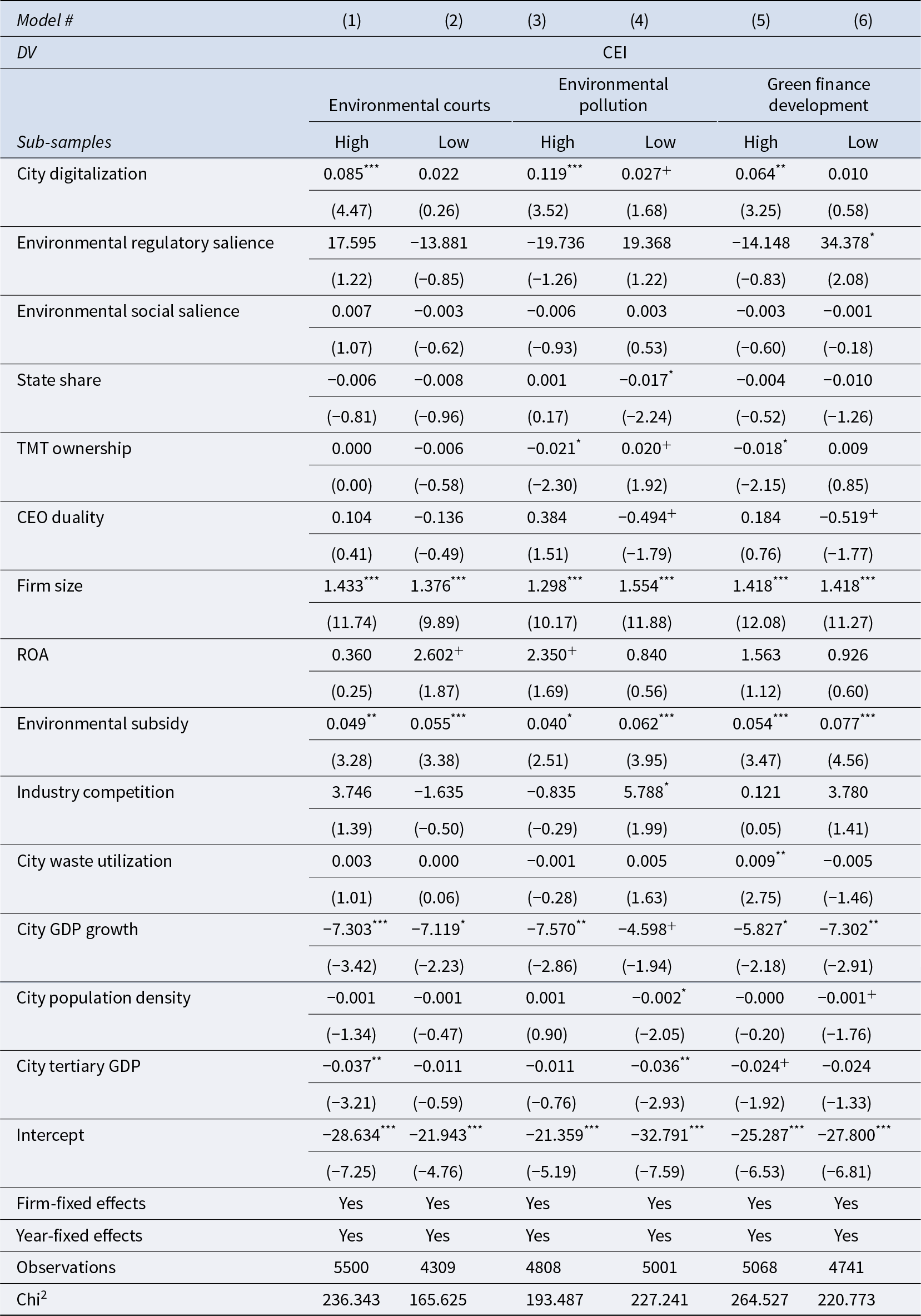
We conduct several heterogeneous analyses and report results in Table A2. We use sub-sample analysis to test whether the effect of city digitalization on CEI differs across regions with varying levels of environmental courts, environmental pollution, and green finance development. These three heterogeneous factors respectively reflect local regulatory, social, and business conditions related to environmental protection.
We measure environmental courts as the total number of intermediate and advanced environmental courts in each province of China (Zhang et al., Reference Zhang, Yu and Kong2019). Data on environmental courts are only available at the province level. Environmental courts in China can be classified into three categories: basic, intermediate, and advanced. We only focus on intermediate and advanced courts because (1) the judicial power of basic-level environmental courts is limited to local counties, in which very few listed firms register and operate; (2) it is difficult to verify the establishment year of basic-level environmental courts.
We measure environmental pollution using the average daily concentration of fine particulate matter 2.5 in the air of a city in a given year (Cho, Huang, Liu, & Yang, Reference Cho, Huang, Liu and Yang2022; Li, Massa, Zhang, & Zhang, Reference Li, Massa, Zhang and Zhang2021).
We measure green finance development using a composite index consisting of six items: green credit, green insurance, green bond, green fiscal support, green funds, and green equity (Zhang, Li, Qi, & Shao, Reference Zhang, Li, Qi and Shao2021). (1) Green credit is measured by the proportion of credit for environmental protection projects in the total credit of a city. (2) Green insurance is measured using environmental pollution liability insurance income divided by the total insurance income in a city. (3) Green bond is measured as the green bond issuance divided by the total bond issuance in a city. (4) Green fiscal support is measured by the proportion of fiscal expenditure on environmental protection in the total fiscal general budget expenditure of a city. (5) Green funds are measured using the market value of green funds divided by the total market value of all funds in a city. (6) Green equity is measured by the sum of carbon trading, energy use rights trading, and pollution emission rights trading divided by the total equity market transactions in a city. We first normalize each item into a value between 0 and 1, and then average six items to generate the mean value of green finance development.
As shown in Table A2, the positive effect of city digitalization on CEI is stronger in the subsample of high conditions (above median) than that in low conditions (below median) across all three heterogeneous factors. Our findings imply that city digitalization functions more effectively in fostering CEI in regions with stricter regulatory enforcement, stronger social awareness, and higher business norms related to environmental protection.
Heterogenous analysis

Table A2 Long description
The table analyzes the impact of various factors on environmental outcomes across different sub-samples categorized as high or low. City digitalization shows a significant positive effect on environmental courts and pollution in high sub-samples, with statistical significance at the highest level. Firm size consistently demonstrates a strong positive effect across all models, indicating its robust influence. Environmental subsidy also shows a positive impact, particularly in low sub-samples. City GDP growth generally has a negative effect, with significant results in most models. The analysis includes firm and year-fixed effects, ensuring that the results account for these variables. Observations range from 4309 to 5500 across the models, providing a comprehensive dataset for analysis.
Notes: t statistics in parentheses. +p < 0.1, *p < 0.05, **p < 0.01, ***p < 0.001 (two-tailed).
Wei Jiang (wei.jiang@xmu.edu.cn) is a professor of marketing at School of Management, Xiamen University. Her research interests focus on business ethics and strategic management in emerging economies. Her work has been published in Journal of Business Ethics, Journal of Business Research, Asia Pacific Journal of Management, International Journal of Hospitality Management, and others.
Bingkun Zhang (bk.zhang@unimelb.edu.au) is a lecturer (assistant professor) at the Faculty of Business and Economics, University of Melbourne. His research interests include non-market strategy, sustainability, human capital, and international business. His work has been published in Journal of International Business Studies, Journal of Management, Leadership Quarterly, and others.
Kevin Zheng Zhou (kevinz@hku.hk) is chair of strategy and international business and Chung Hon-Dak professor in strategy and international business at Faculty of Business and Economics, University of Hong Kong. His research interests include capabilities and innovation, trust and relational ties, and strategic issues in emerging economies. His work has been published in Administrative Science Quarterly, Academy Management Journal, Strategic Management Journal, Organization Science, Journal of International Business Studies, and others.

 Open access

