

Introduction
The disarticulation of rock art from the archaeological record and its changing environment remains a primary obstacle facing many rock art researchers across the globe, but particularly in the American Far West, and California specifically (Robinson & Sturt 2009). A schism, so to speak, exists between the archaeological record and rock art as well as 'dirt' archaeologists and rock art specialists. This is because, in California, and particularly in the rock art rich area of south-central California, rock art research has not focused on investigating archaeological deposits associated with rock art, but delved into ethnographic accounts gathered in colonial and post-colonial times and/or focused upon the images themselves. Equally most 'dirt' archaeology in the region has concentrated either on coastal plain or lacustrine areas, where rock art is scarce. The Enculturating Environments Project broadens the investigation of the rock art of the American Far West by undertaking a combined landscape and geoarchaeological approach to rock art with its associated archaeological and environmental record. Additionally, this project works within interior regions where scant archaeological research has occurred. In so doing, we are applying a suite of approaches to situate rock art within long term landscape change. Entering its fourth year, this is a sustained investigation of the prehistoric and historic enculturation of the environment of hunter-gatherers seen in rock art, land-use, material culture and social interaction.
Location
Research is taking place within south-central California on the Wind Wolves Preserve (Figure 1), the largest private non-profit landholding of its kind in the American Far West and situated within a complex terrain known as the San Emigdio Hills. Uplifted by the San Andreas and other faults, the San Emigdio Hills rise from the southern extent of the expansive San Joaquin Valley. Here, in an otherwise semi-arid landscape, a dramatic topography and tectonic history has created an 'energetic environment' of continuing landscape and land-use change on a range of different scales. Rock has variously been exposed or covered as tectonic and sedimentary regimes shift, whilst the hydrology and broader climate of the regime has oscillated between wet and dry (Figure 2). This zone of varied ecological history also contains an equally rich prehistoric and historical past. Survey has shown that the topography, hydrology, animal, plant and the human past were intertwined most tightly at specific nodes in the landscape; sites with level terraces, sandstone formations and water supply springs, ponds or flowing streams (Robinson 2007). Found at these sites are some of the most spectacular and enigmatic prehistoric works of art found on the North American continent in the form of pictographs attributed to the indigenous Chumash and Yokuts people and their predecessors (Figure 3).
Location of Wind Wolves Preserves (source: USGS).

View of sag pond and exposed rock formations from pictograph site known as Pond.

Rock art elements at Pleito.

Survey, excavation and auguring
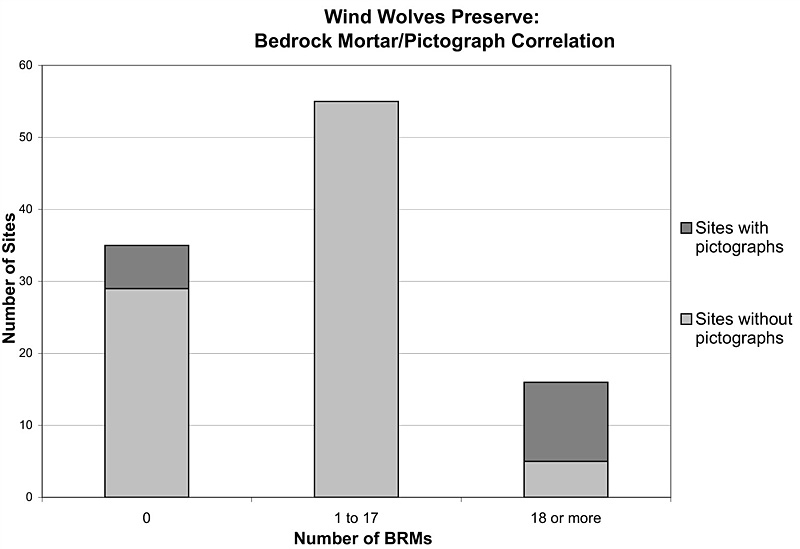
Also found at these sites are multi-component archaeological complexes, consisting of middens and numerous bedrock mortars (Figure 4). Such complexes, known as K-locales (see Jackson 1984; Robinson 2007), were vital backcountry locations for seasonal food processing and group aggregation. Previous survey (Robinson 2007) has shown that most K-locales also have pictographs present; indicating that rock art was placed at vital economic and public places. We have been excavating, augur sampling and digitally recording a number of these K-locales.
Correlations between bedrock mortars (BRMs) and pictographs on the Wind Wolves Preserve.

Excavations have targeted a variety of features and landforms, including bedrock mortar complexes and middens both near to (as in Figure 5) and removed from the pictographs themselves. At all sites excavated, abundant artefactual and faunal material has been recovered, including diagnostic material near the paintings. At the sites of Three Springs and Pond, stone bowl fragments were found in midden contexts near to or within view of the art (Figure 6: bottom). At Pinwheel Cave (Figure 6: top) projectile points, pottery fragments, historical beads and metal objects were found within the cave itself and within direct view of the pictographs, while at Los Lobos, projectile points, debitage and burnt food remains were found in Shelter A containing polychrome rockart.
1 x 1m test pit in front of rock art and BRM shelter at Three Springs.

Top) Artefacts from Pinwheel Cave; bottom) stone bowl fragment from Three Springs (photograph by Peter Style).

These assemblages clearly show a range of activities indicative of subsistence practices, including retouching of projectile points, processing of acorns and cooking and storage of foods. Equally, other finds indicate special depositional practices associated with the art; a stone with iridescent facets was found directly under the pictographs at Los Lobos Shelter B, while Pinwheel Cave was found to have fibrous materials, perhaps 'chews' of some sort, inserted into rock crevices. Chronological evidence indicates that all sites were most intensively occupied during the Late Period, and significantly that Pinwheel Cave was used during historical periods. This confirms an enduring indigenous presence in the area during colonial eras (Bernard 2008). However, there are hints of earlier occupations, especially at the site of Three Springs and perhaps Pond, but we await absolute dating to confirm. What is clear is that these well-watered locales were very important to late prehistoric populations, with rock art reflecting the ideological importance of places crucial to the economic, social and ceremonial welfare of local hunter-gatherers.
Preliminary excavations in 2009 also targeted a quarry site containing exotic blue and green mineral azurite and malachite. Experimental processing (Reeves et al. 2009) of these minerals (Figure 7) has replicated the rock art of Pleito (see Figure 3), considered to be the finest pictograph site in North America. Excavations revealed that multiple phases of quarrying took place, with other minerals also being extracted. Further work will be undertaken to date the extraction events.
Minerals from quarry site used to reproduce pictographs at Pleito (photograph by Dan Reeves).

Conclusion
Clearly, the degree of activity evidenced by the archaeological deposits at rock art K-locales demonstrates a wide range of activities and varying occupational intensities through time. Questions remain as to the nature of that occupation: were they only seasonally occupied, or were they, at times, permanent hamlets or villages? Equally important is judging the changing degree of importance these sites held throughout prehistory: did they gain importance during periods of instability and drought, and can the rock art be seen as reflecting fluctuating value of these sites in changing environments? Likewise, our research will continue to investigate how these sites were re-incorporated into indigenous lifeways during tumultuous colonial eras. Only by undertaking a long term, multi-temporal approach to the rock art and its associated archaeology will understanding the enculturation of the American Far West be improved.
Acknowledgements
We would like to thank Dan York and the Wildlands Conservancy plus the staff of the Wind Wolves Preserve, particularly Sheryl and D.C. Clendenen. Thanks also to Mathew Armstrong, Catherine Bailey, Rick Bury, Ray Corbett, Alice Clough, Kristina Gill, Mike Glassow, Gale Grasse-Sprague, John Johnson, Antoinette Padgett, Jennifer Perry, Dan Reeves, Jack Sprague, Bonnie Whitney, and Bob Yohe. Special acknowledgement to supervisors Gregory Tucker and Wendy Whitby, and warm thanks to all the students and volunteers. Funding has been provided through the Universities of Central Lancashire and Southampton plus the Cotsen Institute of Archaeology.