

Introduction
The International Union for Conservation of Nature (IUCN) guidelines state that the primary objective of national parks is “to protect natural biodiversity along with its underlying ecological structure and supporting environmental processes, and to promote education and recreation” (Dudley Reference Dudley2008, p. 16). However, these objectives could involve contradictory interests (Manning Reference Manning2002, Marion Reference Marion2016). A widespread and general rule is that the protection of natural processes requires as little anthropogenic disturbance as possible, yet park visitors want access to natural scenery and wildlife. As the number of visitors increases, so does their impact on the soil, vegetation, animals and environment of the park, and the potential for the conservation objective to be undermined increases (Newsome et al. Reference Newsome, Moore and Dowling2012, Marion et al. Reference Marion, Leung, Eagleston and Burroughs2016).
The growing number of visitors to national parks worldwide (Hawkins & Lamoureux Reference Hawkins and Lamoureux2001, Foresta Reference Foresta2013, Monz et al. Reference Monz, Pickering and Hadwen2013) and specifically in Germany (Mayer & Woltering Reference Mayer and Woltering2017; Supplementary Material S1, available online) demonstrates that national parks are popular tourist attractions. Visitors are attracted to protected areas, resulting in higher numbers of visitors therein (Cline et al. Reference Cline, Weiler and Aydin2011, Mayer & Woltering Reference Mayer and Woltering2017). Although such nature-based tourism may not be beneficial for the protection of these areas, it is financially important for some national parks (Weaver & Lawton Reference Weaver and Lawton2017), particularly when government funding is below the amount required for fulfilling conservation-related functions and obligations. In fact, in a global study of biosphere reserves, the number of park visitors was positively correlated with park budgets (Eagles Reference Eagles2003). This relationship cannot be explained by visitor-based revenue, as visitor fees are typically low or non-existent as in Germany and can only cover a small percentage of the budget needed for management (except for African national parks; Wells Reference Wells1997). A higher number of tourists being attracted to a region because of a national park increases the political standing of the park, which can be used as a lever to request more funding from the government (Eagles Reference Eagles2003). Another benefit of a high number of visitors is the regional embedding of the park in the local economy, either because local landowners receive compensation for indirect costs, such as land-use restrictions, or because of direct spending by tourists (Mayer et al. Reference Mayer, Müller, Woltering, Arnegger and Job2010, Von Ruschkowski & Mayer Reference Von Ruschkowski and Mayer2011). Such a functioning relationship between parks and people is a prerequisite for successful public participation (Jones-Walters & Çil Reference Jones-Walters and Çil2011).
The paradigm of public participation, integrated into the recommendations of the IUCN, is to “adopt mechanisms to enable representation and participation of all protected area stakeholders at national, regional and local levels” (IUCN 2003), and the planning process should “usually involve much public participation and debate at all stages” (Eagles et al. Reference Eagles, McCool and Haynes2002). Key motives underlying participatory approaches in conservation management are to allow democratic structures, to increase effectiveness through the higher support of affected stakeholders and to increase quality by increasing knowledge (Stoll-Kleemann & Welp Reference Stoll-Kleemann and Welp2008). In practice, new developments are discussed in regular meetings of park managers and stakeholders, such as local authorities, local associations (e.g., members of hiking, climbing and horse-riding clubs), representatives of local political organizations or nongovernmental organizations, foresters and tourism associations, to find consensual strategies for all interest groups.
Public participation is presented as an important element of management, planning and decision-making and seems to be positively related to managers’ subjective feeling of success in conservation areas (Stoll-Kleemann & Welp Reference Stoll-Kleemann and Welp2008). While public participation in decision-making is often seen as a promising trend (e.g., Berkes Reference Berkes2004, Jones-Walters & Çil Reference Jones-Walters and Çil2011), the number of studies critically questioning such participation in the field of conservation is growing (Rauschmayer et al. Reference Rauschmayer, van den Hove and Koetz2009, Gerner et al. Reference Gerner, Heurich, Günther and Schraml2011). One caveat is that public participation aims at a consensus among the various stakeholders; thus, it is expensive and time-consuming, particularly if decisions are controversial (Turnhout et al. Reference Turnhout, Van Bommel and Aarts2010). These authors also show that public participation could lead to unintended adverse effects if some groups are excluded or if communication with stakeholders is unprofessional (Turnhout et al. Reference Turnhout, Van Bommel and Aarts2010). Moreover, interest groups could steer management towards their own (economic) interests and away from conservation objectives, even in the face of declining biodiversity (Fischer Reference Fischer2008). As a consequence, it remains a complex challenge for national park managers to balance partially opposing objectives.
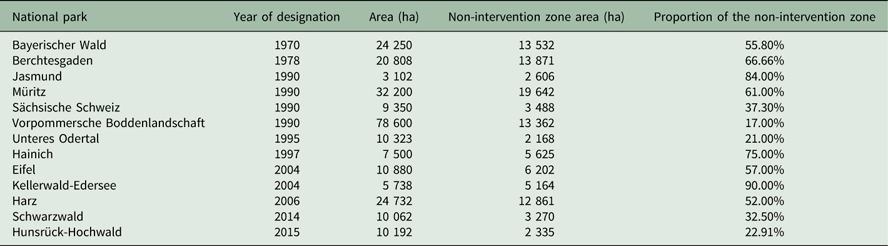
In Germany, the first national park was designated in 1970 with a focus on nature conservation and guided by the concept of ‘let nature take its own course’. Given Germany’s high population density (230 humans km–2) and long history of land use, its national parks were inevitably placed in areas where ecosystem properties had been altered considerably relative to natural conditions. These areas and their surroundings have been used for centuries by local residents (e.g., for hunting, fishing and recreational activities; Mayer & Woltering Reference Mayer and Woltering2017). Most of the German national parks are still in a development phase due to their short history (Table 1). The designation of many parks was often politically motivated to promote regional development in peripheral regions (Mayer et al. Reference Mayer, Müller, Woltering, Arnegger and Job2010). In their early days, the restrictions that usually accompany the designation of conservation areas were imposed from the top down, and these restrictions often conflicted with local traditions and personal liberties, which resulted in strong and lasting opposition to protected areas (Stoll-Kleemann Reference Stoll-Kleemann2001). The acknowledgement of this problem in the past by managers and politicians contributed to a shift from largely conservation-orientated management to management with public participation. The increased acceptance of the national parks by residents since then has been attributed to the intense and well-organized cooperation with local stakeholders (Hoffmann & Wied Reference Hoffmann and Wied2013).
Overview of all German terrestrial national parks in the order of the year of their designation. Data on area and the proportion of the non-intervention zone were taken from Hoffmann and Wied (Reference Hoffmann and Wied2013)
The German Federal Nature Conservation Act (Bundesnaturschutzgesetz, §24 Abs 2) requires that national parks not only protect natural processes, but also enable scientific research, education and public encounters with nature, as long as these do not affect the protection of nature. German national parks follow international requirements (EU Habitats Directive, EU Birds Directive and IUCN Guidelines), national laws, federal state laws, additional regulations, national park acts and internal park regulations adopted by the government of the respective federal state. Owing to the federal system in Germany, the organization and objectives of the parks in Germany differ among the states. Only a few national park administrations possess all the required authority to operate independently; many park decisions are subject to approval by private landowners (regarding their property) and other authorities, including those for conservation, forestry and hunting. This often leads to a high organizational burden and delays in implementation (Hoffmann & Wied Reference Hoffmann and Wied2013, see Supplementary Material S1 for more details).
This study aims to evaluate how national parks in Germany deal with their dual mission of conservation and recreation, given the current imperative of public participation and an increasing number of visitors that expect high-quality experiences in a natural area (Mayer & Woltering Reference Mayer and Woltering2017). The range of management activities in a national park are diverse. We concentrated on management strategies for responding to the growing demand for recreational activities (i.e., on ‘visitor management’; Weaver & Lawton Reference Weaver and Lawton2017). Visitor management requires negotiation with stakeholders whose objectives differ and might conflict with conservation objectives. Recreationists and tourists demand high-quality nature experiences in national parks, local communities and tourism-associated commerce want to increase the number of visitors and some local residents expect no changes in their habits, traditions and liberties.
We addressed the following main questions: (1) Do the national parks respond to the growing demands of recreational activities and, if so, how? (2) Which of the two objectives – nature conservation or recreation – has the highest priority when management strategies are implemented in reality? (3) How do stakeholders, with their different views and interests, affect management decisions in national parks (i.e., does participation lead to a shift in focus from conservation to park services)? (4) What are the challenges faced by national park managers?
Methods
One, two or three executive staff members of visitor management at each of the 13 terrestrial national parks (Table 1) filled out an online questionnaire between May and July 2017 (Supplementary Material S2). We received a total of 15 completed questionnaires (Supplementary Material S3). Responses from employees of the same park were averaged, and one response was received from two parks managed by the same administration (Vorpommersche Boddenlandschaft and Jasmund). This resulted in 12 responses, which were visualized using descriptive statistics, such as bar plots and box plots. The first part of the questionnaire asked about general information on the park. The second part covered the perception of usefulness of guidelines and regulations, in general and in particular. In the third part, the participants were asked about current management strategies to control or attenuate the impacts of visitors to the park. As we were particularly interested in the priority of conservation in visitor management, questions were motivated by general recommendations for strategies and tactics for visitor management published by the IUCN (Eagles et al. Reference Eagles, McCool and Haynes2002). The fourth part of the questionnaire covered the decision-making process in practice, such as the number of people involved in making decisions and the timing of planning and implementation of management measures. Furthermore, we asked about the relevance of possible influencing factors during the planning process. Finally, we asked about the setting of priorities, specifically about targets (e.g., minimization of intervention, species protection and recreation) summarized and aggregated from current guidelines (e.g., IUCN; Eagles et al. Reference Eagles, McCool and Haynes2002, Dudley Reference Dudley2008), EUROPARC (Hoffmann & Wied Reference Hoffmann and Wied2013) and management plans of different national parks. We also asked about possible target conflicts. We telephoned those managers who answered the questionnaires and conducted a semi-structured (qualitative) 30–60-minute interview. In one case, the manager was not available, and so we interviewed a different employee. We interviewed 16 people. The purpose of the interviews was to better understand the answers given in the questionnaire and to gain insight into the challenges and obstacles associated with visitor management in national parks. Each interviewee was first asked to respond to points in the questionnaire that were not answered, if any, and then to elaborate on any responses that strongly deviated from responses received from the other parks in order to understand any unique circumstances of that park. We then asked for a description of a past management process that followed the typical process of decision-making (Peterson et al., Reference Peterson, Cumming and Carpenter2003), namely detection and definition of the problem, information and data collection, development and prioritization of options, selection of the best option and implementation of the selected option. In this way, we aimed at understanding the decision-making process and the associated hurdles. The interviews continued with the question ‘What do you think are the most problematic issues during the management process?’, which gave the interviewee the opportunity to speak freely about any relevant issues. We avoided using leading questions. We ended the interview by asking the interviewee whether he or she agreed with the statement that public participation leads to shifts away from nature conservation towards providing services for the stakeholders.
Results
Do the National Parks Respond to the Growing Demand of Recreational Activities and, If So, How?
Eleven (of twelve) participants answered the question of whether the park wanted to maintain, increase or reduce the number of visitors; five (46%) wanted to maintain the current number of visitors, five (46%) wanted to increase tourism and one wanted to reduce tourism (not shown). Most of the interviewees stated that they found it difficult to provide a specific answer to the general intention of the park concerning increases in visitor numbers because of diffuse outside pressure (e.g., politics, tourism) to attract more visitors. In some parks, the management had no unanimous opinion on this issue. For example, in one park, some members of the administration preferred management actions that increase visitor numbers, whereas others emphasized the negative impact of increasing recreational use because the infrastructure was not designed to cope with intensive use. According to the responses on the questionnaire, the national parks were not limiting the numbers of visitors in general or specifically when the number of visitors was too great, and they were not limiting the length of stay or the group size (Fig. 1(a)). The parks rarely encouraged visitation during times outside of the peak season. The number of park visitors was considerably greater in summer than during the rest of the year, but only one park organized two theme weeks to attract visitors off-season, on the distinctive whooper swan (Cygnus cygnus) and common crane (Grus grus). One park was considering closing the park between dusk and dawn.
Responses of national park managers regarding strategies for general use control (a) and visitor control in sensitive areas (b). The respondents were asked whether they implement or are planning to implement the management tools listed.

While the number of visitors was in general not being monitored (Fig. 1(a)), park management often focused on limiting access to sensitive areas (Fig. 1(b)). In four parks, visitors were encouraged to use other areas within the parks. The majority of the national parks (75%) used brochures or boards to inform visitors about problem areas and to suggest alternative areas to visit. In 58% of the parks, visitors were diverted along marked routes away from particularly sensitive areas; 75% of the parks implemented local or temporary limits to access if endangered species were settling or for security reasons; and in four parks, the number of visitors in problem areas was limited. Seven parks (58%) made the access to sensitive areas difficult. Only two parks (17%) used a ticket system to restrict the number of visitors and their length of stay in a specific area, namely when cranes were resting during migration. However, the route plan in most of the parks had not changed since the parks’ founding because of the difficulty in reaching agreement among all stakeholders involved (e.g., hiking clubs, forestry workers, local residents and landowners). Of nine responders, six felt that making a decision took too long, two did not and one abstained. In the interviews, managers explained that the length of time needed usually depended on the problem, and a lengthy decision-making process was also attributed to limited personnel and financial resources. One interviewee stated, “It is also a question of resources. We just can’t provide everything instantly if we want to avoid a burn-out.” Another manager said, “The time needed for making a decision always depends on the decisiveness of each person and whether he or she just works by the book.”
Three managers from three different parks were infuriated by egoistical visitors. One manager stated, “The problem is the egoists. They take what they want. […] Their interests are the centre of focus, and rules are not followed.” Another manager stated that “for some people, individual self-realization and personal liberty have a higher priority than conservation.” The number of rangers employed by the parks to ensure that visitors follow the rules are often perceived as being too low to appropriately monitor the entire area. For example, one manager reported that, in his park, rangers are occupied with regulating traffic on the parking lot.
Which of the Two Objectives – Nature Conservation or Recreation – Has the Highest Priority When Management Strategies Are Implemented in Reality?
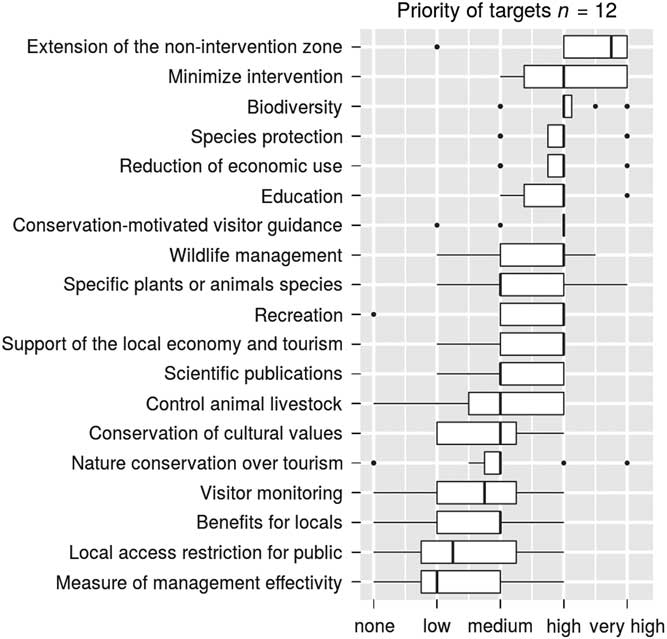
Conservation seemed to have the highest priority (Fig. 2). In particular, the targets of extension of the non-intervention zone and minimization of interventions ranked highest, followed by other targets of high priority, namely maintenance of biodiversity, species protection, reduction of economic use, education and conservation-related visitor guidance. Wildlife management, specific plant or animal species, recreation, support of the local economy and tourism had medium to high priority. Scientific research, control of animal livestock, conservation of cultural values and placing nature conservation over tourism received medium priority on average. Visitor monitoring, benefits for locals, local public access restriction and measurement of the management effectiveness were of low to medium priority.
Responses of national park managers asked to judge the priority of management targets based on guidelines, such as those of International Union for Conservation of Nature (Eagles et al. Reference Eagles, McCool and Haynes2002, Dudley Reference Dudley2008), EUROPARC (Hoffmann & Wied Reference Hoffmann and Wied2013) and management plans of the national parks.
In the interviews, the park employees stated that, in practice, the implementation of conservation-related targets and intentions often failed because of conflicts between different departments of the park management and between stakeholder groups. One interviewee stated, “Often compromises with stakeholders are not based on a factual level, but on the person who can speak the best and has the most political power.” Consequently, in practice, conservation often received a lower priority than had been stated and desired by the managers of the national park. Another interviewee reported a very good relationship with almost all stakeholders and that meetings were less worrying than in earlier days because of “mutual acceptance” and because the participants “know each other already and know what is possible to get through.” However, the interviewee admitted that the original targets had had to be softened to avoid jeopardizing the good relationships that had been established with the stakeholders.
How Do Stakeholders, with Their Different Views and Interests, Affect Management Decisions of National Parks (i.e., Does Participation Lead to a Shift in Focus from Conservation to Park Services)?
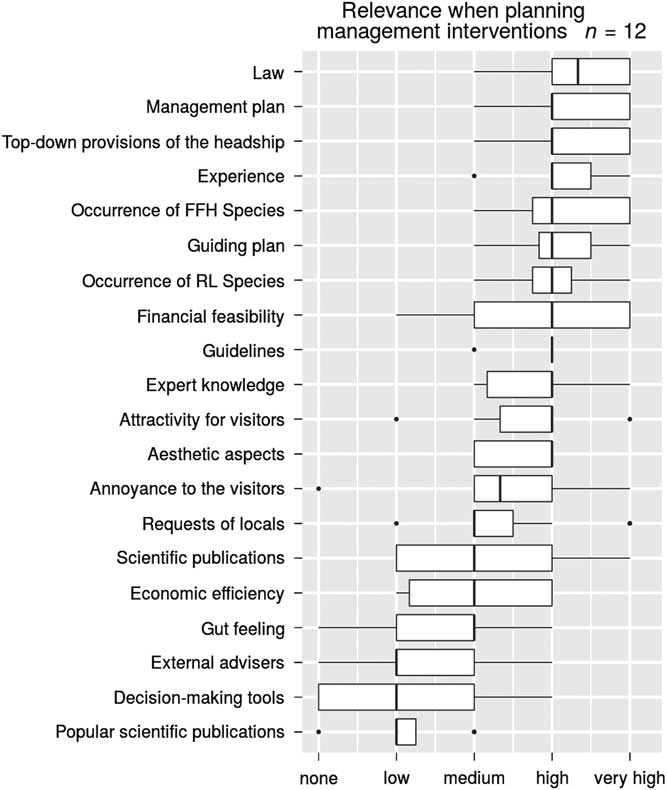
According to the responses to the questionnaire, laws, management plans, guiding plans and guidelines had higher relevance than attractiveness for visitors and requests from locals when planning management interventions (Fig. 3). However, during the interviews, the managers revealed different strategies for dealing with pressure from interest groups. One representative of a park administration asserted that “we are a national park, and they have to accept some degree of restrictions,” but this attitude was the exception. The majority of managers commonly took the view summarized by one interviewee: “We want to include the local people in all our decision-making to increase the acceptance of the national park.” In many parks, the administration still spent much time communicating intensely with opposing groups. Conflicts with these groups were park specific and usually related to the history of the park. For some parks, local residents complained about damage caused by wildlife in the park surroundings; for other parks, traditional hiking clubs, forest workers, fishermen and other locals did not want to change old habits and demanded a dense forest road network for hiking, working and access to firewood, for example. However, the interviewees confirmed that meetings were a prerequisite for successful continuation of the parks. It was the rule that final decisions were compromises among the different interest groups. According to the experiences of the interviewees, political strength and self-interest often had more assertiveness than conservation-related arguments, as stated above. A manager reported instances when “politics forced them” to develop buildings and infrastructure that entailed a considerable increase in visitor numbers in areas that were supposed to be better protected. He said, “Despite strict regulations, nature conservation has a lower importance than tourism.” One manager counted about 40 stakeholder groups with which they had to negotiate, and stated, “The more people involved, the more interests we have, and the more extreme attitudes are represented. Egoism skews the discussions. The broader the basis, the wider the spectrum of opinions.” Examples of undesired consequences in terms of ecological conservation were the high densities of park trails (especially in winter for cross-country skiing), the strong impact of the management of wildlife (strong regulations and feeding stations to keep the animals in the park), the strict control of bark beetle spreading towards adjacent areas, expansion of parking lots and infrastructure in the park, rangers representing their park at tourism fairs and park managers spending more time preparing for negotiations than for conservation-related problems.
Responses of national park managers asked to judge the relevance of different regulations and specifications when planning management interventions in reality. FFH Species are species that are the focus of special conservation measures declared in the EU Habitats Directive (Council Directive 92/43/EEC on the Conservation of natural habitats and of wild fauna and flora). RL Species are species that are listed in the International Union for Conservation of Nature Red List of Threatened Species. FFH=Flora–Fauna–Habitat; RL=Red List.
The vast majority of managers agreed that public participation leads to shifts away from nature conservation towards providing services for the stakeholders (12 agreed, 2 disagreed and 2 did not want to make a judgement). One manager who disagreed stated, “Finding a compromise entails balancing the various interests without losing sight of the goal of conservation. It is like finding a balance for the general public as a whole in a pluralistic society. […] Environmental protection should not be realized at the expense of local residents.”
What Are the Challenges Faced by National Park Managers?
The majority of the park representatives were supportive of and interested in our research project, and three strongly advocated improvement in the scientific basis of visitor management. In particular, five managers stressed the lack of scientific studies on the impact of recreational activities (specifically hiking and bicycling) on animal behaviour, such as that of ungulates; they explained that there were no simple answers to questions asked by visitors about recognizing when animals feel threatened by visitors. One manager admitted, “Ultimately, there is just no time for preparing arguments.” Another manager pointed out that if guidelines change (e.g., to increase the number of visitors), the parks did not have any scientific arguments against this. For example, the administration of one national park with a high density of forestry roads said they would like to remove some of these roads, but that they could not support their stand against the opinions of foresters without scientific evidence that the roads disturb animals. A representative of a new national park had specific questions, such as whether a highway dissecting the park with high levels of constant traffic was more or less disturbing than numerous trails with infrequent disturbances. Two interviewees indicated that not only were scientific publications needed, but also exchanges of experiences between the various national parks (e.g., in workshops). They also felt that electronic data-processing tools or practical guides would be very helpful for evaluating different management interventions.
Discussion
Our results revealed that national parks in Germany seem to be poorly prepared to respond to further increases in numbers of nature tourists, which, while not based on formal monitoring, are anticipated by park administrations. Park management has not planned for the regulation of increasing pressure on the ecosystem to keep it compatible with conservation for the following four reasons. First, management strategies neglect controlling visitor numbers in general (Fig. 1). A forthcoming adaptation is unlikely due to the unwieldy nature of the national park decision-making system. Second, structural rigidity thwarts swift and adaptive action because of a shortage of personnel, sensitive financial dependencies and a requirement to follow official channels, as many parks lack the necessary authority. Third, the mandatory public participation in German national parks leads to a shift in focus from conservation to service provision. Fourth, managers are uncertain about the consequences of recreational activities on wildlife.
In practice, we found that it is imperative that park administrations involve stakeholders in decision-making processes, despite limited empirical support of its usefulness (Layzer Reference Layzer2008, Susskind et al. Reference Susskind, Camacho and Schenk2012). We found that parks are forced to find arguments beyond conservation to increase acceptance and appreciation by all stakeholders. This problem is inherent to national parks, which have experienced strong opposition to the associated restrictions in many countries (Pretty & Pimbert Reference Pretty and Pimbert1995).
The political pressure to provide concessions to opposing stakeholders often leads to economic expectations of both local residents and regional tourist organizations (Mayer et al. Reference Mayer, Müller, Woltering, Arnegger and Job2010). As a consequence, acceptance is ensured if the number of visitors increases, because they generate both direct and indirect economic benefits for the area, as regularly reported in evaluations of the economics of conservation areas (Wells Reference Wells1997, Cline et al. Reference Cline, Weiler and Aydin2011, Woltering Reference Woltering2012).
These utility-orientated views on conservation areas can distract from the actual objective of conservation and could lead to the attitude that national parks are service providers in terms of economic use and recreational activities. In fact, many representatives of the park management interviewed in this study complained about the increasing egoism of individuals or interest groups who are interested only in their own satisfaction and not in the consequences of their behaviour for the environment. Research has aimed at finding the triggers of the behaviour of individuals that lead to possible solutions to such a ‘social dilemma’ (West & Brechin Reference West and Brechin1991), as well as in the context of nature conservation (De Dominicis et al. Reference De Dominicis, Schultz and Bonaiuto2017). Studies evaluating the effectiveness of strategies to motivate collective environmental behaviour have found that focusing on merely financial and extrinsic motives does not successfully change behaviours in the long run (Evans et al. Reference Evans, Maio, Corner, Hodgetts, Ahmed and Hahn2013) and might even have negative consequences, as individuals are prone to behave more selfishly if monetary benefits are salient (Vohs et al. Reference Vohs, Mead and Goode2006). It has instead been proposed that self-enhancing messages should be emphasized more strongly to promote pro-environmental behaviour for both egoistic and altruistic individuals (De Dominicis et al. Reference De Dominicis, Schultz and Bonaiuto2017). Self-enhancing messages appeal to self-interest and should highlight the personal benefits of individuals engaging in pro-environmental behaviour, such as the slogans ‘Save your globe, save yourself’ and ‘Save forests and stay healthy’.
Self-enhancing communications of national parks could more strongly convey their primary legal mandate to protect species and natural processes in large-scale territories of unique and magnificent landscapes; this has been neglected in the past (Hoffmann & Wied Reference Hoffmann and Wied2013). As national parks and the tourism sector already cooperate successfully, they could together develop advertising slogans for national parks to encourage visitors and stakeholders to engage in pro-environmental behaviour (De Dominicis et al. Reference De Dominicis, Schultz and Bonaiuto2017). Enhancing public awareness of the objectives of the national parks also needs the support of municipal and governmental officials, who have the legal mandate to show a strong and clear commitment to environmental protection and who should place a greater emphasis on long-term sustainability of conservation areas than on short-sighted economic interests (Layzer Reference Layzer2008).
The designation of national parks to protect the most valuable ecosystems of a nation is accompanied by rules, regulations and laws, which are sources of local conflicts with stakeholders (Stoll-Kleemann Reference Stoll-Kleemann2001). Differences are currently ironed out through the participation of various local interest groups in decision-making and planning processes. Our finding that public participation leads to a shift from conservation to providing services has also been found elsewhere in Europe (e.g., Finland (Puhakka & Saarinen Reference Puhakka and Saarinen2013) and Poland (Niedziałkowski et al. Reference Niedziałkowski, Paavola and Jędrzejewska2012)). Negotiation processes are challenging because park managers are faced with a great variety of stakeholders, all of whom want their views and values to be acknowledged (Gutiérrez et al. Reference Gutiérrez, Wood, Redpath and Young2016). Disagreements over conservation objectives could lead to destructive conflicts if managers poorly respond to the concerns raised (Gerner et al. Reference Gerner, Heurich, Günther and Schraml2011, Redpath et al. Reference Redpath, Young, Evely, Adams, Sutherland and Whitehouse2013). Similarly, caving in to all local stakeholders’ sensitivities and claims may thwart the national aspiration of ecosystem protection.
Therefore, we agree with Gutiérrez et al. (Reference Gutiérrez, Wood, Redpath and Young2016) that park managers need to be trained in conflict management in adversarial systems or to make use of available management tools to avoid conflicts (Young et al. Reference Young, Thompson, Moore, MacGugan, Watt and Redpath2016). Furthermore, we propose that national park managers regularly meet at conferences or workshops to come up with systematic ecological and social approaches to conflicts.
The acceptance of the conservation area is a prerequisite for the successful maintenance of a national park (Mose & Weixlbaumer Reference Mose and Weixlbaumer2007), which in our opinion has been achieved through concessions and deviations from the conservation objective. We hypothesize that one reason for this shift is that arguments supporting conservation are far weaker than arguments of opposing interests because of insufficient knowledge, as stated by some managers. The perceived lack of knowledge about the effects of recreation on wildlife might be due to hampered access to scientific studies or to a lack of time for reading recent scientific research literature. In fact, scientific publications have a low priority during the planning of management interventions (Fig. 3). However, there are strong statements against increasing unregulated recreational activities; for example, recreational activities reduce reproductive success, alter spatial or temporal habitat use, lead to declines in abundance, occupancy or density and increase physiological stress (reviewed in Larson et al. Reference Larson, Reed, Merenlender and Crooks2016).
To minimize the negative impacts of recreation and inspired by the idea of sustainable tourism, researchers have aimed at determining the number of visitors that can be accommodated by an area (protected or not) and defined the concept of carrying capacity in tourism (McCool & Lime Reference McCool and Lime2001). However, an exact carrying capacity value is difficult to determine because of both the unclear definition of ‘limits of acceptable change’ (Manning Reference Manning2002) and additional factors that influence the severity of impact (Marion Reference Marion2016). Since the type and severity of the impact on the environment is dependent not only on the intensity but also on the type and timing of recreational use, as well as on the environment itself (Monz et al. Reference Monz, Pickering and Hadwen2013), limiting the number of visitors could be one approach, but a modification of visitor behaviour, redistribution of visitor use, improved infrastructure and restoration measures could be alternative strategies to mitigate undesirable impacts (Marion Reference Marion2016). Similarly, the use of ecosystem services is not harmful for an ecosystem per se, as long as the maintenance and/or restoration of the ecological processes are considered simultaneously (Beltrame et al. Reference Beltrame, Cohen-Shacham, Trouillet and Guillet2013). Consequently, a higher priority of recreation objectives does not necessarily mean that conservation objectives will not be achieved. Guidelines that list such targets often do not provide precise definitions, which leads to an understanding of a common idea among people, but one that differs in nuances, particularly between regions and between different types of parks with their specific problems. This was obvious from the interviews and from the divergent answers given that pertained to similar or related targets, such as ‘biodiversity’, ‘species protection’ and ‘specific plant or animal species’.
Rules of thumb are difficult to assess in nature, as ecosystems are too complex and local communities are too heterogeneous to generalize the findings of one specific study area to universal policies (Ginzburg & Jensen Reference Ginzburg and Jensen2004). However, evidence-based conservation should receive greater recognition in the management of national parks, and the cooperation of the parks with scientific research institutes should increase (Adams & Sandbrook Reference Adams and Sandbrook2013). National parks need sufficient, well-trained personnel and monetary resources to increase monitoring of visitors and wildlife in the park, to intensify collaborations with scientific institutions in order to implement research, to publish results and to promote mutual exchange among protected areas. The ultimate goal is to find an appropriate balance between biodiversity conservation and recreational activities, where the participation of local communities and relevant stakeholders facilitates the implementation of this goal.
Supplementary Material
For supplementary material accompanying this paper, visit www.cambridge.org/core/journals/environmental-conservation
Supplementary material can be found online at http://dx.doi.org/10.1017/S0376892918000310
Acknowledgements
We are grateful to the management sections of all terrestrial national parks in Germany for their cooperation. We thank Karen A. Brune for language revision and two anonymous reviewers for constructive comments on the manuscript.
Financial Support
We are grateful to the German Federal Environmental Foundation (Deutsche Bundesstiftung Umwelt) for supporting the project ‘Optimierung von Naturschutzleistungen und der Erholungsnutzung in Großschutzgebieten zur Entscheidungsunterstützung für das Schutzgebietsmanagement’ (AZ 33059/01).
Conflict of Interest
MH is an employee of the Bavarian Forest National Park.
Ethical Standards
None.



