1 Introduction
Publishing is the indispensable intervening event by which writers and readers are brought into relation with each other. It is the linchpin that makes feminist literary criticism as it currently stands simultaneously possible and problematic.
Ann Quin had strong feelings about publishing. The British novelist published four innovative novels between 1964 and 1972 in the UK with the publishing firm Calder and Boyars, run by John Calder and Marion Boyars, which was cementing during this period its reputation as the champion of experimental, challenging fiction. While many before and since have lauded the firm for its ‘defence of literature’, Quin took another position.Footnote 2 In 1966, soon after the publication of her second novel, Three, Quin wrote to Marion Boyars. The letter followed a fractious correspondence over several months about money, but here Quin rages against what she felt was their more general treatment of her. ‘I am sick & tired’, she writes, ‘of being treated like a 10 yr. old – i.e. as if you & John own me’. She has found a literary agent, she writes, as she ‘can no longer cope with the topsy turvey “business” side of writing’. She ends the letter: ‘I guess you feel I ought to feel obliged/privileged for your having published my writing and hence the “talking down to”. Well enough. No more.’Footnote 3 Five years later, following a breakdown, Quin wrote to her friend Larry Goodell and his family. Here she goes even further; an agent is no longer enough to protect the writer from publishers. Writers need to publish themselves:
I burnt all my mss thank God. I have dropped out of working – swept literally all papers & files off the desk at Calders & spat in one of the director’s face. I’m sick to death (& that’s a truth!) of the publisher/lit scene – & can only see the obvious [sic] of people writing / collaborating / printing / publishing their own thing.Footnote 4
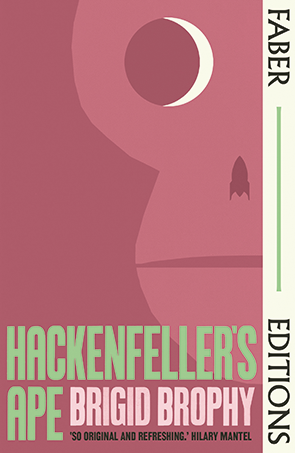
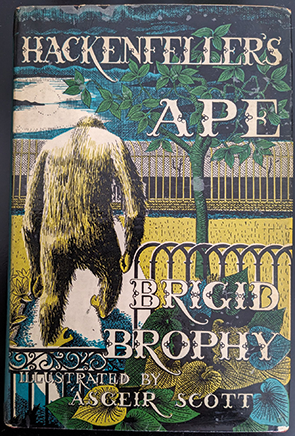
Quin died at the age of thirty-seven in 1973 without becoming her own publisher. Between then and the second decade of the twenty-first century, her work virtually disappeared, ignored by most readers and by feminist literary criticism.Footnote 5 Over the last ten years or so, however, Quin’s novels, along with those by other British women writers from the period, such as Anna Kavan (1901–1968), Brigid Brophy (1929–1995), Christine Brooke-Rose (1923–2012) and Penelope Shuttle (1947–), have returned with a vengeance. They have reappeared in new editions in bookshops and have been the subject of academic conferences, articles, journal special issues and monographs, of newspaper articles, podcasts and radio programmes. This return of and to Quin and other postwar women writers has neither, though, recovered Quin’s critique of publishing nor challenged the description of the publishers who published them as ‘defenders’ of literature. There has been no feminist literary critical return to publishing in the literary critical return to these writers. In early 2024, for example, in The Times Literary Supplement, Joe Darlington reviewed new academic monographs on both Quin and KavanFootnote 6 – both the first on each writer – alongside a reissuing of Brigid Brophy’s novel Hackenfeller’s Ape, first published in 1953, in the Faber Editions series. The article praises the monographs, respectively, for placing Kavan’s work in its ‘sociohistorical context’ and for the creation of a nuanced relation between Quin’s life and work. ‘By engaging directly with Quin’s life’, Darlington concludes, Nonia Williams’ book ‘satisfies the reader’s desire to explain the books’. In reviewing the new edition of Brophy’s novel, however, Darlington’s focus is on today, the moment of republication. He concludes that ‘[a]lthough many of Brigid Brophy’s beliefs are no longer outsider positions, there remains much in this novel to challenge us’.Footnote 7 Darlington’s approach to the monographs on the one hand and the novel on the other is not anomalous or odd; it makes perfect sense. Academic literary critical work looks back to the past, to the moment of original publication, in its reading of a novel’s meaning and significance; newly published novels, even if they are a republishing, are about us now. But that perfect sense obscures a lacuna in the review and in the understanding of the resurgence of interest in postwar experimental writing by women more generally. Feminist literary critical investigations of these novels at the moment they were written and first published are intimately linked to the republishing of those novels now – that’s why they are reviewed together – but the former is so rarely about the latter. The republishing means that we can find these novels more easily, that we can teach them, and that our work resonates in strong ways with the interests of contemporary literary culture, but so far there has been little investigation of why and how these novels have been returned in the form of new editions, what that return might mean about how they are understood and interpreted, or of what methods or frameworks should be used to carry out these investigations. Unlike Quin, we have so far not considered publishing as an element of the histories and current status of these novelists.
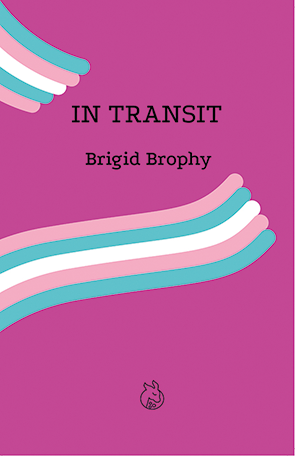
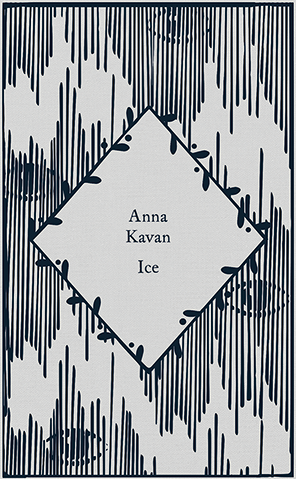
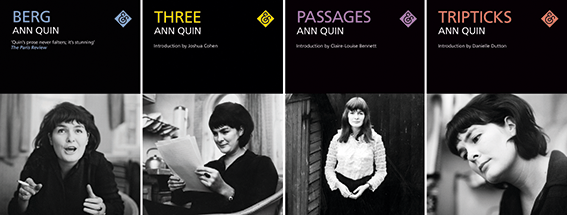
This absence is particularly noticeable because the reissuing of experimental novels by British women from the 1950s and 1960s has been so extensive over the last ten years. All four of Ann Quin’s novels – Berg (1964), Three (1966), Passages (1969) and Tripticks (1972) – were republished by the independent not-for-profit publisher And Other Stories between 2019 and 2022. Although not as a Faber Edition, Faber also republished Brophy’s King of a Rainy Country (1956) and The Snow Ball (1964) in 2020, McNally Editions in the US republished King of a Rainy Country and Lurid Editions republished her In Transit (1969), both in 2025. Novels by Christine Brooke-Rose and Penelope Shuttle were republished by micro-publishers Verbivoracious in 2014 and 2015, and Anna Kavan’s Ice (1967) was republished as a Penguin Modern Classic in 2017 and as a Pushkin Classic in 2025. It is not, as Darlington’s review shows, that this return has been unnoticed. However, the noticing often reveals what is being obscured. At the end of her long article from March 2024 in the London Review of Books on the career and significance of Brophy, Lucie Elven concludes that Brophy’s patchy reception since the 1960s is due to the fact that she ‘doesn’t fit comfortably in any era. She wouldn’t be Brigid Brophy if she did’.Footnote 8 In the article which precedes this conclusion, evidence of Brophy’s novels fitting sometimes and not others has been insistent, if implicit, in the listing of her works as they move in and out of print. Elven’s article was prompted, as in part was Darlington’s, by the republishing of Hackenfeller’s Ape by Faber, but while the vicissitudes of Brophy’s career punctuate the article, the role of publishing, both at the time of original publication and between then and the present, is selective, firmly parenthetical and never really commented on. Elven does not include the fact that Hackenfeller’s Ape was first published by Rupert Hart-Davis and was republished in Virago’s Modern Classics series in 1991. She notes that Brophy’s novel The Snow Ball was republished by Faber in 2020, but not that it was originally published in 1964 by Secker and Warburg. She mentions Brophy’s second novel, The King of a Rainy Country, without mentioning who originally published it (Secker and Warburg), but noting, this time literally in parenthesis that ‘(it will appear from McNally Editions next year)’. Elven does not mention that King of a Rainy Country was republished by Virago in 1990 and by The Coelacanth Press in 2012. She mentions Brophy’s novels Flesh (1962, Secker and Warburg) and The Finishing Touch (1963, Secker and Warburg) without mentioning details of their status as in print or not, and without again mentioning who originally published them. In considering Brophy’s novel In Transit (1969, MacDonald, and the paperback 1971, Penguin), Elven notes, again in parenthesis, that ‘(… it will be republished by Lurid Editions and Dalkey Archive next year)’. Elven does not mention that Dalkey Archive put out an earlier edition in 2002. In its articulation of Brophy’s importance through her supposed lack of fit with any era, its repetitive though selective and parenthetical listing of publication and republication, and its evidencing of a contemporary increase in interest in Brophy, Elven’s article makes clear, but does not explicitly address, the way that ‘fitting’ any era can be traced by whether a novel is in print and, if it is, how and by whom it is published and whether that republishing has effected a greater ‘fit’. What both Darlington’s and Elven’s articles demonstrate, but do not discuss, is the way that publishing frames and determines a writer’s presence or absence in contemporary literary culture and the way we read and understand their work.
As D-M Withers has recently made clear, however, all publishing, but especially republishing, is about timeliness, about ‘fitting’, or not, an era, and that has very particular implications for women novelists and feminist critics. In their Virago Reprints and Modern Classics: The Timely Business of Feminist Publishing, published as an Element in 2021, Withers makes the clarifying and illuminating claim that, in publishing, ‘timing is everything’.Footnote 9 It is even more apposite, Withers shows in their analysis of the Virago Modern Classics (VMC) series, when considering republishing, where it is likely that the title has ‘slipped out of cultural view’ and needs, therefore, to be made to ‘resonate (again) with contemporary readers’.Footnote 10 What republishing makes necessary, Withers argues, is a joining of the time of the writing to the time of the reader: synchronising these is ‘realised when the audience adopts the time embedded in the product as their own’.Footnote 11 Withers investigates how, so successfully and so influentially, the VMC series made the untimely – novels by women long since out of print and usually long forgotten – timely. Withers unpacks each element of Virago’s publishing of the VMC series – choice of title, cover image, cover copy, introductions, the use of phototypesetting, marketing materials, and so on – to show how its titles enacted a ‘tactile time-travel which let Other historical times and a suppressed textual heritage flood in’.Footnote 12 By forming a bridge between contemporary readers and women writers from the past who had been forgotten, the series gave readers both the sense of returning to that moment in the past when the novels were written and first published and an understanding of how they were relevant to the present.
This Element, stimulated and framed by Withers’, takes the significance of time in publishing and uses the relationship between the two – so key in Withers’ argument – to think about the innovative writing by women first published in the postwar decades – primarily in the 1950s and 1960s – which has been republished in the last ten years or so. It does this by focusing on the publishing and republishing of the work of Quin. She has become the poster novelist for the return of innovative novels by women from this period to contemporary literary culture. In 2018, And Other Stories published Quin’s shorter and unpublished writing as The Unmapped Country: Stories and Fragments, edited by Jennifer Hodgson, before republishing all her novels. In a review of The Unmapped Country in The Spectator, the novelist and biographer of the 1960s innovative novelist B.S. Johnson, Jonathan Coe, wondered whether ‘Quin’s time has come at last’,Footnote 13 and indeed the first edition of The Unmapped Country sold out in under two weeks.Footnote 14 Quin’s novels are now widely available in bricks-and-mortar bookshops and, of course, online. Berg and Three have recently been translated into Spanish and Dutch,Footnote 15 and Berg into Polish and German,Footnote 16 and all her novels into Turkish between 2022 and 2025.Footnote 17 Long-form essays have been written on her around the world,Footnote 18 and there have been lively exchanges about her novels on goodreads.com where, at the time of writing, Berg has 1,606 ratings and 211 reviews; 108 people are currently reading it and 5,140 want to read it.Footnote 19 Goodreads is also suggestive about other ways that Quin has returned. Its algorithms tell us that those who have read Berg have already ‘enjoyed’ a range of experimental novels by women: Djuna Barnes’ Nightwood (1936), Anna Kavan’s Ice and Claire-Louise Bennett’s Pond (2015).Footnote 20 Berg, according to goodreads.com, has been reinserted into a particular lineage of the novel. Numerous contemporary writers, too, have championed Quin’s writing over the last ten years or so. An article consisting of contemporary writers’ appreciation of her work in The Quietus in 2018 included contributions from Stewart Home, Isabel Waidner, Lee Rourke, China Miéville and Lara Pawson.Footnote 21 In 2020, the writers Deborah Levy and Juliet Jacques joined the critic Jennifer Hodgson for a London Review of Books podcast on Quin.Footnote 22 In 2021, Claire-Louise Bennett included Quin in her radio programme for the Museum of Literature Ireland on three working-class innovative women writers.Footnote 23 Quin’s work, it would seem, has become timely. In considering how she has been republished, and in comparing it to the republishing of other postwar women novelists, such as Brophy, Kavan and Shuttle, this Element hopes to show how crucial publishing, and republishing, is in our understanding of literary value and literary culture, despite it being almost entirely ignored by literary critics as a determinant of a work’s overall meaning. It was academic feminism’s ‘critical missing link’ for Simone Murray in 2004, and beyond Withers’ work, it mostly remains so. It is recovering that material history and its implications that is the focus of this Element.
The Problem of Time: Recovery, The ‘Intervening Time’ and Linearity
This Element departs from the model used in Withers’ work, though, in its consideration of the temporalities involved in republishing experimental and innovative work by women. While some of the novels written by postwar innovative women writers were republished in the VMC series, most were not, and those that were are mostly now out of print. Indeed, part of the argument of this Element is that the model and the dynamics of republishing so clearly illuminated in Withers’ work do not work in thinking about these writers. Withers’ model of time travel, as important as it is in illuminating the place of time in republishing, stays within the temporal model of feminist recovery. Withers notes that, in its work of making the untimely timely, the VMC series was rooted in the argument and practice of Elaine Showalter’s A Literature of Their Own: From Charlotte Brontë to Doris Lessing (1977), the first UK edition of which was published by Virago in 1978, just as the series was initiated. Indeed, as Withers notes, A Literature of Their Own was Virago’s ‘unofficial sourcebook’ for its ‘literary recovery work’.Footnote 24 However, Showalter’s work in A Literature of Their Own and the VMC series share a problematic temporality, both generally and for experimental work in particular. Showalter begins her study with the acknowledgement that ‘English women writers have never suffered from the lack of a reading audience, nor have they wanted for attention from scholars and critics’, but rather they have suffered from the lack of a visible ‘female literary tradition’.Footnote 25 Once critics start to look, she argues, what can be seen is ‘an imaginative continuum, the recurrence of certain patterns, themes, problems, and images from generation to generation’.Footnote 26 Showalter acknowledges, however, that, though these continua can be retrospectively recreated and women novelists did study the works of other women, often women novelists from the eighteenth century onwards had little sense of their foremothers because of the ‘holes and hiatuses’ produced in the tradition through patriarchal inattention, meaning that ‘each generation of women has found itself, in a sense, without a history, forced to rediscover the past anew’.Footnote 27
Showalter’s model is hard to parse. There is a tradition of women’s writing, but it is soon forgotten, so women writers have to work hard to remember it, but they do remember it, but then it is forgotten, and feminist literary critics have to recover a tradition and ‘a literature of their own’ which women have had ‘all along’.Footnote 28 One of the reasons for this difficulty is that, although she concentrates on those women novelists for whom writing was a profession – they wanted to be published and they wanted to be paidFootnote 29 – Showalter pays very little attention to the activities that produce publication and payment, but that also control what is in print and who gets republished. Showalter’s model is opaque because it mixes, without acknowledgement, the idea of a tradition with its material forms. It does not acknowledge, in other words, the difference made for a woman writer (or a feminist literary critic) of a novel being in print or out of print, only available in a library or second-hand bookshop or available to buy in a new edition. This is not just about access; it is about the ways in which a novel remains present to the present.
Showalter’s study preceded, by some time, feminist engagement with book history and the sociology of literature, but the effects of her work have lasted well beyond the beginnings of these disciplines. More recent incarnations of feminist literary criticism’s ‘recovery’ trope have been criticised for the same limitations I have suggested can be seen in Showalter’s work – a limited sense of temporality and an obscuring of the determining effects of the material practices of publishing. In an article from 2018, Talia Schaffer uses the term ‘recovery feminism’ – defining it as ‘the practice of salvaging texts that have been lost to history’Footnote 30 – in her attempt to show the disadvantages of it as a theoretical framework for feminist literary criticism. For Schaffer, the problem with recovery feminism is a problem of time. Her focus is work on women’s novels from the nineteenth century, but more broadly, from the work of these novelists on, Schaffer argues, women’s writing has been figured by recovery feminism as a ‘linear iteration … marked by gaps’.Footnote 31 The aim of recovery feminism then becomes to ‘fit a forgotten text into an empty space’ within a known chronology.Footnote 32 The problems with Showalter’s model, in other words, have remained in feminist literary work that continues, albeit with added nuance and sophistication, to use her basic concepts – women’s writing, tradition, forgetting and recovery. For Schaffer this model is a problem for a number of reasons, but crucially she draws attention to its simplification of dissemination and reception, its neglect, in other words, of publishing. She argues that the linear chronology assumed by the recovery trope ‘neglects authors’ horizontal relations … and it utterly disregards the structural and material conditions … that determines [sic] what gets written, published and praised’.Footnote 33 If the recovery trope, in its assumption of a linear time, cannot encompass the complex materialities in operation at the time of first publication, it is certainly unable to account for the complexities of multiple republications. What it lacks, then, is a sense of the determining effects of publishing and republishing, but more particularly, a sense of the significance of the space between original publication and the act of recovery in the present.
The lack of consideration of publishing within the recovery trope obscures broader economic considerations too. As Sophie Smith has recently argued in relation to the use of the recovery trope in writing about women philosophers from the past, it both risks a lack of specificity and an effacing of the collusion between patriarchal attitudes and consumer capitalism. ‘Recovery’ does not answer key questions and misses the real causes of women’s patchy and problematic appearance in history and culture: ‘Such generalisations risk shifting the focus, and the responsibility, away from the agents of our ignorance.’Footnote 34 While the rhetoric of so many acts of ‘recovery’, from both scholars and publishers, claims that these are for the benefit of the work of these writers and for the enrichment of our contemporary moment and our understanding of matters of gender, sexuality, novelistic form, and so on, Smith’s essay makes it clear that other benefits and beneficiaries are more tangible and more material: ‘“Forgetting” is a useful – and exculpatory – frame for patriarchy. But it is also a boon to capitalism. Books that participate in what we might call the “women’s recovery industry” sell the lie that the only thing standing in the way of “equality” is a lack of historical awareness’.Footnote 35
The recovery trope cannot tell us how experimental novels by women writers from the 1960s were ‘forgotten’. Their publishers did not forget them. Quin’s novels remained in print throughout the years between their original publication and their republication by And Other Stories, as did the work of Anna Kavan and Penelope Shuttle. Nor were they forgotten by the small number of readers who bought their books, the editors who published excerpts, the film directors who optioned them, the readers who attended live events that included them, or the foreign publishers who bought rights to the novels. That these activities did not make them fully present in literary culture is not the fault of a vague ‘forgetting’ but of the specific structures, dynamics and assumptions of the economic activity of publishing.
The linearity of the recovery trope is particularly problematic for writing by women that is innovative, because innovative writing is about undoing easy assumptions about temporality. In some ways, what Lucie Elven claims about the relationship between innovative writing and being out of time has a sound literary critical base. The novel is, before anything else, an articulation of an understanding of time. As Frank Kermode argued in 1967, the cycle of cohering time and then being found wanting in the creation of that coherence makes it necessary that a novel which is creating new paradigms appear out of time when it first appears – when the old conventions no longer function, but the new ones are too odd and unfamiliar to yet do the job of bringing coherence.Footnote 36 This is the time of the experimental or innovative novel. The forgotten innovative novel cannot be easily replaced in its own ‘gap’ at the time of original publication because it was already untimely.
This sense of the untimeliness of the innovative novel is central to Ellen G. Friedman and Miriam Fuchs’ seminal collection, Breaking the Sequence: Women’s Experimental Fiction (1989). Beginning with Virginia Woolf’s breaking of ‘the metronome of time’, they make it clear that this intervention in temporal expectations subtends experimental writing as such:
To break the sequence is to rupture conventional structures of meaning by which the patriarchy reigns in order to give presence and voice to what was denied and repressed … . The implications of breaking the sequence extend to nearly all of experimental fiction.Footnote 37
Fuchs and Friedman do acknowledge the material obstacles to writers from what they call the ‘third generation’ of experimental women novelists on their timeline – within which they include Quin, along with Christine Brooke-Rose and Eva Figes – noting that:
With only an occasional book or article on a single figure, these women writers lack the critical recognition that helps to sustain an audience and thus have difficulty staying in print. Because they are often confined to small presses and thus not widely reviewed, many writers in this category are largely unknown.Footnote 38
However, they too use the trope of recovery, justifying it because of, and not despite, the untimeliness associated with the writing.
Presence on the timeline, accorded by publication dates, does not fully reveal the extent to which women practiced the new fiction, since women’s books habitually did not see print until many years, sometimes decades, after composition.Footnote 39
The dangers of this focus on recovery via a return to the time of original publication, though, is clear in the chapter in the collection on Quin by Philip Stevick. Here, the experimental nature of Quin’s novels makes it harder to return her to a ‘gap’ in a tradition of women’s writing. Instead, in writing about Berg, her first novel, returning to the original time of the novel means arguing that its innovatory narrative voice was created, not through engagement with the culture around her, but by ‘drawing on her own troubled mind’.Footnote 40 Stevick ‘recovers’ Quin’s novels in order to claim that they are sui generis.Footnote 41
Despite the recent articulations of the difficulties with the trope of feminist recovery, the recovery model remains in recent feminist literary critical work on women’s postwar experimental writing. Julia Jordan, in an article on Quin in the Times Literary Supplement at the time of the publication of The Unmapped Country,Footnote 42 despite adroitly noting the problematic ways that readers and critics look back at women writers and their work from the past, concludes that Quin, ‘[i]n her very capacity for abandon … invites the reader into acts of retrieval on her behalf. The new collection will help us to put the scattered pieces back together again’.Footnote 43 In other work on Quin, discomfort around the presence of the trope is clear even while it is utilised. The title of a special issue on her, published in 2022 in the journal Women: A Cultural Review, edited by Nonia Williams, was ‘(Re)turning to Ann Quin’, situating it nicely between recovery and a sense of our relation to Quin in the present. In her introduction, though, it is on the wealth of ‘recuperative’ critical work on women experimental writers from the 1960s that has recently been published that Williams focuses, suggesting that Quin’s work too has experienced what she calls ‘a substantial renaissance’.Footnote 44 Williams has elsewhere acknowledged that experimental writing, and Quin’s work in particular, may be resistant to such models. In a chapter on Quin’s ‘infuriating’ experiments, she ends by acknowledging that a ‘solely celebratory recuperative mode’ would deny the problematic and frustrating nature of Quin’s writing.Footnote 45 However, Williams describes her own monograph on Quin, reviewed, as we have seen, by Joe Darlington, as ‘a work of feminist critical recovery’.Footnote 46
It is not that seeing this writing as missing from our literary histories is wrong, of course. It is that the recovery model cannot then think fully about the causes for that absence as being rooted in publishing nor, as Schaffer notes, does it consider the time between the work first appearing and its recovery now. It is the case, though, that a framework for thinking about the dynamics of publishing and about this time – between original publication and a discovery by a wider audience – does exist. In his model of ‘restricted production’ – that is, the production of work that attempts something new and is aimed at a minority readership upon first publication – Pierre Bourdieu calls this period the ‘intervening time’Footnote 47 and sees it as vital in the dynamics of literary publishing. It is crucial precisely because, when first published, experimental work is ‘untimely’. Across his work from the early 1970s onwards, and most comprehensively collected in The Rules of Art (1992/1996), Bourdieu argues that restricted production is an ‘inverted economic world’ because economic interest is eschewed by producers, and this produces symbolic capital through the ‘intervening time’ after which that symbolic capital will, when the model works successfully, turn into actual capital, into profit.Footnote 48 This is why Bourdieu describes restricted production as ‘entirely turned towards the future’.Footnote 49 It is in the ‘long run’ that symbolic capital is converted into financial capital.Footnote 50
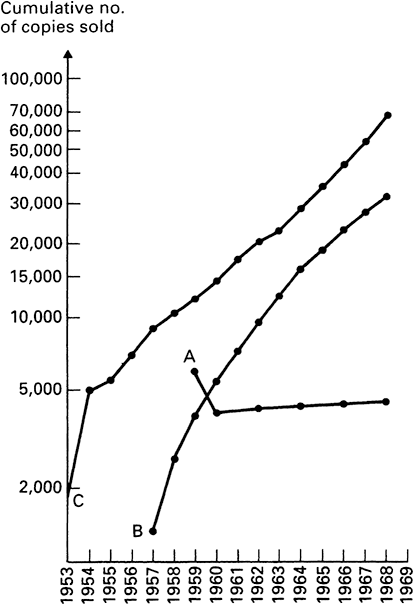
Despite this model still being so often the basis for thinking about contemporary publishing,Footnote 51 Bourdieu’s central example of the operation of this ‘intervening’ time, however, begins to suggest why his model is not finally useful in thinking about the republishing of postwar experimental novels by women. His key example, used across his work on restricted production, is the publishing of En attendant Godot in the early 1950s by the tiny French publisher Les Éditions de Minuit. In Figure 1, he shows in graphic form the dynamics of restricted production by using the sales of Godot along with two other titles published by the firm.
Pierre Bourdieu, The Rules of Art: Genesis and Structure of the Literary Field, Polity, 1996, p. 144.
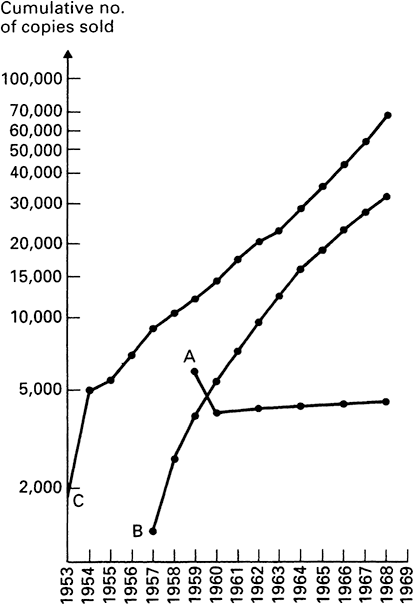
Line A on the graph is what Bourdieu calls a ‘literary prize winner’, line B is Alain Robbe-Grillet’s La Jalousie (1957), and line C shows the sales for Beckett’s play. This graphic representation of the ‘intervening time’ makes it clear that Bourdieu’s model does not work when the ‘intervening time’ is not one of steady increase – the straight line of Godot’s sales. In addition, the twenty-first-century republishing of postwar experimental novels by women has been by publishers other than those that had kept them in print in the intervening time, challenging Bourdieu’s assumption that a text is simply published during this time, rather than licensed, republished and repackaged. The problem is that Bourdieu’s model, like the recovery model, is straightforwardly linear, as the graph suggests, but the temporalities of the writing of Quin and other postwar experimental women novelists, in terms of critical attention, publishing and republishing, are anything but linear.
The Time of Publication
If neither the trope of recovery nor Bourdieu’s model of restricted production fully work as frames for considering the republishing of Quin and other postwar experimental writers, Withers’ work on the VMC series is suggestive about what might act as both a frame and a method. Virago Reprints and Modern Classics uses the paratextual material of titles in the series to show how they were made ‘timely’. This works because, as Gerard Genette argued in his seminal work, Paratexts: Thresholds of Interpretation (1987/1997), the material that surrounds a text, whether attached physically to it – introductions and other preliminary material, cover images and text – or not – correspondence, reviews, publishers’ catalogues, interviews – are about the moment of publication. They not only enable ‘a text to become a book’, occupying space in the public world, but they ‘present it’, they ‘make present, to ensure the text’s presence in the world’.Footnote 52 In his implicit rebuff to Jacques Derrida’s claim for the temporal paradox of prefaces (they appear first in the book but are written after the text),Footnote 53 Genette makes the relationship between paratexts and the moment of publication even more explicit. In contrast to Derrida’s reading, Genette argues that such paradoxes are ‘not what we’re talking about … for the prefatorial function is directed at the reader, and accordingly the relevant time is the time of publication’.Footnote 54 This both shores up Withers’ argument that republishing is about ‘making timely’, but also suggests, in a way that Withers does not, that these paratexts are likely to be a site of tension.
That this tension is particularly acute at the time of republishing can, though, be seen in the paratexts of the VMC series. While the titles in the series are ‘made timely’, as Withers argues, the evidence of the paratexts suggest that this making timely is not smooth or uncomplicated, but complex and contradictory. The tension between a historicising which would situate the writing in its context in the past and one that would assert its significance to the reader of the present is noticeable in the ways that, for example, May Sinclair’s novel Mary Olivier: A Life, first published in 1919, was republished in the VMC series in 1980. Jean Radford begins her introduction with what became a classic claim of recovery feminism, that ‘May Sinclair deserves to be recovered … ’. However, she quickly qualifies this: Sinclair ‘deserves to be recovered – not as a “forgotten genius” – but as an intelligent and talented writer deeply involved in the movements and ideas of her time’.Footnote 55 This is quite different from the back cover copy, which describes Sinclair as ‘one of the greatest, if currently most neglected, of Georgian novelists’. There is a tension, in other words, between the historical value given to Sinclair by Radford and the literary value given to her by the back cover copy, a literary value which aims to make problematic the contemporary ‘neglect’. Radford travels back to the early twentieth century to ‘recover’ Sinclair and her work, to re-place her, as both Showalter and Schaffer, with different inflections, suggest the recovery model does, at a particular moment in the history of women’s writing. The cover copy prioritises the present, the ‘time of publication’, and neither mentions the ‘intervening time’.
It is paratexts that I will use in this Element to think both about the particularities of the ‘intervening time’ for Quin’s novels and about their recent return to literary culture. Genette himself notes the importance of paratexts in the repackaging of books across time: ‘Being immutable, the text itself is incapable of adapting to change in its public in space and over time. The paratext – more flexible, more versatile … is, as it were, an instrument of adaptation.’Footnote 56 What this Element will suggest, however, is that the adaptability of the paratexts, in particular of covers, does change, if not the text, then the way it is read across time. Not only is a focus on the paratext a focus on temporality, it is also a focus on the publisher. In this, my understanding of paratexts differs from that of Genette. He does argue that peritexts – those paratexts physically surrounding the text – are ‘the direct and principle … responsibility of the publisher’. They exist only because ‘a book is published and possibly republished and offered to the public’.Footnote 57 However, his focus is really the author. Early in Paratexts, Genette says that the paratextual, the ‘fringe’ of the printed text, as he describes it, is ‘the purveyor of a commentary that is authorial or more or less legitimated by the author’.Footnote 58 This focus has consequences both in terms of gender and in terms of republishing. Focusing on the author privileges original publication and reproduces patriarchal exclusion. Genette’s eight-page index in the 1997 English translation consists entirely of authors’ names, a tiny proportion of which are the names of women. This is not to suggest that publishers are not shaped and inflected by patriarchal forces – they are, as I will go on to show. But a focus on publishing, and in particular republishing, offers up much about how a novel is interpreted, and the consequences of that, at specific moments in time.
Putting paratextual material at the centre of this analysis illuminates the complex meaning of ‘timeliness’ in relation to republishing experimental women writers, but it also illuminates the difficulties of putting publishing at the centre of literary critical work. As Nicola Wilson has argued, it is, of course, the case that ‘research in the archive allows us to ground our analysis in a sense of the material world and to ask new questions about literature and the dynamics of textual production and authorship that are not available purely from a reading of the text’. It is the case too, however, as she says, that the way archives are ‘organised and structured lends itself to certain formulations and conclusions’, and this includes what reaches the archive in the first place.Footnote 59 Paratextual material – both the peritexts and the epitexts – is often, as Robert Darnton has noted, treated by publishers as waste,Footnote 60 and Wilson makes the point that this is more likely to be the case with smaller publishers who lack the resources needed for careful and thorough record-keeping.Footnote 61 Calder and Boyars’ archive was sold to the Lilly Library at Indiana University in the mid-1970s in order to fund, according to John Calder, its split into two separate companies. Calder’s account makes clear too, however, the extent to which the material that went to the Lilly Library had already been shaped. Before the sale in the mid-1970s, when the firm moved premises, they had to ‘leave our old papers behind’, and one of the firm’s authors, the Scottish experimental writer Alexander Trocchi, and his friends had ‘spent a day sifting through them, finding much interesting material that he then sold to the University of Texas, just before the building was demolished’.Footnote 62 At least it was saved, but, of course, what the Harry Ransom Center at the University of Texas might find interesting may not be what those interested in the activities of publishing itself might need.Footnote 63 In addition, library holdings are shaped by paratexts, but libraries make decisions about what is and is not central to their collection that can be inimical to the study of those paratexts. The British Library catalogue suggests that it holds a copy of the first edition of Berg from 1964. On ordering the book, however, I found that it, in fact, holds a copy of the first paperback edition, from three years later. When Calder and Boyars republished the novel in their Calderbook paperback series in 1967, they used the sheets from the first edition, including the same imprint page, leading cataloguers to assume that it was published in 1964. In addition, as Nicola Matthews and Nickianne Moody note, ‘[b]ook jackets, too, have often been seen as ephemeral marketing devices, to be discarded when a hardcover was placed in a library’.Footnote 64 This is certainly the case for the British Library, which, though after they remove the jacket they do not destroy it, have only very partially catalogued their enormous holding.Footnote 65
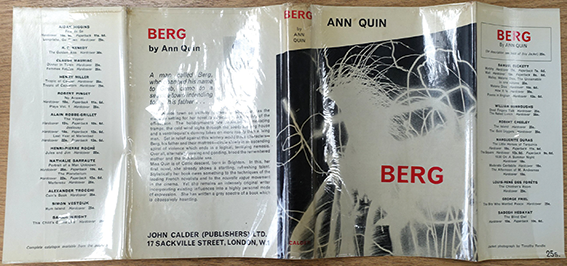
Because of these gaps, this book could not have been written without the internet. My reading of the jacket of the first edition of Berg in Section 3 was only possible by asking an online seller to send me a photograph of the jacket with its flaps displayed. The internet made this possible because, as is being argued increasingly now, the internet is shaped by the demands of late capitalism.Footnote 66 If paratexts are ephemera for publishers focused on things other than literary history, this is no less true of digital paratexts. The hyperlinked nature of the pages on the internet suggests a clearer and more obvious path for the researcher, but as the internet ages, these paths are often blocked. As an example, the online version of an article by the writer Lee Rourke on Quin in the Guardian from 2007 contains links that are key in terms of her publishing history. Calder’s firm is hyperlinked, but a click on it takes one to an ‘Error 404’ page on the site of Alma Books, who acquired Calder’s backlist in the same year. Clicking on the link in the article to Dalkey Archive Press produces a privacy warning. Noting that Quin crops up, scattered across blogs and literary sites, Rourke mentions a particular blog, which is hyperlinked. The link goes to a ‘This site can’t be reached’ page.Footnote 67 Berg is hyperlinked to an Amazon site for the Dalkey Archive Press edition, which is no longer in print. In addition to the ephemeral nature of the internet, it is the market that structures and determines it. So often, my hunt for paratexts took me to sites of second-hand booksellers, where ‘stock images’ were used for titles that I could never afford, whose back covers were not displayed, or where photographs were not of good enough quality to allow me to read the text, for example, which named a cover image or designer.
The contingency of publishers’ archives and the market-determined nature of the internet notwithstanding, in thinking about contemporary republishing, Ann Quin and time together, this Element will show that the paratexts which surround any text and make it public are contradictory, contingent and ephemeral, but also key for the way it is read and for its longevity. In the next section, I will look at the publication of Quin’s first and most famous novel, Berg, during the ‘intervening time’ between its first publication in 1964 by John Calder and And Other Stories’ republishing of it, along with her other novels, in the second and third decades of this century. Marion Boyars, who had joined John Calder’s firm in 1960 as an investor and partner, was Quin’s main editor. The firm’s name changed to Calder and Boyars in 1964, a few months after the publication of Berg, and it went on to publish each of Quin’s novels which followed – Three (1966), Passages (1969) and Tripticks (1972). After John Calder and Marion Boyars went their separate ways in 1975, two years after Quin’s death, Boyars took Quin’s work and continued to publish her novels, to promote them, and to sell rights to them. In 1977 and 1989 Boyars licensed the novel to paperback publishers. It is these republishings, their paratexts, and the contexts of those paratexts that are the focus of the second section. It looks at two moments in the ‘intervening time’ at which republication failed to make Quin’s work ‘timely’ and suggests that this failure can tell us about the republishing of experimental writing by women and timeliness in a way that then can help us historicise and so understand the reasons for the ways they have been republished more recently. After Boyars died in 1999, her firm was run by her daughter, Catheryn Kilgarriff. All four novels were licensed then by the US independent Dalkey Archive Press and published between 2001 and 2003.Footnote 68 These too went out of print. And Other Stories then licensed the novels from Marion Boyars and then, when the latter was sold to Equinox in 2024, bought the underlying rights.Footnote 69 Section 3 situates And Other Stories’ republishing of Quin’s novels within the changes in literary publishing that were a consequence of the 2007/8 financial crash and reads the paratexts of these editions as a very particular attempt to ‘make timely’ in the context of late capitalism and its enabler, digital technologies. In Bourdieu’s example of En attendant Godot, the ‘intervening time’ ends in the late 1960s, when sales reached the point where symbolic capital became financial return. The implication is that the ‘intervening time’ stops there, but as we have seen, for women experimental novelists in particular, that is rarely the case. While the most recent republishing has been so successful in returning Quin to contemporary literary culture, Section 3 argues that the tensions and contradictions in their paratextual material show the difficult negotiation between making Quin our contemporary and colluding with the ‘perpetual present’ of a late capitalism, willing as it is to exploit women’s lives and bodies along with everything else. It suggests the ways in which the republishing has framed our reading of Quin for the near future, but suggests too that this republishing still constitutes an ‘intervening time’, between now and whatever vicissitudes will shape the publishing of her work in the future.
2 Berg’s ‘Intervening Time’
The title of the Book will be the title of the Film.
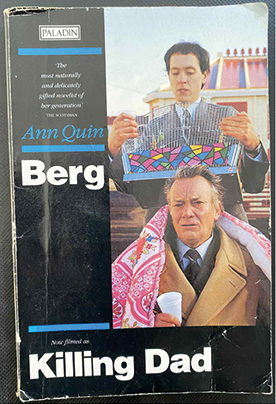
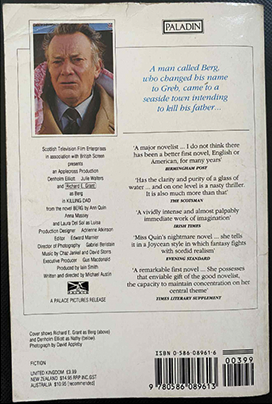
In the ‘intervening time’ between the first publication of her novels and their recent republication by And Other Stories, Quin’s work virtually disappeared. In an online article about Quin, the writer Stewart Home remembers not being sure around the time of the millennium ‘whether she was lost or ripe for a revival’.Footnote 71 When Quin was read in the last decades of the twentieth century, it was usually through finding a novel in a second-hand bookshop, or being passed a second-hand copy by a friend.Footnote 72 If Quin’s sales during this time did not replicate the steadily increasing line of both En attendant Godot and La Jalousie on Bourdieu’s graph, though, neither did they experience the complete silencing assumed by the recovery model. Quin’s work remained in print throughout these years. It was in print with Calder and Boyars until the firm split in 1975, after which it was published by Marion Boyars Ltd. In an interview from 1997, Boyars claimed that she hardly ever let any of her titles go out of print, and this was the case for Quin’s novels;Footnote 73 they were never out of print between their first publication and the And Other Stories’ editions.Footnote 74 More significantly, though, Berg, Quin’s first and most commercially successful novel, was republished three times between its original hardback publication in 1964 and the turn of the millennium, when all four novels were licensed to the US independent publisher, Dalkey Archive Press. Berg is set in a down-at-heel boarding house in an out-of-season seaside resort that is clearly Brighton, and one of the characters, Nathan Berg, the father of the novel’s protagonist, Alistair Berg, is a music hall artist. However, while the novel draws on a world of working- and lower-middle-class seaside Englishness stuck in the past – part of the reason it was so often compared to Graham Greene’s Brighton Rock (1938) on first publication – its narrative style is very far from that world. It is the bringing together of this particular kind of Englishness with the innovations of recent French novels and films – the nouveau roman and the nouvelle vague – that made Berg significant in 1964. It was described by a disgruntled John Fuller in 1965 as ‘the quintessence of Calderism’ – lacking in plot and proper chronology, too serious and in hock to ‘Beckett et al.’ – while other, more sympathetic reviewers saw this as its distinction.Footnote 75 In its ‘intervening time’, Berg was republished as a Calderbook paperback in 1967, as a mass-market paperback licensed to Quartet in 1977, and as a trade paperback licensed to Grafton and published by its imprint, Paladin, in 1989 to tie in with the adaptation of the novel as a film, Killing Dad (Or How To Love Your Mother) (dir. Michael Austin, 1989).Footnote 76
This section focuses on the editions of 1977 and 1989 and sets out the reasons that they failed to make Quin’s novel ‘timely’. In doing so, my aim is to add nuance to our understanding of the republishing of women writers and to our understanding, more generally, of how publishing shapes and makes novels. By considering first the key dynamics in publishing during the 1970s and 1980s in relation to risk, gender and format, and by then looking at the Quartet and Paladin editions, I will argue that timeliness for an experimental novel by a woman writer is more complex than either Bourdieu or the idea of ‘recovery’ suggests. The complexity of the novel’s ‘intervening time’ was caused neither by a monolithically uninterested patriarchy nor by a bemused reception of an innovative novel. It was caused by the complex, gendered dynamics of publishing and by the two paperback editions’ inability to reproduce the novel’s own complicated investigation of timeliness.
Paperbacks, Risk and the Gender of Restricted Production
Paperback publishing had, of course, been revived and revolutionised in the UK by Allen Lane in the 1930s, but the Penguin model was rooted in a fundamental split between hardback and paperback publishing. Lane bought the rights to titles already published in hardback, publishing them more cheaply in well-designed paperbacks and distributing them through sellers beyond the traditional bookshop.Footnote 77 While Penguin quickly went on to publish paperback originals, this model – a title appearing in hardback with the original publisher, then being licensed to a separate paperback publisher – remained dominant until the 1970s. Subtending it, as Paul Scherer notes in his chapter on paperback publishing in the collection put out by the independent publisher Peter Owen in 1988, Publishing: The Future,Footnote 78 was a particular idea about the authority of the original publishers. Scherer argues that ‘[u]nderlying this system was the old belief that the hardcover publisher “made” the book in the first place and the reprinter simply spread it to a rather wider audience by getting it into more outlets’.Footnote 79 The major risk, in other words, had been taken by the original hardback publisher, so that both the authority and the ownership remained with them. This risk justified the hardback publisher’s claim to a significant proportion of the money made on the paperback, money that otherwise would belong to the author and the paperback publisher alone.Footnote 80
This model of licensing to paperback publishers, then, was based on a valuing of risk and the consequent creation of authority that fits neatly with Bourdieu’s description of restricted production, a description which, years before Bourdieu’s work, John Calder had used for the ‘production of belief’ in his publishing company and was often taken up too and used by Boyars.Footnote 81 Founding his firm in 1949, through the 1950s Calder’s publishing was fuelled by the risks of financial failure, public incomprehension, and legal difficulties. Looking back, for example, on an early collaboration with another publisher which produced an unexpurgated translation of The Satyricon of Petronius in 1953, Calder described it as ‘both risqué and risky’.Footnote 82 By the mid-1950s, he had developed a relationship with Maurice Girodias, publisher of Olympia Press, and through him with the Merlin Group, both in Paris and both mixing the publishing of avant-garde writing with the publishing of pornography.Footnote 83 In the second half of the 1950s, Calder developed a relationship with Les Éditions de Minuit (the subject of Bourdieu’s graph reproduced in Figure 1) and, through that, became the publisher of Samuel Beckett’s fiction and of English translations of the nouveau roman writers, in particular Alain Robbe-Grillet, Nathalie Sarraute and Marguerite Duras. Calder also worked in the 1950s with Grove Press in the US, which was also known for putting out work that was commercially dubious and that pushed the boundaries of conventional morality.Footnote 84 In 1961, writing to The Times to assert the ‘place for small publishers’, Calder used the rhetoric that Bourdieu would later describe as ‘the production of belief’ in linking being a small, independent company with risk and literary quality. He argued that the ‘James Joyces and Virginia Woolfs of the future are hardly likely to be encouraged by the large publishing corporations’.Footnote 85 Through the 1960s, the firm became known for taking risks in publishing and for eventually defending in court writing seen by the establishment as obscene. In 1963, the firm published Henry Miller’s Tropic of Cancer when the risk of prosecution had deterred others from publishing the book in the UK.Footnote 86 It then published William Burrough’s The Naked Lunch in 1964, the year of the firm’s name change to Calder and Boyars, and their reputation for risky publishing was sealed in 1966, when Calder and Boyars were taken to court through a private prosecution for publishing Hubert Selby Junior’s Last Exit to Brooklyn.Footnote 87
It was this version of the rhetoric of publishing that Boyars retained following her split from Calder in 1975. Boyars, too, contributed to Peter Owen’s Publishing: The Future, and in describing her firm and her career, her chapter repeats both Calder’s and Bourdieu’s description of the accumulation of authority and symbolic capital through the practice of risk. She says that the ‘gambling spirit’ led her into publishing and had not left her, indeed that she had always loved the ‘uncertainty and the unpredictability’ which she believed to be ‘endemic’ in literary publishing.Footnote 88 In her chapter, Boyars links this risk to the eschewal of financial gain that is at the heart of restricted production, noting that in her field of publishing, ‘the response to “market forces” is largely irrelevant’.Footnote 89 It would make sense, then, that for Boyars licensing paperbacks was part of the ecology of the field of restricted production; such licensing was testament to the risks taken by and so added to the symbolic capital – the reputation and authority – of the original publisher. As Scherer notes, however, by the late 1980s, the field had changed significantly in relation to risk and symbolic capital, and it had changed because of the shifting meanings of format. The split between the original hardback publisher and a separate paperback publisher had become ‘the old system’, and increasing numbers of publishing companies were incorporating both hardback and paperback imprints, becoming what Scherer calls ‘vertically integrated houses’.Footnote 90 What is crucial in the new model for Scherer is that the publication of the book is treated as a ‘totality’ across time and formats.Footnote 91 While different formats reach different readers, having each imprint as part of the same umbrella company meant that their packaging and marketing could be controlled and dovetailed. Scherer’s analysis suggests that the licensing of titles to separate paperback companies was history. While the risk taken in original hardback publication under the old model was about the accumulation of reputation and authority, the risk now was that continuing in that old model would mean a loss of control and so a loss of that hard-won authority.
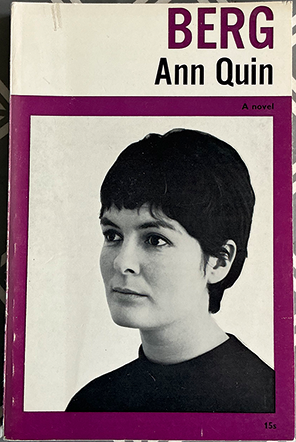
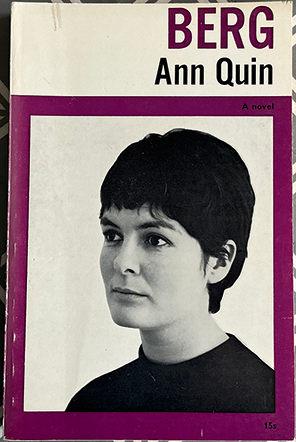
Boyars did often publish paperback editions of her own titles, in 1997 seeing this as part of the maintenance of the longevity of the list,Footnote 92 and through the 1970s and 1980s sold a trade paperback version of the 1967 Calderbook edition of Berg. However, this edition was hard to find and in addition the firm was still selling the 1967 edition. In 1989, Boyars received a letter from the writer and critic Nicolas Tredell, who was at that time writing an essay on Quin, letting her know that he was having difficulty finding a copy of her last novel, Tripticks.Footnote 93 Boyars replied, letting him know that all of Quin’s novels were in print, and sent him a catalogue.Footnote 94 Tredell bought all four of Quin’s novels directly from Boyars,Footnote 95 but his experience makes it clear that, while Boyars had kept them in print, the novels were hard to find and far from the centre of literary culture. The edition of Berg that the firm sold to Tredell was the 1967 Calderbook edition (see Figure 2), still with the name and colophon of a publisher that no longer existed.Footnote 96 In addition, the Calderbook edition, while marking a fresh approach to paperback publishing in the UK and designed in a very contemporary way, looked old-fashioned by the 1980s.
Ann Quin, Berg, Calderbook edition, 1967: Nicolas Tredell’s copy bought from Marion Boyars in 1989.
There is nothing in either the archive or her published writing to suggest why Boyars did not republish Berg herself as a new paperback edition with wider distribution and appeal – it contains no correspondence with either Quartet or Grafton – but, of course, risk is in the eye of the beholder. It is about the ‘production of belief’ rather than an empirically based operation. In particular, risky activities can mean very different things depending on whether they are carried out by a man or a woman. In her chapter in Owen’s collection, Boyars makes it clear that she knows that risk has gendered implications. She insists that the ‘entrepreneurship’ necessary in setting up a publishing company is not a ‘male preserve’, using those she calls ‘the Virago women’ as evidence.Footnote 97 While insisting on this and clearly relishing the risk inherent in literary publishing, however, Boyars shows that during her career gendered assumptions around women’s relation to entrepreneurship were prevalent. She notes that ‘men feel uncomfortable with women in positions of comparative power, even though many subscribe today to the idea that women should be in decision-making positions’, and that this leads to women being ‘relentlessly, if often unconsciously, patronised’.Footnote 98 She relates the subtle (and not so subtle) ways that women’s authority can be undermined in professional settings, demonstrating the extent to which the activity of risk could produce, not symbolic capital, but the perception of incongruity: ‘a printer, on being told that I was the co-owner of the publishing house, asked incredulously, “Are you sure?” – the idea was such a novelty to him’.Footnote 99
This incongruity is the result of risk being gendered as masculine. Even in academic work until the 1990s, as Susan Marlow has argued in her survey of the field, ‘prototypical entrepreneurial attitudes’ were seen as those of agency, risk-tolerance, competitiveness and self-sufficiency, all of which are of course gendered as masculine and this work assumed that all women needed to do to be successful in entrepreneurial activities was to be ‘more like men’.Footnote 100 The assumption was that the low number of women creating and running firms in general, and the location of the firms run by women in low-growth, risk-averse sections – the ‘alleged feminised deficit’ – was the result of individual choices rather than ‘structural gendered subordination’.Footnote 101 However, women being ‘more like men’ are as liable to patriarchal attack as those continuing to act ‘like women’. While Boyars embraced risk, because she was a woman, her work was less often seen as courageously risky and so only partially accrued the symbolic capital associated with it. In Calder’s public account of his relationship with Boyars (after her death), he suggests again and again that she was risk-averse. His account of their first meeting, when she answered his advertisement in The Bookseller looking for investors, includes most of the ways that women can be patronised and undermined, but in particular suggests that she was a dilettante with little relish for risk-taking:
She was a petite dark woman, near my own age – although I never discovered what it was until her death in 1999 – enthusiastic and self-assured. Her marriage was dull, and to relieve her boredom she had recently taken a two-year course at the new and still experimental University of Keele. She wanted a career. She had money enough, but had no intention of taking too much risk. She had heard of some of my authors and was impressed by their names, but everything had to be looked at by her accountant.Footnote 102
The suggestion that Boyars was opposed to risk is reiterated again and again in Calder’s memoir. In relation to his founding of the International Writers’ Conference as part of the Edinburgh Festival in 1962, he suggests that she had watched it with ‘amazement, unable to grasp my reasons for getting involved in such a big and risky undertaking’. In considering the publication of the title which, in many ways, sealed the firm’s reputation as risk-taking, Henry Miller’s Tropic of Cancer (1963), Calder writes that he had ‘great difficulty in persuading Marion to go ahead with the Henry Miller project’.Footnote 103 He also implies her aversion to risk in his account of contracting Hubert Selby Jr’s Last Exit to Brooklyn (1966). Away skiing, he was sent the novel by Boyars: ‘She thought it risky, given the considerable amount of sexual content, but there was a good sales potential. I read it and liked it instantly … ’.Footnote 104 Finally, his account of Boyars’ wish to break up Calder and Boyars and start her own company in the mid-1970s implies not risk-taking, but the wrong kind of ambition and merely derivative success:
Her motives were transparent enough. She resented it every time an article appeared in either the trade or the public press that singled out someone like Nora Smallwood [of Chatto & Windus] as a prominent woman in publishing, and she would write in to say that she was also a woman in publishing with authority. She hated the great attention given to me by other publishers … . She wanted to be famous and admired.Footnote 105
In an article on Calder in the Guardian in 2002, Boyars’ husband, the poet and musicologist Arthur Boyars, gives a different version of her decision to split the company, although one which also reveals the gendering of risky activities and of those seen as without risk:
But publishing really is a lot of work. For John, it meant an occasional appearance in the office – and that was only possible if you had somebody like Marion to do all the work … . Marion to a larger extent found herself running the firm. When she found that she could no longer continue to do all of the work and still got little of the credit, even though the firm was called Calder and Boyars, she decided to split it up and go her own way.Footnote 106
Calder’s risk-taking was always seen by both himself and others as entirely productive – of reputation, of authority, of literature. The preface to a festschrift published in his honour in 1999 quotes the Independent’s description of him as ‘the last of the gentleman publishers’ and links this description to the exercise of judgement which is ‘[f]or a publisher … both an act of courage and a risk’.Footnote 107 In the same year that the festschrift for Calder was published, in his obituary for Boyars in the Guardian, Peter Owen, while noting that she ‘became one of the first women publishers in this country[,] certainly almost the only one to leave her own creative imprint’, reveals too assumptions around women’s work, authority and risk. He notes that, when first joining Calder:
Her first assignment was to soothe the company’s irate authors, such as Marguerite Duras; she had little time to acquaint herself with the finer points of running a publishing house. However, during those early years she often consulted me for advice and information.Footnote 108
The archive may not contain any evidence that would explain why Boyars licensed Berg in the 1970s and 1980s rather than publishing new paperbacks herself, but there is much evidence that for Boyars the symbolic capital accrued through risk was a more fragile thing than it was for male publishers. It is likely that this made the older dynamics, where licensing paperbacks was a marker of the risk that had been taken in publishing the original edition, harder to give up. The licensing of Berg, however, meant that Boyars had little control over its republishing, and I will go on to explore the consequences of this for the place of the novel in the ‘intervening time’, and the failure to make it ‘timely’.
Republishing Berg: Quartet, Paladin and Mis-Timing Berg
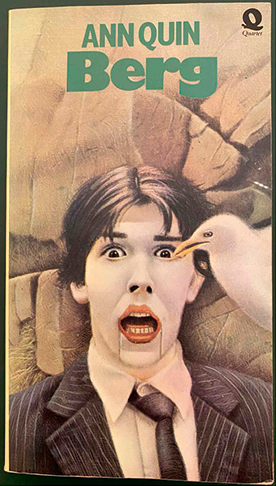
The mass market paperback edition of Berg from 1977 (see Figure 3) failed to make the novel timely because it was a confluence of mixed messages around its genre and its own treatment of timeliness.Footnote 109 This mixture was in part the result of the nature of Quartet itself. The company had been founded in 1972 as an independent publisher, and it had been crucial in the formation of Virago.Footnote 110 Quartet gained a reputation through the early 1970s for being ‘supportive to radical ideas’ and for taking risks.Footnote 111 In some ways, it repeated Calder’s mix of the highbrow and the erotic – the firm published the first UK paperback edition of The Joy of Sex in 1974.Footnote 112 In the mid-1970s, it published the paperback editions of Anaïs Nin’s Journals, licensed to them by her British publisher, Peter Owen. This licensing, though, is an indication both of Quartet’s place in the field and the dangers of loss of control. Nin let Owen know she was ‘appalled at the bad taste of the covers’; she thought them ‘[g]audy and vulgar’.Footnote 113 In response, Owen let Nin know that Quartet says ‘the covers help sales’ but let her know too the reality of paperback licensing: ‘I agree they are not pretty, but it is their decision what they do and I can’t interfere’.Footnote 114 In 1976 Quartet was bought by Naim Attallah’s Namara Group – the year before he financed the founding of The Women’s Press. Simone Murray has described Attallah’s business interests as stretching from ‘the right-wing Literary Review’ to his ‘managing directorships of Establishment hallmarks Asprey’s and Mappin and Webb’, and charts his difficult relationship with The Women’s Press.Footnote 115 Attallah, Murray suggests, was one of those who involved themselves in the publishing of women’s writing with an eye on the market and on profit, rather than ideological commitments.Footnote 116 Under Attallah Quartet’s mix continued, but perhaps with a different emphasis.Footnote 117 Withers notes that Quartet was established with the aim of ‘exploiting new publishing opportunities afforded by simultaneous publication in hardback and “Midway” (now termed trade paperback formats)’,Footnote 118 but Berg was published as a mass market paperback, mixing the literary with the commercial, the past with the present, a newer sense of what women’s writing might mean, created in large part by Virago, with a continuation of conventional assumptions about gender. In each case, what won out misrepresented the novel. The disjuncture between the paratextual and the textual could not but make the 1977 edition untimely.
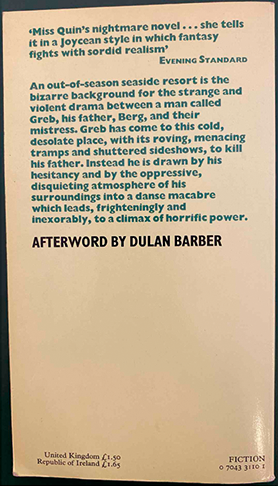
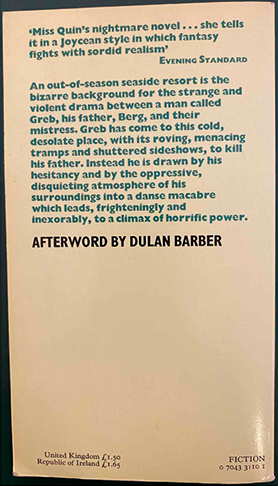
Ann Quin, Berg, Quartet, 1977, front cover (a) and back cover (b).
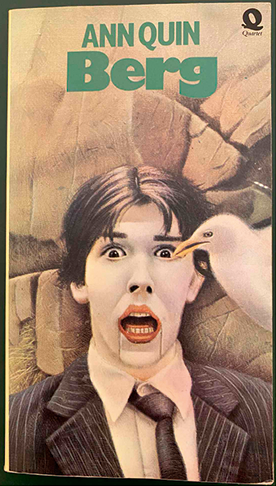
Quin’s novel certainly itself mixes the high and the low, the past and the present, conventional gendered assumptions with their opposites, but to very different effect. The world of the down-at-heel seaside town and the music hall is there – Berg senior’s ventriloquist’s dummy is, he tells his son when asking him to retrieve his possessions from his room in the boarding house, the ‘most important’ of themFootnote 119 – but so are the defamiliarising effects of literary innovation. Many of the reviews of the first edition – both positive and negative – remark on this mixture. The review in the Times Literary Supplement acknowledged the influence of the nouveau roman and of nouvelle vague films, but says that ‘for the first time, these techniques have been used to produce a novel that is both wholly English in atmosphere and quite unpretentious’.Footnote 120 The reviewer in the Daily Telegraph too recognised this mixture: ‘The references, the possible influences, come crowding in on the reader – Greene for the seedy Brighton atmosphere, Sarraute for the nouveau roman technique’.Footnote 121 The Oxford Mail described the novel as ‘a kind of new wave Brighton Rock’.Footnote 122 The Irish Times noted that Quin brings together the ‘anti-novel’ and ‘Brighton Greene-land’ in her own unique way.Footnote 123 The Quartet paperback of Berg, however, while mixing messages, prioritises only one aspect of the mixture. While extracts of reviews used in its preliminary pages stress that the work, although having aspects of genre fiction, is an important literary work – ‘on one level it is a nasty thriller. It is also much more than that’Footnote 124 – the rest of its paratextual material focuses on a version of the ‘nasty thriller’. The front cover is a painting of a young person of ambiguous gender – wearing a suit, but with conventionally feminine facial features – with vertical lines down each side of its mouth, indicating that it is a ventriloquist’s dummy.Footnote 125 While the cover image captures the sexual transgressiveness of Quin’s novel – Alistair Berg at one point dresses as a woman and is propositioned by his father, and there are suggestions throughout that Alistair has barely acknowledged homoerotic desires – it does so via allusion to the music hall tradition of male impersonators without indicating that the novel goes beyond the popular, and dated, forms associated with music hall.Footnote 126 It alludes too to a more recent popular form, the horror novel, having its ‘golden age’ in the 1970s. The seagull is positioned in such a way as it may be just about to peck at the figure’s eye. The Oedipus story is much alluded to in Berg, but faces made grotesque or having something grotesque done to them are ubiquitous on the covers of the decade’s horror novels.Footnote 127 It is the allusion to these that dominates.
The Quartet edition used the sheets of the original Calder hardback edition from 1964, but added to that is an ‘Afterword’ by Dulan Barber, and this too, in various ways, links the novel with genre fiction rather than literary innovation. Barber worked as an editor at Calder and Boyars between 1963 and 1968, corresponding with Quin while she worked on the revisions to Berg and quickly becoming her friend. While the back cover of the edition does include a quote from a review that describes the novel as ‘Joycean’, the largest and most striking textual element of the back cover is ‘Afterword by Dulan Barber’. After Barber left Calder and Boyars, he went on to write a number of non-fiction books, including The Horrific World of Monsters in 1974.Footnote 128 In 1976, he wrote, with Paddy Kitchen, to whom he had been introduced by Quin and to whom he was married, The Marriage Ring, a novelisation of a TV series, Couples. In the same year, Barber had begun to publish genre fiction. Under the pen name David Fletcher, he published Don’t Whistle ‘Macbeth’, a crime novel set in a recently revived opera festival.Footnote 129 In 1977, again under the name David Fletcher, Barber wrote a novelisation of the popular TV series Raffles, produced by Yorkshire Television and running between 1975 and 1977.Footnote 130 From the late 1970s, he went on to publish novels in the horror genre under the name Owen Brookes. Even by 1977, though, Barber was associated with genre and popular fiction.
That Barber’s short essay in the Quartet edition is an afterword, rather than an introduction, is interesting too in relation to this edition’s paratextual characterisation of the novel. Printing concerns cannot have shaped the decision for the postface (all of the initial VMC titles were phototypeset using original editions, with a new introduction inserted at the beginning, and the Dalkey Archive edition of Berg from 2001 uses the 1964 sheets but adds a new introduction), but the implications of introductions may have done. As Genette notes, while the functions of introductions differ across ‘time, place and the nature of the sender’,Footnote 131 the most basic function is to ‘ensure that the text is read properly’.Footnote 132 This function assumes that the writer of the introduction knows more than the reader. Of course, this assumption might be right in one way – the writer of the introduction has read the book, and the reader presumably has not – but this position became increasingly difficult in the postwar world because of its suggestion of a much-written-about ‘democratic deficit’ caused by literary culture’s elitist and patronising ways.Footnote 133 What Genette calls the ‘postface’, however, implies very different, and more egalitarian, assumptions. As Genette expresses it, the postface says, ‘[n]ow you know as much about it as I, so let’s have a chat’.Footnote 134 Barber’s afterword, then, is a chat rather than an introduction to the reader of Quin and her work. While the afterword suggests a democratic equality between its writer and the reader, the fact that it implies that an introduction is not necessary, that Quin is already known, risks alienating potential readers, to most of whom Quin would not have been a familiar name.
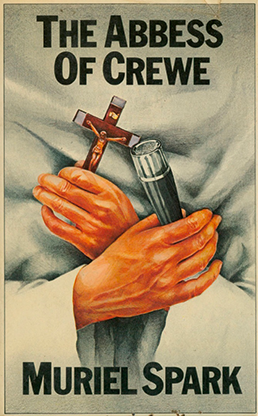
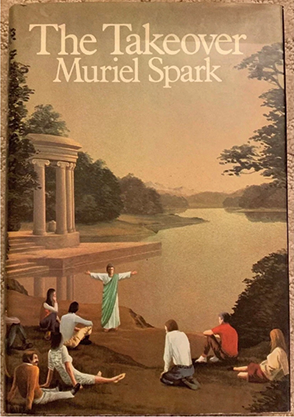
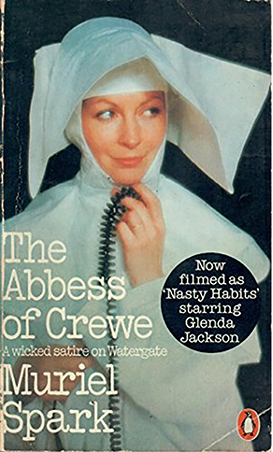
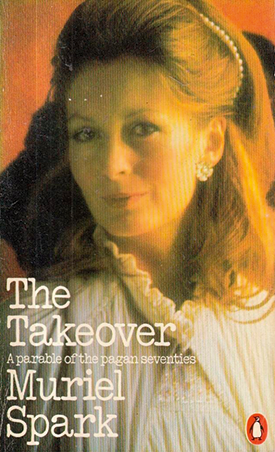
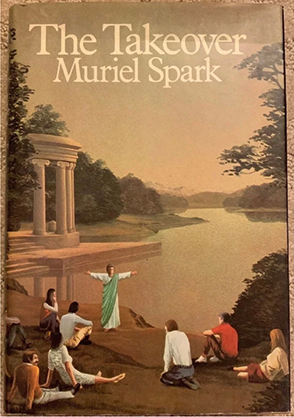
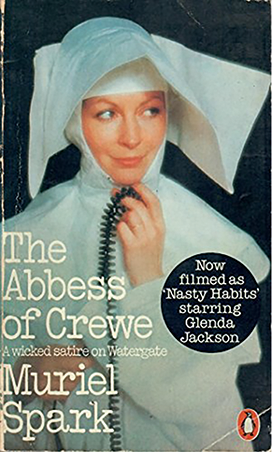
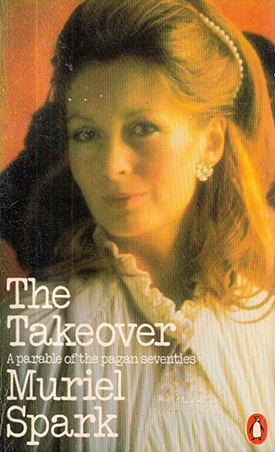
Perhaps the most ‘untimely’ aspect of all the edition’s paratexts, however, is that they completely fail to acknowledge – despite Quartet’s earlier association with Virago and Attallah’s involvement with The Women’s Press – that, between the first publication of the novel and this point, second-wave feminism had arrived. The front cover is very different from either the more explicitly feminist work already being published by Virago or comparable novels by women being published by more mainstream firms. Virago’s early titles – all non-fiction – have covers dominated, on the whole, by figures indisputably female. Their first title, Mary Chamberlain’s Fenwomen: A Portrait of Women in an English Village (1975), featured a naturalistic photograph of a woman pushing a wheelbarrow. The VMC series, of course, from its first title, Antonia White’s Frost in May (1978), used paintings of girls and women on their front covers. Even outside feminist publishing, the covers of novels by women in paperback editions were very different from the Quartet edition of Berg. The covers of Muriel Spark’s novels from the mid-1970s, for example, such as those for The Abbess of Crewe (Macmillan 1974/Penguin 1975) and The Takeover (Macmillan 1976/Penguin 1978) (see Figures 4 and 5), move from less figurative designs in the hardback editions to straightforward images of women’s faces in the paperback.
Muriel Spark, The Abbess of Crewe (a) and The Takeover (b), Macmillan editions.
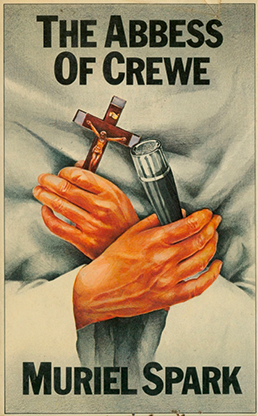
Muriel Spark, The Abbess of Crewe (a) and The Takeover (b), Penguin editions.
The covers of more experimental fiction by women published during the decade tended to avoid naturalistic images, even when in paperback format, but they too differed significantly from the Quartet cover of Berg. Brigid Brophy’s In Transit, for example, challenges even more explicitly than Berg binary assumptions around gender. Set entirely in an airport, with an ambiguously gendered first-person narrator, it was first published in 1969 by MacDonald, and the jacket of the hardback is a monotone, moving-toward-abstraction image of details of an airport. In this, it is cognate with the first hardback edition of Berg, whose dust jacket also featured a sans serif typeface and a black-and-white abstract image, this time a photograph echoing a László Moholy-Nagy photogram or a Man Ray ‘light painting’ (see Section 3 for a reproduction of this cover).Footnote 135 The Penguin paperback of In Transit from 1971, a mass-market size like the Quartet edition of Berg, does feature a figure, and a painting too, again like the cover of Berg, but stylised rather than naturalistic. The figure – half conventionally masculine, half conventionally feminine – is set against a blank yellow background rather than being naturalistically situated, as is the ventriloquist’s dummy on the cover of Berg. The back cover of the paperback edition of In Transit intentionally and humorously mixes the high and the low, in contrast to the awkward mixing of the Berg paratexts. In short sentences, set apart and in different colours, it describes the novel both as a ‘dirty book’ and as ‘lanky, elegant and very nice’, as a ‘labyrinth, a puzzle, a game of hide and seek’ and ‘not straightforward’.Footnote 136
Barber’s ‘Afterword’ continues the cover’s sense that second-wave feminism’s impact had not been considered in relation to the edition. Barber defends Quin from the charge that the scene where Nathan Berg attempts to have sex with his son, who, when dressed as a woman, his father takes to be his lover, Judith, is a ‘flaw in the sense that it is the one place in the book where Ann Quin’s brilliant assumption of a male persona breaks down’.Footnote 137 He goes on, however:
Certainly she wields sex as a weapon in the scene in a way which is, I believe, intrinsically feminine. But to argue that the scene was dictated simply because the writer was a woman and could find no other way of taking her Oedipal theme to a point of consummation is to underestimate Ann Quin’s invention and to misunderstand the true theme of the book.Footnote 138
For Barber, writing ‘as a woman’ is a sign of failure. However, the effect of this scene is actually to undo the unknowability of each sex for the other, to undo that sense of a divide. As his father passes out into a drunken stupor, Aly, as he is often called in the novel, escapes him, thinking: ‘This is how it had been, with Edith [his mother], with Judith … ’Footnote 139 Berg goes on to imagine what sex is like for women in a misogynistic way, evidence of his limited sense of the world, but the effect of the scene is to challenge taboos around sexual behaviour and identity. It is a scene that plays with crossdressing, incest and homosexuality. The ‘true theme’ of the novel for Barber, however, as he goes on to explain, ‘the crux of the problem’, is not the father but the ‘all-forgiving, utterly blameless but consuming mother’.Footnote 140 It is Edith who is ‘the true enemy’.Footnote 141 Quartet published Berg neither in line with the contemporaneously developing conventions of feminist publishing nor in line with the mainstream publishing of other novels by women. The mixed messages of its paratexts in the end suggest that it is a genre novel rather than an innovative literary one. It links the novel to a past popular tradition, the music hall, and to contemporary genre publishing.
The Quartet edition of Berg failed to revive interest in Quin’s work. There is virtually no correspondence in the Marion Boyars’ archive about Quin between 1977 and the mid-1980s. One of the few pieces that is there itself attests to the difficulty of publishing anything by or about Quin at this time. It contains a 1981 letter to Boyars from Brocard Sewell, a Carmelite friar who, through the 1960s, as editor of The Aylesford Review, had championed innovative British writers, including Quin. The letter raises again the possibility of publishing a symposium on Quin that he had wanted to organise after her death, and that Boyars had turned down. In 1976, the year before the Quartet edition, Boyars had written to Paddy Kitchen, letting her know the obstacles to such a publication:
I advised [Brocard] that the only way I think the book can be published is by getting an Art Council’s publisher’s grant … . If a really sizeable publishing grant could be obtained for this, which really literally covers the entire expenses I would be prepared to put my name on the imprint page. But the number of people who would be interested would be very small indeed and one could not possibly publish more than 500 copies, and if these are published at a commercial price it would be something like £5.00 which would frighten away your 500 potential readers!Footnote 142
There is no reply from Boyars in the archive to Sewell’s 1981 letter, and the symposium never appeared.Footnote 143
However, eight years later, in her letter to Nicolas Tredell responding to his difficulties in finding a copy of Tripticks, Boyars let him know that she believed the fortunes of Quin’s work might just be about to change. Not only was a film being made of Berg, but its script, director and cast boded well for its success.
The good news about Ann Quin is that we have finally managed to sell the film of BERG which is going to be released under the title KILLING DAD with Denholm Elliot, Julie Walters, Anna Massey and Richard E Grant in the main role in September. Of course, one never knows how a novel translates into a new medium but with these stars and a good script by Michael Austen [sic] who is making his director’s debut with his film should produce something good [sic].Footnote 144
A successful film or TV adaptation is perhaps both the epitome of evidence of timeliness and of an event that could make a novel, published first sometime in the past, timely. However, if Boyars’ place in the field of publishing limited the extent to which the firm could control the ‘totality’ of Berg and so shaped the meaning, reach and eventual failure of the Quartet edition, it was also a determining factor when the golden goose of the literary industry – a film adaptation – was proposed and made. To tie in with the release of the film in September 1989, Boyars licensed Berg to another paperback publisher, Grafton, whose edition as part of its Paladin imprint was the third republishing of the novel in its ‘intervening time’ (see Figure 6). This time, the edition was a trade, rather than a mass market, paperback, but nevertheless the circumstances of its publishing – its relation to the film – meant that it too failed to revive interest in Quin’s novels.Footnote 145
Ann Quin, Berg, Paladin, 1989, front cover (a) and back cover (b).
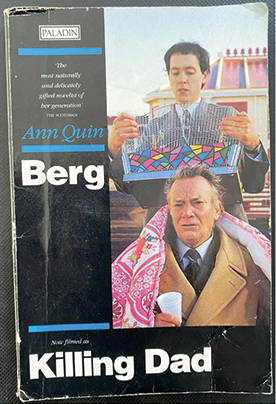
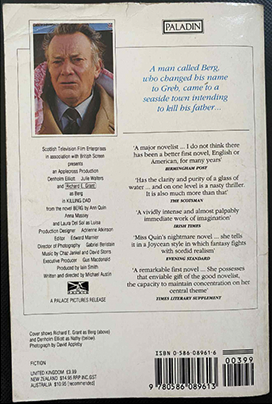
Ostensibly, Boyars had a lot of control over Quin’s work. In 1976, Boyars had explained to Paddy Kitchen that, having lost touch with Quin’s heir, her nephew, Jeremy Ward, she was ‘acting as the unofficial executor of Ann’s estate’.Footnote 146 Even after she found Ward in order to finalise Austin’s option, the ‘Deal Memorandum’ setting out the terms for it was, for example, signed by Boyars ‘for’ Jeremy Ward.Footnote 147 Later, when it came to signing the contract itself, Boyars wrote to Ward that ‘[a]lthough you have given me a blank to sign they insist on your signing as well’.Footnote 148 In other ways too, Boyars clearly attempted to keep control of the process in order to benefit both Quin’s work and her company. In a letter from 1988, Frank Bloom, from the production company’s firm of solicitors, responded to Boyars’ request that her firm be named in the film titles, letting her know that while it ‘may be French practice … it is not Anglo-American practice and there would be difficulties with the distributor’.Footnote 149 However, while Boyars signed the ‘Deal Memorandum’, the document makes clear the difficult gaps around questions of control. The agreement selling the option to Austin’s production company in April 1987 states that:
The title of the Book will be the title of the Film.
If the title of the Film is different from the title of the Book, Author has the right to use Film title on all copies of the Book.Footnote 150
This formulation fails to distinguish between author and publisher, but it also fails to suggest what might occasion the move from the first statement to the second. Once the option had been exercised, at the beginning of 1989, and the script written, it became clear that the title of the book would not be the title of the film. Boyars objected to the title Killing Dad for reasons that echoed Quin’s response to a script of Berg that had been written in the late 1960s following an earlier option – both were uncomfortable with what they saw as a misunderstanding of genre in relation to the novel. In a letter to her friend, Larry Goodell, in August 1967, Quin let him know that the earlier script was ‘somewhat melodramatic: mum puts head in gas oven, and dad is finally stabbed by son at the pier – maybe Hammer productions will eventually do it?!’Footnote 151 For Boyars, genre was the issue with the later script too, and she tried to use her authority as a publisher to persuade Frank Bloom to get the production team to think again:
Jeremy Ward and I have one niggling thought; we do not like the working title Killing Dad (it sounds like a farce and so very English that they will have difficulties selling it in the U.S. and elsewhere). I hope they can be persuaded to rethink the title. We realize that we have no legal rights in this matter, but I certainly have many years of publishing experience and know how very important a title is.Footnote 152
Boyars’ suggestions were not taken up. While she did much to try to expand Quin’s reputation at the time of the film,Footnote 153 the licensing of the novel to Grafton compounded the problems Boyars was already aware of when she wrote criticising the title. The edition is strongly tied to the film. The cover is dominated by a still from the film of Richard E. Grant as Alistair Berg and Denholm Elliott as Nathy Hedge/Monty Berg.Footnote 154 The back cover includes a cropped photo, taken from the front cover image, of Denholm Elliott alone. The front cover reproduces the title of the film in letters as big as the title of the novel; the back cover lists the film’s credits.
The film, however, was a flop. As Ward wrote to Boyars after she sent him copies of the new paperback: ‘alas, I do not hold out too much hope for “Killing Dad”’.Footnote 155 Critics, on the whole, went further than Ward in their sense of the film’s failings. For them too, as it was for Boyars, what is key is the question of genre, and in the reviews, this question of genre is linked to timeliness. Derek Malcolm suggested that the film should have been an ‘Ortonesque black farce’, but was rather one that made its cast look ‘fairly like end of pier performers’.Footnote 156 Tim Pulleine also linked the film to Joe Orton, but in the sense that he saw it as in the ‘sub-Joe Orton vein of comic grotesquerie’, and so as ‘rather dated’.Footnote 157 As I have suggested in relation to the Quartet edition, this datedness seriously misrepresents the temporalities of Berg. Killing Dad reproduces the seedy outdatedness of Berg’s mise-en-scène but fails to reproduce on screen its narrative ironising of that. The film substitutes the ironic distance between the novel’s fabula and syuzhet with farce. The judgement of the film as untimely has not softened with time. In its summing up of the film in its guide to the movies in 2012, Time Out concluded that ‘the film is not located in real time at all, only somewhere between Brighton Rock and The Punch and Judy Man’.Footnote 158
If the film was in the end ‘untimely’, its cast and scriptwriter/director, as Boyars’ letter to Tredell suggests, should have resulted in the opposite. The casting was determined by the nature of successful films of the 1980s and their very particular ways of making timely. Both Denholm Elliott and Richard E. Grant were, in the late 1980s, associated with films about the UK’s past. Elliott was associated with ‘heritage’ films, set generally in the first half of the twentieth century, often adaptations of novels, which looked back nostalgically to supposed certainties of economics, class, gender and nationality.Footnote 159 He appeared in A Private Function (dir. Malcolm Mowbray, 1984), A Room With A View (dir. James Ivory and Ismail Merchant, 1985) and in Maurice (dir. James Ivory and Ismail Merchant, 1987). Killing Dad is not a ‘heritage’ film, however, and in some ways is more like Richard E. Grant’s first film, Withnail and I (dir. Bruce Robinson, 1987), set in 1969. Although the film had not been successful on release – its cult status came later – the character of Withnail, in his solipsism and mixture of ‘main character’ confidence and vulnerability, must have contributed to the decision to cast Grant as Berg. Killing Dad is a comedy, like Withnail and I, with elements of black comedy, like Prick Up Your Ears, the Joe Orton biopic also set in the 1960s and also released in 1987 (dir. Stephen Frears), but its relation to the past is very different from either of those. Bruce Robinson has acknowledged that Withnail and I is haunted by the ‘horror of Thatcherism’Footnote 160 and in Prick Up Your Ears the 1960s and the present are explicitly contrasted through a framing device. In Withnail and I the 1960s is a place of freedom and possibility before the 1970s which brought the first Thatcher government; in Prick Up Your Ears, the relation between the past of the 1960s and the 1980s is more complex, the former full of possibility but marred by homophobia, the latter more venal and conservative in many ways. In Killing Dad, the past is merely a farce, a comedy, silly, naïve, vulgar and repellent. It is the present which ‘knows’. Those key words of Thatcherism, for example, ‘enterprising’ and ‘entrepreneur’, are used ironically in the film, but the irony is not against their contemporary meaning but against the characters from the past. A voiceover by Edith, Berg’s mother, tells her son that his father was an ‘entrepreneur’. While this is just one of the many illusions Edith has about her absent husband, it is not entrepreneurs that are the butt of this joke, but Edith.
Michael Austin, who wrote the screenplay for and directed Killing Dad, like Elliott and Grant, was associated with 1980s films which ‘made timely’ the past. He had written the script for Greystoke: The Legend of Tarzan, King of the Apes (dir. Hugh Hudson, 1984), the film’s distinction being that it was a relatively faithful adaptation of the first Tarzan novel, Edgar Rice Burrough’s Tarzan of the Apes, published in 1912. In addition to this, Hudson, the film’s director, had previously directed Chariots of Fire (dir. Hugh Hudson, 1981), a film which Geoff Eley argues ‘[a]nnounced and initiated’ the British heritage film of the 1980s.Footnote 161 However, Austin’s script fundamentally misread Quin’s novel in relation to its engagement with temporality. Berg is set in a present where the deathly effects of the past dominate the story, but the story is in tension with a narrative that shows the possibilities of the present for change. What Alistair Berg is struggling to do in trying to kill his father is stop the past, to put himself fully into the present, to make the time his. As he thinks to himself:
The tragic sense of destiny is inherent in every man; but I defy fate, I alone am responsible for every action, every scene; in my nothingness I will create the idea, I shall see what I have imagined, and from that alone will spring my entire actions.Footnote 162
While Berg articulates in technique the investment in the new and in the present that can be seen in the nouveau roman and nouvelle vague cinema, what it shows is a newness foiled, unable to lay the past to rest. Berg does not kill his father. The novel ends not only with Berg Jr becoming his father, having moved into the room previously occupied by his father to live with Judith, his father’s lover, but it ends too with the suggestion that his father is now living in the room next door, the room Alistair previously occupied. What Alistair Berg shows is the failure to achieve the contemporary; what Berg shows is the reason for this, the deadening effects of British culture – narrow, class-ridden, patriarchal, living in the past. Berg is of the present by representing the failure of those still imbedded in a certain kind of Englishness to be of the present. The novel distances itself from the past; Killing Dad reproduces it.
The gendering of risk shaped Marion Boyars’ publishing in the 1970s and 1980s. While she continued to try to make Quin’s work timely, her licensing of Berg to both Quartet and Grafton meant that she did not control how these paperback editions were published. Neither of them brought Quin’s work back into contemporary literary culture. The Grafton paperback of 1989 was the last time a new edition of one of Quin’s novels would be republished in the UK until And Other Stories’ editions came out thirty years later. It is to that republishing, beginning in 2018, that I turn in Section 3.
3 Ann Quin, Our Contemporary
A new generation of readers discovering their literary ancestors must be a good thing, so long as it serves the demands of the present rather than answering to a nostalgia for a future that belongs to the past.
The republishing of Berg in the 1970s and 1980s failed to establish Quin’s reputation because, licensed to paperback publishers and so beyond Marion Boyars’ control, the editions aligned the novel with the past when in fact it was an attempt at its exorcism. Its innovative narrative techniques could be accommodated neither within the paperback editions’ nor the film adaptation’s take on the past. This temporal gap also inflected the publishing of other experimental novels by women in this period. As D-M Withers has argued, in the late 1970s and 1980s, nostalgia framed the VMC series, shaping the whole array of its paratextual material, from typeface to cover illustration.Footnote 164 It was this framing that made the series so successful, but the framing was less successful when, from 1990 onwards, the series started to publish more experimental work from the postwar period, such as two novels by Brigid Brophy and four by Ivy Compton-Burnett.Footnote 165 In a 1997 interview, Marion Boyars noted the lack of fit between Virago’s recovery model and innovative work. While she expressed her admiration for the firm, she qualified this with the judgement that it ‘went wrong when they published people other than the classics’.Footnote 166 As we have seen too, though, the model of restricted production, to which Boyars clearly linked her own publishing, was not reproduced in Quin’s ‘intervening time’. Quin disappeared in the 1990s. At the end of the second decade of the twenty-first century, however, Quin became our contemporary. Through the success of the And Other Stories editions of her four novels, in the words of Jonathan Coe quoted in Section 1, it would seem that her ‘time has come at last’.Footnote 167 In unpacking the reasons for this and some of the reasons why we should be cautious about it, I will first place the republishing of Quin in the context of the recent revival of independent literary publishing in the UK, and then go on to read the paratextual material of the And Other Stories editions to suggest what the implications of Quin’s new timeliness might be. What I will show is that Quin’s work has been ‘made timely’ because the dynamics of twenty-first-century capitalism have changed our understanding and experience of time and so of the timely.
‘Maverick Publishers’ and Timeliness
Marion Boyars’ sense of the dynamics of the different fields of publishing – and the way the restricted and the commercial, to use Bourdieu’s terms, define themselves in relation to each other – led her, in 1988, to what she calls ‘crystal-gazing’. In her chapter in the Peter Owen collection, Publishing: The Future (1988), as well as thinking, as we have seen, about what a career in publishing might mean for women, she predicted that in ten years’ time, ‘there will be between five and ten international entertainment conglomerates in the Western world of which publishing will form an economically small but culturally significant part’, and that current independent publishing companies will ‘in some form or other have joined these conglomerates’. Beyond this, though, she predicts that, looking twenty-five years ahead, to the early teens of the second decade of the twenty-first century, ‘we will be back to a modified version of the system I encountered when I entered publishing in 1960’, with new, independent firms reappearing, spurred on by the dullness and conformity of conglomerate publishing:Footnote 168
Our real hope is that the maverick publishers comparable to the innovators of yore, those legendary, infuriating and exceptionally creative eccentrics who could either function as employees or owners, will emerge – since every society throws up such people from time to time: and that these will veer towards a new kind of publishing independence, and through their inventiveness will create conditions where this can really come into being.Footnote 169
While Boyars’ sense of timing was spot on – from around 2010 onwards, the number of independent literary publishers in the UK exploded – her sense that the new ‘mavericks’ would be ‘modified’ repetitions of those from the 1960s was not. The situation for independent presses publishing innovative literary writing in the second decade of the twenty-first century was very different from that of their forebears, and this difference has implications for an understanding of ‘timeliness’.
Of the ‘maverick’ independent presses who, according to Anthony Cummins in 2023,Footnote 170 have ‘redrawn’ the ‘map of British publishing’, nearly all were founded in the second decade of the twenty-first century, dotted around Boyars’ predicted year of 2013. Daunt and And Other Stories began publishing fiction in 2010; Jacaranda, Influx and Galley Beggar Press in 2012; Fitzcarraldo Editions and Dostoyevsky Wannabe in 2014 and Tilted Axis in 2015, with another wave a few years later, with Peninsula Press beginning in 2018, and Swift Press, Lolli Editions and Cipher Press all in 2020. The founding of a large number of independent presses in the UK during this period has been linked to the economic crash of 2007/8 by a number of commentators. While the second edition of John Thompson’s Merchants of Culture retains the argument that the ‘polarization of the field’ in Anglophone publishing has been developing over decades, in it he acknowledges too the intensification of that polarisation since 2008.Footnote 171 It is of course the case, as Sarah Brouillette’s work has made very clear, that ‘the real economy has an absolutely foundational structuring role in transformations in the fate of the literary as a set of affects and dispositions’,Footnote 172 but in many ways, the link between the financial crash and the increase in independent literary publishing is a strange one. As Brouillette also notes, in an economic situation of stagnation and contraction, ‘[t]he things that are necessary to the development of the specifically literary disposition, which were always relatively distinguishing and elite, are now decreasingly available’.Footnote 173 The years of austerity under the coalition and then Conservative governments in the UK between 2010 and 2024 – those years of boom in independent literary publishing – saw a massive contraction of those things that Brouillette suggests are necessary for ‘the literary’ to thrive: public libraries, English departments in universities, secure employment, and so leisure time and the money with which to fill it, state support for the arts, and the possibility of earning a living through writing.Footnote 174 The squaring of this circle has been attempted by different independent publishers in different ways, but crucial has been a redefinition of ‘making timely’.
It is differing regimes of timeliness that most distinguish the new independent publishers from Boyars’ earlier ‘mavericks’.Footnote 175 The importance of Calder and Boyars as a publisher rested to a significant extent on its sense of the temporality of modernity. Modernity, as so many have argued, produced and reproduced time as progress and decline, and in particular, this shaped a sense of the future as conceivable, open to prognosis and to being reshaped.Footnote 176 Calder and Boyars published, that is, according to a very specific temporal sense, one that saw the historical avant-garde as its contemporary and which enmeshed the future into the present through the publishing of new experimental work. What this publishing did was to suggest, pre-empting Bourdieu, that innovation needs time to be fully seen, but it also demonstrated what Adam Guy describes as Calder and Boyars’ commitment to making up ‘the lag that separated new and experimental writing from its potential audience’,Footnote 177 motivated both by democratic principles and by the need to survive economically. In other words, so often for the firm, their claim was that the future can be now. These temporal conceptions can be seen in the original publishing of Berg. The jacket of the 1964 edition featured a photograph, an abstract image alluding to visual innovations in the first half of the twentieth century, such as László Moholy-Nagy’s photograms or Man Ray’s ‘light painting’ (see Figure 7).Footnote 178 However, the cover would not, in 1964, have been read as backward-looking. The most influential postwar book covers, such as those by Alvin Lustig, in particular those he did for the influential US independent publisher New Directions from the 1940s, united modernism with the contemporary in a way that explicitly engaged with the temporalities of modernity. Lustig, for example, wrote that the designer is ‘an integrator of all the art forms – and simultaneously a spokesman for social progress’.Footnote 179 Indeed, what covers such as Lustig’s did was to unite the avant-garde from the past with a present that looked to the future. In similar ways, the cover of the original edition of Berg uses a light explosion, a sans serif typeface, and strong contrasts to balance the placing of Quin in a tradition (as the other Calder and Boyars’ titles listed on the front and back flaps do) with the assertion of her as new, as part of the future which is just arriving.
Jacket of the first Calder edition of Berg, 1964.
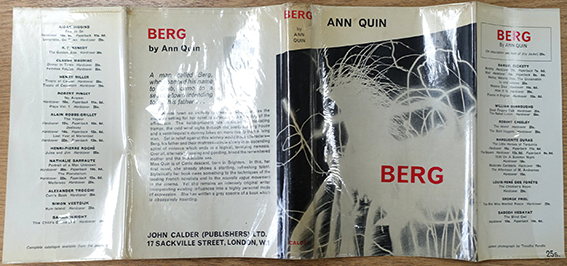
To integrate a vision of the future into the present, as Calder and Boyars’ publishing did, what is necessary is a sense of the future, and it is of course precisely this, as has been argued by many, that our contemporary lacks. We live, as a result of the shift from industrial to financial capitalism, in what Fredric Jameson called ‘the perpetual present’, which he describes as:
the way in which our entire contemporary social system has little by little begun to lose its capacity to retain its own past, has begun to live in a perpetual present and in a perpetual change that obliterates traditions of the kind which all earlier social formations have had in one way or another to preserve.Footnote 180
The ‘perpetual present’ has lost the past and has obliterated a sense of a future that might be different from the present. Jameson’s discussion of the perpetual present is originally from the 1980s (the original version of the essay from which the above is quoted is from 1988), predating the widespread domination of contemporary life by the digital, but the time of the perpetual present is most flagrantly the time of digital technologies. Joel Burges has argued that, through the second half of the twentieth century, the past has not exactly been lost but has been envisaged through cycles of obsolescence and innovation, and that, in particular, the concept of the ‘product life cycle’ has produced a very particular temporal horizon:
in which the experience of historical time is inseparable from innovation and obsolescence, which rhythmically alternate between future and past in a contrapuntal cycle that repeatedly and recursively turns these times into one another within the current moment.Footnote 181
The past and the future exist only, in this dynamic, within the moment of the perpetual present. For Burges, digital computing exemplifies the acceleration of this dynamic in the late twentieth and early twenty-first centuries through the central place of planned obsolescence, but also, as many have noted, it is the primary vehicle of its acceleration. Rob Kitchen argues that ‘the embedding and growing influence of digital technologies across all aspects of everyday life indicate that we have transitioned to a period where the production and experience of time is qualitatively different from in the pre-digital era’.Footnote 182 His survey of theories of time in the contemporary shows that many different descriptions exist of the time produced by the digital – real time, networked time, timeless time, instantaneous time and the interchangeability, in Barbara Adam’s words, of the ‘no-where’ and the ‘now here’.Footnote 183 What all these contemporary theories see as produced by the digital, though, is Jameson’s ‘perpetual present’.
Contemporary independent literary presses exist, then, unlike Calder and Boyars, in a digital world that produces and normalises a perpetual present where there is no non-commodified relation to the past and no sense of a future which is not immediately folded into, rather than transforming, the present. Brouillette’s identification of those things necessary to support literary culture suggests that this temporality of the contemporary is seriously in tension with the idea of the literary. As Simone Murray has noted:
Bourdieu’s consecrators of symbolic capital saw themselves as functioning in advance of high cultural trends – initiating trends through their avant-garde tastes – whereas algorithmic culture, on the other hand, functions retrospectively or in real time … .Footnote 184
The independent publishers of the second and third decades of this century exist, however, both in tension with, but also because of, that digital world. Changes in production from the beginnings of desktop publishing onwards have made smaller print runs more possible, improved print-on-demand technologyFootnote 185 has made it more attractive to literary publishers as a way of abolishing the key risks associated with the traditional publishing model, and social media has made easier the creation of the ‘reader communities’ on which these publishers depend.Footnote 186 Their economic model needs the perpetual present of digital technologies; their sense of value, in order to stave off the decline analysed by Brouillette, needs a different temporal regime. The clash between these temporalities has been noted by Mark McGurl in his study of Amazon, where he identifies the tension between the ‘real time’ which subtends Amazon’s brand and the ‘quality time’ that inheres in novels and the reading of them. The latter, he argues, is a time of ‘intimacy, of analog, face-to-face, inter-subjective attention’.Footnote 187 Contemporary independent publishers are, then, caught between the fact that digital technologies make them possible and the fact that the perpetual present of those technologies destroys the markers of aesthetic value forged throughout the twentieth century. Different literary publishers – from the more mainstream to micro presses – have managed this in different ways, and with different levels of success. But republishing has been key in attempting to square this circle – drawing on a past whose certainties included, supposedly, the value of the literary. A sense of the various ways that republishing over the last decade or so has done this will illuminate the different dynamics of And Other Stories’ republishing of Quin, which I will discuss in the final part of this section.
The key way that contemporary independent publishers attempt to manage the tension between the perpetual present and literary value is through the design of their books, through their existence as ‘branded’ material objects.Footnote 188 This is in clear distinction to the strategies of mainstream literary publishing – at least until the success of the independents started to influence them.Footnote 189 In 2007, a few years before the boom in new independent publishers in the UK, Claire Squires noted that, in relation to literary publishing, ‘imprints do not, for the main, play a large part in consumers’ consciously stated decisions’, but that it is the author who constitutes the brand.Footnote 190 In contrast, And Other Stories, along with other independent publishers such as Fitzcarraldo Editions, Galley Beggar Press, Prototype and Silver Press, for example, all established over the last fifteen years or so, denote their distinction and materialise the claims for literary quality they are making about their titles through branded cover designs which are sparse, uniform, often monochromatic and textual rather than visual. Indeed, this aesthetic was initially so out of keeping with the tendencies of the mainstream that Fitzcarraldo Edition’s covers have been called ‘anti-covers’.Footnote 191 This design language reproduces the practices of French literary and academic publishing, a style begun in 1911 with the austere covers of Éditions Gallimard, dubbed ‘La Blanche’. It looks back, then, to the early twentieth century as a way of asserting the values of the literary that are embedded, as we have seen, in the temporalities of modernity, but this has to be managed carefully when republishing, to ensure that the title and the brand are not returned to the past rather than bringing that title into the present. These design decisions, then, accord with both McGurl’s sense of the way novels challenge the implications of the perpetual present and ‘real time’, but they risk too an undoing of the ‘timeliness’ of the republishing of postwar women writers. This can be seen in the very different recent republishings of two of Brophy’s novels, Hackenfeller’s Ape (1953) by Faber Editions in 2023 and In Transit (1969) by Lurid Editions in 2025. Between these two editions can be seen the different ways in which contemporary temporality, and its undermining of the broad constructions and assumptions of the literary, are managed by contemporary independent presses, and the implications of this for postwar women’s writing.
It is possible that the creation of the Faber Editions series has a link with the creation of a key independent press, Galley Beggar – a link which reveals the tensions between the values of the literary and contemporary conceptions of temporality. In an article in the Guardian in 2009, following the release of the Faber Firsts box set which he describes as ‘lovely new editions of old books’, Sam Jordison questioned whether the contemporary Faber stands for anything. Looking at their current list and comparing it to the days when T.S. Eliot was an editor there, he says:
I couldn’t nail any definite pattern or editorial intent. There are many fine books there, but the list is now far broader – but perhaps also far thinner – than anything Eliot would have imagined. Are they now far removed from their early glory days?
Jordison goes on to suggest that Faber, while technically an independent, has gone the way of the mainstream literary publishers. He ends his article:
Now that so many of these once proud marques have been absorbed into corporate monoliths, they have given up on dictating terms. The singlemindedness that built up the brands has gone and we are left with a few handsome labels, but nothing they really stick to anymore. Even Faber are trading on past glories. So who is going to replace them?Footnote 192
In answering his own question, Jordison went on to found, along with Eloise Millar, Galley Beggar Press, describing it as an ‘old-fashioned publisher for the 21st century’. In an interview, he makes it clear that his thinking about Faber informed the design decisions made in relation to Galley Beggar, whose titles are made coherent through a brand that focusses on the press itself.Footnote 193 Jordison’s thinking in the Guardian article was significant then in his founding of an independent press which publishes new work which it links to literary values from the past, but it might have been significant too in Faber’s creation of the Faber Editions series, which, in republishing novels, goes back to the coherent 1950s identity of which Jordison’s article laments the loss.Footnote 194 Faber Editions, which began in 2021, is described on its website as having the aim of:
Bringing radical literary voices back to life – Faber Editions spotlights rediscovered gems from our archive and beyond, resurrecting radical literary voices who speak to our present, championed by world-famous authors.Footnote 195
While this statement of intent draws on the rhetoric of recovery that was central to feminist presses, the way the paratexts of the Faber Edition Hackenfeller’s Ape, in Genette’s words, ‘present’ and ‘make present’ to the contemporary reader is a problematic version of the VMC’s ‘making timely’ (see Figure 8).Footnote 196 Amy Elias has described the contemporary as the time of ‘techno-duration’, a version of the perpetual present in which the present both spreads out like ‘tsunami waters over the past’ and invades the future.Footnote 197 One consequence of ‘techno-duration’ is the construction of what Elias calls ‘retrofuturism’, which looks back on the ‘futuristic productions of the past’ and ‘sees them as quaint utopian hopes of a future than never arrived’. Thus, techno-duration is shot through with both a dismissal of the naivety of the past and a nostalgia for it, in particular of and for the futuristic styles of the 1950s and 1960s.Footnote 198 But the nostalgia and the dismissal are part of the same thing. Retrofuturism sees a past that had a vision of the future as naïve and ultimately as a failure (otherwise, we wouldn’t need to be nostalgic about it). This can be seen in the ubiquitous domination of the contemporary by the aesthetic called (retrospectively) mid century modern, and it can be seen too in the use of that aesthetic in the Faber Editions. While the dates of original publication of the seventeen titles released so far in the series run between 1929 and 1982, over half are from the 1950s and 1960s. The series design and covers all suggest an aesthetic resonant of the mid century, even when they weren’t first published in the 1950s, such as Kay Dick’s They, first published in 1977 by Allen Lane, or Rachel Ingall’s Mrs Caliban, first published in 1982 (by Faber).Footnote 199 Faber Editions’ design is based on that of the Faber Paper Covered Editions series, launched in the 1950s with a strip down the right-hand side of the cover designed by the celebrated type and book designer Berthold Wolpe, who worked for Faber between 1941 and 1975, and who designed the typeface, Albertus, most associated with it.Footnote 200 The design of the new series has been articulated explicitly in terms of temporal coherence. In an article on Waterstone’s website about the series, its editor and two of Faber’s senior designers describe its aim precisely in terms of the relations between past, present and future. While wanting to ‘channel’ the boldness of Wolpe’s strip, so ‘harking back to Faber’s heritage, it was vital that it was reinterpreted, as this new series symbolised reinvention – fusing not only past and present, but the future, too’.Footnote 201 However, the reproduction of the original 1950s design and the fact that the ‘finishes were chosen to signal craft and elegance, with a woodcut quality lent by the uncoated stock and textured deboss on the type’, together signals a particular version of the past. Not only the Wolpe strip, but the finish and the design for each title all recall the woodcut style most obvious in the work of Eric Ravilious, whose work was produced in the 1930s, but which is now so often used to signal a general mid century sense of the future.Footnote 202 The 1953 cover of Brophy’s novel is of a piece with this aesthetic, and signals the importance of it by naming the creator, Asgeir Scott, on the cover, but of course, as Elias’s definition of retrofuturism makes clear, the revival of a style changes the meaning of that style (see Figure 9). Hackenfeller’s Ape tells the story of a scientist, Professor Darrelhyde, who attempts to save an ape, Percy, from being launched into space. The original cover does not reference the space travel element of the novel at all, while the Faber Editions Hackenfeller’s Ape signals broadly a retrofuturistic construction, not least through the small space rocket that doubles of the monkey’s nose, travelling toward a moon that doubles as its eye. The retrofuturism of the Faber Editions cover means that Hackenfeller’s Ape is framed as a dead past rather than as having a live relation to the contemporary. As Elias suggests, without a critique folded into a return to the future-oriented near past, that return produces ‘the perfect kitsch object for market recirculation’.Footnote 203
Brigid Brophy, Hackenfeller’s Ape, Faber Editions, 2023.
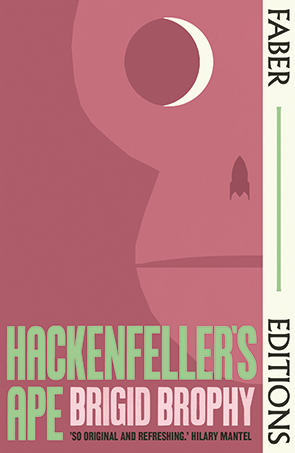
Brigid Brophy, Hackenfeller’s Ape, Rupert Hart-Davis, 1953.
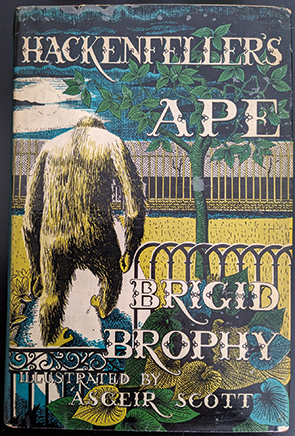
In contrast, the cover of Lurid Editions’ 2025 In Transit produces Brophy and the novel as our contemporary (see Figure 10). Lurid Editions’ publisher is D-M Withers, whose work on the VMC series has been such an important interlocutor for this work. The cover makes no reference to the time of original publication, but rather, like all the titles republished by Lurid Editions, has a plain pink cover, distinguished in the case of In Transit by waves that represent both chem trails produced by aeroplanes and the transgender pride flag.Footnote 204
Brigid Brophy, In Transit, Lurid Editions, 2025.
The negotiation of timeliness as seen in the independent sector recently has influenced the mainstream, and here its implications are more flagrantly signalled. If the Faber Editions’ republishing of Hackerfeller’s Ape approaches kitsch through its retrofuturism, with Penguin’s 2022 edition of Anna Kavan’s Ice (1967) in its Little Clothbound Classics series, kitsch has fully arrived (see Figure 11). While Ice had been kept continually in print by Peter Owen, who first published it in 1967, like Quin’s novels, it only fully entered literary culture in the second decade of the twenty-first century. It became a Penguin Classic in 2017, but this consecration, to use Bourdieu’s term for the movement from restricted production to more mainstream recognition of value,Footnote 205 has quickly become kitsch. Penguin describes the series as consisting of ‘mini editions of short stories, novellas and essays from the world’s greatest writers’.Footnote 206 Ice is part of the series’ ‘winter collection’,Footnote 207 which includes, alongside Ice, a number of stories set at or about Christmas, such as O. Henry’s Gift of the Magi (1905), Conan Doyle’s The Adventure of the Blue Carbuncle (1892) and Saki’s Reginald’s Christmas Revel (1904). The inclusion of these, familiar and consoling, makes it clear that these are gift books. The 2022 edition of Ice is a small, clothbound hardback with stamped decoration that resembles late nineteenth-century book design, such as the book covers designed by Walter Crane.Footnote 208 The messages given out by the packaging of Ice in this series have created a significant gap between text and paratext. The paratexts of the edition, from the shaping of the series to the embossed cover, speak of consolation and nostalgia; like Berg, Ice itself destroys both.
Anna Kava, Ice, Penguin, 2022.
A very different way of negotiating the tension between the perpetual present and the literary can be seen in the recent republishing by Pushkin Press of a number of works from the 1950s and 1960s, originally published by Peter Owen, including Ice, in their Pushkin Press Classics series.Footnote 209 The series design sits between the nostalgia of the Faber Editions and the contemporary design of the Lurid Editions’ In Transit. This series, too, has a uniform design, but it stays just this side of nostalgia. Indeed, on the cover of the Pushkin Press Classics edition of Ithell Colquhoun’s The Crying of the Wind, Ireland from 2025, first published by Peter Owen in 1955, the woodcut aesthetic of late nineteenth-century book cover design is updated rather than, as in the Penguin Little Clothbound Classics series, pastiched (see Figure 12).
Ithell Colquhoun, The Crying of the Wind, Ireland (a) and Anna Kavan, Ice (b), Pushkin Press, both 2025.

What I am going to suggest in the rest of this chapter is that And Other Stories’ republishing of Quin manages the tensions between the perpetual present and literary value quite differently from the approaches of Faber Editions, Penguin or Pushkin. Rather than returning her to the past in any way, their republishing asserts her as our contemporary. While it might seem like this folding of time, although it avoids suggesting that the past is naïve and lacking, risks colluding with the perpetual present, I will argue that these editions suggest rather that something from the past – Quin’s novels – needs to be our contemporary because it is us, the present, that lacks. However, as I will suggest, the specific ways in which Quin’s novels are made timely, while remaking the ‘recovery’ trope, have mostly jettisoned any link between a new kind of ‘recovery’ and feminism.
Making Quin Our Contemporary
The And Other Stories editions of Quin’s novels have made Quin part of contemporary literary culture (see Figure 13). In 2018, reviewing The Unmapped Country, Ian Patterson noted that, ‘[a]fter maintaining scarcely a cult reputation among writers in the years since her death … now everyone’s writing about her’.Footnote 210 These editions are the first time that Quin’s novels have been produced in a series of their own, with their own shared design, and they are the first time that the novels, with the exception of Tripticks, have been newly typeset, rather than using the original Calder and Boyars’ sheets.Footnote 211 They are not though entirely without precedent. The novels were licensed by Marion Boyars Ltd to the US publisher Dalkey Archive Press at the beginning of the twenty-first century, who put out paperback editions – Berg and Three in 2001, Tripticks in 2002, and Passages in 2003 – in various formats and designs. While these editions, which went out of print before the end of the first decade of the new century, share some of the paratextual features of the And Other Stories’ editions, it was not through them that Quin’s time was made our contemporary. This is in part because the timeliness of the new editions inheres in the particular place of And Other Stories in contemporary independent publishing. Until 2025, Quin was the only Anglophone woman novelist from the past to be republished by And Other Stories.Footnote 212 The company was founded to publish work in translation, and most of their titles fall into this category, while work in English published by them has, until now, focused on original publication.Footnote 213 It is the time lag inherent in publishing work in translation, however, that has shaped the publisher’s definition of the contemporary, and so has shaped their republishing of Quin. The ‘11 Commandments’ set out on And Other Stories’ website state that the firm publishes ‘mainly contemporary writing, which for us means written in the last 50 years or so. There are a lot of good writers to catch up with from other literatures. Books can have slow fuses’. The next ‘commandment’, no. 4, implicitly links this lag to Quin: ‘We focus on new publications, but don’t rule out great books from the past that never had the reception they deserved, or which fell into neglect. We’re proud to be growing the Ann Quin fan club with our new editions, for instance.’Footnote 214 The publishing of Quin, then, is set within an idea of timeliness quite different from that of most other publishers.
Ann Quin, Berg, Three, Passages and Tripticks, And Other Stories, 2019–2022.
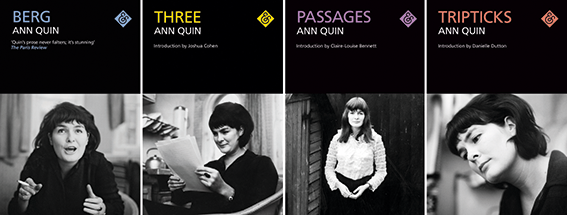
The context of And Other Stories’ publishing of Quin is not just that of translated work, however. In 2015 the novelist Kamila Shamsie wrote in the Guardian about the ‘gender imbalance that exists in publishing houses, in terms of reviews, top positions in publishing houses, literary prizes etc’ and in response suggested that 2018, as the centenary of women over thirty getting the vote, be designated ‘a Year of Publishing Women’.Footnote 215 In January 2018, the Guardian reported that only one publisher had responded positively to Shamsie’s challenge and had decided to publish only women in that year – And Other Stories.Footnote 216 It was the year, of course, that The Unmapped Country was published; the year that Quin returned to contemporary literary culture. Shamsie ended her Guardian article by arguing that the real question following 2018 as a ‘Year of Publishing Women’ would be ‘what would happen in 2019?’. In relation to Quin, of course, the answer was that Berg was republished. Shamsie also acknowledges in her article, however, that what really made a difference to the inclusion of women in literary culture over the previous decades were all-women spaces – the feminist presses of the 1970s and 1980s, ‘of which Virago is the most notable’, and women-only literary prizes. Virago made the women novelists they republished in the VMC series ‘timely’ in very different ways to And Other Stories’ republishing of Quin, however, as the rest of this section will show. The paratexts of the And Other Stories editions make Quin timely because they resist the recourse to nostalgia in asserting the literary over the perpetual present of the digital contemporary. In so doing, however, as I will go on to show, they risk reproducing the conventional gendering of the market.
It is in the visual grammar of the cover design, uniform across each of Quin’s four republished novels, that Quin is most firmly made our contemporary. Much about the covers aligns with visual cues that have been used so extensively by the post-crash independent literary presses in the UK. Their matt black colour, sans serif typeface and relatively large expanses of ‘empty’ space align them strongly with these broad contemporary trends. So too does the link made between the specific title and the brand of the publishers. On the front covers and spines of the And Other Stories editions, the title of each novel has a different colour, and this colour is repeated in the colophon in the top right-hand corner and in the blurb, quotation attributions and colophon on each back cover. The colours distinguish each title, but what is repeated is the identity of title and publisher. Unlike the covers of, though, for example, Fitzcarraldo Editions, Galley Beggar Press, Silver Press, and many of And Other Stories’ titles, the Quin editions are not just monochromatic space and text. Each has a black-and-white photograph of Quin on their front cover, and it is these which work most strongly in making Quin our contemporary. This use of an author’s face on the cover of a novel is very unusual. Cover images are usually illustrative, unlike the indexical use of author photos on back covers, posters and other marketing material. It is a risk, then, when writers from the past are being republished, that a photograph might fix the writer in the past, rather than making her timely; that the photo becomes an index, not of the writer, who is no longer alive, but of that past. This effect can be seen in the republishing of the novels of Penelope Shuttle by Verbivoracious Press in 2015. Shuttle published four novels between 1969 and 1980, the first two with Calder and Boyars, and the second two with Marion Boyars.Footnote 217 These are all republished in Verbivoracious’ The Penelope Shuttle Omnibus (see Figure 14). The Omnibus was not reviewed, however, and has no ratings or comments on Goodreads. It is still technically in print as it was produced through PoD technology, but it has not made Shuttle’s novels part of the contemporary. The front cover of the Omnibus uses, as the And Other Stories editions of Quin’s novels do, a photograph of the author, but it is a photograph that fixes Shuttle in the past. This can be seen by comparing it with the photograph used to accompany an interview of Shuttle by Paddy Kitchen from 1970, the year after her first novel was published by Calder and Boyars (see Figure 15).Footnote 218 That photograph could easily have been taken of a young woman today. The photograph on the cover of the Omnibus, in contrast, is clearly grounded in a particular historical moment.
Penelope Shuttle, The Penelope Shuttle Omnibus, Verbivoracious Press, 2015.
Penelope Shuttle photograph, used in an interview with Paddy Kitchen, Times Educational Supplement, 1970, p. 9.
Photographic theories throughout the twentieth century would appear to predict the effects of the photograph of Shuttle on the cover of the Omnibus. Siegfried Kracauer claimed influentially in his 1927 essay, ‘Photography’, that while contemporary photographs recall the ‘bodily reality’ of their subjects, photographs from the past rather denote something else: ‘When the photograph ages, the direct relation to the original is no longer possible’, but rather it ‘must collapse into its details’.Footnote 219 For Kracauer the details that dominate the photograph from the past are clothes because ‘[p]hotography’s dependence on time corresponds exactly to the time dependence of fashion’.Footnote 220 In looking at the figure of a young woman in a photograph from 1864, Kracauer sees her turned, by the passage of time, into ‘an archaeological dummy serving to present the dress of the period’.Footnote 221 It is fashion from what Kracauer calls the ‘recent past’ that ‘ is more lifeless than a look of long ago’.Footnote 222 For Kracauer, clothes seal the photograph as a sign, not so much of the truth of the historical moment at the time it was taken, but of the distance of the past. As Peter Geimer glosses Kracauer’s argument in 2015, ‘[w]hat the photograph illustrates is not a past age, but the fact that it is past’.Footnote 223 Geimer’s own use of Kracauer’s understanding of clothes in photographs from the past is revealing, though, of a problem with its use now. He argues that:
Whereas the style of clothing of one’s own time is not perceived as historical and, as such, is, so to speak, transparent – laced bodices, top hats, platform shoes, and the like stand out only in retrospect – clothing from a past era can look odd and outlandish.Footnote 224
Geimer’s discussion of the importance of clothes in the temporal fixing of photographs reproduces the temporality of modernity, however, rather than that of the perpetual present. Laced bodices, top hats and platform shoes can look à la mode in the twenty-first century. Burges’ argument about the temporality of the ‘product lifecycle’ suggests that, in the postwar period, and more powerfully since the dominance of digital technology, clothes, along with other consumer commodities, have been recycled so often that their function in this temporal fixing has waned. Kracauer was writing in 1927 about a photograph from 1864, sixty-three years in the past, of a young woman in a crinoline. A similar timespan separates the photographs on the front covers of the And Other Stories editions of Quin’s novels. What has changed, however, is the understanding of this temporal distance. That the photographs of Quin are part of the way that she is ‘made timely’ in these editions is, paradoxically, then, an effect of the perpetual present to which her assertion as literary is a challenge.
It is in the 1960s that Elizabeth E. Guffey locates the flowering of what she calls a ‘unique postwar tendency: a popular thirst for the recovery of earlier, and yet still modern, periods at an ever-accelerating rate’.Footnote 225 The photographs on the front cover of Berg and Tripticks are by Oswald Jones, well known in the 1960s for taking photographs of the up-and-coming in literature, the theatre and music. In general his work – Che Guevara smoking in Zanzibar, Raymond Williams in the middle of searching his pocket, Brendan Behan in a pub, John Osborne in his dressing gown – was relaxed and informal.Footnote 226 The image on the front cover of Three is by Quin’s good friend Larry Goodell, whom she met while in the States,Footnote 227 taken in 1966. While paradoxically more staged than the photographs by Jones – Quin is holding a few manuscript pages in her hands, and appears to be reading them – her slightly awkward pose and smile suggest a more intimate relationship with the photographer. The image on Passages is by the photographer and artist Andrew Lanyon, from 1968. While it is a more formal portrait than any of the other images, Quin’s long hair and white bohemian shirt suggest informality, the modern and the new. In the late 1960s, the frilly white shirt was part of a reinvention of late nineteenth-century decadence, worn by rock stars such as Mick Jagger and Jimi Hendrix in transgression of gender expectations. The modernness of the white shirt is part of what stops the photograph of Shuttle used in the TES interview from being stuck in the past. Indeed, everything Quin wears in these photographs could be worn today without any sense of obsolescence. In their informality, their clothes, hairstyles and jewellery, in their sense of movement and active engagement with the photographer and so with the viewer, all of the images used belie the fact that they are from the past. That they are black and white, given the informality and the more general use of monochrome for the covers of contemporary independent publishers, suggests authenticity rather than pastiche, the present rather than the past. In all of this, they contrast starkly with the photograph of Quin used on the back cover of the original edition of Berg and on the front cover of the Calderbook edition (reproduced in Section 2), which is more formal and, crucially, and like the image of Shuttle used on the Verbivoracious cover, more dated. As an indication of its datedness, it was this cover, dominated by Timothy Rendle’s photograph of Quin, that was used on the website of the Backlisted podcast to illustrate the episode devoted to Berg in 2018.Footnote 228 The podcast returns books from the past to the present and covers used to illustrate the episodes are usually of the first edition, but always indicate the origin of the book in the past. More recent editions are never used. Like the photograph of Shuttle used on the cover of the Omnibus, but unlike the photographs on the covers of the And Other Stories editions, it is obvious that the photograph on the front cover of the Calderbook edition was taken in the 1960s.
The dynamics of the perpetual present – the speeding up of the cycle of obsolescence and innovation – are what allow Quin, via the photographs, to be our contemporary, but in asserting her as our contemporary through them, the editions resist the implications of that very perpetual present. The copy on the back covers of the editions asserts Quin as our contemporary not because of the recycling that Burges argues makes the present assimilate both the recent past and the near future,Footnote 229 but through both an acknowledgement of the complexities of the ‘intervening time’ and of the specificity of the present as needing something from the past that has been lost. The final paragraph of the blurb on the back cover of Berg acknowledges that the novel was written in the past – it calls it ‘a classic of post-war avant-garde British writing’ – but its justification for returning the novel to print is subtly different from that used in the VMC series and in the general rhetoric of ‘recovery’. The paratexts of the VMC Mary Olivier: A Life, discussed in the first section, urge that Sinclair’s novel ‘deserves to be recovered’ and that she is one of the ‘currently most neglected’ Georgian novelists. The suggestion is that the present does not know what it lacks – it is the job of the edition to make it aware. The blurb on the back of the 2019 edition of Berg ends by declaring it ‘finally back in print after much demand’. Here, the novel is returned to a present which knows it is sundered from the past, but which wants to do something about it. This sense of a relation between past and present, and a sense of how the past has created a present that is not sufficiently aware of it but wants to be, is explicitly repeated in the blurbs of the other novels too. The back cover of Three calls Quin a ‘rebellious and disruptive working-class writer’ who is ‘now seen as an important forerunner of many recent writers of an experimental bent’. The blurb for Passages is more explicit about who those writers might be, but also about the relation between past and present. It describes the novel as having been ‘an instant classic when published in 1969’ and Quin as ‘blazing a trail being followed by such authors as Eimear McBride, Chris Kraus and Anna Burns’. Tripticks is described as ‘ground zero for the collusion of punk energy with high style’. The paratexts of the covers of these editions, then, make Quin our contemporary through design, cover illustrations and back cover blurbs which both use and resist the implications of the perpetual present.
If the perpetual present is used and resisted in large part through photographs of a young woman, however, this means that the And Other Stories editions make Quin our contemporary in ways that jar with feminist critiques of the use of biography in critical work on women writers, often noted by those working on postwar women writers, and with the long and persistent feminist critique of the objectification of women’s bodies.Footnote 230 This is the bind for the contemporary republishing of women’s writing from the recent past. ‘Making timely’ is not a neutral activity, but must engage with the dynamics of late capitalism and its imbrication with the strategies and assumptions of the patriarchal. It is for this reason that this republishing cannot be, as Joanna Scutts has it, a ‘revival of an older form of feminist activism’.Footnote 231 At the beginning of the reinsertion of Quin into contemporary literary culture, Ian Patterson ended his review of The Unmapped Country with the thoughts on the place of Quin in contemporary literary culture used as an epigraph to this chapter. He went on to assert that Quin’s work is ‘part of the modernist tradition, a continuing dialogue and development, a way of creating art that needs to be constantly remade, a springboard, not just something to be reclaimed’.Footnote 232 Patterson rightly challenges the dynamics of recovery – the risk inherent in it of a straightforward temporality that cannot but imprison its subjects in the past of their original publication. But serving the demands of the present without nostalgia in the republishing of women writers from the second half of the twentieth century is a complex thing, as this Element has shown. The perpetual present of the contemporary has created the means to ‘make present’ work from the past – through digital technologies, through different dynamics in the sense of the present’s relation to the past – but it also, as McGurl and Brouillette argue in their analyses of the relations between late capitalism and the literary, is precisely what threatens the values represented by the experimental novel. The ‘time of publication’ articulated by paratextual material – the materials through which a novel is published, is made public – is not one time, but many. The way those times are related, the hierarchies established between them, mean success or failure in the ‘making timely’ of novels from the past, but those relations can never be without tension.
4 Epilogue
This Element has been an attempt to pay close attention to aspects of literary culture that are usually overlooked by literary critics – the activities of publishing and republishing. I have argued, in particular, that these activities and their effects are missing from the recent feminist literary critical return to women experimental novelists from the 1950s and 1960s, and I have attempted to centre those activities through close readings of paratextual material. In so doing, I have argued that the existing temporal frameworks through which experimental novels by women from the past might be understood – the recovery trope, which has been so central to feminist literary criticism, and Bourdieu’s model of restricted production – fail to account for the way that publishing and republishing shape the place of these novels in literary culture. By focusing on the republishing of Ann Quin between the original publication of her work and now, this Element has shown that the way her novels have been republished has shaped and determined her place, or lack of it, in literary culture.
The approach of this Element has meant that close reading of Quin’s novels themselves has had a relatively small place in my argument. My focus has been to fill out the absence I have identified, rather than to repeat orthodox feminist literary critical readings. However, close reading is of course still the central method of literary criticism, and it is literary critical work in particular that I wish to influence through the argument of this Element. In their article calling for a new approach to the study of book culture, Beth Driscoll and Claire Squires see the need for ‘a new epistemology of book culture studies that draws on, but moves beyond, collecting, counting and modelling; that works with, but is not subsumed by, a set of metaphors about close and distant, near and faraway, home and away, large and small’.Footnote 233 Their challenge to the assumptions of the discipline is invigorating, but they do not suggest, though, a rethinking of the division, so endemic in considerations of literary culture, between literary critical attention to the detail of novels through close reading and the sociology of literature and the history of the book’s attention to what surrounds those novels materially. My hope is that, beyond the constraints of this short Element, a greater link between close reading and material aspects of book culture can be created. I will use this brief epilogue to suggest the ways that, once the place of publishing has been returned to the literary critical, close reading can illuminate and challenge what publishing does. This epilogue then, is a kind of introduction to what a publishing-aware literary criticism might look like.
Ann Quin’s second novel, Three (1966), is made up of three separate narrative strands about the relationships between three people, a married couple, Ruth and Leonard, and a young woman, S, who has been their lodger and who is dead, possibly through suicide, in the present of the novel. The first of the three strands is a claustrophobic third person narrative which follows Leonard and Ruth as they try to understand S’s death while negotiating the entropy of their marriage. The other two strands – S’s journal and audiotapes she has made – are read and listened to by the couple in the present of the novel. The characters in the novel, then, read a lot. The novel folds the materiality of books, newspapers and journals into itself and this folding of the material culture of books into the novel puts at its centre careful close reading.
This aspect of the novel – its attention to the material cultures of publishing – has been little commented on, however, in any of its paratexts. This lack of comment has meant that descriptions of the novel have missed a significant part of its meaning. The back cover copy of the And Other Stories’ edition from 2020 describes the novel as ‘an absorbing portrait’ of the triangular relationship between Ruth, Leonard and S, ‘and of the emotional and sexual undercurrents of 1950s British middle-class life’. But the novel is not set in the 1950s. It is set in the two years immediately before the novel’s publication in 1966. The evidence for this is in one entry in S’s journal, which covers two pages and begins as follows: ‘Sunday All afternoon, surrounded, exchanging newspapers. I came across the following …’. What is then quoted is a dialogue between two people, who, it becomes clear, are an interrogator and a former Nazi officer working in a death camp. It begins: ‘I was camp adjutant. I merely sat in my office with my paperwork. It may sound unbelievable, but I never set foot inside the actual camp.’Footnote 234 Around halfway through, it continues:
‘Did you know there were gas-chambers?’
‘Yes. But I had no occasion to speak about them.’
‘Never to your Commandant?’
‘He was a strange unapproachable man. I avoided asking him questions.’Footnote 235
At the end of the extract, the former camp adjutant, answering a question about whether he knew that children were murdered in the gas chambers, replies: ‘I was helpless … . I only took note of it all from the outside. It was not my concern.’Footnote 236 Neither S, in her journal, nor Leonard or Ruth, in their reading of it, mention this again.
No introduction or paratext – epitext or peritext – in, on or about any edition of Three mentions this passage. The only critical mention of it I can find is a footnote in Nonia Williams’ book, where she suggests that the journal entry is referring to the Eichmann trial in Jerusalem in 1961.Footnote 237 It is not quoting the Eichmann trial, however, but the first of the Frankfurt Auschwitz trials, which ran between 1963 and 1965, while Quin was writing her novel. The quote is from the cross-examination in January 1964 of Robert Mulka, the adjutant to the Commandant of Auschwitz, Rudolf Höss. The first Frankfurt Trial, and the subsequent two between 1965 and 1968, were widely reported in the press in the UK and in the US, where Quin was living at the time.Footnote 238 More than this, while Quin was writing her novel, a fellow Calder and Boyars author, Peter Weiss, who attended the trials, wrote a dramatic reconstruction of them, The Investigation. This, including part of the interrogation of Mulka, was performed in both East and West Germany and in London in October 1965 and was published by Calder and Boyars in English in 1966.Footnote 239
In the interrogation quoted in S’s journal, what Mulka wants to create is a boundary between his private world and what was happening outside his window, in the buildings he could partially see through it, in order to absolve himself of any responsibility. What the rest of the novel does – as has been widely commented on in many paratexts – is, with gimlet eye, investigate and lay bare the private life of its characters. But just focusing on this private life misreads the novel and its negotiation of the relation between the private and the public. The most common definition of publishing is that it is a ‘making public’. Publishing makes public a private thing, but too often that function is ignored by literary critics. Undoing, rather than shoring up, the divide between the public and the private has always been at the heart of feminist activism and theory. It still is. It is in this that Quin should be our contemporary.
Acknowledgements
Many people have contributed their expertise, support and encouragement. My thanks are to: Kathy Anderson, John Beck, Kate Bland, Lucy Bond, Richard Brammer, David Cunningham, Neil Griffiths, Catheryn Kilgarriff, Toby Litt, Alice Mercier, Polly Nash, Samantha Rayner, Stefan Tobler, Nicolas Tredell, Victoria Walker, Alex Warwick, Nicola Wilson, Henry Wilson-Litt, George Wilson-Litt and D.-M. Withers.
I am grateful for the generous and helpful suggestions of two peer reviewers.
This book was written in part during research leave funded by the School of Humanities, University of Westminster, for which I am very grateful.
This book began in two archive trips, funded by a Harry Ransom Center Research Fellowship in the Humanities and by a Helm Fellowship from the Lilly Library, Indiana University. Thanks for permission to reproduce material from Peter Owen (Firm) Records, Harry Ransom Center, The University of Texas at Austin and from the Calder and Boyars collection and the Marion Boyars collection, the Lilly Library, Indiana University, Bloomington, Indiana.
All attempts have been made to contact copyright holders. For permission to reproduce images, thanks to:
Alma Books for the images reproduced in Figures 2 and 7.
And Other Stories for the images reproduced in Figures 3 and 13.
Faber for the image reproduced in Figure 8.
HarperCollins for the image reproduced in Figures 6 and 9.
Harry Ransom Center, The University of Texas at Austin, for the image reproduced in Figure 15.
Lurid Editions for the image reproduced in Figure 10.
Macmillan for the images reproduced in Figure 4.
Penguin for the images reproduced in Figures 5 and 11.
Polity Press and Éditions du Seuil for Figure 1.
Pushkin Press for the images reproduced in Figure 12
The Times Educational Supplement for the image reproduced in Figure 15.
Verbivoracious Press for the image reproduced in Figure 14.
Series Editor
Samantha J. Rayner
University College London
Samantha J. Rayner is Professor of Publishing and Book Cultures at UCL. She is also Director of UCL’s Centre for Publishing, co-Director of the Bloomsbury CHAPTER (Communication History, Authorship, Publishing, Textual Editing and Reading) and co-Chair of the Bookselling Research Network.
Associate Editor
Leah Tether
University of Bristol
Leah Tether is Professor of Medieval Literature and Publishing at the University of Bristol. With an academic background in medieval French and English literature and a professional background in trade publishing, Leah has combined her expertise and developed an international research profile in book and publishing history from manuscript to digital.
Advisory Board
Simone Murray, Monash University
Claire Squires, University of Stirling
Andrew Nash, University of London
Leslie Howsam, Ryerson University
David Finkelstein, University of Edinburgh
Alexis Weedon, University of Bedfordshire
Alan Staton, Booksellers Association
Angus Phillips, Oxford International Centre for Publishing
Richard Fisher, Yale University Press
John Maxwell, Simon Fraser University
Shafquat Towheed, The Open University
Jen McCall, Central European University Press/Amsterdam University Press
About the Series
This series aims to fill the demand for easily accessible, quality texts available for teaching and research in the diverse and dynamic fields of Publishing and Book Culture. Rigorously researched and peer-reviewed Elements will be published under themes, or ‘Gatherings’. These Elements should be the first check point for researchers or students working on that area of publishing and book trade history and practice: we hope that, situated so logically at Cambridge University Press, where academic publishing in the UK began, it will develop to create an unrivalled space where these histories and practices can be investigated and preserved.
Women, Publishing, and Book Culture
Gathering Editor: Nicola Wilson
Dr Nicola Wilson is Associate Professor in Book and Publishing Studies at the University of Reading and co-Director of the Centre for Book Cultures and Publishing. She specializes in twentieth-century print culture and literary history, publishers’ archives, working-class writing, and histories of reading. She is currently working on a book about the British Book Society Ltd (1929–60) and is lead co-editor of The Edinburgh Companion to Women in Publishing, 1900–2000 (EUP).