


1. Introduction
Product development and manufacturing companies bear a significant responsibility for society’s sustainability impact but are also key actors for turning development towards a sustainable path (Reference Benn, Edwards and WilliamsBenn et al., 2018). Achieving this requires radical shifts in established industrial practices, with product development recognized as a critical enabler of such transformation (Reference Gaziulusoy, Boyle and McDowallGaziulusoy et al., 2013). It is well known that the early phases of design are particularly important, as this is where the majority of a product’s sustainability impact across its life cycle are determined (e.g. Reference Brezet and van HemelBrezet & van Hemel, 1997; Reference Hauschild, Rosenbaum and OlsenHauschild et al., 2018).
In response to this need, academia has developed methods and tools for Sustainable Product Development (SPD), which means that “a strategic sustainability perspective is integrated and implemented into the early phases of the product innovation process, including life-cycle thinking” (Reference Hallstedt and IsakssonHallstedt & Isaksson, 2017). Despite more than 600 unique methods and tools for SPD, eco-design, or sustainable design (Reference Schäfer and LöwerSchäfer & Löwer, 2021), their practical implementation within industry remains low and few are utilized in industrial settings (Reference Peace, Ramirez, Broeren, Coleman, Chaput, Rydberg and SauvionPeace et al., 2018; Reference Pigosso, McAloone and RozenfeldPigosso et al., 2015; Reference Vilochani, Borgianni, McAloone and PigossoVilochani et al., 2024). Barriers include complexity, lack of integration with existing processes, and insufficient consideration of strategic and systemic perspectives (Reference Dekoninck, Domingo, O’Hare, Pigosso, Reyes and TroussierDekoninck et al., 2016; Reference Faludi, Hoffenson, Kwok, Saidani, Hallstedt, Telenko and MartinezFaludi et al., 2020, Reference Zumach, Wehrend and KrauseZumach et al., 2025). In this context, sustainability and innovation consultants working with corporate transformation can play a key role as innovation intermediaries as they can pick up academic findings, assimilate them into their practices, and assist companies in applying specialized knowledge, such as sustainable design (Reference Chatty, Harrison, Ba-Sabaa, Faludi and MurnaneChatty et al., 2022; Reference Küçüksayraç, Keskin and BrezetKüçüksayraç et al., 2015; Reference SoaresSoares, 2024). As such, consultants can function as “knowledge couriers” who disseminate ideas and underscore the value of collaboration, effectively serving as “translators” between university researchers and industry practitioners (Reference Koria, Osorno-Hinojosa, Ramírez-Vázquez and van den BroekKoria et al., 2022).
While the academic literature has extensively examined the broader challenges of knowledge transfer from academia to industry (e.g. Reference Rossoni, de Vasconcellos and de Castilho RossoniRossoni et al., 2024), few studies have focused on how intermediaries, specifically consultants, adopt, adapt, and apply academically developed SPD methods and tools in their client-facing work (Reference Chatty, Harrison, Ba-Sabaa, Faludi and MurnaneChatty et al., 2022). Hence, there is a need to deepen the understanding of how consultants, acting as ‘method experts’, can bridge the divide between academic method development and industrial application of SPD tools.
The aim of this study is to empirically investigate the factors that facilitate consultants’ adoption of SPD methods and tools developed in academia, making them more attractive for consultants to learn and apply with their clients. An additional aim is to explore the perceived value and impact of these tools in practice and examines the interplay between academia and consultancy as a critical enabler for bridging research and industry. By doing so, this study contributes with insights on the interplay between these two actors and provides researchers with guidance on (i) what factors to consider when designing SPD methods and tools to ease their adoption; and (ii) how researchers may collaborate with consultants who can serve as a critical link between academic research and industry practice.
1.1. Knowledge transfer and the role of intermediaries
The transfer of knowledge between academia and industry has long been recognised as a critical yet challenging aspect of innovation and organisational learning in general and for sustainability in particular (Reference Rossoni, de Vasconcellos and de Castilho RossoniRossoni et al., 2024; Reference Orecchini, Valitutti and VitaliOrecchini et al., 2012). While academic research often produces theoretically robust and methodologically sophisticated tools, their uptake in industrial contexts remains limited (Reference Guertler, Marjanović, Štorga, Škec, Bojčetić and PavkovićGuertler, 2018). This gap is particularly evident in domains where the complexity of real-world decision-making collides with the structured nature of academic outputs. However, knowledge transfer is not merely a matter of dissemination, but involves translation, adaptation, and contextualisation (Reference Wallace and BirkhoferWallace, 2011). The concept of the “method ecosystem” introduced by Reference Gericke, Eckert and CampeanGericke et al. (2020) captures this tension, highlighting that each organization operates within a unique constellation of processes, constraints, and routines that academic methods must be adapted to. Method evaluation therefore needs to consider not only the mere validity of the output but also, among other things, usability and customizability in practice (Reference Gericke, Eckert and StaceyGericke et al., 2022). Success factors and barriers for method application in industry were identified by Reference Guertler, Marjanović, Štorga, Škec, Bojčetić and PavkovićGuertler (2018). Reference Mallalieu, Hallstedt, Isaksson, Watz and AlmefeltMallalieu et al. (2024) further elaborated on this specifically in the context of sustainable design and identified 53 interdisciplinary factors that influence the adoption of sustainable design practices, underscoring the need to bridge not only methodological gaps but also organizational and human-behavioural ones. Their findings highlight the importance of method experts who can adapt tools to specific organisational contexts, thereby addressing what they term “situational design problems.” The authors argue that design methods possess a dual nature: they encapsulate both “design know-what” (the problems they aim to solve) and “design know-how” (the procedures for solving them).
This dualism underscores the need for intermediaries who can facilitate both understanding and application, especially when practitioners lack prior exposure to SPD. Intermediaries, i.e. individuals or structures that facilitate the translation of academic knowledge into industrial practice, thus play an important role not only to bridge epistemic gaps but also to mediate between different organisational cultures, priorities, and languages. As such, intermediaries are central to enabling meaningful knowledge transfer, particularly in domains characterised by complexity and uncertainty. Reference Chatty, Harrison, Ba-Sabaa, Faludi and MurnaneChatty et al. (2022) explored the co-creation of a sustainable design framework within an engineering consultancy, emphasising how embedding researchers in industrial teams can enhance alignment with practitioner needs. Co-creation was found to improve receptivity and long-term integration, highlighting the value of participatory processes. Reference Peace, Ramirez, Broeren, Coleman, Chaput, Rydberg and SauvionPeace et al. (2018) similarly advocate for pragmatic sustainability tools that are transparent, easy to use, and compatible with existing workflows.
2. Methods
A case study of the Italian consultancy company NATIVA S.r.l. SB (NATIVA) was conducted to investigate how they adopted, adapted and applied academically developed SPD methods and tools in industry, without any contact or influence from the research team. NATIVA is a certified Benefit Corporation with ca. 70 employees and focuses on supporting businesses transform towards regenerative practices, creating positive social and environmental impact while improving business potential.
Semi-structured interviews were conducted with six SPD experts at the company, all having an academic background on a Master or PhD level. The interviewees have applied SPD tools across diverse sectors, such as fashion, chemicals, electronics, and agriculture for several years, i.e., three of the experts had applied SPD for 3 years, and three experts had applied SPD for 10 years or more with clients. Projects ranged from packaging redesign to product‑level assessments, subsystem analysis, and material‑related decisions, although the study did not systematically map these categories. They were selected based on their knowledge and practical experience of SPD research through the Framework for Strategic Sustainable Development (FSSD) (Reference Broman and RobèrtBroman & Robèrt, 2017) and related methods and tools. The FSSD is a science‑based framework that defines sustainability through a set of socio‑ecological principles and guides strategic backcasting from these conditions. The interviews aimed to provide insight into how SPD tools and methods should be designed and disseminated to enable adoption by consultants as key intermediaries, through understanding and describing i) what capabilities practitioners need, or should improve; ii) success factors for tools and methods adoption or adaption; iii) usefulness, usability, and applicability in different industry sectors and companies; iv) value and impacts experienced by practitioners; and v) current challenges and future outlook.
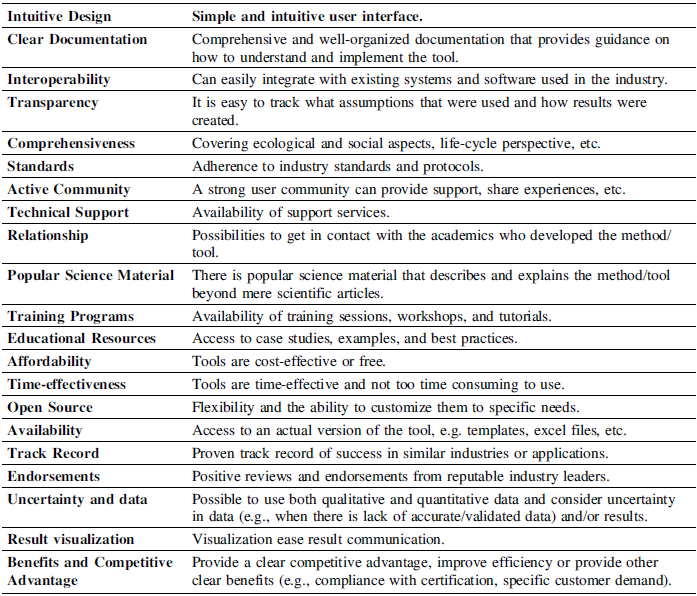
Factors included in the questionnaire; based on Reference Mallalieu, Hallstedt, Isaksson, Watz and AlmefeltMallalieu et al. (2024) and Reference Peace, Ramirez, Broeren, Coleman, Chaput, Rydberg and SauvionPeace et al. (2018)

The interview questions (Appendix A) were sent to each expert prior to the interview. A semi-structured interview approach helped to have an initial structure to guide the process while allowing the researchers to add extra questions and reflections to facilitate the dialogue and clarify the responses from the interviewees (Reference GallettaGaletta, 2013). The online interviews were recorded and transcribed using Microsoft Teams with two researchers and one expert present in the meeting. A qualitative data analysis process as described by Reference Miles and HubermanMiles and Huberman (1994) was applied with the following interactive steps: 1) data collection, where all the interview recordings were transformed to transcripts for the analysis, 2) data reduction, where the collected data was organized, synthetized and analyzed, 3) data display, to understand and visualize the data by using conceptual maps, and 4) writing and verifying, where all the data was interpreted and validated. In steps 2 and 3, a three-stage coding process was performed in NVivo, following the structure proposed by Reference Corbin and StraussCorbin and Strauss (2008): a) inductive open coding, by dividing and labelling the data in several parts, b) axial coding, by identifying code categories, connecting and grouping the codes, and c) selective coding, by identifying core themes to guide the analysis. After the semi-structured interviews, the experts answered a questionnaire, which purpose was to triangulate and gather anonymous quantitative information on which factors, see Table 1, the respondents perceive as (un)important for adoption, adaptation, and application of SPD methods and tools with their clients.
3. Findings
This section starts by presenting what and how SPD tools were adopted and adapted by the consultancy, followed by findings on the factors that ease adoption and make academically developed methods and tools attractive for consultants. Then, the perceived value and impact are described. The section closes with the interviewees’ future outlook of SPD.
3.1. The consultancy’s adoption, adaptation and application of SPD tools
NATIVA’s engagement with SPD tools originated in early exposure to the FSSD, which was described as “[…] the most advanced and complete tool that gets a comprehensive description and the definition of what sustainability means and what it means concretely for companies.” This conceptual foundation influenced the selection of tools; especially the Strategic Life Cycle Assessment (SLCA) (Reference Ny, MacDonald, Broman, Yamamoto and RobèrtNy et al., 2006), a qualitative, principle‑based life‑cycle assessment approach, became a cornerstone. A first version of SLCA (then called a “Sustainability Product Analysis matrix”) was developed in the research area of SPD around 2000 (Reference Byggeth and BromanByggeth & Broman, 2001; Reference HallstedtHallstedt, 2008) and included in a Method for Sustainable Product Development (Reference Byggeth, Broman and RobèrtByggeth et al., 2007). The interviewees stressed the tool’s holistic perspective and adaptability, and one participant noted: “It was very natural for us to choose the SLCA as the main tool to have the baseline of the product and also to have a road map.”
Consultants described client motivations as diverse, ranging from regulatory expectations to commercial positioning, strategic differentiation, and general sustainability ambitions. Clients often face challenges related to limited sustainability knowledge, difficulty interpreting results from established tools such as LCA, and uncertainty about how to move beyond compliance. Many clients seek guidance on how sustainability can create business value and innovation opportunities. Others request support in developing action plans or comparing products through sustainability scoring approaches. An explicit environmental focus is sometimes requested by clients, but in other cases emerges indirectly through broader strategic or compliance‑driven goals.
The consultancy has adapted the SLCA and their application typically begins with an in-person conceptual grounding workshop to get participants on the same page. One consultant described this step as essential: “So what are the sustainability principles? What is backcasting? Why are we doing this? How is this different from other approaches which are reductionist that they [the clients] may have encountered or used before and why is it important that all the actors involved are on the same page about the language, about the meaning, about the process, and so on.” Following the workshop, data collection is carried out using a customized online SLCA platform. This tool allows multiple users to work in parallel, generates visual matrices, and supports structured interviews with key roles across the product life cycle. Consultants emphasized that this process is both educational and practical, enabling companies to identify hotspots and prioritize actions. Simplified visual outputs, such as color-coded matrices or symbolic scoring (e.g., using leaves), are provided to ease communication across different roles in the company. This approach has been used “for many years with dozens and dozens of different companies and products.” SLCA’s standardized structure is frequently customized for specific sectors such as fashion, chemicals, and electronics. This involves reframing questions, simplifying language, and adding examples to make the tool more accessible: “[….] a mix and match of ideas coming from different tools, for example from green chemistry, or how to engage suppliers.” SLCA is primarily qualitative but is often complemented with quantitative indicators to meet regulatory requirements or client expectations. One consultant explained, “We are trying to combine a quantitative measure with the more qualitative assessment.” However, they also stressed the importance of avoiding unnecessary complexity: “We want to give some more quantitative perspective, but this is a different additional aspect that we try to integrate as much as possible, but not to make it too complex for the people that need to use it.”
3.2. Preconditions and success factors for tool adoption
Participants emphasized that adopting and adapting academic tools requires both academic literacy and practical industry experience, e.g., “a group with a lot of people that have a strong academic background, so there is a mindset for research.” Another consultant highlighted that “[…] the prerequisite is that you fully understand the processes at the company level.” The decision to adopt the SLCA was influenced by several factors. First, the tool had a proven track record, having been applied with big companies before, which served as a proof of concept. Second, SLCA was perceived as a holistic model that considers all three dimensions of sustainability, includes value chain aspects, and can be streamlined for practical use. One consultant noted the importance of this integrated perspective: “We always find companies that are highly focused on the environmental aspects, but sometimes they miss or forget about the social aspects or the economic growth.” Academic tools are appreciated due to scientific credibility and potential to drive improvements beyond compliance. “Academia is at the forefront. It is always looking for something new, something better, something stronger.”
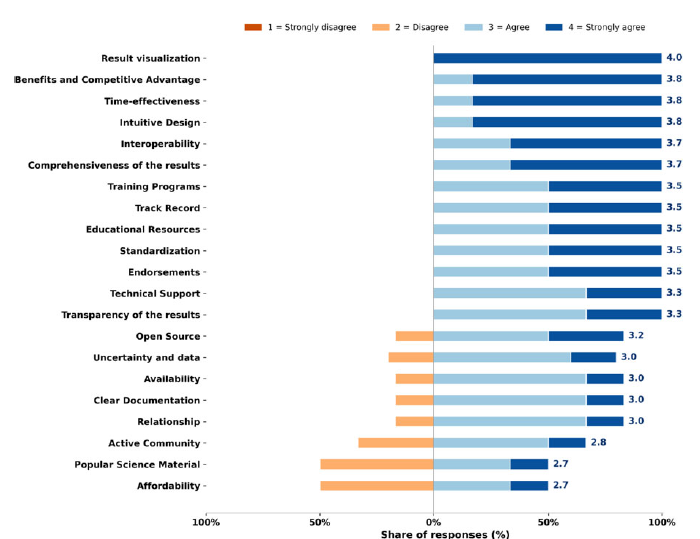
The interviewees also identified several additional features that enhance tool adoption, including customizability, time-efficiency and user-friendliness. These features often require redesigning or simplifying the academic tools and translating scientific language into terms that resonate with practitioners. Emerging technologies such as AI were also mentioned as enablers for efficiency. The questionnaire results on the perceived importance of factors are displayed in Figure 1. A majority of the factors scored relatively high, indicating overall agreement on their importance. This is unsurprising given that the factors were included in the questionnaire based on previous research that indicated their relevance. Result visualization, time-effectiveness, providing clear benefits, and intuitive tool design are pointed out as the most important factors. In addition, free text responses highlighted the importance of (i) the tool being able to connect to economic value creation to show the direct benefit for the company; (ii) third-party verification; (iii) market push (especially from clients); (iv) industry recognition of the tool; (v) purpose alignment; and (vi) ease of marketing and communication.
Perceived importance of factors for adoption of SPD methods and tools (n=6)

3.3. Value and impact of SPD methods and tools
Interviewees emphasized that radical change rarely occurs immediately; it typically emerges through a series of incremental steps that gradually shift mindsets and practices within companies. “Dozens of incremental changes can produce a radical change. So, it’s never radical at the beginning, but the radicality comes when you really change the mindset.” Another interviewee noted that this process often involves a delay: “Then we arrive to the point where it [the change] actually starts and then it’s self-reinforcing. When one success brings another – you need to consider that there is normally a two-year delay.” These reflections underline that the value of SPD tools lies not only in immediate outcomes but in their ability to create conditions for long-term transformation.
According to the interviewees, the SLCA approach often serves as an entry point for sustainability work, creating a common language and fostering collaboration across roles and supply chains. One prominent success story involved an olive oil company that redesigned its packaging from a life-cycle perspective. Changes included replacing plastic coating with biodegradable alternatives, switching to non-toxic inks, and sourcing locally to reduce transportation impacts. These efforts delivered tangible benefits such as cost reductions, marketing advantages, and stronger supplier relationships. Importantly, SLCA became embedded in the company’s processes, used for training, internal communication, and sustainability reporting. Employees began applying SLCA independently, and sustainability principles became part of daily decision-making alongside quality and cost considerations. As one consultant reflected, “They’re also seen as leaders from competitors. So that’s in my opinion a radical change because it is a change introduced in the industry itself.”
Despite these successes, consultants acknowledged that “the level of impact that we have achieved so far is not satisfying. We want to see more concrete and real change in the industry.” Barriers included: (i) difficulty in communicating strategic relevance to senior management, leading to perceptions of extra work rather than strategic investment; (ii) time and resource constraints, as companies prioritize short-term deliverables and hesitate to commit to changes that require extensive investment or testing; (iii) low initial competence levels, which make early training and engagement critical; (iv) sector-specific needs, since generic tools often fail to capture industry nuances and require customization; (v) engagement and motivation, as tools must be attractive and easy to use to sustain interest; and (vi) limited formal recognition or third-party verification, which can make it harder to build credibility and use the results of SLCA for marketing and compliance purposes.
From both successes and setbacks, several lessons emerged. Communication must be adapted from the first contact, clearly explaining why the work matters and how it supports long-term goals. Quick wins and visible outcomes help build momentum: “You need to strive for successes that are concrete and complete and possible to communicate as soon as possible.” Creating positive experiences and fostering enthusiasm were seen as strong drivers for adoption: “The engagements and the fun that can come with these activities is a key element.” Advancing technical aspects is also mentioned as a leverage point for facilitating change at the core of the business model for the company. Multiple respondents stress the importance of creating competence and a sense of ownership at the clients so that they in the end can use the tools on their own: “Once they have understood the principles and the criteria, then they have been able to apply also by themselves, which ultimately is our goal. We actually want to train the people, give them the tools then to apply to the rest of their portfolio or have the flexibility of applying it everywhere.” Ultimately, successful implementation depends not only on methodological soundness but also on human factors such as motivation, clarity, and collaboration.
3.4. Interplay between academia and consultancies
For SPD tools to achieve widespread adoption, they must be both scientifically robust and practical for diverse industrial contexts. Interviews revealed that academia and consultancy can play complementary roles in this process. Academia provides scientific rigor, methodological innovation, and credibility, while consultancies contribute practical experience, sector-specific insights, and the ability to translate theory into actionable steps. “There’s no one world without the other. We should strive to reinforce this kind of interface.”
Consultancies often customize tools for sector-specific contexts, while academia can support this by providing flexible frameworks and engaging in iterative pilots to learn from real-world applications. Balancing qualitative and quantitative approaches reflects shared responsibilities: academia can develop robust indicators and efficient data collection methods, while consultancies integrate these into client workflows. Similarly, digitalization and AI are mentioned as opportunities to improve usability but require caution. “It [AI] is very useful, but it is also dangerous because AI must be fed with the right information”, which is seen as something academia may contribute to.
The interviewees perceive strong incentives for the interplay between academia and consultancy. Consultancies gain access to latest research and increase their credibility, enabling them to offer clients scientifically grounded solutions that go beyond compliance. Academia benefits from consultancies’ access to real-world cases and outreach to industry. However, barriers remain. Major challenges are the difference in speed: “What takes one month in academia needs to take one day in a consultancy”, and the trade-off between comprehensiveness and practicality.
3.5. Future outlook for SPD practices
Interviewees foresee the next decade as a window of opportunity for companies willing to lead the sustainability transition, with a significant acceleration in the integration of sustainability into product development driven by regulatory pressure such as the EU Green Deal and the Digital Product Passport, as well as growing market demand. SPD is expected to become a core business function rather than an add-on, influencing decisions across design, procurement, manufacturing, and marketing, and embedding sustainability into everyday roles and financial choices. Tools that combine qualitative and quantitative approaches, support strategic decision-making under complexity, and enable life-cycle thinking will be essential. Consultants anticipate a growing need for simplified yet robust tools that help companies navigate trade-offs and design products with a systems perspective. As one expert said, “You need tools that help make good decisions. And I think that sustainable product development tools are really crucial in the next 5 or 10 years in order to satisfy and be coherent with all the carbon objectives that the companies already set.” Digitalization and AI are expected to play a major role in enhancing usability and efficiency, provided they are implemented with care and supported by accurate data.
4. Concluding discussion
This study examined how experts at the Italian consultancy NATIVA perceive and adopt academic tools for sustainable product development, the impact these methods and tools create in practice, and the interplay between academia and consultancy as a critical enabler for bridging research and industry. The findings confirm that main barriers for companies to apply tools developed in academia are to modify, transfer, and contextually adapt them (Reference Mallalieu, Hallstedt, Isaksson, Watz and AlmefeltMallalieu et al., 2024). Similar to Reference Peace, Ramirez, Broeren, Coleman, Chaput, Rydberg and SauvionPeace et al. (2018), it was found that tools perceived as complex or resource-intensive are unlikely to be integrated into everyday workflows, regardless of their methodological robustness. The staged and pragmatic approaches advocated in previous research resonate with the consultants’ preference for lightweight, adaptable tools that provide actionable insights. At the same time, the results extend these insights by showing that perceived credibility, result visualization, and the ability to demonstrate value to clients are equally critical, highlighting the importance of a solid conceptual grounding – something which academically developed methods and tools may provide.
The study reinforces Reference Mallalieu, Hallstedt, Isaksson, Watz and AlmefeltMallalieu et al.’s (2024) argument that adoption is shaped by organizational routines and cognitive biases rather than by tool design alone, underlining the importance of iterative engagement and sensemaking rather than one-off training or static guidelines. Furthermore, the findings align with Reference Chatty, Harrison, Ba-Sabaa, Faludi and MurnaneChatty et al. (2022) in highlighting co-creation as an enabler of integration. Consultants valued opportunities to adapt tools collaboratively, which increased ownership and reduced resistance to change. Finally, the interplay between academia and consultants emerges as a leverage point for bringing academically developed methods and tools to industry, echoing the conclusions of Reference Küçüksayraç, Keskin and BrezetKüçüksayraç et al. (2015) and Reference Koria, Osorno-Hinojosa, Ramírez-Vázquez and van den BroekKoria et al. (2022), despite barriers such as speed mismatch and the trade-off between comprehensiveness and practicality.
The study illustrates that consultants do not remove the systemic complexity that companies face, nor can they resolve structural challenges such as locked‑in positions in supply chains. Instead, their contribution lies in helping companies navigate complexity by translating academic tools into phased, communicable practices that make sustainability work approachable in organisational settings. That makes it possible for companies to engage with sustainability challenges incrementally, even when broader constraints limit the pace or scope of change.
Based on these findings, lessons learned may guide future development and dissemination of SPD tools:
-
• Keep the science, translate for practice: Maintain coherence while adapting to company-specific language and workflows.
-
• Engage early and broadly: Involve strategic management and multidisciplinary teams from the start to build commitment.
-
• Combine qualitative & quantitative: Use qualitative tools for system-level framing and guide quantitative deep-dives without over-complexity.
-
• Enable through platforms and visualization: Shared online platforms and visual scorecards accelerate understanding and decisions.
-
• Invest in competence building: Academic literacy and industrial process knowledge are both critical; short training accelerates independence.
-
• Customize and contextualize: Curate sector-specific guided questions and portfolio scoring to scale impact.
-
• Leverage AI for efficiency: Use AI to support and focus human expertise where judgment is essential.
-
• Communicate value quickly: Share tangible outcomes early and involve marketing teams to amplify success stories.
-
• Foster academia–consultancy synergy: Joint development and iterative pilots ensure tools remain scientifically robust yet practical.
The perceived importance of different factors that affect tool adoption by intermediaries, in this case consultants, may guide researchers in their development of tools to maximize their potential for being translated into practice, and, ultimately, have the desired impact. The main limitation of this study is that it is based on one consultancy and SPD tools grounded in the FSSD, particularly SLCA, which limits generalizability. Moreover, the analysis focused on consultants’ perspectives and did not capture client-side dynamics or long-term outcomes. Future research will add a multi-actor perspective by also investigating clients’ perceptions of applied methods and tools and their impact on decision-making.
Acknowledgements
This research was funded partly by the Knowledge Foundation, Sweden, through the Sustainable Product Innovation for Rewarding Transformation (SPIRIT) Synergy Project (contract 20240015), GENIE - Gender Initiative for Excellence and the Area of Advanced Production, at Chalmers University of Technology. Sincere thanks to the interviewees at NATIVA S.r.l. SB.
Appendix A I. Capabilities and success factors to adopt or adapt SPD tools
-
• Can you describe the background behind the development of your SPD tool with your clients?
-
• What motivates your organization to consider using and implementing methods and tools developed in academia with your clients?
-
• What do you think are the pre-requisites to be able to adapt and develop SPD tools that are based on academic research in the field of sustainable product development?
-
• Can you describe your processes or routines for identifying and learning how to use new tools and methods for SPD?
-
• How do you evaluate the potential of academic SPD methods/tools before deciding to implement them in your toolbox for projects?
-
• How did you select those SPD tools?
-
• Are there any specific academic collaborations or partnerships that have influenced your adoption of new methods/tools? How did these relationships impact your decision?
II. Usefulness, usability, and applicability of SPD tools
-
• Can you describe your experience with adopting methods or tools developed in academia?
-
• What challenges were your clients facing when you were consulted?
-
• What SPD tool(s) have been applied for those challenges?
-
• Why did you find that/those tool(s) suitable to apply in relation to the client’s challenges?
-
• Were these tools redesigned to certain contexts?
-
• Were any parts of the tool/method unclear, so that you could not use all of its parts? Which?
-
• How well do you think the tools worked, and in which way did these inspire the development of new tools?
-
• Have you encountered any academic methods/tools that were particularly user-friendly? What aspects made them so?
-
• What specific features or characteristics of academic methods/tools do you think contribute to their ease of use in an industrial setting?
-
• How do you think the training and educational background of your team influences how easily they can adopt academic methods/tools?
III. The value and impact of applied SPD tool(s)
-
• Which criteria do you use for including methods/tools into your methods/tools portfolio?
-
• Where in the client’s organization (which roles, which processes, etc.) are the methods and tools commonly used?
-
• Can you share any success stories where the SPD tool led to improvements in your projects?
-
• What kinds of positive impacts have you observed?
-
• Do you mostly observe radical or incremental change? Why?
-
• Can you share any examples of cases where the application of SPD tool(s) did not lead to the desired impacts?
-
• What reasons do you think were contributing to the lack of impact?
-
• What learnings have you derived from both the success stories and the failures?
IV. Challenges and future outlook
-
• What challenges have you faced when integrating academic SPD methods/tools into your existing workflows?
-
• What advice would you give to academic researchers aiming to make their SPD methods/tools more accessible and appealing to industry professionals?
-
• What incentives/barriers do you see for successful interplay between academia-consultancy?
-
• How do you foresee the role of SPD evolving in your industry over the next 5-10 years?

 Open access

