

INTRODUCTION
The release and migration of 14C and 3H has been identified as a key issue for geological disposal of high-level radioactive wastes. 14C has a sufficiently long half-life for its release as gas to be of relevance. Tritium is also present in irradiated graphite and appears to be released mainly as tritiated water. 14C is produced in all types of reactors, mainly through neutron-induced reactions with isotopes of carbon, nitrogen and oxygen. They are present in the fuel, fuel cladding, coolant, moderator and structural materials of the reactor. In the irradiated graphite, the majority of 14C arises through the irradiation of nitrogen-14 (n,p) reaction, while carbon-13 (n,γ) reaction is the second greatest contributor. Irradiated graphite contains a range of activation products but, from the point of view of geological disposal, another radionuclide which has to be taken into account is tritium (3H or T), produced through neutron induced reaction Li(n,α)T.
14C and 3H are both beta emitters (half-lives 5730 and 12.3 years respectively). As a consequence of the relatively short half-life of 3H the inventory of 3H will be reduced to insignificant level over period of couple of hundreds of years and therefore the release 3H is important for operational safety of the disposal facility, which is not the case for the release of 14C containing gases from irradiated graphite. Irradiated graphite itself is not reactive under geologic repository conditions. Consequently the 14C atoms in the graphite lattice are expected to be released very slowly, if at all, but the 14C atoms formed from nitrogen-14 impurities trapped within closed gaps or from nitrogen-14 atoms incorporated in pore surface are more reactive compared to the carbon atoms in the graphite lattice. The mechanism of the release of 14C and tritium from irradiated graphite under repository conditions is the subject of ongoing international research; it is generally accepted that the majority of 14C in irradiated graphite is immobile under conditions relevant to geological disposal. This work is aimed to measure the leaching of 14C and 3H into solution phase from irradiated graphite samples collected from the thermal column of VVR-S reactor under conditions relevant for long term storage (IAEA 2010).
EXPERIMENTAL
VVR-S Reactor Thermal Column
The VVR-S reactor is a light-water-cooled-moderated-and-reflected, heterogeneous, thermal reactor at National Institute of Research & Development for Physics and Nuclear Engineering “Horia Hulubei” (IFIN-HH) with a maximum thermal power of 2 MW and fueled with enriched uranium (10% in the beginning and 36% subsequently). The facility is a tank-type research reactor of Russian origin research reactor used mainly for radioisotope production and for applied and fundamental research performed in the institute.
It was commissioned in 1957 and dedicated to nuclear physics research and radioisotopes production. The reactor was operational until 1997 when the reactor was definitively shut- down and now is under decommissioning. During 40 years of operation, the VVR-S Reactor produced 9.59 GWd. The maximum flow of the thermal neutrons was 2×10¹³ n/cm2s.
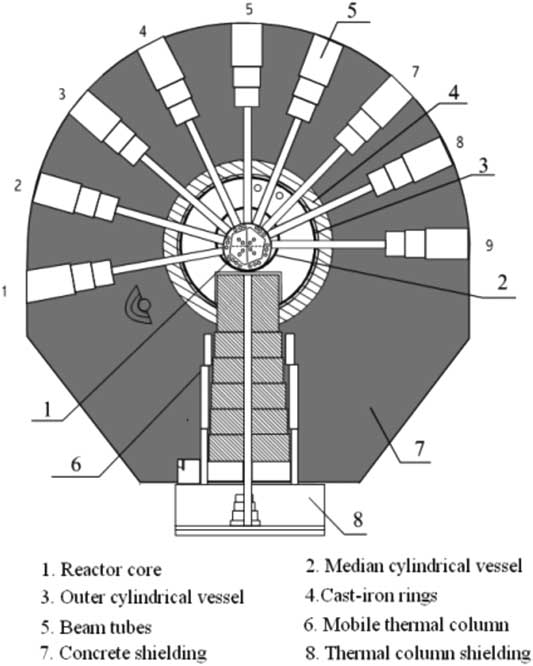
Figure 1 shows a horizontal cross section of the VVR-S reactor core.
VVR-S reactor horizontal cross section.
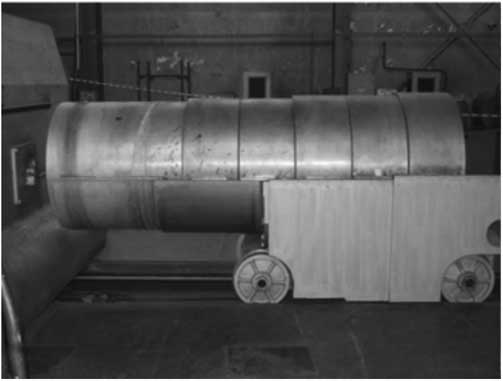
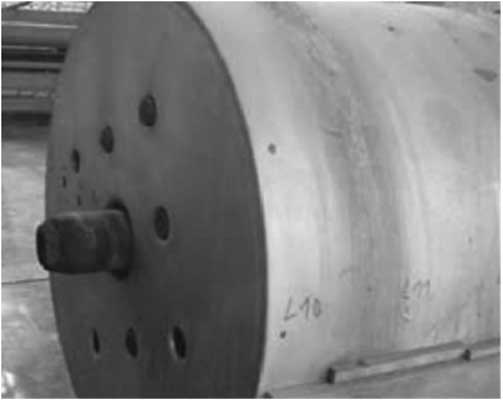
The thermal column of the VVR-S Reactor (Figure 2) is made out of 6 graphite discs placed on a mobile truck. Graphite discs are installed into a 20-mm wall thickness aluminum cylinder. Initially, the thermal column was provided with a cooling system that axially penetrated the graphite plate connected to the water-cooling system. On the basis of subsequent operational experience, it was concluded that this system was no longer necessary; it was not used any further. Therefore, the horizontal tubes of the cooling system were filled with nuclear grade graphite rods of the same type as the discs of the thermal column. Samples have been collected from these graphite rods (Figure 3).
VVR-S reactor thermal column.
Thermal column disc no. 6.
Irradiated Graphite Samples Description and Preparation
The irradiated graphite investigated at IFIN-HH was taken from nuclear grade graphite rods which were used to fill the horizontal tubes of the cooling system of the thermal column of the VVR-S reactor.
For the leaching test the graphite sampling was performed from the small graphite rod (diameter=4.4 cm, length=90 cm) located around the central graphite rod of the disc no 6, which is near the reactor core. One piece was cut from the edge of the rod near the reactor vessel (Sample 6.1) and the other piece from the opposite part of the rod (Sample 6.2).
The mass and dimensions of the two irradiated graphite pieces which have been used for the leaching test are presented in Table 1. In the table, based on our previous results, we also present the estimation of 14C and 3H total activity for each sample (Fugaru et al. Reference Fugaru and Postolache2016).
14C irradiated graphite samples characteristic.

The overall uncertainties regarding the 14C and 3H are estimated as ±10% of the total activity.
The 14C and 3H specific activities were determined by a full combustion method followed by isotope separation and liquid scintillation counting (Pearson Reference Pearson1979; Enachescu et al. Reference Enachescu, Stan-Sion, Petre, Postolache and Fugaru2018). The estimation of the gamma radionuclide inventory of the irradiated graphite Sample 6.1 has been determined by gamma spectrometry using an Ortec Gamma HPGe detector type GMX.
Release of 14C and 3H from Irradiated VVR-S Graphite to Liquid Phase
To evaluate 14C and 3H long-term release in solution, under conditions relevant to a cement-based geological disposal facility, the leaching test was performed under nitrogen atmosphere in closed vessels. The graphite samples were placed in two 1-L flasks with thread screw caps with 4 outlets/ inlets and were submerged in a solution of 0.1 M of sodium hydroxide. All outlets and inlets of the reaction vessel were valved to allow sealing. The 700 mL of solution added to each flask ensured that the graphite samples were completely submerged. The flasks were placed on a magnetic stirrer and adapted to allow the replacement of the air with nitrogen in order to ensure anoxic conditions (Huskisson Reference Huskisson and Ward1974).
The sampling was performed at different time periods: the 1st, 7th 14th, 21st, 28th, 42nd days, 3rd, 6th, 9th, and 12th months. After each sampling, the quantity of the immersion solution removed was replaced with a fresh one.
The amount of 14C and 3H released in the liquid phase was measured by liquid scintillation counting using a TRICARB 3110 TR counter, allowing measurements in low levels.
The leaching experiment began in September 2016 and was performed at room temperature. Two graphite samples collected from reactor thermal column were involved in the experiment.
A volume of 5 mL of immersion solution was sampled and 14C and 3H activities were measured by liquid scintillation counting (Carbon-Tritium measurement protocol) and the total 14C (as CO2) and 3H (as HTO) activities released were calculated (Ko et al. Reference Ko, Kim, Cho, Chung and Kang2017).
In order to determine if the radioisotope 36Cl (a beta emitter which is possible to be present in irradiated graphite) was present or not in the immersion solution, the following experiment was performed:
∙ 1 mL of l solution was mixed with 1 mL NaCl solution (0.1 N),
∙ 1 mL Ag NO3 0.1 N was added to precipitate chlorine followed by an ultra-filtration step,
∙ the filtrate was analyzed by liquid scintillation counting and 14C content was determined.
The difference between 14C activity before and after co-precipitation of chlorine was in experimental errors range. As a conclusion of this experiment, the presence of 36Cl in the immersion solution was not detected.
The starting inventory of 14C in graphite samples was 6191.5 kBq for Sample 6.1 and 338.4 kBq for Sample 6.2 respectively; the inventory of 3H was 21802.2 kBq for Sample 6.1 and 2024.3 kBq for Sample 6.2.
At the end of the leaching experiment (September 2017) the radionuclide inventory of the immersion solution was determined by gamma spectrometry using an Ortec Gamma HPGe detector type GMX.
RESULTS
14C and 3H Release to Liquid Phase
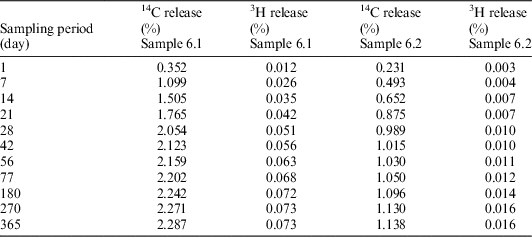
The release of 14C and 3H, expressed as percentage of the initial inventory of 14C and 3H activities in the immersion solution at the end of each sampling period was calculated. The results are presented in Table 2.
14C and 3H average release rate into liquid phase.
The radionuclide inventory of the immersion solution was measured by gamma spectrometry No gamma-emitting radionuclides were detected.
Table 3 shows the 14C average leaching rate (Bq/day and per g) and 3H average leaching rate (Bq/day and per g) were calculated by dividing the activity measured to the sampling period and weight of the sample.
14C and 3H average leaching rate into liquid phase.

CONCLUSIONS
The experiments to measure the release of 14C and 3H into liquid and gas phase were performed over a 12-month period. The irradiated graphite samples collected from the graphite rod located near the reactor core) are representative for the 14C and 3H content of the thermal column of the VVR-S Reactor, because the first graphite disc contains almost 90% of the 14C quantity (Fugaru et al. Reference Fugaru and Postolache2016).
The experiments were primarily designed to measure the total release of 14C and 3H into liquid phase. The liquid leaching test was performed under condition similar to those relevant to geological disposal (NaOH solution 0.1 M, pH=10, anoxic conditions). Over the 365 days that the leaching experiment was running conducted for, 2.287% of the initial 14C inventory of graphite in Sample 6.1 was released to the immersion solution, and 1.13% of the initial 14C inventory of graphite in Sample 6.2. In the case of 3H, the percentages of the initial 3H inventory released into the liquid phase were 0.073% and 0.016% respectively for these samples. The cumulative release of 14C and 3H from graphite Samples 6.1 and 6.2 are presented in Table 2.
The leaching rates for 14C and 3H were calculated by dividing the activity measured by the sampling period and are shown in Table 3. As it can be seen, these leaching rates were high in the first period of the leaching test (30 days) with a maximum in the first week and then decreasing for both radioisotopes. Generally, the leaching rate for 3H decreased with time to a lower value compared with 14C leaching rate.
The average leaching rate of 14C into liquid phase decreased from 259 Bq/day per g to 0.13 Bq/day per g for graphite Sample 6.1 after 365 days and for graphite Sample 6.2 from 9.39 Bq/day per g to 0.01 Bq/day per g.
The average leaching rate of 3H into liquid phase decreased from 30.66 Bq/day per g to 0.01 Bq/day per g for graphite Sample 6.1 after 365 days and for graphite Sample 6.2 from 0.744 Bq/day per g to 0.001 Bq/day per g.
The experimental results regarding the release of 14C and 3H from VVR-S irradiated graphite to liquid show that a major fraction of the total release occurs in the first months and a slower release on a long time scale. However, these results should be applied cautiously for a long time prediction.
ACKNOWLEDGMENTS
The project has received funding from the European Union’s Seventh European Atomic Energy Community’s Seventh Framework Programme FP7/2007-2013 under grant agreement no. 604779, the CAST project and from Executive Unit for Financing Education Higher Research Development and Innovation of Romania, Project no. 41/2015.


 Open access

