

How do we explain American public opinion on antitrust? Antitrust policy, known as competition policy outside the United States, aims to reduce industrial concentration and ensure a free and fair market. By prohibiting anticompetitive behavior, like monopolization and price setting, or requiring approval for large mergers, antitrust policy is supposed to sustain market competition. Stricter antitrust policy should benefit the public, but it comes at the expense of large firms (Weymouth, Reference Weymouth2016).Footnote 1 As the US market becomes increasingly concentrated, the likelihood of government response depends crucially on public support. This article explores which arguments about antitrust are most influential in shaping US public support for strengthening antitrust laws.
Public support was essential for the passage and development of antitrust law in the United States. The conventional wisdom suggests that public opinion on antitrust may be counter-cyclical (Hofstadter, Reference Hofstadter1964): The public is opposed to concentration but disinterested in antitrust laws, allowing firms to chip away at antitrust legal protections and consolidate their market power.Footnote 2 As concentration mounts, antitrust gains traction, and the public again demands action to curb concentration. Consistent with this interpretation, the first antitrust legislation in the United States, the Sherman Act of 1890, resulted from citizen frustration with the trusts or monopolies following the Gilded Age.Footnote 3 Since the 1970s, the lack of public attention to antitrust allowed for a narrowing interpretation of the law to focus exclusively on consumers (Heyer, Reference Heyer2014; Sawyer, Reference Sawyer2019). As concentration has increased in recent years, the United States has seen the rise of a new antitrust movement that supports broader conceptualizations and stricter enforcement of antitrust. This movement, called the “Neo-Brandeis movement” (or “hipster antitrust” by critics) reflects a growing segment of the population that is concerned about increasing concentration (Dayen, Reference Dayen2017; Khan, Reference Khan2017; Reference ShortShort, 2022a ). As part of this movement, politicians seek to activate public support for antitrust. They argue that strengthening laws “is critical to ensuring consumers and small businesses have the opportunity to compete” and that stronger antitrust laws will “help protect consumers” (Klobuchar, Reference Klobuchar2022). Like most democracies, politicians in the United States are unlikely to impose policies that are costly for big business unless there is clear public support. For this reason, we focus on explaining public opinion on antitrust.Footnote 4
We build our theory of public opinion by first acknowledging the growing importance of international markets and the concern with how policies affect the international competitiveness of domestic firms. In the United States, international trade as a percent of GDP almost tripled between 1970 and 2010.Footnote 5 While international competition through trade has historically been thought of as a substitute for domestic competition (Büthe, Reference Büthe2014), trade now seems to reinforce concentration. Trade is overwhelmingly concentrated among the world’s largest firms, with the top 10 percent of US exporting firms accounting for 96 percent of total US exports in 2000 (Bernard et al., Reference Bernard, Jensen, Redding and Schott2007, 105). Only the largest firms can absorb the costs of entering global markets (Betz, Reference Betz2017; Kim and Osgood, Reference Kim and Osgood2019), and small, less productive firms are often forced to exit (Jensen, Quinn and Weymouth, Reference Jensen, Quinn and Weymouth2018). With fewer small firms advocating antitrust, political movement to strengthen antitrust will likely only emerge as a response to public demand.
Furthermore, international integration means that antitrust is no longer only a domestic policy. American regulators frequently target foreign companies, and foreign regulators increasingly target US companies (Browne, Reference Browne2022). Because the market is not limited to the domestic arena and increased international trade and international competition have become significant concerns for many citizens (Baccini, Pinto and Weymouth, Reference Baccini, Pinto and Weymouth2017; Colantone and Stanig, Reference Colantone and Stanig2018), we seek to explain how participation in international markets affects American public support for antitrust policies.
We argue that concerns about the competitiveness of the country loom large for the public, especially for those who are nationalistic. Public concern about the relative competitiveness of the United States is not new. President Reagan emphasized international competition and the need for deregulation in the 1980s, in light of Japan’s economic success (Reference ShortShort, 2022b ). Concerns about competitiveness gained salience with former President Trump’s emphasis on the trade deficit and the “Make America Great” campaign. Such political rhetoric has found a receptive audience. We thus expect that Americans will be more supportive of antitrust laws when they believe it helps American competitiveness and opposed if they think it places American firms at a disadvantage. Antitrust can be understood to have both of these effects: On the one hand, antitrust could reduce competition for domestic firms if it is enforced, particularly in biased ways, against foreign firms. This enforcement could however trigger retaliation, which would be costly for domestic firms—if they compete in foreign markets. On the other hand, antitrust could make domestic firms less competitive if compliance costs are higher for domestic firms.Footnote 6 Because Americans may not have firm notions about the effect of antitrust, we expect them to be receptive to both arguments. Furthermore, we theorize that these effects should be especially pronounced for those who are nationalistic, as they prize their own nation’s success above others.
To evaluate the importance of competing arguments about antitrust policy, we first conduct a descriptive analysis of the media and information environment for antitrust policies. Our analysis of media outlets across the United States shows that antitrust policy receives significant attention in the news, and that concerns about national competitiveness and international antitrust policies are frequent narratives in news stories. We then test our expectations about support for antitrust policy using a survey experiment. We find that individuals are concerned about the effects of antitrust policy on national competitiveness. Notably, highly nationalistic individuals strongly favor strengthening antitrust laws when they know that such laws are frequently enforced against foreign firms. However, we find that individuals who are not nationalistic have the opposite reaction. They may be reluctant to support the execution of antitrust in biased ways or they may be concerned about foreign retaliation. Our findings are consistent with the role of economic nationalism, in the context of global markets, as an important predictor of domestic policy preferences.
Our paper contributes to several lines of inquiry. First, we contribute to the vast literature exploring how corporate and public interests interact. Similar to corporate taxation, the conventional politics of trade, and environmental and labor regulation, we posit that the public interest runs counter to the interests of big businesses, and we expect to see political cleavages along these lines (Baker, Reference Baker2005; Mosley and Uno, Reference Mosley and Uno2007; Ballard-Rosa, Martin and Scheve, Reference Ballard-Rosa, Martin and Scheve2017; Betz and Pond, Reference Betz and Pond2019; Bechtel, Genovese and Scheve, Reference Bechtel, Genovese and Scheve2019). At the same time, however, the public is gravely concerned about the competitiveness of businesses and their future success as employers and drivers of the domestic economy (on bank competitiveness, see Singer, Reference Singer2004). For this reason, we require a more nuanced understanding of when citizens are willing to counter business interests.
Second, our paper contributes to a rapidly growing literature examining the role of nationalism in American attitudes toward economic policy. We move beyond the study of trade and immigration to understand how perceptions of national competitiveness, and the importance of nationalism, shape support for antitrust policy. Given that globalization has led many to view economics through a competitive lens where nations are pitted against each other (Mutz and Lee, Reference Mutz and Lee2020), with each country trying to get its fair share (Brutger and Rathbun, Reference Brutger and Rathbun2021), we argue that antitrust policy can tap into “economic nationalism” that shapes the contours of support for competition policy.
Third, our study complements efforts to understand the economic effects of concentration. Concentration is associated with higher prices and profits, as well as less innovation (Aghion et al., Reference Aghion, Bloom, Blundell, Griffith and Howitt2005), lower employee compensation, and lower net investment (Philippon, Reference Philippon2019). Larger firms also wield greater political influence (Olson, Reference Olson1965; Salamon and Siegfried, Reference Salamon and Siegfried1977), influence that they may use to further limit competition through increased tariffs or other entry barriers (Kennard, Reference Kennard2020; Perlman, Reference Perlman2020; Zingales, Reference Zingales2017). The rise of Big Tech has also given large firms significant influence over the dissemination of political information and control over individuals’ personal data, which has contributed to concerns about the power of firms in the United States and abroad (Chapman and Li, Reference Chapman and Li2023; Woolley and Hajdu, Reference Woolley and Hajdu2021). Understanding public opinion on antitrust in an international context is important for predicting how concentration will develop in the United States.
Antitrust, media coverage, and public opinion
This section provides a brief outline of prominent debates around antitrust from a historical perspective and characterizes recent debates on antitrust, drawing on media coverage from 1990 to 2021. Insights from these debates will motivate the theory and empirical analysis in subsequent sections. The antitrust movement in the United States emerged as a response to high levels of inequality and monopolization during the Gilded Age. In 1890, the United States enacted one of the earliest antitrust laws, the Sherman Act, prohibiting any “restraint of trade” that would limit competition. Industrial consolidation had intensified prior to the passage of the Act, and there was public pressure to do something about it (Gordon, Reference Gordon1963).
Support for antitrust continued until after the second World War when industrial concentration was low and policy was dominated by security concerns and reconstruction. US markets were opened to foreign competition, and US businesses lost market share, especially to Japan and Germany (Reference ShortShort, 2022a , 33). President Reagan came to power in 1980 on a platform committed to economic growth, deregulation, and making American companies competitive.Footnote 7 Proponents of the “consumer welfare standard”—focusing on business interests and developing a more limited interpretation of antitrust that emphasized costs for consumers—began to gain traction in the 1970s and would grow to dominate legal opinion well into the 2000s (Bork, Reference Bork1978; Bradford, Chilton and Lancieri, Reference Bradford, Chilton and Lancieri2019; Sawyer, Reference Sawyer2019).
Market concentration has increased in recent years, and antitrust policy has recently re-entered the public sphere, with strong public support for antitrust action against big tech companies, and significant public distrust of “big business.” The changing landscape was emphasized in one New York Times (2019) headline: “Trusting in Antitrust: Actions Against Big Tech Are Now Palatable.” Geoffrey Mann of the International Center for Law and Economics noted that “Something has definitely changed” for most voters, who now have “a growing sense of skepticism about all these companies” (Streitfeld, Reference Streitfeld2019). With public opinion shifting, government officials have felt empowered to pursue stronger antitrust enforcement and laws. For example, we’ve recently seen congressional (Klobuchar, Reference Klobuchar2022) and executive action seeking to strengthen antitrust policies (White House, 2021). Additionally, in December 2020, a bipartisan group of federal and state regulators, including over 48 attorney generals, initiated a lawsuit against Facebook (Hamilton, Canales and Leskin, Reference Hamilton, Canales and Leskin2020). The case received widespread media attention, as did multiple antitrust actions by the EU against Apple and Google (Chee, Reference Chee2020; Kroll, Reference Kroll2021). However, cases against tech firms are not unique in generating media coverage, as is shown in the headlines reported in Table 1. Across industries and countries, antitrust policy has increased in salience, with the media, politicians, and the public paying greater attention to antitrust. This shift is creating what one New York Times headline called “A New Outlook on Antitrust” (Lohr, Reference Lohr2019).
Headlines from media coverage
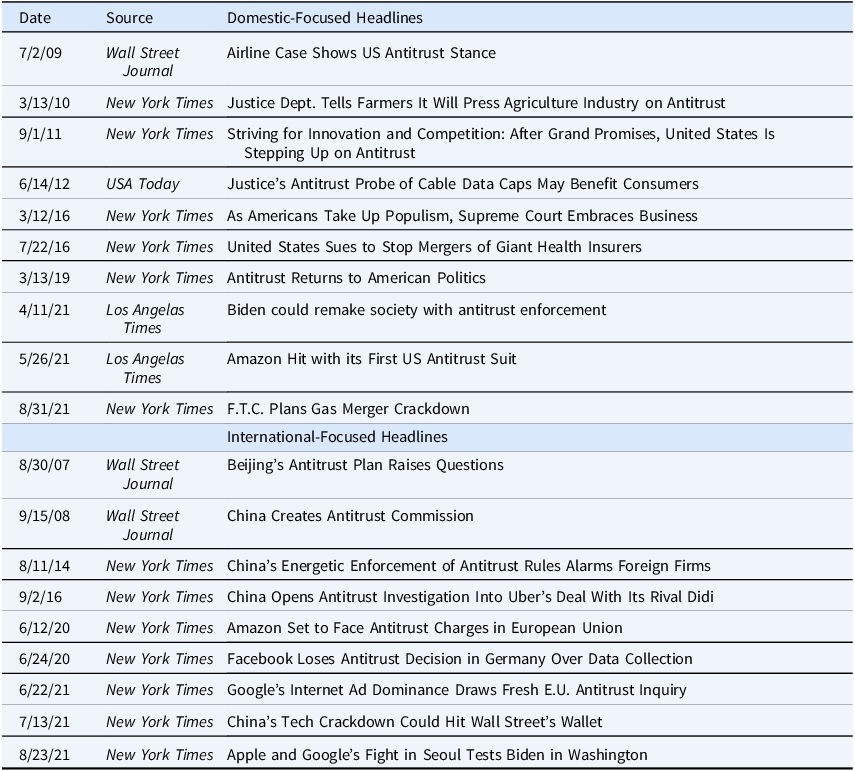
To understand the debates surrounding antitrust and the information environment the public is exposed to, we conducted an analysis of media coverage in the United States. This analysis provides a descriptive assessment of the volume and content of the US media’s coverage of antitrust policy and enforcement. The media headlines presented in Table 1 provide an overview of the style of media coverage that antitrust is generating. The headlines demonstrate that there is not one single focus of the media coverage as it includes stories about various industries, with some focusing on primarily domestic concerns, while others incorporate international concerns.
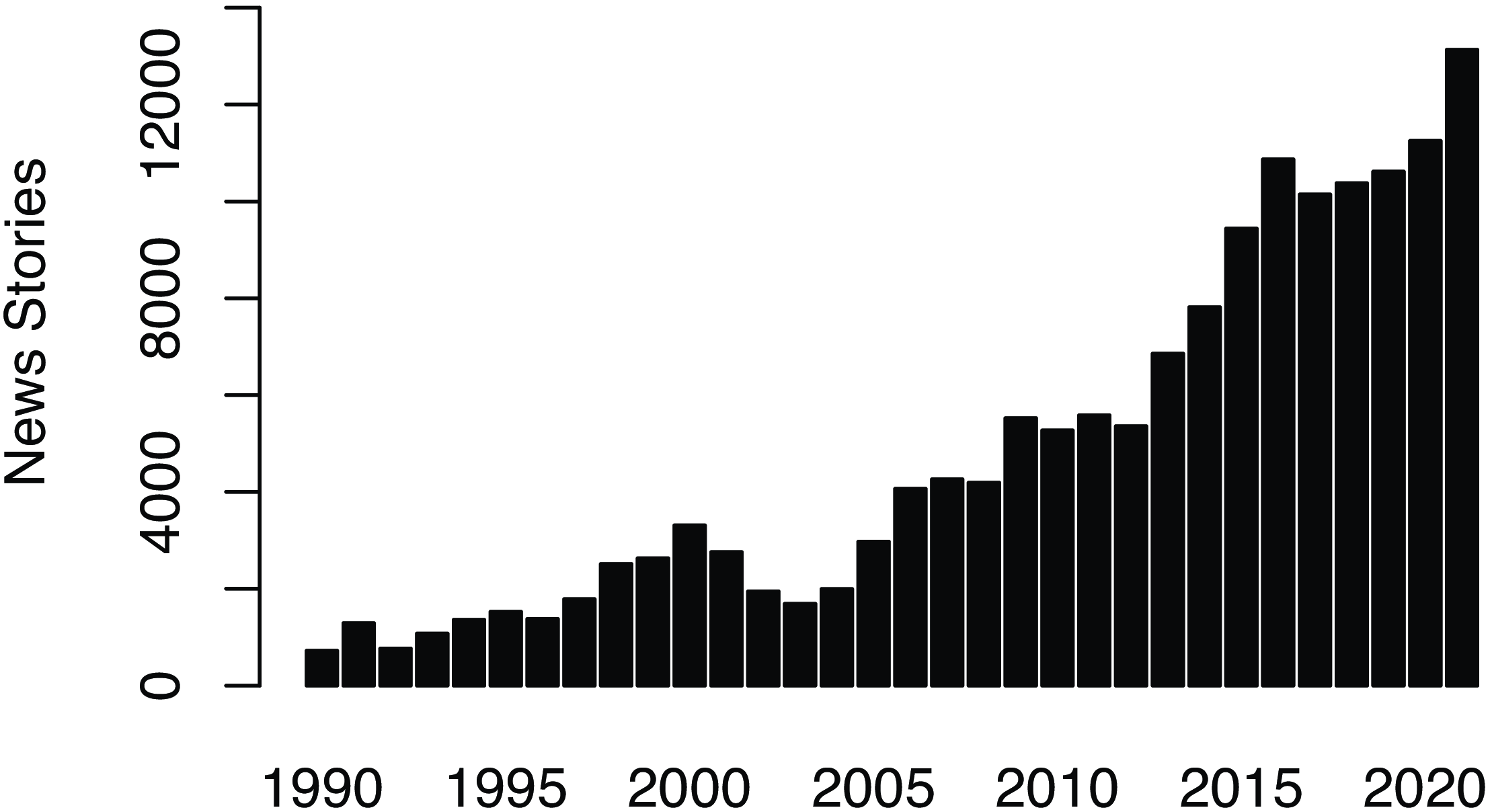
To more systematically examine media coverage and the information about antitrust that Americans are exposed to, we conducted a search of US news coverage of antitrust policy and enforcement using Nexis Uni. We searched for “antitrust AND policy OR enforcement,” beginning with all news coverage from 1990 to 2021. We find that the volume of news coverage on antitrust has increased in recent decades, as shown in Figure 1. In 1990 there were only 722 news stories on antitrust policy and/or enforcement, compared to 13,133 stories in 2021. The increase in coverage could be due to the increasing number of media outlets, so we also replicate the analysis in section 1.1 of the appendix, and find a similar increase in coverage when using a constant set of sources across the same time period. We also examine whether the increase in antitrust coverage meant that it was receiving relatively more attention from the public and media, so we compared interest in antitrust to interest in taxation using two approaches. First, in section 1.1 of the appendix we show that from 2000-2020 antitrust coverage amongst a consistent set of sources increased by 42 percent, while at the same time the volume of tax media coverage decreased by 40 percent. Finally, we also used Google trends to examine searches for antitrust compared to taxation, and find that the relative interest (searches) for antitrust, compared to taxation, has increased over time (see appendix section 1.1). We thus use articles about taxation as a benchmark for articles about antitrust—this is similar to the analysis by Baker, Bloom and Davis (Reference Baker, Bloom and Davis2016), who benchmark their search of policy uncertainty using articles about the economy. We conclude that the increase in coverage corresponds to the changing landscape of political and public attention paid to antitrust and affirms the growing salience of antitrust policy and enforcement in the United States.
Volume of Media Coverage of Antitrust from 1990-2021. Figure 1 shows the number of news stories from 1990 through 2021. The results are from a Nexis Uni search that is limited to US sources, which includes available newspapers and cable news transcripts. The search terms were “antitrust AND policy OR enforcement” which means each story has to have the word “antitrust” and have at least “policy” or “enforcement” (or both) in the story.
To systematically examine the content of the news stories, specifically the arguments presented about antitrust policies, we narrowed our search to major US newspapers from across the country, with the search parameters and coding procedures described in section 1.1 of the appendix. We limited our search to the 25 US newspapers with the highest digital and print distribution, and then searched those that were available through NexisUni. From the search results we randomly selected 525 articles,Footnote 8 which were read and manually coded to identify the prominent themes and arguments presented in the media.Footnote 9
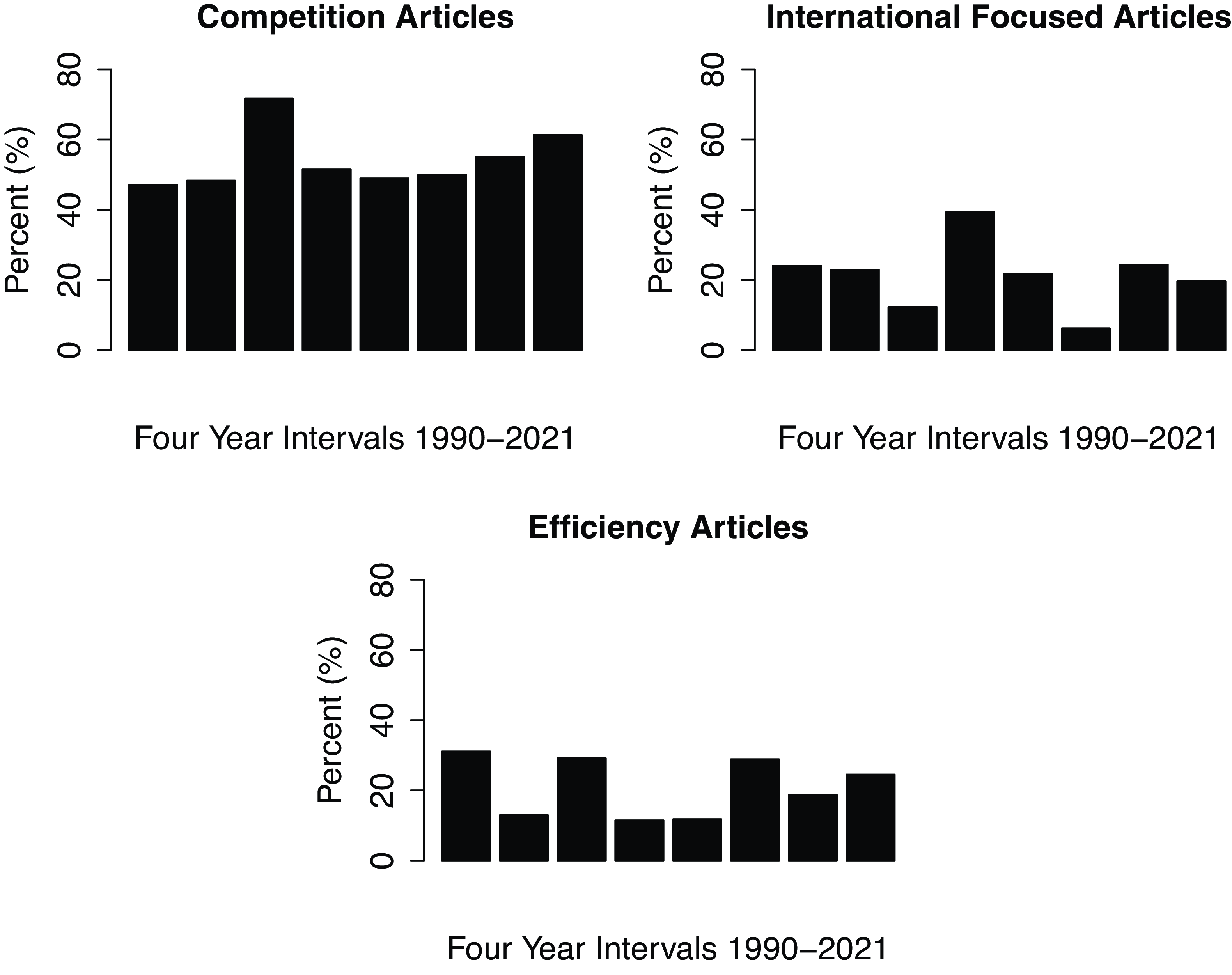
Our analysis of media coverage clearly shows that the media emphasizes the core components of antitrust policies, though they also present a variety of arguments and concerns about antitrust policies. The majority of the articles provide basic information about antitrust, with 57 percent of the articles noting that antitrust policies and enforcement promote competition. One of the next most prominent themes is efficiency, with 21 percent of the articles discussing how antitrust policies contribute to improved efficiency of firms and/or the market. Of particular interest to us, is that 20 percent of the stories focus on the international dimensions of antitrust. To further understand the composition of the media environment, we examine the percentage of the articles that focus on each topic over time. Though antitrust coverage as a whole has increased over time, looking at the breakdown of coverage allows us to examine which arguments have been relatively constant across time, and which have gained, or lost, prominence in the public discourse.
Figure 2 displays the percent of articles that address different antitrust topics and arguments from 1990 through 2021, broken into four-year periods to smooth the trends. The upper left panel shows that media coverage of antitrust typically discusses how antitrust laws promote competition, with about 50 percent of all articles discussing competition in most periods. The upper right panel of Figure 2 shows that there is more variance in reporting on the international components of antitrust, though we find that in most periods about 20 to 25 percent of articles have an international focus. Similarly, the percent of articles discussing how antitrust laws promote efficiency ranges from about 10 to 30 percent across the periods.
Composition of Antitrust Media Coverage. Note: The upper left panel of Figure 2 displays the percent of articles in each period that mention antitrust laws promoting competition. The upper right panel displays the percent of articles in each period that mention international aspects of antitrust, such as whether US firms are helped or hurt relative to foreign firms and whether there are international efforts to address antitrust issues. The lower panel displays the percent of articles in each period that mention antitrust laws promoting efficiency.
Within the internationally focused media coverage, we find that there are a number of different types of prominent arguments. Some of the media reports focus on how US laws can be used to “bring antitrust cases, particularly against cartels that involve foreign companies…” (Labaton, Reference Labaton1993). Such references emphasize how antitrust policies can be used to target foreign firms, and thus may help US companies compete. By contrast, other articles noted that stronger antitrust policies could place US companies at a disadvantage, specifically if domestic firms are targeted, and that “cracking down too hard could risk giving other countries like China a competitive edge…” (Iyengar, Reference Iyengar2020). We analyze the prevalence of these two types of international competitiveness arguments and find that the proportion of articles that focus on how antitrust can hurt the United States and its firms has remained relatively stable over time. However, we find that there has been a modest decline over the years in the proportion of articles that discuss how antitrust policies can help US firms compete ( $p = 0.087$
).Footnote
10
In the first five years of our data, from 1990-1994, 22 percent of the articles discussed how antitrust law could help US firms, but in the last five years of our data, from 2017 to 2021, only 12 percent of articles do so. The media analysis suggests that some themes have remained relatively constant over time, such as the importance of antitrust for promoting competition, but arguments about the potential for antitrust to help American firms compete, particularly against foreign firms, have become relatively less prominent.
$p = 0.087$
).Footnote
10
In the first five years of our data, from 1990-1994, 22 percent of the articles discussed how antitrust law could help US firms, but in the last five years of our data, from 2017 to 2021, only 12 percent of articles do so. The media analysis suggests that some themes have remained relatively constant over time, such as the importance of antitrust for promoting competition, but arguments about the potential for antitrust to help American firms compete, particularly against foreign firms, have become relatively less prominent.
The media coverage on antitrust policy is significant since the media plays a critical role in shaping public attitudes toward policy and influencing the information environment of voters (Baum and Potter, Reference Baum and Potter2008; Druckman, Reference Druckman2005). While there are contrasting theories about how the media selects what news stories to cover, ranging from the media as a passive conveyor of information to the media playing an active role as “a discrete strategic actor” (Baum and Potter, Reference Baum and Potter2008; Bennett, Reference Bennett1990), the important point for our analysis is that the media provides the public with information on antitrust, and that a few distinct themes emerge in news stories about antitrust. However, it remains an open question how responsive the public is to the different types of information provided by the media and elites, and what the contours of support are for antitrust policy.
Because antitrust law pits the interests of the public against the interests of the largest firms, explaining the political incentives for antitrust law requires an understanding of public preferences. Given both the rising salience of antitrust debates and the increasingly international consequences of antitrust law, we examine which prominent arguments about antitrust are most influential in shaping US domestic support for stronger antitrust policies.
Domestic antitrust law in a global economy
Globalization has reshaped domestic and international markets with the largest, most-productive firms increasing their market share. Antitrust law was largely designed to regulate the domestic market. Nevertheless, large, global competitors can threaten domestic firms and jobs.Footnote 11 In recent years, US antitrust has been frequently enforced against, and may even be disproportionately targeted at, foreign firms, as we discuss in subsequent sections. The fact that antitrust now affects the competitiveness of firms at home and abroad means that it’s important to evaluate antitrust policy in the context of global markets.
While antitrust laws were designed to promote domestic competition, strengthening only domestic antitrust laws has the potential to undermine the competitiveness of US firms. Antitrust law is typically enforced against the largest firms. These same firms are also the ones most likely to successfully engage in international trade. Since many Americans are already concerned about the global competitiveness of US firms, we expect that the public will not be supportive of stronger antitrust laws when they are informed that antitrust policy can harm US firms’ international competitiveness.
Our expectation is consistent with a broad literature that emphasizes the public’s concern with how the nation, and its firms, are affected by international trade and economics (Brutger and Strezhnev, Reference Brutger and Strezhnev2022; Mutz and Lee, Reference Mutz and Lee2020). Given that the US media provides substantial coverage of the country’s trade deficit (Guisinger Reference Guisinger2017, Chapt 7), the rapid decline of US manufacturing (Pierce and Schott, Reference Pierce and Schott2016), and public concerns about America’s economic position in the world (Brutger and Rathbun, Reference Brutger and Rathbun2021), we expect Americans to be receptive to concerns about how policies affect national competitiveness. This argument is also one that has been embraced by leaders of large companies, who publicly point to the need to remain competitive internationally. For example, Facebook CEO Mark Zuckerberg argues that if the US government broke up Facebook, it would jeopardize the company’s ability to compete with foreign firms (Zuckerberg, Reference Zuckerberg2020). Due to concerns about the competitiveness of national firms, we expect that informing the public that antitrust law could place American companies at a disadvantage will reduce support for domestic antitrust policies.
It is also possible that antitrust policies, which create a competitive domestic environment, could increase the efficiency of domestic firms—making them more globally competitive. This theme also emerged in the media analysis, where a substantial set of articles emphasized the effects of antitrust on efficiency in the market. We do not include a hypothesis regarding national efficiency here, because existing research has demonstrated that the public often does not respond to the purely economic effects of international economic policy (Bearce and Moya, Reference Bearce and Moya2020; Rho and Tomz, Reference Rho and Tomz2017). In the research design below, we evaluate the strength of an argument stressing the efficiency benefits of antitrust, allowing us to evaluate both arguments.
Hypothesis 1: When informed that US antitrust law may make American firms less competitive, individuals will be less supportive of antitrust law. Footnote 12
Thus far the discussion has emphasized antitrust law as it is intended: as encouraging market competition. However, antitrust law could also be biased against foreign firms in several ways. First, the antitrust process could be biased if foreign violations are more likely to be brought to the attention of regulators. For example, in 2012, two Japanese corporations, Yazaki Corporation and DENSO Corporation, paid almost $550 million in fines for collusion in setting prices and rigging bids on the sale of electrical components for automobiles; four of their executives agreed to serve prison time in the United States.Footnote 13 Similarly and also in 2012, a Taiwanese producer of LCD displays, AU Optronics Corporation, paid over $500 million for price-fixing; two of their executives also served prison time.Footnote 14 These firms are important suppliers that contribute to the production of many goods produced by American firms. Price setting among foreign firms could put their purchasers, American firms, at a disadvantage if they elevate prices or sell these goods more cheaply to their co-nationals. Because supplier firms are at times concentrated in specific countries, American firms may have few substitutes for these products. American firms thus have an incentive to bring the violations to the attention of regulators—much as they do with violations of international trade law (Betz, Reference Betz2018; Brutger, Reference Brutger2023). If antitrust violations in the foreign supply chain are more likely to be scrutinized, then antitrust enforcement could result in differential treatment of foreign and domestic firms.
Second, antitrust could also be intentionally used to protect the domestic market from foreign competition (Evenett, Lehmann and Steil, Reference Evenett, Lehmann and Steil2000; Ikejiaku and Dayao, Reference Ikejiaku and Dayao2021). If “regulation is acquired by the [regulated] industry and is designed and operated primarily for its benefit” (Stigler, Reference Stigler1971, cited by Reference ShortShort, 2022a ), then it makes sense that antitrust policy would be implemented in a biased manner. Domestic firms should have an advantage over foreign firms in acquiring their preferred policies. Recent research lends empirical support to this sort of targeting: cross-border M&As are more likely than domestic M&As to be targeted by competition authorities (Ro, Reference Ro2021) and foreign firms pay higher antitrust penalties than domestic firms (Foster, Reference Foster2022). The targeted use of antitrust policies has led some to criticize it in the media “as protectionism masquerading as antitrust policy” (Lynch, Reference Lynch2001). We expect that these types of arguments, which emphasize that antitrust policies are used against foreign firms, will appeal to those who are concerned about the country’s place in the global marketplace.Footnote 15
Media reports of antitrust being targeted at foreign firms are consistent with the actual use of antitrust policies. In the United States, antitrust is frequently used against foreign firms, with over 91 percent (141 out of 154) of the Sherman Act violations resulting in criminal fines and penalties of $10 Million or more having an international geographic scope.Footnote 16
Integrating a global perspective into a theory of preferences for antitrust policy is thus consistent with how antitrust law is enforced by the US government. Given the public’s concern for national competitiveness, we expect Americans to be more supportive of antitrust policy if they know that it is often enforced against foreign firms.
Hypothesis 2: When informed that US antitrust law is frequently enforced against foreign firms, individuals will be more supportive of antitrust law.
Heterogeneous effects
The receptiveness of individuals to concerns about competitiveness and the benefits of targeting foreign firms is likely related to their backgrounds and experiences. We know from existing work on the psychology of foreign policy attitudes, that individual-level dispositions and foreign policy outlooks play an important role in determining how individuals view their country’s interactions with foreign actors (Brutger and Kertzer, Reference Brutger and Kertzer2018; Herrmann, Isernia and Segatti, Reference Herrmann, Isernia and Segatti2009). When it comes to international economic relations, trade scholarship suggests that in-group favoritism and concern for co-nationals over people in trading partner countries strongly influence support for trade policies (Mansfield and Mutz, Reference Mansfield and Mutz2009; Mutz and Kim, Reference Mutz and Kim2017). This strand of literature emphasizes the importance of concern for the national in-group, which we argue extends to antitrust policy as well. Since globalization has led many to view economics, and especially international trade and business, through a competitive lens where nations are pitted against one another, antitrust law is likely to trigger economic nationalism.Footnote 17 We thus expect that those Americans who are more nationalistic will be less supportive of antitrust law if they believe that the law undermines the competitiveness of American firms in a global market and more supportive of antitrust if they are aware that it is enforced against foreign firms.Footnote 18
Hypothesis 3: The effects—of being informed that antitrust law may make American firms less competitive and of being informed that antitrust law is frequently enforced against foreign firms—will be larger in magnitude for those who are more nationalistic.
Research design
Our empirical approach uses a survey experiment that allows us to measure how attitudes toward antitrust policies shift in response to prominent international arguments advanced in public debates. We also conduct robustness tests to examine whether the results vary based on respondents’ level of political knowledge and education as well as if they were focused on Big Tech companies. We fielded our study in the summer of 2020 with the survey firm Lucid.Footnote 19 Survey samples from Lucid track well with US national benchmarks (Coppock and McClellan, Reference Coppock and McClellan2019) and are increasingly used in social science research, including many political science articles.Footnote 20
Prior to beginning our survey on antitrust policies, all respondents were provided with an informed consent form and had the option to opt-out of the study. Consistent with best practices for data quality (Burleigh, Kennedy and Clifford, Reference Burleigh, Kennedy and Clifford2018), respondents were blocked from participating if they were located outside of the United States or were flagged for using a Virtual Private Server (VPS). We also evaluated the quality of our responses using a generic attention check that is unrelated to our antitrust study.Footnote 21 We dropped the results from all respondents who failed the attention check, which resulted in a sample of 2,843 respondents that reflect the US population for many key demographics.Footnote 22 A summary of the demographics of our sample, and comparison to the national population, is provided in the Appendix, Section 1.2.
The antitrust portion of the study began by providing a basic description of antitrust policy to all respondents. Specifically, respondents read “Antitrust laws prohibit certain mergers and anticompetitive business practices. The prohibited practices include the creation of monopolies or coordination among companies to split markets, fix prices, or limit production.” For respondents in the pure control condition, they were next asked questions about their attitudes toward antitrust policies.
We are also interested in whether respondents’ baseline attitudes differed based on whether the control condition specified that antitrust laws were used against American companies or foreign companies. For select respondents (assigned randomly), we thus added a statement to the baseline information that read, “Antitrust laws are frequently enforced against large companies based in the United States.” We call this the Domestic Targeting Control (see Figure 3 below for the survey design). As described above, we also included a pure version of the control that did not include this sentence. We find that there is no difference in responses to the baseline condition with or without specifying that domestic companies are frequently targeted by antitrust laws, as shown in Section 1.3 of the Appendix. This finding suggests that when Americans are asked about antitrust policy, they likely assume the policies are generally used against American companies. Since our experimental analysis focuses on how the use of antitrust law against foreign versus domestic companies affects attitudes toward antitrust policies, we use the Domestic Targeting Control as our baseline for all reported treatment effects.
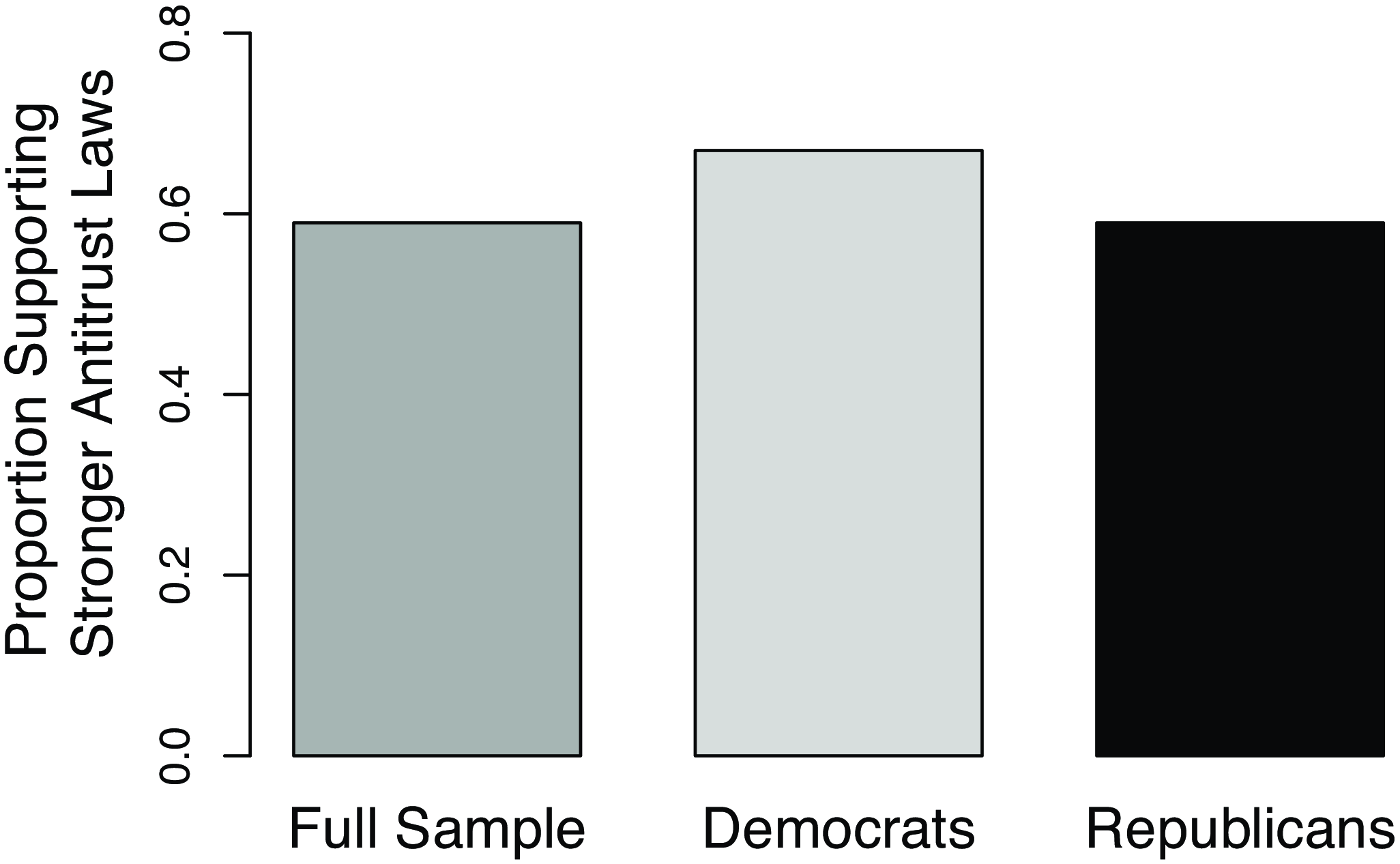
Baseline Support for Antitrust Policies. Figure 3 displays the proportion of respondents in the baseline condition who believe the United States should dramatically or somewhat strengthen its antitrust laws. The full sample includes all respondents, and then we present the results for those who identify as Democrats or Republicans.
The dependent variable was measured on a five-point scale with the following question.
Do you think the US government should strengthen or weaken its antitrust laws? (5 $ = $
dramatically strengthen, 1
$ = $
dramatically strengthen, 1 $ = $
dramatically weaken)
$ = $
dramatically weaken)
Before proceeding to the experimental component of our design, we briefly examine the general attitudes of respondents toward antitrust policies, as displayed in Figure 4. In the baseline condition, we find that the majority of respondents, 59 percent, support strengthening antitrust laws (either dramatically or somewhat). The baseline descriptives in our study are consistent with national polls that found “About half of Americans on both sides of the aisle back the Justice Department’s antitrust lawsuit against Google” (Gold, Reference Gold2020).
Survey Design.
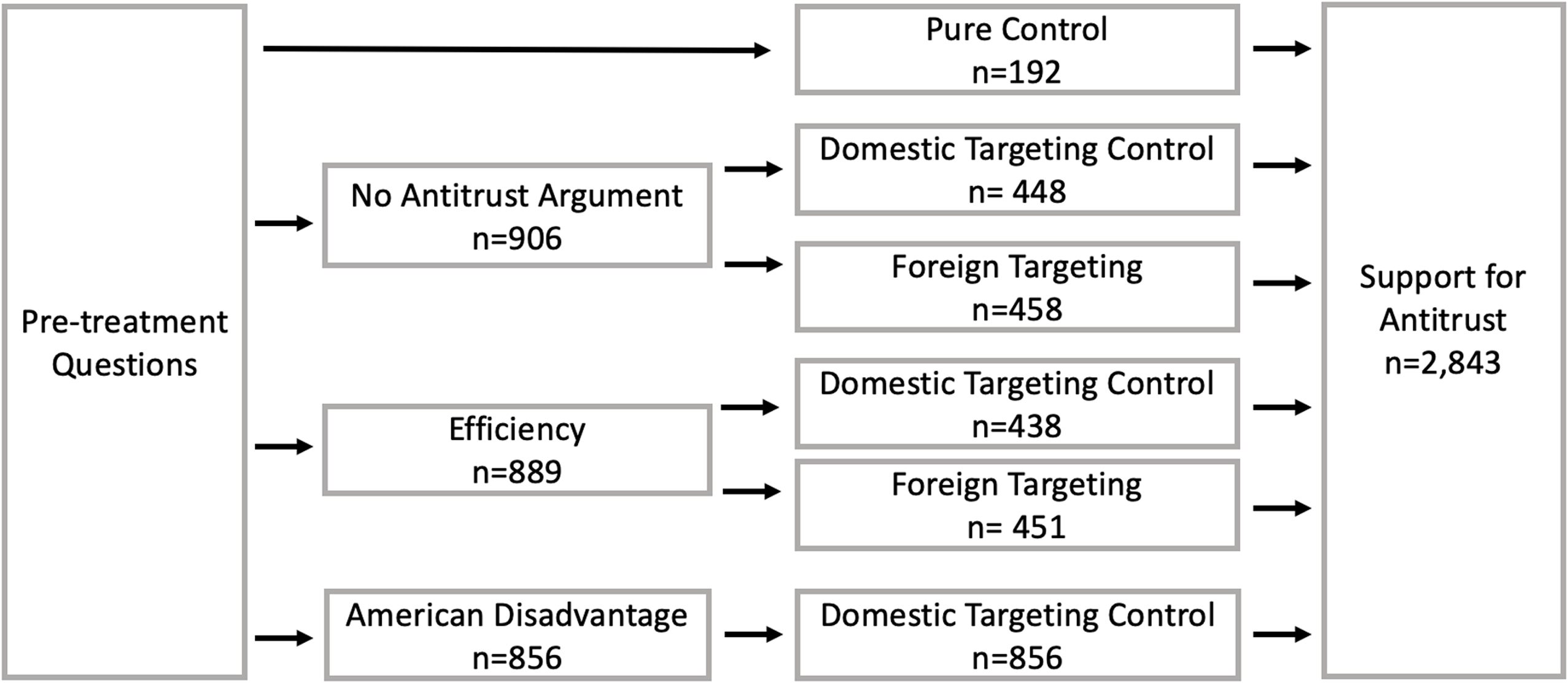
Having established the baseline level of support for strengthening antitrust policies, we now discuss our experimental design which tests how different information about antitrust laws shapes public attitudes. The experiment has two sets of treatments that were administered as additional text added to the Domestic Targeting Control. The first set of treatments randomly provides information about the effects of antitrust laws. These treatments tap into some of the most prominent arguments used in favor, and opposition, to antitrust laws. The treatments focus on the potential for antitrust laws to place domestic firms at a relative disadvantage, compared to foreign companies, and for antitrust to promote efficiency. These treatments are based on actual media coverage, and reflect arguments that are prominent in the news. We use the American Disadvantage treatment, which advances an argument reflecting news articles that focus on the potential for antitrust to hurt US firms’ competitiveness, to test our first hypothesis. The National Efficiency treatment is included because a substantial portion of the news articles argue that antitrust promotes efficiency, as reflected in Figure 2. Though we don’t have strong priors regarding the effect of the National Efficiency Treatment, including this treatment provides a useful comparison that helps us evaluate the relative importance of our theory about the public’s concern for foreign competition, compared to the public’s concerns for efficiency of the domestic economy. The full text of the treatments is shown here.
AMERICAN DISADVANTAGE: Some argue that antitrust laws reduce American competitiveness by limiting the size of American companies, putting them at a disadvantage relative to foreign companies.
NATIONAL EFFICIENCY: Some argue that antitrust laws promote competition, which encourages efficiency in the national economy.
To further test how public concerns about domestic versus foreign competition shape attitudes toward antitrust, we introduce a second component of the experiment, that randomizes whether respondents are told that antitrust laws are frequently used against domestic or foreign companies. As noted above, the Domestic Targeting Control specified that antitrust laws are frequently used against US companies. In the Foreign Targeting treatment, the text is altered so that respondents learn antitrust laws are frequently used against firms based in foreign countries.
DOMESTIC TARGETING CONTROL: Antitrust laws are frequently enforced against large companies based in the United States.
FOREIGN TARGETING: Antitrust laws are frequently enforced against large companies based in foreign countries.
The Foreign Targeting treatment is independently randomized, with the exception that the “American Disadvantage” treatment and the “Foreign Targeting” treatment are never displayed together, since it would be logically inconsistent to do so. Had we presented both treatments together, this would have resulted in “treatment inconsistency” (Brutger et al., Reference Brutger, Kertzer, Renshon, Tingley and Weiss2022), where the components of the experiment are logically discordant and can jeopardize the quality of responses. All respondents first answered a set of pre-treatment questions and then read the brief background defining antitrust. The respondents were then randomly assigned to either the pure control condition or one of the other conditions, as outlined in Figure 3. The survey expectations were not pre-registered, though we report null and significant findings for transparency. Tests for statistical significance are two-tailed.
Results
American disadvantage & national efficiency
We begin our analysis by testing the main effect of the American Disadvantage and National Efficiency treatments while holding domestic targeting constant. Figure 5 depicts the marginal effect of the American Disadvantage and National Efficiency treatments on support for strengthening antitrust laws, using the 5-point scale. As shown on the right side of figure, the National Efficiency treatment does not have an effect on support for antitrust laws. This suggests that one of the most prominent political messages carried by the media in favor of antitrust laws has no effect on public attitudes toward antitrust policy. This null result is consistent with studies that show the public is not always responsive to the economic effects of policies (Bearce and Moya, Reference Bearce and Moya2020).
Effects of National Efficiency and American Disadvantage Treatments. Note: The dependent variable is support for strengthening antitrust laws, which is measured from 1 to 5 with higher values associated with greater support for strengthening antitrust laws. In all conditions analyzed in Figure 5 the treatment and controls specified that antitrust laws are frequently used against US companies.
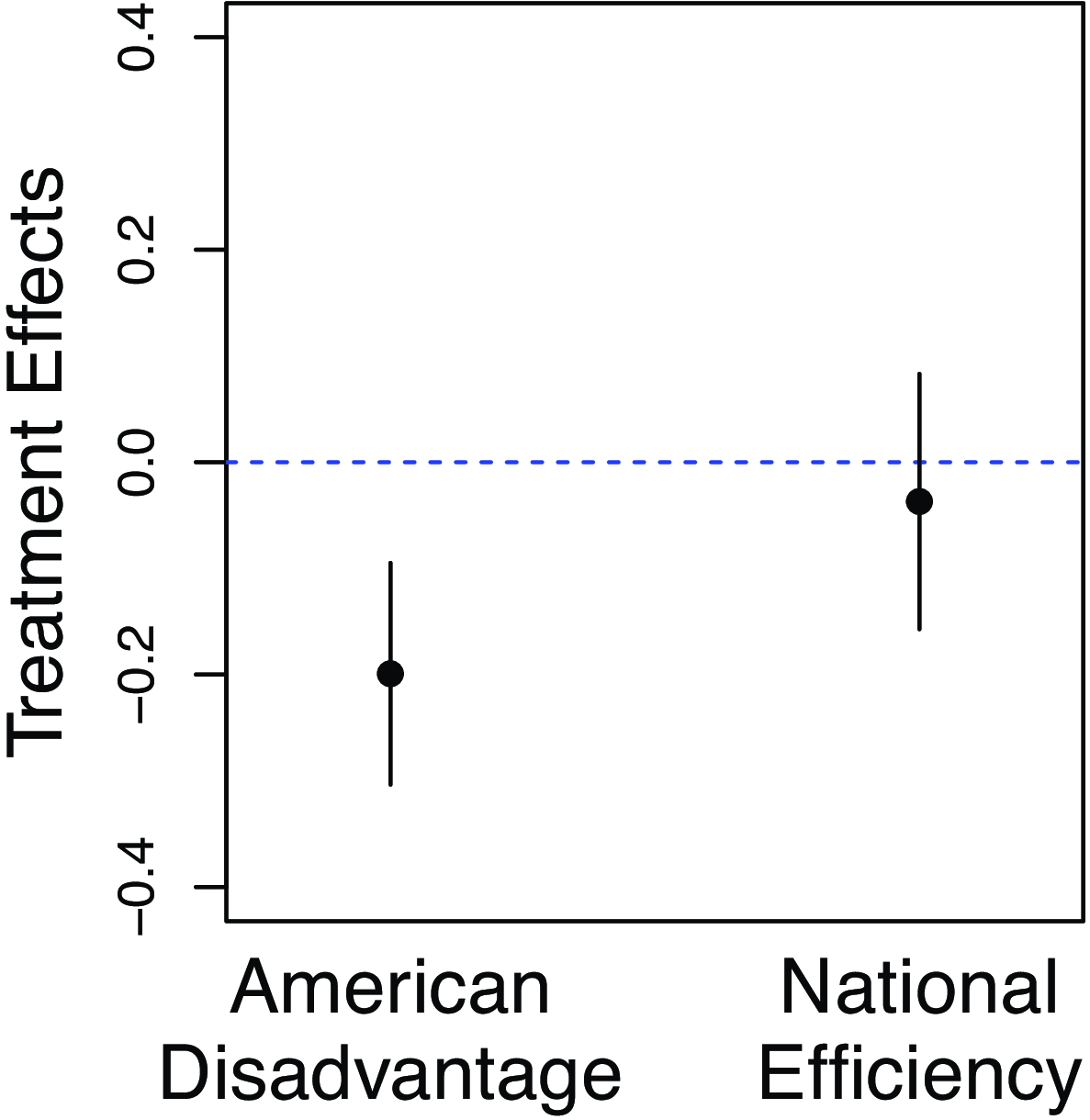
In contrast to the National Efficiency result, we find that the American Disadvantage treatment has a strong negative effect on support for strengthening antitrust laws, as shown in the left side of Figure 5. This result is consistent with Hypothesis 1 and emphasizes the importance of international competition on attitudes toward economic policy. Our finding shows that the public has a significant negative reaction to US companies being potentially placed at a disadvantage relative to foreign competitors, and that this can undermine support for stronger antitrust regulations. To aid in interpretation, we also code a dichotomous measure of support for strengthening antitrust, which is one for respondents that somewhat or strongly support antitrust and zero otherwise. Using this dichotomous measure, the American Disadvantage treatment results in about a 10 percentage point decrease in respondents supporting strengthening antitrust laws, dropping support from 58.7 to 48.5 percent ( $p \lt 0.01$
). Even though antitrust laws were historically domestically oriented, they have become increasingly important for shaping economic competition at the international level, and the American public is quite responsive to arguments that the country and its firms are being placed at a relative disadvantage due to antitrust laws.
$p \lt 0.01$
). Even though antitrust laws were historically domestically oriented, they have become increasingly important for shaping economic competition at the international level, and the American public is quite responsive to arguments that the country and its firms are being placed at a relative disadvantage due to antitrust laws.
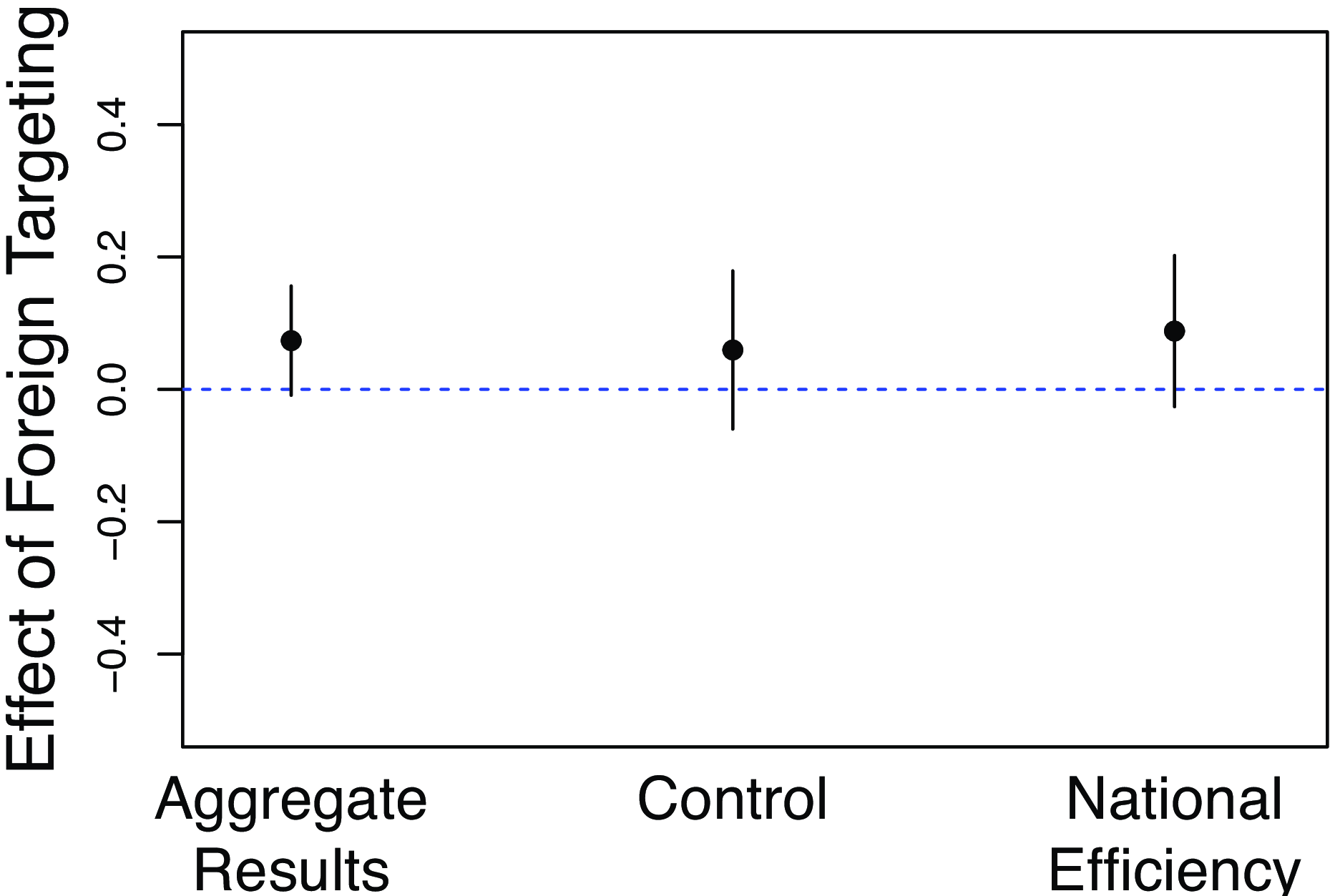
We now test Hypothesis 2, examining the effect of using antitrust laws against foreign versus domestic firms on public attitudes. We first test the effect of Foreign Targeting for the full sample, excluding the American Disadvantage treatment since the Foreign Targeting treatment is never paired with the American Disadvantage treatment, as discussed in the research design. As shown in the left side of Figure 6, we find that Foreign Targeting does not significantly increase support for strengthening antitrust laws. The effect is in the positive direction, as predicted in Hypothesis 2, but does not reach statistical significance when analyzed for the full sample, as shown in the aggregate results ( $p = 0.08$
), or when subsetting to either the Control or National Efficiency conditions. The reason for the limited effect of Foreign Targeting, which we discuss in the next section, is that this treatment triggers divergent responses, which partially negate one another.
$p = 0.08$
), or when subsetting to either the Control or National Efficiency conditions. The reason for the limited effect of Foreign Targeting, which we discuss in the next section, is that this treatment triggers divergent responses, which partially negate one another.
Effect of Foreign Targeting. Note: The results in Figure 6 show the average treatment effect and 95% confidence intervals for being in the Foreign Targeting treatment, compared to the baseline of domestic targeting. On the left are the aggregate results, showing the treatment effect for the full sample of respondents in conditions that randomized domestic targeting (excludes American Disadvantage). Moving to the right, the treatment effects are displayed conditional on being in the control condition or the National Efficiency condition. The dependent variable is support for strengthening antitrust laws, which is measured from 1 to 5.
Heterogeneous treatment effects
Next, we proceed to an examination of our third hypothesis, which predicts that individuals who are highly nationalistic will respond more strongly to the American Disadvantage and Foreign Targeting treatments. We begin by testing the effect of nationalism using a standard set of questions from Herrmann, Isernia and Segatti (Reference Herrmann, Isernia and Segatti2009), which captures individual-level National Superiority. The questions are displayed in full in the Appendix, Section 1.4, and have been frequently used in foreign policy analysis (e.g., Kertzer and Brutger (Reference Kertzer and Brutger2016), Kertzer and McGraw (Reference Kertzer and McGraw2012), and Brutger and Strezhnev (Reference Brutger and Strezhnev2022)).Footnote 23 For ease of interpretation we rescale the measure from zero to one, with higher values associated with high levels of nationalism.
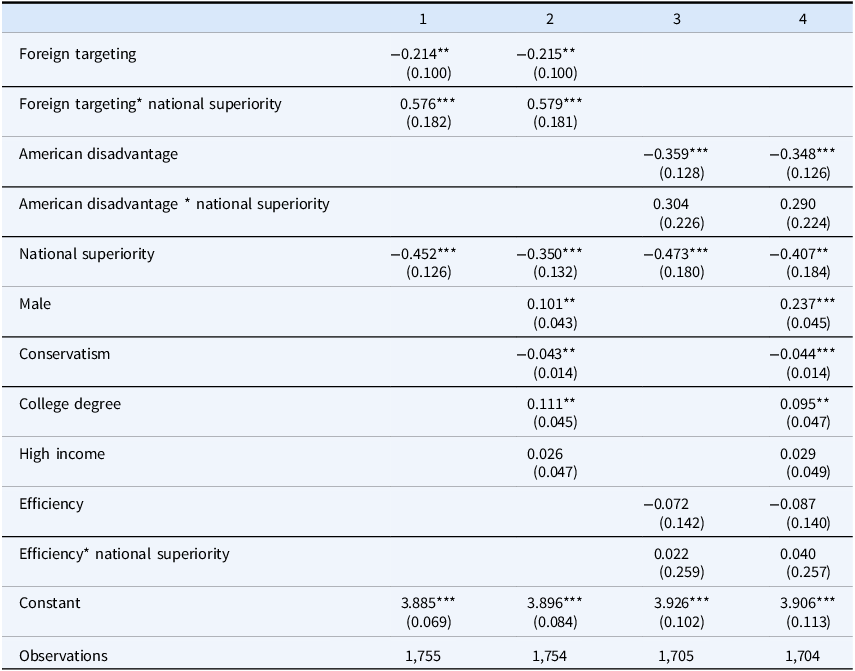
In Table 2 we display the interaction effects with and without demographic controls.Footnote 24 The marginal effects from the models are displayed in Figure 7. We find that those individuals who score highly on the National Superiority measure are more likely to oppose antitrust laws in general. However, consistent with Hypothesis 3, the Foreign Targeting treatment has an especially strong positive effect amongst those who are high in National Superiority. This means that those individuals who are most likely to be skeptical of strengthening antitrust laws are also most likely to react in favor of such policies when they learn that antitrust laws are frequently used against foreign companies. For example, when asked to share their thoughts in a free response, one person noted that “Large companies based in foreign countries should be held accountable…” and another said “Foreign national corporations should be equally accountable to antitrust laws.” Interestingly, at low levels of National Superiority, the Foreign Targeting treatment has a negative effect, as shown in models 1 and 2 of Table 2. This divergence explains the null effect of the Foreign Targeting treatment in the earlier analysis, since we see that the treatment has opposite effects on those who are low and high in National Superiority. Those low in National Superiority might oppose the biased targeting of foreign firms and instead want antitrust to be implemented in a non-discriminatory way. Or, they might be more attuned to concerns about foreign retaliation.
Interaction effects with national superiority
Note: *p $ \lt $
0.1; **p
$ \lt $
0.1; **p $ \lt $
0.05; ***p
$ \lt $
0.05; ***p $ \lt $
0.01. The dependent variable is support for strengthening antitrust laws, which is measured from 1 to 5. Models 1 and 2 do not include the American Disadvantage treatment, since it was never paired with the Foreign Targeting Treatment. Conversely, Models 3 and 4 do not include Foreign Targeting for the same reason. High Income is an indicator for whether respondents make $75,000 or more, which is approximately the median household income in the US. Conservatism is a seven-point ideology measure, where higher values correspond to being more conservative (the measure is provided in the Appendix, Section 1.4).
$ \lt $
0.01. The dependent variable is support for strengthening antitrust laws, which is measured from 1 to 5. Models 1 and 2 do not include the American Disadvantage treatment, since it was never paired with the Foreign Targeting Treatment. Conversely, Models 3 and 4 do not include Foreign Targeting for the same reason. High Income is an indicator for whether respondents make $75,000 or more, which is approximately the median household income in the US. Conservatism is a seven-point ideology measure, where higher values correspond to being more conservative (the measure is provided in the Appendix, Section 1.4).
Marginal Effects by National Superiority. Figure 7 shows the marginal effects of the Foreign Targeting and American Disadvantaged treatments across the full range of the National Superiority measure. The marginal effects are calculated using Strezhnev’s Interaction Plots in R code (Strezhnev, Reference Strezhnev2013), and are generated using Models 1 and 3 from Table 2.
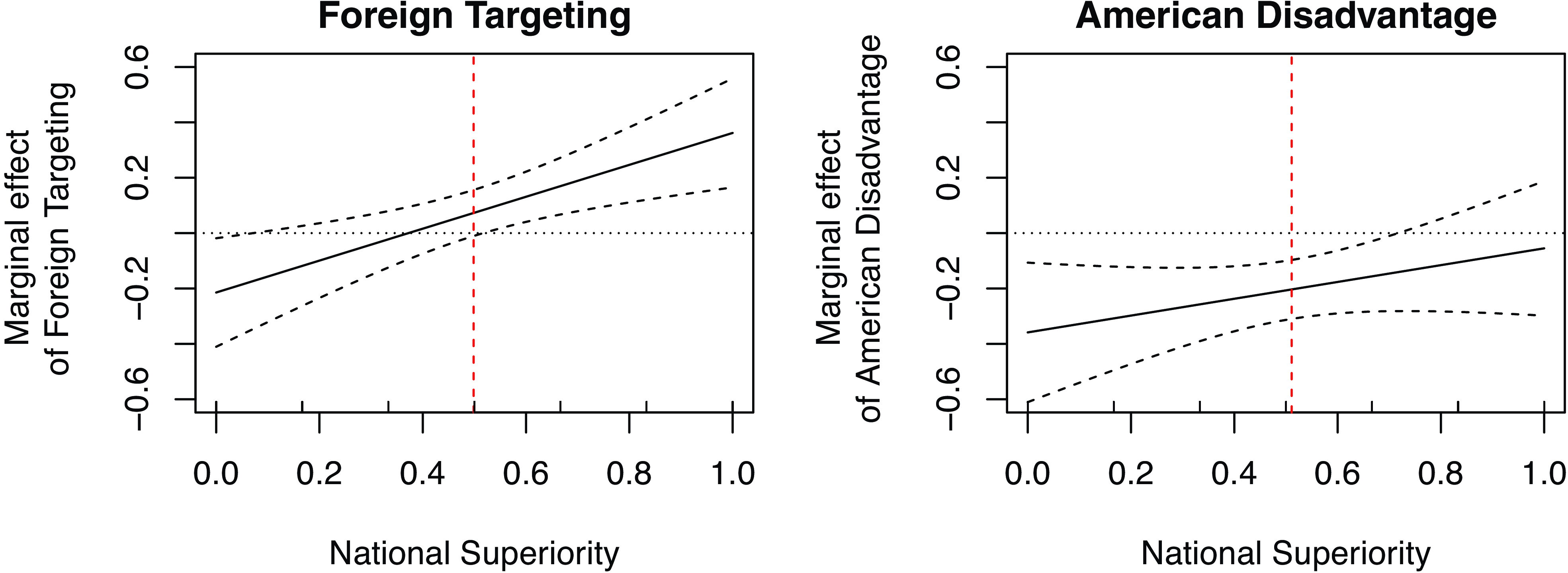
We also analyzed the interaction effects between National Superiority and the American Disadvantage treatment. As shown in columns 3 and 4 of Table 2, there is not a significant interaction effect. This is somewhat surprising, since we expected that the American Disadvantage treatment would have a more negative effect on support for antitrust laws among highly nationalistic individuals. Instead, we find that there is a strong negative main effect of the American Disadvantage treatment, which suggests that people at all levels of nationalism are concerned about US firms being placed at a disadvantage. Interestingly, the sign on the interaction is actually in the opposite direction than predicted, though it does not approach statistical significance. The lack of interaction effect between National Superiority and the American Disadvantage treatmentFootnote 25 suggests that National Superiority’s strength as a moderator primarily functions when respondents learn foreign firms are targeted.
Robustness tests
Nationalism, partisanship, and ideology
To probe the robustness of our results, we now consider the relationship between nationalism, partisanship, ideology, and our findings. Increasingly, nationalism has become sorted by party (Bonikowski, Feinstein and Bock, Reference Bonikowski, Feinstein and Bock2021), with Republicans and conservatives being more likely to embrace an exclusionary conception of the nation. To address this, our main analysis reported in Table 2 includes a control for conservatism, which is a seven-point ideology measure, with higher values associated with increased conservatism.Footnote 26 We also replicate Table 2, but change the ideology measure to a partisan measure, as reported in Section 1.9 of the Appendix. We find that the effects of our treatments are consistent across models, giving us greater confidence in our findings. Interestingly, we find that our treatments have a substantively larger effect on support for antitrust policy than identifying as a Republican or having a college degree. Furthermore, when we interact our treatments with partisan identification, partisanship does not significantly moderate our treatment effects. Though there is clearly variation in baseline attitudes based on partisanship and education, it appears that the public is quite responsive to information about the use of antitrust against foreign firms, and the risk of antitrust placing American firms at a disadvantage, and that these messages do not have significantly different effects for Republicans than Democrats and Independents.
Survey weights
We next evaluate whether our results yield consistent interpretations if we weight our respondents to match the US adult population. As shown in Section 1.2 of the Appendix, our sample closely matches the US population on numerous dimensions, though the sample is less representative when it comes to income and education. We employ the “anesrake” package (Pasek and Pasek, Reference Pasek and Pasek2018) to weight our sample based on age, income, college degree, political party affiliation, and gender. We report a summary of weighting in Section 1.10 of the Appendix. We find that the sign and significance of the treatment effects and their interactions are robust when using the weighted analysis.
Focus on tech and individual knowledge
Finally, we recognize that there are two important potential concerns of testing the effect of information about antitrust policies. First, antitrust may be complicated, such that the treatments would not be easily understood by those who are not well educated or politically savvy. If this was the case, our study would generate more conservative estimates, biasing against finding significant results. That said, we test whether our treatments have differential effects for those who are high in political knowledge versus those who are not and across a range of education levels. Our survey included a series of questions to measure respondents’ political knowledge, which we describe in the Appendix, Section 1.4. The interaction models for political knowledge and education are provided in the Appendix, section 1.5.
We find that those high in political knowledge and those with more education have higher baseline support for strengthening antitrust laws, but we do not find that either variable has a significant interaction with any of our treatments. In fact, the treatment effects are sometimes marginally smaller (though not significantly so) amongst those with more knowledge, which is the opposite of what we would expect if the treatments were too complex for those with low political knowledge or little education. Second, responses to questions about antitrust may simply reflect feelings toward technology companies. We recognize that in recent years, much of the antitrust media coverage and political debate in the United States has focused on Big Tech. Since technology companies like Amazon, Google, and Facebook have different business models than many other industries, and play a major role in the public’s daily life, it is possible that our results would vary for tech companies. To examine this, we leverage the free responses to the question “When thinking about the previous questions about antitrust laws, what were your thoughts or considerations?” We coded all free responses that mentioned tech*, Amazon, Twitter, Facebook, Microsoft, and/or Apple as being focused on tech companies. We then test whether our treatments have differential effects for those who were focused on tech or not. Results are reported in Section 1.6 of the Appendix.Footnote 27 We found that respondents focused on tech had a higher baseline level of support for antitrust policies, but there were no significant interactions between our treatments and being focused on tech. This gives us greater confidence that our results are not limited to those thinking about big tech (or the converse), and that the arguments that shape public support for antitrust policy have similar effects across industries in the United States.
Conclusion
Although much is known about the economics of antitrust law and about how market concentration affects political influence, less is known about public support for strengthening antitrust policies. As markets become increasingly concentrated and global, understanding when citizens support and oppose policy measures that reduce concentration and foster competitive markets becomes increasingly important. In this paper, we present a theory of public support for antitrust policy based on global economic and psychological microfoundations, which we test using a survey experiment that helps assess which arguments resonate with Americans and alter support for antitrust policies.
We find that Americans are divided in their views toward antitrust law, and that public preferences are particularly attuned to the effects of antitrust policy on national competitiveness. Americans become less supportive of antitrust policies when they believe that those policies place American firms at a disadvantage. Interestingly, this effect holds across varying levels of nationalism. We conclude that American concern for the country’s international competitiveness is quite robust. Our analysis also shows that how antitrust policies are used significantly shapes support for strengthening antitrust policies. When Americans learn that antitrust laws are used against foreign firms, highly nationalistic individuals become significantly more supportive of strengthening antitrust laws. This is especially noteworthy, given that these same individuals are typically much less likely to support antitrust policies. However, this same information can lead to a negative reaction amongst those with very low levels of nationalism. Though these individuals are typically supportive of stronger antitrust laws, their support is somewhat undermined when they learn that the laws are frequently used against foreign firms.
Taken together, the findings point to the importance of economic competitiveness and nationalism in shaping preferences toward antitrust. The study suggests that Americans are forming opinions on antitrust at least in part through the lens of economic nationalism. Our findings are consistent with research that finds the American public often focuses on national conditions over narrower individual interests. For politicians seeking to build a coalition of public support in favor of antitrust, it will be important to counter corporate arguments that antitrust laws place American firms at a disadvantage. Instead, politicians can emphasize how such laws help US firms compete on a level playing field and ensure that foreign firms are not abusing their market power.
Our findings also highlight that international competitiveness continues to animate antitrust policy. While concerns about international competitiveness helped motivate support for President Ronald Reagan and the jettisoning of government regulation, these concerns still seem to resonate with the public—even as American-owned firms remain dominant players in international trade and investment. This concern however is consistent with the lop-sided trade balance in the United States: American-owned firms may be thriving, but their production can be located abroad, and big parts of the United States are concerned about American competitiveness and seem to feel left behind.
In the United States, it is clear that antitrust policy is rising in salience, as shown in the media analysis and recent political rhetoric. A major component of the public debate focuses on national competitiveness and concerns about domestic versus foreign firms. Our work suggests numerous avenues for future research. While our study focused on the United States, it’s possible that different concerns are more salient in other countries. The United States has a large, highly concentrated and relatively competitive market, which had, until very recently, been characterized by low inflation for the last several decades. The cost of opening markets and the temptation to use competition policy for protection may be more pronounced in smaller, less competitive markets. The United States also has historically had substantial control over the enforcement of antitrust laws outside its borders. This makes enforcement against foreign firms both salient and realistic, which may not be true in smaller markets. We thus anticipate that this article acts a springboard for additional research into antitrust law, which will continue to gain prominence as both global and domestic markets become increasingly concentrated.
Supplementary material
The supplementary material for this article can be found at https://doi.org/10.1017/bap.2024.35
Acknowledgements
This paper has benefited from the generous feedback provided by David Broockman, Tim Büthe, Alex Debs, Dirk Leuffen, Nina Obermeier, Cleo O’Brien-Udry, Erik Peinert, Tyler Pratt, Didac Queralt, Thomas Sättler, Gerald Schneider, Nicholas Short, David Stasavage, Jan Stuckatz, Lora Anne Viola, Stephen Weymouth, and from participants at workshops and conferences where earlier versions of the paper were presented. We also thank Emma Guard, Katie Lee, Strong Ma, Abby Morris, Camilla Rodriguez Torres, and Avery Wheless for their research assistance on this project.
Competing interests
The authors declare none.


 Open access

