

What accounts for the electoral rise of Javier Milei in Argentina? How did his electoral discourse appeal to the Argentinean voter? Both the unexpected arrival of Javier Milei on the political scene in Argentina and his sudden electoral success become the subject of scholarly debate. Most of the extant research focuses on factors such as the effect of the economic downturn on the incumbent party’s electoral chances and Milei’s outsider profile (Ramírez and Vommaro Reference Ramírez and Vommaro2024), or the importance of the support of the working class (particularly in the informal sector), attracted by the promises of ending populist rule in Argentina through an extreme-right political programme (Balsa Reference Balsa2024; Rojas Reference Rojas2024). Some scholars emphasize the far-right populist perspective in Milei’s speech, despite controversy surrounding such a characterization (Heinisch et al. Reference Heinisch, Gracia, Laguna-Tapia and Muriel2024; Sendra and Marcos-Marne Reference Sendra and Marcos-Marne2024). Recognizing that the phenomenon of Milei’s rise is only partially captured by traditional definitions of populism, recent scholarship frames his electoral campaign variously as populist opportunism in times of crisis (Ramírez and Vommaro Reference Ramírez and Vommaro2024), anti-elitist and libertarian populist discourse (Sendra and Marcos-Marne Reference Sendra and Marcos-Marne2024), a form of anti-populist or disruptive populism (Pérez-Díaz and Arroyas Langa Reference Pérez-Díaz and Arroyas Langa2025; Retamozo Reference Retamozo2025), and even as managerial populism (Pino Díaz Reference Pino Díaz2024).
We argue that Milei’s electoral success can be considered a paradigmatic case of a personalistic electoral campaign, despite sharing some critical attributes of populist leaders. Since the literature does not unambiguously classify him as a populist, and to avoid the risk of conceptual stretching and the related overuse of the concept (Hanson and Kopstein Reference Hanson, Kopstein, Bernhard, Kreppel and de la Torre2024:49; Jones and Menon Reference Jones, Menon, Bernhard, Kreppel and de la Torre2024:61), we rely here on the narrower notion of personalism to account for his electoral rise. The concept of personalism linked to electoral strategies allows us to offer a precise account of Milei’s 2023 campaign, as its scope is narrower than high-order concepts such as populism (Viviani Reference Viviani2025). In this way, it provides a distinct lens for understanding contemporary campaigns that centre on candidates as standalone brands.
In this article, we contend that Milei’s electoral ascent combines concept-specific appeals with other claims that depend on the particular context he faced, allowing for the identification of a specific variety of personalism. Specifically, we argue that the electoral success of Milei in Argentina’s 2023 presidential contest rests on three main appeals. First, as a typical case of electoral personalism, it involved a concept-specific attribute: a deliberate self-promotion strategy, positioning himself as the campaign’s central electoral asset. The other two appeals were context-specific: moral content and ideological rhetoric complemented self-promotion messages aimed at appealing to specific characteristics of Argentine voters, thereby giving rise to a particular type of electoral personalism.
On the one hand, Milei deployed a discourse marked by moral content that challenged the Argentine political establishment, the so-called casta, blaming it for corruption and the country’s moral decay. On the other hand, Milei relied on salient ideological rhetoric, characterized by intense – and often aggressive – messages that emphasized far-right stances and criticized the collectivist vision on the left. Concerning these context-specific appeals, Milei’s moral allegations made against the antagonistic camp are consistent with Argentine politics, where there is a strong anti-Peronist camp that coalesces around this position (Kessler and Vommaro Reference Kessler and Vommaro2025). At the same time, the existence of a salient ideological positioning, such as Milei’s libertarianism, is something of a novelty in the contemporary party system in Argentina (Kessler and Vommaro Reference Kessler and Vommaro2025; Murillo and Oliveros Reference Murillo and Oliveros2024).
We rely on diverse types of empirical evidence to account for the rise of Milei as a case of electoral personalism. First, we analyse the political discourse deployed by Milei as a presidential candidate in his public appearances and on social media. We develop a dictionary-based text analysis inspired by natural language processing, which we adapt to Milei’s speech mannerisms to estimate the salience of his main electoral appeals. By doing so, we extract some critical components of his electoral strategy. We also rely on public opinion data to conduct a statistical analysis in order to identify the key characteristics of Milei’s supporters. Finally, we triangulate our evidence to discuss the main findings of our study.
We intend to make two contributions to the literature. First, we further develop the concept of personalism by identifying the core elements of Milei’s electoral strategy and linking them to his electoral success. Second, by addressing two key context-specific factors, we contribute to the literature by assessing how electoral personalism works and how it varies in response to contextual factors. The latter is particularly relevant for advancing our knowledge of electoral politics in emerging countries like Argentina, which have been under economic and social stress for an extended period. Additionally, distinguishing between concept- and context-specific attributes enables us to expand our knowledge about the varieties of personalism in modern democracies.
The rest of the article is organized as follows. First, we identify and outline the main appeals in Milei’s electoral campaign that give rise to a paradigmatic case of electoral personalism. Next, we combine qualitative and quantitative text analysis to estimate the salience of each particular appeal in Milei’s discourse in public appearances and on social media. Third, we rely on public opinion data to show how Milei’s discourse appealed to the Argentinean voter, examining the audiences with which his electoral appeals resonated most. In the conclusion, we summarize our main findings and pose some questions for future research.
Milei’s personalistic recipe: self-promotion, ideological rhetoric and moral content to maximize electoral support
Personalism has been identified as a rising global phenomenon (Frantz et al. Reference Frantz, Kendall-Taylor and Nietsche2021; Garzia Reference Garzia2014; Garzia et al. Reference Garzia, Ferreira Da Silva and De Angelis2021; Kendall-Taylor et al. Reference Kendall-Taylor, Frantz and Wright2017; McAllister Reference McAllister, Dalton and Klingemann2007; Musella and Webb Reference Musella and Webb2015; Rahat and Kenig Reference Rahat and Kenig2018). The concept of political personalism emphasizes the importance of individuals over collective organizations, such as political parties or cabinets (Friedberg and Rahat Reference Friedberg, Rahat, Friedberg and Rahat2024; Rahat and Kenig Reference Rahat and Kenig2018; Rahat and Sheafer Reference Rahat and Sheafer2007). Despite this, there is limited consensus about how personalism should be defined (Kostadinova and Levitt Reference Kostadinova and Levitt2014). While some scholars focus on personalism as the concentration of political power in a single leader (Frantz et al. Reference Frantz, Kendall-Taylor and Nietsche2021; Frantz et al. Reference Frantz, Kendall-Taylor and Wright2020; Poguntke and Webb Reference Poguntke and Webb2005; Rhodes-Purdy and Madrid Reference Rhodes-Purdy and Madrid2020), others understand personalism as a particular type of political linkage between politicians and their followers (Andrews-Lee Reference Andrews-Lee2019, Reference Andrews-Lee2021; Kitschelt Reference Kitschelt2000; Kitschelt et al. Reference Kitschelt, Hawkins, Luna, Rosas and Zechmeister2010). For that reason, Diego Luján et al. (Reference Luján, Acosta and Lara2024) proposed distinguishing between electoral and governmental arenas in the study of personalism.
This article builds on existing work that has shown a growing trend towards personalization not only in consolidated democracies with institutionalized party systems (Caprara and Vecchione Reference Caprara and Vecchione2017; Garzia Reference Garzia2014; Garzia et al. Reference Garzia, Ferreira Da Silva and De Angelis2021; Rahat and Kenig Reference Rahat and Kenig2018), but also across diverse political contexts (Frantz et al. Reference Frantz, Kendall-Taylor and Nietsche2021; Kendall-Taylor et al. Reference Kendall-Taylor, Frantz and Wright2017). The literature focusing on personalism argues that its rise is driven by both the need to regain disillusioned electorates and the integration of digital media into political communication strategies (Gibson Reference Gibson2020). We also build on previous studies around the importance of personalism as an electoral strategy used by individual politicians to mobilize and persuade voters based on their personal attributes like courage, kindness, competence, honesty, wealth or any other attribute that voters value (Musella and Webb Reference Musella and Webb2015; Rahat and Kenig Reference Rahat and Kenig2018; Tuttnauer and Rahat Reference Tuttnauer and Rahat2025; Wattenberg Reference Wattenberg and King1990, Reference Wattenberg, Aarts, Blais and Schmitt2011). Even though most of this literature focuses on parliamentary systems, presidential elections should be the best setting for developing personalistic campaigns, particularly in contexts of weak and poorly institutionalized political parties, such as those found in most Latin American countries (Mainwaring et al. Reference Mainwaring, Bizzarro, Petrova and Mainwaring2018).
Based on these considerations, we show how electoral personalism works by examining Milei’s electoral rise in Argentina. In doing so, we contribute to refining and expanding the concept. We argue that although there are systematic similarities among personalistic candidates, there are also notable differences. Similarities arise from candidates’ emphasis on self-promotion as a concept-specific attribute, shared by almost all cases of electoral personalism. However, the extent to which they rely on specific appeals depends heavily on the context in which candidates compete in elections. The context varies significantly across space and time, thereby giving rise to context-specific attributes that candidates may rely on to mobilize and persuade voters.
Milei’s success followed a trajectory similar to Nayib Bukele’s in El Salvador, to the extent that Milei also took advantage of the crisis context to highlight his own figure as the main electoral asset for differentiating himself from his opponents. However, the two politicians differ in how they appealed to the electorate in response to context-specific factors. For example, while Bukele based his discourse as a presidential candidate on messages of ideological dilution (Luján and Puig Lombardi Reference Luján and Puig Lombardi2025), Milei did the opposite. Additionally, while Bukele reacted with clear anti-party rhetoric to the decline of traditional Salvadoran parties (FMLN and ARENA), taking advantage of not belonging to either party, Milei adopted a different strategy because he faced a different context: even though the economic crisis had severely damaged Argentinean parties, the established parties maintained a solid rank-and-file basis. Hence, Milei emphasized the moral content of his public speech, differentiating himself from both the traditional parties and the political and economic establishment.
In sum, almost all instances of electoral personalism share a common attribute: the salience of self-promotion by political leaders and candidates. Nevertheless, they vary greatly in how they appeal to the electorate based on the specific conditions politicians face when trying to mobilize and persuade voters. Personalism is not a foreign trait in Argentine politics. Indeed, some authors argue that the system has become increasingly personalized (Gervasoni Reference Gervasoni and Mainwaring2018; Malamud and Marsteintredet Reference Malamud and Marsteintredet2024). Andrés Malamud and Leiv Marsteintredet (Reference Malamud and Marsteintredet2024: 494) claim that ‘the routinisation of personalism rather than the institutionalisation of rules has been a key for party success since democratisation’. They refer to this process as ‘serial personalisation’. Moreover, this is visible in how partisans and the electorate gravitate rhetorically around epithets such as ‘menemismo’ and ‘kirchnerismo’ associated with the current leader (Malamud and Marsteintredet Reference Malamud and Marsteintredet2024: 494–495).
We contend that Milei’s electoral discourse was structured around three main appeals: self-promotion, ideological rhetoric and moral content. By selecting these three particular appeals, we are not arguing that they can account for the entirety of Milei’s political discourse and his electoral success. We do not claim that these three appeals are comprehensive or mutually exclusive of one another. As we elaborate in the following sections, they could complement each other, and a single item of discourse might include none, one or multiple appeals simultaneously. Since our focus is on accounting for Milei’s electoral rise to illustrate how electoral personalism works, the analysis centres on concept-specific messages (self-promotion) and context-specific messages (ideological rhetoric and moral content).
Self-promotion
Electoral personalism involves stressing the candidate’s personality and characteristics over collective appeals such as party or social identifications (Luján et al. Reference Luján, Acosta and Lara2024). As such, it implies candidate-centred campaigns, where political leaders highlight their attributes to mobilize electoral support (Wattenberg Reference Wattenberg and King1990, Reference Wattenberg, Aarts, Blais and Schmitt2011). It also entails investing scarce resources in crafting personal brands rather than party or collective-based brands, particularly in the context of expanding social media use (Gershon Reference Gershon2014; Harris and Rae Reference Harris and Rae2011). Thus, self-promotion is inherent to electoral personalism and lies at the core of the concept. As in other instances of this phenomenon, the case of Milei involved an electoral strategy heavily based on self-promotion.
Personalism in the electoral arena is linked to the decline of parties and the rise of media-centred campaigns. The link between outsider candidates and the opportunistic approach to new technologies for public outreach is not recent. With the advent of the internet, websites and email were swiftly adopted by smaller candidates and parties to gain electoral visibility and support, as they allowed lesser-known candidates to maximize their visibility at a fraction of the cost compared to other, more traditional means (Gibson Reference Gibson2020; Iyengar Reference Iyengar2011). Candidates also benefit from the modern and unfiltered nature these platforms provide (Kartsounidou et al. Reference Kartsounidou, Papaxanthi and Andreadis2023; Metz et al. Reference Metz, Kruikemeier and Lecheler2020) and social media’s algorithmic logics of virality, which favour the emotive and incendiary language that extremists tend to employ (Guevara and Theviot Reference Guevara, Theviot, Guevara and Theviot2024). In this vein, for disillusioned voters, digital platforms and social media have emerged as an alternative source of information and authenticity (Davidson and Enos Reference Davidson and Enos2025).
Concurrently, it is worth highlighting that the format of social media platforms fosters personalized communication. Recent research shows that candidates who personalize their image on social media are perceived more positively by voters (Kruikemeier et al. Reference Kruikemeier, van Noort, Vliegenthart and de Vreese2013), allowing politicians to detach themselves from party-associated pressures and potential negative sentiment towards affiliated actors. Given that citizens prefer personalized online communication over policy or party-related content (Giger et al. Reference Giger, Bailer, Sutter and Turner-Zwinkels2021), it is unsurprising that this behaviour gathers more attention and support on digital platforms.
With more than 80% of its population regularly using social media, more than 50% of its internet users on X, and – most importantly – one of the highest internet adoption rates in Latin America, standing at 88% (Observatorio de Medios UCA 2024; We Are Social and Meltwater 2024), Argentina features a sizeable social media audience. Similar to other cases of personalistic candidacies in the region, such as Nayib Bukele or Jair Bolsonaro in Brazil (Luján and Puig Lombardi Reference Luján and Puig Lombardi2025; Mangerotti et al. Reference Mangerotti, Ribeiro and González-Aldea2022), Milei drew rapid and significant support from his strategic use of social media during his campaign. He notably capitalized on his X profile throughout the campaign, thanks to the active support of volunteers who leveraged his messages through viral amplification and ‘amateur’ campaign visualizations (Digital Democracy Institute of the Americas 2024).
Milei emerged as a disruptive politician in a situation of party decline and poor economic performance in Argentinean politics. Despite being a political outsider, he was elected a national deputy in 2021 after becoming notorious for his appearances as a quirky economist on television and social media. His public appearances went viral on social media through his histrionic showmanship, even involving superhero costumes or breaking a replica of the central bank with a stick on a TV show. His provocative attitude and vulgar and aggressive language earned him extensive public attention. Through a combination of insulting traditional politicians and exaltating the economic principles of the Austrian school, he was able to capture the attention of the disenchanted and frustrated Argentinean voters – especially among the youngest voters, who were not socialized during the three Kirchner administrations (2003–2015) and therefore had no strong links to any political party, particularly Peronism (Semán Reference Semán2023; Vázquez Reference Vázquez2023: 129).
Before being nominated as a presidential candidate, Milei was a widely recognized public figure in Argentina, and a prolific user of social media. However, his public recognition was not restricted to social media alone, because he was a regular guest on Argentina’s most important TV channels long before planning his first political candidacy.
As a paradigmatic case of electoral personalism, Milei developed an electoral strategy centred on his own figure, leveraging his popularity in both social and traditional media. Even after creating his party La Libertad Avanza (LLA; Freedom Advances), he was never limited by the collective organization (Semán Reference Semán2023). During the 2023 subnational elections, when he had already been nominated as the party’s presidential candidate, the party performed poorly in most provincial elections, securing no gubernatorial or mayoral posts. This poor electoral performance showed that the party’s fate in the presidential elections would depend entirely on its ability to mobilize and persuade voters based on the personal appeal of its founder and presidential candidate.
Salient ideological rhetoric
The central goal of political rhetoric is persuasion (Finlayson Reference Finlayson, Freeden, Sargent and Stears2013; Reisigl Reference Reisigl, Wodak and M2008). This goal can be achieved through rational argumentation or non-argumentative means, such as emotionalization, demagogy and entertainment. Even when clear ideological stances are typical in programmatically structured party systems (Kitschelt et al. Reference Kitschelt, Hawkins, Luna, Rosas and Zechmeister2010; Mainwaring et al. Reference Mainwaring, Bizzarro, Petrova and Mainwaring2018), some personalistic leaders also employ ideological rhetoric as part of their public appeals, seeking to mobilize and persuade voters. Leaders like Hugo Chávez in Venezuela or Jair Bolsonaro in Brazil, to mention two well-known contemporary Latin American leaders, have similarly employed salient ideological rhetoric both to bolster their electoral ascent and during their terms in office.
Succinctly, salient ideological rhetoric implies a systematic and persistent use of ideological stances as a central piece of a leader’s public discourse. In the case of Milei, this trait is related to the particular context he faced, in that Argentine politics lacked sufficient left-right differentiation as it was structured along the division between Peronist and anti-Peronist camps (Kessler and Vommaro Reference Kessler and Vommaro2025; Malamud and Marsteintredet Reference Malamud and Marsteintredet2024). Thus, Milei’s salient and extreme (right) ideological rhetoric enabled him to present his personalistic strategy as a distinct form of differentiation based on ideological grounds, while at the same time repudiating the entire political class, whether Peronist or anti-Peronist.
During his presidential campaign, Milei’s ideological rhetoric was pervasive in his public speech, as detailed in the following section. He regularly employed ideological appeals in his tweets and public appearances, particularly favouring liberalism and libertarianism in contrast to collectivist and statist ideologies (Sendra and Marcos-Marne Reference Sendra and Marcos-Marne2024), which he blamed for the economy’s poor performance and Argentina’s long-term decay. By clearly positioning himself on the extreme right of the ideological spectrum, he sought to differentiate himself from his opponents, the Peronist presidential candidate Sergio Massa and anti-Peronists Patricia Bullrich and Horacio Rodríguez Larreta, both backed by the centre-right alliance Juntos por el Cambio (Together for Change).
Moral content
From his beginnings as a public figure, Milei sought to challenge the established political class on a moral basis. His public rhetoric sought to stigmatize the political class with the pejorative label of casta (caste). Although the term was not intended to clearly define a specific group and deliberately has no clear boundaries, it served as a shorthand to blame politicians for the country’s economic and social crisis. The main imputation to the casta was moral, as we show in greater detail below. Even though Milei cannot be unambiguously defined as a populist (Heinisch et al. Reference Heinisch, Gracia, Laguna-Tapia and Muriel2024; Sendra and Marcos-Marne Reference Sendra and Marcos-Marne2024), he shared with populist leaders the use of moral imputations (Mudde Reference Mudde2004). This feature of Milei’s discourse is crucial for addressing his personalistic recipe. It is a response to the decline in the public image of political parties and the broader political class.
The moral nature of Milei’s electoral appeal helps identify a particular type of personalism, as it was a response to the context of decay in the established political parties and individual politicians. He posed a moral challenge to traditional politicians and other relevant social actors by deliberately building a narrative of the economic, social and moral crisis affecting the country. He delivered a political discourse devoted to constructing a framework of ultimate crisis, announcing a hyperinflation cycle and blaming corrupt politicians for the country’s poor economic performance. As previously mentioned, an increasing share of voters felt disenchanted and frustrated with the traditional party brands, leading to brand dilution. In such a context, Noam Lupu (Reference Lupu2016) warns that parties become more vulnerable to punishment through retrospective voting in favour of an outsider who is able to exploit the inconsistent actions that damaged voters’ attachment to their party brand.
Indeed, Milei took advantage of public worries about the country’s economic and social crisis and related it to the casta’s deviant behaviour, thereby exploiting the brand erosion of traditional parties. This framework resembles what the literature has called moral panic, by which society perceives a social problem as a threat to its values and interests (Cohen Reference Cohen2004). It is important to note that moral panic frameworks require identifying individual or collective deviant behaviour that threatens the entire society. As David Garland explains, ‘moral panic can be deliberately engineered for commercial or political gain’ (Reference Garland2008:13). In the case of Milei’s framework, the deviant behaviour was that of the corrupt political class. Milei used media outlets intensively to blame the casta for the country’s economic condition (Flores-Yeffal and Sparger Reference Flores-Yeffal and Sparger2022).
In sum, Milei managed to present himself as an individual outside the political class (self-promotion) who had to enter the electoral arena to promote free-market reforms that would ultimately lead to the reconstruction of the country (ideological rhetoric), persuading public opinion of the moral collapse underlying the country’s crisis (moral content). In the following section, we empirically substantiate our claim regarding the main appeals deployed by Milei in his personalistic electoral strategy.
Unravelling the electoral appeals within Milei’s presidential campaign
This section presents empirical evidence on the presence and salience of the previously conceptualized appeals in Milei’s campaign discourse: self-promotion, salient ideological rhetoric and moral content. To unpack Milei’s personalistic electoral strategy, we scrutinize his electoral campaign speeches both in public appearances and on social media. We conceive speeches made by the candidate during TV interviews and other televised events as public appearances. We watched and transcribed the candidate’s discourse in each instance. However, we excluded comments and questions from other speakers such as the host. Hence, we only analysed the speech of Milei himself during his public appearances. This process resulted in the compilation of a corpus of Milei’s public discourse dataset, enabling us to apply a dictionary-based text analysis.
This approach falls into what Kenneth Benoit (Reference Benoit, Franzese and Curini2020: 468) designates as a ‘hybrid-quantitative’ approach, as the analysis is not fully automated and requires the researcher’s human intervention in constructing the dictionary. Hence, our strategy unfolded in three steps. First, we read the entire compiled corpus, which guided the tailoring of our dictionary. Second, we applied a dictionary-based text-as-data method to process our speech dataset. This method aims to detect the salience of topics in large text corpora (Benoit Reference Benoit, Franzese and Curini2020; Simonsen and Widmann Reference Simonsen and Widmann2023). Finally, we complemented the quantitative analysis with exemplary excerpts from Milei’s speeches on social media and in public appearances to illustrate how the three appeals were articulated in his campaign discourse.
To collect these public appearances, we applied a selection criterion due to the abundance of televised content featuring Milei and an even greater number of edited clips uploaded to YouTube by his followers (and partners) stemming from the same televised content. Hence, we limited our search to TV interviews granted by Milei to the four main news channels in Argentina, ranked by their ratings (see Table A-1 in the Supplementary Material online). We searched for interviews conducted by the candidate from 22 June 2022 (the day he officially launched his presidential bid) to 19 November 2023 (the date of the presidential run-off) that these TV outlets uploaded to their respective YouTube accounts. The search results were restrictedFootnote 1 to the top 10 most viewed public appearances on each of the four channels. This procedure resulted in 29 public appearances that passed our selection criteria, comprising approximately 660 minutes of the candidate’s public discourse; consequently, a corpus totalling 97,174 words.
Regarding social media, we focused on X (formerly Twitter) due to the unfiltered nature of Milei’s posts, which contrasts with the more curated content on other platforms (such as Facebook and TikTok) and because Milei personally administers his X account (El Cronista 2023). Moreover, X provides text-based content, unlike the more visual social media platforms.Footnote 2
To examine Milei’s electoral communication on X, we collected all his tweets from 13 July to 20 November 2023, a period lasting from one month before the primaries until the second round of the presidential election.Footnote 3 This produced a total dataset of 838 original tweets. Retweets were excluded, as were replies to other tweets. Second, we employed the same dictionary-based instrument as for the public appearances. Our dictionary was designed and built to include words relevant to the three key appeals, adapted to Milei’s particular language use (see Table A-4 in the Supplementary Material). Using this technique, we calculated the salience score for each appeal in each public appearance and tweet, applying functionalities from the quanteda package in R (Benoit et al. Reference Benoit, Watanabe, Wang, Nulty, Obeng, Müller and Matsuo2018).
Figure 1 shows the frequency of the most used terms in Milei’s public appearances. The relevance of self-promotion is readily identifiable, with ‘yo’ (I/me) as the most frequent word in his speech. At the same time, several key ideological terms such as ‘inflation’ and ‘politics’ are depicted, while related terms such as ‘economy’ and ‘cambio’ (i.e. exchange rate) are also among the most frequent terms, although with lower relevance, so they do not appear in Figure 1. On the other hand, the figure is not as helpful in highlighting the appeal of moral content due to its highly idiosyncratic and contextual nature, which justifies the third phase of our analysis.
Milei’s Discourse in Selected Public Appearances

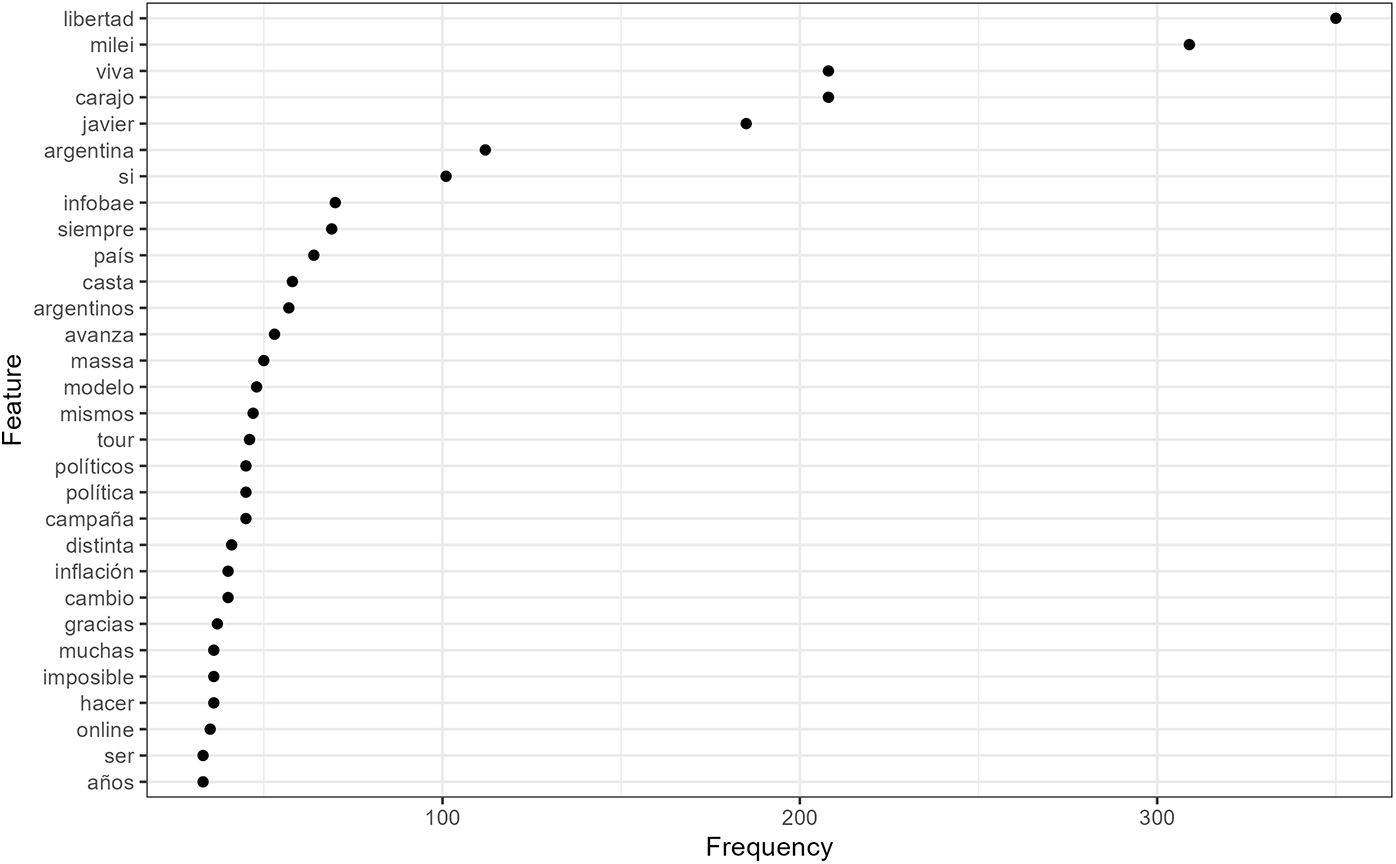
Figure 2 displays the frequency of the main terms (features) in Milei’s tweeting. As can be seen, ‘Milei’ and the exaltation of the idea of freedom (‘libertad’) are by far the most frequent terms in Milei’s social media speech. These two words support our argument about the salience of the main appeals: self-promotion and ideological rhetoric. We also noticed Milei’s popular catchphrase reiteration, ‘Viva la Libertad Carajo’, by devising that ‘viva’ is a frequent word. However, this reiteration is more frequent than word processing software can apprehend, since qualitative scrutiny reveals that he sometimes wrote this catchphrase as ‘VLLC’ instead.
Milei’s Discourse on Social Media (X)

As expected, we note that ‘casta’ and several other pejorative qualifiers are also salient in Milei’s speech, demonstrating the frequent use of moral content in his appeals. It is worth adding here another qualitative finding about his tweeting that illustrates self-promotion in his social media content. This is the social media post in which Milei highlights the fact that he donated his salary as a national deputy to charity throughout his term. Through this self-promotion tactic, he sought to differentiate himself from the rest of the contenders: the casta. Moreover, this was part of his social media speech, as drawing the salary was live-broadcast on YouTube and disseminated via his personal accounts on all social media platforms.
Table 1 displays the main results of the dictionary-based analysis of Milei’s tweeting and public appearances. As can be seen, self-promotion was the most salient appeal in both outlets. Indeed, the dictionary analysis supports the presence and salience of the context-specific appeals. Ideological rhetoric was present in approximately one-third of Milei’s social media speeches and public appearances. At the same time, moral content was present in almost one-fifth of both outlets, with slightly more salience in public appearances compared to X. To assess the reliability of our findings from the dictionary-based analysis, we built a random category in our dictionary, made up of a random selection of words used by Milei in each outlet. This category achieved a maximum of 2% in public appearances and social media, thus leveraging our findings.
Comparison between Milei’s Discourse on Social Media and in Public Appearances: Scores for the Three Main Appeals

Notes: Values in parentheses reflect the weight of each appeal relative to the share of Milei’s tweets pertaining to at least one of the possible appeals.
Source: Authors’ own elaboration.
The quantitative analysis also demonstrates that the qualitative identification of the three main appeals is observable in Milei’s social media activity, as 81.9% of his tweets contained at least one of the appeals. This is also supported by their presence in public appearances through the dictionary-based text analysis. It is worth noting, however, that while the salience of the self-promotion and ideological rhetoric appeals are similar in both outlets, moral content ranks higher in public appearances than on social media.
So far, we have shown that Milei’s discourse as a presidential candidate consisted of three main appeals that were omnipresent in his speeches. We also demonstrated that the three appeals were salient (despite differences in their relative weight) both in public appearances and on social media. Both outlets were essential in promoting Milei’s presidential candidacy as he lacked an established party label and an extensive party organization. Finally, we showed that self-promotion was complemented by context-specific appeals, which helped increase the engagement of his followers. Nevertheless, a fundamental part of our analysis builds on Pablo Semán’s (Reference Semán2023) observation that people find Milei attractive not only for ‘what he says’ but also for ‘how he says it’. Therefore, we proceed with a contextualized qualitative illustration of our quantitative content analysis.
Milei’s campaign successfully contributed to him winning the presidency despite being backed by a poorly known party brand. Therefore, paying attention to his presence in traditional media is fundamental for a thorough analysis of his electoral strategy. Long before his first candidacy as a national deputy, Milei was a widely recognized television celebrity due to his histrionic showmanship and funny look, and he was the leading representative of liberal-libertarian ideas in the media. From his debut on TV in 2015, Milei became a regular on Todo Noticias and La Nación+, which were ranked as the most-viewed channels according to the public opinion consultant Kantar Ibope (Noticias Argentinas, 2023). His presence on top-rated channels during peak viewing hours (see Table A-1 in the Supplementary Material online) ensured that his message reached a broad audience. Moreover, it forged his celebrity status in the Argentine media.
Milei’s celebrity status highlights the importance of his public appearances, which are not isolated events but a central component of his electoral mobilization strategy: the diffusion of the Milei brand. Nobody accompanied him during his public appearances. The ‘Milei brand’ was complemented by Milei’s liberal-libertarian posture, which he pioneered in the country, making him the credible ‘owner’ of that discourse. Finally, he was also notorious for his rants against the casta. Milei’s speech, aimed at the country’s powerful elite, was densely moralized; hence his use of the pejorative ‘caste’ label.
Regarding the prominence of his figure during the campaign, Milei sought to position himself as indispensable to the task of ‘fixing Argentina’. In his view, he was the only person possessing the ability and knowledge to put Argentina on the path to economic growth, as he repeatedly declared in his television appearances: ‘I am a specialist in economic growth with and without money. I am a specialist in growing the economy and lowering inflation. So that is what Argentina needs, right?’Footnote 4 (América 24, 16 August 2023).
Not only did Milei portray himself as ‘What Argentina needs’, but he added the heroic magnification of the indispensable requirement of his presence: ‘In difficult times, cowards and the incompetent leave, those who know what they have to do and have the guts to do it are the ones who remain’ (La Nación+, 12 April 2023). This was not a new stance for Milei; he had already presented himself as a libertarian superhero in his previous legislative campaign, even attending several public appearances dressed in a superhero costume.
In addition, Milei sought to place himself as the only genuinely different candidate, and the only one who represented a rupture with the populism of Kirchnerism and Peronism (Todo Noticias, 28 December 2022). In several public appearances, he explained that he was the only candidate who was different from the Kirchnerists, thus equating the centre-right alliance Juntos por el Cambio with the Kirchnerists, even accusing them of being Kirchnerism’s ‘accomplices’ (La Nación+, 28 February 2023). This recurrent positioning as the pure anti-Kirchnerist (Peronist) candidate, in parallel with him representing the sole anti-populist candidacy, was fundamental to Milei’s conquering the previously mentioned anti-Peronist camp in the context of eroding party brands. Additionally, he claimed to be the only one who was ‘intellectually’ prepared for the task, denouncing his rivals as ‘hav[ing] no intellectual capacity, they are burros’ (La Nación+, 28 February 2023).
These intellectual accusations were raised through a particular personal style that transcended television. Milei’s campaign events had rockstar-like introductions. Furthermore, the constant intellectual denigrations of his opponents are key to connecting Milei’s particular style with the second main appeal he used, which is the salient liberal-libertarian ideological rhetoric articulated in his public discourse. The promotion of liberal-libertarianism is Milei’s trademark, and the thing that distinguishes him from other visible outsider candidates in the country and the region. This is what first brought Milei into the media spotlight and it was the first identifiable trait that Argentines associated with him, although it was soon followed by his notorious showmanship. Therefore, eccentricity was associated with his salient liberal-libertarian ideological rhetoric, as he was keen to display in several amusing examples; such as smashing a replica of the central bank in television and theatre shows, or attending a cosplay event dressed as a superhero character called ‘General Ancap’ (as in, anarcho-capitalist).
Not surprisingly, the promotion of his ideals and strong ideological stance were ubiquitous in Milei’s speech. In broad strokes, he promised to bring freedom to Argentina, a country ‘ruined by socialism’, once and for all (La Nación+, 26 June 2022). Moreover, he lectured that the problem was ideological: ‘If you do not understand the economy, as socialists, you will fail’ (La Nación+, 26 June 2022). These public statements also demonstrate that Milei occasionally complemented the ideological salience by highlighting his technical abilities. In his public speech, he presented himself as an expert in economics.
During his presidential campaign, Milei consistently introduced himself in public appearances and on social media as ‘economista’ (an economist), highlighting his unique blend of personal skills and ideological salience, as his media reputation was initially associated with his economic ideas. This reputation was permanently headlined, sometimes even comically, as when he joked at the rally opening his presidential campaign on 10 June 2022: ‘Lest we have the first liberal libertarian president in Argentina’s history’.
The other prominent and systematic theme in Milei’s ideological rhetoric was the allegation that state intervention was the problem, hence his fierce opposition to collectivism and the welfare state, which he despicably called the ‘State of distress’ (La Nación+, 14 August 2023). The state was accused of encroaching on liberty and prosperity: ‘prosperity was achieved thanks to capitalism, thanks to the ideas of liberty, hence when you embrace socialist ideas, you go back to the caveman era (La Nación+, 18 September 2022).
Nevertheless, Milei’s criticism transcended ideological arguments and was loaded with moral content in the form of moral accusations. For example, while he communicated the popular libertarian idea that taxation is theft, he increased the charge further, stating: ‘Debt and monetary emission is immoral, this system is impoverishing and only suits the friends of power’ (Todo Noticias, 14 August 2023). And he developed his liberal-libertarian yet moral rhetoric further in another interview, clearly illustrating where the problem lay in his eyes: ‘if we continue with these ideas that where there is a need, a right is born, and all those kinds of things that are the basis of populism, which is the basis of the caste model’ (Todo Noticias, 8 March 2023).
By alluding to the ‘friends of power’, Milei introduced the casta, which he fervently denounced from the moment he became a media figure. Using his distinctive histrionic style and eccentric hairdo, he dedicated his personal platform to posing a moral critique of the elites who ran the country. Accordingly, we quote his explanation of what the casta is, given in response to this question during a televised interview: ‘Those who defend wrongdoing for their personal profit, they know it is wrong, but they defend these actions to maintain their profit’ (Todo Noticias, 27 April 2023). Milei continued by giving examples of who belonged to the caste: ‘corrupt politicians, bribed journalists [ensobrados], prebendary businessmen and crooked [chorros] trade unionists’.
Correspondingly, Milei morally vilified the caste’s leading exponents as sinister. He mocked his rivals and gave them nicknames in his public discourse as a communicative shortcut for his condemnation. This discursive manoeuvre, known as ‘labelling’, was strategically employed to delegitimize Milei’s opponents – whether parties or individual candidates – by portraying them negatively in the media (Harris Reference Harris2001; Ross and Rivers Reference Ross and Rivers2017), as shown in Table 2.
Milei’s Derogatory Nicknaming of His Opponents during the 2023 Presidential Campaign

Notes:
a Political parties.
b Presidential candidates.
Source: Authors’ own elaboration.
Alongside calling them evil and incompetent, Milei scolded them for being corrupt and thieves. In one of his earliest public appearances on Todo Noticias, the country’s top political channel, Milei proclaimed: ‘We have a government of felons’, as he simultaneously denounced inflation as a felony, perpetrated by the casta because it lives off robbing the people (Todo Noticias, 28 December 2022). Corruption was thus showcased as the primary moral deficit of the casta: they are immoral because they are corrupt. And in any case, as already mentioned, they are all the same because that is how the casta behaves. Therefore, Milei affirmed that ‘the divide [la grieta] is moral’ (La Nación+, 28 February 2023).
Corruption, embezzlement, and fraud define the casta, a predatory group that the majority had to suffer (Todo Noticias, 28 December 2022). In this way, Milei delivered a highly moralized speech that laid the groundwork for the ultimate crisis, stemming from the casta’s inept and corrupt economic management. He warned: ‘If we continue with the current economic model, we will become the world’s largest slum’ (La Nación+, 15 August 2023). He warned that the majority of Argentines were headed in that dreadful direction in juxtaposition to the casta. The corrupt politicians he denounced were the ones who ‘thrived while the rest are getting poorer and poorer’ (La Nación+, 15 August 2023).
Indeed, Milei even extended the moral accusations against the casta to the point of calling them criminals. In 6 out of the 29 public appearances we analysed, Milei went beyond a simple critique of morality to warn of a criminal plot against his candidacy and even his own life, albeit couched in ambiguous terms: ‘We face a criminal organisation that will do anything to remain in power, including the persecution of those who think differently and oppose them, like me’ (Todo Noticias, 21 September 2022).
In summary, our analysis suggests that the three conceptualized appeals were always present in Milei’s public appearances and occupy a substantial share of his discourse. Moreover, we found that the three appeals worked in complementary ways: Milei positioned himself at the core of the campaign by showcasing his personal virtues and leveraging his rockstar reputation. Taking advantage of this positioning, he preached liberal-libertarian ideals, signalling that he was the sole representative to promote this, alongside a heavily moralized speech denouncing the caste of the political elite. This also positioned him as the true anti-Peronist (anti-Kirchnerist) candidate. The best example is how often Milei combined the immorality of ‘los mismos de siempre’ (the same old faces) campaigning to run the country together with the lack of liberal ideals, resulting in the ruination of what had once been the most prosperous nation in the world (Todo Noticias, 8 March 2023). These three appeals worked together to form and promote Milei’s recipe for electoral success by reinforcing each other. To complete the analysis, we now turn to a study of public opinion data to examine how Milei’s electoral discourse resonated with the Argentinean voter, offering further insights into the audiences where Milei’s electoral appeals had most effect.
Who does electoral personalism appeal to?
This section aims to explore how Milei’s electoral discourse resonated with the Argentinean voter. We do not aim to provide an exhaustive explanation for Milei’s electoral victory but rather offer an account of which individual characteristics are more distinctive of his supporters. We argue that Milei’s electoral success was primarily based on his personalistic campaign. As such, we are interested in evaluating which traits are associated with political support for Milei. To do so, we rely on public opinion data from the Latin American Public Opinion Project (LAPOP) to test for sociodemographic, behavioural and attitudinal factors at the individual level associated with respondents’ propensity to support the presidential candidate, Javier Milei, and his party, LLA.Footnote 5
We estimated several logistic regression models using a binary outcome (support for LLA = 1) as the dependent variable to account for systematic differences among supporters and non-supporters of Milei’s party.Footnote 6 Given the low number of respondents who reported support for any candidates or parties competing in the 2023 presidential election, the number of observations poses some limitations on including too many independent variables in our models. Of the 1,540 respondents, only 370 said they supported a particular candidate or party, while the rest did not answer or did not know which party to support. Beyond the difficulties this entails for estimating statistical models, this issue highlights that the enabling conditions for electoral personalism were in place at the time of the presidential election. Since electoral personalism increases as a consequence of party decline, the low level of partisanship reflected in the responses to the question about political support is evidence of the notable decline of Argentine political parties.
Figure 3 shows the results of our estimations of electoral support for Milei and his party, while Table A-7 in the Supplementary Material shows the complete estimations, which yield interesting results. Among socioeconomic variables, the evidence supports our expectations and aligns with the findings of previous studies (Balsa Reference Balsa2024). Our results show that age is a key factor in explaining support for LLA. The same can be said about gender: males were significantly more prone to support Milei’s party than females. This finding also aligns with previous studies and suggests that women tend to oppose the violent discourse of Milei and his anti-feminist moral discourse. In turn, education shows no significant effect. This result indicates that support for Milei’s party was not limited to more educated voters. Lastly, income also suggests that support for LLA increased with income.
Individual-level Effects on Respondents’ Propensity to Support Milei and His Party, La Libertad Avanza (LLA)

Our findings empirically support our expectations regarding the use of social media. This was statistically significant, suggesting that self-promotion messages disseminated through social media which went viral and were later reproduced by traditional media played a key role in fostering support for Milei and his party. Second, perceptions of political corruption were significant among those who voted for Milei, supporting the expectation that the moral appeal could be a factor. As shown in the previous section, Milei connected economic crisis and widespread social discontent with the corrupt behaviour of the ‘casta’ in his discourse. This moral content facilitated support from people who validated the association between economic decline and corruption within the political class. Third, trust in the secrecy of the vote is positively and significantly associated with supporting Milei’s party. This finding suggests that the ideas spread by Milei and his core supporters through social media during the campaign regarding the possibility of electoral fraud by established parties and traditional politicians resonated strongly with the Argentinean voter.
Finally, regarding respondents’ ideological self-identification, Milei and his party received support from right-wing voters. This finding lends support to the salient ideological rhetoric approach, suggesting that Milei and his party competed with Juntos por el Cambio for the votes of rightists. Since both parties shared a similar ideological profile, the salient and often extreme ideological stances adopted by Milei during the campaign effectively helped him differentiate himself from the established Juntos por el Cambio brand.
Overall, our findings suggest that the core elements of Milei’s personalistic discourse in his social media and public appearances served his purpose for electoral mobilization and persuasion very well. As this section has shown, several factors identified in our theoretical approach were at play in the electoral context in which Milei deployed his electoral strategy. He intensively used social media to reach a wider audience and spread his self-promotion messages. He also employed salient ideological discourse, emphasizing the superiority of liberal and libertarian ideas, in marked contrast to leftist positions that pursue state-centred policies. He also took advantage of this context by highlighting the moral causes of Argentina’s decay, which he primarily attributed to corruption within the political class.
Conclusion
Existing research suggests that personalism is a pervasive phenomenon in both contemporary democracies and autocracies. By addressing Milei’s electoral rise and identifying the main appeals involved in that process, this article contributes to the goal of characterizing varieties of personalism. To the extent that Milei’s rise shares some key elements with similar cases, such as Jair Bolsonaro, Donald Trump or Nayib Bukele, it also presents some distinct characteristics. We demonstrated that these context-specific factors matter for understanding how electoral personalism operates in different contexts.
Broadly speaking, personalism entails candidate-centred campaigns, where politicians use individual appeals to mobilize and persuade voters in the electoral arena. As a paradigmatic case of electoral personalism, Javier Milei relied heavily on self-promotion and crafting a personal brand to win the 2023 presidential election in Argentina. Through his showmanship and celebrity status on traditional and social media, he built a legion of followers who supported his personal political project. These factors lie at the core of electoral personalism and illustrate how it operates in the context of a country that has experienced a severe economic and social crisis, characterized by low party valence due to a sharp divide between the populist and centre-left Peronism and an established centre-right coalition of parties.
Milei’s sudden rise helps shed light on the contextual factors at play in the case under analysis. On the one hand, Milei employed inflammatory ideological rhetoric, which enabled him to position himself at the extreme right on the ideological continuum, as found in previous research (Balsa Reference Balsa2024; Sendra and Marcos-Marne Reference Sendra and Marcos-Marne2024). By doing this, he could differentiate himself from his opponents, particularly the established centre-right coalition, Juntos por el Cambio, the main opposition to the centre-left Peronist incumbent. On the other hand, Milei challenged the Argentine political class, accusing it of being a corrupt and immoral casta. This appeal helped him capitalize on the widespread social rejection of traditional politics, presenting himself as a saviour and taking advantage of the profound economic and social crisis Argentina was experiencing.
Our findings suggest that the case of Milei resembles that of other personalistic leaders who were elected through self-promotion and personal branding, combined with context-specific appeals. Despite their differences, all these cases demonstrate that electoral personalism is a global phenomenon that can take various forms but shares a conceptual core: individual politicians invest scarce resources in crafting a personal brand through self-promotion as saviours of their troubled countries.
Milei’s mediatic hyper-presence, ability to exploit people’s frustration vis-à-vis traditional politicians, and rhetorical construction of a diffuse collective actor to blame for the state of the economy, the casta, were key factors behind his electoral rise. Taken together, they help account for how economic downturns can be linked to moral rhetoric, facilitating the spread of extreme ideological positions that would otherwise be difficult to advance in ordinary times. This way, Milei managed to seduce the anti-Peronist camp far more than the traditional centre-right opposition, Juntos por el Cambio.
The potential increase in the use of electoral personalism raises serious concerns for democratic accountability. First, it allows candidates to circumvent their responsibility for controlling the behaviour of other candidates campaigning under the same banner. Second, by converting their proposals into individualized visions for change they are able to evade accountability pressures for specific policy commitments. As such, electoral personalism risks weakening party cohesion and programmatic representation, exacerbating the disconnect between electoral promises and governing outcomes (Carey Reference Carey2003; Rahat and Kenig Reference Rahat and Kenig2018). Future work investigating the array of appeals expressed under electoral personalism can help further our understanding of how and when this behaviour is likely to arise.
Supplementary material
The supplementary material for this article can be found at https://doi.org/10.1017/gov.2026.10035.
Disclosure statement
The authors report that there are no competing interests to declare.



 Open access

