




Introduction
Radiocarbon dating of archaeological iron using iron-bound carbon by 14C was proposed and performed more than 50 years ago (Van der Merwe Reference Van der Merwe1965, Reference Van der Merwe1969; Van der Merwe and Stuiver Reference Van der Merwe and Stuiver1968) and adopted by many researchers afterwards (a.o. Cook et al. Reference Cook, Wadsworth and Southon2001; Cresswell Reference Cresswell1992; Hüls et al. Reference Hüls, Grootes, Nadeau, Bruhn, Hasselberg and Erlenkeuser2004; Nakamura et al. Reference Nakamura, Hirasawa and Igaki1995; Oinonen et al. Reference Oinonen, Haggren, Kaskela, Lavento, Palonen and Tikkanen2009; Scharf et al. Reference Scharf, Kretschmer, Morgenroth, Uhl, Kritzler, Hunger and Pernicka2004). Concerns such as contamination during sample preparation or during the iron production itself have been raised and discussed by Craddock et al. (Reference Craddock, Wayman and Jull2002), Scharf et al. (Reference Scharf, Kretschmer, Morgenroth, Uhl, Kritzler, Hunger and Pernicka2004), and Hüls et al. (Reference Hüls, Grootes and Nadeau2011). To validate 14C dates for iron objects, additional metallurgic investigations have been proposed (Leroy et al. Reference Leroy, L’Héritier, Delqué-Kolic, Dumoulin, Moreau and Dillmann2015).
Iron axes are objects without a distinct temporal reference, i.e., an ancient wood-cutting axe could appear like a modern axe. Without additional evidence such as markings or associated finds, a chronological classification is difficult.
Here we analyze two arbitrarily selected archaeological iron axes with respect to composition and chronology. The axes originate from comparable periods but different geographical origins: An axe-adze excavated from a Kurgan in Kazakhstan, and an axe from a northern German archaeological survey excavation.
Archaeological background of the Kazakhstan Axe
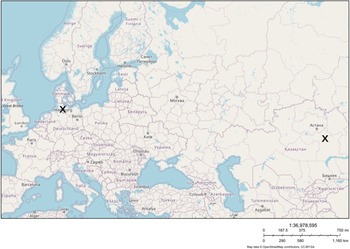
A double-bladed axe-adze was found within the left-bank valley of the Taldinura River within the Kyzylzhartas (Karaganda region, Kazakhstan, Figure 1) archaeological burial ground, consisting of two large structures (Kurgan 1 and 2). The Kyzylzhartas Axe-Adze was excavated in Kurgan 1 in 2020 (Beisenov et al Reference Beisenov, Panichkin and Shashenov2023). Based on their findings, Kurgan 1 could be attributed to the Tasmola culture (8th–5th centuries BCE; Beisenov et al. Reference Beisenov, Svyatko, Kassenalin, Zhambulatov, Duisenbai and Reimer2016). Radiocarbon dating of a human jawbone from the grave in Kurgan 1 gave a 14C age of 2617 ± 28 BP (819–773 BCE; Beisenov et al. Reference Beisenov, Panichkin and Shashenov2023).
Find location of the Kyzylzhartas Axe-Adze in Kazakhstan and the Högersdorf Axe in Northern Germany.

Figure 1. Long description
The map of Europe shows the locations of the Kyzylzhartas Axe-Adze in Kazakhstan and the Högersdorf Axe in Northern Germany. The map includes various countries and cities across Europe, with specific markers indicating the locations of the archaeological artifacts. Key labeled locations include Oslo, Stockholm, Helsinki, Saint Petersburg, Berlin, Paris, London, and Moscow. The map also shows the geographical layout of Europe, including bodies of water such as the Baltic Sea, the North Sea, and the Mediterranean Sea. The markers for the Kyzylzhartas Axe-Adze and the Högersdorf Axe are placed in their respective regions, providing a clear visual reference for their locations.
Although the Kurgan was looted in the past, important archaeological finds such as jewelry made from gold and silver as well as stone statues from the Sakha culture of the Central Kazakhstan tribes (Beisenov Reference Beisenov2021) could be recovered.
The axe was found about 37 cm from the grave boundary. Whether the axe belongs to the grave goods or to the plundering remained open. A 2nd 14C date from a faunal bone inside Kurgan 1 gave a 14C date of 1629 ± 29 BP (384–541 CE; Beisenov et al Reference Beisenov, Panichkin and Shashenov2023) and is probably related to the looting of the grave structure.
Archaeological background of the Northern Germany Axe
Several archaeological survey campaigns between 2008 and 2011 prior highway construction were conducted close to the village of Högersdorf, near the city of Bad Segeberg (Figure 1). During the 2008 field campaign, 4 single bladed iron axes were recovered in addition of postholes and fireplaces without clear chronology (H. Erlenkeuser, pers. comm. 2025).
In 2010 and 2011, about 200–500 m to the east of the 2008 site, a more extensive campaign revealed settlement traces from different periods (Irkens Reference Irkens2011). Several houses, indicated by post-holes, and pits filled with ceramic remains, indicate early medieval Slavic settlements. Furthermore, traces of iron working such as hammerslag and smithing was found. Other archaeologic findings such as cremation burials and possible iron ore smelting remains (oven lining and slags) indicated earlier settlements of a pre-Roman iron age period. The site is located in close proximity to the lowlands of the Trave River, a location, where bog iron ore may be found, which had served as primary raw material for iron production in antiquity (e.g. Buchwald Reference Buchwald2005; Haffner et al. Reference Haffner, Jöns and Reichenstein2000).
Both archaeological iron finds gave a very imprecise chronological classification, suggesting radiocarbon (14C) dating on the carbon from both iron objects. Although not representative, comparable ages and the geographical distance between the two archaeological sites promise interesting insights into the utilized iron technology.
Material and methods
From the 2008 Högersdorf finds, one specimen (ALSH 2008-053, No 337) was sampled in the Leibniz-Laboratory for analysis. The Kyzylzhartas Axe was sampled in Kazakhstan. The Högersdorf Axe was conserved with a wax coating at the State Archaeology Department of Schleswig-Holstein before submitted to the Leibniz-Laboratory, while no conservation treatment was applied to the Kyzylzhartas Axe.
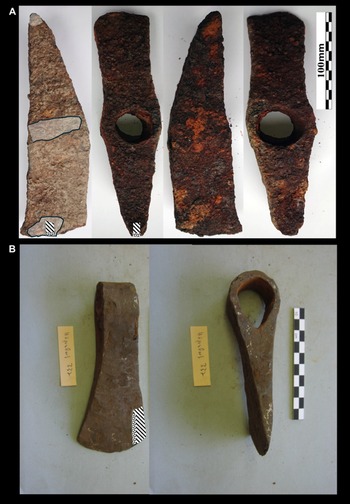
The Kyzylzhartas Axe-Adze (∼ 21.3 cm × ∼ 6 cm) has two blades (=bids) set at a 90° angle to each other. Blade 1 runs parallel to the handle (= the axe-blade), blade 2 (= the adze-blade) is oriented perpendicular to the handle (Figure 2A). The iron tool appears like an axe-adze (i.e. category II bronze-tools, Boroffka Reference Boroffka, Kienlin and Roberts2009, or a Mattock, a tool for cutting and digging).
A) Kyzhylzartas Axe-Adze from all sides, faintly highlighted areas indicate microstructure analyses (Beisenov et al. Reference Beisenov, Panichkin and Shashenov2023) B) Högersdorf Axe from two sides. The sampling for 14C and metallurgy (Microscopy, SEM-EDX) are highlighted with a hatched and dotted areas, respectively.

Figure 2. Long description
The first set of images labeled A shows the Kyzhylzartas Axe-Adze from all sides. Faintly highlighted areas on the axe indicate regions where microstructure analyses have been conducted. The second set of images labeled B displays the Högersdorf Axe from two sides. The sampling areas for radiocarbon dating and metallurgy, including microscopy and SEM-EDX, are marked with hatched and dotted areas respectively.
The Högersdorf Axe (Figure 2B), on the other hand, is a traditional double-beveled, single bladed axe with the elliptic eye for the handle at the top (∼ 16.8 cm × ∼ 3 cm). The curved blade is ∼ 60 mm wide in comparison to a ∼ 35 mm wide socket. Material from both axes was taken for 14C measurement and metallurgic inspection (Figure 2).
Sample preparation for radiocarbon measurements
Pieces of iron were removed using a cutting disk (Högersdorf Axe) or a saw (Kyzylzhartas Axe-Adze). The Kyzylzhartas Axe-Adze was sampled from Blade 1 (10 mm × 4 mm), the Högersdorf Axe was sampled at the side of the blade (27 mm × 6 mm) (Figure 2A and 2B, respectively). Cutting surfaces were ground with a corundum grinding tool for removing significant portions of the surface (∼0.1 mm), and further cut into 1–4 mm sized pieces with a metal shear and an additional abrasion of cutting edges. Lipids from handling and possible contamination (wax) is removed with a Soxhlet type serial extraction with solvents (i.e., 3-fold sequential extraction with boiling tetrahydrofurane (THF), chloroform, petroleum-ether, acetone, methanol, and finally water; Bruhn et al. Reference Bruhn, Duhr, Grootes, Mintrop and Nadeau2001) and dried at ∼60 °C.
Radiocarbon measurements were carried out using carbon trapped within the iron lattice, released by high-temperature oxygenation (Cook et al. Reference Cook, Wadsworth and Southon2001; Cresswell Reference Cresswell1992; Hüls et al. Reference Hüls, Grootes, Nadeau, Bruhn, Hasselberg and Erlenkeuser2004, Reference Hüls, Grootes and Nadeau2011; Van der Merwe Reference Van der Merwe1969; Van der Merwe and Stuiver Reference Van der Merwe and Stuiver1968).
The combustion of crushed iron pieces was done by:
-
a) Method I: closed-tube combustion, i.e. iron pieces were filled in prebaked quartz ampules with CuO (CuO/Fe ∼ 5:1), evacuated, flame sealed and heated in a muffel oven at 1000 °C for 24 hr. Cryogenic CO2 purification was done by dry-ice/ethanol traps and a 2nd CO2-combustion in vacuum-sealed quartz-tube with CuO and Ag at 900°C/4h to remove possible SO2 (Hüls et al Reference Hüls, Grootes, Nadeau, Bruhn, Hasselberg and Erlenkeuser2004, Reference Hüls, Grootes and Nadeau2011).
-
b) Method II: C extraction using a step-combustion procedure with a low-temperature step (LT, ∼570–600 °C, 4–5 hr) followed by a high-temperature step (HT, >970 °C, 5 hr) (Hüls et al. 2019a, 2019b, Reference Hüls, Bulas, Kasiński and Okońska-Bulas2023). Crushed pieces of iron are combusted within pre-burned ceramic bowls with high-purity O2 in an electric resistivity oven which is attached to vacuum gas line for subsequent cryogenic CO2 purification with dry-ice/alcohol, n-Pentane (freezing T –131 °C), and liquid nitrogen to remove and separate H2O and possible SO2 (e.g. Kusakabe Reference Kusakabe2005). The LT-CO2 fraction contains thermally lower stable carbon fractions including lipids and wax and is usually discarded. The HT-CO2-fraction is selected for radiocarbon dating.
The CO2 was graphitized with an iron catalyst (Vogel et al. Reference Vogel, Southon, Nelson and Brown1984; Nadeau et al. Reference Nadeau, Grootes, Schleicher, Hasselberg, Rieck and Bitterling1998). Resulting Fe/C powder-mixture was pressed into aluminum target holders for accelerator mass spectrometry (AMS) 14C measurements with a 3MV HVEE Tandetron AMS system. 14C measurements are normalized to modern Oxalic Acid II standard (NBS SRM 4990C) and corrected for isotopic fractionation and background effects (Nadeau and Grootes Reference Nadeau and Grootes2013). 14C ages are converted to calendar ages using OxCal4 (Bronk Ramsey Reference Bronk Ramsey2009) and the IntCal20 dataset (Reimer et al. Reference Reimer, Austin, Bard, Bayliss, Blackwell, Ramsey, Butzin, Cheng, Edwards, Friedrich, Grootes, Guilderson, Hajdas, Heaton, Hogg, Hughen, Kromer, Manning, Muscheler, Palmer, Pearson, van der Plicht, Reimer, Richards, Scott, Southon, Turney, Wacker, Adolphi, Büntgen, Capano, Fahrni, Fogtmann-Schulz, Friedrich, Köhler, Kudsk, Miyake, Olsen, Reinig, Sakamoto, Sookdeo and Talamo2020).
Sample preparation for metallurgical analysis
Polished cross-sections were prepared for microscopic and SEM/EDX inspection (scanning electron microscopy and energy dispersive X-ray spectroscopy, respectively). Iron pieces were embedded in plastic (Struers ™ phenol resin, for Högersdorf Axe also with a carbon filler for electric conductivity) and pressed at 180 °C and 290. The surface was grinded with 320 standard silicon carbide grinding paper and polished (1: 9 μm diamond suspension (Struers™), 2: 3 μm diamond suspension (Struers™ 2), 3: 0.05 μm Al2O3 suspension (Struers™)). Polished iron samples were etched with a Nital solution (95–98 ml ethanol + 5–2 ml HNO3 conc.) to reveal structures caused from different magnitude of surface leaching related to the carbon content. An Oberhoffer etching (mixture of H2O + C2H5OH + HCl + Cu / Fe / Sn chlorides), was applied to the Högersdorf Axe to highlight phosphorous-rich iron. Metal microstructure was inspected with a microscope (ZEISS Axio Observer Z1).
The Kyzylzhartas Axe-Adze metallurgic sample was prepared in Kazakhstan and sent to the Leibniz-Laboratory for complementary analysis such as SEM/EDX inspection of slag inclusions.
Micro hardness was measured for both axes using a FUTURE-TECH FM-ARS 9000 with pyramidal diamond indenter (Vickers), a test load of 10 N (≈1 kgf), a loading rate of about 0.4 N/s, and a dwell time of 20s (i.e. HV1/20). Micro-hardness was determined by measuring the diagonals of the indent prism (e.g., $H{V_{1/20}} \approx 0.1891{F \over {{d^2}}}\;[N/m{m^2}$
], where F is the applied load [N] and d is the average diagonal length [mm]).
$H{V_{1/20}} \approx 0.1891{F \over {{d^2}}}\;[N/m{m^2}$
], where F is the applied load [N] and d is the average diagonal length [mm]).
SEM/EDX inspection was done using a ZEISS SUPRA 35 Scanning Microscope with Thermo Scientific UltraDry EDS Detector (EHT: 20 kV, measuring time: 600,000 counts, calibration: standardless) for analysis (between 1 and 20 μm2 surface area) of the chemical composition of the slag inclusions (SI). For each sample, numerous measurements of arbitrarily selected slag inclusions were carried out. Element composition is given in wt% oxides (normalized).
Results and discussion
Radiocarbon age estimates
Kyzylzhartas Axe-Adze
Iron pieces from Blade 1 of the Kyzylzhartas Axe-Adze gave sufficient CO2, indicating a carbon content of 0.15wt%C.
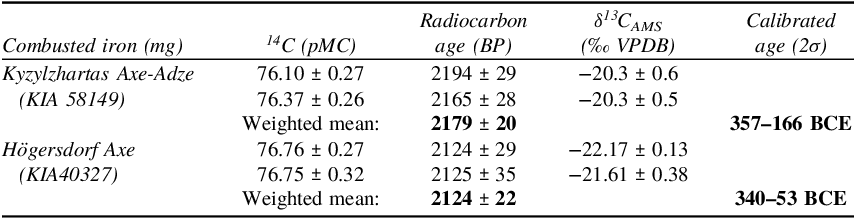
Both measurements of Kyzylzhartas Axe-Adze CO2, extracted by method II, give consistent and reproducible radiocarbon ages (see Table 1; see also Table 1S and Figure 1S in the supplement). Weighted mean radiocarbon age is 2179 ± 20 BP, corresponding to a calibrated calendar age of 357–166 BCE. This is about 400 years younger compared to the human bone age in Kurgan 1, and more than 500 years older as compared to the faunal radiocarbon age which was related to the plundering of Kurgan 1. Apparently, the Kyzylzhartas Axe-Adze neither belongs to the original Tasmola culture of Kurgan 1 burial nor to the looting (4th to 6th century CE). Archaeological investigations of nearby Kurgan 2 burial mound indicate an age comparable to the axe-adze (i.e., 4th to 2nd century BCE; Beisenov and Shashenov Reference Beisenov and Shashenov2024). One may speculate that Kurgan 1 was re-entered during the erection of the younger Kurgan 2 in the Late Saka period.
14C results of Kyzlzhartas and Högersdorf Axe by method II.

Table 1. Long description
The table presents radiocarbon data for Kyzylzhartas Axe-Adze and Högersdorf Axe, including combusted iron measurements, radiocarbon ages, and calibrated ages. It has four columns: Combusted iron in milligrams, radiocarbon in parts per million carbon, radiocarbon age in before present years, and calibrated age in before common era years. The table includes data for two samples of Kyzylzhartas Axe-Adze and one sample of Högersdorf Axe, with weighted mean values calculated for each. The radiocarbon ages are around 2179 before present for Kyzylzhartas Axe-Adze and 2124 before present for Högersdorf Axe, corresponding to calibrated ages of 357 to 166 before common era and 340 to 53 before common era, respectively.
Högersdorf Axe
First 14C measurements for the Högersdorf Axe were done in 2010 and repeated in 2011 using closed-tube combustion for carbon extraction (Method I; see also Table 1S in supplement), giving 14C-ages between 2345 BP and 2191 BP. The elevated variability of about 200 14C years may be related to an insufficient removal of the contamination from the wax preservative by surface abrasion and solvent cleaning.
In 2019 and 2025, further CO2 extraction of iron pieces from the Högersdorf Axe were done by Method II. For the 2019 extraction, both CO2 fractions (LT-CO2 f and HT-CO2 fraction) were measured. While the LT-CO2 fraction gave a comparatively old 14C-age of 3245 ± 70 BP, the HT-CO2 gave a 14C-age of 2124 ± 29 BP, close to the youngest 14C measurement with CO2 extracted by Method I (2191 ± 29 BP). The 2025 HT-CO2-fraction gave a radiocarbon age of 2125 ± 35 BP, consistent with the 2019 HT-CO2 14C age (see Tables 1 and 1S).
Apparently, the low-temperature combustion (580–600 °C) prior to the high-temperature combustion had removed small and not visible contamination of wax, confirmed by consistent and reproducible 14C ages measured on HT-CO2 fractions, extracted on different iron pieces from the Högersdorf axe. The weighted average could be calibrated to 340–53 BCE.
Metallographic Analysis
Kyzylzhartas Axe-Adze
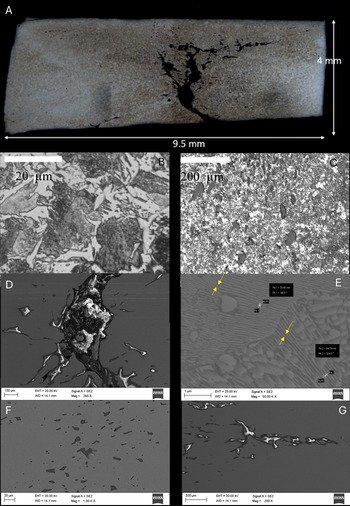
First metallographic investigations were done in Kazakhstan (Beisenov et al. Reference Beisenov, Panichkin and Shashenov2023) by microscopic inspection of polished and Nital etched sections of Blades I and II, as well as at the centric section aside from the eye (see Figure 2A), complemented with microstructure and SEM/EDX inspection of the metallographic sample from Blade 1 (also this study).
The microscopic inspections of Beisenov et al. (Reference Beisenov, Panichkin and Shashenov2023) indicated a heterogeneous composition with softer, non-carbon containing ferritic iron in the central part of the axe and carbon richer iron with pearlitic structures at both blades. Hardness measured by the Vickers method gave varying values with low values in the central part and considerably harder material at both blades (see Beisenov et al. Reference Beisenov, Panichkin and Shashenov2023). A carbon content of about 0.2–0.8 wt% was estimated from the microstructure, in contrast to the amount of carbon extracted for radiocarbon measurement from the higher carburized pearlitic iron of Blade I (i.e. about 0.15 wt%). This underlines the limitation of quantifying carbon content by microstructure analysis, as also highlighted by Galai et al. (Reference Galai, Bérard, Réguer, Foy, Mocuta, Toffolon, Foy, Mocuta, Toffolon, Guilbert and Dillmann2024).
The comparatively small metallographic sample of Blade 1 allows an insight into the material procurement that is not representative of the entire object. The microstructure as seen in Fig. 3A shows a comparatively continuous pearlite structure without a clear carburization zoning. Numerous SI, partially elongated, partially spherical, indicate low mechanical effects of forging on the microstructure (Figure 3A–C). Widmanstätten structures (Figure 3B) indicate thermal treatment of the material to increase physical properties such as hardness (e.g., Todorov and Kristov Reference Todorov and Khristov2004). Microhardness measured on the metallurgic sample from Blade 1 varies between HV1/20 165 in the low carburized ferrite to HV1/20 376 in carburized pearlite (see also Table 2s in the supplement).
Microstructure and SEM inspection of Kyzylzhartas Axe-Adze. A) low magnified polished and Nital etched surface. B) higher magnified Nital etched surface with Widmanstätten-like pearlite-ferrite structures, C) slag-inclusions in pearlite, D-G) SEM inspection with: D, F, G: slag inclusions, and E: fine-pearlite with Fe3C (Cementite) – Ferrite lamellae spacing around 100µm (Troostite).

Figure 3. Long description
The image presents a detailed analysis of the microstructure and SEM inspection of the Kyzylzhartas Axe-Adze. Panel A shows a low magnified polished and Nital etched surface. Panel B displays a higher magnified Nital etched surface with Widmanstätten-like pearlite-ferrite structures. Panel C highlights slag-inclusions in pearlite. Panels D, F, and G focus on SEM inspection of slag inclusions, while Panel E shows fine-pearlite with Fe3C (Cementite) and Ferrite lamellae spacing around 100 micrometers (Troostite).
SEM inspection document fine pearlite structures (a dense cementite (Fe3C) and ferrite lamination around 100 µm called troostite), indicate also thermal handling such as quenching and annealing (e.g. Figure 3E) (e.g., Ridley Reference Ridley1984).
Our findings and those from Beisenov et al. (Reference Beisenov, Panichkin and Shashenov2023) suggest that low-carbon and high-carbon iron were specifically forged together to create this tool.
Högersdorf Axe
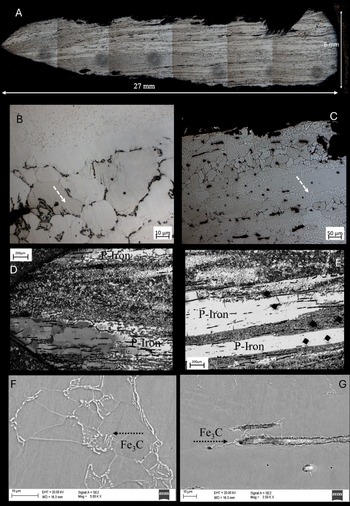
Figure 4 shows a compilation of the microstructure and SEM inspection. This axe was obviously made with different iron variants.
Microstructure and SEM inspection of Högersdorf Axe. A) low magnified polished and Nital etched surface. B and C) higher magnified Nital etched surface with ghost structures (arrows) and slag-inclusions, D and E) Oberhoffer etched surface with high- and low- P containing Ferrite (pale and darker surface, respectively) and imprints of micro-hardness measurements, F and G) SEM inspection with indicated cementite around grain boundaries.

Figure 4. Long description
A cross-sectional view of a polished and etched axe surface. The image shows different magnifications of the surface. At lower magnification, the polished and Nital etched surface reveals overall structural details. Higher magnifications highlight ghost structures indicated by arrows and slag inclusions. Oberhoffer etched surfaces display areas with high and low phosphorus-containing ferrite, distinguished by pale and darker regions, respectively. Imprints of micro-hardness measurements are also visible. Scanning electron microscope (SEM) images indicate cementite around grain boundaries.
Opposite to the Kyzylzhartas Axe-Adze, the Högersdorf Axe indicates very low grade of carburization (Figure 4). Mostly ferritic iron structures are observed, with only very little cementite around grain boundaries (Figure 4F,G). The amount of carbon extracted for 14C measurements gives a C-content of about 0.1wt%.
The microstructure inspection reveals numerous, mostly elongated SI, aligned in layers, indicating plastic deformation during hot forging of different iron alloys (Figure 4C). Furthermore, so-called ghost structures are observed, caused by residues of previous crystal outlines, resulting from altered solubility of a higher phosphorus content in the iron crystal during cooling (see Figure 4B,C). This is confirmed by etching with the Oberhoffer solution (see Methods), which gives a bright appearing copper coating over phosphorous rich iron areas, while the non-phosphor iron parts appear dark. The blade and cheek of the axe is made of alternating phosphor rich and poor iron (Figure 4D,E). Phosphorus containing bog iron ore with Goethite (FeO(OH)) and Limonite (FeO(OH)·nH2O) are often found in wetlands and lowlands near or along the banks of lakes and rivers and could have been a local source for iron production, as was characteristic for ancient iron production in N-Europe (Buchwald Reference Buchwald2005).
One property of phosphorus-rich (P-) iron ores during smelting is the prevention of carburization in the resulting iron (Buchwald Reference Buchwald2005), also seen during SEM inspection, documented with little amounts of cementite around grain boundaries and slag inclusions (Figure 4F,G). Still, P-iron also appears hard but at the expense of increased brittleness at lower temperatures (Buchwald Reference Buchwald2005). Microhardness measurements (see Figure 4E by black pyramidal imprints) on phosphatic and non-phosphatic zones vary between HV1/20 170 (ferrite) to 196 (phosphorferrite), lower as compared to the Kyzylzhartas Axe (see Table 2s).
SI-chemistry
The elemental composition of SI from the Kyzylzhartas Axe-Adze (57 measurements) and the Högersdorf Axe (65 measurements) was determined using EDX and provides further information on the manufacturing process (see Tables 3S and 4S in the supplement) (a.o. Blakelock et al. Reference Blakelock, Martinón-Torres, Veldhuijzen and Young2009; Buchwald Reference Buchwald2005; Buchwald and Wivel Reference Buchwald and Wivel1998; Dillmann and L’Héritier Reference Dillmann and L’Héritier2007).
Indicated by microstructure, the Högersdorf Axe contains significant phosphate, confirmed by SI measurements which fit to observations made on N-European iron remains (e.g., Buchwald Reference Buchwald2005) (see Figure 2S in supplement).
The reducible iron index (RII) is the ratio of silicates to reduced iron. Values > 1 means that SiO2 that has not been fluxed is retained and values <1 that iron has not been reduced from the ore and is left in the slag. The F index refers to the geological composition of the ore and the lining material of smelting ovens, influencing the slag composition during smelting.
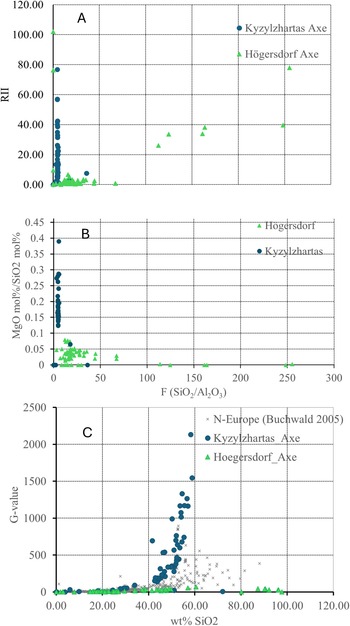
Figure 5-A gives the RII versus silicate to aluminum oxide (F= SiO2/Al2O3; Buchwald Reference Buchwald2005). Both axes show RII values up to 80, with F-values ∼4 for the Kyzylzhartas Axe-Adze and >10 for the Högersdorf Axe, respectively, pointing to an even Al-Si-rich iron ore in case of the Kyzylzhartas Axe-Adze and a Si- enriched ore for the Högersdorf Axe. Chemical SI-composition of both axes indicates a sufficient amount of non-metallic material, i.e. gangue, to form slags. A more fluid slag is indicated for the Kyzylzhartas Axe-Adze, with a lower F-ratio and a basic composition, indicated by index oxides such as MgO (see Figure 5B). In contrast, a predominantly acidic composition, and thus a viscous, SiO2-rich slag, is observed for the Högersdorf Axe, which has a negative impact on the reduction efficiency during smelting (e.g. Lv et al. Reference Lv, Lv, Wang, Qiu and Liu2017; O’Connor et al. Reference O’Connor, Nguyen, Honeyands, Monaghan, O’Dea, Rinklebe, Vinu, Hoang, Singh, Kirkham and Bolan2021).
A) Reducible iron index ( ${{RII}} = 2.39{{*Si}}{{{O}}_2}/ {\rm(} {{{FeO}} + {{MnO}}})$
) vs. SiO2/Al2O3 (=F), B) basicity as approximated by MgO mol%/ SiO2 mol% vs. F. C) The ratio of non-reduced minerals vs. reduced metals
${{RII}} = 2.39{{*Si}}{{{O}}_2}/ {\rm(} {{{FeO}} + {{MnO}}})$
) vs. SiO2/Al2O3 (=F), B) basicity as approximated by MgO mol%/ SiO2 mol% vs. F. C) The ratio of non-reduced minerals vs. reduced metals ${{{G}} = {{({{wt}}\% {{CaO + wt}}\% {{Al2O3 + wt}}\% {{K2O + wt}}\% {{MgO}}){{*100}}} \over {{{{wt}}}\% {{FeO}}\;{{ + }}\;{{wt}}\% {{MnO}}\;{{ + wt}}\% \;{{BaO}}\;{{ + }}\;{{wt}}\% {{P2O5}}}}}$
(Buchwald Reference Buchwald2005).
${{{G}} = {{({{wt}}\% {{CaO + wt}}\% {{Al2O3 + wt}}\% {{K2O + wt}}\% {{MgO}}){{*100}}} \over {{{{wt}}}\% {{FeO}}\;{{ + }}\;{{wt}}\% {{MnO}}\;{{ + wt}}\% \;{{BaO}}\;{{ + }}\;{{wt}}\% {{P2O5}}}}}$
(Buchwald Reference Buchwald2005).

Figure 5. Long description
The image contains three separate graphs labeled A, B, and C. Graph A plots the reducible iron index (RII) against the ratio of silica to alumina (F) for Kyzylzhartas Axe-Adze and Hoegersdorf Axe. Graph B shows the basicity, approximated by the ratio of magnesium oxide to silica, against F. Graph C presents the ratio of non-reduced minerals to reduced metals (G-value) against the weight percentage of silica dioxide. The Kyzylzhartas Axe-Adze data points are represented by blue circles, while the Hoegersdorf Axe data points are shown as green triangles. The graphs illustrate the chemical composition and age relationships of the artifacts, indicating that the Kyzylzhartas Axe-Adze is significantly older than the faunal radiocarbon age associated with the plundering of Kurgan 1. The data suggests that the axe-adze does not belong to the original Tasmola culture of Kurgan 1 burial nor to the looting period. The archaeological context points to an age comparable to the Late Saka period, around the 4th to 2nd century BCE.
The reduction efficiency during the smelting can be evaluated by calculating the amount of non-reduced minerals (i.e. Σ CaO, Al2O3, K2O, MgO) versus the reduced metals (Σ FeO, MnO, BaO, P2O5), which ideally should be minimized within the slag. Figure 5C shows this (glass) G-value for both axes in comparison to > 500 SI measurements from N-European archaeological iron and slags (Buchwald Reference Buchwald2005). The Högersdorf Axe give G-values between 0 and 71, typical for iron made by the bloomery process and archaeological iron found in Northern Europe. In contrast, the Kyzyzhartas Axe shows high G-values >400. Buchwald in his 2005 study found G-values > 400 in samples of iron coming from blast furnaces. Apparently, a very efficient smelting process for the Kyzyzhartas Axe-Adze as compared to the Högersdorf Axe is indicated.
In bloomery iron-ore smelting, the non-reduced compounds (NRC), particularly silica (SiO2) and other minerals in the gangue, play a crucial role in slag formation. These compounds, along with fuel ash (i.e., from charcoal) and iron oxides not reduced, will react to create a molten slag. Molten slag carries reduced iron and shields it from oxidation in the lower furnace.
Both iron tools differ significantly in NRC-composition., The Kyzylzhartas Axe-Adze contains slags richer in Aluminosilicates, Ca, Ka, and Mg, while the Högersdorf-Axe SI are more enriched in SiO2 and low abundances of CaO, K2O, and MgO (see Figure 3S in supplement), indicating a low metal-reduction efficiency by a reduced fluidity (s.a.).
Conclusion
We demonstrate 14C dating and metallurgical analysis for two archaeological iron axes from the early iron age in Kazakhstan and Northern Germany.
The Kazakhstan-Axe-Adze was found inside a grave complex of the Tasmola culture (8th-5th century BCE; Beisenov Reference Beisenov2024). The Högersdorf Axe belongs to a Hoard find of 4 axes at an assumed Iron-Age settlement.
14C ages were measured on thermally (about 950 °C–1000 °C) extracted carbon from shredded iron pieces by AMS. The Kyzylzharts Axe-Adze from Kazakhstan gave a 14C age of 2179 ± 20 BP, calibrated to 357 – 164 BCE (2σ probability), and the Högersdorf Axe from N-Germany a 14C age of 2124 ± 24 BP, calibrated to 340–53 BCE (2σ probability).
The Kyzylzhartas iron tool corresponds in shape to an axe-adze. Microstructure inspection indicates an advanced production technique with a careful selection of differently carburized iron, e.g., steely iron for the blades and softer, carbon free metal around the eye at the socket. The blades are composed of fine pearlite (Troostite), indicating heat treatment. Vickers hardness varies between 165 HV1/20 to 376 HV1/20. The SEM-EDX analyses of slag inclusions (SI) within the metal matrix show a comparably high ratio between non-reduced minerals (e.g. CaO, Al2O3, K2O, MgO) and reduced metals (e.g. FeO, MnO, BaO, P2O5), indicating a highly fluid slag promoting an efficient ore smelting which, with respect to the measured G-value in comparison to compiled data from North European archaeological iron and slags (Buchwald Reference Buchwald2005), was seen in Europe much later during the Medieval.
The traditionally formed Högersdorf Axe consists of a poorly carburized, phosphoric-rich ferritic iron. Microstructure inspection reveals an arrangement of phosphor-rich and phosphor-poor ferritic iron layers. Hardness varies between 170 HV1/20 and 238 HV1/20 which is considerably softer than the Kazakhstan counterpart. Elemental composition of SI shows a comparably high Fe concentration in the SI and indicates a lower iron-ore reduction efficiency during smelting, which is in-line with archaeological iron finds in Northern Europe (Buchwald Reference Buchwald2005) from the Iron Age up to the Medieval. The Högersdorf Axe SI composition and local find situation could indicate a local iron production.
Although not representative, this study from both axes may still exemplify the technological ability for utilizing resources for complex iron-tool construction.
Supplementary material
To view supplementary material for this article, please visit https://doi.org/10.1017/RDC.2026.10226
Acknowledgments
M H would like to express his sincere thanks to the archaeologist Helge Erlenkeuser, who led the excavations at Högersdorf in 2008, for his detailed explanations and clarifications of the discovery of the Högersdorf axes. Research of the Kyzylzhartas Axe-Adze in Kazakhstan was funded by the Committee of Science of the Ministry of Science and Higher Education of the Republic of Kazakhstan (BR24992951). We appreciate the constructive comments of the reviewers helping to shape this manuscript.


 Open access

