

The preliminary evaluation of an oyster midden exposed by coastal erosion at West Voe, Shetland has provided the first direct evidence for Mesolithic human activity in the Northern Isles of Scotland. An overlying midden, composed of cockles, has also yielded an early date and may be associated with a structure.
Introduction
The evidence for humans in the Northern Isles of Scotland during the Mesolithic has thus far been confined to a few tantalising clues. These include a small number of tanged points from Orkney and a flint core tool from Fair Isle (Reference MithenMithen 2000: 15; Reference SavilleSaville 2000: 94) and pollen and microcharcoal analyses from corings. On Shetland, changes in vegetation during the period 7500 to 5400 BP have been interpreted as resulting from the human introduction of grazing animals (Bennett et al. 1992: 241, 267; Bennett & Sharp 1993a: 18; Bennett & Sharp 1993b: 77; Reference EdwardsEdwards 1996: 29-37), although this interpretation has been questioned (Reference TippingTipping 1996: 43). It has been thought that Holocene sea level rise (Reference MykuraMykura 1976: 110-111; Firth & Smith 1993; Shennan et al. 2000: 312) would have submerged evidence of Mesolithic coastal occupation of the archipelago (Reference FojutFojut 1993: 8; Reference TurnerTurner 1998: 21).
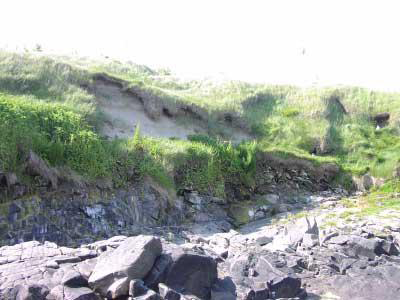
View of the eroding cliff section at West Voe, Shetland.

In the mid 1990s a shell midden was noted eroding from the cliff at West Voe, Sumburgh (NGR: HU 39205 10199). The site is recorded in the Shetland Sites and Monuments Record, entry 5625, where it is described as extending for approximately 10 metres and as being prehistoric in character. Further examination of the site in 2002 revealed that it consists of two middens separated by a layer of sand, the lower midden being made up predominantly of oyster shells (Fig. 2) and the upper, which appears to butt a structure, of cockle shells. It seems likely that the lower midden can be identified with the 'fossil' oysters that George Low described digging for 'in the seabank' at Sumburgh during his tour of Shetland in 1774 (Reference LowLow 1879: 186).
Archaeological excavations at the nearby site of Jarlshof (Hamilton 1956) failed to produce evidence of oysters. This is particularly noteworthy, since Bronze Age and Iron Age shell middens were excavated and a range of other marine species identified (ibid.). Oyster shells are also extremely rare at nearby Old Scatness Broch (Nicholson & Dockrill 1998) where ongoing excavations include an intensive programme of soil sieving and flotation which, alongside hand collection, has resulted in the recovery of large quantities of marine mollusc shells. The excavation of Bronze Age houses at Sumburgh Airport (Downes & Lamb 2000) also failed to recover evidence of oysters, although the preservation of organic materials at this site was said to be very poor (Lamb pers. comm.). Taken together, the evidence from these sites suggests that by the Bronze Age oyster beds were not present in local coastal waters, although elsewhere on Shetland oysters were exported until the nineteenth century (Johnston 1999: 176).
In addition to these Bronze Age and Iron Age settlement sites, the Sumburgh locality has also produced evidence of Neolithic settlement: a Neolithic multiple burial cist, dated to 3235-3135 cal. BC, which was exposed on the site of the airport control tower (Hedges & Parry 1980: 18) emphasises that this area was of prime importance in the early settlement of Shetland. With these facts in mind, it was decided that the midden merited further examination. A limited investigation was undertaken in the summer of 2002 in order to obtain samples for dating the oyster midden and to permit a preliminary evaluation of its contents.
The 2002 investigations
In the summer of 2002 preliminary investigations consisted of cleaning and recording a 3.3 metre section of the oyster midden [WV3] (Figure 2). This revealed that it sealed a thin dark greasy layer [WV4] which lay directly upon shattered sandstone bedrock. Midden [WV3] was sealed by a thin layer of greyish sand [WV2] that was in turn sealed by a deposit of clean sand [WV1]. Limited samples were taken during the cleaning of the section from contexts [WV2], [WV3] and [WV4]. No artefacts were found, but an optically stimulated luminescence (OSL) sample was taken to date the sand layer [WV2]. In order to minimise destabilisation of the eroding cliff face (see Figure 1), the cleaned section was not extended vertically to the cockle midden, although a small sample of this was also taken from the exposed section.
Generalised view of the oyster midden [WV3] separated from the shattered bedrock by a thin dark layer [WV4].

Detail of oyster midden layer [WV3]

A preliminary examination of the oyster midden sample has shown that whilst it primarily consisted of oyster (Ostrea edulis) shells, it also contained, less frequently, limpet (Patella vulgata), mussel (Mytilus edulis), sea bird bones (including the now extinct great auk (Pinguinus impennis) and marine mammals (details of the species present are given in the table opposite). In composition the oyster midden therefore appears similar to the Danish Ertebølle coastal kitchen middens which date to the Late Mesolithic (Reference MilnerMilner 2002: 3-4). The OSL sample from the sands sealing the midden provided a date of 4830 ± 430 BC (X1461) (68.2% probability) (Rhodes pers. comm), thus indicating that the site was likely to represent the first evidence for a Mesolithic human presence on Shetland. In order to confirm the OSL date, a shell from each of the middens was radiocarbon dated. These gave dates of 4320-4030 cal. BC (GU-11218) and 3750-3520 cal. BC (GU-11219) (95.4% using Oxcal with the marine calibration curve) for the oyster and cockle middens respectively.

The radiocarbon dates thus confirm the OSL evidence, and demonstrate that the oyster midden accumulated during the Late Mesolithic and that the cockle midden dates to the Late Mesolithic/Early Neolithic period. If, as appears likely, this midden butts a structure, then the latter is the earliest known on Shetland and would be somewhat earlier than the Neolithic human remains from the Sumburgh cist. The site has the potential, therefore, to provide a significant contribution to understanding the Mesolithic colonisation of, and the Mesolithic-Neolithic transition in, the Northern Isles and the wider North Atlantic region. In advance of any larger-scale project, further evaluation is planned in order to obtain additional midden samples, to clarify the stratigraphic relationship between the cockle midden and the structure and to access the survival of that building.
Acknowledgments
Ed. Rhodes (University of Oxford Research Laboratory for Archaeology and the History of Art) and Zoe Outram (University of Bradford) undertook the OSL dating. The radiocarbon dates were provided by Gordon Cook at the Scottish Universities Research and Reactor Centre (SURRC) with funding from Historic Scotland. Lindsey Kemp obtained the site coordinates using a Magellan GPS 315. The authors are also grateful for advice from Val Turner of the Shetland Amenity Trust.