

In 1560, the first authorized Latin translation of the Book of Common Prayer, the Liber precum publicarum (literally ‘Book of Common Prayer’) was issued primarily for the few institutions which reserved the right to use Latin in the liturgy after 1559: the public schools at Eton and Winchester, and the college chapels of Oxford and Cambridge.Footnote 1 Although this volume has received some scholarly coverage at various stages since the 1840s,Footnote 2 only rarely has it been discussed in any detail — perhaps because few copies are known to survive.Footnote 3 Existing historiographical work has usually focussed primarily on Elizabeth’s reasons for sanctioning a Latin-texted prayer book, usually viewed as an attempt by the queen to secure a more traditional settlement than that which was provided for by the 1559 Book of Common Prayer,Footnote 4 or for the purposes of edification.Footnote 5 The Liber precum publicarum does occasionally feature in musicological discourse, but is always given short shrift;Footnote 6 it therefore stands at odds with other prayer books published as a result of England’s break from Rome, most of which have received detailed coverage both in terms of their texts,Footnote 7 and in terms of their implications for music and musicians.Footnote 8 Little is known of the book’s background: the precise circumstances under which the volume was sought by the institutions for which it was produced are uncertain, and firm evidence for who translated it is wanting. Precisely how this prayer book differed from the English-texted prayer books of 1549, 1552 and 1559 — in terms of its Ordinary and Office texts, and in terms of its rubrics to indicate singing by a choir — remain largely unanswered questions. Little has been done, moreover, to contextualize the volume’s impact in 1560 and the years that followed: although it has been assumed that the book was adopted by the few institutions for which it was produced, the extent to which the Liber precum publicarum was actually acquired and used by those institutions had not yet been addressed. The following pages seek to assess the background of the 1560 Liber precum publicarum — its purpose, date, printer, and translator; to consider its contents in relation to the 1559 prayer book on which it was purportedly based, particularly in terms of its Ordinary and Office texts, and its provision for singers; to examine the extent to which it was adopted by the institutions for which it was produced; and to address the degree to which composers active in the 1560s appear to have used the volume as a textual source.
The publication of a Latin translation of the Book of Common Prayer was an important milestone in England’s reformation. A key aim of the protestant reformers was for worship to be in a language that was understood by all. In the case of public worship, at parish level, this meant that services should be in English — ‘the vulgar tongue’,Footnote 9 rather than Latin, which was understood by the educated classes but nobody else. It was for this reason that the liturgical use of Latin was criticized at various stages before the introduction of the first English prayer book in 1549: Cranmer wrote of ‘parrots, that be taught to speak, and yet understand not one word what they say’;Footnote 10 Latin was also condemned as ‘howlinge and jabberinge in a foren language’.Footnote 11 This criticism extended to music with Latin words also: Erasmus wrote of the three degrees of separation between polyphony and the people, achieved by their non-participation, the use of Latin rather than the vernacular, and musical textures which obscured the words;Footnote 12 Stephen Gardiner (1483–1555), bishop of Winchester, complained that ‘a great meany [singers] understode not what they song’.Footnote 13 The preface to the first Book of Common Prayer, published in 1549, drew attention to the fact that services ‘hath been read in Latin to the people, whiche they understoode not’,Footnote 14 adding that, in presenting the reformed liturgies in English, it endeavoured to ‘have suche language spoken to the people in the churche, as they mighte understand and have profite by hearyng the same.’Footnote 15 Consequently the established church was to use a single prayer book for all services, in which ‘all things shall be read and song in the Church in the English tongue’,Footnote 16 in order to establish ‘one uniforme conformitie’.Footnote 17
The Edwardian Act of Uniformity, passed on 21 January 1549, authorized and imposed the 1549 Book of Common Prayer as the main format for public worship — a volume in English throughout. But it did allow ‘any man that understands the Greek, Latin, and Hebrew tongue, or other strange tongue’ to say Matins and Evensong ‘in Latin, or any such other tongue, saying the same privately, as they do understand’ — an allowance that was printed in the 1549 prayer book, as well as in the later English prayer books of 1552 and 1559,Footnote 18 which retained the same concession. The same act also permitted the public use of those languages in university chapels, ‘being no parishes churches’, for the services of ‘Matins, Evensong, Litany, and all other prayers’, but with ‘the Holy Communion, commonly called the Mass, excepted’.Footnote 19 Thus in the universities the Offices could be said in Latin, but the Communion service had to be in English — presumably because it was intended by Cranmer to be the main public service of the week, whereas the Offices were subsidiary services, mainly said privately.Footnote 20 (Holding public services in English would also have prevented those unlearned in Latin from confusing the new public liturgies with those of the obsolete Sarum rite.)Footnote 21 The Liber precum publicarum of 1560 consequently broke new ground in offering a permissible Latin version of the Communion rite for public use, albeit for use at a restricted number of institutions, and did so for the first time since the introduction of the first Book of Common Prayer in 1549. This ought to have had important implications for composers who in the 1560s were connected to scholastic institutions, since with the publication of a Latin-texted prayer book they were presumably permitted to continue composing settings of the Mass Ordinary and other liturgical texts in Latin. Yet there are none — none, at least, which can be proven beyond doubt to post-date 1559, and which were written for bone fide liturgical use.
Innovative though it may have been, the Liber precum publicarum does not represent the first time that a Latin version of an English prayer book had been sought or produced. A reformed Latin prayer book was under consideration as early as 1538, at least for the Offices, but was never issued;Footnote 22 the Order of the Communion (an English form of Communion for use in the Latin Mass, published in 1548) was translated into Latin by the reformer Francis Dryander, only a few weeks after the English text was published,Footnote 23 but this was sent to Henry Bullinger in Zurich — one of several translations sent abroad for foreign scrutiny. Cranmer himself began drafting a Latin version of the 1549 Book of Common Prayer, presumably for scholastic purposes, but this was not finished.Footnote 24 A request that the 1549 Book of Common Prayer be ‘drawen into Latten’ was made by the Lord Deputy of Ireland in 1550, since the English text had been ‘hard to plante in mens myndes’ in the Gaelic-speaking parts of Ireland, where English was barely understood.Footnote 25 (A translation was produced there by a Mr Smyth,Footnote 26 but this was never authorized or published;Footnote 27 it was in fact a version of the 1560 Liber precum publicarum that the Irish Act of Uniformity later prescribed for use wherever congregations understood only Gaelic,Footnote 28 and which included certain rites which were excluded from the scholastic version — something discussed further below). A Latin translation of the 1549 Book of Common Prayer was also made, in England, by Sir John Cheke, but this was another translation for the eyes of continental reformers abroad: the Latin prayer book of 1560 (a modified version of which was later authorised for use in Ireland), does not appear to have been published with any international appeal in mind.Footnote 29 Thus in terms of an officially sanctioned and published translation from English to Latin, issued for actual use in England rather than for foreign scrutiny, the Liber precum publicarum of 1560 was the first of its type (see Figure 1).

Figure 1. The title page to the Liber precum publicarum of 1560. From an original in The Huntington Library, San Marino, California (call number 438000:431); image provided by Early English Book Online (ref. 2248508542), used by permission.
Background
The Letters Patent
Our main source for information on the background to the Liber precum publicarum are the Letters Patent that introduce the publication and authorize its use, printed at the front of the volume (see Figure 2).Footnote 30 Dated 6 April in the second year of the reign of Elizabeth I (i.e. 1560),Footnote 31 they tell us that the prayer book was produced in response to a petition from the schools of Eton and Winchester and the universities of Oxford and Cambridge. (The only university college named specifically is Christ Church, Oxford, which may suggest that the petition emanated from that college.)Footnote 32 The initiating petition does not survive,Footnote 33 but the Letters Patent make clear that a Latin prayer book had been sought by the scholastic institutions named in it ‘so that the Latin monuments of Holy Scripture may be rendered the more familiar to them, to the more fruitful profit of Theology’.Footnote 34 Latin remained the language of scholarship despite England’s various doctrinal oscillations; a Latin prayer book would have enabled Latin to remain as the language of worship in scholastic institutions, as it had been under the Marian restoration (1553–58), and as it was prior to the publication of the first Book of Common Prayer in 1549 — save for the few previous experiments with English-texted liturgies.Footnote 35 The Letters Patent make clear that the Latin prayer book was primarily for public worship at the institutions for which it was produced, for use only when the whole congregation could understand Latin: otherwise services were to be in English.Footnote 36 But it was also published for the private use of priests who might wish to read the Offices in Latin when they were not publicly officiating.Footnote 37

Figure 2. The Letters Patent to the Liber precum publicarum of 1560. From an original in The Huntington Library, San Marino, California (call number 438000:431); image provided by Early English Book Online (ref. 2248508542), used by permission.
Date and publisher
Apart from what they tell us about the volume’s intended purpose, the Letters Patent to the Liber precum publicarum are themselves an object of curiosity because they differ from other similar documents. Ordinarily, Letters Patent were petitioned from the Crown. The petition was considered first by the secretary of state (who from 1558 onwards was William Cecil, later Lord Burghley),Footnote 38 and then by the monarch. If the petition was approved of, a warrant would be produced and forwarded to the Privy Seal Office, the Lord Chancellor’s office, or to the Chancery; this would be authorized by the Solicitor General, and a patent would then be drafted. The Lord Chancellor, Lord Keeper would pass the Letters Patent under the Great Seal, and the patent would be engrossed into the Patent Rolls for posterity (the main state repository in which all grants of Patents were entered following their production, authorization and sealing). The sealed Letters were then issued to the patentee.Footnote 39 With these Letters Patent there is no mention of any seal; nor is their existence recorded in the Patent Rolls.Footnote 40 Instead, the Liber precum publicarum appears to have been authorized by the queen as Supreme Head of the Church, and published under the terms of the Elizabethan Act of Uniformity, which gave the queen the authority to ‘ordain and publish such further Ceremonies or rites as may be most for the advancement of God’s glory, the edifying of His church and the due reverence of Christ’s holy mysteries and sacraments’.Footnote 41 Not only do the Letters Patent for the volume seem to have evaded the layers of state scrutiny that were usual for such documents, but the publication itself would not have required the usual parliamentary and synodical authorization in order to be published.
Other than the regnal date of their Letters Patent, the Liber precum publicarum bears no date of publication. A colophon at the end of the volume gives the words ‘Excusum Londini apud Reginaldum Volfium, Regiae Maiest. in Latinis typographum Cum privilegio Regie Maiestatis’, which confirms that the book was printed in London by Reyner Wolfe, a Dutch-born protestant émigré who had been active as a bookseller in London since 1530 and as a printer since 1542.Footnote 42 Wolfe printed the volume under his privilege for printing books in Latin, Greek, and Hebrew, which had been awarded to him by Edward VI in April 1547.Footnote 43 (His patent was apparently obtained with the help of Thomas Cranmer, whose books Wolfe published.)Footnote 44 But the matter of the date of the publication itself, and of the sequencing of events behind it, cannot be narrowed down any further by recourse to the records of the Stationers Company because official state-sponsored publications, such as prayer books, did not need to be entered in the Stationers’ Register;Footnote 45 nor did they require approval by the Ecclesiastical Commissioners, as was the case for all other volumes issued from 1559 onwards.Footnote 46 The print run for the volume cannot be determined: prayer books were exempted from the official print run limit of 1250–1500 copies in 1587,Footnote 47 although this cap could be raised on petition to 2500 or 3000 copies;Footnote 48 presumably the print run for the Latin prayer book of 1560 was less than c.1250–1500 copies.
Determining the chronology of the Liber precum publicarum is not assisted by any official state paperwork. The initiating petition for the Latin prayer book does not survive, as already mentioned; nor do legislative events of 1558 and 1559 offer much help in the matter. The Elizabethan Act of Uniformity of 1558, passed in 1559, repealed the doctrinal laws made under Mary, and declared that the Edwardian prayer book of 1552 was to be reissued ‘with the alterations and additions therein added and appointed by this statute’ in order to produce the Elizabethan prayer book of 1559.Footnote 49 (This 1559 prayer book was to be ‘attained and gotten’ by all churches by 24 June that year; its use was obligatory.)Footnote 50 The Elizabethan Uniformity bill was passed by parliament on 28 April 1559, but it received Royal Assent only on 8 May 1559; only after this rubber-stamping did it officially become the Act of Uniformity, and so the petition for a Latin prayer book presumably post-dates the passing of Elizabeth’s Act of Uniformity into law.Footnote 51
A terminus ante quem for the initiating petition is provided by a letter dated 12 August 1559 from Sir John Mason to William Cecil, Secretary of State. It records that ‘The book of common servyce in latten is now in p(er)fection. I wolde godde yow wolde so putt yowr authorite to the sett(in)g of itt to the printer, all scholars sholde be bownde to yow therfor’ (see Figure 3). Sir John Mason had served as statesman to both Edward VI and Mary I, and was reappointed as Chancellor of Oxford University on 20 June 1559, a post he held until he resigned in 1564 (he had already served a stint in the same capacity from 1552 to 1556, under Mary).Footnote 52 He had also been presented by the crown to the deanery of Winchester in 1549, despite being a layman. Mason therefore had a double interest in the Liber precum publicarum, since it was produced for use in two jurisdictions over which he had, or once had, oversight: the University of Oxford and Winchester College. William Cecil, later Lord Burleigh, was chief adviser to Elizabeth for much of her reign, but from February 1559 was Chancellor of the University of Cambridge. Both Mason and Cecil were therefore connected to the institutions for which the Latin prayer book was produced — a prayer book which was evidently drafted by 12 August 1559.

Figure 3. John Mason, letter to William Cecil, 12 August 1559, London, National Archives, SP 12, vol. 6, fol. 28r. Image reproduced by permission of The National Archives.
The translator
The translation of the Liber precum publicarum has traditionally been attributed to Walter Haddon (1515–71), an advocate of Protestant reform and civil lawyer considered to be ‘one of the great and eminent lights of the reformation’.Footnote 53 Originally this attribution was made with a degree of caution: by the ‘pen and diligence of Walter Haddon (as some suppose)’;Footnote 54 later commentators claimed that he was ‘probably editor or one of the editors’,Footnote 55 or that the prayer book was ‘chiefly the work of Walter Haddon’,Footnote 56 although his supposed association with the volume later acquired the status of fact.Footnote 57 Haddon was certainly well placed to have produced the translation: he served both of the universities in a number of capacities, where the use of Latin was common;Footnote 58 he was a published Latinist with a ‘reputation second to none in the sphere of Latin composition’;Footnote 59 there was even said to be ‘no better Latine man within England’.Footnote 60 Haddon also had proximity to the crown via his appointment to a number of commissions from 1558 onwards,Footnote 61 was granted an annuity of £50 by Elizabeth in 1558 ‘for good counsel and attendance’,Footnote 62 and had been involved with Cranmer’s proposed revision of canon law in 1551–52 — the text of which was to be ‘drawn by that learned man Mr Doctor Haddon, and penned by that excellent learned man Mr Cheke’.Footnote 63 Yet Haddon is not mentioned anywhere in the Liber precum publicarum itself, nor in any of the (admittedly scarce) archival documentation that pertains to its preparation and production.
The Liber precum publicarum and its Text
At first glance, the Liber precum publicarum of 1560 appears to resemble closely the English-texted prayer books of 1549, 1552, and 1559, save for the change in language. Although it begins with the Letters Patent rather than the usual Act of Uniformity (which was printed towards the front of all three of the English-texted prayer books), what follows is more familiar. First there is a Preface (‘Praefatio’), which is followed by a foreword, ‘Of Ceremonies, why some be abolished, and some retained …’ (‘De Ceremoniis, cur aliae Quid abrogatae, aliae vero retentae ac receptae sunt …’). Then comes the ‘Index and Calendar’ (‘Index & Calendarium’): this lists which Psalms are to be read on which days, provides a sequence of scriptural readings to be used throughout the church’s year, and which identifies major festivals and saints’ days. This is followed by the actual liturgies: the orders for Matins (‘Matutinae Preces’), Evensong (‘Ordo Vesperarum’),Footnote 64 the Litany (‘Sequitur Letania & Suppicationes’), the Collects and Epistles (‘Collectae, Epistolae’) arranged in liturgical order, and then the weekly Communion service (‘Ordo administrandi Coenam Domini, sive Sacram Commuionem’).Footnote 65 This is supplemented by occasional Offices for the sick, the dead, for burial, and for Ash Wednesday, etc. Also included is a service for the commemoration of benefactors, followed by a form of Requiem Eucharist; excluded are some services such as Baptism, Confirmation, and Marriage. Otherwise, the Latin prayer book of 1560 appears to be closely modelled on an English-texted Book of Common Prayer — at least insofar as its key constituents are concerned.
The copy-text
The Letters Patent for the Liber precum publicarum claim that it is ‘agreeing with Our English book of public prayers now received and used throughout the whole of our kingdom’.Footnote 66 This must refer to the 1559 Book of Common Prayer. The Elizabethan Act of Uniformity of 1558, which was passed by the House of Commons on 20 April 1559, rendered all previous prayer books ‘void and of none effect’; it also directed the use of an amended version of the short-lived Edwardian prayer book of 1552, which was to be reissued ‘with the alterations and additions therein added and appointed by this statute’ in order to form the 1559 Book of Common Prayer,Footnote 67 as already mentioned. This 1559 prayer book was in general use from 24 June 1559 onwards — well in advance of April 1560, the date of the Letters Patent to the Latin prayer book of 1560.
The Liber precum publicarum was not a translation of the 1559 Book of Common Prayer, however, but a revision, presumably by Walter Haddon, of a Latin translation of the 1549 prayer book: Ordinatio ecclesiae seu, Ministerii ecclesiastici in florentissimo regno Angliae (see Figure 4).Footnote 68 It was produced by Alexander Alesius (1500–65), a Scotsman-turned-Lutheran who had fled England to escape the effect of the Six Articles of 1539;Footnote 69 the volume was published in 1551, in Leipzig, where Alesius held a chair in theology.Footnote 70 The Prooemium to Alesius’s book tells us that he was translating the 1549 prayer book in order to ‘make it known as widely as possible’, since it represented a ‘shining example of British diligence and virtue in the ordering of Christ’s church’.Footnote 71 Translating the 1549 Book of Common Prayer into Latin would have made its text intelligible to continental readers, since English was barely read or spoken beyond England’s shores in the sixteenth century. Alesius’s 1551 translation is just one of several translations of English prayer books and other liturgical texts that were made for the scrutiny of continental reformers abroad.Footnote 72

Figure 4. The title page to Alexander Alesius, Ordinatio ecclesiae seu, Ministerii ecclesiastici in florentissimo regno Angliae (Wolfgang Gunter, 1551), from an original in the British Library, London (General Reference Collection 221.e.5), © British Library Board; image provided by Early English Books Online (ref. 2240872525), used by permission.
Haddon’s apparent reliance on the 1549 prayer book should have produced a conservative Latin prayer book, since the 1549 Book of Common Prayer was in many respects a conservative volume. It retained all sections of the Mass Ordinary, in the same formula and sequence as they had appeared in the Sarum Rite: the Kyrie, Gloria, Credo, Sanctus with Benedictus, and the Agnus Dei. Cranmer had translated these sections of the 1549 prayer book directly from the Sarum Missale;Footnote 73 consequently they closely resembled the Roman liturgy on which they were based, save for the change in language. Thanks to the work of Roger Bowers, we also know that the 1549 Book of Common Prayer included numerous rubrics to indicate singing by a choir, both optional and obligatory: ‘shalbe song or sayd’, ‘In the communion tyme the Clearkes shall sing’, etc. (see Figure 5), which allowed for music to take the place of spoken words in various liturgies, including the Communion service. This meant that the Mass Ordinary could continue to be sung by a choir, as it had been in the Roman liturgy;Footnote 74 the only difference was that it had to be sung in English rather than Latin. It was for this prayer book and its singing rubrics that John Merbecke produced his Book of Common Praier Noted, containing monophonic plainsong-like settings of 1549 prayer book texts.Footnote 75

Figure 5. The various sections of the Mass Ordinary as printed in the 1549 Book of Common Prayer, with rubrics, shown in red, to indicate optional singing of the Kyrie, but obligatory singing of the Gloria (following the intonation by the priest), as well as for the Sanctus and Benedictus, and for the Agnus Dei. Images from an original in Cambridge University Library; image provided by Early English Book Online (ref. 2240953826), used by permission.
The more intensely protestant 1552 Book of Common Prayer made a number of changes to the 1549 prayer book’s text.Footnote 76 The more significant alterations for our purposes were to the Mass Ordinary — not only to its texts, but to their positions in the Communion rite. The words of the Kyrie were incorporated into responses to the commandments (‘Lord have mercy upon us, and incline our hearts to keep this law’);Footnote 77 the words ‘Osanna in the highest’ were omitted from the Sanctus;Footnote 78 the Benedictus was entirely cut from the Communion service (although it did feature in the Litany);Footnote 79 also excised, completely, was the Agnus Dei.Footnote 80 The Gloria, which had traditionally followed the Kyrie, early in the service, was relegated to a post-Communion position;Footnote 81 a repetition of the words ‘Thou that takest awaye the Sinnes of the worlde, have mercy upon us’ was also introduced into the Gloria, perhaps to compensate for the removal of the Agnus Dei from the 1552 text.Footnote 82 The 1559 prayer book included most of these alterations, although the words ‘Osanna in the highest’ were restored to the Sanctus. As well as the various changes to the Ordinary texts themselves, the 1552 prayer book also removed all but one of the rubrics relating to choral performance in the Communion service (only the Gloria bears an instruction that it may be sung), and most others elsewhere. The 1559 prayer book, which was essentially a reissue of the 1552 volume with a few alterations, maintained this position.Footnote 83
Alesius’s 1551 translation may have been based on the more conservative 1549 Book of Common Prayer, but his translation was not exact. Rather than produce a literal translation of Cranmer’s 1549 text, he excluded some texts, offering only their first lines;Footnote 84 some concluding formulae in collects and prayers were either omitted or abbreviated, and a number of rubrics were truncated.Footnote 85 Some sections were also paraphrased, while others were interpreted rather than translated.Footnote 86 Moreover, in producing his version of the 1549 prayer book, Alesius was said to have drawn upon literary sources that were ‘both more Roman and more evangelical than the English liturgy’:Footnote 87 for instance, at times he ‘adopted the more elaborate text of the Sarum missal’ over Cranmer’s reduced English text, or ‘slipped into the language of the Latin rite or preferred it deliberately’; in other sections he took a more staunchly protestant position, omitting the various prayers and rubrics relating to chrism in Baptism, Visitation of the Sick, and Communion of the Sick.Footnote 88
Because Alesius’s translation was based, albeit with its deviations, on the 1549 Book of Common Prayer, it consequently included some material which had been included in the 1549 prayer book, but which was excluded from the later editions of 1552 and 1559. For instance, it included provision for an epistler and gospeller, vested in copes at the Communion, and also reservation of the sacrament for the sick — elements of the 1549 Book of Common Prayer that had been abolished in the subsequent texts of 1552 and 1559.Footnote 89
None of these deviations should have had particularly negative consequences for musicians. Alesius included the Kyrie, Gloria and Creed in the usual sequence, although he did not provide their full texts (only their incipits); but he did so for the Sanctus with Benedictus, and the Agnus Dei, all of which appear in the traditional order. A number of singing rubrics from his 1549 exemplar were likewise retained. The Kyrie is prefixed with the words ‘Sacerdos dicet, aut Clerici canent’ (‘The priest will say, or the Clerks will sing’); the ensuing Gloria incipit is prefixed with the words ‘Sacerdos stans ad medium altaris canet’ (‘The priest stands before the altar and sings’), with the word ‘chorus’ appearing after the intonation. The word ‘Chorus’ also appears before the Sanctus with Benedictus, while the Agnus Dei is prefixed with the rubric ‘Tempore comnunionis cantet Chorus’ (‘At the time of communion the choir sings’). In Alesius’s translation, only the Credo appears to have lacked any instruction as to the possibility that it might be sung.
The Mass Ordinary
Haddon’s apparent adoption of Alesius’s 1551 translation of the 1549 Book of Common Prayer as his copy-text for the 1560 Liber precum publicarum was, in turn, not exact. Some sections of the Mass Ordinary — although they are present elsewhere in the book, in different services — do not appear together in the Communion rite. The words of the Kyrie appear at several points (in Matins, in the Litany — where it is responsorial, and in the Offices for the Visitation of the Sick, the Dead, for Burial, and for Ash Wednesday), but they are not part of the actual Communion service. The Gloria does feature in that service, but it comes towards the end rather than the start — as it had done in the prayer books of 1552 and 1559. The Credo also appears in the Communion service, as does the Sanctus with Benedictus, in the usual sequence, but the Agnus Dei does not (it appears only in the Litany). Thus, although all of the Ordinary texts are present in the Liber precum publicarum, they do not all appear together in the Communion rite; nor are they in the same sequence as they had been in the Latin Mass, and as they were in the first English prayer book. Consequently, in terms of the Mass Ordinary, the Liber precum publicarum had more in common with the prayer books of 1552 and 1559 rather than the 1549 text on which it had apparently been indirectly modelled.
Moreover, whereas Alesius’s 1551 translation of the 1549 prayer book retained most rubrics to indicate singing by a choir, the Latin prayer book of 1560 whittled them down substantially. In the Communion service, only the Gloria bears a rubric of ‘Deinde dicatur aut canatur’ (Then shall be said or sung’) to indicate that it might be sung (see Figure 6); those for the Credo and the Sanctus with Benedictus were excised. Thus, in terms of singing rubrics also, the Liber precum publicarum book had more in common with the prayer books of 1552 and 1559, in which choral provision was severely sapped, rather than the 1549 prayer book text on which its translation had been (indirectly) based.

Figure 6. Mass Ordinary texts in the Communion service of the 1560 Liber precum publicarum, with the words ‘Deinde dicatur au canatur’ (shown in red) appearing before the Gloria only. Images from an original in The Huntington Library, San Marino, California (call number 438000:431); image provided by Early English Book Online (ref. 2248508542), used by permission.
Because the Liber precum publicarum was an authorized Latin translation of the Book of Common Prayer, it has often been assumed that the scholastic institution for which it was produced could continue to use Latin-texted Communion settings. Hugh Benham has suggested that, with the publication of the Latin prayer book in 1560, the ‘Holy Communion service was now available in Latin, and performances of pre-Reformation Latin settings were possible in theory at least’.Footnote 90 This would not have been possible within the Communion service of the Liber precum publicarum, however, since the traditional sequence of the Mass Ordinary sections, available to composers from the earliest cyclic mass settings until the publication of the first Book of Common Prayer in 1549, were displaced. Only the Gloria, Credo and the Sanctus with Benedictus were included in that Communion rite, with the Gloria towards the end rather than the start of the service; the Kyrie and Agnus Dei were excluded.Footnote 91 Moreover, whereas the 1549 Book of Common Prayer, according to its rubrics, permitted English-texted music to take the place of spoken word at several junctures in the Communion service, similar instructions in the Communion rite of the Liber precum publicarum are limited to a single occasion (the Gloria). Thus music could not, it would appear, feature in the liturgy to the same extent as it had done in the first Edwardian prayer book. The sections of the Mass Ordinary and their rubrics for choral performance, as they are presented in the various editions of the Book of Common Prayer, are shown in Table 1.
Table 1. Mass Ordinary sections of the Communion service and their singing rubrics, as presented in the various editions of the Book of Common Prayer
| Prayer book | Comment | Rubric for choral performance |
|---|---|---|
| 1549 Book of Common Prayer | ||
| Kyrie | ‘The Priest shall saye, or els the Clearkes shal syng’ | |
| Gloria | ‘The Clearkes’ [after intonation] | |
| Creed | ‘The Clearkes shall syng the rest’ [after intonation] | |
| Sanctus | (‘This the Clearkes shall also syng’) | |
| Benedictus | follows straight on from the Sanctus | ‘This the Clearkes shall also syng’ |
| Agnus Dei | ‘In the Communion tyme the Clearkes shall syng’ | |
| 1551 translation (Alesius) | ||
| Kyrie | ‘Sacerdos dicet, aut Clerici canent’ | |
| Gloria | ‘Sacerdos stans ad medium altaris canet’; ‘Chorus’ | |
| Creed | ||
| Sanctus | ‘Chorus’ | |
| Benedictus | follows straight on from the Sanctus | (‘Chorus’) |
| Agnus Dei | ‘Tempore comnunionis cantet Chorus’ | |
| 1552 Book of Common Prayer | ||
| Kyrie | responsorial: ‘and incline our hearts to keep this law’ etc. | |
| Creed | ||
| Sanctus | omits ‘Osanna in the highest’ | |
| Gloria | ||
| 1559 Book of Common Prayer | ||
| Kyrie | responsorial: ‘and incline our hearts to keep this law’ etc. | |
| Creed | ||
| Sanctus | omits ‘Osanna in the highest’ | |
| Gloria | ||
| 1560 Liber precum publicarum | ||
| Credo | ||
| Sanctus | incudes ‘Osanna in excelsis’ | |
| Benedictus | follows straight on from the Sanctus; incudes ‘Osanna in excelsis’ | |
| Gloria | ‘Deinde dicatur aut canatur’ |
The Calendar
Another important difference between the Liber precum publicarum and the 1559 prayer book on which it was purportedly based was its Calendar — the section of the book which designates major festivals and saints’ days, and which sets out the appointed scriptural readings and Psalms. The Sarum calendar, used before the Reformation, was complex: it catered for the commemoration of a large number of saints. Feasts were classified as either double or simple, and then further subdivided as principal, major, minor and inferior; feasts could also be assigned either three or nine lessons — a system which was not always concordant with that of that Sarum Breviary.Footnote 92 (Cranmer complained that it took ‘more business to fynd out what should be read, then to read it when it was founde out.’)Footnote 93 The Calendar in the first prayer book of 1549 was an ‘exercise in censorship of the saints’:Footnote 94 the Temporale, the seasonal calendar, survived largely unscathed; but the Sanctorale, the calendar for feast days of saints, was substantially reduced.Footnote 95 Restricted to the apostles, evangelists, and other New Testament figures, these were whittled down to only twenty-five — a position largely maintained in the prayer books of 1552 and 1559.Footnote 96 Alesius, in his 1551 translation, largely followed the suit of his 1549 exemplar (his miscellanea are, according to Peter Blayney, translated with ‘no additions or subtractions’).Footnote 97
The Calendar of the 1560 Liber precum publicarum, however, designated more than 300 days as saints’ days, leaving only some 40 days vacant — it is the fullest calendar ever to be published in a Church of England prayer book (for the month of February see Figure 7).Footnote 98According to Clay, it ‘brought back very many names of saints, which had for some years been authoritatively banished’.Footnote 99 It cannot, therefore, have been a mere mechanical translation of Alesius’s 1551 re-working of the 1549 prayer book text, since it had more in common with the obsolete calendar of the Sarum use than the reformed liturgies of the Book of Common Prayer. This ought to have put it firmly at odds with the doctrinal ambitions of protestant reformers, who condemned the veneration of saints and their relics.Footnote 100 Moreover, the short introduction to the Calendar states that reference to Psalms in the volume is in terms of the vulgate numbering,Footnote 101 rather than the Hebrew numbering system that had been adopted in the great English Bible of 1539 and in all subsequent English-texted prayer books. To those users who bothered to read that introduction, this must have further strengthened the connection of the Liber precum publicarum to the redundant Sarum liturgies rather than to the reformed English-language services promulgated in the prayer books of 1549, 1552 and 1559. Why that statement was made, however, is uncertain: reference to the Psalms in the prayer book is according to the Hebrew system.

Figure 7. The Calendar for the month of February, as printed in the Liber precum publicarum of 1560. From an original in The Huntington Library, San Marino, California (call number 438000:431); image provided by Early English Book Online (ref. 2248508542), used by permission.
The inclusion of such a substantial calendar in the Latin prayer book connects it with a further publication also issued in 1560: the Orarium,Footnote 102 a Latin-texted book of hours. Ironically published in tandem with the Metrical Psalter, this volume preserved the old structure of the liturgy, providing the texts of the eight hours, with their original titles (Matins, Lauds, Prime, etc.),Footnote 103 although prayers and invocations to Our Lady, such as the Angelus and the Ave Maria, are omitted. It also had a full calendar, though not in exactly the same format as that of the Liber precum publicarum. The Orarium used the Vulgate numbering,Footnote 104 presumably because it was based on the 1551 King’s Primer — a volume issued under Edward VI,Footnote 105 but which was itself modelled on a conservative primer issued in the reign of Henry VIII, when the vulgate system was in force.Footnote 106 (A primer is essentially a Book of Hours — the term Primer is usually used for English-texted books.)Footnote 107 Perhaps it was the calendar to this publication that was originally envisaged for use in the Liber precum publicarum.
The publication of the divergent Calendar in the 1560 Liber premium publicarum pre-empted a revision of the Calendar for use in prayer books more generally. In a letter to her Ecclesiastical Commissioners (which names Walter Haddon as one of her Masters of Requests), dated January 1561, Elizabeth I orders some ‘new calendars to be imprinted, whereby such chapters or parcels of less edification may be removed, and other more profitable may supply their rooms’.Footnote 108 This new 1561 calendar, which was included in impressions of the 1559 Book of Common Prayer from 1562 onwards,Footnote 109 was not a new production, but was, as with the Orarium of 1560, a reworking of the Calendar from the 1551 King’s Primer However, it removed reference to most of the Catholic saints who had appeared in the Liber precum publicarum, while retaining some fifty-five saints for black-letter days.Footnote 110 The position was perpetuated when further saints appeared in the calendar of the Preces Privatae of 1564 (a book of private prayers),Footnote 111 which, like the Liber premium publicarum, included various saints’ days that had been suppressed at the Reformation, although it did offer an explanation as to why. The book’s ‘Admonition to the Reader’, printed at the rear of the volume, states that its Calendar includes ‘notes and evidence of certain things whose times and seasons are greatly helpful to know, ignorance of which can be harmful to people of our own time’.Footnote 112 In other words, it was included for antiquarian purposes,Footnote 113 for the purposes of edification. Presumably the same rationale was behind the divergent calendar in the Latin prayer book of 1560,Footnote 114 even though the renewed prominence of Saints in these new calendars could have easily been viewed as a revival of Catholic traditions, especially by the more radical reformers.Footnote 115 (Phebe Jensen has pointed out that the ‘larger roster of Sarum saints’ in the Liber precum publicarum was perhaps ‘thought to pose less religious danger to the academic audience for this scholarly version of the official prayer book.’)Footnote 116
The Offices
The main Offices in the Liber precum publicarum are those of Matins and Evensong, which appear as ‘Matutinae Preces’, and ‘Ordo Vesperarum’ respectively (the 1549 prayer book called them ‘Matins’ and ‘Evensong’, but these were changed to ‘Mornyng prayer’ and ‘Euenyng prayer’ from 1552 onwards). As with the Mass Ordinary texts, various texts belonging to the Offices were prefixed or suffixed with rubrics to indicate that they could be sung by a choir. In the 1549 prayer book, Matins permitted the singing of the Venite (‘shalbe sayed or song’),Footnote 117 the Lessons (which ‘in such places where they doe syng’ could be ‘songe in a playne tune after the maner of distincte readyng’), and, on certain feast days, the Quicunque vult (‘shall be song or sayed’),Footnote 118 but not others. Not one singing rubric was provided for Evensong, however — a position maintained in the later prayer books of 1552 and 1559. Alesius’s 1551 translation of the 1549 prayer book retained the same singing provisions as in the 1549 text, but he additionally rubricated for the singing of Te Deum (or, in Lent, the Benedicite), and also the Benedictus dominus deus Israel in Matins; he also permitted the singing of the Psalm, Magnificat, and Nunc Dimittis at Evensong — something not found in the 1549 book, nor in those of 1552 or 1559. The 1560 Liber precum publicarum, apparently based on Alesius’s translation, offered similar provisions. Thus, while the Liber precum publicarum may have offered reduced choral provision for the Mass Ordinary, for the Offices of Morning and Evening Prayer, its rubrics were more generous. The singing rubrics for the Offices are set out in Table 2.
Table 2. The Offices of Matins and Evensong and their singing rubrics, as presented in the various editions of the Book of Common Prayer. The respective Offices in each prayer book are separated by a dotted line
| Prayer book | Comment | Rubric for choral performance |
|---|---|---|
| 1549 Book of Common Prayer | ||
| Preces & responses I | ||
| Venite | ‘Psal. XCV.’ [Hebrew numbering] | ‘Then shalbe sayed or song without any Inuitatorye this Psalme, Venite exultemus, &c. in Englishe, as followeth’ |
| Psalm | ||
| Lesson | ‘And (to the ende the people maye the better heare) in such places where they doe syng, there shall the lessons bee songe in a playne tune after the maner of distincte readyng: and lykewyse the Epistle and Gospell.’ | |
| Te Deum (or Benedicite) | The Benedicite takes the place of the Te Deum in Lent | |
| Lesson | [As for the first lesson] | |
| Benedictus dominus deus Israel | ||
| Creed (or Quicunque vult) | The Quicunque vult was for use on certain feast days | (‘… shall be song or sayed, immediately after Benedictus, this confession of our Christian fayth’) |
| Preces & responses II | ||
| Preces & responses | Only one versicle and response, followed by the Gloria | |
| Psalm | ||
| Lesson | ||
| Magnificat | ||
| Lesson | ||
| Nunc dimittis | ||
| Preces & responses II | The reader is referred back to Matins for the text | |
| 1551 translation (Alesius) | ||
| Preces & responses I | ||
| Venite | Incipit only | ‘Deinde sine Inuitatorio Anglica lingua canatur Psalmus Venite Exultemns [sic.] Domino &c.’ |
| Lesson | ‘Et ut populus melius intelligat in his locis, in quibus Musica Figuralis cani solet, Lectiones, Epistolae, & Euangelia simpliciter uno tono in modum perpetuae dictionis distincte legantur’ | |
| Te Deum (or Benedicite) | Incipit only; the Benedicite takes the place of the Te Deum in Lent | ‘Post primam Lectionem cantitur, Te Deum Laudamus, Lingua Anglica per totu annum, praeter quam in Quadragesima, in qua loco eius cantabitur hymnus, Benedicite omnia opera Domini Domino’ |
| Benedictus dominus deus Israel | Incipit only | ‘Post alteram lectionem per totum annum canitur Hymnus Zachariae Benedictus dominus deus Israelis.’ |
| Creed (or Quicunque vult) | Incipit only; the Quicunque vult was for use on certain feast days | (‘Ad Matutinas immediate post hymnum Benedictus, canitur Symbolum Anthanasii, lingua Anglica, Quicunque uult saluus esse &c.’) |
| Preces & responses II | ||
| Preces & responses | Only one versicle and response, followed by the Gloria | |
| Psalm | ‘Postea canuntur Psalmi praemonstrati in Tabula…’ | |
| Lesson | ||
| Magnificat | Incipit only | ‘Deinde canitur Anglica lingua, Magnificat anima mea Dominum.’ |
| Lesson | ||
| Nunc dimittis | Incipit only | ‘Post hunc hymnum legitur caput aliquod noui Testamenti pro altera lectione, & continuo canitur hymnus, Nunc dimittis seruum tuum Domine, Anglica lingua.’ |
| Preces & responses II | The reader is referred back to Matins for the text | |
| 1552 Book of Common Prayer | ||
| Preces & responses I | ||
| Venite | ‘Then shalbe sayd or song thys Psalme folowinge.’ The Easter anthems Christ rising again from the dead or Christ is risen again the firstfruits of them that sleepy be sung or said in lieu of the Venite on Easter Day. | |
| Psalm | ||
| Lesson | And (to thend the people may the better heare) in such places where they do sing, there shall the Lessons be song in a plain tune, after the manner of distincte reading: and likewyse the Epistle and Gospell.’ | |
| Te Deum laudamus (or Benedicite) | ||
| Lesson | [As for the first lesson] | |
| Benedictus dominus deus Israel (or Jubilate deo) | (Incipit only for Jubilate; ‘C. Psalme’) ‘Psal. XCV.’, Hebrew numbering | |
| Creed (or Quicunque vult) | The Quicunque vult was for use on certain feast days | (‘… shalbe song, or sayd immediatly after Benedictus this confession of our Christen [sic.] fayth.’) |
| Preces & responses II | ||
| Preces & responses | ||
| Psalm | ||
| Lesson | ||
| Magnificat (or Cantate Domino) | (Incipit only for the Cantate Domino; ‘xcviii. Psalm’, Hebrew numbering) | |
| Lesson | ||
| Nunc dimittis (or Deus misereatur) | (Incipit only for the Deus misereatur) | |
| Creed | ||
| Preces & responses II | The reader is referred back to Matins for the text | |
| 1559 Book of Common Prayer | ||
| Preces & responses I | ||
| Venite | ‘Then shalbe sayde or song, this Psalme folowyng’ | |
| Psalm | ||
| Lesson | ‘And to thende the people may the better heare, in such places where they do syng, there shall the Lessons be song in a playne tune, after the maner of destinct readyng: and lykewyse the Epystle and gospelle.’ | |
| Te Deum (or Benedicite) | ||
| Lesson | [As for the first lesson] | |
| Benedictus (or Jubilate deo) | (‘C. Psalme.’, Hebrew numbering) | |
| Creed (or Quicunque vult) | The Quicunque vult was for use on certain feast days | (‘… shalbe song or sayd, immediatly after Benedictus this confession of our Christian faythe.’ ) |
| Preces & responses II | ||
| Preces & responses I | ||
| Psalm | ||
| Lesson | ||
| Magnificat (or Cantate Domino) | (‘Psalmo xcviii’ [Hebrew numbering]) | |
| Lesson | ||
| Nunc dimittis (or Deus misereatur) | (‘Psal. lxvii’, Hebrew numbering) | |
| Creed | ||
| Preces & responses II | The reader is referred back to Matins for the text | |
| 1560 Liber precum publicarum | ||
| Venite | ‘Psalm. 95’ lxvii, Hebrew numbering | ‘Tunc canatur Psalmus sequens’ |
| Lesson | ‘Et vt facilius intelligatur, in his locis ubi Musica figurails cani solet, Lectiones, Epistolae, & Euangelia simpliciter & naturali tono, in modum perpetuae dictionis distincte legantur’ | |
| Te Deum (or Benedicite) | ||
| Lesson | [As for the first lesson] | |
| Benedictus (or Jubilate deo) | Psalm. 100’, Hebrew numbering | ‘Deinde sequatur lectio secunda qua finita, canatur Hymnus Zachariae’ |
| Credo | ||
| Preces & responses | ||
| Quicunque vult | ‘In festis Natalis Domine, Ephiphania, Mathiae, Paschatis, Ascentionis, Pentecostes, Trinitatis, Ioannis Baptistae, S. Iacobi, S. Batholomaei, S. Matthaei, Simonis & Iudae, & S. Andreae, ad matutinas statim post Benedictus, canetur Symbolum Athanasii’ | |
| Preces & responses | ||
| Psalm | ‘Postea canuntur Psalmi praemonstrati in Tabula, nisi festum fuerit quod proprios habeat Psalmos …’ | |
| Lesson | ||
| Magnificat (or Cantate Domino) | (Psalm. 93) [recte 98] | ‘Deinde canitur’. [It has been suggested that the Magnificat could be replaced by the Dominus regnavit, presumably because the Cantate Domino is labelled as Psalm 93 (See Tallis, Harley, 174), but this appears to be a misprint.] |
| Lesson | ||
| Nunc dimittis (or Deus misereatur) | (Psalm. 67, Hebrew numbering) | ‘… canatur Canticum Simionis’ |
The Occasional Offices
Because the Liber precum publicarum was based on Alesius’s 1551 translation of the 1549 prayer book rather than the 1559 Book of Common Prayer directly, it provided certain rites which were never part of the 1559 text on which it was purportedly based. Included are prayers for the deceased, and a service of commemoration for college benefactors followed propers for a Requiem Eucharist — even though the abolition of purgatory had rendered requiems, annual obits, and other intercessory rites redundant.Footnote 119 (These propers had been included in the 1549 prayer book but were dropped from 1552 onwards.)Footnote 120 A service commemorating college benefactors was evidently necessary for a prayer book that was to be principally used in the universities, since they relied heavily on donations — offered in return for intercessory prayers and anniversary masses for donors’ souls.Footnote 121 The prospect of perpetual commemoration must have played an important role in the greasing of donors’ pockets: including a service for benefactors in the 1560 Latin prayer book would have allowed for this largesse to continue. (Many colleges in any case enshrined the making of corporate prayers for the commemoration of benefactors in their respective statutes.)Footnote 122 The inclusion of these extra services is signalled in the Letters Patent to the prayer book, which mention how ‘We have instructed that there be added certain specific items to be sung at the funerals and memorials of Christians’.Footnote 123 (Although they are not found in the English prayerbook of 1552 and 1559, these services cannot have been considered wholly inappropriate to English reformers, since, in 1570 an English form of this service was produced for use in Cambridge colleges, which were apparently not wanting to use this Latin version,Footnote 124 as well as for the Order of the Garter, to be used at St George’s Chapel, Windsor.)Footnote 125
The 1560 book, although it included some material which did not feature in the 1559 Book of Common Prayer (like its fat Calendar), also left some sections out. The scholastic version of the Liber precum publicarum excluded the occasional offices of Baptism, Confirmation, Marriage, the Churching of Women, and the Commination (a service of penitence for the beginning of Lent);Footnote 126 the other, which included most of the occasional services, at the end of the book, was produced for use in Ireland — where it remained in use until an Irish translation of the Book of Common Prayer was issued in 1625.Footnote 127 University members were required to be unmarried; consequently they had no need for services relating to nuptials and procreation, whereas the version used in Ireland had to cater for the needs of ordinary parishioners.
The Psalter
As well as omitting some occasional services, the Liber precum publicarum, in both its scholastic and Irish forms, omitted the Psalter. Reference is made to psalms in the Calendar and elsewhere throughout the prayer book, but its users were presumably expected to consult their own Latin-texted psalters — perhaps ones that had survived destruction during Edward’s reign,Footnote 128 or which had been printed in great quantity in the reign of Mary. The suggestion in the Latin prayer book that references to the Psalms was to be by the Vulgate numbering, when in fact it was according to the Hebrew system, as mentioned above, must have been confusing to its potential users.
Motivations
The Liber precum publicarum of 1560, then, is in some ways more conservative than the 1559 Book of Common Prayer on which it was purportedly based, according to its Letters Patent: this is the case with its Calendar, its Offices for the dead, and its service for the commemoration of benefactors with its propers for a Requiem Eucharist. Other traits align more closely with the prayer book texts of 1552 and 1559: this is the case with its Mass Ordinary, which lacks the Kyrie and Agnus Dei (although the Benedictus is included), and with the apparent excision of most rubrics to indicate singing in that rite — although its evening service provides more rubrics on this front than any preceding English prayer book. Some of the volume’s more conservative contents can be explained by its compiler, supposedly Walter Haddon, basing his translation on Alesius’s 1551 translation of the first prayer book of 1549, since this volume retained various elements which were removed in later prayer books. Clay reckoned that Haddon had ‘thoughtlessly copied Aless’,Footnote 129 with no ulterior motive; similar views were expressed by A. F. Scott Pearson, who claimed that the 1560 book was ‘slavishly based upon the Ordinatio of Alesius, so far as the first Edwardian Prayer Book was incorporated in the Elizabethan’.Footnote 130 Frere claimed, conversely, that the inclusion of the more traditional elements in the 1560 volume were ‘calculated to give foreign catholics an all too favourable view of the English service’.Footnote 131
Others have suggested that the Liber precum publicarum represents an attempt by Elizabeth I to secure a more traditional settlement than that which was provided for in the 1559 Book of Common Prayer. This is an appealing proposition since the queen herself is thought to have preferred the more traditional 1549 prayer book, and had hoped to restore it, although this was deemed too difficult a road to tread politically.Footnote 132 (Her own doctrinal stance was apparently closer to the 1549 book than to ‘either Henrician national catholicism or the more militant reforms of the second Prayer Book’.)Footnote 133 Having a Latin prayer book translated from the more conservative 1549 text could have offered a media via — a volume which was less progressive than the 1559 prayer book, and more closely aligned with that of 1549. Haugaard, moreover, views the Liber precum publicarum, along with Elizabeth’s injunctions of 1559 and the new calendar of 1561, as manoeuvres intended to move ‘the liturgical settlement in the queen’s conservative direction.’Footnote 134 This possibility seems especially viable given that the book was published under the terms of the Elizabethan Act of Uniformity, and that its Letters Patent avoided the usual layers of state scrutiny that were typically applied to similar documents.Footnote 135
The queen was evidently aware of the risks inherent in publishing a prayer book that was in Latin throughout, and which catered for the memorial of numerous saints which had in previous prayer books been banished. Her 1561 letter regarding the revision of the Calendar, mentioned above, also asked her commissioners to ‘prescribe some good orders to the collegiate churches […] so that our good purpose in the said translation be not frustrated, nor be corruptly abused, contrary to the effect of our meaning.’Footnote 136 However, towards the end of the same letter, she directs that ‘the alteration of any thing hereby ensuing be quietly done, without shew of any innovation in the church. And these our letters shall be your sufficient warrant in this behalf.’Footnote 137 This arouses further suspicion that the church’s more staunch reformers would not have approved of her interventions, and that the queen was seeking to circumvent the channels of scrutiny that were usual for prayer books and other religious texts.
Norman Jones, however, has questioned whether the differences between the Liber precum publicarum and the 1559 Book of Common Prayer were deliberate alterations or merely mistakes, suggesting that the book ‘grew out of poor editing, not a subtle plot to reintroduce the older forms’.Footnote 138 Haddon’s reliance on Alesius’s 1551 translation possibly arose out of lack of time: the pre-existence of a Latin translation of a reformed prayer book would have offered Haddon a readily workable text, which, even with its deviations, may have allowed him to produce the 1560 prayer book more quickly (the 1559 volume was given Royal Assent on 8 May, and was to be used by 24 June, less than seven weeks later; the Latin draft was ready by 12 August, according to Mason’s letter, referred to above, which would have left only three months in which to finalise a text).
The extent to which Haddon may have imposed his own views on the prayer book is an open question. Haddon himself was a reformer, and a friend of the reformer Martin Bucer; it seems unlikely, therefore, that he would, himself, have deliberately imbued the prayer book with texts and rubrics that were overtly more Catholic than the 1559 Book of Common Prayer. How conscious Haddon was of the divergent music provision between his copy text and the Latin prayer book is also difficult to answer. Some English reformers were certainly resistant to the ‘Romaine manner’ of Latin-texted liturgical music,Footnote 139 while others condemned liturgical music generally as an ‘earthly vanity and corruption of the flesh’,Footnote 140 or complained that musicians ‘care nothyng at all for the vertue, pithe and strength of the wordes’.Footnote 141 The official view, however, was that liturgical music was, under certain circumstances, permissible (Archbishop Parker claimed that the reformers ‘did not expel musick’ from services because it ‘drowned not the principal regard of our prayer’).Footnote 142 Haddon’s own views, however, suggest that he was more progressive than conservative. He wrote poetry in praise of music (including De musica);Footnote 143 but he disliked the Catholic tendency to ‘feede the eares with musicke, and song, whose soules you ought to have fed with the word of God’;Footnote 144 he also seems to have been sceptical of liturgical music — particularly services in which ‘Organes and other instruments of Musicke sounde very loude’, and in which ‘Psalmes and Hymnes are song in pricksong [polyphony]’.Footnote 145 Haddon was no puritan: he referred to puritans as ‘vulgar men’;Footnote 146 yet he was evidently content to reduce music provision in the Communion rite, but improve it for Evensong. Therefore, the Latin prayer book of 1560 did not align exactly with the more intensely protestant texts of 1552 and 1559 in terms of its texts, or in terms of its rubrics.
Acquisition and Use
The various differences between the Liber precum publicarum of 1560 and the 1559 Book of Common Prayer on which it was purportedly based raise the question of the extent to which the Latin prayer book was acquired and used by those institutions for which it was produced. Clay reckoned that it was ‘adopted in many places’,Footnote 147 but this is not borne out by the evidence of college book acquisitions, insofar as they are extant. This in turn raises the question of the religious and political climate in Oxford and Cambridge in the 1560s.
Oxford and Cambridge
At Cambridge, St John’s purchased copies of the 1549 and 1552 Book of Common Prayer,Footnote 148 as required by law, but not the Latin book of 1560;Footnote 149 it also bought twenty Geneva Psalters in 1563 (presumably copies of Sternhold and Hopkins’s Whole Book of Psalms),Footnote 150 and the chapel’s English Bible had to be rebound in 1562 and replaced in 1566.Footnote 151 Leonard Pilkington, Master of St John’s from 1561, was an evangelical (he claimed that the use of ‘swete Organes for the eare’ was popish idolatry); this, taken with the college’s acquisitions of Geneva materials suggests that worship there was in English, with simple, unaccompanied hymnody rather than elaborate polyphony in Latin.Footnote 152 Trinity acquired the 1549 Book of Common Prayer,Footnote 153 and its accounts for 1552–53 even record a payment of 16d. for ‘the Service to be song in the Chappell for Alexander Alesius’s translacion’;Footnote 154 but it did not acquire the Latin book of 1560.Footnote 155 (Trinity’s master from 1561 to 1567 was Robert Beaumont: it acquired only five ‘song bokes’ in 1562–63, and until 1570 had never more than three lay clerks.)Footnote 156 King’s had been ‘obliged to come to terms with the promulgation of the vernacular Book of Common Prayer of June 1559’,Footnote 157 even though it was under a more conservative provost, Phillip Baker, who had ‘manifest leanings towards popery’ and who hoarded ‘masse bookes, with other blasphemouse bookes’.Footnote 158 Yet King’s cannot be shown to have acquired the Latin prayer book either (its accounts for the year 1559–60 are missing; nor can the book be traced later).Footnote 159 Moreover, of the numerous ‘songe bookes’ produced for King’s choir in the 1560s and 1570s (which, following near-extinction in the 1540s, was functioning from Mary’s reign onwards),Footnote 160 none of the records pertaining to their acquisition or production mentions language.Footnote 161 Similarly, at Gonville & Caius College, the then Master John Caius was said to have been engaging in ‘popish trumpery’;Footnote 162 yet it acquired only the English-texted prayer books, and not the Latin one of 1560.Footnote 163 The historian John Strype famously recorded that Archbishop Parker sought to enforce the use of the Liber precum publicarum at Corpus Christi College and Gonville Hall (as Caius was known until it was re-founded in 1557), but that it was rejected as the ‘Pope’s dregs’ — presumably because the 1560 translation retained too many features of the 1549 Book of Common prayer that had been excised from the later editions.Footnote 164 (Strype also records how ‘some of the fellowship of Bene’t College [as Corpus was then known] went contemptuously from the Latin Prayers’ — another sign of rejection.) In evangelical Cambridge, then, the English prayer books were acquired, but the more traditional liturgies of the Latin book were evidently not appreciated. It was Geneva Psalters that were a common acquisition among Cambridge colleges,Footnote 165 not Latin-texted prayer books or Latin-texted music.
At Oxford the position was similar. Exeter had been a ‘strongly catholic college’,Footnote 166 but nevertheless acquired ‘two books of public prayers bought by the king’s order’ (i.e. the 1549 Book of Common Prayer); they later acquired the editions of 1552 and 1559, but not the Latin one of 1560.Footnote 167 Merton likewise acquired the 1549 book, purchasing two copies on 1 August that year for 10s.; it also purchased six copies of what must be the 1559 prayer book, ‘pro sex libris sacris’, at a cost of 3s. 4d. each, but apparently not the Liber precum publicarum of 1560.Footnote 168 The situation was perhaps similar at University College, even though it had otherwise been ‘surprisingly resistant to reform’.Footnote 169 Robert Horne, Bishop of Winchester, found New, Corpus Christi, and Trinity colleges ‘full of papists’ in 1561;Footnote 170 yet New College certainly acquired the 1549 and 1552 texts,Footnote 171 and probably that of 1559, although its accounts for 1560 are missing.Footnote 172 The situation was similar at Corpus,Footnote 173 and also at Trinity. University College, while it acquired the English prayer books, replaced all but one member of its Fellowship by January 1563:Footnote 174 presumably its fellows had been sympathetic to the Marian regime and were unsuited to the heavily protestant climate of the 1560s. Balliol continued ‘Roman practices’ until injunctions to be ‘perpetually observed’ were forced upon it in 1565: these required services to be in English, ‘as it is set forthe in the booke of common prayer’; Latin service books, presumably those used in the reign of Mary, were to be destroyed.Footnote 175 Whether they ever acquired the Latin text of 1560 is uncertain, since the College’s accounts survive only from 1568 onwards.Footnote 176
Thus, as with Cambridge, Oxford’s colleges typically purchased the various English-texted editions of the Book of Common Prayer, as required by law, but not the Latin one of 1560 — not even Christ Church, which was mentioned by name in the Letters Patent (evidence for that college’s acquisitions is admittedly incomplete).Footnote 177 With few exceptions, worship in Oxford’s colleges by the 1570s was in English, and without excessive ritual.Footnote 178
The only exception may be Magdalen College. Although it would become a centre of Puritanism in the 1560s and 1570s, it acquired several prayer books between 1559 and 1571. Bloxam suggested that two books purchased on 26 May 1560 were ‘probably’ copies of the Liber precum publicarum,Footnote 179 presumably because their acquisition closely follows its publication (the Letters Patent are dated 6 April 1560), and because they were acquired from London, where its publisher Reyner Wolfe was based (other prayer books, such as the three acquired on 11 April 1560 were acquired from ‘Mro Garbrand’ — probably Garbrand Herks, a Dutchman who was a well-known protestant bookseller in Oxford).Footnote 180 It has also been suggested that the College’s potential acquisition of the Latin prayer book was due to Walter Haddon, the Latin prayer book’s apparent compiler, having served as Provost there in the 1550s.Footnote 181 These purchases are shown in Table 3.
Table 3. Payments for prayer books made by Magdalen College, Oxford, 1559–71Footnote 182
| Year | ledger | aggregate price | individual price |
|---|---|---|---|
| 1559 | pro tribus libris precum publicarum seu communionis | 13s. 6d. | 4s. 6d. |
| 1560 | 11 Aprilis Mro Garbrand pro tribus libris precum publicarum | 10s. | 3s. 4d. |
| 26 Maii pro duobus allis precum publicarum Londini emptis | 5s. 8d. | 2s. 10d. | |
| 1562 | 21 Martii Mro SeresFootnote 183 pro duobus libris precum publicarum | 6s. 8d. | 3s. 4d. |
| 1567 | Mro Garbrand pro libro precum publicarum | 8s. | 4s.?Footnote 184 |
| 1571 | pro libro precum publicarum | 4s. | 4s. |
The difficulty with this line of enquiry is that Magdalen’s records for the years in question are in Latin,Footnote 185 which makes it impossible to distinguish between the English and Latin prayer books on the basis of description alone. The payment of 13s. 6d. ‘pro tribus libris precum publicarum seu communionis’ in 1559, for instance, must pertain to the 1559 Book of Common Prayer, since the Latin prayer book had not yet been published; further purchases in 1560, 1562 and 1567, which use similar terminology, could be the 1559 or the 1560 prayer books, since all of them are described as ‘libris precum publicarum’ or similar. The matter is not much assisted by pricing information: although a price-cap was in place for the English-texted prayer books (from 1552 onwards the cap was 2s. 6d. unbound, and 3s. 4d. or 4s. bound, depending on the material),Footnote 186 some of Magdalen’s acquisitions appear to breach it.Footnote 187 The books they purchased on 26 May from London are more likely to be Latin prayer books of 1560 in terms of price (they were apparently only 2s. 10d. each, which may reflect the fact that the book omitted the Psalter and the Occasional Offices), although, as will be seen below, unequivocal evidence for the purchase of the Latin prayer book suggests that its price was closer to 1s. 8d.
Eton and Winchester
Despite survivals such as the Eton Choirbook attesting to a demonstrably rich choral past, involving complex Latin-texted polyphony performed by a large choir, Eton College, like the chapels of Oxford and Cambridge, acquired the 1549 Book of Common Prayer,Footnote 188 after which more sober musical fare was doubtless offered.Footnote 189 Although its accounts are incomplete, Eton seems not to have acquired or used the Liber precum publicarum of 1560; Magnus Williamson has pointed out that the college choir’s diet after 1558 ‘consisted of metrical psalms, not florid Magnificats.’Footnote 190
Winchester like Eton, had a choir, but of more modest proportions: the school’s statutes made provision for sixteen ‘quiristers’ (choristers) and three lay clerks, but no organist (there was an organ in place by 1520, however, and an organist played regularly from 1548 onwards).Footnote 191 Fragmentary survivals of music manuscripts suggest that, prior to the reformation, this choir too sang complex Latin-texted polyphony.Footnote 192 Like other institutions, Winchester College obtained the 1549 Book of Common Prayer, and, later, that of 1552;Footnote 193 in Edward’s reign, the College probably made use of ‘settings of the English canticles and some embryo anthems by composers such as Christopher Tye.’Footnote 194 Although the use of such materials would have been halted during the Marian restoration, for which the College reverted to materials of the Latin rite,Footnote 195 in 1559 it acquired the Elizabethan Book of Common Prayer. However, the accounts for the few years that follow contain evidence that the College also acquired the Latin prayer book of 1560: they record the purchase of ‘libris communione Latine’ for instance. These acquisitions are shown in Figure 8. According to Winchester’s accounts, the cost of a single Liber precum publicarum was 1s. 6d. — lower than the 2s. 10d. Magdalen had ostensibly paid for the same volume (see Table 3).Footnote 196

Figure 8. Records for the purchase of prayer books by Winchester College, 1559–1562 (Winchester, Winchester College, WCM 22215, 1559/60, under ‘custus capelle et librarie’). Images provided by Richard Foster, Fellows’ Librarian, Winchester College; reproduced by permission.
The same records also show that Winchester then acquired a ‘libro communion anglic(ur)’ for 2s. 6d. in the year 1561–62. This was probably due to the appointment of the evangelical Robert Horne (d. 1579) as Bishop of Winchester in 1560, who had oversight of the school as its episcopal visitor. Following a visitation in 1561 he directed that the chapel’s altar be replaced by a communion table in the middle of the Choir; at a second visitation in 1571, he ordered that the rood-screen be removed and that the organ be silenced;Footnote 197 Horne also ordered that the organist’s stipend be put to other purposes,Footnote 198 ended the use of Latin graces before and after meals, apparently because the clerks, choristers, and others did not understand Latin, and ordered that the prayers said by choristers in the chapel be English rather than Latin. Presumably Horne essentially forced the College to revert to the English-texted prayer book of 1559, causing them to abandon the Latin-texted version of 1560.
Individual ownership
Although it was published for priests who might wish to privately read the offices in Latin, as well as for public collegiate use, remarkably few copies of the Liber precum publicarum have so far been traced to the private ownership of individuals. Archbishop Parker owned a copy,Footnote 199 but only three further copies are clearly listed in probate inventories.Footnote 200 (The Book of Common Prayer is equally scarce among probate inventories, perhaps because copies were often bound together with bibles, or because probate appraisers would often aggregate volumes of small format.)Footnote 201 The volume cannot have been entirely unsuccessful with individual buyers, however. Further editions of the Latin prayer book were issued in 1572, 1574, 1594, and beyond: these were not merely re-workings of the 1560 edition, based as it was on Alesius’s 1551 translation into Latin of the 1549 Book of Common Prayer, but were properly based on the 1559 prayer book — the volume which was sanctioned as the official English-texted prayer book from 1559 onwards. Therefore, they propagated the alterations to the Mass Ordinary that had been made in the 1552 and 1559 prayer books (the words of the Kyrie were incorporated into responses to the commandments; the Benedictus and Agnus Dei was entirely excised; the Gloria was also relegated to a post-Communion position). These later editions also included most of the occasional offices, and, unlike the 1560 edition, the Psalter.Footnote 202 They were also issued as octavo or duodecimo publications, rather than quarto: they were presumably produced for private use by individuals rather than for use by priests officiating in an institutional context.Footnote 203
The Latin prayer book of 1560, then, was apparently shunned by the institutions for which it was produced. This is perhaps unsurprising, for to the more staunch protestant reformers even the English-texted prayer books were not radical enough (the London clergymen John Field and Thomas Wilcox called it an ‘an unperfect book, culled and picked out of that popishe dunghil, the Portuise and Masse’).Footnote 204 To certain clergy, any reformed prayer book, whether in Latin or English, would not have been welcome. As for the Liber precum publicarum of 1560, Foxe admitted that it contained elements ‘which appear not to square exactly with the need of ecclesiastical reformation, and which probably ought rather to be changed.’Footnote 205 This cannot merely come down to the prayer book’s language: even England’s reformer-in-chief Thomas Cranmer did not object to the liturgical use of Latin. According to Diarmaid MacCulloch, he ‘had absolutely no objection to Latin as such; it was the international language of his era, and in the right circumstances it might be just as much a vehicle for godly Protestant worship as it had been an ally of popery’.Footnote 206 As mentioned above, Cranmer had himself begun working on a reformed Latin prayer book as early as 1538, at least for the Offices, but this was never issued.
The most likely explanation for its very low rate of acquisition is the religious climate in Oxford and Cambridge from c. 1560 onwards. ‘Committed protestants’ in Oxford in the first years of Elizabeth’s reign were few;Footnote 207 John Strype, writing in 1569, even commented on the ‘Prevalency of Popery in Oxford’ — singling out Corpus Christi, and New colleges for special mention,Footnote 208 but that situation would change. Laurence Humphrey (1527?–1590), Regius Professor of Divinity at Oxford from 1560 and President of Magdalen College from 1561, ‘quickly turned Magdalen into a puritan seminary’; he was also instrumental in the appointment of the evangelical theologian and Marian exile Thomas Sampson (c. 1517–1589) as Dean of Christ Church, Oxford, in 1561.Footnote 209 For them, the 1560 prayer book — with its bonanza of Saints and liturgies for the dead — was not in keeping with the ideals of Protestantism imported from Germany and Geneva. Haugaard suggested that some of the volume’s more traditional texts and rubrics would have been ‘especially objectionable’ to reformers.Footnote 210 This must have been especially true of the volume’s provision for a Requiem liturgy: Elizabeth’s own bishops had in 1563 denounced ‘sacrifices of Masses […] for the quick and the dead’ as ‘blasphemous fables, and dangerous deceits’ (which is perhaps why the vernacular funeral service never made it into any subsequent editions of the Book of Common Prayer).Footnote 211 The Latin prayer book was, ultimately, not catholic enough for the traditionalists, and not protestant enough for the more devoted reformers. Indeed, the use of the Book of Common Prayer was mandatory, but the acquisition of the 1560 Liber precum publicarum was optional: consequently it was not acquired. It was the later editions, modelled on the 1559 Book of Common Prayer, issued in smaller formats, for private use, that appear to have been more popular.
The Liber precum publicarum and Latin-Texted Polyphony
With its apparently poor uptake, it is perhaps unsurprising to find that there are few works, if any, which set texts of the 1560 Liber precum publicarum, or which can be said with certainty to have been composed for use in its liturgies. This is not the case with other, English-texted volumes. With the first prayer book of 1549, we have hard evidence to show that composers set its texts to music, in both polyphonic and monophonic fashion.Footnote 212 (Since this prayer book retained all sections of the Mass Ordinary, in the same sequence and formula they had been in the Latin Mass, save for the change in language, composers must have felt on relatively safe ground when this first Book of Common Prayer was issued.) While the same cannot be said for the short-lived prayer book of 1552, which was in use for only a few months before it was banned by Mary I,Footnote 213 both liturgical and extra-liturgical music (with English words) appeared following the publication of the 1559 prayer book,Footnote 214 even though some composers preferred the 1549 text to that of 1559, perhaps assuming that this book would be restored.Footnote 215
With the Liber precum publicarum we are not so fortunate: virtually no works survive to show that it was used as a textual source. Tallis’ (now incomplete) setting of the Magnificat and Nunc dimittis, in Latin, was once thought to post-date 1559 because its only contemporary manuscript source, the Baldwin partbooks, places them together in a collocated position, suggesting they belonged to the reformed service of Evensong rather than to the separate pre-1549 services of Vespers and Compline.Footnote 216 Since the works in question are in Latin, Paul Doe and Joseph Kerman reckoned they were composed for use in Liber precum publicarum services, at the Chapel Royal.Footnote 217 They have now been dated to the 1540s on the basis of their musical style, however;Footnote 218 therefore they cannot be held up as an example of Tallis making use of the 1560 Latin prayer book. Indeed, of the numerous Magnificat and Nunc dimittis pairs which can be dated to the 1560s with any confidence, all of them have English words.Footnote 219 Nor do Byrd’s three Latin-texted Mass settings count, since they were composed for underground Catholic worship rather than for bona fide liturgical use.Footnote 220
Of the institutions for which the Latin prayer book was produced, none of them appears to have been involved in the commissioning of new Latin-texted polyphony — even those which may have acquired the Latin prayer book. When Robert Horn, Bishop of Winchester, visited Oxford in September 1561, he found Magdalen College much more ‘conformable’ than other colleges under his jurisdiction (the Bishop of Winchester was the visitor for New College, Corpus Christi College, and Trinity College);Footnote 221 although ‘conformable’ could imply conformity with the Latin prayer book of 1560 or the 1559 Book of Common Prayer, any use of Latin, whether spoken or sung, would doubtless have been halted at the arrival of Laurence Humphrey as president in December 1561. Humphrey, an evangelical, is unlikely to have tolerated Latin in any form within the liturgy, and it follows that the various music books purchased for Magdalen in the 1560s would not have contained Latin-texted music.Footnote 222 (Humphrey, along with Thomas Sampson, would later complain of ‘blemishes which still attach to the church of England’, including ‘the use of organs’.)Footnote 223 He clearly permitted some music in chapel, since 30s. was paid to a ‘Meacock’ in 1589 for music books purchased by order of the president,Footnote 224 but given Humphrey’s doctrinal stance these probably contained suitably austere settings of the Psalms, in English, of the type that had been ‘brought in from abroad by the Exiles’.Footnote 225 None of the extant evidence for music provision among Oxford and Cambridge’s colleges from 1560 onwards documents the acquisition of unequivocally Latin-texted music.Footnote 226
Whether pre-existing Latin-texted polyphony could be used in services from 1560 onwards is unclear. John Milsom has questioned whether the few institutions for which the Liber precum publicarum was issued ever ‘took advantage of the dispensation [that] allowed their choirs to sing (for example) pre-Reformation settings of the Te Deum and the Magnificat’, since ‘the books that were used by those choirs no longer exist, and no service-lists or first-hand accounts survive to shed light on the matter.’Footnote 227 The Te Deum and Magnificat texts are present in the Liber precum publicarum, in Matins and Evensong respectively; yet although the words ‘Deinde dicatur aut canatur’ or similar appear at several occasions in the prayer book, including for the Magnificat and Nunc dimittis, the Te Deum bears no rubric to indicate that it might be sung (see Table 3).
It seems likely, however, that liturgical prayer book texts could be sung even without a rubric to invite choral performance. None of the English prayer books of 1549, 1552 or 1559 included any specific rubrics to indicate singing in Evensong, although the Latin prayer book of 1560 did so (see Table 3). Yet there are numerous English-texted settings of the Magnificat and Nunc Dimittis — from composers active before as well as after the reformation, including Thomas Tallis and William Byrd. The same is true of other prayer book texts, such as the Preces and Responses, which, in all of the English-texted prayer books as well as the Latin one of 1560, were, according to their rubrics, to be spoken. Yet we find numerous settings of those texts to music, for use in Matins and Evensong.Footnote 228
Well-known injunctions issued by Elizabeth I in 1559 included provision for the ‘Continuaunce of synging in the church’, which, as well as legislating against choral foundations being siphoned of their funding, made specific reference to music, stipulating that it must be ‘modeste and destyncte’, so that the words could be ‘playnelye understanded, as if it were read without singing’.Footnote 229 (This principle was first outlined by Cranmer,Footnote 230 and enforced locally by further directives,Footnote 231 before it was reiterated in the injunctions of 1559.) This injunction was to apply to ‘all partes of the common prayers in the Churche’ — i.e. all sections of the Book of Common Prayer. Footnote 232 Roger Bowers interprets this as granting leave for ‘the priest to sing in monotone any passage appointed for him to utter, and for the choir to sing in plainsong the psalms, and in suitable harmony such items as the responses, the canticles of Morning and Evening Prayer, and the Kyrie and Creed of ante-Communion.’Footnote 233 This would explain why we find settings of the Responses, for instance, even though none of the reformation prayer books, whether Latin or English, make reference to the notion that they may be sung. Elizabeth’s injunctions of 1559, then, superseded the prayer books’ various singing rubrics — even those of the 1560 Latin prayer book, which was printed a year after her injunctions were promulgated.
The same injunctions also included well-known provision ‘for the comforting of such as delite in musicke’, however, permitting the use of a ‘hymne, or suche lyke songe, to the prayse of almyghty God’, so long as the ‘sentence of the hymne maye bee understanded and perceyued.’Footnote 234 To musicians, this must have represented a golden thread running through the fabric of Elizabeth’s reforms: it allowed for the insertion of an extra-liturgical work into a service,Footnote 235 such as an anthem, provided that the text was intelligible to the listener. (According to Jonathan Willis, this ‘could be taken to sanction anything from polyphonic choral music to the unaccompanied congregational singing of metrical Psalms’.)Footnote 236 Although language is not mentioned in the injunction, it presumably referred to English words, since English was the language of the 1559 Book of Common Prayer. But because the Liber precum publicarum was an authorized Latin-texted prayer book, the same injunction presumably permitted the use of Latin-texted music, mutatis mutandis. Thus, although the liturgical performance of a complete musical setting of the Communion service in Latin would not have been possible according to the Liber precum publicarum, given that its Communion rite lacked the Kyrie and the Agnus Dei, any prayer book texts could apparently be set to music for liturgical use (such as the responses). An extra-liturgical work such as a Latin-texted Hymn or motet was also permissible — provided it was ‘modeste and destyncte’, and that the words could be ‘playnelye understanded’.Footnote 237 It follows that even pre-reformation settings of Latin texts would also have been suitable for liturgical or extra-liturgical use, provided that the music itself followed the textural principles first laid down by Cranmer. Yet there are no Latin-texted responses, canticles or other texts which can be said with certainty to post-date 1560, and which were clearly composed for use in the Latin-texted liturgies of the Liber precum publicarum; nor is there any hard evidence to show that pre-existing Latin-texted works were used in its services. (It is more common to find contrafacta of pieces with English words in place of the original Latin ones,Footnote 238 with only a few exceptions.)Footnote 239
Settings of texts from other Latin-texted publications
While composers do not appear to have relied upon the 1560 Liber precum publicarum as a textual source, they did set texts from other Latin-texted publications also issued in 1560s: the Orarium of 1560,Footnote 240 and the Preces Privatae of 1564.Footnote 241 As mentioned above, both volumes were modelled on the 1551 version of the King’s Primer, which had itself been modelled on Henry VIII’s original of 1545. The Orarium was a Latin primer which included the catechism and the eight hours, but which excluded the Dirige and the Commendations; the Preces Privatae provided Latin texts for morning and evening prayer (although not the eight hours), but not in the same formula as it had appeared in the English-texted version of the 1559 Book of Common Prayer. Footnote 242 Both publications included several antiphons and office hymns that were retained from the obsolete Sarum rite,Footnote 243 including the Lenten hymn for compline Christe qui lux es et dies — a text which was set to music no less than four times by Robert White (c. 1538–1574),Footnote 244 and once by William Byrd (c. 1540–1623).Footnote 245 The ‘Typographus Lectori’ to the Preces Privatae explains that it was published for similar reasons as the Liber precum publicarum: for students and others learned in Latin; those without Latin were directed instead towards vernacular prayer books.Footnote 246
Since these Latin-texted hymns appear in state-issued prayer books, presumably their texts could form the basis of musical settings for use on an extra-liturgical basis, in conjunction with the liturgies of the Liber precum publicarum — provided that their text was intelligible to the listener. This possibility is all the more attractive given that both White and Byrd abandon the original liturgical format of the hymn Christe qui lux es et dies in their respective settings: White sets only the even stanzas of an original seven; Byrd sets the text in what Kerman calls ‘anti-liturgical’ fashion, setting only stanzas two to six.Footnote 247 (In the Sarum use, an alternatim hymn such as this one would have had the odd verses sung to chant, and the even verses to polyphony.) The Liber precum publicarum, then, with its Latin-texted liturgies, used under Elizabeth’s overriding injunction ‘for the comforting of such as delite in musicke’, could ultimately have permitted Latin-texted polyphony to be used within a service, provided that its text was doctrinally inoffensive, and that it was ‘modeste and destyncte’, so that the words could be ‘playnelye understanded, as if it were read without singing’.Footnote 248 A number of Latin-texted works that were ostensibly copied or published with devotional or recreational use in mind could therefore have served as extra-liturgical motets — even qualifying psalm-motets.Footnote 249 Presumably any of the simpler works from Byrd and Tallis’s 1575 Cantiones sacrae would likewise have been suitable for extra-liturgical use within a Latin-texted service, according to the Liber precum publicarum, had only the institutions for which it was produced adopted it.
Qualifying composers
Of the various composers active in the 1560s, it was presumably only those employed by scholastic institutions who were permitted to continue composing Latin-texted music, in conjunction with the use of the Liber precum publicarum. The number of composers who may be connected with any certainty to those institutions in the 1560s, however, is remarkably slim: only Robert White and Thomas Mulliner (fl. 1545–75) emerge as possible candidates, and then only tentatively. (While most of England’s first-rank composers attended one of the universities as students, virtually none remained in Oxford or Cambridge beyond their early years; most sought promotion to England’s cathedrals or to the Chapel Royal.) Robert White appears to have been a lay clerk at Trinity College, Cambridge, from 1555 until his appointment as organist and master of the choristers of Ely Cathedral on 29 September 1562;Footnote 250 he was presumably in Cambridge to supplicate for his MusB degree, which was approved on 13 December 1560 (for which he was required to compose a Communion service, although the record of the supplication does not mention language).Footnote 251 Although his whereabouts in 1560 are uncertain, Thomas Mulliner was appointed as ‘organorum pulsator’ to Corpus Christi College, Oxford, on 3 March 1563.Footnote 252 Neither Trinity nor Corpus appears to have acquired the Latin prayer book of 1560, however; nor do any settings of Liber precum publicarum texts survive from White or Mulliner. Nor, moreover, can any freshly composed Latin-texted polyphony from either composer, produced in the 1560s or 1570s, be said to have been produced decisively with extra-liturgical use in mind.Footnote 253
The Chapel Royal
Since it was the Queen who ultimately authorized the Liber precum publicarum, it has been suggested that the Latin prayer book was used in her Chapel Royal, and, consequently, that Latin-texted liturgies and music were performed there after 1559. Harrison reckoned the fact that a Latin prayer book was issued at all ‘leaves little doubt that Latin was used in the Queen’s chapel, if in few other places’;Footnote 254 Benham suggested it would ‘undoubtedly have enjoyed considerable use’ there, given the queen’s ‘very conservative outlook’ — a view shared by others.Footnote 255
Whether Latin-texted services actually continued in the Chapel Royal after 1559 is a moot subject. In stark contrast to those churches which were acquiring metrical psalters from the 1560s onwards,Footnote 256 the Chapel Royal in the 1560s is thought to have been ‘overwhelmingly conservative in all particulars’:Footnote 257 it used vestments ‘of the Roman tradition’;Footnote 258 its altar bore a silver crucifix with lighted candles.Footnote 259 Elizabeth herself apparently preferred the text of the 1549 prayer book, as mentioned above;Footnote 260 she also had a ‘fondness for ritual and ceremony’,Footnote 261 and was the dedicatee of Latin-texted polyphony.Footnote 262 Peter le Huray went as far as to say that, save for certain ‘small changes’ made from 1559 onwards, Chapel Royal services remained as they had been in Mary’s reign.Footnote 263 The contemporary commentator Henry Machyn (1496–1563) recorded in his diary for 1559 that ‘The xij day of May begane the Englys [service] in the quen(’s) chapell’,Footnote 264 suggesting that the Chapel Royal was using the Book of Common Prayer by May 1559, just before its use became compulsory on 24 June.Footnote 265 Moreover, the various surviving communion settings show that Chapel Royal composers were setting reformed prayer book texts — even those of the short-lived prayer book of 1552, in use for only a few months before it was banned by Mary I.Footnote 266 Texts of the 1559 prayer book were also set: Thomas Causton (d. 1570) and Richard Farrant (c. 1528–1580) appear to have composed only for English-texted Book of Common Prayer services;Footnote 267 no Latin-texted works survive from either composer.
The possibility that Latin-texted music was ‘cultivated or even tolerated’ in Elizabeth’s Chapel Royal has been dismissed vociferously by Kerry McCarthy, who has observed that ‘there is not a shred of positive evidence that [Latin texted] motets were ever sung in their original form by groups such as the Chapel Royal.’Footnote 268 The reports of foreign dignitaries who attended Chapel Royal services appear to support this position. When the Habsburg ambassador Adam Zwetkovich visited Whitehall in 1565, he attended a ‘special choral service’ at which ‘the Earl of Sussex interpreted the hymns and anthems’ — suggesting they were not in Latin, which Zwetkovich would have understood.Footnote 269 (Zwetkovich goes on to say that the Queen ‘gave me the book [of common prayer] which I accepted’.)Footnote 270 The only other explanation could be a polyphonic texture in which the words were not clear. Zwetkovich’s mention of a ‘special choral service’ may suggest that his experience was not typical: perhaps at this service the choir performed only English-texted music so as to promote the (still fairly new) liturgies of the 1559 Book of Common Prayer.
A similar situation occurred in 1601, when the Russian diplomat Grigori Mikulin was invited by the queen to ‘witness our ceremonies and customs, how in our country the Communion Service is sung’: Mikulin reported music ‘on the organ, and on wind instruments, with much other music and song’, but had to be told that the choir ‘are singing the psalms of David’.Footnote 271 This has been read to imply that the psalms were sung in English, which Mikulin did not understand.Footnote 272 Yet Mikulin was the resident Russian ambassador to England, and must have understood at least some English;Footnote 273 he was also accompanied by his secretary Ivan Zinoviev, and his interpreter Andrei Grot.Footnote 274 His report may suggest that the words of the psalms were not clearly audible because of the musical texture — and that the setting he heard was in contravention of the queen’s own 1559 injunction that the words should be ‘playnelye understanded, as if it were read without singing’. That the queen should invite Mikulin to see ‘how in our country the Communion Service is sung’ might also suggest an attempt to showcase the talents of the Chapel Royal composers. Whether the Chapel Royal ever acquired and used the Liber precum publicarum is ultimately uncertain: records of its book acquisitions for the 1500s have not yet been located. Had it obtained and used the volume, then the performance contexts for Latin-texted music, of the type issued by Chapel Royal composers Thomas Tallis and William Byrd after 1560, would demand fresh re-evaluation as extra-liturgical motets.Footnote 275
The 1560 Liber precum publicarum had the potential to change the musical map. Although published for a very specific cadre, it permitted certain scholastic institutions to continue using Latin-texted liturgies and, by extension, Latin-texted polyphony — both liturgical and extra-liturgical. Yet in terms of institutional consumption the book was unsuccessful, probably because its text — not a translation of the 1559 Book of Common Prayer, as suggested in its Letters Patent, but a re-working of an indirect translation of the 1549 prayer book — was deemed too conservative. The universities may have petitioned a Latin prayer book from the queen, but the religious climate changed fast. By the mid-1560s Cambridge was largely evangelical (hence their appellation for the book of ‘the pope’s dregs’); the position was similar in Oxford. Some Protestants had found even the 1559 Book of Common Prayer to contain too many remnants of the old ritual;Footnote 276 Oxford, with its staunchly Protestant masters like Humphrey and Sampson (both installed by 1561) is hardly likely to have appreciated the saints and liturgies for the dead of the 1560 Liber precum publicarum — which was not in a ‘tongue […] understanded of the people’,Footnote 277 and which did not, therefore, assist in establishing ‘one uniforme conformitie’.Footnote 278 Many of the more evangelical clergy also considered ‘curious prickesong’ to be ‘more mete for stage playes’ than the liturgy,Footnote 279 and are unlikely to have encouraged Latin-texted polyphony in collegiate worship, however intelligible the verbal text.
The more traditional aspects of the 1560 prayer book, such as its bumper calendar and Catholic rubrics, have been viewed as an attempt by the Queen to sneak in a more traditional liturgy by the back door. This seems especially tempting given that the volume was published under the terms of the Elizabethan Act of Uniformity, and which therefore evaded the layers of state scrutiny that were usual for similar documents. It seems more likely, however, that the deviations in the 1560 text arose from Haddon’s ‘editorial sloth, and bureaucratic inefficiency’,Footnote 280 assuming it was he who was behind the translation. Alesius’s 1551 model offered an off-the-peg translation, albeit a translation of the 1549 prayer book rather than that of 1559. This would explain why textural and rubrical directions are more conservative than the 1559 prayer book on which the 1560 book was purportedly based; the more progressive elements of the volume are perhaps the result of Haddon’s light editing, in order to bring the 1560 translation into closer alignment with the officially promulgated text of 1559.
Given that the Liber precum publicarum appears to have been acquired by few of the institutions for which it was produced, we consequently have little Latin-texted music that may be firmly connected to its use; composers associated with qualifying scholastic institutions in the 1560s were also few. Whether the 1560 Liber precum publicarum was ever adopted by establishments beyond its intended scholastic audience remains uncertain: evidence for the provision of Latin-texted music at the Chapel Royal is lacking; none of its composers appears to have set Liber precum publicarum texts, whereas they did so from other volumes. Surviving ecclesiastical music manuscripts produced in the reign of Elizabeth are notoriously few, however, and if Latin-texted music could still be at certain educational establishments, thanks to a Latin-texted prayer book issued by the queen’s order, then Elizabeth, with the best composers in England at her disposal, and a keen sense of her own prerogative, could have whatever music she liked. If the 1560s Chapel Royal was indeed ‘overwhelmingly conservative in all particulars’,Footnote 281 then there is no reason why this conservatism could not have extended to music also. Elizabeth apparently preferred the text of the 1549 prayer book;Footnote 282 she also had a ‘fondness for ritual and ceremony’,Footnote 283 and was herself the dedicatee of Latin-texted polyphony, as mentioned above. The accounts of foreign dignitaries, who must have had at least some English, may suggest that they heard music in Chapel Royal services in which the words were not clear — and therefore in contravention of the queen’s own injunction that the words should be ‘playnelye understanded’. Possibly the Chapel Royal had worship in English when necessary to promote the 1559 Book of Common Prayer, but in Latin on other occasions, according to the Liber precum publicarum of 1560, based indirectly as it was on the queen’s preferred 1549 prayer book text, with Latin-texted music sung by the Chapel Royal’s choir of twenty-four singing men and twelve choristers. Perhaps this is why the queen’s chapel was said in 1572 to be one of several ‘popishe dennes’ with ‘organes and curious singing’.Footnote 284
APPENDIX
| The Letters Patent to the Liber Precum Publicarum, translated by Leofranc Holford–Strevens. |
| ELIZABETH, by the grace of God of England, France, and Ireland queen, Defender of the Faith, etc., to all to whom these presents shall come, greeting. |
| WHEREAS, mindful of our duty towards God Almighty (by whose providence of whom princes reign) We have gladly given Our royal assent to certain most salutary laws, by the consent of the three estates of our kingdom enacted in the first year of Our reign, among which there was carried one law, that everywhere within the English church the public prayers should be conducted in the vulgar and vernacular tongue, in one and the same form of praying, certain and prescribed, whereby Our subjects might the more easily understand that which they were praying, and at last might shun that error absurd but of long standing within the Church, (for it is impossible that prayers, supplications, or thanksgivings that are not understood may at any time awaken and arouse the ardour of the mind, since God, who is spirit, desireth to be worshipped in spirit and in truth, not merely with the noise of the mouth, whereto it may added that oftentimes, in this blind ignorance, superstitious prayers or things impertinent, unapt to be uttered to God, the examiner of human hearts, were offered with impious mouth); |
| WE DESIRE IT TO BE KNOWN UNTO YOU, that forasmuch as We understand that the colleges of both universities, Cambridge and Oxford, also the New College by Winchester, and that of Eton, devoted to good letters, are seeking with humble petitions that they may be permitted to use the same form of prayers in Latin, so that the Latin monuments of Holy Scripture may be rendered the more familiar to them, to the more fruitful profit of Theology, Desiring to provide for all the members of Our commonwealth, so far as in Us lies, and to provide as well for the needs of them that do not understand Latin, and to the will of them that comprehend both tongues, |
| WE HAVE ORDAINED by these presents that it be allowed and permitted, by Our authority and royal prerogative, both to the Dean and Chapter of Christ Church in Our university of Oxford, and to the presidents, wardens, rectors, masters, and fellows of all and sundry the colleges of Cambridge, Oxford, Winchester and Eton, that they use publicly in their churches and chapels this manner of praying in Latin which we have caused to be issued by Our printer in this present volume, agreeing with Our English book of public prayers now received and used throughout the whole of our kingdom, to which also We have instructed that there be added certain specific items to be sung at the funerals and memorials of Christians, notwithstanding anything contrary within that statute aforesaid concerning the observance of public prayers (of which We have made mention above), promulgated in the first year of Our reign. |
| PROVIDED ALWAYS that, within the colleges of this kind to which parishes of lay persons have been annexed, and also within those other to the chapels whereof lay persons, servants and attendants of the said colleges, or any others whomsoever unskilled in the Latin tongue, are obliged of necessity to resort, to these persons several opportune times and places shall be assigned within the said churches and chapels, at which, at least on feast–days, Morning and Evening Prayer shall be read and recited, and, at their due times, Sacraments may be administered in English, to the edification of the laity. Also We exhort all other ministers of Our English Church, of whatever degree they be, to use privately this Latin form of prayer, on those days on which either they are not accustomed, or are not obliged, to recite the public prayers in the vernacular tongue according to the form of the statute aforesaid unto their parishioners resorting according to custom to the House of God. In faith and witness of the foregoing We have caused these Our letters to be created. |
| Given at Our palace of Westminster on the sixth day of April in the second year of Our reign |


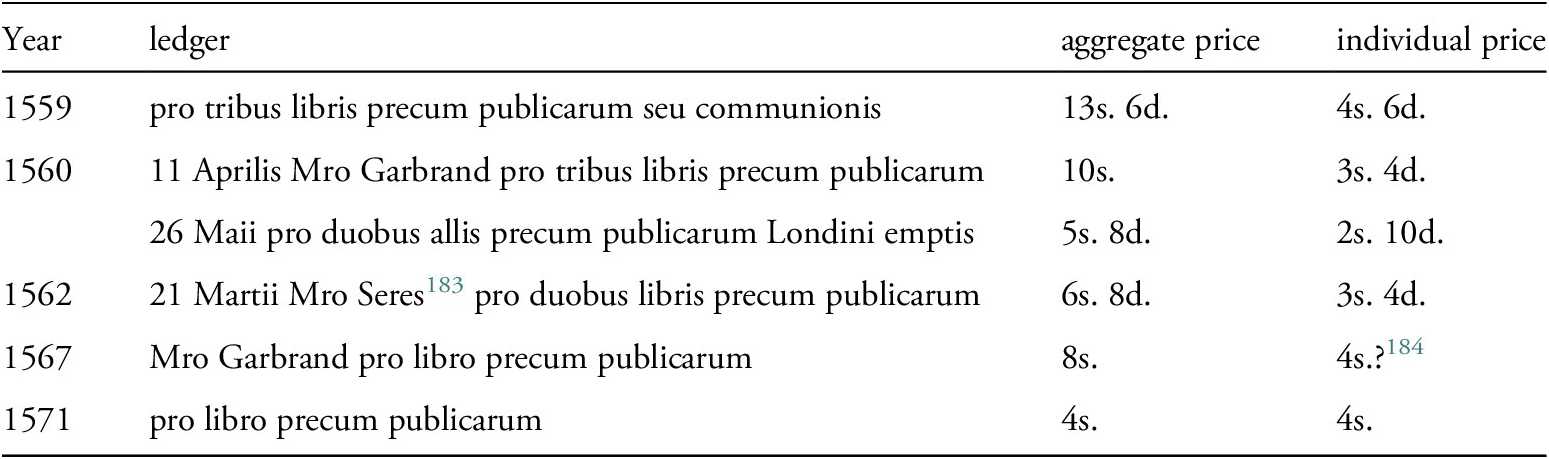


 Open access

