





Introduction
To address societal problems and create social change at scale, two broad families of approaches have long been studied: social movement-based strategies and mission-driven organizational models, including a host of voluntary, non-profit and third-sector (i.e., neither state nor market-rooted) organizational structures. Though both have been critiqued for various shortcomings, the two approaches are typically conceptualized separately and as empirically distinct. Nonetheless, scholars have documented instances of entities seeking to transcend this conceptual binary, as to mitigate the drawbacks of each approach. Is it possible to combine the two at scale and build a global organization based on a social movement’s structure? What features might such a structure possess?
We use qualitative interview data and document analysis to develop a grounded-theory (Glaser & Strauss, Reference Glaser and Strauss1967) inductive analytic case study of a globally scaled organization, Project ECHO (Extension for Community Healthcare Outcomes), whose structure is purportedly based on that of a social movement. Project ECHO’s founders sought to create an organizational structure to advance its mission, legitimacy, and scale. They explicitly sought to mimic social movements’ structure to avoid the deficiencies of standard non-profit or non-governmental organization (NGO) models. Social movement structures enable mission, legitimacy, and scale, but not permanence (McAdam, Reference McAdam1982). Formal organizational structures generally facilitate permanence and scale, or permanence and mission or legitimacy, but not all four at once: mission-driven organizations typically degenerate as they scale (Cornforth, Reference Cornforth1995), while NGOs cannot maintain legitimacy and effectiveness at both local and global levels as they scale (Balboa, Reference Balboa2018). Neither social movements nor organizations are thus typically able to effectively balance challenges of mission, legitimacy, permanence, and scale.
We identify four features—a flexible-but-required partnership agreement, for-profit commercial restrictions, evaluation requirements, and an unusual degree of bottom-up and decentralized, democratic control—that appear to enable Project ECHO to maintain mission and legitimacy while achieving permanent scale. The first three features are common in formal, complete organizations in the third sector, but are not defining features of movements. The fourth feature is a hallmark of movements, but rarely appears in formal, complete organizations, particularly those with permanency at scale. Given these traits, we conclude that though Project ECHO describes itself as operating as if it is a movement, it is more accurately an organization that is operating with social movement elements. The specific organizational form it most closely resembles is a non-profit or social fractional franchise model. In as much as Project ECHO’s distinct organizational model has been able to balance competing priorities, its approach may offer more generalizable insights for other mission-driven organizations seeking to reach global scale while maintaining legitimacy and mission.
Literature review: The organization–movement binary and beyond
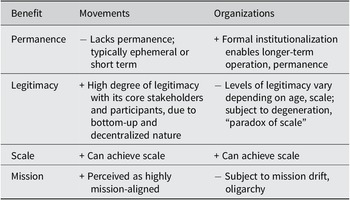
In seeking to understand how to solve social problems and create lasting social change at scale, scholars have extensively studied both the overlap and the distinction between social movements and organizations. In this work, they have identified a troubling paradox: while social change agents may initially pursue movement-based strategies to achieve their goals, such approaches are typically short term. Eventually, they shift from movements to permanent, formal organizational models. In so doing, they experience a trade-off, gaining permanence at the expense of sustained mission and legitimacy at scale. This suggests it may not be possible to solve social problems or create lasting social change at scale, using either a movement or organization-based model alone. Despite documenting this challenge (Brown, Reference Brown2014), scholars have elided over a provocative question: Is it possible to structure a formal, permanent organization at scale using the model of a social movement? If so, how? Below, we review literature related to this question, addressing the benefits, drawbacks, and features of movements and organizations (also summarized in Table 1), before examining their overlap.
Comparison of benefits and drawbacks of movements vs. organizations

Table 1. Long description
The table has three columns: Benefit, Movements, Organizations. For Permanence, movements lack permanence and are typically ephemeral or short term, while organizations have formal institutionalization enabling longer-term operation and permanence. For Legitimacy, movements have a high degree of legitimacy with core stakeholders and participants due to their bottom-up and decentralized nature, while organizations’ legitimacy varies depending on age and scale and is subject to degeneration and the paradox of scale. For Scale, both movements and organizations can achieve scale. For Mission, movements are perceived as highly mission-aligned, while organizations are subject to mission drift and oligarchy.
Social movements: Values-driven and scalable, but informal and impermanent
Though the myth that social movements are not organized has been dispelled (den Hond et al., Reference den Hond, Rehbein, de Bakker and Lankveld2014; Soule, Reference Soule2013), movements are nonetheless typically not defined as a type of recognizable, formal organization or organizational type. Though different definitions of social movements abound, nearly all share three criteria: “a network of informal interactions between a plurality of individuals, groups and/or organisations, engaged in a political or cultural conflict, on the basis of a shared collective identity” (Diani, Reference Diani1992, p.13, emphasis added).
Many movements are led by “social movement organizations” (SMOs) (Hensmans, Reference Hensmans2003; Zald & Ash, Reference Zald and Ash1966). SMOs are “not bounded entities…[but] embedded in a web of connections to other organizations (both within the movement and outside of the movement)” (Soule, Reference Soule2012, p. 1721); SMOs are thus a distinct movement component. They reflect, like movements themselves, a form of “partial organization” (Ahrne & Brunsson, Reference Ahrne and Brunsson2011), as contrasted with “formal organizations that are ‘complete’” (den Hond et al., Reference den Hond, Rehbein, de Bakker and Lankveld2014, p. 293). The latter exist “when…elements of membership, rules, hierarchy, monitoring, and sanctioning are substantially present” (ibid). SMOs may produce manifestos or charters to democratically establish the movement’s mission, and establish shared commitments (Bailey et al., Reference Bailey, Wang, Soule and Rao2023; Tilly, Reference Tilly1993). Such formal statements do not typically establish “complete” and “formal organization” traits (i.e., binding rules, hierarchy, membership, etc.) across the movement’s network. The networks of organizations operating across and within social movements thus do not typically codify formal organizational relationships and commitments, which remain tacit (cf. Polanyi, Reference Polanyi1966). The lack of such codification may enable social movements to maintain bottom-up and decentralized control, another key feature of social movements that enable their missions at scale (Benford & Snow, Reference Benford and Snow2000; McAdam, Reference McAdam1982; McCarthy & Zald, Reference McCarthy and Zald1977, Reference McCarthy, Zald, Goodwin and Jasper2003; Tarrow, Reference Tarrow1994).
Despite their ability to effect change at scale, movements have been critiqued for their impermanence. The informal, flexible, democratic, values-based, and bottom-up organizing networks most associated with them, as referenced above,Footnote 1 are hard to sustain beyond the short term (Edwards & Marullo, Reference Edwards and Marullo1995). Given this, movements often either incubate or associate with formal organizations (often voluntary or non-profit in nature), which might seek to enact the movement’s goals on a more permanent basis (Clemens, Reference Clemens1997; Spicer & Kay, Reference Spicer and Kay2022; Spicer & Lee-Chuvala, Reference Spicer and Lee-Chuvala2021).
Organizations: Permanence, but at what cost?
Though organizations enable permanency, they come with drawbacks with respect to mission, legitimacy, and scale. Often articulated as part of broader critiques of “NGOization” (Al Jayousi & Nishide, Reference Al Jayousi and Nishide2024; Brown, Reference Brown2014; Chewinski, Reference Chewinski2019; Choudry & Kapoor, Reference Choudry and Kapoor2013; Della Porta, Reference Della Porta2020) within the “non-profit industrial complex” (Rodriguez, Reference Rodriguez2016), third-sector organizations over time often experience “mission drift” (Grimes et al., Reference Grimes, Williams and Zhao2019). Oligarchy, centralization, and hierarchy often take hold, formally or tacitly (Freeman, Reference Freeman1972; Michels, Reference Michels1962; Voss & Sherman, Reference Voss and Sherman2000), undermining bottom-up, democratic control. Global NGOs also face a paradox of scale: they can maintain global or local legitimacy and effectiveness—but not both at once (Balboa, Reference Balboa2018). Efforts to standardize across diverse contexts undermines local, contextually variable missions.
To manage these challenges, some actors may attempt to blend different organizational models to balance competing social and commercial logics, temporarily deploying various hybrid governance strategies and activities, including selective use of profit-making activities (Ebrahim et al., Reference Ebrahim, Battilana, Mair, Staw and Brief2014). In the long term, balance becomes untenable, still resulting in mission drift and/or goal displacement (Cornforth, Reference Cornforth2014), making it difficult to distinguish social change organizations from more traditional ones (Bromley & Meyer, Reference Bromley and Meyer2017).
Movements and organizations: Beyond the binary
Though connections between social movements and organizations were long recognized (den Hond et al., Reference den Hond, Rehbein, de Bakker and Lankveld2014; Zald, Reference Zald2005; Zald & Berger, Reference Zald and Berger1978), for decades they remained “twins separated at birth, largely unaware of the other’s existence” (Davis & Kim, Reference Davis, Kim, Poole and de Ven2021, p. 211). Despite continuing to conceptualize them as distinct, scholars have also examined their overlap. Movements can, for example, form within organizations (Soule, Reference Soule2009), but movements can also contain and include organizations, often to provide resources or act as mobilizing structures (McAdam, Reference McAdam1982). Organizations may also sometimes claim to operate with “movement-like” features, by “astroturfing” (McNutt & Boland, Reference McNutt and Boland2007), whereby organizations engage in “synthetic grassroots organizing…for manipulative political purposes” (ibid, p. 167) and adopt social change language and appearances of social movements, but do not operate with their form or substance.
Scholars have also identified select instances of structures that blur the movement–organization binary. Multipurpose hybrid voluntary organizations (Hasenfeld & Gidron, Reference Hasenfeld and Gidron2005) combine SMO elements with voluntary organization formalization and may avoid some of the challenges that both organizations and movements each face, but there is little evidence in the literature of their sustained existence at global scale. Chadwick (Reference Chadwick2007) demonstrated how new digital technologies enable new movement–organization combinations, but limited his study specifically to political organizations, which blur the boundaries between political parties, interest groups, and movements. His proposition, however, is consistent with Anheier and Themudo (Reference Anheier and Themudo2002), who argued many global civil society organizations’ forms no longer “fit standard classifications” (p. 195). They detail the case of Jubilee2000, a global partnership of NGOs that “avoided a formal structure and instead preferred to adopt the structure and identity of a social movement” (p. 192), but the partnership was not long-lived. At the local scale, Brown (Reference Brown2014) identified a formal organization in Punjab, India, the Kheti Virasat Mission (KVM), which attempted to construct itself as a “people’s movement” (ibid, p. 55). The KVM, a locally focused, registered charitable trust, is one of many such local entities that have attempted to distance itself from what it saw as the increasingly problematic NGO label and its associated organizational model. The goal of Brown’s study, however, in reviewing the long-standing conceptual “binary” between NGOs and movements, was not “to assess KVM’s ‘true’ organisational structure” (p. 63), but to examine how activists navigate and construct issues related to organizational identity. Nonetheless, he observed that in attempting to avoid the common problems associated with NGOs by structuring itself as a movement, four traits were evident (ibid, p. 57): KVM acted in an informal, flexible way, formed action groups to mobilize interested parties, mounted campaigns, and relied on a charismatic leader. Brown’s study also does not address whether such features might apply to a global, large-scale, and/or multi-issue organization; KVM did not scale beyond its region, and there is little subsequent literature suggesting others using this model have reached national and global scales.
Beyond these localized, smaller-scale, and/or narrow-scope instances of boundary-blurring structuresFootnote 2, third-sector scholars have also examined other large-scale entity types, such as non-profit (Oster, Reference Oster1992) and social (Giudici et al., Reference Giudici, Combs, Cannatelli and Smith2020; Thurston et al., Reference Thurston, Chakraborty, Hayes, Mackay and Moon2015) franchises, which implicitly might bridge some aspects of the movement–organization binary. Though all organizations and movements ultimately consist of networks (Borgatti & Foster, Reference Borgatti and Foster2003; Diani, Reference Diani1992; Fernandez & McAdam, Reference Fernandez and McAdam1988; Krinsky & Crossley, Reference Krinsky and Crossley2014; Salancik, Reference Salancik1995), these franchises are implicitly conceptualized as a specific type of networked organization: a central entity maintains formal partnership agreements with other independent organizations, which coordinate their collective operation around a formally defined set of shared activities. Franchisees typically sign an agreement with the central franchisor, who they pay to deploy their brand and model. Though non-profit franchises can be quite large (e.g., Goodwill, United Way, Friends of the Earth), the franchiser often exerts a high degree of top-down control on the model (Oster, Reference Oster1992). In social franchises, which can include profit-making social enterprises, studies have identified some instances where control of the central entity and its model is, to a degree, not only decentralized, but also bottom-up, as well,Footnote 3 with stakeholders at local franchisees sometimes able to substantially modify its content (Giudici et al., Reference Giudici, Combs, Cannatelli and Smith2020; Thurston et al., Reference Thurston, Chakraborty, Hayes, Mackay and Moon2015). These franchises can also be fractional, i.e., the franchisees maintain an independent broader identity and operate with the franchisor’s model and brand only for select set of activities (ibid). While documented cases of such social franchises to date have demonstrated the ability to achieve some degree of scale, they have typically involved either a narrow scope around a particular issue, such as family planning services or creating social impact hubs, or in a specific geography, such as a particular country or group of countries (e.g., lower/middle-income countries; ibid). In the literature, these entities are not explicitly attempting to borrow from social movements, nor have the above-cited recent studies delineated their defining organizational features, nor have they analyzed the effect of these features.
Despite calls to better interrogate linkages between third-sector organizations and social movements (Della Porta, Reference Della Porta2020; Spicer et al., Reference Spicer, Shatan and Williams2025), there is thus limited evidence identifying features that might characterize a globally scaled movement-like organizational structure, particularly at scale. This is surprising, given the extensive literature reviewed above, which highlights the shortcomings of each approach and cases that blur their boundaries. Social movements, which are partially organized and lack formal, codified commitments, can democratically establish mission and legitimacy from the bottom-up at scale, but usually only for short periods. Third-sector organizations can be better sustained on a longer-term basis by formalizing and codifying commitments and relationships, but struggle to maintain mission and legitimacy when attempting to maintain global scale over time. Like social movements, they also often struggle to maintain or incorporate decentralized and bottom-up participation and control (Coule et al., Reference Coule, Dodge and Eikenberry2022), as oligarchy, hierarchy, and centralization to take root.
Brown’s KVM case suggests, however, there are nonetheless local organizations in existence that might seek to base themselves on a movement model. If operating at a global scale, however, what features might they deploy and to what end? Brown, as noted earlier, did not set out in his article to identify movement vs. organizational features, nor was his case global. Other cases of potentially relevant forms, reviewed above (e.g., non-profit/social franchises, fractional franchises), have also not been clearly organizationally defined with respect to their features, particularly in relation to movements. By identifying features that might enable a global entity to transcend the movement–organization binary to achieve lasting and broad social change, scholars might advance both academic and practical efforts to understand how to effectively deploy organizational structures to solve social problems at scale.
Methods, analytical approach, and case background and context
In analyzing whether or how it might be possible to create a globally scaled organization based on the structure of a social movement, we identified an entity that claims to have structured itself as a movement. In terms of analytical approach, we developed a grounded theory case study to investigate its defining features. Below, we review the empirical context and background of the case, before explaining our methods and analytical approach.
Case background and empirical context
Project ECHO was founded in 2003 at the University of New Mexico, where a medical doctor observed that many hepatitis C virus (HCV) patients, who were disproportionately low-income, Indigenous, and/or people of color located at a distance, were dying because they were on waiting lists to receive care from him, the only treatment specialist in the state. As relayed in interviews with a co-author, he wondered: could he bring care to the patients, instead of having patients travel to receive care? With a nurse, they travelled the state to recruit medical doctors to be trained remotely to treat HCV, at no cost to participating clinicians. They developed a specific protocol and process to mentor clinicians and evaluate outcomes; by 2011, they had published results in a key medical journal establishing the approach’s efficacy (Arora et al., Reference Arora, Thornton, Murata, Deming, Kalishman and Dion2011). Not only did patients receive care, but also HCV cure rates were higher than for in-person care at his clinic.
After establishing its efficacy through this peer-reviewed publication, interest in the approach exploded. Today, more than 4 million professionals and clinicians across 193 countries and six continents have participated in Project ECHO (Project ECHO, 2024), which now covers not only dozens of healthcare-related conditions, but other social service domains, through its expansion into civics and education. Based on the authors’ analysis, there have been a triple-digit number of peer-reviewed articles referencing Project ECHO’s outcomes in indexed journals.
Despite widespread study of its outcomes, there has been scant academic consideration of Project ECHO’s organizational model. At its core, Project ECHO’s network model enables health and social service professionals to volunteer to give away their expertise, or “demonopolize knowledge,” as Project ECHO describes it, to where and whom it is needed. This involves a distinct organizational structure, explicitly created by its founder to mimic that of a social movement. As stated by the founder in an interview with one of the authors, he asked himself, in developing the structure with collaborators, after finding non-profit and government models deficient: “What really has scaled globally? Movements scale globally…Why? Because I’m not putting my own interests and mixing it up with the interests of the movement,” which enhances its legitimacy and its ability to maintain mission. The model the founder developed enables volunteer professionals at partner organizations (also referred to as participants) to form hubs, which run virtual “telementoring” clinics where experts give away their expertise to other professionals at other partner organizations, referred to as spokes. Of note, in creating the structure, the founder and his collaborators do not seem to have reviewed academic literature on different organizational models (such as franchises), nor did they initially work with organizational consultants.
Hubs and their constituent spokes are democratically self-organized groups of professionals, typically initiated on a bottom-up, democratic basis, who engage in mutual learning as they volunteer to either train or be trained; they join “communities of practice” (Lave & Wenger, Reference Lave and Wenger1991) seeking to learn to solve a specific problem, be it to administer HCV care, train law enforcement officers how to recognize people with mental health issues, or instruct low-resource English language learners (ELL). In the USA alone, we identified over 600 partner organizations that are hosting Project ECHO hubs (and superhubs, i.e., hubs of hubs) and 62,000 spoke participant organizations. Professionals at the hubs or spokes are not employees of Project ECHO; these are voluntary positions that supplement their paid employment at partner non-profit, for-profit, and governmental organizations.
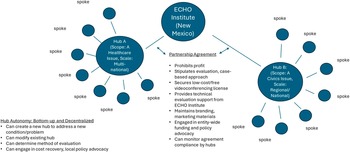
As depicted in Figure 1, the entity’s headquarters, the ECHO Institute, is housed at the University of New Mexico. It engages in administrative, decision-making, and strategic functions for the entire organization. Its paid staff coordinate partnership agreements that specify certain terms and conditions offer resources on evaluation and best practices and provide free or low-cost technology licenses (having adopted videoconferencing well prior to COVID-19). It also runs conferences to cross-connect hubs and spokes. Though hubs can seek funding sources to reimburse costs of instructing clinicians’ time, they are restricted from reselling materials for commercial gain by the partnership agreement, which also mandates tracking and evaluation, the sharing of best practices, and case-based learning.
Project ECHO organizational diagram.

Fig. 1. Long description
At the center is a large blue oval labeled ECHO Institute (New Mexico). Two double-headed arrows extend outward, one to the left and one to the right, connecting to two large circles. The left circle is labeled Hub A (Scope: A Healthcare Issue, Scale: Multi-national) and the right circle is labeled Hub B (Scope: A Civics Issue, Scale: Regional/National). Each hub is surrounded by smaller circles labeled spoke, radiating outward in a wheel-and-spoke pattern. Between ECHO Institute and the hubs is a text box titled Partnership Agreement, listing: prohibits profit, stipulates evaluation and case-based approach, secures low-cost or free videoconferencing license, provides technical evaluation support from ECHO Institute, maintains branding and marketing materials, engaged in entity-wide funding and policy advocacy, can monitor agreement compliance by hubs. Below Hub A is a text box titled Hub Autonomy: Bottom-up and Decentralized, listing: can create a new hub to address a new condition or problem, can modify existing hub, can determine method of evaluation, can engage in cost recovery and local policy advocacy. The diagram visually represents a decentralized network with central coordination and local autonomy.
Despite its growth, global scale, and widespread academic coverage of outcomes, there has been little study of Project ECHO’s organizational model, nor has there been any interrogation of whether it is actually structured as a movement.
Methods and analytical approach
To evaluate whether it is structured like a movement, we developed an inductively analytic case study (Eisenhardt, Reference Eisenhardt1989), a common approach in management studies and across the social sciences (Seawright & Gerring, Reference Seawright and Gerring2008), including specifically in entrepreneurial processes in third-sector organizations (Andersson, Reference Andersson2022). A co-author undertook intensive ethnographic fieldwork, totaling more than 70 observational sessions and in-depth interviews (N = 44) at or with Project ECHO and its partners. To be able to generalize results beyond specific problems and to account for the fact that Project ECHO has many partners, the authors purposively sampled diverse “sub-cases” of medical conditions and non-medical social problems, located in highly varied settings, encompassing locations in both the Global North and South. Additional method details are provided in the Appendix.
Findings
From our grounded theory case study process, four organizational features emerged as collectively enabling Project ECHO to balance organizational priorities which would be difficult to achieve if operating solely as either a social movement or a traditional third-sector organization. These features and their effects are summarized in Table 2. These four features—a required, flexible partnership agreement, for-profit commercial restrictions, an evaluation requirement, and a high degree of bottom-up control—serve not only to individually advance several key priorities the entity seeks to balance, but also to mutually reinforce one another. This effectively creates a degree of organizational redundancy in its structure in support of balancing these key priorities. The first three of these four features are hallmarks of organizations, particularly third-sector organizations, but are not definitional to movements, while the fourth feature (bottom-up control) is more associated with movements than with formal organizations. Our findings also suggest it is this mix of features from organizations and movements that allows Project ECHO to balance four priorities that neither a traditional organizational nor movement-based model alone would enable. Below, we develop these points in greater detail.
Movement and organizational features of Project ECHO and their effect
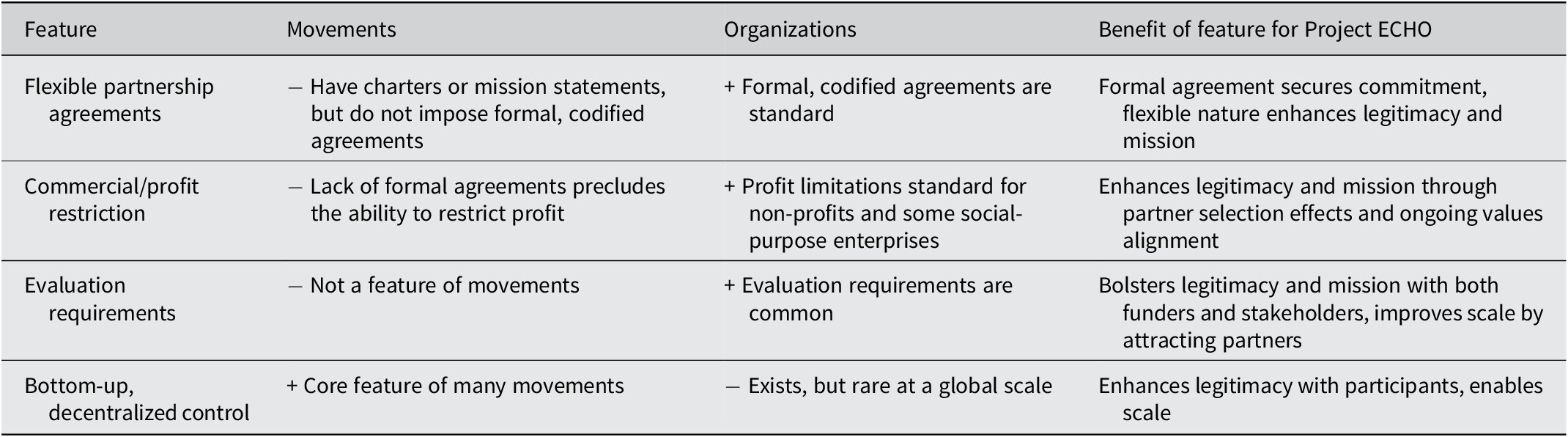
Table 2. Long description
The table has four columns labeled Feature, Movements, Organizations, and Benefit of feature for Project ECHO. From top to bottom, the first row is Flexible partnership agreements. Movements have charters or mission statements but do not impose formal, codified agreements. Organizations have formal, codified agreements as standard. The benefit is that formal agreement secures commitment, and flexible nature enhances legitimacy and mission. The second row is Commercial or profit restriction. Movements lack formal agreements, which precludes the ability to restrict profit. Organizations have profit limitations standard for non-profits and some social-purpose enterprises. The benefit is enhanced legitimacy and mission through partner selection effects and ongoing values alignment. The third row is Evaluation requirements. Movements do not have this feature. Organizations have evaluation requirements as common. The benefit is bolstered legitimacy and mission with both funders and stakeholders, and improved scale by attracting partners. The fourth row is Bottom-up, decentralized control. Movements have this as a core feature. Organizations have it, but it is rare at a global scale. The benefit is enhanced legitimacy with participants and enabled scale.
A flexible, required partnership agreement
While movements do not require formally codified agreements, Project ECHO requires partners—at the institutional level—to sign a partnership agreement that outlines the nature of the relationship between the ECHO Institute and partners and specifies the obligations and rules for each party. One ECHO staffer explained that although they did not want to create barriers to participation, partnership documents provided “some kind of a relationship clarification (that) was really important.” ECHO Institute staff explained some partners initially find the partnership agreement unnecessary: “…one of the big stumbling blocks I think, initially, is…the partnership agreements. Some of them balk at having to have everybody sign these things….especially when we’re giving it up for free.” The partnership agreement, however, formalizes a commitment and codifies a set of shared values. The requirement that partners sign it distinguishes Project ECHO from movements and the ECHO Institute from SMOs, as social movements and SMOs are not bound by formal, codified commitments and rules and instead often operate with tacit agreements and an informal intra-organizational structure. The partnership agreement thus goes beyond a movement’s charter or mission statement.
Moreover, regardless of its actual content, the partnership agreement, which can be flexibly altered to meet different local contexts and scales of action, functions to provide not just permanence, but also enhance legitimacy—at both local and international levels—for partners. For example, the Chief HIV Clinical Mentor for Project ECHO Namibia suggested that the flexibility of the partnership agreement allowed his team to create permanent solutions to core challenges, which increased legitimacy (see Appendix, Partnership Agreement, Quotation A). ECHO staff also described a partner running a child abuse prevention ECHO clinic centered on discussions of actual cases, which would violate the partnership agreement’s rule against identifying patients while in clinics. They wanted to modify the agreement and were allowed to do so (Appendix, Partnership Agreement, Quotation B). Beyond enabling permanence, the flexibility in the formal, codified agreement thus also enhances Project ECHO’s legitimacy by allowing partners to express substantive, bottom-up input in the model.
For-profit commercial restriction
Beyond merely having a required, but contextually flexible, agreement, participating organizations must also agree to its specific terms and conditions, including “for-profit commercial restrictions,” as one ECHO Institute staff member referred to it, that prevent partners from profiting off the ECHO model; these are inflexible and cannot be waived. In the partnership agreement, this requirement is explicitly linked to Project ECHO’s mission (Appendix, For-Profit Commercial Restriction, Quotation A). In practice, this means Project ECHO participants can operate to recover direct costs, such as reimbursements for clinicians’ time in running or participating in hubs to share their knowledge, but it cannot seek to generate profit through sales to end users or beneficiaries, who cannot be directly charged. It therefore eschews the approach of some hybrid enterprises (as referenced in the literature review), which may engage in select profit-making action.
This restriction serves two critical functions: it reinforces organizational mission, creating a “guardrail” mechanism (Smith & Besharov, Reference Smith and Besharov2019) to combat mission drift, and it enhances its legitimacy, both locally and internationally, as participants know partners must proactively agree to this in writing. The physician who started the first Northern Ireland ECHO clinic, for example, explicitly linked maintaining the ECHO mission to its prohibitions on profit (Appendix, For-Profit Commercial Restriction, Quotation B). Due to this requirement, Project ECHO exhibits a selection effect: it attracts partners who self-select because of the focus on mission and for whom the for-profit commercial restriction is not a problem or a disincentive (Appendix, For-Profit Commercial Restriction, Quotation C).
A co-author observed how potential partners were attracted to Project ECHO’s mission because it aligned with their own, due to profit restrictions against operating as a “business.” During a meeting between the founder and a Pakistani physician, specializing in HCV, who was considering becoming an ECHO partner, for example, the role of commercial restrictions was referenced, in ways that indicated the for-profit commercial restriction reinforces Project ECHO’s mission and legitimacy and is seen as a benefit to like-minded potential partners. The exchange also suggested that this feature helps build a collective identity based on shared mission between Project ECHO and its partners, who live and work in varying political and economic environments (Appendix, For-Profit Commercial Restriction, Quotation D).
Such commercial restrictions are, of course, foundational to most third-sector organizational models, as reviewed earlier. In theory, many social movements might eschew profit (some may not), but their lack of a formal, codified agreement precludes their ability to enforce or sanction such restrictions. Such financial restrictions help serve the mission and reduce mission drift, by removing incentives to focus on the organization’s financial profile or financial “sustainability,” often cast as a necessity for organizational survival that can dilute the mission, as explained by the founder (Appendix, For-Profit Commercial Restriction, Quotation E). By prioritizing mission over profit, Project ECHO is not focused on the ECHO Institute’s survival beyond what is minimally required, in much the way a movement might be. But by formalizing and codifying this commercial restriction, it can do so with the benefits of organizational permanence.
Evaluation requirement
In addition to commercial restrictions, Project ECHO requires partners to track data and monitor outcomes, another key organizational feature, which is required in signed agreements (Appendix, Evaluation Requirement, Quotation A). The founder explained the purpose of this requirement as “putting a feedback loop in the system.” The partnership agreement also allows for flexibility with this requirement so that partner organizations with less capacity and fewer resources are not prevented from participating (Appendix, Evaluation Requirement, Quotation B). What this means, in practice, as relayed by interviewees, is that even if participants cannot conduct an end-user outcome evaluation, they will be supported in tracking what data they can as to move toward it eventually. In the interim, other data might be collected, for example, on clinicians’ improved job satisfaction from participating in ECHO. Thus, while end-user or beneficiary evaluation may not exist initially, ECHO works with the participating organization to track other evaluative data at first. As one ECHO Institute staffer explained, the goal is to remove unnecessary barriers, and they do not want the evaluation requirement to preclude any otherwise mission-aligned organization from participating.
The evaluation requirement appears to serve two critical organizational functions: it reinforces the organization’s mission and it enhances its multi-scalar legitimacy, i.e., both locally and internationally. As one partner explained, “Its fidelity to a didactic followed by case presentations followed by evaluation—those are the core components. If I wanted to really be reductionist, that for me is ECHO. I think that’s pretty close to what it is on a world-wide basis because that works. It’s got the evidence base.” As the partner suggests, the evaluation requirement provides legitimacy, by demonstrating that it works and creating a minimal degree of global consistency and standardization.
The importance of evaluation for legitimacy and scale is reflected in Project ECHO’s unusual rate of growth since its initial effectiveness was established via research in a peer-reviewed publication, as referenced earlier (Arora et al., Reference Arora, Thornton, Murata, Deming, Kalishman and Dion2011). Many partners cited this article as their first knowledge of Project ECHO and as their introduction to its work. Some noted that the article, by “proving” the efficacy of the ECHO model (i.e., legitimacy with potential participants and funders), was significant in their decision to join. Potential partners do not want to invest their time and resources in a model that does not work. Evidence is therefore critical for scaling and attracting new participants.
As with any non-profit/profit-limited organization reliant on external funding, evidence is also critical to establishing legitimacy for funding. Funders, including governments, philanthropies, non-profits, and for-profit organizations, expect projects they support will be evaluated. Most funding for Project ECHO now requires grantees to produce evaluations. A co-author observed many meetings that included high-level Project ECHO staffers, funding organizations, and government officials, during which discussions centered on better data to produce more rigorous research on the ECHO model’s outcomes in various settings, all in pursuit of legitimacy to attract and retain funding and further enable scale. Partners find that measuring outcomes is the most difficult aspect of the ECHO model, and the most expensive. The ECHO Institute therefore provides partners strategies and resources to gather data, including iECHO, a clinic management tool that “allows all ECHO programs to track the growth and success of the model.”
Bottom-up and decentralized control
Project ECHO operates with a decentralized organizational model as well as a bottom-up approach to organizational control: in exchange for participants’ acceptance of the formal, codified restrictions imposed through the three organizational features above, they are granted a high degree of autonomy and latitude by the coordinating ECHO Institute with respect to which conditions they address and how they address them. Specifically, while the ECHO Institute holds the licensing rights to the technology and approach, Project ECHO does not “own” any of the clinics; they are merely governed by collaboration and intellectual property terms of use agreements. There is in fact no direct financial benefit generated for or controlled by any “owner.” With this decentralized organizational approach, partners also have significant, bottom-up control over their ECHO clinics; the creation of a new ECHO clinic is also locally controlled. Indeed, interviewees repeatedly stated that new clinic creation was most commonly initiated in the bottom-up manner.
This bottom-up control by ECHO partners functions to support all four organizational effects its model seeks to balance: scale, mission maintenance, legitimacy, and permanence. Unlike the first three features, which are all hallmarks of third-sector organizations, the fourth is distinctive of movements. We know of no formal, globally scaled, permanent organization that enables participants such a degree of control, and this is a feature that may otherwise typically be present only in short-term, large-scale movements, or in local, small-scale organizations.
As noted above, the ECHO Institute does not set the agenda for existing hubs and spokes, nor does the creation of a new hub require the ECHO Institute to approve how or what conditions/problems will be addressed. As an ECHO Institute staffer confirmed, provided the activity aligns with Project ECHO’s stated mission in partnership documents, hubs and spokes have complete control over what they do, as a doctor explained with respect to the autonomy he had to create new clinics in Namibia (Appendix, Bottom-Up Control, Quotation A). As another partner explained, this bottom-up control reinforces ECHO as a “community-led model.” It also functions to strengthen Project ECHO’s local and global legitimacy because partners are trusted to use the model to address local needs and deferred to as those who have the unique expertise to effectively and efficiently address issues in their contexts.
While some hubs choose a new condition/problem which Project ECHO has not addressed previously, they can also take an existing ECHO clinic that addresses a problem in one context and adopt it for use in their own. As a Namibian clinician explained, this bottom-up flexibility is a key characteristic of the model (Appendix, Bottom-Up Control, Quotation B). Partners also suggested the bottom-up approach allows for their control, but also provides them support, as an Australian participant explained in an interview (Appendix, Bottom-Up Control, Quotation C).
The bottom-up approach is also built into Project ECHO’s hub and superhub structure. It enables partners—as superhubs—to provide trainings, outreach, and quality assurance to ensure fidelity to the ECHO Model. The ECHO superhub team in Uruguay, for example, trained the team in Mexico. This functions to increase the legitimacy of the partners and the global organization, as an ECHO staffer suggested: “By hosting let’s say, an immersion training…I think, would provide them that sort of legitimacy, if you will, and credibility that, yes, they really are a part of ECHO and ECHO has trusted them to develop this conference, this training or whatever it is there.” It also supports Project ECHO’s permanence by ensuring that partners’ superhubs can carry out the organization’s work at the same level as the ECHO Institute.
Project ECHO’s bottom-up approach also extends to how ECHO clinics are structured and run—non-hierarchically, or as a partner in Northern Ireland put it: “a non-hierarchical approach to teamworking.” Another echoed this comment: “And just the white coat, you know, doctor image — we took that out and tried to paint the picture of that ‘all teach, all learn’ component where it’s more democratic. It’s not…hierarchical.” An ECHO Institute staffer affirmed this point in explaining how this bottom-up approach also reinforces the organization’s mission (Appendix, Bottom-Up Control, Quotation D). The strength of the bottom-up approach was perhaps most starkly reflected in Project ECHO’s effectiveness when deployed with an archetypally top-down organization—a branch of the US military—that hosts an ECHO clinic focused on treating pain, where, as a Project ECHO staffer explained (Appendix, Bottom-Up Control, Quotation E), its bottom-up approach helps reinforce the organization’s mission, even when working with groups accustomed to hierarchy.
Notably, bottom-up control by hubs is not formally codified in any organizational agreements or in writing, as affirmed by ECHO Institute staff. In theory, the ECHO Institute could attempt to remove this feature, though this would likely result in participation decline.
Discussion: Succession, seasoning, security
Our findings do not imply the ECHO organizational model does not have its limits or challenges, nor is it a panacea for NGOization and associated drawbacks of institutionalization. Specifically, we identify three areas that may undermine not only the generalizability of the model to other situations, but also its long-term viability for Project ECHO itself. These limits relate to succession and related governance protocols, seasoning, and funding security.
First, we found evidence that Project ECHO had previously struggled with “founder’s syndrome” (Block & Rosenberg, Reference Block and Rosenberg2002), which describes “unhealthy organizational situations in which founders are more heavy-handed and indifferent about the imbalance of their control over organizations” (Block & Rosenberg, Reference Block and Rosenberg2002, p. 354). Specifically, some ECHO Institute interviewees expressed concern that the founder, who is extremely charismatic, a common trait among founders (ibid), even among movement-like organizations as reviewed earlier (Brown, Reference Brown2014), does not sufficiently spread core decision-making across the central ECHO Institute; as of this writing, Project ECHO still has no board of directors, though it has begun to move in this direction and to create more distributed governance processes (see below). And although hubs retain control over the conditions they address and how they address them, the central ECHO Institute staff report to the founder. Given the critical coordination role the institute plays across hubs, there were long-standing concerns that should the founder be sidelined or retire, the institute may not be well prepared for the transition. Nonetheless, in 2025, the founder announced his planned retirement. Governance processes at the ECHO Institute, to date largely conducted on an ad-hoc basis between the founder and the senior staff and not formalized into any constitution or by-laws at the institute, are now being developed for operation after his retirement. This includes, according to written correspondence to the authors in 2025, a new “global advisory board to help advise and support the continued growth of the global movement.” It is currently unclear if or when this advisory board will operate formally as a board of directors.
Second, it is possible Project ECHO has not yet succumbed to a noticeable degree of mission drift, nor experienced challenges in maintaining multi-scalar (local and global) legitimacy, due to organizational newness. Though now over two decades old, the bulk of its growth has largely occurred over the last 10–15 years. It is entirely possible in the decades ahead it will experience mission drift and legitimation crises; it may simply require more organizational seasoning and maturation to unfold. Nonetheless, to date the organization has shown little sign of these challenges, suggesting its model may slow, if not eliminate, such organizational degeneration.
Finally, funding struggles remain critical to Project ECHO’s ability to maintain its global scale. This struggle is, as noted earlier, partly of its own creation, due to its profit restrictions, and its choice not to allow select profit-making activities. Project ECHO will nonetheless benefit from a new billing reimbursement code from a key government health agency in the USA, however, which will allow clinicians to be reimbursed in government health programs for their time. This will be key to enhancing Project ECHO’s financial security in the long term and was made possible in part by bipartisan legislation (the ECHO Act) passed by the US Congress, which enabled the US Department of Health and Human Services to study how to better enable telementoring models like Project ECHO. Although partners in the Global South have limited financial support from philanthropic and corporate donors, a majority receive significant funding from national governments. The national government of Georgia, for example, funded a project to eliminate HCV infections entirely. Namibia set up HIV ECHO clinics across the country and created new internet access for them. Governmental support in the Global South, particularly with technology and internet infrastructure, is quite common. Across our sample, national governments in the Global South appeared to provide a higher percentage of support to partners than US federal or state governments; written communication between the authors and the ECHO Institute confirmed this to be true and that they actively partner with government ministries in developing, Southern, and lower-income countries to achieve a degree of funding stability.
Notably, we found little evidence of “astroturfing,” in which the language of movements is borrowed on a superficial level. Voluntary participants referred to it as a movement and expressed genuine values alignment with a desire to use the approach to solve social problems at scale, as one would expect of movement participants. Participants are granted a high degree of bottom-up latitude and local control and work in non-hierarchical teams, while receiving a minimally effective level of centralized support from the ECHO Institute, consistent with how movement participants might work with a coordinating SMO. To date, this freedom and high degree of autonomy have not seemed to pose challenges with respect to ensuring quality and consistency of either services provided, nor have there been significant instances of malfeasance or deficient usages of the model, either. Nonetheless, given that Project ECHO can rely on the partnership agreement and evaluation requirement to mitigate these possibilities, it is possible that such challenges may emerge in the future, reflecting long-established concerns regarding the trade-offs that come with decentralization in such cases (cf. Anheier & Themudo, Reference Anheier and Themudo2002).
Conclusions
We analyzed claims of a global entity that claims to have structured itself based on a social movement, to identify the key features and functions deployed in its model. By requiring a formal partnership agreement, one that limits for-profit commercial activities and imposes evaluation requirements in exchange for ceding a high degree of bottom-up organizational control to participants, the entity appears to have found a medium-term path to balance challenges associated with mission, legitimacy, permanence, and scale. These challenges variably plague either organizations or social movements. Project ECHO appears to have attempted to create an entity that may overcome the joint challenges associated with either form. Based on the features we identified, Project ECHO appears to operate as a variant of an organizational model sometimes called a social or non-profit fractional franchise (as per the literature review), into which it has explicitly incorporated social movement elements as to operate on a global, multi-issue scale and scope.
This is not to say such an approach is free of challenges: we noted evidence conforming to known organizational challenges of founder syndrome and related governance challenges, organizational seasoning, and funding insecurity. It is possible, however, such challenges might be mitigated over time: the organization appears to be successfully navigating founder’s syndrome, given his voluntary decision to retire and an associated succession plan announced in 2025, after a lengthy period in which institute staff and hubs members had voiced concern regarding this issue.
In as much as the model is replicable to address other types of global organizational challenges and social problems at scale, however, its movement-like structure may be adoptable and adaptable by others. Consistent with Brown (Reference Brown2014) and Della Porta (Reference Della Porta2020), future research involving similar entities might seek to advance our understanding of when and how they are viable and able to effectively realize their missions, especially across varying and diverse contexts and in addressing different problems. In particular, comparative case studies of similarly large, globally scaled and multi-issue entities might also affirm the model’s replicability and generalizability, by seeking to identify patterns of similarity—or difference—in their structure and their key operating features, while analyzing the consequences of such similarities or differences, as well.
Supplementary material
The supplementary material for this article can be found at https://doi.org/10.1017/S0957876526000094.
Acknowledgements
The authors wish to thank En-Ya Tsai for her assistance with manuscript preparation. They also wish to thank Mark Sidel, Cristina Balboa, George Mitchell, Joannie Tremblay-Boire, Paola Ometto, Katherine Chen, Howard Lune, and other annual conference participants at ARNOVA, SASE, and ASA on various prior versions of this paper.
Competing interests
The authors have no competing interests to declare that are relevant to the content of this article. All authors certify that they have no affiliations with or involvement in any organization or entity with any financial interest or non-financial interest in the subject matter or materials discussed in this manuscript.


 Open access

