


Introduction
China is located in an earthquake-prone area, and earthquakes in Chinese mainland account for about one-fourth to one-third of the world's earthquakes. According to statistics, from 1950 to 2017, a total of 722 independent earthquakes occurred in Chinese mainland, resulting in direct economic losses of US$223.7 billion and 352 282 deaths (He et al., Reference He, Wu, Wang and Ye2018). On 12 May 2008, an earthquake measuring 8.0 on the Richter scale hit Wenchuan County in western China's Sichuan province, killing or injuring more than 400 000 people and destroying more than 30 million houses (Zhang et al., Reference Zhang, Liu, Li, Liu, Liu, Lin, Shen, Tang, Zhang and Liang2012; Peng et al., Reference Peng, Li, Huang, Jiang, Xu and Lai2018). After the Wenchuan earthquake, the Chinese government carried out the rescue with a shocking response speed and put all efforts across the country to complete the reconstruction 3 years after the earthquake (Lin et al., Reference Lin, Ashkenazi, Dorn and Savoia2014; Park and Wang, Reference Park and Wang2017). However, this great catastrophe has resulted in not only mass physically injured, but also survivors' mental disorder. One and 3 months after the Wenchuan earthquake, the prevalence of post-traumatic stress disorder (PTSD) symptoms among adult survivors in the hard-hit areas was 62.8 and 39.6%, respectively (Wang et al., Reference Wang, Ni, Chen, Liu, Wang, Shao, Xiao, Cheng, Jiang and Yan2011; Cheng et al., Reference Cheng, Ma, Yang, Agho, Stevens, Raphael, Cui, Liu, Yan, Ma and Yu2015). Three years after the earthquake, when reconstruction has been completed, 8.8% of survivors in the hard-hit areas still have PTSD symptoms (Wen et al., Reference Wen, Shi, Li, Yuan and Wang2012). What is worse, a cross-sectional survey 8 years after the earthquake demonstrated that the prevalence of PTSD symptoms among survivors in the hard-hit areas was 11.8% (Guo et al., Reference Guo, He, Qu, Wang and Liu2017). It is evident that long-term mental health after a major disaster should be paid much attention to, and PTSD is a terrible trouble among survivors.
PTSD is a common psychiatric disorder after traumatic exposure (Shalev et al., Reference Shalev, Liberzon and Marmar2017). The lifetime prevalence of PTSD ranges from 0.5 to 14.5% and varies across regions of the world due to the nature of trauma, the intensity of exposure and the intensity of post-traumatic social support (Uniyal et al., Reference Uniyal, Singh, Akhtar, Dhaliwal, Kuhad and Sah2020). About 50% of PTSD symptoms last for more than 3 months and develop into a chronic disease (Watson, Reference Watson2019). At present, there are few studies on the long-term PTSD of Wenchuan earthquake survivors. The trajectories of the course of PTSD are complex and do not always follow a linear course (Bryant, Reference Bryant2019). Chronic PTSD (PTSD with a course of more than 3 months) (Shalev et al., Reference Shalev, Liberzon and Marmar2017) causes considerable disease burden, social and occupational injuries, and might increase the risk of other mental disorders and even suicide (Merz et al., Reference Merz, Schwarzer and Gerger2019; Hayashi et al., Reference Hayashi, Ohira, Nakano, Nagao, Okazaki, Harigane, Yasumura, Maeda, Takahashi, Yabe, Suzuki and Kamiya2021).
The purpose of this study is to investigate the prevalence of chronic PTSD among survivors aged 16 and above in the hard-hit areas 10 years after Wenchuan earthquake, and reveal the risk factors of long-term chronic PTSD after the disaster by comprehensively exploring the relationship between sociodemographic factors, earthquake exposure factors, physical health, social support and PTSD of survivors. This helps to better understand the long-term impact of major natural disasters on the mental health of survivors and helps local governments and medical institutions to identify high-risk groups with PTSD.
Methods
Study design and population
A matched case–control design was used in this study, and the data were from a cross-sectional survey 10 years after the Wenchuan earthquake. From May to June 2018, the survey collected information on sociodemographic factors, earthquake exposure factors, social support, physical health and mental health of 1054 survivors in the hard-hit areas through four-stage sampling. The four-stage sampling procedure was as follows: (1) randomly select three of the 39 hard-hit areas assessed by the Ministry of Finance of China in Sichuan Province, namely Shifang County, Wenchuan County and Mianzhu County; Wenchuan is located in the epicentre, with a seismic intensity of IX–XI; Mianzhu is 18 km away from the epicentre and the seismic intensity was IX–X; Shifang is 28 km away from the epicentre, and the seismic intensity was VIII–XI; (2) randomly select four towns within each of the counties; (3) randomly select two villages within each of the towns; and (4) select 46 earthquake survivors within each of the villages and conduct a face-to-face questionnaire survey. Residents who were 16 years old or older at the time of investigation and had experienced the Wenchuan earthquake met the inclusion criteria, while those with hearing or language impairment were excluded.
Cases were defined as those with positive PTSD screening, that is, those with a PTSD Checklist-Civilian Version (PCL-C) score of 38 or above. Cases were matched to controls in a 1:3 ratio, based on community location and age (±3 years).
Ethical approval
Ethical approval was obtained from the Institutional Review Board of West China Hospital in Sichuan University. Before filling out the questionnaire, the investigators explained the investigation purpose, questionnaire content and information security measures to each respondent and obtained informed consent. For those under the age of 18, the consent of their guardian was obtained at the same time.
Variables and measurements
The questionnaire included four parts: demographic information, earthquake exposure information, Multidimensional Scale of Perceived Social Support (MSPSS) and PCL-C.
Demographic information form included gender, age, home address, ethnicity (Han/Tibetan/Qiang/others), education (illiteracy/primary school/junior high school/high school/junior college or above), occupation (farmer/worker/businessman/civil servant/student/unemployed/others), annual household income (<5000/5000–20 000/20 000–50 000/⩾50 000 RMB), purchasing any kind of medical insurance (including new rural cooperative medical insurance, medical insurance for urban workers, medical insurance for urban residents and commercial insurance) (Yes/No), playing mahjong – a common recreational activity in rural areas of Sichuan Province (Yes/No), drinking alcohol (Yes/No), 2-week illness (Yes/No), having chronic disease (Yes/No). Chronic disease was defined as at least one of the following diseases: chronic cardiovascular and cerebrovascular diseases (such as hypertension and heart disease), chronic digestive system diseases (such as hepatitis and gastric ulcer), chronic respiratory system diseases (such as asthma and bronchitis), chronic genitourinary system diseases (such as nephritis and kidney stones), chronic joint diseases (such as rheumatoid arthritis and lumbar disc herniation), diabetes, tumours, etc. The above chronic diseases should have been diagnosed by doctors before the investigation and be with current symptoms or treatments. We hypothesised that all of these demographic factors are associated with the development of PTSD. For instance, playing mahjong helps increase interpersonal communication so as to maintain the survivors' mental health (Tsang et al., Reference Tsang, Wong and Gao2016); alcohol use might interfere with the emotional processing of trauma survivors and increase susceptibility to PTSD (Straus et al., Reference Straus, Haller, Lyons and Norman2018); and 2-week illness might exacerbate psychological stress (Ohrnberger et al., Reference Ohrnberger, Fichera and Sutton2017).
Earthquake exposure variables were collected as follows: (1) house damage in the earthquake (not collapsed/collapsed), (2) property loss in the earthquake (⩾80/<80%), (3) buried in the earthquake (Yes/No), (4) injured in the earthquake (Yes/No), (5) witnessing the injury in the earthquake (Yes/No), (6) witnessing the death in the earthquake (Yes/No), (7) relatives injured during the earthquake (Yes/No), (8) immediate families (parents/spouses/children) disabled during the earthquake (Yes/No), (9) immediate families (parents/spouses/children) died during the earthquake (Yes/No).
Perceived social support was measured by MSPSS (Zimet, Reference Zimet, Dahlem, Zimet and Farley1988), which includes 12 items to assess individual satisfaction with emotional and practical support from family, friends and other special people. The total score ranges from 12 to 84, and a higher score means a higher perceived level of social support. Moreover, the Chinese version of MSPSS has good retest reliability and internal consistency (Gao et al., Reference Gao, Qu and Wang2020). The Internal consistency (Cronbach's α coefficient) for this sample was 0.95.
PTSD symptoms were measured by PCL-C (Weathers et al., Reference Weathers, Litz, Herman, Huska and Keane1993). This 17-item self-report scale is based on the Diagnostic and Statistical Manual of Mental Disorders, Fourth Edition (DSM-IV) (American Psychiatric Association, 1994) and can effectively assess the severity of survivors' re-experience, avoidance, negative emotions and over-excitement related to traumatic events (Zhang et al., Reference Zhang, Shi, Wang and Liu2011). In this study, survivors were asked to indicate the degree of each symptom related to the Wenchuan earthquake, ranging from 1 (nothing at all) to 5 (extremely severe). The total score ranges from 17 to 85, and survivors with a score of 38 or higher were classified as likely to have PTSD. Previous studies have demonstrated the reliable accuracy and validity of PCL-C in screening for PTSD (Wen et al., Reference Wen, Shi, Li, Yuan and Wang2012; Zhou et al., Reference Zhou, Song, Hu, Li, Cai, Huang, Li, Kang and Li2015). Items in the scale were appropriately modified to make it anchor to the Wenchuan earthquake, such as ‘Repeated, disturbing memories, thoughts or images of the Wenchuan earthquake experience?’, ‘Repeated, disturbing dreams of the Wenchuan earthquake experience?’ The internal consistency (Cronbach's α coefficient) of PCL-C in this study was 0.89.
Sample size
After a cross-sectional study, we got 1054 questionnaires. Among the respondents, we identified 93 cases with PTSD symptoms. To increase statistical power, controls were matched to cases at a ratio of 3:1 by location and age (±3 years). Finally, 86 cases and 258 controls were successfully matched and analysed in this study.
Quality control
We recruited graduate students proficient in Mandarin and Sichuan dialect from West China Medical School of Sichuan University and conducted rigorous investigator training for them. To ensure the data quality, each questionnaire was reviewed by two investigators. Besides, EpiData was used for double data entry and consistency checks.
Statistical analysis
Frequencies, percentages, means and standard deviations were calculated for descriptive analysis. Statistical differences in characteristics between cases and controls were examined using the Mann–Whitney U test for MSPSS scores and Pearson χ2 tests, Fisher exact tests for categorical variables. Conditional logistic regression was used in univariate and multivariate analyses to account for the matched design. To control all the potential influencing factors of PTSD symptoms, all variables were included in the multivariate logistic regression model, and then the ‘enter method’ was used for multivariate analysis. Two-tailed p < 0.05 was considered statistically significant for all analyses. All statistical analyses were conducted using SPSS version 25.0 for Windows (IBM Corporation, Armonk, NY, USA) and R 3.4.3 (R; GitHub, San Francisco, USA).
Results
From May to June 2018, we surveyed 1054 Wenchuan earthquake survivors and obtained 1026 complete questionnaires. Of the 1026 survivors, 93 were screened positive for PTSD (PCL-C score ⩾38). The prevalence of PTSD symptoms was 9.1% (93/1026). Three controls from a pool of the remaining 933 survivors were randomly assigned to each case, matching the community location and age (±3 years). After excluding seven cases without eligible controls, a total of 344 survivors were included in the analysis (86 cases and 258 controls) (Fig. 1).
Flow chart of sampling.

The age of 344 survivors was 41–86 years old, with an average of 61.6 (s.d. = 10.8). Of these, 40.7% were from Mianzhu, 37.2% were from Wenchuan, 63.4% were female (Table 1). Most of the cases and controls were illiterate or had only primary education (74 cases [86.0%] and 193 controls [74.8%]). The annual household income of 77.9% cases (67/86) and 54.3% controls (140/258) was below 20 000 RMB. Compared with the control group, the case group had more women, lower education level, lower income, lower insurance purchase rate, higher prevalence of 2-week illness and chronic disease, greater property losses during the earthquake, higher possibility of disability or death of immediate families (parents, spouse and children) due to the earthquake, lower level of perceived social support from friends and important others.
Characteristics of the study population

a Immediate families refer to parents, spouse and children in this study.
Univariate conditional logistic regression analyses indicated that the PTSD symptoms were related to gender, education level, income level, insurance, 2-week prevalence, chronic disease, property loss in the earthquake, disability or death of immediate families in the earthquake and perceived social support (Table 2).
Results of conditional logistic regression
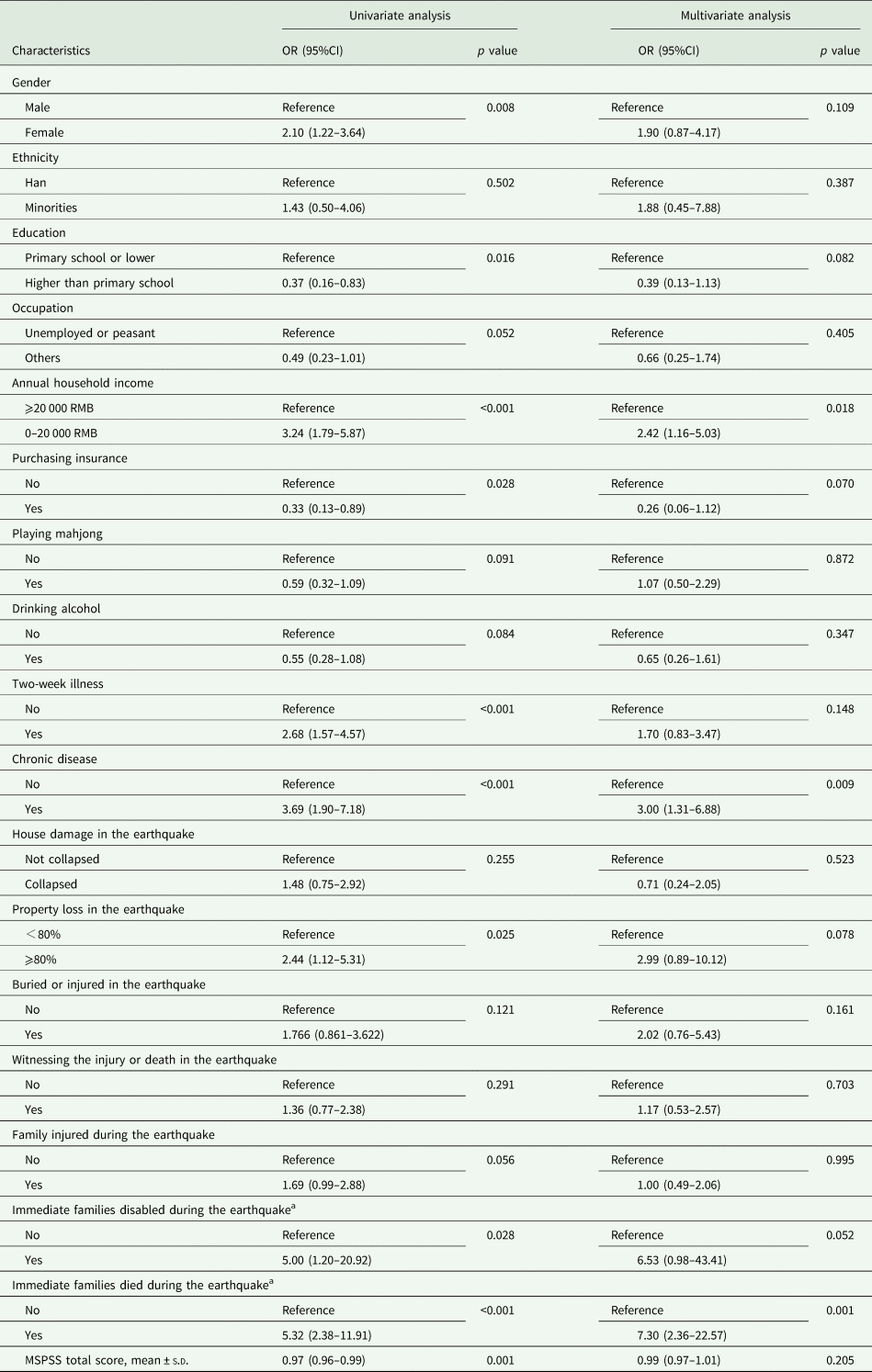
aImmediate families refer to parents, spouse and children in this study.
The multivariable conditional logistic regression results showed that compared with an annual household income of 20 000 RMB or above, annual household income below 20 000 RMB was associated with a 142% increase in odds of PTSD symptoms (OR 2.42; 95% CI 1.16–5.03) (Table 2). Chronic disease was associated with a 200% increase in odds of PTSD symptoms (OR 3.00; 95% CI 1.31–6.86). The death of parents, spouses or children in the earthquake was associated with a 630% increase in odds of PTSD symptoms (OR 7.30; 95% CI 2.36–22.57), compared with no death. While, in the multivariable analyses, MSPSS total score was not significantly associated with the odds of PTSD symptoms (OR 0.99; 95% CI 0.97–1.01).
Discussion
This study showed that the prevalence of PTSD symptoms among survivors aged 16 and above in the hard-hit areas 10 years after the Wenchuan earthquake was 9.1%. Low income, chronic diseases and death of close family members in the earthquake were related to PTSD symptoms 10 years after the Wenchuan earthquake. Odds of PTSD symptoms were not statistically increased for survivors losing property or houses, for survivors buried or injured, for survivors witnessing injure or death, for survivors whose families were injured or disabled in the earthquake and for survivors perceiving lower social support after the earthquake.
The 9.1% prevalence rate of PTSD symptoms 10 years after Wenchuan earthquake was similar to the 8.8% prevalence rate by using the same survey tools in the same sampling areas 3 years after the earthquake (Wen et al., Reference Wen, Shi, Li, Yuan and Wang2012). This again reminds us that a great catastrophe might impact survivors' mental health for quite a long period, even more than 10 years. All stakeholders should pay much attention to the public health issue and take some measures to reduce the risk of developing the disease.
Consistent with the results of this study, a negative correlation between financial constraints and PTSD symptoms was also observed among survivors of the L'Aquila earthquake, Ecuador earthquake, Hurricane Katrina and mudslides in southwestern China (Chen et al., Reference Chen, Keith, Leong, Airriess, Li, Chung and Lee2007; Gigantesco et al., Reference Gigantesco, Mirante, Granchelli, Diodati, Cofini, Mancini, Carbonelli, Tarolla, Minardi, Salmaso and D'Argenio2013; Chen et al., Reference Chen, Chen, Au, Feng, Chen, Guo, Li and Yang2014; Gerstner et al., Reference Gerstner, Lara-Lara, Vasconez, Viscor, Jarrin and Ortiz-Prado2020). A review on poverty and disasters pointed out that the impact of disasters on victims varies with social class; compared with the rich, the poor are more vulnerable to trauma both physically and mentally (Fothergill and Peek, Reference Fothergill and Peek2004). The theory of personal vulnerability believes that this is because persons with low socioeconomic status have fewer resources and are less capable of responding to and recovering from disasters (Tang et al., Reference Tang, Deng, Glik, Dong and Zhang2017). In turn, PTSD could also cause occupational barriers, resulting in a decrease in the income of survivors (Merz et al., Reference Merz, Schwarzer and Gerger2019). After the Wenchuan earthquake, some residents in the hard-hit area moved to a new location. At the same time, they lost the farmland they depended on, which increased employment problems for farmers, especially females. Therefore, solving the employment problem and increasing household income might help promote the mental health of survivors in the hard-hit areas.
The results of this study showed that chronic disease is related to PTSD symptoms. Some previous studies have reached similar conclusions (Gigantesco et al., Reference Gigantesco, Mirante, Granchelli, Diodati, Cofini, Mancini, Carbonelli, Tarolla, Minardi, Salmaso and D'Argenio2013; Guo et al., Reference Guo, Wu, Tian, Wang, Zhang, Zhang and Qu2014; Liao et al., Reference Liao, Ma, Gao, Zhang, Zhang, Liu and Li2019). A study of Fukushima nuclear accident survivors found that, on the one hand, chronic diseases before accidents are one of the predictors of PTSD symptoms; on the other hand, PTSD increases the risks of chronic diseases such as hypertension, hyperlipidaemia, coronary heart disease, etc. (Tsujiuchi et al., Reference Tsujiuchi, Yamaguchi, Masuda, Tsuchida, Inomata, Kumano, Kikuchi, Augusterfer and Mollica2016). Therefore, while paying attention to the psychological health of survivors after the earthquake, the management of chronic diseases should also be given sufficient attention.
Death or disappearance of family members has been proved to be an important risk factor for symptoms of PTSD (Wang et al., Reference Wang, Ni, Chen, Liu, Wang, Shao, Xiao, Cheng, Jiang and Yan2011; Zhang et al., Reference Zhang, Shi, Wang and Liu2011; Wen et al., Reference Wen, Shi, Li, Yuan and Wang2012; Chen et al., Reference Chen, Chen, Au, Feng, Chen, Guo, Li and Yang2014). The results of this study showed that the death of close relatives in the Wenchuan earthquake increased the probability of PTSD symptoms 10 years after the earthquake by 6.3 times (95% CI 2.36–22.57) (Table 2). It is well known that individuals whose families were killed in the earthquake have a high degree of trauma exposure, and the severity of trauma is recognised as an important risk factor for the persistence of PTSD symptoms (Neria et al., Reference Neria, Nandi and Galea2008). During the post-disaster reconstruction period, the death of a family member is a constant trauma reminder for individuals, making them easy to recall disaster scenes and causing persistent mental health disorders (Goenjian et al., Reference Goenjian, Steinberg, Najarian, Fairbanks, Tashjian and Pynoos2000). Therefore, survivors who lost their parents, spouses or children in the earthquake should be listed as priority intervention targets, no matter in the emergency response period or the recovery period.
For many years, it has been generally believed that social support is a protective factor for PTSD, which helps to buffer traumatic experiences by establishing attachment relationships and enhancing security (Chen et al., Reference Chen, Keith, Leong, Airriess, Li, Chung and Lee2007). This view was supported by a large amount of evidence (Brewin et al., Reference Brewin, Andrews and Valentine2000; Kohler et al., Reference Kohler, Schafer, Goebel and Pedersen2018; Lee, Reference Lee2019). However, not all studies have reached a consistent conclusion. Zhang et al. (Reference Zhang, Shi, Wang and Liu2011) and Feder et al. (Reference Feder, Ahmad, Lee, Morgan, Singh, Smith, Southwick and Charney2013) concluded that social support is not significantly associated with PTSD symptoms. Most of the above studies were cross-sectional designs, and the inconsistent results might be attributed to differences in the study population, assessment methods and post-traumatic time. In 1990, Cook and Bickman (Reference Cook and Bickman1990) proposed that time is an influential factor in the relationship between social support and PTSD symptoms, that is, social support has a stronger protective effect on PTSD shortly after the disaster, but this protective effect will gradually weaken over time. This conclusion was supported by several subsequent longitudinal studies (Adams and Boscarino, Reference Adams and Boscarino2006; Kaniasty and Norris, Reference Kaniasty and Norris2008; Campbell and Renshaw, Reference Campbell and Renshaw2018). Our previous study indicated that 3 years after the Wenchuan earthquake, perceived social support has a significant negative correlation with PTSD symptoms in hard-hit areas (Cheng et al., Reference Cheng, Wang, Wen and Shi2014). However, this study failed to reveal this association, which might be explained by the following reasons: (1) 10 years after Wenchuan earthquake, the protective effect of perceived social support on the mental health of survivors was weakened; and (2) 10 years after Wenchuan earthquake, PTSD symptoms reduced survivors' ability to perceive social support.
Early researches after the Wenchuan earthquake showed that property loss, house damage, buried or injured, injury or disability of relatives, and witnessing injury or death were all risk factors of PTSD symptoms (Liang et al., Reference Liang, Cheng, Josef and Liu2019). However, unlike the earlier studies, this population-based matched case–control study did not show statistically significant associations between the above-mentioned earthquake exposure factors and PTSD symptoms 10 years after the earthquake. This might be partly due to the healing effect of time and great post-disaster reconstruction. But time cannot heal all wounds (Morina et al., Reference Morina, Wicherts, Lobbrecht and Priebe2014). At present, the burden of mental disorders for survivors in the hard-hit areas of the Wenchuan earthquake is still high.
In view of the serious mental consequences of major natural disasters, long-term mental health monitoring and medical research for disaster survivors are necessary (Havenaar et al., Reference Havenaar, Bromet and Gluzman2016). Furthermore, it is significant to further translate research evidence into policy and practice (Andermann et al., Reference Andermann, Pang, Newton, Davis and Panisset2016). The results of this study would provide evidence for PTSD screening and the formulation of other policies and measures to improve mental health in Wenchuan earthquake-stricken areas. In rural Sichuan, where mental health resources are scarce, local governments and primary medical institutions could actively undertake the task of mental health care for earthquake survivors: implementing PTSD screening among high-risk group survivors of low-income, chronic diseases and loss of immediate families in the earthquake, and providing evidence-based treatment or referral to professional institutions for individuals with PTSD. At the same time, based on the research evidence, policies and measures could be proposed in various health-related fields to improve the mental health of survivors, such as increasing the employment rate, promoting a healthy lifestyle and improving the management of chronic diseases. In addition to the above-mentioned significance, this study suggests that other low- and middle-income countries or regions affected by natural disasters could pay long-term attention to the mental health of survivors, especially individuals with low socioeconomic status, chronic diseases and loss of immediate families in disasters, because these factors have a significant correlation with long-term PTSD.
To our knowledge, this study is one of the few focusing on the long-term health consequences of the Wenchuan earthquake. To improve test efficiency, a matched case–control design was adopted. Cases and controls were from representative community samples obtained through multistage random sampling. In addition to the above strengths, several limitations of this study should be mentioned. First, there might be recall bias and reporting bias in collecting information through the questionnaire survey. Second, PCL-C was used to screen PTSD, instead of more professional diagnostic methods, which might cause misclassification. Third, the original PCL-C might not be the best tool to measure stress disorder after a specific traumatic event, so we modified its items to anchor the Wenchuan earthquake in this study. Fourth, the relationship between age, distance from epicentre and PTSD could not be explored because cases and controls were matched by age and location. Nevertheless, the results of this study provide new evidence for the long-term mental health consequences of major natural disasters.
Conclusions
Ten years after the Wenchuan earthquake, the prevalence of PTSD symptoms among survivors in the hard-hit area was still high. The death of close relatives in the earthquake was an important predictor of long-term PTSD symptoms. Moreover, low income and chronic diseases were significantly associated with PTSD symptoms. Therefore, local governments and primary medical institutions should focus on survivors with the above risk factors, and implement evidence-based intervention measures for PTSD patients as soon as possible. In addition, increasing the family income of survivors and standardizing chronic disease management might be important ways to promote the mental health of survivors.
Data
Data are available from the authors on reasonable request.
Acknowledgements
The authors wish to thank all the investigators and respondents involved in this study.
Author contributions
All listed authors fulfil the ICMJE criteria for authorship.
Financial support
This work was supported by the National Natural Science Foundation of China (grant number 71874115) and Special Funds for COVID-19 Prevention and Control of West China Hospital of Sichuan University (HX-2019-nCoV-023).
Conflict of interest
None.
Ethical standards
The authors assert that all procedures contributing to this work comply with the ethical standards of the relevant national and institutional committees on human experimentation and with the Helsinki Declaration of 1975, as revised in 200.


 Open access

