


Psychopathy is characterised by a callous lack of concern for the suffering of others, egocentricity, manipulativeness, impulsivity, superficial charm and shallow affect. Reference Cleckley1 Although the association between psychopathy and antisocial behaviour is well characterised, the nature of this association remains unclear. Some researchers argue that an early emerging and persistent pattern of behavioural disturbances should be regarded as an integral part of psychopathy, Reference Hare and Neumann2 whereas others see problematic behaviours as epiphenomena with little diagnostic value for psychopathy. Reference Skeem and Cooke3–Reference Cooke, Michie, Hart and Clark5 Most measures of psychopathy conflate psychopathic traits and antisocial behaviour, making it difficult to come up with any adequate assessment of the degree of overlap. In order to assess the degree to which psychopathic traits and conduct disorder co-occur, it is important to investigate these features in the general population rather than focusing on correctional samples. Preferably, one needs to disentangle risk for psychopathy from risk for antisocial behaviour. The English and Romanian Adoptees (ERA) sample provides such an opportunity. The ERA study is a prospective longitudinal study investigating children adopted from profoundly depriving Romanian institutions into the UK. Reference Rutter, Beckett, Castle, Colvert, Kreppner and Mehta6 The approval of parents seeking to adopt aims to exclude families thought likely to present substantial environmental risks. Although such exclusion is likely to be imperfect, the expectation is that the risks for antisocial behaviour are likely to be relatively low. There are no good grounds for expectations on the risks for psychopathy, but the experience of profound institutional deprivation is likely to have predisposed individuals to social deficits of some kind. Here, we tested the association between callous–unemotional traits and conduct disorder in the ERA sample. This allowed us to investigate whether the frequently found high degree of overlap between disruptive behaviour and psychopathy would be observed in our sample, or whether high callous–unemotional traits can be present without manifest conduct disturbances. Because the sample is one involving a high environmental risk, it investigates ‘what can be’ rather than ‘what is’ the case in the general population as a whole.
Method
Sample
The ERA study enrolled 165 children adopted from Romania and a group of 52 children born and adopted within the UK before the age of 6 months. The selection of participants is described in detail elsewhere. Reference Rutter and Sonuga–Barke7 Briefly, the Romanian adoptees sample contained roughly equal numbers of children adopted before 6 months, between 6 and 24 months and over 24 and under 42 months. A small number (n = 21) of the 165 Romanian children were adopted from family settings without having experienced institutional rearing. None of the children in the within-UK adoptee group had been exposed to early deprivation, neglect or abuse. The current analyses are based on a sample for which both psychiatric assessment and information on callous–unemotional traits was available (n = 135 for parent report, n = 117 for youth self-report).
Callous–unemotional traits
The Inventory of Callous–Unemotional Traits (ICU) psychopathy questionnaire, developed by Frick and colleagues, Reference Frick8 was used to test for psychopathy features in the ERA sample. The ICU questionnaire is based on the Antisocial Process Screening Device (APSD). Reference Frick and Hare9 The ICU questionnaire was developed to provide a more comprehensive assessment of callous–unemotional traits that overcomes some of the psychometric limitations of the APSD. Reference Essau, Sasagawa and Frick10 Test of the psychometric properties of the scale showed an acceptable internal consistency (α = 0.77) and confirmatory factor analyses indicated that the ICU scale consists of meaningful subgroups of items. Reference Essau, Sasagawa and Frick10 The 24 items are rated on a 4-point Likert scale ranging from 0 (not at all true) to 3 (definitely true). Scores are summed to provide an overall psychopathy score. From the 24 items, three psychopathy subscales were defined by grouping and summing specific items: callousness, uncaring and unemotional. Reference Essau, Sasagawa and Frick10 In contrast to the APSD, the ICU does not contain items on the dimensions of narcissism and impulsivity. Shortly after the 15-year follow-up, parent report and youth self-report versions of the ICU were mailed to participants. For our initial analyses, callous–unemotional traits were coded as absent or present using the sample-specific eightieth percentile cut-off for the sum score.
Psychiatric assessment
Around the children's 15th birthday, the Child and Adolescent Psychiatric Assessment (CAPA) was administered. The CAPA is a standardised investigator-based interview used with both parents and young people to elicit descriptions of behaviour that are then coded according to precise instructions on the concepts and criteria. Reference Angold, Prendergast, Cox, Harrington, Simonoff and Rutter11 As originally designed, it assessed behaviour over the most recent 3-month period. However, for our purposes, it was modified to code behaviour over the period from 11 to 15 years of age. The codings provide systematic information on both the age at onset and degree of functional impairment. For the present analyses, we used data dealing with behavioural disturbance as evident in conduct problems or oppositional/defiant behaviour. For CAPA-based DSM-IV 12 diagnoses of conduct disorder, 8 or more out of 21 symptoms had to be present. Oppositional defiant disorder was established when four or more out of nine symptoms were present. Additional criteria were incapacity (i.e. questions on whether oppositional behaviour or conduct problems interfered with getting along with family, performance in school, or with doing things normally liked by the individuals), which was considered present when it was reported as either ‘possible/maybe’ or ‘definite’. Conduct disorder or oppositional defiant disorder were regarded as present when criteria were met by information from either informant. Diagnoses, using the CAPA, of attention-deficit hyperactivity disorder (ADHD), depression and anxiety as well as information on alcohol and tobacco misuse were used to control for possible confounds.
Results
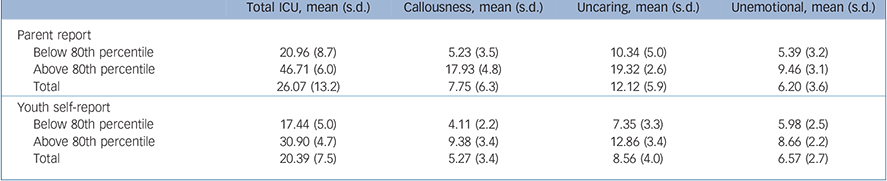
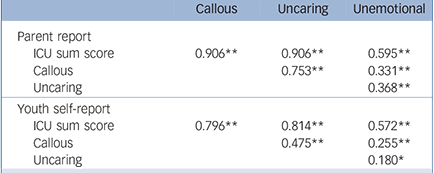
Preliminary analyses showed that the agreement between parent report and youth self-report regarding the ICU scores was moderate (Pearson's r = 0.574, P<0.001); therefore, analyses are presented separately for parent report and youth self-report. Table 1 shows the mean and standard deviations for the ICU sum scores and the three subscales for the above and below eightieth percentile cut-off, and for the total sample. Table 2 shows correlations between the ICU sum score and the subscales.
Mean and standard deviations for the total Inventory of Callous–Unemotional Traits (ICU) scores and the three subscales for the above and below the eightieth percentile cut-off, and for the total sample
| Total ICU, mean (s.d.) | Callousness, mean (s.d.) | Uncaring, mean (s.d.) | Unemotional, mean (s.d.) | |
|---|---|---|---|---|
| Parent report | ||||
| Below 80th percentile | 20.96 (8.7) | 5.23 (3.5) | 10.34 (5.0) | 5.39 (3.2) |
| Above 80th percentile | 46.71 (6.0) | 17.93 (4.8) | 19.32 (2.6) | 9.46 (3.1) |
| Total | 26.07 (13.2) | 7.75 (6.3) | 12.12 (5.9) | 6.20 (3.6) |
| Youth self-report | ||||
| Below 80th percentile | 17.44 (5.0) | 4.11 (2.2) | 7.35 (3.3) | 5.98 (2.5) |
| Above 80th percentile | 30.90 (4.7) | 9.38 (3.4) | 12.86 (3.4) | 8.66 (2.2) |
| Total | 20.39 (7.5) | 5.27 (3.4) | 8.56 (4.0) | 6.57 (2.7) |
We also analysed whether the high and low ICU groups differed on potential confounding variables. Time spent in institution – used as an index of environmental adversity – was not significantly different between the high and low ICU groups (P = 0.08). The high ICU group had significantly lower IQs (ICU high mean 88.7 (s.d. = 15.4) v. ICU low mean 98.2 (s.d. = 18), P = 0.02) and higher rates of ADHD diagnoses (P = 0.004). These variables were used as covariates in the logistic regression analyses (see below). There were no differences in the rate of depression, anxiety, or alcohol and tobacco misuse (all P-values >0.13).
Association between callous–unemotional traits and conduct disorder
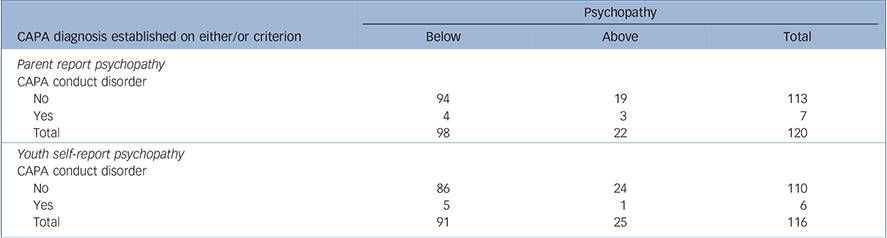
Chi-squared tests were used to test the degree of overlap between conduct disorder diagnoses and the presence/absence of high callous–unemotional traits. Using parent report on callous–unemotional traits, the large majority of individuals above the cut-off for callous–unemotional traits (86.4%) did not have a conduct disorder diagnosis, compared with 13.6% who did (Table 3). Conversely, 57.1% with conduct disorder diagnoses were below the cut-off, and 42.9% individuals were above (Fisher's exact: P = 0.114).
The same analyses were performed again, using youth self-report on callous–unemotional traits, and no significant overlap was observed (Fisher's exact: P = 0.616). The large majority with high callous–unemotional traits (96.6%) did not qualify for a conduct disorder diagnosis. In fact, there was only one individual (0.9%) who qualified for both a conduct disorder diagnosis and had scores above the ICU cut-off according to youth self-report.
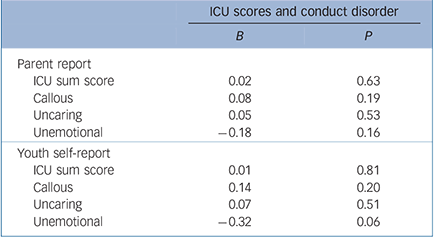
Since there are no established cut-off scores for ICU traits, we extended our analyses to a dimensional approach. Using logistic regression, we analysed whether the ICU questionnaire sum score or the subscale scores were associated with conduct disorder. We included IQ scores and CAPA ADHD scores as covariates. Table 4 shows that, according to both parent report and youth self-report, there were no significant associations between the ICU sum score or the subscale scores and conduct disorder diagnoses.
Although research is almost entirely focused on the association between callous–unemotional traits and conduct disorder, we also analysed the co-occurrence of high callous–unemotional traits and oppositional defiant disorder diagnoses, given the overlap of conduct disorder and oppositional defiant disorder. Only about one-third of those characterised with high callous–unemotional traits (29.2%) also qualified for an oppositional defiant disorder diagnosis. Although this represents a significant overlap (Fisher's exact: P = 0.023), it is of note that 70.8% of those individuals with high callous–unemotional traits did not qualify for a diagnosis of oppositional defiant disorder. According to youth self-report, there was no significant overlap between ICU high and low categories and oppositional defiant disorder diagnoses. Of those individuals with above cut-off scores on callous–unemotional traits, 16.7% also had an oppositional defiant disorder diagnosis, whereas 83.3% did not (Fisher's exact: P = 0.50). Dimensional analyses using parent report showed that the ICU sum score (P = 0.01) and the callous (P = 0.002) and uncaring (P = 0.004) scores were significantly associated with an oppositional defiant disorder diagnosis, whereas there was no association between the unemotional (P = 0.87) scale and oppositional defiant disorder. Analyses of youth self-report showed no significant association between ICU sum or subscales scores and an oppositional defiant disorder diagnosis (all P-values >0.23).
Correlations between Inventory of Callous–Unemotional Traits (ICU) sum score and ICU subscales
| Callous | Uncaring | Unemotional | |
|---|---|---|---|
| Parent report | |||
| ICU sum score | 0.906Footnote ** | 0.906Footnote ** | 0.595Footnote ** |
| Callous | 0.753Footnote ** | 0.331Footnote ** | |
| Uncaring | 0.368Footnote ** | ||
| Youth self-report | |||
| ICU sum score | 0.796Footnote ** | 0.814Footnote ** | 0.572Footnote ** |
| Callous | 0.475Footnote ** | 0.255Footnote ** | |
| Uncaring | 0.180Footnote * |
* P<0.05
** P<0.01.
Discussion
Main findings
In summary, we observed that overall the majority of individuals with high callous–unemotional traits in the ERA sample did not show conduct disorder or oppositional defiant disorder as established by the CAPA. There was no significant association between high callous–unemotional traits and conduct disorder, according to both parent report and youth self-report. According to parent report, 25 out of 27 individuals above the eightieth percentile cut-off for callous–unemotional traits did not have a conduct disorder diagnosis, and according to youth self-report, only 1 individual out of 25 with scores above the cut-off qualified for a conduct disorder diagnosis. Further analyses using a dimensional approach showed that according to both parent and youth report, callous–unemotional traits were not associated with a conduct disorder diagnosis. Regarding the overlap between oppositional defiant disorder and callous–unemotional traits, the parent report did show a significant overlap; however, 19 out of 28 individuals with high callous–unemotional traits showed no oppositional defiant disorder. According to youth self-report, there was no significant association between callous–unemotional traits and oppositional defiant disorder (21 out of 25 of the individuals in the high ICU group did not show oppositional defiant disorder). Dimensional analyses showed no association between youth self-reported callous–unemotional traits and oppositional defiant disorder, whereas there was a significant association between psychopathy scores and oppositional defiant disorder according to parent report, supporting the results obtained in categorical analyses.
Overlap between conduct disorder diagnosis and psychopathy (established by the eightieth percentile cut-off on Inventory of Callous–Unemotional Traits questionnaire) by parent report and youth self-report
| Psychopathy | |||
|---|---|---|---|
| CAPA diagnosis established on either/or criterion | Below | Above | Total |
| Parent report psychopathy | |||
| CAPA conduct disorder | |||
| No | 94 | 19 | 113 |
| Yes | 4 | 3 | 7 |
| Total | 98 | 22 | 120 |
| Youth self-report psychopathy | |||
| CAPA conduct disorder | |||
| No | 86 | 24 | 110 |
| Yes | 5 | 1 | 6 |
| Total | 91 | 25 | 116 |
CAPA, Child and Adolescent Psychiatric Assessment.
The agreement between parent report and youth self-report of psychopathy was reasonable (r = 0.574), but still modest. Which of the two measures is to be preferred is not clear, as both have their advantages and disadvantages, and that is why both are reported.
There are a number of explanations for these findings. First, the ERA sample is a special one and it is possible that there is a different developmental trajectory in post-institutionalised children, leading to a phenotype of callous–unemotional traits that does not show the usual overlap with antisocial behaviour and may have different underlying causes related to early institutional deprivation. Second, the protective family environment might prevent the callous–unemotional traits being expressed in overt behavioural difficulties as observed in oppositional defiant disorder or conduct disorder. In contrast to other instruments, such as the APSD or Psychopathy Checklist – Revised (PCL-R), Reference Hare13 the ICU focuses on the callous–unemotional dimension and does not include items that capture other dimensions of psychopathy, such as impulsivity or narcissism.
Findings from other studies
There has been a great deal of research on the importance of callous–unemotional traits in the development of conduct problems and antisocial behaviour. Reference Frick and White14 Longitudinal studies in both community samples and clinic-referred samples reported that callous–unemotional traits measured in early adolescence predicted measures of psychopathy in young adulthood, even after controlling for measures of antisociality. Reference Burke, Loeber and Lahey15,Reference Lynam, Caspi, Moffitt, Loeber and Stouthamer–Loeber16 Dadds et al Reference Dadds, Fraser, Frost and Hawes17 showed in a community sample of 4- to 9-year-olds that callous–unemotional traits were predictive of antisocial behaviour 1 year later, but only for boys. Several studies have shown that callous–unemotional traits are associated with aggression, delinquency and conduct problems, but it also seems to be the case that callous–unemotional traits are not particularly strongly associated with conduct problems (in contrast to the impulsivity and narcissism dimensions). Frick & White Reference Frick and White14 summarised the research findings as indicating that callous–unemotional traits are characterised by deficits in emotional arousal to fear and distress in others and abnormalities in responses to cues of punishment and danger with respect to one's own behaviour. They also note that conduct problems and callous–unemotional traits have quite different associations with parenting measures and with anxiety.
Results of logistic regression analyses, testing the association between Inventory of Callous–Unemotional Traits scores and conduct disorder diagnosis
| ICU scores and conduct disorder | ||
|---|---|---|
| B | P | |
| Parent report | ||
| ICU sum score | 0.02 | 0.63 |
| Callous | 0.08 | 0.19 |
| Uncaring | 0.05 | 0.53 |
| Unemotional | –0.18 | 0.16 |
| Youth self-report | ||
| ICU sum score | 0.01 | 0.81 |
| Callous | 0.14 | 0.20 |
| Uncaring | 0.07 | 0.51 |
| Unemotional | –0.32 | 0.06 |
Callous–unemotional traits do seem to be important for designating a particular severe and aggressive pattern of antisocial behaviour within antisocial youth. Reference Frick, Stickle, Dandreaux, Farrell and Kimonis18,Reference Rowe, Maughan, Moran, Ford, Briskman and Goodman19 However, the fact that the callous–unemotional traits are useful for identifying subgroups potentially associated with different risk factors and different developmental processes of behavioural problems is not at odds with the findings presented here. The focus of our paper was not on those individuals with manifest behavioural problems as observed in conduct disorder or oppositional defiant disorder. The sample size is much too limited to identify meaningful subgroups within the group of oppositional defiant disorder or conduct disorder individuals by means of ICU scores. Also, since callous–unemotional measures are not available for previous assessment ages, the predictive value of callous–unemotional traits for development of behavioural problems cannot be assessed. It will be worthwhile to investigate the predictive value of callous–unemotional traits obtained at age 16 years for behavioural disturbance, delinquency, etc. in young adulthood when the adoptees will be faced with challenges of independent living outside the protective family environment that characterised the adoptive homes. Reference Rutter and Sonuga–Barke7
Rather, we wanted to address the question whether high callous–unemotional traits can be present without manifest behavioural disturbances. In support of our findings, Frick et al Reference Frick, Bodin and Barry20 found in a large community sample that the majority of callous–unemotional symptoms, although relatively more common in individuals with conduct disorder than in those without, actually occurred most often in those without conduct disorder. Furthermore, an investigation of callous–unemotional features in a very large general population, the British Child and Adolescent Mental Health Survey, found that callous–unemotional traits were more common than conduct disorder. In fact, about 75% of those with high callous–unemotional traits showed no conduct disorder. Reference Rowe, Maughan, Moran, Ford, Briskman and Goodman19 The children with callous–unemotional traits but not conduct disorder tended to have subthreshold conduct problems but even when this was taken into account, the callous–unemotional traits-only group still showed lower levels of prosocial behaviour (as compared with those with neither callous–unemotional traits nor conduct disorder) and elevated psychosocial impairment, peer problems, and all diagnoses other than conduct disorder. The findings clearly show that pure callous–unemotional traits involve significant clinical impairment but that only some of this concerns conduct disorder.
There are no data available to test whether callous–unemotional traits in our sample had the same neurobiological characteristics as those associated with callous–unemotional traits involving a strong genetic influence when it is associated with conduct disorder. Our findings in no way challenge the empirical findings on the strong genetic influences on psychopathy Reference Viding, Blair, Moffitt and Plomin21 nor the findings on the stronger genetic influences for conduct disturbance when it is associated with psychopathic features. However, it is unlikely that callous–unemotional traits in our sample are strongly influenced by genetic factors. Owing to the limited sample size, investigation of genetic variation associated with antisocial behaviour (such as monoamine oxidase A) Reference Caspi, McClay, Moffitt, Mill, Martin and Craig22 is unlikely to yield conclusive results.
Implications
In terms of classification, and in light of the present findings, we argue for a diagnostic scheme whereby psychopathy can be diagnosed in the absence of conduct disorder. This is important in order to detect clinical consequences of pure callous–unemotional traits.
A similar point has recently been made by Skeem & Cooke, Reference Skeem and Cooke3 who questioned whether antisocial or criminal behaviour should be regarded as a central component of psychopathy. They argued that antisocial behaviour is an epiphenomenon of psychopathy rather than an integral part, and highlight the danger of equating measures of psychopathy with the construct.
Our findings indicate that callous–unemotional traits can develop as a result of institutional deprivation, Reference Rutter and Sonuga–Barke7 and when that occurs, it usually does so in the absence of conduct disorder or oppositional defiant disorder. It remains to be seen to what extent our findings can be generalised to other populations, but they certainly highlight the need to investigate samples in which callous–unemotional traits can be dissociated from antisocial behaviour.




eLetters
No eLetters have been published for this article.