




Introduction
Comprising c. 46.4 million km2 in 2020, protected areas (PAs) have become a central pillar of global conservation (Gurney et al. Reference Gurney, Adams, Álvarez-Romero and Claudet2023). However, existing PAs face multiple challenges, particularly regarding social-ecological effectiveness, equitable management, ecological representativeness and connectivity (Gaston et al. Reference Gaston, Jackson, Cantú-Salazar and Cruz-Piñón2008). Many large PAs are adversely affected by negative developments on surrounding lands, and PA management is often weak and insufficiently orientated towards biodiversity conservation needs (Palomo et al. Reference Palomo, Montes, Martín-López, González, García-Llorente, Alcorlo and Mora2014).
Although PAs are often situated in remote marginal areas (such as deserts, marshlands or mountains; Joppa & Pfaff Reference Joppa and Pfaff2009), urbanization has progressively become a key pressure (González-García et al. Reference González-García, Palomo, Arboledas, González, Múgica, Mata and Montes2022). It has been estimated that urban land near PAs will increase from 450 000 km2 in 2000 to 1 440 444 km2 in 2030 (Güneralp & Seto Reference Güneralp and Seto2013). Asia and Africa are the continents where urbanization rates are currently the highest (Nagendra et al. Reference Nagendra, Bai, Brondizio and Lwasa2018). India is experiencing a high magnitude of urban expansion near PAs. Current and future urban pressure on PAs and their surroundings implies localized but significant degradation of biodiversity at the levels of ecoregions and individual species of conservation concern (McDonald et al. Reference McDonald, Mansur, Ascensão, Ml, Crossman and Elmqvist2019).
People living in or near PAs often depend on local natural resources and are deprived of protein, timber and income sources when their livelihood activities are restricted (Loos Reference Loos2021), ultimately leading to local opposition to conservation (Holmes Reference Holmes2013). At the same time, people living in areas surrounding PAs are frequently exposed to ecosystem disservices (defined as ‘ecosystem generated functions, processes, and attributes that result in perceived or actual negative impacts on human well-being’; Shackleton et al. Reference Shackleton, Ruwanza, Sinasson Sanni, Bennett, De Lacy and Modipa2016) from PAs – for instance, crop raiding or attacks on livestock by wild mammals. While disservices focus on the instrumental values of nature, the broader concept of ‘disvalues’ has been developed to recognize the potential for negative values across instrumental, intrinsic and relational values (Lliso et al. Reference Lliso, Lenzi, Muraca, Chan and Pascual2022).
Land-use conflicts that result from the perceived or actual disvalues of PAs are accelerated by urbanization impacts, such as human population growth, loss of rural identities and increased mobility. On the other hand, PAs close to urban areas can offer important contributions to people’s well-being – for example, by providing fresh water, recreational spaces and access to nature (Brill et al. Reference Brill, Anderson and O’Farrell2017). In some cases, urbanization may even present opportunities for biodiversity – for example, by reducing the intensity of fuelwood collection or by offering nodes for ecosystem recovery (Nagendra et al. Reference Nagendra, Sudhira, Katti, Schewenius, Elmqvist, Fragkias, Goodness, Güneralp, Marcotullio and McDonald2013).
Participatory approaches, such as participatory mapping, can play a critical role in helping identify the diverse values of nature in relation to PA management. A participatory mapping approach, Public Participation Geographic Information Systems (PPGIS), has increasingly been used to inform land-use planning and management of both urban and rural environments and also to help us understand the multiple dimensions of human–nature relationships (Brown & Fagerholm Reference Brown and Fagerholm2015). In the context of PAs, the mapping of visitors’ perceptions regarding nature experiences, perceived ecosystem services, tourism impacts, management preferences or infrastructural needs has often been at the centre of PPGIS studies (e.g., Solé et al. Reference Solé, Hearn, Witra, Lechner and Fagerholm2025). Social and cultural landscape values, land-use preferences and acceptance/rejection of management practices have also been mapped to identify potential for land-use conflicts (Engen et al. Reference Engen, Runge, Brown, Fauchald, Nilsen and Hausner2018). PPGIS has been used in case studies to elicit landscape uses such as harvesting of forest products or recreational activities (Torralba et al. Reference Torralba, Topp, Mounir, Kmoch and Plieninger2025) as well as similar and dissimilar values of nature among different stakeholders (Loc et al. Reference Loc, Park, Thu, Diep and Can2021). Ecosystem services (both social perceptions and biophysical flows) inside and outside of PAs have also been mapped at landscape levels (Palomo et al. Reference Palomo, Martín-López, Potschin and Haines-Young2013), and in some cases PPGIS has been part of stakeholder participation activities (Ioki et al. Reference Ioki, Din, Ludwig, James, Hue and Johari2019).
Bannerghatta National Park (BNP) in southern India is an iconic PA that illustrates many conservation challenges. It forms a part of a critical ecological link between the Eastern and Western Ghats (a global biodiversity hotspot) and serves as a migratory corridor for an endangered flagship species, the Asian elephant (Venkataramana et al. Reference Venkataramana, Sreenivasa and Lingaraju2015). Parts of BNP and its surroundings are inhabited by local people. Several villages inside and around BNP harbour traditionally forest-dependent communities (Gopalakrishna et al. Reference Gopalakrishna, Somashekar, Anand and Varma2010) who use the landscape for collecting wild fruits, meat, manure, firewood, lac (a resinous substance produced by insects) and honey (Varma et al. Reference Varma, Anand, Gopalakrishna and Avinash2009). BNP is also inhabited by several tribal and marginalized caste communities (Scheduled Caste, Scheduled Tribe). Furthermore, BNP is strongly affected by the expansion of the megacity Bengaluru. Urban development has led to fragmentation of the ecological network and increased incidences of human–wildlife conflicts, especially with elephants at the fringes of BNP. With all these drivers affecting it, BNP offers important insights that are of relevance for other PAs facing urbanization in the Global South. While some studies have investigated human–elephant conflicts (e.g., Venkataramana et al. Reference Venkataramana, Sreenivasa and Lingaraju2015) and land-cover changes (e.g., Adhikari et al. Reference Adhikari, Southworth and Nagendra2015) in the study area, little is so far known about the broader societal values and disvalues of BNP.
The overall aim of this study is to explore, quantify and map the interplay of landscape values and disvalues as perceived by residents living along the boundary of BNP through a free-listing and PPGIS survey. Our specific objectives are to: (1) explore the places in the landscape that local residents valued positively and negatively (i.e., disvalued); (2) compare the frequency of landscape values and disvalues mapped inside and outside BNP; (3) identify the spatial patterns of intensity, richness and diversity of landscape values and disvalues; and (4) reveal the socio-demographic characteristics influencing landscape values and disvalues.
Our study complements the aforementioned participatory mapping exercises around PAs by expanding PPGIS to a joint assessment of perceived landscape values and disvalues. Stronger consideration of the positive and negative values of nature is considered a prerequisite to socially inclusive biodiversity conservation but has rarely been achieved to date (Lliso et al. Reference Lliso, Lenzi, Muraca, Chan and Pascual2022). Integrating landscape values and disvalues could be particularly helpful for inventorying human–nature-related issues in a specific conservation context (Oostvogels et al. Reference Oostvogels, Dumont, Nijland, de Boer and Ripoll-Bosch2024) and for understanding broader human–nature connections and disconnections more comprehensively (Beery et al. Reference Beery, Stahl Olafsson, Gentin, Maurer, Stålhammar and Albert2023). Failure to adequately integrate disvalues may, especially in a PA setting, lead to the alienation of people who have experienced harms from nature and/or from PA management (Luque-Lora Reference Luque-Lora2024). A second contribution of our study to the idea of socially inclusive conservation (De Pourcq et al. Reference De Pourcq, Thomas, Elias and Van Damme2019, Raymond et al. Reference Raymond, Cebrián-Piqueras, Andersson, Andrade, Schnell and Battioni Romanelli2022) is the combination of a standardized PPGIS survey with an open-ended, qualitative elicitation of landscape values and disvalues. The open-ended nature of free-listing allows for the exploration of underlying, broader narratives regarding the values and disvalues of the landscape (c.f. Wartmann et al. Reference Wartmann, Acheson and Purves2018), while PPGIS focuses on the spatial patterns of a specific set of key values and disvalues. This dual approach enables a comprehensive analysis of landscape values and conflicts.
Methods
Study area
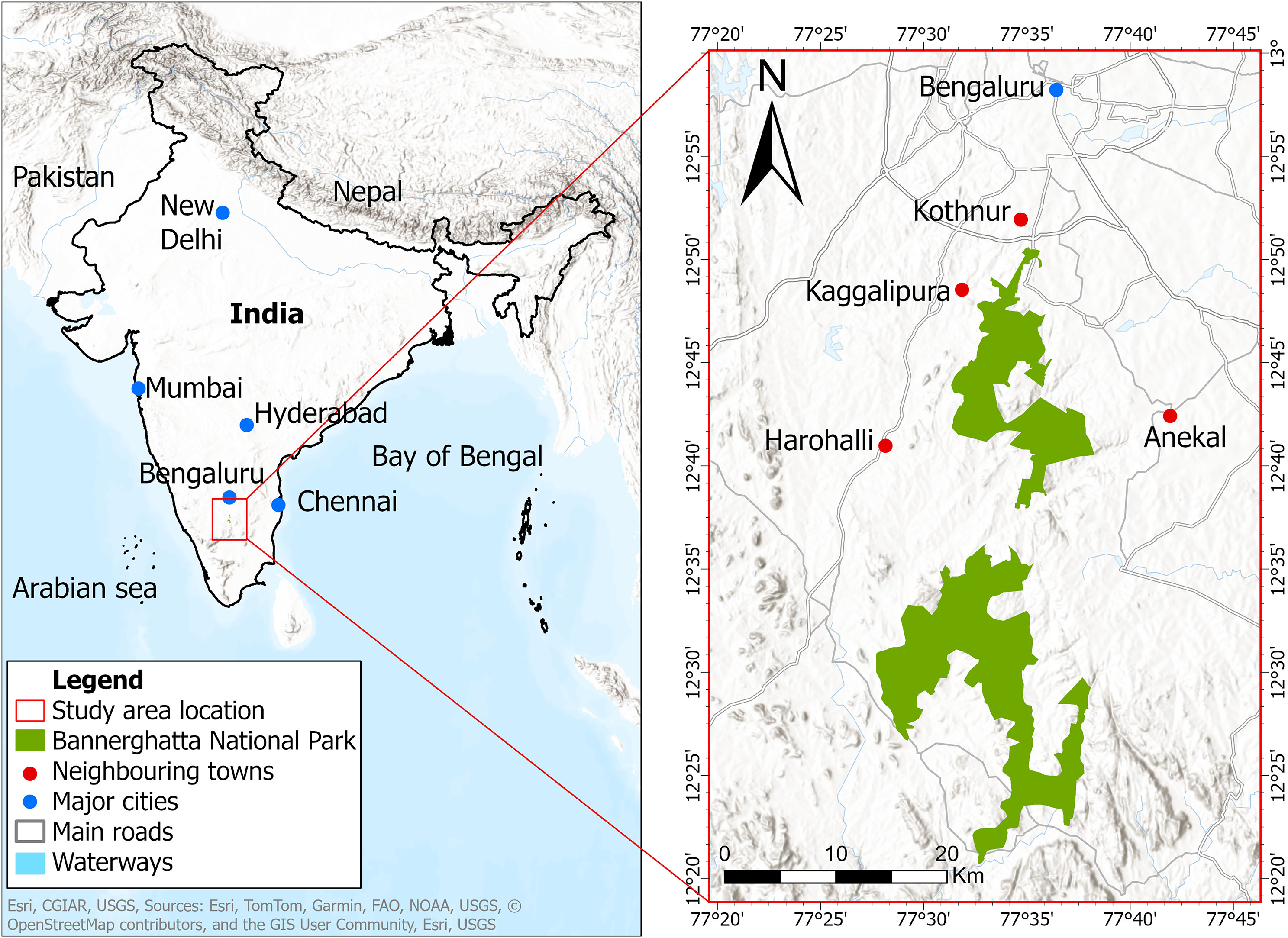
BNP is located at the southern periphery of Bengaluru, India’s fastest-growing metropolis, with a population of c. 10 million (Fig. 1). BNP is Bengaluru’s largest natural landscape, and it harbours dry deciduous and scrub forests spread over rocky and uneven landscapes. BNP was declared a national park in 1974 under the Wildlife Protection Act of 1972. The initial park area of 103 km2 was expanded in 2011 to a total area of 260 km2 under protection. Presently, BNP comprises 12 reserve forests spread over the districts of Bengaluru Urban, Bengaluru Rural and Ramanagara, as well as four wildlife ranges or administrative zones: Bannerghatta, Anekal, Harohalli and Kodihalli. BNP has a highly irregular shape, with a length of c. 59 km and a width varying from 0.3 km to 13.8 km. An ‘eco-sensitive zone’ was established around BNP in 2018 to cushion the National Park against developmental pressures, under which commercial activities such as mining, setting up of polluting industries or discharge of harmful effluents are prohibited, while small-scale establishments such as hotels and resorts, small industries, agriculture or road-widening projects are regulated.
Map indicating the location of Bannerghatta National Park.

Major land-cover changes have taken place around BNP, including conversion of native forest into land dedicated to agriculture, horticulture, industrial and suburban development, mining, grazing and illegal logging (Adhikari et al. Reference Adhikari, Southworth and Nagendra2015). The conversion of grazing commons and farmlands into urban development projects has been the most severe process in the northern and north-eastern parts of BNP (Jayaprakash & Hickey Reference Jayaprakash and Hickey2019). The villages in and around BNP face crop damage, livestock loss and even human injuries or losses due to wildlife despite the implementation of protective measures such as fencing and trenching.
Data collection
Twelve villages located along the boundary of BNP were selected purposively to geographically cover the study area, representing different distances to the main cities and towns in the region. Within these villages, permanent residents were selected based on their age, caste and gender to ensure a balanced representation in the sample. Informants between 18 and 29 years old were considered young, those from 30 to 59 years of age were considered middle-aged and those aged 60 years and above were considered old. After stratification, informants were chosen by convenience sampling and approached at their homes and in key public locations, such as tea shops, kattes (sacred platforms that are popular meeting points), temples and marketplaces. The total number of respondents amounted to 489 (Appendix S1 shows the socio-demographic characteristics of the sample of respondents).
Face-to-face PPGIS surveys were conducted in May 2022 using maptionnaire software on tablets with the facilitation of five locally trained enumerators. The questionnaire (Appendix S2) was pre-tested in three different villages and subsequently adapted before starting the final survey. In a first questionnaire section, the respondents located their homes and those places in the landscape on the map that they associated with different uses and values related to BNP. The typology of uses and values (both here referred to as ‘values’) was built based on previous studies examining landscape values through PPGIS (Garcia-Martin et al. Reference Garcia-Martin, Fagerholm, Bieling, Gounaridis, Kizos and Printsmann2017). In the second section, respondents located specific places of disvalue (where people had experienced human–wildlife conflict, crop damage, risk to livestock and other nuisances). The final choice of categories was developed through a series of exploratory visits and interviews with residents and visits to the area. The third section included two open questions that asked about the respondents’ most valued and most disvalued elements from their everyday landscapes. The last section of the questionnaire captured socio-demographic information. Initially, it took some time for older and illiterate respondents to familiarize themselves with the digital maps. However, the field researcher (PT) and enumerators assisted them in navigating the maps. Younger and more educated respondents were typically able to fill in the survey without assistance. Overall, we believe that our procedure allowed all respondents to accurately identify all of the locations on the maps. A systematic self-assessment provided by University of Kassel indicated that our survey should be performed using an ethically sensitive procedure (but the university’s ethics committee did not require formal ethical approval). All respondents were informed about the objectives of the study and their rights regarding data use. They consented explicitly before a survey was conducted.
Data analysis
The answers to the free-listing questions regarding positively and negatively valued landscape elements were inductively analysed. The open responses were translated from the local language to English. For content analysis, a protocol was developed that included several iterations of coding. The items associated with the most valued elements related to BNP were grouped into eight categories, inspired by the well-being components of Rogers et al. (Reference Rogers, Duraiappah, Antons, Munoz, Bai, Fragkias and Gutscher2012): ecosystems and biodiversity; social relationships; climate and ecosystem functions; work and leisure; health; education; agency and political voice; and physical and economic security. Items associated with the most disvalued elements were grouped into seven categories, partly following the typology of PA conflicts by Soliku & Schraml (Reference Soliku and Schraml2018): restricted access conflicts; human–wildlife conflicts; urbanization–conservation conflicts; agriculture and land-use conflicts; social coexistence conflicts; Indigenous rights conflicts; and conflicts related to legislation and policy.
The spatial extent and intensity of values and disvalues were analysed by calculating spatial indices (Fagerholm et al. Reference Fagerholm, Raymond, Olafsson, Brown, Rinne and Hasanzadeh2021). Firstly, we created kernel density surfaces from the mapped point data separately for the uses and values and for the disvalues (Brown & Fagerholm Reference Brown and Fagerholm2015). Kernel density estimation was calculated as points per hectare, with a 200-m output cell size and 200-m search radius. Richness was calculated as the total number of values or disvalues present in each 200-m cell. Diversity was calculated with the Shannon diversity index (H’), which measures the diversity and occurrence of values or disvalues in each 200-m cell; an H’ value of zero indicates that only a single value or disvalue is present in the cell. The maximum values for H’ are reached when all of the values or disvalues are represented by the same number of mapped points in a specific cell.
The identified values as well as disvalues were analysed using descriptive statistics. We then used Kruskal–Wallis tests to assess whether the values or disvalues identified varied according to the different socio-demographic characteristics of the respondents and between the different locations inside and outside BNP.
Results
Most valued and disvalued elements of respondents’ everyday landscapes
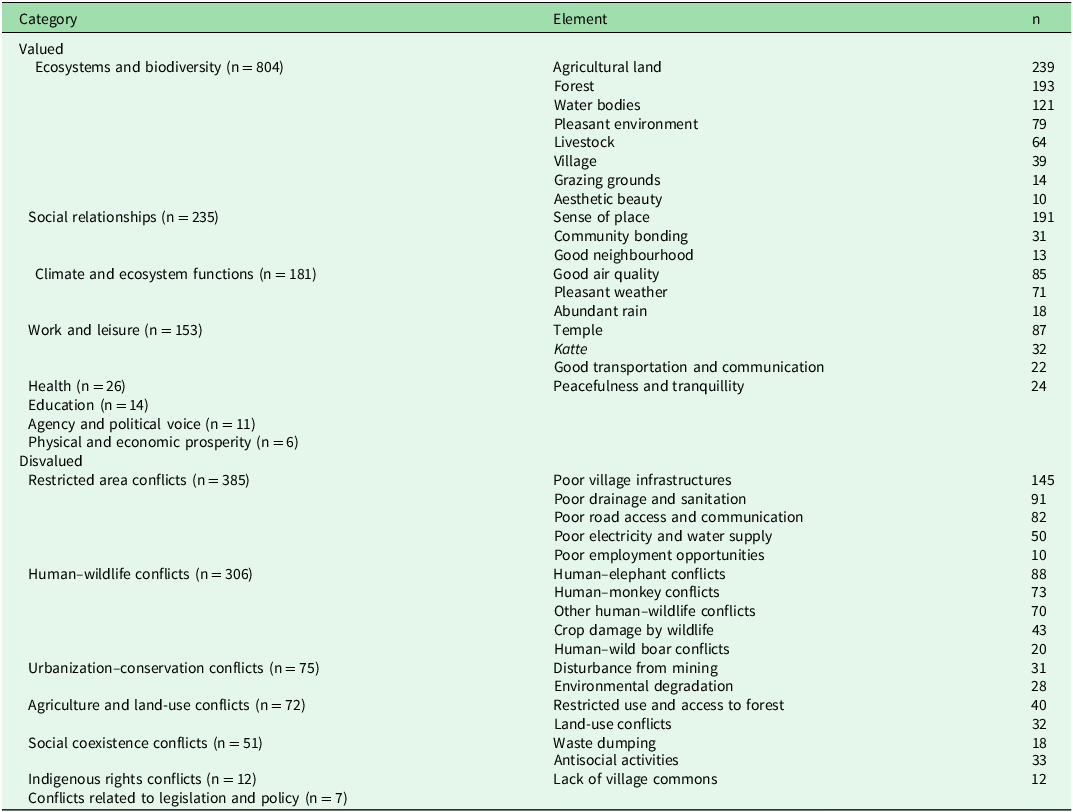
The exploration of the most valued and disvalued elements resulted in a broad diversity of elements, which included 37 different most valued elements and 25 most disvalued elements (Appendices S3 & S4). Among the valued elements, the most frequently mentioned were agricultural land, forest, sense of place, water bodies, temples and good air quality (Table 1). When classifying these items based on the well-being dimension to which they referred, the most relevant category was ecosystems and biodiversity (Table 1). The most frequently mentioned disvalued elements were poor village infrastructure, poor sanitation systems, human–elephant conflicts, poor road access, human–monkey conflicts and other human–wildlife conflicts (Table 1). The most relevant categories were restricted area conflicts and human–wildlife conflicts (Table 1 & Appendix S4).
Relative proportions and frequencies of the most valued and most disvalued elements in the respondents’ everyday landscapes. Relative proportions were calculated from the total of 1430 (for the most valued) and 908 (for the most disvalued) items. Only those individual elements coded at least 10 times are displayed.

Landscape values and disvalues mapped
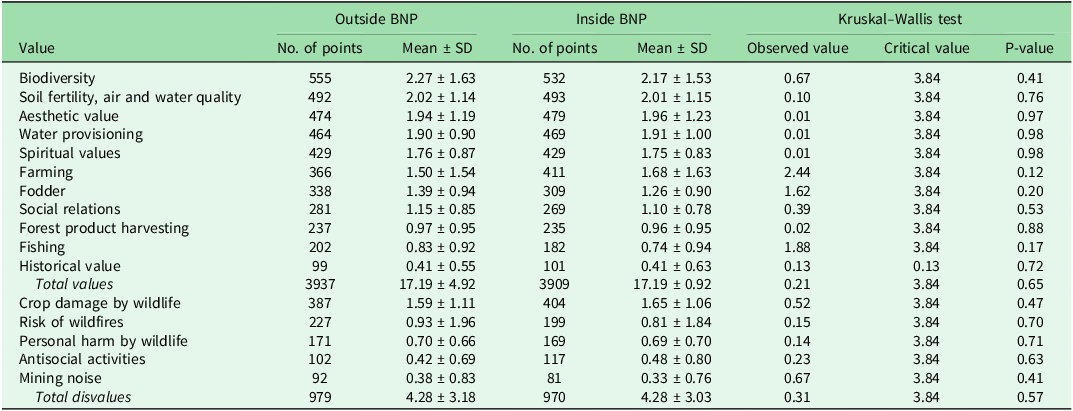
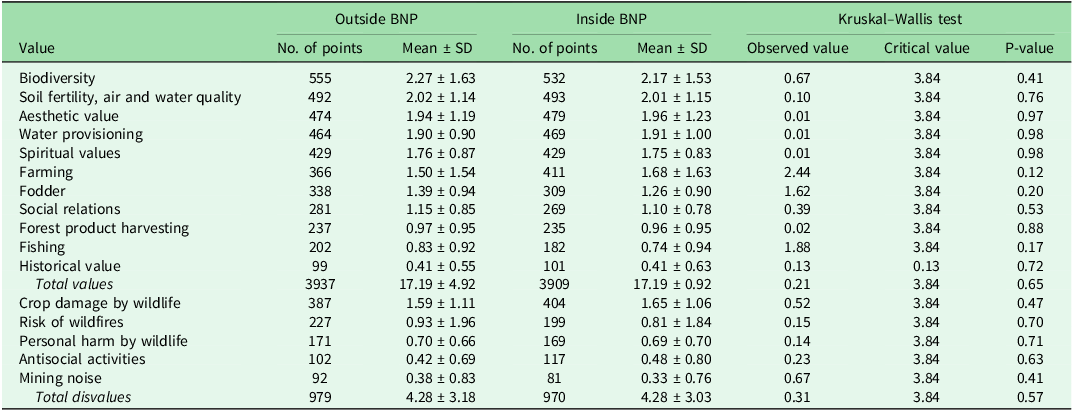
The 489 respondents mapped a total 7846 values and 1949 disvalues (Table 2). On average, each respondent mapped 20 locations. Biodiversity was the most frequently identified among the values, followed by regulation of diverse ecosystem functions (soil fertility, clean air and water), aesthetics and the supply of water. In relation to disvalues, crop damage inflicted by wildlife was the most frequently mapped disvalue, followed by risk posed by wildfire and personal damage inflicted by animals. No significant differences were found between areas inside and outside of BNP.
Values and disvalues mapped inside and outside Bannerghatta National Park (BNP).
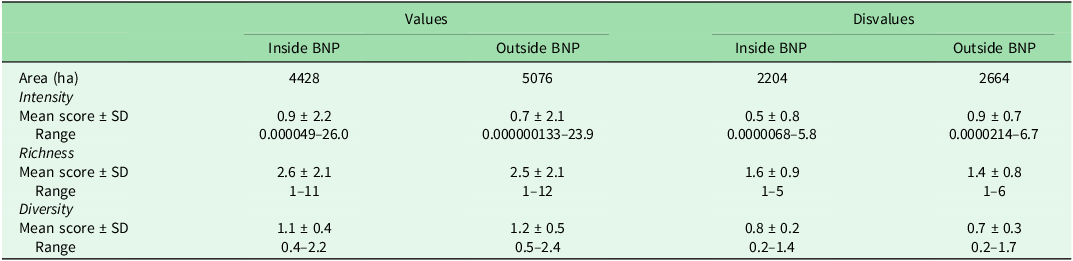
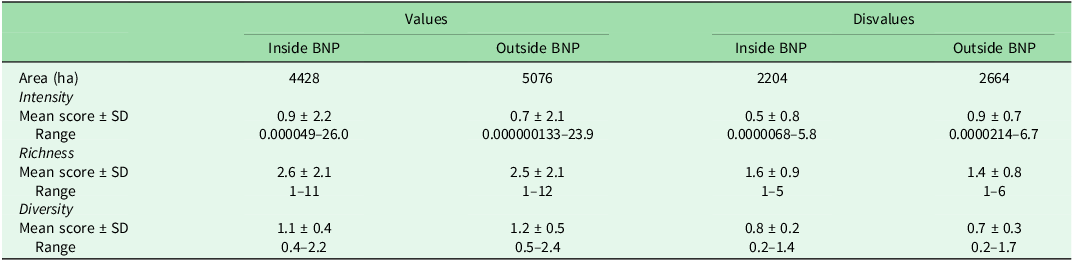
Overall, differences in intensity, richness and diversity of values and disvalues between those inside and outside BNP did not vary strongly; however, values and disvalues showed slightly higher mean richness values inside BNP compared to those outside. In contrast, the intensity of mapped disvalues was higher outside BNP (Table 3).
Intensity, richness and diversity of values and disvalues as mapped inside and outside Bannerghatta National Park (BNP).
Spatial pattern analysis
Values were generally spread over a larger area across the landscape (9504 ha) compared to disvalues (4868 ha) and showed predominantly higher mean intensity, richness and diversity scores of mapped sites (Table 3). Both values and disvalues were largely clustered within the villages and their surroundings.
Values and disvalues were spread across a smaller area inside BNP compared to outside. The values and disvalues of those outside BNP appeared to be slightly less clustered and were also mapped on locations near the National Park borders. While several values were mapped in areas within BNP, hardly any values or disvalues were allocated to areas outside BNP beyond the immediate surroundings of respondents’ villages.
Visual inspection showed a large spatial overlap among intensity, richness and diversity areas for both values and disvalues. However, high-intensity areas were larger in size than high-richness and high-diversity areas of values and disvalues.
Relationship with socio-demographic information
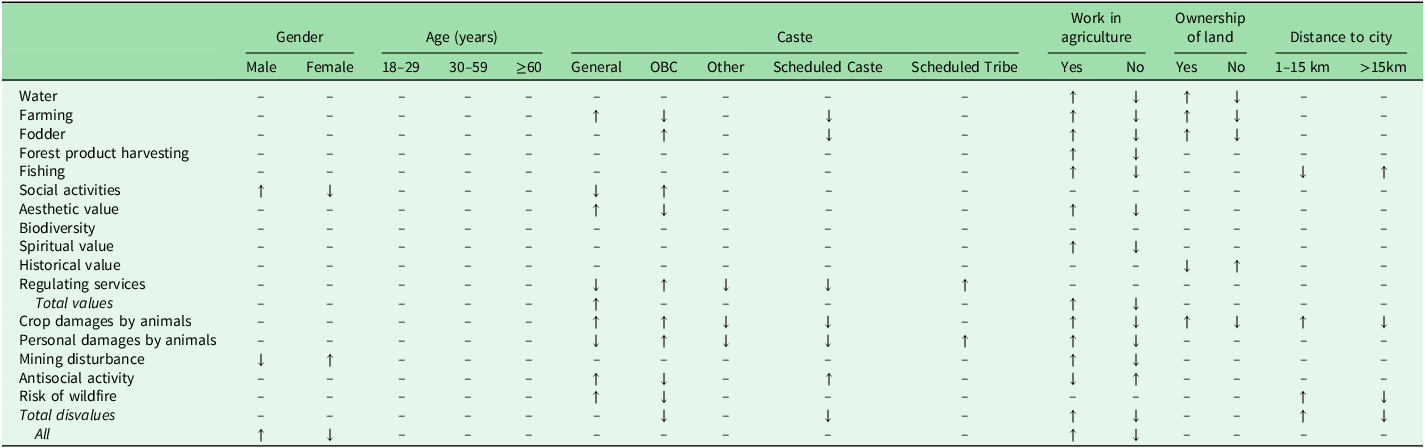
Values and disvalues were mapped differently by different groups of respondents (Table 4). Men identified on average more locations than women. However, the only statistically significant gender differences were that men valued social activities in landscapes more strongly, while women mapped the disvalue of mining disturbances more frequently. Respondents self-identified as general caste perceived substantially more values than other respondents, while respondents from marginalized castes (so-called Other Backward Classes (OBC) and Scheduled Classes) perceived more disvalues. People working in agriculture generally mapped many more values and disvalues than people working in other sectors. Respondents who owned some land in the study area identified more values associated with the landscape, particularly certain key resources (farming land, water, fodder), than landless respondents. Lastly, respondents living closer to a city perceived more disvalues than respondents living far from cities.
Kruskal–Wallis tests comparing the frequencies of mapped landscape values and disvalues based on socio-demographic information. Arrows indicate statistically significant differences (p < 0.05). For instance, ↑ indicates that respondents working in agriculture mapped water-related values significantly more often than those who did not work in this sector.
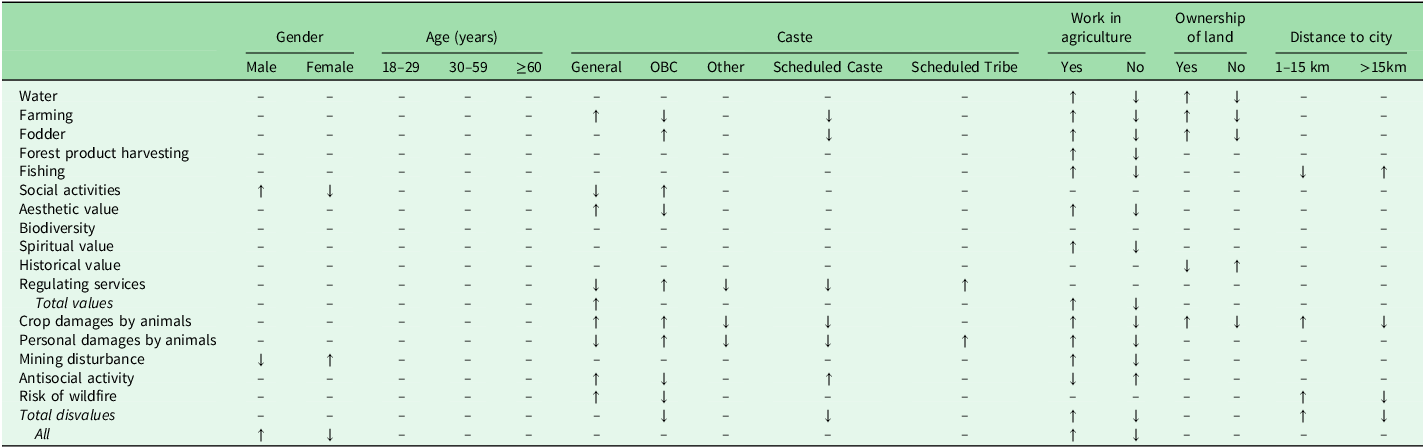
OBC = ‘Other Backward Classes’.
Discussion
This study strives to elicit how residents living in close proximity to an urbanizing national park perceive landscape values and disvalues. In our survey, communities living in and those living around BNP mapped landscape values and disvalues rather similarly. However, we did identify differences in relation to the places where respondents mapped landscape values, which were smaller inside BNP, probably because more restrictions on movements and uses in this landscape apply. Correspondingly, we found a higher intensity of both values and disvalues inside BNP, possibly indicating a higher potential for conflict.
When our study asked about PA residents’ subjective perceptions of those landscape features that supported their individual well-being, ecosystems and biodiversity (a category that includes many land-related items, including productive uses) emerged as the most relevant dimension, highlighting the importance of nature to local communities. Similar findings of people valuing predominantly biodiversity and ecosystem-related features were gained in a recent survey in Portuguese UNESCO biosphere reserves (Moreira et al. Reference Moreira, Frazão, Cusens, Castro, Gouveia and da Silva2024). Second in importance was the stability of the ecosystems and their capacity to navigate disturbances, which relates to the importance of local farming and other natural resource uses for the communities’ livelihoods. Similarly, communities living near nature reserves in China emphasized vegetation, clean water and air quality as central aspects of life satisfaction (Ma et al. Reference Ma, Qin, Zhang, Zheng, Hou and Wen2021). Other dimensions of well-being featured very little in our study. In contrast, studies performed in Europe highlighted outdoor recreation and cultural values much more prominently (Fagerholm et al. Reference Fagerholm, Martín-López, Torralba, Oteros-Rozas, Lechner and Bieling2020, Lampinen et al. Reference Lampinen, García-Antúnez, Jalkanen, Havu, Olafsson, Gulsrud and Raymond2024). People’s positive and negative perceptions of how a PA influences their well-being are clearly mediated by local- and national-scale factors (Allendorf et al. Reference Allendorf, Radeloff and Keuler2019).
The most disvalued landscape features reflected the most pressing conflicts around BNP. They relate primarily to human–wildlife conflicts that – as in the case of crop raids by elephants – are exacerbated by urbanization pressures and their disruptive impacts on, for instance, wildlife corridors. These conflicts may be particularly significant around BNP due to its irregular shape, which results in an extended boundary area compared to the PA’s core area. Such social impacts of PAs have strong effects on people’s subjective well-being levels (Jones et al. Reference Jones, Malesios, Kantartzis and Dimitrakopoulos2020). However, the expressed negative aspects also went beyond factors directly influenced by the PA and included access to infrastructure and urbanization-related conflicts.
The fact that the most valued landscape features were linked to ecosystems and that the most disvalued features were related to PA management and spatial planning highlights the complex relationship of residents with their natural protected surroundings. Nature can be at the same time the most important factor contributing to well-being and the source of the most relevant problems, highlighting that the direction and magnitude of landscape valuation are location-dependent. For example, local residents appreciated values such as recreation and crop production in a watershed in the USA while at the same time being concerned about increased flooding, biological invasions and other social-ecological stressors of the watershed (van Riper et al. Reference van Riper, Lorraine, Ben, Sanghyun, Suresh and Seunguk2024). Similar findings were obtained in urban green spaces (Neidig et al. Reference Neidig, Anguelovski, Lliso and Pascual2023) and forests (Baumeister et al. Reference Baumeister, Gerstenberg, Plieninger and Schraml2022). This type of paradox reflects the importance of considering the plural values of nature and the local context-related need for implementing methods that capture nature’s both positive and negative impacts on human well-being (De Vos et al. Reference De Vos, Joana and Dirk2018). It also highlights the need to further consider horizontal interactions within the diverse values of nature – for example, how specific values vary not only between but also within the same subjects (Raymond et al. Reference Raymond, Anderson, Athayde, Vatn, Amin and Arias-Arévalo2023).
The findings from our participatory mapping were similar to those from studies of perceived landscape values in PAs elsewhere in the world (e.g., Yee et al. Reference Yee, Loc, Poh, Vo-Thanh and Park2021). The most frequently mapped landscape values were biodiversity, soil fertility, air and water quality and aesthetic values. Based on the comprehensive number of landscape values mapped, BNP appears – despite its focus on wildlife conservation – to be a multifunctional landscape that supports a broad range of uses and values simultaneously. A similarly multifunctional bundle centring around linking biodiversity and agricultural and heritage values was identified for a PA in Norway (Cusens et al. Reference Cusens, Barraclough and Måren2022). However, many disvalues were also mapped (although to a lesser degree), especially those related to human–wildlife conflicts. In addition to harm to crops, livestock and people, the prominence of wildfire risks was notable in BNP. This concern may reflect disagreement with current BNP management practices, which have led to increased shrubland and tree density, subsequently raising wildfire risks. The inclusion of such disvalues in PPGIS highlights critical areas for management intervention and community engagement to ensure that conservation efforts align more closely with the needs and perceptions of local residents (Baumeister et al. Reference Baumeister, Gerstenberg, Plieninger and Schraml2022).
The spatial overlap of values and disvalues that we found again suggests the importance of incorporating the mapping of negative perceptions in PPGIS to gain a more nuanced understanding of landscape dynamics. Although human–wildlife conflicts and debates over ‘fortress conservation’ are prevalent in the area, it is surprising that BNP-related landscape values were more frequently mapped than disvalues. This discrepancy might indicate a complex relationship between residents and BNP, where positive perceptions outweigh negative experiences, despite ongoing conflicts.
Similar to other PPGIS studies (Loc et al. Reference Loc, Park, Thu, Diep and Can2021), our study revealed comparatively substantial differences between socio-demographic respondent groups. Caste, employment in agriculture and legal ownership of land were the most relevant factors that mediated human–nature relationships. These findings partly confirm and partly contrast with findings from previous socio-cultural valuation studies. In particular, individuals experiencing closer daily interaction with nature, such as those working in agriculture and those owning land, tended to associate more values and disvalues with the landscape, similar to what was found previously by Fagerholm et al. (Reference Fagerholm, Torralba, Moreno, Girardello, Herzog and Aviron2019). The fact that men observed more landscape values than women may be a consequence of the typical division of work within families, with men being more dedicated to outdoor work (most notably farming) and women to home-keeping (Thapa et al. Reference Thapa, Torralba, Bhaskar, Nagendra and Plieninger2023). We found several differences between more privileged and more marginalized castes that deserve more detailed exploration. Our results suggest that marginalized castes perceive disvalues from BNP more intensively. In other valuation studies in the area, general caste members typically expressed stronger appreciation for biodiversity and recreational values, whereas members of poorer and more marginalized castes focused more strongly on the provisioning of ecosystem services for subsistence (Nagendra Reference Nagendra2016, Plieninger et al. Reference Plieninger, Thapa, Bhaskar, Nagendra, Torralba and Zoderer2022). The magnitude of these differences points to the importance of a differentiated analysis of local residents in and around PAs for conservation planning and management. Other intersecting respondent characteristics, such as age or level of urbanity, were less influential.
Our approach was mostly quantitative in nature and may not capture the more subtle or multifaceted landscape values (e.g., the spiritual meanings of nature) around the National Park. It would also be important to monitor changes in perceived values and disvalues over time with further ongoing urbanization. Expanding assessments of nature’s values and disvalues by focusing more on the rights of nature, people’s bonds to nature and people’s trauma stemming from negative natural events and environmental degradation (Luque-Lora Reference Luque-Lora2024) may be another avenue for future research.
Conclusions
We highlight the need to develop specific strategies that can address the unique challenges facing PAs due to urbanization, especially in the Global South. Our participatory mapping study of urbanizing BNP (India) provides two main methodological contributions to the study of environmental conservation in this context. First, it expands participatory mapping to include both the values and disvalues of PAs. Our study indicates that local communities extensively use and value PAs for their well-being, but they also identify serious disvalues, including harm to humans. Such a consideration of both the positive and negative impacts of PAs on people is a prerequisite for balanced decision-making and, as a consequence, improved people–PA relationships. Second, this study integrates free-listing with participatory mapping, which is helpful for linking mapped values and disvalues with informants’ relational connections to the landscape. By considering multiple values and methods, we can focus on a plurality of methods, actors and values in biodiversity conservation (Pascual et al. Reference Pascual, Balvanera, Díaz, Pataki, Roth and Stenseke2017). Our approach allowed us to uncover a more nuanced picture of landscape value perception, which would have been incomplete or biased if we had conducted this assessment using only one of these method.
While the number of perceived values outweighs that of disvalues, many of the perceived landscape values are related to crop cultivation and pastoralism. Our study highlights that in and around PAs facing urbanization pressure, values can still be fundamentally tied to supporting basic food production needs and traditional livelihoods; this challenges assumptions regarding changing priorities in urbanizing landscapes. It is thus crucial to design PAs in a way that accommodates agricultural uses in their surroundings, especially within an urbanization context in which farming is compromised both by PA regulations and by the conversion of farmland to built-up land. At the same time, our study highlights that many of these disvalues can be addressed by improving access to basic infrastructure, especially for the more marginalized residents.
Supplementary material
To view supplementary material for this article, please visit https://doi.org/10.1017/S0376892925100234.
Acknowledgements
We are grateful to our enumerators and all residents who responded to our interview requests. We thank Samudyatha Ramanada and Sarang KT for supporting the field data collection, Katri Väänänen for assisting in PPGIS data analysis and Chaima Mobarak for the map of the study area.
Financial support
This research has received funding from the German Research Foundation (DFG) through grant number 421285339 (FOR2432/2). DB acknowledges support from the Department of Biotechnology (DBT) of the Government of India (grant number BT/IN/German/DFG/14/BVCR/2019).
Competing interests
The authors declare none.
Ethical standards
The authors assert that all procedures contributing to this work comply with applicable national and institutional ethical guidelines.


 Open access

