


Introduction
Since the 1980s, wind farms have become an economically attractive energy option (ITDG 2005), often receiving substantial governmental support in many countries (Carrete et al. Reference Carrete, Sánchez-Zapata, Benítez, Lobón and Donázar2009). As a result, wind farms have proliferated worldwide and this trend is expected to continue (Ledec et al. Reference Ledec, Rapp and Aiello2011). In Spain, the rise in the number of wind farms is unprecedented. The country is now the fifth producer of wind energy in the world, with an installed capacity of 22,988 MW distributed at 1,077 wind farms by the end of 2015 (AEE 2016). However, because Spain is along an important flyway for many birds migrating between Europe and Africa, the potential negative impact of wind farms can be substantial and therefore needs adequate study.
Wind farms have negative environmental impacts on the landscape and can cause high mortality in birds and bats (May et al. Reference May, Reitan, Bevanger, Lorentsen and Nygård2015, Peste et al. Reference Peste, Paula, da Silva, Bernardino, Pereira, Mascarenhas, Costa, Vieira, Bastos, Fonseca and Pereira2015). Birds are often killed by collisions and electrocutions (Drewitt and Langston Reference Drewitt and Langston2008, Lucas et al. Reference Lucas, Ferrer, Bechard and Muñoz2012), but they can also be displaced from their nesting sites, foraging areas, as well as have their daily transit and migration routes disrupted (Drewitt and Langston Reference Drewitt and Langston2006). For some species, deaths caused by turbine collisions can be significantly high, and may negatively impact their populations (Johnson et al. Reference Johnson, Erickson, Strickland, Shepherd, Shepherd and Sarappo2002). In particular, long-lived species such as vultures, eagles and other birds of prey, are more vulnerable (Carrete et al. Reference Carrete, Sánchez-Zapata, Benítez, Lobón and Donázar2009, Sanz-Aguilar et al. Reference Sanz-Aguilar, Sánchez-Zapata, Carrete, Benítez, Ávila, Arenas and Donázar2015).
Generally, in most countries, environmental authorities require wind developers to monitor sites for 1–2 years after the start of operations of wind farms and power lines post-construction to assess the impact on birds. Around these structures, bird mortality is frequently estimated by direct measurement of bird collisions. However, there is no legislation stipulating a standard monitoring frequency. Often, monitoring is arbitrarily decided by the individual environmental authorities for each specific case. The most common procedure is for bird carcass searches to take place every 1–2 weeks within a 50–100 m radius around turbines or under power lines in the monitored wind farms (Ferrer et al. Reference Ferrer, de la Riva and Castroviejo1991, Osborn et al. Reference Osborn, Higgins, Usgaard, Dieter and Neiger2000, Lucas et al. Reference Lucas, Janss and Ferrer2004, Drewitt and Langston Reference Drewitt and Langston2008, Farfán et al. Reference Farfán, Vargas, Duarte and Real2009, Lasch et al. Reference Lasch, Zerbe and Lenk2010). There is no scientific evidence supporting this monitoring frequency or search area radius.
Studies of bird mortality around wind farms and power lines usually report relatively low rates (Alonso and Alonso Reference Alonso, Alonso, Janss and Ferrer1999, Erickson et al. Reference Erickson, Johnson, Stricland, Young, Sernka and Good2001, Langston and Pullan Reference Langston and Pullan2003, Percival Reference Percival2005, Farfán et al. Reference Farfán, Vargas, Duarte and Real2009, Gue et al. Reference Gue, Walker, Mehl, Gleason, Stephens, Loesch, Reynolds and Goodwin2013). Such low impact levels may reflect a mismatch between the location of the wind farm or power line and the concentrations of birds (Carrete et al. Reference Carrete, Sánchez-Zapata, Benítez, Lobón, Montoya and Donázar2012), but may also be the result of a relatively low coverage of sites. Moreover, most studies report body counts without taking into account carcass detectability due to habitat differences, search efficiency and effort, or removal of carcasses by scavengers (Scott et al. Reference Scott, Roberts and Cadbury1972, Morrison Reference Morrison2002, Erickson et al. Reference Erickson, Johnson and Young2005, Smallwood Reference Smallwood2007, Drewitt and Langston Reference Drewitt and Langston2008, Carrete et al. Reference Carrete, Sánchez-Zapata, Benítez, Lobón and Donázar2009). Although all these factors are sources of error and variation when determining wind farm bird mortality (Gehring et al. Reference Gehring, Kerlinger and Manville2009, Longcore et al. Reference Longcore, Rich, Mineau, MacDonald, Bert, Sullivan, Mutrie, Gauthreaux, Avery, Crawford, Manville, Travis and Drake2012), carcass removal by scavengers is likely to considerably bias estimates. This is so because removal of carrion is quick and prevalent in most habitats (Kostecke et al. Reference Kostecke, Linz and Bleier2001, Prosser et al. Reference Prosser, Nattrass and Prosser2008, Ponce et al. Reference Ponce, Alonso, Argandoña, García Fernández and Carrasco2010, Smallwood et al. Reference Smallwood, Bell, Snyder and Didonato2010). In particular, if the time interval between carcass searches is more than the permanence of a carcass in an area, then observers will only detect a small percentage of these.
The persistence of animal carcasses at wind farms or power lines has been investigated by some authors. For example, Ferrer et al. (Reference Ferrer, de la Riva and Castroviejo1991) showed that 70% of rabbit Oryctolagus cuniculus carcasses placed under pylons and power lines, disappeared within one month after placement. In contrast, Lucas et al. (Reference Lucas, Janss, Whitfield and Ferrer2008) indicated that large bird carcasses, equivalent to or larger than a black kite Milvus migrans could remain for months or even years untouched by scavengers. However, information on how long small to medium-sized birds (such as kestrels, pigeons, or small passerines) killed at wind farms remain, is still limited (Drewitt and Langston Reference Drewitt and Langston2008).
In this paper, we experimentally examine the rates of removal by scavengers of pigeon (representing medium-sized birds) and quail carcasses (representing small birds) placed at wind farms and power lines in southern Spain. We quantified permanence rates of these two different sized birds. In addition, we placed radio transmitters on some pigeon carcasses to calculate dispersal distances caused by scavengers. From the data obtained in our study we developed a useful metric to correct potential errors arising in the estimation of avian mortality rates at wind farms and power lines caused by carcass removal by scavengers
Methods
Study area
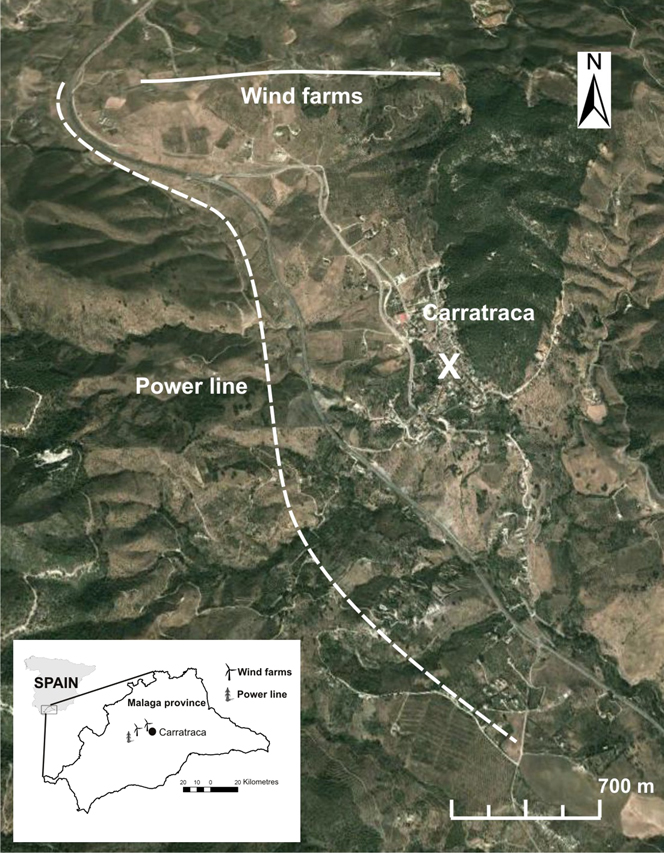
The study wind farms, “Puerto de Malaga” and “Sierra de Baños”, and their associated power lines, were located in Malaga province, southern Spain (UTM 30SUF38). Both wind farms were situated on a W-E oriented mountain ridge and were contiguous. In total there were 13 wind turbines (150 m apart along 1,800 m), evenly distributed along a continuous row, 555–727 m above sea level. The power line was located along the westernmost part of the wind farms and run in a N-S direction; a total length of 23,000 m. We studied the 5-km stretch nearest to the wind farms (Figure 1).
Location of the study area. Χ: geographic reference (36° 51’ 9’’N; 4° 49’ 12’’W)
Vegetation in the study area was dominated by Mediterranean-type scrubland. The most representative species are Phlomis purpurea, Phlomis lychnitis, Quercus coccifera, Chamaerops humilis, Rosmarinus officinalis, Cistus albidus, and Ulex parviflorus. There were also scattered Aleppo pine trees Pinus halepensis along the eastern section of the wind farms. In the lower western area, scrubland was found mixed with cereals and olive groves.
The vertebrate community in the study area is represented by several bird and mammal species (Martí and Del Moral Reference Martí and Del Moral2003, Palomo et al. Reference Palomo, Gisbert and Blanco2007). The main scavengers present in the area were Common Raven Corvus corax, red fox Vulpes vulpes and Egyptian mongoose Herpestes ichneumon. Feral cats and dogs were also very common (pers. obs.).
Field methods
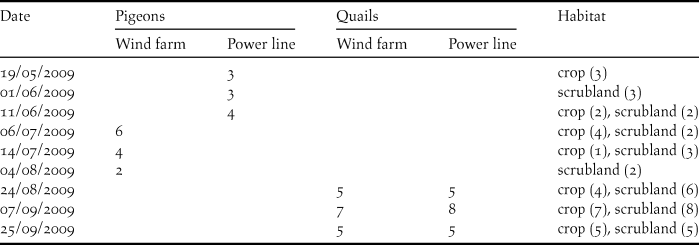
Our study lasted between May and September 2009. We placed a total of 57 bird carcasses (22 domestic pigeons Columba livia f. domestica and 35 Common Quails Coturnix coturnix) at the two wind farms, and on the 5-km associated power line along nine different series (Table 1). All carcasses were positioned between 08h00 and 10h00. At the wind farms, carcasses were randomly distributed around a maximum radius of 70 m from a wind turbine, but were randomly placed under pylons and power lines. Bird carcasses were spread far apart to avoid an increase in removals caused by a higher carcass density (Bevanger et al. Reference Bevanger, Bakke and Engen1994, Stevens et al. Reference Stevens, Reese and Connelly2011). We also placed carcasses in the two different habitats found in the study area: crops and scrubland. All carcasses were inspected daily, as recommended by Smallwood (Reference Smallwood2007). We estimated the Kaplan-Meier product limits to measure the disappearance rate of carcasses (White and Garrott Reference White and Garrott1990).
Distribution of pigeons and quails placed in the two wind farms and power line. The date and habitat used in the nine series are shown.
We attached a 27-g TW 3 brass collar transmitter (Biotrack, UK) to all dead pigeons. To locate the carcasses, we employed a GPS eTrex Vista Cx (Garmin, USA), a portable Yagi-antenna, and a Yaesu VR-500 receiver (Wagener Telemetrie, Germany). The homing-in technique was used to locate all carcasses (White and Garrott Reference White and Garrott1990). The dispersal distance (in metres) of each carcass was estimated as the span between the point where the carcass was placed and the point where it was discovered or radio transmitter found.
Statistical approach
We used a GLM with Poisson error distribution and a log-link function model (Crawley Reference Crawley1993) to analyse whether type of carcass (quails vs pigeons), habitat type (crops vs scrubland) and placement site (wind-power plant vs power line) affected the permanence time (in days), the dependent variable.
All mean values of analysed parameters are given with their standard error.
To calculate the mortality rate linked to the studied wind farms and associated power line, we employed the following equation:
 $$EMR = {{OCB} \over {ED}}$$
where EMR is the estimated daily mortality rate, OCB is the observed number of carcasses, and ED is the number of equivalent days, i.e. the number of days in which the collision of birds yielded the observed carcasses if the disappearance rate was zero. ED was calculated by adding the proportion of daily persistence for quail and pigeon carcasses, respectively.
From equation (1) it follows that the estimated mortality during a specific period of time results from the EMR multiplied by any number of days between successive monitoring days.
Bias in estimating bird mortality
We used disappearance rate and dispersal distances of pigeons obtained in this study to show that the current monitoring schemes approved by the environmental authorities (at a frequency of 1–2 weeks and over a surface of 50–100 m) may underestimate mortalities of medium-sized birds.
Results
As revealed by radio tagging, most carcasses (60%) were taken from where they were first deposited to distances of > 100 m. The GLM model showed a good fit to the Poisson distribution (0.931) and explained 71.4% of the deviance. The model revealed that carcass type and placement site had the highest explanatory power (highest Wald statistic values); both variables had a significant effect on permanence time (Table 2). Permanence time was positively affected by carcass type, higher for pigeons (4.6 ± 0.7 days) than for quails (1.5 ± 0.3 days), but negatively affected by placement site. Permanence was less around wind turbine sites compared to the power line regardless of carcass type (wind turbines: pigeons: 4.1 ± 1.1 days, quails: 1.0 ± 0.3 days; power line: pigeons: 5.1 ± 1.0 days, quails: 2.1 ± 0.5 days).
Results of the GLM model analysing factors affecting the permanence time (in days) of two types of carcasses. Factors included in the model were type of carcass (1, pigeon or 2, quail), type of placing site (1, wind-power plant or 2, power line) and type of habitat (1, crops or 2, scrubland).

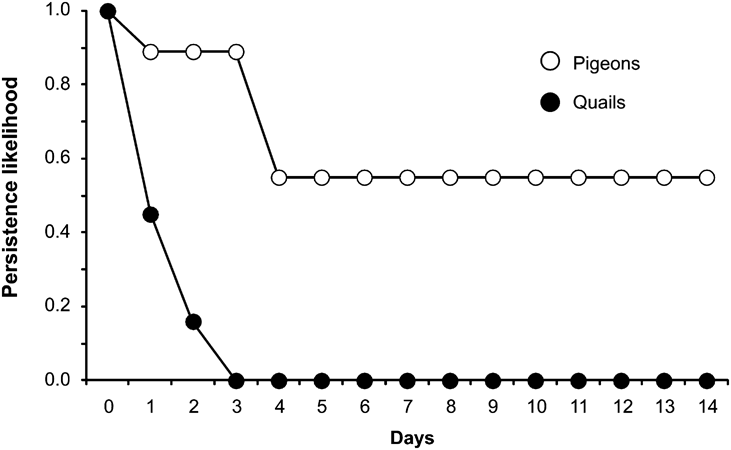
The disappearance rate of quails was 55% on the first day, 85% on the second day, and 100% on day 3. Disappearance rate was less for pigeons; 10% on the three first days and 45% until day 14 (Figure 2).
Kaplan-Meier disappearance functions for pigeon and quail carcasses experimentally deposited under wind farms and power line in the study area.
Using the disappearance rates for quails and pigeons, the daily mortality rate was estimated as:
1. Quails:
ED quails = 1.00 + 0.45 + 0.16 = 1.61
 $$EMR = {{OCB} \over {1.61}}$$
2. Pigeons:
ED pigeons = 1.00 + 0.89 + 0.89 + 0.89 + 0.55 + 0.55 +0.55 +0.55 +0.55 +0.55 + 0.55 = 7.52
 $$EMR = {{OCB} \over {7.52}}$$
At both seven and 14 days, the proportion of pigeons remaining on the placement sites was 55% (12 carcasses) but the remaining 45% (10 carcasses) were spread by scavengers. Scavengers displaced three carcasses < 50 m, and one other up to distances of 50–100 m. Monitoring with a frequency of 7–14 days and a sampled surface area of 50 and 100 m underestimated bird mortality by 31.8% and 27.3%, respectively.
Discussion
Previous studies on the impact of wind farms on birds have focussed on documenting mortality by collisions on wind farms, by recording species found dead under turbine blades (Martínez-Abrain et al. Reference Martínez-Abraín, Tavecchia, Regan, Jiménez, Surroca and Oro2012). Small birds and bats may have been overlooked in previous carcass searches (Kunz et al. Reference Kunz, Arnett, Erickson, Hoar, Johnson, Larkin, Strickland, Thresher and Tuttle2007) due to cryptic colouration, small body size, rough topography, or thick vegetation, among other factors. The practice of counting dead birds in wind farms has been considered to underestimate fatalities due to air currents blowing carcasses away from the collision site, and to an unknown impact of scavengers removing carcasses (Desholm et al. Reference Desholm, Fox, Beasley and Kahlert2006). In this paper, we show that the reported low mortality rates currently used to dispel any concerns about wind energy may be seriously affected by the removal of carcasses by scavengers. We demonstrate that, at least in spring and summer, the disappearance rate of dead animals is greater than the search intervals usually proposed by environmental authorities (periods of 7–14 days), hence clearly underestimating the number of dead animals.
Our results, alongside those of other authors, indicate that scavengers can remove carcasses within a few days. Prosser et al. (Reference Prosser, Nattrass and Prosser2008) found removal rates of up to 32% (winter) and 91% (summer) within four days, Kostecke et al. (Reference Kostecke, Linz and Bleier2001) up to 66% within five days, and Ponce et al. (Reference Ponce, Alonso, Argandoña, García Fernández and Carrasco2010) up to 66.7% of small birds (represented by quails) and 85.7% of very small birds (represented by quail halves) within two days after placement. In contrast, Smallwood et al. (Reference Smallwood, Bell, Snyder and Didonato2010) found that scavengers took away large-bodied raptor carcasses within 15 days; none during winter and 67% in summer. Urquhart et al. (Reference Urquhart, Hulka and Duffy2015) showed that 85% of Buzzard Buteo buteo carcasses could remain for up to a period of 95 days. These results indicate that the recommended monitoring period of 7–14 days for carcass search surveys is insufficient, especially when recording the impact on small-sized birds. Our study demonstrates that scavengers can remove quails (representing small birds) faster than they remove pigeons (representing medium-size birds). Other authors have also found that scavengers will remove small birds in very short periods of time (Kerlinger et al. Reference Kerlinger, Curry and Ryder2000, Lekuona and Ursúa Reference Lekuona, Ursúa, Lucas, Janss and Ferrer2007, Ponce et al. Reference Ponce, Alonso, Argandoña, García Fernández and Carrasco2010, Stevens et al. Reference Stevens, Reese and Connelly2011), while raptor carcasses may persist longer than non-raptors (Smallwood Reference Smallwood2007, Urquhart et al. Reference Urquhart, Hulka and Duffy2015).
The lower permanence of experimental carcasses under wind farms compared to the power line obtained in this study can be explained by the differences in the abundance of scavengers at these sites. From our own observations, we suggest that feral cats and dogs may have been more abundant in wind farms. However, we have not performed any analyses to determine whether there was a significant effect of this factor.
Our results also show that there were more carcasses dispersed at distances of > 100 m. These observations suggest that it is highly unlikely for monitors employed by environmental authorities to discover dead animals within the currently used radius of 50–100 m around wind farms and power lines therefore underestimating bird mortality. We further argue that monitoring bird mortality every 7–14 days and around a 50–100 m radius will severely underestimate medium-sized bird mortality, as shown by our pigeon data. Although we did not radio-tagged quails, representing small birds, the disappearance rate indicates that for this species, monitoring every 7–14 days and within a 50–100 m radius, also underrepresents small bird mortality.
From our results, we are confident in suggesting, as Drewitt and Langston (Reference Drewitt and Langston2008) do, that the currently reported bird mortality rates at wind farms is only the minimum number of actual fatalities. If our study is confirmed in other sites, given the proliferation of wind farms and associated power lines worldwide, there is a pressing need to improve the methods used in fatality studies. It is fundamental to determine the real impact of these structures on flying fauna, and ensure the conservation of the most vulnerable species.
A key challenge in wildlife mortality surveys is, among other factors, the control of errors caused by not taking into account the impact of scavengers. Accounting for the fact that these losses are specific to wind farms or power line, a first step would be to correct the estimation of fatalities for each wind farm and associated power line. In the present study, we propose a method that could be applied to any wind farm and power line in different habitats, bird communities or scavenger communities. If the correction of the number of fatalities is not applied, increasing search effort can minimize biases. Environmental authorities must demand shorter periods for search surveys as the current recommended period of 7–14 days is clearly insufficient. As we discuss, scavenging losses are wind farm and power line-specific but the number of days during which small and medium sized (non-raptor) birds persist is very short. Thus, according to our results, and in line with Kostecke et al. (Reference Kostecke, Linz and Bleier2001), we consider it reasonable to recommend that in spring and summer, when a higher proportion of carcasses are likely to be removed by scavengers (Prosser et al. Reference Prosser, Nattrass and Prosser2008, Ponce et al. Reference Ponce, Alonso, Argandoña, García Fernández and Carrasco2010), searches are undertaken daily for small birds and at 3-day intervals for medium-sized birds. By implementing such carcass search frequencies will no doubt improve the mortality rate estimation of, until now, a fairly neglected group of organisms affected by the wind power industry.
Acknowledgements
We thank to Gonzalo Zubieta and IBERDROLA, the property developer of “Sierra de Baños” and “Puerto de Málaga” wind farms respectively, for allowing us to carry out the present study on their properties. This work has been partially supported by the Spanish Ministry of Agriculture, Food and Environment, Spanish National Parks Network, project 1098/2014. We are grateful to Jose Tella and two anonymous reviewers for their insightful comments on our paper.



