

In 2012, California became the largest state to shift most state and federal elections to a nonpartisan election system. The “top-two” replaced a traditional partisan primary: any voter can choose any candidate in the primary, and the two leading candidates advance to the general election. Although other states use variants of this innovation, California’s size and high profile make the state a key test case for the reform. This paper uses descriptive data to reframe the debate about the trade-offs resulting from adopting the top-two. We find that same-party general elections, often occurring in safe partisan districts, increase both meaningful participation and between-candidate competition relative to the old partisan primary system.
Passed as Proposition 14 in 2010, advocates argued the new law would reduce polarization and provide other benefits (McGhee Reference McGhee2010).Footnote 1 Scholars have given this mixed reviews, particularly regarding moderation (e.g., Ahler, Citrin, and Lenz Reference Ahler, Citrin and Lenz2016; Grose Reference Grose2020; McGhee and Shor Reference McGhee and Shor2017; Nagler Reference Nagler2015). When two candidates of the same party compete in the general election, the moderate may have an advantage (Alvarez and Sinclair Reference Alvarez and Sinclair2015; Grose Reference Grose2020). Yet, parties might “sidestep” the reform (Crosson Reference Crosson2021; Hill Reference Hill2022) by manipulating candidate entry and controlling resources, as they do across electoral contexts (Cohen et al. Reference Cohen, Karol, Noel and Zaller2008; Hassell Reference Hassell2018). The mixed moderation findings are often compared to an apparent downside of same-party general elections: some “orphaned” voters – voters without an available candidate of their party – skip participating (Fisk Reference Fisk2020; Patterson Reference Patterson2020).
Nevertheless, the trade-offs could be framed differently. Although evaluating moderation is important, the rules also impact representation along other lines, such as race or gender (Sadhwani Reference Sadhwani2022; Sadhwani and Mendez Reference Sadhwani and Mendez2018; Stauffer and Fisk Reference Stauffer and Fisk2022). Furthermore, other potential benefits, such as increased competition, are broadly associated with improved policy outcomes in other contexts (Gamm and Kousser Reference Gamm and Kousser2021). The extent to which individual officeholders seek to provide public, rather than private, goods should depend both on the size of the required winning coalition and the ease with which leaders can replace coalition members (Bueno de Mesquita et al. Reference Bueno de Mesquita, Smith, Siverson and Morrow2005; Bueno de Mesquita and Smith Reference Bueno de Mesquita and Smith2022). As a consequence, we focus on individual-level competitiveness instead of party-level competitiveness. We also focus on participation at the level of the specific contest, rather than the number of voters casting a ballot in the election. Although general election roll-off is one kind of participatory cost in this sense, a more complete evaluation of the nature of the winning coalition should consider what candidates must do to win both stages of the election, including accounting for the importance of each vote (higher in more competitive elections). With this theoretical lens, the question becomes whether participatory costs outweigh competitiveness gains, a trade-off directly involving the unique mechanism of this class of nonpartisan rules, the same-party general election.
Our evaluation is set against a background of an ongoing crisis of partisanship in state and federal politics, with Washington mired in dysfunction and “meager evidence of accountability” in state legislatures (Rogers Reference Rogers2023, 4). We find that copartisan general elections create meaningful competition in districts lacking cross-party competition, although we also confirm the existence of substantial roll-off. We then reconsider participation, focusing on the safe seats of the stronger party, the Democrats. We observe that the relevant comparison is between participation in the primary under the old rule and the “last Democrat” – primary or general – election under the new rule. This perspective lowers the participatory costs: same-party general elections involve more voters than the old partisan primaries. These voters cannot rely on party cues to guide their choice and, as our final section illustrates by examining the subset of elections with write-in finalists, even poorly resourced copartisan candidates can produce surprisingly strong challenges. We conclude by arguing that this approach to analyzing competition and participation should be used to study other similar state election reforms.
Competition for safe seats
Although California’s Citizens Redistricting Commission – adopted, with the top-two, in time for the 2012 election (McGhee and Shor Reference McGhee and Shor2017) – increased the number of competitive seats, many state legislative and congressional districts remained dominated by Democrats. Copartisan elections allow competitive general elections in parts of the state in which cross-party competitive districts could not be drawn. Consider California’s 50th Assembly District, which then covered Santa Monica to West Hollywood in Los Angeles County.Footnote 2 In 2012, President Obama won three-quarters of the two-party presidential vote share there, on par with his county-wide vote. Yet, in 2012, only 1,705 votes separated the general election candidates – how?
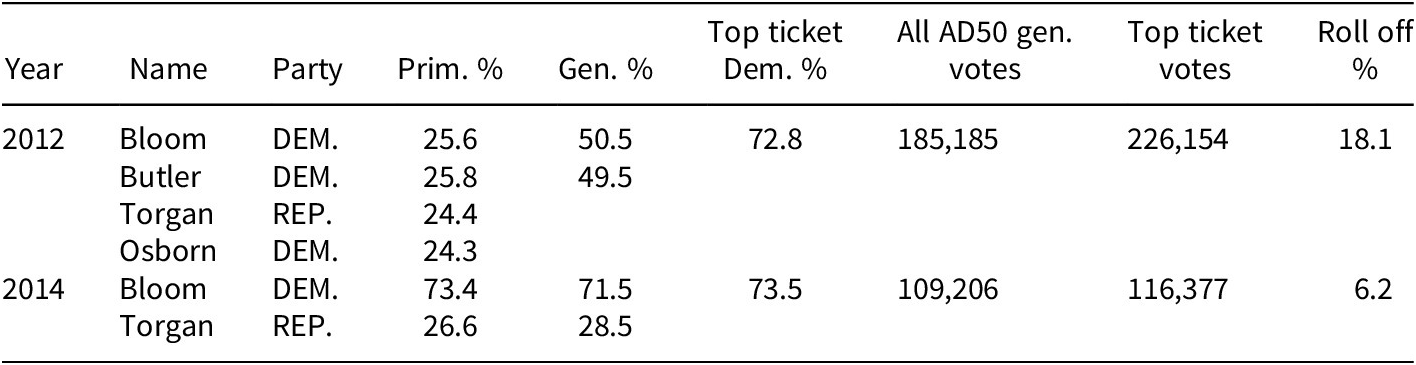
As described in Alvarez and Sinclair (Reference Alvarez and Sinclair2015) and shown in Table 1, three Democrats and one Republican split the June 2012 AD50 primary vote. Although incumbent Democrat Betsy Butler came in first, Democrat Richard Bloom narrowly beat Republican Brad Torgan for second place. In November, reversing the order from the primary, Bloom beat Butler in a competitive election, a contest requiring both candidates to fight hard for every vote. Yet, the concerns Fisk (Reference Fisk2020) and Patterson (Reference Patterson2020) raise about roll-off manifested themselves in this election, too: Bloom and Butler, combined, had 18% fewer general election votes than did the candidates in the presidential election.
California’s 50th Assembly District, 2012 and 2014

In 2014, Torgan returned to challenge Bloom, providing a sense of what might have happened in 2012 if Torgan had won only a very small number of additional primary votes and advanced. With party labels now distinguishing the candidates, Bloom won with approximately the party’s presidential vote share, although roll-off (from the 2014 gubernatorial vote) was smaller, at only about 6%. Having a same-party general election in 2012, in terms of competitiveness between candidates, likely shifted AD50 from a landslide to a coin flip.
Not every same-party general election is competitive, but facing a copartisan candidate in a safe seat amounts to the only way such elections can be close. Figure 1 illustrates the complete absence of any competitive safe-seat cross-party general elections in the decade before or after the adoption of the top-two. District partisanship in Figure 1 is the Republican presidential vote share from 2008 (for 2002 to 2010) or 2012 (for 2012 to 2020). After 9/11, a few Republicans won just inside the “Democratic” side, and Democrats made advances in marginal Republican seats in the Trump era, but those are exceptions that prove the rule: district winners typically get within a few percentage points of their party’s presidential vote share. The same-party general elections with the top-two break this trend. A regression estimating winner’s vote share (see Supplementary Appendix 1) emphasizes that the competitiveness of same-party elections does not depend on the district’s partisan composition, controlling for open seats, write-in opponents, and the election year.
Winner’s general election vote share, California state legislative and US House elections, 2002 to 2020.

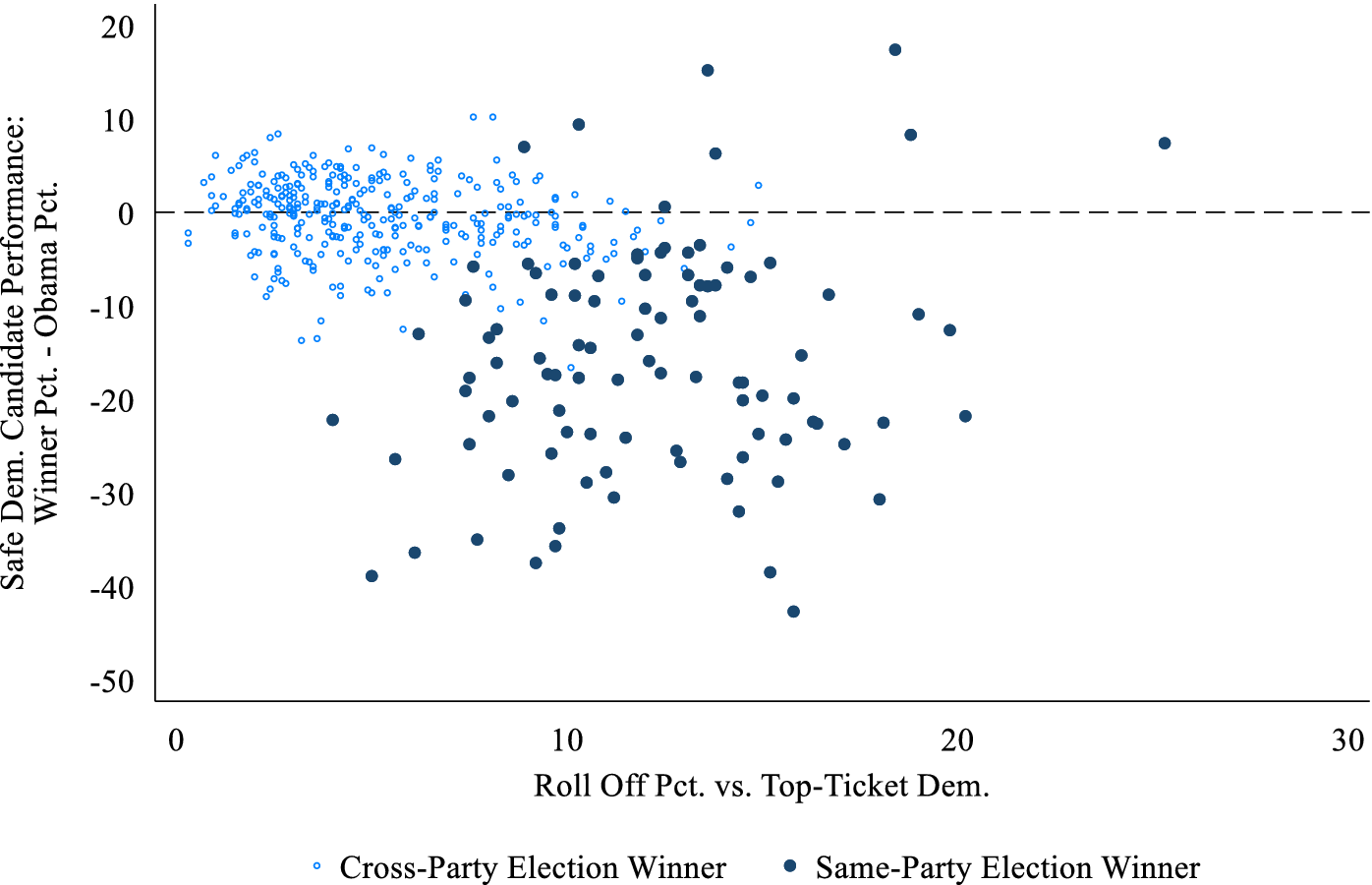
The safe-seat general election competitiveness arises directly from the same mechanism creating the roll-off. Figure 2 plots competitiveness and roll-off in safe Democratic seats from 2012 to 2020 (safe: 2012 Republican presidential vote share under 40%). The y-axis is a candidate performance measure, subtracting President Obama’s 2012 presidential two-party vote share from the winning Democrat’s vote share. For most cross-party elections, this difference is small and close to zero. In contrast, some of the same-party general elections have a 20 or 30-point gap, with the vast majority below the Obama percentage. The x-axis displays roll-off percentages, compared to participation in the district’s top-of-ticket election each year. While there is some roll-off for nearly all elections, it is greater for the same-party contests: the typical roll-off for same-party elections corresponds with some of the most extreme roll-offs in cross-party elections. An increase in competition could justify the decreases in participation, even if this was the only perspective on it; nevertheless, in the next section, we turn to a concept that uses both the primary and general election stages to examine participation from a different angle.
General election competition and roll-off.
Note: This figure displays the difference between the Democratic winner’s vote share and Obama’s 2012 vote share, as well as the percentage decline of participation relative to district top-of-ticket voting in California legislative and US House districts from 2012 to 2020 with at least two candidates and a Republican vote share under 40%.

The general is the primary
V.O. Key’s famous observation of the American South of the 1940s – in many districts, the primary “is in reality the election” – holds true in many places today (Key Reference Key1984, 407). Primary elections are venues for an electoral link “in the cases that matter most,” open seats without meaningful cross-party competition (Hirano and Snyder Jr. Reference Hirano and Snyder2019, 2). The top-two does much the same, but with a twist: when two candidates of the same party advance, the general election takes on the significance of the traditional partisan primary election, choosing the ultimate winner among the candidates of the dominant party. The findings about roll-off (Figure 2) should be set in this context. For the participatory cost to be truly a trade-off, the roll-off must be so severe that fewer participants make the ultimate (meaningful) choice. In fact, the top-two nets greater participation despite the roll-off in the most relevant election.
For this analysis, we focus on safe Democratic seats – a majority of California legislative elections, seats like AD50 in our motivating example. From 2002 to 2010, 463 of 765 Assembly, Senate, and US House elections (61%) took place in districts with a 2008 Republican presidential vote share under 40%. Democrats won 457 of them (99%).Footnote 3 These winners made up 95% of the total Democrats elected in this period for these offices. From 2012 to 2020, safe Democratic seats – using the 40% Republican threshold, but from 2012 – covered 442 of 765 Assembly, Senate, and US House elections (58%). Democrats won them all, including every AD50 election in these years. Despite the redistricting commission and Democratic advances into Republican areas later in the decade, these victories still comprise 79% of all Democrats elected to these offices.
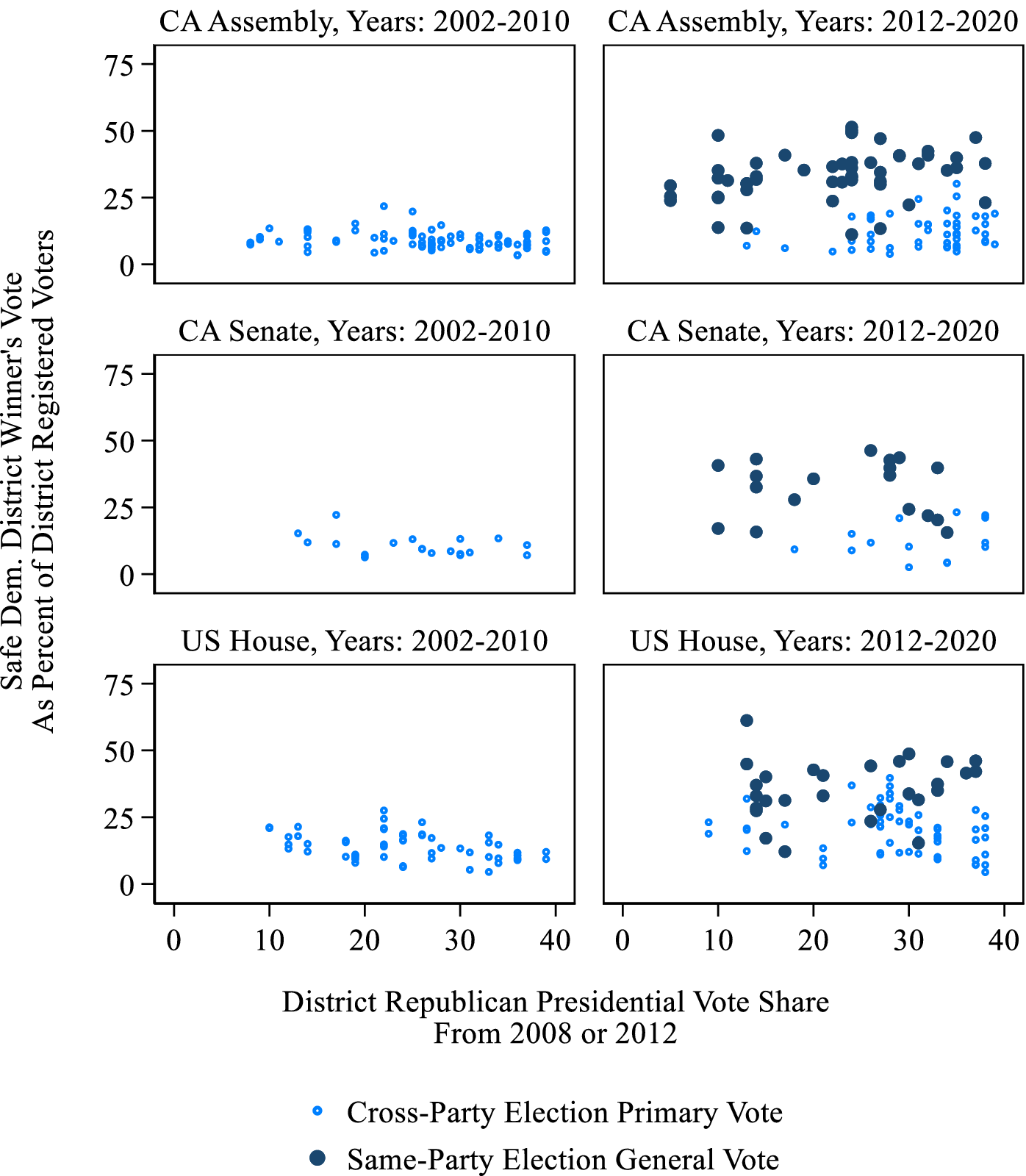
We examine the “last-Democrat” elections, in which the Democratic winner defeated the final alternative Democrat. In the partisan primary era, this had to be in the primary. In the top-two era, it could be either the primary or general election. In our AD50 example, Richard Bloom did not defeat the last Democrat until the general election in 2012. To measure coalition size across contexts, we examine the winner’s obtained share (total votes) out of the potential pool of voters (all registered voters). Figure 3 displays the results, ignoring, for the moment, uncontested elections.Footnote 4 The averages for the partisan primary era are quite low: Republicans were ineligible to participate in the Democratic primary, many independents did not, and turnout overall was not particularly high.
Democratic winner’s vote of district total registered voters, facing the last Democrat. State legislative or US House districts with a Republican presidential vote share under 40%.

Many elections are uncontested. Of the 457 Democratic safe-seat winners of the partisan primary era, 305 won 100% of the primary election vote. Since the general elections were foregone conclusions, many districts lacked any meaningful election. Even in contests with at least two Democrats, the partisan primary winners needed only tiny coalitions, with the average winner obtaining votes from about 11% of the district’s registered voters. Since not every election was vigorously contested, this also could be well above what was needed to win. Compared to this, it would be difficult for any alternative system to be worse, a fact all the more remarkable given the widespread disapproval voters directed at California government at the time.
In the top-two era, at least two Democrats ran in 227 of the 442 safe seats, resulting in 130 cross-party general elections and 97 copartisan general elections. Winners headed to cross-party general elections obtained a greater support share than did winners in traditional partisan primaries – on average, 16%, compared with 11%. While larger, the exact difference is not particularly important: what matters is that this equals or exceeds the partisan primary results. Comparing partisan primary results to the copartisan general elections reveals a much larger difference, as is apparent in Figure 3. Democratic winners in copartisan, often competitive, general elections obtain an average share of 34% of the support of the district’s registered voters. The proportion of registered voters supporting the ultimate winner in the final choice between Democrats is about three times greater with the top-two copartisan general elections than with the contested partisan primaries.
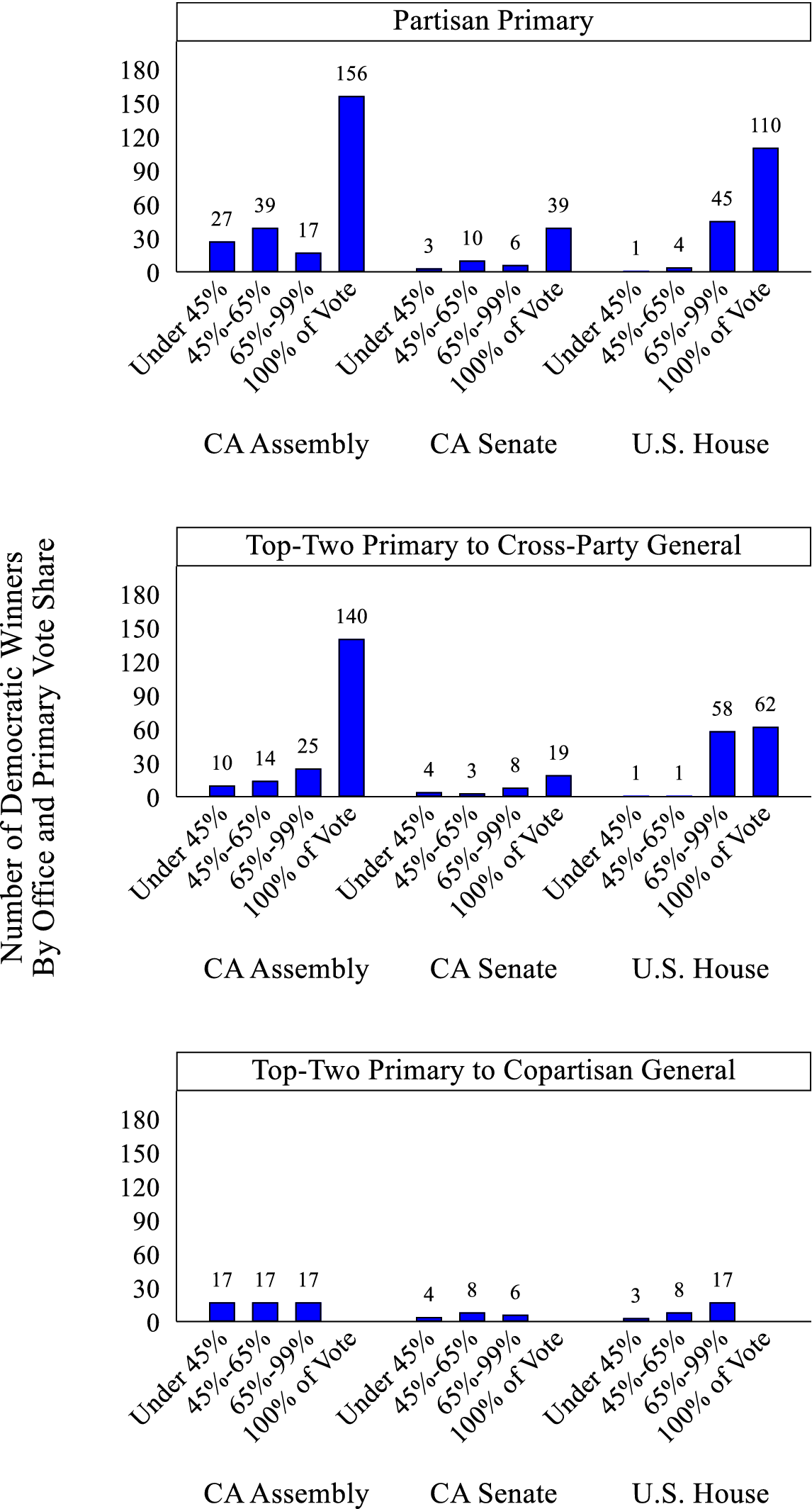
In the partisan primary era, meaningful elections were rare in safe seats. Figure 4 breaks down the contests by era, district, outcome type, and primary competitiveness. In only 53 of the 457 safe-seat Democratic victories from 2002 to 2012 did the winner obtain between 45% and 65% of the vote in the primary. As mentioned above, most were uncontested or not seriously in doubt, with the winner obtaining over 65% of the vote. Furthermore, in 31 elections, the winner earned under 45% of the primary vote. While those elections are more competitive, a split field shrinks the size of the required winning coalition, and deeply fractured fields also raise representational concerns.
Democratic winner’s primary Democratic vote share, in State legislative or US House. District Republican presidential vote share under 40%, 2002 to 2020.

After the reform, safe-seat Democratic winners obtained 100% of the vote for Democratic candidates in 50% (221 of 442)Footnote 5 of the elections, down from 67% (305 of 457) with partisan primaries. Furthermore, there are two other important differences associated with highly fractured fields. First, of the safe-seat contests that went on to feature cross-party general elections, the winning candidate earned under 45% of the vote in only 15 of the primaries. In the 24 cases with fractured fields resulting in same-party elections, the winner also had to win over 50% in the general election against another Democrat. Second, in 13 of those 24 same-party cases, the primary’s second-place Democrat overcame the first-place Democrat in the general election. Returning to the motivating example, Richard Bloom came in 2nd in 2012’s AD50 with only one-in-three primary votes for the Democratic candidates – but he won a majority of the votes cast in the higher-turnout general election.
The general election roll-off depicted in Figure 2 is notable and, as part of a holistic evaluation of the top-two, worth considering alongside the increase in competition displayed in Figure 1. Figures 3 and 4 reframe the question about participation, complicating the apparent trade-off between participation and competition. Viewed as a comparison about the winning Democrat’s coalition size, considering both the primary and the general election, it is possible that the top-two increases participation (evidence: larger winning coalitions in the ultimate choice between Democrats), despite the roll-off. Was it worth it, in AD50 in 2012, to have some roll-off in the general election in exchange for deciding between Bloom and Butler in the larger general electorate? There were 62,413 votes cast in the primary and 185,185 votes cast in the general election in that race, even with the roll-off. Behaviorally, since there is some uncertainty about precisely which voters will roll off, campaigns also have an incentive to try to win votes from all of the opposite-party coalition, as well, even if many of those voters ultimately stay home. Below, we argue that this result matters because party polarization has almost eliminated the possibility of cross-party accountability.
Polarization and political behavior
The close correspondence between district presidential vote share and legislative candidate vote share, as well as the close relationship between state and federal legislative election outcomes (see Figure 1 and Rogers Reference Rogers2023, 3), suggests that accountability typically must occur at the party level. Most voters will favor one party up and down the ballot, with somewhat idiosyncratic swing voters deciding close elections. This behavior presents challenges for a constitution defined by separation-of-powers and federalism; for meaningful individual officeholder accountability to operate, voters must be able to make decisions about individual candidates. Same-party general elections mean voters cannot simply default to party cues to decide between candidates.
While other studies have used regression discontinuity approaches to compare like cases and understand the impact of same-party contests (Crosson Reference Crosson2021; Patterson Reference Patterson2020), there is also a subset of top-two elections for which we already know a great deal about equivalence: elections with write-in finalists. In this period, no write-in candidate wins. They share the absence of a preexisting plan for ballot access. They have correspondingly fewer resources. They typically earn under 1% of the primary vote. The top-two, though, propels some of those write-ins to the general election ballot, where they have the same partisan cues printed as other candidates.Footnote 6 Write-ins can reveal the baseline voting behavior in the absence of long-planned and highly resourced campaigns.
Same-party general elections with a write-in candidate advancing from the primary are more competitive than cross-party elections featuring candidates originating as primary write-ins, even though cross-party write-ins obtain many times the vote they won in the primary. In most elections with write-in losers in the general election, the winning candidate obtains approximately the party’s presidential vote, just as shown in Figure 1; in the regression (Supplementary Appendix Table 1), the variable for “write-in” is insignificant, with only a small estimated coefficient. If voter behavior is largely a combination of uninformed partisan voting with some idiosyncratic noise, this is what we would expect to see: the write-ins do as well (or poorly) as the regular candidates in cross-party competition. Yet, same-party write-in contests result in comparatively more competitive elections even for established candidates. Although uninformed partisan vote in cross-party contests follows the party cue, uninformed and mostly random choice between two candidates of the same party has the consequence of tightening a same-party election, potentially empowering a smaller number of voters with more knowledge about specific candidate performance.
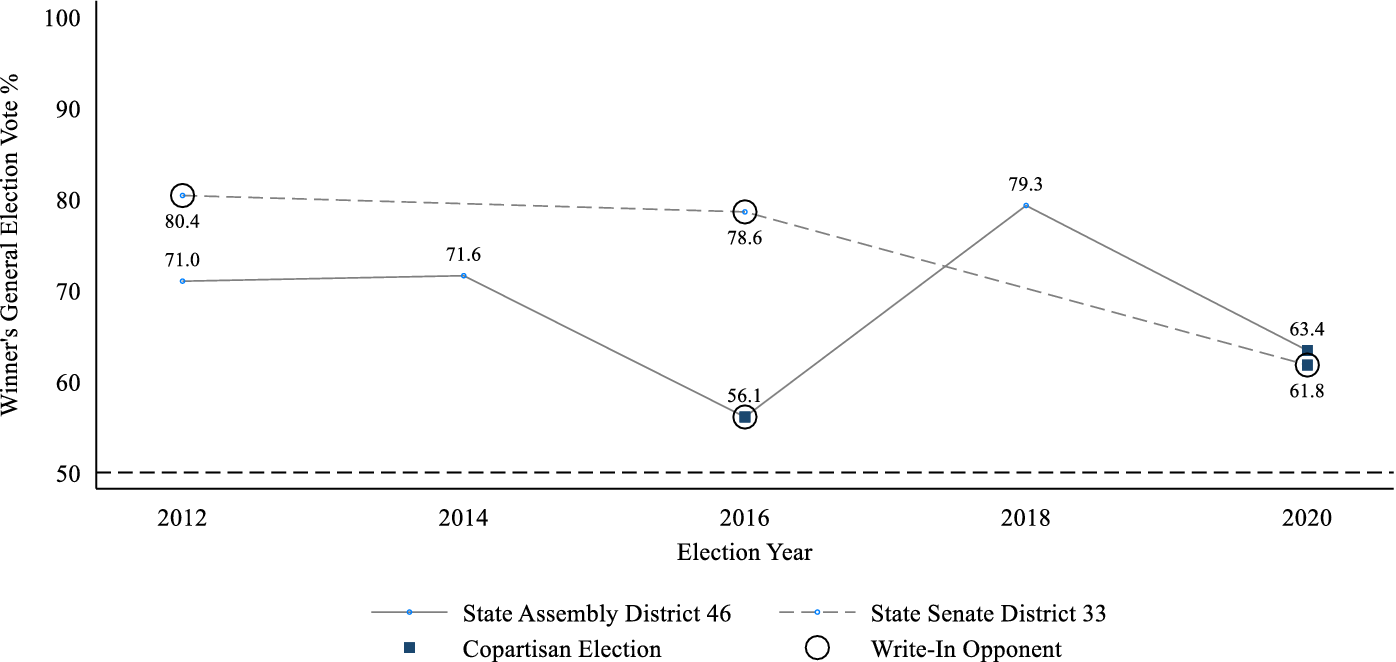
Two elections illustrate these dynamics: Democrat-on-Democrat contests in AD46 in 2016 and SD33 in 2020 (see Figure 5). Adrin Nazarian won every election in AD46 between 2012 and 2020. Yet, he had his lowest vote total in the 2016 same-party election against Angela Rupert. He won only 56% of the general election vote, despite Rupert only commanding 131 write-in primary votes and campaign finance reports indicating that he out-raised her $785,784.84 to $59,382.00 (California Secretary of State 2023). His second-lowest total came in a regular same-party contest in 2020; he won over 70% of the vote in his three cross-party elections. In SD33 in 2020, Lena Gonzalez had recently won a special election to take over a safe seat from Ricardo Lara. Against an opponent with merely 205 primary write-in votes, she obtained only 61% of the general vote, lagging around 20 points behind the Democratic presidential vote share. These results underscore that even strong candidates should take any same-party opposition seriously.
Winner’s vote share, CA AD46 and SD33, 2012 to 2020.
Note: The Democratic Party’s 2012 presidential vote share was 76% in AD46 and 80% in SD33.

Conclusion
American politics is experiencing a period of intense polarization. Most elections between Democrats and Republicans are decided down-ballot on party label alone, with individual candidates generally receiving a share of the vote proportional to their party’s top-of-ticket strength. The prospect for any kind of accountability in that environment, with many lopsided states comprised of lopsided districts, is remote. The exception in California comes from Democrat-on-Democrat general elections, a feature only possible due to the top-two rules. In these elections, some Republicans will not vote; yet, in the old partisan primaries, no Republicans were able to vote, and fewer Democrats and independent voters participated as well. The overall consequence of these Democratic copartisan elections is an increase in participation in the most consequential choice. While the debate about whether the top-two results in moderation continues, and is beyond the scope of these data, we demonstrate that these same-party elections bring some competition to places that otherwise would not have it. Winners must be accepted by a broad coalition and the potential for competitiveness means each member of the coalition is important. Larger coalitions made up of hard-to-replace members should result in a political process that increases public goods production (Bueno de Mesquita and Smith Reference Bueno de Mesquita and Smith2022).
These results are for California, but the issues extend to other types of nonpartisan systems where individual, instead of party-oriented, competitiveness provides the key to accountability. Elections in which at least two candidates carry the same party identification require voters to evaluate something else, and non-partisan structures can shift the most important choice into a higher-participation general election. Washington uses a very similar system to California, and Alaska recently adopted a top-four with ranked-choice voting. The roll-off with the top-two could be considered analogous to incomplete rankings with ranked-choice rules, and so this type of analysis could be deployed there after a few more cycles of elections establish a pattern in the results. As other states continue to consider alternative election systems, we hope that these findings encourage scholars to perform similar analyses. While ideological moderation remains a goal for many reform advocates, increased individual-focused competitiveness and participation in the most critical choice are also important outcomes.
Supplementary material
The supplementary material for this article can be found at http://doi.org/10.1017/spq.2025.10007.
Acknowledgments
The authors would like to thank the Rose Institute of State and Local Government at Claremont McKenna College and CMC’s Summer Research Program for supporting work on the project.
Competing interests
The authors declare none.
Author biographies
J. Andrew Sinclair is an Assistant Professor of Government at Claremont McKenna College and a faculty affiliate of CMC’s Rose Institute of State and Local Government. He completed his PhD at the California Institute of Technology in 2013.
Ian O’Grady graduated from Claremont McKenna College as a Philosophy, Politics, and Economics major in 2015. As a Marshall scholar he completed an MPhil in Politics at Oxford University and remains affiliated with CMC as a Rose Institute Alumni Research Fellow.
Bryn Miller graduated from Claremont McKenna College as an International Relations major in 2019 and remains affiliated with CMC as a Rose Institute Alumni Research Fellow.
Catherine M. Murphy graduated from Claremont McKenna College after majoring in Government and International Relations in 2024. She also remains affiliated with CMC as a Rose Institute Alumni Research Fellow.



 Open access

