

Introduction
The application of ancient DNA data is currently undergoing fundamental change. From the initial interest of identifying large-scale population histories (Fernandez et al. Reference Fernandez, Pérez-Pérez and Gamba2014; Haak et al. Reference Haak, Lazaridis and Patterson2015; Hofmanova et al. Reference Hofmanova, Kreutzer and Hellenthal2016; Olalde et al. Reference Olalde, Brace and Allentoft2018; Reference Olalde, Mallick and Patterson2019; Papac et al. Reference Papac, Ernée and Dobeš2021), there is now an increasing trend in providing period-, region- and site-specific narratives addressing social relations at a smaller scale, notably centred on kinship (Booth et al. Reference Booth, Brück, Brace and Barnes2021; Fowler et al. Reference Fowler, Olalde and Cummings2022; Knipper et al. Reference Knipper, Mittnik and Massy2017; Mittnik et al. Reference Mittnik, Massy and Knipper2019; Rivollat et al. Reference Rivollat, Rohrlach and Ringbauer2023; Seersholm et al. Reference Seersholm, Sjögren and Koelman2024) and social inequality (Cassidy et al. Reference Cassidy, Maoldúin and Kador2020; Rivollat et al. Reference Rivollat, Thomas and Ghesquière2022). These developments are pushing archaeologists to be much clearer about how social processes in the past operated. In particular, the incorporation of aDNA into narratives about power deserves further consideration, if we are not to repeat patterns already critiqued for earlier aDNA studies. These include an insufficient awareness of traditions of interpretation in archaeology; an elision of key details of archaeological context; and a tendency to emphasize the spectacular, rather than engaging fully with the complexity of the evidence (Blakey Reference Blakey2020; Booth Reference Booth2019; Brück Reference Brück2021; Brück & Frieman Reference Brück and Frieman2021; Crellin & Harris Reference Crellin and Harris2020; Eisenman et al. Reference Eisenman, Bánffy and van Dommelen2018, 6–7; Ensor Reference Ensor2021; Ensor et al. Reference Ensor, Irish and Keegan2017; Frieman & Hofmann Reference Frieman and Hofmann2019; Frieman et al. Reference Frieman, Teather and Morgan2019; Furholt Reference Furholt2018; Reference Furholt2019; Reference Furholt2020; Hakenbeck Reference Hakenbeck2019; Jones & Bösl Reference Jones and Bösl2021). Thus, although aDNA methodologies are now robustly and rigorously applied and their results show exciting relational connections between biological kin, the full potential of aDNA data to inform us about the past is not yet realized (see also Smyth et al. Reference Smyth, Carlin and Hofmannin press a).
To contrast with approaches to date, we illustrate in this paper the richer possibilities of integrating biomolecular data with fine-grained archaeological data, even when these are complex and non-contiguous. We do so with reference to Neolithic Ireland (Table 1), focusing from the outset on the relevant archaeological evidence, especially for mortuary practices and megalithic monuments, rather than less immediately relevant strands like historical or ethnographic parallels. We summarize the findings from genetic investigations of Neolithic Ireland and Britain, focusing on a recent aDNA study by Cassidy et al. (Reference Cassidy, Maoldúin and Kador2020) which claimed—to significant media attention—the existence of a dynastic hereditary network, that is, a series of leaders from the same elite family who had restricted access to ‘burial’ in passage tombs during the latter part of the fourth millennium bc and beyond (Cassidy Reference Cassidy2020; Reference Cassidy, Whittle, Pollard and Greaney2023). Here, we present an alternative interpretation that takes fuller account of the archaeological and genetic evidence to argue that the deposition of human remains within passage tombs was not primarily driven by biological connections (see also Smyth et al. Reference Smyth, Carlin and Hofmannin press a). Instead, the genetics indicate the emergence of more expansive forms of relatedness, spanning ever-greater parts of the island during the fourth millennium bc, that were enabled and reflected by the construction, use and modification of these monuments.
Chronology for Neolithic Ireland used in the text.

Accessing the dead: where do aDNA samples come from?
Unlike contemporary genetic research which studies living populations, aDNA analysis relies on accessing unburnt human remains from archaeological contexts. The availability of this material is constrained by a variety of cultural and taphonomic factors, each particular to different places and times, which influence the results of such analysis. In Neolithic Ireland, there is little evidence for human remains from settlement or domestic contexts (Smyth Reference Smyth2014; Reference Smyth, Barclay, Field and Leary2020), though some come from caves and pits (Dowd Reference Dowd2015; Dowd et al. Reference Dowd, Lynch and Cassidy2020; Smyth Reference Smyth, Anderson-Whymark and Thomas2012). The inhumed child burials from around the settlements at Lough Gur remain unique (Cleary Reference Cleary1995; Reference Cleary2018, 95–100; Grogan & Eogan Reference Grogan and Eogan1987; Ó Ríordáin Reference Ríordáin1954). Acidic soils across large parts of the island also affect the survival of inhumed unburnt bone (Cooney Reference Cooney2023, 33 & 120). This means that most Neolithic human bone recovered in Ireland has been partially protected, either through the cremation process and/or by deposition within megalithic monuments.
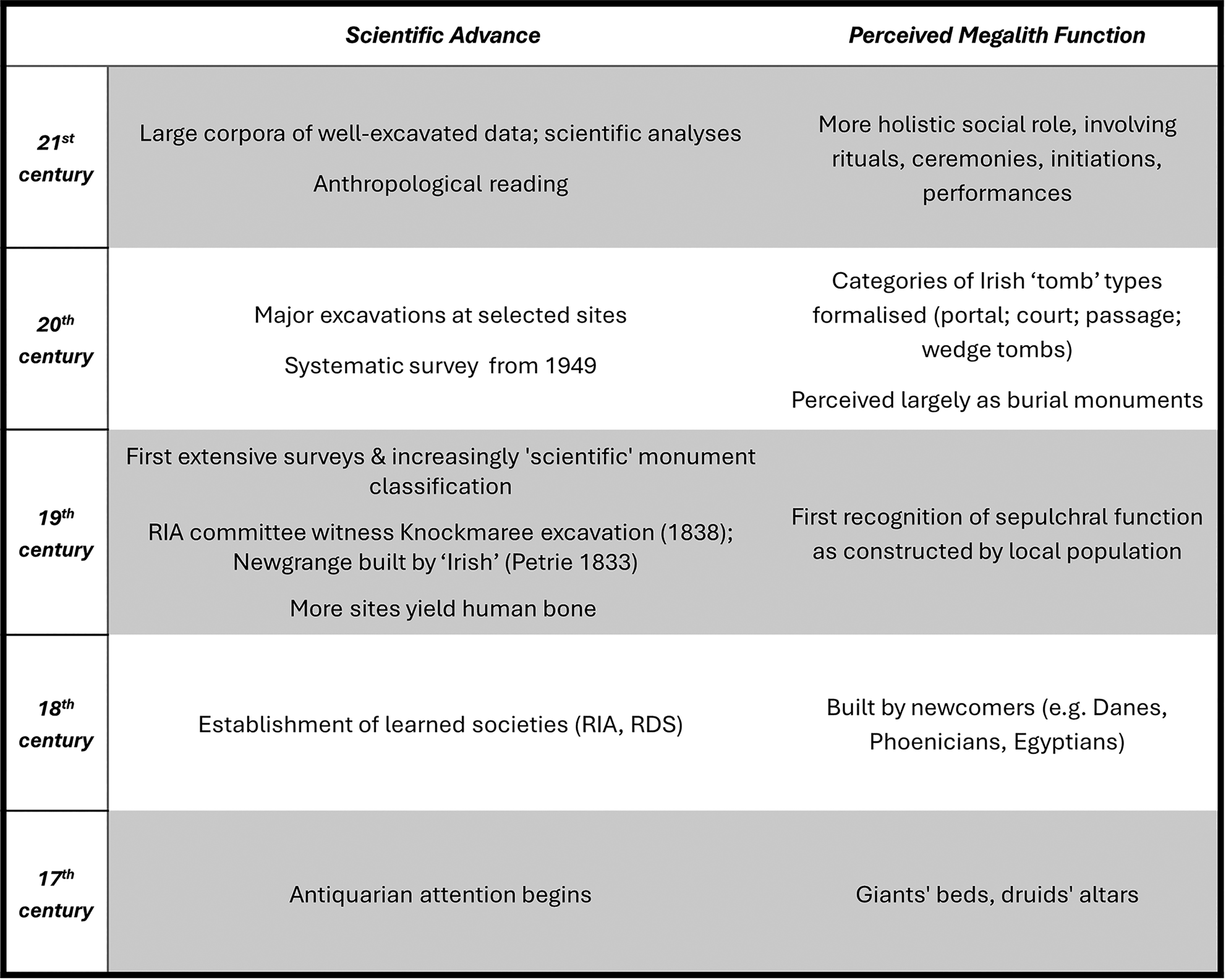
Megalithic monuments, in turn, are not simply seen as containers for ‘burials’, and it is important to trace how understandings of these sites have emerged (Fig. 1). Their upstanding and frequently imposing remains have been the focus of antiquarian attention from at least the seventeenth century, and variously interpreted as the beds of fleeing heroes, burial places of giants, or edifices of the ‘Danes’ (Jones Reference Jones2007; Waddell Reference Waddell2005). In the earlier nineteenth century, as more sites yielded human bone, we see increasing consensus that even the smaller, more denuded monuments were not druids’ altars but sepulchral chambers (McGuinness Reference McGuinness2010). This occurred alongside growing recognition of local input into their construction, rather than recent newcomers such as ‘the Danes’ (e.g. Petrie Reference Petrie1833), even if named creators were still occasionally plucked from mythology (Betham Reference Betham1838/40). The subsequent turn to a more ‘scientific’ view of megaliths in the late nineteenth century led antiquarians to concentrate on describing, classifying and comparing monuments, with the first extensive surveys undertaken in the 1880s and 1890s (Borlase Reference Borlase1897; Wood-Martin Reference Wood-Martin1888). Systematic survey appeared in the mid twentieth century with the work of the Megalithic Survey, commencing in 1949 and overseen by the Ordnance Survey of Ireland (e.g. de Valéra & Ó Nualláin Reference de Valéra and Nualláin1961). This work formalized the now traditional categories of Irish megalithic tomb ‘types’—portal tomb, court tomb, passage tomb and wedge tomb. Most recent archaeological thinking, informed by an increasingly large corpus of well-excavated data and the results of scientific analysis, recognizes that these ‘tombs’ served multiple purposes including rituals, ceremonies, initiations and performances (e.g. Cooney Reference Cooney2023, 135–8; Cummings & Richards Reference Cummings and Richards2021; Hensey Reference Hensey2015; McFadyen Reference McFadyen2006).
A timeline of megalith studies in Ireland.
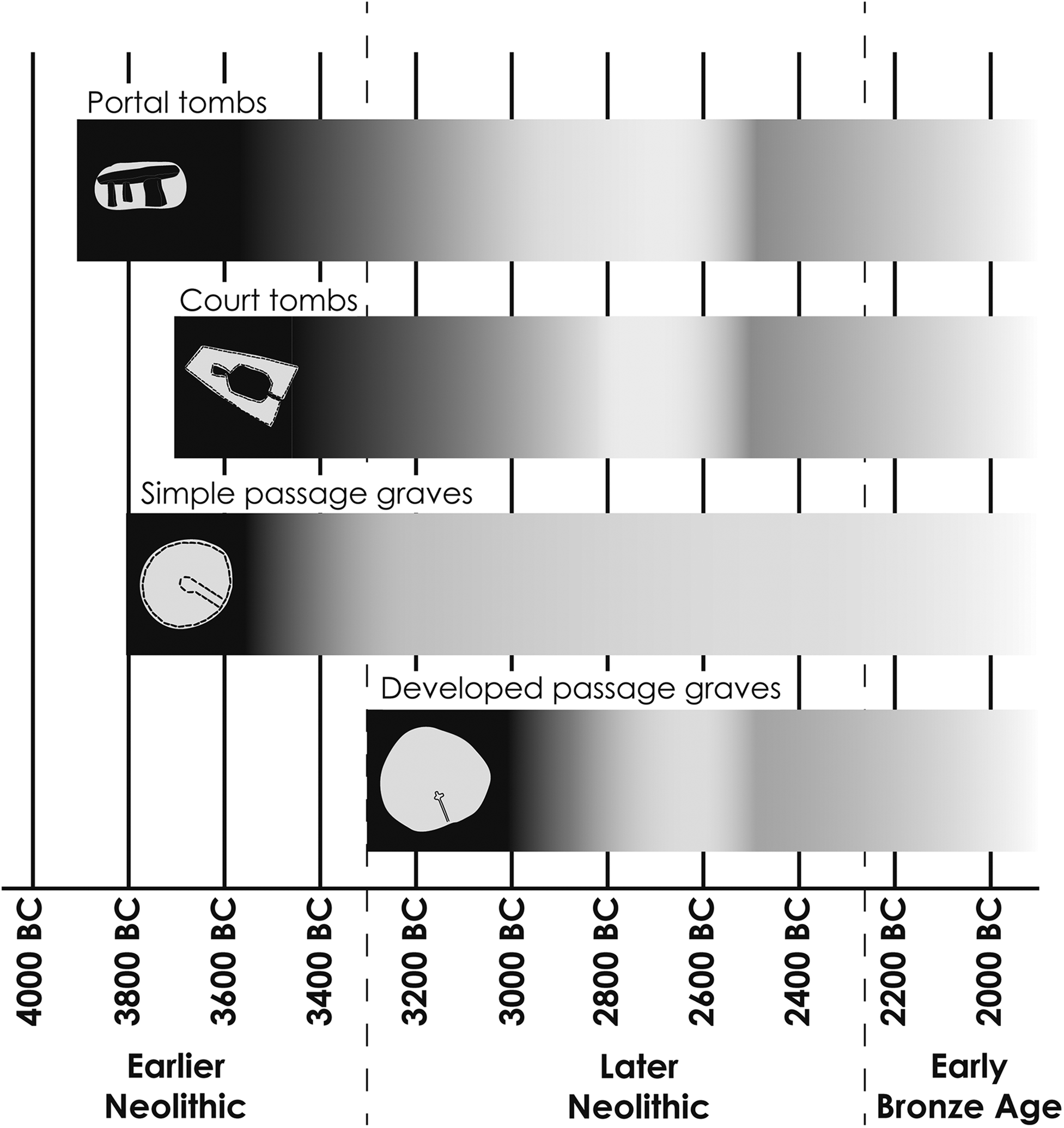
Traditional megalithic monument ‘types’ were in part based on a presumed sequence of construction and use by distinct social groups (e.g. Herity & Eogan Reference Herity and Eogan1977). However, their chronological distinctiveness has been substantially blurred with the widespread adoption of AMS radiocarbon dating and more source-critical sample selection showing significant chronological overlaps between them (e.g. Bayliss & O'Sullivan Reference Bayliss, O'Sullivan, O'Sullivan, Scarre and Doyle2013; Cooney et al. Reference Cooney, Bayliss, Healy, Whittle, Healy and Bayliss2011; Whitehouse et al. Reference Whitehouse, Schulting and McClatchie2014). Extensive dating of human and animal bone and teeth from the portal tomb at Poulnabrone, Co. Clare (Cassidy et al. Reference Cassidy, Maoldúin and Kador2020, SI1; Lynch Reference Lynch2014) provides the earliest evidence so far of Neolithic mortuary activity, seemingly confirming this monument type as the earliest form to appear on the island, c. 3880–3700 cal. bc. However, deposition of human and animal remains at Poulnabrone stretches into the thirty-fourth and thirty-third centuries cal. bc.
Similarly, recent dating of archive material now shows that passage tombs emerge as early as c. 3750 cal. bc (Bergh & Hensey Reference Bergh and Hensey2013; Eogan & Cleary Reference Eogan and Cleary2017; Hensey Reference Hensey2015; Schulting et al. Reference Schulting, Bronk Ramsey, Reimer, Eogan, Cleary, Cooney and Sheridan2017a), overlapping with the initial use of court tombs between 3700 and 3560 cal. bc (95 per cent probability; Schulting et al. Reference Schulting, Murphy, Jones and Warren2012, fig. 9). Another Neolithic mortuary tradition, the so-called ‘Linkardstown-type’ tombs, comprise large earthen mounds over a central stone cist containing one to four unburnt mostly male bodies (articulated or disarticulated), occasionally with children and cremated remains (Brindley & Lanting Reference Brindley and Lanting1989/90; Cooney Reference Cooney2000, 97; Reference Cooney2023). These are often accompanied by a single highly decorated pottery vessel and occasional additional items, such as bone toggles or shell necklaces. Only 10–12 examples—mostly in the east and southeast of the island—have been identified to date, compared to the approximately 230 passage tombs recorded (Hensey Reference Hensey2015), and are modelled as probably emerging 3710–3560 cal. BC (68 per cent probability; Cooney et al. Reference Cooney, Bayliss, Healy, Whittle, Healy and Bayliss2011, 637, fig. 12.44). This leaves us with a scenario of potentially three or four very different funerary traditions in use on the island at the same time (Fig. 2). Only between 3300 and 3000 bc do the now famous monuments at Newgrange, Knowth and Dowth appear, part of what is termed the ‘developed’ phase of the passage-tomb tradition (Bayliss & O'Sullivan Reference Bayliss, O'Sullivan, O'Sullivan, Scarre and Doyle2013; Cooney Reference Cooney2000; Hensey Reference Hensey2015; Schulting Reference Schulting2014a; Schulting et al. Reference Schulting, Bronk Ramsey, Reimer, Eogan, Cleary, Cooney and Sheridan2017a,Reference Schulting, McClatchie, Sheridan, McLaughlin, Barratt and Whitehouseb; Sheridan Reference Sheridan1986). The similarly dated sites of Ballynahatty and Millin Bay, both in Co. Down, display clear ‘developed’ passage tomb traits in terms of architecture, pecked art motifs and pottery types, but here human remains were deposited in sub-surface stone structures alongside above-ground settings (Collins & Waterman Reference Collins and Waterman1955; Hartwell et al. Reference Hartwell, Gormley, Brogan and Malone2023; MacAdam Reference MacAdam1855; Murphy Reference Murphy2003).
Date ranges for the construction and intensity of use (represented by shading) of the major megalithic traditions in Neolithic Ireland.
Mortuary practice at Irish megalithic monuments
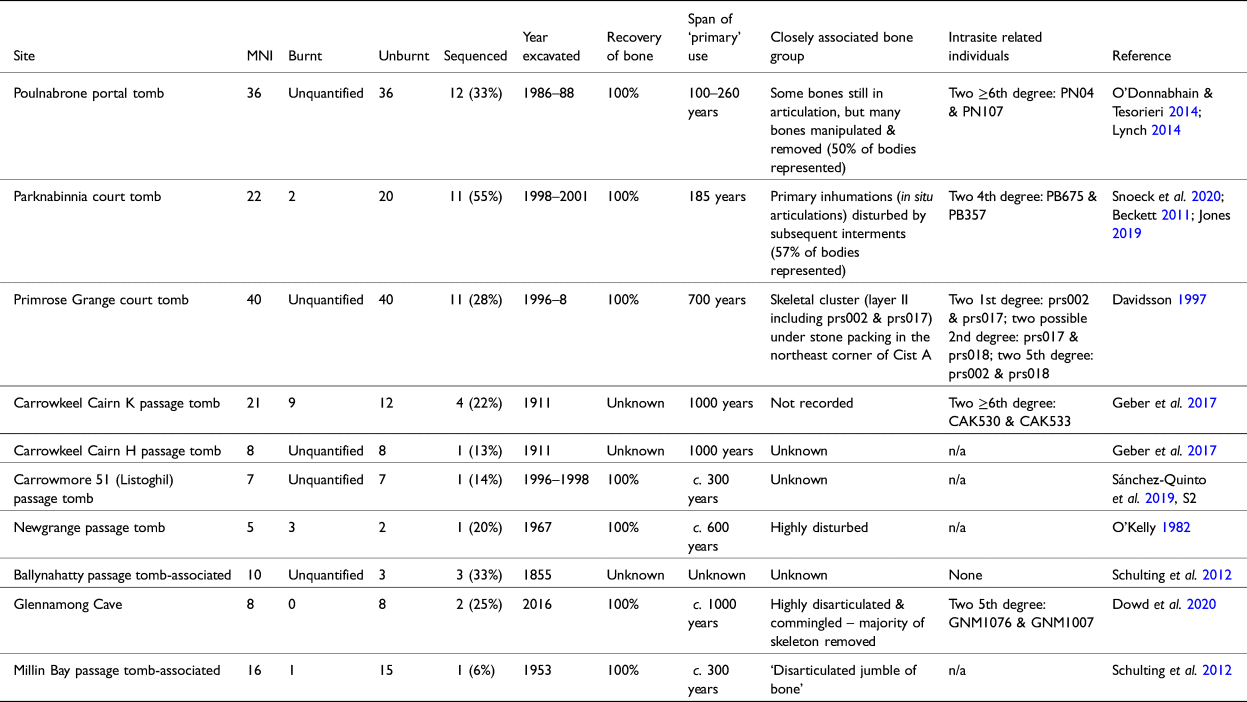
Just as our understanding of megalithic monuments has become more nuanced, so too has our appreciation of the treatment of human remains at these sites. Once barely recorded in publications, cremated bone is now recognized as a key component, alongside unburnt bone, in portal, court and passage tombs in the Irish Neolithic (Cooney Reference Cooney, Brophy and MacGregor2016; Reference Cooney, Eogan and Cleary2017; cf. Cooney Reference Cooney2023, 120). Notwithstanding that human remains from some tombs may not have been fully recovered during excavation or are now undergoing modern osteological (re)analysis (Smyth et al. Reference Smyth, Geber, Carlin, Cummings, Hofmann, Iversen and Bjørnevad-Ahlqvistin press b), the proportions of cremated to unburnt bone seem to vary from site to site, with cremated bone generally dominating in passage tombs (see Table 2). Both burnt and unburnt human bone of adults and children was certainly deposited contemporaneously and in combination (e.g. Kuijt & Quinn Reference Kuijt, Quinn and O'Sullivan2013; Schulting et al. Reference Schulting, Bronk Ramsey, Reimer, Eogan, Cleary, Cooney and Sheridan2017a), but we do not yet fully understand the possible taphonomic bias imposed by acidic soils and the complex processes of transforming bodies into bones.
Varying ratios of cremated to unburnt bone at various passage tombs.

Nevertheless, it is clear that multi-stage activities (excarnation, dismemberment, disarticulation and cremation) were conducted at many locations prior to the eventual deposition of some bones in tombs, often resulting in large, commingled deposits of whole and fragmented human remains (Beckett Reference Beckett2011; Beckett & Robb Reference Beckett, Robb, Gowland and Knüsel2006; Cooney Reference Cooney2000; Reference Cooney, Eogan and Cleary2017; Fowler Reference Fowler2010; Geber et al. Reference Geber, Hensey, Meehan, Moore and Kador2017; Kador et al. Reference Kador, Cassidy, Geber, Hensey, Meehan and Moore2018; Kuijt & Quinn Reference Kuijt, Quinn and O'Sullivan2013; Murphy Reference Murphy2003; O'Donnabháin & Tesorieri Reference O'Donnabháin and Tesorieri2014; O'Sullivan Reference O'Sullivan2005). Radiocarbon dates from multiple sites show that this deposition extended over a few centuries at least (Bayliss & O'Sullivan Reference Bayliss, O'Sullivan, O'Sullivan, Scarre and Doyle2013; Bergh & Hensey Reference Bergh and Hensey2013; Schulting Reference Schulting and Lynch2014b; Schulting et al. Reference Schulting, Bronk Ramsey, Reimer, Eogan, Cleary, Cooney and Sheridan2017a,Reference Schulting, McClatchie, Sheridan, McLaughlin, Barratt and Whitehouseb). Further interaction with these human remains continued within tombs like Poulnabrone for centuries (e.g. Becket Reference Beckett2011; O'Donnabháin & Tesorieri Reference O'Donnabháin and Tesorieri2014; Cooney Reference Cooney2023). As bodies may have been disarticulated before cremation (e.g. Cooney Reference Cooney and Carlin2017), a key outstanding issue is whether bone from the same individual was processed in different ways, i.e. a portion cremated and a portion remaining unburnt. This has been argued for human remains at Fourknocks I, where unburnt skulls and long bones were placed within spreads of cremated bone (Hartnett Reference Hartnett1957, 269; cf. Cooney Reference Cooney and Carlin2017, 403). Purposefully placed unburnt skulls and long bones have also been recorded at other sites, e.g. at Millin Bay (Collins & Waterman Reference Collins and Waterman1955) and Poulnabrone, where skulls seem to have been removed from bodies and placed against the chamber walls (O'Donnabháin & Tesorieri Reference O'Donnabháin and Tesorieri2014). The practice of placing unburnt skeletal elements into larger deposits of cremated bone continues into the first half of the third millennium bc, but almost exclusively within passage tombs (Carlin Reference Carlin2017).
The protracted and complex nature of funerary activities in the Neolithic, as well as post-depositional manipulation, means that we are left with an incomplete set of evidence likely representing only a fraction of the deposits from each tomb (Becket Reference Beckett2011; O'Donnabháin & Tesorieri Reference O'Donnabháin and Tesorieri2014; Robb Reference Robb2016). However, social practices can still be inferred. The ongoing deposition of human remains and the singling out of specific bones for special treatment (e.g. possible circulation of skulls), in conjunction with the way that many megaliths enabled continued access to these deposits, are generally accepted as indicating a strong concern with ancestral rites in the Irish Neolithic (see Barrett Reference Barrett, Barrett and Kinnes1988; Fowler Reference Fowler2010). The placement of human remains was not simply ‘burial’ (Cooney Reference Cooney2023, 135–8). Instead, their complex mortuary treatment implies an extended transition from life to death and a period when the deceased remained an active member of the community before and after deposition. What proportion of the community underwent this mortuary treatment remains unresolved (e.g. Bradley Reference Bradley2007; Quinn Reference Quinn2015; Whittle et al. Reference Whittle, Healy and Bayliss2011, 871–5), and may well have varied based on differing rites and practices (perhaps represented in different monumental forms), but some form of selection was undertaken to produce the low numbers of what have been termed the ‘visible dead’ (Bradbury & Scarre Reference Bradbury and Scarre2017). These selected individuals were clearly valued by society, although we do not know how such values were defined. It should not be automatically assumed that special was equivalent to high status, or that the status of the ‘visible dead’ as ancestors-in-circulation mirrored their relations in life (see Smyth et al. Reference Smyth, Carlin and Hofmannin press a).
Neolithic Ireland through the lens of genetics
In Ireland, analyses of ancient DNA have both confirmed prior knowledge on the Irish Neolithic, and provided important new information relating to people's genetic ancestry and biological relationships. Genomes have now been sequenced for at least 55 out of a possible Minimum Number of Individuals (MNI) of 140 (Tables 3 & 4) from a variety of funerary contexts in Ireland including caves, portal tombs, court tombs, Linkardstown-type and passage-tomb tradition monuments (Cassidy et al. Reference Cassidy, Martiniano, Murphy, Teasdale, Mallory, Hartwell and Bradley2016; Reference Cassidy, Maoldúin and Kador2020; Sánchez-Quinto et al. Reference Sánchez-Quinto, Malmstrøm and Fraser2019). The analysis of multiple individuals from some of these monuments has enabled micro-scale analyses of biological relationships, though this is partially impeded by both the character of the Irish evidence and the fact that some sites, especially passage tombs, only have aDNA information for one or two individuals (Tables 3 & 4). Direct radiocarbon dates on these individuals range broadly from 3800 to 2400 cal. bc (see Table 4). Most of these data were published by Cassidy et al. (Reference Cassidy, Maoldúin and Kador2020), with additional discussion in other publications (Cassidy Reference Cassidy2020; Reference Cassidy, Whittle, Pollard and Greaney2023; Dowd et al. Reference Dowd, Lynch and Cassidy2020; Kador et al. Reference Kador, Cassidy, Geber, Hensey, Meehan and Moore2018), and are based on sequencing whole genomes, rather than SNP capture which only targets a limited proportion of the genome (see Cassidy Reference Cassidy, Whittle, Pollard and Greaney2023, 154–6).
Quantities of multiple directly dated sequenced genomes and detected levels of confirmed relatedness from highly partial burial assemblages (based on Cassidy et al. Reference Cassidy2020; Sánchez-Quinto et al. Reference Sánchez-Quinto, Malmstrøm and Fraser2019).
The relatedness of ancient DNA samples from Neolithic Ireland arranged in chronological order. *=Measurements calibrated using OxCal v4.4 and IntCal20 (Bronk Ramsey Reference Ramsey2017; Reimer et al. Reference Reimer, Austin and Bard2020); measurements with error >25 years bp are rounded out to nearest 10.

One key finding is that the appearance of Neolithic things and practices, including monument building, cattle rearing and cereal cultivation in Ireland, coincided with the arrival of newcomers with ultimately Near Eastern genetic ancestry, who had intermixed with hunter-gatherers as they migrated across Europe. A similar pattern has been identified in Britain (Brace et al. Reference Brace, Diekmann and Booth2019; Olalde et al. Reference Olalde, Brace and Allentoft2018; Sánchez-Quinto et al. Reference Sánchez-Quinto, Malmstrøm and Fraser2019) and elsewhere in western and northwestern Europe (Allentoft et al. Reference Allentoft, Sikora and Refoyo-Martínez2024; Ariano et al. Reference Ariano, Mattiangeli and Breslin2022; Brunel et al. Reference Brunel, Bennett and Cardin2020; Rivollat et al. Reference Rivollat, Jeong and Schiffels2020; Seguin-Orlando et al. Reference Seguin-Orlando, Donat and Der Sarkissian2021), highlighting the key role of migrations in the Mesolithic/Neolithic transition. Neolithic newcomers to Ireland and Britain probably had little awareness of their Anatolian/Aegean genetic ancestry: analysis of their haplotypes reveals considerable homogeneity, suggesting they came to both islands from a range of similar source locations, probably in present-day northern France (Ariano et al. Reference Ariano, Mattiangeli and Breslin2022; Brace & Booth Reference Brace, Booth, Whittle, Pollard and Greaney2023, 125; Brace et al. Reference Brace, Diekmann and Booth2019; Cassidy Reference Cassidy, Whittle, Pollard and Greaney2023; Cassidy et al. Reference Cassidy, Martiniano, Murphy, Teasdale, Mallory, Hartwell and Bradley2016; Olalde et al. Reference Olalde, Brace and Allentoft2018). That the presence of distinctive ‘farmer’ genomes coincides with a decline in the genetic signatures typical of pre-existing ‘hunter-gatherer’ populations in Ireland has been seen as evidence of large-scale maritime colonization (Cassidy Reference Cassidy, Whittle, Pollard and Greaney2023, 148; Cassidy et al. Reference Cassidy, Maoldúin and Kador2020). However, important questions remain about the scale, suddenness, timing and impact of such movements, and ongoing interactions with ‘hunter-gatherers’ including gene-flow as indicated by an individual at Parknabinnia court tomb (see Brace & Booth Reference Brace, Booth, Whittle, Pollard and Greaney2023, 132; Carlin & Cooney Reference Carlin and Cooney2020a; Cassidy et al. Reference Cassidy, Maoldúin and Kador2020; Cummings et al. Reference Cummings, Hofmann, Bjørnevad-Ahlqvist and Iversen2022; Thomas Reference Thomas2022).
Kinship and society
While the genome is a powerful tool for revealing biological relationships, we do not know how family or kinship was defined throughout the Neolithic. Biological relations are not kinship facts and in many societies genetics, blood or biology are neither a determining nor necessary factor of relatedness (see Abel & Frieman Reference Abel and Frieman2023; Carsten Reference Carsten2004; Schneider Reference Schneider1984; Stone & King Reference Stone and King2019, 96). People actively make their kin through cultural practices conducted within the particular context of their society, such as caring for one another, gift giving, the sharing of substances and engaging in collective commensal practices, or living, working or burying the dead together (e.g. Brück Reference Brück2021; Brück & Frieman Reference Brück and Frieman2021). Johnston (Reference Johnston2020, 13–18) uses the concept of ‘kinwork’ drawn from feminist anthropology (di Leonardo Reference di Leonardo1987) to highlight how these activities constituted people as social beings with close relationships, personal identities and a sense of belonging. This is not to deny the existence of non-kin or wider forms of relational work beyond immediate kin, e.g. defining one's group against others. Kin relations play out in complex ways in the funerary sphere. Relationships may be affirmed, created, or broken through the rites and ceremonies surrounding the dead person (e.g. Brück Reference Brück2009), and the redefinition of that person's own relation to the living community is a regular feature of these rites (Parker Pearson Reference Parker Pearson1999). These processes include decisions about where and with whom to inter deceased kin and community members. Within some societies, a person may be returned to their natal community upon death and it cannot be assumed that those buried together were co-residents in life (see Ensor Reference Ensor2021, 12). Indeed, such movement of human remains after death would have been strongly facilitated by the mortuary practices associated with Irish megaliths (e.g. Brück Reference Brück2009). This illustrates how the funerary record is composed from aspects of life, rather than directly reflecting it, and was formed through complex practices that transformed a person into another state (such as becoming an ancestor).
As outlined above, megalithic tombs were one of the places where the dead and their relationships were transformed. Depositing human remains in these monuments thus enabled the creation and negotiation of kinship (e.g. Fleming Reference Fleming1972; Powell Reference Powell2005). At the Early Neolithic long barrow at Hazleton North in southern Britain, combined genetic and archaeological analysis showed that the majority of its occupants came from an extended, but closely biologically related group (i.e. a lineage: Fig. 3): four females who had children with the same male partner, and the immediate descendants of these women (Cummings & Fowler Reference Cummings and Fowler2023; Fowler Reference Fowler2022; Fowler et al. Reference Fowler, Olalde and Cummings2022). The monument's dual architectural layout played a key role in the organization of relationships between the human remains over a 100-year period. These were largely placed successively within various parts of the tomb in accordance with their descent from the four key females. However, at least eight non-lineage individuals were also included (Fig. 3), highlighting that while parentage and descent seem to have played a major role in the rites that structured funerary deposition at Hazleton North, biology did not dictate kin relations. These emerged instead from a range of social practices which are archaeologically and biologically invisible. Similarly, many of the burials within the Frälsegården passage tomb in Sweden were interred in particular locations based on their descent from a specific lineage (comprising two sub-lineages) spanning two centuries, though non-lineage individuals were also included (Seersholm et al. Reference Seersholm, Sjögren and Koelman2024).
Genetic genealogy of individuals interred at Hazelton North, with location of interment indicated by colour and dotted lines representing degrees of relatedness.
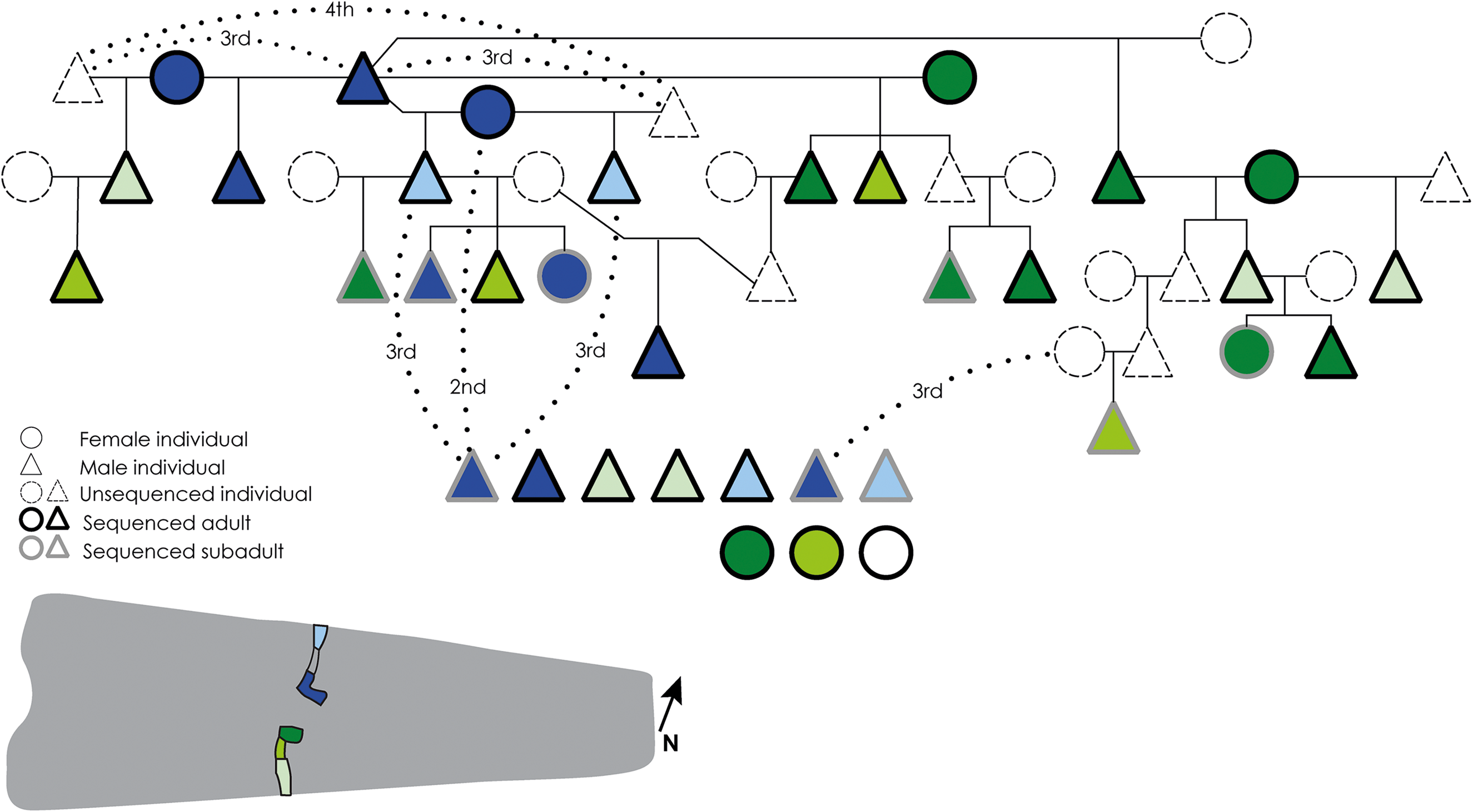
Broader patterns in male genetic relatedness have been used to infer an emphasis on patrilineal ancestry in the Irish Neolithic, i.e. that ‘burial’ in tombs was associated with descent from a paternal lineage, as argued elsewhere (e.g. Bentley et al. Reference Bentley, Bickle and Fibiger2012; Cassidy et al. Reference Cassidy, Maoldúin and Kador2020; Fowler et al. Reference Fowler, Olalde and Cummings2022; Rivollat et al. Reference Rivollat, Rohrlach and Ringbauer2023; Sánchez-Quinto et al. Reference Sánchez-Quinto, Malmstrøm and Fraser2019; Seersholm et al. Reference Seersholm, Sjögren and Koelman2024). Additionally, Cassidy et al. (Reference Cassidy, Maoldúin and Kador2020) observed that this was supported by the fact that the Y haplogroups (inherited from father to son) of the male interments from two neighbouring tombs, Poulnabrone and Parknabinnia, were distinct from one another and remained so over time. However, three of the eight Parknabinnia males did not belong to the dominant haplogroup in that tomb, so this male genetic homogeneity may just reflect patrilocality (Elliott et al. Reference Elliot, Saupe, Thompson, Robb and Scheib2022, 203) and evidence for descent from specific lineages (like at Hazleton or Frälsegården) is notably absent from Ireland. Overall, patrilineality likely was one of several factors (including matrilineality) that determined whose remains were interred, and need not correlate with other aspects of social structure, such as patriarchy (see critique in Brück Reference Brück2021; Fowler Reference Fowler2022, 71–2; Stone & King Reference Stone and King2019).
Biological relatedness in Neolithic Ireland
Importantly, where multiple genomes have been sequenced from Neolithic contexts in Ireland, studies have shown that most of the individuals buried together were not closely biologically related (Tables 3 & 4). This contrasts strongly with the findings from the well-preserved burial deposits of Frälsegården or Hazleton, but matches the general picture emerging from Britain, including Orcadian passage tombs (with their admittedly small sample sets), of people buried together not being closely related, especially in the Later Neolithic (Brace & Booth Reference Brace, Booth, Whittle, Pollard and Greaney2023, 138–9; Brace et al. Reference Brace, Diekmann and Booth2019; Olalde et al. Reference Olalde, Brace and Allentoft2018; Patterson et al. Reference Patterson, Isakov and Booth2022). Where such inter- or intra-site relations have been identified from Ireland, they are frequently distant (e.g. fifth degree or further: e.g. second cousins or a great-great-great grandparent) (Cassidy et al. Reference Cassidy, Maoldúin and Kador2020), rather than close genetic relationships (e.g. first to fourth degree: parents, children, siblings, grandparents/grandchildren, uncles or aunts or nieces and nephews, or first cousins). Some of these closer genetic relations might more plausibly have been known. Only a very small number of closely biologically related interments are currently known and these are exclusively of Earlier Neolithic date (see Figure 4 and Table 4). At Primrose Grange court tomb in county Sligo, individuals prs002 and prs017 were shown to be a father and daughter and another individual (prs018) was possibly a second-degree relative of prs017 (Sánchez-Quinto et al. Reference Sánchez-Quinto, Malmstrøm and Fraser2019). No such close genetic relationships were uncovered at the Early Neolithic portal tomb at Poulnabrone or the court tomb at Parknabinnia, even though a higher proportion of their total MNI was sampled compared to Primrose Grange. Indeed, each site featured closely associated bone-groups within comparatively well-preserved deposits, despite centuries of use (Table 3).
Biological kinship in Neolithic Ireland.
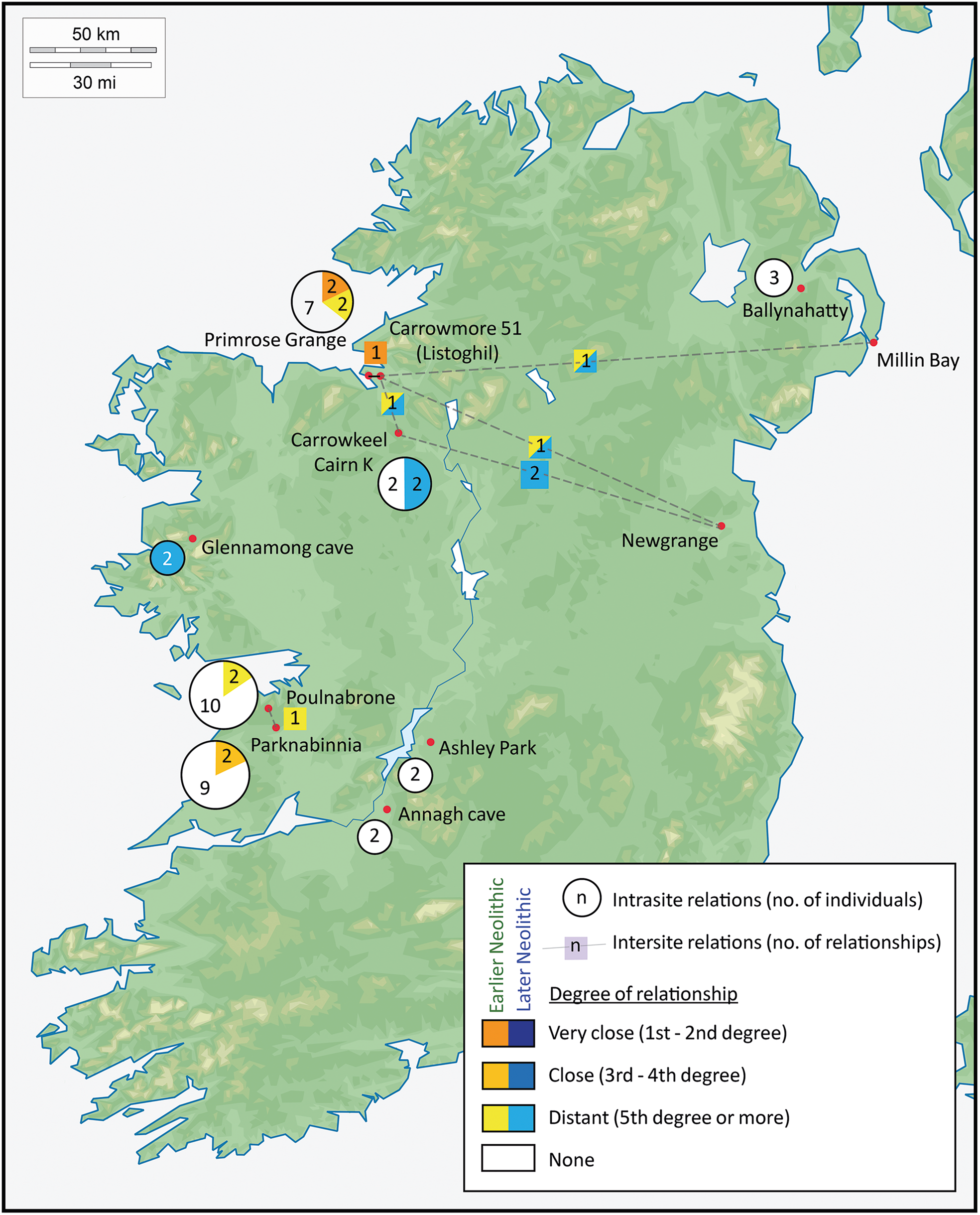
Post-3640 cal. bc, an individual (car004 dating between 3640 and 3380 cal. bc) from Listoghil, the large central passage tomb at the Carrowmore complex, was initially deemed related in the first or second degree to an individual (prs007, also dating between 3520 and 3360 cal. bc) from Primrose Grange, over two kilometres away (Table 4; Sánchez-Quinto et al. Reference Sánchez-Quinto, Malmstrøm and Fraser2019, 9472–3), although this could not be verified by Cassidy et al. (Reference Cassidy, Maoldúin and Kador2020, supp. info. 50). Increasingly distant biological relations (sixth degree or further: e.g. great-great-great grand uncle or aunt) were detected through analysis of IBD-segment-sharing—using the lcMLkin method (Lipatov et al. Reference Lipatov, Sanjeev, Patro and Veeramah2015)—between the male deposited at Listoghil (car004) and other bodies from passage-tomb-related contexts (Fig. 4): Newgrange (NG10), Millin Bay (MB6) and Carrowkeel (CAK533). These individuals have considerable geographic spread (up to 150 km apart) and date to different periods, with most post-dating 3300 cal. bc and the latest (CAK530) dated to 2800–2600 cal. bc, almost a millennium later than car004 (Cassidy et al. Reference Cassidy, Maoldúin and Kador2020). An adult male individual from Newgrange (NG10), represented by an unburnt cranial fragment found within the chamber, is the offspring of an incestuous union between either full siblings or a parent and child (Cassidy et al. Reference Cassidy, Maoldúin and Kador2020), which in itself is highly unusual given the lack of evidence for consanguinity across prehistoric Europe (Ringbauer et al. Reference Ringbauer, Novembre and Steinrücken2021). Dating to 3340–3020 cal. bc (95 per cent probability; OxA-36079, 4473±29), he lived at least two, and probably more, generations after the Listoghil male (car004). A similarly distant relationship was identified between NG10 and two individuals from Cairn K at Carrowkeel (CAK532 and CAK530), who probably died several generations later than NG10 (Cassidy et al. Reference Cassidy, Maoldúin and Kador2020, 386; Kador et al. Reference Kador, Cassidy, Geber, Hensey, Meehan and Moore2018). Interestingly, no first- or second-degree relatives were found among the four Later Neolithic samples from Carrowkeel Cairn K passage tomb, where two individuals (CAK530 and CAK533) were very distantly related (Table 4). A key question remains whether these detected levels of biological relatedness in passage-tomb tradition sites are truly representative. This is considered further below.
On the basis of the shared ancestry among these individuals, as determined by IBD analysis, Cassidy et al. (Reference Cassidy, Maoldúin and Kador2020) argue that they form a haplotypic cluster of individuals more closely genetically related to each other than the rest of the British and Irish Neolithic population (who had hitherto been genetically undifferentiated). This distinct cluster exclusively comprises individuals postdating c. 3640 cal. bc who were associated with the passage-tomb tradition in Ireland. While contemporaneous unburnt bones occur across all other tomb ‘types’ (including the neighbouring Poulnabrone and Parknabinnia monuments), as well as in caves, none of these form part of this distinct genetic cluster (see Table 4). Intriguingly, other passage-tomb tradition samples, all from Ballynahatty (BA64; BA342; BA346), do not form part of this cluster either, further suggesting that practices differed at this unusual site (Fig. 4).
Non-random mating and hereditary networks
This genetic clustering of distantly related individuals in passage tombs and related contexts (extending over considerable distances and spanning several generations or centuries) warrants consideration, not least because it has been claimed to represent ‘non-random mating’, indicating the existence of a dynastic hereditary network with restricted access to ‘burial’ in passage tombs from the latter part of the fourth millennium bc onwards (Cassidy Reference Cassidy, Maoldúin and Kador2020; Reference Cassidy, Whittle, Pollard and Greaney2023; Cassidy et al. Reference Cassidy, Maoldúin and Kador2020).
The first issue is the representativeness of the sample. It cannot be assumed that the sampled individuals in a study represent entire living populations (Booth Reference Booth2019, 588; Furholt Reference Furholt2019)—this is exemplified by genetic analysis of sites like Hazleton North which shows that some members of the local community were absent from that tomb (see Fig. 3). Past cultural practices, including funerary rites and reproductive choices, post-depositional histories and the vagaries of archaeological excavation and curation impact directly on the availability of suitable samples for genetic analysis (Frieman Reference Frieman2023, 59–60). As outlined above, most of the population received a funerary treatment that left no archaeological trace and cremations are dominant among the surviving human remains from Neolithic Ireland. Thus, a restricted sample of unburnt Neolithic material is available for genetic analysis, with only a subset of this sequenced.
As a single individual's genome contains a mosaic of information about several of their genetic ancestors, even a small number of aDNA samples provides insights into the ancestry of a much wider population (Booth Reference Booth2019, 588; Li & Durbin Reference Li and Durbin2011). Yet if groups only practising cremation (and/or other mortuary treatments that left little archaeological trace) rarely reproduced with those who practised inhumation, then they would not enter the genetic record. Such a scenario has been suggested for Chalcolithic Britain, with descendants of the Neolithic population persisting as a genetically invisible group (practising cremation) in parallel to newcomers (practising inhumation) from continental Europe, until changes in their mating network resulted in them reappearing in the genetic record some centuries later (Booth Reference Booth2019, 588; Booth et al. Reference Booth, Brück, Brace and Barnes2021, 381; Brace & Booth Reference Brace, Booth, Whittle, Pollard and Greaney2023). However, given that inhumation and cremation were both practised in combination and contemporaneously at passage tombs and other megalithic monuments in Ireland, this scenario is unlikely here.
The exclusion of Neolithic people whose bones do not form part of the current genetic record (for the various reasons outlined above) may partially account for the paucity of evidence for close genetic relatives. Additional sampling is needed to confirm this and may yet result in significantly increased detection of biological relations (e.g. Mittnik et al. Reference Olalde, Mallick and Patterson2023). However, such bias seems to be minimal because neither denser sampling of better-preserved deposits nor lower ratios of cremated:inhumed bone result in greater levels of biological relatedness (see Table 3), thereby suggesting that the consistently detected distant biological relatedness (fifth/sixth degree or further) across a random sample set from passage tombs or related contexts is genuinely representative of social practices at the time in Ireland.
If the deposition of human remains within passage tombs had been primarily biologically driven (as in a dynastic hereditary network), then we would expect to see many more genetic connections and close relatives (like at Frälsegården or Hazleton where lineage was emphasized), over the long timeframe of 3600–2500 cal. bc. Given the power of genome-wide sequencing to infer much of a person's overall ancestry (Booth Reference Booth2019, 3), it is striking that so little evidence for relatedness has yet been uncovered from passage tombs. For example, a recent aDNA study showed that one-third of samples from Ancient Greece were the product of first-cousin mating (Skourtanioti et al. Reference Skourtanioti, Ringbauer and Gnecchi Roscone2023). We do not know how close relations of the analysed individuals within passage tombs were treated after death because, thus far, they are entirely absent. This includes the passage tomb with the most analysed genomes, Carrowkeel Cairn K (n=4). Given the above, we cannot say that these tombs were the final resting-places of a dynastic lineage who restricted access to ‘burial’ within these tombs to their relatives, contrary to what has been argued by Cassidy et al. (Reference Cassidy, Maoldúin and Kador2020).
Yet there is certainly something non-random about the genetic relationships of people from passage tombs, even though this distant relatedness may not necessarily have been known or appreciated. Reproductive relationships with immediate and close biological relatives (e.g. first to fourth degree) were largely avoided, while those with non-closely related individuals who also used passage tombs were pursued. This matches the general picture for Neolithic Europe, where people predominantly reproduced with others sharing broadly similar cultural practices and genetic ancestry, but who were not close relatives (Booth et al. Reference Booth, Brück, Brace and Barnes2021; Brace & Booth Reference Brace, Booth, Whittle, Pollard and Greaney2023, 139; Brown Reference Brown2014). Nevertheless, it makes the Irish passage-tomb genetic cluster different from haplotypic groupings identified among other smaller island populations from Neolithic Malta and Orkney, where increased inbreeding and/or restricted population sizes (as indicated by high runs of homozygosity and higher levels of gene-sharing) have been detected (Ariano et al. Reference Ariano, Mattiangeli and Breslin2022; Ariano & Bradley Reference Ariano, Bradley, Whittle, Pollard and Greaney2023, 45). In contrast, Ireland had sizeable communities with extensive interaction networks (Cassidy et al. Reference Cassidy, Maoldúin and Kador2020, 385), which seem to be particularly focused on Britain, rather than the European continent (e.g. Allentoft et al. Reference Allentoft, Sikora and Refoyo-Martínez2024, fig. 6; Ariano et al. Reference Ariano, Mattiangeli and Breslin2022, fig. 5; Ringbauer et al. 2024). This is also supported by the archaeological evidence.
Alternative social worlds: kinwork
We do not know if the biological relationships revealed by genetics were known or how they were socially understood, but they do not seem to have played a determining role for ‘burial’ within passage tombs. Rather than being biologically driven, the patterning in the genetic data fits with what we know archaeologically about social developments across Neolithic Ireland. For instance, fourth-millennium bc tomb ‘types’ exhibit consistently distinctive characteristics of form, landscape setting, visual and material culture, which suggest that they were associated with particular communities of practice (Cooney Reference Cooney2000, 93–126). These monuments served important roles in making and marking ancestry and social relations within Neolithic society—but in ways and at scales particular to each tomb type (see Cummings & Fowler Reference Cummings and Fowler2023; Fowler Reference Fowler2022; Powell Reference Powell2005; Reference Powell, Robin, D'Anna, Schmitt and Bailly2014).
Prior to 3600 cal. bc, social groups seem to have interacted at a smaller scale, as exemplified by the construction and use of portal or court tombs, as well as ‘simple’ passage tombs. Compared to later ‘developed’ passage tombs, these are all smaller, more local monuments. Their siting and architecture made them less visible from afar, while the contents and locations of court and portal tombs are both closely linked to those of contemporary houses (e.g. Case Reference Case1969; Cooney Reference Cooney2000, 97; Darvill Reference Darvill1979; Powell Reference Powell2005, 23). This matches with the closer genetic relationships of the individuals sometimes revealed in them, like the father and daughter at the Primrose Grange court tomb or the pair of fourth-degree relatives at Parknabinnia. Powell (Reference Powell2005, 20) previously suggested that portal tombs were not concerned with lineage relations; so the absence of close genetic relations from Poulnabrone across over 20 generations of ‘burial’ activity seems directly informative about how kinship was practised and portrayed differently by users of that tomb. Contemporary, but potentially different kinds of social relations are represented by ‘Linkardstown-type’ tombs (see above). Few burials from these have been sequenced, but they do not form part of the passage-tomb genetic cluster. However, the distinctive kinwork associated with ‘Linkardstown-type’ tombs requires deeper consideration than is possible here.
Only during the later fourth millennium bc do new social practices associated with ‘developed’ passage tombs emerge, that enabled wider-scale social connections than any other tomb-type. Strontium isotope analysis of human remains from both the Carrowkeel passage-tomb complex and the passage-tomb-related monument at Ballynahatty indicates that a relatively diverse population were brought together in each monument, including some non-local individuals from outside these respective regions (Kador et al. Reference Kador, Cassidy, Geber, Hensey, Meehan and Moore2018; Snoeck et al. Reference Snoeck, Pouncett and Ramsey2016, cf. Snoeck et al. Reference Snoeck, Jones and Pouncett2020). Indeed, ‘developed’ passage tombs show strong links beyond Ireland to western Britain, especially Orkney (Cooney & Carlin Reference Carlin, Cooney, Card, Edmonds and Mitchell2020b), but also Brittany and Iberia (Eogan Reference Eogan1990; O'Sullivan Reference O'Sullivan, Joussaume, Laporte and Scarre2006; Shee Twohig Reference Shee Twohig1981). Arguably, the genetic clustering caused by shared haplotypes among some individuals deposited at passage tombs relates to the emergence of more expansive forms of kinship whereby people (some of whom were distantly biologically related) interacted with each other at a greater frequency, intensity and geographical scale than before. We argue that these practices can be understood as ‘kinwork’, aimed at creating new, socially salient networks of relatedness that included, but also transcended, biological kin. Thus, such networks are only revealed by combining both genetic and archaeological evidence, e.g. the multiple characteristics of developed passage tombs.
Unlike other tombs, these later monuments were larger and situated in elevated, visible locations (Cooney Reference Cooney2000, 138; Powell Reference Powell, Robin, D'Anna, Schmitt and Bailly2014). Their entrances were generally aligned on each other, as well as landmarks and solstitial or other astronomical events, while smaller or lower tombs were located in such a way that intervisibility was maintained to larger focal tombs, often between passage-tomb complexes and over considerable distances (Prendergast Reference Prendergast2016; Prendergast & Ray Reference Prendergast, Ray, Eogan and Cleary2017). The occurrence of these passage tombs in often dense, extended clusters further stresses this social interconnectedness (Cooney Reference Cooney1990; Reference Cooney2000, 152–64; Eogan & Cleary Reference Eogan and Cleary2017). Their siting also increasingly situated them at a remove from the everyday, which necessitated seasonal journeys to participate in their construction and use (Cooney Reference Cooney2000, 141, 145; Hensey Reference Hensey2015, 32–3).
All this is exemplified by the remarkable passage-tomb concentration at Brú na Bóinne, comprising at least 40 monuments, including three very large examples at Dowth, Knowth and Newgrange. Their stone fabric combines both local and non-local materials obtained from a diverse set of places, some more than 40 km away (e.g. Corcoran & Sevastopulo Reference Corcoran, Sevastopulo, Eogan and Cleary2017; Mitchell Reference Mitchell1992; Phillips et al. Reference Phillips, Corcoran and Eogan2002) (Fig. 5). Although these megaliths were cumulatively constructed over a few centuries, their quantities of quarried and transported stone or stripped turves and complex architecture required large numbers of people and extensive cooperation, with groups likely gathering for episodes of quarrying at significant sources, before journeying to the sites of construction (Carlin Reference Carlin2017; Cooney Reference Cooney2000, 135–8; Eogan & Cleary Reference Eogan and Cleary2017, 765; Hensey Reference Hensey2015, 112–15). The intensity of these gatherings and the scale of interactions are also indicated by concentrations of contemporaneous lithics around the monuments, many of which were also made from non-local stones imported into the area from various locations (Brady Reference Brady, Larsson and Parker Pearson2007; Reference Brady2018). These repeated communal acts of labour created and reinforced social cohesion. In other words, in constructing monuments collectively, people were also constructing kin relations. Such processes should not be assumed as being driven by elites, not least because unambiguous evidence is lacking and power relations were highly fluid and context-specific (Carlin & Cooney Reference Carlin, Cooney, Card, Edmonds and Mitchell2020b; Smyth et al. Reference Smyth, Carlin and Hofmannin press a).
Mapping the varied scale of Brú na Bóinne's interconnections with people, places, plants and things c. 3300–2700 bc. Shaded areas indicate zones where developed passage tombs occur. (Data sources: Copper et al. Reference Copper, Whittle and Sheridan2024; Corcoran & Sevastopulo Reference Corcoran, Sevastopulo, Eogan and Cleary2017; Davis et al. 2017; Eogan & Shee Twohig Reference Eogan and Shee Twohig2022; Longworth & Cleal Reference Longworth, Cleal, Cleal and MacSween1999; Marshall Reference Marshall1976/77; Meighan et al. Reference Meighan, Turkington and Cooper2011; O'Kelly 1982; Prendergast Reference Prendergast, Meller, Reichenberger and Risch2021; Robin Reference Robin2008; Roe Reference Roe, Coles and Simpson1968; Reference RugglesRuggles 1999.)
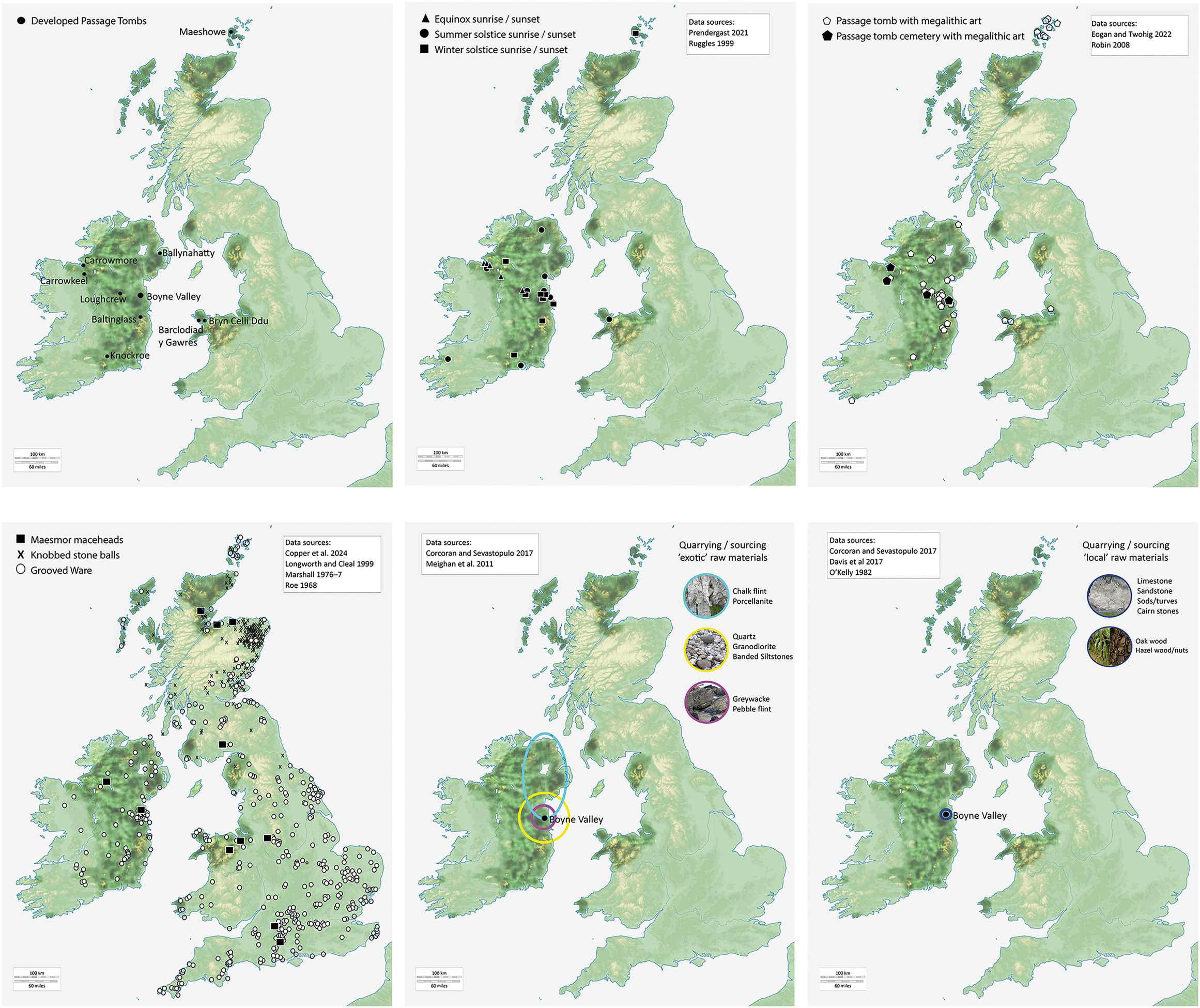
The architecture of developed passage tombs greatly facilitated ongoing exchanges and interactions that made and remade a tangled web of kin connections between the living and dead, but also among the dead themselves (Fig. 5). Unlike other megaliths, art motifs and specially selected stones highlight important locations for such activities outside and inside the tomb, including the large central chambers (Eogan & Shee Twohig Reference Eogan and Shee Twohig2022; Powell Reference Powell1994; Robin Reference Robin2010). Their accessibility enabled the ongoing deposition of, and interaction with, remains of people of various ages and sexes, as well as those which had been in circulation, alongside animal remains, ceramics, pins, balls, pendants and maceheads, in a burnt or unburnt and/or fragmentary condition from c. 3300–2600 cal. bc (Cooney Reference Cooney, Eogan and Cleary2017; Eogan Reference Eogan1986). The orthostats and kerbstones were successively reworked and/or redecorated; and some also circulated, being removed from older monuments and incorporated into the fabric of new ones (Eogan Reference Eogan1998; Hensey Reference Hensey2015, 120–28; Jones & Díaz-Guardamino Reference Jones and Díaz-Guardamino2019). The exteriors of ‘developed’ passage tombs, with their straightened front façades and recessed entrances, seem designed to enable shared spaces for larger groups to participate in ceremonial activities. This is supported by the artwork on the kerbstones, external stone structures and the deposits of pottery, stone and flint tools outside these tombs, particularly near the entrances (Carlin Reference Carlin2017; Cooney Reference Cooney2000; Jones Reference Jones2012, 56–7; O'Kelly Reference O'Kelly1973, 379).
The genetic clustering shown by individuals from passage tombs is likely to have emerged from such kinwork, rather than a purely hereditary network. Over the centuries of passage-tomb-related social and religious practices, people may have preferentially chosen their reproductive partners from within this extended community of passage-tomb users, some of whom were genetically distantly related. Thus, when they reproduced with each other, haplotypes became shared, but also more widely dispersed across space and time. This resulted in the tangled web of distant genetic relations between individuals in the Carrowmore and Carrowkeel passage tomb cemeteries, Co. Sligo, as well as Newgrange, Co. Meath and the passage tomb-related monument at Millin Bay, Co. Down. Given the continuity of shared ritual practices over several generations within an insular environment, it should not be surprising that distant biological relatedness could endure over centuries. What remains unclear, given the extent of sampling so far, is how genetically distinctive the individuals deposited in passage tombs were compared to other members of the population from 3600 cal. bc onwards.
This developed passage-tomb network may have its origins in the northwest of Ireland after 3600 bc, where there were uniquely strong links in the architecture and siting of smaller, earlier passage tombs, such as those at Carrowmore, and nearby contemporary court tombs (see Cooney Reference Cooney2000, 112–16; Reference Cooney, Brophy and MacGregor2023, 149; de Valéra Reference de Valéra1965; Herity Reference Herity1974, 274; Powell Reference Powell2005, 22). Indeed, it is only in the west, particularly the northwest, that we see depositional activity at court tombs continuing into the late fourth and early third millennium bc (e.g. Schulting et al. Reference Schulting, Murphy, Jones and Warren2012; Smyth et al. Reference Smyth, Carlin and Cooneyforthcoming). This seems to be reflected in the very close genetic relationships between car004 (from a passage tomb) and prs007 (from a court tomb), both individuals alive between 3640 and 3360 cal. bc, and likely contemporaries. The more distant genetic relatedness between car004 and others (dating from 3600–2500 bc) at the passage-tomb tradition sites of Carrowkeel, Newgrange and Millin Bay indicate considerable interaction between the northwest and eastern parts of the island over a sustained duration (Fig. 5). These places were interconnected via important communication routes along river networks and the sea (Moore Reference Moore, Leary and Kador2016, 54–8). Emerging programmes of strontium isotope analyses on human and faunal remains are expected to clarify such longer-range mobility during this timeframe (Smyth Reference Smyth, Higginbottom, Verdonkschot, Scarre, González-García and Criado-Boadoforthcoming).
Conclusion
Overall, the selection of bones for deposition within passage tombs in Neolithic Ireland does not seem strongly influenced by biological relatedness. Many other facets of identity, kinship, ability, role, cosmology and value influenced these decisions. The mapping of distantly related individuals interred within passage tombs far apart in time and place shows the shift towards more closely connected cultural and religious networks. These likely comprised dispersed groups who were increasingly mobile across a wide swathe of Ireland in the later half of the Neolithic. The evidence certainly does not support the existence of hereditary power (a ‘dynasty’) in these populations (see Smyth et al. Reference Smyth, Carlin and Hofmannin press a). We posit that this shared ancestry can be explained as resulting from preferential choice of partners within a dispersed community who shared cosmological beliefs and practices and enforced their social relationships through collective activities, including the construction of large, monumental sites and the funerary rites that played out at these. Over generations, the choice to reproduce with people whose values and practices aligned with one's own resulted in a somewhat closer genetic relationship within this group than between members of this group and the wider Irish Neolithic population.
More work is vital to achieve a fuller understanding of the social changes occurring in Ireland after 3600 cal. bc. We require more aDNA samples from a greater number of contemporary contexts, as well as denser sampling of key passage-tomb sites which allow analysis of biological relatedness (i.e. with more than four individuals). These results need to be fully contextualized with information from material culture, architecture, the settlement record and the human body, taking into account the theoretical frameworks underpinning the discipline of archaeology today. Such integration of genetic and archaeological evidence and expertise is required to achieve the full benefits of both fields (Frieman & Hofmann Reference Frieman and Hofmann2019; Greaney Reference Greaney, Whittle, Pollard and Greaney2023; Richardson & Booth Reference Richardson and Booth2017). Further considerations of kinship, including the role of lineages and clans, and changing understandings of descent in the Neolithic (as outlined in Fowler Reference Fowler2022, 68–9), are also crucial. In particular, more attention needs to be given to the rich archaeological evidence for kinship practices in their widest sense: the ways in which people, places, plants, animals and things mutually constituted each other through their exchanges and relationships.
As scholars across the human sciences have repeatedly made clear, biologically determinist narratives (conflating biological realities with social identities) reinforce ethnocentric and historically contingent categories of self and other in ways that are not just incomplete but actively harmful (Abel & Frieman Reference Abel and Frieman2023). Ancient genetics offers a new suite of data about past people and their worlds, but it is just one source among many that must be tested, twined together and teased apart to make sense of the complex human practices that ultimately created the archaeological record. The past must be allowed its difference.
Acknowledgements
We thank Gabriel Cooney for commenting on an earlier draft and the helpful input of two anonymous reviewers. JS's contribution was supported by Irish Research Council Consolidator Laureate Award IRCLA/2017/206 ‘Passage Tomb People’; CJF's contribution is supported by Australian Research Council Future Fellowship FT220100024 ‘Kin and Connection: ancient DNA between the science and the social’.


 Open access

