

Introduction
Ireland has been unusual in European politics. Though Ireland has a significant ethno-nationalist and anti-establishment party, Sinn Féin, that party had been clear in its pro-immigrant position for decades. However, Sinn Féin still tended to gain support from those who would normally be attracted to anti-immigrant parties (O'Malley Reference O'Malley2008). The large-scale influx of asylum seekers, coupled with the state's legal obligation to house them, caused great controversy during 2023. Immigration dominated a year in which very little happened in terms of elections or other major political changes, as the economy continued to thrive, though the aftereffects of Brexit continued to cause problems in the relationship with the UK government and unionist parties in Northern Ireland.
Election report
There were no elections in Ireland in 2023.
Cabinet report
There were no changes to the Cabinet in 2023 (Table 1), although Helen McEntee reverted to being Minister for Justice from 1 June 2023 after a period out on maternity leave, during which she remained part of the government as a Minister without Portfolio.
Cabinet composition of Varadkar II in Ireland in 2023

Notes: Minister of Justice, Helen McEntee (FG), was on maternity leave from 25 November 2022 to 1 June 2023. She remained a member of Cabinet and her portfolio was covered by Simon Harris, Minister for Further and Higher Education.
Source: Department of the Taoiseach and Oireachtas websites (2023) (last accessed 16 May 2023).
Parliament report
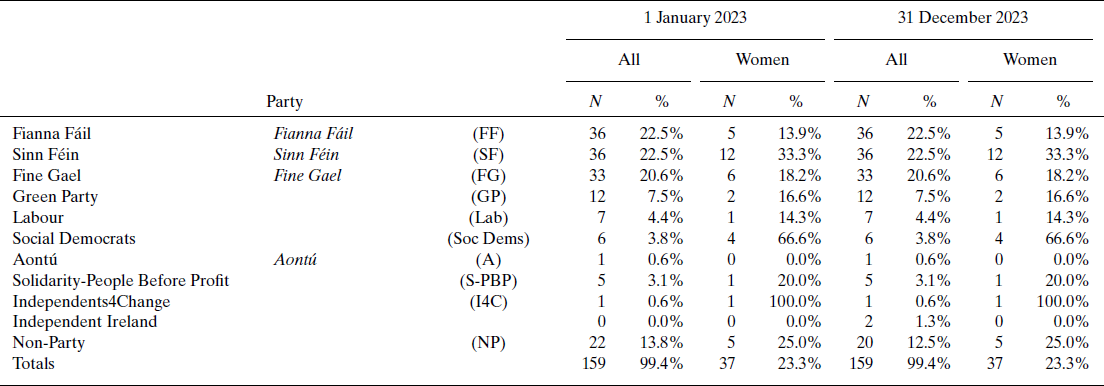
There were no changes in the composition of the Houses of the Oireachtas (Irish Parliament) in 2023 (Table 2). A Judicial Appointments Commission Act was passed late in the year. It sets up a commission to regulate the appointment of judges replacing a Judicial Appointments Advisory Board. The Bill had been a long time in gestation, having first been proposed by Independent Alliance members of the Kenny II government in 2016. It was controversial because it gives the judiciary half of the voting members and, thus, what appears to be a veto in the appointment of judges, something that is a reserved function of the government in the Irish Constitution. For this reason, the President referred the Bill to the Supreme Court to test its constitutionality. This was the first such Article 26 reference exercised by President Michael D. Higgins. A number of judges recused themselves from the decision because they had been consulted in the formation of the new Commission. The Supreme Court upheld the Bill's constitutionality, finding that there was nothing explicit or implicit in it requiring the government to accept the nomination of the Commission.
Party and gender composition of the lower house of the Parliament (Dáil Éireann) in Ireland in 2023

Note: There are 160 TDs (members of Parliament), including the Ceanna Comhairle (speaker) who was elected as a Fianna Fáil TD, but does not sit with the party or attend its meetings. He does, however, remain a member of that party. Except where there is a tie, he does not vote in divisions of the House.
Source: Department of the Taoiseach and Oireachtas websites (2023) (last accessed 16 May 2023).
Another controversial Bill was being held up in Seanad Éireann (the Senate). The Criminal Justice (Incitement to Violence or Hatred and Hate Offences) Bill 2022, better known as the Hate Crime Bill, passed the Dáil with minimal opposition. But many commentators had expressed concern that because ‘hatred’ was so loosely defined, it would give the courts the ability to regulate speech. Though it had not been defeated in the Seanad, the level of opposition was such that the government had not proceeded to the next stage in the second half of 2023, with expectations that there would be significant amendments proposed or that it might be dropped altogether.
Political party report
Changes in political parties are shown in Table 3. On 22 February, the co-leaders of the Social Democrats, Róisín Shortall and Catherine Murphy, announced their intention to stand down. The subsequent contest for leadership only drew one candidate. Holly Cairns was appointed leader by acclamation. Given that the two original leaders had both left Labour at various stages in their careers, there was a hope in Labour that the two centre-left parties would consider a merger or some form of formal co-operation. Cairns quickly ruled that out, as hostility towards the Labour Party and its facilitation of austerity when last in government remained strong within the Social Democrats.
Changes in political parties in Ireland in 2023

Notes: The Social Democrats had a dual leadership structure until this was replaced by a sole leader (Holly Cairns) on 1 March 2023.
Source: Electoral Commission website (2024) (last accessed 16 May 2024).
On 8 November, two independent TDs (MPs)—Michael Collins and Richard O'Donoghue—joined to form a new political party, Independent Ireland. The two TDs promised that the new party would oppose ‘overcentralised and bureaucratic decision-making’ (Independent Ireland 2024) and cut funding for lobbying Non Governmantal Organisations, usually a short-hand for criticism of progressive policies. These conservative TDs came from the Rural Independents technical group within Dáil Éireann (the House of Representatives) and will remain in the group for the purposes of parliamentary time and such.
Institutional change report
An independent Electoral Commission was set up in 2023. Its role in managing the electoral process was previously carried out by a number of different organisations. The first major task of the Commission was to recommend a revision of the Dáil and European election constituencies. Given the rapid growth in the Irish population, there was a constitutional requirement to increase the size of Dáil Éireann after the election that would have to take place by March 2025. The Commission could recommend an increase in the size of Parliament by up to 21 seats (from 160). In the end, it decided to increase the size to 174 seats. This decision was less impactful than the change in constituency boundaries, which caused a small number of TDs to announce that they would not run at the subsequent election and that probably made the prospects of some other TDs of re-election more remote. Many TDs depend on local areas for the bulk of their votes, and if this is split by a boundary revision or if their local area is moved to another constituency, this can be damaging to their electoral prospects. The boundary reviews tend not to favour any one party or have any partisan effect. It was beyond the remit of the Commission to consider the creation of constituencies outside the three- to five-seat bounds set in law. Larger districts with more elected representatives can facilitate smaller parties and independents winning seats.
Issues in national politics
The Windsor Framework, a settlement based on the Northern Ireland Protocol, was agreed by both the European Union and the British government in an effort to address concerns expressed by unionists in Northern Ireland. It was released in February and formally adopted in March. The purpose was to remove some of what were seen as barriers to trade within the United Kingdom. It was hoped that the Framework would enable the Northern Ireland Assembly and its executive to re-form. By the end of 2023, that had not yet happened, though there was a sense that progress was being made.
Another issue that dominated the media was the management of RTÉ, the state broadcaster. RTÉ had released data on its top earners in February but later corrected these figures, revealing that it had underdeclared payments to one of its more prominent broadcasters for the previous five years. The scandal revealed poor management at RTÉ and the director general resigned immediately. More revelations in parliamentary committees filled the media during the summer and increased pressure on the relevant minister, Catherine Martin, who was less than convincing in her attempts to take control of the situation.
Large tax takes continued to reflect a buoyant economy. This facilitated a giveaway budget in the autumn that largely removed the need for making choices about what to prioritise. There appeared to be money to transfer to any group that needed it. These redistributive measures to tackle the cost-of-living crisis tended to take the form of increased cash transfers rather than any significant reform of the welfare state. Though the Irish Fiscal Advisory Council—an independent state body—was critical of the government's pro-cyclical spending, very few opposition politicians were promising to do anything except maybe spend more. In its defence, the government could point out that it had run a budget surplus.
One of the ongoing and increasing expenses that the government had not anticipated was the cost of accommodating people who had come to Ireland seeking international protection. The number of applicants surged in 2022 and continued to rise in 2023 to about 26,000 by the end of the year. The cost of accommodating these rose to an estimated €500 m in 2023, and this figure excludes refugees from Ukraine who were automatically given residency rights and accommodated through a different system. Ireland had taken in just over 100,000 refugees from Ukraine by the end of 2023. Per head of population, Ireland had accommodated more Ukrainian refugees than France, Belgium or any of the EU Nordic states. These refugees were mainly women and children, and three-quarters of them lived in state-supported accommodation. There was something of a warm glow within the country about how well they were treated. When in 2023 the numbers of Ukrainians continued to arrive, there was a suspicion that Ireland's generous welfare system was being exploited by people who were moving from other EU states to Ireland. By the end of the year, the government agreed to reduce the amount paid to new arrivals from Ukraine to bring it into line with other European countries.
The government was responding to increasing tension regarding the asylum process. Because Ireland already had a significant housing problem, with the regular reporting of the number of people living in temporary accommodation being a focus of political debate on the issue, there was some popular resentment that the state was seen to go to great lengths to accommodate newly arrived asylum seekers. Some protests were set up outside buildings, including hotels that had been rented or repurposed to accommodate asylum seekers. These, at times, turned violent, and there were cases in which buildings alleged to have been refurbished for use by refugees were set ablaze.
None of these events prepared people for what happened in Dublin on the evening of 23 November. There had been an incident that afternoon in which a woman and three children were attacked in Dublin city centre. Rumours circulated that the perpetrator was an immigrant, and various people known to be linked to anti-immigrant groups circulated messages on social media and privately to attend a protest at the scene of the incident. Tensions rose during this protest, and after some time, the Gardaí (police) lost control of the situation within the city centre. Effectively, there was a complete breakdown in law and order. A number of Garda cars were set alight as were some buses and a light rail tram. There was looting and vandalism in shops in the vicinity. Immediately, there were calls for the resignation of the Minister for Justice, Helen McEntee, who was already subject to criticism for her anaemic response to increased crime in Dublin city centre, in particular following an attack on a US tourist during the summer. In response to the riot, she faced a motion of no-confidence from Sinn Féin but retained the support of coalition colleagues, even if privately they were critical of her handling of the situation. The political fallout was clear. The Overton Window had shifted. Parties were more open to discussing the costs of immigration than they had been before. Polls made clear that a majority of Irish people felt the level of immigration needed to be stemmed (Leahy Reference Leahy2023). Here, there was a conflation of two separate issues, those migrating to Ireland legally, largely from other EU countries, and those seeking international protection.
As a result of this increased focus on immigration, Sinn Féin saw its polling numbers fall through 2023. The party had surprised many when it was the most popular party in 2020, but its unremitting focus on housing appeared to pay off. Though housing remained an important issue, the increased importance of immigration probably had an effect on the party's support. The coalition of different groups that had sustained support for this progressive but anti-establishment party seems to show cracks, as it dropped about four points in cumulative polling during 2023 (Louwerse & Müller Reference Louwerse and Müller2024). This support tended to go to independent candidates rather than any other party, the independent bloc being the most anti-immigrant voice within Dáil Éireann. The longer-term effect of the introduction of migration as an issue in Ireland was to further increase uncertainty in the party system.
The attacks by Hamas on Israeli citizens on 7 October caused expected condemnation from Irish politicians. Some, however, sought to, if not justify, ‘explain’ the attacks in reference to the treatment of Palestinians by the Israeli state. Ireland is one of the most pro-Palestinian countries in the Western world, possibly because of a narrative framing that compares their treatment by Israel to Irish treatment by the British when Ireland was part of the British state. The ferocity of the Israeli response led to condemnations of Israel from the Taoiseach who said in early November the military response was ‘something approaching revenge’ (Humphries Reference Humphries2023). Leo Varadkar's later comment on the release of a hostage, the daughter of an Irish citizen, that she had been ‘lost’ and now was ‘found’ caused anger in the Israeli government, with the Irish ambassador in Tel Aviv being reprimanded. Meanwhile, there were calls for the expulsion of the Israeli ambassador to Dublin.
Acknowledgements
Open access funding provided by IReL.



 Open access

