

Zeolites are natural or synthetic crystalline materials with a three-dimensional microporous structure composed of [SiO4]4– and [AlO4]4– tetrahedra sharing oxygen atoms (Barrer, Reference Barrer1948). The various crystalline structures that can be developed provide zeolites with exceptional properties, including high adsorption capacity and ion-exchange capacity and catalytic properties.
The first synthetic zeolite was prepared by Sainte-Claire Deville in 1862 (Querol et al., Reference Querol, Moreno, Umaña, Alastuey, Hernández, López-Soler and Plana2002), and, according to the International Zeolite Association (IZA), there are currently more than 250 synthetic zeolites (Brouwer et al., Reference Brouwer, Brouwer, Mesa, Semelhago, Steckley, Sun and Baerlocher2020), classified into three main groups based on their Si/Al ratio: zeolites with low silica content (Si/Al ratio = 1–2), zeolites with medium silica content (Si/Al ratio = 3–10) and zeolites with high silica content (Si/Al ratio >10; Baerlocher et al., Reference Baerlocher, McCusker and Olson2007). Synthetic zeolites are characterized by their extreme purity, good thermal stability, uniform crystal size and controlled porosity, resulting in a homogeneous final product that is useful for specific industrial applications.
The most common zeolite synthesis methods used today are solvothermal methods and their hydrothermal variants (Johnson & Sazmal, Reference Johnson and Sazmal2014), the alkaline fusion method (Melian-Cabrera et al., Reference Melian-Cabrera, Espinosa, Groen, van der Linden, Kapteijn and Moulijn2006; Wajima et al., Reference Wajima, Yoshizuka, Hirai and Ikegami2008; Ma et al., Reference Ma, Yao, Fu, Ma and Dong2010; Belviso et al., Reference Belviso, Cavalcante, Niceforo and Lettino2017), the sol-gel methodology (Han et al., 2007; Wittayakun et al., Reference Wittayakun, Khemthong and Prayoonpokarach2008; Tsujiguchi et al., Reference Tsujiguchi, Kobashi, Oki, Utsumi, Kakimori and Nakahira2014) and microwave-assisted synthesis (Xu et al., Reference Xu, Yang, Liu and Lin2000; Li & Yang, Reference Li and Yang2008; Joseph et al., Reference Joseph, Tosheva and Doyle2020) or ultrasound-assisted synthesis (McCausland et al., Reference McCausland, Cains and Martin2001; Mason & Peters, Reference Mason and Peters2002; Andaç et al., Reference Andaç, Tatlıer, Sirkecioğlu, Ece and Erdem-Şenatalar2005; Boels et al., Reference Boels, Wagterveld, Mayer and Witkamp2010), depending on the type of zeolite to be obtained.
The solvothermal method uses organic solvents instead of water, unlike the hydrothermal method, for the synthesis of zeolites. In this approach, the primary sources of silicon and aluminium are mixed with an organic solvent (alcohol, ethylene glycol, hydrocarbons, pyridine, etc.; Bibby & Dale, Reference Bibby and Dale1985), and thee are synthesized in a reactor at high temperatures and self-generated pressures. The main advantage of this approach lies in the fact that the organic medium, having different polarity and coordination properties compared to water, can uniquely influence nucleation and crystal growth, leading to the formation of crystalline phases or morphologies that are inaccessible by hydrothermal synthesis, or with very high Si/Al ratios (Johnson & Sazmal, Reference Johnson and Sazmal2014; Jamil et al., Reference Jamil, Muraza and Al-Amer2016).
However, hydrothermal synthesis also has significant advantages compared to the use of organic solvents, mainly due to the use of water as a solvent. Firstly, it is more economical and sustainable because it uses water instead of expensive and potentially polluting organic solvents, minimizing the generation of toxic waste. Furthermore, hydrothermal synthesis is the industry standard method, with a technological maturity and knowledge base that guarantees scalability for the production of commercial zeolites with high crystal order (Wu et al., Reference Wu, Tu, Yuan, Chen, Xiang, Zhao and Cao2006; Byrappa & Yoshimura, Reference Byrappa and Yoshimura2012).
The main limitations of the hydrothermal methodology include the need to use, in certain cases, structure-directing agents (SDAs), which require a subsequent combustion process to eliminate them (Meng & Xiao, Reference Meng and Xiao2014), the use of long synthesis times for some types of zeolites (1–20 days), the difficulty of controlling nucleation, which leads to the formation of large crystals, and the fact that conventional stirring is not sufficient to achieve a uniform mixture (Li et al., Reference Li, Li, Guo and Liu2006). To minimize these drawbacks, strategies such as microwave-assisted synthesis (Meng & Xiao, Reference Meng and Xiao2014) or ultrasound-assisted synthesis (Li et al., Reference Li, Li, Guo and Liu2006) and alkaline fusion synthesis have been developed, in which the raw material is thermally activated at temperatures of 600°C and mixed with alkaline hydroxides, mainly NaOH, prior to synthesis. This process increases the reactivity of the raw material, shortening the synthesis time (Belviso et al., Reference Belviso, Cavalcante, Niceforo and Lettino2017).
Alternative raw materials with a high Si and Al content, such as industrial waste, can be used to synthesize zeolites, provided that they are readily available, continuously and homogeneously generated and have low levels of foreign substances. For this reason, the use of waste as a raw material for zeolite synthesis has generated considerable interest in zeolite synthesis studies. Various types of waste have been studied for this purpose, including solid waste (Mencía et al., Reference Mencía, Goiti, Ocejo and García Giménez2020; Sayehi et al., Reference Sayehi, Hajji, Boudjema, Kazemian and Tounsi2022; Cao et al., Reference Cao, Xuan, Yan and Wang2023; Murakami et al., Reference Murakami, Otsuka, Fukasawa, Ishigami and Fukui2023; Eren et al., Reference Eren, Türk and Arslanoğlu2024; Petrovic et al., Reference Petrovic, Gorbounov and Masoudi Soltani2024).
Synthetic zeolites have applications in wastewater treatment (Gollakota et al., Reference Gollakota, Volli, Munagapati, Wen and Shu2020; Ameh et al., Reference Ameh, Oyekola and Petrik2022; Xu et al., Reference Xu, Gao and Yuan2022), where the use of industrial waste as a raw material for their synthesis represents a cost-effective and efficient alternative for treating this wastewater. Mokrzycki et al. (Reference Mokrzycki, Fedyna, Marzec, Szerement, Panek and Klimek2022) modified zeolite X with Cu(NO3)2·3H2O to remove phosphates, and Angaru et al. (Reference Angaru, Choi, Lingamdinne, Choi, Kim, Koduru and Chang2021) developed FeNi bimetallic nanocomposites on zeolites from fly ash capable of removing Cr(VI) and Cu(II) through a combination of reduction, adsorption and ion exchange. In addition, Na-P1 zeolite synthesized from fly ash for the treatment of pig wastewater has shown great efficiency in the removal of ammoniacal (Cardoso et al., Reference Cardoso, Horn, Ferret, Azevedo and Pires2015).
Due to their high stability and reusability, low preparation costs and environmental friendliness, zeolite-based catalysts have become alternatives to commercial catalysts commonly used in the petrochemical industry, where zeolites are known as ‘molecular sieves’. The characteristics of zeolite catalysts such as their morphology (Si/Al ratio, crystal size, crystal order) and surface acidity have a significant influence on catalytic performance (Asl et al., Reference Asl, Ghadi, Baei, Javadian, Maghsudi and Kazemian2018; Kamaluddin et al., Reference Kamaluddin, Gong, Ma, Narasimharao, Chowdhury and Mokhtar2022). SAPO-34 zeolite synthesized from rice husks could be used to convert methanol into olefins (Fard et al., Reference Fard, Askari, Ebrahimi and Heydarinasab2022). Sivalingam et al. (Reference Sivalingam and Sen2018) manufactured catalysts capable of converting CO2 into methane using zeolite X obtained from ash as a support for nickel. However, it appeared that after the addition of nickel, the micropores of the zeolite became clogged, affecting its proper function as a catalyst. Linde type A (LTA) zeolites with pores of ∼17 nm were synthesized from ash (Chen et al., Reference Chen, Song, Lin, Qiao, Wu, Yi and Kawi2022). The large pores of these zeolites help molecules to pass through them, and their large number of active acid sites improve their performance as industrial catalysts. In addition, NaY zeolites can be used as catalysts in the catalytic cracking process in refineries to obtain petrol and diesel from heavy petroleum fractions (Ríos et al., Reference Ríos, Oviedo, Henao and Macías2012).
The purification of gas streams from contaminants such as volatile organic compounds and CO2 using adsorption capture methods (Li et al., Reference Li, Wang, Guo, Zhu and Xu2021) is an additional application of zeolites. In fact, zeolites, due to their crystal structure with empty mineral cavities, large specific surface area and uniform, polar micropores, are highly effective as molecular sieves due to their selectivity and modifiable physicochemical properties (Ahsan et al., Reference Ahsan, Ayub, Meeroff and Lashaki2022). As an example, synthetic zeolite MCM-41 was modified using different amines, and the modified forms were investigated while exploring strategies to improve the efficiency of their adsorption processes (Quan et al., Reference Quan, Chu, Zhou, Su, Su and Gao2022).
Many types of adsorbents are being studied for their potential use in capturing CO2 from point sources of emission, with zeolite 13X being the most prominent one. Zeolite 13X is considered the reference adsorbent for post-combustion carbon capture due to its high selectivity for CO2, as well as because it is inexpensive and is currently used in other industrial applications (Wilkins & Rajendran, Reference Wilkins and Rajendran2019).
The adsorption of CO2 through the use of zeolites involves both physical and chemical processes. The CO2 that is physically adsorbed can be easily desorbed by changes in pressure or temperature because it is bound by very weak Van der Waals forces. However, chemisorption forms strong chemical bonds between the CO2 and the adsorbent, making it a very good option if long-term storage is desired or if it is to be used for other chemical processes, in which CO2 desorption would require very demanding conditions (Murrithi et al., Reference Muriithi, Petrik and Doucet2020).
CO2 emissions into the atmosphere greatly affect global warming. Therefore, this work proposes an experimental study for the synthesis of zeolites based on various industrial wastes with high Si and Al contents using alkaline fusion and hydrothermal methodology, with the aim that these zeolites will be used for CO2 capture through adsorption.
Materials
The industrial waste materials used as the raw material for the synthesis of zeolitic materials are granite cutting sludge (GCS), slate cutting sludge (SCS; generated at the industrial facilities of Naturpiedra Pizarras JBernados S.L., Spain) and aggregate washing sludge (AWS; generated in the aggregate quarries owned by Áridos Hermanos Moral Cantera Añoreta S.L., Spain). The wastes were dried at 105°C until constant mass and then ground to a particle size of less than 63 µm. Hydrochloric acid (37% wt.% HCl, PanReac) and nitric acid (65% wt.% HNO3, PanReac) were used to obtain regia water for acid pretreatment, while sodium hydroxide (NaOH) in pellet form (PanReac) was used as an alkaline activator for zeolite synthesis.
Experimental
Synthesis of zeolite
The GCS, SCS and AWS industrial wastes were used to synthesize zeolites through alkaline fusion and subsequent hydrothermal treatment. Acid pretreatment using aqua regia (ratio 3:1 HCl:HNO3) was performed to reduce/eliminate the iron content of the original materials (Sangsuradet et al., Reference Sangsuradet, Tobarameekul and Worathanakul2022), as Fe tends to form stable phases (e.g. hematite, Fe–Al spinels or amorphous oxide/hydroxide phases) that do not dissolve easily in an alkaline medium and compete with the formation of the Si–O–Al zeolite framework (García Barrero et al., Reference García Barrero, Pazos Zaramá, Chaparro-Barajas, Fonseca Martínez, Pavón González and Alba Carranza2020). The various stages of the synthesis are described in the following paragraphs.
For acid pretreatment, 100 g of waste was added to 10 mL of aqua regia diluted in a 200 mL volumetric flask, which was subsequently kept in a fume hood at room temperature for 24 h. The samples were then filtered, washed with distilled water until neutral pH and dried in an oven at 105°C. Next, 20 g of the acid-pretreated waste was dry-mixed, without mechanical grinding, with NaOH pellets at a weight ratio of 1:1.25 (pretreated waste:NaOH) and calcined in an electric furnace (Tecnopiro, Benjamin-4) at 600°C for 45 min to perform alkaline fusion.
For the hydrothermal synthesis, 100 mL of deionized water was added to the powdered material obtained from the alkaline fusion, stirred at 500 rpm for 24 h and then transferred to a hydrothermal reactor (Berghof, DAB-3) for crystallization at 180°C for 12 h. To complete the synthesis, the product obtained was washed with deionized water until pH 9–10.
Sample characterization
The chemical compositions of the GCS, SCS and AWS industrial waste materials and the synthesized materials were determined by wavelength-dispersive X-ray fluorescence spectroscopy (WDXRF; Thermo Fisher, Perform’X WDXRF spectrometer) using a Rh tube with voltage 4 kW. Qualitative mineralogical analysis was carried out on a X-ray diffractometer (XRD; PANalytical, Empyrean) using Cu-Kα radiation, operating at 45 kV and 40 mA in the 4–70°2θ scanning range. Identification of the phases was made from Powder Diffraction File references (PDF2 Release 2009) using PANalytical High Score Plus software. Quantitative mineralogical analysis (wt.%) was performed using the Rietveld refinement method on a XRD device (Bruker, D8 Advance) with Mo-Kα radiation, equipped with an EIGER detector operating in VDO (Variable Detector Opening) mode and operating at 50 kV and 50 mA in the 2.5–40°2θ range for 180 min. Quantification was performed using Bruker TOPAS software. The abundance of amorphous material was determined on a second XRD trace after addition of alumina standard (Al2O3 NIST-SRM-676-a, Sigma-Aldrich) under similar conditions. Fourier-transform infrared (FTIR) absorbance spectra in the region 4000–500 cm−1 with a spectral resolution of 4 cm−1 were recorded on a FTIR/attenuated total reflectance (ATR) spectrometer (Jasco, 6800FV) at room temperature to identify functional group information. The morphology of the synthetic zeolites was examined by scanning electron microscopy (SEM; Nanolab 650, FEI Helios) equipped with an energy-dispersive X-ray spectroscopy (EDX) detector (X-Max, Oxford Instruments).
The CO2 adsorption capacities of the synthetic zeolite materials and a commercial 13X zeolite (13X powder ≈ 2 µm, Sigma-Aldrich) used as a reference material were determined by passing a gas stream controlled by mass flow meters, consisting of 85% N2 + 15% CO2, through the zeolite material, which had been placed in the central part of the sample holder tube. The outgoing gas stream was sent to a CO2 analyser (AO200, ABB) equipped with a URAS26 infrared radiation detector. The measurement process began with thermal pretreatment at 300°C to degas and dry the zeolite material with a gas flow of 25 mL min–1 of N2. Once the reactor reached room temperature, the CO2 adsorption curve was obtained by supplying a stream of N2/CO2 gas through a bypass to establish the CO2 measurement baseline at 15%. Once the signal was stabilized at 15% in the analyser, the N2/CO2 gas stream was switched through the sample holder to perform the adsorption, and this configuration was maintained until the CO2 measurement returned to a stable value of 15%.
Results and discussion
The chemical compositions of the waste raw materials are listed on Table 1. The main constituents are SiO2 and Al2O3, with the SiO2/Al2O3 molar ratio values of the GCS, SCS and AWS waste materials being 9.26, 6.94 and 4.67, respectively, rendering them suitable as primary sources of Si and Al for the synthesis of zeolites. The Fe2O3 contents of 4.1%, 7.5% and 9.0% for GCS, SCS and AWS wastes, respectively, are unfavourable for zeolite synthesis (Aloui et al., Reference Aloui, Mezghich, Mansour, Hraiech and Ayari2023). Acid pretreatment reduced the content of these elements in the waste materials before synthesis (Mohammadi et al., Reference Mohammadi, Mirghaffari, Razavi and Soleimani2025). In the synthesized materials Ze-GCS, Ze-SCS and Ze-AWS, a drastic reduction in the SiO2/Al2O3 molar ratio was observed after the synthesis process, ranging from 2.30 to 3.05 for the final products (Table 1). According to these SiO2/Al2O3 molar ratios, the materials are characterized as zeolites with low or medium silica contents, which is consistent with the identification of the LOS phase.
Chemical compositions of the wastes used as raw materials and the zeolites synthesized from them.

Table 1 Long description
The table reports oxide compositions (SiO2, Al2O3, K2O, Fe2O3, CaO, Na2O, MgO, TiO2, P2O5, SO3), loss on ignition (LOI), and the SiO2/Al2O3 ratio for three wastes (GCS, SCS, AWS) and their derived zeolites (Ze-GCS, Ze-SCS, Ze-AWS). Among wastes, SiO2 is highest in GCS (69.4) and lowest in AWS (56.7), while Al2O3 is highest in AWS (20.7); corresponding SiO2/Al2O3 ratios are 9.26 (GCS), 6.94 (SCS), and 4.67 (AWS). After zeolite synthesis, SiO2 decreases to 35.8–37.5 and Al2O3 increases to 20.9–26.9, lowering SiO2/Al2O3 to 2.30–3.05 (lowest in Ze-GCS at 2.30). Na2O rises sharply from 0.5–3.0 in wastes to 18.0–21.1 in zeolites, while K2O drops from 3.1–4.4 to 0.5–1.4. LOI increases from 0.6–5.8 in wastes to about 10.0–10.2 in zeolites. Some entries are missing (shown as “–”), notably SO3 for SCS and Ze-SCS and P2O5 for Ze-GCS and Ze-SCS, so comparisons for those oxides are incomplete.
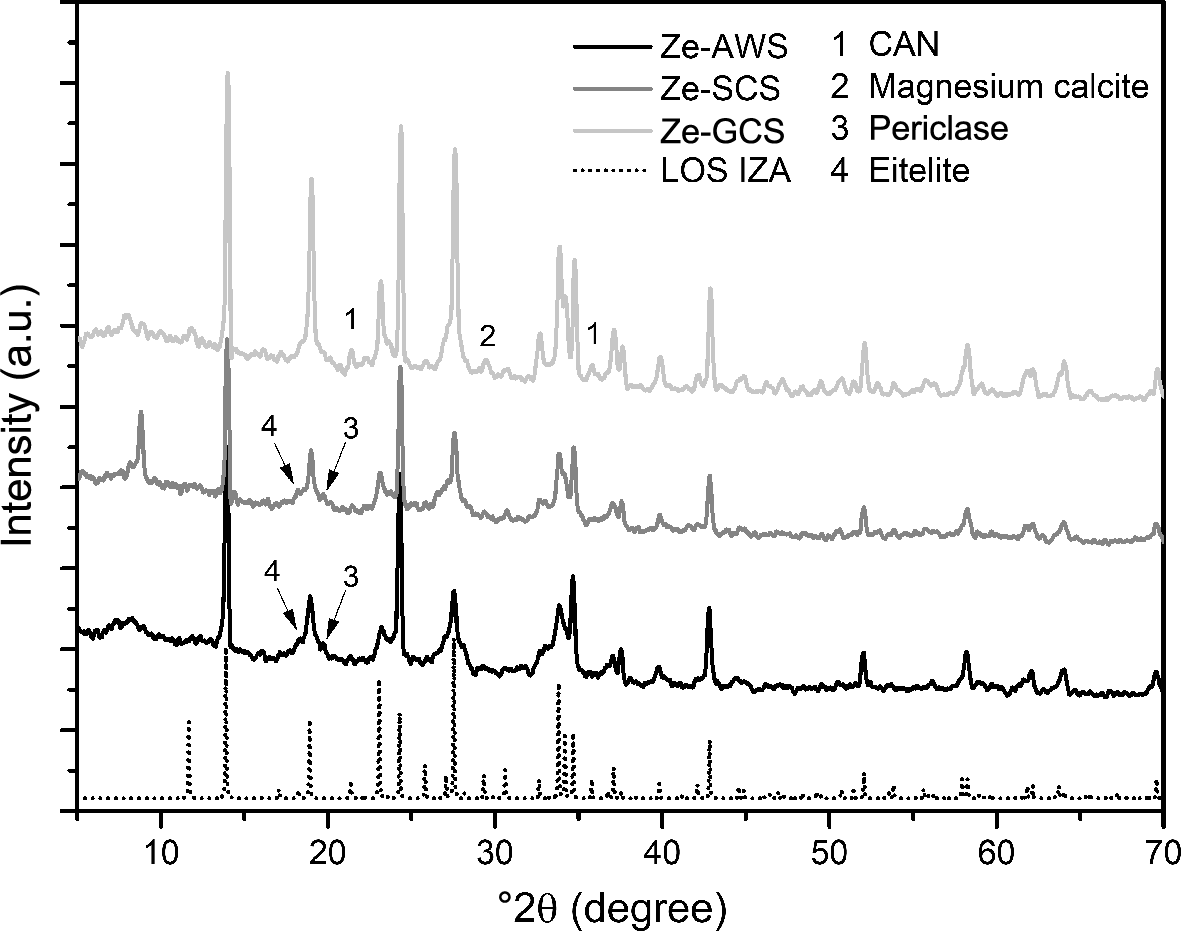
The synthesis process was successful, as was confirmed by XRD analysis, obtaining as the main crystalline phase a carbonated zeolite with a LOS (Losod) structure (Kowalak et al., Reference Kowalak, Jankowska and Mikołajska2010), regardless of the waste used as the primary source of Si and Al (Fig. 1). The LOS (Losod) zeolite is a crystalline hydrated sodium aluminosilicate (Na12Al12Si12O48·xH2O), which crystallizes from batches with a low sodium content (Na/Al ≤ 1 and Si/Al ≈ 1). LOS (Losod) zeolite crystals are hexagonal (a = 12.91 and c = 10.54 Å), and their structure shows a polytopic relationship with sodalite (SOD) and cancrinite (CAN). Losod has sorption/desorption properties and an ion-exchange capacity characteristic of a small-pore zeolite (Sieber & Meier, Reference Sieber and Meier1974).
XRD traces of zeolite materials synthesized from GCS, SCS and AWS wastes.

Figure 1 Long description
XRD traces of zeolite materials synthesized from GCS, SCS and AWS wastes. A multi-trace line plot with a vertical axis labeled Intensity (a.u.) and a horizontal axis labeled 2theta (degree). The horizontal axis shows tick labels at 10, 20, 30, 40, 50, 60 and 70. Three stacked traces are labeled at the left as Ze-AWS, Ze-SCS and Ze-GCS. A legend lists CAN, Magnesium calcite, Brucite and Etelite and also lists LOS IZA. Each trace shows multiple narrow peaks across the 2theta range. The Ze-AWS trace includes several peaks between about 10 and 35 degrees and additional peaks extending through about 70 degrees. The Ze-SCS trace shows prominent peaks in the region around 15 to 35 degrees and additional peaks at higher angles. The Ze-GCS trace shows multiple peaks across the full range, with several peaks clustered between about 10 and 35 degrees and further peaks beyond 40 degrees. Small numeric markers 1, 2, 3 and 4 appear near several peaks in the lower-angle region and vertical reference-stick patterns appear along the bottom of the plot aligned to specific 2theta positions.
Quantitative analysis showed that the end-products obtained from GCS, SCS and AWS (Ze-GCS, Ze-SCS and Ze-AWS, respectively) contained 63, 61 and 51 wt.% of LOS zeolite, respectively. Minor crystalline phases identified were CAN zeolite (3 wt.%) and magnesium calcite (1 wt.%) from Ze-GCS, and eitelite-Na2Mg(CO3)2 and periclase-MgO (both 3 wt.%) were identified in Ze-SCS and Ze-AWS materials.
However, the inherent difficulty in quantifying zeolite phases using XRD limits the reliability of the analysis to a semi-quantitative nature, with weighted profile R-factor (R wp) errors of ∼15%, indicating that the limitations stem mainly from the starting structure used in the analysis. The structure is characterized by a high content of non-diffracting and/or amorphous domains, which include phases with short-range order, as well as microcrystal imperfections and defects. The percentage of the amorphous material and/or non-diffracting fraction varies between 33% for Ze-GCS and Ze-SCS and 43% for Ze-AWS. The high percentage of amorphous material in the zeolite end-products is attributed to the high Fe2O3 content of the synthesized zeolites (2.8–7.7%; Table 1), despite the acid pretreatment. Unleached iron may remain occluded in the structure or form secondary phases that are undetectable by conventional XRD if they are of nanometre size or amorphous. In addition, Fe3+ can act as a precipitating agent or form complex gels that hinder the homogeneity of the precursor gel, favouring amorphous non-zeolitic phases instead of the desired zeolite (Quintana et al. Reference Quintana, Aparicio, Parra, Henao and Ríos2014).
The AWS, which has the lowest SiO2/Al2O3 ratio among the precursors (4.67; Table 1), produces the zeolite with the lowest percentage of crystalline phases (51% in Ze-AWS) and the highest amorphous fraction (43%), while Ze-GCS, with an SiO2/Al2O3 ratio of 9.26 in the GCS precursor, has the highest content of zeolite crystalline phases (66%) and the lowest content of amorphous material (33%). This suggests that, for Losod formation, there is a critical threshold of reactive silicon necessary to sustain crystalline nucleation for the 12 h hydrothermal treatment. An excess of aluminium relative to silicon in the synthesis gel would favour the precipitation of amorphous aluminosilicates before long-range structural ordering occurs (Pattaranun & Apinon, Reference Pattaranun and Apinon2012).
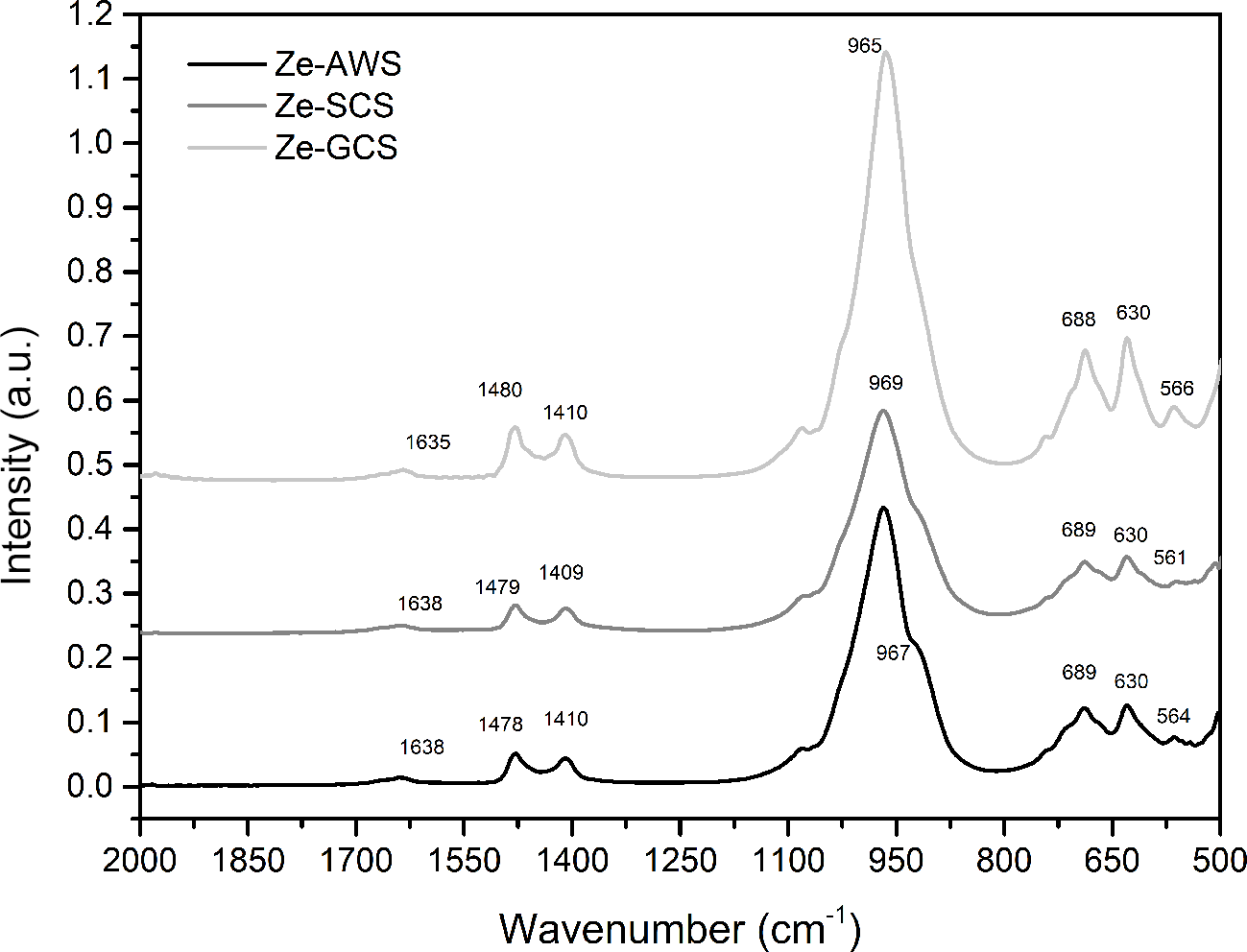
The FTIR spectra of the synthesized Ze-GCS, Ze-SCS and Ze-AWS are shown in Fig. 2. The band at 1635 cm–1 in Ze-GCS and at 1638 cm–1 in both Ze-SCS and Ze-AWS are attributed to the presence of free water molecules absorbed in the zeolite structure (Mohammadi et al., Reference Mohammadi, Mirghaffari, Razavi and Soleimani2025). The double absorption band at 1480 and 1410 cm–1 present in the three synthesized samples is associated with adsorbed atmospheric carbonates, CO32– (Amin et al., Reference Amin, Wahab, Mukti and Taba2023), which is in accordance with the presence of both compounds (H2O and CO32–) and with the loss on ignition (LOI) value in the chemical composition of the synthesized materials (Table 1). The absorption bands at 965, 969 and 967 cm–1 for Ze-GCS, Ze-SCS and Ze-AWS, respectively, corresponds to the T–O–T (Al or Si) stretching vibration (Khawaja et al., Reference Khawaja, Naeem, Khoja, Kanwal, Raza and Anwar2024). The presence of these bands indicates the formation of new bonds between the components of the original waste and the alkaline activator to form the LOS zeolite structure. Formation of new crystalline structures involves modification of the chemical composition of the synthesized materials with respect to the original raw materials (Table 1), which enriches Al to obtain molar SiO2/Al2O3 ratios of 2.30, 3.05 and 2.48 for the synthesized zeolites Ze-GCS, Ze-SCS and Ze-AWS, respectively, and incorporates a large amount of Na in the final composition of the synthesized samples. The bands at wavelengths of 689, 630 and 565 cm–1 in the three materials are attributed to bending vibration of the Si–O–Si group from the CAN cage (Amin et al., Reference Amin, Wahab, Mukti and Taba2023), which is a composite building unit (CBU) that makes up the three-dimensional structure of LOS (Losod) zeolite. This is because some units (e.g. double six-ring, CAN cage, alpha cavity, double crankshaft chain) appear in several different framework structures and so can be useful for identifying relationships between framework types (Baerlocher et al., Reference Baerlocher, McCusker and Olson2007).
FTIR spectra of zeolite materials synthesized from GCS, SCS and AWS wastes.

Figure 2 Long description
A line graph with three overlaid spectra and a legend listing Ze-AWS, Ze-SCS and Ze-GCS. The x-axis is labeled Wavenumber (cm superscript minus 1) with tick labels 2000, 1850, 1700, 1550, 1400, 1250, 1100, 950, 800, 650 and 500. The y-axis is labeled Intensity (a.u.) with tick labels from 0.0 to 1.2 in increments of 0.2. Ze-AWS has labeled peaks at 1638, 1480, 1410, 969, 689, 630 and 596. Ze-SCS has labeled peaks at 1638, 1479, 1409, 969, 689, 630 and 591. Ze-GCS has labeled peaks at 1636, 1480, 1410, 965, 689, 630 and 564. All three spectra show a prominent peak in the 965 to 969 region and smaller labeled peaks at 689 and 630, with additional labeled peaks near 1636 to 1638 and 1409 to 1480.
The morphologies of the synthetic zeolites of the three synthesized materials can be observed in the SEM images shown in Fig. 3. At 35,000× magnification, agglomerated materials are observed, with the presence of some elongated crystalline structures, mainly in the Ze-GCS material. At 65,000× magnification, the Ze-SCS and Ze-AWS materials form crystalline structures, which are surrounded by a finer material with no defined shape that might belong to amorphous material determined by the Rietveld analysis. The crystalline structures of the materials synthesized from SCS and AWS wastes (Fig. 3e,h) are characterized by a clod-like structure with hexagonal and/or square faces, being characteristic of Losod zeolites (Sieber & Meier, Reference Sieber and Meier1974). In the material synthesized from GCS waste, in addition to the clod-like structure, there are also minor hexagonal tubular crystalline structures characteristic of CAN-type zeolites (Amin et al., Reference Amin, Wahab, Mukti and Taba2023), in accordance with the Rietveld analysis.
SEM-EDX images of materials synthesized from (a–c) GCS, (d–f) SCS and (g–i) AWS wastes.

Figure 3 Long description
The image shows a close-up of a person's face, capturing their serious and intense expression. They are wearing a dark-colored top, which contrasts with the silver chain around their neck. The lighting highlights the contours of their face, emphasizing their features and adding depth to the portrait. The background is blurred, drawing focus to the subject's face and expression.
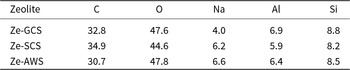
The relative mass composition analysed by EDX (Table 2) was obtained as the average value of the points analysed in Fig. 3c,f,i. The three synthetic zeolite materials are composed of Na, Al, Si, C and O, as these are the constituent elements of the synthesized LOS zeolites and CAN zeolites, the latter being present in low proportions in Ze-GCS. The Si/Al ratio varies between 1.27 and 1.39, confirming that this is a zeolite material with low Si content, which provides a high cation-exchange capacity. The Si/Al ratio and the Na/Al ratio, which vary between 0.58 and 1.05, are in agreement with the theoretical ratios (Si/Al ≈ 1 and Na/Al ≤ 1) for LOS zeolite (Sieber & Meier, Reference Sieber and Meier1974). However, the presence of C in the EDX analyses (Table 2) is consistent with the FTIR and XRD results and with the LOI of the XRF chemical composition (Table 1).
Relative mass compositions of the synthesized zeolite materials obtained according to EDX.

Table 2 Long description
The table reports EDX-derived relative mass percentages of elements (C, O, Na, Al, Si) for three synthesized zeolites: Ze-GCS, Ze-SCS, and Ze-AWS. Oxygen is the largest component in each sample (47.6% Ze-GCS, 44.6% Ze-SCS, 47.8% Ze-AWS), followed by carbon (32.8%, 34.9%, and 30.7% respectively). Sodium varies the most among the minor elements, from 4.0% in Ze-GCS to 6.2% in Ze-SCS and 6.6% in Ze-AWS. Aluminum is similar across samples (6.9% Ze-GCS, 5.9% Ze-SCS, 6.4% Ze-AWS). Silicon is consistently close to 8–9% (8.8% Ze-GCS, 8.2% Ze-SCS, 8.5% Ze-AWS). Overall, Ze-SCS has the highest carbon and lowest oxygen, while Ze-AWS has the highest sodium and lowest carbon. Values are relative mass compositions from EDX and may not represent full bulk composition or detect all elements present.
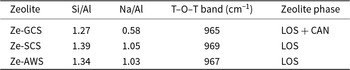
The data in Table 3 show how an increase of Al in the network, evidenced by a decrease in the Si/Al ratio, leads to a proportional increase in Na to maintain electroneutrality, as is observed in the chemical composition of the zeolite materials (Table 1). This increase in Al results in a reduction in the vibration frequency of the T–O–T stretching band from 969 to 965 cm–1. The synthesized materials Ze-SCS and Ze-AWS, with quasi-ideal stoichiometric Na/Al ≈ 1 ratios and main T–O–T stretching bands at 969–967 cm–1, validate the formation of a balanced framework. By contrast, the Ze-GCS material shows a cation deficiency (Na/Al = 0.58) that correlates with the presence of secondary phases detected via XRD, demonstrating that the zeolite framework has been formed with a consistent atomic arrangement among the three types of industrial sludge used as raw materials.
Shifts of the main T–O–T vibration bands with variation in the Si/Al and Na/Al ratios.

Table 3 Long description
The table relates zeolite composition ratios (Si/Al and Na/Al) to the main T–O–T vibration band position (cm−1) and the identified zeolite phase. Ze-GCS has Si/Al 1.27 and Na/Al 0.58 with a T–O–T band at 965 cm−1 and a mixed phase of LOS + CAN. Ze-SCS has Si/Al 1.39 and Na/Al 1.05 with the highest band at 969 cm−1 and phase LOS. Ze-AWS has Si/Al 1.34 and Na/Al 1.03 with a band at 967 cm−1 and phase LOS. Across these samples, higher Si/Al and Na/Al coincide with slightly higher band positions, but the shift is small (4 cm−1 total range). Phase differs only for Ze-GCS, so composition–band comparisons may also reflect phase differences rather than composition alone.
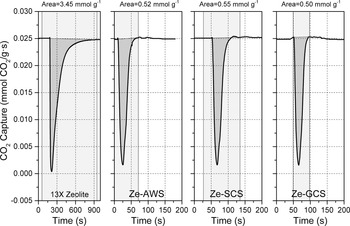
The CO2 adsorption tests of the materials synthesized from GCS, SCS and AWS industrial waste and 13X zeolite are shown in Fig. 4. The area enclosed by the curve, which represents the amount of CO2 gas adsorbed by the sample, was calculated using OriginPro software. At room temperature, the CO2 adsorption capacities of Ze-GCS, Ze-SCS and Ze-AWS zeolites were 0.50, 0.55 and 0.52 mmol g–1, respectively, while the value obtained for the reference 13X zeolite was 3.45 mmol g–1, indicating that the adsorption capacity of the synthesized zeolites is very low compared to the tested reference adsorbent (Table 4). An absorbent is efficient at capturing CO2 when its adsorption capacity exceeds 3.00 mmol g–1 (Dindi et al., Reference Dindi, Quang and Abu-Zahra2019). After analyzing the CO2 capture data obtained from the synthesized materials, it is observed that the values do not vary significantly despite changes in the developed crystallinity. Consequently, it can be confirmed that the pore size of the Losod zeolite represents the bottleneck for improving the capture process rather than the amount of crystalline phase formed. This indicates that optimization efforts should be directed towards modifying the zeolite structure rather than purifying LOS zeolite, as a determining factor for CO2 adsorption capacity is the crystalline structure obtained.
CO2 capture of zeolite materials synthesized from GCS, SCS and AWS wastes and a reference zeolite (13X).

Figure 4 Long description
Area equals 3.45 millimole per gram superscript negative 1. Vertical axis label: CO subscript 2 capture (millimole CO subscript 2 per gram per second). Vertical axis range: negative 0.005 to 0.030. Horizontal axis label: Time (second). Horizontal axis range: 0 to 900. Text: 13X Zeolite. Plotted line values: at time 0 the line is near 0.025; it drops to near 0.000 around time 200; it rises to near 0.025 by around time 500 and stays near 0.025 through time 900. Area equals 0.52 millimole per gram superscript negative 1. Vertical axis label: CO subscript 2 capture (millimole CO subscript 2 per gram per second). Vertical axis range: negative 0.005 to 0.030. Horizontal axis label: Time (second). Horizontal axis range: 0 to 200. Text: Ze-AWS. Plotted line values: at time 0 the line is near 0.025; it drops to near 0.002 around time 50; it rises to near 0.025 by around time 80 and stays near 0.025 through time 200. Area equals 0.55 millimole per gram superscript negative 1. Vertical axis label: CO subscript 2 capture (millimole CO subscript 2 per gram per second). Vertical axis range: negative 0.005 to 0.030. Horizontal axis label: Time (second). Horizontal axis range: 0 to 200. Text: Ze-SCS. Plotted line values: at time 0 the line is near 0.025; it drops to near 0.002 around time 50; it rises to near 0.025 by around time 90 and stays near 0.025 through time 200. Area equals 0.50 millimole per gram superscript negative 1. Vertical axis label: CO subscript 2 capture (millimole CO subscript 2 per gram per second). Vertical axis range: negative 0.005 to 0.030. Horizontal axis label: Time (second). Horizontal axis range: 0 to 200. Text: Ze-GCS. Plotted line values: at time 0 the line is near 0.025; it drops to near 0.002 around time 50; it rises to near 0.025 by around time 90 and stays near 0.025 through time 200.
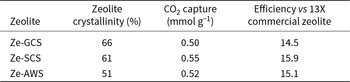
CO2 capture capacity and crystallinity of synthesized zeolite materials.
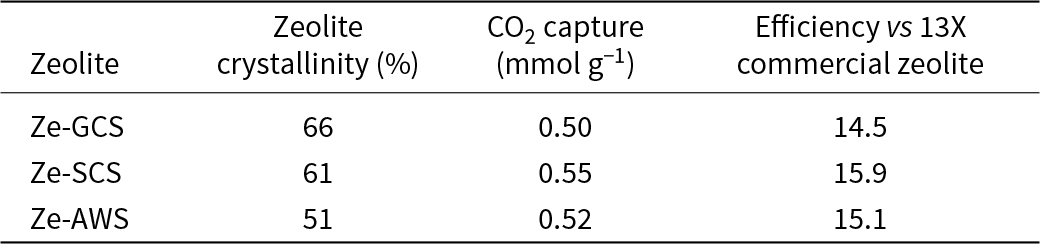
Table 4 Long description
The table compares three synthesized zeolites by crystallinity (percent), CO2 capture capacity (mmol per gram), and efficiency relative to commercial 13X. Ze-GCS has the highest crystallinity at 66% but the lowest CO2 capture at 0.50 mmol/g and the lowest relative efficiency at 14.5. Ze-SCS shows the highest CO2 capture (0.55 mmol/g) and the highest efficiency (15.9), with crystallinity of 61%. Ze-AWS has the lowest crystallinity (51%) and intermediate CO2 capture (0.52 mmol/g) and efficiency (15.1). Across these samples, higher crystallinity does not correspond to higher CO2 capture or efficiency. Efficiency values are relative to 13X, but the baseline performance of 13X is not provided, limiting direct comparison of absolute gains.
The three synthesized materials have a LOS-type framework, characterized by the absence of open channels, defined as pores formed by rings of more than six tetrahedra, through which the adsorbate can diffuse, unlike the three-dimensional structure of the open channels of zeolite 13X, with a faujasite (FAU)-type framework. This structural limitation, in terms of both the type and quantity of zeolite synthesized, explains why CO2 adsorption values are low and comparable for the three materials synthesized from GCS, SCS and AWS wastes. Therefore, the adsorption capacity of the synthesized materials is conditioned by the specific surface area, a parameter that has not been determined in this work.
However, as there is no linear correlation between CO2 adsorption capacity and the amount of zeolite phases obtained (Table 4), it could be concluded that the amorphous phase resulting from alkaline fusion has an intrinsic adsorption capacity comparable to Losod zeolite microcrystals. This is in agreement with the study conducted by Pattaranun & Apinon (Reference Pattaranun and Apinon2012) using ash, in which the specific surface area provided by the amorphous sodium silicate matrix was significant, compensating for the low accessibility of the pores in the zeolite crystalline phase.
Conclusions
GCS, SCS and AWS can be considered as alternative primary sources of Si and Al for the synthesis of artificial zeolites using alkaline fusion and subsequent hydrothermal synthesis.
The type of zeolite obtained depends on the synthesis methodology applied rather than the nature of the starting waste, as the same type of zeolite is obtained in all the cases studied despite significant differences in the original composition of the waste, converging towards similar chemical profiles. This indicates that the alkaline fusion methodology is robust and mitigates the heterogeneity of the residual raw material.
During synthesis, crystalline zeolite yields of between 51% and 66% were obtained, confirming the technical viability of this procedure for recovering industrial by-products and generating new mineral phases with ion-exchange and adsorption properties. However, the use of these wastes as raw materials for zeolite synthesis requires optimization of the durations and temperatures of the hydrothermal processes and/or the use of a SDA to increase the percentage of zeolite obtained and reduce the amount of amorphous material produced.
The exhaustive characterization of the synthesized materials confirmed the effective transformation of industrial waste into zeolite phases with a low silica content. XRF analyses revealed a significant enrichment in Na and Al after hydrothermal synthesis. In addition, XRD, FTIR and SEM-EDX analyses consistently identified LOS zeolite as the predominant crystalline phase in all of the samples, regardless of the starting waste, with there being a direct correlation between the availability of silicon in the original sludge and the efficiency of nucleation under standard hydrothermal conditions (12 h, 180°C). However, the low CO2 adsorption capacity of the zeolite materials is mainly due to their LOS-type structure, which involves small pores and a lack of open channels.
The next steps in this line of research will focus on improving both the efficiency of zeolite synthesis from waste and the CO2 adsorption capacity through the use of SDAs, which act as molecular templates in zeolite synthesis, defining the porous structure and promoting the formation of specific crystalline structures. Thus, both the pore diameter and the presence of open channels in one, two or three dimensions can be controlled.
Acknowledgements
The authors would like to thank Project ProyExcel_00797, INGEMATS, Incentives for Research Projects of Excellence, Andalusian R&D&I Plan, call 2021. Technical and human support provided by Servicios Centrales de Apoyo a la Investigación (SCAI) Universidad de Jaén y Universidad de Málaga (UJA, UMA, MICINN, Junta de Andalucía, FEDER) is gratefully acknowledged.
Competing interests
The authors declare none.



 Open access

