


The British poetry scene has changed significantly, especially in terms of publishing, reviewing, and prizing poets of color. How are we to understand the rising recognition of Black and Asian poets in the past decade? And in what ways have poets and poems anticipated, celebrated, challenged, and intervened in their own inevitable racialization in the cultural field by continuing to invest their aesthetic innovations with political possibility in the face of social realities of spiraling crisis?
In 2005, the Free Verse Report concluded that “less than 1% of poets published by major presses were black or Asian” (Teitler, “The Complete Works Poetry Research”). Two decades later, the annual shortlists for the Forward Prizes and the T. S. Eliot Prize – arguably the two most prestigious poetry awards in the UK – include more and more poets of color, who comprise between 20 and 40 percent of nominees and who have increasingly won since 2015. As is common in prize culture, past winners of these prizes subsequently serve as judges, as when Anthony Joseph won the T. S. Eliot Prize in 2022 for his collection Sonnets for Albert (Bloomsbury) and was then a judge in 2024. Bernardine Evaristo served as the chair of judges for individual collections for the 2023 Forward Prize, commenting: “I like to think that these shortlists, dominated by writers who probably would have struggled to get published 10 years ago, represent a propulsive future for poetry” (Creamer). Evaristo’s reference to poetry’s propulsion forward – and the greater centrality of Black and Asian poetry to British letters generally – is in large part due to two initiatives: The Complete Works (2008–2020) and the Ledbury Poetry Critics (2017–present).
Initiated by Evaristo and directed by Nathalie Teitler, The Complete Works (TCW) was an influential mentoring scheme that guided poets of color from the workshop room to print publication. Funded by the Arts Council England and with the financial support of Sarah Sanders, the program mentored thirty fellows who have gone on to publish with some of the most significant poetry presses, including Faber, Penguin, Chatto & Windus, Granta, Jonathan Cape, Bloodaxe, Carcanet, and Peepal Tree. TCW alumni have served as guest editors to literary journals including Oxford Poetry, The Poetry Review, and Magma (Teitler, “Introduction”). Malika Booker, Nick Makoha, Karen McCarthy Woolf, Roger Robinson, Mona Arshi, Jay Bernard, Kayo Chingonyi, Rishi Dastidar, Sarah Howe, Warsan Shire, Raymond Antrobus, Will Harris, and Momtaza Mehri have also garnered significant recognition from the Forward Prizes and T. S. Eliot Prize as nominees, winners, and judges.
After leaving her directorship of TCW, Teitler established in 2021 the James Berry Prize, originally conceived by Evaristo and sponsored by Bloodaxe, in partnership with Newcastle University, and funded by National Portfolio Organisation grants for inclusivity projects (“James Berry Poetry Prize”). Under Teitler’s leadership, three poets of color can work with a mentor over a three-year period, culminating in the possibility for their poetry collection to be published with Bloodaxe, which has a strong record of featuring poets of color (Teitler, “Introduction”). Evaristo and Teitler’s collaboration with established poets, literary magazines, press editors, universities, and funding streams has clearly been transformative in diversifying the British poetry scene to the point that, at the time of writing, poets of color publishing with “major presses” account for about 10 percent of listed collections (Flood).
Meanwhile, the Ledbury Poetry Critics was cofounded by Sandeep Parmar and Sarah Howe in 2017 to promote poetry reviews by and for nonwhite poets and critics in British literary journalism (“Ledbury Poetry Critics”). Since its inaugural year, the program has linked over a dozen up-and-coming critics of color with established poet-critics such as Will Harris, Kit Fan, and Vahni Capildeo, among several others. Through the Ledbury Poetry Critics and under the Centre for New and International Writing at the University of Liverpool, Dave Coates conducted a series of studies reporting on “The State of Poetry and Poetry Criticism,” covering twenty-nine journals, websites, and magazines between 2012 and 2018 and updated again in 2020 and 2021. In the 2011 Census, 12.9 percent of people self-identified as Black, Asian, or Minority Ethnic (the controversial acronym BAME, which this book has purposefully sidestepped until now). And yet, up until 2016 only 4 percent of all poetry reviews were written by nonwhite critics. This number increased to 9.6 percent between 2017 and 2019. Remarkably (or perhaps not!), of the total number of articles and reviews written by nonwhite critics (391 in total), 40 percent were written by fellows at TCW, Ledbury Poetry Critics, or both (“The State of Poetry,” 3).
Still, for the London Review of Books (LRB) – which published 105 articles by thirty-nine different poetry critics covering 127 different poetry books between 2009 and 2019 – each and every poetry critic was white and wrote only on white poets. Let’s pause. For an entire decade, not a single poetry review in the pages of LRB was written by a person of color. Nor did the LRB review a poet of color despite, for instance, Derek Walcott winning the T. S. Eliot Prize in 2010 for White Egrets (Faber), Kei Miller winning the Forward in 2014 for The Cartographer Tries to Map a Way to Zion (Carcanet), or Ocean Vuong winning both the Forward and the T. S. Eliot in 2017 for Night Sky with Exit Wounds (Cape Poetry) (“The State of Poetry,” 3). Other literary magazines, however, have been welcome platforms for reviews and criticism by nonwhite authors. Venues such as Wasafiri (51 percent), The Poetry School (24.8 percent), Poetry London (15.8 percent), and Poetry Review (14.9 percent) have welcomed critics of color, far surpassing the 12.9 percent “yardstick” of the 2011 Census (“The State of Poetry,” 3).
Since 2021, Ledbury fellows have published articles and reviews in the pages of The Guardian, The Telegraph, the Times Literary Supplement, and the New Statesman. And in 2021, the program received funding from the Arts and Humanities Research Council EDI Fellowship to place fellows in training residencies for editorial positions. The State of Poetry Report found in 2020 that 94 percent of editors and 83 percent of co-editors are white (7). “The Ledbury Critics programme is committed to further scrutinising such inequalities,” the report concludes (5). “We hope this data analysis is enlightening and that it encourages reviewers and poets of colour as well as editors and readers from across the UK and Ireland to act collectively and consistently, towards equality and diversity in poetry criticism.” The Ledbury Critics program has been influential in encouraging editors at literary journals and magazines to include more reviews written by critics and about poets who identify as racial, ethnic, gendered, or sexual minorities – and, hopefully, to begin to change the institutional makeup of editorial boards, recruitment, and hiring.
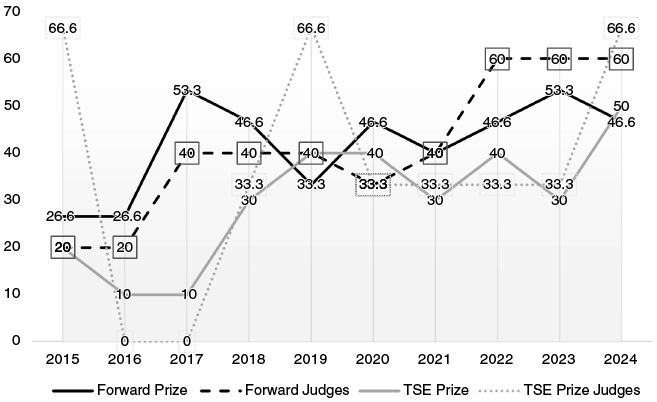
An in-depth empirical analysis of race and poetry prizes deserves a chapter unto itself. For the purposes of this conclusion, though, I tracked the changes in the representation of poets of color between 2015 and 2024 on the shortlists and the judges’ panels for the Forward Prizes for Poetry and the T. S. Eliot Prize (see Figure 5).
Changes in the representation of poets of color for the Forward Prize and T. S. Eliot Prize, 2015–2024.
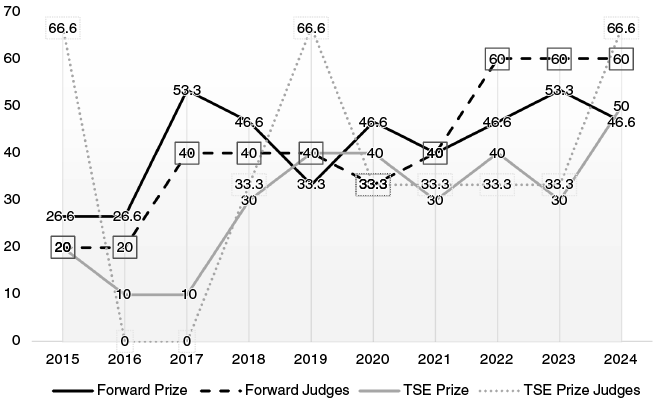
For the Forward (represented by a solid black line), I combined three mainstay categories: Best Collection, Best First Collection, and Best Individual Poem, each of which includes five possible poets on the shortlist, for a total of fifteen poets overall.1 The annual Forward panel comprises five judges (a dotted black line). The T. S. Eliot includes a total of ten poets on its shortlist (a solid gray line) and three judges each year (a dashed gray line). Let me put some names and titles to the numbers.
The year 2015 marked a watershed, when two poets from TCW took these prizes for the first time: Mona Arshi’s Small Hands (Liverpool UP, Pavilion Poetry) won the Forward Best First Collection, and Sarah Howe’s debut Loop of Jade (Chatto & Windus) won the T. S. Eliot amid significant controversy (Parmar, “Decolonizing the English Lyric,” Reference Parmar and Quayson446–48). For readers unfamiliar with the structure of these awards, it is important to explain that publishers (houses, presses, magazines), not individual authors, submit entries to the prize committees for consideration. There is a reciprocal relationship, then, between prizing and the publishing industry, which often foregrounds race and ethnicity in its marketing of authors and, further, looks to increase their sales by having a collection on a shortlist or, even better, win outright; conversely, the prize as an economy of prestige rewards itself by consolidating cultural capital through poetry’s “literary excellence,” accruing symbolic capital through more inclusive “racial representation” among shortlists and judges, and by conferring economic capital to poets. The Forward Best Collection amounts to £10,000, Best First Collection to £5,000, and Best Poem to £1,000 while the T. S. Eliot pays out £25,000.
Generally, these two prestigious prizes have had poets of color comprise between a third and as high as half of their shortlists. In 2017, the Forward saw Nuar Alsadir’s Fourth Person Singular (Pavilion Poetry) shortlisted for Best Collection; Richard Georges’s Make Us All Islands (Shearsman Books) and Nick Makoha’s Kingdom of Gravity (Peepal Tree Press) were shortlisted for Best First Collection, which was won by Ocean Vuong’s Night Sky with Exit Wounds (Cape Poetry); and Malika Booker, Mary Jean Chan, Harmony Holiday, and Ishion Hutchinson competed for Best Individual Poem. Mona Arshi and Sandeep Parmar sat on the Forward judges panel that year, a testament to their acuity as writers and critics as well as the significant work of TCW and Ledbury Critics. Still, among the eight poets shortlisted in 2017, four are US-based, a point to which I will return momentarily. That same year, the T. S. Eliot also awarded the prize to Vuong, the sole poet of color to be nominated that year. From 2018 onwards, though, we see a steady increase in the representation of Black and Asian poets among shortlists and judges’ panels alike. In 2024, the T. S. Eliot Prize included five poets of color among its ten-poet shortlist, including Raymond Antrobus’s Signs, Music (Picador Poetry), Gustav Parker Hibbett’s High Jump as Icarus Story (Banshee Press), Gboyega Odubanjo’s Adam (Faber), Carl Phillips’s Scattered Snows, to the North (Carcanet Press), and Karen McCarthy Woolf’s Top Doll (Dialogue Books).
There is, though, a pattern in which often half of the poets of color listed each year are either US-born or US-based. The Forward and T. S. Eliot are admittedly international prizes open to collections published in the UK. North American poets of color have, overall, tended to increase their percentage of representation nearly every year, with the exception of 2019, when all the poets of color for both prizes were British or British-based. That year, the Forward shortlist included Vidyan Ravinthiran, Raymond Antrobus, Jay Bernard, Mary Jean Chan, and Parwana Fayyaz, while the T. S. Eliot included Anthony Anaxagorou, Bernard, and Ravinthiran, with Roger Robinson’s A Portable Paradise (Peepal Tree Press) winning the prize. While US poets of color have enjoyed publication and recognition in the UK, the reverse is rarely the case, never mind being shortlisted for US poetry prizes.
Looking to judges and judging, the Forward panel begins at 20 percent in 2015 and 2016 and then increases to around 40 percent between 2017 and 2021, and it has been as high as 60 percent between 2022 and 2024. By comparison, the T. S. Eliot panel comprised three white judges in 2016 and 2017 but has regularly included at least one and as many as two judges of color since then. Sarah Howe and Nick Makoha (both TCW alums) served as judges on the T. S. Eliot panel in 2019, and in 2024 Mimi Khalvati chaired the T. S. Eliot accompanied by Anthony Joseph, who won in 2022. In publishing, reviews, and prize culture, the tide has begun to turn.
The previous discussion has outlined some of the institutional and sociological transformations that have taken place in the prizing of race over the past decade. Throughout this book, I have granted agency to poets, poems, and readers to negotiate the forces and pressures shaping poetic production and reception at different conjunctures of crisis. My dialectical critical approach has traced a series of nonidentical relationships – the gaps, discontinuities, and incommensurabilities – between social forces of violence and inequality as they impact poetic forms, situated in specific times and places of cultural production and political organization; and, conversely, the ways in which poems invent different political postures, stances, and formations premised in otherness and difference. The unruly otherness, that is, the nonidentity, distinguishing poetry and race carves out a space for understanding the remarkable complexity of the ways in which poems – as mediations of crisis and struggle – question, reimagine, and at times seek to abolish the social conditions that give rise to poetic enunciations of race, here understood as a form not just produced by crisis but always already traversed by crisis.
With this in mind, one question that arises at the current conjuncture of the increasing “prizing of race” concerns the relative agency of poets and poems to anticipate, challenge, perform, or even fail to perform their own racialization within the economy of prestige. How, in short, do poets continue to signal race in prevailing crisis given the prevalent prizing of race?
As I bring my discussion towards a conclusion, I would like to spotlight just one especially well-recognized, award-winning collection published during the ascendency of the prizing of race in the past several years: Jason Allen-Paisant’s Self-Portrait as Othello (Carcanet), which won both the Forward Prize for Best Collection and the T. S. Eliot Prize in 2023. Allen-Paisant joins Ted Hughes (1998), Sean O’Brien (2007), John Burnside (2012), and Vuong (2017) in holding the distinction of winning both prizes in the same year. In a January 2024 interview with The Guardian, Allen-Paisant remarks that, as overwhelmed as he felt to win, he also knew that his work would likely appeal to readers and judges alike. “Othello,” he says, is “in” (Knight). It seems both timely and opportune for Allen-Paisant to refashion the most canonical exemplar of Black masculinity to suit contemporary concerns over race, migration, and bodily vulnerability.
In addition to its critical acclaim, Self-Portrait as Othello also extends many of the core preoccupations running across this book’s study of the aesthetics and politics of British Black and Asian poetry. “My name is in crisis,” the persona-as-Othello says, “I am scattered all over / your cities, Europe!” (Self-Portrait, Reference Allen-Paisant51). Allen-Paisant purposefully puts on the persona of “Othello” to self-reflect upon his poetry’s aesthetic performances of “race” and the ways in which Blackness and the Black body are produced and traversed by crisis. The poet patterns social crises over race and racialization through a range of formal innovations including lyric-dramatic-performance poems, broken sonnets, dramatic monologues, prose poems, and ekphrastic poems. Despite a title that advertises itself as an ostensible “self-portrait as Othello,” the collection unequivocally marks the distance – the nonidentical gap – between Allen-Paisant’s poet-persona and Shakespeare’s Othello, a world-renowned figure of Blackness. “I’m haunted as much by the character Othello,” the speaker states in “Self-Portrait as Othello I,” “as by the silences in the story” (45). “Othello,” the speaker says, “is a real structure of feeling taking shape, which the world had never known.” In many ways, “Othello” functions as a value-added placeholder for staging – exhibiting, performing, and curating – the complexities and contradictions of social-historical-political forces flowing through the Black body as object.
In doing so, Allen-Paisant’s writing further self-reflects upon the ways in which the categories of “race” and “poetry” are formed out of enduring histories of injury and woundedness that precede and exceed discursive representation, histories that his poetry encodes through instances of fragmentation, erasure, and fluidity. Ultimately, Self-Portrait as Othello is especially illustrative for the tensions that arise when artists of color such as Allen-Paisant anticipate – and play into – their own tokenization and, by extension, question the forces shaping “the prizing of race” by cultural institutions. Allen-Paisant, however, seems less concerned with matters of representation, recognition, or identity than with his poetry’s capacity to bring his persona and speakers to the edge of language. It is by dwelling in spaces of inscrutability and impenetrability that his poetry activates what he calls a politics of bewilderment.
Across the collection, Allen-Paisant creates a series of personae that interweave Othello’s imagined personal and collective history with the poet’s self-performance of Black masculinity, emotional vulnerability, and racialized shame as he travels across twenty-first-century Europe. The collection is divided into three parts. Part I comprises a sequence of lyric-dramatic-performance poems reflecting upon the poet-persona’s childhood in rural Coffee Grove and Porus, Jamaica, where he is raised by his grandmother (“Mama”) while his actual mother is training to become a schoolteacher and after his father abandoned him before he was born. Part II, which I discuss later, comprises a poem sequence of self-portraits as Othello. Part III offers a series of moving elegies for the poet’s “Mama,” for his living but absent father, and for collective Black grief owing to the pervasive historical presence of slavery in the twenty-first century: “how / does a multitude of orphans weep together / when each one speaks an alien tongue?” (74).
In Part I, the poet-persona tracks his rural upbringing as “a Jamaican country boy” who then pursues a doctoral education on scholarship at Merton College, Oxford, where he dons tweed jackets and fake “Prada lenses” to blend in (20). Perfectly fluent in French thanks to his adolescent education at the Alliance Française in Kingston (“my vowels how they wrapped / their arms around me”), the speaker spends a year in Paris studying at the prestigious L’École normale supérieure, dancing in the Violin Dingue nightclub in the Latin Quarter, and courting his own Desdemona (the poet’s future wife, Lucille Paisant). Throughout, the speaker is filled with the self-hatred “that Black was a different language” that no amount of acculturation or Veuve Clicquot could overcome (23, 31). In the process, the “I” comes to the recognition that, no matter how perfect his French accent or how deep his Oxford learning, he will remain an imposter, a “ghost actor” whose Black body betrays his performance of (white) sophistication (23). Part I concludes with the persona now back in Coffee Grove reflecting upon his European travels. With renewed confidence and swagger, he declares:
The only way around performance is through the performance of race, with the “I” multiplied into actor, spectator, and a carnival of bodies. That is, it is precisely by accepting how Blackness is a perpetually failed performance of otherness as much as of whiteness that Allen-Paisant’s persona can perform its failures purposefully through its dispersal and multiplicity.
Like D. S. Marriott, Allen-Paisant similarly enacts “Blackness” through failed performances. But whereas Marriott’s failed performance of Blackness requires the inventive leap into opaque, unknown forms of Blackness by way of Fanon (“the abyssal” structure of Blackness), Allen-Paisant takes Aimé Césaire as his critical model. In Engagements with Aimé Césaire (OUP, 2024), Allen-Paisant describes how Césaire interweaves Afro-Caribbean, West African, and French poetic traditions to reconceive poeisis far beyond what is written in verbal textual form. Poetry, for him, becomes a way of “thinking with spirits,” here understood as an “acting, moving, agential energy within all things” (Engagements, Reference Allen-Paisant8). “In African/diasporic cosmologies,” Allen-Paisant writes, “Spirit appears as the plenitude that is wholly in the here-and-now of each earthly thing” (16).
In this way, poeisis signals a collaboration, indeed, “an act – of desire, of exchange” that requires the full participation of cultural makers/poets, cultural artifacts infused with spirit-and-sound-and-image, and cultural recipients whose bodies carry reverberations in acts of listening and resounding (85–86). Object is not merely object any more than spirit is merely spirit. Poeisis, for him, designates instead forms of embodied making through hands, breath, and body, embodied makings that carry an impenetrability in that they articulate the known and the unknown, the familiar and the unfamiliar (9–10).
Poetry, thus understood, reorients us to a language of “unfamiliarity” that dissolves the fiction of the “I” as an individuated being and instead embraces becoming “traversed, spread, distributed” and “inhabited by other beings” (12). Poetic experience, for Allen-Paisant, invites an openness to becoming other whereby “poetry” becomes an active “human collaboration with ‘things,’” even of becoming constituted by other beings and other things (15). “Spirit possession,” he writes, “is resistance to the domination of time – which is another way of saying, to the domination of the body” (7). For Allen-Paisant, objects are not only objects but also embodied carriers of prior histories, languages, cultures, and experiences, however impenetrable or bewildering – especially in the objects of poems.
For my purposes here, I will focus on two instances in the collection that reflect upon Othello’s object status as corollaries for and even participants in Allen-Paisant’s poetic and political preoccupations. The first appears in “Ringing Othello,” the prologue to the collection. “How could I resurrect you to speak,” the poet’s self-fashioned persona asks, “when your burial ground is no ground” (13)? Across the broken Petrarchan sonnet, the figure of “Othello” is repeatedly cast in negation as occupying “no ground,” a “something / that has been left undone,” a “life, / unfinished,” a “silence” and “a haunting” (13). Othello’s absent presence confounds the speaker, compelling him to ask at the end of the octave: “Who am I?” The correspondences between Othello’s predicament and the speaker’s own as a Black male body whose very being is trapped within its object status, despite or because of his elevated speech, education, and worldly knowledge, compel the persona to feel as though Othello’s life “is lived also through mine.” Rather than making Othello “speak” or presuming to re-present him as a verbal icon, the lyric “I” instead becomes a conduit for conjuring “Othello.”
The final lines of the poem read: “I conjure you / furiously.” So much hinges on the word “furiously,” the madness of poetic creation associated with “the furies,” which write and speak their way through the poet-speaker in the act of summoning. The word “fury” appears twice in Shakespeare’s Othello. In Act 4, scene 2, as Othello becomes overwhelmed by jealous rage and commands Desdemona, “Let me see your eyes. / Look in my face,” she replies in complete confusion: “Upon my knees, what doth your speech import? / I understand a fury in your words, / But not the words” (4.2. 33–34). It is as if the “fury” of Iago’s racist discourse has entirely subsumed Othello’s being, driving him to a frenzy beyond his control. “Fury” also appears earlier, when Othello describes the making of the handkerchief given to him by his mother and sewn by an Egyptian sybil:
The object – whether the object of the Black male body as emblematized through “Othello” or the poet-persona, the aesthetic object of the play or the poem, or the woven Egyptian handkerchief moving across the play – is not merely an inanimate object. Allen-Paisant’s conception of poeisis could be best described as “thaumaturgical”: a magical working of wonders through a self-reflexive performance of being with spirits as they reanimate the lived world.
“Who am I?,” we might ask again. For the speaker-persona in “Ringing Othello” to “summon you / furiously,” it is as if the “you” of “Othello” reanimates the “I” in the fury of Allen-Paisant’s poetic creation, transforming into something like an “Othello-I.” The sonnet’s redoubled “Othello-I” in turn becomes furiously inhabited by numerous others: by Othello’s unnamed mother and, behind her, the silent Egyptian sibyl as spiritual-material forces; forces moving through the lyric “I” and by extension the collection’s composite self-portraits of the fictive author, “Jason Allen-Paisant”; and, now, any reader who speaks these words aloud as performative correspondences over race, racialized violence, and “being with spirits,” however tenuous or uncertain.
His is a poetic manifesto for a fully politicized animism. “If we conceive of all ‘things’ as having some form of personhood,” Allen-Paisant writes, “then we can make room for them in our decision-making” (Engagements, Reference Allen-Paisant124). Ultimately, this would require expanding the frame of physiological personhood to include human, ecological, and nonhuman earth dwellers through “cross-temporal solidarities” (125).
The sequence of poems in Part II focuses squarely on Allen-Paisant’s self-portraiture as Othello. At times, Allen-Paisant takes on the voice of a reimagined Othello in early modern Venice through the first-person pronoun “I,” such as in the dramatic monologues “Self-Portrait as Othello I” (43–44) and “Self-Portrait as Othello IV” (52). At others, Allen-Paisant maintains a clear distinction between the “I” of the poet’s speaker-persona and the “you” of Othello. For instance, in poems such as “Othello Walks” (46) and “Who Is Othello? II” (50), the speaker addresses the “you” of Othello to reflect upon the temporal distance between them even as these poems put their respective experiences of Black masculinity and migration in Europe into conversation with one another. And in other poems, Allen-Paisant wryly uses a single lyric “I” that purposefully blurs the poet-speaker’s “I” and Othello’s “I,” almost to the point that they become nearly indistinguishable from one another.
We can see this latter instance of a redoubled lyric “I” in the culminating poem of the sequence, “Self-Portrait as Othello V” (51–52). Across seven unrhymed stanzas almost entirely devoid of punctuation, the “I” asserts itself as “neither a thugz nor a shotta” but merely as desiring to “not / be invisible, to have face” (53). It initially appears as though the “I” resembles Allen-Paisant’s cultural background through its uses of Jamaican slang, neither a criminal nor a gangster. The poem quickly proceeds, however, to reflect upon the ways in which the speaker’s very desire to “have face” cannot escape its racialization before whiteness:
For a moment, the speaker appeals to the “here” of the stanza as a space of ceaseless self-invention. This momentary glimpse of freedom, however, is immediately denied by the running enjambment that ensnares the “I” through its dependency upon its white audience’s insatiable desire for “stories” of self-exoticism. By italicizing “stories,” the speaker marks the gap between the “I”’s ostensibly free self-narration and the constraints it suffers – and plays into – due to the demands of Desdemona, Brabantio, Iago, and, for that matter, contemporary readerships compelling Black poets to perform Blackness. In this way, Allen-Paisant’s carefully crafted persona of Blackness becomes indistinguishable from Othello’s staged otherness before Venetian society.
The poem rapidly changes time and location, leaping from Othello’s Venice and the “controlling” voice of Iago to the “MCR,” or Middle Common Room, the graduate meeting room at the University of Oxford. Here, the speaker is surrounded by “public school boys” whose full-rounded accents resound the false “knowledge” that they “can know every place” and can “do every thing.” The repetition of “every” here and across the poem reinforces the “I”’s entrapment before the totalizing power of racist discourse as eloquently articulated by the Iagos of the world, then and now (53).
The final stanza of “Self-Portrait as Othello V” reads:
The diminutive “me” posits an alternative form of “knowledge” premised in an “undefinable desire” for merely “a country.” The speaker’s hunger is not only to evacuate Othello’s prior stories of “hair-breadth ’scapes” for prurient colonial eyes and ears who have already, in advance, stolen personhood from him as the racialized object, ready-made for madness and death. Rather, this poem in particular – and Allen-Paisant’s oeuvre as a whole – take as a given the object status of the racialized Black body. In the face of its inevitable objecthood, the “me” poetically summons that which moves within and potentially beyond the coordinates of racist discourse, gesturing towards a decolonial politics arising through “the liquid of language.”
“Politically speaking,” Allen-Paisant writes, “what’s at stake for the world as we know it is the need to create a space in language – in our grammars of the world – for un-languageable things. It’s the ability of sound to enact forms of knowing based on non-knowing, on bewilderment, that makes poeisis a medium for an otherwise form of sociality” (Engagements, Reference Allen-Paisant85). In his writing on Césaire, Allen-Paisant also discusses “the liquidity” of language, especially for someone who speaks several languages including French, German, Italian, and Jamaican patois (91). The liquidity of language, for him, creates the sense in the body, even on the tongue, that each “word summons the other; each word summons a history which summons another history, until the word melts into a kind of moving mist, no longer stable, no longer a thing unto itself” (91). Poetry’s peculiar fluidity, to become liquid, is a powerful political resource for Allen-Paisant to “search for a way out of the claustrophobia of racist violence”: poetry’s liquidity can create “an attunement to otherliness,” that is, “to what is more than us, beyond us, and yet organic to us, that continuity of being which ultimately nullifies the border between subject and object” (91). Indeed, far more than Shakespeare’s Othello, Allen-Paisant would seem to be summoning the poetic powers and political possibilities of Aimé Césaire, for whom sound and image in poetry collaborate to enact what he calls a “politics of bewilderment” (85).
“Othello” is precisely Allen-Paisant’s figure – a complex, knotted entanglement of social-political-aesthetic forces comprising an entire structure of feeling spanning centuries – for resounding “un-languageable things” in their “otherliness.” The liquidity flowing through Allen-Paisant’s poetic “I,” Othello’s “I,” and echoes of Césaire’s writing resonates alternative forms of togetherness, of being-with-objects. The category of “Othello” indisputably stands as the representative of objectified Black masculinity par excellence: the perpetual tragedy of having been born into a racialized world of nonbeing. With Césaire in mind, however, Allen-Paisant also summons other “stories” to “Othello” whose bewildering impenetrability become the blackest form of Blackness of all. These are the “stories” that remain unsaid and unsayable: prior histories of Black peoples who were sold into slavery and necessarily populated Europe but that remain inaccessible due to the gaps in the archive. These are the stories that seek to fashion new self-portraits in and through others, stories that seek a way out of the claustrophobia of racist discourse. And these are stories constituting as yet unwritten narratives that would refuse the racialized order of death in the name of a renewed politics of life.
What would it mean to inhabit “a country” through “the breathing of the ocean” in “the liquid of language”? Returning to the final lines of the poem, it would require occupying a space of bewildering inscrutability. If we read these final lines slowly, we can see how the speaker’s knowledge of and desire for “a country” – a place of residence, a place of belonging, a homeland – hovers over and syntactically slides into “the breathing of the ocean.” The poem here plays upon the tension between the line and the caesura. That is, even as the poetic line demarcates “a country” from “the breathing of the ocean,” the semicolon shores them together. It is as if the rising and falling of waves engulf the “me” into the nonbeing of the ocean, the literal repository of Black death for centuries. At the same time, the breathing of the ocean replenishes the “me” through the plentitude of more “stories.” For Allen-Paisant, it is poetry’s utopian possibility as a life-giving force that takes shape through the active participation of poetic makers, aesthetic objects, and readers-listeners attuned to otherliness. If, in Othello, “there’s magic in the web of it,” in Self-Portrait as Othello, there’s spirit in the liquid of language.
My profile of Allen-Paisant is but a brief snapshot of the ways in which poets of color can anticipate, play into, and challenge the forces shaping the “prizing race” suited to the bewildering complexities and contradictions of twenty-first-century British culture. In self-fashioning Othello, Allen-Paisant might, arguably, court the favor of prize committees who, ultimately, reward themselves by seeking to bridge poetic excellence with forward-thinking social conscience and left-leaning political relevance, especially given the timeliness of the vulnerability of Black bodies, in discourse as in reality. What is also true, however, is that Allen-Paisant’s writing performs “race” in ways that are always already in crisis through his poetry’s unfinished process of becoming and being with difference, both in struggle and in community.
Looking ahead, one path for future research would be to conduct the arduous work of collecting data on poetry prizes in twenty-first-century Britain – not only the Forward and T. S. Eliot, but also the Ondaatje, the Cholmondeley, the National Poetry Competition, and the Poetry London Prize. Such a research project in a British context could follow the lead of the work undertaken by Juliana Spahr, Stephanie Young, and Claire Grossman through their Post45 Data Collective set on “The Index of Major Literary Prizes in the US.” What would the contours of the British prize cultural landscape look like if one were to map out the gender, race, and educational background of winners and shortlisted poets, the range of publishers, and the panel of judges and their respective backgrounds? This could become a mechanism for identifying patterns and changes of representation, recognition, inclusion, and exclusion for poets of color, especially in the last two decades.
As Spahr and Young argue, there is no question that prizes “reflect power imbalances” that far exceed the genre of poetry (“On Poets and Prizes”). In the face of these imbalances, they call for a switch of perspective. If we accept that prizes do not reflect literary “excellence” but rather the “exchanges of honors among a small cadre of poets,” this could open up the possibility for “diversify[ing] the prize winnings among these cadres while also reducing the inevitable biases when judges and winners come from the same cadre.” “Imagine if,” Dan Sinykin asks in his Los Angeles Review of Books essay “Fuck the Poetry Police,” which covers the Post45 Data Collective set on awards and prizes, “we could link the ‘Major Literary Prizes’ data set with the agents who represented the winning books, the editors who edited them, the houses that published them, and the venues that reviewed them.” Such a mapping in a British context would go a long way to clarify the unequal structure of prizing institutions, the publishing networks and coteries of poets and poetry circles, the struggles between authors and their particular position in the cultural field, and the forces shaping and conditioning the kinds of styles, voices, and forms that subsequently become recognized and awarded. It would also mean looking into the strategies poets and poems adopt to work within and potentially transform the unequal poetry world.
What is clearer than ever in the twenty-first century is the sheer abundance of poetry by well-established and up-and-coming artists of color publishing across a range of platforms, from websites and social media, through literary magazines, journals, major corporate houses, and small independent presses, to public spaces and performance venues across the UK. Given the flourishing of Black and Asian poetry in British letters, the time is ripe once again for more reviews, more articles, more monographs, more anthologies, and more critical companions devoted to the study of a rich and various body of verbal art that is sure to undergo even further transformation in the coming century. The crisis continues. And poems are always ahead of it.

 Open access