1. Introduction
In the first half of 2020, as a result of the COVID-19 pandemic, global CO2 emissions were 8.8% lower than in the same period in 2019 (Liu et al., Reference Liu, Ciais, Deng, Lei, Davis, Feng and Schellnhuber2020). To limit global heating to the aspirational Paris target of 1.5°C above pre-industrial temperatures (UNFCCC, 2015), global CO2 emissions would have to be reduced by about 55% by 2030 (UNEP, 2019). This foreshadows the magnitude of the climate mitigation challenge, which is underlined by the observation that, despite the appearance of a second wave of COVID-19 in several parts of the world, there was, commencing in April–May 2020, an increase in global emissions as some economies started to recover from the pandemic (Liu et al., Reference Liu, Ciais, Deng, Lei, Davis, Feng and Schellnhuber2020).
Yet, business activity must regrow, in order to provide the desperately needed jobs that were lost, and even selective ‘green’ growth will increase consumption. This raises the following research questions, which are also questions of urgent practical politics: how can climate change be mitigated while economies recover from the pandemic? More generally, how can pandemic recovery be designed to avoid repeating the adverse environmental and social impacts of the old economic system?
Critiques of the existing economic system, and neoclassical economics theory that allegedly justifies it, abound (e.g. Blatt, Reference Blatt1983; Daly, Reference Daly1977; Daly & Cobb, Reference Daly and Cobb1990; Dennis, Reference Dennis2016; Keen, Reference Keen2011; Ormerod, Reference Ormerod1994; Smith & Max-Neef, Reference Smith and Max-Neef2011; Waring, Reference Waring1988). These authors argue that the economic system is environmentally destructive because it encourages endless growth in the consumption of energy, materials and land, together with population growth, on a finite planet, and because it doesn't distinguish sufficiently between environmentally beneficial consumption/production on one hand and environmental damaging consumption/production on the other hand. The critique also points out that the old system fosters inequity based on exploitation and other forms of social injustice. Inequity fosters ill-health, reduced life expectancy, illiteracy, violence, crime and other social problems (Wilkinson & Pickett, Reference Wilkinson and Pickett2010). The critique of neoclassical macroeconomic theory is that it contains unjustifiable assumptions and fundamental internal contradictions, and so has little relevance to real-world economies.
Therefore, during the pandemic and its recovery, there is the opportunity to debate, develop and implement new or modified socioeconomic systems that can create and maintain ‘sustainable prosperity’ while being consistent with ecological sustainability and improved social equity/justice (D'Alessandro et al., Reference D'Alessandro, Cieplinski, Distefano and Dittmer2020; Wiedmann et al., Reference Wiedmann, Lenzen, Keyßer and Steinberger2020). Within this context, the scenario of this paper addresses rapid climate mitigation for the former and full employment, together with health benefits (Krug & Eberl, Reference Krug and Eberl2018; WHO, 2018), for the latter.
Energy generation from fossil fuels – providing electricity, non-electrical heat and transportation – was responsible for 73% of global greenhouse gas emissions in 2016 (Ge & Friedrich, Reference Ge and Friedrich2020). Therefore, the vast majority of fossil fuel resources must be left in the ground (Steffen & Rice, Reference Steffen and Rice2015). Mitigation must be rapid because we may have only a few years at most to keep the global average heating below 1.5°C (DNV-GL, 2020; Lenton et al., Reference Lenton, Rockström, Gaffney, Rahmstorf, Richardson, Steffen and Schellnhuber2019), taking account of feedbacks. Global energy-related CO2 emissions increased by 12.7% from 2010 to 2018 (IEA, 2019). Realistically, achieving 1.5°C appears impossible, except as a result of economic collapse, but 2°C may still be achievable, because its carbon emissions budget is about three times that of the 1.5°C target (IPCC, 2018, Table 2.2). Even 2°C requires an urgent break in current emission trends (Friedlingstein et al., Reference Friedlingstein, Andrew, Rogelj, Peters, Canadell, Knutti and Le Quéré2014).
Section 2 discusses the strengths and limitations of technological change in transitioning rapidly to net zero emissions, focussing on the energy sector. It finds that technological change is necessary, but unlikely to be sufficient for keeping heating significantly below 2°C, and therefore that socioeconomic and behavioural changes may be necessary. Hence this paper considers a COVID-19-recovery scenario with two principal components.
One component, called low-carbon jobs, involves creating new employment in labour-intensive work with relatively low-carbon emissions (Section 3.2). This involves both technological and socioeconomic changes. In the energy sector, these jobs are created by substituting renewable energy (RE) for fossil fuels while increasing energy efficiency (EE) and energy conservation. However, even these selective activities will increase consumption to some degree and hence emissions (Suh, Reference Suh2006). Therefore, the second component of the scenario (Section 3) is degrowth to a steady-state economy (Daly, Reference Daly1977; D'Alisa et al., Reference D'Alisa, Demaria and Kallis2014; Dietz & O'Neill, Reference Dietz and O'Neill2013). The pandemic has assisted to some degree in facilitating degrowth, because many people have become accustomed to working from home and walking and cycling for recreation near their homes. Degrowth requires socioeconomic and behavioural changes.
Section 4 discusses a strategy for degrowth, including policies for reducing rebound and funding the transition using Modern Monetary Theory in countries where it is applicable. Section 5 is the general discussion and conclusion.
2. Technological change is necessary but not sufficient
2.1 Renewable energy and energy efficiency can replace fossil fuels
A large body of evidence – comprising scenario studies, simulations and practical experience in several regions, countries and states/provinces – indicates that zero-emission energy could be provided by a combination of RE and EE and that the transition would be affordable (e.g. Bogdanov et al., Reference Bogdanov, Farfan, Sadovskaia, Aghahosseini, Child, Gulagi and Breyer2019; Butler et al., Reference Butler, Denis-Ryan, Graham, Kelly, Reedman, Stewart and Yankos2020; Diesendorf & Elliston, Reference Diesendorf and Elliston2018; Elliston et al., Reference Elliston, Riesz and MacGill2016; Graham et al., Reference Graham, Hayward, Foster and Havas2020; IRENA, 2020; Jacobson et al., Reference Jacobson, Delucchi, Cameron and Frew2015, Reference Jacobson, Delucchi, Cameron and Mathiesen2018; Lazard, 2019; Ram et al., Reference Ram, Bogdanov, Aghahosseini, Gulagi, Oyewo, Child and Breyer2019). Furthermore, recent research indicates that the energy return on energy invested of renewable electricity technologies and systems may be typically equal to or greater than that of fossil-fuelled electricity (Brockway et al., Reference Brockway, Owen, Brand-Correa and Hardt2019; Diesendorf & Wiedmann, Reference Diesendorf and Wiedmann2020; Leccisi et al., Reference Leccisi, Raugei and Fthenakis2016; Raugei & Leccisi, Reference Raugei and Leccisi2016).
The main elements of the transition strategy proposed by these and other RE and EE researchers are to:
(1) improve EE of buildings, appliances and industrial processes;
(2) replace fossil fuelled electricity generation with renewable electricity and storage;
(3) electrify non-electrical heating and most transportation;
(4) use renewable electricity to split water to produce hydrogen, convert it to ammonia which is more manageable, and use this ‘renewable’ fuel in aircraft and ships and for long-distance road transport in remote areas and
(5) assist workers disadvantaged by the transition by retraining, relocation and retirement packages.
Table 1 summarises the status and affordability of the proposed strategic initiatives for the RE + EE scenario.
Table 1.Status of EE, RE and other low-carbon technologies
Most global electricity will be generated by wind and solar supplemented by hydro. Regions lacking these RE resources will import renewable electricity, in most cases by transmission line and in a minority of cases as gaseous or liquid ‘renewable’ fuels by a tanker ship. Thus, a relatively rapid global transition, completed before 2040, for transitioning to renewable electricity and electrifying most transport, appears technically and economically feasible. This covers the majority of emissions in most countries. But, transitioning fossil-fuelled heating, for homes, commercial buildings and industry, to electricity may take longer because of the long lifetimes of existing fossil-fuelled heating technologies (REN21, 2019). Non-energy industrial emissions (e.g. making cement and iron ore), ‘green’ hydrogen and agriculture still need more research and development.
2.2 Chasing a receding target
From 2010 to 2017, global total final energy consumption (TFEC) grew by 10% (IEA, 2019). Given that the global population growth rate averaged over the same period was 8.5% (United Nations, 2019), TFEC per person grew 1.57% over the same period. Global material flows have also increased (Wiedmann et al., Reference Wiedmann, Schandl, Lenzen, Moran, Suh, West and Kanemoto2015). Thus, apart from the pandemic pause in 2020, technology change has been chasing a receding target. Since actions to slow population growth (education of women, dissemination of contraceptive information and improved social security) are likely to be slow, the principal mitigation efforts must focus on both technological change and reducing energy consumption per person.
Similarly, although technological improvements can make some reductions in emissions from non-energy industrial processes and agriculture, reductions in consumption – for example, by increased reuse and recycling of materials and eating less red meat – will also be necessary in these sectors.
3. Socioeconomic and behavioural strategies to reduce consumption
3.1 Choice of strategy
Wiedmann et al. (Reference Wiedmann, Lenzen, Keyßer and Steinberger2020, Table 1) have identified a wide range of strategies for ‘sustainable prosperity’, ranging from radical approaches such as Eco-socialism and Eco-anarchism, through reformist approaches such as Post-Growth and Steady-State Economies, to Green Growth, such as ecological modernisation characterised partly by economic growth decoupled to some degree from environmental impacts. The scenario of the current paper combines low-carbon jobs, which inevitably drive some growth in economic activity, with a reformist strategy comprising degrowth to a steady-state economy (Daly, Reference Daly1977; D'Alisa et al., Reference D'Alisa, Demaria and Kallis2014; Dietz & O'Neill, Reference Dietz and O'Neill2013). Low-carbon jobs are necessary, but not sufficient, for cutting emissions (Agora Energiewende, 2020; Parrique et al., Reference Parrique, Barth, Briens, Kerschner, Kraus-Polk, Kuokkanen and Spangenberg2019).
This strategy is chosen for the following reasons:
(1) to restore employment to people who lost it during the COVID-19 pandemic and, if possible, provide employment for all who wish to work; many of the jobs lost are in the service sectors (especially in retail, small businesses and tourism) which are labour-intensive and, apart from air and road transport, relatively low in carbon emissions;
(2) to achieve rapid, deep climate mitigation;
(3) because some parts of the economy (e.g. RE and EE technologies; public and active transport; environmental protection) must grow, while other parts (e.g. fossil fuel use and native forest logging) must decline and
(4) because, beyond a low threshold, economic growth leads to only slight improvements in well-being (Fanning & O'Neill, Reference Fanning and O'Neill2019).
Although the focus of this paper is on government strategies and policies on the macroeconomic scale, it does not discount the possibility that individual and grassroots community initiatives will greatly expand independently from governments. They can reduce emissions and other environmental impacts, but are limited by existing institutions. For example, communities that wish to grow their own food and create their own microgrids are constrained by land access and regulations favouring electricity utilities, respectively. Therefore, government action, driven by changes in individual and community attitudes and behaviour, is necessary to remove barriers.
The current paper uses Herman Daly's (Reference Daly1977, p. 17) biophysical definition of a steady-state economy: ‘an economy with constant stocks of people and artifacts [sic], maintained at some desired, sufficient levels by low rates of maintenance “throughput”’. Using a biophysical definition is important, because a monetary definition in terms of GDP obscures the fact that growth in some businesses and industries results in much lower emissions than growth in other businesses and industries. It is well established that on average GDP and biophysical impact are coupled, although there are exceptions observed over short periods of time in specific locations for particular environmental impacts (Haberl et al., Reference Haberl, Wiedenhofer, Virag, Kalt, Plank, Brockway and Creutzig2020; Le Quéré et al., Reference Le Quéré, Korsbakken, Wilson, Tosun, Andrew, Andres and van Vuuren2019; Parrique et al., Reference Parrique, Barth, Briens, Kerschner, Kraus-Polk, Kuokkanen and Spangenberg2019). However, in recovering from the COVID-19 pandemic, we are less concerned with the average, than the economic activities that can be grown at the margin. Furthermore, in the present context, we are not concerned about the fate of GDP – if an index is really needed, other indices, such as the Index of Sustainable Economic Welfare (Lawn, Reference Lawn2006), would be more appropriate.
3.2 Low-carbon jobs
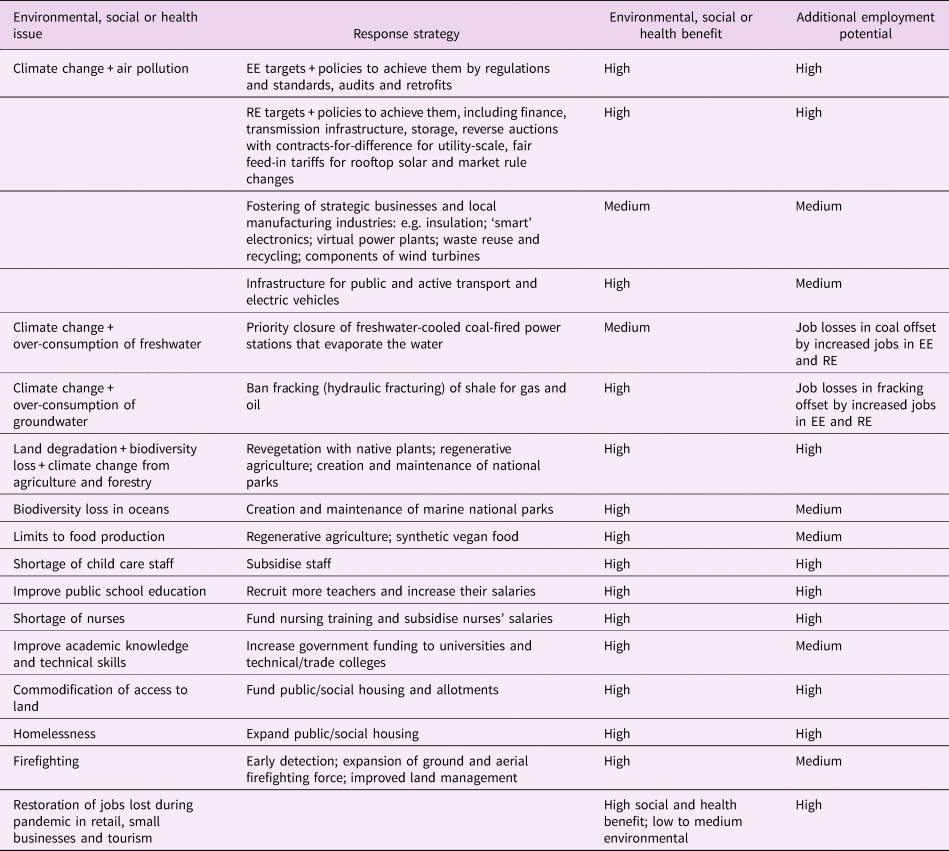
Table 2 compiles suggestions from numerous scholarly, NGO and media publications, for low-carbon employment, that also address major environmental, social and health (WHO, 2018) issues, for which there is generally believed to be medium and high job creation potential. It includes the restoration of low-carbon, high-labour intensity jobs lost during the pandemic. Climate change is a causative factor in many of the issues with high environmental impacts. The high additional employment potential of RE and EE is well documented (Briggs et al., Reference Briggs, Rutovitz, Dominish and Nagrath2020; Hondo & Moriizumi, Reference Hondo and Moriizumi2017; IRENA, 2019); employment is also likely to be high for child care, nursing, education and training, and firefighting. Expanding nursing and childcare has both general social and health benefits and specific value as a precautionary approach for managing pandemics, present and future. Firefighting is part of the defence against one of the devastating impacts of climate change (Mullins et al., Reference Mullins, Bradshaw and Pearce2020).
Table 2.Employment potential of addressing environmental, social and issues
The largest initial increases in emissions from employment listed in Table 2 are likely to come from responses involving improvement of physical infrastructure. However some of these investments can lead to net reductions in emissions over their lifetimes: for example, railways that substitute for road and air travel; transmission lines that enable a higher penetration of RE into the grid; energy efficient public/social housing located close to public transport and town centres; pollution control measures that improve public health and hence reduce the demand for medical and hospital facilities. Technological improvements, such as low-emission cement and zero-emission processes for replacing metallurgical coal for making iron, would greatly reduce the emissions from constructing infrastructure. However, selective growth, even in the service sector, is unlikely to reverse the absolute growth in the total biophysical economy (Parrique et al., Reference Parrique, Barth, Briens, Kerschner, Kraus-Polk, Kuokkanen and Spangenberg2019; Suh, Reference Suh2006; Victor, Reference Victor2012). Further reduction of throughput of materials, energy and land-use, together with a levelling off of population growth, is also required.
Although many environmental NGOs are currently recommending Green Growth recovery from the COVID-19 pandemic, very few governments are planning for it. Indeed, the government of Australia, the world's largest exporter of natural gas and one of the two largest coal exporters, has announced a ‘gas-led recovery’ (Morton, Reference Morton2020) and budgeted a subsidy to an old existing coal-fired power station (Joshi, Reference Joshi2020). The main barriers to transitioning to low-carbon businesses and industries are vested interests, especially fossil fuel interests (Pearse, Reference Pearse2007). Possibly the best of the inadequate responses is that of the European Commission (2020), which proposed in May 2020 a dedicated recovery budget for 2021–2024 of 750 billion EUR for stimulating the economy and accelerating climate action as part of its European Green Deal and climate objectives. But Agora Energiewende (2020) has questioned whether much of this amount will actually be used for green investment.
4. Strategy for degrowth to a steady-state economy
Media and anecdotal experience indicate that the pandemic, which has resulted in many people staying at home, has led to increased work in home and garden improvements, including EE, rooftop solar and local food production in developed countries that are not subject to total lockdown. Hardware stores, plant nurseries and online stores are booming. This could be fostering some cultural change that can be built on for low-carbon socio-economic recovery. A negative aspect, in terms of emissions reduction, has been the reduction in use of public transport.
Next, a common objection to the effectiveness of saving energy must be addressed.
4.1 Reducing rebound from saving energy
Energy consumption per person can be reduced by EE and energy conservation (Creutzig et al., Reference Creutzig, Roy, Lamb, Azevedo, Bruine de Bruin and Weber2018). Energy efficiency is defined as obtaining the same energy service – for example, warm house in winter; hot shower; cold food; mobility – with a reduced energy use. It is achieved mostly by improved technologies, for example, home insulation; water-efficient shower head; energy-efficient refrigerator; efficient vehicle or public transport. Energy conservation (sometimes called energy sufficiency) is defined as reducing energy use by accepting a modified or different energy service – for example, wearing warmer clothes and accepting reduced home heating in winter; taking a shorter shower; walking or cycling to the local shops instead of driving. Since energy conservation is mostly behavioural, it cannot be legislated directly; it can be facilitated by fostering a culture in which the benefits of sufficiency are contrasted with the downsides of waste. Governments can also provide appropriate infrastructure (e.g. pedestrian areas, cycleways and public transport) to give people alternatives to high-energy activities such as driving cars. Both EE and energy conservation can be implemented quickly and save money as well as energy and emissions.
Saving money by saving energy will lead to some rebound in economic activity, because part of the money saved is inevitably spent or invested in increasing energy use or in consumption in other economic sectors (Binswanger, Reference Binswanger2001; Herring & Sorrell, Reference Herring and Sorrell2009; Sorrell et al., Reference Sorrell, Gatersleben and Druckman2020). For example, insulating one's home can result in heating the whole house in winter instead of just the room occupied at a given time. Since wind and solar electricity is now cheaper than from fossil fuels over most of the world (Graham et al., Reference Graham, Hayward, Foster and Havas2020; IRENA, 2020; Lazard, 2019), the implementation of these RE technologies can also lead to some rebound.
Much of the literature on the rebound effect is written within the framework of neoliberal economics, implying that the demand for energy services will never be satisfied (e.g. most chapters in Herring and Sorrell (Reference Herring and Sorrell2009)), that attempting to gain significant reductions in energy consumption is futile and that any rebound from EE should be accepted or even encouraged. This is made explicit by the recent trend to replace the term ‘energy efficiency’ by ‘energy productivity’, defined at the macroeconomic level as GDP divided by energy consumption. Thus, although growing energy productivity, absolute energy consumption can increase, as long as GDP grows more rapidly.
Considering the importance of rebound for degrowth economic scenarios, very little research has been conducted on the effectiveness of various policies for reducing it (Font Vivanco et al., Reference Font Vivanco, Kemp and van der Voet2016). Since economic savings in the energy sector can lead to more expenditure in other sectors (indirect rebound effect), policies must extend beyond the energy sector. To follow a scenario of degrowth, reducing consumption is necessary, especially in developed and rapidly developing countries (see below). Policy options include (Font Vivanco et al., Reference Font Vivanco, Kemp and van der Voet2016; Nørgaard, Reference Nørgaard, Herring and Sorrell2008):
(1) mandatory labelling, regulations and standards for EE of buildings, appliances, equipment and industrial processes;
(2) mandatory labelling, regulations and standards for increased durability of products;
(3) incentives to shift from private to public transport (Turner et al., Reference Turner, Figus, Lecca and Swales2016);
(4) carbon pricing (Sorrell et al., Reference Sorrell, Gatersleben and Druckman2020) and, more generally, environmental taxes and
(5) in developed countries, mandating a shorter working week, with salaries/wages reduced proportionately, together with minimum hourly income.
4.2 Jobs growth plus degrowth: curbing the big emitters
Additional policy measures arise from recognising that the vast majority of environmental impacts, including carbon emissions, come from consumption by a small fraction of the world's population (Wiedmann et al., Reference Wiedmann, Lenzen, Keyßer and Steinberger2020 and references therein). Specifically, the world's top 10% of income earners are responsible for about 45% of global emissions, while the bottom 50% emitters contribute 13% of global emissions (Chancel & Piketty, Reference Chancel and Piketty2015). The world's rich include high-income earners in both developed and rapidly developing countries. Their environmental impacts come indirectly from their savings and investments (Druckman et al., Reference Druckman, Chitnis, Sorrell and Jackson2011) as well as their direct expenditure on consumption. Their consumption can be reduced by progressive taxation that discourages very high incomes and by carbon pricing.
The COVID-19 pandemic shows that shutting down economic activity and doing nothing else results in widespread unemployment and impoverishment. However, modelling of the biophysical economy of Australia (Turner, Reference Turner, Washington and Twomey2016, Reference Turner2019) shows that employment can be maintained while GDP and biophysical throughput are reduced during transition to a ‘sustainable future’, provided additional policies and behavioural changes are implemented. These measures include reducing household consumption, reducing the length of the working week and stabilising the population. Macroeconomic modelling of the Canadian economy obtains similar results for its scenario of degrowth to a steady-state economy (Victor, Reference Victor2012, Reference Victor2019; Victor & Rosenbluth, Reference Victor and Rosenbluth2007), which Victor defines in terms of GDP and GDP per capita. Based on macrosimulation modelling, D'Alessandro et al. (Reference D'Alessandro, Cieplinski, Distefano and Dittmer2020) argue that degrowth – together with a job guarantee, working time reduction and a wealth tax – is an economically and politically feasible scenario for cutting emissions and improving social equity. However, the barriers to degrowth are vested interests, neoliberal economics and the pro-growth institutions and culture they have created that lock people in developed countries into high consumption energy-intensive lifestyles (Alexander, Reference Alexander2012).
To the author's knowledge, the only environmental NGOs supporting a steady-state economy or degrowth are those specifically dedicated to those purposes. Although degrowth has been ignored or dismissed as preposterous by almost all governments and trade unions, government interventions in the economy in response to the pandemic have set aside neoliberal dogmas against subsidising businesses, increasing (temporarily) unemployment and social security benefits, and avoiding huge deficits. For example, the Australian government has allocated a total of AUD 206 billion to COVID management and recovery in 2019–20 and 2020–21, compared with its revenue in 2019–20 of AUD 470 billion and estimated revenue in 2020–21 of AUD 464 billion (Australian Government, 2020). Governments have been forced to recognise implicitly that market economics has failed to manage the economic impacts of the pandemic. This opens up the opportunity for public questioning of the validity of neoliberal economics, including the notion that eternal growth on a finite planet is possible and desirable.
The remaining question is how governments can fund the transition to a steady-state economy with low throughput.
4.3 Funding the transition
4.3.1 Funding in conventional macroeconomics
Within the framework of conventional macroeconomics, a government can use the following policies: increasing taxation, reducing other expenditures such as social security and education, and borrowing, for example, by issuing government bonds. The first is often unpopular with the electorate, the second tends to increase poverty and the third gives concerns about government debt, high expenditure on interest and a burden on future generations. Some specific policies for increasing government revenue and reducing wasteful expenditures, that are unlikely to damage social equity, are (Grudnoff & Richardson, Reference Grudnoff and Richardson2018):
(1) ensuring that multinational corporations selling goods and services in the country of interest are taxed adequately;
(2) removing any arbitrary legislative caps on the tax to GDP ratio;
(3) cancelling any proposed tax cuts;
(4) removing government incentives for citizens to speculate in property;
(5) reducing superannuation tax concessions;
(6) placing super-profit taxes on the mining industry and
(7) introducing a financial transactions tax.
Additional economic savings can be obtained from the reduction in air and water pollution and their health impacts, as well as the reduction in water use and land degradation associated with many coal-fired power stations.
4.3.2 Funding in Modern Monetary Theory
In recovering from the Global Financial Crisis and during the present COVID-19 crisis, the US government has been ‘printing’ (i.e. creating digitally) trillions of dollars and using it to buy bonds, without causing inflation (Holland et al., Reference Holland, McCormick and Ainger2020). This supports unintentionally the broad approach to macroeconomics of Modern Monetary Theory (MMT) (Kelton, Reference Kelton2020; Mitchell et al., Reference Mitchell, Wray and Watts2019),Footnote i which argues that sovereign states that issue their own fiat currenciesFootnote ii are not like households in being constrained to spend only their revenue. Instead, they can create debt-free money, so long as they manage their currency so that it retains its value. If governments spend beyond the capacity of their economy to produce, then, and only then, inflation becomes a risk. However, economies depressed by the pandemic are operating well below capacity. MMT builds on Keynesian economics, the concept of ‘functional finance’ introduced by Lerner (Reference Lerner1943), and the insights of Mosler (Reference Mosler2013).
Within the framework of MMT, the debt-free process by which governments can create money, sometimes called Overt Monetary Financing, is as follows (Mitchell, Reference Mitchell2015, p. 364):
…governments typically spend by drawing on a bank account they have with the central bank. An instruction is sent to the central bank from the treasury to transfer some funds out of this account into an account in the private sector, which is held by the recipient of the spending. A similar operation might occur when a government cheque is posted to a private citizen who then deposits the cheque with their bank. That bank seeks the funds from the central bank, which writes down the government's account, and the private bank writes up the private citizen's account. All these transactions are done electronically through computer systems.
MMT proponents recommend that relevant governments – which include the USA, Canada, UK, Japan and Australia – establish a permanent Job Guarantee programme (Kelton, Reference Kelton2020; Mitchell et al., Reference Mitchell, Wray and Watts2019). People who would be otherwise unemployed would be paid the minimum wage by the national government for working in positions established by all tiers of government and non-profit organisations. The Job Guarantee would stabilise the economy by employing more people during downturns, maintaining or enhancing skills until the economy recovers, and employing fewer people during boom times. Because wages would be generally less than those paid by the private sector, these new jobs would not compete significantly with existing jobs, and workers in the guaranteed jobs would still have an incentive to seek higher-paid jobs in the private and public sectors (Kelton, Reference Kelton2020; Mitchell et al., Reference Mitchell, Wray and Watts2019).
Alexander and Baumann (Reference Alexander, Baumann and Washington2020) observe that low-income earners, who could practise voluntary simplicity and so participate in degrowth to a steady-state economy, are ‘locked in to a very long market commitment in order to buy or rent housing’. They propose that, as well as providing unemployed people with a modest living wage, the government should allow them to rent public land and public housing at 25% of their income.
Governments of countries that do not have sovereignty over their currencies, such as members of the European Union, cannot easily create money and so may be limited at present to the conventional economic measures listed in Section 4.3.1. However, the EU could resolve this by changing Article 123 of the Maastricht Treaty to allow Overt Monetary Financing to be used on an ongoing basis (Mitchell, Reference Mitchell2015, p. 367).
5. Conclusion
The COVID-19 pandemic has opened up the opportunity for a sustainable development recovery. This paper proposes a sustainable development scenario that brings together key environmental and social equity aspects, namely climate mitigation and job restoration and creation. If we return to pre-COVID economic growth rates and if mitigation methods are limited to technological change, it will be very difficult to keep the global average temperature increase above pre-industrial temperatures to 2°C by 2050. It is now almost certainly too late for human civilisation to transition smoothly and without overshoot to an increase of 1.5°C. Therefore, in our scenario, socio-economies follow a path of degrowth to a steady-state economy while full employment is ensured by means of a Job Guarantee focussed on low-carbon jobs.
Degrowth is necessary, because even the low-carbon jobs listed in Table 2 will result in increased economic activity and hence an increase in emissions. Indeed, increased economic activity in some sectors is essential for post-COVID-19 recovery. The dilemma can be resolved provided the increase in emissions from low-carbon jobs is more than offset by degrowth in the economy at large. This entails rapidly reducing consumption per person and gradually ending population growth. Degrowth can be focussed by recognising that the rich 10% of human population, who comprise a large fraction of developed country inhabitants and a small fraction of developing country inhabitants, are responsible for the majority of environmental impacts within the existing economic system. Policies to address this situation include progressive taxation to discourage very high incomes, environmental tax reform including carbon taxes, inheritance taxes, a shorter working week and fair minimum incomes.
Realistically, a mass movement is needed to force governments to act against the interests of powerful vested interests and the ideology of endless economic growth which has been embedded in our culture. However, the situation that governments have had to set aside neoliberal economic ideologies during the pandemic makes socioeconomic change less difficult.
It is even easier for governments to foster low-carbon jobs. They must use strategic planning and incentives/disincentives to encourage appropriate businesses and industries. Many state/provincial and city governments, and several national governments, are already implementing such policies, although not rapidly enough. In particular, policies are needed to accelerate EE and conservation, to provide the infrastructure for renewable electricity, to shift heating from fossil fuels to electricity, and to foster public transport, active transport and electric vehicles. Environmental tax reform and a shorter working week would help drive this component of the strategy.
A Job Guarantee can be paid at the minimum wage by national governments. Labour-intensive jobs can be created by all levels of government and non-profit organisations mainly in the areas of caring for people and caring for the environment. Although national governments could fund the Job Guarantee temporarily by borrowing while interest rates are low during COVID recovery, a permanent solution for countries that have monetary sovereignty and are operating below full economic capacity is to create money as justified by MMT. Renting public land to low-income earners could also contribute to the transition while improving social equity.
With strong public pressure on governments and business, led by environmental, social justice and economic reform NGOs, transition to a 2°C target with full employment may still be possible.




 Open access


1. Introduction
In the first half of 2020, as a result of the COVID-19 pandemic, global CO2 emissions were 8.8% lower than in the same period in 2019 (Liu et al., Reference Liu, Ciais, Deng, Lei, Davis, Feng and Schellnhuber2020). To limit global heating to the aspirational Paris target of 1.5°C above pre-industrial temperatures (UNFCCC, 2015), global CO2 emissions would have to be reduced by about 55% by 2030 (UNEP, 2019). This foreshadows the magnitude of the climate mitigation challenge, which is underlined by the observation that, despite the appearance of a second wave of COVID-19 in several parts of the world, there was, commencing in April–May 2020, an increase in global emissions as some economies started to recover from the pandemic (Liu et al., Reference Liu, Ciais, Deng, Lei, Davis, Feng and Schellnhuber2020).
Yet, business activity must regrow, in order to provide the desperately needed jobs that were lost, and even selective ‘green’ growth will increase consumption. This raises the following research questions, which are also questions of urgent practical politics: how can climate change be mitigated while economies recover from the pandemic? More generally, how can pandemic recovery be designed to avoid repeating the adverse environmental and social impacts of the old economic system?
Critiques of the existing economic system, and neoclassical economics theory that allegedly justifies it, abound (e.g. Blatt, Reference Blatt1983; Daly, Reference Daly1977; Daly & Cobb, Reference Daly and Cobb1990; Dennis, Reference Dennis2016; Keen, Reference Keen2011; Ormerod, Reference Ormerod1994; Smith & Max-Neef, Reference Smith and Max-Neef2011; Waring, Reference Waring1988). These authors argue that the economic system is environmentally destructive because it encourages endless growth in the consumption of energy, materials and land, together with population growth, on a finite planet, and because it doesn't distinguish sufficiently between environmentally beneficial consumption/production on one hand and environmental damaging consumption/production on the other hand. The critique also points out that the old system fosters inequity based on exploitation and other forms of social injustice. Inequity fosters ill-health, reduced life expectancy, illiteracy, violence, crime and other social problems (Wilkinson & Pickett, Reference Wilkinson and Pickett2010). The critique of neoclassical macroeconomic theory is that it contains unjustifiable assumptions and fundamental internal contradictions, and so has little relevance to real-world economies.
Therefore, during the pandemic and its recovery, there is the opportunity to debate, develop and implement new or modified socioeconomic systems that can create and maintain ‘sustainable prosperity’ while being consistent with ecological sustainability and improved social equity/justice (D'Alessandro et al., Reference D'Alessandro, Cieplinski, Distefano and Dittmer2020; Wiedmann et al., Reference Wiedmann, Lenzen, Keyßer and Steinberger2020). Within this context, the scenario of this paper addresses rapid climate mitigation for the former and full employment, together with health benefits (Krug & Eberl, Reference Krug and Eberl2018; WHO, 2018), for the latter.
Energy generation from fossil fuels – providing electricity, non-electrical heat and transportation – was responsible for 73% of global greenhouse gas emissions in 2016 (Ge & Friedrich, Reference Ge and Friedrich2020). Therefore, the vast majority of fossil fuel resources must be left in the ground (Steffen & Rice, Reference Steffen and Rice2015). Mitigation must be rapid because we may have only a few years at most to keep the global average heating below 1.5°C (DNV-GL, 2020; Lenton et al., Reference Lenton, Rockström, Gaffney, Rahmstorf, Richardson, Steffen and Schellnhuber2019), taking account of feedbacks. Global energy-related CO2 emissions increased by 12.7% from 2010 to 2018 (IEA, 2019). Realistically, achieving 1.5°C appears impossible, except as a result of economic collapse, but 2°C may still be achievable, because its carbon emissions budget is about three times that of the 1.5°C target (IPCC, 2018, Table 2.2). Even 2°C requires an urgent break in current emission trends (Friedlingstein et al., Reference Friedlingstein, Andrew, Rogelj, Peters, Canadell, Knutti and Le Quéré2014).
Section 2 discusses the strengths and limitations of technological change in transitioning rapidly to net zero emissions, focussing on the energy sector. It finds that technological change is necessary, but unlikely to be sufficient for keeping heating significantly below 2°C, and therefore that socioeconomic and behavioural changes may be necessary. Hence this paper considers a COVID-19-recovery scenario with two principal components.
One component, called low-carbon jobs, involves creating new employment in labour-intensive work with relatively low-carbon emissions (Section 3.2). This involves both technological and socioeconomic changes. In the energy sector, these jobs are created by substituting renewable energy (RE) for fossil fuels while increasing energy efficiency (EE) and energy conservation. However, even these selective activities will increase consumption to some degree and hence emissions (Suh, Reference Suh2006). Therefore, the second component of the scenario (Section 3) is degrowth to a steady-state economy (Daly, Reference Daly1977; D'Alisa et al., Reference D'Alisa, Demaria and Kallis2014; Dietz & O'Neill, Reference Dietz and O'Neill2013). The pandemic has assisted to some degree in facilitating degrowth, because many people have become accustomed to working from home and walking and cycling for recreation near their homes. Degrowth requires socioeconomic and behavioural changes.
Section 4 discusses a strategy for degrowth, including policies for reducing rebound and funding the transition using Modern Monetary Theory in countries where it is applicable. Section 5 is the general discussion and conclusion.
2. Technological change is necessary but not sufficient
2.1 Renewable energy and energy efficiency can replace fossil fuels
A large body of evidence – comprising scenario studies, simulations and practical experience in several regions, countries and states/provinces – indicates that zero-emission energy could be provided by a combination of RE and EE and that the transition would be affordable (e.g. Bogdanov et al., Reference Bogdanov, Farfan, Sadovskaia, Aghahosseini, Child, Gulagi and Breyer2019; Butler et al., Reference Butler, Denis-Ryan, Graham, Kelly, Reedman, Stewart and Yankos2020; Diesendorf & Elliston, Reference Diesendorf and Elliston2018; Elliston et al., Reference Elliston, Riesz and MacGill2016; Graham et al., Reference Graham, Hayward, Foster and Havas2020; IRENA, 2020; Jacobson et al., Reference Jacobson, Delucchi, Cameron and Frew2015, Reference Jacobson, Delucchi, Cameron and Mathiesen2018; Lazard, 2019; Ram et al., Reference Ram, Bogdanov, Aghahosseini, Gulagi, Oyewo, Child and Breyer2019). Furthermore, recent research indicates that the energy return on energy invested of renewable electricity technologies and systems may be typically equal to or greater than that of fossil-fuelled electricity (Brockway et al., Reference Brockway, Owen, Brand-Correa and Hardt2019; Diesendorf & Wiedmann, Reference Diesendorf and Wiedmann2020; Leccisi et al., Reference Leccisi, Raugei and Fthenakis2016; Raugei & Leccisi, Reference Raugei and Leccisi2016).
The main elements of the transition strategy proposed by these and other RE and EE researchers are to:
(1) improve EE of buildings, appliances and industrial processes;
(2) replace fossil fuelled electricity generation with renewable electricity and storage;
(3) electrify non-electrical heating and most transportation;
(4) use renewable electricity to split water to produce hydrogen, convert it to ammonia which is more manageable, and use this ‘renewable’ fuel in aircraft and ships and for long-distance road transport in remote areas and
(5) assist workers disadvantaged by the transition by retraining, relocation and retirement packages.
Table 1 summarises the status and affordability of the proposed strategic initiatives for the RE + EE scenario.
Status of EE, RE and other low-carbon technologies
CA, commercially available; D, demonstration stage; LA, limited affordability; EE, energy efficiency; RElec, renewable electricity; FF, fossil fuel; PV, photovoltaic; EV, electric vehicle.
Sources: Drawn from Jacobson et al. (Reference Jacobson, Delucchi, Cameron and Frew2015, Reference Jacobson, Delucchi, Cameron and Mathiesen2018), European Commission (2019), Ram et al. (Reference Ram, Bogdanov, Aghahosseini, Gulagi, Oyewo, Child and Breyer2019), REN21 (2019), Butler et al. (Reference Butler, Denis-Ryan, Graham, Kelly, Reedman, Stewart and Yankos2020).
Most global electricity will be generated by wind and solar supplemented by hydro. Regions lacking these RE resources will import renewable electricity, in most cases by transmission line and in a minority of cases as gaseous or liquid ‘renewable’ fuels by a tanker ship. Thus, a relatively rapid global transition, completed before 2040, for transitioning to renewable electricity and electrifying most transport, appears technically and economically feasible. This covers the majority of emissions in most countries. But, transitioning fossil-fuelled heating, for homes, commercial buildings and industry, to electricity may take longer because of the long lifetimes of existing fossil-fuelled heating technologies (REN21, 2019). Non-energy industrial emissions (e.g. making cement and iron ore), ‘green’ hydrogen and agriculture still need more research and development.
2.2 Chasing a receding target
From 2010 to 2017, global total final energy consumption (TFEC) grew by 10% (IEA, 2019). Given that the global population growth rate averaged over the same period was 8.5% (United Nations, 2019), TFEC per person grew 1.57% over the same period. Global material flows have also increased (Wiedmann et al., Reference Wiedmann, Schandl, Lenzen, Moran, Suh, West and Kanemoto2015). Thus, apart from the pandemic pause in 2020, technology change has been chasing a receding target. Since actions to slow population growth (education of women, dissemination of contraceptive information and improved social security) are likely to be slow, the principal mitigation efforts must focus on both technological change and reducing energy consumption per person.
Similarly, although technological improvements can make some reductions in emissions from non-energy industrial processes and agriculture, reductions in consumption – for example, by increased reuse and recycling of materials and eating less red meat – will also be necessary in these sectors.
3. Socioeconomic and behavioural strategies to reduce consumption
3.1 Choice of strategy
Wiedmann et al. (Reference Wiedmann, Lenzen, Keyßer and Steinberger2020, Table 1) have identified a wide range of strategies for ‘sustainable prosperity’, ranging from radical approaches such as Eco-socialism and Eco-anarchism, through reformist approaches such as Post-Growth and Steady-State Economies, to Green Growth, such as ecological modernisation characterised partly by economic growth decoupled to some degree from environmental impacts. The scenario of the current paper combines low-carbon jobs, which inevitably drive some growth in economic activity, with a reformist strategy comprising degrowth to a steady-state economy (Daly, Reference Daly1977; D'Alisa et al., Reference D'Alisa, Demaria and Kallis2014; Dietz & O'Neill, Reference Dietz and O'Neill2013). Low-carbon jobs are necessary, but not sufficient, for cutting emissions (Agora Energiewende, 2020; Parrique et al., Reference Parrique, Barth, Briens, Kerschner, Kraus-Polk, Kuokkanen and Spangenberg2019).
This strategy is chosen for the following reasons:
(1) to restore employment to people who lost it during the COVID-19 pandemic and, if possible, provide employment for all who wish to work; many of the jobs lost are in the service sectors (especially in retail, small businesses and tourism) which are labour-intensive and, apart from air and road transport, relatively low in carbon emissions;
(2) to achieve rapid, deep climate mitigation;
(3) because some parts of the economy (e.g. RE and EE technologies; public and active transport; environmental protection) must grow, while other parts (e.g. fossil fuel use and native forest logging) must decline and
(4) because, beyond a low threshold, economic growth leads to only slight improvements in well-being (Fanning & O'Neill, Reference Fanning and O'Neill2019).
Although the focus of this paper is on government strategies and policies on the macroeconomic scale, it does not discount the possibility that individual and grassroots community initiatives will greatly expand independently from governments. They can reduce emissions and other environmental impacts, but are limited by existing institutions. For example, communities that wish to grow their own food and create their own microgrids are constrained by land access and regulations favouring electricity utilities, respectively. Therefore, government action, driven by changes in individual and community attitudes and behaviour, is necessary to remove barriers.
The current paper uses Herman Daly's (Reference Daly1977, p. 17) biophysical definition of a steady-state economy: ‘an economy with constant stocks of people and artifacts [sic], maintained at some desired, sufficient levels by low rates of maintenance “throughput”’. Using a biophysical definition is important, because a monetary definition in terms of GDP obscures the fact that growth in some businesses and industries results in much lower emissions than growth in other businesses and industries. It is well established that on average GDP and biophysical impact are coupled, although there are exceptions observed over short periods of time in specific locations for particular environmental impacts (Haberl et al., Reference Haberl, Wiedenhofer, Virag, Kalt, Plank, Brockway and Creutzig2020; Le Quéré et al., Reference Le Quéré, Korsbakken, Wilson, Tosun, Andrew, Andres and van Vuuren2019; Parrique et al., Reference Parrique, Barth, Briens, Kerschner, Kraus-Polk, Kuokkanen and Spangenberg2019). However, in recovering from the COVID-19 pandemic, we are less concerned with the average, than the economic activities that can be grown at the margin. Furthermore, in the present context, we are not concerned about the fate of GDP – if an index is really needed, other indices, such as the Index of Sustainable Economic Welfare (Lawn, Reference Lawn2006), would be more appropriate.
3.2 Low-carbon jobs
Table 2 compiles suggestions from numerous scholarly, NGO and media publications, for low-carbon employment, that also address major environmental, social and health (WHO, 2018) issues, for which there is generally believed to be medium and high job creation potential. It includes the restoration of low-carbon, high-labour intensity jobs lost during the pandemic. Climate change is a causative factor in many of the issues with high environmental impacts. The high additional employment potential of RE and EE is well documented (Briggs et al., Reference Briggs, Rutovitz, Dominish and Nagrath2020; Hondo & Moriizumi, Reference Hondo and Moriizumi2017; IRENA, 2019); employment is also likely to be high for child care, nursing, education and training, and firefighting. Expanding nursing and childcare has both general social and health benefits and specific value as a precautionary approach for managing pandemics, present and future. Firefighting is part of the defence against one of the devastating impacts of climate change (Mullins et al., Reference Mullins, Bradshaw and Pearce2020).
Employment potential of addressing environmental, social and issues
EE, energy efficiency; RE, renewable energy.
Source: Author's selection from many articles.
The largest initial increases in emissions from employment listed in Table 2 are likely to come from responses involving improvement of physical infrastructure. However some of these investments can lead to net reductions in emissions over their lifetimes: for example, railways that substitute for road and air travel; transmission lines that enable a higher penetration of RE into the grid; energy efficient public/social housing located close to public transport and town centres; pollution control measures that improve public health and hence reduce the demand for medical and hospital facilities. Technological improvements, such as low-emission cement and zero-emission processes for replacing metallurgical coal for making iron, would greatly reduce the emissions from constructing infrastructure. However, selective growth, even in the service sector, is unlikely to reverse the absolute growth in the total biophysical economy (Parrique et al., Reference Parrique, Barth, Briens, Kerschner, Kraus-Polk, Kuokkanen and Spangenberg2019; Suh, Reference Suh2006; Victor, Reference Victor2012). Further reduction of throughput of materials, energy and land-use, together with a levelling off of population growth, is also required.
Although many environmental NGOs are currently recommending Green Growth recovery from the COVID-19 pandemic, very few governments are planning for it. Indeed, the government of Australia, the world's largest exporter of natural gas and one of the two largest coal exporters, has announced a ‘gas-led recovery’ (Morton, Reference Morton2020) and budgeted a subsidy to an old existing coal-fired power station (Joshi, Reference Joshi2020). The main barriers to transitioning to low-carbon businesses and industries are vested interests, especially fossil fuel interests (Pearse, Reference Pearse2007). Possibly the best of the inadequate responses is that of the European Commission (2020), which proposed in May 2020 a dedicated recovery budget for 2021–2024 of 750 billion EUR for stimulating the economy and accelerating climate action as part of its European Green Deal and climate objectives. But Agora Energiewende (2020) has questioned whether much of this amount will actually be used for green investment.
4. Strategy for degrowth to a steady-state economy
Media and anecdotal experience indicate that the pandemic, which has resulted in many people staying at home, has led to increased work in home and garden improvements, including EE, rooftop solar and local food production in developed countries that are not subject to total lockdown. Hardware stores, plant nurseries and online stores are booming. This could be fostering some cultural change that can be built on for low-carbon socio-economic recovery. A negative aspect, in terms of emissions reduction, has been the reduction in use of public transport.
Next, a common objection to the effectiveness of saving energy must be addressed.
4.1 Reducing rebound from saving energy
Energy consumption per person can be reduced by EE and energy conservation (Creutzig et al., Reference Creutzig, Roy, Lamb, Azevedo, Bruine de Bruin and Weber2018). Energy efficiency is defined as obtaining the same energy service – for example, warm house in winter; hot shower; cold food; mobility – with a reduced energy use. It is achieved mostly by improved technologies, for example, home insulation; water-efficient shower head; energy-efficient refrigerator; efficient vehicle or public transport. Energy conservation (sometimes called energy sufficiency) is defined as reducing energy use by accepting a modified or different energy service – for example, wearing warmer clothes and accepting reduced home heating in winter; taking a shorter shower; walking or cycling to the local shops instead of driving. Since energy conservation is mostly behavioural, it cannot be legislated directly; it can be facilitated by fostering a culture in which the benefits of sufficiency are contrasted with the downsides of waste. Governments can also provide appropriate infrastructure (e.g. pedestrian areas, cycleways and public transport) to give people alternatives to high-energy activities such as driving cars. Both EE and energy conservation can be implemented quickly and save money as well as energy and emissions.
Saving money by saving energy will lead to some rebound in economic activity, because part of the money saved is inevitably spent or invested in increasing energy use or in consumption in other economic sectors (Binswanger, Reference Binswanger2001; Herring & Sorrell, Reference Herring and Sorrell2009; Sorrell et al., Reference Sorrell, Gatersleben and Druckman2020). For example, insulating one's home can result in heating the whole house in winter instead of just the room occupied at a given time. Since wind and solar electricity is now cheaper than from fossil fuels over most of the world (Graham et al., Reference Graham, Hayward, Foster and Havas2020; IRENA, 2020; Lazard, 2019), the implementation of these RE technologies can also lead to some rebound.
Much of the literature on the rebound effect is written within the framework of neoliberal economics, implying that the demand for energy services will never be satisfied (e.g. most chapters in Herring and Sorrell (Reference Herring and Sorrell2009)), that attempting to gain significant reductions in energy consumption is futile and that any rebound from EE should be accepted or even encouraged. This is made explicit by the recent trend to replace the term ‘energy efficiency’ by ‘energy productivity’, defined at the macroeconomic level as GDP divided by energy consumption. Thus, although growing energy productivity, absolute energy consumption can increase, as long as GDP grows more rapidly.
Considering the importance of rebound for degrowth economic scenarios, very little research has been conducted on the effectiveness of various policies for reducing it (Font Vivanco et al., Reference Font Vivanco, Kemp and van der Voet2016). Since economic savings in the energy sector can lead to more expenditure in other sectors (indirect rebound effect), policies must extend beyond the energy sector. To follow a scenario of degrowth, reducing consumption is necessary, especially in developed and rapidly developing countries (see below). Policy options include (Font Vivanco et al., Reference Font Vivanco, Kemp and van der Voet2016; Nørgaard, Reference Nørgaard, Herring and Sorrell2008):
(1) mandatory labelling, regulations and standards for EE of buildings, appliances, equipment and industrial processes;
(2) mandatory labelling, regulations and standards for increased durability of products;
(3) incentives to shift from private to public transport (Turner et al., Reference Turner, Figus, Lecca and Swales2016);
(4) carbon pricing (Sorrell et al., Reference Sorrell, Gatersleben and Druckman2020) and, more generally, environmental taxes and
(5) in developed countries, mandating a shorter working week, with salaries/wages reduced proportionately, together with minimum hourly income.
4.2 Jobs growth plus degrowth: curbing the big emitters
Additional policy measures arise from recognising that the vast majority of environmental impacts, including carbon emissions, come from consumption by a small fraction of the world's population (Wiedmann et al., Reference Wiedmann, Lenzen, Keyßer and Steinberger2020 and references therein). Specifically, the world's top 10% of income earners are responsible for about 45% of global emissions, while the bottom 50% emitters contribute 13% of global emissions (Chancel & Piketty, Reference Chancel and Piketty2015). The world's rich include high-income earners in both developed and rapidly developing countries. Their environmental impacts come indirectly from their savings and investments (Druckman et al., Reference Druckman, Chitnis, Sorrell and Jackson2011) as well as their direct expenditure on consumption. Their consumption can be reduced by progressive taxation that discourages very high incomes and by carbon pricing.
The COVID-19 pandemic shows that shutting down economic activity and doing nothing else results in widespread unemployment and impoverishment. However, modelling of the biophysical economy of Australia (Turner, Reference Turner, Washington and Twomey2016, Reference Turner2019) shows that employment can be maintained while GDP and biophysical throughput are reduced during transition to a ‘sustainable future’, provided additional policies and behavioural changes are implemented. These measures include reducing household consumption, reducing the length of the working week and stabilising the population. Macroeconomic modelling of the Canadian economy obtains similar results for its scenario of degrowth to a steady-state economy (Victor, Reference Victor2012, Reference Victor2019; Victor & Rosenbluth, Reference Victor and Rosenbluth2007), which Victor defines in terms of GDP and GDP per capita. Based on macrosimulation modelling, D'Alessandro et al. (Reference D'Alessandro, Cieplinski, Distefano and Dittmer2020) argue that degrowth – together with a job guarantee, working time reduction and a wealth tax – is an economically and politically feasible scenario for cutting emissions and improving social equity. However, the barriers to degrowth are vested interests, neoliberal economics and the pro-growth institutions and culture they have created that lock people in developed countries into high consumption energy-intensive lifestyles (Alexander, Reference Alexander2012).
To the author's knowledge, the only environmental NGOs supporting a steady-state economy or degrowth are those specifically dedicated to those purposes. Although degrowth has been ignored or dismissed as preposterous by almost all governments and trade unions, government interventions in the economy in response to the pandemic have set aside neoliberal dogmas against subsidising businesses, increasing (temporarily) unemployment and social security benefits, and avoiding huge deficits. For example, the Australian government has allocated a total of AUD 206 billion to COVID management and recovery in 2019–20 and 2020–21, compared with its revenue in 2019–20 of AUD 470 billion and estimated revenue in 2020–21 of AUD 464 billion (Australian Government, 2020). Governments have been forced to recognise implicitly that market economics has failed to manage the economic impacts of the pandemic. This opens up the opportunity for public questioning of the validity of neoliberal economics, including the notion that eternal growth on a finite planet is possible and desirable.
The remaining question is how governments can fund the transition to a steady-state economy with low throughput.
4.3 Funding the transition
4.3.1 Funding in conventional macroeconomics
Within the framework of conventional macroeconomics, a government can use the following policies: increasing taxation, reducing other expenditures such as social security and education, and borrowing, for example, by issuing government bonds. The first is often unpopular with the electorate, the second tends to increase poverty and the third gives concerns about government debt, high expenditure on interest and a burden on future generations. Some specific policies for increasing government revenue and reducing wasteful expenditures, that are unlikely to damage social equity, are (Grudnoff & Richardson, Reference Grudnoff and Richardson2018):
(1) ensuring that multinational corporations selling goods and services in the country of interest are taxed adequately;
(2) removing any arbitrary legislative caps on the tax to GDP ratio;
(3) cancelling any proposed tax cuts;
(4) removing government incentives for citizens to speculate in property;
(5) reducing superannuation tax concessions;
(6) placing super-profit taxes on the mining industry and
(7) introducing a financial transactions tax.
Additional economic savings can be obtained from the reduction in air and water pollution and their health impacts, as well as the reduction in water use and land degradation associated with many coal-fired power stations.
4.3.2 Funding in Modern Monetary Theory
In recovering from the Global Financial Crisis and during the present COVID-19 crisis, the US government has been ‘printing’ (i.e. creating digitally) trillions of dollars and using it to buy bonds, without causing inflation (Holland et al., Reference Holland, McCormick and Ainger2020). This supports unintentionally the broad approach to macroeconomics of Modern Monetary Theory (MMT) (Kelton, Reference Kelton2020; Mitchell et al., Reference Mitchell, Wray and Watts2019),Footnote i which argues that sovereign states that issue their own fiat currenciesFootnote ii are not like households in being constrained to spend only their revenue. Instead, they can create debt-free money, so long as they manage their currency so that it retains its value. If governments spend beyond the capacity of their economy to produce, then, and only then, inflation becomes a risk. However, economies depressed by the pandemic are operating well below capacity. MMT builds on Keynesian economics, the concept of ‘functional finance’ introduced by Lerner (Reference Lerner1943), and the insights of Mosler (Reference Mosler2013).
Within the framework of MMT, the debt-free process by which governments can create money, sometimes called Overt Monetary Financing, is as follows (Mitchell, Reference Mitchell2015, p. 364):
…governments typically spend by drawing on a bank account they have with the central bank. An instruction is sent to the central bank from the treasury to transfer some funds out of this account into an account in the private sector, which is held by the recipient of the spending. A similar operation might occur when a government cheque is posted to a private citizen who then deposits the cheque with their bank. That bank seeks the funds from the central bank, which writes down the government's account, and the private bank writes up the private citizen's account. All these transactions are done electronically through computer systems.
MMT proponents recommend that relevant governments – which include the USA, Canada, UK, Japan and Australia – establish a permanent Job Guarantee programme (Kelton, Reference Kelton2020; Mitchell et al., Reference Mitchell, Wray and Watts2019). People who would be otherwise unemployed would be paid the minimum wage by the national government for working in positions established by all tiers of government and non-profit organisations. The Job Guarantee would stabilise the economy by employing more people during downturns, maintaining or enhancing skills until the economy recovers, and employing fewer people during boom times. Because wages would be generally less than those paid by the private sector, these new jobs would not compete significantly with existing jobs, and workers in the guaranteed jobs would still have an incentive to seek higher-paid jobs in the private and public sectors (Kelton, Reference Kelton2020; Mitchell et al., Reference Mitchell, Wray and Watts2019).
Alexander and Baumann (Reference Alexander, Baumann and Washington2020) observe that low-income earners, who could practise voluntary simplicity and so participate in degrowth to a steady-state economy, are ‘locked in to a very long market commitment in order to buy or rent housing’. They propose that, as well as providing unemployed people with a modest living wage, the government should allow them to rent public land and public housing at 25% of their income.
Governments of countries that do not have sovereignty over their currencies, such as members of the European Union, cannot easily create money and so may be limited at present to the conventional economic measures listed in Section 4.3.1. However, the EU could resolve this by changing Article 123 of the Maastricht Treaty to allow Overt Monetary Financing to be used on an ongoing basis (Mitchell, Reference Mitchell2015, p. 367).
5. Conclusion
The COVID-19 pandemic has opened up the opportunity for a sustainable development recovery. This paper proposes a sustainable development scenario that brings together key environmental and social equity aspects, namely climate mitigation and job restoration and creation. If we return to pre-COVID economic growth rates and if mitigation methods are limited to technological change, it will be very difficult to keep the global average temperature increase above pre-industrial temperatures to 2°C by 2050. It is now almost certainly too late for human civilisation to transition smoothly and without overshoot to an increase of 1.5°C. Therefore, in our scenario, socio-economies follow a path of degrowth to a steady-state economy while full employment is ensured by means of a Job Guarantee focussed on low-carbon jobs.
Degrowth is necessary, because even the low-carbon jobs listed in Table 2 will result in increased economic activity and hence an increase in emissions. Indeed, increased economic activity in some sectors is essential for post-COVID-19 recovery. The dilemma can be resolved provided the increase in emissions from low-carbon jobs is more than offset by degrowth in the economy at large. This entails rapidly reducing consumption per person and gradually ending population growth. Degrowth can be focussed by recognising that the rich 10% of human population, who comprise a large fraction of developed country inhabitants and a small fraction of developing country inhabitants, are responsible for the majority of environmental impacts within the existing economic system. Policies to address this situation include progressive taxation to discourage very high incomes, environmental tax reform including carbon taxes, inheritance taxes, a shorter working week and fair minimum incomes.
Realistically, a mass movement is needed to force governments to act against the interests of powerful vested interests and the ideology of endless economic growth which has been embedded in our culture. However, the situation that governments have had to set aside neoliberal economic ideologies during the pandemic makes socioeconomic change less difficult.
It is even easier for governments to foster low-carbon jobs. They must use strategic planning and incentives/disincentives to encourage appropriate businesses and industries. Many state/provincial and city governments, and several national governments, are already implementing such policies, although not rapidly enough. In particular, policies are needed to accelerate EE and conservation, to provide the infrastructure for renewable electricity, to shift heating from fossil fuels to electricity, and to foster public transport, active transport and electric vehicles. Environmental tax reform and a shorter working week would help drive this component of the strategy.
A Job Guarantee can be paid at the minimum wage by national governments. Labour-intensive jobs can be created by all levels of government and non-profit organisations mainly in the areas of caring for people and caring for the environment. Although national governments could fund the Job Guarantee temporarily by borrowing while interest rates are low during COVID recovery, a permanent solution for countries that have monetary sovereignty and are operating below full economic capacity is to create money as justified by MMT. Renting public land to low-income earners could also contribute to the transition while improving social equity.
With strong public pressure on governments and business, led by environmental, social justice and economic reform NGOs, transition to a 2°C target with full employment may still be possible.
Acknowledgements
I thank Thomas Wiedmann for valuable comments.
Financial support
This research received no specific grant from any funding agency, commercial or not-for-profit sectors.
Conflict of interest
None.
Ethical standards
This research and article comply with publishing ethics guidelines of Global Sustainability.