

By 2010, the dictatorships ruling the MENA region seemed more self-assured than ever. President Assad retained an iron grip on Syria, President Saleh of Yemen was preparing to alter the constitution to stay in power for life, and Colonel Gaddafi in Libya was now a partner, rather than an enemy, in the global war on terror. But just when the power of these regimes seemed so secure, the despair of a single person ignited a volcano that had been boiling under the surface for decades. In the Tunisian city of Sidi Bouzid, a young man named Mohammed Bouazizi set himself on fire following humiliating abuse by municipal officials in December. His fellow Tunisians came out within hours to protest on his behalf. After the state-sanctioned murder of protesters produced a predictable backlash (Hess and Martin Reference Hess and Martin2006), mounting demonstrations and the demurring of the military successfully pressured President Ben Ali and his family to flee the country on January 14, 2011.
Egyptians then took up the mantle, confronting President Hosni Mubarak’s police state head-on. Given Egypt’s regional and symbolic importance, activists across the region knew that whatever happened next would signify whether the Arab Spring was going to become a game changer or get passed off as a fluke. After protesters from Cairo’s Tahrir Square to Alexandria and Port Said endured a series of state-sanctioned attacks and patronizing speeches, the Egyptian people pushed back, paralyzing the country with sit-ins, strikes, and riots. After the military decided to take control on February 11, 2011, Mubarak stepped aside, at least for the time being (Holmes Reference Holmes2019; Ketchley Reference Ketchley2017; Said Reference Said2020). The impossible was really happening, and populations around the world cheered in celebration.
As discussed in the book’s Introduction, the Arab Spring inspired protests across the region and the world over. Among the six countriesFootnote 1 hosting uprisings demanding the fall of ruling regimes, protesters in Libya, Yemen, and Syria became embroiled in prolonged battles against dictatorships over the course of 2011 and beyond. The regimes’ violent responses to peaceful protesters calling for bread and dignity sent shockwaves into diaspora communities. These uprisings were what many exiles had been waiting for their whole lives, and the rebellions at home reinvigorated their activism. The Arab Spring also transformed many diaspora members’ suppressed anti-regime sentiments into public calls for liberation and voice.
The emotions that these groups felt while watching the uprisings unfold from afar – rage, horror, hope, and excitement – might have been sufficient to inspire mobilization (Goodwin et al. Reference Goodwin, Jasper and Polletta2001; Jasper Reference Jasper1998, Reference Jasper2018; Nepstad and Smith Reference Nepstad, Smith, Goodwin, Jasper and Polletta2001). For the diaspora members in this study, however, two hurdles posed significant obstacles to voice, that is, public, collective claims-making against authoritarianism. As I explained previously, the operation and effects of transnational repression made non-exiles too fearful and mistrustful to wage either horizontal or vertical voice against the regimes. Conflict transmission also divided anti-regime members, sapped their efficacy by directing grievances toward one another, and undermined their willingness to act collectively for a common goal. Emotions played an important role in what happened next, but diaspora members needed other conditions to fall into place in order to overcome these obstacles to transnational activism.
In order to explain the Arab Spring’s significant effects on diaspora mobilization, this chapter builds on the theory of “quotidian disruption” proposed by sociologist David Snow and his collaborators (Reference Snow, Cress, Downey and Jones1998). Snow et al. argue that major disruptions to the quotidian – that is, the normative routines and attitudes that guide everyday life – stoke mobilization by motivating previously disempowered actors to engage in activism. Extending this theory to diasporas and their transnational practices, I propose that the disruptions caused by the Arab Spring stoked public, collective claims-making in the diaspora by undermining the normative operation and effects of transnational deterrents to activism – albeit in different ways and at varying times for each national group. Once these deterrents fell, diaspora members could at last capitalize on their civil rights and liberties abroad to express voice and consort with “stranger” conationals, thereby forging new protest movements, organizations, and coalitions for change at home.
As this chapter explains, the Arab Spring first undermined the normative operation and effects of transnational repression for Libyans and Syrians by changing the circumstances of their loved ones at home. First, when diaspora members’ relatives and friends were harmed, forced to flee, or became embroiled in the fighting, individuals abroad were released from the obligation to keep their anti-regime views a secret in order to protect their loved ones in the homeland. Second, acute regime brutality against peaceful, vanguard activists – such as Hamza al-Khateeb, a young Syrian teenager who was mutilated and tortured to death in unspeakable ways by regime agents early in the uprising – led diaspora members to take a principled stand in spite of the potential risks of coming out. As many in the United States and Britain came to believe that it would be shameful to hide their views to protect themselves or their families when protesters and innocent civilians were being slaughtered, their objects of obligation (Moss Reference Moss2016b: 493) expanded from kin to the national community writ large. Third, activists decided to go public after deducing that the risks and costs of activism had been reduced. They did so after observing that the regimes seemed incapable of making good on their threats against the diaspora while waging a full-scale war for survival at home.
The Arab Spring also broke down the normative operation and effects of conflict transmission, albeit for different durations across national groups in the United States and Britain. After regime violence unified political groups and factions in the home-country, I find that previously fractured conationals followed suit and came together to support their compatriots. While activists did not always join the same group or organization, they came to engage in a common tactical repertoire to facilitate rebellion and relief (which I discuss at length in Chapter 5) and rallied around the anti-regime revolutionary struggle. Thus, the formation of revolutionary coalitions at home against a common enemy, which Beissinger (Reference Beissinger2013) calls “negative coalitions,” was transmitted abroad through members’ ties. This led regime opponents to forge new diaspora movements and coalitions.
At the same time, the emergence of diaspora movements against authoritarianism was not a linear, uniform process. While Libyans came out rapidly in public and reported a strong degree of solidarity for the duration of the revolution in both host-countries, Syrians and Yemenis residing across the United States and Britain faced challenges due to persistent fears of transnational repression and resurgent conflict transmission. Because the Syrian regime remained relatively intact during the revolution’s escalation, transnational repression continued to pose a threat to the diaspora during the first years of the revolution. As a result, anti-regime diaspora members only gradually joined the public pro-Arab Spring movement, with many guarding their identities and voices throughout the revolution’s early stages. As the Syrian revolution became plagued by infighting, mistrust, and competition, diaspora activists too became subjected to conflict transmission and began to splinter apart once again.
Meanwhile, Yemenis did not have to overcome the hurdles posed by transnational repression because the regime was too weak to effectively repress voice after exit. Accordingly, regime violence and the outrage it caused were sufficient to motivate anti-regime individuals to come out against the regime. However, it was only after revolutionary coalitions formed at home that they overcame conflict transmission and formed new protest movements abroad. Obstacles to maintaining a unified voice for regime change reemerged, however, after regime violence prompted northern elites in Yemen to defect to the revolution. This move irked southern separatist supporters at home and abroad – the diaspora’s key anti-regime force before the Arab Spring – since the revolution coalition now included the perpetuators of southern oppression. Mirroring their compatriots at home, some Yemeni groups and activists withdrew their support as a result. In other words, conflict transmission reemerged as Yemen’s revolutionary coalition between north and south became redivided. Yemen’s Arab Spring therefore created its own hurdles to solidarity and divided the diaspora shortly after movements emerged to contest Ali Abdullah Saleh.
Taken together, the findings of this chapter demonstrate how home-country conditions and changes therein travel through cross-border ties to influence the use of voice (Hirschman Reference Hirschman1970). The transnational effects of the Arab Spring had a significant, positive impact on diaspora mobilization not simply by stoking emotional distress or excitement but also by upsetting the transnational deterrents that had suppressed voice and divided their loyalties for so long. At the same time, the quotidian disruptions that brought people out and together to engage in public activism were also fleeting in some cases. As I show here, changes at home continuously shaped diaspora mobilization dynamics over time, leading to durable long-distance nationalism in some cases, and fissures or withdrawal in others.
4.1 The Breakdown (and Persistence) of Transnational Repression
4.1.1 The Libyan Case: The Implosion of Regime Control and the Diaspora’s Coming Out
Libya’s Day of Rage was announced on Facebook as planned for Thursday, February 17, 2011, a day that commemorated regime violence against protesters in Benghazi in 2006. However, protests exploded two days early on February 15 after the regime cracked down on activists and arrested Fathi Terbil, the lawyer representing the families of the Abu Salim Massacre victims. This gave already-aggrieved activists and the relatives of slain prisoners a reason to riot. As regime forces mowed down protesters with lethal force, civilians and army defectors overran the military’s barracks, forcing the brigade stationed in Benghazi to retreat. In this stunning turn of events, protesters claimed Benghazi as liberated territory. Protests then spread rapidly across the country to cities such as Misrata, Derna, Bayda, Ras Lanuf, Zawiya, and to the western capital of Tripoli. Within a week, Benghazi’s uprising had become a national revolutionary movement.Footnote 2
The regime attempted to reassert control by offering meager concessions while simultaneously killing protesters, conducting mass arrests, and shutting down the Internet. On February 21, two Libyan air force pilots flew to Malta and defected, claiming that they had been ordered to bomb Benghazi. Saif al-Islam responded by threatening to crush the uprisings in a televised address, which signaled the “final chapter in the comedy that was reform,” according to one of his advisors (Pargeter Reference Pargeter2012: 229). On February 22, Gaddafi also gave a long-winded speech; blaming foreign powers and drug-addicted protesters for the disruptions, he promised to “cleanse” Libya of “rats” and “cockroaches.” This proved to be a huge mistake, as it justified a multilateral and militarized intervention against him (see Chapter 7). Regime violence also induced widespread defections in the military, which all but imploded under the force of the exodus. Defectors formed what became known as the Free Libya Army, a loose conglomeration of underequipped fighting forces. In response, Gaddafi supplemented his loyalist forces with foreign mercenaries. Some protesters had secured small arms from abandoned military depots, but they were badly outgunned and largely untrained.
These developments were followed by a series of high-ranking defections by figures such as Mustafa Abdul Jalil, Gaddafi’s former justice minister, on February 21. He warned the international community that Gaddafi would not hesitate to annihilate entire populations, claiming, “When he’s really pressured, he can do anything. I think Gaddafi will burn everything left behind him” (Al Jazeera English 2011a; Black Reference Black2011). International institutions and heads of state condemned the “callous disregard for the rights and freedoms of Libyans that has marked the almost four-decade long grip on power by the current ruler,” as Navi Pillay, the UN High Commissioner for Human Rights, announced (Al Jazeera English 2011b). Within a week of the initial protests in Benghazi, the protester-regime standoff had escalated into a nationwide war that left approximately one thousand Libyans dead. On February 27, elite defectors and commanders announced the formation of the National Transitional Council (NTC) in Benghazi, giving the Free Libya Army official representation and what was to become an internationally recognized government-in-waiting.
As described in Chapter 3, Libyans in the diaspora had been largely silent on matters of home-country politics and regime change due to the threats posed by transnational repression. For this reason, the emergence of the rebellion was insufficient to automatically induce public mobilization in the diaspora. Libyans who were not previously “out” against the regime had to carefully consider whether or not to lend their faces and names to the cause out of concern for their family members at home. And yet, the majority of these respondents came out publicly against the regime in protests, community gatherings, and online forums during the onset of the revolution for three reasons.
The primary reason cited by respondents for using voice was because the conflict rapidly engulfed their relatives. When their family members joined the revolution, fled the country, or were harmed by the regime, this released persons in the diaspora from the obligation to hide their anti-regime sentiments. For example, Sarah – introduced in the Introduction – decided to attend protests at the London embassy because her family in Benghazi had joined the revolution. When Sarah called her aunt, her aunt declared,
“The whole family’s outside” – where people were being shot! And I said, “Go back inside!” and she was like “No!” You could hear shooting on the line, and she’s like, “It’s either Gaddafi or us. For us, Sarah, the fear is gone.”
For this reason, Sarah decided to do the unthinkable and go to the London embassy to protest against Gaddafi. From the Washington, DC, region, Dr. Esam Omeish, who went on to co-found a new anti-regime lobby called the Libyan Emergency Task Force (see also Chapter 5), had a similar experience. He also felt empowered to speak out in the media because his parents’ escape from Tripoli “helped us to increase our activities without fear for any reprisals against them there.” Violent repression therefore upset the relational mechanisms that had previously forced those abroad to keep their anti-regime sentiments private.
The second factor prompting activists to come out occurred after they observed vanguard revolutionaries taking brazen risks and sacrificing themselves for the cause of dignity (karamah) and freedom (hurriyah). This led respondents to embrace the potential costs of coming out for moral reasons. Even though some continued to receive threats, as when Mohammad of Sheffield received a threatening anonymous email and had his computer-based communications hacked, he said,
[With] women being raped, children being killed, innocent people being killed, I didn’t care, you know. I mean, compared to what the Libyans are going through while I’m sitting in an office in the UK, trying to help, and compared to what they do in [Libya], it is nothing.
Ahmed, a British Libyan doctor, also decided to reveal his identity during the second day of demonstrations because “there was a fire in me. People are dying! I’m talking to my friends who are protesting in central Tripoli and I’m wearing a mask? That’s ridiculous! It just didn’t seem right.” Even after agents inside of the London embassy were observed photographing the participants, Sarah recalled that “it was too late. We were out already.” Likewise, Ahmed H., a Libyan American who had been active anonymously before 2011, stated that despite the fact that his sibling was trapped in Tripoli, identifying publicly with the revolution was important for the collective effort.
I wouldn’t cover my face at that point. I made it a point to do everything – [in] all of my online communications, all my appearances, my name was being spoken. To make sure that people understood that if people are going to be out there on the front lines, sacrificing or risking their lives, then the very least I could do from the US was to make my name known and to say I’m with you, no matter what.
Adam of Virginia felt the same way, scoffing, “Everyone was just like, you know what? Screw it. If people in Libya are willing to die for it, I mean, what are you going to do? Take my picture? All right, here, I’ll take it for you – I’ll pose.”
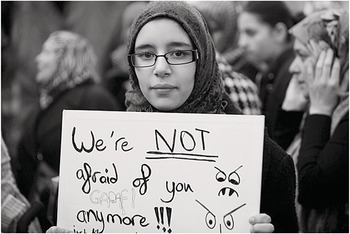
An anti-Gaddafi protester demonstrates voice by holding a sign reading “We’re not afraid of you anymore” from London in support of the Libyan revolution against Muammar al-Gaddafi.
Abdullah also recalled that Libyan students abroad came to side with the revolution rapidly in the United States, even though these students risked having their scholarships withdrawn and their families harmed. When Abdullah and his colleagues in Enough Gaddafi! talked to them in Washington, DC, “We said, ‘Aren’t you afraid? You have family in Libya!’” He recalled with admiration,
They’re telling me, “Those guys are facing bullets! The least I can do is come to a protest, you know?” [They] had this confidence and this loyalty to the lives that are being lost, the people who were dying, and the idea that, hey, we’re really on the cusp of a real change. And those were a lot of the same students who were forced to come out for Gaddafi at the UN [in 2009], protesting on the other side of the line from us.
As journalist Evan Hill (Reference Hill2011) reported for the Doha-based news agency Al Jazeera English, this shift in moral obligation also led students to explicitly refute regime threats.
For some of the students in the United States, the sight of citizens publicly calling for Gaddafi’s ouster was enough to inspire them to defy the embassy’s demands to come to Washington, DC. “I was up late all last night watching the videos of masked youths pleading to the Libyan people to rise against the oppression,” one of the students wrote in an email. “These videos have been circulating on Facebook, and after watching them I broke into tears. I will no longer accept this oppression.”
This sea change in respondents’ orientations toward risk and a new obligation to fellow nationals was both a strategy of resistance and an expression of newfound empowerment. As Mahmoud, a lifelong activist who had been shot by regime agents in London in 1984, stated, “The mask came off. It became [about] facing them eye to eye.”
As the regime was put on the defensive in Libya, the third factor prompting participants to come out was the regime’s relatively weak response to dissent in the diaspora and the rapid collapse of its outposts and informant base. Initially, activists expected a significant counter-mobilization effort because of the heavy-handed tactics used in the past. As Dina of California explained, some people refrained from joining the diaspora’s first anti-regime protests because “they thought that others were going to report back to the regime, take pictures, and take down names and send them back to Libya. So people were still afraid at first.” Osama, an organizer of the first demonstration held on February 19 in Washington, DC, recalled that they made plans for “security because [we] had an expectation that Gaddafi would send his people” to confront them and instigate a fight to discredit pro-revolution demonstrators. But while the presence of pro-Gaddafi demonstrators “shook up” those who traveled periodically to Libya, as a participant named Manal recalled, these efforts came to be perceived as an empty “scare tactic.” Mohamed of London also attested that the students who were initially coerced into attending pro-regime protests rapidly defected to the revolution side, and the throngs of pro-Gaddafi supporters that many expected to materialize never did.
The regime’s inability to deter dissent through threats and counter-demonstrations further empowered activists to confront the institutions and agents that had long terrorized them. Tamim, co-founder of the Libyan Emergency Task Force, attested that the Washington, DC-area community spoke out to harass and shame the Libyan ambassador, Ali Aujali, after he refused to side with the revolution in an interview on CNN. After Aujali officially resigned from his post on February 22, protesters entered the DC mission, which was still under the regime’s jurisdiction, and ripped down pictures of Gaddafi, shouting, “Is this a free country or is this Libya?” (Fisher Reference Fisher2011). Exhilarated by this previously unthinkable showing of dissent, participant Rihab recalled that it was about “finally being able to do something and [making] a statement on behalf of the martyrs.” A similar incursion occurred in London on March 16 when demonstrators stormed the embassy and raised the revolutionary flag.
Ten of my respondents reported guarding their identities beyond the first days of the revolution because their family members were trapped in Tripoli or because they were corresponding directly with rebels on the ground.Footnote 3 As Dina from California attested,
During Tunisia, I was tweeting in my own name. When Libya started, the first thing my mom said was change your name on everything, take down any pictures, because my entire extended family is in Tripoli.
Yet, respondents attested that anonymity was relatively rare, and did not hinder their efforts to form new movement groups under the banner of the revolutionary flag. Because the regime proved incapable of making good on its threats at the onset of the revolution, members of the diaspora largely experienced a rapid liberation of their own. The murders of protesters in the early days of Libya’s uprising not only backfired at home, therefore, but also abroad, as the barrier caused by fear of consorting with the “wrong” Libyan largely dissipated.
4.1.2 The Syrian Case: Persistent Fears of Transnational Repression and Guarded Advocacy
In contrast to the swift eruption of a regime-rebel standoff in Libya, Syria’s uprising resembled a “slow motion revolution” (International Crisis Group [ICG] 2011a). Calls on Facebook for a “Day of Rage” on February 4 failed to materialize on the ground, and the regime attempted to stave off protests by implementing a series of concessions, including lifting the bans on YouTube and Facebook.Footnote 4 Yet, many Syrians were aggrieved by years of growing inequality, corruption, and everyday abuse. In light of the new mood induced by Egypt’s Arab Spring, individuals and crowds in Syria began to spontaneously challenge regime officials in ways that were previously unimaginable (ICG 2011a). For example, about a dozen children were arrested by security forces on March 6 for chanting slogans against the regime in the city of Daraʻa. After their families rallied to demand the children’s release, security forces used live ammunition to disperse them. This incident motivated this group to escalate their demands from releasing their children to demanding the end of the regime itself. Other collective displays of dissent emerged in Damascus as well, as when small groups held vigils to support neighboring revolutions. Cell phone videos of protests being harshly dispersed, including one that showed security forces dragging activist Suheir al-Atassi by her hair and throwing her in jail for demonstrating peacefully, affirmed to many observers that Bashar al-Assad was not interested in change.
On March 15, the moment that many regime opponents-in-exile had been waiting for arrived. A small demonstration in the central market of Damascus’ Hamidiya neighborhood was recorded and disseminated to international news channels for the first time, and the territorial scope of the protests expanded shortly thereafter. Assad’s March 30 speech denounced dissenters as traitors and foreign conspirators (ICG 2011b). Attempts by demonstrators to form a Tahrir Square–esque sit-in movement in Homs were brutally crushed by a military siege in late April. During a subsequent siege in Daraʻa, a young teenager named Hamza al-Khateeb was detained by regime forces. On May 25, his corpse was returned to his family displaying evidence of burns, broken bones, and dismemberment. Images of his body circulated on the Internet and were broadcast on Al Jazeera, stoking outrage inside and outside of the country.Footnote 5
As the Syrian army moved to quell protests in Baniyas, Homs, Latakia, Hama, the Damascus suburbs, and other cities in May with lethal force, their brutality provoked defections and increased anti-regime sympathies. As reports circulated about mass detainment, torture, rape, and massacres of entire families by al-Shabiha loyalist militias, the death toll hit approximately one thousand five hundred in July. But even as protests and riots continued through the fall of 2011, the regime retained control over broad swaths of the population and its territory through a range of coercive tactics, including stoking fears of an Islamist-extremist takeover among minorities. The pitting of an Alawite-dominated security force against a Sunni majority and the Kurdish minority stoked further ethno-religious divides on the ground. As the International Crisis Group reported (2011c: 2),
Denied both mobility and control of any symbolically decisive space (notably in the capital, Damascus, and the biggest city, Aleppo), the protest movement failed to reach the critical mass necessary to establish, once and for all, that Assad has lost his legitimacy. Instead, demonstrators doggedly resisted escalating violence on the part of the security services and their civilian proxies in an ever-growing number of hotspots segregated from one another by numerous checkpoints.
As a result of these dynamics, the Syrian revolution unfolded in phases that were distributed unevenly across the country. The uprising was first characterized by pockets of protest and riots that gradually spread to many cities and towns, but it did not constitute a national rebellion until many months later. International condemnation did little to temper the regime’s brutal approach. In December, the UN High Commissioner for Human Rights reported the death toll as having reached approximately five thousand; by the end of 2012, that figure would increase at least tenfold.
Syrians in the diaspora went public in their opposition to the Assad regime over the course of 2011 and beyond. This was because the three factors enabling Libyans to wield voice also became operative in the Syrian case: (1) the engulfment of their significant others into the conflict; (2) the embrace of risk-taking and cost-sharing for moral and ethical reasons; and (3) the perceived decline in the regime’s capacity to target individuals abroad. However, the pace at which Syrians went public was staggered because regime control in Syria was largely held in the initial months of the uprising. Correspondingly, regime agents and loyalists continued to threaten activists in the United States, Britain, and other host-countries during the revolution’s first year and beyond.
The threats posed by agents of transnational repression were realized in some cases. For example, after protesters met with the ambassador to Syria in Washington, DC, in mid-April to discuss their grievances, some of their relatives in Syria were detained or disappeared, and others received death threats (Public Broadcasting Service 2012). Additionally, when Syrian artist Malik Jandali performed at a July rally in Washington, DC, in support of the 2011 revolution, regime agents kidnapped his father and beat his mother in Homs, telling her, “We’re going to teach you how to raise your son” (Amnesty International 2011). The brutalization of Jandali’s parents was cited by activists across the United States and Britain as a deterrent to using voice. Media reports also detailed additional instances of Syrians’ relatives being harmed after they spoke out against the regime over the course of the uprisings’ first year (Devi Reference Devi2012; Hastings Reference Hastings2012; Hollersen Reference Hollersen2012; Parvaz Reference Parvaz2011). Batul, a student who later became active in a youth chapter of SAC, explained that these reprisals made her family too fearful to go public in 2011. Her mother told her,
“I understand we all want to voice our opinions. I understand we live in America, it’s a free country. But you’ve got to think of the others. Don’t be selfish. You’re not the one that’s going to face the harm – they are.” That’s why [we were] quiet for a year.
Fears were also heightened by the presence of counter-demonstrators at protest events. Pro-Assad protesters took photographs and video recordings of revolutionary gatherings and verbally threatened individuals in Arabic, as I observed firsthand in Los Angeles in 2012. This marked a notable difference from the Libyan situation. Libyan American activist Dr. Saidi, whose wife is Syrian, attended protests for both causes; he attested that
When I was marching with Syrians in the beginning, we always had people intimidating, taking photos. Sometimes they are on the streets, sometimes they are in a car. [This happened] much less with the Libyans. Much less. Because [although] there were a few pro-Gaddafi, because they saw everyone is against Gaddafi, none of them were willing to stand up or do this intimidation.
These acts of intimidation by pro-Assad Syrians were not always empty gestures. One man named Mohamad Soueid was in fact arrested and convicted of documenting the DC-area opposition with the intent to “undermine, silence, intimidate, and potentially harm persons in the United States and Syria who protested,” according to the indictment (United States of America v. Mohamad Anas Haitham Soueid 2011: 3).
Pervasive regime threats also made my presence at protests suspicious to some participants. In January 2012, a woman observed me jotting down the names of protesters I recognized during a sidewalk rally in Anaheim. She asked in a flat tone, “Why are you writing names?” As I hurried to introduce myself, she remained standoffish and seemed unconvinced. Another woman who was listening to the conversation turned to me and explained in a Syrian accent, “We’re not afraid for ourselves, but for our families.” British Syrians also reported that the presence of outsiders at their events raised serious concerns. Ayman, a doctor who had been living in Manchester since the 1980s, recalled that public events did not start in his city until “late 2011” and that he was “very afraid” to participate because “I have elderly parents in Syria and I don’t want them to be harassed, and we know that people have been.” The counter-mobilization of pro-regime groups meant that just because revolution sympathizers were out demonstrating in public did not mean that they necessarily felt free to be identified as revolution supporters.
These fears led some activists to engage in what I call “guarded advocacy” by covering their faces during protests, posting anonymously online or not at all, and refusing invitations to speak to the media in order to avoid being identified as pro-revolution. Sarab, for example, first helped activists in New York organize from behind the scenes “because I hadn’t gotten approval from my family to be public.” The guarded character of activism also meant that public events took on a semi-private character. For example, despite declarations by a speaker that “the wall of fear has come down!” at a SAC-LA community meeting in December 2011, I was explicitly instructed not to photograph the audience. Persistent concerns about infiltration also led activists who went public early on to be suspected as agents provocateurs. Susan of Southern California, who had gotten permission from her father in Syria to come out, recalled that “people were like, why is she doing this if her family is home? Why is she not scared for them? Reality was, I was scared to death.” In this way, respondents reported that their mobilization efforts suffered from enduring suspicion between conationals. As Rafif from the DC area recalled,
Many people used pseudonyms for a very long time. Other people would sort of mask their faces or something so they wouldn’t be recognized on camera. So people took their pace, whatever they were comfortable with, in terms of coming out publicly in support of the revolution. That also created some mistrust, right? [Because it raised questions as to] why is one guy completely out there and not afraid, and then somebody else is still protecting his identity?
Mistrust in the community also created a challenge for Syrian organizers, because early supporters of the revolution could not get significant numbers of sympathizers in their communities to sign their names on petitions, join organizations like SAC, or affiliate with public calls for regime change. This was a problem because organizers wanted to combat regime propaganda that slandered the revolution as a conspiracy of foreign powers and a terrorist plot. As Said Mujatahid, one of the early SAC organizers, recalled, because of the “phobia in the Syrian community to say anything against the Syrian regime, I would say the first four months was difficult. Even some of your closest people will stay away from you because they are afraid of being associated.” In another example, Belal formed the National Syrian American Expatriate group in Anaheim, which he hoped would bring individuals with varied political views together to support gradual liberalization in Syria. This group of a dozen or so individuals put together a list of requests for Assad, including presidential term limits, in March 2011. However, Belal’s expatriate group was formed in secret out of fears of transnational repression, and Belal was the only member willing to sign his name to the group’s demands.
4.1.3 Syrians’ Gradual Coming Out and Risk-Taking Strategies
Despite the challenges of going public, Syrians reported doing so after regime violence converted their families to the cause or forced their loved ones to flee. Sharif observed this shift among his conationals in Bradford, who began to tell him, “Look, if my family in Syria are going on the street, why do I need to be frightened here in England?” Similarly, Batul was able to “open up” in 2012 after her relatives in Syria decided to make their anti-regime position known and gave “their okay” for their relatives to come out. Washington, DC-based Mohammad al-Abdallah, a political exile whose father was imprisoned by the regime at the onset of the uprising, likewise reported being able to escalate his public criticisms of the regime after his father reached out to condone his son’s activism. He said,
When the uprising started, I was on TV commenting and basically criticizing the government. But I had that concern about my family’s safety because members of my family were in prison. In April, I get a phone call from my father inside the prison. He managed to basically bribe a police officer and use his cell phone. And he called me, [saying] they’re arresting lots of people from the street and bring[ing] them to the prison here, but they tell me they see you on TV and they’re very proud of you. So please continue doing that regardless of what’s happening here.
The victimization of loved ones also compelled respondents to transition from guarded to public advocacy. Nebal, a student in London, emphasized that although an embassy official had contacted him to demand that he attend pro-Assad demonstrations, he felt that he had “no choice” but to go public after his brother was imprisoned. Others did so after experiencing a personal loss. As Abdulaziz Almashi, a founder of the Global Solidarity Movement for Syria, attested,
When I start joining the anti-Assad demonstrations in late April, we used to hide our faces with scarves because we’re not sure about the consequences, we’re worried about loved ones in Syria. In late May, my friend was killed in Hama and I saw the video on Al Jazeera. One week after that, the Syrian embassy again contacted me to ask me to join their protests, and I made my decision. I said “look, I’m not joining you, you are killing our people.” The person said to me, “if you don’t join us, that means you are against us.” I said “I am against you, go to hell!” I was using the megaphone, shouting. They were [taking pictures of] me. And I didn’t care at that time. It was the spark of my activism in the open way.
Respondents also came out after the scope and brutality of regime violence transformed their sense of obligation to encompass the broader national community, rendering nonfamilial Syrians as significant others. Omar, an activist from Houston, recalled, “My brother and family are in Syria, but people were losing their lives. And I don’t think our lives are more precious than those people who lost their lives.” Similarly, Firas of Southern California came out after the regime sent tanks to put down protests in Daraʻa in April 2011. Before this incident, he had covered his face in protests, and
[I tried] to avoid mentioning my name in any petition. But after using the tanks, it was like, no, screw it! Why should I worry about my family when all of the people are getting killed? I know that this regime uses collective punishment. But I was like, I’m not going to care. I’m going to go public.
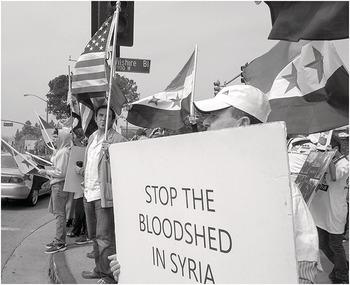
Syrians and SAC organizers call for outside powers to “Stop the Bloodshed in Syria” at the Federal Building in Los Angeles, California, on June 9, 2012.
Fadel, a doctor in London, refuted peer pressure not to go public by referencing Syria’s most famous child martyr: “You can’t only be concerned about yourself and your family. If you think Hamza al-Khateeb is not part of your family, I think you are very selfish.” Ahmed of London also attested that he came out after Hamza’s mutilated body was posted on YouTube. “The thing that affected me most was the murder of Hamza al-Khateeb. Before that, I was reluctant to do protests. When that happened, the next day I was protesting outside the embassy.”
The perception that costs should be collectively shared sometimes forced activists to choose between their families and the cause. Muhammad N., exiled to London at the time, described the agonizing decision of whether or not to give a televised interview because his family in Aleppo might be subjected to reprisals. His brother advised him, “This is a duty on every one of us. If all of us are cowards because we have family in Syria, then it’s treason.” Muhammad decided to speak to the media, but the decision pitted his family’s safety against his principles. For other Syrians, the decision to embrace the potential costs of coming out led to familial discord. Fadel in London reported,
I was in a big dispute with my mother. She said, “aren’t you risking yourself?” I said “I’m not, I am safe here.” Then she said, “you have a brother and sister back home.” I said, “Mom, I have to get out of my silence and talk and protest. Those people on the ground, they are brave enough to sacrifice their lives. And I’m sitting here, knowing that nobody is going to shoot at me, and I’m still hesitating? No way. This is the least I can do.”
Some experienced significant social costs for choosing the cause over their familial obligations. When Nour, an independent activist from a Christian family, set up a Facebook page in February 2011 calling for liberty for Syrians, some of his family members in the United States called him very “angry” to say that “if you don’t care about yourself, fine, but we want to go to Syria.” Friends and family abroad and in Syria then began to sever their connections with Nour for fear of “getting in trouble,” and he “started to unfriend a lot of people just to spare them the headache.” Because two of his uncles in Syria were interrogated by security forces about Nour’s social media posts, he published an announcement on Facebook that his family had rejected him. That way, he reasoned, if the regime questioned any of his relatives about him again, they could see that he did not represent their views. “But it wasn’t an easy call,” Nour explained. “I experienced extreme isolation and social stigma. I lost everything, all my social connections.” In a parallel case, Hussam stated that coming out early on as a member of SAC was a strategy “to help others break the fear, the wall of fear. Because it was unusual for people to go public criticizing the regime.” At the same time, “We got a lot of heat. I had family members calling me from Syria like what the heck are you doing? Relatives from all over. All of us went through that, although our [initial] letter [to the regime] was very respectful.” Many participants reported that they had to cut all forms of communication with their families at home so as not to incriminate them by association, which was emotionally trying.
Lastly, activists came out because they perceived that the Assad regime’s increased use of collective and arbitrary violence in Syria meant that going public no longer posed additional risks to their significant others. As L. A. from California explained, such escalations signaled that her family’s fate was no longer in her hands.
Even if I didn’t do anything, if they want my family, they will take them for no reason. When my mom tells me you are [putting a] target on us, I say mama, when they want you, they won’t wait for me to protest or not to protest.
Sabreen also stated that although her mother initially asked her to remain anonymous, she later told Sabreen, “It doesn’t matter if you speak or not, because they are targeting everybody.” As such, members of the diaspora went public because they came to perceive that the regime was no longer willing or able to sanction them in a targeted fashion. As Y. explained,
In the beginning, because everything was so slow in Syria, the regime was able to crack down on everyone who talked. Then it got to a point where they’re not going to keep up. When the conflict escalated militarily, we’re like, okay, their focus is not on Facebook anymore.
This rendered formerly high-risk activism abroad as low-risk, enabling activists to transition from guarded to overt advocacy.
In summary, Syrian anti-regime mobilization in the United States and Britain emerged as never before over the revolution’s first year. As Qayyum (Reference Qayyum2011: 4) writes, this coming-out process cultivated a new consciousness in public space, as Syrians came to “link their names to their stories and opinions as an act of defiance … [and] to rebuff intimidation tactics facilitated by the Syrian government.” However, transnational repression also obstructed diaspora solidarity and mobilization by perpetuating mistrust and fear, and by imposing costs. As Sarab explained, the decision to “cross that line of fear” was belabored.
After I put my first post on Facebook condemning the regime, my finger was trembling and my heart was racing. So it gives you a sense of how repressed and how conditioned we were to be quiet and never express ourselves as long as I’ve been alive.
Furthermore, because many of their family members still resided in Syria, some Syrians chose to only use their first names or to remain partially hidden online or in public.
As numerous members of the anti-regime diaspora began to come out on behalf of the revolution, Syrians attested that the cause lumped and split the community into pro- and anti-regime camps. The fear of being informed upon by fellow conationals also increased polarization within the diaspora. Respondents reported cutting off communications with those who came out on behalf of the regime and avoiding or boycotting businesses known (or believed) to be pro-regime. Though the respondents interviewed in this study affirmed that they would continue to be public regardless of the eventual outcome of the revolution, many knew of others who remain silent or guarded.Footnote 6 Hassan of SAC-LA cited this as a pervasive dilemma for Syrians because “we enjoy freedom and democracy. We came to this country for those things. That fear should not be there. And still, people are afraid.”
4.1.4 The Yemeni Case: Regime Repression’s Effect on Public Mobilization
Protests broke out in Yemen’s capital city of Sanaʻa on January 15, 2011, in support of Tunisia’s revolution, and street-level demonstrations grew steadily each week across the country. Calls by demonstrators known as the “independent youth” for Saleh to step down were intertwined with calls by the legal opposition, including Yemen’s Al-Islah Party and the Yemeni Socialist Party, for reform. After Yemen’s first Day of Rage on February 3, protesters pitched tents at the newly christened Change Square at Sanaʻa University and in Freedom Square in Taʻiz. Regime forces killed several participants in response and spurred a steady growth in protests and sit-ins.
The resignation of Egypt’s president on February 11 escalated Yemen’s uprising. Thousands took to the streets to demonstrate in at least eight cities across different regions of Yemen, including in the restive South and its largest city of Aden. In the North, the regime deployed al-baltajiyya – plainclothes security forces and thug groups – to disperse protests by force. Repression in the South included a series of coordinated attacks, firing on fleeing civilians, preventing doctors and ambulances from reaching injured demonstrators, and disappearing victims (Human Rights Watch 2011a). In the capital and elsewhere, erratic shootings by Saleh’s forces killed about a dozen protesters each week. By the end of February, regime violence prompted Hussein al-Ahmar, a paramount leader of the prominent Hashid tribal confederation, to rally thousands of tribesmen to the cause. He also urged northern Houthi insurgents and southern secessionists to “drop their slogans, adopt a unified motto calling for the fall of the corrupt regime” (ICG 2011d: 5). In February and March, some southern protest factions acquiesced to requests by northerners not to raise the secessionist flag.
In early March, Saleh announced that he would implement reforms while also deporting as many foreign journalists as his enforcers could get their hands on. Soon after, the regime attempted to clear Sanaʻa’s Change Square for good. During a day of protest dubbed the “Friday of Dignity,” or Jumaat al-Karamah, Saleh loyalists shot and killed more than fifty unarmed protesters in the square and injured hundreds (Ishaq Reference Ishaq2012). The massacre backfired, however, by drawing international condemnation and stoking key defections. Saleh’s former ally and commander of the First Armored Division, General Ali Mohsen al-Ahmar, announced that his unit would defect to protect the protesters. Sadeq al-Ahmar, another prominent figure in the Hashid confederation (and of no relation to Ali Mohsen), also came to side with the revolution. This gave the sit-in movement in Sanaʻa armed protection by Mohsen and his division. At the same time, other protests and sit-in movements across Yemen remained exposed. The regime continued to target them with regularity, leading to dozens of deaths each week.
The Yemeni diaspora did not experience the same degree of threats or fear as their Libyan and Syrian counterparts, as Chapter 3 describes, owing to the regime’s relative weakness and inability to effectively intimidate Saleh’s opponents abroad. Several activists, particularly those from the South, were concerned that they might have trouble returning to Yemen for going public. That said, many of these individuals took that risk out of a sense of moral obligation. Arsalan of Sheffield said that his family worried about potential retribution from the regime, but “I couldn’t stand to stay home and watch TV while my brothers and sisters were being killed back home and not do anything.” Furthermore, unlike their Syrian counterparts, no Yemeni diaspora respondents reported covering their faces at protests or witnessing others doing so, and only one interviewee guarded his identity online.
Respondents reported that regime violence also undermined the sway of the regime over students on state-sponsored scholarships. Hanna, who had been active before 2011 organizing with southern Yemenis in New York, recalled,
In the beginning, a lot of Yemenis, mainly from the North, were pro-Ali Abdullah Saleh. So that was one of our main challenges. [At] the first rally that we had, we had a group come rally against us. And it was mainly people from the embassy, mainly students that the regime was paying for, they said well, we’re paying for your schooling, you have to come out to this rally and support the regime against the other activists. [But] a lot of them, after the killings and after just the tortures and a lot of things that were going on, [those] Yemenis came to our side. So the pro-government rallies started dissipating.
Furthermore, while a core group of activists had already begun mobilizing on behalf of the revolution in February and March, the Friday of Dignity Massacre on March 18 spurred a dramatic spike in protest participation in the diaspora. Adel of Michigan described it as a “turning point” because the killings motivated many who were not previously active or were pro-regime to join their calls for Saleh to step down. Idriss of Washington, DC, recalled, “At that point, there was no going back. Whatever happens, we weren’t going to stick with Saleh anymore.” Respondents attested that they found the footage of the protests appalling. As Ali from the DC-area community described,
Personally, what motivated me most was all those videos I watched on Facebook and on the news. All those young people getting killed by Saleh’s army. I felt like I have to do something. If those people over there are facing the army with guns and everything, the least I can do is support them with my voice.
For Haidar of Birmingham, the massacre also affected him personally. He said,
Initially, Yemenis in the UK were not involved in the revolution heavily, until what happened in March 2011 in [Change] Square, Jumaat al-Karamah. I remember that day, it was – a black day – when we saw the blood of our friends, our colleagues. Some of my best friends were injured in this massacre. Since this day, we started to move.
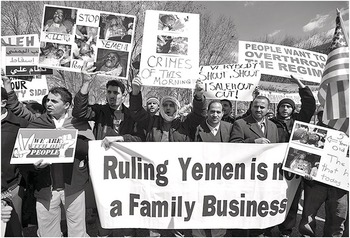
Yemeni community members shout slogans against Yemen’s embattled president Ali Abdullah Saleh during a demonstration in front of the White House in Washington, DC, on March 26, 2011. The large banner reads “Ruling Yemen is not a family business.”
Mahmoud of Sheffield described the effect of the massacre as “shocking” in its scale. Referring to another well-known community figure and longtime regime opponent named Abdallah al-Hakimi, he said,
It [became] not only about me or Abdallah calling people and saying, let’s go out. It was amazing how people were calling us to say, look guys, you have to do something, we need to mobilize. I think we had one or two demonstrations beforehand, but they were not as big as after Jumaat al-Karamah. The response of people was very enormous to that.
Morooj also attested that the massacre inspired activists across different US cities to begin working together to launch national days of protest in Washington, DC. She recalled, “After that day, we really began to start working with other cities and start connecting our actions together and [planned] a national day of action in solidarity with Yemenis. So that day definitely was a big turning point. [I]t brought the movement home [to us].” Nadia reported that this event motivated her to galvanize other women in Birmingham to participate in the London-based protests.
The women weren’t involved as much in the organizing for the revolution. They weren’t normally invited. When they killed that many people in one day, that was it for me, I had had it. I felt that it was my children who were getting killed and hurt, [so] I went and booked a coach [to London]. [My husband] said “why did you do that? you haven’t even spoken to the men about it.” I said that “we’re going to fill the coach, even if we fill it with women.” That was the turning point where I was prepared, if anyone was to say to me, “You don’t have the right,” I would say, “Yes I do.” There’s a point where you go past thinking, am I supposed to do, am I not supposed to do. It’s something you have to do, it’s obligatory. So for me, [Jumaat al-Karamah] was the turning point.
As the experiences of activists like Nadia and others illustrate, Yemen’s revolution not only brought diaspora members out in public to protest, but also increased the political participation of Yemeni women as well.
From one of Yemen’s largest concentrated communities in the United States, a community organizer named Adel also observed that the massacre had a counteractive effect on the pro-regime protests in Dearborn, Michigan.
At the beginning, just a few people showed up to a small demonstration. But especially after the Friday of Dignity, lots of people showed up. There were also two demonstrations that were big in numbers that were pro-government. And those were the people who were members of [Saleh’s] Al-Mu’tamar [General People’s Congress] party. They showed up with the president’s pictures. But after that Friday, I don’t think they did anything after that. Some of them kind of joined the revolution and some of them just stayed on their own. And the last [pro-Saleh] one was kind of an embarrassment because only like ten or eleven people showed up to the city hall.
In all, regime repression at home undermined the weak effects of transnational repression in the Yemeni diaspora and, as I explain below, stoked the outrage needed for community members to condemn Ali Abdullah Saleh. As a result, anti-regime activists, both new and old, came together to wield voice as never before.
4.2 The Breakdown (and Resurgence) of Conflict Transmission
4.2.1 The Libyan Revolution and Diaspora Solidarity
In addition to upending transnational repression, the rapid escalation of a zero-sum standoff in Libya also undermined conflict transmission and induced solidarity between conationals for the Arab Spring. As Noueihed and Warren (Reference Noueihed and Warren2012: 180) write,
[Gaddafi’s] now-infamous pledge to go “zanga zanga, dar dar” or from “alley to alley, house to house” to “cleanse” the “rats” and “cockroaches” carried echoes of the 1994 genocide in Rwanda, when Hutus described the Tutsis in similarly insect-like terms. Saif al-Islam’s calls for dialogue and a “general assembly” were ignored by both the opposition and the outside world, while his rambling speech threatening “rivers of blood” prompted Western politicians to fall over each other in their rush to distance themselves from Libya’s heir apparent … Even though Gaddafi promised an amnesty to those who gave up their weapons, threats of “no mercy” to those who resisted suggested that a terrible vengeance would be visited upon Libya’s second city [of Benghazi].
Thus, the revolution created shared anti-regime grievances between revolutionaries in exile, reformists who had treated the regime as a bargaining partner in recent years, bystanders who had eschewed home-country politics in the past, and students abroad on state-sponsored scholarships. As a result, regime repression and revolutionary backlash in Libya produced a newfound alignment that paired a “diagnostic frame” attributing the Gaddafi regime as the problem with a “prognostic frame” naming the armed revolutionary movement under the National Transitional Council (NTC) as the only legitimate solution (Benford and Snow Reference Benford and Snow2000; Snow and Benford Reference Snow and Benford1988). These conditions motivated mobilization among a wide cross-section of Libyans in the United States and Britain and produced a newfound sense of nationalistic solidarity among conationals. As M., a second-generation exile and member of the Enough Gaddafi! network, explained,
It was incredibly unfortunate, the severity of the crisis, but it left a very clear line for us. There wasn’t any doubt if Gaddafi was doing this or he was not doing this – like in Syria, where there’s a lot of doubt floating around regarding who did what, and what was going on, who’s the good guy or the bad guy. We were lucky enough to have all of that very black and white. The severity of his actions made it very clear. Whether or not [others] had been supportive of Gaddafi before, it changed a lot of people afterwards, not to mention those who had already been affected.
Dina from California also attested to how important Saif al-Islam’s threatening reaction to the uprising was in discrediting the regime. A young professional from Southern California, Dina had spent time working in Libya during Saif’s “liberalization” period before being imprisoned for a brief but terrifying time over government suspicions that she was a spy. She said,
Many people actually, at the beginning of the revolution, did not expect Saif to react in the way that he did. People forget that, but that’s still really an important part of the whole puzzle – the way that he came out so strongly in those first days. His hatred was just so shocking.
Saif’s speech also prompted individuals like Adam, who had engaged with regime representatives through Saif’s diaspora outreach initiative in 2010, to change his mind. He explained his decision in the following way:
If I’m having a debate with somebody and the person decides to slap my sister, the debate is over. I understand we want to limit as much bloodshed as possible. But when you’re fighting a rabid dog, you can’t speak with it, you can’t calm it down with words anymore. That’s it. You’ve got to put it to sleep, end it then and there. The point of return is long gone. And [the regime] passed it.
Abdullah of Enough Gaddafi! also recalled the transformative effect of the revolution in unifying members’ grievances. He reported that during the initial planning meetings for the first protest in Washington, DC, on February 19, he and his fellow organizers debated,
What if people bring [the] green flags [of the regime]? What if people don’t want to see posters that are cursing Gaddafi? There were all these things that we were trying to accommodate so that we’d get as many people to come out as possible. But when the nineteenth came, all of that went out the window. When people were getting killed, people could see the bravery of the youth in the street, and it was all the independence flags, down with Gaddafi! It was just unified all of a sudden.
Niz, a Libyan doctor-turned-revolutionary who was living in Cardiff at the time, also noted that the regime’s use of overwhelming force was critical in legitimizing armed revolution as a necessary method of resistance. He explained,
Very quickly, the realization was that Gaddafi is not Ben Ali or Mubarak. They are all brutal and corrupt dictators, but Gaddafi is a different breed, and public protests at squares – these things were not going to bring the regime down. And that the Gaddafi regime would easily kill 90 percent of the population if it meant him staying in power. They would continue to gun down protesters. And very quickly, the idea came about that this cannot be a mass peaceful protest movement. It needed to become an armed uprising.
For this reason, respondents came to validate the armed struggle by the Free Libya Army (also known as the National Liberation Army) and to back the NTC.
Respondents overwhelmingly reported experiencing a newfound sense of community that brought exiles, refugees, non-activist immigrants, migrants, and even some formerly pro-regime individuals together for the same cause. As Abdo G. of Manchester recalled, “It unified the Libyan community. Because before February 17, the Libyan community in Manchester was in silence. There wasn’t a community.” But after the onset of the revolution, he exclaimed, “People [were meeting] new people. My own brother met his future wife at one of these events!” This sentiment was echoed by activists based in the United States as well. As Khaled recalled, the first Washington, DC, protest on February 19 was
the biggest thing I’ve ever been a part of. Usually when we protest[ed], I would have spent my last dime driving to New York or DC for a protest that had maybe thirteen people. The DC protest was the most Libyans I have seen in one place in America ever. It was [hundreds of] people who had never been politically active, who had never met before.
Osama, who at the time of the revolution was living in Chicago but had grown up among other Libyan families in Tucson, Arizona, echoed that at informal community events, such as “the picnics that happened during the revolution, suddenly everyone [is] singing freedom songs, singing the national anthem – any picnic it would be like that.” The contrast in community relations before and during the Arab Spring could not have been starker.
Of course, neither the revolution itself nor the diaspora’s response was a purely harmonious effort. There were underlying conflicts and mistrust between groups, including violence between anti-regime forces in Libya itself, as well as lingering resentments by long-standing regime opponents of those who had jumped on the anti-regime “bandwagon,” as Ahmed H. recalled. Several members of Enough Gaddafi! who helped to organize the February 19 protest also recalled competition between opposition figures to dominate the event. Ahmed explained that he spoke with the leaders of other groups in order to tell them,
Listen, we just need people to show up. If you want to demonstrate solidarity with the people who are on the front lines going through it right now, [then participate]. That’s the objective more than anything else. We want to present a common front, a unified front, to the world.
Mohamed of Manchester also referenced an underlying “competition” over who would appear in the media. However, despite these wobbles in community cohesion, respondents reported experiencing a sense of solidarity as never before. Mohamed said his experience protesting in Manchester around February 19 “was in and of itself amazing” because
We were rubbing shoulders with everyone. The thing that brought us together was being Libyan and being anti-Gaddafi. I was talking and standing together with socialists, communists, liberals, Islamists, we all had one goal and one pain and we were happy to be together.
Furthermore, despite some tensions, collective action in the diaspora was fundamentally unified around a set of anti-regime grievances and demands. As M. stated, “There was one goal to be achieved. Yes, we all have our differences, but the main goals were to get Gaddafi out, and to stop the killing of people.” Mohamed of Manchester also recalled that Libyans were joined together by the fact that the revolution had escalated immediately into “a fight to the death” – and that despite the disparate groups involved, the revolution-supporting opposition was “united in one fight” against Gaddafi, as Adam from Virginia recounted. As a result, their various strategies to intervene in the revolution itself, described in the next chapter, remained complementary and largely unified for the duration of the fight.
For Libyans, the Arab Spring not only prompted individuals to ally themselves under the banner of the revolutionary flag, but also enabled them convert all known preexisting diaspora groups and organizations in the United States and Britain to the cause (see Table 4.1). This not only empowered individuals to unite in new ways, but also allowed diaspora members to use previously “neutral” or apolitical “indigenous organizations” (McAdam Reference McAdam1999[1982]), that is, community associations and groups formed prior to the revolutions, as spaces for conationals to congregate. In this way, the Arab Spring transformed Libyan organizations into “mobilizing structures” for activism (McAdam et al. Reference McAdam, McCarthy and Zald1996), providing leaders with a base of support and collective resources for intervention at home. Although the NFSL and other groups formed in the 1970s and 1980s were no longer in operation just before the revolution, many of their participants immediately came to support the struggle. So too did Dr. Abdul Malek, founder of Libya Watch and representative of the Muslim Brotherhood from Manchester. He recalled that he and the Brotherhood came to ally with the revolution because of the regime’s severe response.
When we went to the general meeting, which is the highest authority in the Ikhwan [Brotherhood], we expected something to happen on the seventeenth of February. The argument was over what to expect. Would we expect an outright revolution? Would we expect just some people to come out and then go home, or what? Our position at the end of the day was this: if something happens on the seventeenth, then we will have to wait for the response of the regime. If the regime uses brutal force and kills demonstrators, then we will go out right [away] with the revolution and there will be no going back. But if the regime backs away and allows these young people to vent their energy and their steam without an incident and without killing anyone, then the reform prospects that we are very keen on will continue. But obviously, the regime decided to act brutally against the uprising and started killing right away, and immediately we moved into the revolution mode.
| Diaspora Group/Organization | Converted? |
|---|---|
| USA | |
| Enough Gaddafi! | Yes |
| Libyan Association of Southern California | Yes |
| National Conference for the Libyan Oppositiona | Yes |
| Britain | |
| Libyan Muslim Brotherhooda | Yes |
| Libya Watch | Yes |
| Libyan Women’s Union | Yes |
| National Conference for the Libyan Oppositiona | Yes |
a Denotes multinational membership.
The revolution also transformed previously apolitical organizations for empowerment and socialization into politicized groups for the Arab Spring. Dr. Saidi of the Libyan Association of Southern California remarked that “when the revolution started, every Libyan gathering became political.” While attending one of these events in Fountain Valley, California (which convened just a few days after the October 2011 killing of Gaddafi), I observed that the event was entirely revolution-themed: children gleefully swatted at piñatas draped with pictures of the Gaddafi family, and different men gave a series of speeches while wearing the revolution flag like a cape, heralding the triumphs of their compatriots. Participants wore clothing adorned with the revolution flag, ate revolution-flag-colored food, and sang revolution songs, both old and new. British Libyans witnessed this transformation as well. Zakia, founder of the Libyan Women’s Union in Manchester, explained that her organization transformed from a social empowerment group into an activist organization dedicated to intervening in three areas: “one for charity, one for media, one for protests.” As these examples show, diaspora organizations and community events came to be pro-revolution in orientation and mission, giving activists the structural foundation and legitimacy to launch collective actions for rebellion and relief.
4.2.2 The Syrian Revolution and the Diaspora’s Gradual Coming Together
As in the Libyan revolution, the onset of protests in Syria re-energized existing activist networks that had previously opposed the regime. For groups like the Syrian Justice and Development Party in London, the onset of the protests in their home-country presented a welcome opportunity to support and incite resistance. Co-founder Malik al-Abdeh recalled that his group began to play amateur footage of protests in Syria repeatedly on Barada TV to prod Syrians into doing “more of this kind of stuff.” Exiles such as Dr. Radwan Ziadeh and Marah Bukai in Washington, DC, also came out immediately to support the uprising. They used their political connections to meet with US officials on Capitol Hill and speak out in the media. After Suheir al-Atassi was released from prison in Damascus, Marah recalled contacting her friend to affirm that “we’ll do what we can do here to support your aims and targets.”
However, not all activists in exile were comfortable with the prospect of a Libya-style revolutionary war. Ammar Abdulhamid, an activist in exile and co-founder of the Tharwa Foundation, expressed grave concerns about the poor state of rebels’ preparedness. Recalling his thinking at the time, Ammar said, “If people are in the street, I’ll be with them, [and our] Tharwa network is part of it anyway.” Still, he recalled warning other exiles and regime opponents that “we’re not ready,” expressing concerns about the lack of vision and planning on how to overcome the challenges inherent in launching a successful revolution.
The uprising also breathed new life into the Syrian American Council (SAC), but the gradual emergence of the revolution meant that SAC’s reform-oriented stance did not automatically convert into a pro-revolutionary one. Hussam, who helped establish the Los Angeles chapter of SAC and would later became its national chairman, recalled that the council’s first statement on the uprisings was laughably humble in hindsight. He said,
It wasn’t asking for changing of the regime. It was still addressing Bashar al-Assad as the legitimate president – Dear President Assad, basically. We stated support for the demands of the protesters, which at that time were very, very simple. It was very peaceful. It was about political reforms, freedoms, release of political detainees. And the argument behind it was that’s what they’re asking for in Syria. And we can only support what they’re asking for on the street. There’s no need to push the envelope higher than they’re doing. As long as the regime is willing to compromise and come to somewhere in the middle, that’s my insistence. We made it a condition [that] anyone joining SAC or speaking for SAC [had] to abide and be committed to a peaceful revolution, a nonviolent one demanding freedom and democracy and a slow process of change.
This initially put SAC at odds with longtime activists calling for regime change. When Marah Bukai was invited to SAC’s first national meeting in May, she recalled asking them, “‘What is going to be your major statement?’ They said, ‘We want to see some changes in Syria.’ I told them, ‘I’m sorry, you should go and knock on the door of someone else. For me, I want this regime to go.’ So their ceiling was different than my ceiling.”
Just as many Libyans had believed that Gaddafi’s son Saif al-Islam would be the harbinger of reason in the early days of the uprising, many Syrians also held out hope that Bashar al-Assad would do the same. Belal, a Syrian American from Orange County, California, had represented the Syrian expatriate community in dialogues with Syrian regime officials in the past. He explained,
When I met [Assad] face to face and we were talking, you know, he really showed humility and he showed passion. He was very passionate about making change and I believed him. So that’s why I became part of the expatriate [group] that wanted to build a bridge between here and Syria.
However, after sending a letter to the regime and receiving a favorable response, Belal was left waiting in vain as violence on the ground escalated into the summer of 2011 and produced over one thousand casualties.
Once the regime escalated its retaliatory response to protests by laying siege to entire cities and towns, reformist groups mirrored calls for the fall of the regime that were spreading across Syria. Hussam of SAC recalled, “After the regime showed that they had absolutely no interest in reforming or changing their ways, that’s when I said dialogue cannot work.” In an evolution of SAC’s position, he explained why the organization transitioned from supporting a peaceful revolution to armed resistance:
Initially, most people truly believed the nonviolent path was the only path. It started changing, [but] the change didn’t happen overnight. That transition first included: what do you do with soldiers who defect? These people are being tracked down by the government and killed, and their wives were being raped and their parents were being shot. So there was a debate, can they defend themselves and their own families and villages? The first transition was yes, they have the right, actually they have the responsibility to refuse these orders. And when they go in hiding, if the government is pursuing them, they have the right to defend themselves and their families. And the next phase became, what about these soldiers defending their whole village, their whole town, or their neighborhood? Because the regime is coming to practice collective punishment on the cities. Can they defend their own villages and neighborhoods? The answer was yes. And then the next question becomes, what if a young man joins them because there weren’t enough defecting soldiers to defend the village? What if a young man says, I will join you? Yes. And that transition eventually became, what if we [the revolutionaries] raid [government forces] before they raid us? What if we go and raid a Syrian army base and take the weapons so that they don’t use them against us? Yeah, that sounds good, too.
He added, wryly, “I know from here, it sounds great to be Gandhi.” Yet, because regime forces and militia known as al-Shabiha were hunting down pacifists and defectors, this left the opposition with no choice but to fight back. Belal, despite having initiated dialogue with the regime in the past, also came to side with the revolution by the end of the summer. He said,
When people rise up for a change, you should accept that. I learned that here [in the United States]. People were going out in their bare chest, they’re resisting, they’re asking for change. And they were met with weapons, machine guns, and attacked. Basically they were paying the price with their life. Even we supported that they carry arms because they were getting killed and slaughtered.
As violence worsened significantly over the course of 2012, activists reported that many members in their respective communities came to sympathize with the uprising within a year of its onset. Sabreen, a youth activist from Southern California, reported that different events, including a slew of massacres occurring in people’s hometowns and cities, “hit different people at different points. So there wasn’t one specific event. [But] you can’t really go back on all those massacres, you can’t go back on all those deaths. And you can’t just accept the regime after all that.” The escalation of the conflict over the course of 2011 gradually brought different politicized factions into alignment with the view that the regime must fall.
As a result, Syrians converted many preexisting organizations to the Arab Spring (see Table 4.2). Groups such as the Syrian American Council, which lay relatively dormant since its founding in 2005 due to the threat of transnational repression (see Chapter 3), and elite-led organizations like Ammar Abdulhamid’s Tharwa Foundation and Dr. Radwan Ziadeh’s Center for Political and Strategic Studies, immediately converted their groups to the Arab Spring. Activists also converted professional service organizations, previously perceived by respondents as co-opted by regime elites, to the cause of relief. The two medical associations that operated in the US and British diasporas before the revolution – the Syrian British Medical Society and the Syrian American Medical Society, both founded in 2007 – came to channel their resources to the conflict after pro-revolution humanitarians and activists mobilized to liberate these organizations from regime loyalist control.
| Diaspora Group/Organization | Converted to the Rebellion and/or Relief? |
|---|---|
| USA | |
| All4Syria | Yes |
| Syrian American Association (Southern CA) | No |
| Syrian American Club of Houston | No |
| Syrian American Council | Yes |
| Syrian American Medical Societya | Yes |
| Syrian Center for Political & Strategic Studies | Yes |
| Tharwa Foundation | Yes |
| Britain | |
| Syrian British Medical Societya | Yes |
| Syrian Justice & Development Party | Yes |
| British Syrian Society (London) | No |
| Syrian Observatory for Human Rights | Yes |
a Denotes an exclusively charitable/service nonprofit organization.
Dr. Fadel Moghrabi of London, who came out early for the revolution, attested that he joined the Syrian British Medical Society during the revolution in 2012 “for one reason: because corruption was everywhere [in Syria], and it was reaching here as well. When the people were killed in the street, the Syrian British Medical Society was silent because half of the leaders were connected to the government.” Fadel responded by mobilizing his colleagues to threaten a mass resignation unless regime loyalists were removed from the society’s leadership. After these doctors succeeded in pressuring the organization to hold new elections, Fadel and his colleagues joined the board so that “now we can open up, we can talk freely, we can talk as a medical society looking at the scale of atrocity going on against doctors, against medical facilities, hospitals, paramedics, all those things.” The Syrian American Medical Society did the same, enabling the organization to “fulfill its potential,” according to one respondent, as a bona fide relief agency working inside and outside of Syria to save civilian lives.
That said, conflict transmission over the revolution and the presence of loyalists in Syrian communities meant that not all groups followed in lockstep, as in the Libyan case. Three social clubs mentioned by interviewees – the Syrian American Club of Houston, the Syrian American Association of Southern California, and the British Syrian Society of London – did not convert to the revolution. Omar Shishakly, a board member of Houston’s Syrian American Club who had come out on the side of the revolution early on, maintained that the Houston club had to remain neutral. As an organization dedicated to providing scholarships and hosting community gatherings, he argued that it was required to adhere to its nonpolitical bylaws and continue serving the broader community regardless of their political views.
However, another activist from Houston attested that the club’s neutrality made it pro-regime by default because they would not allow community members to use the space or the listserv to advertise events, such as fundraisers for humanitarian relief or documentary films on the uprising. This respondent told me with more than a hint of disdain, “I see the club as kind of an extension of Damascus – Little Damascus thinking they can stay neutral and everything will be okay.” Associations in California and London were likewise perceived by outsiders as taking Assad’s side once the conflict began because they were run by loyalists and remained silent on the crisis at home.
Nevertheless, as Table 4.2 shows, most Syrian diaspora organizations – including those with long-standing political claims and capacities to deliver much-needed aid – were converted by their leaders to the revolution, granting the anti-regime diaspora an institutionalized means of raising attention and aid for the cause.
4.2.3 The Resurgence of Conflict Transmission in the Syrian Diaspora
The escalating conflict in Syria produced an unprecedented surge in anti-regime activism, as I detail further in Chapter 5. However, the revolution was also represented by and divided into a multitude of groups without a unified leadership. Over the course of 2011, numerous revolution-supporting organizations emerged across Syria. These included the Local Coordination Committees, which promoted nonviolent civil resistance and broadcast the Syrians’ plight to the outside world. On July 29, defector Colonel Riad al-Asaʻad announced the formation of the Free Syrian Army (FSA) and later merged his loyalists with another group called the Free Officers Movement. The Syrian National Council was established in Turkey in August 2011, initially recognized by foreign governments as an umbrella body to coordinate and lead the internal opposition (Carnegie Endowment for International Peace 2013).
Yet, many opposition groups operating inside of Syria contested the Syrian National Council’s authority. In addition, while defectors and volunteers formed FSA units to protect their towns and neighborhoods from regime violence, the disjointed character of these armed units made the rebel army “more a wild card than a known entity” in the conflict (ICG 2011c: 6). The FSA’s lack of coordination with the Syrian National Council also posed significant challenges in unifying the opposition. As Yassin-Kassab and Al-Shami (Reference Yassin-Kassab and Al-Shami2018: 57) argue, “The Syrian revolution wasn’t led by a vanguard party and wasn’t subject to centralised control. It didn’t splinter, because it was never a monolith.” Many other groups were coordinating resistance at the local and national levels, including the militarized Syrian Revolution General Commission, the Syrian Revolution Coordinators Union (Yassin-Kassab and Al-Shami Reference Yassin-Kassab and Al-Shami2018), and the Supreme Council of the Syrian Revolution (O’Bagy Reference O’Bagy2012).
Many defectors and civilians later allied themselves with the Free Syrian Army, but this force was comprised of multiple factions that lacked a central command structure. Various coordinating groups emerged inside and outside of Syria to represent the opposition, but these groups lacked a common vision and often contested each other’s tactics and legitimacy. As a result, Syrians came to share the demand that “the regime must go!” but lacked consensus over a prognostic frame of who should lead and represent this effort (Snow and Benford Reference Snow and Benford1988). This lack of coordination and consensus in the home-country was reproduced in the opposition abroad. So just as the Syrian community was beginning to join together and publicly support the revolution, emergent pro-revolution groups in the diaspora became redivided by conflict transmission.
A major hurdle in sustaining cohesion among the anti-regime diaspora was the fact that leaders of pro-revolution groups and organizations were perceived as trying to co-opt the movement for their own gains. As Malik of the Syrian Justice and Development Party recalled, the London pro-revolution scene quickly succumbed to infighting and competition that was easily observable during street protests.
The demonstrations caused a lot of problems within the community itself. The same problems, the same divisions that were happening in the Syrian opposition were reflected in this microcosm of the Syrian community in the UK. Because you had the professionals who were like – there was a guy and he wants to be basically the head of whatever revolutionary body that represents the Syrian community in the UK, even though he was very close with the ambassador until very recently, before the revolution. On account of the fact that he thinks he’s clever and he’s got a high position and he’s highly regarded in the community, he has to be the boss. And then the Muslim Brotherhood came along thinking oh, hold on a second. We’ve been doing this for years, this is our gig! So then they started muscling in. We tried to set up a protest coordination committee, but it kept falling apart because whenever there was a Muslim Brotherhood guy involved, they would say, oh, Muslim Brotherhood is hijacking this thing. It just became extremely messy. And basically, it got to a point where there isn’t really any organization in the UK that represents Syrians who are against the regime. And this is the challenge when it comes to organizing anything Syrian in the UK, because you have certain political forces that believe that they have an automatic right to assume leadership regardless of who created the body or whatever. One of those forces that was probably the most influential was Muslim Brotherhood.
Making the situation more difficult was the fact that active members of the Syrian Muslim Brotherhood were (and are) a part of the opposition, but have not been card-carrying members of an official organization with a brick-and-mortar headquarters. This made it all the more confusing as to who was truly a Brotherhood member and who was not, which created mistrust and suspicion over activists’ underlying agendas. In addition, many interviewees who denied having a Muslim Brotherhood affiliation were nevertheless accused by others of being secret members working as a fifth column for a Brotherhood takeover. For instance, when the name of a widely known anti-regime figure in London was raised in an interview I was conducting with an independent activist, this respondent interjected, “He is Brotherhood, by the way.” When I replied that this person explicitly denied being affiliated in any way with the group, he said with a raised eyebrow, “Do you think he would actually tell you that he is?” suggesting that I had been easily deceived.
In this way, I came to learn that the Brotherhood was used as a label to refer to actual members of the opposition-in-exile forced to leave Syria in the early 1980s, as well as current factions within Syria’s revolutionary movement perceived as working in the service of the transnational Brotherhood movement and on behalf of Islamist principles more generally. Activists also branded other dissidents as “Brotherhood” when they perceived them as co-opting the revolution on behalf of a conservative Sunni Muslim agenda, regardless of their actual intentions and identities. According to Conduit (Reference Conduit2019: 167), Walid Saffour, the longtime Syrian activist in exile in London who represented the Syrian Human Rights Committee on the Syrian National Council, was later appointed as the Opposition Coalition’s ambassador to London. This gave “the Brotherhood an important formal diplomatic link to the UK through an undeclared member” (Conduit Reference Conduit2019). However, Conduit also reports that “a Brotherhood associate was highly critical of the decision, arguing that Saffour was unqualified for such an important diplomatic role and that the Brotherhood’s push to have one of their own represented amounted to ‘gross incompetence’ on the group’s part” (Conduit Reference Conduit2019). This criticism followed in line with the Brotherhood’s compromised reputation in Syria as being linked clandestinely to “front” groups that had not been open or honest about their ties to the Ikhwan (Conduit Reference Conduit2019: ch. 6). It also followed concerns among Syrians at home and in the diaspora that the Brotherhood was attempting to dominate the opposition.
This mistrust exacerbated long-standing conflict transmission and factionalism in the community; as Ahmed of London lamented, “you always had this accusation against people, that they’re Muslim Brotherhood.” After joining a pro-revolution activist group in London, he found himself shunned as a result of this accusation.
They identified me as being Muslim Brotherhood. I tell them I’m not and I haven’t got anything to do with them. I mean, my father was part of them but he left them when I was very young. He is very religious. I’m not as religious as he is, by the way. And well, they made it very clear that they didn’t like my presence with them.
Diaspora organizations were also accused of being Brotherhood-run. As Hussam reported, the decision of a SAC founding member to exit the organization and start his own group raised accusations in the broader community.
I hear from community members telling me that [this] person told people that [he] decided to quit the organization because it’s a Muslim Brotherhood organization. It’s easy to throw these accusations – completely baseless, by the way. I heard that even when I wanted to join. But I checked and I talked to people who are members and I talked to people who know them, [and] they said no. Some of them do have sympathies. Some of them are Christians, some of them are Alawites, some of them socialists. They were everybody. And in this case here, I was laughing. I said, “you know, did that person tell you [that he] was the president of the local [SAC] chapter? That person must be Brotherhood then, if that organization is Brotherhood!” But it’s easier to throw these things in the community because they resonate.
Other groups were perceived to be Brotherhood-affiliated because they were comprised of the older generation of opposition activists, or because activists felt that their leadership style was too domineering or religiously oriented. Abdulaziz of London, for example, said that despite the fact that protests in London brought Brotherhood and non-Brotherhood members together, he stopped participating in them because
[Their] style was mainly [supporting] the Muslim Brotherhood objectives. And we are not really happy with the ideology of Muslim Brotherhood, because [they] are in exile since the 1980s. And the people who started the Syrian revolution were the Syrian people inside [of the country]. So basically, we believed it is good to listen to the people from within Syria. We can work accordingly with what they want us to do. The Muslim Brotherhood didn’t really want that. They thought they are the only opposition party. They are organized, but they are this kind of dictatorship to some extent. Unfortunately, they are still living in the 1980s.
Belal of California also emphasized that the assortment of various groups affiliated with the revolution inside and outside of the country raised a series of unanswerable questions that ultimately hindered solidarity among opposition sympathizers. “Unfortunately,” he stated,
some groups are working under the radar. They’re attracting others and they’re organizing things, but we really don’t know who those groups are. Who do they represent? What are their intentions? There are religious groups, but then who are they? After the revolution, can I get along with these people? Are they really pro-democracy, or are they planning for their own agenda? Are they Muslim Brotherhood, are they Salafis, are they extremists? I don’t know. People are just jumping and joining groups, and [they] don’t know who they are.
As Syrian activist and author Yassin al-Haj Saleh (Reference Al-Haj Saleh2017: 122–23) argues, this “persistent infighting, which is most likely driven by attempts at self-promotion; and the deeply mediocre standing of most opposition spokespersons, manifest in their lack of discipline and a clear, shared vision” contributed to the collapse of trust in the opposition by Syrians and outside powers alike (I take up the issue of outside powers in Chapter 7).
In addition to religious and generational divides, Kurdish separatists who had mobilized against the Syrian regime from Britain before the Arab Spring also quit the protest movement early on because they felt disrespected and marginalized by the Arab-dominated opposition. Dr. Jawad Mella, founder of the pro-secessionist Western Kurdistan Association, remarked that he had initially encouraged his colleagues to participate in anti-Assad protests with the Syrians in London. However, Syrian Arabs at the protests “did not allow them to raise the Kurdish flag.” For this reason,
I then told them: you don’t go and I don’t go if the exiled Syrian people will be just like the Syrian government! They are as bad as the regime when they will come to the power, or be worse. So since the revolution, I didn’t participate in any demonstrations, when before that we had many demonstrations in all locations. We are against the regime, and we are against this opposition as well.
These strains were further exacerbated by the fact that many Arab Syrians raised the Turkish flag at pro-revolution protests because of the Turkish government’s support of the revolution. This was an insult to many Kurdish Syrians, since Turkey has long repressed Kurds and their separatist aspirations. On the other side, Ahmed attested that the Kurds made “trouble” at the revolution protests in London. He felt that they attempted to dominate the Syrian nationalist cause with their ethnic and separatist grievances. Ahmed recalled,
We used to have a lot of problems with the Kurds at the first protests. They would attend and they would bring the Kurdish flag, so it would look like a Kurdish protest. And then Syrian Arabs would protest, and then sometimes fights happen. Especially once when some people wore Turkish flags. The Kurds didn’t like that.
As a result, many Kurds like Dr. Mella broke away from the Syrian opposition, choosing to withhold their support of the revolution altogether, or forming new organizations dedicated to pursuing distinctly Kurdish claims, such as youth activist Tha’er’s decision to form a group called the Syria Future Current Party.
While some respondents perceived the proliferation of pro-revolution groups as a healthy expression of Syrians’ newfound freedom to use voice, others argued that the fragmentation of the opposition, both at home and abroad, was counterproductive. Hussam of SAC stated, “The unhealthy part was when people insist on remaining part of a one-man organization because they don’t want to dilute their power or authority.” This led to an atmosphere of competition and slander within the opposition community that shocked many activists. As Razan from Britain said while shaking her head, “I felt like we’re protesting for freedom, campaigning for freedom. And despite that, we’ve got this disease within us – this competition. I couldn’t understand it.” Her brother Hassan echoed in a separate interview, “Why have twenty groups? It’s better to have one or two. People are still learning that we need to have unity.” Unfortunately, the resurgence of conflict transmission compromised activists’ abilities to unite the anti-regime diaspora and led to infighting and withdrawals as time wore on.
In summary, the anti-regime uprising in Syria released a sufficient number of Syrians in the diaspora from the deterrent effects of transnational repression. After experiencing the liberating effects of the revolution, activists mobilized to use voice by launching protests and social movement organizations for rebellion and relief. At the same time, the revolution lacked a unified and inclusive representation and a corresponding prognostic frame around who should lead the anti-Assad movement. This conflict was reproduced in the diaspora, as exemplified by fights over suspected Muslim Brotherhood agendas and by Kurdish Syrian representation in the nationalist cause. So although the Syrian revolution stoked a heightened degree of mobilization abroad, it did so slowly and without the sense of solidarity experienced by activists’ Libyan counterparts.
4.2.4 The Yemeni Revolution and the Resurgence of Conflict Transmission
In February 2011, Yemenis in the diaspora began to meet to discuss how to support their compatriots back home. Organizers held community meetings and formed committees, applied for permits to demonstrate, and reached out to activists in other cities to launch cross-community protests in Washington, DC, and London. In addition to organizing these events through their preexisting networks, several started Facebook groups, such as the Yemen Revolution UK page, to disseminate news reports from Yemen and coordinate local actions. These efforts marked the first time that Yemenis in the diaspora launched anti-regime protests that were not about the South. Dr. Ibtisam al-Farah, a women’s rights activist from Sheffield, recalled, “Positively, it was the first time that the community was brought together. It got new faces involved in the Yemen issues. [This] never would have happened without the revolution.”
The defection of former regime allies after the Friday of Dignity Massacre in March presented a dilemma for Yemenis at home and abroad, however. The newfound allegiance of General Ali Mohsen and tribal elites to the revolution was especially problematic for southern separatists (al-Hiraak) because Mohsen had spearheaded violent attacks against them in recent years. Protesters in Aden also condemned the infiltration of their movement by preexisting political parties, decrying the fact that “Islah began to dominate the protest venues and antagonised independents and protesters who sympathized with the Hiraak” (ICG 2011e: 11). Reports also circulated that Al-Islah supporters were attacking independent youth protesters in Aden. Southerners told the International Crisis Group (2011e: 12) that their counterparts in Sanaʻa were ignoring their grievances.
Ultimately, the chief obstacle to cooperation lay in the fact that, by April, Southerners feared the revolution would fail and that it had been compromised by opposition parties and regime insiders such as Ali Mohsen…. As it were, after his encounter with Northern protest leaders, a Southern representative remarked: “Youth in the North have the same mentality as the rulers.” … Distrust and differences grew over time, and by late April the initial euphoria over coordination with the North had faded. Protesters throughout the South once again vocally called for separation.
When the revolution emerged, activists abroad who supported southern secession were split on how to respond. Some perceived the uprising as a natural extension of their anti-regime grievances, while others viewed it as a threat to their demands for autonomy. As a result, the Arab Spring produced heated debates within southern activist circles. Fathi, a journalist from London with origins in the South, described that some of his friends and colleagues felt they should wait and see what would happen, while others came out immediately for or against the revolution. Fathi himself decided to join the protests immediately, and urged other southerners to do the same.
Just as elites in Yemen had asked southern protesters to lay down the flag of secession and mute their calls for independence, so too did organizers in the diaspora try to convince southern Yemenis to join northerners in support of regime change. Nadia in Birmingham recalled negotiating with southern leaders over the phone to convince them to participate in the protests without carrying their flags because revolution was for all Yemenis. She urged them, “It’s totally humanitarian. We will go to London just to show that our aim is to get [Saleh] down. It’s not about north and south. If you want to split later, you can. It’s not the time to talk about it [now].” Mazen O. of Washington, DC, reported doing the same and stated that early negotiations with southerners not to raise the South Yemen flag were successful.
There [was] a group from the southern Hiraak movement. They came and they were raising the southerners’ flag. And then we had to, you know, communicate with them. We came to a common ground that this regime is killing everyone, whether they were northern or southern. So they have to come and raise the current Yemeni flag and join us with our effort. So we unified against the regime.
Some pro-unity organizers also promised not to raise the national Yemeni flag or chant slogans about unity in exchange for the southerners’ support. These negotiations initially forged pro-revolution protest coalitions that converged in DC, New York, and London during the initial weeks of the uprising.
However, many southerners reported changing their views shortly thereafter, echoing claims by southerners in Yemen that northern military elites, Islahis, religious figures, and tribal elements in Yemen were working to subvert the southern people. Saleh of Sheffield recalled that the revolution lost its potential for meaningful change as soon as these elites sided with the uprising after the Friday of Dignity Massacre. He explained,
Momentum was gradual, and it was meaningful, and it was making progress. And then as soon as you got these [people like] Hamid al-Ahmar all of a sudden becoming revolutionaries, I thought, it’s the end. What can we do? We need them, because they’re powerful, in order to get rid of the regime. [But] it just distorted the whole momentum that was going on.
Understandably, Saleh and his colleagues in Sheffield found the slogans of “unity or death” proclaimed by Sanaʻa-based elites such as Hamid al-Ahmar and General Ali Mohsen to be both threatening and insulting. Fathi in London also recalled that rather than benefitting his homeland, “We realized that the fall of Saleh [would be] to the benefit of Hamid al-Ahmar and Ali Mohsen. They are as bad, if not worse, than Ali Abdullah Saleh in terms of [stolen] land acquisition” in the South. In the eyes of many southerners at home and abroad, northern defections had hopelessly compromised the uprising.
In addition to losing their faith in the revolution itself, many southern respondents also withdrew their support because they came to feel marginalized in pro-revolution protests abroad. Ali from Birmingham stated unequivocally that the revolution period presented another example of how northerners were speaking over southern voices and muting their demands in Britain. This claim was further substantiated, according to Ali, by the displaying of the Yemeni national flag at these protests, which for him and many others was a symbol of occupation. He recalled,
In 2011, we went to London to support the anti-Saleh demonstrations with our brothers and sisters from the North. We thought that this is going to bring change. When we went as one, we forgot [about] all the [different] parties. The main objective was one: to get rid of Ali Abdullah. Everyone forgot their own objective – the Houthi, the South. We had an agreement before we left that the banners should have only “get rid of Ali Abdullah,” nothing about the South. But when we went there, we were shocked to see them lifting different banners. Even some of them were speaking [against] the idea that we agreed [upon]. I saw that people were trying to show themselves as a leader, they’re trying for their own benefit. They had their own agendas. [So] the wool [was pulled] off our eyes. They were trying to fool us. Islah party jumped on the bandwagon of the revolution, the Islamic ideology, and took it over. They were taking advantage of this opportunity and not being fair.
Other southerners also found newcomers to the anti-regime movement to be untrustworthy partners. Fakhary, a southern youth activist in Sheffield, felt that because the pro-revolution protests were organized by many people who had “switched sides” from pro- to anti-regime over time, “how would you trust people like that?” he exclaimed. When meeting with a pro-revolution organizer who was trying to convince all Yemenis to come out and support them, Fakhary recalled,
I stood up and said, “hold on a minute. [Before], you were protesting for Saleh in London. Today, you’re asking us to protest against Saleh! Why didn’t you come with us in the previous protest? We’ll come and protest with you, but on one condition: that you come and protest with us on the southern issue.” And then after that, they faded.
Abdo Naqeeb of Sheffield, who had been an organizer on behalf of the South for many years, stated that both he and his colleague Dr. Mohammed al-Nomani initially supported the revolution and even connected with activists in Taʻiz to give a speech through Skype. He said, “We ask them to recognize our revolution in the South, to recognize our specific goals and aims. I am not against the public in the North, but against the mafia, the corrupt people.” However, after the Islah party and Ali Mohsen sided with the uprising, he viewed the revolution as antithetical to the southern cause. When organizers in Sheffield approached him and fellow Southern Democratic Assembly (TAJ) members to join them, he refused.
I had a discussion with people who came to convince us to join them. I said, why didn’t you recognize our marches [from before] February 2011? You didn’t recognize our movement and our rights, our people’s aims, what they experience and how they suffer! If you don’t recognize that, how will we be together? They said you are calling to divide the country. We said that our differences are not only with Saleh but also with you.
In addition to being upset that purported opportunists were trying to “jump on the bandwagon” during the revolution, as Ali put it, southerners expressed how northerners were being callous by pushing aside their grievances. Ali lamented that after he tried to raise southern grievances on the Yemen Revolution UK Facebook page, he was lambasted for being partisan. “They said it’s nothing to do with the South, that the main objective is the Yemeni revolution,” he explained. “‘Don’t bring North and South into it.’ What do you mean, don’t bring North and South into it? They’re neglecting the southern issue. It really hurts.” His Birmingham-based colleague Abdul Hamid agreed, adding, “They don’t understand us. They don’t feel our pain. I thought the revolution would change them a little bit, but it’s the same.” The dismissiveness with which some treated the southern issue at this time also led to renewed disagreements on- and offline. Adel of Sheffield described his disgust at the fact that pro-revolution Yemenis at home and abroad did not demonstrate goodwill by drawing up concrete plans to address the problems in the South. He argued,
They said this is a chance to get rid of Saleh and build a new Yemen when I’m still discriminated against, with no house, no job, a lot of people have been killed since the unity and since 2007. You want us to forget about that? Do you have a solution for these problems?
As Abdul Hamid told me, “Everyone is opposing us, even here, since 2007. When the revolution come, people join us. They say oh, there will be change. And then they hijacked the whole thing.” Accordingly, as southern separatists in Yemen became disillusioned with the revolution, so too did secessionists in the United States and Britain.
On the other side, the demands of pro-secessionists to prioritize the southern issue offended activists who came to feel that the southerners were the ones trying to hijack the revolution for themselves. Yazan, a youth protester from Sheffield, was outraged that some southerners at the London protests “tried to push their agenda.” He recalled,
We stopped them instantly. They were never going to be allowed to push their agenda in a protest about the revolution. No – don’t be cheeky, put your flag down. [If] you want to protest that, protest it later. Right now, the South isn’t suffering on its own. “The South’s suffering, the South’s suffering.” We’re all suffering right now, mate! We’re all here for a common cause that involves the whole of Yemen, not just one bit. I was so upset, I was so angry. Because it was like some of them tried to hijack the entire thing. I was like, Yemen right now is at its most delicate. It’s just so opportunistic and I really didn’t appreciate that. But when you’re in such a sensitive state and then you go and create more division, it ruins it for everybody.
Activists in the United States experienced the same tensions. Hanna, who had taken part in the pro-southern protests in New York before the revolution, said that when southern Yemenis came out for the revolution early on,
One of the great things we were able to do was also bring the South Yemen Association into the movement for Yemen as a whole. Bringing everyone together, fighting for one cause, fighting for democracy and human rights, was one of our major achievements early on. [But] a couple months afterward, when a lot of southern Yemenis just got really tired of the promises and a lot of that base started remobilizing [for the South] again, the huge solidarity that we had in the beginning was starting to break.
In addition, some protesters in the United States sported T-shirts with the slogans “New Yemen, United Forever” and the unity flag. Morooj from Washington, DC, reported that this made southerners feel “very marginalized.” She continued,
And they were [marginalized], honestly. Because [organizers] were like, oh, that’s not our messaging now. We’re one. And so they stopped coming. They didn’t feel like it was their space, and it was unfortunate. Because we all need to be united for the Yemeni people. That doesn’t mean that we can’t have our different opinions about what Yemen should look like or whatnot. So it was difficult to have the activists from the South participate. They did in the beginning, but they weren’t respected.
While Morooj recalled that some southerners rejoined them for specific events later on, they did so while holding the southern independence flag and came to speak specifically about the southern issue. “I don’t blame them,” as Fouad from New York grimaced, since all that southern Yemenis have received in general “is a lot of talk – about nothing.”
Overall, as in the case of pro-secession Kurds in the Syrian diaspora, Yemen’s ethnic and regional divisions were exacerbated by the revolution at home. Southern grievances were perceived by pro-unity Yemenis as subversive to the broader cause, while pro-unity messaging came to be perceived by secessionists as corrupting and co-opting. As a result, the only public anti-regime movements in operation before the Arab Spring did not remain part of the broader nationalist cause for long.
4.2.5 Contestation over Preexisting Yemeni Groups and Organizations
As a result of fears of co-optation and the problem of regional Yemeni politics, no preexisting Yemeni organizations were converted to the revolutionary cause by their leaders (see Table 4.3). Instead, the organizers of functioning diaspora empowerment and social organizations discussed in Chapter 2, including the Yemeni Community Associations in Britain and the American Association of Yemeni Scientists and Professionals, worked to insulate their organizations from the effects of the revolution. Because YCA leaders considered home-country politics as toxic to the work of diaspora empowerment organizations, they reported making the strategic decision to enforce a no-politics rule during the revolution. Respondents argued that they were required to adhere to bylaws stipulating a nonpolitical mission and as necessary to maintain their organizations’ legitimacy and service provision. As Saleh of the Sandwell YCA recalled,
Our response as a management committee, of which I’m a part, is that, look, this is a free country here, and we want a free country in Yemen. You go and do what you want as an individual, but not under the banner of the Yemeni Community Association. Because [our] principles are no politics. When the revolution came about, politics reared its head within the community. And there were elements within the community that felt, for example, that, yes, we should be very pro-revolution and go out there and demonstrate. It was hard because it started fragmentation in the community. But alhamdulillah [thank God], [we were able to] enforce our decision. And of course, we should not be putting in barriers to stop them to do that. But we won’t open up the center to facilitate that kind of activity because it puts the objectives of the organization at risk.
The YCAs of Birmingham and Sheffield reported adopting the same strategy in order to prevent their facilities from being used as a “political tool, either pro- or anti-revolution,” as Nageeb of Birmingham stated. Mohammad al-Sahimi of Sheffield echoed this view, stating, “If [the association is] going to say that we support the revolution, we’re also going to have to say that we support the Hiraak (the southern secessionist movement). Let’s leave the Yemen Community Association as a voluntary organization, not involved in politics.” Awssan’s nascent organization, the Yemen Forum Foundation, was also left unconverted to the revolution because of the rules stipulated in its bylaws. This foundation became dormant as he and his colleagues went on to form a new group to support Yemen’s uprising.
| Diaspora Group/Organization | Converted to the Rebellion and/or Relief? |
|---|---|
| USA | |
| South Yemeni American Association | No |
| American Association of Yemeni Scientists and Professionals | No |
| Yemeni American Association of Bay Ridge | No |
| Britain | |
| TAJ – Southern Democratic Assembly | No |
| National Board of South Yemen | No |
| Yemen Forum Foundation | No |
| Yemeni Youth Association | No |
| Yemeni Community Association, Birmingham | No |
| Yemeni Community Association, Sandwell | No |
| Yemeni Community Association, Liverpool | No |
| Yemeni Community Association, Sheffield | No |
| Yemeni Migrant Workers Organisation | No |
| Yemen Refuge Organisation | No |
| Yemeni Education and Relief Organisation | No |
That said, the Yemeni Community Association in Liverpool, which was perceived by revolution supporters as dysfunctional, corrupt, and an arm of the regime (see Chapter 3), became itself the target of anti-regime diaspora mobilization. As members of the community held meetings to debate how to respond to the uprising in early 2011, some of the independent youth decided to take action to force a change to the YCA’s leadership. As Kamal recalled, their youth movement “all wanted to do something locally. The idea was, let’s oust the old regime from the community association – they’re all supporters of Ali Abdullah Saleh anyway.” His brother Omar attested, “The YCA is important to us because it has a distinct status in the sense that it’s approved by the Ministry of Foreign Affairs in Yemen; it’s approved by the embassy.” Omar explained that their aim was to “change the direction of the organization democratically.” To do so, organizers set out to register new members of the YCA in the hopes of voting out the incumbent leadership in an upcoming election. Another participant in this campaign named Bashir recalled that they recruited between seventy and eighty people in the community by having them fill out a YCA membership application and pay a three-pound fee. Their expectation was that with a surge of new members, the community would vote out longtime incumbents who had left the organization in “tatters,” according to Abdul Basit, who had served as the YCA’s secretary in 1997.
Despite their enthusiasm, however, their campaign was ultimately unsuccessful. Neshwan recalled that the YCA was only open one or two afternoons a week – an accusation that Abdul Alkanshali, head of the YCA in Liverpool, denied to me in a separate interview – which made it difficult to deliver the applications. Once election-drive volunteers found the YCA to be open and rushed to deliver the applications, Omar reported that trying to convince the association chair to accept the applications posed another obstacle. According to Neshwan, Alkanshali refused the applications by claiming that the YCA required each new applicant to present their paperwork in person. Alkanshali affirmed this response in an interview with me, accusing the group of violating the association’s rules.
[They submitted] forged documents. First, they didn’t use the proper documents from the YCA. They printed their own stuff. And then they went round getting signatures. The rules said that the person himself must come into the YCA, fill the application form, and none of that happened.
Neshwan recalled retorting that they would bring each new applicant to the YCA to do so, but that Alkanshali said, “‘No, we can’t accept you.’ Why? ‘Because you are coming here to overtake.’ That was explicit. Overtake. ‘And we can’t let you do this.’” Bashir said that in response to the YCA’s refusal to accept the new applications, they launched a spontaneous protest. In the end, however, the campaign to reform the YCA failed, “And now it’s still a problem,” he said.
Since this campaign, Bashir explained that they decided to ignore the YCA because it was a failing organization that was “collapsing within itself.” But despite the fact they failed to reclaim the YCA, respondents described this campaign with relish in light of the community’s past ennui and passivity. Abdul Basit reported,
[The revolution] activated the challenging nature within us. Before, we were just like, accepting we [have a] dysfunctional community association. We [had] a dysfunctional country [i.e., Yemen] – and we just accepted it. What the revolution did is make that initial jumpstart for us all.
Kamal also explained how this campaign signaled to local elites and elders that the youth were not going to be so accepting of the status quo in the future.
We’ve reached that here [in] the diaspora itself and in Yemen – we’ve reached that point now where there is no going back to the old ways where you get elders who come and do nothing and talk rubbish, and then wreck the community like they’ve done.
The YCA in Liverpool represented a microcosm of Yemen’s electoral authoritarianism to pro-revolution activists in the community. While their campaign failed to reform the organization by democratic means – in contrast to Fadel’s experience reorganizing the Syrian British Medical Society in London – these efforts nevertheless demonstrate how Yemen’s uprising created an impetus for change within the diaspora community itself by promoting new forms of civic engagement. That said, the YCAs and other organizations remained unconverted to the cause. In the United States and Britain, activists who worked to mobilize protests, community meetings, and other initiatives were therefore forced to do so without the backing or the resources of existing organizations and their members.
At the same time that many southerners came to boycott revolution events and protests, pro-unity activists also reported being threatened by the efforts of elites and elders to dominate their coalitions. Activists in Liverpool, for example, commented that this dynamic was pervasive from their very first community meeting about the revolution. Former regime allies dominated the discussion, which made the youth angry. “While they’ve got a voice in the community and a valid voice,” Kamal of Liverpool explained, “they’re not representative of all of the voices, and they were trying to be dictatorial in how they did it.” As a result, the youth broke off to form their own independent group. But as Awssan of London recounted, “Even when protests were initiated successfully, the problem was people were put off because the actual youth leadership were pushed aside.” He found it highly questionable that community leaders who used to be friendly with the Yemeni ambassador were now drowning out independent youth voices during demonstrations and in the media. These dynamics created a significant “division within only five hundred or three hundred or two hundred people who would come out.” Awssan’s colleague Anter agreed, stating that it was difficult for the participants to keep working together because they all had their “own agendas.”
Rabyaah, a New York–based organizer, likewise lamented that certain figures within the pro-revolution movement tried to co-opt the protests.
We had some within our group who were more conservative, working for their own agenda – essentially for the Islah party. I had a big argument with one of the organizers. We wanted to keep it non-partisan. We’re not going to say Islah – we’re just an [independent] group, no Islah, no socialists. We’re not going to associate ourselves with any party. [But] they wanted to bring their Islah banners. We were at a rally and I said, you had better bring that down right now. It doesn’t represent us, it’s not what we’re here for. Here we are, already glorifying Bayt al-Ahmar [the Ahmar family] and this hizb [party]! Have we not learned anything from this revolution?
Dr. Ibtisam al-Farah of Sheffield also noted that the main reason that solidarity for the revolution started to break down was because certain figures were taking advantage of the situation. She found pro-Saleh individuals who were throwing their support behind the revolution in demonstrations to be highly suspicious. That said, other respondents mentioned Dr. Ibtisam as an example of a pro-regime infiltrator, signifying prevalent mistrust between supporters of regime change.
The lack of trust between participants in the protest movement was also apparent through respondents’ personal stories of being slandered as pro-regime spoilers. Speaking of her activist colleague Ibrahim, Safa in London recalled, “You’d get idiots in Sheffield accusing Ibrahim, who are you to lead the movement? Who are you, the London people? And you think, bloody hell, who are you?” Mazen O. of Washington, DC, attributed this infighting to elders and elites wanting to do things the “Yemeni” way, rather than the “Yemeni American” way. He lamented that “They want to control things. They want to be on top, in power. They want to have their names published in articles. And [lead in] the protest. For example, we did protests here. A lot of people, especially from Michigan – everyone wants to deliver a speech.”
Because trust and solidarity were tenuous within the movement, many organizers paradoxically sought to support the revolution while distancing themselves from “politics.” For this reason, respondents used broad rhetorical strategies to avoid accusations of being proxies for any particular political party or elite “agenda.” When Safa joined the first youth meeting of activists in London, she found that the group was being extremely careful of who they included and were intentionally vague in their anti-regime claims and slogans. She recalled,
Not all of them wanted to have a political framework, which seemed odd to me. They just wanted to basically say that they’re not happy with tyranny in Yemen anymore and they wanted to see radical change. The odd thing was that they wanted to see regime change, but I didn’t feel that there was anything else [to their demands]. As an older person, who comes with experience, I needed to feel that I was with people who had a common vision. I think they misunderstood me by thinking, “Oh, she wants us to get political. She wants to direct us into this political minefield.”
Eventually, Safa warmed up to this way of thinking because Ibrahim convinced her that having more specific political claims would “open a can of worms.” Summer from New York also attested that she had to keep her discussions general in order to avoid appearing political and rousing North-versus-South sentiments. “I just talk[ed] about just the general,” she said. “We want to kick Saleh out because we want a better life, we want education. So it was just a general type of talk.”
In sum, the Yemeni movements that emerged in the United States and Britain in 2011 were primarily led by youth activists who had previously been involved in diaspora empowerment initiatives. After the Friday of Dignity Massacre, organizers attested that revolution sympathizers and some Saleh supporters came to side with the revolution and join their protests. Many who had mobilized on behalf of abuses in Yemen’s southern region also joined in and acquiesced to the requests of organizers not to raise the South Yemen independence flag or secessionist slogans. However, after many southerners in Yemen came to feel betrayed and withdrew their support from the national revolution, so too did secession-supporting activists in the diaspora. Independent youth activists also observed attempts by elites to co-opt the diaspora movement, just as had happened in Sanaʻa. In response, organizers attempted to keep their calls for change “general” and their movements informal so as to be inclusive. Even so, as the Yemeni Spring turned into summer, pro-revolution movements in the diaspora experienced a heightened degree of conflict transmission that proved taxing to their efforts over time.
4.3 Conclusion
As the Arab Spring took the world by surprise and the region by storm in early 2011, the moment that many political exiles had been waiting for arrived. In the Libyan case, the sudden eruption of a nationwide revolt at home produced the quotidian disruptions necessary for activists abroad to back the revolution and justify armed resistance against the Gaddafi regime. These disruptions enabled fearful regime opponents and revolution sympathizers to overcome the deterrent effects of transnational repression and use their voices publicly on behalf of the uprising. As regime opponents were relatively united under the banner of revolution led by a singular cadre, this correspondingly unified the revolution-supporting diaspora around a common cause.
The emergence of the Syrian uprising, on the other hand, was far more piecemeal than in the Libyan case. As a result, the quotidian disruptions necessary for Syrians to overcome the deterrent effects of transnational repression occurred gradually over time. The revolution in Syria also succumbed to power struggles and infighting between groups. This dynamic was transmitted to the diaspora through a resurgence of conflict transmission. As a result, just as Syrians began to come out against the Assad regime as never before, so too did revolutionary movements fall victim to infighting over who should lead and represent the opposition. Suspicions over Muslim Brotherhood “agendas” at home and abroad were widespread, and Kurdish separatists withdrew their support after becoming marginalized within the Arab-dominant opposition. These dynamics exacerbated long-standing fault lines between ethnic and religious groups, as well as between older and younger generations, and factionalized the anti-regime diaspora.
Yemenis in the diaspora did not report the same degree of fear of the regime as their Libyan and Syrian counterparts. They came out against Saleh en masse after the Friday of Dignity Massacre because regime violence stoked a sense of outrage and urgency to use voice against the regime. Just as in the Syrian case, however, the opposition at home and abroad splintered along preexisting fault lines. Many southerners came to feel betrayed by what they perceived as northern co-optation of the movement, and independent activists also perceived that elite elements were working to co-opt the revolution on behalf of existing political parties and Islamist factions. As a result, the Yemeni revolution produced a heightened degree of both mobilization and factionalism in the diaspora, and as in the Syrian case, activists’ efforts were plagued by mistrust, in-fighting, and frustration.
Nevertheless, while diaspora mobilization was far from a seamless process, the activist groups that emerged did far more than hold demonstrations in their free time or post headlines from their laptops. Beyond coming out and coming together to hold lawful demonstrations on the streets of London or Washington, DC, respondents – whether divided or unified with their conationals – worked in a variety of ways to support the rebellions and facilitate relief efforts for the humanitarian crises that followed. The next section of this book explains these dynamics, comparing how and to what extent voice transcended their local communities and became a transnational force against authoritarianism at home.


 Open access