


Social media summary: The moral intuitions of American early-adolescent boys and girls show different developmental patterns.
Introduction
Moral foundations theory (MFT) posits that consistency in the types of social challenges faced during our evolutionary past has given rise to innate cognitive biases that provide a foundation for morality. Innate here refers to evolutionarily derived, genetically guided ontogeny that could influence cognitive processing or bias learning outcomes in meaningful ways, e.g. more readily learning a fear of snakes as opposed to learning a fear of flowers (Cook & Mineka, Reference Cook and Mineka1989; Deloach & LoBue, Reference DeLoache and LoBue2009; Rakison, Reference Rakison2009). As an intuitionist theory, MFT claims that moral judgements are primarily guided by feelings rather than the slower, rational processes of moral reasoning (Graham et al., Reference Graham, Haidt, Koleva, Motyl, Iyer, Wojcik and Ditto2012; Haidt, Reference Haidt2012). While MFT has found valid applications in social and political psychology studies involving adults, the field of moral development remains dominated by rationalist perspectives focused on the development of reasoning abilities (Killen & Dahl, Reference Killen and Dahl2021). To what degree evolutionarily derived innate biases influence moral intuition development and to what degree learning and reasoning influence moral intuition development are perennial questions of psychologists in the field. While this study cannot answer those questions per se, it does offer an important starting point for understanding the development of moral intuitions by considering a biologically driven latent factor structure to moral judgements in early adolescents and assessing the latent factor mean differences between males and females in two distinct age groups roughly based on pubertal onset.
Placing morality in the context of evolutionary theory
From an evolutionary theory perspective, theories of human morality draw primarily from research on group-level selection (Smith, Reference Smith2020). Under this paradigm, MFT views morality as a complex function of evolved psychological mechanisms and their genetic, cognitive, and cultural correlates that increase cooperation and group fitness, i.e. the ability for extended members of a family, clan, tribe, or society to function better (reproductively fitter) than another family, clan, tribe, or society (Curry, Reference Curry2016; Curry, Mullins, & Whitehouse, Reference Curry, Mullins and Whitehouse2019; Henrich & Henrich, Reference Henrich and Henrich2006). Common components of these mechanisms include empathy, the basic emotions (e.g. fear), the moral emotions (e.g. guilt and shame), cultural norms and taboos, and reward and punishment (e.g. punitive deterrents). Importantly, the functional fitness gained from such mechanisms refers to incremental gains throughout evolutionary history and does not necessarily have anything to say about how beneficial these evolved psychological and cultural mechanisms are in the contexts of modern-day societies (Gross, Reference Gross1998; Richerson & Boyd, 2006; Tooby & Cosmides, Reference Tooby and Cosmides1990).
Evolutionary theory also suggests certain sex differences in moral intuitions, and these differences might be primarily derived from differences in reproductive strategies. For example, sexual strategies theory suggests that males are biased towards short-term promiscuous sexual strategies whereas females are biased towards long-term and more committed sexual strategies (Buss, Reference Buss2016), and different moral intuitions will be more or less aligned with these strategies. For example, empathy and loyalty are consistent with long-term strategies whereas autonomy is more consistent with a short-term strategy.
Moral foundations theory therefore attempts at an evolution-based explanation for many of the moral phenomena demonstrated in experimental studies and everyday life, e.g. the tendency to rapidly judge others’ behaviours as right or wrong (good or bad), the increased emotional salience of moral violations when compared with social norm violations, and the persistence with which people will maintain their moral beliefs even in the face of evidence against their rational concerns, a.k.a., moral dumbfounding (McHugh et al., Reference McHugh, McGann, Igou and Kinsella2017). Moral foundations theory researchers have systematised the testing of these theoretical foundations of moral concern using five specific criteria: (1) evidence of stimulating a common concern in third-party normative judgements; (2) evidence of automatic affective stimulation; (3) evidence of widespread cultural distribution; (4) evidence of some form of innate preparedness; and (5) evidence that an evolutionary model demonstrates an adaptive advantage. For more elaboration on the development of these criteria and examples for how they are met, see Graham et al. (Reference Graham, Iyer, Nosek, Haidt, Koleva and Ditto2011, Reference Graham, Haidt, Koleva, Motyl, Iyer, Wojcik and Ditto2012).
The six most widely accepted and studied foundations of MFT are care, justice, loyalty, authority, sanctity and autonomy. However, more recent studies of adults have shown that models that split the care foundation into animal physical harm, human physical harm and human emotional harm exhibit better model fit statistics (Clifford et al., Reference Clifford, Iyengar, Cabeza and Sinnott-Armstrong2015). Prior studies of adolescents have assumed a latent factor structure of moral intuitions based on the original six factors mentioned above (Bespalov et al., Reference Bespalov, Prudnikova, Nyamdorj and Vlasov2017; Cingel & Krcmar, Reference Cingel and Krcmar2020; Joeckel et al., Reference Joeckel, Bowman and Dogruel2012, Reference Joeckel, Bowman and Dogruel2013; Tamborini, Reference Tamborini2011; Valkenburg & Peter, Reference Valkenburg and Peter2013). However, in more recent studies designed specifically to assess the latent factor structure of adolescents, only three of these foundations found psychometric support consistent with MFT: autonomy, loyalty and animal physical harm (Bretl, Reference Bretl2020). Therefore, the present study explored the theoretical potential of considering these three foundations as primary components of adolescent moral development by testing for psychometric validity and comparing their latent factor mean differences based on age and sex.
Autonomy, loyalty and empathy in developmental context
For this study, we explored the possibility of considering the three factors exhibiting prior psychometric validity with adolescent populations (autonomy, loyalty and animal physical harm) as a triad of primary latent factor constructs relevant to adolescent moral development. Ratings of animal physical harm were considered a proxy for empathy because links between empathy development and judgements of animal cruelty have empirical support (Eisenberg-Berg & Mussen, Reference Eisenberg-Berg and Mussen1978; McPhedran, Reference McPhedran2009; Taylor & Signal, Reference Taylor and Signal2005). Indeed, the animal physical harm vignettes used in the present study were especially well suited to assess an empathy construct because they theoretically allowed for the bypassing of intentionality and culpability processing. The important role of intentionality and culpability processing in moral judgements and the ability to bypass such processing has been demonstrated experimentally as well (Alicke, Reference Alicke2000; Clark et al., Reference Clark, Chen and Ditto2015; Cushman, Reference Cushman2008; Davies & Rogers, Reference Davies and Rogers2009).
Autonomy is often considered the goal of adolescent development, and thousands of research papers attest to the importance of this construct across cultural settings (Smetana, Reference Smetana2017; Soenens et al., Reference Soenens, Vansteenkiste and Van Petegem2017; Zimmer-Gembeck et al., Reference Zimmer-Gembeck, Collins and Adams2003). Previous research using autonomy violation vignettes to assess moral judgements has demonstrated that judgements of autonomy violations seem to be especially sensitive to the degree of kinship between actors. For example, moral violation ratings seem to be particularly sensitive to autonomy violations between immediate family members – and even more precisely sensitive to mother/daughter relationships, thus suggesting possible evolutionary correlates (Curtin et al., Reference Curtin, Barrett, Bolyanatz, Crittenden, Fessler, Fitzpatrick and Henrich2020; Lieberman et al., Reference Lieberman, Tooby and Cosmides2007).
Loyalty can be seen as the antithesis to autonomy development, as loyalty involves the balancing of commitments to others with commitments to self. Often described as ‘the vexing virtue’, there is good reason for adolescents to be especially sensitive to loyalty violations (e.g. betrayal) as they navigate increasingly meaningful peer relationships and at the same time seek to increase their independence (autonomy).
Unfortunately, little research to date has studied these developmental constructs under an MFT-based paradigm. Nonetheless, what can be gleaned from the scant literature suggests that the latent factor constructs of autonomy, loyalty and empathy as a triad of primary constructs related to adolescent moral development provide a promising starting point for future research investigating innate correlates of moral development during the transition from childhood to adulthood.
Age differences and hormonal influence
Hormonal influence on cognition and brain development has been generally understudied despite overwhelming evidence that there is a lot of meaningful sex-hormone-dependent brain development that takes place (Cahill, Reference Cahill2018). Indeed, pubertal onset is when many sex-based brain structure and function differences emerge (Goddings et al., Reference Goddings, Beltz, Peper, Crone and Braams2019). Of relevance to general social processing and affectively mediated moral intuitions, a common theme of U-shaped and inverted U-shaped patterns of affective reactivity during adolescent development have been shown to be influenced by sex hormones. For example, inverted U-shaped peaks in amygdala and hippocampus responses to fearful facial expressions and sex differences in social- and self-evaluative processing brain regions have been found. However, testosterone levels in females exhibited an inverse pattern (U-shaped) in these neural responses correlated with pubertal stage (Vijayakumar et al., Reference Vijayakumar, Pfeifer, Flournoy, Hernandez and Dapretto2019). All of this is to suggest the possibility of meaningful correlations between pubertal sex hormones and affectively mediated moral intuitions.
More specifically, previous research suggests that early adolescence is a critical period for the maturation of brain areas that are involved in both socio-cognitive and affective processing, and these developmental changes may lead to fluctuating empathy levels during early adolescence (Blakemore & Choudhury, Reference Blakemore and Choudhury2006). Interestingly, previous empirical findings suggest a temporal decline in general empathy during early adolescence (Goering & Mrug, Reference Goering and Mrug2021; Van der Graaff et al., Reference Van der Graaff, Branje, De Wied, Hawk, Van Lier and Meeus2014). Concurrently, early adolescence is a critical period for the nascent development of autonomy from parents as youth begin to detach from caregivers and spend more time with their peers (Meeus, Reference Meeus2016). In turn, adolescents’ feelings of loyalty, specifically to other adults, may also decrease – which often manifests as parent–child conflict and increased feelings of adults as out-group ‘others’ during early adolescence (Marceau et al., Reference Marceau, Ram and Susman2015). Thus, we might expect to see higher sensitivity to violations of autonomy and lower sensitivity to violations of loyalty corresponding with pubertal onset; however, it should be noted that this would only hold true for moral violations committed by adults.
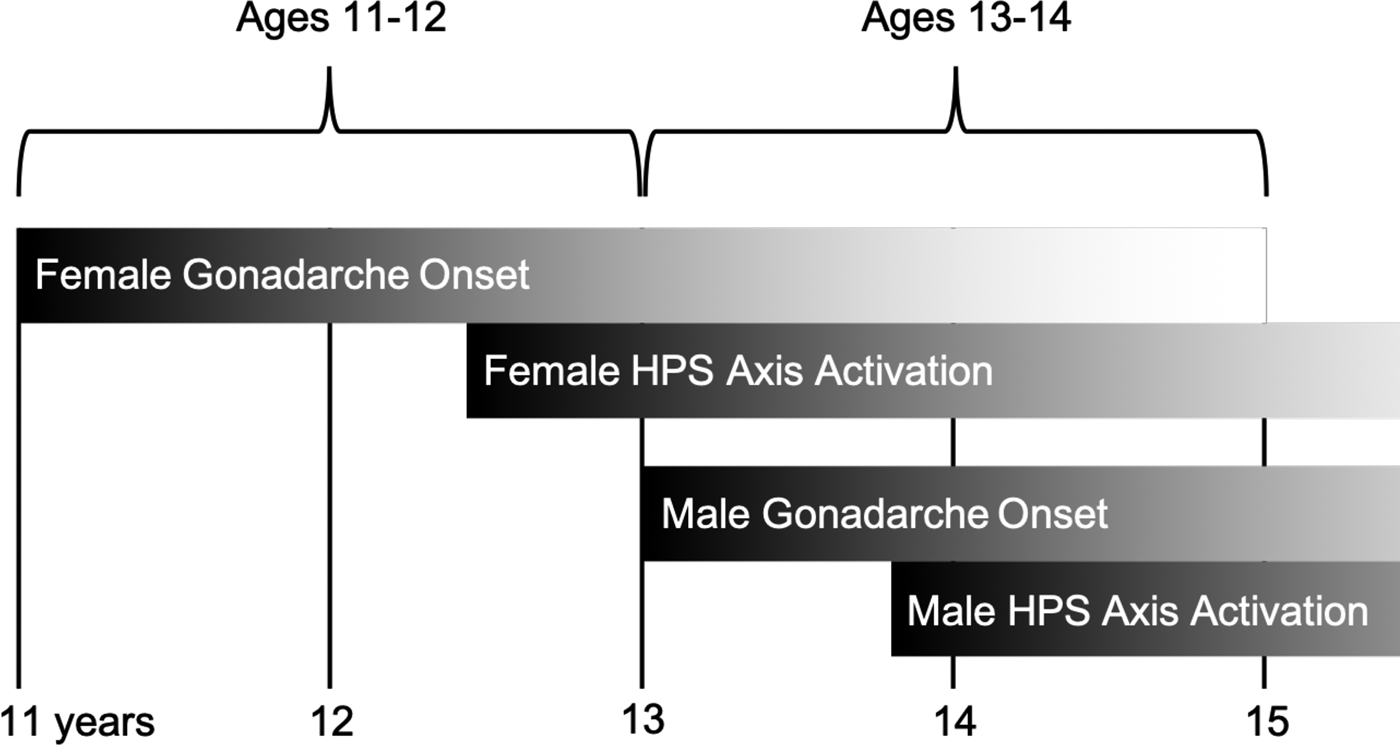
On average, the onset of gonadarche is about age 11 for females and about age 13 for males, and the activation of the growth hormone axis (a primary consequence of puberty) is about age 12.5 for females and about age 13.8 for males (Figure 1) (Hansen et al., Reference Hansen, Bretl and Amini2019). Therefore, we hypothesised that sensitivity to violations of autonomy would be particularly pronounced in 11–12-year-old females and in 13–14-year-old males owing to the onset of pubertal processes. We also hypothesised a decrease in loyalty sensitivity in these same groups owing to the fact that the moral violation vignettes in the current study involve adult perpetrators.
CFS-3 latent factor mean comparisons between age and sex groups.
Sex differences
Sex differences in empathy, autonomy and loyalty during early adolescence have been reported in prior research. In general, early adolescent females have higher levels of empathy compared with their male counterparts, and males experience a stronger temporal decline in empathy during early adolescence (Van der Graaff et al., Reference Van der Graaff, Branje, De Wied, Hawk, Van Lier and Meeus2014). Autonomy development has been specifically linked to the onset of puberty, and therefore females may develop concerns for autonomy earlier than their male counterparts as a result of having earlier pubertal timing (Branje, Reference Branje2018; Negriff & Susman, Reference Negriff and Susman2011), and indeed, research in this area has demonstrated that females have higher levels of autonomy and self-reliance compared with males during early adolescence (Steinberg & Silverberg, Reference Steinberg and Silverberg1986).
A meta-analysis on sex differences in friendship expectations found that females, in general, put greater emphasis on peer relationships, operationalised as feelings of loyalty, compared with males (Hall, Reference Hall2011). There is also evidence that males and females exhibit different degrees of betrayal sensitivity, with females showing greater sensitivity (Atlas & Ingram, Reference Atlas and Ingram1998; Burton et al., Reference Burton, Halpern-Felsher, Rankin, Rehm and Humphreys2011; Feldman & Cauffman, Reference Feldman and Cauffman1999; Gobin & Freyd, Reference Gobin and Freyd2009; Keng et al., Reference Keng, Noorahman, Drabu and Chu2019; Leets & Sunwolf, Reference Leets and Sunwolf2005; Singer & Doornenbal, Reference Singer and Doornenbal2006). However, relatively few studies have examined sex differences in loyalty expectations in early adolescence outside the realm of traumatic betrayal (Blakemore & Choudhury, Reference Blakemore and Choudhury2006).
Current study
This study sought to confirm the psychometric validity of these three latent factors as assessed by the 3-Factor Character Foundations Survey (CFS-3). The study then sought to determine if there exist any significant differences between males and females during the developmental period of early adolescence and between two distinct age groups (11–12-year-old and 13–14-year-old). Based on prior research, it was hypothesised that compared with males, females would have a higher latent factor mean rating in the animal physical harm factor (which serves as a proxy for empathy), a higher latent factor mean in the autonomy factor, and a higher latent factor mean in the loyalty factor. It was also hypothesised that 11–12-year-old females and 13–14-year-old males (when compared with same sex, different age groups) would have higher ratings in the autonomy factor but lower ratings in the loyalty factor owing to pubertal timing. In short, we hypothesised that there would be significant differences based on age and sex, yet owing to the lack of prior developmental research under an MFT-based paradigm and no direct measure of pubertal stage, our primary goals were exploratory in nature.
Methods
Measures
The study presented here used the CFS-3, which draws from a standardised database of moral violation vignettes created by Clifford et al. (Reference Clifford, Iyengar, Cabeza and Sinnott-Armstrong2015). A complete list of vignettes for each factor is presented in Table 1.
Factors and items of the CFS-3

For this study, the CFS-3 was administered as part of a larger, eight-factor, 48-item instrument, with the additional items acting as validation evidence in other studies (Bretl, Reference Bretl2020). The survey was taken via Qualtrics online software, and vignettes were presented in six blocks with each block containing eight randomly ordered vignettes (the order of which randomly changed for each participant) plus norm violation ratings and attention checks for further validation purposes. Instructions for each block read ‘Rate the following situations’: and each vignette started with ‘You see a/an/someone …’ and was followed by the moral violation. Under each vignette was a five-point Likert scale consisting of the choices 1 = ‘Not Bad’, 2 = ‘A Little Bad’, 3 = ‘Bad’, 4 = ‘Very Bad’ and 5 = ‘Extremely Bad’. After completing all blocks of vignettes, participants were asked a series of demographic questions including grade, age and sex. Two attention checks asked participants to simply choose a specific rating for that item (e.g. ‘For this item, select ‘A Little Bad’). The protocol for this study was approved by the University of Kansas's Institutional Review Board as STUDY00142366: ‘Character Foundations Survey (CFS) Reliability and Validation Study’.
Participant demographics
Adolescent participants came from three medium-sized, suburban middle schools in Kansas, USA. These schools had relatively large military populations as a result of nearby military bases. About 50% of students at these schools qualified for free or reduced lunch, and the racial demographics of the schools closely equated to national averages from the 2010 census (i.e. about 65% white, 15% black, 15% Hispanic and 5% other).
A total of 1,373 students from these three schools logged on to the survey website (62% of total school enrollment). Of students who logged on to the survey, 62% rated all violations, provided age and sex demographic information and answered the two attention checks correctly (n = 850). Respondents had an average reported age of 12.4 years (SD = 0.96). Frequencies of students divided into four age- and sex-based groups are provided in Table 2.
Age and sex group frequencies

Statistical analysis: factor analysis
Factor analysis is one the most widely used multivariate statistical procedures in psychology (Brown, Reference Brown2015; Spearman, Reference Spearman1904). The method is primarily concerned with determining the number and nature of latent variables (factors) that account for variation and covariation among a set of observed measures (indicators) (Brown, Reference Brown2015). In other words, a latent factor is an unobserved variable that influences a set of observed measures and accounts for correlations among observed measures. Often, the interpretation is that the observed measures are intercorrelated because they share a common cause (i.e. influenced by the same underlying construct). To accomplish this, factor analysis partitions the variance of each indicator (derived from the sample correlation/covariance matrix which is used as input for the analysis) into two parts: (1) common variance, which is the variance accounted for by the factor, estimated on the basis of variance shared with other indicators in the analysis; and (2) unique variance, which is a combination of (a) reliable variance specific to the indicator (i.e. systematic influence on only one indicator) and (b) random error variance (i.e. measurement error or unreliability in the indicator) (Brown, Reference Brown2015).
Results
CFA of the CFS-3, adolescent data
A baseline null model was run to determine the relevance of comparative fit indices. For this model, the RMSEA was above 0.158 (RMSEA = 0.195), thus providing evidence that comparative fit indices could be used to compare the model fit (Kenny et al., Reference Kenny, Kaniskan and McCoach2015). The CFA showed good model fit (Table 3).
Fit statistics of CFS-3, adolescent data

x 2, chi squared; d.f., degrees of freedom; RMSEA, root mean square error of approximation; CI, confidence interval; AIC, Akaike information criterion; and CFI, comparative fit index.
Modification indices indicated one substantial point of strain in the model between items Q4_4 and Q6_4. These were the only two items that involved an autonomy violation between a mother/daughter pair. That covariance was included in the model and fit significantly improved, so that covariance was kept in the model for subsequent analyses. The final model showed excellent fit (Table 4), and a final model path diagram is provided in Figure 2.
Adolescent CFS-3 path diagram (standardised).

CFS-3 fit statistics with relevant error covariance, adolescent data

CFS-3 Multi-Group CFA by Age and Sex
A multi-group CFA was then run by dividing adolescent participants into four groups: 11–12-year-old males, 13–14-year-old males, 11–12-year-old females and 13–14-year-old females (Table 2). A multi-group CFA was then conducted to see if the multi-group model fit sufficiently well. The model showed good fit (Table 5). No further meaningfully interpretable error covariances could be found from the modification indices.
CFS-3 multi-group CFA fit statistics, adolescent data

In order to compare latent factor means, a standard procedure of establishing partial metric invariance was followed (Putnick & Bornstein, Reference Putnick and Bornstein2016). The initial multi-group model demonstrated metric invariance but scalar non-invariance, so items were released one-by-one based on chi-square difference testing. In the end, partial metric invariance was established by releasing three items (Q2_4, Q3_4 and Q3_2; Table 6). Items, non-invariant groups and relevant item characteristics are provided in Table 7. Elaboration on the characteristics of these three items is provided in the Discussion section.
CFS-3 configural, metric and scalar model comparisons

Scalar non-invariant items, groups and relevant item characteristic

To compare latent factor means between groups, multi-group CFAs were conducted with a reference group's latent factor intercepts constrained to zero. Standardised latent factor intercepts of the other groups could then be interpreted as latent factor mean differences. A table of the latent factor mean comparisons is presented in Appendix A, and a graph of significant mean differences is presented in Figure 3.
CFS-3 latent factor mean comparisons between age and sex groups. Reference group means constrained to zero. Graphs showing results at p < 0.05 significance level. No statistically significant results found between latent factor means of 11–12 year old males and 13–14 year old males.
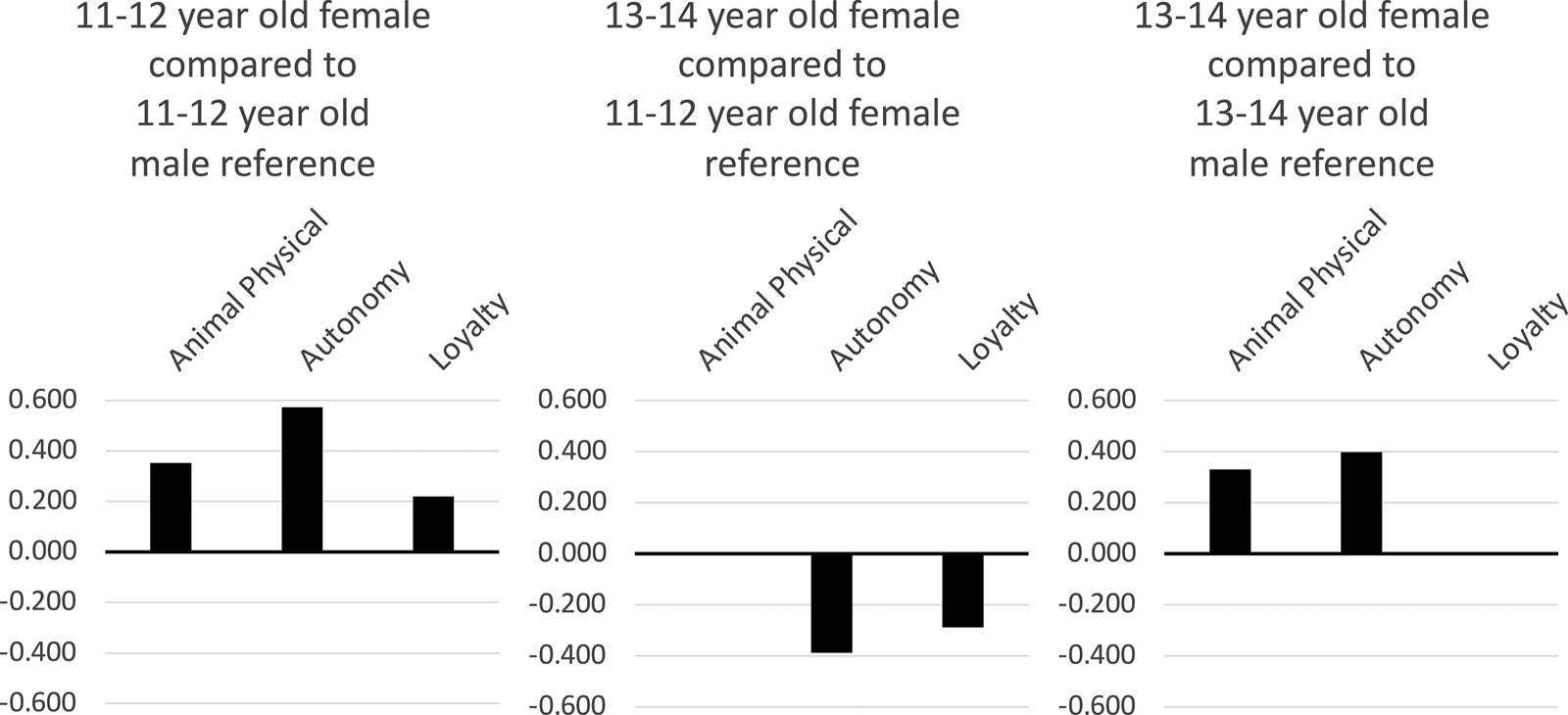
In the 11–12-year-old range, females had higher latent factor means in all three factors (animal physical harm, autonomy and loyalty). When comparing 11–12-year-old females with 13–14-year-old females, we see lower latent factor means for autonomy and loyalty, but no significant difference in animal physical harm. The comparison of 13–14-year-old females and males showed no significant differences in the loyalty latent factor mean but higher autonomy and animal physical harm latent factor means in females compared with males. The lack of significant differences between latent factor means of 11–12-year-old males and 13–14-year-old males suggests no significant differences in males during early adolescence on these latent factor constructs.
Discussion
Validity and partial metric invariance
Analyses support the psychometric validity of the CFS-3 to assess the three latent factor constructs of autonomy, loyalty and animal physical harm in early adolescence under an MFT-based paradigm; additionally, partial metric invariance across age- and sex-based groups was achieved by releasing three items to allow inter-group comparisons. The three items released included two from the autonomy factor and one from the animal physical harm factor. The non-invariant items align with item characteristics that further support the idea of autonomy violation ratings as being highly sensitive to the nuanced details of kin relationships (Table 7). Given the lack of prior research on this area, no firm conclusions about the possible role of culture in these outcomes can be made, but a reasonable explanation for the male groups demonstrating non-invariance in this animal physical harm item might be the result of it being the only item involving a pet dog, and the experience of a having a pet dog might be uniquely salient to early adolescent males in this cultural context and during this developmental window. Again, this is merely an example of how culture might have an influence in these circumstances.
Latent factor mean differences
Animal physical harm
The present findings suggest that females have higher ratings on the animal physical harm factor in both age groups. When ratings of animal physical harm are used as a proxy for empathy, the present findings are consistent with previous findings suggesting that sex-based differences in empathy peak during early adolescence with females being more empathic and showing greater concern for physical harm violations (Rochat, Reference Rochat2022). The present findings showed no significant age differences in animal physical harm ratings. Therefore, the present findings do not support previous evidence of a temporary decline in empathy during early adolescence in males, but it should be noted that those prior studies did not include adolescents younger than 13 years old (Van der Graaff et al., Reference Van der Graaff, Branje, De Wied, Hawk, Van Lier and Meeus2014), and others involved a predominantly African American youth population who experience earlier pubertal timing and puberty-related social-emotional changes (Chumlea et al., Reference Chumlea, Schubert, Roche, Kulin, Lee, Himes and Sun2003; Goering & Mrug, Reference Goering and Mrug2021). Therefore, the male participants in the current study might simply be too young to demonstrate a developmental change in the empathy construct.
Autonomy
Consistent with our hypothesis, some age-based differences in sensitivity to violations of autonomy between 11–12- and 13–14-year-old females were demonstrated. Specifically, 13–14-year-old females showed lower sensitivity to violations of autonomy compared with 11–12-year-old females. As mentioned previously, adolescents’ concern for autonomy has been linked specifically to the onset of puberty (Branje, Reference Branje2018). These findings are consistent with an inverted U-shaped pattern often seen in adolescent development where autonomy sensitivity is low prior to early adolescence, peaks at the onset of puberty, and then declines again in mid to late adolescence.
However, these differences were not demonstrated between 11–12- and 13–14-year-old males. One possible explanation is that all the items of the autonomy factor in the CFS-3 involve violations committed by an adult, so for females we might be witnessing effects as a result of declining attachments to parents and adult figures in general during pubertal onset. It has been demonstrated that females form stronger attachments with adults, so the lack of such attachments in males might explain the lack of decrease in male ratings of autonomy violations committed by adults at the onset of puberty.
The present findings also suggest that compared with males, females have higher sensitivity to violations of autonomy in both age groups – even after the significant decrease in autonomy sensitivity suggested by lower latent factor means in 13–14-year-old females described above. Again, greater autonomy during early adolescence is associated with de-idealising childhood attachment figures, and therefore may also be confounded by the CFS-3 employing only adults as committers of autonomy violations. Thus, the higher sensitivity to violations of autonomy in females may be explained by females having an earlier pubertal timing than males and the socio-cultural attachments that females tend to form with adult caregivers (Negriff & Susman, Reference Negriff and Susman2011), and it should also be noted that early adolescent males are usually granted more autonomy by caregivers compared with females, which may also explain higher sensitivity to violations of autonomy in females (Bumpus et al., Reference Bumpus, Crouter and McHale2001).
Loyalty
Consistent with our hypothesis, the present findings suggest that females have greater sensitivity to violations of loyalty compared with males at age 11–12 years old. Again, a possible explanation of this is the shift adolescents experience as they separate from primary attachment figures and form greater attachments with peers (Meeus, Reference Meeus2016). Similar to the items in the autonomy factor, the items in the loyalty factor all involve situations in which an adult in a position of power shows disloyalty to their in-group. A greater sensitivity to violations of loyalty from authority figures may be an expression of closer attachment to such authorities. Previous research suggests that females have closer attachments to non-parental authority figures such as teachers during both childhood and adolescence (Commodari, Reference Commodari2013; Liljeberg et al., Reference Liljeberg, Eklund, Fritz and af Klinteberg2011) and may thus be more sensitive to violations of loyalty from these figures compared with males.
Interestingly, the present results suggest that males and females do not differ in their sensitivity to loyalty violations at age 13–14 years old even though females aged 13–14 showed lower sensitivity to violations of loyalty than females aged 11–12 years old. With the development of more objective evaluations of attachment figures taking place during early adolescence combined with decreasing reliance on these attachment figures (Allen, Reference Allen2008), slightly older adolescent females may be less sensitive to loyalty violations committed by adults. Lower sensitivity to violations of loyalty in 13–14-year-old females would also be consistent with an inverted U-shaped pattern where high loyalty sensitivity (at least when considering adult violators) correlates with the onset of puberty and decreases in mid- to late-adolescence. However, the lack of this pattern in males is inconsistent with our hypotheses, suggesting that there may be important interaction effects from socio-cultural factors that are not accounted for in the present study.
Limitations
The present study has some important limitations worthy of consideration by anyone interested in future research on this topic. Several of these limitations relate to the instrument itself and the characteristics of the items. For example, the autonomy and loyalty items are distinct in that the autonomy items describe violations that occur in a close relationship of two individuals, whereas the loyalty items describe violations of one individual to a group of people. Future studies should test if there are effects based on individual- vs. group-based violations that confound the autonomy and loyalty constructs. Additionally, both the autonomy and loyalty items only include violations committed by adults, and therefore the instrument does not capture autonomy and loyalty violations committed by adolescent peers. As peers become increasingly important attachment figures during early adolescence, future research should seek to replicate the present findings with items involving violations committed by fellow adolescents. Another limitation is that the age differences found may not reflect actual developmental change as the present study used a cross-sectional design and did not collect longitudinal data. Future research should aim to replicate the age differences found with a longitudinal design that examines within-subject change during the critical period of early adolescence. Another important limitation is that participants in this study all came from a distinctly Mid-western USA socio-cultural context. This includes social demographics of the participant schools that include relatively high military populations and conservative political ideologies. Future studies of other social and cultural contexts in the USA and abroad will need to be done to further parse the biological and socio-cultural factors directing moral intuition development.
Conclusion
Results from the 3-Factor Character Foundations Survey demonstrated psychometric validity when used to assess early adolescents’ moral intuitions in the domains of autonomy, loyalty and animal physical harm under an MFT paradigm. These three domains represent a triad of factors theoretically recognised as having significant influence on social and developmental outcomes during adolescence. Partial metric invariance was established for the instrument and age- and sex-based differences in latent factor means were found. Consistent with our hypothesis, 11–12-year-old females exhibited higher latent factor means than 11–12-year-old males in all three latent factor constructs, but inconsistent with our hypothesis, males exhibited no latent factor mean differences between the 11–12- and 13–14-year-old age groups. Consistent with our hypothesis, 13–14-year-old females exhibited a lower latent factor mean in the autonomy construct, but inconsistent with our hypothesis, they also exhibited a lower latent factor mean in the loyalty construct. This resulted in 13–14-year-old females remaining higher than 13–14-year-old males in the latent factor means of empathy and autonomy but showing no significant difference in the latent factor mean of loyalty. These results are consistent with inverted U-shaped developmental patterns common during adolescence, but further research will be need to confirm such a pattern. These findings nonetheless provide an important starting point for those interested in studying moral intuition development from a biological perspective and under an MFT-based paradigm. Additionally, the CFS-3 shows promise as a tool to test more rigorous theories of human evolution and innate neural ontogeny relevant to moral development, e.g. using the vignettes in neuroimaging studies to test the functional networking and influence of sex hormones on regions of interest theoretically involved in moral processing.
Author contributions
BB conceived and executed the study, data analysis, and first drafts. MG contributed significantly to the theoretical interpretation of findings and subsequent drafts.
Conflicts of Interest
None declared.
Data availability
All data will be made freely available by the corresponding author upon request
Appendix A: Latent factor mean comparisons between age and sex groups


 Open access

