


A. Aftermath Like in a Fairty Tale
Once upon a time, there was a ruler who was officially called “president.” When his term in office came to an end because he lost the election, he did not want to part with the presidential documents. But they were “classified.”Footnote 1 A number of them were top secret.Footnote 2 Still, he transported them from the office to his home and stored them—in the bathroom and ballroom—of his Mar-a-Lago estate.Footnote 3 Therefore, he was indicted by a Grand Jury on no less than forty counts of violating federal law.Footnote 4 He was accused of mishandling documents from the White House, where he had previously resided as president.Footnote 5 After all, the materials contained hundreds of files that also included nuclear secrets and military plans.Footnote 6 The ruler was outraged. He spread the word that his successor as president, “public enemy” Joe Biden, was conducting a “witch hunt” against him.Footnote 7 His lawyers further argued that Biden’s “henchmen in the Justice Department” were engaging in “prosecutorial abuse” led by special counsel Jack Smith because, according to the Presidential Records Act,Footnote 9 the outgoing president had “every right to keep the documents.”Footnote 10 After he took office for the second time,Footnote 11 the Department of Justice returned to him the boxes that the Federal Bureau of Investigation (FBI) had seized in August 2022, and on February 28, 2025, he brought the boxes to Mar-a-Lago again.Footnote 12
The Mar-a-Lago bathroom of the former President who was later re-elected.Footnote 8

Originally, he had also claimed that the Espionage ActFootnote 13 did not apply to him, because he was not a spy: “The Espionage Act has been used to go after traitors and spies. It has nothing to do with a former president legally keeping his own documents.”Footnote 14
After the FBI raid, the former ruler demanded his files back.Footnote 15 Just one year later, he was re-elected president.Footnote 16 Before and after that, the fate of the documents took an unexpected turn. Before, in June 2024, U.S. District Court Judge Aileen Cannon—who, as luck would have it, had been appointed by the President during his first term—dismissed the lawsuit over the storage of the documents.Footnote 17 Judge Cannon ruled that the appointment of the special investigator and the financing of the prosecutor’s investigation had no statutory basis and were unconstitutional.Footnote 18 After the former President’s re-election, the appeal went nowhere because the mantra of “no indictment of a sitting president” prevailed.Footnote 19 Thus, it will remain unclear whether the presidential documents at Mar-a-Lago are private or public—in nature, not regarding the access—and could be stored with impunity in the domestic bathroom and ballroom.
The lost election of 2020 had another aftermath. The outgoing ruler was hit with the well-founded accusation that he had attempted to manipulate the election results while still in office.Footnote 20 Moreover, to incite his supporters to storm the U.S. Capitol in order to prevent the election results from being certified, Trump once again told the fairy tale of the stolen election: “This the [sic] most corrupt election in the history, maybe of the world.”Footnote 21 He said, among other things: “We fight like hell. And if you don’t fight like hell, you’re not going to have a country anymore…. So, we’re going to, we’re going to walk down Pennsylvania Avenue. I love Pennsylvania Avenue. And we’re going to the Capitol….”Footnote 22
In response to the “conspiracy against the United States,” which was well and widely documented in the media, the Supreme Court investigated whether the outgoing president had acted ex officio or as a private person.Footnote 23 The subject of the dispute was once again the public/private distinction, now in the context of presidential immunity concerning a president’s address and the attempt to manipulate the election results. The “government majority” of the U.S. Supreme Court introduced another variation on this distinction.Footnote 24 By a vote of six to three, the justices ruled that presidents enjoy absolute immunity for actions within the scope of their core constitutional powers.Footnote 25 They can invoke presumed immunity for “official acts” within the “outer perimeter of his official responsibility,” while “unofficial acts” do not enjoy immunity.Footnote 26 The Court thus overturned the Appellate Court’s decision and remanded the case back to the District Court to examine whether the specific actions of the defeated incumbent, who had quite obviously and by all means sought to reverse the 2020 election result in his favor, and in particular his speech on January 6, 2021, should be classified as official—public—or unofficial—private—conduct.Footnote 27
Unlike the defendant and his lawyers, it seems sensible to take a look at what is widely regarded as the “law of the land,” rather than spinning tales of witch hunts, law abuse, or possible “fake news.”Footnote 28 Thereafter, I introduce a matrix of the public/private divide and take a closer look at some critical narratives of the distinction.Footnote 29 Finally—as a last resort—I offer four readings of the distinction that might or might not serve as a possible justification in the classified documents case and as an explanation of the immunity ruling.Footnote 30
B. The Law’s Counter-Narrative
In the dispute over the classified documents, most of the 40 charges were based on the Presidential Records Act of 1978 (PRA), with a few others based on the Espionage Act of 1917.Footnote 31 The provisions of the PRA leave nothing to be desired in terms of clarity of wording and purpose:
§ 2202. Ownership of Presidential records.
The United States shall reserve and retain complete ownership, possession, and control of Presidential records; and such records shall be administered in accordance with the provisions of this chapter.
§ 2203. Management and custody of Presidential records.
(a) Through the implementation of records management controls and other necessary actions, the President shall take all such steps as may be necessary to assure that the activities, deliberations, decisions, and policies that reflect the performance of the President’s constitutional, statutory, or other official or ceremonial duties are adequately documented and that such records are preserved and maintained as Presidential records pursuant to the requirements of this section and other provisions of law.
(b) Documentary materials produced or received by the President, the President’s staff, or units or individuals in the Executive Office of the President the function of which is to advise or assist the President, shall, to the extent practicable, be categorized as Presidential records or personal records upon their creation or receipt and be filed separately.Footnote 32
The purpose of preserving presidential records is clearly to provide Congress, the public, and researchers with documents, background information, and explanations of a president’s—official—actions, and not to transfer the records to the private ownership of the (former) office holder. To this end, the PRA establishes the necessary public regulations for storage, maintenance, and access—especially for the public.Footnote 33
In contrast and in addition to this, the Espionage Act traditionally prohibits interference in military operations, espionage, and anti-war statements, but currently also penalizes the deliberate withholding of state secrets.Footnote 34 According to a parallel assessment in the lay sphere, it is difficult to understand how classified information could be the private property of a departing president. Whether the normative order nevertheless provides a satisfactory solution is a question to be asked and answered below.
C. On the Public/Private Distinction
I. The Matrix
Between the case of the classified documents and the decision on immunity, the respective distinction between public and private establishes an internal connection; an external one can be deduced from the practice of “efficient rule-breaking.”Footnote 35 The question arises as to whether it would not have been helpful to examine more closely the distinction between public and private actions—and property—of a U.S. president in order to then activate the protection of immunity from criminal prosecution. Examining the public/private nature of both the documents and their storage location could at least clarify whether, contrary to the PRA, the president has a right to justificationFootnote 36 that allowed him to “privatize” the White House documents. Yet, this would also mean that the public prosecutor’s office had not recognized their admissible private nature or their coverage by presidential immunity. Therefore, attention must be paid to the different forms of ownership that could be at stake in the documents case—and the ironic twist that the documents are public but their classification reduces the access of the general public at least for the time being.
Using a matrix, I will attempt to present four conceivable—not equally plausible—perspectives, which encapsulate narratives of the ownership of the classified documents and their storage location, the bathroom. The matrix is meant to show logically possible variants of the public/private distinction (Figure 2). Its horizontal axis connects the private or public storage location, whereas the vertical axis assigns the documents to private or public ownership.
Matrix concerning the storage of classified documents in a bathroom. Source: the author.

The narrative presented in Trump v. United States provides little guidance on how to determine which behavior is private or public and whether the outgoing president’s “politics of the self”Footnote 37 should be penalized.Footnote 38 It is not surprising that this task falls, at least formally, to the lower courts. The framing of the Supreme Court’s immunity narrative is likely to give presidents an incentive to shift private actions—or rather actions that do not fall within the scope of “official” conduct—into the protected public sphere, because official conduct would be immune from judicial scrutiny.Footnote 39
This is precisely what happened when the former president and defendant in the classified documents case argued that the government documents were private and could comfortably be stored in a private bathroom or ballroom—rather than in the National Archives.Footnote 40 Trump thus classified the case as one of quadrant No. 2, while the prosecution and Grand Jury had already opted for quadrant No. 1.
In connection with the four readings of the public/private distinction presented in the last section of this article—to be considered the wisdom of last resort—it will be necessary to ask whether documents and storage locations could plausibly be classified in quadrant No. 3 or No. 4. These readings are prepared by a very brief excursion to the philosophical family tree of the public/private distinctionFootnote 41 , two sobering reviews of the distinction to problems,Footnote 42 and of critical situations.Footnote 43
II. The Philosophical Pedigree of the Public/Private Distinction
According to liberal political philosophy, the dichotomy between public and private spheres arose from a “double movement in political-legal thinking” in the course of modernity.Footnote 44 Firstly, the emergence of the nation state and the corresponding theories of sovereignty gave the new public sphere an institutional structure.Footnote 45 Secondly, in response to monarchs and later to parliaments and administrations, a philosophical counter-movement emerged that aimed to demarcate spheres of action and private property and protect them from unlawful state interference. The property-based “possessive individualism”Footnote 46 of private persons was defended by conservative, but above all liberal philosophers such as James Harrington, who was rather republican, and especially John Locke and later John Stuart Mill.Footnote 47 The public/private distinction came to full fruition in the social contract theories of the liberal paradigm.Footnote 48 In their models, influential white, male members of the propertied class—embodied by the nobility, the landed gentry, and, since the 19th century, also the bourgeoisie—were always the main actors and reference persons.Footnote 49 The focus was invariably on private property rather than, say, dignity or integrity, as is illustrated, for example, by eminent philosophers.Footnote 50
In exercising his rather unusual position as “gentleman of the bedchamber,” James Harrington was required to perform a balancing act between his private duty of dressing the king and his public function of advising him on political matters.Footnote 51 Harrington thus constructed a theoretical model that attempted to strike a balance between the property of the few and that of the many.Footnote 52 He understood property as a defining characteristic and basis of power and linked it to the common good.Footnote 53 In contrast, Harrington’s contemporary, John Locke, attempted to justify private property as a natural right.Footnote 54 Work played a key role in this.Footnote 55 In his theory of the social contract, Locke introduced two moments of consent: consent to acquire private property through work in the state of nature and to give money value as a medium of exchange; and also the agreement to cede all power to the majority in order to enforce the rights associated with private property and to establish a public authority of civil society.Footnote 56
In these philosophical narratives, the separation between public and private is linked to a spatial vocabulary—spheres. They each delimit an area in which property is appropriated privately, either in the state of nature, in civil society, in the state, or on the market. This sphere is contrasted with an area in which public institutions, especially courts, parliaments, the administration, or the state as a whole, intervene generally on the basis of public law and, if necessary, enforce the protection of property under private law.
III. The Connection Between the Distinction and a Problem
A distinction such as that between public and private spaces and official/public and unofficial/private conduct must offer a meaningful contrast and be stable, that is, it must be able to be maintained even when situations change. Otherwise, it will be ignored or rejected by the interpretive community as an implausible concept for semantic operations. From a philosophical point of view, at least the liberal one, the public/private distinction is plausible if one shares the premises. However, its status and stability are not constant. The reason: Its conceptual components are usually associated with a problem characterized by the tension between what is and what could or should be.Footnote 57 As a result, the boundary between what should be considered private or public is inherently unstable over time, both in terms of the perception of the problem at hand and the techniques used to solve it.Footnote 58 Given the central importance of public or private property in the case of classified documents and of official or unofficial conduct in the ruling on immunity, it is worth identifying the problem underlying the difference.
Problems, which social sciences analyze, change with any shift in perspective. This distinguishes them from problems in mathematics, which, once solved, are repeated as exercises. Accordingly, problems addressed by social sciences are not permanently or intrinsically assigned to a specific area of action, such as the public or private sphere, in the problem view. The instability of classifications and distinctions—triggered by problems and their perception—can be illustrated, for example, by the historical development of taxation from a private gift to a compulsory public levy: “As late as the sixteenth century, English judges still analyzed taxation, not as an exaction by the state but as a private gift from the donor – the taxpayer. Parliament was thought to have simply arranged this consensual private transaction.”Footnote 59
With the advent of the fiscal state and budgetary law, taxation came to be understood as a matter of public law. Private individuals make payments—taxes—to a central public authority—the Internal Revenue Service—to finance government spending, for example, during wartime or for catering at peace conferences. Similarly, the conceptualization of property crosses the boundary between public and private—in the transition from feudal to capitalist market societies or from capitalist to socialist systems.
Oliver Letwin, a British conservative theorist, observed that the private sector had to be invented. This occurred with the great European trading companies, such as the British and Dutch East India companies, founded in the 17th century. Notions of property before the Renaissance assumed that different actors had different relations to the same property.Footnote 60
Pure capitalism is defined as a system wherein all of the means of production (physical capital) are privately owned and run by the capitalist class for a profit, while most other people are workers who work for a salary or wage (and who do not own the capital or the product).Footnote 61
Another example illustrates the influence of problem-solving techniques on this distinction—the dramatic transformation of portrait painting from a private to a social and more public practice. This change is evident in two key developments, firstly, from a painter’s self-portraits to “selfies,” and secondly, from portraits as status symbols to their role as instruments of social criticism.Footnote 62 These changes were driven by advances in artistic techniques—in painting and photography—which in turn contributed to the blurring of boundaries and the transmutation between public and private social life in the digital age. This transformation is taking place through a transition from autobiographical memory to (probably) public reproduction and dissemination of visual images.Footnote 63
The connection between the problem and the view of the problem, on the one hand, and the private/public dichotomy, on the other hand, is also evident in the Supreme Court’s case law on immunity, which will only be briefly mentioned here. In Nixon v. Fitzgerald, the Court ruled that the president’s official acts are protected from civil damages claims, but later clarified that the protection does not extend to acts committed before taking office.Footnote 64 The Trump v. Vance decision limited the president’s privileges in the context of court proceedings.Footnote 65 This added a temporal and procedural dimension to the immunity narrative and included the concept of risk. Thus, immunity varied according to the greater or lesser risk involved—deprivation of liberty or civil damages, and according to the conflicting legal interests in civil or criminal proceedings. The president was granted immunity in civil proceedings because the court considered that the enforcement of civil/private claims was not absolutely necessary.Footnote 66 In criminal proceedings, however, Trump was not granted any privilege with regard to the presentation of evidence; here, the court attached greater social and legal importance to the administration of criminal justice.Footnote 67
IV. Critical Situations in the Conceptual Life of Distinctions
In their conceptual life, distinctions not only change because they are tied to problems, and their perspective, but also typically find themselves in critical situations that may occur. These are commonly referred to as incoherence and contradiction—to which I will add and elaborate perversion.Footnote 68 Accordingly, the public/private distinction reaches a critical point, “when troublemakers begin to argue that the distinction is incoherent because, no matter how you try to apply it, you end up in a situation of hopeless contradiction.”Footnote 69
Incoherence can also be triggered when the same phenomenon is characterized as private at one instance and public at another—either at different points in time or even simultaneously. This can be illustrated by the conflict over classified documents and the immunity narrative. In the latter case, the court changed the boundary between private and public and, in terms of form and scope, privileged a doctrine that deviated from earlier legal and democratic ideas.Footnote 70 It was sharply criticized by historians, political scientists, constitutional lawyers, and journalists.Footnote 71
Inconsistencies and contradictions also arise when distinctions become stereotypes:
Stereotypification means that people come to see the overt, formally rational part of the argument about where an institution fits on the continuum, and about what mixed package of rules of procedure it should operate under, as involving the mechanical manipulation of balanced, pro/con policy arguments that come in matched pairs.Footnote 72
Stereotypification occurs, for instance, when arguments put forward by a court to substantiate the public nature of a project can be applied equally to virtually any conceivable project, including private ones. In the case of the classified documents, federal District Court Judge Cannon avoided stereotypificaton when suspending the proceedings by failing to even touch upon the public nature of government documents after the end of a president’s term of office. Instead, Judge Cannon focused on the legal basis for the appointment of the Special Counsel.Footnote 73 If the proceedings were to continue—at the earliest after the end of the sitting president’s term of office—it would be entirely conceivable that the majority of the Supreme Court might not only redraw the boundaries of immunity, but also stereotypify classified information as private, thereby manipulating the public/private distinction in yet another way.
Strictly speaking, however, such a privatization of public documents would transcend stereotyping. It illustrates a complete breakdown of the distinction, which can be described as perversion. Perversion occurs when a distinction is deliberately abolished or reversed for political or other reasons that are neither required nor justified by law. A striking example of perverse “distinction problems” of this kind is illustrated by the ruling on immunity, operating with the terms of “official” and “unofficial” conduct. With regard to the central argument of the Court, this perversion was aptly criticized as giving “instructions for law-breaking presidents”Footnote 74 because it teaches an officeholder how to evade accountability by simply conspiring with other government officials—preferably after hours—in order to transform a public act into a private one and avoid being held accountable. The distinction between official/public and unofficial/private acts thus contradicts fundamental principles of law-rule and democracy by defining the unofficial conduct of presidents, even after their term of office has expired, as ex officio—in an extremely counterfactual manner—in order to extend the scope of immunity,Footnote 75 leads to the ironic and perverse result that a president can be held publicly accountable only when the President acts privately, that is, outside the scope of official conduct.
V. A Few Critical Keywords to the Public/Private Distinction
The public/private divide as celebrated by liberal philosophies has been submitted to a variety of critical readings which focus on relational aspects. Feminist criticism inspired by Carole Pateman’s ground-breaking study, The Sexual Contract, has focused on the perversion of the distinction, without using this term.Footnote 76 According to Pateman, the feminist critique of the dichotomy between public and private “is central to almost two centuries of feminist writing and political struggle.”Footnote 77 The assumption of a clear distinction is not only called into question but also, and more importantly, the dichotomy itself is criticized as implying a hierarchical, sexualized, and gendered binary order that is constituted by the public social contract and the myriad of private sexual contracts between spouses: “The social contract is a story of freedom, the sexual contract a story of subjugation.”Footnote 78
Carole Pateman’s original and unorthodox interpretation of social contract theories ties in with Freud’s analysis The Civilization and Its Discontents.Footnote 79 According to Pateman, the public social contract has always been accompanied by a prior sexual contract that lays down the rules for theprivate relationships between men and women.Footnote 80 These relationships have a political and public dimension and, more importantly, involve a proprietary aspect Pateman refers to as “self-ownership.”Footnote 81 The fundamental original pact is immanent in men’s consent to dominate women, which contract theory conceals or fails to recognize.Footnote 82 Liberal theory, Pateman argues, legitimizes patriarchy and masculine property interests through methods of contractual subjugation and serves a systemic sexism.Footnote 83
Like Pateman, legal-critical approaches also question the spatial architecture of spheres and their boundaries, instead focusing on relational aspects and the power structure that also dominates property rights:
[As] a social institution that comprises a variety of contextual relationships among individuals through objects of social wealth and is meant to serve a variety of individual and collective purposes. It is characterized by allocating to individuals a measure of control over the use and alienation of, some degree of exclusivity in the enjoyment of, and some of obligation to and responsibilities for scarce and separable objects of social wealth.Footnote 85
The legal significance of the network of relationships becomes apparent when property rights are enforced. Relationship certainty is then ensured by property-related legal remedies, such as claims for compensation or injunctions.
The relational patterns of the dichotomy between private and public and the property basis can be schematically represented as follows:
Public/private dichotomies and relations.Footnote 84

D. Four Readings of the Public/Private Distinction to Justify the Double Immunity of Presidents
Armed with the matrix, the discussion of different problem situations, and some critical keywords regarding the public/private distinction, a final attempt is now made to discuss four narratives that might help justify the “privatization” of the classified documents and the decision on presidential immunity.
I. First Reading: Liberal
In accordance with the PRA and the Espionage Act, both the prosecution and the Grand Jury, as explained, rely on a conventional rule of law interpretation of the conflict over classified information.Footnote 86 This interpretation is covered by the liberal paradigm with respect to freedom of information, public access, property and privacy. As a result, the prosecutor and the Grand Jury assumed, very plausibly, that the bathroom in the Mar-a-Lago residence is firmly integrated into the sphere dominated and demarcated by the defendant’s private property. In contrast, the classified documents stored there do not share the legal nature of their place of storage. Ownership of the documents belongs to the United States, with the result that they had to be placed in legal custody and transferred to the National Archives.Footnote 87
Not enough time had passed since the outgoing president left office and stored the documents in his bathroom, so the president could hardly claim a transfer of ownership by adverse possession under the rules of common law, usucapio in Roman Law.Footnote 88 Furthermore, since the Watergate scandal and the Supreme Court’s decision that then President Richard Nixon was obliged to hand over the tape recordings, the argument that the outgoing president acquired the government documents in good faith would, or should, not stand up in court. Although possession usually gives a “strong right”—because the common law is more “pragmatic” in this respect than, say, § 903 of the German Civil Code— the PRA explicitly excludes ignorance of the relevant provisions as a justification for acquisition bona fide.Footnote 89
No matter how you twist and turn the arguments of liberal philosophers and legal theorists on the dichotomy of public/private property, they will not provide the outgoing president with a narrative of justification. So, Trump should actually be more interested in obscuring their versions of the distinction, since they draw and defend precisely the boundary between public and private he has repeatedly tried to cross. At best, Thomas Hobbes,Footnote 90 with his ‘natural’ “right of everyone to all things,”Footnote 91 could be called upon as an ally. While this right would hardly be of any help with the immunity narrative, where help is not currently sought anyway, it could—tentatively—be brought into play with regard to the documents. Admittedly, even Hobbes, despite his sympathy for the “engineers of the right order”Footnote 92 and their disregard for ethics, would probably point out that there is no private property that takes precedence over the property rights of the state. Hobbes would likely add the argument that, after the conclusion of the social contract “all property relations are determined by the sovereign.”Footnote 93 After the end of the president’s term in office, however, this position was passé at least for the time being. No chance for any “possessive illiberalism” then.Footnote 94 Unless, that is, the United States Government found itself in a state of nature after the former president’s return to office.
Even in a state of nature, John Locke’s theory of propertyFootnote 95 would not give the president a natural right to retain classified information once it had already been legally defined as public—US—property. The philosopher never approved of efforts to include objects belonging to other persons or institutions in the “realm of the suum.”Footnote 96 Instead, Locke believed that people in a state of nature must primarily be able to “acquire” through work the things necessary for their livelihood.Footnote 97 While access to government documents under a freedom of information act is important for democracy, the documents are hardly necessary to sustain the livelihood of a former president.Footnote 98 According to Locke and relevant U.S. law, the documents could not be appropriated and “privatized.” Without perversion they could not be made the “private property” of the then-former president, such as the Lockean “fruits” and “animals.”Footnote 99
II. Second Reading: Authoritarian
To justify keeping secret documents in his private residence, the Trump claimed, to repeat, that they were his private property—in conformity with the PRA, while the Espionage Act did not apply to him as president. This defense—relying on quadrant 2 of the matrix—is hardly conclusive, because contrary to the opinion of the President and his lawyers, the PRA does not grant a departing president “unverifiable discretionary power” to classify US documents as personal.Footnote 100
It is unlikely that the President or his legal team recognized or were concerned that this defense, located in the second quadrant, could reveal a structure of authoritarianism.Footnote 101
Withholding and mishandling classified documents may not only reveal a character flaw and negligence, but also and above all this practice shows the casual transformation of public power into private property that presupposes an understanding the office of president as a personal asset. The events following the lost election illustrate an authoritarian mindset and logic of power, even if the decision of the conservative majority of the Supreme Court on immunity points in a different direction. After a flood of baseless lawsuits against the election results failed, the defeated incumbent even pressured election officials to commit electoral fraud.Footnote 102 Contrary to all evidence, he claimed the election had been stolen, insisted on repeated recounts, and defended what he believed to actually belong to him—the presidency.
After being abandoned by the majority of voters, Congress, and judges in the courtrooms in 2020, the President decided on January 6, 2021, at the “Save America” rally, to take the last remaining option and stage a ‘postmodern’ coup,Footnote 103 which he had previously warned about.Footnote 104 “Take back your country” was the proprietary rhetorical move to regain the President’s lost property—his power.Footnote 105 Encouraged and incited by their idol, far-right leaders and their cohorts such as the Oath Keepers and the Proud Boys first besieged the U.S. Capitol, then overwhelmed the security forces—who were bereft of the support of the National Guard—stormed Congress, and vandalized the building to prevent the counting of the Electoral College votes.Footnote 106 All that just to restore the authoritarian order, that is, the privately owned office of the former president.Footnote 107 After “ruling by cheating”Footnote 108 and “autocratic hedging,”Footnote 109 the defeated incumbent followed the path of other autocrats—over a hundred since 1946—who had seized power from a legitimate government through an autogolpe, or at least attempted to do so.Footnote 110 If necessary, they were prepared to lift or ignore term limits by making the necessary cosmetic constitutional changes, assigning compliant party cadres to the task, or openly disregarding constitutional rules. These avenues were closed to the outgoing president. Nor could Trump transfer his office to a person he trusted, just as owners transfer their property, to ensure the continuity of authoritarian rule.
When the public/private distinction is not merely translated into a physical or symbolic space, but is based on a power structure of crude politics, any justification in the dispute over the classified documents is bound to fail. Courts might have accepted that the boxes and their contents were private and could therefore be lawfully stored in a private bathroom before the ruling on Nixon’s White House tapes. After the Watergate trauma in 1973, which led to United States v. Nixon and the passage of the PRA, even a government majority on the Supreme Court could not overlook the perversion of the public/private distinction in this dispute and decide that, within the scope of their powers, a sitting or unseated president could reclassify government documents as private property in clear violation of the law.
III. Third Reading: Perspective
Regardless of the legal situation following the intervention of Federal District Court Judge Aileen Cannon and after the Justice Department dropped the case against the defendantFootnote 111 because of its “longstanding policy” that a sitting president should not be prosecuted,Footnote 112 the former and re-elected president might still be tempted to hold on to the idea of the documents being private, as suggested by the authoritarian interpretation of the case. To avoid the legal consequences discussed above, a president would have to change the legal nature of the storage location and declare the bathroom, and ballroom, to be public though.
The space/documents combination would then place this idea in quadrant No. 3 of the matrix, which, incidentally, would confirm the defeated incumbent’s and also re-elected president’s preference for claims about “post-truth”Footnote 113 and “fake facts.”Footnote 114 Needless to say, to characterize the bathroom at Mar-a-Lago as public the owner of the premises would have to grapple with the findings of toiletology and an authoritative statement as well as a definition presented at the 1995 International Symposium on Public Toilets in Hong Kong:
[A] [t]oilet is part of history of human hygiene which is a critical chapter in the history of human civilisation and … cannot be isolated to be accorded unimportant position in history. […] Community toilets are toilets shared by a group of households in a community. In some cases each household will have a key to one of the toilets within a block: this may be one toilet per household, or one toilet for a group of households. Communal toilets may be owned by the group of households. Public toilets are toilets open to anybody, in public places or in residential areas: Typically, there will be a charge for each use. Sometimes charging will be monthly: each user pays for a monthly ticket. Users of public toilets will generally feel less ‘ownership’ than users of communal toilets.Footnote 115
This view has been confirmed worldwide and historically substantiated.Footnote 116 Despite some excursions into eccentricity and variations in design and construction, indoor toilets or bathrooms, as seen in Mar-a-Lago, have been considered private places for centuries. This is true even when they were set up as outbuildings with no physical connection to the main house. There is evidence that toilets were, and still are, sometimes used for individual spiritual contemplation. It was on a toilet that Martin Luther, as he—actually or presumably—claimed, received the idea of “salvation through faith alone.”Footnote 117
In stark contrast to this spiritual location, a public toiled is a mostly walled room or small building with toilets or urinals, pissoirs in France, and washbasins for use by the general public. A public toilet went through many onomatological changes, from the former latrine and public lavatory to the public toilet facility, and multiple synonyms: bathroom in American English; public bathroom; comfort room in the Philippines; powder room, a polite term for a ladies’ or guest toilet; restroom, a more formal term; lavatory; retirade, a formerly common French-Italian term; WC; or washroom, usually in the commercial context. Ergo, customers, travelers, employees, students, prisoners, museum visitors, and many othersFootnote 118 now have access to facilities that guarantee a certain degree of privacy in public.
Toilets, especially public ones, are subject to a range of regulations, often found in building codes, industry standards, and guidelines relating to construction, hygiene, performance, for example, flushing and waste disposal, maintenance, usage fees, and number in public areas, etc. Even the World Health Organization has issued guidelines, accordingly: “Toilets should be … [s]uitable, private and safe to use for all intended users, taking into consideration their gender, age and physical mobility (e.g. disabled, sick, etc.),” and ”[a]ll shared or public toilets should have … doors that can be locked from the inside, and lights.”Footnote 119
With a wild, post-factual, alternative, and almost Nietzschean twist, the defense in the classified documents case could have argued, when it was still relevant, that all insights and ideas—including the concept of a bathroom, toilet, or washroom—are the result of a particular perspective, hence there are many possible perspectives from which a truth could be inferred or a value judgment made. As a conclusion, they could have claimed that there is no objective truth to the statement that the toilet at Mar-a-Lago is functionally integrated into the owner’s private space. If there is neither a “true” view nor a single hermeneutic interpretation that covers the world of toilets, then also any outgoing president could argue that they simply have a different perspective on the documents.
Nevertheless, the President’s “perspectival” interpretation—whether Nietzschean,Footnote 120 Latourian,Footnote 121 or otherwise—would have to contend with the widely accepted notion that not all perspectives are equally valid, including those that concern the distinction between private and public property and its use. At the core of Nietzschean perspectivism, one learns, lies a minimum of realism: “There is only perspectival seeing, only perspectival ‘cognition’; and the more emotions we express about a thing, the more eyes, different eyes, we know how to use for the same thing, the more complete our ‘concept’ of this thing, our ‘objectivity,’ will be.”Footnote 122
If, therefore, it is fair to assume that even perspectivism requires a modicum of realism for the production of knowledge, then the President’s assertion that the documents are private and his bathroom is public, quadrant No. 3, should collapse in a similar way to how Bruno Latour never denied gravity, but understood it metaphorically.Footnote 123
And what if the former and now incumbent President had cared little about the public or private nature of his bathroom? Even then, the argument that the documents were stored in a toilet intended for public use would hardly be tenable. And the President himself would run the risk of falling into a category once introduced by the philosopher Harry Frankfurt—the bullshitter.Footnote 124
IV. Fourth Reading: Symbolic
Under the highly counterfactual assumption in this case that raw politics and greed are not the only personal characteristics of a president and that the judicial administration of justice still functions reasonably well, it would have been possible for the—former—defendant, if necessary,Footnote 125 to seek final salvation from criminal prosecution—or else to pardon himself.Footnote 126 Another option would be to clear his name in some other way,Footnote 127 if that were still conceivable and called for. In any case or rather for the purpose of this text, Trump could invoke the doctrine of immunity, which works in his favor anyway, and argue that both the boxes containing the documents and the bathroom are legal fictions emanating from the public domain. With this argumentative move, the defense would resort to quadrant No. 4 of the matrix.
At first glance, this strategy seems absurd. It would have the advantage, though, of shifting the controversy over the classified materials and the interpretation of presidential immunity into the symbolic dimension. It is true that realpolitik has little to do with a symbolic shift of the public/private distinction à la quadrant No. 4. It is also true that realpolitik finds no resonance in the wording and purpose of the Presidential Records Act and the Espionage Act.Footnote 128 Nevertheless, salvation could lie in the field of political theology.Footnote 129 Of course, this would require accepting the assumption that the body and even the bathroom of a president have a dual nature. This would then clear the way to invoking the—admittedly medieval—doctrine of the two bodies of the king—supplemented by the two natures of his bathroom—and tentatively update it in three steps as follows.
Firstly, this argument would transfer the legal distinction made by medieval political theology between the natural and mortal, private, body of a king and his spiritual body, or “body politick”Footnote 130 —contrary to the secularization of rulership—mutatis mutandis to the body of a sitting or outgoing U.S. president.
Secondly, the toilet in the residence of an incumbent or outgoing president would reflect the dualism of the president’s two bodies, provided no distinction is made between the private “natural body” and the spiritual “political body” upon its use.
Thirdly, the dualism should therefore also apply to the space that is inevitably located within the “outer sphere” of a president’s duties.Footnote 131 Thus, one could conclude that it is primarily public because it serves a former office holder who still has the right to be addressed as “Mr. President” and enjoys far-reaching immunity: “A former President is entitled to absolute immunity from damages liability for acts within the ‘outer perimeter’ of his official responsibility.”Footnote 132
We do not know, nor will we ever know, how Ernst Kantorowicz—or his critics—would interpret this problem and the technique to solve it. It is impossible to say with certainty whether the groundbreaking and fascinating treatise on The King’s Two Bodies,Footnote 133 which reconstructs the origins and facets of once influential legal doctrines of common law, could be updated in light of, say, the immunity ruling and be applied, at least as an ironic punchline, to the case of the classified documents. For the sake of the monarchy and to resolve property disputes, medieval common law, as we learn from Kantorowicz, distinguished between the roles of monarch and landowner. The king as feudal lord, with a small “k,” could sell property as long as it was considered private. In contrast, the King as Crown, with a capital ‘“K,”‘ was prohibited from selling crown lands, as these were legally deemed public.Footnote 134
First were the lands the King held as feudal lord. These he could alienate as private property. But increasingly, English law defined a second category of crown lands—in essence, public lands—which he could not alienate. Here we see an example of the gradual emergence of a distinctively public realm, which in the field of crown ownership of land finally crystallized in seventeenth-century struggles over the King’s power to alienate land between high and low watermark.Footnote 135
Ernst Kantorowicz examined the vocabulary and techniques developed by medieval theologians and jurists to “defeat death” and “extend physical existence far beyond the limits of the flesh.”Footnote 136 The legal fiction of two bodies relied on notions of time and narrative to settle disputes over property rights under customary law while preventing the squandering of the Crown’s property. What Frederic Maitland had called the abstract “metaphysical … nonsense” of constitutional historyFootnote 137 was explained by Kantorowicz as a mystical fiction with theological roots that was applied by Tudor jurists to rather concrete property conflictsFootnote 138 and then—unconsciously—transferred to the myth of the stateFootnote 140 as a public body politic. Thus, the separation between public and private was closely linked to the estate, power, and property of the monarch and was more symbolic than spatial in nature. In his fascinating treatise Kantorowicz demonstrated how the myth was translated into a complex web of doctrines in private law, particularly in debt and property law.
While the separation between public and private life of royals in the Tudor era and the political-theological distinction between their mortal “natural body” and the immortal, symbolic “political body” can hardly be transferred one-to-one to today’s presidents, two principles of that time are still instructive. On the one hand, the mantra of the “King can do no wrong” finds its secular echo in the immunity rule of the Supreme Court.Footnote 141 “Rex non potest peccare,” the Latin version, rose from its common law context to the status of a doctrine of sovereign immunity.Footnote 142 The figure of the ruler who is immune from criminal and civil prosecution, regardless of his sins, is entirely consistent with some presidents’ understanding of their office—and their self. On the other hand, medieval law in England might be relevant here in so far as it distinguished, from Kantorowicz’s perspective, between forms of property−ownership of land as a material thing and ownership of the kingdom as an immaterial, symbolic corpus. It is therefore possible, if certainly contested, to conclude that property, not really the king, was and has always remained at the heart of the public/private distinction.Footnote 143
Nonetheless, the doctrine of the King’s Two Bodies is far too finely spun and its legal doctrines are certainly too complex and symbolically charged to be applied to the casual practice of today’s materialistic zeitgeist. Even if the mythical narrative may appeal to an indicted president, medieval legal doctrines on property rights neither justify the illegal privatization of public documents nor magically transform a private toilet into a public one. Accordingly, quadrant No. 4—like any of the other quadrants—does not give a president the right to keep and store classified state documents in a private bathroom.
Ultimately, a head of state to whom fell the bonanza to reshape the Supreme Court and federal courts, as they please, can only turn to his appointees—much like even a King with a capital K has to turn to their loyal barons and servants, which, history shows,Footnote 144 is not without risks. However, the King cannot seriously expect the law to grant him what the legislature has already denied every incumbent or outgoing president. At the end of the day, the classified documents of the US remain public property, regardless of the publicness or privateness of the Mar-a-Lago bathroom.
E. Epilogue: “Ripley’s Believe It or Not”
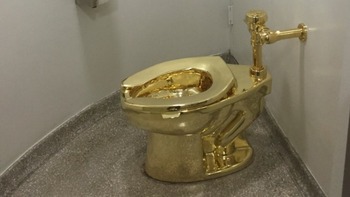
America by artist Maurizio Cettalan.Footnote 139

One of the two toilets made of solid 18-karat gold, created by Italian artist Maurizio Cattelan and christened America, was once installed for public use in the restrooms of the Guggenheim Museum in New York City.Footnote 145 It was later offered to the U.S. President after his request to borrow Vincent Van Gogh’s Landscape with Snow had been turned down.Footnote 146 Trump did not accept the offer, perhaps because he saw through its irony—but could hardly “read” it as a veiled ironic commentary on the case of the classified documents and the distinction between public and private. Cattelan’s America then found a new—again public—home at Blenheim Palace, the birthplace of William Churchill.Footnote 147 In the museum located there, the fully functional toilet America was accessible to all visitors as an object of art before it may be again relocated to serve, in a quiet place, its intended purpose. Of course, what the artist had created as a public statement on the contrast between excessive wealth and extreme poverty in the United States and the inequality between the classes mutated in Blenheim into a series of “private comments” on British history, “disposed of” by museum visitors and users. In 2019, a theft that has not yet been solved led to the illegal privatization of the Blenheim golden toilet and abruptly ended its public existence, much like the removal of a president from office. A sibling will replace it and will be displayed first—and later, maybe, made accessible as a functional toilet.
Acknowledgements
I am greatly indebted to Fernanda G. Nicola and Russell Miller for their generous support and many helpful comments to earlier versions. I thank also the anonymous reviewer for thoughtful suggestions.
Competing Interests
The author declares none.
Funding Statement
No specific funding has been declared in relation to this Article.



 Open access

