

INTRODUCTION
The Early Bronze Age in south-central Europe started at the end of the 3rd millennium BC. Due to the growing demand for the new material bronze, trading increased including long-distance exchange (i.e. Baltic amber) and settlement activities along the ore-rich Carpathian Mountains intensified (Kienlin Reference Kienlin2010, Reference Kienlin2015). Fidvár, near Vráble in SW Slovakia, was in the center of one of the hotspots of metal exchange and communication at that time (Ducke and Rassmann Reference Ducke and Rassmann2010; Gauss et al. Reference Gauss, Bátora, Nowaczinski, Rassmann and Schukraft2013).
Chronological systems in literature can differ noticeably and the available absolute dates are still limited, while regional comparisons are complicated by pronounced local developments (Kienlin Reference Kienlin2010; Marková and Ilon Reference Marková and Ilon2013; Roberts et al. Reference Roberts, Uckelmann and Brandherm2013). From the western foreland of the Carpathian Mountains of Slovakia, for example, the Únětice, Nitra, and Mad’arovce cultures are known, while the Hatvan, Füzesabony, and Otomani cultures occupied the central and eastern parts in the course of the Early Bronze Age. The Makó-Kosihy-Čaka complex represents the end of the prevailing Eneolithic (Buchvaldek et al. Reference Buchvaldek, Kosnar and Lippert2007; Bátora et al. Reference Bátora, Eitel, Falkenstein and Rassmann2008).
While the Únětice culture represents the Early Bronze Age in an area reaching from eastern Germany through Austria and Czechia into Slovakia, the Hatvan culture was centered in the Carpathian Basin at the northern Tisza River (Buchvaldek et al. Reference Buchvaldek, Kosnar and Lippert2007; Kienlin Reference Kienlin2010). Besides its pottery style, the Hatvan culture is characterized by the beginnings of Bronze Age tell settlements, while the typical Ùnětice settlements were at ground level (Kienlin Reference Kienlin2010). In southwest Slovakia, the southeast expanding Únětice culture occupied some of the northwesternmost Hatvan settlements and was followed by the Mad’arovce culture (Bátora et al. Reference Bátora, Behrens, Gresky, Ivanova, Rassmann, Tóth and Winkelmann2012). The disappearance of the Mad’arovce culture marks the end of the Early Bronze Age and was a gradual extinction, leaving behind in the settlements not many bronze or golden artifacts (Bátora Reference Bátora2009; Marková and Ilon Reference Marková and Ilon2013; Jelínek Reference Jelínek2015; Vavák Reference Vavák2015).
In contrast to the neighboring regions, there are few absolute dates for the Early Bronze Age of Slovakia, and even these might be methodologically problematic (Forenbaher Reference Forenbaher1993; Peška Reference Peška2012). The existing absolute chronologies are largely based on series of collagen accelerator mass spectrometry (AMS) dates on human bones from cemeteries (Bátora Reference Bátora2000; Görsdorf Reference Görsdorf2000; Bátora et al. Reference Bátora, Eitel, Falkenstein and Rassmann2008) or animal bones from cultural layers (Görsdorf et al. Reference Görsdorf, Marková and Furmánek2004). Uncertainties with bones including the extraction of collagen can possibly lead to deviations between different laboratories of some hundreds of years for the same archaeological period (Peška Reference Peška2012). In addition, clam shells and fish bones as found at Fidvàr (unpublished data) and other Early Bronze Age sites (Hlavatá Reference Hlavatá2015) raise the question as to the extent of a reservoir effect (Sayle et al. Reference Sayle, Cook, Ascough, Gestsdóttir, Hamilton and McGovern2014; Shishlina et al. Reference Shishlina, Sevastyanov, Zazovskaya and van der Plicht2014). For the transition from the Hatvan to the Únětice culture observed in SW Slovakia, no absolute age control exists (Bátora et al. Reference Bátora, Eitel, Falkenstein and Rassmann2008, Reference Bátora, Behrens, Gresky, Ivanova, Rassmann, Tóth and Winkelmann2012). To expand the data available and to verify the existing absolute chronologies, we aimed to provide additional dates and a wider spectrum of dated materials.
SITE DESCRIPTION
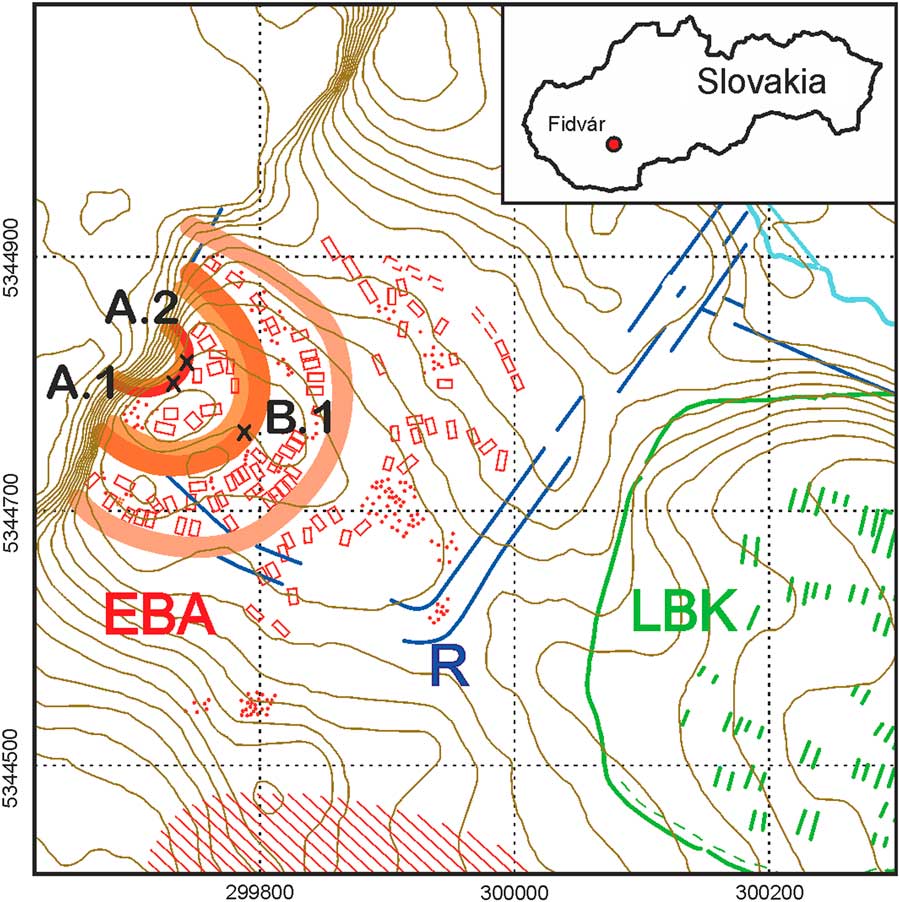
Fidvár, near Vráble in SW Slovakia (Figure 1), is one of the most important and best-known Early Bronze Age settlements in the Carpathian Basin (Kienlin Reference Kienlin2012). It was fortified by three generations of moats (Bátora et al. Reference Bátora, Behrens, Gresky, Ivanova, Rassmann, Tóth and Winkelmann2012). Fidvár is one of the very rare sites where the tell-building Hatvan culture from the Tisza area was succeeded by the central European Únětice culture. The oldest, inner moat was created by the Hatvan people and refilled by anthropogenic-derived sediments of 4–5 m depth (Bátora et al. Reference Bátora, Eitel, Falkenstein and Rassmann2008). During the Únětice period, the settlement reached its greatest extension (~12 ha) and a second ditch took over the fortification function. The youngest moat, located between the previous two, was built during the following Mad’arovce period and was filled after the abandonment of the settlement by 7 m of sediments (Bátora et al. Reference Bátora, Eitel, Falkenstein and Rassmann2008; Nowaczinski et al. Reference Nowaczinski, Schukraft, Hecht, Rassmann, Bubenzer and Eitel2012). Some centuries before the rise of the fortified Early Bronze Age settlement, people of the Eneolithic Košihy Čaka culture inhabited the site (Točík Reference Točík1986 in Bátora et al. Reference Bátora, Eitel, Falkenstein and Rassmann2008; Gauss et al. Reference Gauss, Bátora, Nowaczinski, Rassmann and Schukraft2013).
Archaeological structures at Fidvár reconstructed from geomagnetic surveys; EBA: Early Bronze age settlement, pits and cemetery; LBK, Neolithic ditch and houses; R, Roman march camp. WSG 1984 UTM 34 N, grid 200 m wide (Gauss et al. Reference Gauss, Bátora, Nowaczinski, Rassmann and Schukraft2013; Nowaczinski et al. Reference Nowaczinski, Schukraft, Rassmann, Hecht, Texier, Eitel and Bubenzer2013).
The indirectly derived ages from archaeological artifacts for the Fidvár-Vráble site are somewhat vague (Bátora Reference Bátora2000; Bátora et al. Reference Bátora, Eitel, Falkenstein and Rassmann2008, Reference Bátora, Behrens, Gresky, Ivanova, Rassmann, Tóth and Winkelmann2012), not dating the Hatvan/Únětice transition, and seem to contradict the older ages of charcoals from the ditches (Nowaczinski et al. Reference Nowaczinski, Schukraft, Hecht, Rassmann, Bubenzer and Eitel2012; Nowaczinski Reference Nowaczinski2014). In view of these uncertainties, we developed a new approach to derive a chronology based on taxonomically identified botanical and zoological macroremains from moats, a category of on-site archives that is still often underestimated.
MATERIAL AND METHODS
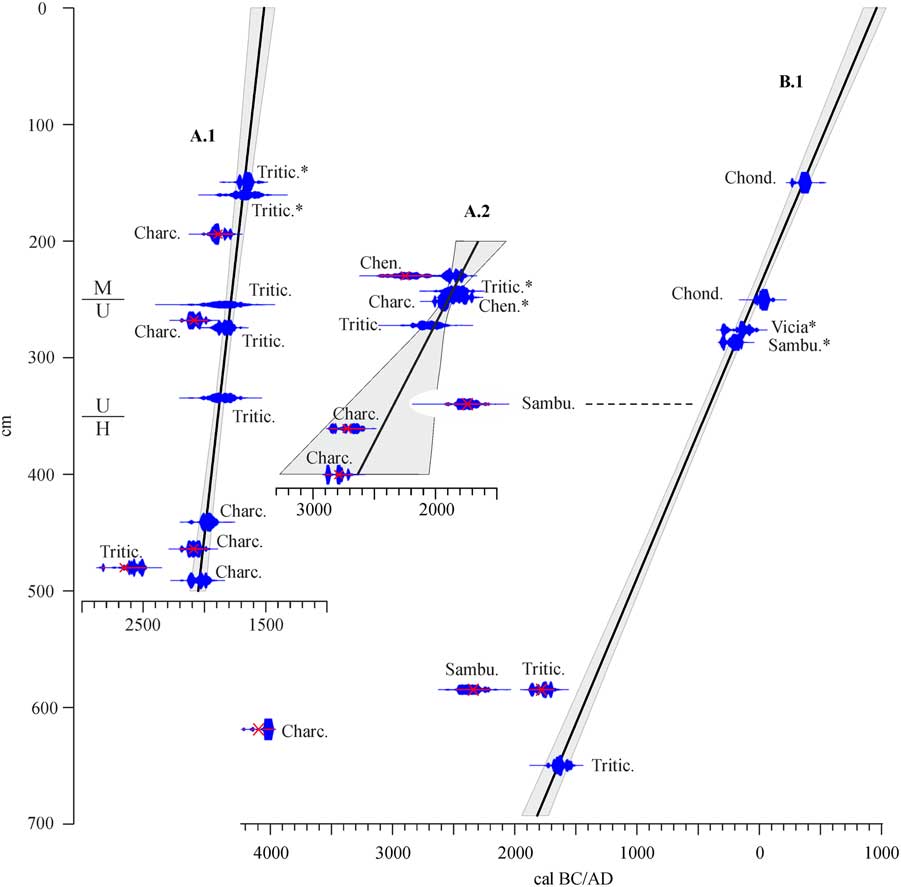
To cover the occupation phase and the following period, two percussion cores (A.1, A.2) from the oldest moat and one (B.1) from the youngest moat were selected for detailed microscopic analyses of pollen, archaeobotanical, and zoological remains (unpublished data). During the physical and chemical characterization of the cores, a total of nine obvious pieces of wood charcoal were directly sent for dating to the Curt Engelhorn Centre for Archaeometry in Mannheim (lab code MAMS) without any morphological or taxonomical analyses (Nowaczinski et al. Reference Nowaczinski, Schukraft, Hecht, Rassmann, Bubenzer and Eitel2012; Nowaczinski Reference Nowaczinski2014). For our microscopic analyses, the cores were divided into natural stratigraphic layers and sublayers and each sample was wet sieved (smallest mesh diameter 0.25 mm). After identification to the genus or species level, 18 botanical samples and 2 snail shells were dated at the Poznań Radiocarbon Laboratory (lab code Poz, Table 1). The shells were thoroughly cleaned mechanically, in an ultrasonic bath, and with diluted hydrochloric acid inside and out. For the principals of dating small snail shells, the reader is referred to Pigati et al. (Reference Pigati, Rech and Nekola2010, Reference Pigati, McGeehin, Muhs and Bettis2013). The age models were calculated using the free R package clam (Blaauw Reference Blaauw2010) with the calibration curve IntCal13 (Reimer et al. Reference Reimer, Bard, Bayliss, Beck, Blackwell, Bronk Ramsey, Buck, Cheng, Edwards, Friedrich, Grootes, Guilderson, Haflidason, Hajdas, Hatté, Heaton, Hoffmann, Hogg, Hughen, Kaiser, Kromer, Manning, Niu, Reimer, Richards, Scott, Southon, Staff, Turney and van der Plicht2013) and graphically reworked (Figure 2).
Age models of the ditches with the type of dated samples. Outliers are marked in red, with one recent date omitted. Transitions from Hatvan to Únětice (H/U, A.1) and Únětice to Mad’arovce (U/M, A.1, A.2) concluded from palynological and archaeobotanical analyses (Schlütz and Bittmann 2015). *Samples of overlapping depth graphically equalized; for acronyms see Table 1. All Sambucus (Sambu.) dates refer to core B.1. Gray zones mark the 95% confidential interval of age models, with red crossed samples not included. The upper part of the age model of core A.2 was not plotted due to missing dates.
14C dates from the moats.

*Post-bomb atmospheric NH1 curve (Hua et al. Reference Hua, Barbetti and Rakowski2013). Plant and zoological remains: Chenopodium (Ch. album, white goosefoot, and Chenopodium spec.), Triticum (wheat), T. monococcum (Einkorn), T. dicoccum (Emmer), Sambucus ebulus (danewort), Vicia hirsuta (tiny vetch), and Chondrula tridens (three-tooth bulin snail). Dates except those marked with + are treated as outliers (Figures 2, 3, 4) and classified as too old (>) where the divergence with the model age does not exceed the lifespan of the dated remains (here, trees) and as much too old (>>). Charcoal data from Nowaczinski et al. (Reference Nowaczinski, Schukraft, Hecht, Rassmann, Bubenzer and Eitel2012, 2014) calibrated in clam (Blaauw Reference Blaauw2010) with IntCal13 (Reimer et al. Reference Reimer, Bard, Bayliss, Beck, Blackwell, Bronk Ramsey, Buck, Cheng, Edwards, Friedrich, Grootes, Guilderson, Haflidason, Hajdas, Hatté, Heaton, Hoffmann, Hogg, Hughen, Kaiser, Kromer, Manning, Niu, Reimer, Richards, Scott, Southon, Staff, Turney and van der Plicht2013).
RESULTS AND DISCUSSION
A total of 29 samples were dated from the three cores A.1, A.2, and B.1 (Table 1). Apart from the nine wood charcoal samples, all remains were identified taxonomically. In contrast to the charcoal pieces, they are parts of plants or animals formed over short time periods of weeks (caryopses, seeds) to a few years (snail shells) and deposited shortly afterwards. All botanical remains were charred. To avoid mixing remains of potentially different ages, individual specimens were chosen for dating wherever feasible. This led in some cases to falling below the standard limit of the Poznań laboratory for carbon content of AMS samples of 0.4 mg (http://www.radiocarbon.pl/).
Charcoals
While the taxonomic identities of the nine dated charcoal remains are uncertain (Nowaczinski Reference Nowaczinski2014), not dated charcoals OR other charcoals from moat A, storage pits, and cultural layers were mostly identified as oak (Quercus) followed by ash (Fraxinus) and accompanied by charcoals of short-lived taxa like willow/poplar (Salix/Populus) and shrubs (Corylus, Buxus, Viburnum) (Schlütz and Bittmann Reference Schlütz and Bittmann2015). Compared to the age models, a number of charcoals appear a few hundred years too old (Figure 2). This could be caused by dating inner parts of long-lived oak trees, the reuse of construction timber, or reworking. Charcoal ages that match with the models may originate from short-lived tree or shrub species, twigs, or the outer part of tree trunks.
In contrast to charcoals, all other dated botanical material (seeds, grains, spikelet forks) is of short-lived nature built over a few months by plants being annuals (wheat, goosefoot, hairy vetch) or small herbs (danewort). Their carbon content therefore reflects most probably the atmospheric 14C conditions shortly before the charring event.
Wheat, Triticum
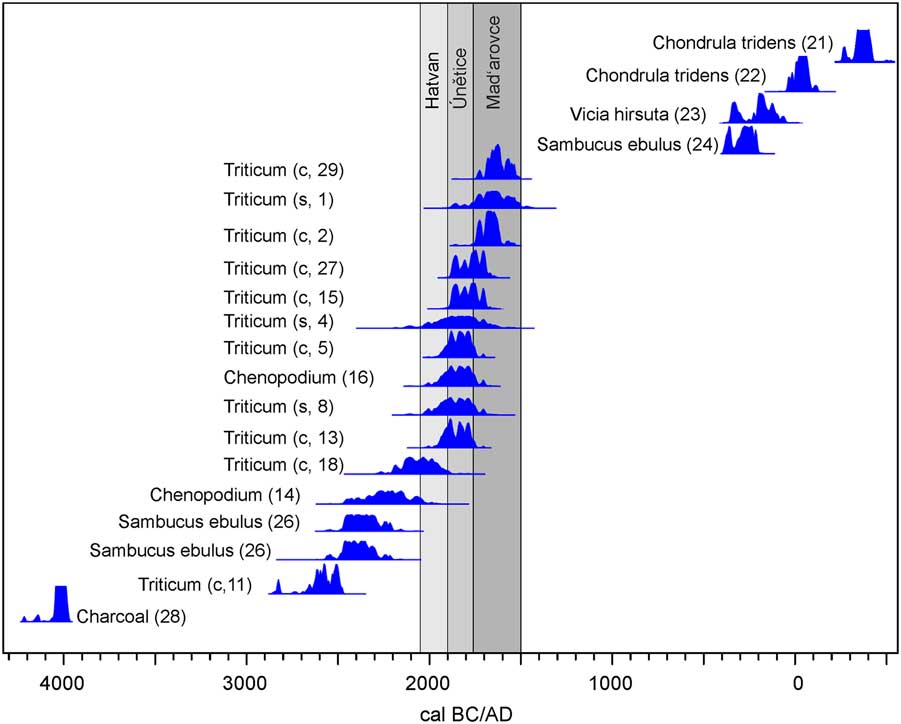
In addition to eight wheat caryopses (grains), three fragments of spikelet forks (chaff remains) were also processed (Table 2). Especially the fragile spikelet forks that yielded only 0.2–0.3 mg carbon each contributed significantly into building the age-depth models (Figure 3, Table 2). Wheat remains were restricted to the Early Bronze Age, except one (number 11), suggesting that wheat consumption occurred at the site much earlier, in the Eneolithic Košihy Čaka period.
Results of all taxonomically identified remains and a single pre-Bronze Age charcoal sample. The beginning of Hatvan and Únětice period as concluded from core A.1. and end of Mad’arovce are in accordance with Bátora et al. (Reference Bátora, Behrens, Gresky, Ivanova, Rassmann, Tóth and Winkelmann2012). Numbers in parentheses refer to Table 1 (c, caryopsis; s, spikelet fork fragment).
Summary of sample age compared to model age or to the archaeological context for all types of material and in addition for those of low carbon content. For the explanation of symbols, refer to Table 1.

Danewort, Sambucus ebulus
Three single seeds of danewort (Sambucus ebulus) were dated from core B.1. While the uppermost seed perfectly matches the age model, the two lower ones are both of the same age and much older than expected. Their old age points to fires possibly related to the Košihy Čaka culture known from the site before the Hatvan period (Bátora et al. Reference Bátora, Eitel, Falkenstein and Rassmann2008). The two seeds are separated by more than 2 m and were thus possibly independently incorporated into the ditch sediment with a time interval of more than about 1 ka. Nevertheless, bioturbation might be involved as well.
Goosefoot, Chenopodium album
Samples of Chenopodium consisting of more or less intact charred seeds of white goosefoot (Chenopodium album) and fragments, most probably also white goosefoot, were dated. Resulting from one recent date, the calibrated ages span over 4 ka. Goosefoot was, and still is, a very common weed at Fidvár. Most possibly the recent seeds were introduced into the material during fieldwork, as bioturbation down to more than 3 m depth seems unrealistic. Compared to all other remains, Chenopodiaceae samples gave the most unreliable results. This may relate to their high mechanical persistence, omnipresence, and minuteness, enabling any kind of relocation.
Snail Shells, Chondrula tridens
The three-tooth bulin snail (Chondrula tridens) forms high-spired shells of about 7–16 mm height (Welter-Schultes Reference Welter-Schultes2012) and prefers open xeric conditions, suggesting steppe-like conditions on the later moat slopes (Lisický Reference Lisický1991; Ložek Reference Ložek2012). Chondrula tridens feeds on dead plant material and deposits the eggs into the litter. As the species can move into soil cracks during dry periods (Boschi Reference Boschi2011), shells might be found some centimeters below the related ground level. Like other small terrestrial snails, the lifespan of Chondrula tridens will not exceed a few years. In general, snail shells appear less resistant to mechanical stress than charcoals, and are therefore most probably seldom reworked in archaeological contexts. Therefore, dating of complete and well-preserved shells may avoid problems of relocation. The two selected specimens (8.5 mm, 7.0 mm) were adults with well-developed apertural folds. They revealed sound ages without evidence of a carbon reservoir effect. Pigati et al. (Reference Pigati, Rech and Nekola2010, Reference Pigati, McGeehin, Muhs and Bettis2013) found that certain small snails only seldom have a reservoir effect, in contrast to larger snails. We believe that our results suggest Chondrula tridens snails also fall into this category of small snails. This probably offers significantly higher precision over archaeological finds of freshwater mollusks (Gulyás et al. Reference Gulyás, Sümegi and Molnár2010). Furthermore, the young ages mean that the shells did not originate from the Pleistocene loess in which the moats were dug (Ložek Reference Ložek1965). Other snails, like species of the genus Vallonia, are much more common in the moat sediments and even more fragile, but several shells would need to be combined to provide enough carbon for AMS dating. Nevertheless, they could be an appropriate key for further age controls.
Regarding Table 2, spikelet forks of Triticum seem to be the most reliable botanical dating material in our study. Due to their high fragility, spikelet forks when subject to any kind of reworking or redeposition possibly disintegrate instantly into units too small to be selected for dating. This kind of system inert preselection might also relate to a certain degree to cereal caryopses, as long as they are complete enough to be determined to at least genus level (Table 2, Triticum). For smaller fragments of caryopses, not dated in our study, a higher degree of mismatch due to redeposition might be expected. Seeds of Vicia hirsuta might fall into the same category as determinable caryopses, but further data are needed.
Charcoals and charred seeds of danewort and of goosefoot appear to be far less reliable. In this group, two-thirds of the dates turned out to be invalid. The resistant seeds of goosefoot and danewort are relatively frequent in our archaeobotanical spectra, but easily displaced by any kind of (bio-)turbation due to their small dimensions. Of short-living character, these seeds can show 14C ages very close to the time of charring, but their susceptibility to reworking make them unsuitable for dating in archaeological contexts. Charcoals can be very stable as well and contain high amounts of carbon, explaining their frequent use in a wide range of geochronological applications (Bird Reference Bird2007). In addition, charred beams and poles even disintegrated over several size orders through time by (recurrent) rework processes may still fulfill the quantitative requirements for AMS dating, resulting in 14C ages (much) older than the archaeostratigraphical context. In addition, the so-called old-wood effect can reduce the chronostratigraphic usability of charcoal ages (Regev et al. Reference Regev, de Miroschedji and Boaretto2012; Dong et al. Reference Dong, Wang, Ren, Motuzaite Matuzeviciute, Wang, Ren and Chen2014; Dreibrodt and Wiethold Reference Dreibrodt and Wiethold2014). Especially in areas with long-living trees, like oaks in former SW Slovakia, the inbuilt age of the inner tree trunk can be several hundred years higher than the charring event (Gavin Reference Gavin2001). In landscapes with short-living arboreals, the resulting dating error might be only a few decades (Bruins and van der Plicht Reference Bruins and van der Plicht1995). Due to the possible reuse of construction timber, the discrepancy between wood and fire age can be enhanced as well. Charred twigs or charcoals proven to be from shrubs like willow or hazel might provide acceptable results.
DATING THE ARCHAEOLOGICAL PERIODS
Cores A.1 and A.2 from the Oldest Moat
Cores A.1 and A.2 are from the oldest moat and consist of sediments filled into the ditches by humans. The age model of core A.1 dates the ditch base to about 2050 cal BC (Table 3). As deduced from the microscopic analyses (Schlütz and Bittmann Reference Schlütz and Bittmann2015), the transition from the Hatvan to the Únětice culture is reflected in the sediments of core A.1 at about 3.5 m depth dating to about 1900 cal BC (Figure 2). At about the same time, 150 km to the east at Včelince, the pure Hatvan culture ended by the upcoming influence of the Otomani (Ottomány) culture (Görsdorf et al. Reference Görsdorf, Marková and Furmánek2004). The end of the Únětice period is marked by a loamy layer (226–247 cm) dating to about 1770 BC, which coincides with the end of the classical phase of the Únětice culture in its Bohemian heartland at Prague-Miškovice at around 1750 BC (Ernée et al. Reference Ernée, Müller and Rassmann2009).
Results of the age models of core A.1 and B.1 at 50-cm intervals with cal BC in negative values.

The ditch was filled already approximately by the end of the Mad’arovce period at about 1500 cal BC. Hence, the 5-m-deep sediments accumulated during just 500 yr, equating to an average rate of 10 mm/yr. Core A.2 was taken several meters northeast of core A.1. No suitable material was recovered from its upper part. The density of dated material around 2.5 m is high, while the two charcoals from the base appear too old. Accordingly, the resulting age model is imprecise and not fully displayed in Figure 2. The transition from the Únětice to the Mad’arovce culture was less clear than in core A.1, but also situated around 2.5 m depth. Wheat and goosefoot from this particular section (Table 1, numbers 15, 16) gave ages in concordance with the age model of core A.1.
Core B.1 from the Youngest Moat
Charred remains are scarce and in some parts absent in core B.1. The age model suggests a refilling starting at 1800 BC. This early date is actually based on a single wheat caryopsis, which may have been reworked from cultural layers of the settlement. Archaeological reasoning suggests an installation of ditch B by the Mad’arovce people and therefore a start of the refilling about 3 centuries later with the end of the site occupation (Bátora et al. Reference Bátora, Eitel, Falkenstein and Rassmann2008; Falkenstein et al. Reference Falkenstein, Bátora, Eitel and Rassmann2008). Nevertheless, the refilling of this youngest ditch might have started like for the oldest one, shortly after the installation. A future use of snail shells for dating the base could be pioneering here. The deposition of the 7-m refill took roughly 2.5 ka (~2.8 mm/yr). The low rate is in sharp contrast to the anthropogenically influenced sedimentation rate of the oldest moat, which was about three times faster.
Early Hatvan and Pre-Hatvan Dates
The oldest ages of danewort and goosefoot (Figure 3) might be related to the Eneolithic Košihy Čaka or very early Hatvan activities that started about 150 km to the east at Včelince between 2200 and 2030 BC (Görsdorf et al. Reference Görsdorf, Marková and Furmánek2004). Goosefoot and danewort point to possibly human-made nitrogen-rich habitats already in this early occupation stage. The oldest wheat grain indicates cereal consumption in the Košihy Čaka period. The oldest charcoal (MAMS-15362) is of Neolithic origin and might relate to the nearby settlement located a few hundred meters east of the later Fidvár (Figure 1) (Furholt et al. Reference Furholt, Bátora, Cheben, Kroll, Rassmann and Tóth2014).
CONCLUSION
While archaeological excavations need time-consuming fieldwork, ditch cores can be taken rapidly by percussion drilling, but need intense sedimentological and microscopic analysis as well as thorough geochronological investigations. By using taxonomic identification of charred botanical remains and shells of small terrestrial snails, ambiguities related to carbonate reservoir effects (human bones, water mollusks, diet residuals) and collagen preparation can be minimized or prevented. Regarding the well-matching ages of cultural periods derived from bones (Görsdorf Reference Görsdorf2000; Görsdorf et al. Reference Görsdorf, Marková and Furmánek2004; Ernée et al. Reference Ernée, Müller and Rassmann2009) and botanical remains presented here, both dating approaches complement each other and provide mutual support. In addition, absolute ages of botanical remains offer direct evidence of former human activities like cereal cultivation and ecological conditions, such as the occurrence of nitrogen-rich soils and the steppe character of moats after the abandonment of the settlement. Cores of larger diameter or additional parallel cores could increase the amount of suitable remains and therefore enable the dating of smaller stratigraphic subdivisions. Snail shells can be an alternative when charred material is scarce and/or charred remains are not contemporaneous due to a lack of anthropogenic and natural fires and/or incorporation processes. The age-model-derived absolute chronology for all mentioned Early Bronze Age cultures is well within the age ranges given in the cited literature. The replacement of the Hatvan culture by the Únětice culture took place at around 1900 BC, which is the first absolute date for this important cultural transition. Its concomitance to the end of pure Hatvan culture may reflect simultaneous larger regional developments. The absolute chronostratigraphical framework presented here will also be helpful for regional and supraregional comparisons of future archaeobotanical and archaeological analyses (Bátora and Tóth Reference Bátora and Tóth2014). In spite of the positive results presented, it should be kept in mind that moats like other ditches belong to a category of very complicated archives. Their utilization as chronological records might be successful only under certain circumstances.
ACKNOWLEDGMENTS
The authors would like to thank the German Research Foundation (DFG) for funding this study (BI 783/5) as part of the bundle project “Holocene human‐nature interaction at a geoecological key location - Geomorphological and sedimentological investigations at Vráble, Slovakia.” We kindly thank our project partners from the Geographical Institute of Heidelberg, especially E Nowaczinski, for the generous release of the core material and fruitful discussions, as well as our archaeological partners from the RGK Frankfurt and from the Slovak Academy of Sciences for their support. Two anonymous reviewers helped to improve our manuscript considerably.


 Open access

