

Introduction
Even in developed contemporary welfare states, many citizens in need of help do not receive timely and appropriate assistance. People who experience multiple problems are especially at risk of getting stuck in the cracks of the system (Rosengard et al., Reference Rosengard, Laing, Ridley and Hunter2007). This is the result of a mismatch between their personal situations and needs on the one side and the design, delivery, management, and accountability practices (De Jong & Rizvi, Reference De Jong and Rizvi2009, p.168) of fragmented and supply-oriented care systems (Carey, Reference Carey2014; Reinhoudt-den Boer, Reference Reinhoudt-den Boer2023) on the other side. In the absence of appropriate and integrated support, their precarious situations often deteriorate, which imposes great costs on themselves, their families, communities, and the public (De Jong & Rizvi, Reference De Jong and Rizvi2009). It is therefore claimed that a more demand-oriented approach is needed, enabling policy practitioners, known as street-level bureaucrats (SLBs), to tailor public services in accordance with the complex needs of citizens (Reinhoudt-den Boer, Reference Reinhoudt-den Boer2023; Oldenhof & Linthorst, Reference Oldenhof, Linthorst and Hupe2022). This, however, is not an easy task because SLBs work in a context of ambiguous and changing-policy directives (Jessen & Tufte, Reference Jessen and Tufte2014; Greve, Reference Greve2022; Oldenhof & Bal, Reference Oldenhof, Bal and Chambers2023) and must work alongside other professionals who adhere to different organisational norms or role conceptions (Zacka, Reference Zacka2017).
SLBs are public service workers such as police officers, teachers, and social workers, who have direct interaction with citizens and have significant, although varying, discretion in the execution of this work (Lipsky, Reference Lipsky2010). This means that they have a certain space to use their professional judgement, choosing when to enforce certain rules, whom to give extra attention, or whom to provide access to scarce public resources. The amount of discretion that SLBs have and ideas about what it means to use discretion ‘well’ however vary in accordance with changing ‘organisational working conditions and expectations’ (Esmark & Liengaard, Reference Esmark and Liengaard2022; see also Murphy, Reference Murphy2023; Bergmark & Stranz, Reference Bergmark and Stranz2023; Redman et al., Reference Redman, Fletcher, White and Mccarthy2022; Brodkin, Reference Brodkin2007).
In the past decades, many welfare states have implemented policies to control public spending and to promote efficiency through strict policy directives and performance measurement (Hemerijck & Matsaganis, Reference Hemerijck and Matsaganis2024). Consequently, the autonomy and discretionary space of SLBs have decreased (Blomqvist and Winblad, Reference Blomqvist and Winblad2024). However, these policies have come under scrutiny in several countries like Norway, Australia, and the Netherlands after revelations of social security scandals caused by rigid implementation of social policies (Rouwhorst, Reference Rouwhorst2022), plunging citizens into hardship. Therefore, several welfare states have started to re-emphasise the need for discretion to stimulate service provision that concentrates less on consistency and more on the specificity of each case (Kelly & Lobao, Reference Kelly and Lobao2021; Needham, Reference Needham2011; Oldenhof & Linthorst, Reference Oldenhof, Linthorst and Hupe2022). With the return of responsive service provision, the importance of SLBs discretionary judgements is reestablished (Skjold & Lundberg, Reference Skjold and Lundberg2022). In the current climate, though, this development might be challenging for SLBs because rules to promote standardisation and austerity policies are still in effect and limit SLBs’ discretionary possibilities and resources (Murphy, Reference Murphy2023). SLBs must therefore make hard choices about how to allocate their limited resources and time (Lavee, Reference Lavee2022). Studies show that SLBs’ notions of a citizen-client’s ‘deservingness’ or ‘worthiness’ for public services inform how discretion is performed in day-to-day interactions (Altreiter & Leibetseder, Reference Altreiter and Leibetseder2015; Jilke & Tummers, Reference Jilke and Tummers2018; Dubois, Reference Dubois2016; Lavee, Reference Lavee2022), and influences how they decide to either strictly apply, bend, or ignore rules and regulations (Evans, Reference Evans2013; Koch, Reference Koch2021; Nothdurfter & Hermans, Reference Nothdurfter and Hermans2018; Riccucci, Reference Riccucci2005).
Traditionally, SLB decision making has been studied by focusing on the perspectives that individual SLBs have on citizen-clients (Lipsky, Reference Lipsky2010). However, in contemporary debates discretion ‘is increasingly understood to be collective; both in terms of how it is embedded in and the result of relations and deliberations with other practitioners’ (Visser & Kruyen, Reference Visser and Kruyen2021, p.678; see also Møller, Reference Møller2021; Raaphorst & Loyens, Reference Raaphorst and Loyens2020; Rutz & de Bont, Reference Rutz and de Bont2019). Recent studies show, for example, that peer deliberation (Piore, Reference Piore2011) and collective decision making (Rutz & de Bont, Reference Rutz and de Bont2019) can enhance consistency in SLB decision making without loss of the ability to also adjust to specific circumstances (Raaphorst, Reference Raaphorst2021). Nevertheless, it has been noted that although deliberation may help to minimise influences of individual biases, it may also serve to entrench shared biases regarding the characterisation of (un)deserving citizen-clients (Ibid.). Møller (Reference Møller2021) therefore calls for further research to elucidate these processes of collective deliberations that take place in the ‘organisational backstage’ and tend to remain out of sight.
In this study, we answer the call to examine processes of collective deliberation but also take the discussion a step further. In practice, SLBs such as social workers increasingly work not only in teams with peers but also in fragmented networks (Ambrose-Miller & Ashcroft, Reference Ambrose-Miller and Ashcroft2016; Schot et al., Reference Schot, Tummers and Noordegraaf2020). Therefore, when implementing decisions, they may depend on SLBs outside their team or organisation. This raises the question of what happens when professionals with different role conceptions must jointly determine how discretionary space is used in a context of shifting policy directives. To answer this question, we studied, using narrative analysis (Murray & Sools, Reference Murray, Sools, Rohleder and Lyons2014), a policy experiment in Rotterdam, the Netherlands, in which SLBs from different departments were brought together to provide more responsive and tailored assistance to people with complex problems who ‘got stuck’ in the system. By tradition, the Netherlands was known for its generous entitlement-based welfare regime. In the past decades the Dutch welfare state gradually transformed to a ‘participation society’, thereby shifting to a reciprocity-based attitude to welfare combined with austerity measures (Peeters, Reference Peeters2013; Hemerijck & Matsaganis, Reference Hemerijck and Matsaganis2024). However, the Dutch attitude is currently shifting again, with emphasis on social rights based on individual needs, (Tijdelijke Commissie Uitvoeringsorganisaties, 2021; Kerstens, Reference Kerstens2019; van Zutphen & Kalverboer, Reference van Zutphen and Kalverboer2021), thus enabling policy experiments such as the one studied in this paper. Our contribution to the SLB and social policy literature is to investigate and theorise how SLBs use storytelling within networked interdependencies. We show how SLBs use storytelling to bring cohesion to complex situations, to convince and mobilise other SLBs to use their discretion, and to jointly substantiate what it means to use discretionary space well. Our final contribution is a critical reflection on the meanings of storytelling for SLBs.
Theoretical perspectives
When faced with clients who experience multiple problems, SLBs often require cooperation with SLBs from different domains to provide quality care (Rutz & de Bont, Reference Rutz and de Bont2019, Noordegraaf, Reference Noordegraaf2011, Oldenhof & Bal, Reference Oldenhof, Bal and Chambers2023). Consequently, they have to collectively make sense of and navigate the uncertainty and complexity in their work, which may cause conflict. In such instances when discretionary space becomes collective, the accustomed conceptualisation of discretion as the degree of – granted or acquired – freedom of an individual actor (Hupe & Hill, Reference Hupe and Hill2007) falls short. Following Rutz and de Bont (Reference Rutz and de Bont2019), we therefore understand discretion and discretionary space as a product of collective deliberations (see also: Møller, Reference Møller2021)., i.e., as the outcomes of collective sensemaking (Picione & Lozzi, Reference Picione and Lozzi2021).
According to Iedema (Reference Iedema2022), one way to make sense of chaotic, nonroutine, or uncertain situations is through stories, which serve to impose coherence (White, Reference White1981, Bietti et al., Reference Bietti, Tilston and Bangerter2019). Correspondingly, Maynard-Moody and Musheno (Reference Maynard-Moody and Musheno2022, p.153) endorse academic interest in the street-level stories and moral reasoning that SLBs use to navigate ‘through the shoals of ambiguity and conflict’ of their everyday work. Studies into these stories could help to better understand how SLBs collectively make sense, create meaning, and convey and enforce norms in this process (Ibid.).
Several prominent authors (e.g. Zacka, Reference Zacka2017; Cecchini & Harrits, Reference Cecchini and Harrits2022; Maynard-Moody & Musheno, Reference Maynard-Moody and Musheno2022), have already taken up this call and investigated narratives about what it means to be a ‘good’ professional and what it means to use discretion ‘well’. Maynard-Moody and Musheno (Reference Maynard-Moody and Musheno2000, p.329), for example, describe how SLBs themselves embody two narratives. On the one hand, they are state-agents who act in response to rules, procedures, and laws, but on the other hand, they are citizen-agents who act in response to individuals and circumstances. Building on this work, Zacka (Reference Zacka2017, pp.101–109) presents three moral dispositions: indifference, where the worker aims to effectively and indiscriminately apply the same rules, disregarding individual circumstances; caregiving, where the worker is compassionate and responsive to the particularities of individual clients’ circumstances, disregarding equal treatment; and enforcement, where the worker aims to preserve the fairness of the system beyond the letter of the law, discerning for example between clients who are genuinely entitled to benefits and assistance and those who seek to take advantage of public services.
A related body of literature has investigated the stories that SLBs use to attribute social identity categories to citizen-clients such as the deserving or undeserving poor (Dubois, Reference Dubois2016; Katz, Reference Katz2013), or characterisations like the iconic victim (Loyens & Paraciani, Reference Loyens and Paraciani2021), pawns and queens (Djuve & Kavli, Reference Djuve and Kavli2015), welfare queens and deadbeat dads (Cammett, Reference Cammett2014). These imposed identities are important because they form the premise for moral judgements that SLBs make to determine how rules, procedures, and policies are applied; ‘From bending the rules and providing extraordinary assistance for those deemed “worthy”, to allowing only begrudging and minimal help and at times to abuse for those deemed “unworthy” (Maynard-Moody & Musheno, Reference Maynard-Moody and Musheno2022, pp.153–156; also see Riccucci, Reference Riccucci2005; Koch, Reference Koch2021; Nothdurfter & Hermans, Reference Nothdurfter and Hermans2018).
According to Raaphorst (Reference Raaphorst2021), SLBs decide who is ‘worthy’ of their time and resources based on moral judgements of neediness, honesty, trustworthiness, motivation, and cooperativeness. However, it seems to vary between contexts which one of these signifiers ‘counts’ to determine worthiness. This is seemingly so because notions of worthiness are partly interpreted in terms that are dictated by social policies and prevailing disciplinary regimes. Lavee (Reference Lavee2022, p.11) found for example, that some SLBs determine the ‘worthy’ as those who are ‘deserving’ in terms of the regime of personal responsibility and work commitment, whereas others regarded worthiness as those who are in need, specifically the most socially weakened. This indicates that SLBs’ reasoning to decide who is ‘worthy’ of (extraordinary) help, mirrors grand narratives on what it means to be a ‘good’ citizen, client, or victim, in a given context.
For interdependent SLBs who work under different policy directives and/or hold different moral dispositions, it may therefore be hard to collectively decide who is ‘worthy’ because they foreground different signifiers or attach different meanings to them. Unfortunately, little is known about the role of SLBs’ deliberations to make sense of, and socially construct, citizen clients, their problems, and solutions (Møller, Reference Møller2021, p.484). On that account, we will investigate how SLBs in inter-departmental settings make sense of complex cases in deliberation through storytelling, and collectively determine whether a client is worthy of a more lenient interpretation of entitlement categories.
The case
Our case study is a policy experiment in the Dutch post-industrial city of Rotterdam, a city that is marked by relatively high unemployment and poverty, low self-perceived health, and housing shortages (Onderzoek en Business Intelligence, 2021). The goal of this experiment was to increase professionals’ use of discretion to be more responsive to the needs of citizens who ‘get stuck’ in complicated welfare systems. This was done by organising (online) multidisciplinary case meetings for two ‘neighbourhood teams’ that cooperate with other municipal departments, such as the income and work department, and many other organisations, such as housing associations. The goal of these meetings was to explore if and how a more lenient interpretation of entitlement categories could be made, a hardship clauseFootnote 1 could be invoked, or other creative solutions could be found, to solve complex cases. These cases also served to indicate existing policies or procedures that might need to be changed to better fit the situations of citizens.
To achieve more responsive service provision, social professionals were invited to submit (client) cases (to the project leaders) for which they thought a responsive approach and deviation from regular procedures was necessary, for example, because eligibility criteria restricted access to certain resources. In preparation for the case meetings, a document was shared with all participants in which the introducing professional described the case and a proposed solution. Next, the project leaders invited professionals from other municipal departments needed to solve the case, such as the departments of work and income, shelter and protected housing, and/or youth services, to join the ‘case meeting’.
Within the experimental context, the project leaders stimulated the audience to relate to the premise of promoting responsiveness by using discretion to more leniently interpret entitlement categories, or to find other creative solutions. Because the audience often consisted of professionals from the income and housing departments and the social shelter, who are mostly expected to abide by rules and regulations, they were now asked to take a different perspective and abide more to the specific needs of an individual client.
The meetings were attended by spectators: the researchers, social professionals and, sometimes, visiting municipal politicians. As responsiveness is a central aim of this experiment but is ambivalent in meaning, we perceive the meaning(s) of responsiveness itself as an outcome of the experiment.
Methods
From January 2021 to March 2022, the first, second, and fourth authors were involved as action researchers in the policy experiment using the qualitative research method of focused ethnography (Knoblauch, Reference Knoblauch2005). During the study, we were in close contact with professionals and policymakers and shared our observations and analysis as input for adjustment of the experiment and its activities. For our data collection, we observed, recorded, and made notes of thirty-three case meetings in which sixty-two cases were discussed. To supplement the field notes of the case discussions and to check our observations, we contacted and conducted informal conversations with thirty-six practitioners, nine policy makers, and the two project leaders who were involved in the discussions. These informal conversations were usually arranged directly after the case meetings and were important to verify how participants of case discussions felt during and after discussion of cases, which was difficult to establish based on observations of talk and facial expressions only. Important discussion points and perspectives from the informal conversations were recorded in separate field notes. Because we did not know the clients and they were not present at the case meetings, we had to approach them more formally through their social workers. A selection of twelve clients was made based on the nature of their problems that needed to be solved in the meeting (such as problems with housing, income and depts, childcare). To better understand the construction of the client-story in the meetings, we approached and interviewed them to capture their version of the narrative. These conversations were recorded and transcribed verbatim. The research material, including transcripts, field notes, and memos, was imported into Atlas.ti (version 22).
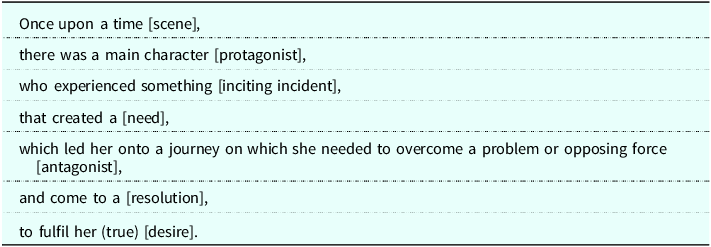
We performed a dialogic narrative analysis to uncover the ‘who, what, and why of narratives’ (Riessman, Reference Riessman2008), using the steps provided in the narrative analysis framework of Murray and Sools (Reference Murray, Sools, Rohleder and Lyons2014). First, the first author read all transcripts and observation notes and formulated a case title and short introduction for each case. He then coded the storyline elements (Yorke, Reference Yorke2013) displayed in Table 1.
Storyline elements in [brackets]

Next, in several meetings, the first, second, and last author identified recurring storylines in the case discussion, for example by looking for types of characterisations of protagonist and antagonist, and, subsequently reflected upon similarities in different case discussions to construct ideal-typical plot-types. In the case discussions, there was continuous interaction among multiple actors introducing or questioning storylines, going back and forth in often fragmented, incoherent, and nonlinear fashion, which is characteristic of ‘stories in the making’ (Boje, Reference Boje, Zachry and Thralls2007). This meant that the stories described in the Results chapter did not manifest themselves as readymade but had to be teased out and reconstructed during the analysis. Finally, we went back to the observation notes to explore which storylines and plots were related by whom and noted differences between the main users of plot-types. To explain these differences, we used information on motives from the supplementary field notes. All these steps were taken in an iterative process going back and forth between analysis and data. For a member check, we discussed our analysis with social workers involved in the experiment in the final round of interviews, at a meeting for policymakers and practitioners in Rotterdam, and at the European Conference of Social Work Research 2022.
In the following chapter, we briefly outline the meetings’ procedures. We then illustrate storytelling in the introduction of cases and describe two plot-types. Next, we present our analysis of the subsequent deliberations and introduce two other plot-types that were used to reframe the client story, thereby changing the outcomes of the discussion in terms of responsibilities for the actors involved.
Results
The stage
To better understand how SLBs make sense of complex cases in deliberation, we observed how they attempted to find solutions for individual clients who got ‘stuck’ in the system. The meetings were structured along the following lines. Firstly, the case was introduced with a plea, asking the audience, and often a specific department or employee, to use their discretion to invoke a hardship clause or convince them of a more flexible interpretation of entitlement categories to give the client access to a public service, like access to the shelter or a special allowance. Almost all cases were brought in and introduced by professionals working in the neighbourhood teams. In the interviews, several respondents noted that these professionals tend to see themselves, and were described by others (sometimes mockingly), as ‘caretakers’ who serve the needs of their individual clients and will do everything in their power to help them. This closely mirrors the ‘caregiving’ disposition and the ‘citizen agent’ narrative as described, respectively, by Zacka (Reference Zacka2017) and Maynard-Moody and Musheno (Reference Maynard-Moody and Musheno2022). Secondly, participants were invited to pose informative questions about the case and thereafter discuss possible courses of action. We observed that at this stage, participants tended to deliberate whether a certain client was eligible and ‘worthy’ of a more flexible interpretation of entitlement categories or to invoke a hardship clause. More precisely, participants debated whether the specific circumstances and characteristics of a particular client were sufficient reason for one or more participant(s) to use their discretionary space to deviate from regular procedures. The answer to this question, we found, often depended on how the client-story was told and which version was agreed upon.
In what follows, we will first show how an exemplary client story is introduced by describing various key elements in a client story. We will then highlight two plot-types that were used to frame the client as worthy: ‘the victim of circumstances’ and ‘the good citizen’, of which the first was used most often.
Introducing citizen stories: key narrative elements in storytelling
The introductions of the neighbourhood professionals often started with the description of the citizen-client as a relatable character [protagonist], such as the parent, the child, the caregiver, the worker, and/or the victim. These characters were also attributed certain personal qualities, and signifiers of ‘worthiness’ such as resilience, motivation, pitifulness, innocence, gratefulness, and cooperation:
I want to help her as best as possible because she does her best to go to school, complete her education and she will soon start working (…) She is a girl who, despite everything, just keeps going. She also cooperates superbly well, with all appointments really, and the fact that she accepts all the help, she is really the ideal client in that regard – neighbourhood team professional
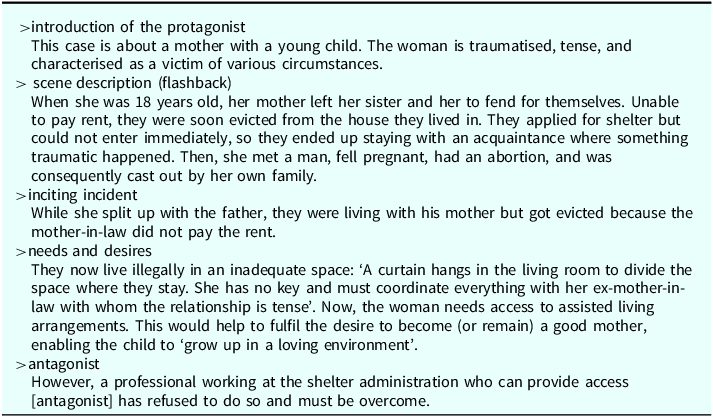
Interestingly, when analysed from a narrative perspective, the introductions almost always contained the storyline elements that are essential for effective plots (Yorke, Reference Yorke2013); there are protagonists, most often a mother and/or child. Inciting incidents disrupt the story worlds of the protagonists thus creating needs. But to fulfil these needs and their ultimate desires, the clients must overcome antagonists, which were often ‘the system’ or professionals embodying the system. We noticed that this use of the narrative conventions of storytelling, as exemplified in Table 2, enabled the introducing professionals to reduce the layered characters and complex situations of clients into simple and relatable stories that imposed meaning in terms of temporality and causality; i.e. X has happened because of Y and therefore Z is an appropriate solution.
Examplary introduction story of Case SP1.2 by a neighbourhood worker, Part 1

We also noticed that storytellers used metaphors to convey a sense of urgency and to induce feelings of compassion. For instance, this was conveyed by depicting a boy sleeping in his car as a ticking time bomb or by sketching a vivid description of suffering. However, from the interviews with both professionals and clients, we also learned that certain story elements were minimised or left out, such as a criminal history and convictions, because these could signify unworthiness and reduce the willingness of the audience to use their discretion to allow a more flexible interpretation of entitlement categories:
I once submitted a case of a young person who came out of detention. But always when it comes to detention, people tend to think that it was intentional and that the perpetrator should consequently sit on the blisters. However, such a boy may as well have had a very difficult life [and may not have had a real choice]. In these cases, people tend to base their judgement on their emotions instead of on their professional judgement. Because the person does not have an attractive story, no exception will be made. -neighbourhood team professional
Arguing for the use of discretion invoking two plot-types
In how the stories were told, we recognised recurring patterns which we analysed to identify different plot-types. To plea for more a lenient interpretation of entitlement categories for a specific client, caretakers used two plot-types: ‘the victim of circumstances’ and ‘the good citizen’.
Plot-type 1: the victim of circumstances
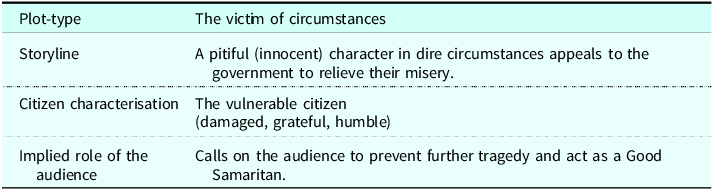
In the first plot-type, ‘victim of circumstances’ (Table 3), the protagonists were primarily pitiful, desperate, and waiting to be rescued. The story was told as a classic ‘tragedy’ story, depicting the downfall of the protagonist that would come true if the audience did nothing. The downfall should be thwarted both to reduce suffering and to prevent the collective costs of more expensive care along the line due to escalation.
The victim of circumstances plot-type

Plot-type 2: the good citizen
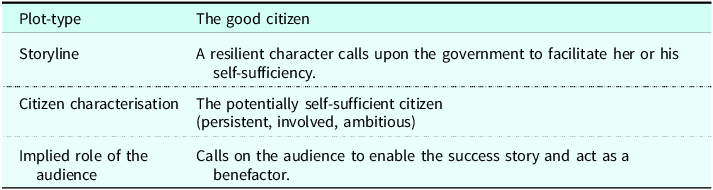
In the second plot-type, ‘the good citizen’ (Table 4), protagonists were resilient, caring, ambitious, and involved in the care process. Also, similar to Lavee’s (Reference Lavee2022) findings, this plot-type echoed notions of active citizenship that are dominant in Dutch policy discourse (Verhoeven & Tonkens, Reference Verhoeven and Tonkens2013), stressing commitment to work, education, or taking care of loved ones. So, whereas ‘the victim of circumstances’ plot-type primarily stressed prevention of costs and suffering, ‘the good citizen’ plot-type also stressed the potential of the client to contribute to society or the economy. This story was generally told along the lines of the ‘defeat the monster’ or ‘quest’ genre, depicting a hopeful future that could be realised if the audience intervened.
The good citizen plot-type

Impact on and response by service providers
Generally, the stories were directed at professionals who described their job position and themselves as ‘service providers’. Professionals who adhered to this identity, which mirrors the ‘state agent’ narrative (Maynard-Moody & Musheno, Reference Maynard-Moody and Musheno2022), attached foremost importance to rule adherence. They do so, however, not to slavishly follow policy, but to represent collective interests most fairly. Consequently, they are quite willing to use their discretion to leniently interpret entitlement categories or invoke a hardship clause if doing so also serves the collective and does not hurt the interests of others.
To understand the reactions of this audience to the plot-types, it is important to first highlight the process of moral positioning in storytelling (De Fina & Georgakopoulou, Reference De Fina and Georgakopoulou2011; Deppermann, 2013). This is the process in which all actors within a story are placed in relation to events and other actors and ascribed with categorical (interrelated) identities, such as doctor/nurse/patient or hero/monster/victim. These identities are associated with certain rights, duties, and moral connotations, and assign meaning to their actions (Ibid.). Accordingly, we found that the stories told by the ‘caregivers’ not only characterised the clients but also framed members of the audience as actors in the story. For these professionals, to be morally positioned in the client-story could evoke strong emotions, both positive and negative. For example, by inviting a member of the audience to play the role of benefactor (in the good citizen story) or the good Samaritan (in the vulnerable citizen story), they could feel proud for doing the right thing. In contrast, if they were framed as ‘the bad guy’ that must be defeated to bring the story to a good ending, this could feel uncomfortable or even painful, as illustrated by a social shelter team leader who felt the need to defend the ‘humanity’ of her colleagues as a reaction to being framed as antagonists:
Don’t forget what this does to our people. We talk to these kinds of people every day. I call my people every day to blow off steam. It is underestimated, we really have a tough task. We’re not talking about packets of butter; we’re talking about people. And our people take that home with them anyway and lie awake at night because of it.
However, because the practice of moral positioning inherently depended on how the story was told, we also saw recurring reactions to the first two plot-types that aimed to reframe the story. If, for example, the client-protagonist’s characterisation, the need, or the antagonist was framed differently, the meaning of (in)action could change, or moral responsibility could be diverted to another professional, to the social network, or to the client herself, thus freeing certain participant(s) of the social pressure to use their discretion. Consequently, further discussions arose about the client-story, leading to two distinct reactions.
Reaction A: finish the story together
In the first reaction of service providers, the plot-type used in the introduction of the case (‘victim of circumstance’ and ‘the good citizen’) was embraced, although some elements, signifying eligibility and/or worthiness, had to be added to enable members of the audience to use their discretion. During the round of questions, for example, they often asked for more information about the scene and/or personal attributes (Is there a passport? Is there an address? Is she motivated? What about parenting skills?), to determine if certain rights/duties were in order. In part, we recognised these questions in relation to the institutional demands of different job positions, that come with certain (bureaucratic) criteria that an acceptable story needs to meet to be able to justify a more flexible interpretation of entitlement categories or to invoke a hardship clause. This included the need to determine the exceptionality of the case (since irregular cases require irregular treatment), what other solutions to fulfil the need were tried, or more information about the social network, and/or preferences of the client.
In many case discussions, slight additions were sufficient to provide an acceptable version of the story and reach a shared understanding, as illustrated by a wrap-up of a project leader: ‘I think we’ve got it covered, to sum it up, I think it’s actually a very obvious story and we just have to see how we are going to approach it practically.’ Multiple interviewees working at the income, housing, and transportation department mentioned that the deliberations and the stories produced in the meetings enabled them to deviate from institutional demands and entitlement criteria that they deem valuable but at times also experience as barriers to “doing good”.
Reaction B: reframing the client story
When members of the audience questioned or disagreed with the initial story (‘victim of circumstance’ or ‘the good citizen’), we also noticed a second type of reaction in which they reframed the story using the ‘not needy enough’ and ‘the bad citizen’ plot-types. These alternative plot-types were generally used by professionals adhering to the ‘service provider’/‘state agent’ narrative to protect policy directives and collective interests. For example, when a plea was made to allow a client access to a shelter, this could conflict with the (perceived) interests of other clients with equal or greater needs. Especially when it concerned access to very scarce resources such as housing, discussions about the characterisation and deservingness of the client protagonist arose. This occurred less often if it concerned a service such as special allowances or taxi services, which could only ‘hurt’ more abstractly in the sense of collective affordability of care.
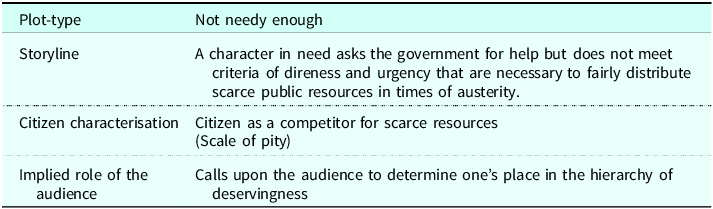
Alternative plot-type for reframing the client story: not needy enough
The plot-type ‘not needy enough’ (Table 5) focused on entitlement in relation to other clients, whose needs might be equally or more dire. An example of the ‘not needy enough’ plot-type could be found in the round of questions after the introduction of Case Sp1.2 (Table 2). In recent years, in the Netherlands, a distinction has been made between those who are ‘homeless’ (people living on the street) and ‘couch-sleepers’ (people who are homeless but still have a place to sleep). As this distinction determines whether someone is entitled to certain services, this was used by a shelter employee to reframe the story and divert the antagonist role. For her, not giving a particular client access did not make her ‘the bad guy’ because she also guards the interest of others who might be more deserving:
To us, this lady is a couch sleeper. However unpleasant her situation might be, it is still better than sleeping under a bridge. If all couch sleepers would come and knock at our door, it just wouldn’t work. We have to select the very worst cases. It may be better for her to remain a couch sleeper, as the shelter is no picnic.
Not needy enough plot-type

Alternative plot-type for reframing the client story: ‘the irresponsible citizen’
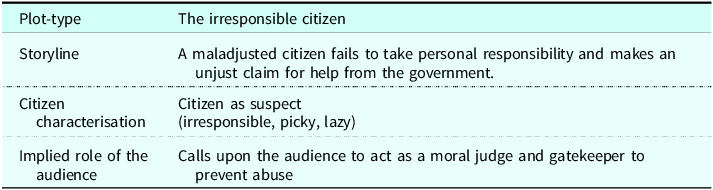
‘The irresponsible citizen’ plot-type (Table 6), in which deservingness is discredited based on individual flaws, (signifiers of unworthiness), is the second plot-type used for reframing.
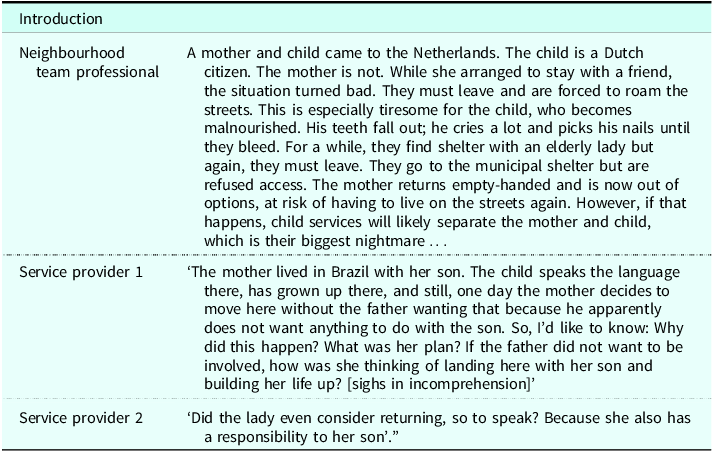
An example of reframing with this plot-type can be found in the discussion of Case Hs15. This case was first introduced as a typical tragedy story using the victim of circumstances story, as displayed in Table 7. In response to this introduction, a service provider started asking questions about the Dutch father: what was his role in the story and why didn’t he take responsibility? The neighbourhood team worker explained that the father lives abroad and does not want to be involved. Then, as a plot twist, the service provider, supported by a colleague, reframed the antagonist by pinpointing an internal moral flaw of the mother. Mirroring the irresponsible citizen plot-type, she implied that the mother is no victim but a culprit who herself is to blame for their predicament and who fails to take personal responsibility.
The irresponsible citizen plot-type

Example of reframing

Similar dynamics were found in other case discussions where introductory pleas were contested with storylines that questioned individual decisions. On the one hand, victimhood and notions of good citizenship served to signify worthiness and to make the intended audience embrace the ‘victim of circumstances’ or ‘the good citizen’ plot-type and use their discretion to best help the client. On the other hand, a lack of urgency, culpability, a lack of personal responsibility, and moral inferiority were used to signify unworthiness and to reject the stories that framed the use of discretion to enable a more flexible interpretation of entitlement categories as the right thing to do.
Resolutions
After an introductory story was reframed with the alternative two plot-types, this necessitated the intended audience (often the introducing professionals and the project leaders) to respond. They could affirm the story and come to an agreement. For example, that it would indeed not be fair to a person sleeping under a bridge to allow a ‘couch sleeper’ to go to the shelter. In other instances, the story could be reframed again. For example, by moving the story away from the ‘irresponsible mother’ towards ‘the innocent child’. This continued deliberation could eventually lead either to agreement or stalemate disagreement about the story and the preferred course of action. In most case discussions, participants seemed to come to an agreement and a (temporary) resolution. However, from the interviews, we learned that discussions often flared up again and continued after the case meetings. This indicates that the case discussions we observed were a snapshot in a longer trajectory with recurring moments of collective meaning-making. This dynamic process shows how client-stories can be constructed in continuous deliberations, and function as both frameworks to distribute responsibilities and as frameworks to underpin the use of discretion to tailor public services in accordance with the complex needs of citizens.
Discussion
Across advanced democracies, ‘personalisation’ is a theme in welfare state reforms (Needham, Reference Needham, Evans and Hupe2020, p.295) Instead of a ‘one size fits all’ approach, tailored service delivery is expected, with a focus on the whole person. SLBs (e.g. a casemanager) are responsible for coordinating these personalised services across care, health, employment, and housing (Ibid, p.303). On the one hand, this increases the discretion of these SLB’s (Ibid.). On the other hand, it makes them more dependent on the cooperation with other SLB’s from other organisations and departments with different interests and perspectives on providing adequate services (Zacka, Reference Zacka2017). Discretion is therefore increasingly socially constructed, with the need to mobilise consensus for collective action, requiring new skills.
Our narrative analysis of inter-departmental case discussions shows the importance of storytelling skills for collective sensemaking and deliberation. By sharing client-stories, SLBs collectively navigated tensions between policy directives and available means and, with varying results, tried to bring their perspectives together to justify and decide whether it was right to use discretion for a more lenient interpretation of entitlement categories. The plot-types used show that there are patterns or maybe even restrictions that determine which stories are or can be told about citizen-clients. Hence, our study confirms previous findings that the stories that SLBs tell and adhere to on the street-level, are not produced in a vacuum. Instead, they are situated constructions that reflect the multilayered and sometimes conflicting meanings prescribed by the social organisation of their work (Volckmar-Eeg & Vassenden, Reference Volckmar-Eeg and Vassenden2022), the disciplinary regimes in which they work (Lavee, Reference Lavee2022), and grand narratives regarding citizenship and solidarity (Verhoeven & Tonkens, Reference Verhoeven and Tonkens2013).
Our analysis confirms earlier studies that show that SLBs determine a client’s worthiness based on client-characteristics, such as attitude, guilt or innocence, and direness and urgency (Loyens & Paraciani, Reference Loyens and Paraciani2021; Maynard-Moody & Musheno, Reference Maynard-Moody and Musheno2022). However, we also argue that ‘worthiness’ should not be understood only in terms of objective client characteristics that can be observed by every SLB in the same way. Rather, these characteristics can equally be viewed as the products of collective and negotiated social constructions by SLBs. We found, for example, that the very same client can be either a victim or a culprit depending on how their story is told. This framing significantly influenced how certain characteristics of the clients were foregrounded in the story, as well the determination of ‘worthiness’. Additionally, we observed that the client-story entailed more than just a characterisation of the client. The stories we studied in case discussions depicted a construction of the client’s past, present, and future, which helped to bring cohesion to a complex situation. In the case of multi-problem clients, many different problems interact, and it is not always clear to the SLBs involved in the case what the underlying problem is that needs to be tackled first to create a new future perspective for the client. When SLBs with diverse backgrounds were able to create a shared client story, this story functioned as an important basis upon which to act.
Previous studies have already concluded that the emotions of SLBs play an important role in how they interact with clients and use their discretion (Halliday, Reference Halliday2021). Volckmar-Eeg & Vassenden (Reference Volckmar-Eeg and Vassenden2022) found, for example, that SLBs rely on their emotions as a form of embodied knowledge when choosing what cases to prioritise. To date, SLBs’ emotions have primarily been studied in relation to client characteristics and at the interface of client-professional (e.g. Drury, Reference Drury2019; Kampen et al., Reference Kampen, Hölsgens, Tonkens, Bredewold, Duyvendak and Kampen2018; Dubois, Reference Dubois2016, p.112–116). Our findings suggest, however, that SLBs also influence each other’s emotions through storytelling, thus affecting their use of discretion and their decision-making (also see: Orr & Bennett, Reference Orr and Bennett2017). Two patterns were observed. Firstly, they worked on each other’s emotions about the client. For example, by referring to the ‘victim of circumstances’ and the ‘the good citizen’ plot-types, SLBs promoted feelings of sympathy and compassion for the client which, as Dubois shows (2016, pp.112–116), is likely to increase their feelings of responsibility for solving the client’s distress. Secondly, they worked on the emotions of other SLBs by morally positioning them in certain roles (Deppermann, 2013), which evoked emotions ranging from anger and frustration to pride and joy. For example, SLBs could be positioned as the bad guys in the story by embodying a bureaucratic and rigid system that hindered a client from flourishing. In other instances, SLBs could be framed as the benefactor/good Samaritan who could avert a tragedy and bring the story to a good ending, if only they would use their discretion for a more lenient interpretation of entitlement categories. In the latter case, SLBs were more inclined to show positive emotions, such as joy, whereas in the former case, SLBs often reported feelings of frustration and hurt during the interviews, as they did not feel recognised or valued by their colleagues. Our analysis also shows that in the context of storytelling the use of the ‘caretaker’ and ‘service provider’ labels (mirroring the state-/citizen agent narrative) was not neutral but used as a form of identity and emotion work (also see: Dubois, Reference Dubois2016; Hochschild, Reference Hochschild1979). Hence, the affective dimensions of storytelling should be taken more seriously.
This study shows that worthiness of responsive service provision is discussed and negotiated in these storytelling deliberations. Consequently, as responsiveness is promoted in social policy, storytelling skills might become more important in interdisciplinary and interdepartmental organisations. We argue that this comes with opportunities as well as risks. An opportunity for SLBs is that storytelling creates space to care for citizens who fall between the cracks of the bureaucratic siloed system. With storytelling, professionals can help each other to see the client less abstractly and more holistically. Our analysis adds to recent research that shows that discussions of hard-to-resolve cases can help to signal rule conflicts and obstructive jurisdictional boundaries in social care (Sabel et al., Reference Sabel, Zeitlin and Helderman2024). We found that SLBs are often well equipped to tell stories that show for whom and how social policy does not work out as intended. Furthermore, we observed that the telling of a good client story can have a strong emotional appeal and create a sense of urgency for policy-makers to improve social policy. Hence, stories can function as a catalyst for change.
Our analysis also shows the possible ‘dark sides’ of storytelling. A potential risk is that an overreliance on storytelling in responsive service provision may exclude groups of people who do not display the characteristics or behaviour needed to frame them as ‘the good citizen’ or ‘the victim of circumstances’, while situations of poverty and hardship simultaneously make it hard for them to display these behaviours, thus increasing inequality (Mullainathan & Shafir, Reference Mullainathan and Shafir2012; Koekkoek et al., Reference Koekkoek, Hutschemaekers, van Meijel and Schene2011). Furthermore, we found that for SLBs, responsiveness does not only mean the unlimited use of discretionary space to be responsive to client needs. Discretion to be responsive is restricted by a context of austerity that inhibits them from fulfilling all their clients’ needs. According to some service providers in our study, it would be better to problematise the austerity that necessitates them to refuse clients access to care even if they might need it. Instead, they plead for policy measures to reduce austerity so they can provide adequate care based on social rights.
This study has some limitations. The storytelling practices described in this study took place in the context of a policy experiment and do not necessarily reflect storytelling practices in regular work settings. Because storytelling practices are influenced by organisational and policy contexts, our findings may not hold true for different cities and cultural contexts. While the plot-types we found mirror basic plot-types and stories known in the literature (Yorke, Reference Yorke2013; Booker, Reference Booker2004), it is likely that in another time and place, the storytelling would be different and might serve different purposes. Future research might therefore investigate SLBs’ collective storytelling in different contexts.
Acknowledgements
This work was made possible by the municipality of Rotterdam. Special thanks go to the social workers, policy employees, and clients who contributed to the experiment and our research and to the members of CARE lab Rotterdam.
Competing interests
The authors declare none.

 Open access

