





1. Introduction
Over the past two decades, a wealth of studies has investigated how the grammatical gender of personal nouns influences the inferred gender of the individuals they refer to. This line of inquiry stems from both theoretical questions in anaphor resolution, and practical concerns regarding which linguistic forms promote more gender-balanced representations. The present study aims at contributing to the latter line of inquiry.
Masculine generic
Within this field of research, particular attention has been paid to the masculine generic, a grammatical convention whereby masculine forms can refer to individuals or groups of unknown or irrelevant gender, or to mixed-gender groups. Masculine generic is considered standard according to descriptive grammars of contemporary French (Abeillé & Godard, Reference Abeillé and Godard2021, chapter 4, section 2.2.1). For instance, “les chercheurs” (‘researchersMASC’) can denote a group of both men and women, or even, in some cases, a group composed exclusively of women. We therefore distinguish a masculine-generic use of the masculine form, such as:

from a masculine-specific use:

There is now robust evidence that, when a sentence refers to a person or group whose gender is not previously known, masculine-generic forms tend to elicit masculine-specific interpretations (Brauer & Landry, Reference Brauer and Landry2008; Braun et al., Reference Braun, Gottburgsen, Sczesny and Stahlberg1998, Reference Braun, Sczesny and Stahlberg2005; Gygax et al., Reference Gygax, Gabriel, Sarrasin, Oakhill and Garnham2008; Stahlberg et al., Reference Stahlberg, Sczesny and Braun2001; Tibblin et al., Reference Tibblin, Weijer, Granfeldt and Gygax2022; Xiao et al., Reference Xiao, Strickland and Peperkamp2023). This has been demonstrated using experimental paradigms such as sentence-evaluation tasks, in which participants need to read two sentences and to judge as quickly as possible if the second sentence is a sensible continuation of the first one (Tanenhaus & Carlson, Reference Tanenhaus and Carlson1985, Reference Tanenhaus and Carlson1990). In Gygax et al. (Reference Gygax, Gabriel, Sarrasin, Oakhill and Garnham2008), for instance, participants read a sentence using masculine generic such as

followed by a continuation specifying the gender of some individuals in the group

When the continuation referenced women, readers took on average 242 ms longer to process the sentence and accept it as a coherent continuation, compared to when the continuation referenced men. This result suggests that masculine-generic forms initially trigger a masculine-specific interpretation: although readers were ultimately able to judge the feminine continuation as correct, revising their initial interpretation involved additional processing, resulting in longer response times. In situations where no explicit question about gender or general coherency is asked, such self-correction may not occur, leading to a default masculine bias when masculine generic is used. This effect has been observed in various settings, such as political surveys (Brauer & Landry, Reference Brauer and Landry2008; Stahlberg & Sczesny, Reference Stahlberg and Sczesny2001), questions about favorite public figures in a particular domain (Brauer & Landry, Reference Brauer and Landry2008; Stahlberg & Sczesny, Reference Stahlberg and Sczesny2001), and tasks requiring participants to describe a prototypical individual of a given category (Brauer & Landry, Reference Brauer and Landry2008) or to gauge the proportion of women in a group (Hansen et al., Reference Hansen, Littwitz and Sczesny2016; Tibblin et al., Reference Tibblin, Weijer, Granfeldt and Gygax2022; Xiao et al., Reference Xiao, Strickland and Peperkamp2023).
Gender-fair writing
A possible solution to eliminate this asymmetry is to make both the masculine and feminine markings visible through the use of double forms such as “chercheurs et chercheuses” (‘researchersMASC and researchersFEM’), or reduced double forms such as “chercheur·euses” (‘researchersMASC·FEM’). In a recent study, Spinelli et al. (Reference Spinelli, Chevrot and Varnet2023) used the sentence evaluation paradigm to measure the gender bias induced by reduced double forms in the initial sentence. The results showed that this form effectively eliminated the masculine bias, resulting in comparable reaction time for masculine and feminine continuations. This effect has been replicated across experimental designs, suggesting that increased salience of feminine markers can shift interpretation (Tibblin et al., Reference Tibblin, Weijer, Granfeldt and Gygax2022, Reference Tibblin, Granfeldt, van de Weijer and Gygax2023; Xiao et al., Reference Xiao, Strickland and Peperkamp2023).
Hybrid nouns
The present study investigates a different category of generic terms, referred to as hybrid nouns. Hybrid nouns are personal generic nouns with a fixed grammatical gender, either masculine or feminine (Storme & Delaloye Saillen, Reference Storme and Delaloye Saillen2024). This category includes particular nouns that are formed through metonymy [such as “un nez” (‘a noseMASC’) when referring to a perfumer, or “une autorité” (‘an authorityFEM’) for someone in power] and metaphors [“un mouton” (‘a sheepMASC’) when referring to someone who blindly follows others] as well as depreciative terms [“une crapule” (‘a scoundrelFEM’), “une brute” (‘a bullyFEM’)], and military roles [“une sentinelle” (‘a sentinelFEM’), “une recrue” (‘a recruitFEM’)](Elmiger, Reference Elmiger2019; Yaguello, Reference Yaguello2014). They also include very common terms such as “une personne” (‘a personFEM’), “un individu” (‘an individualMASC’), “un bébé” (‘a babyMASC’). In his comprehensive account of grammatical gender systems, Corbett (Reference Corbett1991) distinguished between two categories of hybrid nouns. Although most hybrid nouns can in principle be referred to with either a masculine or a feminine pronoun (for instance, “la sentinelle” can be followed by either “il” or “elle”), some of them accept agreement with only one grammatical gender (for instance, “la personne” can only be followed by “elle”, even when referring to a man).Footnote 3
As noted very early on, hybrid nouns are instrumental for experiments on the processing of grammatical gender (Cacciari et al., Reference Cacciari, Carreiras and Cionini1997). Storme & Delaloye Saillen (Reference Storme and Delaloye Saillen2024) highlight two key advantages over masculine generics terms. First, hybrid nouns can be either grammatically masculine or feminine, thus allowing for a more comprehensive test of the influence of grammatical gender. In particular, feminine hybrid nouns may help determine whether the well-documented masculine bias has a feminine counterpart. Interestingly in this regard, Tibblin et al. (Reference Tibblin, Granfeldt, van de Weijer and Gygax2023) noted that reduced double forms such as “les voisin·es” (‘neighboursMASC·FEM’) elicit a small feminine bias, possibly because feminine markings are more salient than male markings in this case. Similar effects have been observed in other languages (Körner et al Reference Körner, Abraham, Rummer and Strack2022; Stahlberg & Sczeny Reference Stahlberg, Sczesny and Braun2001), although they don’t seem to be consistent across studies (Xiao et al. 2022; Spinelli et al. Reference Spinelli, Chevrot and Varnet2023). This effect of feminine markings suggests that feminine hybrid nouns might elicit a measurable feminine bias.
Second, hybrid nouns cannot be inflected for gender. This is a noteworthy feature as it allows us to disentangle two competing explanations for the effects observed with masculine generics. One possibility is that the brain uses grammatical gender as a cue for inferring the referred person’s gender. If this is true, then masculine hybrid nouns should elicit a male bias in the same way as masculine generic forms. Alternatively, the male bias observed with masculine generics might stem from the presence of an implicit feminine competitor. In this view, readers make a pragmatic inference: since the feminine form was not used, the masculine interpretation is more likely to have been intended. If this explanation holds, then masculine hybrid nouns – which lack a feminine counterpart – should not trigger a masculine bias.
Several studies have used hybrid nouns to explore the processing of grammatical gender (Cacciari et al., Reference Cacciari, Carreiras and Cionini1997, Reference Cacciari, Corradini, Padovani and Carreiras2011; see also Kim et al., Reference Kim, Angst, Gygax, Gabriel and Zufferey2023; Tibblin et al., Reference Tibblin, Weijer, Granfeldt and Gygax2022, Reference Tibblin, Granfeldt, van de Weijer and Gygax2023 although these last three studies only included a few hybrid nouns in their materials as part of a broader “gender-neutral” condition). Using a protocol similar to the sentence evaluation paradigm, but without requiring participants to make explicit judgements, Cacciari et al. (Reference Cacciari, Carreiras and Cionini1997) demonstrated on a small set of 13 Italian hybrid nouns that a mismatch between grammatical gender and the referred person’s gender leads to longer reading times for the second sentence. However, to date, only one study has contrasted grammatically masculine and feminine hybrid nouns.Footnote 4 Storme & Delaloye Saillen (Reference Storme and Delaloye Saillen2024) presented participants with French sentences containing a hybrid noun and then asked them to rate the perceived age, gender, and education level of the person mentioned on a 1–7 scale. Notably, the hybrid nouns were selected from synonym pairs of both genders such as “personne”/“individu” (‘personneFEM’/‘individualMASC’), “tête”/“cerveau” (‘headFEM’/‘brainMASC’), “dépouille”/“cadavre” (‘dead bodyFEM’/‘corpseMASC’), which allowed the researchers to treat the item as a random effect in the analysis. Overall, the results revealed a clear asymmetry between masculine and feminine hybrid nouns: while the former elicited more masculine interpretations, the latter were not female-biased in general. This pattern echoes observations reported by Brauer and Landry (Reference Brauer and Landry2008) for the pair “personne”/“individu”.
The present study
The present study addresses the same research question as Storme & Delaloye Saillen (Reference Storme and Delaloye Saillen2024) using a sentence evaluation paradigm. This task offers two advantages over gender ratings on a Likert scale. First, it is more implicit as it requires participants to detect semantically anomalous continuations regardless of grammatical gender. Therefore, participants are less likely to infer the purpose of the study and adjust their responses accordingly. Second, reaction time measurements are less affected by ceiling and criterion effects than Likert ratings, and may provide more precise data, as they are based on continuous rather than discrete values.
As outlined above, this study aims to test two specific research hypotheses. The first hypothesis pertains to the existence of a feminine counterpart to the well-documented masculine bias induced by masculine generic forms. If such a feminine bias exists, we would expect longer reaction times for masculine than for feminine continuations following a feminine hybrid noun. The second hypothesis examines the role of gender inflection in triggering the masculine bias. If the existence of a feminine alternative is not necessary for the bias to emerge, we should observe longer reaction times for feminine than masculine continuations following a masculine hybrid noun. Furthermore, the percentage of correct responses in the task is expected to reflect patterns similar to those observed in reaction times, though the former measure may also involve more explicit processing.
2. Methods
The experimental and analysis protocols were identical to those described in Spinelli et al. (Reference Spinelli, Chevrot and Varnet2023). All data are publicly available on Zenodo, and the corresponding analysis scripts are accessible on GitHub at https://github.com/LeoVarnet/HybridNouns.
Participants
Sixty-eight psychology students (62 women, 6 men) at Grenoble-Alpes University, participated in this study for course credit. They were all French native speakers and had either normal or corrected vision. No participants were excluded from the analysis.
Simulations using the same Bayesian hierarchical modeling approach as the present study confirmed that this sample size provides sufficient sensitivity to detect an effect of similar magnitude as found in previous sentence-evaluation experiments on the effect of masculine generic forms (Cohen’s dz ≈ 0.3). These simulations also indicated that the model can reliably identify effects as small as dz = 0.1 in artificially generated datasets, assuming no effect of condition and no interaction, further supporting the adequacy of the current sample size.
Stimuli
In order to prepare the list of stimuli, we first aimed to collect as many masculine and feminine hybrid nouns as possible. Since no comprehensive resource was available, we initiated a collaborative crowdsourcing effort through the Mastodon social media platform, inviting users to contribute terms via a shared notepad. The compiled and curated list is included in the Github repository. We excluded from this list insults, words that are not particularly frequent in everyday language, and terms that were obviously associated to gender stereotypes [such as “magnat” (‘tycoonMASC’) or “sentinelle” (‘sentinelFEM’)]. Twenty-two masculine hybrid nouns and twenty-two feminine hybrid nouns were selected to be used as stimuli. Although no pre-testing was conducted for selecting the items, two separate post-tests were designed to assess the stereotypically of the concept associated with each noun. Eighteen native French speakers were asked to rate, on a 0%-100% scale, the extent to which each of the 44 hybrid nouns referred to men or to women. Nouns were presented without a determiner, and filler items were also included in the list. Participants were divided equally between two questionnaires: one asking for an estimated proportion of men, and the other for an estimated proportion of women. Because the obtained measure may itself have been influenced by the grammatical gender of the hybrid nouns, a second post-test was conducted with native English speakers who performed the same task on English translations of the French hybrid nouns. The results of both post-tests are reported in the Annex.
One hundred and thirty-two sentence pairs of context sentence/continuation sentences were presented for each participant. Twenty-two context sentences contained a feminine hybrid noun. Half of these sentences were followed with a female character described in the continuation sentence and the other half with a male character, such as:

Twenty-two context sentences contained a masculine hybrid noun. Half of these sentences were followed with a female character described in the continuation sentence and the other half with a male character

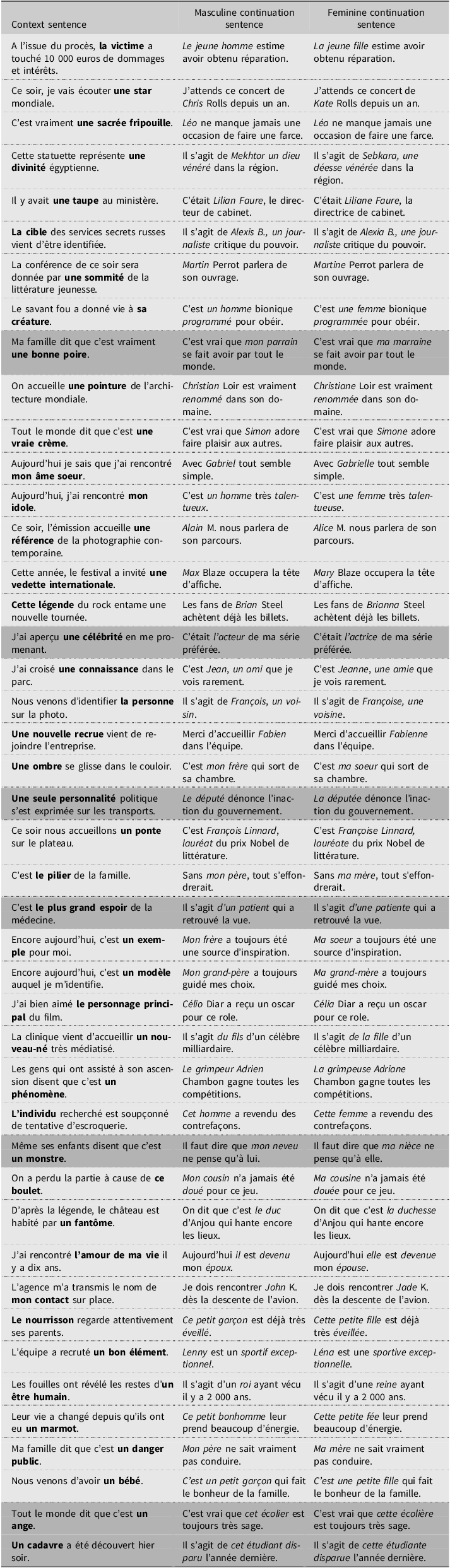
These pairs correspond to the 44 experimental pairs and each continuation sentence constituted a good continuation of the context sentence, hence expecting a “yes” response (see the complete set of stimuli in Annex). They were balanced between two lists such that, for each sentence, one group of participants was presented with the feminine continuation, and the other one with the masculine continuation.Footnote 5 Participants were also presented with 44 sentence pairs for which continuation sentences constituted bad continuations of the context sentences, hence expecting a “no” responses:

Half of these incorrect sentence pairs included a masculine hybrid noun and the other half a feminine hybrid noun.
Finally, 44 filler sentence pairs were added so that participants would not become accustomed to the structures of the experimental items

In half of these items, the continuation sentence was a good continuation of the context sentence whereas in the other half it was not the case.
In similar sentence evaluation paradigms, other researchers have designed more constrained and standardized materials following a fixed sentence structure (e.g., Tibblin et al., Reference Tibblin, Granfeldt, van de Weijer and Gygax2023). Our goal, however, was to draw broad conclusions about the comprehension of hybrid nouns rather than to test processing of a narrowly defined structure. Furthermore, hybrid nouns refer to a wide range of entities making it practically impossible to create a full set of natural-sounding sentences within a highly constrained structure. Finally, a pilot test indicated that the use of fixed sentence structure allowed some participants to perform the task without reading the full sentences, by extracting only the relevant information always displayed approximately in the same position on the screen. For these three reasons, we deliberately chose to include heterogeneous materials, in particular by varying the position of the hybrid noun in the first sentence.
Due to human error, five sentences were modified before the testing began in a manner that could have rendered the masculine continuation interpretable as a masculine generic. To prevent this potential confound, these sentences were excluded from subsequent analyses. In addition, two sentences were found to be syntactically too complex, leading to excessively long response times on average, and were also removed. A follow-up analysis confirmed that the overall pattern of results remained consistent regardless of whether these seven sentences were included or excluded.
Procedure
The experiment took place in a quiet experimental booth at Grenoble Alpes University. Participants were seated ∼50 cm from a computer screen. They were informed that they would read a succession of sentences, in pairs, and that they would have to determine as quickly as possible whether the second sentence was a good or bad continuation of the first one. The experiment was run on E-Prime 2.0 software (Psychology Software Tools, Pittsburgh, PA). The first sentence (context sentence) remained on the screen for 3 s. It was then replaced by the second one (continuation sentence). The participant then had to respond as quickly as possible whether the second sentence was a correct continuation of the first one by using one of the two keys on the keyboard (“N” for good continuation and “C” for bad continuation for right handed participants; reversed for left-handed participants). The intertrial interval was 2 s. The experiment began by five practice trials followed by a list of 132 trials that were randomly presented. The experimenter remained in the same room as the participant, but was positioned so that he could not see the participant’s responses. The experiment lasted around 15 minutes.
Analysis
Data were analysed through Bayesian hierarchical mixed effects. All analyses were conducted in R using package Rstan for Bayesian model fitting. The same analysis scripts as Spinelli et al. (Reference Spinelli, Chevrot and Varnet2023) were used. The next paragraph is a short description of the model; readers should refer to Spinelli et al. for more details about the model specifications.
Firstly, reaction times for all positive responses were examined.Footnote 6 Reaction times were z-scored, then fitted with a linear hierarchical model including fixed effects corresponding to the grammatical gender of the hybrid noun in the first sentence (condition; 1=FEM, 0=MASC) and to the gender of the term in the second sentence (gender; 1=FEM, 0=MASC), as well as the interaction between the two (condition×gender). The model also included random effects for participant and item, implemented as a hierarchical prior on the intercept. In line with prior sentence evaluation studies, the number of characters was not included in the model, as it only shows minimal variation between masculine and feminine continuation sentences.
The equation of the model for z-scored response times is:
 $$\eqalign{ & RTz = {\alpha _{participant,item}} + {\beta _{condition}} \cdot condition + {\beta _{gender}} \cdot gender \cr & \quad\;\;\quad + {\beta _{condition \times gender}} \cdot condition \cdot gender + \varepsilon}$$
Where $\varepsilon\sim N\left( {0,\sigma } \right)$
. Each pair of a specific participant and a specific item was associated with a unique intercept
$\varepsilon\sim N\left( {0,\sigma } \right)$
. Each pair of a specific participant and a specific item was associated with a unique intercept ${\alpha _{participant,item}}$
which was defined as the combination of three terms:
${\alpha _{participant,item}}$
which was defined as the combination of three terms: ${\alpha _{participant,item}} = {\beta _0} + {\beta _{participant}} + {\beta _{item}}$
with ${\beta _{participant}}\sim N\left( {0,{\sigma _{participant}}} \right)$
and
${\beta _{participant}}\sim N\left( {0,{\sigma _{participant}}} \right)$
and ${\beta _{item}}\sim N\left( {0,{\sigma _{item}}} \right)$
. Weakly informative, conservative distributions
${\beta _{item}}\sim N\left( {0,{\sigma _{item}}} \right)$
. Weakly informative, conservative distributions ${\beta _X}\sim N\left( {0,1} \right)$
were used for all fixed-effect parameter and for the hyperprior
${\beta _X}\sim N\left( {0,1} \right)$
were used for all fixed-effect parameter and for the hyperprior ${\beta _0}$
. The dispersion of the participant-specific and item-specific parameters (
${\beta _0}$
. The dispersion of the participant-specific and item-specific parameters ( ${\sigma _{participant}}$
and
${\sigma _{participant}}$
and ${\sigma _{item}}$
) was associated with a prior distribution Gamma(2, 0.1), enforcing the pooling of information to improve estimation. The same prior was used for
${\sigma _{item}}$
) was associated with a prior distribution Gamma(2, 0.1), enforcing the pooling of information to improve estimation. The same prior was used for $\sigma$
.
$\sigma$
.
The model for percent correct followed the same hierarchical structure, with a binary outcome corresponding to the correctness of the participant’s response (Spinelli et al., Reference Spinelli, Chevrot and Varnet2023). The linear combination of factor was then transformed into a probability of correct response through a logistic function, with a lower asymptote corresponding to a probability of correct answer equal to 0 and an upper asymptote to a probability of $1 - {p_{miss}}$
, therefore accounting for a certain proportion of lapse (assumed to be the same across all participants, for simplicity). The probability
$1 - {p_{miss}}$
, therefore accounting for a certain proportion of lapse (assumed to be the same across all participants, for simplicity). The probability ${p_{miss}}$
was estimated from the data using a weak Beta (5, 10) prior.
${p_{miss}}$
was estimated from the data using a weak Beta (5, 10) prior.
All analyses were carried out with R version 4.3.0 (R Core Team, 2022), using the RStan interface to STAN for Bayesian modeling (Carpenter et al., Reference Carpenter, Gelman, Hoffman, Lee, Goodrich, Betancourt, Brubaker, Guo, Li and Riddell2017; Stan Development Team, 2020). Seven chains of 7,000 samples each were run independently (3,000 burn-in samples, estimates based on 4,000 samples). Their convergence was monitored through standard summary statistics R-hat and Effective Sample Size, absence of divergent transition, and visual inspection of posterior distributions. Throughout this article, Bayesian estimates will be reported along with their 95% credible intervals, providing an assessment of the reliability of the results. All the codes and data supporting this analysis are openly available on Github at https://github.com/LeoVarnet/HybridNouns.
3. Results
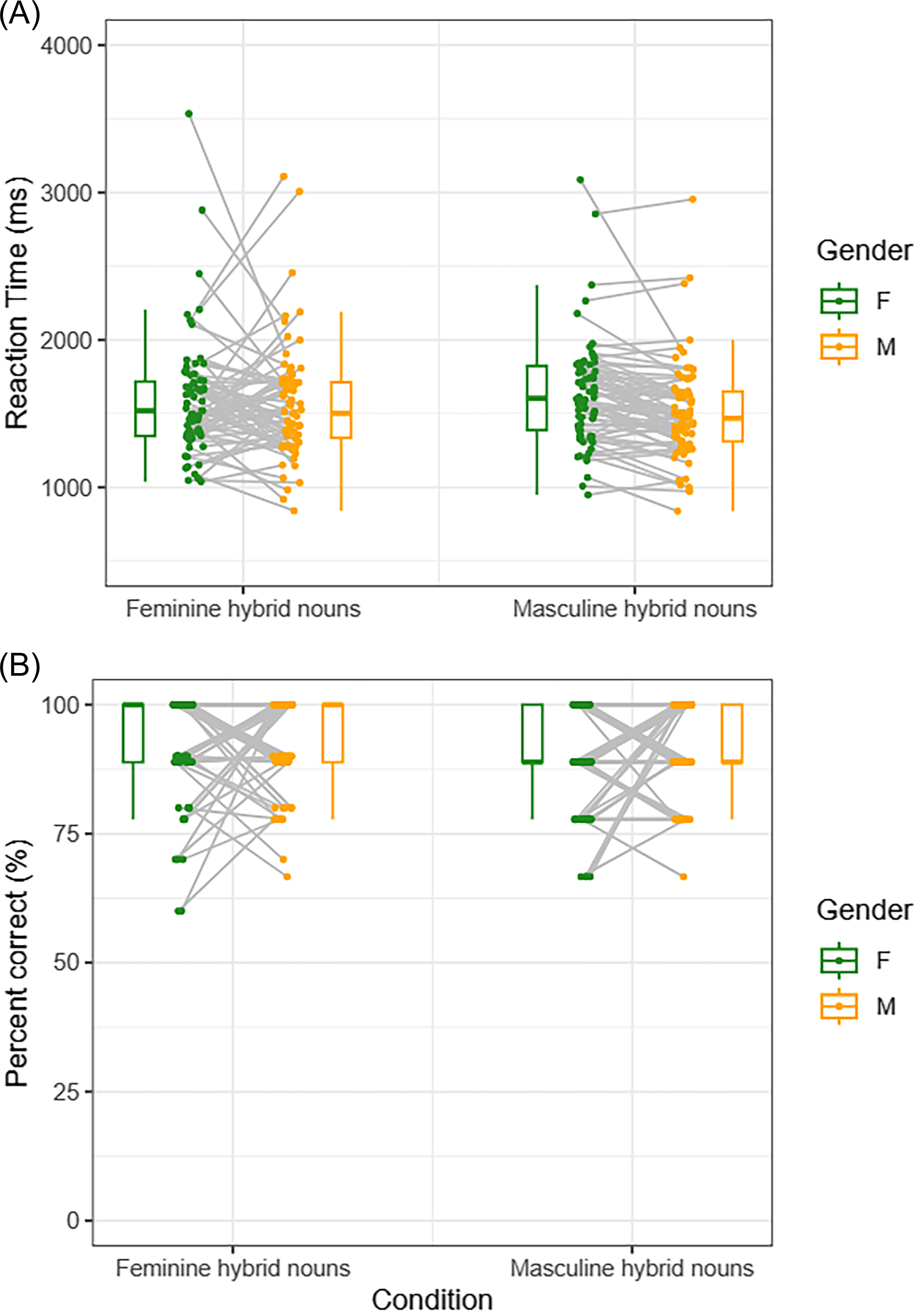
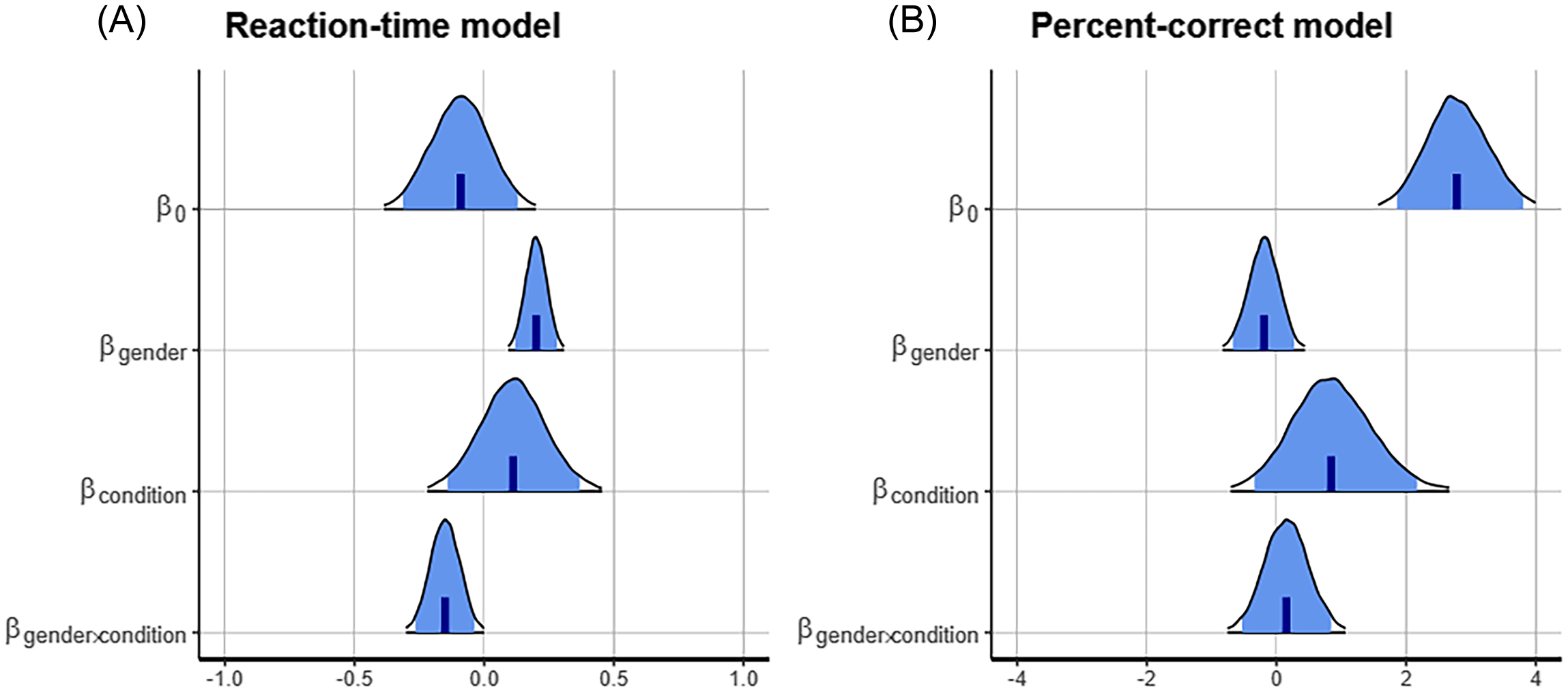
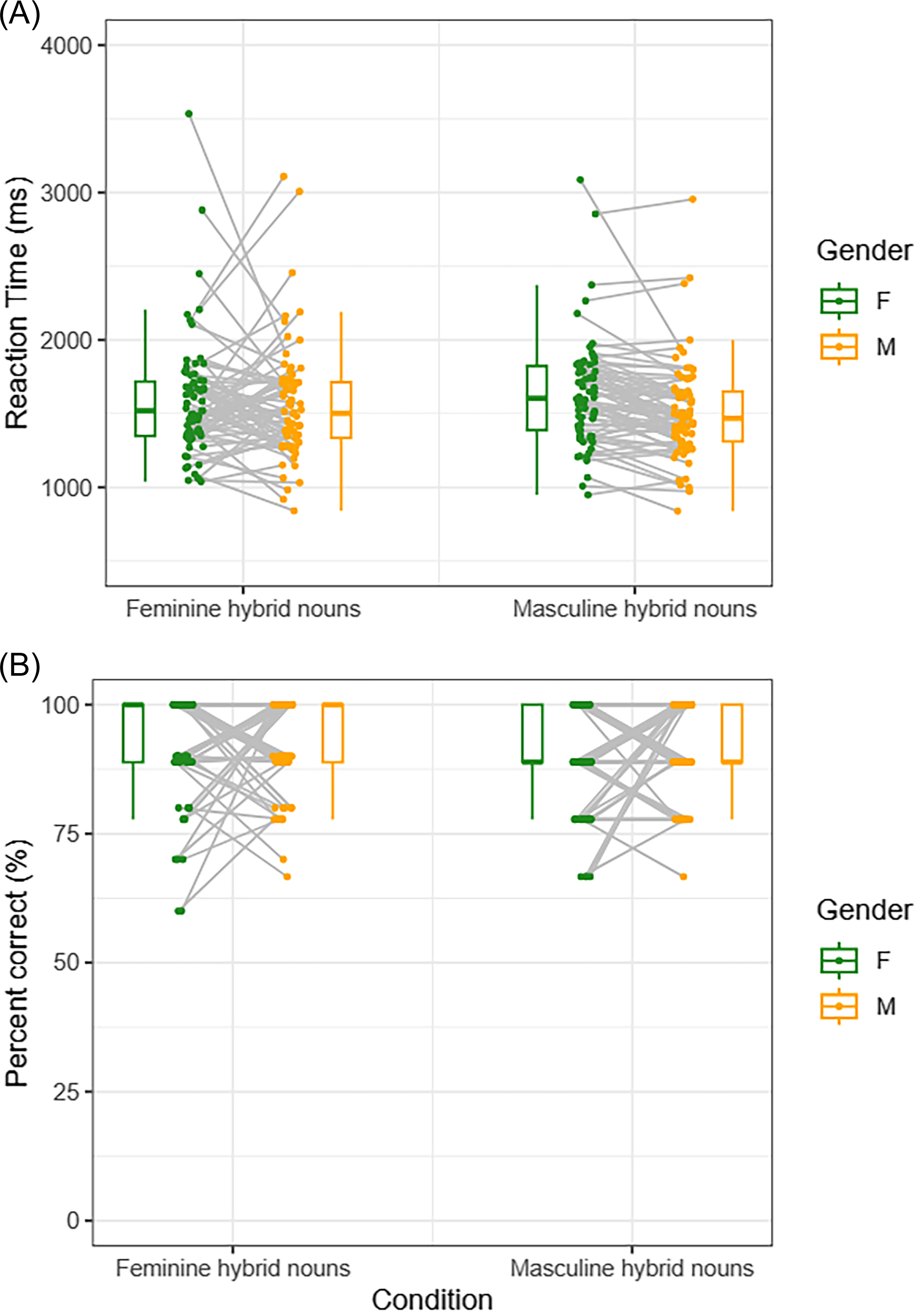
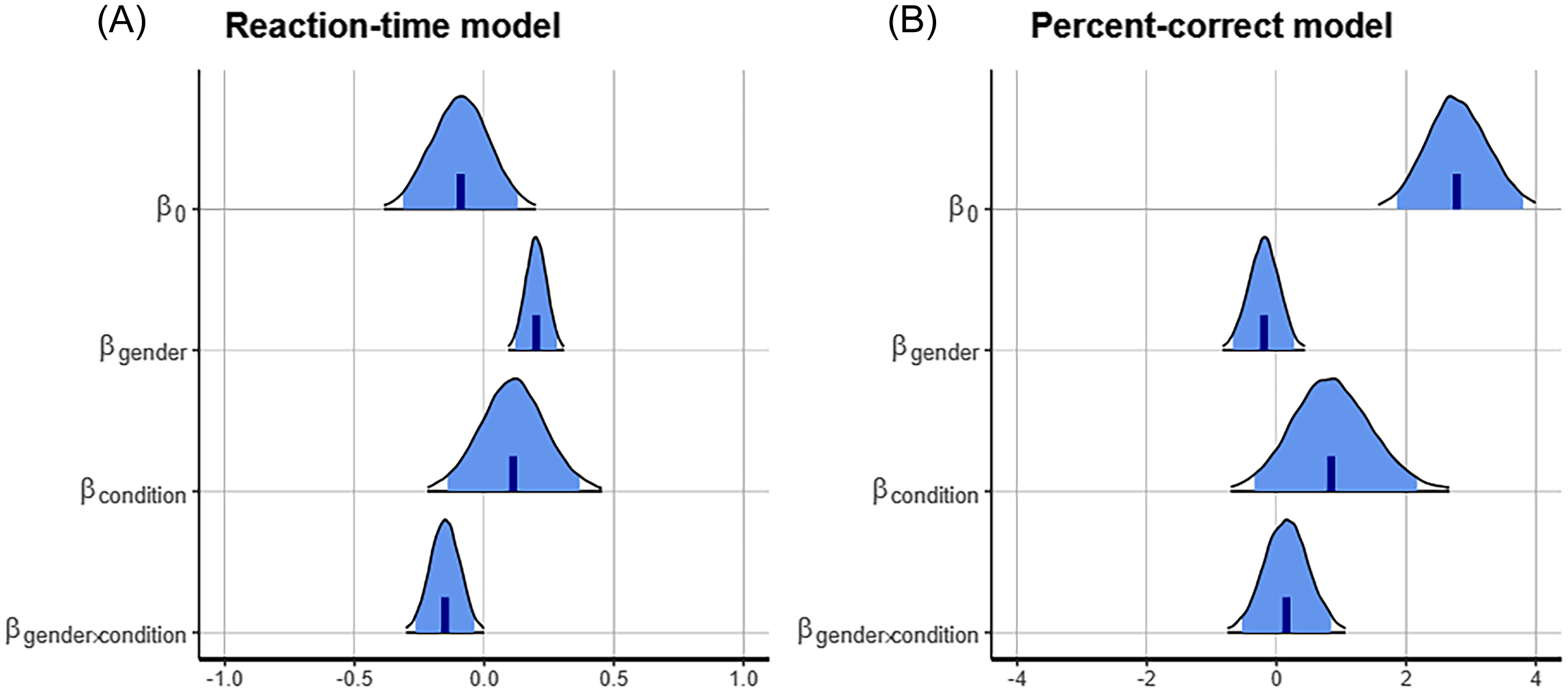
Response times and percent correct data, averaged by participant, condition and grammatical gender of the continuation, are shown in Figure 1. Although there was a large variability in individual response times (likely due to interindividual differences in reading speed), this variability does not affect the precision of our results thanks to the within-participants experimental design. The posterior distributions for the intercept and fixed effects model parameters are shown in Figure 2. More precisely, this figure illustrates, for the two types of data (response time and percent correct) the estimated effects of gender (masculine vs. feminine continuation sentence), condition (masculine versus feminine hybrid nouns) and the interaction between these two factors. The 95% credible intervals, shaded in blue, indicate the range of likely values for each parameter, given the data and model. When these intervals do not include zero, the corresponding effect is interpreted as reliably different from zero.
Average reaction times (A) and percent of correct responses (B) for each participant and each type of continuation sentence. The boxplots show the median and the 25th and 75th percentiles.
Posterior distributions for all fixed-effect parameters in the reaction-time models (A) and the percent-correct models (B). The blue regions indicate 95% credible intervals. The black contours delimit the 99% credible interval.
In the “feminine hybrid nouns” condition, participants showed comparable performance for both types of continuation sentences. Feminine continuations resulted in a mean reaction time of 1610 ms (± 650 SD) and an average accuracy of 90.24%, while masculine continuations produced similar outcomes with a mean reaction time of 1588 ms (±596 SD) and an accuracy of 90.78%. In contrast, the “masculine hybrid nouns” condition revealed a reaction time difference of 131 ms between continuation types. Specifically, feminine continuations had a mean reaction time of 1656 ms (± 570 SD), whereas masculine continuations resulted in an average reaction time of 1525 ms (± 498 SD). Despite this discrepancy in reaction times, accuracy rates remained closely matched: 85.03% for feminine continuations and 86.50% for masculine continuations.
The hierarchical model on reaction time data for positive answers did not indicate a substantial main effect of condition as the posterior distributions for β condition largely overlapped with 0 [mean = 0.11; CI95% = (−0.14, 0.37)]. In contrast, the posterior distribution for β gender revealed a strong effect [mean = 0.20; CI95% = (0.12, 0.28)], consistent with the pattern of reaction times described above. Because of the way the variables were dummy-coded (0=MASC; 1=FEM), β gender corresponds to the effect of gender in the masculine hybrid noun condition. The posteriori distribution for β condition×gender also revealed a strong interaction effect [mean = −0.15; CI95% = (−0.27, −0.04)], indicating a difference in the effect of gender between the two conditions. This was confirmed by examining the posterior distribution for the effect separately in each condition: while, as seen above, masculine hybrid nouns yielded different reaction times for male and female continuations, this was not the case for feminine hybrid nouns [mean = 0.05; CI95% = (−0.03, 0.13)].
For percent correct accuracy, the 95% credible interval for both main and interaction effects overlapped with zero to a large extent [βcondition: mean = 0.86, CI95% = (−0.34, 2.17); βgender: mean = −0.20, CI95% = (−0.68, 0.27); βcondition×gender: mean = 0.15, CI95% = (−0.53, 0.84)].
4. Discussion
This study aimed to investigate the effect of hybrid nouns on gender representations using a sentence evaluation paradigm. In each trial, participants first read a context sentence containing a hybrid noun, followed by a continuation sentence specifying the gender of the character referred to in the first sentence. Participants were then asked to judge whether the second sentence was a coherent continuation of the first. Response times were compared between male and female continuation sentences to assess implicit gender biases. The stimuli contained twenty-two masculine and twenty-two feminine hybrid nouns (corresponding to the two conditions in this experiment). Two research hypotheses were investigated: (1) whether a feminine bias exists, analogous to the well-documented masculine bias; and (2) whether the masculine bias depends on the presence of a gender-inflected alternative.
The reaction-time data revealed two main findingsFootnote 7: on the one hand, masculine hybrid nouns elicited a bias towards masculine representations; on the other hand, no comparable bias emerged in the case of feminine hybrid nouns. These results align with those reported by Storme & Delaloye Saillen (Reference Storme and Delaloye Saillen2024), who used a gender rating task on a Likert scale (see Introduction). Below, we explore the theoretical implications of these findings and their relation to the broader literature on grammatical gender and mental representations.
Masculine hybrid nouns elicited a strong masculine bias: on average, feminine continuations took 131 ms longer to process than masculine continuations. This delay is consistent, although slightly smaller, with that observed for masculine generic forms in sentence-evaluation tasks (Garnham et al., Reference Garnham, Gabriel, Sarrasin, Gygax and Oakhill2012; Gygax et al., Reference Gygax, Gabriel, Sarrasin, Oakhill and Garnham2008; Sato et al., Reference Sato, Gygax and Gabriel2013; Tibblin et al., Reference Tibblin, Granfeldt, van de Weijer and Gygax2023). This suggests that masculine grammatical forms, whether generic or hybrid, systematically bias interpretation toward male referents during language processing. These results support the view, previously articulated by Storme and Delaloye Saillen (Reference Storme and Delaloye Saillen2024), that the masculine bias associated with grammatically masculine nouns cannot be explained solely by the presence of an implicit feminine alternative, since hybrid nouns cannot be inflected for gender. Rather, the bias likely stems from the grammatical gender itself, which contributes to the activation of gendered representations for the referents.
If this interpretation holds, then feminine hybrid nouns might be expected to produce a parallel feminine bias. Strikingly, however, no such effect was observed, neither in the present study nor in Storme and Delaloye Saillen (Reference Storme and Delaloye Saillen2024). Instead, feminine hybrid nouns yielded balanced representations, as indicated by comparable processing times for masculine and feminine continuations. More broadly, the current available evidence in favour of a feminine bias in the scientific literature is mixed: some studies have reported a modest feminine bias in response to forms where feminine marking is particularly salient, such as the contracted double form in French (Tibblin et al., Reference Tibblin, Granfeldt, van de Weijer and Gygax2023) or, in German, the “Großes I” (Braun et al., Reference Braun, Sczesny and Stahlberg2005; Stahlberg & Sczesny, Reference Stahlberg and Sczesny2001) and gender star forms (Körner et al., Reference Körner, Abraham, Rummer and Strack2022). However, this effect is not consistently replicated across studies (Spinelli et al., Reference Spinelli, Chevrot and Varnet2023; Tibblin et al., Reference Tibblin, Weijer, Granfeldt and Gygax2022; Xiao et al., Reference Xiao, Strickland and Peperkamp2023; Zacharski & Ferstl, Reference Zacharski and Ferstl2023). Together with the current study, the available evidence suggests that the feminine bias, if any, is considerably weaker than the masculine bias. Two explanations may account for this asymmetry. One hypothesis is that feminine forms are perceived as genuinely neutral – which would challenge the general claim that grammatical gender influences representations. A perhaps more plausible hypothesis would be that the feminine bias exists, but that it is counterbalanced by a broader, default tendency to interpret referents as male across all grammatical forms (the “people = male” bias described by Silveira, Reference Silveira1980). While this account remains speculative, it is supported by the observation that gender-neutral forms, such as unmarked French (Spinelli et al. Reference Spinelli, Chevrot and Varnet2023) and (Irmen & Roßberg Reference Irmen and Roßberg2004) German nouns, as well as pronouns in grammatically genderless languages like Finnish and Turkish (Renström et al., Reference Renström, Lindqvist, Akbas, Hekanaho and Sendén2022), all tend to elicit a masculine bias. Under this account, the apparent neutral interpretation of feminine hybrid nouns may actually reflect the cancellation of two contradictory effects: a feminine bias and a default masculine interpretation.
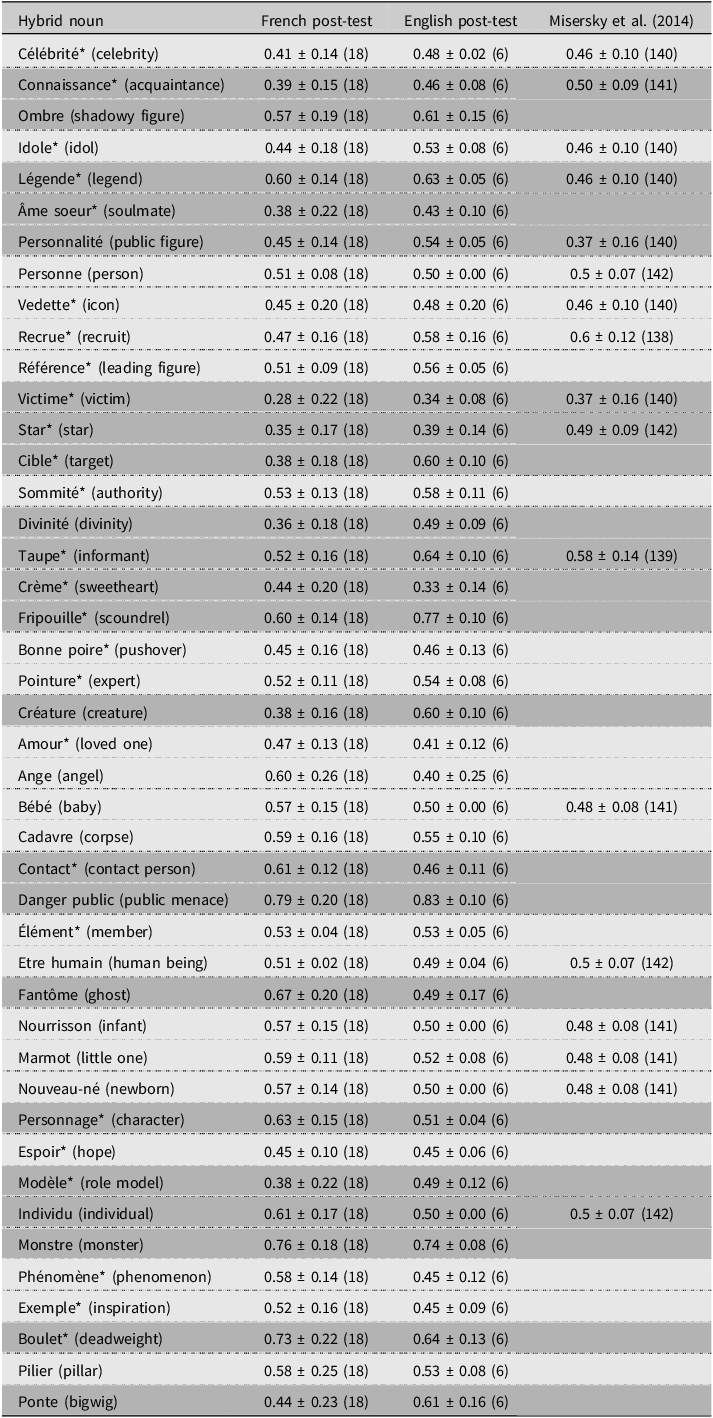
A limitation shared by the experimental protocol of Storme and Delaloye Saillen (Reference Storme and Delaloye Saillen2024) and the present study is the difficulty of precisely controlling for the influence of gender stereotypes. In particular, if one condition includes a disproportionate number of nouns associated with either male or female stereotypes, this could bias the observed effect in the corresponding direction. In order to address this potential confound, we collected stereotypicality ratings from native French speakers for each of the 44 hybrid nouns, and from native English speakers for their English translations. Additionally, some of the items, or close synonyms, had previously been rated for stereotypicality by a larger sample of English native speakers in Misersky et al. (Reference Misersky, Gygax, Canal, Gabriel, Garnham, Braun, Chiarini, Englund, Hanulikova, Ottl, Valdrova, Von Stockhausen and Sczesny2014). To examine whether stereotypes may have influenced our result, we repeated the analysis using only stereotype-neutral hybrid nouns. A stringent criterion was applied: only items scoring between 40% and 60% in all three stereotypicality measures (both the French and English post-test and Misersky et al.’s data) were considered. This resulted in a subset of 22 stereotype-neutral hybrid nouns (see Annex). Analyses restricted to this subset yielded results consistent with those reported above, indicating that the observed effect were not critically driven by the stereotypicality of the stimuli. Nevertheless, it remains possible that the choice of carrier sentences introduced contextual information that biased the observed effects in one direction or the other, for instance in sentences such as “On accueille une pointure de l’architecture mondiale.” (‘We are welcoming one of the world’s leading figures in architecture.’). This possibility should be examined more systematically in future research.
Since the purpose of the study was to draw general conclusions on the comprehension of hybrid nouns, we deliberately chose to include heterogeneous materials in order to increase the external validity of our finding, i.e., to make sure that the observed effect was not tied to a specific sentence structure or type of hybrid nouns. While more homogeneous materials are often preferable in studies aimed at testing specific theories on mental model formation, our goal was instead to use stimuli reflecting the variability inherent in natural language. Although it is unlikely that this heterogeneity may have biased our observation, it may have introduced noise into our measurements, potentially obscuring an existing effect. We therefore decided to conduct complementary analyses limited to some subsets of items.
Some of the heterogeneity in our material was related to the type of determiner preceding the hybrid noun. To assess whether this factor influenced the results, we repeated the analysis, excluding items that could have attenuated the effect of grammatical gender, either because the determiner lacked gender marking (e.g., “l’individu”) or because its surface gender marking was incongruent with that of the hybrid noun (e.g., “mon idole”). The posterior distributions were similar to those obtained in the main analysis, showing a masculine bias for masculine hybrid nouns and no consistent bias for feminine hybrid nouns. Similar results were observed when restricting the analysis to items with indefinite articles, as well as when excluding sentences in which hybrid nouns were introduced by possessive pronouns. Another source of heterogeneity in our materials stemmed from the type of hybrid nouns included. Specifically, our stimuli comprised hybrid nouns formed through metonymy or metaphor (e.g., “une vraie crème”, ‘a cream’; “le pilier”, ‘the pillar’) which might not readily activate a mental representation of a person, in turn reducing the effect. To assess whether this factor might have led us to underestimate the results, we repeated the analysis using only the metonymic and metaphoric items. Once again, the results closely mirrored those of the main analysis.
While hybrid nouns offer a useful tool for probing how grammatical gender shapes interpretation, they also come with a limitation: they are subject to ongoing linguistic changes. For example, fifty years ago, most French occupational titles functioned as hybrid nouns and were used exclusively in the masculine form, even when referring to women. In French, as in other gender-marked languages, this usage has since evolved, with the development or reintroduction of feminine counterparts [e.g., “un avocat/une avocate” (‘a lawyerMASC/a lawyerFEM’)]. Similarly, it is not uncommon in contemporary French to encounter feminine variants of masculine hybrid terms [e.g. “un malfrat/une malfrate” (‘a gangsterMASC/a gangsterFEM’); “un mouchard/une moucharde” (‘a snitchMASC/a snitchFEM’), “un individu/une individue” (‘an individualMASC/an individualFEM’)] as well as masculine hybrid terms used with feminine determiners [e.g. “un ange/une ange” (‘an angelMASC/an angelFEM’), “un bouc-émissaire/une bouc-émissaire” (a scapegoatMASC/a scapegoatFEM’), “un ponte/une ponte” (‘a leading figureMASC/a leading figureFEM)] – see Elmiger (Reference Elmiger2019) for an in-depth discussion of this phenomenon. This instability in usage complicates the interpretation of our results, as it becomes unclear whether participants interpret the items as truly hybrid. If, on the contrary, some masculine hybrid nouns were perceived in fact as shifting toward gender-specific use, this may have led to an overestimation of the masculine bias. However, even clearly unambiguous hybrid nouns with no feminine alternative, such as “nourrisson” (‘infantMASC’), elicited a masculine bias in our study, suggesting that the effect is not driven solely by shift in use.
Another related difficulty with the use of hybrid nouns is that, although most can in principle be referred to with either a masculine or a feminine pronoun, some of them accept agreement with only one grammatical gender (see Introduction). Since no reference classification exists, we structured our list of hybrid nouns based on the authors’ usage (see Annex, Table 2). Corbett (Reference Corbett1991) noted that hybrid nouns with a fixed gender agreement generally denote non-humans living beings. Accordingly, in our classification, most – though not all – of these nouns correspond to entities bordering on non-human: either very young individuals or mythical beings. When hybrid nouns with fixed gender agreement were excluded from the analysis, the bias observed in the masculine condition was reduced and no longer consistently different from zero. In contrast, the main findings remained unchanged when restricting the analysis to hybrid nouns with fixed gender agreement. This suggests that participants may have reacted more negatively to incongruent continuations following these items because they considered them ungrammatical. For instance, since “nourrisson” (‘infantMASC’) only allows agreement with “il”, the continuation sentence beginning with “cette petite fille” (‘this little girl’) may have been more difficult to process than the one beginning with “ce petit garçon” (‘this little boy’). Further research is needed to confirm this interpretation.
One way to circumvent the limitations inherent to hybrid nouns is to explore a different class of personal nouns. Collective nouns, such as “l’orchestre” (‘the orchestraMASC’) or “la famille” (‘the familyFEM’), have a fixed grammatical gender and can refer to groups of any gender composition. Importantly, unlike hybrid nouns, collective nouns are currently stable in their usage. Previous studies have investigated these terms and found that they resulted, on average, in a masculine bias, without contrasting between masculine and feminine collective nouns (Tibblin et al., Reference Tibblin, Granfeldt, van de Weijer and Gygax2023). Building on these first results, it would be valuable to test whether the asymmetry observed in hybrid nouns extends to collective nouns (i.e., that the masculine bias reported by Tibblin et al., Reference Tibblin, Granfeldt, van de Weijer and Gygax2023, is driven primarily by masculine collective nouns).
The stimuli used in sentence-evaluation paradigms are based on anaphors, that is, two expressions co-referring to the same object. For instance, in example (5), “la personne sur la photo” is the antecedent and “François” is the anaphoric expression, which needs to be mentally linked to the antecedent for correct comprehension of the sentence. In the present study, response time in anaphor resolution is used as a tool to assess gender representations elicited during language processing. Nevertheless, it is interesting to explore how these findings relate to more theoretical work on anaphor resolution (Garnham, Reference Garnham2001).
In natural language comprehension, several factors contribute to anaphor resolution (Cacciari et al., Reference Cacciari, Corradini, Padovani and Carreiras2011; Poesio et al., Reference Poesio, Yu, Paun, Aloraini, Lu, Haber and Cokal2023). Some of them are conceptual factors, such as stereotypes or contextual information. They are useful to disambiguate sentences such as:

In this example, “she” is unambiguously identified as co-referring with Mary thanks to commonsense knowledge. Another factor affecting anaphor resolution is grammatical agreement constraints such as gender and number. They are among the strongest cues for relating the anaphoric expression with its antecedent. In the following sentence where conceptual and grammatical factors compete, gender agreement indicates that “she” unambiguously refers to Sarah although the meaning of the resulting sentence is unclear:

Together with earlier sentence-evaluation studies investigating the influence of specific grammatical forms in the first sentence (Garnham et al., Reference Garnham, Gabriel, Sarrasin, Gygax and Oakhill2012; Gygax et al., Reference Gygax, Gabriel, Sarrasin, Oakhill and Garnham2008; Tibblin et al., Reference Tibblin, Granfeldt, van de Weijer and Gygax2023), the present study indicates that grammatical agreement influences the process of anaphor resolution even when grammatical gender is in fact irrelevant. This is true even in the presence of conceptual factors (Garnham et al., Reference Garnham, Gabriel, Sarrasin, Gygax and Oakhill2012; Gygax et al., Reference Gygax, Gabriel, Sarrasin, Oakhill and Garnham2008). These results are also confirmed by previous studies investigating hybrid nouns using two-sentence constructions linked by an anaphor, similar to the sentence-evaluation paradigm, but relying only on self-paced reading time without asking their participants to make explicit judgments. Cacciari et al. (Reference Cacciari, Carreiras and Cionini1997) found that, in the absence of contextual cues, reading times were shorter when the grammatical gender of an anaphoric expression using a hybrid noun matched the gender of the referent, compared to when they were incongruent (although the latter case introduced no additional processing cost compared to gender-unmarked nouns). This finding was extended by Cacciari et al. (Reference Cacciari, Corradini, Padovani and Carreiras2011) who included contextual cues in the form of gender stereotypes in the sentence (see also Irmen & Roßberg, Reference Irmen and Roßberg2004). Again, referent gender representation was primarily driven by the grammatical gender of the hybrid noun, with contextual information integrated only at a later stage in the process. These results, together with ours, are informative about how readers build a mental model of the situation described in a text as they read it, suggesting in particular that grammatical agreement, even when irrelevant, might prevail over conceptual factors during the initial stages of processing.
5. Conclusion
This study provides evidence for an asymmetry in the processing of grammatical gender in French hybrid nouns. Using a sentence evaluation paradigm, we demonstrated that masculine hybrid nouns systematically elicit a male bias, as evidenced by significantly faster processing of male continuations compared to female ones. This effect confirms that masculine generic forms influence gender representation during language comprehension, even for nouns that cannot be inflected for gender. In contrast, feminine hybrid nouns did not produce a comparable bias, a result that aligns with previous findings obtained on more explicit tasks. This could reflect the fact that feminine forms are perceived as genuinely neutral, or that they are subject to competing biases, such as a broader default tendency to interpret referents as male. Judgement scores revealed no significant differences between conditions, however, possibly due to a ceiling effect.
Future studies are needed to further explore the influence of stereotypicality and gender-agreement properties of hybrid nouns on interpretation, as well as to explore whether these findings generalize to collective nouns.
Acknowledgments
We would like to thank the many Fediverse users who contributed via the collaborative notepad shared on Mastodon to help compile the list of generic feminine and masculine terms. This study was supported by the ANR-DFG grant “DRhyADS” (ANR-22-FRAL-0003) and the EUR Frontiers in Cognition ANR-17-EURE-0017.
Funding
This study was funded by the ANR grants DRhyaDS (No. ANR-22-FRAL-0003) and FrontCog (Grant No. ANR-17-EURE-0017).
Competing interests declaration
The authors declare that the research was conducted in the absence of any commercial or financial relationships that could be construed as a potential conflict of interest.
Annex:
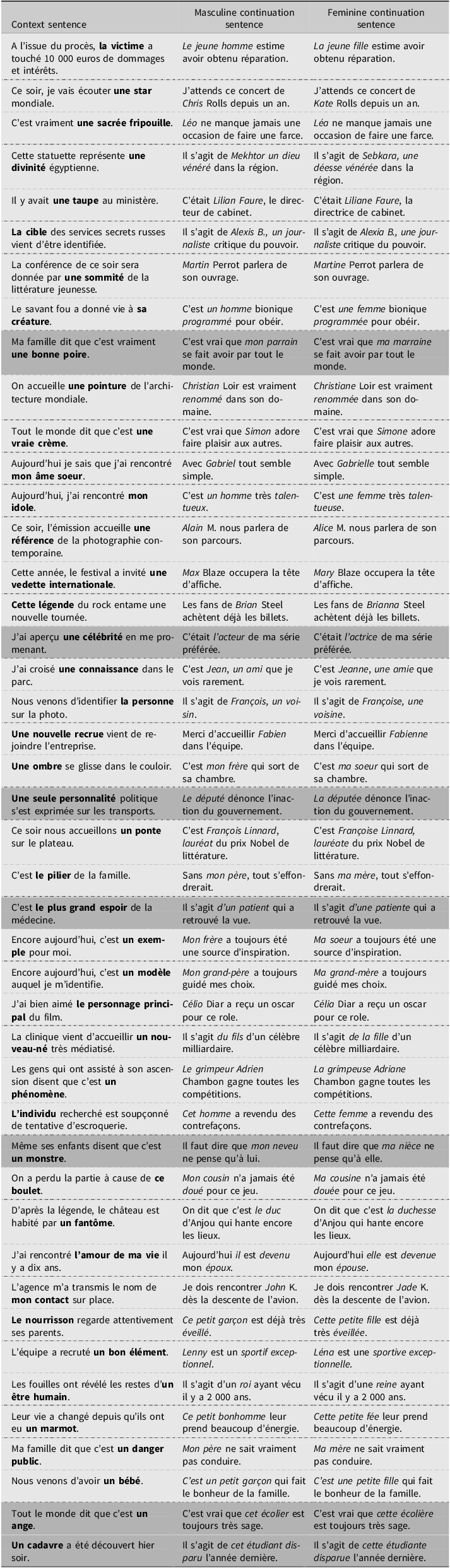
Stimuli used in the experiment. Only items containing hybrid nouns in the context sentence (in bold) and a correct continuation sentence are included. Elements indicating the gender of the referent in the continuation sentence are italicized. Rows shaded in gray represent stimuli excluded from the main analysis (see text for details)
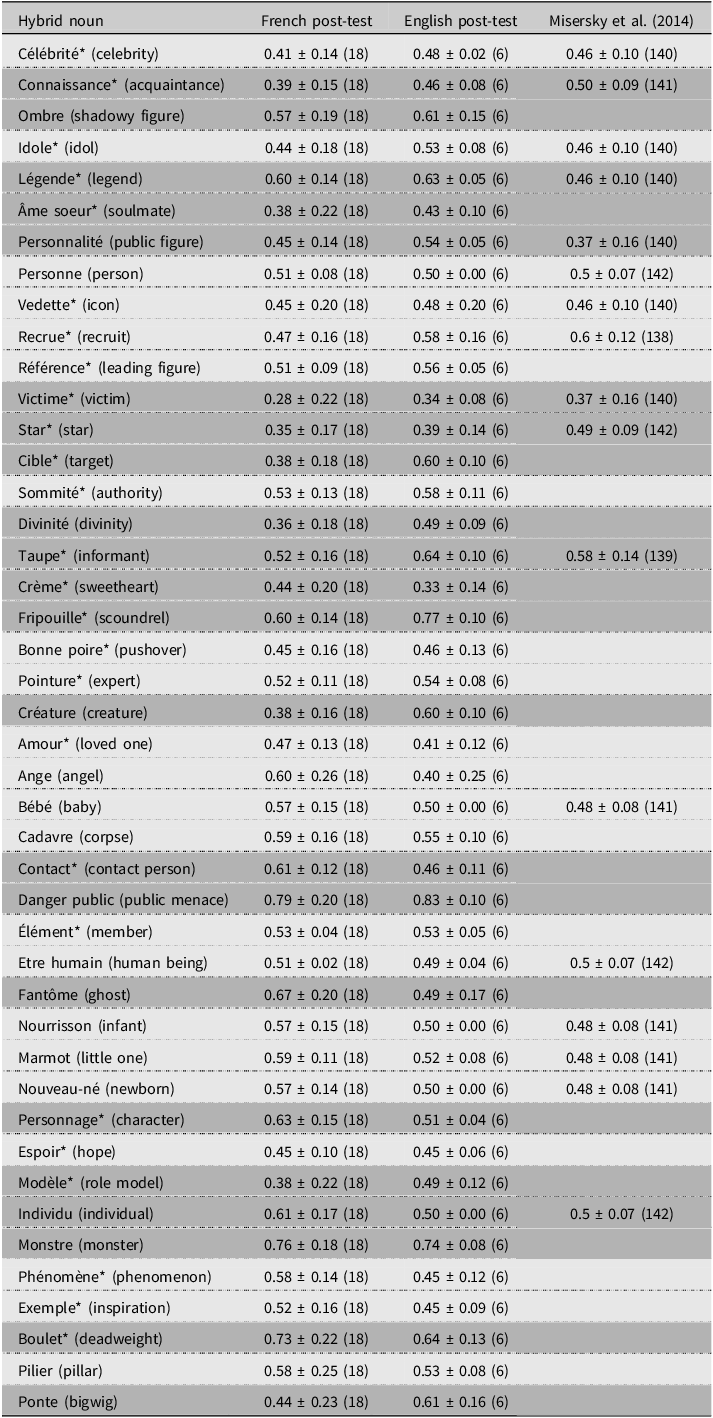
Means, standard deviations, and number of respondants for all hybrid nouns tested in the French English stereotypicality post-test and, when applicable, in the English group of Misersky et al. (Reference Misersky, Gygax, Canal, Gabriel, Garnham, Braun, Chiarini, Englund, Hanulikova, Ottl, Valdrova, Von Stockhausen and Sczesny2014). Rows shaded in gray represent stimuli excluded from the complementary analysis restricted to stereotype-neutral items (see main text for details). Asterisks indicate hybrid nouns that were classified as accepting agreement with either masculine or feminine pronouns

 Open access

