


Introduction
Aesthetics influence how people feel, interact, and perform at work (Arif, Katafygiotou, Mazroei, Kaushik & Elsarrag, Reference Arif, Katafygiotou, Mazroei, Kaushik and Elsarrag2016; Thibaud, Reference Thibaud2015). Aesthetic attributes of space include furniture, colors, and design elements, which often interrelate with unique ambience characteristics, i.e., the conditions that make ‘a space habitable’, including lighting, views, and temperature (Oyedeji, Ko & Lee, Reference Oyedeji, Ko and Lee2025). Therefore, organizational space should be designed to enhance comfort and well-being (Arif et al., Reference Arif, Katafygiotou, Mazroei, Kaushik and Elsarrag2016), and recent studies highlight that office work can be a resource for mental health (Bergefurt, Weijs-Perrée, Appel-Meulenbroek & Arentze, Reference Bergefurt, Weijs-Perrée, Appel-Meulenbroek and Arentze2022). Aesthetics and ambience stimulate the senses (Muskat, Prayag, Hosany, Li, Vu & Wagner, Reference Muskat, Prayag, Hosany, Li, Vu and Wagner2024; Oyedeji et al., Reference Oyedeji, Ko and Lee2025), creating sensory value by ‘putting us in a certain bodily and affective stage and engaging our senses’ (Thibaud, Reference Thibaud2015, p. 42). Organizational space also offers value for workers seeking individual creative expression and cultural engagement (Islam & Sferrazzo, Reference Islam and Sferrazzo2022). Following signaling theory, environmental cues can convey specific meanings (Bird & Smith, Reference Bird and Smith2005; Spence, Reference Spence1973), and signals in organizational space can positively engage our human senses and enhance workplace experiences (Thibaud, Reference Thibaud2015).
This study contrasts coworking spaces and traditional open-plan offices. Coworking spaces are increasingly popular, particularly in urban settings (De Vaujany, Leclecq-Vandelannoitte, Munro & Nama, Reference De Vaujany, Leclecq-Vandelannoitte, Munro and Nama2021; Frenkel & Buchnik, Reference Frenkel and Buchnik2025), offering community-like environments that support open communication, shared experiences, and positive emotions (Gandini, Reference Gandini2015; Waters-Lynch & Duff, Reference Waters-Lynch and Duff2021). Their ambience also represents affordances to workers that support more sustainable work practices (Gauger, Pfnür & Strych, Reference Gauger, Pfnür and Strych2021). By contrast, traditional open-plan offices have remained unpopular (Bergefurt et al., Reference Bergefurt, Weijs-Perrée, Appel-Meulenbroek and Arentze2022; Jahncke, Hygge, Halin, Green & Dimberg, Reference Jahncke, Hygge, Halin, Green and Dimberg2011). Though originally intended to promote community, communication, and reduced hierarchy (Kim & De Dear, Reference Kim and De Dear2013; Weijs-Perrée, van de Koevering, Appel-Meulenbroek & Arentze, Reference Weijs-Perrée, van de Koevering, Appel-Meulenbroek and Arentze2019; Wright, Marsh & Wibberley, Reference Wright, Marsh and Wibberley2022), research keeps on highlighting the negative outcomes of the open-plan office design. Studies have provided evidence of negative outcomes, such as low job satisfaction, poor mental health, absenteeism, and weak performance (Kim & De Dear, Reference Kim and De Dear2013; Oldham, Reference Oldham1988; Veitch & Newsham, Reference Veitch and Newsham2000).
Despite these contrasts, both office types were designed to contribute positively to work. Yet, coworking spaces may differentiate themselves by incorporating aesthetic features that enhance comfort and even ‘fun’ (Fleming & Sturdy, Reference Fleming and Sturdy2009). It appears that distinct aesthetic aspects in workspace design may possibly explain its popularity and what contrasts their ambience and the unpopularity of open-plan offices. This study takes a visual perspective on organizational space and posits that certain aesthetics function as signals (Connelly, Certo, Ireland & Reutzel, Reference Connelly, Certo, Ireland and Reutzel2011; Drover, Wood & Corbett, Reference Drover, Wood and Corbett2018), providing symbolic sensory information (Bird & Smith, Reference Bird and Smith2005) that shapes worker experiences. It is known that when workers perceive certain positive signals, they are more likely to become ‘members’ and belong to a space (De Vaujany, Dandoy, Grandazzi & Faure, Reference De Vaujany, Dandoy, Grandazzi and Faure2019) and a group (Bird & Smith, Reference Bird and Smith2005; Blumer, Reference Blumer1969). Subsequently, since ambience and aesthetics of organizational space affect workplace experience (De Vaujany et al., Reference De Vaujany, Dandoy, Grandazzi and Faure2019; Fuzi, Reference Fuzi2015), understanding the visual signals coworking spaces send could help explain their popularity (Weijs-Perrée et al., Reference Weijs-Perrée, van de Koevering, Appel-Meulenbroek and Arentze2019).
However, thus far, very little is known about the visual aesthetics of coworking spaces and the visual differences that contrast them to traditional open-plan offices. This research, therefore, compares the two space types to explain which aesthetic aspects account for coworking’s popularity and open-plan’s unpopularity. To do so, we initially use AI-driven deep learning exploratory techniques and visual analytics to contrast online photo data. To further interpret our findings, we are guided by two research questions (1) Which visual features set coworking spaces apart from open-plan offices? and (2) How can these features explain coworking spaces popularity?
Australia is the empirical context for our study, we focus on Melbourne, Sydney, Perth, and Brisbane. In Australia, coworking was already highly popular pre-COVID and resurged post-COVID, while traditional offices declined (Mordor, 2025). Visual analytics, a data science approach relying on inductive reasoning, allows rigorous modeling that can extend beyond this case (Andrienko, Andrienko, Miksch, Schumann & Wrobel, Reference Andrienko, Andrienko, Miksch, Schumann and Wrobel2021). Advances in AI and computer vision enable sophisticated photo analysis, identifying artifacts, shapes, colors, and patterns as distinctive visual features.
Organizational space and workspace design
Existing literature often reflects on workspace design ideas derived from scientific management and Taylorism at the end of the 19th century (Wright, Reference Wright1993). The physical environment influences experiences at work (Oyedeji et al., Reference Oyedeji, Ko and Lee2025), shaping attitudes, judgments, emotions, and ultimately performance (De Nisco & Warnaby, Reference De Nisco and Warnaby2014; Puncheva-Michelotti, Vocino, Michelotti & Gahan, Reference Puncheva-Michelotti, Vocino, Michelotti and Gahan2018). Beyond tangible features, the concepts of aesthetics at work and ambiance emphasize the intangible, sensory, and affective value of the work environment (Oyedeji et al., Reference Oyedeji, Ko and Lee2025), highlighting the importance of how the body experiences work (Thibaud, Reference Thibaud2015). The open-plan design concept aimed to maximize open spaces and minimize private spaces. Walls were removed and the ‘office landscape’ was created, reflecting core values of organizational rationality, efficiency, and scientific management. While intended to promote productivity, this aesthetic workplace design reflected workers as ‘rational economic beings’, with limited attention to the sensory and aesthetic qualities of the workplace (Cairns, Reference Cairns2003; Peaucelle, Reference Peaucelle2000).
With the emergence of coworking spaces, the focus has shifted toward the intangible and affective dimensions of organizational space. Scholars highlight their emphasis on social relations (Bacevice & Spreitzer, Reference Bacevice and Spreitzer2023; Howell, Reference Howell2022) and affective design (Waters-Lynch & Duff, Reference Waters-Lynch and Duff2021). Coworking spaces are increasingly in demand, bringing professionals out of isolation (Vidaillet & Bousalham, Reference Vidaillet and Bousalham2020) and positively shaping experiences at work (Fuzi, Reference Fuzi2015; Weijs-Perrée et al., Reference Weijs-Perrée, van de Koevering, Appel-Meulenbroek and Arentze2019). Post-COVID, they have also helped rebuild community-like environments (Resh & Hoyer, Reference Resh and Hoyer2021). At the same time, coworking spaces have gained in popularity with individual workers who seek to build their individual personal brand and focus on expressing their individual identities (e.g., Thompson-Whiteside, Turnbull & Howe-Walsh, Reference Thompson-Whiteside, Turnbull and Howe-Walsh2018), striving for less normative control, and more ‘fun’ at work (Fleming & Sturdy, Reference Fleming and Sturdy2009). Coworking spaces are shared offices for mobile knowledge workers (Kim, Lim & Monzani, Reference Kim, Lim and Monzani2024), attracting startup founders, freelancers, and casual workers. As organizations in the knowledge economy move toward non-standard alternatives to full-time employment, often housed in coworking spaces, workspace aesthetics that support this more nomadic way of working in a community-oriented environment may have become an essential consideration in organizational spatial design (Cappelli & Keller, Reference Cappelli and Keller2013; Gandini, Reference Gandini2015).
Although coworking spaces are perceived as more enjoyable and inspiring (Weijs-Perrée et al., Reference Weijs-Perrée, van de Koevering, Appel-Meulenbroek and Arentze2019), little is understood about the specific design and visual elements that contribute to their popularity and differentiate them from traditional open-plan offices. Hartog et al. (Reference Hartog, Weijs-Perrée and V Appel-meulenbroek2018, p. 536) summarize these elements as including ‘location, office exterior and division, office décor, facilities and services, seclusion rooms, office leisure, ICT and equipment, privacy, and office climate’. Literature on organizational aesthetics suggests that design can go beyond functional purpose, blending professional and personal lives, enhancing work–life balance (Leclercq-Vandelannoitte & Isaac, Reference Leclercq-Vandelannoitte and Isaac2016), and offering inclusive alternatives to coffee shops or home offices (Spinuzzi et al., Reference Spinuzzi, Bodrožić, Scaratti and Ivaldi2019).
Traditional open-plan offices were also designed to promote creativity, interaction, and collaboration (Weijs-Perrée et al., Reference Weijs-Perrée, van de Koevering, Appel-Meulenbroek and Arentze2019). Whereas they were initially considered positive, they have since been exposed to ongoing criticism. Studies document poor ambient conditions and negative health outcomes compared to private offices (De Paoli, Sauer & Ropo, Reference De Paoli, Sauer and Ropo2019; Jahncke et al., Reference Jahncke, Hygge, Halin, Green and Dimberg2011; Kim & De Dear, Reference Kim and De Dear2013; Sander, Marques, Birt, Stead & Baumann, Reference Sander, Marques, Birt, Stead and Baumann2021). Visual elements such as poor lighting (Hirning, Isoardi & Cowling, Reference Hirning, Isoardi and Cowling2014; Veitch & Newsham, Reference Veitch and Newsham2000) and color selection (Veitch, Newsham, Boyce & Jones, Reference Veitch, Newsham, Boyce and Jones2008) contribute to declines in well-being and task performance (Pinnington & Ayoko, Reference Pinnington and Ayoko2021). High-density layouts reduce privacy and efficiency, leading to territorial behaviors and negative spatial experiences (Monaghan & Ayoko, Reference Monaghan and Ayoko2019). In addition, sensory factors like noise increase stress, fatigue, and poor concentration, undermining satisfaction and motivation (Banbury & Berry, Reference Banbury and Berry2005; Jahncke et al., Reference Jahncke, Hygge, Halin, Green and Dimberg2011; Kim & De Dear, Reference Kim and De Dear2013; Oldham, Reference Oldham1988).
To conclude, coworking and open-plan offices appear similar in design intent – both seek to foster creativity, social interaction, and community. Yet, empirical evidence shows their effects on workers differ sharply: open-plan offices often undermine health and satisfaction, while coworking spaces are associated with positive experiences and growing popularity (De Vaujany et al., Reference De Vaujany, Leclecq-Vandelannoitte, Munro and Nama2021). Symbols and signals in each office space directly influence workplace culture (Nanayakkara, Wilkinson & Halvitigala, Reference Nanayakkara, Wilkinson and Halvitigala2021), and its attractiveness stems from the affective, social, and relational value coworking spaces provide (Gandini, Reference Gandini2015; Waters-Lynch & Duff, Reference Waters-Lynch and Duff2021). However, it remains unclear which visual aesthetic elements of physical environments drive these differences. These elements may operate as signals that convey symbolic meaning to workers, shaping how they perceive and experience different workspace designs.
Theoretical setting
Signaling theory and organizational space
We adopt signaling theory as our theoretical lens. Signaling theory (Spence, Reference Spence1973) serves in this study to explain how visual elements in coworking spaces create signals that explain the popularity of this space. Signals convey symbolic meaning and help individuals make sense of the social world (Blumer, Reference Blumer1969). In organizational spaces, visual signals guide to make sense of textual signals in reports, founders’ credentials, and communications to external parties (Drover et al., Reference Drover, Wood and Corbett2018). Further, signals create symbolic meaning for workers related to social and relational interactions (Bird & Smith, Reference Bird and Smith2005). Visual signals in office design can clearly define boundaries and social norms (Kim et al., Reference Kim, Lim and Monzani2024), embedding tacit knowledge supporting and visuals can be drawn upon to interpret and manage individual’s work (Connelly et al., Reference Connelly, Certo, Ireland and Reutzel2011).
Visual signals in organizational spaces can include art, leisure, and ‘fun’ features that symbolize creativity and innovation (De Paoli et al., Reference De Paoli, Sauer and Ropo2019; Weijs-Perrée et al., Reference Weijs-Perrée, van de Koevering, Appel-Meulenbroek and Arentze2019). Moreover, specific signals that convey creativity and deep thinking, such as leisure amenities, seclusion rooms, and private spaces (Hartog et al., Reference Hartog, Weijs-Perrée and V Appel-meulenbroek2018; McCoy & Evans, Reference McCoy and Evans2002). Klitzman and Stellman (Reference Klitzman and Stellman1989) suggest that workplace designers can utilize this knowledge by purposefully adding artistic elements to enhance user experiences. Other research (e.g., De Paoli et al., Reference De Paoli, Sauer and Ropo2019) suggests that leisure artifacts in workplaces are symbols of a ‘happy, relaxed, and playful’ atmosphere (p. 1), which may be important to meet the growing need of workers for self-fulfillment and more ‘fun’ at work (Fleming & Sturdy, Reference Fleming and Sturdy2009).
Color is another important signal in organizational space. Color ‘provokes, conditions, disrupts, and alters how the organization takes place and unfolds’ (Beyes, Reference Beyes2017, p. 1478). Color can evoke both positive and negative feelings (Valdez & Mehrabian, Reference Valdez and Mehrabian1994), with lighter shades being perceived as less stimulating and more peaceful, and warmer colors generating stronger reactions and excitement. Color schemes in organizational spaces can influence job experiences (Bakker, van der Voordt, De Boon & Vink, Reference Bakker, van der Voordt, De Boon and Vink2013).
From a symbolic interactionism perspective, such visual signals allow for a better understanding of how individuals at work interpret aesthetic signals. It can also explain how they interact and connect with coworkers. Ultimately, these signals help explain why certain spatial designs, in our case, coworking spaces, are experienced as more attractive and popular than traditional open-plan offices. To explore these contrasting signals between coworking spaces and traditional open-plan offices, we now turn to our visual methodology. We examine large-scale online photo data of each workspace to visually contrast the two categories of organizational spaces.
Methodology
Visual methods in organizational research
Organizational research methods use data from ‘images, logos, videos, building materials, graphic, and product design, and a range of other material and visual artifacts’ (Boxenbaum, Jones, Meyer & Svejenova, Reference Boxenbaum, Jones, Meyer and Svejenova2018, p. 597) because visual artifacts represent organizational culture (Shortt & Warren, Reference Shortt and Warren2019) and convey encoded meanings of space. Visual data are increasingly used because of the ‘visual and material turn’ in organizational studies, which has increased interest in understanding the meaning of visual artifacts in the workplace (Boxenbaum et al., Reference Boxenbaum, Jones, Meyer and Svejenova2018) and how they construct social reality (Meyer, Höllerer, Jancsary & Van Leeuwen, Reference Meyer, Höllerer, Jancsary and Van Leeuwen2013).
However, capturing and analyzing visual data remains complex. The complexity arises from the nature of visual data. For example, data from visual ‘objects at work’ can be digital or physical, stable or moving, and two-dimensional or multi-dimensional (Ewenstein & Whyte, Reference Ewenstein and Whyte2009). To make sense of the data, organizational researchers adopt either objective or subjective underlying ontologies. In organizational studies, subjective ontologies are dominated by constructivist paradigms that aim to elicit and interpret the constructed meaning of visual data (Shortt & Warren, Reference Shortt and Warren2019). For example, studies use dialogical approaches and researchers are involved, engaged, and participate in visual data collection and engage with their participants (Boxenbaum et al., Reference Boxenbaum, Jones, Meyer and Svejenova2018). Images and photos are collected during visual fieldwork to develop interpretive, reflective, and textual narrative accounts (Boxenbaum et al., Reference Boxenbaum, Jones, Meyer and Svejenova2018; Shortt & Warren, Reference Shortt and Warren2019).
This study adopts a visual analytic approach to investigate how coworking spaces and open-plan offices differ in their aesthetic signals. Following the ‘visual and material turn’ in organizational studies (Boxenbaum et al., Reference Boxenbaum, Jones, Meyer and Svejenova2018; Shortt & Warren, Reference Shortt and Warren2019), we treat photos of workplaces as organizational artifacts that encode cultural meaning. Our aim is to identify visual differences and to subsequently interpret how these differences signal meaning to workers. To do so, this paper uses an archaeological analytic approach to retrieve large-scale online photo data, where the collection and analysis are the sole responsibility of the researcher (Shortt & Warren, Reference Shortt and Warren2019).
This study is informed by a critical realist ontology. We appreciate the reality of visual artifacts as objective data while also treating their organizational meaning as constructed, contingent, and interpretive. Thus, after conducting the AI-based contrast analysis visual results of the two different workplace categories, we then proceed to interpret the possible meanings of these results. That way, we methodologically extend existing AI-based visual analytics deep learning techniques, which have rarely combined a layered ontology with visual large-scale data and interpretation of visual analytics data.
To operationalize this approach, we propose a novel AI-based methodology that generates new knowledge by combining electronic data processing with human interpretation. As shown in Figure 1, our methodology for office photo analysis is based on deep learning techniques and consists of three steps:
1. Online Photo Extraction: to extract Internet photos of open-plan offices and coworking spaces for analysis.
2. Automatic Photo Understanding: to automatically identify the content of the photos using a deep learning-based technique.
3. Knowledge Discovery: for statistical analysis and data visualization. We used contrast analysis techniques to capture the knowledge discovered in the previous step.
Details descriptions of the proposed methodology.

Online photo extraction
Online photo extraction formed the basis of our methodology. Photo-based social media platforms such as Pinterest (https://www.pinterest.com) and Coworker (https://www.coworker.com/) offer a wide variety of publicly accessible photos. These photos capture all aspects of life and represent a large-scale visual data used by researchers in a variety of research domains where aesthetic and visual sensory cues are relevant (Zhang & Du, Reference Zhang and Du2020). Aesthetics encompasses sensory knowledge related to cognition and emotions, feelings, and respective reasoning (Taylor & Hansen, Reference Taylor and Hansen2005).
To identify suitable platforms for collecting photos related to coworking spaces and open-plan offices, we reviewed several well-known, open-access, photo-based social media platforms. The Coworker (https://www.coworker.com) and Pinterest (https://www.pinterest.com) were chosen because of the availability of a large number of photos related to the respective workspaces studied. Photos posted on Coworker were considered to be related to the coworking space, as Coworker’s business model is exclusively designed for sharing and booking of coworking spaces. Photos posted on Pinterest were selected by using the keyword ‘open-plan office’ in the search box to retrieve open-plan office-related photos. As a result, a large number of photos that conveyed the key aesthetic ambiance conditions of the respective workspaces were retrieved from these two platforms.
Australia was chosen as the context for our analysis because coworking spaces were already highly popular before the COVID-19 lockdowns (Ormiston et al., 2023) and have regained popularity with the recovery from the pandemic (Mordor, 2025). Accordingly, photos were extracted from the major cities in Australia, such as Melbourne, Sydney, Perth, and Brisbane. In total, 2,923 photos were collected. At this stage, we acknowledge that although the size of this dataset is insufficient to train a high-performance neural network, it is sufficient for our analysis, whose purpose is to identify the difference between coworking spaces and open-plan offices. We used a unique ID to ensure photos from each workspace were only downloaded once, as users may share photos of the same workspace multiple times. Table 1 shows the details of the collected dataset. Of the 2,923 collected photos, 1,287 represent coworking spaces, and 1,636 represent open-plan offices.
Coworking space and open-plan office photo data set

Automatic photo understanding
Deep learning techniques have been included in our methodology to automatically analyze the content of collected office photos. As a dominant technique in AI, deep learning helps researchers achieve significant performance improvement in several computer vision and image understanding tasks, such as image classification and object recognition (Zhao, Zheng, Xu & Wu, Reference Zhao, Zheng, Xu and Wu2019). One critical challenge in deep learning is collecting and producing large volumes of high-quality labeled data to train the model. It is well noted that this data collection and labeling process is time-consuming and labor-intensive. Although some novel learning paradigms, such as semi-supervised learning (Zhao et al., Reference Zhao, Zheng, Xu and Wu2019) and transfer learning (Zhang & Du, Reference Zhang and Du2020), have been proposed to alleviate this problem, the use of a considerable amount of labeled data is still inevitable for high-quality deep learning models. Consequently, building deep learning models from scratch is a challenge for many research and application scenarios.
This study alleviates the above problem by using a pre-trained industry-level image understanding application programming interface (API) – Google’s Vision API. We chose this API because it is optimized for structured image analysis tasks, such as object detection, label annotation, and text extraction. Compared to large language models such as GPT-4, the Vision API provides more consistent, scalable, and reproducible output, which is crucial when analyzing large image datasets. It provides thousands of pre-trained models, which are based on the latest deep neural network architectures, such as transformers and convolutional neural networks. These models have been pre-trained on a large dataset: approximately 920 million photos, and can be used for text recognition, logo detection, and photo object identification (Bisong, Reference Bisong2019).
The Vision API automatically labeled the contents of our collected office photos. Its input was the photo and, intuitively, its corresponding output was a set of identified entities (i.e., labels) such as the human face, room, table, furniture, and plants. Because a photo often contains multiple entities, the output of the Vision API is a probabilistic distribution of entity scores that describes the confidence levels of the identified entities, rather than the entity score of a dominant entity. Examples of the Vision API’s output are depicted in Figures 2–7, where the top 10 labels and corresponding entity scores are listed. Figure 2 shows a cafeteria-style coworking space. Figure 3 depicts a coworking space with a strong yellow color scheme. Figure 4 illustrates a coworking space with a dining room atmosphere. Figures 5–7 display the typical settings of the open-plan offices. These automatically generated labels provided the foundation for our subsequent AI-based visual analytics deep learning contrast analysis.
Cafeteria-style coworking space.

Coworking space with a strong yellow color scheme.

Coworking space with a dining room atmosphere.

Open-plan office with no private space.

Open-plan office with dense sitting area.

Open-plan office without plants.

Knowledge discovery
Several data mining techniques are adopted in this step to discover how the aesthetic aspects of the two workplace categories differ at work. First, the frequent itemset identification technique was used to identify the popular entities such as tables, chairs, floors, and plants in the photos. The frequent itemset identification technique is the basis of the Apriori algorithm (Edastama et al., Reference Edastama, Dudhat and Maulani2021), which aims to identify the most frequent items in a data set. The assumption is that Karlstad photos in their respective photo collection  $C = \left\{ {{p_1},{\text{ }}{p_2},{\text{ }}{p_3}, \ldots {p_n}} \right\}{\text{ }}$contain a set of entities $\left\{ {{e_1},{\text{ }}{e_2},{\text{ }}{e_3}, \ldots {e_m}|e \in E} \right\}$, where $E$ represents the sum of all entities identified by the Vision API. The support of each entity ${e_i}$ can then be estimated as in Equation 1:
 \begin{align}{\text{Supp}}\left( {{e_i}} \right) = {\text{ }}\frac{{\left| {{e_i} \in C} \right|}}{{\left| C \right|}}\end{align}
 where represents the number of photos that contain the entity  ${e_i}$ and $\left| C \right|$ is the total number of photos in the collection.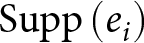 ${\text{Supp}}\left( {{e_i}} \right)$ is an efficient measure to quantify the popularity of the identified entities and is used by researchers to capture the popular entities in the photo collection. Since we are interested in the physical performance and aesthetic elements that can differentiate the coworking space from the open-plan offices, and in identifying the unique features that can explain positive evaluations and higher worker performance. We then applied contrast analysis, a data mining method designed for identifying the differentiating characteristics between groups of data (Ren et al., 2021). Suppose ${C_\alpha }$ and ${\text{ }}{C_\beta }$ are two collections of photos. In contract analysis, the difference in support for the entity ${e_i}$ between photo collections ${C_\alpha }{\text{ }}$and ${C_\beta }$ is measured by a metric $Diff$, which is estimated as Equation 2:
 \begin{align}Dif{f_{Supp\left( {{e_i},{\text{ }}\left( {{C_\alpha },{\text{ }}{C_\beta }} \right)} \right)}} = \left| {Supp\left( {{e_i},{\text{ }}{C_\alpha }} \right) - Supp\left( {{e_i},{\text{ }}{C_\beta }} \right)} \right|\end{align}
 After having  $Diff$, another measurement – popularity ratio (PRatio) – is calculated in contrast analysis to quantify how much more popular an entity is in one working place than in the other. It is estimated as Equation 3:
 \begin{align}PRatio\left( {{e_i},\left( {{C_\alpha },{\text{ }}{C_\beta }} \right)} \right) \left\{ \begin{array}{*{20}{c}}
{0,{\text{ }}if{\text{ }}Supp\left( {{e_i},{\text{ }}{C_\alpha }} \right) = 0{\text{ }}and{\text{ }}Supp\left( {{e_i},{\text{ }}{C_\beta }} \right) = 0} \\
{\infty ,{\text{ }}if{\text{ }}Supp\left( {{e_i},{\text{ }}{C_\alpha }} \right)*Supp\left( {{e_i},{\text{ }}{C_\beta }} \right) = 0} \\
{\frac{{Supp\left( {{e_i},{\text{ }}{C_\alpha }} \right)}}{{Supp\left( {{e_i},{\text{ }}{C_\beta }} \right){\text{ }}}}{\text{ }}other{\text{ }}wise}
\end{array} \right. {\text{ }}\end{align}
\begin{align}PRatio\left( {{e_i},\left( {{C_\alpha },{\text{ }}{C_\beta }} \right)} \right) \left\{ \begin{array}{*{20}{c}}
{0,{\text{ }}if{\text{ }}Supp\left( {{e_i},{\text{ }}{C_\alpha }} \right) = 0{\text{ }}and{\text{ }}Supp\left( {{e_i},{\text{ }}{C_\beta }} \right) = 0} \\
{\infty ,{\text{ }}if{\text{ }}Supp\left( {{e_i},{\text{ }}{C_\alpha }} \right)*Supp\left( {{e_i},{\text{ }}{C_\beta }} \right) = 0} \\
{\frac{{Supp\left( {{e_i},{\text{ }}{C_\alpha }} \right)}}{{Supp\left( {{e_i},{\text{ }}{C_\beta }} \right){\text{ }}}}{\text{ }}other{\text{ }}wise}
\end{array} \right. {\text{ }}\end{align} where  $PRatio = {\text{ }}\infty $ represents the entity ${e_i}$ appearing in one photo collection and not the other.
Findings
Visual content analysis
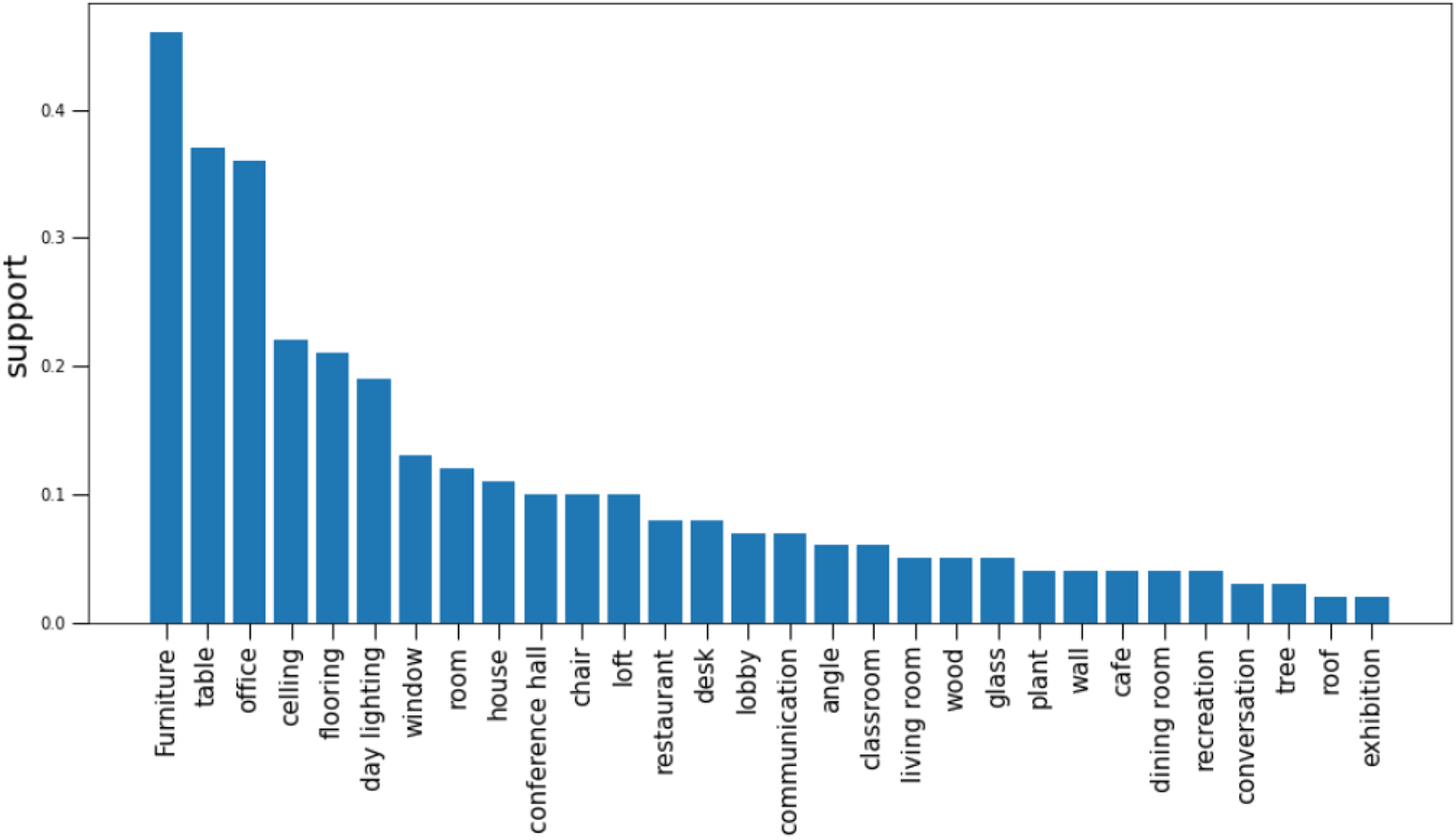
To perform visual content analysis, the dataset was added to the automatic photo understanding component to identify the entities, such as tables and chairs, in each photo. We included photos with entity value scores greater than 0.5 and identified more than 2,000 entities. Most of the photos had multiple entities, as demonstrated in the discussion of automatic photo understanding in the methodology section. To identify the most frequent entities in the collected photos, the support value of each entity was calculated using Equation 1, and entities with a support value of less than 0.05 were considered infrequent and removed.
We selected 0.05 as our support threshold because it is a commonly used value in existing research with frequent itemset analysis techniques in data mining (Ren et al., 2021). General entities such as ‘interior design’, ‘home’, and ‘property’ were removed, because these entities are unable to help us understand the difference between coworking spaces and open-plan offices. We retrieved 140 entities for the contrast analysis. Figure 8 shows the top 30 most frequent entities and their corresponding support values. These results indicate that many of the popular entities are indoor facilities, such as furniture, tables, offices, ceilings, flooring, and daylighting.
Top 30 most popular entities.

To understand the context and layout of these entities in our photos, a group search algorithmFootnote 1 was used to identify the representative photo for each entity. The algorithm first grouped the photos according to their entity labels. The algorithm then performed a partition-exchange sort to find the photo with the highest entity score. Examples of representative photos and their entity scores are shown in Figure 9. The identified entities are consistent with human judgments. It is worth noting that the Vision API was able to distinguish between similar photos, such as a room with a table and a potted plant (see Figure 9a) or a tall plant (see Figure 9b), or furniture (see Figure 9c), or a chair (see Figure 9d), which can be confusing even for humans. These results also demonstrate that our automatic photo understanding component can understand the difference between coworking spaces and open-plan offices from collected photos.
Representative photos and their entity scores.

Contrast analysis
In this section, we present the results of the contrast analysis we conducted to examine the aesthetic and physical differences between the two distinct workspace designs. As described in the theoretical framework section, the support value of each identified popular entity was calculated according to Equation 1 for each photo collection (i.e., coworking spaces and open-plan offices). After that, the difference and the popularity ratio (PRatio) of these entities were calculated according to Equations 2 and 3.
Table 2 shows these entities with a large difference between coworking spaces and open-plan offices. A z-test was applied to verify and quantify this difference; a positive z-score represents higher support for an entity in the coworking space, and a negative z-score represents higher support for an entity in the open-plan office. A small p-value (less than .05) indicates that there is a significant difference between the open-plan office and the coworking space for an entity.
Contrast analysis between coworking spaces and open-plan offices
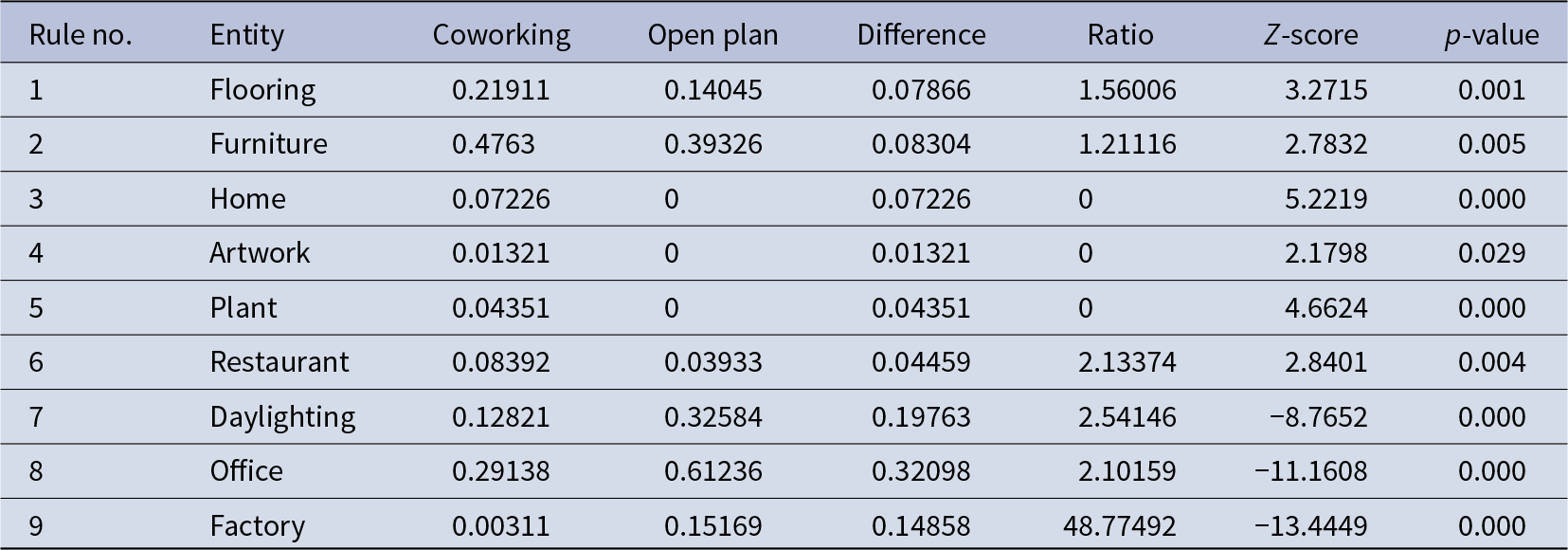
The analysis results in Table 2 show that coworking spaces rate higher in terms of homely features (Rule 3), restaurant atmosphere (Rule 6), artwork (Rule 4), and plants (Rule 5). They also have more furniture (Rule 2), display more open space, and are visualized in terms of larger flooring (Rule 1). By contrast, open-plan offices resemble a factory (Rule 9) and traditional office spaces (Rule 8), and, interestingly, have larger windows to bring in more daylight (Rule 7).
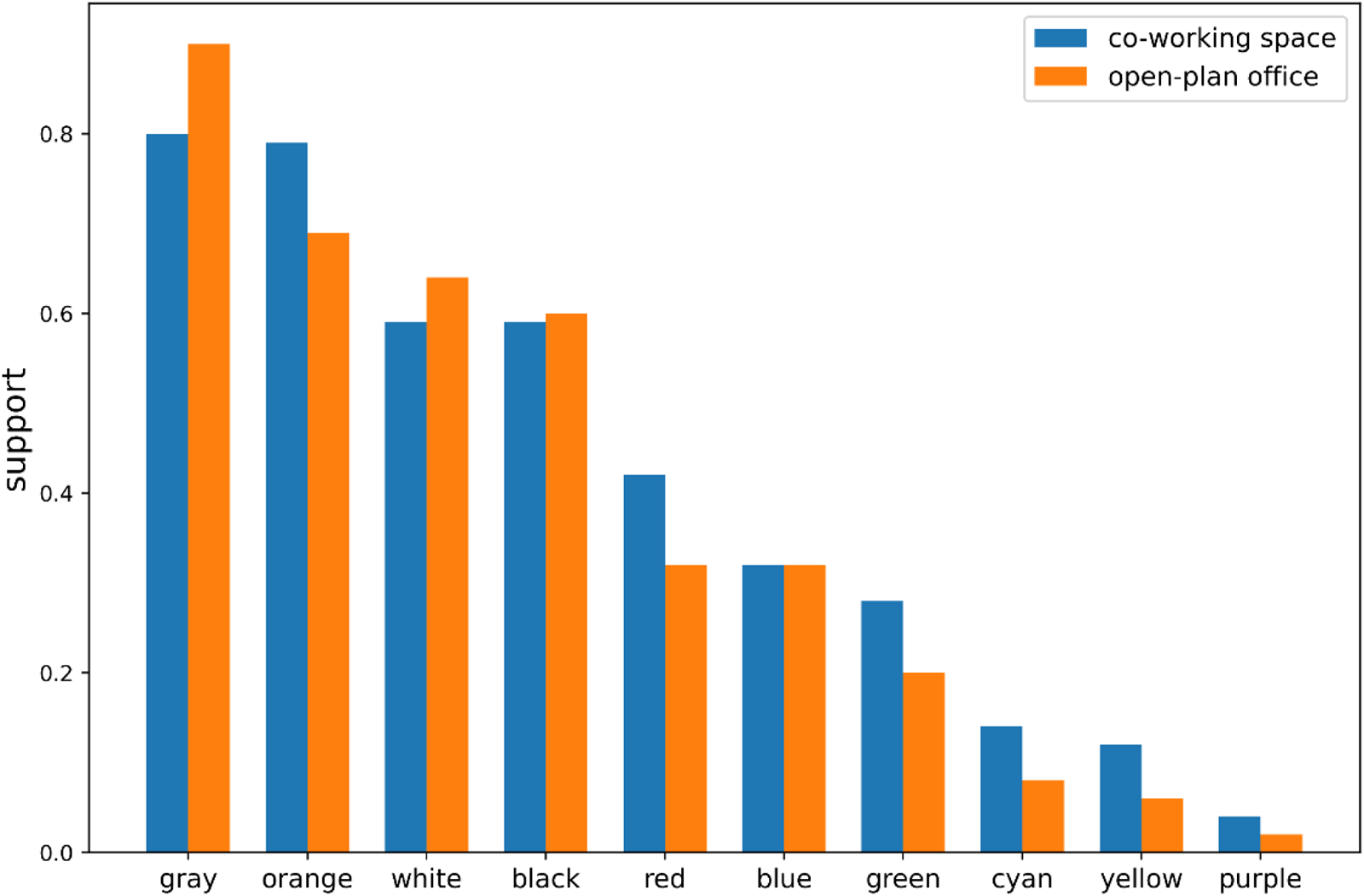
To explain the aesthetic differences between these two types of working spaces, another color analysis was performed. In this analysis, we first compared the distribution difference of the identified common colors in coworking spaces and open-plan offices. The results are shown in Figure 10. In terms of commonalities, we found that gray, orange, white, and black were dominant colors with higher support in both types of working spaces. However, the results also revealed a significant difference between several colors. Specifically, orange, red, green, cyan, yellow, and purple showed higher values in coworking spaces, whereas open-plan offices showed higher values for gray, white, and black. Thus, coworking spaces are more colorful compared with open-plan offices. In contrast, gray and white are common in open-plan offices.
Popular color distribution difference.

Table 3 shows the contrast analysis for the color schemes of the two distinct workspace designs. It clearly shows that coworking spaces are more likely to use warm colors such as orange, red, and green, whereas the popular color in open-plan offices is gray, which is considered to have no positive effect.
Contrast analysis on color theme

To perceive the differences in the color schemes used in these two types of working spaces, the group search algorithm described in the previous section was again used to find the representative photos for different color schemes. Figure 11 shows the identified representative photos. The coworking spaces usually have furniture, plants, and different colors, making them feel homey (see Figure 11a–c). However, the open-plan offices usually have a single-color scheme (see Figure 11d), which looks bland.
Representative photos for different color schemes.

Discussion and conclusions
In this discussion, we interpret the results of our contrast analysis to clarify why coworking spaces are generally associated with positive effects on workers, whereas open-plan offices are often linked to negative outcomes. We sought to understand why coworking spaces have become popular, while traditional open-plan offices, even though they were designed for a similar purpose, are viewed negatively. Based on the AI-based visual deep learning contrast analysis of coworking spaces versus open-plan office photo data, we now turn to interpret the meaning-making of signals, symbolic, and the contrasts of ambience in these organizational spaces.
As a key finding, our study reveals unique aspects that distinguish coworking spaces from traditional open-plan offices. Specifically, we find that coworking spaces are characterized by homely, dining room atmosphere, comfortable furniture, artwork, and plants, often evoking a restaurant and hospitality-like ambience. By contrast, no homely element or artwork, and, surprisingly, almost no plants, were represented in the collected open-plan office photo data. Color use also differs significantly. Coworking spaces favor warmer palettes such as orange, red, and green, whereas open-plan offices use cooler, muted tones. These findings establish the foundation for our three theoretical contributions to the management literature, which we outline in the following section.
First, interpreted through signaling theory, our findings suggest that coworking spaces send positive symbolic signals of social warmth, creativity, and belonging (Bacevice & Spreitzer, Reference Bacevice and Spreitzer2023). These signals help explain their popularity and the more positive worker experiences they foster – features largely absent in traditional open-plan office designs. For instance, coworking spaces may shape perceptions of what a modern workspace should look like in the new economy. Their aesthetics may appeal to individuals who associate coworking environments with start-ups or other contemporary, creative organizations (Bacevice & Spreitzer, Reference Bacevice and Spreitzer2023). At the same time, our analysis shows that the boundaries between workspace and leisure space are becoming increasingly blurred. This suggests that the current shift in ideologies about the meaning of work – toward a higher appreciation of neo-normative values – may be materializing within organizational space. More ‘fun’ at work (Fleming & Sturdy, Reference Fleming and Sturdy2009), an increased demand for individual creative expression (Islam & Sferrazzo, Reference Islam and Sferrazzo2022), and a growing emphasis on personal brand building (Thompson-Whiteside et al., Reference Thompson-Whiteside, Turnbull and Howe-Walsh2018) may all manifest in the symbolic signals that convey a more leisurely and appealing spatial design.
Second, our findings show a strong restaurant and hospitality ambience in coworking spaces. Following signaling theory, this can indicate positive signals of belonging, social warmth, and an overall hospitable environment, which has been described to include ambient lighting, plants and flowers, and artwork (Suess & Mody, Reference Suess and Mody2018). For users of these workspaces, emotional registers could form based on these signals, which would evoke a sense of belonging to the respective space (De Vaujany et al., Reference De Vaujany, Dandoy, Grandazzi and Faure2019). These visual signals in the workplace could also encourage workers to create meanings about the interactive-relational context and value of the workspace. Coworking spaces contain warm colors; a homely dining room atmosphere; artwork and plants; and a restaurant-style ambiance and these signals may act as important stimulants that can trigger well-being at work. As such, we extend the debate on the popularity of coworking spaces (Howell, Reference Howell2022) by offering a new sensory aesthetic perspective to understand coworking spaces, showing that ambience elements can symbolize a place of shared consumption and social interaction.
Third, drawing on symbolic interactionism theory and imagining that material, utilitarian, and non-utilitarian artifacts can be understood as representations of meaning in workplaces (De Vaujany et al., Reference De Vaujany, Dandoy, Grandazzi and Faure2019), we suggest that the homely and restaurant ambiance may symbolize a sense of connectedness among people. Thus, even for those users of co-working spaces who are self-employed or situated outside of a formal organization (e.g., entrepreneurs, casual workers, freelancers, and business travelers), the ambience could signal belonging to the group (Bird & Smith, Reference Bird and Smith2005; Blumer, Reference Blumer1969) and positively influence social relations in organizational space (Howell, Reference Howell2022). Our findings also support the idea that workspaces should be designed to enhance workers’ positive experiences and the need ‘to empathize with the struggles and challenges faced by members of an organization accustomed to physically working and interacting in a common workspace’ (Stigliani, Corley & Gioia, Reference Stigliani, Corley and Gioia2025, 9). We therefore affirm that aesthetics and perceptual elements are important factors at work (Hartog et al., Reference Hartog, Weijs-Perrée and V Appel-meulenbroek2018). We also agree with existing research that states the physical workspace shapes identities (Bacevice & Spreitzer, Reference Bacevice and Spreitzer2023) and can influence performance (Issa & Pick, Reference Issa and Pick2010; Oyedeji et al., Reference Oyedeji, Ko and Lee2025; Puncheva-Michelotti et al., Reference Puncheva-Michelotti, Vocino, Michelotti and Gahan2018). More broadly, we argue that the aesthetics of workplaces create meaning for workers, foster comfort, and enable positive experiences at work.
Practical implications
The practical implications of this research are pertinent to managers and workers in traditional open-plan offices, as well as managers and users of coworking spaces. The physical environment influences well-being at work (Oyedeji et al., Reference Oyedeji, Ko and Lee2025), and its signals and symbolic meanings shape attitudes, emotions, and judgments (De Nisco & Warnaby, Reference De Nisco and Warnaby2014; Puncheva-Michelotti et al., Reference Puncheva-Michelotti, Vocino, Michelotti and Gahan2018). Insights from our visual analysis could help decision makers implement some of these design aspects and create hospitable organizational spaces. This can include artwork, plants, comfortable furniture, and warm color palettes and create a more comfortable, welcoming atmosphere with a dining room–like ambience. Adding sensory value and affordances for workers helps preserve collaborative workplace use and mitigates shifts toward exclusively remote work.
For designers and managers in open plan offices, we emphasize the need to consider the importance of organizational space in understanding employee wellbeing (Boxenbaum et al., Reference Boxenbaum, Jones, Meyer and Svejenova2018; Shortt & Warren, Reference Shortt and Warren2019). Despite the positive intentions to design collaborative open workspaces, our findings reveal a stark visual contrast between both workspaces. Traditional open-plan offices often resemble factory-like work environments and purpose-built structures that emphasize efficiency over atmosphere. Open-plan office design also minimizing private space, using cooler colors, and creating clear boundaries between work and leisure by avoiding the addition of art or leisurely furniture. To enhance workplace well-being and engagement, we recommend that managers should integrate design features that promote warmth and belonging (i.e., Bird & Smith, Reference Bird and Smith2005; Suess & Mody, Reference Suess and Mody2018). We recommend that managers include warmer color schemes, plants, artwork, and homely artifacts that signal hospitality and community, with the aim to enhance workspace experience and wellbeing at work.
Limitations
We are conscious of the limitations of this study and offer ideas for future research. This study was based on online photo data retrieved from Pinterest and Coworker, which visualized and represented the work environments that we analyzed. The advantages of using online photo data were the accessibility and prevalence of high-volume social media, and the diversity of online content. However, there are, of course, many offices that do not have photos published on either of these two platforms. Thus, future studies could advance this research by incorporating photo data collected in field studies to mitigate this sample selection bias. Whilst Google’s Vision API offers scalable and reproducible outputs for large-scale analysis, we acknowledge that it can be susceptible to noise and image distortions and may occasionally generate inaccurate or ‘hallucinated’ results (Hosseini, Xiao & Poovendran, Reference Hosseini, Xiao and Poovendran2017). Instead of drawing on large-scale online data, future research could collect primary visual data from similar organizational spaces and analyze it through qualitative visual analysis.
Finally, in our research, we did not differentiate between types of users in the two workspaces. We recognize that our comparison may span different user populations in these different types of organizational spaces. Open-plan offices are typically occupied by salaried employees with relatively constrained autonomy. Clearly, users of coworking spaces are diverse and include entrepreneurs, individual freelancers, casual workers, and business travelers. Future research could study the differences between these groups and examine how differences, such as levels of autonomy or selection bias, influence our results.
Declarations
ChatGPT was employed to assist with language editing and formatting, under the authors’ full supervision and responsibility. All intellectual and interpretive contributions are those of the authors.
The authors declare that no external funding was received for the research, authorship, or publication of this article.







 Open access

