



Mental health problems, particularly depression and anxiety, are rising worldwide (Kessler et al., Reference Kessler, Aguilar-Gaxiola, Alonso, Chatterji, Lee, Ormel, Üstün and Wang2009) and are increasingly burdening individuals, families, and society. Approximately 10%–20% of pregnant and postpartum women experience mental health problems (i.e., depression and/or anxiety during pregnancy or after childbirth) (Gaynes et al., Reference Gaynes, Gavin, Meltzer-Brody, Lohr, Swinson, Gartlehner, Brody and Miller2005; Bowen et al., Reference Bowen, Bowen, Butt, Rahman and Muhajarine2012). Maternal depression and anxiety do not just affect the woman (Beck, Reference Beck2006; Leigh and Milgrom, Reference Leigh and Milgrom2008), they can negatively impact the social, emotional, cognitive, and physical development of the Reference Evans, Melotti, Heron, Ramchandani, Wiles and Steinchild before and after birth (Sohr-Preston and Scaramella, Reference Sohr-Preston and Scaramella2006; Weissman et al., Reference Weissman, Wickramaratne, Nomura, Warner, Pilowsky and Verdeli2006; Oberlander et al., Reference Oberlander, Reebye, Misri, Papsdorf, Kim and Grunau2007; Evans et al., Reference Evans, Melotti, Heron, Ramchandani, Wiles and Stein2012). Maternal mental health problems also contribute to paternal depression, family stress, poor family function, and increased costs to the health, education, and judicial systems (Goodman, Reference Goodman2004; Muhajarine et al., Reference Muhajarine, Loptson, Shan, Turnbull, Premji, Leggett and McMullin2010; Murray et al., Reference Murray, Arteche, Fearon, Halligan, Goodyer and Cooper2011).
Many women suffering with maternal mental health problems are undiagnosed or do not seek help and, therefore, do not receive appropriate treatment (O’Hara, Reference O’Hara2009; Pearlstein et al., Reference Pearlstein, Howard, Salisbury and Zlotnick2009). In addition, studies have shown that family physicians often fail to identify postpartum depression (PPD), and even when pregnant and postpartum women are diagnosed with depression, they are more cautious and tend to either not treat or undertreat the disease (Cohen, Reference Cohen2005; Jameson and Blank, Reference Jameson and Blank2010).
Mental health service providers have embraced shared care models to address the lack of specialized psychiatric and other mental health services. Shared care includes the collaboration between multidisciplinary health care members, such as psychiatrists, family physicians, and other health care team members providing opportunities to build capacity for more effective mental health care through detailed consultation and treatment plans for follow-up care by primary health care providers (Paquette-Warren et al., Reference Paquette-Warren, Vingilis, Greenslade and Newman2006; Ungar et al., Reference Ungar, Goldman and Marcus2013).
The Maternal Mental Health Program (MMHP)
We developed the MMHP to improve the mental health of pregnant and postpartum women in response to an increased awareness of maternal mental disorders and the lack of specialized mental health services for women during pregnancy and postpartum (Bowen et al., Reference Bowen, Baetz, Mckee and Klebaum2008a). A collaborative mental health care model using a shared care approach brought a multidisciplinary team of clinicians (psychiatrist, psychologist, and mental health nurse therapist) together to improve maternal mental health care.
The MMHP is located in a primary health care center, adjacent to other community-based services for women (e.g., public health, family physicians, breastfeeding center, and prenatal and postpartum outreach programs). The location offers an on-site child-care center, bus services, and free parking (Bowen et al., Reference Bowen, Baetz, Mckee and Klebaum2008a).
The MMHP provides women an initial consultation with a psychiatrist specializing maternal mental health, during which the psychiatrist examines women’s mental status, makes diagnosis, prescribes medications, explains diagnosis and medications, answers women’s questions, discusses their concerns, and makes referrals to clinical health psychologist, and/or nurse therapist. The clinical health psychologist offers therapy sessions to women; and nurse therapist provides therapy sessions as well, and also connects women with social worker or other support in the community based on women’s needs. Women receives support from the MMHP staff through consultations and phone calls when they have questions or concerns. The program also provides access to a PPD support group, a weekly facilitated educational and peer support group on site, and makes referrals to other education or support programs.
In addition, the MMHP provides in-depth consultation, detailed treatment plans, and support for the referring care provider. Continuing education had been provided at professional conferences, and ‘lunch-and-learn’ sessions at family practice offices, and with presentations at psychiatry, family medicine, and obstetrics grand rounds (physician research seminars) (Bowen et al., 2008a). The MMHP also provides clinical learning experiences for multidisciplinary mental health care providers and students.
This study aims were to evaluate: (1) the impact of the MMHP on participating women’s anxiety and depressive symptoms; (2) women’s and referring physician satisfaction with the program; (3) and referring physician knowledge of and competence in treating maternal mental health patients.
Methods
To evaluate the change in women’s depression and anxiety symptoms, a pre and post cross-sectional study design was used. Women’s and physician/midwife satisfaction were measured in a cross-sectional survey.
Inclusion criteria
All women who attended the MMHP between September 2006 and August 2011, understood English, had consented to participate in research studies associated with the program, and had completed the Intake Questionnaire were invited to participate in the evaluation. All physicians (obstetricians, family physicians, and psychiatrists) and midwives who referred women to the program during the same period were invited to participate.
Data collection
The women’s evaluation
The women attended the MMHP two ways: through self-referral or referral by their physician or midwife. Women who self-referred to the MMHP were interviewed by the Nurse Therapist; if appropriate for the MMHP, they were asked to get a referral from their doctor, but were added to the list for possible participants right away. The Intake Questionnaire and the arrangements for their initial appointment were mailed to the possible participants. This included the covariates of demographic, medical, obstetric, breastfeeding and baby’s status, and modifiable factors (e.g., service utilization, social support). Women either brought the completed Intake Questionnaire to the MMHP or completed while waiting for their appointment. Upon discharge from the MMHP, an Evaluation Questionnaire was sent to the women along with a return-postage envelope.
Questionnaire
The women’s questionnaire addressed program satisfaction and mental health symptoms. Part one was designed to measure women’s satisfaction with the MMHP. It consisted of an eight item, five-point Likert-style scale (5=strongly agree, 4=agree, 3=neutral, 2=disagree, and 1=strongly disagree) that addressed three areas: (1) care received (i.e., The staff understood my problem, the staff explained my care to me, The person who cared for me was thorough and competent), (2) location and childcare, and (3) overall satisfaction (e.g., I would recommend the MMHP to other women like me and The MMHP met my expectations). It also included three open ended questions.
The second part included sociodemographic, obstetrical, medical, and mental health, treatment, breastfeeding status, and anxiety and depression symptoms.
Measures
Depression: Depression symptoms were measured at intake and evaluation using the Edinburgh Postnatal Depression Scale (EPDS) (Cox et al., Reference Cox, Holden and Sagovsky1987). The EPDS is the most common validated measure to screen for both antenatal and PPD (Cox et al., Reference Cox, Holden and Sagovsky1987; Murray and Carothers, Reference Murray and Carothers1990). This self-report instrument reflects the woman’s experience over the past week. It contains 10 items, and each item is scored on a scale from 0 to 3 resulting in a possible total score range of 0–30. A cut-off score of 13 was used as positive screen of depression (Thessedre and Chabrol, Reference Thessedre and Chabrol2004; Matthey et al., Reference Matthey, Henshaw, Elliott and Barnett2006; Sit and Wisner, Reference Sit and Wisner2009).
Anxiety: Anxiety symptoms were measured at intake and post program evaluation using the EPDS Anxiety Subscale. The three-item EPDS Anxiety Subscale (items 3, 4, and 5) detects both antenatal and postpartum anxiety (Ross et al., Reference Ross, Gilbert Evans, Sellers and Romach2003; Bowen et al., Reference Bowen, Bowen, Maslany and Muhajarine2008b; Tuohy and McVey, Reference Tuohy and McVey2008). As with other studies, a cut-off score of 6 was used to examine anxiety (Matthey, Reference Matthey2008).
The physician evaluation
The Physician Questionnaires were distributed at the monthly meetings and grand rounds (physician research seminars) of the Departments of Obstetrics and Gynecology, Psychiatry, and Family Medicine. Only physicians who referred prenatal and postpartum women to the MMHP were asked to complete the questionnaires during these activities. The questionnaires were anonymous, but physicians checked their name off a list of obstetricians, family physicians, and midwives. The remaining physicians on the list were mailed a questionnaire.
Questionnaire: The questionnaire was organized into two parts. The first part assessed physician satisfaction with the MMHP. It included a 10 item, five-point Likert-style scale (5=strongly agree, 4=agree, 3=neutral, 2=disagree, and 1=strongly disagree) and questions about the physician’s gender, years of practice, and medical specialty. The second part consisted of three short answer questions regarding the area of the program they liked the most and which parts of program could be improved. Physician satisfaction focused on three areas: (1) accessibility (i.e., I am familiar with the MMHP, I know how to refer my patients to the MMHP, I am aware that there is a multidisciplinary team I can make referrals to, and The waiting time for my patients was reasonable), (2) physician knowledge of and competence in treating maternal mental health problems (e.g., improved knowledge of maternal mental health issues, confidence treating maternal mental health issues, and consultation provides information that allows me to care my patients), and (3) the MMHP overall (e.g., I am happy to refer my patients to the MMHP, rating of the MMHP overall and how well the MMHP met expectations).
Data analysis
Descriptive statistics were used to characterize sociodemographic, health-related data, anxiety and depression status, and evaluation results. The Wilcoxon Signed Rank test was used to exam the difference in the mean EPDS and anxiety subscale scores at intake and evaluation. To test the reliability of the women’s and physician evaluation questionnaires, the EPDS score, and the EPDS anxiety subscale, the internal consistency estimates of reliability of the items on the questionnaires and scores were conducted by computing coefficient α (Cronbach’s α) by factor analysis (Green and Salkind, Reference Green and Salkind2011) through factor analyses. Significance was set at P<0.05.
Results
The MMHP had contact with 433 women; 277 (52.4%) of them completed the Intake Questionnaire, and of these 183 (42.3%) gave written consent to the study. Of these, 99 women (54.1%) completed the Evaluation Questionnaire. A total of 127 physicians referred women to the MMHP and of these 69.3% (n=87) physicians and one midwife completed the Evaluation Questionnaire.
The women
The average age of the participating women was 29.6±5.05 years old (range 18–42 years old). The women came from different socio-economic backgrounds that is presented in Table 1.
Socio-demographic information of participating women

Obstetric and breastfeeding status
At intake, 52 women were pregnant, 43 were postpartum, and four were preconceptual. The average gestation was 20.3 weeks (SD: 9.04), and the average number of weeks postpartum was 20.1 weeks (SD: 9.04). At intake, 47.7% (n=86) women reported that they experienced complications during their pregnancy, and 59% (n=39) of postpartum women reported complications during labor and delivery. The majority of women (59.5%, n=42) at intake either breastfed their babies or breastfed and used a supplement, but at the time of evaluation only 38.9% (n=36) of women either breastfed or both breastfed and bottlefed.
Mental health status
The primary diagnoses are presented in Table 2. Most of the women reported a history of depression (74.2%, n=89), nearly 40% (n=68) of them had a self-reported history of PPD, and 29.2% (n=72) of them reported a history of antenatal depression. In all, 34 women (34.7%) had a second mental health diagnosis and six (6.1%) had a third mental health diagnoses.
Primary diagnoses for participating women
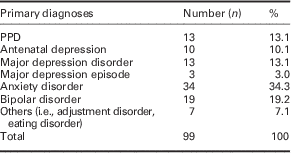
PPD=postpartum depression.
Service utilization within the MMHP
A majority of the women (n=86, 87%) used the MMHP services three times or more. Most of the women (n=82, 83%) saw the nurse therapist for counseling, support, and/or referral; 79% (n=78) of women visited a psychiatrist (consultation and/or psychotherapy); and 20 (20%) saw the psychologist (assessment and/or counseling). A total of 71 (72%) women saw two members of the MMHP team and only nine (9%) women saw all three members of the team. A total of 49 (50%) women were referred to other programs or groups, and 55.1% (n=27) of them attended the programs or groups as referred (see Table 3).
Attending program/group information
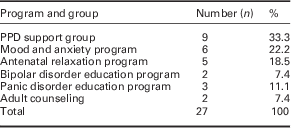
PPD=postpartum depression.
Changes in symptoms
Depression symptoms
The mean intake EPDS score: 14.97 (n=99, SD: 5.97), was significantly higher than the mean evaluation EPDS score, 9.13 (n=99, SD: 5.71) (P<0.001). The Cronbach’s α for the EPDS at intake and evaluation were calculated to be 0.87 and 0.89, respectively, indicating high internal consistency.
Anxiety symptoms
The mean intake EPDS anxiety subscale score: 5.90 (n=99, SD: 2.04), was significantly higher than the mean evaluation EPDS anxiety subscale mean score 3.86 (n=99, SD: 2.36) (P<0.001).
Women’s satisfaction with the MMHP
Women’s satisfaction with the MMHP was identified in three areas: (1) care received, (2) location and childcare, and (3) overall satisfaction. A Cronbach’s α of 0.86 of the questionnaire indicates high internal consistency.
Care received
The majority of women (83.3%, n=82) reported the staff understood their problem, 76.0% (n=75) said the staff adequately explained their care to them, and 87.6% (n=87) believed that the person who cared for them was thorough and competent. Women replied to the item: the one thing I liked the most about the MMHP: ‘Knowing I had support and help when I needed,’ ‘Caring and understanding staff,’ ‘The time to talk one on one, and it was safe to talk …no one judging,’ and ‘I absolutely loved the support.’
Location and childcare
Most of the women (56.6%, n=56) felt that the location was convenient. Many (n=60, 60.8%) did not answer the question of ‘childcare,’ some of which were not applicable (pregnant or children in daycare), while 27% of women (n=27) believed that the childcare services met their needs. Women who did use childcare stated, ‘childcare provided was very helpful,’ and ‘childcare was critical and dearly needed.’
The MMHP overall
In all, 88 women (89%) would recommend the MMHP to women like themselves, and 75.8% (n=75) of women believed that the MMHP met their expectations. Women wrote; ‘It was a great resource I would not have made such positive change otherwise,’ ‘The teamwork with all the disciplines- psychiatrist, nurse, family doctor,’ ‘seeing everybody on the same day, great accessibility,’ ‘The expertise for my issues in pregnancy,’ ‘The expertise in postpartum depression,’ and ‘This program is fabulous. I have two older children and experienced PPD after giving birth to both of them. I sought help early on (when I was 5 months pregnant), and I feel as though getting help then helped me enjoy my baby which I had never experienced before. I will refer the program to who may need it. Thank you for helping me enjoy my sweet baby!’ For the prompt, ‘The one thing I would change about the MMHP,’ women stated that a follow-up phone call from the MMHP would be helpful, they wanted more counseling, and suggested more publicity for the program, particularly in rural areas.
The Physicians
Of the 136 physicians who referred women to the MMHP, 64.7% (n=88) returned the questionnaires. Of these 88 physicians, 80.7% (n=71) were family physicians, 15.9% (n=14) were obstetricians, two were psychiatrists (2.3%), and one was a midwife (1.1%) (the midwife attended the family physician meetings and was therefore included with physicians for data collection and analyses).
Satisfaction
Physician satisfaction with the MMHP was identified in three areas: (1) accessibility, (2) physician comfort and skill treating maternal mental health problems, and (3) the MMHP overall. The questionnaire had high internal consistency with a Cronbach’s α of 0.91.
Access to the MMHP
Most of physicians (77.8%, n=68) were familiar with how to refer their patients and which services the program provided. A majority (62.7%, n=55) of physicians thought that the waiting time for their patients to receive care from the MMHP was reasonable (median waiting time for the MMHP patient was four weeks). In response to the question: ‘What are your expectations of a program for maternal mental health patients?’ a majority of physicians (60.9%, n=59) commented positively on the accessibility: they commented that the program provided a quick referral response, quick assessment, and timely access. Physicians wrote: ‘Expediently seen’ and ‘It is great to have the program, and the consultation is quite acceptable.’
Knowledge of and competence in treating maternal mental health problems
Overall, physicians believed that the MMHP had improved their knowledge of maternal mental health (55.3%, n=49), felt more confident treating maternal mental health problems (63.5%, n=56), and thought that the MMHP consultation provided enough information to allow them to care for their patients (73.5%, n=65). Some physicians, particularly those who had been in practice less than two years, expressed a need for more support from the MMHP in terms of direction and guidance for treating their patients in their care. Physicians wrote: ‘Give direction to family physicians,’ ‘Provided appropriate antenatal and postpartum counselling,’ and ‘Expert assessment and effective treatment plan.’
The MMHP overall
The majority of physicians were satisfied with the program (71.5%, n=66) and the program was a valuable resource for them (76.8.0%, n=67). Physicians wrote: ‘My experiences with the program has been positive,’ ‘Please keep the program going,’ ‘A great component for our medical residents,’ and ‘Excellent idea – present information in grand rounds (physician research seminars’). Physicians believed that improving communication between the program and referring physicians would enhance the quality of the program. The physicians wanted to see the entire assessment and treatment of their patients during their participation in the MMHP (e.g., the psychologist, nurse therapist, and other programs attended by their patient, not just the psychiatry consultation). They indicated that there was a need for ongoing support for patients and their families such as education, counseling, and follow-up in the community.
Discussion
This evaluation suggests that a MMHP using a shared care approach can improve maternal anxiety and depression symptoms; especially in women with the most severe symptoms on intake.
Participating women and referring physicians viewed the MMHP as a valuable resource that was easily accessible for women who would not otherwise receive specialized treatment during this vulnerable time. Accessibility is an issue in health care for patients, and practitioner, the Canadian Psychiatric Association recommends that the waiting time to access to a psychiatrist after a family physician referral should be no more than four weeks (Canadian Psychiatric Association, 2006). The median waiting time for seeing a psychiatrist for the MMHP patients was four weeks, in comparison with five and half weeks in the province of Saskatchewan, and seven weeks nationally (Esmail, Reference Esmail2009); however, some physicians wanted their patients to have more immediate access to the MMHP, which might indicate that some patients needed help right away. In order to improve accessibility to the program within the current level of resources, prioritizing urgent cases, and improving communication with referring physicians are the key.
In this study, women were at different stages of gestation and weeks postpartum; therefore, the reduction of anxiety and depression symptoms occurred at different times and may be more attributable to engagement in the MMHP. While some may question that mental health symptoms will dissipate over time. Some researchers have suggested that for large percentage of women, depression levels are highest during the first few months postpartum and decrease significantly soon after (Campbell and Cohn, Reference Campbell and Cohn1997; Heron et al., Reference Heron, O’Connor, Evans, Golding and Glover2004), but others studies have shown no significant change in depressive levels after the early postpartum period (Beeghly et al., Reference Beeghly, Weinberg, Olson, Kernan, Riley and Tronick2002; Horowitz and Goodman, Reference Horowitz and Goodman2004). In addition, there are a significant number of women whose PPD continues well beyond the early postpartum period (Horowitz and Goodman, Reference Horowitz and Goodman2004; Mayberry et al., Reference Mayberry, Horowitz and Declercg2007).
Both women and physicians suggested that more support, education, counseling, and more follow-up with women before and after completing the program are desirable. The MMHP nurse therapist and the psychologist also refer women to different programs (education, counseling, and support); however, the waiting time for individual counseling took up to six months. It was also suggested that a social worker needs to be added to the team to connect women with community resources, particularly financial support.
Most referring physicians reported feeling more confident and comfortable treating maternal mental health patients through consultation and communication with the MMHP while newer physicians felt that they needed more support from the MMHP in terms of direction, guidance, and education. As Kates et al. (Reference Kates, McPherson-Doe and George2011) have noted, regular structured education training, and discussion sessions between referring physicians and the program are helpful.
This evaluation suggests shared care MMHPs are effective in reducing symptoms and the simplicity of the approach points to increased feasibility for implementation in other centers, particularly in rural or remote areas where access to specialized mental health services is a challenge to access and equity in health care.
Further study could implement a randomized control trial to establish association between the program and symptom relief. Loss of follow-up is problematic in scientific research involving human subjects. It could also include more in-depth qualitative study through individual interviews or focus groups to help better understand women’s and physician’s experience of the program. It would also be useful to study alternative methods of providing shared care consultations through ehealth innovations and remote-presence technologies.
Limitations
Just over 50% of eligible women consented for their information to be used in the study and were then approached for the evaluation component; this may have been due to administrative changes at the onset of the program. In addition, it is acknowledged that without a control group, one cannot attribute all of the symptom improvement to the program itself. However, it is difficult and unethical to have a control group for local women when they and their physicians know here is a resource available to help them within a few weeks. We planned to have a control group of women who were waiting for participation in the MMHP, but the average waiting time was four weeks from the time of intake to being consulted and this was too short of a time to engage the woman in the study and was not long enough to compare with treated women.
Conclusions
This evaluation demonstrates a shared care approach can ease maternal anxiety and depression symptoms, while also satisfying the needs of women and physicians. Shared care consultations and treatment plans provide an opportunity for increasing knowledge and skills of primary health care providers such as physicians and midwives, recognizing that new practitioners may need increased support.
Acknowledgments
The Saskatchewan Health Research Foundation (#1834) supported this research. Hua Li received support from Graduate Studies and Research at the University of Saskatchewan. Gratitude is expressed to the women and staff associated with the Maternal Mental Health Program.
Conflicts of Interest
There are no known conflicts of interest.
Ethical Standards
Ethical approval was obtained from the Research Ethics Board of the University of Saskatchewan and the Saskatoon Health Region.



