




A wave of Indigenous people promoting counter-narratives of Brazilian history gained prominence in the 21st century. This counter movement happened most notably through the Indigenous movement; the rise of audiovisual materials; and later in literature, visual arts, and the performing arts. I refer to this period as the fourth moment of Indigenous history in Brazil. The three prior moments were approached by Brazilian researchers such as Daniel Munduruku and Darci Secchi, who connected indigenist policies with Indigenous education.
For Munduruku, the first moment would have been marked by an attempt of physical annihilation of Indigenous peoples.Footnote 1 The second moment happened through the forced assimilation of Indigenous peoples with attempts of total erasure of native cultures and identities. The third moment emerged from Brazil’s 1988 Constitution, when Indigenous peoples secured constitutional rights and took their struggles to the legislative arena and into high politics. Secchi offers a slightly different approach.Footnote 2 The first moment of Indigenous education was led by Indigenous people with traditional teachings. The second moment was during the colonial period, when education for Indigenous peoples was marked by catechizing, ethnocentric, and integrationist features. The third moment was the Indigenous school education after Brazil’s 1988 Constitution, which guaranteed the right to difference, bilingual and differentiated teaching, and intercultural education.
As Secchi expands his research beyond Indigenous education, he focuses on roles of leadership played by Indigenous individuals in the construction of public policies. This perspective points to a fourth moment in the history of Indigenous public policies in Brazil. Like Secchi, I develop this fourth moment, expanding the idea of leadership to include the presence of Indigenous people in fields such as the arts, communication, and literature and their impact on official history. In doing so, I want to stress the significance of web networks for Indigenous strategies to be recognized. Similarly, it is key to highlight how ethnic–racial relations have historically developed in Brazil and how this directly affects the shaping of labor relations, public policy, and education for Indigenous and non-Indigenous individuals alike.
The Indigenous presence in the public sector has been expanding in recent years, both in the civil service and in the political sphere. Key examples include the creation of the Ministry of Indigenous Peoples in 2023, the election of two female Indigenous federal legislators in the 2022 congressional election, the occupation of strategic positions by Indigenous persons within state, federal, and municipal administrations, as well as the growing presence of Indigenous people in academia, whether it is through public recruitment, hiring processes for tenured faculty positions, or temporary contracts. This is happening in other fields, with Indigenous health professionals increasingly present in medical positions such as nurses, nursing technicians, doctors, and psychologists.
1. The place of others in Brazilian research and higher education
In recent decades, curiosity regarding Brazilian Indigenous artistic production has caught the attention of professionals in the art world. This fueled a significant increase in Indigenous participation in the art market and across global art circuits. At the 2025 Venice Biennale, for instance, the Brazilian Pavilion was curated by Indigenous peoples and the presence of Indigenous artists was the central focus of the exhibition. This interest has brought to the scene some highlights that soon occupy the fundamental spaces to leverage the Indigenous presence in artistic markets, whether in literature, visual arts, or theater. In media, for instance, the search for novelty set the tone for the growing emergence of Indigenous artists and writers, feeding a scene that feeds back on the “new.”
A similar trend is tangible in higher education and research institutions across Brazil. In addition to occupying faculty positions, Indigenous researchers are now also contributing to research projects and include Indigenous knowledge and epistemologies in key national debates on climate issues.
What I seek to emphasize in my research is that before the rise of this great visibility in the 21st century, Indigenous people were already producing documentary-style audiovisual work. They were participating as collaborators of works of visual arts signed by non-Indigenous people, they had been holding their own exhibitions that did not gain much public projection because they were performed far in the rural regions far from large urban centers. This means that small artistic movements were already happening in Brazil, but outside the mainstream axis of visibility for the visual arts that cities like Sao Paulo may offer. The vastness of Brazil’s territory combined with the lack of media coverage for Indigenous performances left many Indigenous contributions invisible in the national gaze.
The now internationally acclaimed Indigenous public intellectual Ailton Krenak exhibited his artistic works for the first time at the 1991 Embassy of Forest Peoples [Embaixada dos Povos da Floresta] under the curatorship of Bené Fonteles.Footnote 3 Back in 1998, Krenak had exhibited 48 prints of various materials at Kakibaka Gallery in Tokyo, Japan.Footnote 4 Already in the 1980s and 1990s, Indigenous artists made appearances on national television. Macsuara Kadiweu, a Brazilian actor who had his first appearance in national cinema around 1980, has recently acted on television in Rede Globo telenovelas. In 2024, it was the turn of Daniel Munduruku, an actor, writer, and cultural agitator recently elected to office who belongs to the Indigenous Munduruku nation.Footnote 5 It is important to mention this so that from the point of view of the mediatization and the performance of whiteness, we do not fall into the fallacy of the “first one,” a narrative that empties the political-activist tone of Indigenous achievements, placing the aura of historical reparation and “mission accomplished” of whiteness, emptying the idea of what being the first brings to Indigenous individuals and groups.
Growing access to computers and the internet was undoubtedly one of the enabling factors for this dissemination of Indigenous lifeways. Indigenous youth took great advantage of emerging opportunities on the web to become content producers. By content producers, I mean influencers who work on social networks, especially Instagram and TikTok.
Indigenous presence has been changing the scene of formal and nonformal education in Brazil. Evidence of this change is the presence of Indigenous intellectuals or public figures speaking in classrooms, seminars, and academic conferences, in-person or virtually, to spaces that are almost always packed with people who want to refresh their knowledge or access new forms of knowing. This contributes significantly to strengthening Brazil’s Federal Law 11.645/08, which requires elementary schools to teach about Indigenous art and culture.Footnote 6 It simultaneously encourages the creation of research groups and knowledge production in the form of monographs or doctoral and master’s theses across academic institutions. In practice, however, the Law has not been disseminated the way it should be within Brazilian educational institutions. One of the reasons is the lack of sustained training for educators on how to implement the Law and engage Indigenous culture. Another is the scarcity of updated support and didactic materials that present Brazilian Indigenous history and contemporary Indigenous peoples and lifeways in today’s context. The emergence of research and doctoral theses can nonetheless generate important references, especially when they are produced by Indigenous scholars.
With this in mind, it is urgent to further recognize the purpose of popularizing Indigenous knowledge and the challenges it faces, valuing the contribution of Indigenous science and technology in concrete ways. One way is by sharing some observations on how conventional fields of study in the natural sciences can dialog with the sciences and ways of knowing of Indigenous and other peoples placed, who have been pushed to the margins of the construction of scientific knowledge for centuries. Let me now turn to my own research at the Research Project “Museum-Lab of Art, Science and Technology,” at the Federal University of Mato Grosso, Brazil.
2. Art, science, and technology to make visible other possibilities of good living
My research at the Museum-Lab of Art, Science and Technology began in 2024 with a focus on the dissemination of scientific knowledge in accessible ways for all, rather than for Indigenous peoples only. I am interested in discussing the role of scientists in the construction of good living, the recognition of scientific research by society at large, and their important role for solving urgent problems, such as climate emergencies. Currently, I am concluding the first stage of the project: a study of museums that play a key role in disseminating science.
In this immersion, I seek to observe the presence of “others” and their knowledge in these spaces, connecting their contributions to the promotion of solidarity and respect for diverse ways of being and doing. I also seek to investigate how art can be a powerful mediator, understanding its dimension as a mediator of knowledge and apprehending its power to reach different audiences and to develop alternative perceptions of the world.
As an artist, I have used art as a mediator and translator of Indigenous conceptions and cosmogonies. This is a role that many Indigenous artists have developed in Brazil—to retell the history of our country and the Indigenous presence in it.
My artistic research-action, “Eu sou uma árvore” [“I am a tree”] (2019) (see figure 1), performs the manipulation of images of various trees of the world, so that the manipulation results in the “appearance” of living beings “within them.” For originary peoples and first nations, this means that the plant world is treated as a relative of human beings, with respect and harmony.
Photographic series “I am a tree”, Naine Terena, 2022. Image captured and manipulated by Naine Terena. Artistic performance of Naine Terena’s research-action “I am a tree,” at the Theaterformen Festival, Braunschweig, Germany (2022).
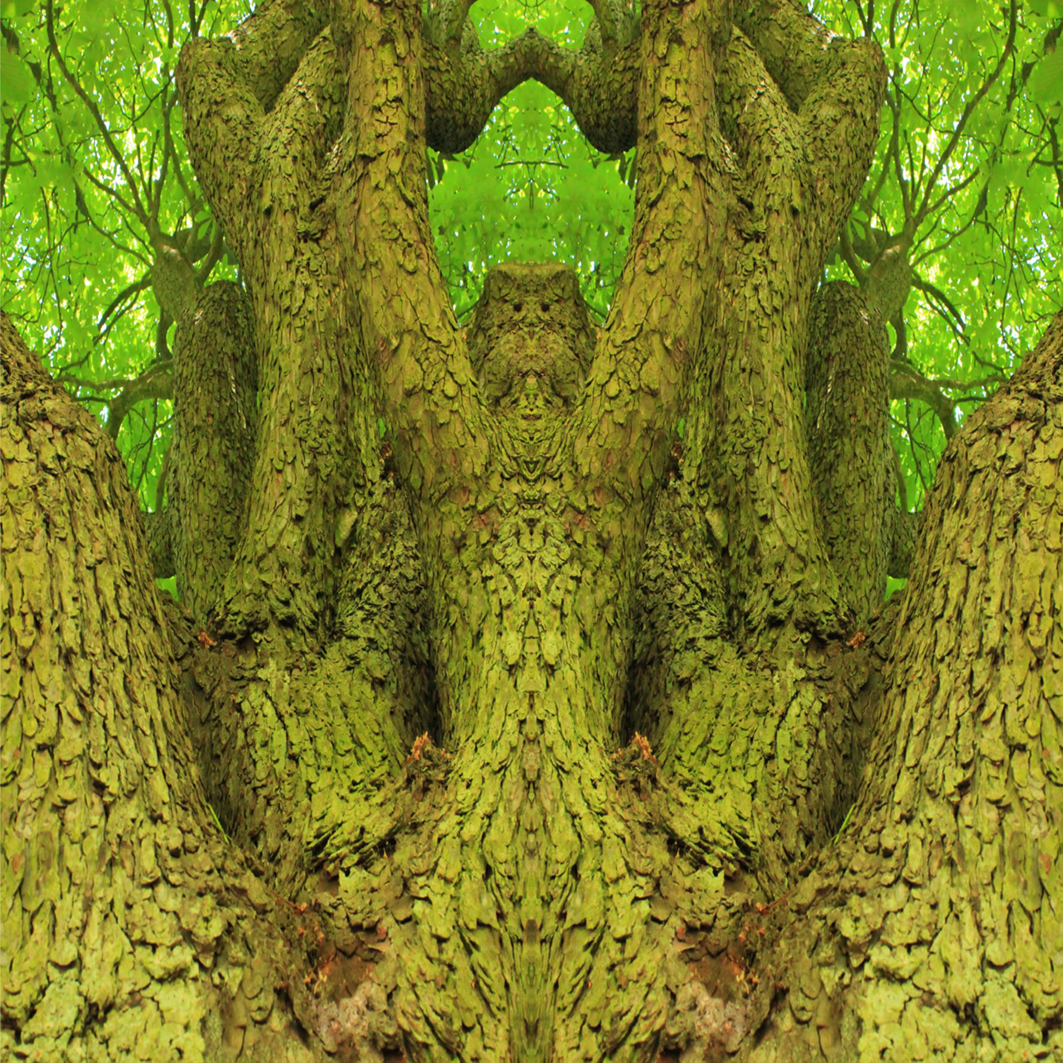
The possibility of bringing to the visual field the being of trees reinforces and problematizes theories on the rights of nature expressed in documents such as the 2019 Declaration of the Rights of Trees.Footnote 7 It also expands the desire for societies to envision other possibilities of relating to nature, beyond the extractivist regimes that exploit natural resources with all the imbalance that this brings to human life on the planet. “I am a tree” produces an interesting impact on the academic world and a certain strangeness for the general public, as it presents a perspective of the aura, spirit, or living being of the trees, beyond what meets the eye.
The Trees were first presented at the Festival Theaterformen in Germany in 2022, based on the plotting of manipulated images on the glass wall of the Park Theater in the city of Braunschweig. In this Festival edition, we produced walking trees, creating a kind of costume that strolled through the City Park, drawing the public’s attention to a new form of performance.
The photographs were acquired a year later by the Mead Art Museum, affiliated to Amherst College, through the Boundless, an exhibition that featured a diverse array of Indigenous artists from across the hemisphere. In 2024, the I am a tree photographs were mediators in a lecture at the Nature-based Solutions Conference at Oxford University, alongside a photo of the researcher in the Indigenous territory to which she belongs (photos attached), to seek dialog on how Brazilian Indigenous peoples understand human–nature relations.Footnote 8
The interactions through this action research and additional previous research and consulting activities in museums and art institutions reveal many gaps that arise in similar ways. Building the presence of marginalized groups requires institutional coordination to change the action plans of each of these institutions, to promote policies and public investments for their presence in places that hold collections, and to disseminate Indigenous knowledge and technologies.
The assembling of prior experiences with my ongoing research at the Museum-Lab of Art, Science, and Technology points to the need for a reflection to be reinforced in the coming years. We need to find more ways to bring scientific knowledge closer to the general public, to foster solidarity between scientists and artists, to broaden dialogs, and to recognize other ways of being and existing in the world. It is urgent to consider effective learning and actions for community life, building a set of useful proposals for the maintenance of life on Earth. In the next stages of the project, we will put the curatorial framework into practice in order to design an exhibition that brings us closer to the population, and from there, broaden the interest in this field of study, articulating it with the life of the Brazilian people.
Thinking about this close connection to the life of the Brazilian people, I have become increasingly interested in establishing a link between Indigenous knowledge and the scientific knowledge produced by academic researchers, so that, together, they can bring to people different perspectives of being and existing in the world, thereby reducing racial and intellectual discrimination and environmental racism to strengthen collaborations in the making and dissemination of science to everyone.
Author contribution
Writing - original draft: N.T.
Conflicts of interests
The author declares no competing interests.

 Open access

