




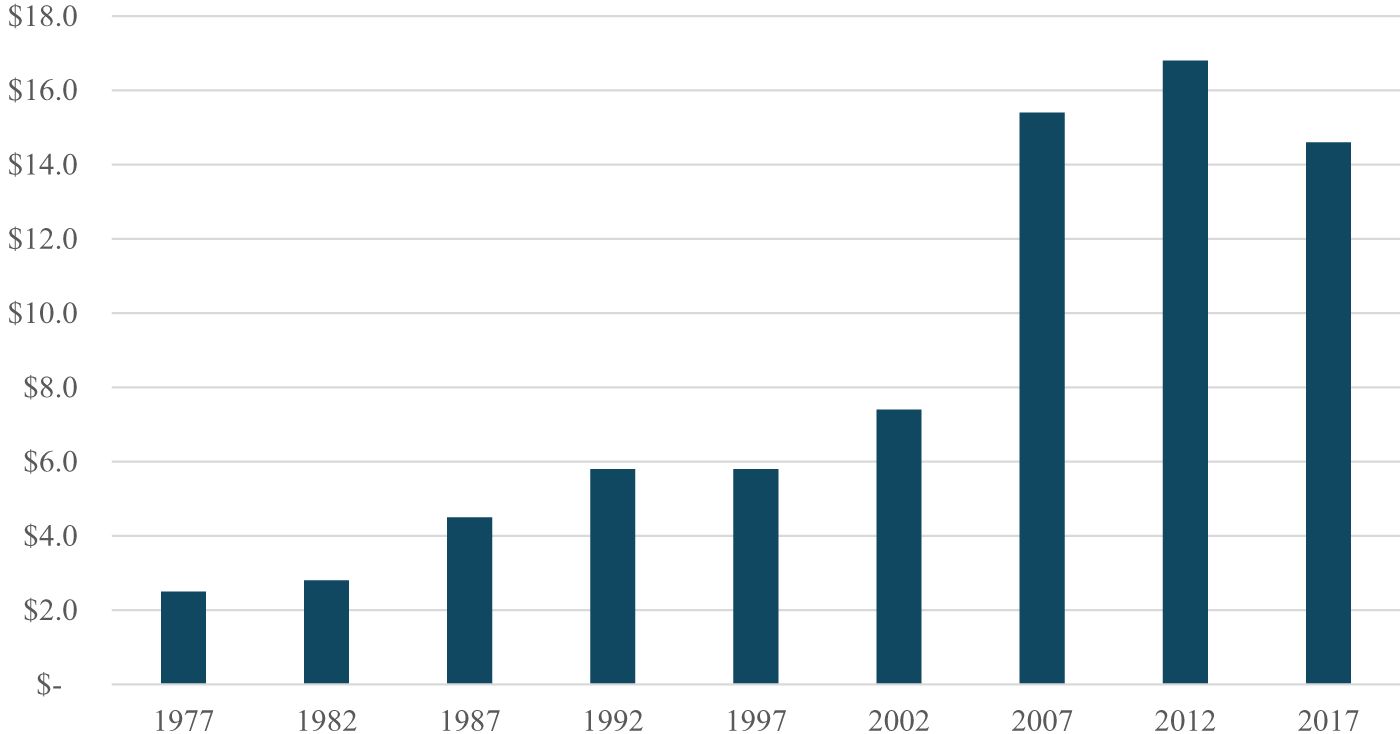
How do sociolegal scholars who liken monetary sanctions to “bleeding a turnip” (Atkinson Reference Atkinson2016; Feola Reference Feola2020; Mendez et al. Reference Mendez, Selbin and Tupper2022; Nichol and Hunt Reference Nichol and Hunt2021) or “drawing blood from stones” (Harris et al. Reference Harris, Evans and Beckett2010; Posner Reference Posner1972) reconcile these idioms with the fact that fines and fees constitute a growth industry? Since neither turnips nor stones bleed when pricked or prodded, the implication is that money cannot be extracted from those without disposable income. The problem is one of realization, long identified by classical thinkers from Cesare Beccaria (Reference Beccaria[1764] 1872) to Jeremy Bentham (Reference Bentham1789) to Georg Rusche and Otto Kirchheimer (Reference Rusche and Kirchheimer1939), where the pecuniary character of monetary sanctions confronts natural limits when people lack the finances to pay them. From this standpoint, fines and fees conflict with “principles of proportionality” that are crucial to liberal theories of punishment. Their severity is differentially experienced according to social standing, meaning financial penalties frequently inflict hardships that are out of step with an offense’s seriousness. Because monetary sanctions disproportionately impact those of modest means, especially the racialized poor (Harris Reference Harris2016; Sances and You Reference Sances Michael and Young You2017; Singla et al. Reference Singla, Kirschner and Stone2020), some reasonably conclude that they represent more of a controlling force of domination than a source of revenue to be exploited for financial benefit (e.g., Pager et al. Reference Pager, Goldstein, Helen and Western2022). Yet, revenues from fines and fees have grown at exponential rates since the 1970s (see Figure 1).Footnote 1 Between 1977 and 2017, they have increased by 484% from $2.5 billion to $14.6 billion (inflation held constant) to become a structural feature throughout local governments in the United States. In the study to come, we take up the topic of monetary sanctions within a case study on parking tickets in Chicago. Our goal is to understand the ways that fines and fees paradoxically generate resources from those without any.
Monetary sanctions are a growth industry for local & state government, 1977–2017 (values are adjusted for inflation, currency presented in billions as 2017 dollars).
Following the predation model developed by Joshua Page and Joe Soss (Reference Page, Soss, Schram and Pavlovskaya2018; Reference Page and Soss2021), we offer another take for understanding the extractive utility of monetary sanctions. Rather than lack value in the modern economy, the indebted are reformulated as assets who underwrite profits for public and private interests alike. The emphasis on public and private interests, here, distinguishes our inquiry from recent applications of predation. Whereas some mobilize the framework to stress how governments use fines and fees to offset budgetary shortfalls (e.g., Carbado Reference Carbado2022; Le and Young Reference Le and Young2023; Waller et al. Reference Waller, Rich and Robbins2024), others highlight the illegality of these takings without providing adequate services in return (e.g., Atuahene Reference Atuahene2020; Reference Atuahene2023). These contributions clarify “what’s broken” in government by identifying the classic gap between “law on the books” and “law in action” (Pound Reference Pound1910) where face-neutral legal punishments crystallize structured inequalities instead of equal treatment (see also Sarat Reference Sarat1985). By taking up questions of “what’s broken,” these applications of the predation framework evade inquiries that consider how these debts are “working” as intended. Diagnosing the gulf between what law is supposed to be (i.e., formal equality) versus what it does (i.e., substantive inequality) strictly as an expression of government dysfunction overlooks how private interests partake in extractive projects through collaborations with the state that are functional if not strategic. The omission is one of high theoretical stakes since it reduces predation to a critique of government failure when the framework is also a cautionary warning about developments in capitalism. Monetary sanctions represent a sprawling growth industry, in part, because private interests have “piggybacked” onto the delivery of expanding infrastructure, from monitoring and enforcement to debt collection to payment-processing technologies (Page and Soss Reference Page, Soss, Schram and Pavlovskaya2018; Reference Page and Soss2021). Together, the state and for-profit interests form a symbiotic relationship that facilitates processes of accumulation while further entrenching inequality – all within a rule of law.
In the study to come, we take up the empirical task of measuring which communities are singled out by predation. Drawing upon a multivariate analysis of 11.3 million parking tickets issued in Chicago between 2013 and 2017, we answer two research questions: (1) To what extent are there are associations between the issuance of tickets and neighborhood-level characteristics and (2) which of these communities incur ballooning costs and muscular collection efforts when debts go unpaid? Whereas the predation frame identifies communities subjugated by race and class as the primary targets of fines and fees (Page and Soss Reference Page, Soss, Schram and Pavlovskaya2018; Reference Page and Soss2021), we point out ways that different dynamics apply outside the theory’s original domain of application: criminal law. Our analysis documents how parking tickets are experienced in two contrasting ways that follow patterns of racial duality. On the one hand, we show how a more generalized population is subject to parking tickets compared to monetary sanctions of the criminal-legal system. We theorize that this outcome results from parking violations being more of a regulatory affair that is morally decoupled from racialized threats of criminality. On the other hand, even though tickets implicate a broader population, we find that these penalties to constitute a tiered system of extraction given their disproportionate impact. Ticket-related debts devastate people of color because so many within these communities are already economically vulnerable. Our contribution is situated within research on “empirical critical race theory.” We bridge empiricism common in the social sciences with critical race theory to pursue a “hybrid methodology” (Barnes Reference Barnes2016) that offers two clarifications for how predation operates within the specific context of parking tickets. In this line of inquiry, empiricism and critical race theory are seen as needed interventions upon one another (Carbado Reference Carbado2011; Carbado and Roithmayr Reference Carbado and Roithmayr2014; Gómez Reference Gómez2012; Obasogie Reference Obasogie2013; Parks Reference Parks2008). Our use of critical race theory dislodges social science from a priori assumptions that overlook how a racist order is a constitutive feature of law (Bell Reference Bell1973; Crenshaw et al. Reference Crenshaw, Gotanda, Peller and Thomas1995; Delgado and Stefancic Reference Delgado and Stefancic2001), while the empirical methods we deploy provide critical race theory with a measurable basis for how racial inequality unfolds through legal practices that evade reference to race altogether (Peery and Obasogie Reference Peery and Obasogie2018).
Finding a spot for parking within works on predation
Much of the sociolegal work on predation to date focuses on monied sanctions that stem from misdemeanor and felony offenses in the criminal-legal system (Carbado Reference Carbado2022; Deckard Reference Deckard2024; Horowitz et al. Reference Horowitz, Larson, Stewart and Uggen2024; Martin Reference Martin2023; Ruhland Reference Ruhland2024; Shannon et al. Reference Shannon, Larson, Kennedy, O’Neill and Harris2024; Strong Reference Strong2023). Yet, pecuniary penalties are not exclusive to this domain of law. They are applied across many settings, from punitive damages in civil suits to consumer protections of public interests to tickets for parking violations. All these sanctions are like penal fines and fees insofar as they represent financial obligations that are coerced by the state (Pattillo and Kirk Reference Pattillo and Kirk2021), but each has its own purpose, function, and genealogy (Faraldo-Cabana Reference Faraldo-Cabana2017). Parking tickets stand apart from other monied sanctions in how they are adjudicated in the lowest echelon of law: municipal courts (Natapoff Reference Natapoff2021). Municipal courts do not practice the same standards of judicial integrity found in other legal settings (Bottoms Reference Bottoms, Garland and Young1983; O’Malley Reference O’Malley2009). Most tickets do not require courtroom appearance (Fox Reference Fox1995). There is no presumption of innocence (Henricks and Ortiz Reference Henricks and Ortiz2022b). The burden of proof falls on the accused (Murray et al. Reference Murray, McVie, Matthews and Gorton2024). Individualized attention for each ticket is deprioritized for speedier summary proceedings (Grace Reference Grace2013). In fact, the same procedural safeguards found in criminal courts would be impossible in municipal ones. The volume of cases would collapse them. Given these fundamental differences in municipal courts, we suggest that predation likely operates in unique ways from its practice in the criminal-legal system. In the study that follows, we extend the theory of predation articulated by Page and Soss (Reference Page, Soss, Schram and Pavlovskaya2018; Reference Page and Soss2021), with some revision, to focus on parking tickets as the primary object of inquiry.
Whereas our inquiry centers parking as the site where government exercises sovereign power through fines and fees (Marusek Reference Marusek2023), we acknowledge that a growing body of sociolegal research discusses the intersection of cars and monetary sanctions within the context of traffic stops (Headworth Reference Headworth2023; Livingston and Ross Reference Livingston and Ross2022; Seo Reference Seo2019). What sets this inquiry apart from these other studies is our emphasis on cars in-place rather than in-motion. We recognize that every drive begins and ends with a parked car. Not only does the average vehicle spend 95% of its life resting in place (Shoup Reference Shoup2005), but the vast space devoted to parking makes it no trivial matter of regulation (Marusek Reference Marusek2012). In Los Angeles, for example, as much as 81% of surface land in the city’s central business district is parceled for parking (Kenworthy and Laube Reference Kenworthy and Laube1999). The coverage rates are 36% and 18% for Chicago and New York, respectively. Beyond these social facts, we contend that parking tickets are a more modal experience among the population than are traffic stops. As much is true even though some sociolegal scholars describe traffic stops as the epicenter of government encounters (Baumgartner, Epp, and Shoub Reference Baumgartner Frank, Epp Derek and Kelsey2018; Epp, Maynard-Moody, and Haider-Markel Reference Epp Charles, Steven and Donald2014). Between 2013 and 2017 in the City of Chicago, for example, there were 15.8 times more parking tickets than traffic stops. Whereas records from Chicago’s Department of Finance indicate that, on average, 2.4 million parking tickets were issued each year, the annual average number of traffic stops documented by the Chicago Police Department amounted to 149.2 thousand. By centering something so seemingly mundane but touches the lives of so many, we argue that a focus on parking tickets positions us to build a more comprehensive theory of predation. Our project identifies a more expansive project that reaches beyond traffic stops, and criminal law more generally, toward a broader project of governance.
The racialized duality of predatory parking tickets
Insights from critical race theory lead us to expect that predation will operate differently in municipal courts compared to criminal ones. Before proceeding with our study, we will specify what is meant by critical race theory. We do not view this line of inquiry as a unified body of knowledge that is defined by canonical agreement. There are unsettled debates, for example, over whether the social sciences are compatible with critical race theory (Moran Reference Moran2010). Some contend the kind of empiricism central to our study runs counter to the theory’s critique of objectivity and defense of situated knowledge (Culp et al. Reference Culp, Harris and Valdes2003). Others insist the social sciences represent one of many ways of knowing that can inspire unasked research questions, demand reconsiderations of key claims, and push discovery forward in unexpected directions (Barnes Reference Barnes2015; Reference Barnes2016; Obasogie Reference Obasogie2013). Methodological debates aside, we draw inspiration from Kimberlé Crenshaw (Reference Crenshaw2011) when she describes critical race theory more as an evolving, general orientation than a fixed set of ideas that are universally established. The field of study is comprised of many voices that are, at times, competing but nevertheless committed to a common goal: to understand how a racist order persists in patterned and resilient ways across institutions that intersect with the law (see also Lipsitz Reference Lipsitz2011).
We build upon the intellectual engagement of critical race theory by synthesizing some of its key ideas with developing work on the extractive nature of fines and fees. Our contribution highlights the duality of predation within the context of parking tickets, one that follows disparate patterns of racialization in terms of who is targeted by these sanctions versus who is burdened by them. Because parking violations are generally viewed more as low-stakes violations of technicality than heinous affronts to the social order,Footnote 2 we contend that these sanctions can be more flexibly imposed onto nontraditional categories of “offenders” (see also O’Malley Reference O’Malley2009). Leaving these debts unpaid, however, constitutes a distinct violation that is held to higher standard. The associated penalties for unpaid tickets blur the conventional boundaries between regulatory and criminal law. Within the criminal-legal system, for example, severe punishments are more frequently reserved for offenses that are broadly viewed with greater ethical importance (see also Garland Reference Garland1985). The associated penalties for unpaid parking tickets follow a similar schematic insofar as they exceed the original sanction. Stepped-up reprimands include additional financial penalties, vehicle confiscation, and other criminal-legal entanglements, all of which intensify the seriousness of unpaid tickets by subjecting people to greater proportions of punishment. In the immediate sections to follow, we motivate two sets of hypotheses regarding how the duality of racialization colors (1) who is subjected to parking tickets and (2) which communities incur additional punishments for unsatisfied debt.
Hypothesis 1: The relationship between parking tickets and representation
Police are perhaps the most visible manifestation of state power among communities subjugated by race and class (Soss and Weaver Reference Soss and Weaver2017). Especially in hypersegregated cities like Chicago, most encounters poor residents of color have with government take place through beat patrols, traffic stops, and technologized surveillance (Jefferson Reference Jefferson2020; Kane et al. Reference Kane, Gustafson and Bruell2013; Meehan and Ponder Reference Meehan and Ponder2002). When officers are assigned to police these segregated communities of color, there are greater opportunities to criminalize residents within these spaces – all of which reinforces a self-fulfilling pattern where heavily patrolled areas yield higher rates of crime (Bell Reference Bell2020; Correia and Wall Reference Correia and Wall2018). Racial disparities in general crime statistics dovetail with general sentiment that communities of color are dangerous (Chiricos et al. Reference Chiricos, McEntire and Gertz2001; Quillian and Pager Reference Quillian and Pager2001). This link between race and disorder may help explain why police are more likely to deploy aggressive enforcement techniques in communities of color relative to their white counterparts (Beck Reference Beck2023; Bohon and Ortiz Reference Bohon and Ortiz2021; Roh and Robinson Reference Roh and Robinson2009). Under a predation framework, these practices of policing not only divide and exclude according to markers of race. They leverage the vulnerabilities of communities of color, especially poor ones, “to pursue projects of expropriation, extreme exploitation, and/or dispossession” (Page and Soss Reference Page and Soss2021:291). The predation framework draws attention to how the racialized poor are called upon to bankroll a justice system that imposes much punishment upon them.
We propose that predation operates by different standards when it comes to parking tickets. Whereas race and criminality are often conflated within the criminal-legal system (Butler Reference Butler2010; Carbado Reference Carbado2002; Lee Reference Lee2012; Russell-Brown Reference Russell-Brown[1998] 2009), parking violations represent more of a regulatory than moral affair that is distanced from encoded threats (i.e., “dog whistles”) to safety (Haney López Reference Haney López2014). In other words, parking violations are generally regarded as public inconveniences. They are not considered to be serious or harmful acts. They often lack any accompanying sense of guilt for breaking the law. They are “deracialized” in the public imagination. To the extent that racialization refers to “the extension of racial meaning to a previously racially unclassified relationship, social practice, or group” (Omi and Winant Reference Omi and Winant1986:111), then deracialization can be defined in oppositional terms. Rather than use race as a basis of differentiation, which is at the heart of racialization, deracialization represents the absence (or withdraw) of racial meaning (see also Lewis Reference Lewis2004). Against the contrived anxieties that conflate Blackness or Brownness with criminality, ranging from minor offenses like welfare fraud (Gustafson Reference Gustafson2011) to violent crimes such as street muggings (Hall et al. Reference Hall, Critcher, Jefferson, Clarke and Roberts[1978] 2013), we argue that parking violations exist in a separate moral universe. The reprimands that result from these misdeeds, to extend our argument further, are not clouded by racialized desires for punitive recourse other studies have identified for criminal offenses (Bobo and Johnson Reference Bobo and Johnson2004; Peffley and Hurwitz Reference Peffley and Hurwitz2007). Nor do parking tickets follow the assumptions behind sentencing practices of criminal law. They do not incapacitate, rehabilitate, or possibly even deter. Parking tickets are not as intrusive as the liberty-depriving punishments that define penal systems.
Parking tickets blur the line between what represents a reprimand, on the one hand, and what is the retrospective price of some forbidden misdeed, on the other (Bottoms Reference Bottoms, Garland and Young1983; O’Malley Reference O’Malley2009). Those who are issued tickets can duck courtroom appearances with online payments or mailed checks. So long as debts are paid, noncompliance is not an indictable offense. Violations can be repeated indefinitely without further repercussions. Paying a parking ticket represents the cost of no further punishment, as least until the next one is written (see also Pattillo and Kirk Reference Pattillo and Kirk2021). Because money is the medium of atonement, as opposed to the state’s more repressive possibilities of punishment, not only are parking infractions commercialized, but the sanctions, themselves, are depersonalized as an anonymized financial transaction (see also Simmel Reference Simmel[1900] 2004). With these features in mind, we suggest that parking tickets fall within a broader constellation of “light-touch” punishments. They are reserved for violations that do not symbolize reprehensible breaches to mainstream sensibilities within a racialized culture of punishment. The exceptionality of parking tickets is important to emphasize insofar as it informs our point of departure from how predation is theorized. Whereas the predation framework singles out poor communities of color as targets of extractive practices (Page and Soss Reference Page, Soss, Schram and Pavlovskaya2018; Reference Page and Soss2021), we view the regulation of parking violations as efforts to “govern through crime” (Simon Reference Simon2007) in a broader policing project that does not solely target the racially precarious. The revenue-maximizing capacity of ticketing practices hinges upon casting a wider net onto the population. Our first hypothesis is formalized accordingly:
Hypothesis 1: The incidence rate of parking tickets will bear little to no relationship with the minority representation of a neighborhood.
Hypothesis 2: The relationship between intensified reprimand and representation
Those who violate the rules of the road, at least from a contractual standpoint, have secured something of value denied to others (i.e., free parking). On paper, parking violations can seem like they hold people to a common standard. Regardless of personal background or political influence, the ticketed face a uniform set of penalties. They are subjected to what amounts to a punishment grid of fixed penalties that are statutorily predetermined. All these features satisfy the hallmarks for universal principles of justice. Under this colorblind register of the law, as critical race theorists have identified, everyone appears as though they are treated as equals (Gotanda Reference Gotanda1991; Haney Lopéz Reference López2010; Van Cleve and Mayes Reference Van Cleve and Mayes2015). Punishments are presumed to begin from a neutral starting point even though underlying inequalities ensure they are differentially experienced (Bell Reference Bell1987; Harris Reference Harris1993). Inequality structures the pains of punishment so that some are under-protected while others are overprotected. In no way can such reprimands be labeled as discriminatory from a constitutional viewpoint, so the colorblind narrative goes, because actions can only be defined as such when specific deeds are identified, individual wrongdoers named, explicit malice proven, and direct harm demonstrated (Freeman Reference Freeman1977; Moore Reference Moore2014; Williams Reference Williams1989). Meanwhile, this same rule of law simultaneously maintains an inequitable status quo since debt is more debilitating than dutiful among the racialized poor (Bing et al. Reference Bing, Pettit and Slavinski2022; O’Neill et al. Reference O’Neill, Kennedy and Harris2022; Sykes et al. Reference Sykes, Ballard, Giuffre, Goodsell, Kaiser, Celestino Mata and Sola2022).
Given how differential demands are imposed upon the indebted according to economic standing, which is a racialized location itself, we suspect the fallout from unpaid tickets will be racially stratified. Racial differentiation serves as a broader organizing principle that constitutes, and is constituted by, the broader political economy (Robinson Reference Robinson1983). As Eduardo Bonilla-Silva (Reference Bonilla-Silva, Doane and Bonilla-Silva2003) explains, those who are racialized as “white” inhabit “the visible uniform of the dominant racial group” and possess an “embodied racial power” (p. 271, emphasis original; see also Haney López Reference Haney López1996; Harris Reference Harris1993). When it comes to fines and fees, claims to whiteness can be converted to what George Lipsitz (Reference Lipsitz1998) describes as a “cash value” to satisfy a debt:
it accounts for advantages that come to individuals through profits made from housing secured in discriminatory markets, through the unequal educations allocated to children of different races, through insider networks that channel employment opportunities to the relatives and friends of those who have profited most from present and past racial discrimination, and especially through intergenerational transfers of inherited wealth that pass on the spoils of discrimination to succeeding generations. (p. vii)
Whereas people of color, especially those who are racialized as Black or Latinx, are overrepresented on the bottom of socioeconomic indicators, whites are overrepresented at the top. Racial stratification defines virtually every one of these measures available to social scientists, including un- and under-employment, wage differentials, occupational segregation, and wealth disparities, among other measures (Manning Reference Manning1983). Sedimentary layers of inequality represent the culminating effects of structural racism that are not confined to (in)actions of the present (Oliver and Shapiro Reference Oliver and Shapiro[1995] 2006). They epitomize a form of social inertia that mitigates the risk of who suffers from the state’s coercive apparatus (Harris Reference Harris2020).
When people fail to pay their parking tickets, whatever the reason, the indebted are haunted by what amounts to a “negative credential” (Pager Reference Pager2003). More than a repressive source of intensified rebuke, though, unpaid tickets are productive (in the Foucauldian sense) for the state insofar as they convert the indebted into governable subjects (Page and Soss Reference Page, Soss, Schram and Pavlovskaya2018; Reference Page and Soss2021). They become an entry point, or wedge, for the state to extract more resources from the indebted and/or their extended family (Boches et al. Reference Boches, Martin, Giuffre, Sanchez, Sutherland and Shannon2022; Deckard Reference Deckard2024; Katzenstein and Waller Reference Katzenstein and Waller2015; Page et al. Reference Page, Piehowski and Soss2019). More specifically, we see the stepped-up penalties associated with unpaid tickets as a form of enclosure that creates a new class of noncompliance. The indebted become “subprimed” populations who face reprimands from surcharges and collections fees, on the lighter end of the extractive spectrum, to more strongarmed interventions like vehicle seizure, ownership transfer to the state, and license suspension, on the harsher end. Ticket-related debt is at the heart of moving drivers through intensified legal categories of governability. We anticipate that communities of color will be most impacted by mounting forms of extraction linked to nonpayment, given their location within the racialized political economy, but not necessarily for reasons identified by those who study fines and fees.
Whereas numerous studies on fines and fees identify the influence of pejorative stereotypes that evoke racial scripts of crime in the discretionary sentences of monetary sanctions (Gordon and Glaser Reference Gordon and Glaser1991; Harris et al. Reference Harris, Evans and Beckett2011; Kohler-Hausmann Reference Kohler-Hausmann2018), our emphasis is placed on extractions that are automatically triggered when parking tickets go unpaid. The distinction keeps with a key theme of critical race theory. It draws attention to how the racial order is reproduced through multilevel arrangements among units of analysis beyond the individual (Ansley Reference Ansley1988; Bell Reference Bell1980; Gómez Reference Gómez2010; Lawrence Reference Lawrence1990). Vesting the authority of these stepped-up interventions within a systematized workflow, rather than legal actors who are implicated in the ticketing regime, severs a direct relationship between the ticketer and the ticketed. When someone does not pay their ticket, for example, municipals operate a ticketing-processing system that monitors unpaid debts and escalates their penalties according to a set of prefigured benchmarks. Notifications for these intensifying penalties are institutionally buffered impositions. There is no need for prejudicial decisions made by parking enforcement agents, hearing officers, or judges to nevertheless carry out racially disparate outcomes. By substituting discretion with a rule-bound authority, the legal organization of monetary sanctions routinizes the reproduction of racially disparate outcomes, we suspect, to a transcendent point where institutional discrimination surpasses the sum of its parts (see also Ture and Hamilton Reference Ture and Hamilton[1967] 1992). The second hypothesis is formalized as follows:
Hypothesis 2: Neighborhoods with proportionally more Black or Latinx residents will be subjected to higher incidence rates for escalating reprimands tied to unpaid tickets.
Chicago as a case study of broader diagnostic
Using Chicago as a case study, where the neighborhood-level relationship between ticketing outcomes and racial composition is centered, we offer a granular account of predation within a bellwether case of urban governance. Census data show that growth patterns of monetary sanctions in Chicago follow similar patterns as local governments throughout the U.S. (see Figure 2). Whereas the City of Chicago collected only $56.8 million from fines and fees in 1989, these sanctions generated as much as $321.3 million by 2017 even as the city’s population declined by 3.9% during the same time. Holding inflation constant, the increase represents a positive change of 465% over some three decades. The growth trend began under Richard M. Daley who served as the city’s longest-running mayor from 1989–2011. During the early 1990s, Mayor Daley introduced a culture of compliance by turning to parking tickets for income to reduce property taxes and subsidize the costs of public services. As the mayor explained to City Council, “There’s a limit to what we can ask of local taxpayers. And that’s why we’re putting even more muscle into collection of fines and fees next year” (“City of Chicago” 1992:10). By “muscle,” Daley ordered the City Clerk’s Office to perform routine audits on drivers to verify they purchased annual city stickers. The Department of Streets and Sanitation would expand its “vehicle immobilization program” with more boots, tows, and impoundments. Storage fees were doubled at the city’s impoundment lots. Those who owed the most debt would find their name published in a monthly list of the “most wanted scofflaws.” Altogether, these kinds of initiatives forecasted the embrace of “offender-funded justice” during the decades to come not just for those who violated parking restrictions but those who evaded parking-related debts.
Monetary sanctions are a growth industry for the city of Chicago, 1977–2017.
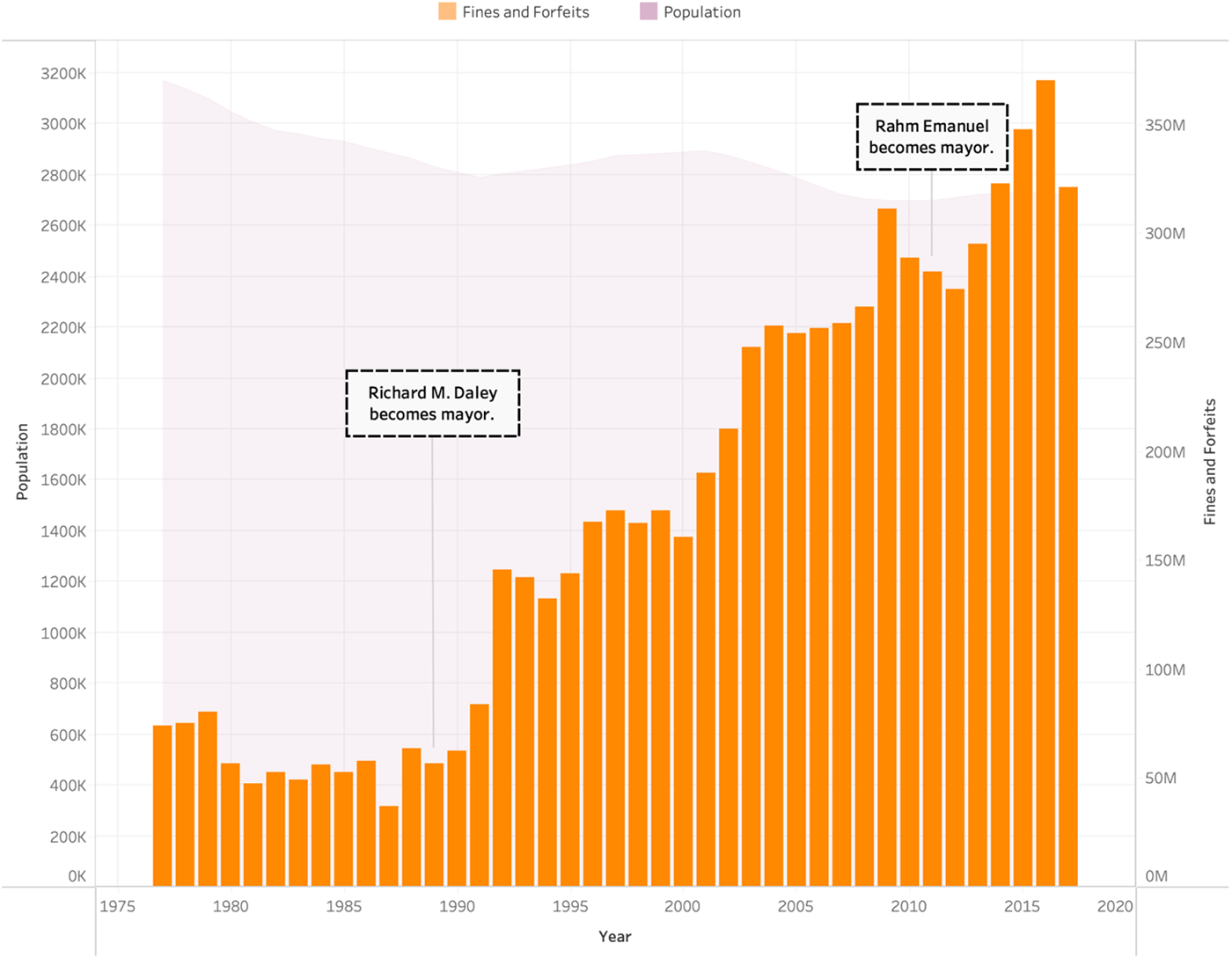
New punitive heights were reached during the 2010s. Before being appointed the U.S. Ambassador to Japan but after serving as the White House Chief of Staff, Rahm Emanuel was the Mayor of Chicago from 2011 to 2019. Among the first problems he confronted in office was a budgetary shortfall of $635.7 million. Following the political playbook of his predecessor, Mayor Emanuel turned to parking tickets to make up the difference (“City of Chicago, Office of Mayor” 2011b). Using familiar imaginaries of the “undeserving” poor (Katz Reference Katz1989), and many of the racist implications it evokes (see also Brown Reference Brown2007; Kidder and Martin Reference Kidder and William Martin2012; Willmott Reference Willmott2022), he derided the indebted as though they encompassed all that was wrong with unbalanced budgets if not a lack of law and order (see also Friedman and Pattillo Reference Friedman and Pattillo2019; Kirk et al. Reference Kirk, Fernandes and Friedman2020). Consider the mayor in his own words:
Moving forward there will be no more free rides, debt scofflaws will be found and they will pay what they owe the City…. That means we will take a smarter more aggressive approach to recover this debt, not only to collect what we are owed but to ensure that it never reaches this level again. (qtd. in “City of Chicago, Office of the Mayor” 2011a:1)Footnote 3
With this kind of framing, Emanuel did not simply cast the indebted outside Chicago’s circle of civic belonging. He marked them as suitable subjects for state-sanctioned reprisals of extraction. The “make them pay” discourse was followed with a series of accountability measures, including additional late penalties and collections fees, an increase in the number of boots, tows, and impoundments, and driver’s license suspensions. Beginning in 2014, the City of Chicago began a three-year streak of breaking its own record for revenue from monetary sanctions. Census data show that annual revenues surpassed $323 million in 2014, $348 million in 2015, and $370 million in 2016. According to Chicago’s Comptroller Amer Ahmad, the purpose behind the city’s debt recovery efforts was to “improve the way the city collects its debt so that the honest Chicago taxpayers who play by the rules aren’t left holding the bag” (qtd. in Ramos Reference Ramos2012:4).
Though Chicago’s political leadership insists parking tickets provide needed revenue for state capacity, as evidenced by the above comments from Richard M. Daley, Rahm Emanuel, and Amer Ahmad, many of the proceeds are redirected to profit-seeking interests that have little direct connection to the city. According to records we obtained from Chicago’s Department of Procurement Services, many outside interests have a vested stake in the city’s parking infrastructure. In 1989, the City of Chicago began one of its first experiments with privatization by outsourcing its towing services. United Road Towing has monopolized the exclusive contract ever since, and it is now owned by a private equity firm based out of New York (Mill Point Capital). In 1998, the City of Chicago contracted with IBM for technology intended to fulfil all its ticket-processing needs. The contract remains ongoing under a spin-off company, Kyndryl, Inc., that inherited IBM’s managed infrastructure services. In 2006, the City of Chicago leased four downtown parking structures, including some 9,000 spaces, to the New York investment firm Morgan Stanley at $563 million for 99 years. In 2008, nearly 36,000 metered spaces were leased to a Morgan Stanley-led conglomerate, joined by German investor Allianz Capital and the Abu Dhabi Investment Authority, at $1.16 billion for 75 years. All these privatized arrangements speak to how Chicago cannot be reduced to a self-contained field site. While our data are geographically bounded by jurisdictional borders, the city’s business dealings with private interests expose broader developments within the political economy. They showcase how profit-seeking incentives are grafted onto government services (Ashton et al. Reference Ashton, Doussard and Weber2016). In other words, Chicago represents a case study that is relevant for broader diagnostic.
Methodology
The study sets out to answer two questions: (1) To what extent are there are associations between the issuance of tickets and neighborhood-level characteristics and (2) which of these communities incur ballooning costs and muscular collection efforts when debts go unpaid? To fulfill this objective, we geocoded the full universe of parking tickets issued by the City of Chicago from issued from January 1, 2013 to December 31, 2017, under Chapter 9-64 of the Municipal Code. This five-year snapshot was purposefully chosen to capture the moment of unprecedented levels of aggressive ticketing strategies and debt recovery efforts. The city’s ticketing records offer much information, from what ordinance was violated to where a citation was issued, but they do not reveal personal information about the car’s registered owner. Among the 11,779,371 parking, standing, and compliance citations in question, the final sample consists of 95.8% of the tickets that were issued. The remaining cases were omitted out of concerns of data quality with the location information (e.g., incomplete addresses, typographical errors). Our data were obtained through Freedom of Information Act requests to Department of Finance.Footnote 4 They are current as of May 14, 2018. Any parking, standing, and compliance violations outlined therein are subject to penalties ranging from $25 to $250. Should drivers not satisfy these debts, they can be subject to further impositions like late penalties, collections fees (i.e., add-on of 22%), immobilization and impoundment, transfer of ownership, and driver’s license suspensions. In the analysis to come, we model each of these penalties as their outcome.
Each of our outcomes are placed within a multivariate framework by joining them with outside data sources that are aggregated at the census tract level. Using the census tract as our unit of analysis keeps our study aligned with much of the Chicago-focused literature on neighborhood levels of crime. An aerial measure is appropriate here, we argue, given that most tickets are issued when drivers are physically not present at the scene. In other words, their cars rest as stationary props within a backdrop of their more anonymous neighborhood settings. Therefore, ticketing practices may be as much of a reflection of the surrounding community as anything else. Three tracts were omitted from our final sample because they lacked a residential population (i.e., those overlapping with Midway and O’Hare International Airports). The final analysis consists of 798 census tracts. While exploring whether ticketing-related outcomes have racially disparate impacts is the central empirical goal of our study,Footnote 5 we recognize that these outcomes can be influenced by a host of competing factors.
Neighborhood conditions structure the terrain for what ticketing outcomes are possible, and they often covary by a neighborhood’s residential population (Sampson Reference Sampson2012). Therefore, any spurious association between ticketing outcomes and racial makeup should disappear once other factors are considered. Tickets can be unevenly issued across a geography defined by population and housing features (Brazil Reference Brazil2020; Brazil et al. Reference Brazil, Vang and Abdelnur2024; Chester et al. Reference Chester, Fraser, Matute, Flower and Pendyala2015; Manville and Pinski Reference Manville and Pinski2021; Shoup Reference Shoup2005; Wo et al. Reference Wo, Kim and Malone2023). These include measures like median income, renter-occupied housing, and population density. Some studies have shown that ticketing patterns can be impacted by commuting characteristics (Waller et al. Reference Waller, Rich and Robbins2024). These include measures like the number of households that have a car, the average travel time to work, and the degree of nearby traffic intensity. Others document how ticketing patterns can be influenced by the proximity of brick-and-mortar institutions (Henricks Reference Henricks2020). These include measures like how close a car was parked to a nearby bus stop, school, or hospital. Features of the built environment can influence whether someone is issued a ticket too (Brazil et al. Reference Brazil, Vang and Abdelnur2024). These include measures like if cars were parked nearby commercial corridors, railways, or airports. There is also the matter of regulatory exposure (Gao et al. Reference Gao, Xie and Ozbay2018), like whether a car is parked in a ticketing “hotspot” or nearby a police precinct. We link our ticketing records to data from nine other sources to account for all these possibilities. Table 1 overviews the variables we considered.
Overview of the considered measures in the final models (n = 798)
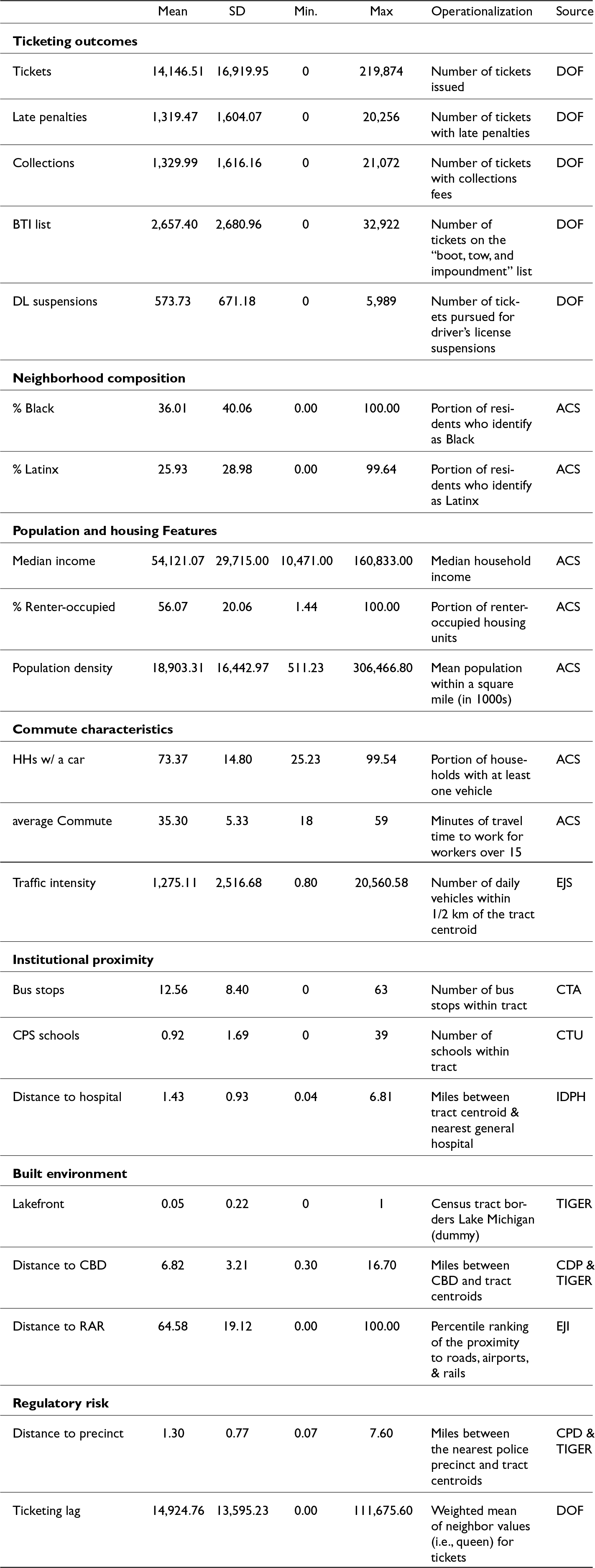
ACS: American Community Survey, U.S. Census Bureau; CDP: Chicago Data Portal, City of Chicago; CPD: Chicago Police Department; CTA: Chicago Transit Authority, City of Chicago; CTU: Chicago Teachers Union DOF: Department of Finance, City of Chicago; EJI: Environmental Justice Index, Centers for Disease Control and Prevention; EJS: EJScreen, Environmental Protection Agency; IDPH: Illinois Department of Public Health; TIGER: TIGER/Line Shapefiles, U.S. Census Bureau.
The calculus behind our count models
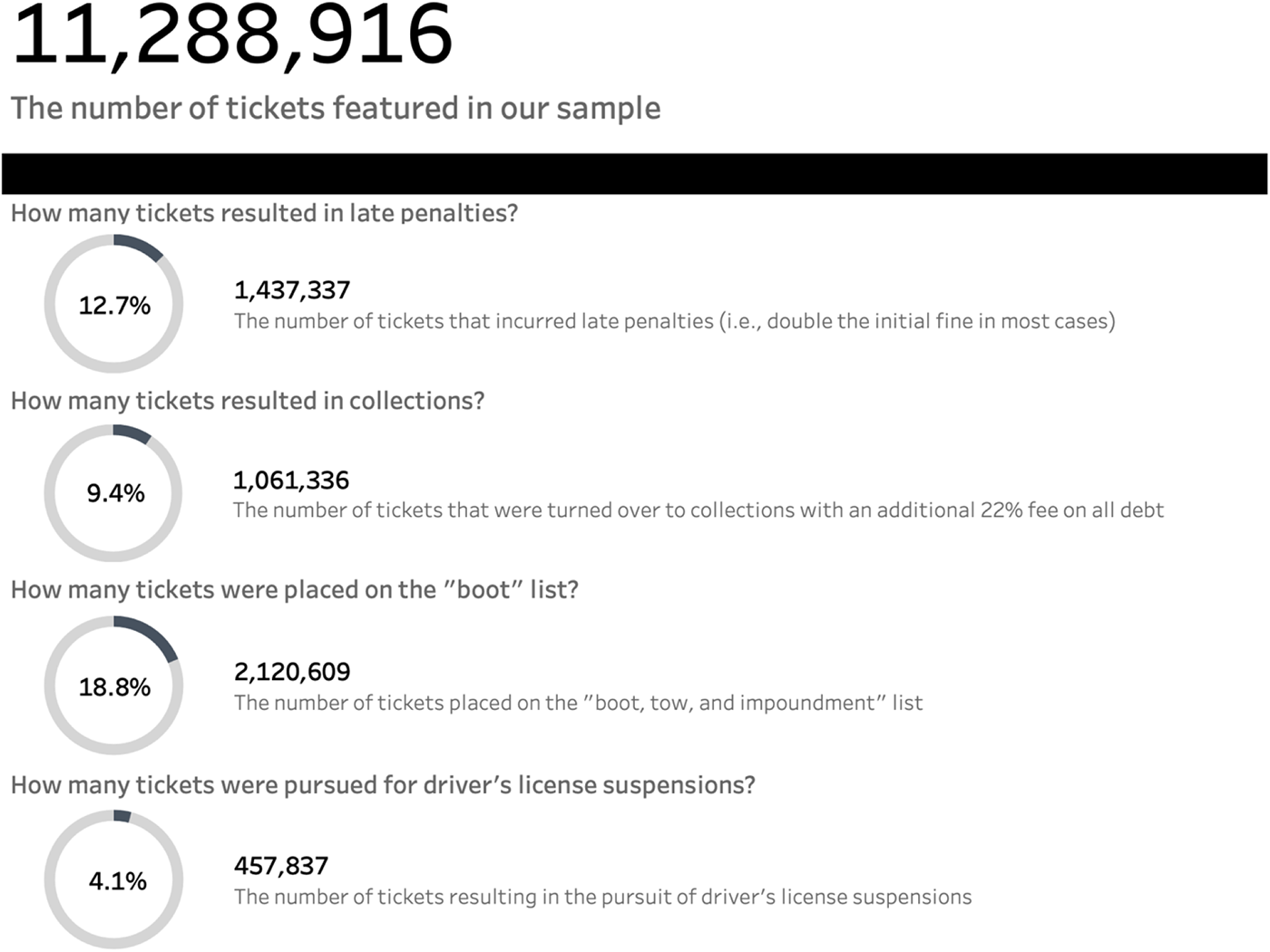
We offer a series of negative binomial regression models that examine racial disparities across five outcomes. Each outcome represents a benchmark in a chain of events for the City of Chicago’s ticketing process (see Figure 3). The sequence begins with the issuance of a citation. Most tickets amount to $50 or $60. Any unpaid tickets can be subject to late penalties, collections costs, possible booting, towing, and impoundment, and possible license suspension. Once a car is ticketed, the registered owner has 14 days to appeal by mail or 21 days to request a hearing. If a person is determined to be at fault, they are notified by the Department of Finance. A total of 11,288,916 tickets issued between 2013 and 2017 are featured in our final sample. When debts are not paid by the due date, a late penalty is assessed. These penalties equal the original fine amount. As much as 12.7% (or 1,437,337) of the tickets in our sample incurred late penalties. Should a final notice be mailed, the registered owner accrues 22% in collections fees that add to the original fine and late penalty. These charges can be avoided if debts are resolved within 180 days. As much as 9.4% (or 1,061,336) of the tickets in our sample incurred collections fees. When owners receive three or more final notices, or if they have two tickets over a year old, their cars are placed on the “boot, tow, and impoundment” list. Once a car on this list is identified on the public way, the vehicle is immobilized with a wheel lock (i.e., the Denver boot). The owner is subject to an additional $60 fee. When owners do not settle their debts or setup a payment plan within 24 hours of being booted,Footnote 6 their cars will be towed and drivers are subject to a $150 towing fee. Once at the impoundment center, drivers accrue a $20 daily storage fee. The rate jumps to $35 after five days. As much as 18.8% (or 2,120,609) of tickets in our sample were associated with a car on the city’s “boot, tow, and impoundment” list. Among the drivers who accumulate 10 or more unpaid parking tickets, Chicago’s Department of Finance will collaborate with the Illinois Secretary of State to suspend their license.Footnote 7 Owners are notified of the pending suspension, and they have 45 days to satisfy their debt. A much as 4.1% (or 457,837) of tickets in our sample resulted with pursuit of license suspension.
The cascading reprimands of unpaid tickets in the city of Chicago, 2013–2017.
To accomplish the empirical goal of our analysis, we turn to a series of count models that predict the incidence rates of tickets at the tract level as well as how many were subject to reprimands tied to nonpayment. More specifically, we run five separate models to predict: (1) the incidence rate of tickets, (2) the incidence rate of tickets subjected to late penalties, (3) the incidence rate of tickets that incurred collections fees, (4) the incidence rate of tickets that place a car on the “boot, tow, and impoundment” list, and (5) the incidence rate of tickets tied to a subsequent driver’s license suspension. While we could select from several possible count models (e.g., Poisson, negative binomial, zero-inflated approaches), our strategy pursues a negative binomial approach for two reasons. First, our outcomes do not follow a Poisson distribution where the conditional mean and variance are assumed to be similar values. Rather, our outcomes are overdispersed. Negative binomial models correct for this problem with the inclusion of a dispersion parameter that accounts for the excess variance in a distribution. Second, zero-inflated models are unnecessary, here, given that drivers in most every neighborhood were ticketed and subject to intensified penalties. Within our sample, only one tract (or 0.1%) went without any tickets, late penalties, collections fees, or immobilization. Five (or 0.6%) went without a driver’s license suspension.
Because coefficients for negative binomial models follow a natural logarithmic scale, we exponentiate these results for ease of interpretation. Any measures not dichotomously coded are standardized as z-scores to place them on a common scale. The resulting coefficients can be interpreted as incidence rate ratios. They represent the multiplicative change in an outcome that is associated with a standard deviation increase from the average of a given predictor, all else equal. In contrast to odds ratios that are absolute measures of association (e.g., unpaid tickets that incur reprimand versus those that do not), incident rate ratios are relative measures of association (e.g., the number of tickets ending in reprimand as a proportion of all tickets issued). Values greater than “1” indicate a positive relationship. Those below “1” indicate a negative one.
Which communities are ticketed and face escalating penalties?
We begin our analysis with an overview that identifies the ticketing geography of Chicago as well as which tickets result in additional penalties due to nonpayment. Figure 4 outlines the spatial distribution for each of our five outcomes: (a) tickets issued, (b) tickets that incur late penalties, (c) tickets subject to collections fees, (d) tickets placed on the “boot, tow, and impoundment” list, and (e) tickets that end in license suspension. These maps visualize the incidence levels for each outcome, and all the measures are standardized to present the distributions on a consistent scale. Alongside these maps, we provide descriptive statistics and test results for overdispersion (i.e., Cameron and Trivedi’s Test). The overdispersion tests confirm the appropriateness of using negative binomial regression models for our data structure. Generally speaking, the spatial distributions illustrated in Figure 4 are consistent with our original hypotheses. At a basic level, they contrast where tickets are issued throughout the city and which tickets incur intensified reprimands tied to nonpayment. These outcomes follow distinct spatial patterns that are apparent to the naked eye, and these contrasts grow starker as the reprisals are more punitive. In the immediate paragraphs to follow, we will provide a descriptive analysis on each outcome to detail how they follow different geographies.
The geography of ticketing outcomes in the city of Chicago, 2013–2017.
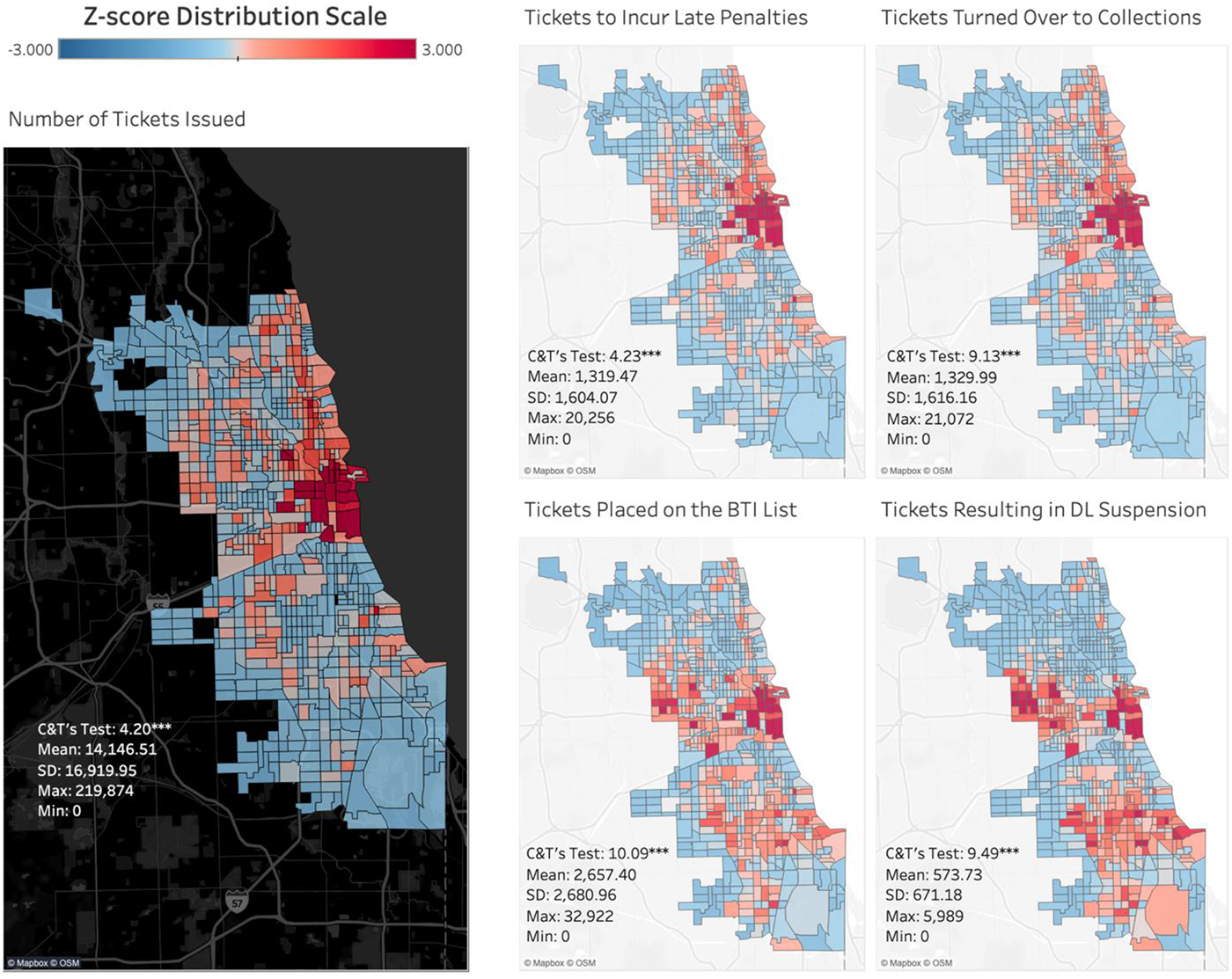
Looking to the first outcome, the number of tickets issued, most of the ticketing “hot spots,” which are represented in red, cluster around the city’s downtown area. This space represents the radial hub of Chicago’s transportation network, and all routes flow in a direction that feeds the city’s hungriest ticketing district. Isolating those tracts that are nested within community areas that overlap or border the Central Business District, which includes the Loop, Near North Side, Near South Side, Near West Side, and West Town, we find that 79 neighborhoods accounted for 26.9% of all issued tickets. Not only do these hot spots host one of the world’s largest job centers in the Loop, but they house major tourist destinations like Navy Pier, the Water Tower, and the Magnificent Mile on the Near North Side. Within these hot spots are the city’s most ticketed cross-streets: Erie and Fairbanks. These streets intersect at Northwestern Memorial Hospital. In contrast, many of the city’s “cold spots,” which are indicated in blue, cluster around the city’s northwest, southern, and southwest edges. Whereas the south side communities are comprised mainly by Black residents, the other neighborhoods include Chicago’s so-called “guns and hoses” bungalows. They are home to many police officers, firefighters, and other city employees.
When attention is shifted to the remaining outcomes that measure reprimands that are tied to nonpayment, we observe spatial distributions that are dissimilar to where tickets are issued. Whereas there appears to be some overlap between tickets and escalating penalties on the lighter end of rebuke, including late penalties and collections fees, the similarity diminishes when it comes to tickets that placed a car on the “boot, tow, and impoundment” list or resulted in license suspensions. More specifically, many of the predominantly Black neighborhoods located on the south and west sides flip from cold spots of ticketing to hot spots of tickets-turned-intensified punishment. Isolating only those tracts nested within community areas on the far westside, including Austin, Humboldt Park, West Garfield Park, East Garfield Park, and North Lawndale, we find that 76 neighborhoods account for 22.3% of the tickets that were tied to license suspensions. The comparison is striking: these far westside communities have 1.7 times as many tickets turned into license suspensions compared to tracts overlapping with or bordering the Central Business District, despite having only 3.3 times fewer tickets issued. The far westside neighborhoods we identify are the same communities where Dr. Martin Luther King Jr. and many others mobilized for fair housing in Chicago during the mid-1960s. In North Lawndale at the cross-streets of 16th and Hamlin, Dr. King and his family resided for just under a year before returning south for the “Poor People’s Campaign.” Today, those ticketed in these neighborhoods face the harshest consequences for unpaid ticket debt.
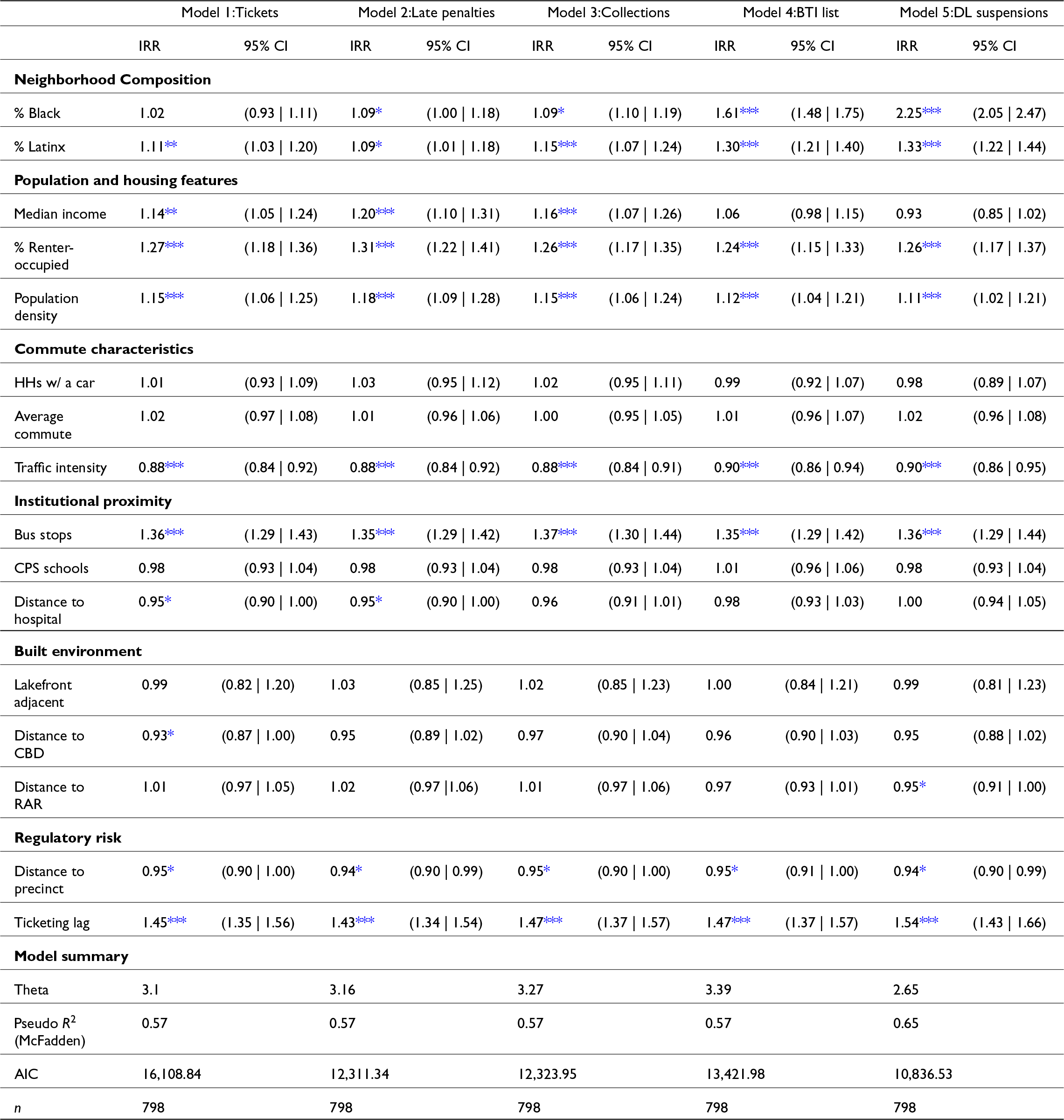
Now that distinct spatial distributions have been established between the issuance of parking tickets and those tickets that are subject to further rebuke, we examine whether these patterns hold in a multivariate framework. Table 2 summarizes the results from our negative binomial regression count models. They are models that measure the association between our ticketing outcomes and racial composition, while controlling for competing factors. Keeping with prior studies, we account for measures of a neighborhood’s population and housing qualities, commuting characteristics, proximity to mainstream institutions, features of the built environment, and regulatory exposure. These count models allow us to disentangle the independent effect of a neighborhood’s racial makeup alongside other likely correlates that are considered in simultaneous fashion. Our analysis provides new evidence that speaks to the racialized duality of predation insofar as parking tickets are concerned. Although parking tickets implicate a more generalized population than penal fines and fees, the debts that come with these sanctions nevertheless devastate Black and Latinx communities. Not only does ticket-related debt introduce another problem to a much broader crisis of precarity, but racial disproportionality intensifies as penalties for nonpayment become more punitive.
Negative binomial models for parking tickets and subsequent punishment for unpaid debt, 2013–2017
Significance levels:
* p< .05; **p< .01; ***p< .001.
Tickets vary from one neighborhood to the next
Model 1 answers our first research question of whether there are associations between the issuance of tickets and neighborhood-level characteristics. Given how parking violations are more of an administrative than moral affair, where transgressions are distanced from racially encoded threats to the social order, we expected that ticketing practices would implicate a broader set of targets than the usual suspects of crime control. Formally stated, we hypothesized that the number of parking tickets issued would bear little to no relationship with a neighborhood’s minority representation. The model provides mixed support. Tickets are issued more frequently in neighborhoods with greater Latinx representation, while no significant relationship emerges with Black representation. Specifically, the incidence rate of tickets rises by 11% for each standard deviation increase in a neighborhood’s Latinx population (IRR: 1.11, p < .01). In contrast, the coefficient for Black residents is statistically insignificant. These findings diverge from prior studies on fines and fees within the criminal-legal system that show how neighborhoods with larger Black populations experience higher levels of monetary sanctions (Sances Michael and Young You Reference Sances Michael and Young You2017; Singla et al. Reference Singla, Kirschner and Stone2020).
The unique vulnerabilities facing Latinxs may help explain why these spaces experience different ticketing patterns from predominantly Black communities (see also Delgado and Stefancic Reference Delgado and Stefancic2000). Many tracts with the highest ticket counts, outside of downtown and its immediate vicinities, are not just any Latinx communities. They include “sanctuary spaces” that are located within community areas like the Lower West Side (“Pilsen”), Brighton Park, New City, and South Lawndale (“Little Village”). These are the same spaces that house considerable shares of Chicago’s some 183,000 undocumented, mostly Latin American residents (Tsao Reference Tsao2014). To the extent that citizenship serves as a marker of division, the state can leverage the spatialized vulnerabilities of residents within Latinx communities through practices of “pocketbook policing” that raise revenue through parking-related sanctions (Pacewicz and Robinson Reference Pacewicz and Robinson2021).
Among Latinx communities, tickets can translate into unwanted attention from authorities who are viewed, often with good reason, as a gateway to dragnet policing strategies of immigration enforcement (De Genova Reference De Genova2005). Even those who have established legal status often fear of being targeted by immigration practices that can end in deportation (Asad Reference Asad2020). Many of those who park within these places are poorly positioned to push back against exercises of state-backed power. Otherwise, they are exposed to lurking risks of expulsion (Sanchez et al. Reference Sanchez, Cadigan, Abels-Sullivan and Sykes2022). Rather than take these risks, many just pay their tickets outright. In Chicago, these Latinx spaces are the same communities that have the lowest rates of appeal, even when tickets are issued under circumstances when restrictions did not apply (Henricks and Ortiz Reference Henricks and Ortiz2022b). Parking tickets rarely pose any risk of deportation, but encounters with the state are structured by its possibility. The omnipresent threat of deportation produces a tractability among communities with high proportions of those without legal status, one that renders parked cars in these spaces as more suitable targets for predation (Page and Soss Reference Page, Soss, Schram and Pavlovskaya2018; Reference Page and Soss2021).
Turning our attention to the other variables considered in our model, we see that Latinx representation is one of several factors influencing ticket rates. According to Model 1 in Table 2, there are many variables that exert more influence on ticket incidence. Measures of a neighborhood’s population and housing features, including median income (IRR: 1.14, p < .01), rental occupants (IRR: 1.27, p < .001), and population density (IRR: 1.15, p < .001), all have coefficients with stronger effects. The same goes for select measures of commuting characteristics (traffic intensity IRR: 0.88, p < .001), institutional proximity (bus stops IRR: 1.36, p < .001), and regulatory risk (ticketing lag IRR: 1.45, p < .001). These findings are consistent with our original hypothesis: Tickets will implicate a more generalized population than fines and fees of the criminal-legal system. With the decline of manufacturing across major U.S. cities, the economies of urban centers like Chicago have become more dependent upon the finance, tourism, and retail sectors (Brenner and Theodore Reference Brenner and Theodore2002; Peck and Tickell Reference Peck and Tickell2002). The shift has profound implications for how the state regulates movement throughout urban spaces (Beckett and Herbert Reference Beckett and Herbert2010), including many of the factors that show up as significant in Model 1.
So much of the highly ticketed spaces in Chicago is devoted to a post-industrial service economy that focuses on tourism and retail. The business models of these industries are ones that are defined by qualities of flow. Many of the tickets issued in these commercial corridors regard metered violations that tend to affect nonresidents who are passing through on short-term visits (Brazil et al. Reference Brazil, Vang and Abdelnur2024; Chester et al. Reference Chester, Fraser, Matute, Flower and Pendyala2015; Wo et al. Reference Wo, Kim and Malone2023) as opposed to other violations like street cleaning that target neighborhood residents (Brazil Reference Brazil2020). By ticketing these densely populated, commercial spaces more so than anywhere else in the city, where parking demand often outpaces supply, the interests of commerce are promoted through attempts to limit interruptions to market-based circulation. Under these circumstances, parking tickets become an appropriate intervention to both preempt and penalize disruptions of capital. These findings lend support to our expectation that ticketing practices do not exclusively target race-class subjugated communities. They also implicate those who typically evade criminalization in the public imagination (i.e., deracialization) by evoking a different policing standard where breaches to the law are viewed as more regulatory than moral.
The same tickets have different consequences for black and latinx communities
We now return to the second research question of our analysis: Which communities incur ballooning costs and muscular collection efforts when ticket-related debt is not discharged? We offer four separate models in Table 2 to answer this question. Model 2 predicts the rate that tickets were subject to late penalties. Model 3 predicts the rate that tickets incurred late penalties. Model 4 predicts the rate that tickets resulted in a car being placed on the “boot, tow, and impoundment” list. Model 5 predicts the rate that resulted in the pursuit of driver’s license suspensions. On each of these four outcomes, the coefficients for the proportion of Black and Latinx residents are statistically significant and point in a positive direction. The higher the percentage of Black residents in a community, the higher the incidence rates of tickets resulting in late penalties (IRR: 1.09, p < .05), collections (IRR: 1.09, p < .05), “boot, tow, and impoundment lists” (IRR: 1.61, p < .001), and driver’s license suspensions (IRR: 2.25, p < .001). As much is true for Latinx spaces too. The higher the percentage of Latinx residents in a community, the higher the incidence rates of tickets resulting in late penalties (IRR: 1.09, p < .05), collections (IRR: 1.15, p < .001), “boot, tow, and impoundment lists” (IRR: 1.30, p < .001), and driver’s license suspensions (IRR: 1.33, p < .001). We find that these relationships remain robust when competing factors are considered, though several other variables are salient on their own terms. In other words, the findings lend support to our second hypothesis that specified neighborhoods with proportionally more Black or Latinx residents would incur higher frequencies of reprimand for unsatisfied debt.
Although all Chicagoans are subject to the same reprimands when they do not satisfy their debt, we understand these outcomes to be highly racialized given how precarity underwrites the consequences of unpaid debt (see also Bell Reference Bell1987; Gotanda Reference Gotanda1991; Haney Lopéz Reference López2010; Harris Reference Harris1993). White Chicagoans enjoy a comparative advantage that is unavailable to most of their Black and Latinx peers in the sense that they can access assets that can readily be converted to cash. One study estimates that as much as 48% of Black Chicagoans and 42% of Latinx Chicagoans are “asset poor,” meaning they could not subsist above the poverty line for three months without income (Corporation for Enterprise Development 2017). Only 20% of white Chicagoans fall under this threshold. When it comes to differences in liquid financial assets, like having money vested in a checking, savings, or money market account, another study reports that the median Black family in Chicago held approximately $1,000 (Bhaskaran et al. Reference Bhaskaran, Al-Khaldi, Biu, Chang, Ihejirika, Patricia Muñoz and Hamilton2024). Their white counterpart held $27,000.
Under circumstances of racial precarity, the financial burdens of ticket debt are more acutely experienced as a debt spiral by those without disposable income. As other studies on fines and fees have shown (Cadigan and Kirk Reference Cadigan and Kirk2020; Le and Young Reference Le and Young2023; Shannon et al. Reference Shannon, Huebner, Harris, Martin, Pattillo, Sykes and Uggen2020), mounting debts harm the racialized poor because they experience them as a tradeoff for another important expense. A $60 ticket that balloons into $120 with late penalties could have been a winter coat. The 22% collections fees added onto these debts may have been a water bill. Should drivers have their car immobilized by a wheel lock, the $60 boot fee they incur could have covered a couple weeks of public transit. Those who have their car impounded are subject to a $150 towing, money that could have paid a monthly cell phone bill. The daily storage fees of $20 for the first five days, and $35 thereafter, could have been a nourishing meal.
Now that we have established the context for where tickets are issued and how they impose differential demands upon the indebted, we return to whether the effect size of a neighborhood’s racial composition increases as the penalties tied to nonpayment become harsher. The short answer is yes. When it comes to late penalties (M2), for instance, the incidence rate rises by 9% for each standard deviation increase in a neighborhood’s Black (IRR: 1.09, p < 05) and Latinx (IRR: 1.09, p < 05) populations. For the more punitive outcome of driver’s license suspensions (M5), the rate rises by 125% for each standard deviation increase among Black residents (IRR 2.25, p < .001). It rises by 33% for each standard deviation increase among Latinx residents (M5 IRR: 1.33, p < .001). These findings align with other studies that document how the harshest punishments of monetary sanctions are reserved for communities of color (e.g., Gordon and Glaser Reference Gordon and Glaser1991; Harris et al. Reference Harris, Evans and Beckett2011; Kohler-Hausmann Reference Kohler-Hausmann2018). Whereas these studies focus on the criminal-legal system and emphasize the role of judicial decision-making in racially disparate outcomes, we add to this body of work identifying how a systematized workflow can reproduce the same results. Our point of emphasis returns to a key theme among critical race theorists who highlight how legal practices privilege one group over others without conscious acts of discrimination (Ansley Reference Ansley1988; Bell Reference Bell1980; Gómez Reference Gómez2010; Lawrence Reference Lawrence1990). The reprimands tied to unpaid tickets represent an institutionalized process insofar as they are automatically triggered upon nonpayment, predetermined prior to noncompliance, and carried out through an automated workflow. These sanctions are administered on a mass scale that amplifies their reach while the reprimands, themselves, grow more punitive.
When turnips bleed: Turning debt into profit
Ticket-related debt in Chicago represents another example of the persistent mismatch between “law on the books” versus “law in action” (Pound Reference Pound1910; Sarat Reference Sarat1985). Whereas the “law on the books” standpoint renders parking tickets as impositions that are freely entered into and adjudicated through an open process, rule-based decision-making, and standards of uniformity, the “law in action” perspective draws attention to how law is differentially experienced to reproduce existing inequalities. We are not the first to identify these discrepancies and locate them within a framework of predation. Sociolegal scholars have advanced such arguments by pointing to how local governments turn to fines and fees for relief from fiscal crisis (e.g., Carbado Reference Carbado2022; Le and Young Reference Le and Young2023; Waller et al. Reference Waller, Rich and Robbins2024) and to illegally augment the public purse (Atuahene Reference Atuahene2020; Reference Atuahene2023). Our study departs from these arguments insofar as we resist framing predation strictly in terms of government failure. Locating the production of predation within the state minimizes how a rule of law is mired by an economic context it both produces and is produced by (Page and Soss Reference Page, Soss, Schram and Pavlovskaya2018; Reference Page and Soss2021). To the extent that private interests have increasingly assumed core functions of local government, a profit-motive has been grafted onto public endeavors once administered without a revenue imperative (Peck and Theodore Reference Peck and Theodore2012; Soss et al. Reference Soss, Fording and Schram2011). Not only does narrow focus on the state occlude these public–private entanglements, but it diminishes how public endeavors of government have been marketized as an image of capital. We do not view predation as a form of government failure. Rather, we see it as a project working as intended for those who benefit from it.
Our empirical study set out to answer two empirical questions regarding who is targeted by predatory projects of extraction: (1) To what extent are there are associations between the issuance of tickets and neighborhood-level characteristics and (2) which of these communities incur ballooning costs and muscular collection efforts when debts go unpaid? Whereas several sociolegal studies on predation single out poor communities of color within the criminal-legal system (Carbado Reference Carbado2022; Deckard Reference Deckard2024; Horowitz et al. Reference Horowitz, Larson, Stewart and Uggen2024; Martin Reference Martin2023; Ruhland Reference Ruhland2024; Shannon et al. Reference Shannon, Larson, Kennedy, O’Neill and Harris2024; Strong Reference Strong2023), we build upon this body of work to review parking tickets within the City of Chicago. Though parking tickets are frequently overlooked within sociolegal research on monetary sanctions, our focus on them allows us to capture a much more modal experience among the population. In anchoring our analysis within the world of parking tickets, herein lies our contribution to the developing work on predation. More specifically, we leaned heavily upon insights from empirical critical race theory to clarify exactly who represents lucrative targets of monetary sanctions and who is subject to reprimand when these debts turn delinquent. We found a racialized duality to be at play. Whereas parking tickets implicate a more generalized population, the spiraling punishments that come with nonpayment disproportionately falls on communities of color.
We argue that parking tickets implicate a more generalized population because they are de-racialized in ways that many criminal offenses are not. Questions of who gets policed, what punishments they face, and the severity of sentences all tend to be filtered through race-making processes within the criminal-legal system (Butler Reference Butler2010; Carbado Reference Carbado2002; Lee Reference Lee2012; Russell-Brown Reference Russell-Brown[1998] 2009). Stereotypes that caricaturize people of color as deviant are so pervasive throughout the U.S. justice system that any mention of “crime” often stands in as codespeak for Blackness or Brownness (Haney López Reference Haney López2014). Parking violations are decoupled from the same kind of intrinsic association with racial markers. Their banality occupies a separate moral universe from most criminal offenses that are viewed as outrageous. We suggest the moral distinctions between criminal offenses and parking violations help buttress a symbolic divide of respectability. Penal fines and fees come into play within criminal courtrooms where punishments express the public sentiment of condemnation. Parking tickets impact people who might otherwise be described as “respectable offenders.”Footnote 8 They neither have bad motives nor diminished moral worth. Rather, they are rulebreakers who are generally seen as doing something illegal that anyone else might do. For reasons like these, we contend that the relative absence of a racialized stigma makes parking tickets politically palatable to a broader population that does not single out communities of color.
When parking tickets remain unpaid, the City of Chicago intervenes with stepped-up penalties to create a new class of noncompliance. To make matters worse, any debt associated with parking tickets in Chicago follows the common law doctrine of nullum tempus occurrit regi. The Latin phrase translates as “no time runs against the king,”Footnote 9 meaning that the meter on unpaid parking tickets never runs out of time. With no statute of limitations, the City of Chicago tallies as much as $1.45 billion in outstanding ticket debt through 2017 that can be dated to 1990 (Sanchez and Kambhampati Reference Sanchez and Kambhampati2018). We estimate that as much as $536.2 million of this debt is associated with tickets within our dataset that were issued between 2013 and 2017 alone. These unending debts represent more than claims to future resources. They represent an entry point that innovates upon a legal framework by multiplying the in-roads to further reprimands, ones that grow more severe as debt is accumulated (see also Beckett and Murakawa Reference Beckett and Murakawa2012). What begins as relatively mild punishment for unpaid tickets (e.g., late penalties, collections fees) escalates to more intrusive penalties (e.g., boot, tow, and impoundment; license suspension). Because these stepped-up punishments lay claim to future resources, they carry a forward-looking orientation that structures a particular social order where people are beholden to financial obligations yet to be fulfilled (Adkins Reference Adkins2017). Alternatives to this relation are foreclosed upon because the debtor relation commits people to an already-indebted future of managing their resources to satisfy what is owed or face worse-off consequences that are backed by coercive force.
Drivers within Black and Latinx communities in Chicago are most impacted by reprimands associated with unpaid tickets. When recourse against defaulted debts are viewed from a colorblind perspective (Gotanda Reference Gotanda1991; Haney Lopéz Reference López2010; Van Cleve and Mayes Reference Van Cleve and Mayes2015), they are idealized as moral obligations of accountability imposed through standards to which everyone must follow. In contrast to “respectable offenders” who pay their parking tickets, those who default are seen by colorblind adherents as personally irresponsible, deserving of contempt, and legitimate objects of disciplinary power (Henricks and Ortiz Reference Henricks and Ortiz2022a). Against this backdrop, as the predation frame outlines, communities of color are already positioned as suspect figures within a broader culture of punishment that conflates race and criminality (Page and Soss Reference Page, Soss, Schram and Pavlovskaya2018). The consequences of intensified punishment stand to amplify vulnerability among already vulnerable because they reinforce existing patterns of structural inequality (Bell Reference Bell1987; Harris Reference Harris1993). Without access to money, satisfying ticket-related debt becomes an insurmountable obstacle. To the extent that parking regulations confer a propertied claim over people’s money, their cars, and their driving privileges, the City of Chicago wields the upper hand in a relationship over the racially precarious. The state can leverage people’s inability to do anything about these practices (i.e., little access to mainstream institutions) for the financial gain of itself and its benefactors (see also Miller and Sarat Reference Miller and Sarat1980-1981). Many within Chicago’s Black and Latinx spaces, specifically, have few options of recourse. These exposures make their resources ripe for the taking by public and private interests who labor in revenue-maximizing capacities. Among the predatory, precarity makes people within communities of color even more desirable as prey.
If ticket-related debt serves a functional if not strategic purpose, at least one question remains to be answered: who benefits from predation? The question is important to ask for future inquiries because it shifts attention from the substance of what predation is to those who are responsible and how they carry out its operations. Such a shift in focus stands to push theorization forward in understanding how predation constitutes a growth industry that is marked by expanding the state’s capacity for impositions of debt. In the City of Chicago, for example, local government collaborates with myriad corporations to monitor, collect, and punish those with ticket-related debt. We obtained vendor records from agencies throughout the City of Chicago to identify some of these businesses. Between 2013 and 2017, for example, Chicago Parking Meters LLC was paid $135.0 million for metered spaces that were taken out of service. IBM was paid $98.6 million for its ticket-processing services during this same timeline. Four debt collectors (A & O Recovery Services, Arnold Scott Harris, Linebarger Attorneys at Law, and Linebarger Goggan Blair & Sampson, LLP) were paid $74.8 million for recovery services of unpaid tickets. United Road Towing was paid $40.7 million for its boot, tow, and impoundment services. The list could go on, but our point remains the same: predation can be, and often is, a crowded field. It is comprised by a configuration of private actors that are now ancillary to the bureaucratic preservation of monetary sanctions. Yet, sociolegal research on predation generally has little to say about how corporate interests, like those we identify in Chicago, coordinate their actions with local government. Few studies clarify how corporations leverage existing infrastructure to satisfy their own business goals within a competitive marketplace. Even less scholarship delineates the conditions for when they enter the market from unique entrepreneurial angles, innovating where they can, in ambitious pursuits of profit. Answering these kinds of questions will expose who profits from racial precarity and how they do it.
Acknowledgements
We are indebted (the good kind) to the journalism of Melissa Sanchez, Elliott Ramos, David Eads, and Matt Chapman. The project grew out of conversations with them and engagement with their work. Early versions of our paper benefited from close readings offered by Michelle Brown and Tyler Wall; generative discussions with Amanda Lewis, Iván Arenas, Ralf Poscher, and Randall Stephenson; and fellowship support from the Max Planck Institute for the Study of Crime, Security, and Law and the Institute for Research on Race and Public Policy. Any views expressed therein are ours alone and do not represent the opinions of Acacia Center for Justice. Last but not least, we want to express our thanks to the thorough engagement offered by Mario Barnes, Osagie Obasogie, Katharina Heyer, Ashley Rubin, and Shauhin Talesh, in addition to the three confidential reviewers, who provided pointed guidance throughout the review process. We know the end result is better for it.


 Open access

