


Introduction
Clinical trials are the ‘gold standard’ for establishing the efficacy of anti-cancer agents. However, only a limited number of hypotheses can be tested because of the high expense, the limited number of patients and the length of time necessary to complete these studies.Reference Weinstein1 The realisation that each cancer site consists of multiple molecular subtypes that may respond differently to a particular targeted agent further complicates trials,Reference Simon and Roychowdhury2 making companion biomarkers a high priority. Model systems are therefore increasingly necessary to test the molecular basis of drug activity, which cannot be explored directly in patients.
Cancer cell lines are the most widely used model systems in cancer research; however, they are imperfect, as they lack a three-dimensional environment, stromal interactions, tumour-microenvironmental features like hypoxia, and immune system effects.Reference van Staveren, Solis, Hebrant, Detours, Dumont and Maenhaut3,Reference Bhandari, Hoey, Liu, Lalonde, Ray and Livingstone4 Cell lines do, however, present with several advantages, including the fact that they cost relatively little to maintain, can be easily manipulated in biological assays, are relatively amenable to genetic manipulation and provide rapid results. Indeed, they are the only model system that can be feasibly screened with a large number of agents to thoroughly explore mechanisms of drug sensitivity and resistance.Reference Ghasemi, Black, Sun, Vizeacoumar, Pinto and Ruicci5 In particular, there have been large-scale cell line drug screening efforts to correlate genetic profiles with drug response.Reference Barretina, Caponigro, Stransky, Venkatesan, Margolin and Kim6–Reference Klijn, Durinck, Stawiski, Haverty, Jiang and Liu8
Although there are well-established high-passage cell lines, patient-matched reference DNA is not available for accurate characterisation. Early passage cell lines are thought to better retain the molecular features of the primary tumours and have a stronger correlation with patient drug response.Reference O'Driscoll, Gammell, McKiernan, Ryan, Jeppesen and Rani9,Reference Wenger, Senft, Sargent, Bamezai, Bairwa and Grant10 They have the potential additional advantage that patient-matched reference DNA and the primary tumour may be available to confirm that the cell line was indeed derived from the source patient and improved the accuracy of the genomic profiling.
For these reasons, we describe the establishment and characterisation of four head and neck cancer cell lines, including two human papillomavirus (HPV)-positive head and neck squamous cell carcinoma (SCC) cell lines. We confirmed the origin of all the cell lines through short tandem repeat profiling, and used whole exome sequencing of triplet samples (normal, primary tumour, cell line) to compare the genetic landscape of the cell line with the primary tumour and determined the importance of the normal reference DNA for making accurate mutational calls.
Methods
Patient recruitment and tumour processing
Patients with head and neck SCC undergoing biopsy or resection were consented for tumour collection with University of Western Ontario Health Sciences Research Ethics Board approval 16579E.
Ten millilitres of blood were drawn intra-operatively into heparinised tubes. The diagnosis of viable head and neck SCC was confirmed by frozen section in the operating theatre, and a portion of the remaining specimen was transported immediately in saline for processing. A portion of tumour was stored at −80°C. The remainder of the sample was further rinsed with saline and then minced into as small pieces as possible with a sterile razor blade. The tissue was incubated in 3 ml of Dulbecco's modified Eagle's medium/F12 medium supplemented with 10 per cent fetal bovine serum (Gibco®), penicillin (100 IU/ml) and streptomycin (100 μg/ml; Wisent, Quebec, Canada), amphotericin (0.25 mg/ml; Wisent) and collagenase (prepared to 1 mg/ml; Sigma®) for 1 hour at 37°C with regular agitation. Cells were washed twice with phosphate buffered saline, resuspended in primary tumour cell growth medium and divided into a six-well dish.
The medium was changed every 72 hours, and evaluated by microscopy for epithelial cell adherence and growth. If the cells were able to achieve confluence and clusters of cells appeared epithelial, passaging was attempted; if no yeast or fungus contamination was evident, the cells were transferred to cell line complete growth medium, which consisted of Dulbecco's modified Eagle's medium/F12 medium supplemented with 10 per cent fetal bovine serum and penicillin and streptomycin mixture. This was performed by incubation with 1 ml of trypsin (0.25 per cent, Wisent) for 2–5 minutes, followed by re-plating of 100 per cent of the cells into T75 flasks. This process was repeated for cell lines that continued to be able to achieve confluence and continued to have an epithelial appearance of greater than 50 per cent of cells. Representative stocks of each cell line were collected and frozen at −80°C during the passaging process in filter-sterilised freezing medium comprising 85 per cent fetal bovine serum and 15 per cent dimethyl sulfoxide.
DNA extraction
DNA was extracted from cultured cells and matched primary tumours using the AllPrep DNA/RNA Kit (Qiagen, Toronto, Canada), following the instructions provided by the manufacturer. The DNA was extracted from the buffy coat layer separated from whole blood using the QIAamp DNA Blood Mini Kit (Qiagen). Minimum quality requirements for sequencing studies were 1 μg of genomic DNA with an optical density 260/280 ratio of between 1.7 and 1.9.
Short tandem repeat profiling and virus detection
For each cell line that was developed, the corresponding matched blood and primary tumour were analysed by short tandem repeat profiling at The Centre for Applied Genomics (Toronto, Canada), as we have previously reported.Reference Ruicci, Meens, Sun, Rizzo, Pinto and Yoo11 The lines were genotyped with a panel of 10 selected markers. The cell line short tandem repeat profiling results were compared with the corresponding primary tumour tissue and blood to confirm the identity of the sample. Cell line DNA and RNA were also tested for the presence of all high-risk HPVs (types 16, 18, 31, 33, 35, 39, 45, 51, 52, 56, 58, 59, 68, 69 and 74) by real-time polymerase chain reaction, as we have previously described.Reference Nichols, Palma, Dhaliwal, Tan, Theuer and Chow12
Immunoblotting
Whole cell lysates were prepared, immunoblotted and analysed as described previously.Reference Ruicci, Pinto, Khan, Yoo, Fung and MacNeil13 Membranes were exposed to chemiluminescence reagent (Luminata™ Crescendo or Luminata™ Forte (Millipore®)) using a Bio-Rad ChemiDoc™ MP Imaging System.
Cell line morphology and doubling time
Photographs of all cell lines were taken at 4× and 10× magnification. In order to measure cell line doubling time, cells were counted and seeded into T25 flasks. Forty-eight hours later, the cells were collected and counted. Doubling time was calculated using an online calculator.Reference Roth14
Matched cell line sequencing, tumours and reference blood
DNA samples were submitted to The Centre for Applied Genomics for whole exome sequencing. FASTQ files were aligned to GRCh38 using Burrows–Wheeler aligner algorithm with maximal exact matches (version 0.7.15). Duplicates were marked. Indel realignment and recalibration were performed using the Genome Analysis Toolkit (version 3.7.0). For tumours with a matched normal, germline single nucleotide polymorphisms were called using the Genome Analysis Toolkit HaplotypeCaller (version 3.7.0), and filtered for quality and read depth. The SomaticSniper (version 1.0.5.0) genome modelling tool was used to call single nucleotide variants in paired samples (tumour or cell line), with the reference being leukocyte DNA. A hypergeometric test was used to assess the probability of overlap between tumour and cell line samples, with p > 0.05 indicative of both samples having a greater overlap than expected by chance.
Germline single nucleotide polymorphisms were generated using the Genome Analysis Toolkit (version 3.7.0). HaplotypeCaller was then run on the realigned and recalibrated individual binary alignment maps, followed by genotyping, variant selection and hard filtering. Unpaired mutation calling was first performed using the MuTect identification algorithm (version 1.1.7), without supplying the paired normal for the tumour, and the cell line was realigned with recalibrated binary alignment maps for each patient. A panel of ‘normals’ was generated using MuTect (version 1.1.7) from 438 of Cancer Genome Atlas head and neck SCC normal exomes. The single nucleotide variants, unpaired with the panel of ‘normals’, were further filtered to retain only the ‘pass’ calls. The single nucleotide variants that were in the panel of ‘normals’ but were also in the ‘allowlist’ (because of being in the Catalogue of Somatic Mutations in Cancer (‘COSMIC’) database) were also removed. Single nucleotide variants in the capture regions and in chromosomes chr 1-22, X, Y and M were preserved. Somatic single nucleotide variants were filtered to remove non-functional (intronic or intergenic) variants prior to downstream analyses. Average true positive, false positive and false negative rates were then calculated for the four cell lines. Data visualisation employed the BPG (BoutrosLab.plotting.general) package.Reference P'ng, Green, Chong, Waggott, Prokopec and Shamsi15
Results
Cell lines, tissue of origin and viral status
This section concerns the establishment of cell lines, confirmation of tissue of origin and HPV status. Short tandem repeat profiling of the patient's blood, the primary tumour and the developed cell line demonstrated a match for the majority of all 10 markers, confirming that the cell lines were indeed derived from the index patient and tumour (Appendix 1, available on The Journal of Laryngology & Otology website). In all cases, the short tandem repeat profiles matched exactly between the blood and primary tumour DNA; however, there were occasional differences at a single marker between the cell line and the parental tumour samples, likely because of minor drift as the cell line adapted to a plastic environment.
We tested the cell lines that we were able to establish for the presence of HPV DNA and transcripts. UWO23 was positive for HPV type 33 and UWO37 was positive for HPV type 16 on real-time polymerase chain reaction and Sanger sequencing. In addition, both lines expressed high levels of p16 on western blotting, as is commonly observed for HPV-positive head and neck cancers (Figure 1). UWO37 was positive for expression of HPV16 E7, although the signal was weak. In contrast, UWO23 E7 expression was not detected by this HPV16-specific antibody (Figure 1a).
Determination of human papillomavirus (HPV) status in UWO23 and UWO37. (a) UWO23 and UWO37 were confirmed to express p16. UPCI:SCC090 was included as an HPV-positive control. The NM2 clone of the HPV16-specific antibody confirmed that UWO37 (and UPCI:SCC090) were HPV16-positive. The antibody did not cross-react with UWO23 (HPV33). Tubulin acted as a loading control. (b) Reverse transcription polymerase chain reaction confirmed that the parental tumour (325T) and derived cell line (UWO23) were positive for HPV33 E6 and E7 transcripts when compared to the positive control (HPV33). 382T (patient tumour) and UWO33 were a matched tumour/cell line pair not described in the manuscript, but used as an HPV-negative control for the specificity of the primers. (c) Reverse transcription polymerase chain reaction of the parental (pt 485) tumour and clones of the UWO37 cell line were positive HPV16 E7 transcripts. No HPV16 E7 transcripts were observed for UWO23 (HPV33 positive cell line), the negative control SCC61 or the ‘no template control’ (NTC). (d) UWO23 and (e) UWO37 alignment to E6 region of the appropriate HPV Genbank reference sequences. In (d), the UWO23 sequence is presented at the top and the HPV33 (HQ537706) sequence is aligned below. In (e), the UWO37 sequence is presented at the top and HPV16 (NC_001526) is aligned below. Dots indicate an exact nucleotide match at that position.

Although predominantly epithelial, cell line morphology varied (Figure 2). UWO17 cells grew in defined, loose colonies until they merged together into monolayers with even cell-to-cell spacing. They doubled in number every 40 ± 4 hours (mean ± standard deviation) (Table 1). UWO23 cells exhibited an epithelial morphology and grew in tight monolayers. They doubled every 50 ± 6 hours. When passaged at low density, UWO31 cells grew in tight clusters that developed satellites of cells as the colonies spread. This line doubled approximately every 62 ± 6 hours. Stromal-like cells, in addition to epithelial cells, survived in these cultures. UWO37 grew as colonies of cells, and maintained this pattern even at high density. They doubled in number approximately every 41 ± 4 hours.
Cell morphology of the UWO primary cell lines. The four lines are shown at high magnification (10×) to illustrate the individual cell phenotype and colony organisation. The inset shows the cells at a higher density (lower magnification, 4×).

Patient of origin details and cell line doubling time

HPV = human papillomavirus; SD = standard deviation; F = female; M = male; NED = no evidence of disease; DOD = died of disease
Matched reference DNA for cell line mutation calls
Matched reference DNA was essential for accurate cell line mutation calls. Whole exome sequencing was undertaken for the four tumours and their corresponding cell lines, and compared against the patient's reference leukocyte DNA (patient-matched). This was accomplished using the MuTect algorithm, where matched leukocyte DNA was employed as a reference versus using a panel of ‘normals’ generated from 438 Cancer Genome Atlas head and neck SCC samples (as described in the Methods section); this is in contrast to cell line mutation calls, which were performed against the matched leukocyte DNA. When we performed unmatched analysis, we observed an average of 314.5 true positive single nucleotide variants, 20.5 false negative single nucleotide variants and 2222.75 false positives relative to the gold standard paired analysis (Table 2). The false positive rate was 87.6 per cent and the false negative rate was 6.1 per cent.
False positive and false negative mutational calls of cell lines identified using MuTect versus MuTect unpaired*
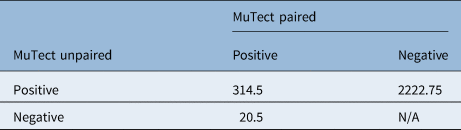
Values reflect average numbers of mutational calls.
* With reference patient matched. N/A = not applicable
Mutational landscape of early passage cell lines
Tumour and corresponding cell lines with reference patient matched DNA were analysed using SomaticSniper software (Figure 3a). For each corresponding tumour and cell line pair, the cell line exhibited more mutations than the contributing tumour, perhaps reflecting changes necessary for cells to adapt to culture conditions. When compared with the top 25 genes identified in the Cancer Genome Atlas marker paper,16 single nucleotide variants in NOTCH1, TP53 and CDKN2A genes were identified (Figure 3b). A complete list of mutations in the cell lines and tumours is provided in Appendix 2, available on The Journal of Laryngology & Otology website. The hypergeometric distribution test was then applied to each tumour and cell line pair to assess whether two samples shared the same lineage based on mutation calls. For each of the paired samples, the p-value was not significant, suggesting that they did in fact share significantly more mutations than would occur by chance alone (Figure 4).
Mutational comparison of primary tumours and cell lines. (a) Heatmap of all single nucleotide variants identified by whole exome sequencing in four cell lines (CL) and their matched parental tumours (T). A full gene list is provided in Appendix 2 (available on The Journal of Laryngology & Otology website). (b) Single nucleotide variants identified in the top 20 most frequently mutated genes in the Cancer Genome Atlas head and neck squamous cell carcinoma study. Note that both human papillomavirus positive cell lines were TP53 wild-type as expected. UTR = untranslated region

Overlap of the single nucleotide variants between tumour and cell line samples. (a) Patient 152, cell line UWO17. (b) Patient 325, cell line UWO23. (c) Patient 370, cell line UWO31. (d) Patient 485, cell line UWO37. Hypergeometric tests showed p-values of more than 0.05 for all samples, demonstrating that the paired cell lines and the parental tumours are genetically related.

Discussion
We have presented the establishment and molecular characterisation of four novel early passage head and neck SCC cell lines, including two HPV-positive lines. Importantly, we demonstrated that the reference patient-matched DNA from each patient is important to make accurate mutation calls. These patient-matched reference samples, as demonstrated in this study, allow accurate characterisation of cell lines. Furthermore, as observed in this study, bioinformatics pipelines are prone to errors with high false positive rates (87.6 per cent in our study). While cell lines and primary tumours shared significant numbers of specific mutations, demonstrating that they are related, both contained unique mutations, suggesting that genetic drift occurred in the cell lines as they adapted to culture conditions. It is also worth noting that the mutational calls between normal tissue and primary tumours that are shared are sufficient, but not necessary, for tumour transformation. These would be missed when using reference DNA.
There is an urgent need to identify novel chemicals with high activity in head and neck cancers in order to improve outcomes. Cancer cell lines are by far the most widely used model systems in cancer research, as they cost relatively little to maintain and can be easily manipulated in biological assays and feasibly screened with a large number of agents. Potentially, genomic characterisation of these cell lines could allow correlation of molecular features with drug response. Indeed, there have been two large-scale studies involving hundreds of genotyped cell lines of different tissue types,Reference Barretina, Caponigro, Stransky, Venkatesan, Margolin and Kim6,Reference Garnett, Edelman, Heidorn, Greenman, Dastur and Lau7 which have identified known, as well as novel, genetic markers of drug response.Reference Barretina, Caponigro, Stransky, Venkatesan, Margolin and Kim6,Reference Garnett, Edelman, Heidorn, Greenman, Dastur and Lau7 We specifically reanalysed the head and neck SCC data from both these studies and identified associations between PIK3CA mutations and response to a PI3K inhibitor; however, our analysis was limited by the small number of head and neck SCC lines and the limited number of drugs tested.Reference Nichols, Black, Yoo, Pinto, Fernandes and Haibe-Kains17
In order to expand drug discovery and develop additional biomarkers, we previously screened 1433 agents in a panel of 26 head and neck SCC established cell lines, and identified drugs with preferential activity in HPV-positive and HPV-negative cell lines.Reference Ghasemi, Black, Sun, Vizeacoumar, Pinto and Ruicci5,Reference Ghasemi, Black, Vizeacoumar, Pinto, Ruicci and Le18 However, our original intention was to correlate the cell line genomic profiles with drug response. We characterised our cell line panel with both OncoScan™ copy number arrays and whole exome sequencing, which our team has analysed extensively.Reference Hua, Ahmed, Guo, Zhang, Chen and Soares19–Reference Espiritu, Liu, Rubanova, Bhandari, Holgersen and Szyca25 While copy number arrays perform well without reference normal DNA,Reference Boutros, Fraser, Harding, de Borja, Trudel and Lalonde22,Reference Ewing, Houlahan, Hu, Ellrott, Caloian and Yamaguchi24,Reference Cooper, Eeles, Wedge, Van Loo, Gundem and Alexandrov26 exome sequencing is prone to frequent false positives and negatives for both primary tumours and cell lines. In an effort to specifically address this, we developed a ‘reference-free somatic variant’ pipeline, which uses an extensive mutational ‘allowlist’ (known pathogenic variants) and ‘denylist’ (likely germline variants based on large population cohorts) as well as additional bioinformatics analysis.Reference Sun, Lalansingh, Espiritu, Yao, Yamaguchi and Prokopec27 This pipeline is highly accurate in primary head and neck SCC and prostate tumours; however, despite exhaustive efforts, it does not perform well on cell lines.Reference Sun, Lalansingh, Espiritu, Yao, Yamaguchi and Prokopec27 For this reason, we have started to generate a panel of both HPV-positive and HPV-negative cell lines from primary tumours, along with matched blood. To date, we have generated 17 such lines, and we have presented genomic analysis of the first 4 of these here.
An additional advantage of the cell lines described in this study is that they are early passage cell lines. Established cell lines have the distinct advantage of being broadly available to the cancer research community through established commercial culture collections. This offers the opportunity to reproduce data independently with the same reagents. Nevertheless, the correlation of established cell line drug responses with patient tumour responses appears to be modest,Reference Domcke, Sinha, Levine, Sander and Schultz28–Reference Cree, Glaysher and Harvey30 potentially because of additional molecular drift from the primary tumour profile through selection pressure in culture.Reference O'Driscoll, Gammell, McKiernan, Ryan, Jeppesen and Rani9,Reference Wenger, Senft, Sargent, Bamezai, Bairwa and Grant10 Although beyond the scope of this manuscript with regard to comparison of early versus late passage cell lines, there is some evidence that early passage cell lines may represent superior models for drug screening.Reference Domcke, Sinha, Levine, Sander and Schultz28–Reference Cree, Glaysher and Harvey30 Thus, panels of genomically characterised early passage cell lines with patient-matched reference DNA, such as our novel University of Western Ontario panel, may be beneficial for the first phase of drug testing.
• Four early passage cell lines were established, and genomic characterisation was undertaken
• Two cell lines were human papillomavirus positive, confirmed by sequencing and P16 immunoblotting
• Short tandem repeat profiling confirmed that all four cell lines were established from their index tumours
• Whole exome sequencing revealed that matched normal reference DNA was critical for accurate mutational analysis: a high rate of false positive mutation calls (87.6 per cent) were excluded
The HPV-positive cell line models are of great interest to the head and neck research community in light of the epidemic of HPV-related oropharyngeal cancer.Reference Nichols, Palma, Dhaliwal, Tan, Theuer and Chow12,Reference Chaturvedi, Engels, Pfeiffer, Hernandez, Xiao and Kim31 However, while numerous HPV-negative head and neck SCC cell lines exist, there is a paucity of HPV-positive lines.Reference Cheng, Yang, Si, Saleh, Xiao and Coupar32 The ideal HPV-positive cell lines would be derived from non-smoking patients with a treatment-naïve oropharyngeal cancer; however, almost all lines, including our own, are derived from smokers, radiation failures (UWO37) or non-oropharyngeal primary sites (UWO23, oral cavity).Reference Cheng, Yang, Si, Saleh, Xiao and Coupar32 Only recently has an ideal cell line been described.Reference Forslund, Sugiyama, Wu, Ravi, Jin and Swoboda33 Further culture efforts are needed to generate additional models to facilitate drug discovery.
Conclusion
We describe the establishment and characterisation of four head and neck SCC early passage cell lines with patient-matched reference DNA. These cell lines will act as a resource for drug discovery, as they can be genomically characterised and may be more accurate than late passage models. Development of additional early passage lines, particularly HPV-positive models, is needed.
Acknowledgements
This work was financially supported by: a Canadian Institutes of Health Research grant (MOP 377832, awarded to ACN and PCB); the Ontario Institute for Cancer Research, through funding provided (to PCB) by the Government of Ontario; the Wolfe Surgical Research Professorship in the Biology of Head and Neck Cancers Fund (supporting ACN); Terry Fox Research Institute and Canadian Institutes of Health Research New Investigator Awards (supporting PCB); and the National Institutes of Health/National Cancer Institute (under award number P30CA016042).
Supplementary material
The supplementary material for this article can be found at https://doi.org/10.1017/S0022215122000846.
Competing interests
KBP, SP, JWB and JSM do not have any relevant disclosures. ACN is a consultant for Need Oncology, and has research funding from Novartis Canada, Sequenom, Merck Canada and Champions Oncology. PCB sits on the Scientific Advisory Boards of BioSymetrics, Intersect Diagnostics and Sage Bionetworks.


 Open access

