


Introduction
Approximately, 281 million people are international migrants worldwide (International Organization for Migration, 2021). The increasing cultural and ethnic diversity resulting from migration has made successful inclusion processes for immigrants a priority in many countries (Harder et al., Reference Harder, Figueroa, Gillum Rachel, Hangartner, Laitin David and Hainmueller2018; Oliver & Gidley, Reference Oliver and Gidley2015). Experiencing a lack of belonging can adversely affect mental health (van Bergen et al., Reference van Bergen, Wolf, Badou, de Wilde-Schutten, Jzelenberg, Schreurs, Carlier, Hoff and van Hemert2018) and lead to negative social orientation (Schiefloe, Reference Schiefloe2019; Twenge et al., Reference Twenge, Baumeister, Tice and Stucke2001). Thus, community belonging is deemed crucial for both individuals and society, making the topic of social inclusion relevant. Social inclusion involves ensuring equal access to resources and opportunities for everyone, with the goal of enabling participation, acceptance, and a sense of belonging, regardless of background, identity, or abilities (Baumgartner & Burns, Reference Baumgartner and Burns2014; Omidvar & Richmond, Reference Omidvar and Richmond2003; van Bergen et al., Reference van Bergen, Wolf, Badou, de Wilde-Schutten, Jzelenberg, Schreurs, Carlier, Hoff and van Hemert2018).
Governments in the Global North frequently advocate that immigrants´ participation in volunteering is a positive strategy for social inclusion. This approach is assumed to enhance the integration of immigrants through the building of social networks, language training, and preparations for the labor market and utilizing an unused source of volunteers to contribute to and enrich the society (Bendel, Reference Bendel2014; Christensen & Christensen, Reference Christensen and Christensen2006; IMDi, 2022; Ministry of culture, 2018; Smith et al., Reference Smith, Ellis, Howlett and O´Brien2004). Research has partially found support for these assumptions (Ambrosini & Artero, Reference Ambrosini and Artero2023; Handy & Greenspan, Reference Handy and Greenspan2009; Sveen et al., Reference Sveen, Anthun, Batt-Rawden and Tingvold2023a, Reference Sveen, Anthun, Batt-Rawden and Tingvold2023b).
Following conceptions of volunteering, these contributions are made freely to benefit people or groups outside one’s family or social network without any expectation of rewards or compensation (Snyder & Omoto, Reference Snyder and Omoto2008). Idealistic notions of volunteering have connected it to the benefit of the weakest groups in society and conceptualized it as actions carried out with selflessness, altruism, and solidarity (Seligman, Reference Seligman1995).
Social Inequality in Volunteering
Research has shown that immigrants participate less than does the majority population in voluntary organizations (Eimhjellen et al., Reference Eimhjellen, Espegren and Nærland2021; Qvist, Reference Qvist2018; Wilson, Reference Wilson2012). People with more resources, such as higher education, higher income, and a larger social network, tend to volunteer in voluntary organizations (Eimhjellen & Fladmoe, Reference Eimhjellen and Fladmoe2020; Hustinx et al., Reference Hustinx, Grubb, Rameder and Shachar2022; Musick & Wilson, Reference Musick and Wilson2008; Wilson & Musick, Reference Wilson and Musick1997).
Immigrants´ lower participation in formal volunteering is associated with factors such as being a woman, having lower education, being older, having weak language skills, and lacking the networks and knowledge of how to start volunteering (Eimhjellen & Segaard, Reference Eimhjellen and Segaard2010; Eimhjellen et al., Reference Eimhjellen, Espegren and Nærland2021). Furthermore, stigmatizing or exclusionary contexts, lack of appropriate support, skills, and qualifications, financial costs, and different conceptualizations of volunteering are found to be barriers to volunteering for immigrants (Greenspan et al., Reference Greenspan, Walk and Handy2018; Southby et al., Reference Southby, South and Bagnall2019). Some voluntary organizations might also require commitment over time and competence in organizational democracy and the culture of volunteering, which may make it more difficult for immigrants to participate (Ødegård et al., Reference Ødegård, Loga, Steen-Johnsen and Ravneberg2014).
Volunteer Recruitment
The literature on volunteer management and recruitment efforts is limited. However, some research based on participants’ hypothetical likelihood of volunteering has suggested best practices (Einolf, Reference Einolf2018). These practices include aligning recruitment messages with potential volunteers´ motives (Clary et al., Reference Clary, Snyder, Ridge, Miene and Haugen1994, Reference Clary, Snyder, Ridge, Copeland, Stukas, Haugen and Miene1998), anticipating feelings of pride in the organization, expecting respectful treatment, and perceiving openness to newcomers (Boezeman & Ellemers, Reference Boezeman and Ellemers2014). According to Haski-Leventhal (Reference Haski-Leventhal2010), organizations vary in their ability to recruit volunteers, known as ´recruitability,´ comprising accessibility, resources, networks, and cooperation.
The recruitment process is documented as one of the main mechanisms for reproducing differences in volunteer participation (Acker, Reference Acker2006; Meyer & Rameder, Reference Meyer and Rameder2022; van Overbeeke et al., Reference van Overbeeke, Koolen-Maas, Meijs and Brudney2022). Several researchers have suggested theoretical explanations for the inequalities in participation in volunteering. The integrated theory of volunteer work argues that human, social, and cultural capital are essential for volunteering, and that recruitment is based on individuals possessing these forms of capital (Wilson & Musick, Reference Wilson and Musick1997). In Norway, research supports this view, indicating that volunteers are often recruited based on education and skills that are beneficial to the organization (Folkestad et al., Reference Folkestad, Fladmoe, Sivesind and Eimhjellen2017). While this theory views recruitment as a process involving the demand and supply of objectively desirable resources, Bonnesen (Reference Bonnesen2019) argues that various social practices produce different types and degrees of inequality. She identified three exclusionary recruitment practices—non-recruitment, informal exclusion, and formal exclusion—that contribute to social inequality in volunteering based on social class and age. Non-recruitment involves advertising in places that do not reach everyone (Bonnesen, Reference Bonnesen2019), and being directly asked to volunteer is a major influence on becoming a volunteer (Meyer & Rameder, Reference Meyer and Rameder2022; Wollebæk et al., Reference Wollebæk, Sætrang and Fladmoe2015). Network recruitment, a strategy where recruitment tends to occur among similar individuals, is a key aspect of non-recruitment (Bonnesen, Reference Bonnesen2019; Grubb et al., Reference Grubb, Holstein, Qvist and Henriksen2022; Musick & Wilson, Reference Musick and Wilson2008). Informal exclusion is associated with the economic costs of being a volunteer, such as organizational membership fees. Another practice within informal exclusion is recipient retention, which aims to transition service recipients to volunteers. However, this transition is challenging because these individuals are never fully considered volunteers. Formal exclusionary practices involve dismissing volunteer applicants who are deemed unfit for the volunteer role (Bonnesen, Reference Bonnesen2019).
However, this topic has not been sufficiently explored. Given the increasing globalization and immigration, there is a need for additional research on recruitment and inclusion practices within organizations to advance the inclusion of diverse social groups. Norway faces similar challenges to those reported globally in recruiting immigrants to voluntary organizations. This study addresses this research gap by examining the recruitment and inclusion practices of immigrants in volunteering by exploring how volunteers with recruitment responsibilities carry out these practices and reflect on them. The research questions are as follows: How is the recruitment of volunteers with immigrant backgrounds carried out, and what influences the recruitment?
The Norwegian Context
In modern times, immigration to Norway has occurred in waves, driven by factors such as employment opportunities, the consequences of war and conflict in the immigrants´ home countries, and family reunification (Steinkellner et al., Reference Steinkellner, Krokedal and Andersen2023). Most immigrants in Norway seek employment or family reunification, and approximately, 32% of the immigrants have a refugee background. The largest immigrant populations originate from countries such as Poland, Lithuania, Ukraine, Sweden, Syria, and Somalia (Steinkellner et al., Reference Steinkellner, Krokedal and Andersen2023). We acknowledge that immigrants´ diverse backgrounds and reasons for migration may impact their prerequisites for inclusion in society (Eimhjellen et al., Reference Eimhjellen, Espegren and Nærland2021; Ichou, Reference Ichou2014). However, in this study, the term `immigrant` denotes all first-generation immigrants, regardless of country of origin or reason for migration.
Voluntary organizations play a crucial role in civic society, acting as intermediaries between citizens and the state (Enjolras & Strømsnes, Reference Enjolras, Strømsnes, Enjolras and Strømsnes2018). Since the late nineteenth century, most voluntary organizations have been membership based and democratic, connecting local communities to the national society. However, a contemporary shift is observed with the rise of independent organizations without bonds to national organizations, including organizations managed by and for immigrants (minority organizations). Membership in organizations is losing importance, and organizational attachment is declining, and the focus is now on volunteer activity (Qvist et al., Reference Qvist, Folkestad, Fridberg, Lundåsen, Henriksen, Strømsnes and Svedberg2019; Selle, et al., Reference Selle, Strømsnes, Svedberg, Ibsen, Henriksen, Henriksen, Strømsnes and Svedberg2019).
In Norway, voluntary organizations span various orientations, including culture, leisure, welfare, community orientation, and religion (Folkestad et al., Reference Folkestad, Fladmoe, Sivesind and Eimhjellen2017), with a concentration in leisure, sports, and culture similar to that of other Scandinavian countries (Qvist et al., Reference Qvist, Folkestad, Fridberg, Lundåsen, Henriksen, Strømsnes and Svedberg2019). The different organizations fulfill different roles in civil society; some prioritize organizational life for community, belonging, and social interaction, considering democracy as an outcome of values. Others view voluntary organizations as democratic institutions involved in policymaking and advocating for interest groups (Wollebæk et al., Reference Wollebæk, Selle and Strømsnes2008). Voluntary organizations are important social institutions, because they have been recruiting broadly socially and have counteracted social isolation and exclusion; however, these characteristics are not stable over time and place (Wollebæk & Selle, Reference Wollebæk and Selle2002). New organizational structures and purposes impact their ability to recruit and foster community inclusion (Wollebæk et al., Reference Wollebæk, Sætrang and Fladmoe2015). Traditional membership-based organizations with a national structure and local associations are often considered crucial for integration because they provide access to the majority population, societal values, and norms (Eimhjellen et al., Reference Eimhjellen, Espegren and Nærland2021; Putnam, Reference Putnam2000).
Theoretical and Conceptual Frameworks
Various factors influence voluntary organizations' strategies for recruiting and training new volunteers. Organizations differ regarding which groups they target, their access to resources, leadership and management structure, organization of volunteer tasks, need for qualifications, and cultural context (Grubb et al., Reference Grubb, Holstein, Qvist and Henriksen2022). In addition, the professionalization and formalization of volunteer management practices have been well documented (Grubb et al., Reference Grubb, Holstein, Qvist and Henriksen2022; Hill & Stevens, Reference Hill and Stevens2011). Hill and Stevens (Reference Hill and Stevens2011) present four typologies of organizational strategies that are used to recruit and train volunteers. These four typologies are as follows: (1) volunteer-led and volunteer-run organizations are small organizations with no paid staff or informal organizational structure and aims that are often related to campaigning and mutual support. (2) Staff-supported organizations are relatively small and have a handful of paid staff supporting day-to-day activities, but volunteers handle the strategic management. (3) Volunteer-supported organizations are characterized by volunteers involved in day-to-day volunteer management, but paid staff make strategic decisions. (4) Volunteer-involving organizations involve volunteers in operational and service delivery, but paid staff make management and strategic decisions. In this study, we draw on this typology of voluntary organizations to explore how structural factors may influence recruitment practices among recruiters at the five voluntary organizations we investigated.
We also chose to include a theoretical lens of social networks, as this became important through our analyses. According to previous research, social networks are central to recruiting volunteers (Paik & Navarre-Jackson, Reference Paik and Navarre-Jackson2011; Wollebæk et al., Reference Wollebæk, Sætrang and Fladmoe2015). ´The strength of weak ties´ theory (Granovetter, Reference Granovetter1973, Reference Granovetter1983) is a sociological concept that suggests that strong social ties provide social support and cohesion within existing groups such as family and close friends. Weak ties, or acquaintances, play a significant role in social networks by providing access to new information, new perspectives, opportunities for engagement, and resources that are not readily available within close-knit groups. These interpersonal interactions might provide a micro–macro bridge (Granovetter, Reference Granovetter1973, Reference Granovetter1983). Janoski (Reference Janoski2010) suggested that these ties leading to being asked to volunteer are socially constructed in formal or informal groups and potentially facilitated by a volunteer opinion leader who influences volunteering through the layers of civil society.
Methods
This study has a qualitative explorative design, and qualitative interviews were employed as the data collection method.
Study Context
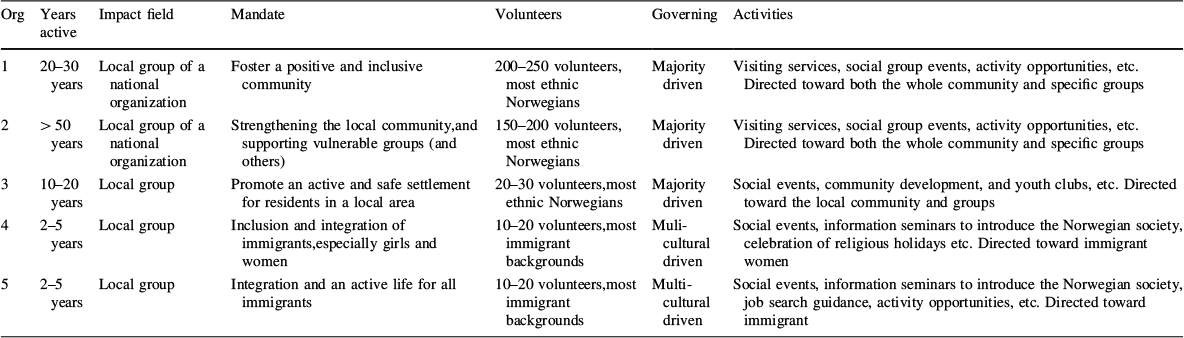
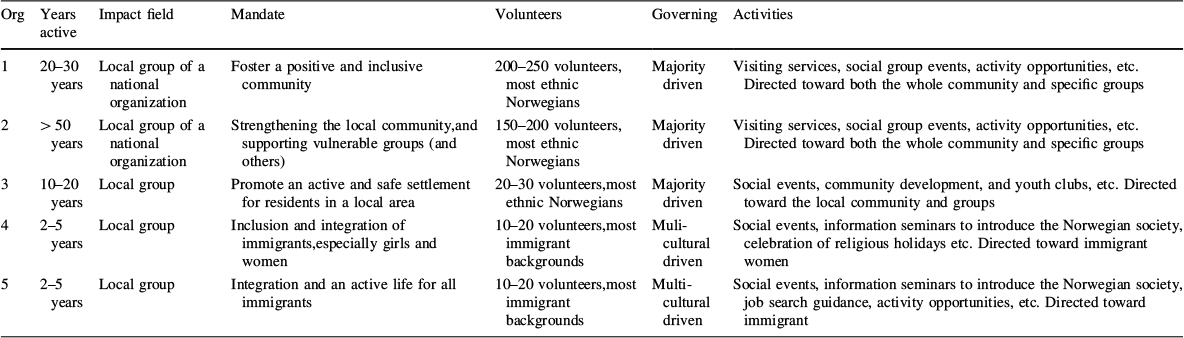
The study context is a semirural community in a large municipality (over 20,000 residents) in Norway (Langørgen et al., Reference Langørgen, Løkken and Aaberge2015). The five volunteer organizations in this study engage in welfare- and community-related activities because of their centrality to the community and the lack of research regarding these organizations. Two of the organizations are large (150–250 volunteers), and local divisions of national organizations are mostly associated with volunteers with a majority background representing the traditional voluntary organizations in Norway referred to as large-scale organizations. These organizations have a national superstructure and activities are largely reflected by the national activity provision, with some local adjustments. Three organizations are small (10–30 volunteers) and locally bound, with closeness to the board and management, these are referred to as small-scale organizations. The activities are based on a local need and are fully administrated by the local group. One organization is mostly associated with volunteers with majority backgrounds, and two are associated with diverse minority backgrounds. The different organizations were chosen to reflect a spectrum of the diversity of organizations operating in the municipality. For details, see Table 1.
Organizational characteristics
Org |
Years active |
Impact field |
Mandate |
Volunteers |
Governing |
Activities |
|---|---|---|---|---|---|---|
1 |
20–30 years |
Local group of a national organization |
Foster a positive and inclusive community |
200–250 volunteers, most ethnic Norwegians |
Majority driven |
Visiting services, social group events, activity opportunities, etc. Directed toward both the whole community and specific groups |
2 |
> 50 years |
Local group of a national organization |
Strengthening the local community,and supporting vulnerable groups (and others) |
150–200 volunteers, most ethnic Norwegians |
Majority driven |
Visiting services, social group events, activity opportunities, etc. Directed toward both the whole community and specific groups |
3 |
10–20 years |
Local group |
Promote an active and safe settlement for residents in a local area |
20–30 volunteers,most ethnic Norwegians |
Majority driven |
Social events, community development, and youth clubs, etc. Directed toward the local community and groups |
4 |
2–5 years |
Local group |
Inclusion and integration of immigrants,especially girls and women |
10–20 volunteers,most immigrant backgrounds |
Muli-cultural driven |
Social events, information seminars to introduce the Norwegian society, celebration of religious holidays etc. Directed toward immigrant women |
5 |
2–5 years |
Local group |
Integration and an active life for all immigrants |
10–20 volunteers,most immigrant backgrounds |
Multi-cultural driven |
Social events, information seminars to introduce the Norwegian society, job search guidance, activity opportunities, etc. Directed toward immigrant |
Participants and Data Collection
To recruit participants for this study, we used a purposeful sampling approach (Patton, Reference Patton2014) and ´snowball sampling´ (Henry, Reference Henry2009). In this context, purposeful sampling refers to sampling that is based on a participant's role in a voluntary organization. Snowball sampling refers to the way in which study participants help recruit other eligible participants (Henry, Reference Henry2009). The inclusion criterion was that participants had to have some responsibility for recruiting new volunteers for their voluntary organization. This includes leaders of organizations, board members, volunteers with recruitment tasks, and leaders of volunteer activities. The leaders of the organizations were asked to participate in the research project and facilitated contact between the researcher and other eligible participants within the organization. Individuals who met the inclusion criteria were informed about the study and decided whether to participate. Twenty-one individuals (18 volunteers and three employees) were included. Ten were ethnic Norwegian, and eleven had immigrant backgrounds (Africa, Middle East, Asia, and Europe). The participants´ ages ranged from 20 to 70 years, with 46 years as the average. The participants agreed to participate in individual interviews that were audio-recorded. These interviews ranged from 45 min to 2.5 h, with most interviews lasting one hour. The interviews were conducted at locations chosen by the participants to ensure their privacy and safety regarding personal preferences considering the COVID-19 pandemic. The interviews were conducted in person (18) and digitally via Zoom (3). One interview was conducted with two participants simultaneously, following the participants´ choice. Sufficient time was provided in the interviews for the participants to become familiar with the researcher and to be assured that the researcher wanted to learn about their reflections on recruitment, not to make an evaluation of right or wrong.
The participants agreed to be recontacted for follow-up questions. After the interviews, the researcher had several meeting points with some participants at information meetings and board meetings to become familiar with the research context, and the interviews were supplemented with informal conversations to increase the quality of the research. COVID-19 limited access and opportunities for these meetings.
Interview Content
Semi-structured interviews were conducted based on a guide with themes and questions posed to everyone. Nevertheless, the researcher had the opportunity to explore themes and responses during the interviews. The participants were initially asked about their personal volunteering experience and the activities they engaged in. The interviews focused mainly on the recruitment of new volunteers. The participants were asked about their experience with recruitment, what they considered success factors, and what they experienced as challenging when recruiting volunteers with immigrant backgrounds. They were asked about their thoughts on the importance of diversity in volunteering and on whether and how volunteering could promote the inclusion of immigrants.
Analysis Method
The first author transcribed all the interviews verbatim and imported the transcripts into NVivo software. The data analysis process was inspired by stepwise deductive induction (Tjora, Reference Tjora2019), in which the analysis progresses from an inductive interpretation and adopts a theoretical perspective through the analytical phase.
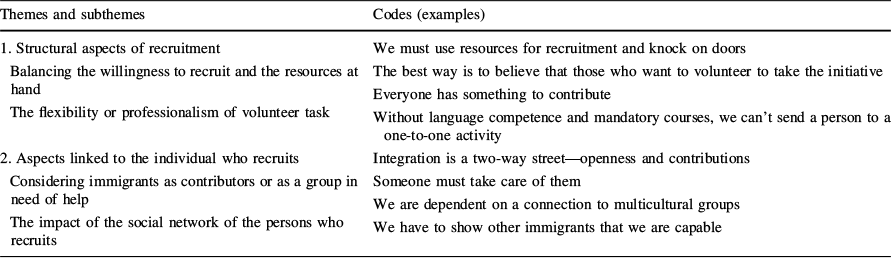
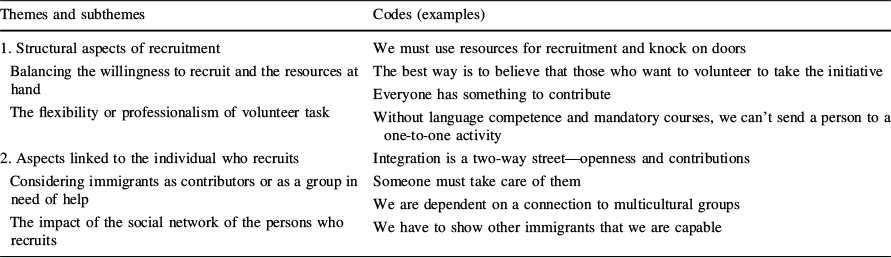
The first step was to code the data inductively “in vivo” such that the codes were grounded in the empirical data; this process is similar to the coding used in grounded theory (Glaser & Strauss, Reference Glaser and Strauss1999). Codes must correspond closely to the participants’ statements to ensure that the codes are drawn from the data rather than from theories, research questions, or previously chosen themes (Tjora, Reference Tjora2019). The first author performed the empirical inductive coding of all the text in the transcripts. The next step was to group the codes that exhibited internal thematic connections. Based on these code groups, the main theme relevant to this article is ´Recruitment to volunteering´. Through our analysis, four themes related to recruitment emerged. At this stage, the codes were examined inductively, and then we incorporated theories, previous research, and interest, making the approach more abductive. The first author conducted this step in a close discussion with the other authors. Upon examining the four themes, we observed that two were linked to the recruiters, while the other two were structural aspects of the organizations. The four themes were included as subthemes under the main themes ´Structural aspects of recruitment´ and ´Aspects linked to the individual who recruits´. The subthemes were categorized and are elaborated in the results section as follows: ´Balancing the willingness to recruit and the resources at hand,´ ´The flexibility or professionalism of volunteer tasks,´ ´Considering immigrants as contributors or as a group in need of help,´ and ´The impact of the social networks of the persons who recruits.´ Table 2 contains the themes and examples of some of the associated codes. Furthermore, we chose to use professionalization and formalization and ´the strength in weak ties´ as a theoretical and conceptual lens in the discussion of our results following the abductive phase.
Themes, subthemes, and examples of associated codes
Themes and subthemes |
Codes (examples) |
|---|---|
1. Structural aspects of recruitment Balancing the willingness to recruit and the resources at hand The flexibility or professionalism of volunteer task |
We must use resources for recruitment and knock on doors The best way is to believe that those who want to volunteer to take the initiative Everyone has something to contribute Without language competence and mandatory courses, we can’t send a person to a one-to-one activity |
2. Aspects linked to the individual who recruits Considering immigrants as contributors or as a group in need of help The impact of the social network of the persons who recruits |
Integration is a two-way street—openness and contributions Someone must take care of them We are dependent on a connection to multicultural groups We have to show other immigrants that we are capable |
Ethics
The participants signed informed consent prior to the interviews. The participants were informed about their right to withdraw from the study without stating a reason. They were assured that confidentiality would be maintained concerning the transcribed data (anonymized systematically) and any publications resulting from the study. The participants’ confidentiality in publications was secured by assigning them nicknames and dividing the organizations to which they belonged into ´large-scale organizations´ and ´small-scale organizations.´
Results
Structural Aspects of Recruitment
Balancing the Willingness to Recruit with the Resources At Hand
The participants presented some dilemmas regarding the recruitment of immigrants to volunteers. As was the case for these participants, face-to-face recruitment and asking for a concrete task were considered the best or most ideal ways to recruit immigrants as volunteers. Potential language issues and the opportunity to explain information were some of the reasons provided for the need for face-to-face contact. Participants from one of the small organizations reported that recruitment was conducted by asking every person who wanted to benefit as a member of their activity to contribute as a volunteer as well. However, for participants with immigrant backgrounds, face-to-face contact was crucial for reasons other than language issues. They also thought that immigrants respond best to direct and personal communication, and that it is a matter of respect. Sana explained the importance of investing time in the strategy for recruiting newly arrived immigrants:
We are good at recruiting new immigrants as members because we visit them at home and invite them. We try to use their mother tongue, we call them… People with immigrant backgrounds respond best to direct communication, not letters and such… The best way is to talk to them! (…) It is respectless only to send a letter!…But if you take your time to visit them and talk to them, you show more dignity… and they are more willing to participate. Small details like this that Norwegians do not necessarily know greatly impact recruitment. [Sana, small-scale organization].
Many of the participants reflected on such differences in communication and way of life and emphasized the need for cultural competency or diversity competency in volunteering.
Participants from large-scale organizations, especially ethnic Norwegians, described face-to-face communication in recruitment as a resource-demanding strategy. Anna, an experienced volunteer with an ethnic Norwegian background, said it was impossible to knock on people's doors to recruit volunteers for their organization. She explained:
We do not have the capacity to work a lot with recruitment! (…) The best way is still to believe that the people who want to volunteer register and join at their own initiative! [Anna, large-scale organization].
When someone registered on their webpage, they tried their best to contact the new volunteers to invite them to an information meeting as soon as possible. Nevertheless, it could sometimes take a couple of months due to the lack of volunteers dedicated to recruitment.
In addition to the question of resources, some participants found it challenging to recruit successfully face-to-face because it was crucial to ask the “right people,” such as caring and social people that had the time and interest in volunteering.
A common reflection from the participants in organizations struggling to recruit immigrants was that they needed to be more proactive than they currently were. They had to provide information about volunteering at places where immigrants attended, such as the school responsible for Norwegian language courses for immigrants or asylum receptions. Bjarne, an ethnic Norwegian who had been an active volunteer throughout his life, said that he had experienced some success but also many difficulties recruiting immigrants as volunteers.
(…) But I do not think we have a big enough commitment to recruit people with immigrant backgrounds either! …so many [of the board members] say: ´but they don’t want to participate, and we don’t manage to include them!,´ but I think it may be something wrong with our approach… [Bjarne, small-scale organization].
However, several participants with ethnic Norwegian backgrounds stated they could not be too proactive in their recruitment to ensure not to force anyone to volunteer. One ethnic Norwegian, Mia, who had been employed at one of the organizations for several years, shared her thoughts:
[The recruitment] is self-propelled, really… if they have a good time [as participants in the activity], I believe they are joining [as volunteers], but it doesn't hurt to ask them, but we can't force them either! It is a balance between doing too much or too little. We can´t be too pushy! [Mia, large-scale organizations].
The Flexibility or Professionalism of Volunteer Tasks
All of the participants were clear that their organizations welcomed everyone who wanted to join. Some participants highlighted that they recruit new volunteers in a flexible manner, based on what the newcomers want and consider themselves capable of contributing. On this matter, Michel elaborated on his experience of being both an immigrant himself and the founder of several voluntary organizations:
It is important that people know they can be a volunteer! (…) We have people who don’t speak much Norwegian who contribute to some activities, too. We try to lower our requirements and try to explain that you don´t need many skills and qualifications to join. Everyone can join our organization! [Michel, small-scale organization].
All the organizations have membership fees, making it possible to run them. In some organizations, volunteers must attend mandatory courses prior to volunteering. These courses included information on the Norwegian welfare and the voluntary sector, the values of being a volunteer, and the duty of confidentiality. This is regarded as a necessary preparation for volunteering. For instance, it was outlined how important it is to know something about the duty of confidentiality and what one’s volunteering should or should not involve when, for example, volunteering in a one-to-one activity with people in vulnerable situations. Bianka, a woman with an immigrant background who worked with the recruitment and inclusion of immigrants in a large-scale organization, talked enthusiastically about how people have to build up their competence in volunteering:
(…) you have to start by being a volunteer, and then get an activity leader position, and gradually… you need some time to learn about how Norway is organized and structured. It [volunteering] doesn’t exist in other countries, and it is complicated! To me, it took about a year to learn and understand it. [Bianka, large-scale organization].
This reflects the participants' opinion that it takes time to become familiar with and comprehend the context for volunteering and obtain the necessary skills and competence to take volunteer roles with responsibility in organizations.
However, both membership fees and mandatory courses were considered obstacles to recruiting volunteers with immigrant backgrounds. Vera reflected on why it is difficult to recruit immigrants who must attend mandatory courses:
We try to offer different courses, but few are interested in that. (…) I think the reason is language issues, and they do not understand what this is all about and why they must take courses. [Vera, large-scale organization].
The dilemma of volunteers needing qualifications combined with the desire to include everyone is strong among individuals who recruit for some of the organizations in this study.
Some of the participants with immigrant backgrounds also reflected on how professionalized volunteering is being presented and how people might be afraid of becoming volunteers due to the responsibility. Parvin, a refugee who volunteered in different organizations her whole life, shared her experience:
I remember a man I tried to recruit to become a volunteer in the visiting services, but he thought everything was too difficult! The explanation of the activity from the organization's people was too advanced. So, I tried to say it in a simpler way, “It isn’t that difficult…just consider it like visiting someone. It is like a new friend”. [Parvin, large-scale organization].
Aspects Linked to the Individual Who Recruits
Considering Immigrants as Contributors or as a Group in Need of Help
Some participants explicitly stated that people with immigrant backgrounds have the resources to contribute to volunteering and should not be seen as merely a group of people needing help. The value of convincing them that all can contribute in one way, or another was seen as substantial by many of the immigrant participants. However, they shared that it was common for many immigrants to consider themselves as a group needing help instead of people who could help others. Michel, who had a burning passion for helping other immigrants become integrated into Norwegian society, stated this explicitly:
Integration is a two-way street! We must do something to be a part of society (…) it isn’t like members are the ones who get help, and volunteers are the helpers because you can do both! Someone can help you with one thing, and you can help others with something else. [Michel, small-scale organization].
In contrast, other participants shared the common opinion that people need qualifications to volunteer, such as language skills and an understanding of how Norwegian society is structured. This impacts who and where they recruit. It was mentioned that newly arrived immigrants might be recruited from schools with Norwegian language courses, but this would lead to recruiting people without the knowledge and language skills the organization prefers. Mia, who had worked with recruitment at a large-scale organization for many years, shared some thoughts on this:
(…) it might be a bit early when they are in the introduction program, and they might be in different phases as the introduction program lasts two years. I don’t think this is the best arena to recruit. (…) I would appreciate getting more people with an immigrant background as volunteers because I think the government is on to something when they say that volunteering may be inclusive, but then they have to participate in an activity that they handle because if they don´t…I´m afraid it would be the opposite. If you fail in that [volunteering], trying to get a paid job might be even harder! [Mia, large-scale organization].
Her colleague, Tiri, who was participating in the same interview, agreed and said,
(…) We have to ensure that they have an activity they can manage to volunteer in and that we have the capacity to take care of them! [Tiri, large-scale organization]
The Impact of the Social Network of the Person who Recruits
Recruitment was described as dependent on the person who recruits and their social connections. Having volunteers who represent many different cultural and ethnic backgrounds was considered an advantage for further recruitment and inclusion since it would be easier to connect with new immigrants. Per, who has volunteered at different organizations throughout his life, described the importance of accessing immigrant groups:
It´s all different because we direct all the activities toward immigrants, so it is much easier to recruit immigrants to volunteer than in other organizations. We have people with immigrant backgrounds on the board and leading the activities. [Per, small-scale organization].
Conversely, in these organizations, the participants said they struggled to recruit ethnic Norwegians.
Some participants with an ethnic Norwegian background reported that they had to depend on an ‘insider’ in the immigrant community for direct contact. Some explained that they lost their relation to multicultural networks when their volunteer with an immigrant background quit.
‘Word of mouth’ was mentioned as an important recruitment approach by all participants, as volunteers recruited their friends and networks. Nevertheless, the participants with immigrant backgrounds understood “word of mouth” to function like a role model, showing other immigrants that they can contribute to equal footing with ethnic Norwegians. Francine, who engaged in much volunteering, explained:
We talk a lot about how to recruit new volunteers for the organization, and when I got to know one Somali woman who understands a lot, I asked her if she could talk to the Somali group and show them that she volunteered and that they could also volunteer! [Francine, small-scale organization].
The participants with immigrant backgrounds spoke about using their own experience of being an immigrant to help others participate in Norwegian society.
Many participants said that the few immigrants they had recruited were resourceful, had lived in the country for many years, and knew much about Norwegian organization and culture. As Bjarne shared.
(…) Ehh…I think that the ones [immigrants] we have recruited are familiar with Norwegian culture and systems. They have absolutely preserved their ethnic background, but they had a job and an understanding of ‘the Norwegian’ and maybe been a bit included, or maybe well-integrated as well! [Bjarne, small-scale organization].
The participants attributed this to better communication and understanding of volunteering and to immigrants being settled down in the new society.
Discussion
This study reveals structural factors and individual aspects of recruiters having an impact on attracting and including immigrants as volunteers. Large-scale organizations are more professionalized and more directed by resources and frameworks and demand more qualifications due to their volunteer tasks, and this approach is supported by Hill and Stevens´ typology (Reference Hill and Stevens2011). This might make inclusive recruitment more challenging. Small-scale organizations have greater flexibility and less professionalization of volunteer activities, leading to the possibility of more inclusive recruitment. In addition, if the small-scale organizations are minority driven, they may be better equipped to recruit immigrants as volunteers due to greater diversity sensitivity and more connections with immigrants through their social network.
Accessibility is Crucial
Many factors influence whether voluntary organizations could be a central arena for inclusion (Handy & Greenspan, Reference Handy and Greenspan2009; Sveen et al., Reference Sveen, Anthun, Batt-Rawden and Tingvold2023a, Reference Sveen, Anthun, Batt-Rawden and Tingvold2023b). Some have also noted the problem of using the voluntary sector as a qualifying arena to be ´good citizens´ and obtain access to the labor market (Yap et al., Reference Yap, Byrne and Davidson2010) or as an ´imagined participation´ as it is the labor market they should have access to (Codó & Garrido, Reference Codó and Garrido2014). Accessibility is, however, crucial.
A diversity-sensitive approach may be needed to recruit volunteers with an immigrant background rather than to recruit the majority population. Our inquiry revealed that face-to-face communication and showing new immigrants that they are welcome, capable, and valuable resources were considered crucial for recruitment. Not all participants in large-scale organizations experienced having the capacity to conduct such recruitment efforts. The lack of resources and not wanting to force anyone to volunteer compelled them to rely on people's own initiative to register as volunteers. In the small-scale organizations examined in this study, the recruitment approaches were described as flexible and individually tailored. Research has shown that being asked to volunteer is one of the most important determinants of volunteering (Bowman, Reference Bowman2004; Musick et al., Reference Musick, Wilson and Bynum2000; Wollebæk et al., Reference Wollebæk, Sætrang and Fladmoe2015) and that immigrants may also experience a lack of opportunities, language skills, and the necessary understanding of volunteering (Greenspan et al., Reference Greenspan, Walk and Handy2018; Southby et al., Reference Southby, South and Bagnall2019). Hence, it is questionable how successful it is to recruit immigrants merely by waiting for them to take the first initiative to volunteer, contribute to society, and promote their social inclusion.
In our study, it seems that people with an immigrant background have another approach and access to different ethnic groups by either belonging to the same ethnic group or merely having their own experience being an immigrant and hence experiencing a greater comprehension of the need for joining volunteering. This is supported by Janoski (Reference Janoski2010), who emphasizes opinion leaders and the recruitment in social networks across civil spheres, and Granovetters (Reference Granovetter1973), who emphasizes the strength of weak ties. Recruitment to volunteering has often been stated to occur primarily through social networks and weak ties, and volunteers recruit others who are similar to themselves (Musick & Wilson, Reference Musick and Wilson2008; Paik & Navarre-Jackson, Reference Paik and Navarre-Jackson2011; Wollebæk et al., Reference Wollebæk, Sætrang and Fladmoe2015). Ødegård et al. (Reference Ødegård, Loga, Steen-Johnsen and Ravneberg2014) found that in these traditional majority-driven large-scale organizations, immigrants do not necessarily become volunteers upon arrival but have this bridge-maker role. This is mirrored in our study, where volunteers with a majority background experienced being dependent on an insider in the immigrant community to obtain access. It seems that diversity competence among volunteers is needed to obtain attractiveness and diverse recruitment.
Different Activities and Goals?
The large-scale organizations in this study partly function as complementary service deliverers to ease the burden of the public sector in some areas and face increasing pressure and economic support to contribute to these public tasks (Stein & Fedreheim, Reference Stein and Fedreheim2022; Wollebæk et al., Reference Wollebæk, Sætrang and Fladmoe2015). To carry out these types of volunteer tasks, these organizations depend on professional quality and, therefore, require potential volunteers to have certain qualifications. This creates a paradox in which voluntary organizations are considered central integration and inclusion arenas, but the need for qualified volunteers to pursue the community's tasks excludes people who may not yet have the necessary qualifications. This may lead to counteracting the goal of integrating disadvantaged groups through volunteering (Meyer & Rameder, Reference Meyer and Rameder2022). For many years, some large-scale organizations have been central to organizing help for refugees (Hagelund & Loga, Reference Hagelund and Loga2009; Ødegård et al., Reference Ødegård, Loga, Steen-Johnsen and Ravneberg2014), which may still affect the perceptions of immigrants as pure recipients of services or activities. However, immigrants are not a homogenous group, and it is necessary to reflect on immigrants' diversity, diverse backgrounds, different reasons for migration, and diverse personal and social resources. On the other hand, small-scale and especially minority-driven organizations include everyone regardless of prior knowledge and skills, and volunteers can contribute based on what they can and want to do as they are flexible in activities. This, however, may raise a discussion of how much these organizations contribute to the social inclusion of the overall society, such as contact with the majority population (Putnam, Reference Putnam2000). Another reflection is whether these organizations end up functioning as steppingstones to the majority-driven organizations when the immigrants are qualified enough. This may create a hierarchy of voluntary organizations and be problematic because the goal is to enter the labor market, which might be even further away.
Strength and Limitations
This study deepens the empirical knowledge of volunteering in a culturally diverse society and adds novel insight into how recruitment is thought upon and put into practice in various organizations. The study was carried out in a semirural context in Norway. Further studies, including studies of alternative locations and research methods, are needed to determine the transferability of our findings.
Conclusion
The voluntary sector has had a pivotal role in securing the social welfare and humanitarian services of people by working to improve the well-being of individuals and communities and offering inclusion and support. This sector promotes civic engagement and fills critical gaps in social services. In the context of global migration, the inclusion of the immigrant population in voluntary organizations is highlighted as important for inclusion in the larger society. However, immigrants participate less than the majority population in voluntary organizations and having investigated the strategies employed to recruit volunteers in such organizations; we suggest that part of the problem, and therefore also part of the solution, lies within recruitment approaches. Changes in the voluntary sector and the increasing professionalization of volunteer tasks seem to make it difficult for large-scale organizations to recruit newly arrived immigrants and fulfill the expectation of facilitating immigrant inclusion through volunteering. However, small-scale minority-driven organizations apply more flexibility in their approaches and have a more suitable framework that better connects to recruiting immigrants. Thus, to succeed in recruiting immigrants, voluntary organizations should develop diversity sensitivity in their recruitment approaches and acknowledge that the social networks of those who recruit are crucial in recruitment. This is of particular importance for large-scale organizations in order to attract, recruit, and retain volunteers with different ethnic backgrounds and to ensure an inclusive civil society.
Acknowledgements
We want to thank our study participants who made this study possible. We would also like to thank Guro Ødegaard, Director of Norwegian Social Research (NOVA), for valuable perspectives and comments on different versions of this article.
Author’s Contribution
All authors contributed to the conception and design. Silje Sveen conducted data collection, and all authors performed analyses. Silje Sveen wrote the first draft of the manuscript, and all authors commented on previous versions of the manuscript. All authors read and approved the final manuscript.
Funding
Open access funding provided by NTNU Norwegian University of Science and Technology (incl St. Olavs Hospital - Trondheim University Hospital). This study received no external funding and is part of a Ph.D. research study at the Norwegian University of Science and Technology (NTNU) in Gjøvik.
Declarations
Conflict of interest
The authors declare that there is no conflict of interest.
Informed Consent
The participants all signed informed consent prior to the interviews. They were informed about their right to withdraw from the study without stating a reason. The study was approved by the Norwegian Center for Research Data prior to the beginning of the data collection process under Reference Number [888539].

 Open access

