


Why a systematic literature review on lobbying coalitions?
In their lobbying efforts, interest groups rarely move alone. Coalition-building is indeed a frequent element of lobbying strategies, as well as political strategies more broadly. Over the last few decades, scholarly research on interest groups has thus increasingly taken coalitional lobbying into account as a key factor of interest politics, both as a dependent and independent variable. Some have focused on the conditions and motivations that push interest groups toward coalitions (Beyers and De Bruycker, Reference Beyers and De Bruycker2018; Gray and Lowery, Reference Gray and Lowery1998; Hanegraaff and Pritoni, Reference Hanegraaff and Pritoni2019; Heaney and Leifeld, Reference Heaney and Leifeld2018; Hojnacki, Reference Hojnacki1997; Holyoke, Reference Holyoke2009; Rothschild, Reference Rothschild2022); others have studied the impact of coalitional lobbying on influence dynamics and policy outcomes (Dwidar, Reference Dwidar2022; Heaney and Lorenz, Reference Heaney and Lorenz2013; Junk, Reference Junk2020a; Klüver, Reference Klüver2013a; Nelson and Yackee, Reference Nelson and Yackee2012; Pagliari and Young, Reference Pagliari and Young2014). Furthermore, a third group of studies has contributed to pursue knowledge accumulation on this topic, for instance, refining the conceptual framework concerning lobbying coalitions (Junk, Reference Junk2020b). The present study belongs to this third group: through the first systematic literature review on this topic, we aim to facilitate knowledge accumulation, analyzing and synthesizing what the literature has found on this subject in the last four decades.
Relying on the PRISMA protocol for scoping reviews, we analyzed all scientific articles published in political science journals between 1985 and 2023 on the topic of lobbying coalitions, identifying their analytical categories, research methods, and empirical findings. Thus, we were able to map various trends characterizing this body of research, both at the descriptive level – looking for instance at political systems under scrutiny, units of analysis, conceptual definitions, research questions, as well as publication venues – and (meta-)theoretical level, synthesizing findings and tested hypotheses.
As the accumulation of knowledge is one of the primary goals of scientific inquiry, systematic literature reviews are extremely useful, especially in fields where various competing theoretical expectations co-exist and contradictory empirical findings may persist. This is exactly the case for the literature on lobbying coalitions, where different studies point to various factors as decisive in interest groups’ choice to form or join coalitions (Hanegraaff and Pritoni, Reference Hanegraaff and Pritoni2019; Hojnacki, Reference Hojnacki1997; Mahoney, Reference Mahoney2008; Pritoni and Vicentini, Reference Pritoni and Vicentini2022). Systematically reviewing the literature is then a valuable choice not only to achieve a more comprehensive view of the various empirical findings, but also to identify potential shortcomings in the literature, raising new and interesting questions worth exploring in future research.
The article is structured as follows. The next section illustrates our research design, explaining our protocol and methodology. Section 3 provides a descriptive overview of our sample, looking at the diachronic trend of the research articles on lobbying coalitions and mapping publication venues, political systems scrutinized, research methods, and definitions of interest groups and lobbying coalitions adopted in each case. Section 4 illustrates our meta-analysis of the literature, specifically discussing the determinants of the choice of interest groups to form or join a lobbying coalition. Finally, the conclusion recalls the most important results of our study, acknowledging its limitations and proposing some avenues for future research.
Reviewing literature on lobbying coalitions following the PRISMA protocol
Systematic literature review methods still struggle to impose themselves in political science (Dacombe Reference Dacombe2017, 149). The former represent a distinctive research strategy to map and analyze the trends, models, findings, and gaps in a given research domain, with the goal of establishing a solid ground for further theory development (Petticrew and Roberts, Reference Petticrew and Roberts2006). Originally devised in the clinical and health sciences as the accepted method to synthesize and assess results from previous research, systematic literature reviews must come to terms with the problems and specificities of social sciences. Systematic reviews in health sciences allow for statistical meta-analysis of evidence collected in previous studies thanks to the comparability of results and the shared methodological framework. Yet, it is far more challenging in social sciences to have such comparable results and methodologies.
The vast diversity of approaches and methods in social research, reflective of the complexity of the research objects in the social world, raises specific issues regarding the comparability, synthesis, and evaluation of the research findings. To be useful, systematic review strategies must meet the peculiar features of the research domain they intend to sift and respond to specific research goals while ensuring the greatest rigor, transparency, and reproducibility possible (Dacombe, Reference Dacombe2017, 154). Distinctive guidelines for systematic reviews in social research have been developed in the literature (Davis et al., Reference Davis2014; Tranfield et al., Reference Tranfield, Denyer and Smart2003). Two main approaches stand out as possible tools for systematic reviewing whenever a quantitative meta-analysis is not possible: the scoping review and systematic ‘meta-synthesis’ (Saini and Shlonsky, Reference Saini, Shlonsky, Saini and Shlonsky2012). While sharing the same quest for quality, transparent, and accountable protocols for collecting, evaluating, and presenting the available research evidence, the two methods have different, while complementary, purposes. Scoping review refers to a systematic exploratory analysis of a complex research field, thus mapping ‘broader topics where many different study designs might be applicable’ (Arksey and O’Malley, Reference Arksey and O’Malley2005, 20) and identifying their main conceptual, methodological, and empirical coordinates. While building on such a scoping review approach, the distinctive aim of systematic meta-synthesis is to provide a comprehensive interpretative analysis of the core findings or gaps of a literature domain, so as to revise, develop or supersede a set of explanatory hypotheses. Thus, meta-synthesis’s main goal is ‘not aggregations of data, but theory’ (Dixon-Woods et al., Reference Dixon-Woods2006, 36).
Building on both methodological strands, our systematic literature review aims to scope the research related to lobbying coalitions and elaborate a critical meta-analysis of its findings and gaps. As for the procedural framework, we follow the widely established and accepted PRISMA protocol for scoping review (Tricco et al., Reference Tricco2018). The PRISMA protocol (Preferred Reporting Items for Systematic Reviews and Meta-Analyses) consists of a checklist of reporting itemsFootnote 1 and a diagram flow aiming at providing a highly standardized, transparent, and potentially replicable literature review procedure. Following the PRISMA guidelines, below we present the research rationale, questions, search source, and criteria adopted, together with the resulting sample used in the subsequent meta-analysis.
Our systematic review aims at mapping, comparing, and evaluating the findings concerning the study of lobbying coalitions in political science and public administration literature, addressing two main research questions:
Research question1 – What are the key characteristics and trends of research in the academic debate on lobbying coalitions?
Research question2 – What are the main explanations used to account for interest groups’ choice to form or join a coalition?
To answer these questions, we conducted our literature search on the Web of Science (WoS) Core Collection database (https://www.webofscience.com/wos/author/author-search), an internationally authoritative database for scientific publications, including social and political science. We limited our search to academic articles in English, since those usually have the largest diffusion and impact in the international scientific community (Bunea and Baumgartner, Reference Bunea and Baumgartner2014, 1415). We thus used the following key search terms, appropriately combined through Boolean operators: ‘lobby’, ‘coalition’, ‘interest’, ‘group’, ‘alliance’Footnote 2 . To ensure comparability and a focus on high-quality peer-reviewed research, we restricted our selection to the ‘article’ type of document, thus excluding books, book chapters, and other grey literatureFootnote 3 . The search has been conducted on the fields ‘title + keywords’ in the WoS categories related to ‘Political Science’ and ‘Public Administration’Footnote 4 . The selected time period covers 39 years, spanning from January 1st, 1985, to December 31st, 2023. This time frame is easily justifiable. On the one hand, the WoS database we selected does not go further back than January 1st, 1985. Also, from a theoretical standpoint, in the second half of the ‘80s we find the seminal works by Sabatier and Jenkins-Smith, which spurred the scholarly debate on interest coalitions in public policy (Heintz and Jenkins-Smith, Reference Heintz and Jenkins-Smith1988; Sabatier, Reference Sabatier1988; Sabatier and Pelkey, Reference Sabatier and Pelkey1987). On the other hand, 2023 is the most recent full year at the time of writing.
Figure 1 shows the PRISMA diagram flow, with the main steps of our literature review selection and screening. The application of our search criteria in WoS brought a circumscribed number of articles (N = 45). We then screened the articles’ abstracts to verify their actual eligibility according to our search criteria and research questions. Thus, we obtained a reduced number of eligible articles (N = 34). Lastly, we conducted an additional ‘snowball sampling’ of other eligible items based on the relevant references in the articles included in our initial sampleFootnote 5 . The resulting number of articles form our final sample (N = 80).
PRISMA Flow Diagram.

To analyze our corpus of texts, we elaborated a codebook based on our research questions and goals. The coding exercise covered the descriptive information about the publication (including the articles’ bibliographical references, the timeframe and geographical scope considered), the research questions, methodological and research design choices, the definition of ‘interest group’ and ‘lobbying coalition’, and the set of independent and dependent variables adoptedFootnote 6 . Two researchers independently analyzed and coded the sample of articles. Intercoder reliability has been verified by using Krippendorff’s alpha test (K-Alpha) as a more robust statistical technique to measure inter-rater reliability than Cohen’s kappa test (O’Connor and Joffe, Reference O’Connor and Joffe2020, 8–9). The K-Alpha test was conducted on eight randomly selected articles (10% of the sample) independently coded by the two researchers. The resulting K-Alpha is 0.889, which is generally considered a high level of intercoder agreement (Marzi et al., Reference Marzi, Balzano and Marchiori2024).
Mapping the debate: descriptive findings
In this section, we provide a descriptive overview of the body of articles considered in our study, resulting from the selection illustrated in the previous section.
First, we aim to verify whether the topic of lobbying coalitions has received increasing (or decreasing) scholarly attention over time. To do so, however, we cannot simply count the number of articles devoted to the topic year by year, because scholarly research, over the past four decades, has expanded quantitatively. In recent years many more scholarly articles have been yearly published than in the past, both in political science in general and on the macro-topic of interest groups and lobbying more in particular. Accordingly, Figure 2 presents the percentage values that can be derived from the simple ratio between the articles that are part of our sample, on the one hand, and all scientific articles that have ‘interest’ and ‘group’ or ‘lobby’ within their title and/or among their keywords, year per year.
Diachronic trend of articles on lobbying coalitions (1985–2023): percentage of articles on lobbying coalitions compared to all scientific articles with ‘interest group’ or ‘lobby’ in their title and/or keywords.
Source: authors’ elaboration based on WoS data.

Scholarly attention on lobbying coalitions has slowly risen in the last four decades, with some peaks of interest registered especially in 2000 (four articles out of 19), 2014 (seven articles out of 38), 2016 (four articles out of 26), and 2019 (nine articles out of 60), and with at least three articles published annually on this topic since 2013. Given that, in our sample, more than half of the articles come from snowballing, this is especially remarkable, because one would assume that snowballing favors the inclusion of older rather than newer articlesFootnote 7 .
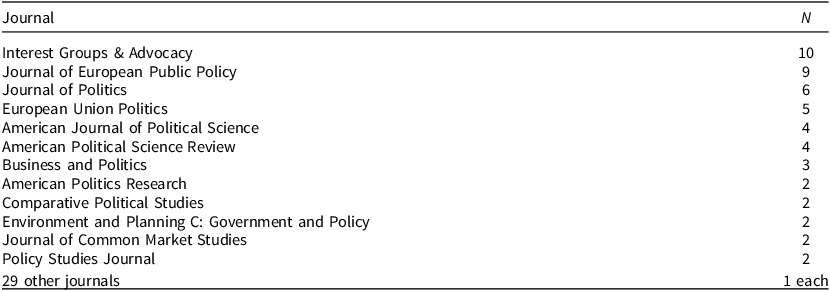
As for the publication venues, in the same period (1985–2023), the most receptive journals on this topic among those covered by our study have been Interest Groups & Advocacy and the Journal of European Public Policy, leading the list of all articles with ten and nine articles respectively. This is not surprising: the former is a recently establishedFootnote 8 scientific journal specifically devoted to the study of interest groups and lobbying, while the latter has for some time now chosen to publish both theoretical and empirical studies on lobbying with some frequency (Bunea and Baumgartner, Reference Bunea and Baumgartner2014, 1416; Pritoni and Vicentini, Reference Pritoni and Vicentini2022). Looking at the wider list (Table 1), we can find both generalist political science journals (such as the Journal of Politics or the American Political Science Review) as well as journals more specifically dedicated to policy studies (Policy Studies Journal).
Articles on lobbying coalitions (1985–2023): most receptive journals

Source: authors’ elaboration based on WoS data.
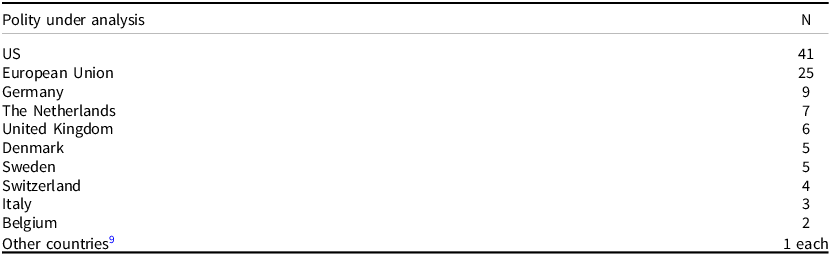
When looking at the political systems scrutinized by the articles under consideration (Table 2), unsurprisingly, a clear predominance of the US and the EU is found, in line with the bulk of the more generalist literature on interest groups and lobbying (Bunea and Baumgartner, Reference Bunea and Baumgartner2014; de Figueiredo and Richter, Reference de Figueiredo and Richter2014; Harris et al., Reference Harris, Bitonti, Fleisher and Skorkjær Binderkrantz2022; Mahoney, Reference Mahoney2008). This predominance may be easily explained by considering various factors, such as the political and regulatory international relevance of both the US and the EU, as well as the wider availability of data and information on policy processes andFootnote 9 lobbying activities, resulting from the advanced regulatory frameworks operating in those contextsFootnote 10 (Hogan, and Bitonti, Reference Hogan, Bitonti and Timmermans2024). Nevertheless, other polities have increasingly come under scrutiny in various studies, focusing on lobbying coalitions in Germany, the Netherlands, the UK, and other European countries. Somewhat surprising is the scarcity of studies on lobbying coalitions in other non-European countries, even those that exhibit regulatory frameworks on lobbying such as Canada and Australia (object of only one article respectively in our sample: Pagliari and Young, Reference Pagliari and Young2014; Sawer and Groves, Reference Sawer and Groves1994).
Polities under scrutiny in articles on lobbying coalitions (1985–2023)

Source: authors’ elaboration based on WoS data.
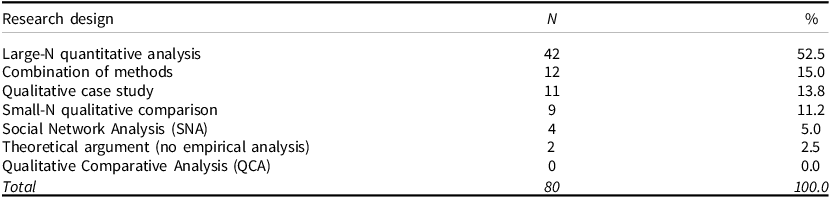
Yet, other interesting insights may be advanced in terms of research design adopted by those who studied lobbying coalitions (Table 3).
Research design of articles on lobbying coalitions (1985–2023)

Source: authors’ elaboration based on WoS data.
The quantitative analysis of many cases turns out clearly to be the most chosen method to study lobbying coalitions, adopted by more than half of the articles in our sample (42 articles out of 80). Other methods such as mixed methods, qualitative case studies, and qualitative comparisons of a small number of cases, follow at great distance (12, 11, and 9, respectively). It is also interesting to note how Social Network Analysis (SNA) was used only in a handful of cases (Beyers and Donas, Reference Beyers and Donas2014; Box-Steffensmeier et al., Reference Box-Steffensmeier, Christenson and Hitt2013; Grossmann and Dominguez, Reference Grossmann and Dominguez2009; Sawer and Groves, Reference Sawer and Groves1994), while Qualitative Comparative Analysis (QCA) – an increasingly successful method in political studies (Ragin et al., Reference Ragin2003; Schneider and Wagemann, Reference Schneider and Wagemann2012) – appears in none.
If we look at the trends in terms of research design in the various decades (see Table A1 in the online Appendix), the breakdown confirms a clear dominance of large-N quantitative analyses in all decades. This method has steadily grown in use since the 1990s, reaching its peak in the 2010s and continuing to be the prevalent one in the 2020s. At the same time, there has been an increase in the diversification of research methods, with a slowly growing use of other approaches such as qualitative case studies and mixed methods. Particular attention should also be given to the growing use of mixed-method research designs, especially in recent years: there is an increasingly widespread belief that a skillful combination of different methods allows for a more refined analysis of the available empirical material. On this, there are for instance quite a few studies combining SNA and quantitative analysis (Bunea et al., Reference Bunea, Ibenskas and Weiler2022; Heaney and Leifeld, Reference Heaney and Leifeld2018; Heaney and Lorenz, Reference Heaney and Lorenz2013), while experiments – again combined with quantitative analysis – are also beginning to gain traction (Rothschild, Reference Rothschild2022).
It is finally useful to map how the studies under consideration conceptualize (and operationalize) both interest groups and lobbying coalitions. This is the case because such conceptualizations (and, consequently, definitions) are not neutral as for the outcomes of empirical research, nor are they, above all, secondary issues when attempting to compare different studies and thus advance some accumulation of scientific knowledge.
As for the conceptualization of interest groups, two different approaches are commonly found in the literature: the organizational approach and the behavioral one (Baroni et al., Reference Baroni2014; Chalmers et al., Reference Chalmers, Puglisi, van den Broek, Harris, Bitonti, Fleisher and Binderkrantz2022). While both adhere to the classic definition of interest group as ‘any group that, on the basis of one or more shared attitudes, makes certain claims upon other groups in the society for the establishment, maintenance, or enhancement of forms of behavior that are implied by the shared attitudes’ (Truman, Reference Truman1951, 33), the organizational approach considers only member-based organizations, while the behavioral one considers any actor ‘actively trying to influence the distribution of political goods’ (Berry, Reference Berry1977, 10), including companies and even institutional actors. Out of all the articles on lobbying coalitions considered in our study, the vast majority (70%: 56 out of 80) adopt the behavioral approach, while only a minority use the organizational one (12.5%: 10 out of 80), with the remaining ones (14) not clarifying any specific choice in this regard. Even this empirical finding is not particularly surprising: the study of lobbying coalitions, whether understood as a phenomenon to be explained (dependent variable) or as a potential cause of something else (independent variable), is often linked to the empirical investigation of the influence exerted by such lobbying coalitions in policymaking (Junk, Reference Junk, Harris, Bitonti, Fleisher and Binderkrantz2022). Since both associative actors and individual companies or even single institutions seek to influence policymaking (Beyers et al., Reference Beyers2014), the choice of a behavioral definition often appears as the most appropriate one.
As for the conceptualization of lobbying coalitions, three different definitions (and operationalizations) may be found in the literature (Junk, Reference Junk2020b). Some conceive lobbying coalitions as simple policy camps or sides, so that an interest group may be broadly considered part of a coalition based on a preference similarity approach (see, for instance, Klüver, Reference Klüver2013b). However, while ‘some common denominator of shared preferences or common goals will arguably be a necessary condition for a lobbying coalition, some will question whether they are a sufficient condition for speaking about a “coalition”’ (Junk, Reference Junk2020b, 24). Therefore, a second narrower approach adopts a behavioral definition, requiring ‘a non-trivial degree of coordinated activity over time’ (Sabatier, Reference Sabatier1988, 139). Examples of coordinated activities (of various degrees) are the exchanges of information that occur between coalition partners, the coordination of strategies, or the actual deployment of common lobbying actions. A third even stricter conceptualization may be also recalled, the organizational one, defining lobbying coalitions based on the existence of a formal organization that binds coalition partners, as typically happens with umbrella associations or network organizations. These distinctions are far from secondary, as they identify empirical referents that can be significantly different from one another, making an explicit comparison between studies using different conceptualizations impossible. Especially when the formation of a lobbying coalition is the phenomenon being studied, it is advisable to use more stringent conceptualizations, as they assume the actual pooling of lobbying strategies (behavioral conceptualization) or, additionally, of resources and/or organizational structures (organizational conceptualization). Since, to the best of our knowledge, this is the first time that such methodological differences are clearly mapped and empirically consideredFootnote 11 , our impression is that these aspects have not, at least so far, received the necessary attention. On this, a once again overwhelming majority of the studies under consideration adopt a behavioral definition of lobbying coalitions (59 articles out of 80), with the alternative options adopted only in 12 (policy camp) and 6 (formal organization) cases. No significant change in this regard may be observed when looking at the trends throughout the various decades.
The determinants of forming or joining a lobbying coalition
In the literature, the formation of a lobbying coalition has been alternatively treated as a dependent variable or as an independent variable (Junk, Reference Junk, Harris, Bitonti, Fleisher and Binderkrantz2022). In the latter case, researchers have examined the potential correlation between the pooling of strategies and resources by different interest groups, on one hand, and the increase in their policy influence (or policy success), on the other. The aim, in this second case, is to verify whether actors who form or join a lobbying coalition are indeed able to exert more influence in policymaking. On this point – which, however, is not our specific focus here – empirical results are contradictory (Hanegraaff, and Pritoni, Reference Hanegraaff and Pritoni2019): there are prominent studies that demonstrate both a positive relationship between coalition formation and policy success (groups that form coalitions are more influential in policymaking) (Junk, Reference Junk2019; Nelson and Yackee, Reference Nelson and Yackee2012), as well as a negative relationship (groups that form coalitions are less influential in policymaking) (Bunea, Reference Bunea2013; Haider-Markel, Reference Haider-Markel2006; Heinz et al., Reference Heinz1993; Junk, Reference Junk2020a). More specifically, the relationship between coalition formation and policy influence/success seems to be shaped by several additional intervening factors. Chief among these are the characteristics of the coalition itself (such as its size and degree of heterogeneity or homogeneity), the policy context (notably its salience or complexity), the attributes of the participating actors, and the political arena – be it judicial, legislative, media, or otherwise – where the extent of policy influence/success is assessed. We will, however, devote the remainder of this systematic literature review to those articles in our sample treating the formation of a lobbying coalition as a phenomenon to be explained (dependent variable), leaving the analysis of lobbying coalition formation as a potential explanatory factor of policy influence for future research. Focusing on coalition formation as the dependent variable is indeed crucial for explaining what drives one of the most strategical choices in lobbying (Junk, Reference Junk, Harris, Bitonti, Fleisher and Binderkrantz2022); furthermore, it serves to start understanding its mixed effects on policy influence.
Yet, to do this meaningfully, we must add some further caveats. In particular, in addition to considering only articles where the formation of a lobbying coalition is the explanandum, (i) we focus on articles using either the behavioral or the organizational conceptualization of lobbying coalition, not considering articles where lobbying coalitions are conceptualized as policy campsFootnote 12 ; (ii) we select articles where the unit of analysis is the individual interest group (or the individual lobbyist); and (iii) we exclude purely theoretical articles, where no empirical test of theoretical hypotheses is provided. Therefore, this section qualitatively delves into a sub-sample of 16 articles, with a total amount of 77 theoretical hypotheses testedFootnote 13 . However, to bring some order to this complexity, we deemed it appropriate to group theoretical hypotheses into a series of homogeneous categories. First, we differentiate hypotheses based on the level of analysis to which they refer: macro, meso, and micro. Doing so is necessary to understand the variable empirical consistency of factors placed at different levels of analysis, and thus to understand whether and how individual choices (micro level) are affected (also) by contingent elements related to the specific policy process (meso level) and/or the overall institutional environment within which they are taken (macro level).
Therefore, macro-level hypotheses are those that link the formation of a lobbying coalition to the characteristics of the broad environment where groups interact (i.e., the institutional setting or the interest system’s features in terms of density and diversity, or the pluralist, statist, or neo-corporatist arrangements, as well as the level of competition groups perceive to face in raising resources). Gray and Lowery (Reference Gray and Lowery1998) or Pritoni (Reference Pritoni2019) are examples of studies adopting hypotheses formulated at this level: the former stresses the explanatory potential of factors like, among others, interest system density and the level of balkanization of resources at disposal to groups, while the latter focuses on (high) environmental challenges as a factor pushing interest groups to coalition formation. Meso-level hypotheses are those that, for instance, focus on the peculiarities of the policy context in which groups are called upon to mobilize politically (i.e., public salience, level of political conflict, technical complexity, policy scope, etc.). Hojnacki (Reference Hojnacki1998), who highlights the relevance of the issue scope as driver for joining a coalition, or Beyers and De Bruycker (Reference Beyers and De Bruycker2018), who stress how (public, media and self-perceived) saliency push groups to engage in lobbying coalitions, are examples of studies adopting hypotheses formulated at this level. Micro-level hypotheses are those that concentrate on the characteristics of individual interest groups (or lobbyists) who decide (not) to form a lobbying coalition. Both Newmark and Nownes (Reference Newmark and Nownes2019) and Hanegraaff and Pritoni (Reference Hanegraaff and Pritoni2019), who theorize coalition formation as a ‘weapon of the weak’, are examples of studies adopting hypotheses formulated at this level. Obviously, it is not ruled out that some hypotheses may combine two (or more) of these levels of analysis: in such cases, the level is considered as composite.
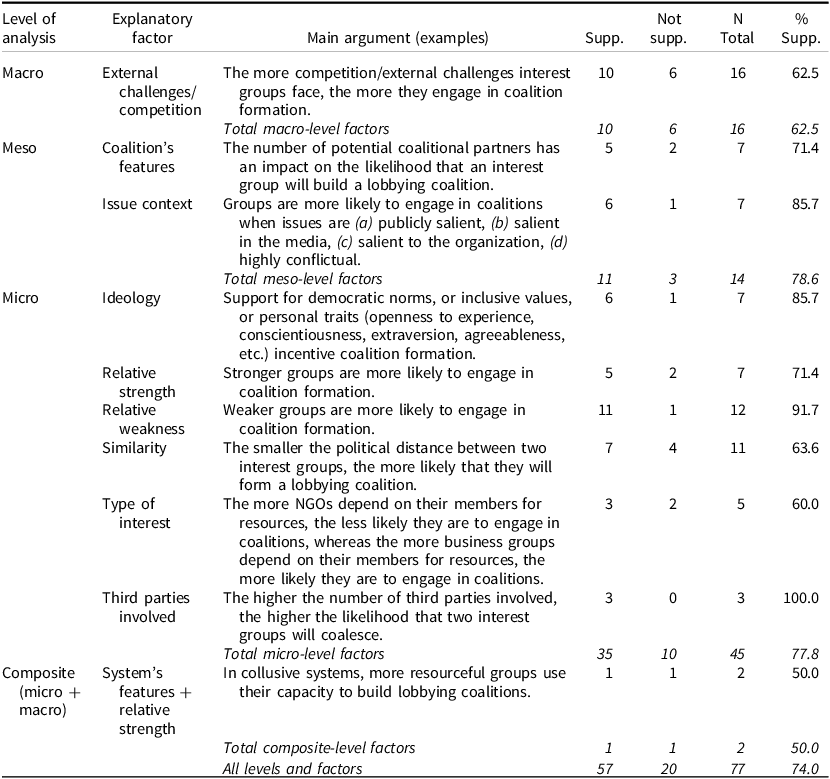
Moreover, within these categories we also identified a series of explanatory factors; for instance, within the micro-level category, it is possible to highlight the importance of several different individual characteristics: the similarity between coalition members; an ideology oriented toward sharing (strategies or resources); a more or less evident scarcity of resources, which forces groups to mobilize jointly, etc. Table 4 summarizes our choicesFootnote 14 and shows the varying empirical consistency of different factors (and level of analysis), reporting how many hypotheses are either empirically supported or not supported for all of them.
Theoretical hypotheses explaining coalition formation in articles on lobbying coalitions (1985–2023)

Source: authors’ elaboration based on WoS data.
The largest number of tested theoretical hypotheses pertains to the micro level, which is consistent with the aims those same hypotheses set, as they indeed concern the individual choices of groups or lobbyists. If one aims to explain a micro-level choice, such as the decision (not) to form or join a lobbying coalition, it is plausible that the (main) causes of that choice should also be sought at the same level of analysisFootnote 15 .
Moreover, and seemingly contradictorily, there is no clear difference – depending on the level of analysis investigated – in the empirical consistency of the various factors considered. Put differently, although the micro level seems the most appropriate for explaining the choice to engage (or not) in a lobbying coalition, as just argued, it does not also represent the level of analysis where empirical findings are the most consistent and/or unambiguous. Meso-level explanations (78.6% of hypotheses confirmed) perform slightly better than micro-level explanations (77.8% of hypotheses confirmed), whereas macro-level explanations (62.5% of hypotheses confirmed) are those performing the worst. Yet, the fact that micro-level explanations do not perform clearly better than others can be easily justified if we focus on hypotheses pertaining to both the ‘similarity’ and the ‘type of interest’ micro-level explanatory factors. As for the former, not only similar interest groups form lobbying coalitions: when the policy context makes it more strategically useful (Junk, Reference Junk2019), they also form heterogeneous coalitions, also called ‘strange bedfellows coalitions’ (Beyers and De Bruycker, Reference Beyers and De Bruycker2018). As for the latter, the contradictory behavior of non-governmental organizations (NGOs) in terms of coalition formation is well-known since Hojnacki’s seminal studies at the end of the 1990s (Hojnacki, Reference Hojnacki1997; Hojnacki, Reference Hojnacki1998). Furthermore, previous research already demonstrated that issue characteristics could matter more than organization-level factors for choosing lobbying strategies and, eventually, reaching policy success (Junk, Reference Junk2016; Klüver, Reference Klüver2013b).
Finally, many empirical studies tested whether coalition formation is a weapon of the weak, following the argument that pooling resources (and strategies) is particularly beneficial for those that lack those same resources. In other words, those studies argue that lobbyists often lobby in packs, as wolves hunting their prey, because they are not as strong as lions, which indeed hunt alone (Hanegraaff and Pritoni, Reference Hanegraaff and Pritoni2019). On this point, our systematic literature review tends to confirm this approach: in most cases, it is the weaker interest groups, rather than the stronger ones, that rely more heavily on coalition building (Hanegraaff and Pritoni, Reference Hanegraaff and Pritoni2019; Newmark and Nownes, Reference Newmark and Nownes2019; Pritoni, Reference Pritoni2019). However, there is also a significant minority of empirical studies that show the opposite (Beyers and Donas, Reference Beyers and Donas2014; Gray and Lowery, Reference Gray and Lowery1998), suggesting that a minimum threshold may exist below which a single group (or individual lobbyist), no matter how willing, is unable even to join a lobbying coalition.
In a nutshell, our systematic literature review demonstrates that interest groups are more likely to form or join lobbying coalitions, in particular, when: (i) they are called to mobilize in a highly salient and conflictual policy/issue context (Beyers and De Bruycker, Reference Beyers and De Bruycker2018; Newmark and Nownes, Reference Newmark and Nownes2019); (ii) they are ideologically in favor of pooling resources and strategies, for whatever personal traits or characteristics (Brady and Djupe, Reference Brady and Djupe2016); and (iii) third parties are involved, acting as facilitators or brokers between potential allies (Carpenter et al., Reference Carpenter, Esterling and Lazer2004). Furthermore, as said, especially weak interest groups decide to build a lobbying coalition, presumably to increase their resources and to signal to policymakers that a particular policy position is supported by broad popular consent. Yet, on this aspect there is also empirical evidence going in the opposite direction.
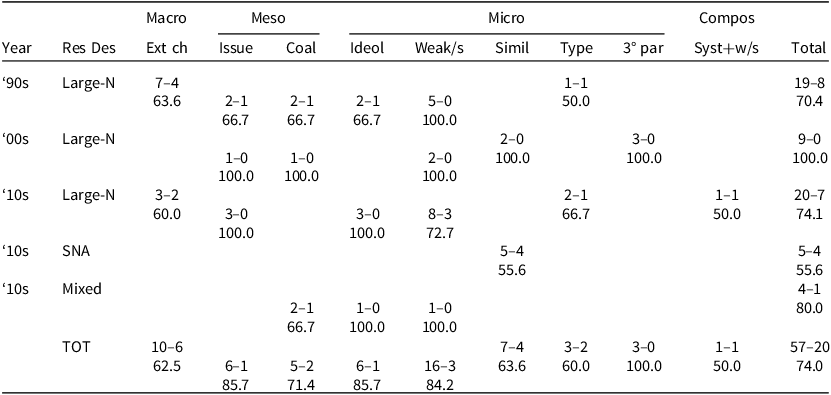
That said, what remains to be emphasized deals with the diachronic dynamics inherent in the rate of confirmation of theoretical hypotheses (Table 5). This enables us to examine the timing and dynamics of the knowledge accumulation process within this field of study. In other words, the diachronic reconstruction that follows aims to determine whether more recent studies have been designed to refine – or explicitly refute – the theoretical hypotheses proposed in earlier periods.
Testing theoretical hypotheses explaining coalition formation in articles on lobbying coalitions (1985–2023): diachronic trends

Notes:
Abbreviations in the Table: Res Des = research design; Ext ch = external challenges; Issue = issue context; Coal = coalition’s features; Ideol = ideology; Weak/s = relative weakness or relative strength; Simil = similarity; Type = type of interest; 3° par = third parties involved; Syst+w/s = system’s features + weak/strong; SNA = social network analysis; Mixed = mixed-method research design.
To attribute a specific theoretical hypothesis to the relevant decade, we focus on the year of publication of the article in which that theoretical hypothesis was formulated.
Each cell in the table contains both the absolute numbers of supported (first) and not supported (then) hypotheses, as well as the relative percentage of hypotheses pertaining to that specific explanatory factor that have been supported by empirical research (e.g., as for external challenges in the ‘90s, 7 hypotheses were supported whereas 4 were not supported, for a confirmation rate equal to 63.6%).
Source: authors’ elaboration based on WoS data.
Apart from an increased complexity and differentiation of methods used – already discussed in the previous section – there does not appear to be any recognizable pattern followed by researchers over time. There is only one exception concerning the transition between the 1990s and the following decade. In the 1990s, theoretical hypotheses addressing all three levels of analysis – macro, meso, and micro – were proposed. Among these, the one that yielded the most consistent results, the micro level, was indeed more frequently tested in the following decade, yielding to an even better performance (100% confirmation rate in the 2000s for micro-level theoretical hypotheses), whereas macro-level explanatory factors were abandoned, signaling a declining importance of macro-level analysis in the fieldFootnote 16 . Additionally, in the 2000s, we observe a good number of meso-level theoretical hypotheses, which had shown some gaps in the previous decade; in this case, however, this kind of hypotheses were refined, as they were consistently confirmed. In other words, it appears that the work at the end of the previous century served as the foundation from which researchers in the new millennium began building.
Similar dynamics are not observable in the subsequent transition from the 2000s to the 2010s. As noted, methods proliferate, explanatory factors are used at all levels of analysis, and theoretical hypotheses that combine more than one level of analysis are even introduced for the first time. However, the results of this substantial effort are not immediately apparent, so much so that the confirmation rate of theoretical hypotheses returns is alarmingly close to that of two decades earlier. Yet, what at first glance might appear as an inability to accumulate knowledge in this field of study could represent the initial phase of a potential paradigm shift in explaining the formation of lobbying coalitions. It is as if we are witnessing a pars destruens, awaiting a more complete and refined pars construens, whose empirical reliability is amplified by the multiplicity and combination of new research methods. In other words, we may be in the midst of a kind of ‘creative destruction’, with levels of analysis, explanatory factors, theoretical hypotheses, and research designs combined in original ways – sometimes yielding good results, sometimes not – while awaiting those who will follow to have the tools to identify the most promising interpretive strands and build upon them. Are we too optimistic? Time will tell.
Advancing research on lobbying coalitions
This study provided the first systematic review and meta-analysis of the scholarly literature on lobbying coalitions in the political science field. We adopted the PRISMA guidelines for transparent and replicable scoping reviews to map the core trends, methods, and conceptualizations adopted to analyze coalitional lobbying and then conduct a meta-analysis of the theoretical hypotheses tested to explain it. This review thus aimed to provide an exhaustive ‘state of the art’ of the research field, while also identifying strengths and weaknesses in the explanatory factors, and corresponding levels of analysis and research designs, to account for the formation and characteristics of lobbying coalitions. Our mapping exercise depicted an evolving and increasingly diversified field of inquiry. Studies on lobbying coalitions had a swinging trend from the second half of the 1980s to 2023, with a more apparent increase during the 2010s. Specialized journals on interest groups and public policies host most of the research on lobbying coalitions, covering prominently the US and EU, in line with a Western-centered trend in the generalist literature on lobbying. Quantitative research designs dominate the field, while a slow diversification of methodological approaches can be noticed, with the rising number of studies adopting qualitative and mixed-method designs. Notably, however, some methods whose popularity is growing rapidly in political science, such as SNA and QCA, still struggle to make their way in the analysis of lobbying coalitions.
As regards the conceptualization of lobbying coalitions, our review showed an evident prevalence of behavioral definitions of interest groups and their coalitional dynamics. The behavioral definition of interest groups clearly emerges as the scholars’ preferred option so as not to limit the investigation of lobbying coalition-building to formal organizations. Yet, remarkably, a significant number of studies do not provide a clear definition of an interest group (17.5%: 14 out of 80). The definition of what constitutes a ‘coalition’ also varies in the literature, crucially affecting the identification of the object to be analyzed empirically, its measurement, and comparability. Building on the typology elaborated by Junk (Reference Junk2020b), we found that about three-quarters of the studies in our sample define coalitions in terms of coordinated behavior, with a minority of works opting for the minimalist definition as policy camp or the most demanding one of the formal organizational coalition.
Having charted the research field, we then focused on the hypotheses and factors tested to explain the choice of interest groups and lobbyists to join in coordinated and even formal coalitions. We thus elaborated an original classification scheme that combines the different levels of analysis (macro, meso, and micro) with the related explanatory factors used within each. Our meta-analysis showed that scholars mainly tested micro- and meso-level explanatory hypotheses and factors, which are also those scoring the highest empirical consistency. The review of the existing empirical research thus provides evidence of the likelihood of coalition-building in lobbying when interest groups mobilize on salient and conflictual policies, when they have an ideological propensity to coordinate resources and strategies, and when third-party actors help to bridge potential allies. Moreover, while the bulk of empirical evidence also shows that coalitional lobbying tends to be a ‘weapon of the weak’, a significant minority of studies disconfirm such a hypothesis, leaving the question open.
Lastly, looking at the historical development of theoretical hypotheses, we singled out a first phase of ‘knowledge accumulation’ from the ‘90s to the 2000s, with the abandonment of macro-level explanatory factors and the refocusing of the research efforts towards the development and refinement of micro- and meso-level explanations, whose confirmation rates evidently improved. However, in the second stage, from the 2000s to 2010s, such a trend suffered a setback, with a hypothesis’ confirmation rate slightly improved compared to the 1990s. As we noted above, such a development could signal a halt in the ‘cumulative’ improvement of the adopted micro- and meso-level factors’ explanatory potential, and a parallel ‘expansion’ of the same field of inquiry, driven by the increasing diversification and combination of research methods, analytical levels, and explanatory hypotheses. According to this interpretation, the identified literature trends would hint at a potential ‘paradigm crisis’ in the study of lobbying coalitions, with a growing number of scholars willing to experiment with new combinations of methodologies and factors, also at the cost of having a lower success rate compared to the past.
While striving to be as systematic as possible, any such literature review suffers from limitations related to the unavoidable research choices to make, like the selection criteria and coding strategies for the meta-analysis. As regards the former, the choice for the WoS - Core Collection database led us to neglect the literature published before 1985, thus offering a limited timeframe. Moreover, restricting the eligibility criteria to the scientific journals in ‘Political Science’ and ‘Public Administration’ could have brought the exclusion of relevant articles published in journals of different research domains or of other scientifically valid publications, like book chapters and monographsFootnote 17 . Furthermore, we had to dichotomize between empirically supported and not supported hypotheses to offer a measurable and comparable way to analyse them, while potentially losing a more granular consideration of those hypotheses’ consistency and limits. While some of these limits are probably inescapable, the PRISMA framework adopted in this review has at least the merit of transparently exposing the former to the readers and the academic community to foster peer reviewing and public scrutiny.
However, the most relevant contribution of this study is likely to lie in the possible future research directions that it tries to highlight. We stress three of them which look noteworthy.
First, our meta-analysis shows a promising path in developing mixed method designs and combining multiple analytical levels and explanatory factors, pointing to the increasing refinement of research strategies to account for a complex phenomenon like coalitional lobbying. A rather promising recent trend is to propose composite models, which simultaneously consider both micro- and meso- or macro-level factors. An example of such a perspective is the work of Sorurbakhsh (Reference Sorurbakhsh2016), who hypothesizes interaction between the resources available to the group (micro level) and the characteristics of the interest system (macro level). But other theoretical hypotheses could follow the same approach, for example by linking resources at disposal, type of interest represented or ideological affinity – all micro-level explanatory factors – with characteristics of the policy process such as salience, extent of conflict or complexity – all meso-level elements. Moreover, our review shed light on a methodological gap concerning the adoption of alternative approaches like SNA and QCA, the latter still unexplored in the field. As for SNA, its usefulness in lobbying studies is fully understandable, as lobbying coalitions can be easily conceptualized within a policy network framework. As for QCA, despite being a methodological approach that is struggling to establish itself in the study of interest groups, partly because of some limitations related to aggregation biases, problematic inference (Hug, Reference Hug2013) and the impossibility to allow for counterfactuals (Clarke, Reference Clarke2020), the conception of conjunctural causality that characterizes it (Schneider and Wagemann, Reference Schneider and Wagemann2012) could be decisive in developing those integrated and composite models mentioned above.
Secondly, the question of whether coalitional lobbying is a weapon of the weak or the strong remains substantially open, with empirical evidence slightly leaning toward the ‘weak’ hypothesis. For instance, it seems reasonable to hypothesize that between resources available and the likelihood of forming or joining a lobbying coalition there is not a linear relationship, but rather a curvilinear one, and even more specifically in the shape of a normal distribution. Interest groups with very few resources do not join or form any coalition, because they are unattractive allies, just as much as organizations with a great deal of resources, who, on the contrary, see no need to join forces with other actors with whom they would then be called upon to make compromises. On the contrary, all those interest groups with an ‘average’ amount of resources would represent the ideal components of a lobbying coalition: they are useful as allies, but they cannot lobby entirely independently.
Lastly, while our meta-analysis focused on coalitional lobbying as the dependent variable, its role as a potential factor to explain interest groups’ influence and lobbying success still deserves to be systematically reviewed in the literature. On this point, as already claimed, Junk (Reference Junk, Harris, Bitonti, Fleisher and Binderkrantz2022) has recently hypothesized that many additional factors intervene in the relationship between the formation of a lobbying coalition and its ability to reach policy results, altering its strength and direction. In short, this aspect, too, could be usefully investigated through composite theoretical models and methodological approaches that explicitly employ a conjunctural conceptualization of causality.
Supplementary material
The supplementary material for this article can be found at https://doi.org/10.1017/S1755773925100143.
Data availability statement
While the supplementary material for this article can be found at [final doi url of the article], the full dataset and the codebook are available from the corresponding author upon request.
Acknowledgements
We would like to thank Wiebke Marie Junk, who read an early version of this work, as well as the three anonymous referees, for their suggestions and comments during the preparation of this article.
Funding statement
This research received no specific grant from any public or private funding agency.
Competing interests
The authors have no conflicting interests to report.
Andrea Pritoni is Associate Professor of Political Science at the Department of the Arts, University of Bologna, where he teaches Electoral campaigns in Italy and Institutional relations and lobbying strategies. His main research interests are Italian politics, interest groups and lobbying, comparative public policies. He has recently published articles on Governance (2025), Policy Studies Journal (2025), South European Society and Politics (2024), International Review of Administrative Sciences (2024), Contemporary Italian Politics (2024), and European Political Science (2024).
Alberto Bitonti is Lecturer of Political and Public Communication at Università della Svizzera Italiana (Switzerland) and Professor of Politics at IES Abroad Rome (Italy). His research is grounded in political philosophy, political science, and communication studies, with a specific research interest in lobbying, public affairs, and political innovation. He co-edited the Palgrave Encyclopedia of Interest Groups, Lobbying and Public Affairs (Springer 2019-2022, co-edited with Phil Harris, Craig S. Fleisher, and Anne S. Binderkrantz) and Lobbying in Europe. Public Affairs and the lobbying industry in 28 EU countries (Palgrave Macmillan 2017, co-edited with Phil Harris). He published various articles and essays in international books and journals such as Contemporary Politics, the European Journal of Communication, the Journal of Public Affairs and the Italian Political Science Review.
Giuseppe Montalbano is a Postdoctoral Researcher at the Department of Urban Development and Mobility, Institute of Political Science, University of Luxembourg. His research focuses on European economic and financial integration, interest groups’ influence and the politics of financialization. He has published in West European Politics, Business and Politics, Journal of Economic Policy Reform, among others.




 Open access

