


November 1859 saw the publication and initial serialisation of some of the most influential and enduring books of the nineteenth century. Wilkie Collins inaugurated the new class of sensation fiction with The Woman in White, which began serialisation in November, immediately after the conclusion of A Tale of Two Cities in Dickens’s journal, All the Year Round; and the first parts of Beeton’s Book of Household Management appeared, edited by Mrs Isabella Beeton. Samuel Smiles’s Self-Help was advertised in John Murray’s eclectic list of pre-Christmas publications, alongside Darwin’s On the Origin of Species by Means of Natural Selection; or, The Preservation of Favoured Races in the Struggle for Life (see Figure 7.1).
Advertisement for John Murray’s books, The Athenaeum, 15 October, p. 485.
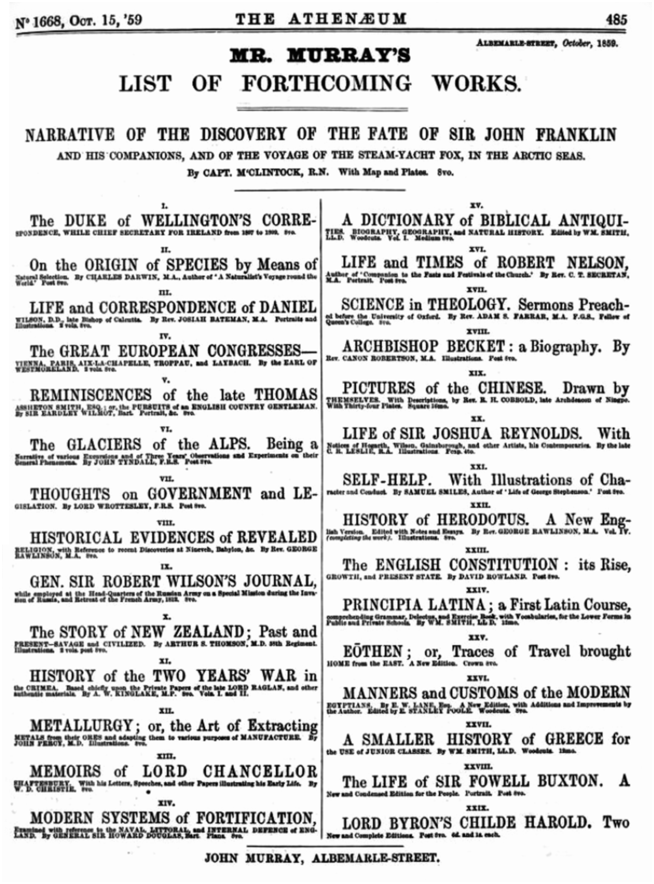
Figure 7.1 Long description
October 15, 1859. The Athenaeum. Mr Murray’s List of Forthcoming Works.
NARRATIVE OF THE DISCOVERY OF THE FATE OF SIR JOHN FRANKLIN, AND HIS COMPANIONS, AND OF THE VOYAGE OF THE STEAM-YACHT FOX, IN THE ARCTIC SEAS, by Capt McClintock, R N, with Map and Plates.
1. THE DUKE OF WELLINGTON’S CORRESPONDENCE, WHILE CHIEF SECRETARY FOR IRELAND.
2. On the ORIGIN OF SPECIES by Means of Natural Selection. By Charles Darwin.
3. LIFE and CORRESPONDENCE OF DANIEL WILSON, DD. By Rev Josiah Bateman, M A.
4. THE GREAT EUROPEAN CONGRESSES. By the Earl of Westmoreland.
5. REMINISCENCES of the late THOMAS ASSHETON SMITH, Esq. By Sir Eardley Wilmot.
6. The GLACIERS of the ALPS. By John Tyndall.
7. THOUGHTS on GOVERNMENT and LEGISLATION. By Lord Wrottesley, F R S.
8. HISTORICAL EVIDENCES of REVEALED RELIGION. By Rev George Rawlinson, M.A.
9. GEN. SIR ROBERT WILSON’S JOURNAL, while employed at the Head-Quarters of the Russian Army on a Special Mission during the Invasion of Russia, and Retreat of the French Army.
10. The STORY of NEW ZEALAND: Past and Present – Savage and Civilized. By Arthur S Thomson, M D.
11. HISTORY of the TWO YEARS’ WAR in the CRIMEA, Based chiefly upon the papers of the late Lord Raglan. By A W Kinglake, M P.
12. METALLURGY; or, the Art of Extracting Metals from their Ores and adapting them to various purposes of Manufacture. By John Percy M D.
13. MEMOIRS of LORD CHANCELLOR SHAFTESBURY. By W D Christie.
14. MODERN SYSTEMS OF FORTIFICATION. By General Sir Howard Douglas, Bart.
15. A DICTIONARY of BIBLICAL ANTIQUITIES. Edited by W M Smith.
16. LIFE and TIMES of ROBERT NELSON. By Rev. C T Secretan, M.A.
17. SCIENCE in THEOLOGY. Sermons Preached before the University of Oxford. By Rev. Adam S Farrar, M A, F G S.
18. ARCHBISHOP BECKET: a Biography. By Rev. Canon Robertson, M A.
19. PICTURES of the CHINESE. Drawn by themselves. With descriptions by REV. R H Cobbold.
20. LIFE of SIR JOSHUA REYNOLDS. By the late C R Leslie, R A.
21. SELF-HELP. With Illustrations of Character and Conduct. By Samuel Smiles.
22. HISTORY of HERODOTUS. A New English Version. By Rev. George Rawlinson, M.A.
23. The ENGLISH CONSTITUTION: its RISE, GROWTH, and PRESENT STATE. By David Rowland.
24. PRINCIPIA LATINA; a First Latin Course. By W M Smith, L L D.
25. EŌTHEN; or, Traces of Travel brought Home for the East.
26. MANNERS and CUSTOMS of the MODERN EGYPTIANS. By E W Lane, Esq.
27. A SMALLER HISTORY OF GREECE for the USE of JUNIOR CLASSES. By W M Smith, L L D.
28. The LIFE of SIR FOWELL BUXTON. A New and Condensed Edition for the People.
29. LORD BYRON’S CHILDE HAROLD. Two New and Complete Editions.
JOHN MURRAY, ALBEMARLE-STREET.
When the list went on sale to the book-trade on 22 November, Self-Help received 3,200 orders, and Darwin’s work 1,500, outstripping its first print run of 1,250. But the best-seller was Captain McClintock’s Narrative of the Discovery of the Fate of Sir John Franklin, which sold 7,600, of which 3,000 went to Mudie’s alone.1 McClintock’s account was more typical than either Smiles’s or Darwin’s work of a list that consisted largely of travel narratives, memoirs, and histories and seemed primed to satisfy the popular appeal of retrospection and armchair travel. As Sylvia Nickerson writes, John Murray’s ‘specialty was the development of travel and exploration literature, an emerging genre that delivered to readers the safe exoticism of English stories from the frontiers of British rule’.2
November’s most enduring texts had in common their central engagement with forms of history and with the representation and mechanisms of change, and an evolving understanding of both the relationship between past and present, and the part that the past might play in the achievement of change. This chapter examines November’s major texts alongside each other in order better to understand the agency of the past at the end of the decade, and how custom features within them. In doing so, I concentrate specifically on 1859, and not on the after-life of its texts, one of the repercussions of which in Darwin’s case is to shift emphasis away from religious controversy and onto its participation in the year’s temporal preoccupations. For Darwin and others, this included the question of whether it was really possible to be original.
On the Origin of Species
Over twenty years in the writing, the potential originality and impact of Darwin’s work had nearly been scuppered when Alfred Russel Wallace wrote to him with his own account of natural selection in June 1858. Wallace was at the time a lone scientist living in the Maluku Islands in the Pacific, where he had been based for several years.3 In a letter to Charles Lyell, Darwin generously acknowledges Wallace’s work whilst conveying his own ideas’ precedence and concluding, erroneously, ‘So all my originality, whatever it may amount to, will be smashed’.4 In fact, both Darwin’s and Wallace’s works were read to the Linnean Society later that summer, and Darwin was, to the relief of his friends, given the spur needed to complete the ‘abstract’ of his ideas on natural selection. He sent numerous copies of his book to fellow scientists, seeking to alert them to the significance of what he was about to disclose, and spent October in uneasy anticipation of the book’s publication. Bemoaning his ‘troublesome progeny’, the ‘confounded Book, which half killed me’, he went to Ilkley in Yorkshire to take the water cure (to Murray, 15 October, p. 351; to Huxley, 15 October, p. 351), which had been his recourse at times of stress for years.
Initial reviews found Darwin’s arguments difficult fully to comprehend, though their stance was broadly perplexed rather than openly hostile, with several writers referring to Darwin’s own frequent admission of ignorance and gaps in the geological record. The Examiner responds much more positively that Darwin’s work shows that ‘all organic beings, man included, are in a perpetual progress of amelioration […which] runs parallel with the social advancement of man himself, which began with the cowering cannibal, and in its progress has already produced a Howard and a Nightingale’.5 A key concern in these early, non-specialist responses is the future, and both The Spectator and Athenaeum quote this passage from Darwin’s Conclusion:
Judging from the past, we may safely infer that not one living species will transmit its unaltered likeness to a distant futurity. And of the species now living very few will transmit progeny of any kind to a far distant futurity; for the manner in which all organic beings are grouped shows that the greater number of species of each genus, and all the species of many genera, have left no descendants, but have become utterly extinct. We can so far take a prophetic glance into futurity as to foretell that it will be the common and widely-spread species, belonging to the larger and dominant groups, which will ultimately prevail and procreate new and dominant species.
The Athenaeum reviewer retorts to these ‘bold views’: ‘We cannot say that this is easy doctrine’.6 Darwin’s confident projection of ‘a secure future’ which ‘will tend to progress towards perfection’ (Darwin, Origin, p. 489) offers no comfort to the habitually sardonic Athenaeum: it is ‘a delightful vision; natural and gradual optimism is a welcome fancy. What need of distinct creation? If a monkey has become a man – what may not a man become?’ (pp. 659–60).
This is a very early recognition of natural selection’s connotations for humankind, which Darwin had carefully not addressed; he might have wanted to write solely of the natural world, but reviewers saw through his silences and what they meant for a period interested in progress. Chambers’s Journal refers to Darwin’s hopes to ‘revolutionise natural history’ before going on to acknowledge his challenge to natural theology,7 and many were horrified by Darwin’s topical depiction of nature as ‘but one wide theatre of war!’ (Athenaeum, p. 659). On the same page of The Times, which carried T. H. Huxley’s influential review of Darwin, readers could learn of the hostilities between Spain and Morocco, in which fighting was being conducted without ‘due regard to the humanity expected of civilized nations’.8 Furthermore, in a period when shipwreck was a frequent occurrence, particularly in the unusually severe autumn and winter storms of 1859, Huxley’s analogy – ‘The individuals of a species are like the crew of a foundered ship, and none but good swimmers have a chance of reaching the land’ – would have hit home.9 As Huxley realised, along with the Athenaeum and the Spectator, part of the compelling nature of Darwin’s theory for his first readers lay in its chiming with contemporary conditions, which they could appreciate as illustrations of the processes of which Darwin wrote. Huxley describes ‘the marvellous struggle for existence which is daily and hourly going on among living beings’, which entails that ‘[n]ot only does every animal live at the expense of some other animal or plant, but the very plants are at war … the seedlings rob one another of air and light and water’, ‘the strongest robber [wins] the day, and extinguish[es] his competitors’.10 Contemporary conflicts prepared readers for a text of struggle, of species that battled each other, as nations did, to survive. And in a year which found it difficult to look forward except through its experience of its history, On the Origin of Species offered little to assuage this quandary as the future only became possible through the medium of a struggle in the present that ran the risk of wiping out the inheritance of the past.
Apart from Chambers’ brief allusion to natural theology, first reviews of On the Origin of Species generally steer clear of explicit mention of its challenge to religious belief, which had so concerned Darwin. Indeed, it sat well outside the realm of the primary religious controversy in late 1859, which as we have seen centred rather on the challenges of the Roman Catholic church to Anglican practice, with widely reported violent riots erupting in the London parish of St George’s in the East, where parishioners were being encouraged to join a newly inaugurated ‘National Anti-Puseyite League’.11 ‘Puseyism’ and ‘popery’ were more immediately threatening than Darwin.12 But privately many acknowledged what was at stake. Harriet Martineau characteristically got to the heart of the matter when she wrote on 26 December: ‘What a work it is! – over-throwing (if true) revealed religion on the one hand, & Natural (as far as Final Causes & Design are concerned) on the other. The range & mass of knowledge take away one’s breath’ (to George Holyoake; Letters, pp. 208–09). And George Eliot wrote appreciatively to Barbara Bodichon:
We have been reading Darwin’s book on the ‘Origin of Species’ just now: it makes an epoch, as the expression of his thorough adhesion, after long years of study, to the Doctrine of Development … it will have a great effect in the scientific world, causing a thorough and open discussion of a question about which people have hitherto felt timid. So the world gets on step by step towards brave clearness and honesty!
Darwin’s own post-publication concerns about challenging faith may be gleaned from his enthusiastic response to a letter from Charles Kingsley, which expressed the opinion that his faith could accommodate Darwin’s views on the mutation of species. Whilst preparing a Preface for a new edition (of 3,000 copies) of his work, Darwin wrote to John Murray that ‘I have made some few corrections, & have inserted a capital sentence from Rev. C. Kingsley [into the book’s Conclusion] in answer to anyone who may, as many will, say that my Book is irreligious’ (2 December, p. 410):
A celebrated author and divine has written to me that ‘he had gradually learnt to see that it is just as noble a conception of the Deity to believe that He created a few original forms capable of self-development into other and needful forms, as to believe that He required a fresh act of creation to supply the voids caused by the action of His laws’.13
Darwin also inserted a reference to ‘the Creator’ into his book’s final sentence, but his expectation of the ameliorative effect of these amendments was optimistic and would do little to address the pained and painful seriousness of such responses as he received from his friend, Adam Sedgwick, Woodwardian Professor of Geology at Cambridge. Sedgwick wrote, ‘I have read your book with more pain than pleasure. Parts of it I admired greatly; parts I laughed at till my sides were almost sore; other parts I read with absolute sorrow; because I think them utterly false & grievously mischievous’ (24 November, p. 396). Sedgwick believed that ‘there is a moral or metaphysical part of nature as well as a physical. A man who denies this is deep in the mire of folly. Tis the crown & glory of organic science that it does thro’ final cause, link material to moral’, and, he went on, were it possible to break that link, ‘humanity in my mind, would suffer a damage that might brutalize it – & sink the human race into a lower grade of degradation than any into which it has fallen since its written records tell us of its history’ (p. 397). Sedgwick maintains his own belief in God’s laws, concluding sorrowfully, ‘I humbly accept God’s revelation of himself both in His works & in His word; & do my best to act in conformity with that knowledge which He only can give me, & He only can sustain me in doing. If you & I do all this we shall meet in heaven’ (p. 397). Sedgwick’s response was far from untypical as Martin Hewitt’s detailed account of both public and private contemporary responses to Darwin shows. It would be decades before Darwin’s theories were fully accepted.14
Though Darwin replied affectionately to Sedgwick, stating that he was grieved ‘to have encountered your severe disapprobation & ridicule’ and that ‘Your kind & noble heart shows itself throughout your letter’ (26 November, p. 404), he described the older man as ‘poor dear old Sedgwick’ to Thomas Huxley (25 November, p. 399), and ridiculed Sedgwick as ‘almost childish’ to Charles Lyell (29 November, p. 407), in which uncharacteristically uncharitable responses we may see the personal anguish experienced by Darwin, as well as his professional anxiety. Darwin did not explicitly refer either to religion or man in his work, but they hover uneasily in the margins as he explains that species mutation over millions of years is the only way to make sense of the evidence of the natural world, and indeed that ‘the whole history of the world, as at present known, although of a length quite incomprehensible by us, will hereafter be recognised as a mere fragment of time, compared with the ages which have elapsed since the first creature, the progenitor of innumerable extinct and living descendants, was created’ (p. 458). Darwin concedes the near impossibility of what he is asking people to conceptualise – ‘The mind cannot possibly grasp the full meaning of the term of a hundred million years’ (p. 453) – whilst insisting that this must be done, that they must differentiate between the ‘history of the world’ and ‘enormous periods of time’ (p. 393). The former is necessarily conceivable as it relies on an ordering consciousness to create it; the latter does not. On the Origin of Species asks its readers to reshape their relationship to time and temporality as well as to the natural world, and in a period so self-consciously aware of its position in history, and of ‘the nature of inheritance itself’,15 this was necessarily deeply disturbing.
Sedgwick persists in an understanding of history that underwrites a Biblical narrative of creation; that is, he holds on to the scope of ‘the written records’ of human history rather than recognising that Darwin had followed Charles Lyell in opening up the concept of ‘deep time’, which depended to an extent on its being almost beyond concept and record. Peter Dear compares the ‘shallow time’ of everyday existence, and of recorded or historical time, with the ‘deep time’ upon which Darwin’s theories rest, writing that, ‘Darwin used a metaphysics of time that treated the deep time of evolution as qualitatively distinct from the quotidian time of ordinary [historical] experience’.16 Gillian Beer writes similarly that On the Origin of Species ‘is work without the bounds of time … It must work on a stupendous scale while acknowledging its humdrum origins’, and that it relies on this precariously conjured and occupied historical continuum as it records ‘scrupulous observation’ of species mutation which ‘explod[es] into an argument that reaches back into an inconceivable past’.17 Once conceded, the presence of deep time cannot but affect the experience of history and its mechanisms.
Huxley tried to convey to the readers of Macmillan’s Magazine’s first issue the incommensurability of the time scales within which Darwin was working. If:
the condition of the world, which has obtained throughout geologic time, is but the sequel to a vast series of changes which took place in pregeologic time, then it seems not unlikely that the duration of this latter is to that of the former as the vast extent of geologic time is to the length of the brief epoch we call the historical period; and that even the oldest rocks are records of an epoch almost infinitely remote from that which could have witnessed the first shaping of our globe.18
The complexities of the sentence acknowledge both the care with which the temporal possibilities of Darwin’s work have to be introduced to the reader and the immense journey upon which that reader’s attention needs to be taken in order even to begin to grasp the connotations of Darwin’s writing. The terms used to try to describe the import of the sheer scale of the time conjured by Darwin – deep time, pregeologic time, a time before history as narration existed – attest to the challenges of his enterprise, literally to attempt to write a narrative of a process which exceeded the extant concepts of both time and history on which narrative relies.
The first edition of On the Origin of Species ends:
Thus, from the war of nature, from famine and death, the most exalted object which we are capable of conceiving, namely, the production of the higher animals, directly follows. There is grandeur in this view of life, with its several powers, having been originally breathed into a few forms or into one; and that, whilst this planet has gone cycling on according to the fixed law of gravity, from so simple a beginning endless forms most beautiful and most wonderful have been, and are being, evolved.
As Gillian Beer notes, the term ‘endless’ draws on Biblical sources, and Darwin ‘turns it to his own needs’ (p. 139), and both looks back to an almost inconceivably distant past and forward to the present and an endlessly wonderful future. There are conjured here multiple visions of excess that exceed narrated history as Darwin disputes the experience of time as a lived, narratable entity.
A significant part of On the Origin of Species’ capacity to disturb its readers rests in this revelatory relationship to history. Philip Davis might argue that natural selection’s reliance on deep time is ‘beyond anything human beings could plan or calculate, and almost beyond anything they could imagine’,19 and yet, as we have seen, a series of geological and archaeological discoveries had gradually been accustoming the public to the need to conceptualise and experience time differently just as they were also getting used to what Trish Ferguson describes as ‘public time’. She writes of the significance of Big Ben’s sounding through the London streets this year, suggesting that it demonstrated that ‘public time [had] eventually obtained a central place in the Victorian consciousness, internalised to facilitate industrial capitalism’. She continues: ‘The dawning of the clock-controlled world of the Industrial Revolution was a defining moment of a revolution in man’s experience of time … time could be embedded in capitalist enterprise’.20 But an even bigger shift was occurring concurrently through the agency of Darwin’s work, where a form of time which was not conveniently signalled by the newly heard booms of Big Ben was taking on dimensions which could only be apprehended through allusions, and, Darwin’s favoured mode, analogies from minutely calculated evidence; as Gillian Beer writes, ‘The activity of making analogies is essential to human perception as much as to argument’ (Beer, p. 82).
Unlikely though it might initially seem, custom may be seen as one such analogy, despite only appearing three times in the On the Origin of Species, on none of which does Darwin acknowledge the category as having determining qualities. Indeed, on conceding that ‘habit or custom’ might have some influence, he immediately retorts on himself with a counter-assertion supporting natural selection.21 It is also notable that on this occasion Darwin confounds custom with habit. The scarcity of ‘custom’ in Darwin, and its casual substitution by ‘habit’, emphasises how far custom is interpreted by Darwin as something usually extraneous to the economy of natural selection in the animal world.22 There are clear differences between evolution and custom, but there are similarities too: the analogy is just that and not a complete identification. Evolution and custom both exceed commoditised, industrial time as experiential forms, and neither can, unlike ‘public time’, readily be measured. It might be the case that custom is to evolution as history is to time: custom and history are the narratable, more readily realisable, human-inflected simulacra of evolution and time, which achieve their full being far beyond anything that humans can experience at any one moment. Most crucially, custom may, like evolution, effect change almost invisibly through ‘slow, varying, and insensible changes’ (Origin, p. 98) taking place over ‘centuries or thousands of years’ (p. 95). meaning that at no single point can that change be observed. As Huxley writes in Macmillan’s:
Just as a small portion of a great curve appears straight, the apparent absence of change in direction of the line being the exponent of the vast extent of the whole, in proportion to the part we see; so, if it be true that all living species are the result of the modification of other and simpler forms, the existence of these little altered persistent types, ranging through all geological time, must indicate that they are but the final terms of an enormous series of modifications, which had their being in the great lapse of pregeologic time, and are now perhaps for ever lost.
We might think about any number of customs (weddings, for instance) which mutate over the centuries, and are visible only through historical research, as mutations in the natural world are available initially only to the scientist.
Becoming Accustomed
Darwin understood the need to create analogies for his readers, and his most important one – that of the pigeon fanciers who breed improved birds through artificially selecting the qualities they wish to promulgate and pairing the birds accordingly – is picked up by many reviewers.23 Practised as well as observed by Darwin, this homely activity enacted before readers’ eyes in an accelerated form what evolution might take millennia to achieve. In cultivated plants and animals, and through the deliberate intervention of agents and the desire for change, mutation is more rapid and may be visible from one generation to the next.
We can see enacted here Darwin’s most important contribution to an understanding of evolution as a form of change, that is, in providing an account of the mechanism underpinning it. And in Self-Help and Mrs Beeton’s Book of Household Management, which both engage with the ambition for self-improvement, we can see how they achieve changes, too. Like the pigeon fanciers who breed new stock by optimising conditions, Beeton and Smiles choose examples of behaviour which they believe have proven to be beneficial, and inculcate them in the present generation. They introduce these changes as practices to which one might very profitably become accustomed. Custom’s becoming a vehicle of social change is a significant marker of the particularity of historical consciousness in 1859, and one that is strongly aligned with evolution.
We have already seen (in Chapter 4) how Smiles addresses the aspirational individual, offering inspirational stories of great men whom the reader might emulate, drawing on quotations that embed his teachings in a form of descended authority, and providing an introduction to a form of cultural capital that will itself be of value. But the means of actually achieving social progress involved hard work and the development of good habits, or customs. Self-Help invokes the customary as a fundamental part of Smiles’s teaching lexicon, and works to signal the rewards, to both the individual and to society, of apparent conformity with it. Within the remarkably similar-sounding series of narratives of the artists, industrialists, men of business, and inventors whom Smiles cites, the trope of personal exemplariness is regularly expounded, and the notion of ‘being accustomed to’ regularly extolled: ‘The late Dr Pye Smith, when apprenticed to his father as a bookbinder, was accustomed to make copious memoranda of all the books he read, with extracts and criticisms’; a late Lord Chancellor ‘was accustomed to walk from country town to country town when on circuit, being as yet too poor to afford the luxury of posting’; and Francis Horner ‘was accustomed to note in his diary and letters the books by which he was most improved and influenced’ (Smiles, pp. 120, 186, 307). Each of these uses, and the very many more which litter the text, denotes the discipline of making oneself become accustomed to a certain regime and set of practices which would stand their subject in good stead in the years and careers to come, but which would also certainly remind the working man of his roots, of the genealogy of his success, and which, arguably, would not allow him to proceed beyond the parameters of those initial inspirations. This is custom as a form of training and coercion, custom as an aspirational form that is acquired through careful nurturing and control. In a cruder form than Adam Bede, it also demonstrates how, whilst seeming most acquiescent with behavioural models derived from the past, the customary might effect a significant shift in an individual’s class-affiliations without destabilising class dynamics, in this respect echoing evolution’s equilibrium.
Whilst Smiles might demur from Hazlitt’s suggestion in his 1822 essay ‘On Thought and Action’ that ‘the great requisite for the prosperous management of ordinary business is the want of imagination, or of any ideas but those of custom and interest on the narrowest scale’ which he quotes (Smiles, p. 221), nevertheless Hazlitt’s neat financial pun highlights the commercial imperatives underlying Smiles’s use of custom and signals the extent to which Britain was in thrall to an economic as well as a historical model that tied the country firmly to its past, and actually to a practice of seeking validation through that past, whilst effecting a progressive move into the future for the individual and society: ‘For the nation is only the aggregate of individual conditions and civilization itself is but a question of personal improvement’ (Smiles, p. 2). As individuals collectively become accustomed to emulating the examples of their predecessors, so the nation should incrementally progress, just as individual creatures’ mutations ensure the perpetuation of their species.
The same impulse to look back whilst effecting improvements for the future can also be seen in Beeton’s Book of Household Management. In a light green cover, elaborately decorated with drawings of animals and poultry entwined with vines, and priced at 3d., the first instalment is a compendium of recipes and minutely detailed domestic and social instructions. The emphasis is firmly on the management of the household, its staff and routines, and its mistress. The impetus behind the work goes back to the start of the year with its controversy over decent British dinners, and the need to ensure that men came home in the evening rather than going to their clubs to find good food and an orderly atmosphere. There were many recipe books on the market, but few which so systematically, or so cheaply, promised to provide the housewife with all she needed to know to keep a tidy and welcoming home, along with an appetising table. Perhaps some of Beeton’s popularity lay in the fact that she did not under-estimate the sheer effort that went into managing a Victorian home, and respected the mistress at its heart, on whom rests ‘the happiness, comfort, and well-being of a family’ (Beeton, November, p. 1).
In a year in which women’s employment had been widely debated, both at the recent Association for Social Sciences in Bradford, and throughout the year in the English Woman’s Journal,24 it is interesting to see the gravitas with which Beeton invests the figure of the domestic mistress, and indeed the figure of the housekeeper, who is the subject of her second chapter. The responsibilities of a clean, hospitable, healthy, and well-nourished household are considerable, and are set out here in a level of detail which must convince readers of that. At the heart of the home is the kitchen. A chapter on ‘Arrangement and Economy’ includes advice about seasonality and kitchen equipment, and an illustrated lesson on how utensils have evolved since ancient times. Illustrations of modern equipment sit alongside those excavated from the ruins of Herculaneum and Pompeii, and cooking is declared to be nothing less than one of the measures of ‘the progress of mankind from barbarism to civilization’.25
As well as educating its readers about the history of the food and techniques she describes, Mrs Beeton also includes up-to-date material such as the ‘Soup à la Solferino (Sardinian recipe)’ given to her, she records:
by an English gentleman, who was present at the battle of Solferino, on June 24, 1859, and who was requested by some of Victor Emmanuel’s troops, on the day before the battle, to partake of a portion of their potage. He willingly enough consented, and found that these clever campaigners had made a most palatable dish from easily-procured materials. In sending the recipe for insertion in this work, he has, however, Anglicized, and somewhat, he thinks, improved it.26
The carefully calibrated cosmopolitanism of the work is intriguing, and particularly so, inevitably, in relation to the French, whose cuisine is something to aspire to, but whose manners are not:
When dinner is finished, the DESSERT is placed on the table, accompanied with finger-glasses. It is the custom of some gentlemen to wet a corner of the napkin but the hostess, whose behaviour will set the tone to all the ladies present, will merely wet the tips of her fingers, which will serve all the purposes required. The French and other continentals have a habit of gargling the mouth; but it is a custom which no English gentlewoman should, in the slightest degree, imitate.
This extract reveals one of many complex sets of constraints within which the mistress/hostess has to operate. Beeton helps out her reader, possibly newly introduced to a more elevated social sphere, or aspiring to belong to it, with an exhaustive and exhausting set of instructions about dinners, dress and fashion, friendships, conversation, and the rules of making calls,27 and explains social customs for the benefit of a reader frightened of being seen to do the wrong thing:
Friendships should not be hastily formed, nor the heart given at once, to every new-comer … Hospitality is a most excellent virtue; but care must be taken that the love of company, for its own sake, does not become a prevailing passion; for then the habit is no longer hospitality, but dissipation … In conversation, trifling occurrences, such as small disappointments, petty annoyances, and other everyday incidents, should never be mentioned to your friends … If the mistress be a wife, never let an account of her husband’s failings pass her lips … Every head of a household should strive to be cheerful, and should never fail to show a deep interest in all that appertains to the well-being of those who claim the protection of her roof.
In making courtesy calls, a boa or neckerchief may be removed, but not a shawl or bonnet, though they may be removed on a visit of friendship, ‘if it will not interfere with her subsequent arrangements’, but callers should remember that ‘serious discussions or arguments are to be altogether avoided’ (p. 18), and that it is at all times better to be under- than over-dressed (November, p. 10). Such rules were not observed by all. Jane Welsh Carlyle complains exasperatedly to a friend, whose observing the ‘rules’ of morning calls clearly hurt Carlyle: ‘God bless you and all your belongings – my love to your eldest Sister. She seemed to me more pleased to see me last autumn than you ever are – I can’t get over the “twenty minutes”’ (to Jane Dods, 31 December, p. 34).
In Beeton’s work, it becomes clear that the success of her readers, especially those of the newly wealthy middle classes, is measured by their approximation to an expectation of behaviour sanctioned by its having become customary. The promise and threat of the customary looms over the hapless, newly genteel housewife who, especially if young, may not yet be ‘accustomed to order “things for the house”’ (November, p. 6), and who though she may be tempted by the growing ‘custom of non-introduction’ at social events, which ‘is very much in vogue in many houses’, should be aware that Mrs Beeton deems it a ‘cheerless and depressing custom, although in thus speaking, we do not allude to the large assemblies of the aristocracy, but to the smaller parties of the middle classes’ (November, p. 15). Custom helps one to know one’s place, both social and economic, and to build appropriate ties. Such customs are of recent date, but they readily invoke the authority of custom’s more long-standing forms.
Custom is far from an inert category: throughout Beeton’s and Smiles’s work, custom, the customary, the state of being or becoming accustomed, the financial act of being a customer, loom large over the present, determining its moments through an approximation to the used categories of the past, and denoting a set of practices and expectations that position the subject in a relation to the past which may be ideological, practical, or financial. These might, as Mill feared, connote simply a relation of compliance, an observation of authority, and a self-positioning which is bound by retrospection, by the backwards pull of custom. But for the aspirational or socially insecure for whom Beeton and Smiles wrote, the conscious adoption of custom, its exploitation rather than its unconscious proliferation, could ground and enable change, camouflaged under a guise which seemed to embody the repetition and reiteration of the past and the greater availability of its benefits in the present.
An engagement with change is of the essence of Smiles’s and Beeton’s use of custom, the assumption of which could pave the way to an altogether new way of life. Thus, under custom’s aegis of endless (to echo Darwin) near-repetition, significant social change could take place almost undetected: in the right circumstances, the iteration of apparently unchanging custom might effect quite radical changes in ways of life in camouflaging the assumption of rights and the acquisition of wealth and position by new groups, in this case, the new middle classes. Echoing Adam Bede, Smiles and Beeton effect a significant recalibration of the period’s understanding and use of custom as a taxonomy of lived experience, and enable an understanding of the past as a means of effecting change in the future.
‘continuous original work(s) of fiction […] sustained works of imagination that may become a part of English Literature’
As readers were encountering Darwin, Smiles, and Beeton, they could also read the final numbers of Dickens’s novel, which saw the culmination of bloody human agency and vengeance in Sydney Carton’s death at the guillotine. The revolution of 1789, like Darwinian evolution, is a struggle for survival, its bloodiness driven by bitter vengeance matured through long years of suffering. The chaotic changes wrought by revolution, as history and the novel’s final words acknowledge, are not fully sustainable. Rather what can be sustained is the family built around the Manettes, who, displaced from their original setting, gather around them people similarly lacking a place to belong, and who find it in their quiet square in Soho. As numerous commentators testify, it is Lucie who creates the conditions that can sustain a loving and affectionate family-oriented community. Barton R. Friedman writes of this home as ‘Edenic’, and suggests that ‘two temporal dimensions co-exist in the novel: the aevum, in which duration changes nothing, and history, in which duration changes everything’.28 But as he himself acknowledges, Soho is not immune to history, and the Manette/Darnay family is drawn back to Paris.
The final words of Dickens’s historical novel look to the future, and invite the reader to fill the gap between Sydney Carton’s prophetic words on the scaffold and the present in which they were reading. The relationship between past and present is embedded throughout the text: in the first chapter, we are made aware that:
rooted in the woods of France and Norway, there were growing trees … already marked by the Woodman, Fate, to come down and be sawn into boards, to make a certain movable framework with a sack and a knife in it, terrible in history. It is likely enough that in the rough outhouses of some tillers of the heavy lands adjacent to Paris, there were sheltered from the weather that very day, rude carts, bespattered with rustic mire, snuffed about by pigs, and roosted in by poultry, which the Farmer, Death, had already set apart to be his tumbrils of the Revolution.29
The past waits, ready to come to maturity, to be harvested, and the agricultural metaphor is sustained in the novel’s final chapter, where, as prophesied, ‘as the sombre wheels of the six carts [carrying prisoners to the guillotine] go round, they seem to plough up a long crooked furrow among the populace in the streets’. Thus is the ‘seed of rapacious licence and oppression’ brought to harvest, when it ‘will surely yield the same fruit according to its kind’.30 We have seen elsewhere, too, how the past lurks, waiting to be excavated from a prison wall, as a fossil from limestone: Emily Allen and Dino Felluga write that ‘Dickens frames political cataclysm not as rupture but as continuous narrative, organically grown and inscribed in the very geologic sediment’.31 Less important than the time which it takes for change to take place is Dickens’s insistence that it is always there, inevitable, unavoidable, whether metaphorised or experienced as revolution, evolution, or an earthquake that ‘is always preparing, though it is not seen or heard’;32 change and suffering are a constant present.
In the novel’s final instalment, Carton repeats to himself as he walks through Paris, and finally as he waits at the foot of the guillotine: ‘I am the resurrection and the Life, saith the Lord: he that believeth in me, though he were dead, yet shall he live: and whosoever liveth and believeth in me shall never die’ (John, 11.25), thus importing a history-defying understanding of time into the text. Like Dr Manette, Carton is ‘recalled to life’, but a life that can only be fully achieved by his death. Narrative is extended beyond the present, invoking a proleptic form of time – rather than history – tied to memory and Christianity as Carton speaks his final words: ‘It is a far, far better thing that I do, than I have ever done; it is a far, far better rest that I go to than I have ever known’ (p. 95).33
These are the novel’s final words, but they are not exactly Carton’s: his last speech is entirely conditional, and is never actually spoken by him but is rather prefaced with these words: ‘If he had given utterance to his [thoughts], and they were prophetic, they would have been these’. In this most historical of Dickens’s novels, these famous words were never heard and never had historical expression; instead, they operate in a space that, like the conclusion of Tennyson’s ‘Guinevere’, verges on the mythic and is beyond the historical. The end of the novel is opened up in time but is unconfined by history. In this final prophecy, in the present tense, fiction supplants the historical record:
I see Barsad, and Cly, Defarge, The Vengeance, the Juryman, the Judge, long ranks of the new oppressors who have risen on the destruction of the old, perishing by this retributive instrument, before it shall cease out of its present use. I see a beautiful city and a brilliant people rising from this abyss, and, in their struggles to be truly free, in their triumphs and defeats, through long years to come, I see the evil of this time and of the previous time of which this is the natural birth, gradually making expiation for itself and wearing out.
I see the lives for which I lay down my life, peaceful, useful, prosperous and happy, in that England which I shall see no more. …
I see that I hold a sanctuary in their hearts, and in the hearts of their descendants, generations hence. …
I see that child who lay upon her bosom and who bore my name, a man winning his way up in that path of life which once was mine. I see him winning it so well that my name is made illustrious there by the light of his. I see the blots I threw upon it, faded away. I see him, fore-most of just judges and honoured men, bringing a boy of my name, with a forehead that I know and golden hair, to this place – then fair to look upon, with not a trace of this day’s disfigurement – and I hear him tell the child my story, with a tender and a faltering voice.
The shift into the present tense acts as a silent acknowledgement of Dickens’s primary historical source, Carlyle’s The French Revolution: A History.34 But unlike Carlyle’s history, Dickens’s novel ends in prolepsis as it tests the limits of historical narrative in trying to realise the human and individual as well as the more global possibilities for change and development. This final chapter of the novel defies the brutality of the guillotine and with it the disruptive potential of revolution and the spectre of revolutionary change itself, and stresses instead what Dickens presents as time-resistant love and human emotion, continuity rather than change. This continuity may be one of Darwin’s ‘endless’ mutations of beautiful new forms.
As his novel ended on 26 November, Dickens was thinking about how its impact might be sustained. The novel’s last words are followed by this paragraph, which demonstrates his interest in fiction as a form of enduring quality and originality:
We purpose always reserving the first place in these pages for a continuous original work of fiction … The second story of our series we now beg to introduce to the attention of our readers. It will pass, next week, into the station hitherto occupied by A Tale of Two Cities. And it is our hope and aim, while we work hard at every other department of our journal, to produce, in this one, some sustained works of imagination that may become a part of English Literature.35
The ‘second story’ was The Woman in White by Dickens’s friend and collaborator, Wilkie Collins. Dickens’s words beg the question of whether and how originality is possible at this time. J. S. Mill argued that ‘originality is a valuable element in human affairs’, and is indeed crucial in ensuring that ‘civilisation should not die out’. ‘[O]riginality in thought and action’ is a rare thing, dependent on true freedom and thus precludes custom and ‘the moulds which society provides in order to save its members the trouble of forming their own character’ (Mill, pp. 115–17). Indeed, insofar as it is underpinned by a belief in the sovereignty of the individual,36 originality is inherently antipathetic to custom and the communal. How far can The Woman in White’s claim to originality resist custom?
In her assessment of the sensation genre, Collins was acknowledged by Margaret Oliphant as ‘tak[ing] up an entirely original position’, with a work that was ‘a new beginning in fiction’, though he was ‘not the first man who has produced a sensation novel’.37 He was, however, the first to do so without recourse to ‘black art’, ‘mad psychology’, ‘magic and supernaturalism’ such as were to be found in the work of Bulwer Lytton (p. 565). Oliphant applauds Collins’s ‘avoidance of extremes’, his trusting to ‘the reasonable resources of the combatants’ in eliciting ‘wonder, terror, and breathless interest, with positive personal shocks of surprise and excitement’, and ‘some shudder of natural feeling’ (p. 566). Though Oliphant couldn’t approve a novel whose greatest attraction was the appallingly fascinating villain, Count Fosco, she does clearly appreciate the nature of Collins’s achievement.
We can see some interesting congruences if we read this text in the 1859 context in which it begins. In terms of subject matter, the Italian Signor Pesca is apparently a harmlessly eccentric, voluble man of tiny stature, but late in the novel he is revealed as a member of an underground revolutionary cell, which acts as a further reminder of Italy’s fraught political situation. And the novel’s content, its high-profile cases of fraud and forgery, and marital complications are entirely appropriate to a year with its own experience of fraud, and of the reports of the secrets of the marital bed that were being exposed in the new divorce courts. ‘[T]he mysteries which are at our own doors’,38 to use Henry James’s famous definition, were being exposed. The secrets that emerged via the disjunction between public display and the inner workings of the psyche or the home were the basis for many sensation plots, and for the moral panic that the genre fuelled. But more specifically, at the end of 1859, attention was being paid to Darwin, and it is alongside his impact that I suggest we consider The Woman in White.
Collins’s reliance is on ‘the common human acts performed by recognisable human agents’ (Oliphant, p. 566). In chapter eight of the novel, which appeared in All the Year Round on 10 December, the artist and teacher Walter Hartright describes a portrait he sketched of Laura Fairlie, one of his pupils:
A fair, delicate girl, in a pretty light dress, trifling with the leaves of a sketch-book, while she looks up from it with truthful, innocent blue eyes – that is all the drawing can say; all, perhaps, that even the deeper reach of thought and pen can say in their language, either. The woman who first gives life, light, and form to our shadowy conceptions of beauty, fills a void in our spiritual nature that has remained unknown to us till she appeared. Sympathies that lie too deep for words, too deep almost for thoughts, are touched, at such times, by other charms than those which the senses feel and which the resources of expression can realise. The mystery which underlies the beauty of women is never raised above the reach of all expression until it has claimed kindred with the deeper mystery in our own souls. Then, and then only, has it passed beyond the narrow region on which light falls, in this world, from the pencil and the pen.
Laura triggers in Hartright awareness of an emotional emptiness unknown until she filled it. This is not simply a romantic fancy but a firm assertion of a universe in which humanity is the centre. There is no reference here to divine love, or to any authorising form beyond that of the purely human. In that respect, the present, with its individual, time-limited memories, is all that there is. The mystery of the beauty of women might pass ‘beyond the narrow region on which light falls, in this world’, but it does so by moving into ‘our own souls’ which are not in this case a sign of something supernatural. The paragraph attempts to situate an experience that verges on the numinous within a humanist aesthetic and experience, and the novel as a whole explicitly draws our attention to the multivalent meanings of ‘sensation’ and specifically to its often conjoined physical, cognitive, and emotional connotations.39
Returning late at night from Hampstead to his London home, Hartright recalls:
I wound my way down slowly over the heath, enjoying the divine stillness of the scene, and admiring the soft alternations of light and shade as they followed each other over the broken ground on every side of me. So long as I was proceeding through this first and prettiest part of my night walk my mind remained passively open to the impressions produced by the view; and I thought but little on any subject – indeed, so far as my own sensations were concerned, I can hardly say that I thought at all.40
Moments later, however, ‘every drop of blood in my body was brought to a stop by the touch of a hand laid lightly and suddenly on my shoulder from behind me’, and thus Hartright meets Anne Catherick, the eponymous woman in white. His cognitive sensations had been rendered passive by nature, but the sensation of the touch of a hand on a shoulder, in the depths of the night on a ‘lonely high-road’ (p. 101) invokes a physical feeling of terror. Collins’s scaffolding of Hartright’s meeting with Anne Catherick foregrounds temporal aspects of his novel, which resound compellingly in 1859. The initiation of the novel in a physical touch locates it determinedly within the present as its primary setting, which is to say that it explicitly eschews the grounding in the common historical and natural heritage that Adam Bede was based on, and that Eliot would draw on again in The Mill on the Floss. The novel further declares its affiliations to the present when Hartright reflects on the shortcomings of nature, as opposed to the power exerted by the ‘smallest human interest that the pure heart can feel’,41 and in so doing repudiates the Romantic influence inherited by Eliot and the Victorians.
Collins’s reference to ‘sympathies that lie too deep for words, too deep almost for thoughts’ (p. 142) confronts that inheritance. The words echo the last line of Wordsworth’s ‘Ode on Intimations of Immortality from Recollections of Early Childhood’ (1807), where he writes of ‘thoughts that do often lie too deep for tears’. Wordsworth situates the source of the profundity of his emotion in the natural world, and within an awareness of the way in which ‘man’s mortality’ is framed by our cognisance of the sun’s greater longevity:
Collins’s novel works within a human-centred time-frame which takes little or no notice of the natural world, either as a signifier of deep time or as an aesthetic or sensory experience. He goes on later in the chapter to reinforce the latter suggestion, to deny that nature’s importance is anything but a literary conceit, and to suggest that if we can conceive of any kind of immortality, it rests in the persistence of love:
At any time, and under any circumstances of human interest, is it not strange to see how little real hold the objects of the natural world amid which we live can gain on our hearts and minds? We go to Nature for comfort in trouble, and sympathy in joy, only in books. Admiration of those beauties of the inanimate world, which modern poetry so largely and so eloquently describes, is not, even in the best of us, one of the original instincts of our nature. As children, we none of us possess it. No uninstructed man or woman possesses it. Those whose lives are most exclusively passed amid the ever-changing wonders of sea and land are also those who are most universally insensible to every aspect of Nature not directly associated with the human interest of their calling. Our capacity of appreciating the beauties of the earth we live on is, in truth, one of the civilised accomplishments which we all learn as an Art; and, more, that very capacity is rarely practised by any of us except when our minds are most indolent and most unoccupied. How much share have the attractions of Nature ever had in the pleasurable or painful interests and emotions of ourselves or our friends? What space do they ever occupy in the thousand little narratives of personal experience which pass every day by word of mouth from one of us to the other? All that our minds can compass, all that our hearts can learn, can be accomplished with equal certainty, equal profit, and equal satisfaction to ourselves, in the poorest as in the richest prospect that the face of the earth can show. There is surely a reason for this want of inborn sympathy between the creature and the creation around it, a reason which may perhaps be found in the widely-differing destinies of man and his earthly sphere. The grandest mountain prospect that the eye can range over is appointed to annihilation. The smallest human interest that the pure heart can feel is appointed to immortality.
In the whole of this long quotation, there is a rejection of the Romantics, and of Wordsworth, a one-time friend of Collins’s father, in particular. Writing again of Laura, Hartright instructs the reader to ‘take her as the visionary nursling of your own fancy; and she will grow upon you, all the more clearly, as the living woman who dwells in mine’ (pp. 142–43), co-opting Wordsworth’s term at the start of the fourth of his ‘The River Duddon’ sonnets (1820) where he writes, ‘Take, cradled Nursling of the mountain, take/ This parting glance, no negligent adieu!’.43 Wordsworth writes of a river, Collins of a living woman.
Collins’s emphasis on the present-ness of the physical body inflects the novel’s relationship to time: we may note that the customs of The Woman in White, such as they are, are of very short-standing. Settled at Limmeridge House, Hartright reflects on social practices there:
In the morning, when I went down into the breakfast-room at the usual hour, Miss Halcombe, for the first time since I had known her, was absent from her customary place at the table.
Miss Fairlie was out on the lawn … She waited on the lawn, and I waited in the breakfast-room, till Mrs. Vesey or Miss Halcombe came in. How quickly I should have joined her: how readily we should have shaken hands, and glided into our customary talk, only a fortnight ago.44
Hartright’s ‘customs’ are established within a fortnight as the novel cuts loose from the time-bound nature and conventions of many of its predecessors and contemporaries.
Darwin’s work might seem initially to have little in common with Collins’s: as we have seen, On the Origin of Species depends on the awareness of deep time beyond history’s bounds. But both authors are concerned with the power of the present instant, and its manifestation on and in the bodies of characters and of individual animals which are part of mutating species, and as such they diverge from contemporary representations and understandings of history’s human agency in their descriptions of their subjects’ occupation of and definition in and by the temporal present. In neither writer is custom determining as I argue it has been for other writers in this year, and as it was also in terms of behaviour, legal precedent, and indeed the government of the country. David Rowland’s A Manual of the English Constitution; with a Review of its Rise, Growth, and Present State, also published in November by Murray, reviews the English constitution with frequent references to the power of custom, including ‘the law and custom of parliament’, ancient custom, and ‘the custom of the court’.45 Rowland argues that ‘the constitution of the legislature of the kingdom’, and the relative legislative and constitutional position of ‘the knights, citizens, and burgesses’ were based on their being ‘established by the custom and usage of the kingdom’ (p. 106).
Custom had grounded British government, society, and culture for centuries, and Collins and Darwin were challenging its dominance through the re-framing of experience, and the re-imagining of narratives that had been determined primarily by previous understandings of the passage of historical time. This is not to say that they discard custom altogether, but, as we have seen, they rather use it as a familiar point of reference whilst dismantling its function and meaning. Darwin uses it analogically whilst introducing readers to new understandings of time; Collins employs it as an empty social form, a polite acknowledgement of a convention that no longer has currency in his fictional world. It is this shared commitment to observation of and immersion in the present, and to a sidestepping of Whiggish assumptions about progressive history, which might enable both Darwin and Collins to be perceived as original.
John S. Wilkins writes that ‘one of Darwin’s greatest contributions was with respect to novelty. Every new structure or trait of organisms was a modified form of prior structures or traits, not something that arrived de novo’.46 One might wonder then, despite Darwin’s recognising the valuing of ‘novelty’ as a part of ‘human nature’ (p. 39)47 and his own desire to be recognised for his originality, whether the nature of his ideas actually precluded the possibility of originality. In later editions of On the Origin of Species, Darwin would add ‘An Historical Sketch of the Progress of Opinion on the Origin of Species, previously to the publication of the first edition of this work’, which acknowledged the history of thinking about evolution out of which Darwin’s work emerged. This is not to detract from his achievement but rather acknowledges that, as Robert Macfarlane writes, ‘the imagination does not conjure ideas out of thin air, but continually reworks and converts pre-existing intellectual matter’,48 as indeed does evolution.
Origins and Originality
How realistic was the ambition to be original? On 15 December, the first number of the long-awaited and much-hyped Cornhill Magazine went to press. The Daily News recorded, ‘It is a long time since any event unconnected with politics or battles has been so eagerly looked for as the appearance of the first number of the Cornhill’,49 and it was hailed by the publisher George Smith as the literary event of the year. But like the National Portrait Gallery before it, this significant cultural event did not herald innovation. George Meredith wrote of it to his publisher, Samuel Lucas: ‘As to the Cornhill Magazine: the first number fairly entitles it to be call[ed] the ‘Old Fogies’. It reeks with old Fogydom’.50 The number contains yet more articles on The Fox’s voyage, China, and the Rifle Volunteers, an obituary article on Leigh Hunt (‘A Man of Letters of the Last Generation’), ‘Studies in Animal Life’ by G. H. Lewes (who would become a regular contributor and later editor), the first three chapters of Trollope’s Framley Parsonage, chapter one of Lovel the Widower by Thackeray (the Cornhill’s editor), and the same author’s ‘Roundabout Papers I: the lazy boy’. In its review of the first number, The Examiner welcomes the success of the Cornhill, but its acknowledgement of Trollope is rather wearied: ‘Mr Trollope here again meets us within the diocese of Barchester, revives our acquaintance with the Doctor and Mrs Proudie, and brings back upon the scene Miss Dunstable the heiress’, whom readers had last seen in Dr Thorne (1858). ‘Mr Thackeray, however, begins his story of Lovel the Widower in the freshest vein.’51 Nonetheless, the social accoutrements of each novel and the educational experiences of their respective heroes were very similar, and very familiar. Hall alleges that the first number sold around 120,000 copies, on the back of an advertising campaign costing around 5,000 pounds. Meredith might be irritated at being left out, but he is essentially right in his assessment: the first number largely replays issues by now familiar to readers and offers little that is new. In an unfortunately apt image, the historian Lord Macaulay was found by his nephew with the first number of the Cornhill lying ‘unheeded before him, open at the first page of Thackeray’s story of “Lovel the Widower”’ on the day that he died (Life and Letters, II, p. 404). This rather implies the difficulty of achieving anything ‘original’, and indeed many of 1859’s texts attract suspicions about their originality, or complications over authorship. Kathryn Hughes has shown in The Short Life and Long Times of Mrs Beeton just how indebted Beeton’s work was to earlier cookery books, and how Beeton would go on to lift substantial amounts of health advice for her later chapters on ‘The Doctor’ and ‘The Rearing of Infants’ from Florence Nightingale’s Notes on Nursing, which came out late in December.52 Some innovations were themselves plagiarised.
Darwin himself of course was famously rushed into publishing his own work by the emergence in 1858 of Alfred Russel Wallace’s parallel discoveries. There was no question of plagiarism here, but Darwin was compelled to publish swiftly in order to assert the precedence of his own observations. Darwin’s text had a difficult relationship to its own immediate history, which may be seen in a letter to his friend John Hooker:
Lastly I shd like particularly to know, whether I have taken anything from you, which you wd like / to retain for first publication; but I think I have chiefly taken from your published works; & though I have several times in this chapter [11. Geographical Distribution] & elsewhere acknowledged your assistance, I am aware that it is not possible for me in the abstract to do it sufficiently.
When sending a copy of his book to Wallace on 13 November, Darwin wrote uncomfortably of the proximity of their ideas: ‘I shd very much like to hear your general impression of the Book as you have thought so profoundly on subject & in so nearly same channel with myself. I hope there will be some little new to you, but I fear not much’ (p. 375). He goes on, reassuring himself as much as Wallace, ‘I do not think your share in the theory will be overlooked by the real judges [sic] as Hooker, Lyell, Asa Gray &c.’. After a paragraph regarding his own isolation and ill-health, Darwin hopes that Wallace ‘keep[s his] health; I suppose that you will be thinking of returning soon with your magnificent collection & still grander mental materials. You will be puzzled how to publish. The Royal Soc. Fund will be worth your consideration’. The letter acknowledges the gulf between the two men, one independently wealthy in the UK and the other living on a barely inhabited island over 8,000 miles away, struggling to work and to find recognition.
Dickens faced more serious challenges over attribution, which cannot all be accounted for by Macfarlane’s suggestion that the workings of the unconscious creative mind might provide ‘a useful realm of non-property where the associative memory made unaccountable links between phrases and ideas, and where heed was not necessarily paid to socially constructed concepts of ownership’ (Macfarlane, p. 78), though this kind of potentially unconscious influence might account for some similarities between A Tale of Two Cities and Adam Bede, which, as we have seen, Dickens read enthusiastically when it first came out. The texts include two of the most notable knitters in Victorian literature: Mrs Poyser, who is rarely seen without her knitting, a symbol of her desire to be productive even when physically inactive, or overseeing the work of others; and Madame Defarge, whose knitting transforms domestic productivity, craft, and thriftiness into a register of reckoning and retribution. It would be too much to suggest that Mrs Poyser directly inspired Madame Defarge’s depiction, as the tricoteuses were a chilling element in Carlyle’s History of the French Revolution, but the juxtaposition of the two women, the strongest female characters in their respective texts, is highlighted by their use of knitting, a craft associated at the time with usefulness and frugality, as a form of power.53 Mrs Poyser’s knitting, like Madame Defarge’s, is an extension of her being and of her frustration: she knits ‘in a rapid and agitated manner’ (I, p. 144), and with ‘fierce rapidity, as if that movement were a necessary function, like the twittering of a crab’s antennae’ (II, p. 317). Their knitting speaks volumes about their frustrated energies, and the ways in which women’s customary occupations scarcely contain them. The final tumbril rides in both novels also share characteristics of self-forgetfulness, mercy, and pure dramatic spectacle, and it is in the tumbril-scenes that the dramatic climax of both novels takes place. All these details, combined with the similarities between Jewsbury’s Right or Wrong and A Tale of Two Cities, make Dickens seem at best a literary magpie in 1859. Elisabeth Jay refers to ‘the fairly tight range of stereotypical situations and characters from which mid-Victorian novelists constructed their pictures of city life, and more specifically Parisian life, which they mostly knew less well than London’,54 but that Dickens borrowed so widely makes A Tale of Two Cities a novel of contested origins. This is confirmed in the controversy that broke when the novel concluded.
In mid-November, Watts Phillips’s The Dead Heart premièred at the New Adelphi Theatre. Like A Tale of Two Cities, it was set in France at the end of the eighteenth century, and starred Benjamin Webster as Robert Landry, a young sculptor who begins the play as a radical. He falls foul of the Count de Saint Valéry and Abbé Latour just as he is about to marry a young woman who has caught the Count’s eye. The Count and his accomplice manage to compromise Landry’s fiancée, Catherine Duval, and to have Landry imprisoned in the Bastille, where he is forgotten until the storming of the prison in 1789. He emerges to find that Catherine has since married the Count and had a son by him, but that she is now a widow. Robert becomes a hardened revolutionary and is immune to Catherine’s pleas for mercy for her son, a young man corrupted by the Abbé and due to be executed at the guillotine. Just before this takes place, Robert kills the Abbé in a duel and finds on his body a letter clearing the Count of collusion in Robert’s prolonged imprisonment. This enables Robert to throw off the ‘dead heart’ that had been corrupting his better nature and to take pity on Catherine, who is about to lose her only son to the guillotine. Landry decides to take the place of Arthur de Saint Valéry, and as the curtain drops he approaches the guillotine and sacrifices himself for the sake of his former love.
The play was warmly received: critics praised it as an important play ‘in which some of the most stirring aspects of the first French Revolution are illustrated. A frantic Carmagnole, a Bastille actually stormed, and a real guillotine’.55 Lloyd’s Weekly Newspaper was less keen on the guillotine, believing its display to be ‘in bad taste, and somewhat suggestive of Madame Tussaud’s pacific institution’, that is, her waxworks and its chamber of horrors.56 But this is a rare criticism amongst reviews which find the play ‘exceedingly strong’ in terms of its situations, and one of ‘the greatest “hits” of the season’.57 However, when the final chapter of A Tale of Two Cities was published, questions were asked about the originality of Phillips’s play. Phillips was adamant that his work had been composed first, and had already expressed his anger about an earlier incident in the novel that also appeared in his play:
2 June 1859
My dear Webster,
Of course they will make a play of Dickens’ new tale, The Two Cities, and (if you have read it) you will see how the character of the man ‘dug out’ of the Bastille will CLASH with the man in The Dead Heart written more than THREE years ago. … And now, owing to a delay of years [in getting the play produced], Dickens puts into words what I had hoped long ago to see you put into ACTION. The tone of this resurrection from the Bastille ought to have been fresh on my play, not on his story.
It’s very heart-breaking.58
The Preface to A Tale of Two Cities’ publication in volume form in November carefully noted:
WHEN I was acting‚ with my children and friends‚ in Mr. Wilkie Collins’s drama of The Frozen Deep [in 1857]‚ I first conceived the main idea of this story. A strong desire was upon me then to embody it in my own person; and I traced out in my fancy, the state of mind of which it would necessitate the presentation to an observant spectator‚ with particular care and interest.…
Whenever any reference (however slight) is made here to the condition of the French people before or during the Revolution‚ it is truly made‚ on the faith of trustworthy witnesses. It has been one of my hopes to add something to the popular and picturesque means of understanding that terrible time‚ though no one can hope to add anything to the philosophy of Mr. Carlyle’s wonderful book.
Dickens seeks to establish the origins of his story and its roots in the self-sacrificing hero of Collins’s play, who gave his life to save his rival in love but notably fails to mention that in 1857 he had heard Benjamin Webster reading Watts Phillips’ play, The Dead Heart.
The Saturday Review ironically and misguidedly notes in its December review of The Dead Heart:
The semi-animate condition in which the hero of Mr Watts Phillips’ play is brought from the Bastille, strongly resembles that of a French physician in Mr Dickens’s tale, and hence arises a conjecture that the periodical may have furnished hints to the dramatist. Such is the talk of the day with respect to the Dead Heart.59
The coincidence of the texts was more significant than the Saturday knew and became clearer when Dickens’s serialisation ended, two weeks after the play was first performed. Michael Slater argues persuasively that the sacrificial ending of both texts might have had a common root in Bulwer Lytton’s Lucretia, but that only adds further to the complicated genealogy of Dickens’s novel.60
Dickens’s re-working of earlier texts begs questions of origins and of the possibility of originality itself at a period so imbued with the impulse to filter the present through the past. It might be more useful to see such creative and cultural interactions through an alternative term, resonant with both scientific and cultural meaning: adaptation. The well-known term and practice took on a new and compelling resonance in the work of Darwin and is of course still rich with interpretative potential today.61 The popular playwright Andrew Halliday riffed to comic effect on the possibility of originality with his adaptation, Romeo and Juliet Travestie; or, The Cup of Cold Poison: a burlesque, which opened at the Strand Theatre in November. The Theatrical Journal observed coolly: ‘“Romeo and Juliet, or the Cup of Cold Poison,” at this house, must be accounted a success, not from any merit the piece itself possesses, but from the united powers of drollery and talent in which the clever Strand company are so efficient. But we really cannot admire this class of Shakspearian burlesque.’62
Audiences were more generous, however, and the play was well-received. It is recognisably adapted from Shakespeare’s Romeo and Juliet but includes numerous references to contemporary issues, such as voting reform, Big Ben’s failure to strike properly, and divorce as a resort for young women like Juliet who might have married unhappily: ‘All they’ve to do –‘tis nearly truth I tell – /’Tis to go down and ring Sir Cresswell’s bell;/ To make it up he never tries to force ’em,/ He’ll come down in his night cap and divorce ’em.’63 Halliday plays havoc with some of Romeo and Juliet’s best-known moments to telling topical effect: Juliet’s reflections on naming and the sweet smell of the rose are used to comment on the stinking Serpentine; Mercutio’s ‘plague on both your houses’ is made to refer to the parliamentary controversies of early summer: ‘I never more/ Will join in your debates and your divisions, which never seem to help you to decisions./ I now must yield to Tybalt’s resolution; There’s nothing for it but a dissolution’ (p. 235); the Friar’s plot to fake Juliet’s death is based on her falling deeply asleep after reading a novel by Martin Tupper, a friend of Gladstone; and the crucial letter miscarries because it was unstamped: ‘Alas, my note to Romeo,/ Being without a stamp, the G.P.O./ Sent back to the writer: a rule devised/ In thoughtless haste – an order Hill advised’ (p. 253). (Rowland Hill was modernising the Post Office and bringing in the practice of pre-payment for postage.) And there is the obligatory joke about crinolines: the Nurse has a ‘rope-ladder hanging on the barred hopes of her crinoline’ (p. 240), which enables Romeo to escape.
Shakespeare himself is brought on stage at the end of the play in the guise of Roubiliac’s statue (then in the British Museum, and now to be seen in the British Library) ‘holding up his finger in a menacing attitude’, and is addressed by Romeo:
That is, Shakespeare’s play needs to adapt, or to be adapted, in order to survive. Halliday’s work is energetic and irreverent, as many Shakespearean adaptations were, but it always maintains a close relationship with its source text: it would not work as a burlesque without the active persistence of Shakespeare’s play in the mind of the audience.
Shakespeare’s work had been the subject of adaptations almost since it was first produced, and some plays, notably Richard III, were better-known in their adapted form (in this case Colley Cibber’s version) than in the original. But Shakespeare’s work was itself often the result of adaptations, magpie-like picking over Classical texts, and politicised re-workings of source texts, with Richard III and Henry V being excellent examples. Yet, there are few people who would not acknowledge Shakespeare as an ‘original’, creative writer, despite the derivative sources of many of his plays. Darwin’s work evidenced the mutation of new species from old, adapting creatively to the demands of their moment, just as did writers. As Linda Hutcheon puts it, ‘Stories also evolve by adaptation and are not immutable over time’.64 This is not to say of course that stories cannot be wilfully purloined from other writers but that creativity in both science and literature does not come from nowhere, and that there might not be a substantive divide between adaptation and originality. That some prejudice might insist on this split is perhaps a left-over from a Romantic valorisation of the imagination.
It is important to note too that the materiality of originary text and adaptation are co-dependent, like species. However, unlike species, the literary source has the ability to persist alongside its later iteration as it is adapted for new times and audiences. Romeo and Juliet Travestie invites us to consider burlesque as demonstrating a sophisticated take on the practice of adaptation, which here is not the one-way process as envisaged by Darwin but rather a playful and reversible act which carries within it the possibility of multiple mutations which can accrue around and enrich the source text without impairing its essential qualities. The original text is reiterated and re-played in an audience’s mind even whilst it is being burlesqued, parodied, or adapted. I would suggest that it acts in some respects like a custom, persisting across centuries whilst mutations are necessitated by the passing of time. Cultural and biological adaptation are not a perfect fit for each other, and indeed the understanding of each is still changing, but they do have an analogical resonance which disputes questions of absolute origin, enables the intervention of imagination in both science and culture, and makes of both forms dynamic, interactive phenomena.65
The month of November is rich in its texts, and in what it contributes to an understanding of 1859 and its characteristics. Since then, we have continued to feel the influence of Darwin, Beeton, and Smiles as their texts are adapted, re-read, generate creative responses, and accustom themselves to another new century. These and November’s other texts show us how ‘custom’ itself mutates as a concept and practice, accruing new possibilities, affirming itself as part of a mechanics of change and progression, and maintaining a powerful affective significance.

 Open access