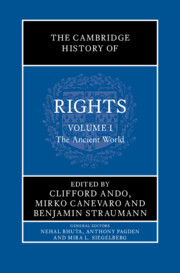
Book contents
- the cambridge history of Rights
- The Cambridge History of Rights
- The Cambridge History of Rights
- Copyright page
- Contents
- Contributors to Volume I
- General Introduction
- Introduction to Volume I
- 1 To Claim to Protect Claims
- 2 The Individual and the Communal
- 3 Human Rights in the Hebrew Bible?
- 4 Greek Subjective Rights?
- 5 Aristotle on Subjective Rights
- 6 Do Rights Exist in Hellenistic Philosophy?
- 7 Rights in Ptolemaic Egypt
- 8 Rights in Roman Republican Thought
- 9 Ius in the Subjective Sense in Classical Roman Law
- 10 Rights and Dignity in Late Ancient Thought
- 11 Rights in Late Ancient Law?
- 12 Rabbinic Judaism
- 13 Sasanian Law
- Index
- References
2 - The Individual and the Communal
Early Confucian Resources for Human Rights
Published online by Cambridge University Press: 31 January 2026
By

Book contents
- the cambridge history of Rights
- The Cambridge History of Rights
- The Cambridge History of Rights
- Copyright page
- Contents
- Contributors to Volume I
- General Introduction
- Introduction to Volume I
- 1 To Claim to Protect Claims
- 2 The Individual and the Communal
- 3 Human Rights in the Hebrew Bible?
- 4 Greek Subjective Rights?
- 5 Aristotle on Subjective Rights
- 6 Do Rights Exist in Hellenistic Philosophy?
- 7 Rights in Ptolemaic Egypt
- 8 Rights in Roman Republican Thought
- 9 Ius in the Subjective Sense in Classical Roman Law
- 10 Rights and Dignity in Late Ancient Thought
- 11 Rights in Late Ancient Law?
- 12 Rabbinic Judaism
- 13 Sasanian Law
- Index
- References
Summary
Stephen Angle and Marina Svensson assert that prior to the mid-nineteenth century, there was not a Chinese word that translates the concept of “rights.” They hold that even though the classical and postclassical Chinese talked about “privileges and powers,” they didn’t have ideas of rights that correspond to the modern Western senses: namely, those that correspond to duties, protect the individual person, or provide “antimajoritarian trumps on the general interest.” Even though rights talk was also relatively new to the West then, Angle and Svensson claim that rights were founded on the historical Western understanding of persons as autonomous individuals. In contrast, they hold that the Chinese view persons as always already bound up in roles and relationships which, instead of developing into rights that correlate with duties as in the West, remains as talk about “reciprocal responsibilities” in their theorizing about ethics and politics.
Keywords
Information
- Type
- Chapter
- Information
- The Cambridge History of Rights , pp. 48 - 70Publisher: Cambridge University PressPrint publication year: 2025
References
Further Reading
Angle, S. C., and Svensson, M. (eds.), The Chinese Human Rights Reader: Documents and Commentary 1900–2000 (New York, M. E. Sharpe, 2001).Google Scholar
Angle, S. C., and Svensson, M. Human Rights and Chinese Thought: A Cross-Cultural Inquiry (Cambridge, Cambridge University Press, 2002).CrossRefGoogle Scholar
Bell, D. A. (ed.), Confucian Political Ethics (Princeton, NJ, Princeton University Press, 2008).Google Scholar
de Bary, W. T., Asian Values and Human Rights: A Confucian Communitarian Perspective (Cambridge, MA, Harvard University Press, 1998).Google Scholar
de Bary, W. T., and Weiming, T. (eds.), Confucianism and Human Rights (New York, Columbia University Press, 1998).Google Scholar
Freeman, M., “Human Rights, Democracy and ‘Asian Values,’” Pacific Review 9/3 (1996), 352–66.CrossRefGoogle Scholar
Ghai, Y., “Human Rights and Governance: The Asia Debate,” Australian Year Book of International Law 15 (1994), 1–34.CrossRefGoogle Scholar
Kwong-Loi, Shun, and Wong, D. B. (eds.), A Comparative Study of Self, Autonomy, and Community (Cambridge, Cambridge University Press, 2004).Google Scholar
Sim, M., “A Confucian Approach to Human Rights,” History of Philosophy Quarterly 21/4 (2004), 337–56.Google Scholar
Sim, M., “Rethinking Virtue Ethics and Social Justice with Aristotle and Confucius,” Asian Philosophy 20/2 (2010), 195–213.CrossRefGoogle Scholar
Sim, M., “Rival Confucian Rights: Left or Right Confucianism?” International Philosophical Quarterly 51/1 (2011), 5–22.CrossRefGoogle Scholar
Sim, M., “Confucian Values and Resources for Human Rights,” in LeBar, M. (ed.), Justice (Oxford, Oxford University Press, 2018), pp. 237–60.Google Scholar
Sim, M., “Justifying Human Rights in Confucianism,” in McLeod, A. (ed.), The Bloomsbury Research Handbook of Early Chinese Ethics and Political Philosophy (London, Bloomsbury Academic, 2019), pp. 267–85.Google Scholar
Sim, M., “Confucianism and Transgenerational Grounds for Justice,” The Monist 106/2 (2023), 181–93.CrossRefGoogle Scholar
Sim, M., “Confucian Resources for Human Rights,” in Tomalty, J. and Woods, K. (eds.) Routledge Handbook of Philosophy of Human Rights (2025).Google Scholar
Accessibility standard: Inaccessible, or known limited accessibility
Why this information is here
This section outlines the accessibility features of this content - including support for screen readers, full keyboard navigation and high-contrast display options. This may not be relevant for you.Accessibility Information
The HTML of this chapter is known to have missing or limited accessibility features.
We may be reviewing its accessibility for future improvement, but final compliance is
not yet assured and may be subject to legal exceptions. If you have any questions,
please contact
accessibility@cambridge.org.
Content Navigation
Table of contents navigation
Allows you to navigate directly to chapters, sections, or non‐text items through a linked table of contents, reducing the need for extensive scrolling.
Allows you to navigate directly to chapters, sections, or non‐text items through a linked table of contents, reducing the need for extensive scrolling.
Index navigation
Provides an interactive index, letting you go straight to where a term or subject appears in the text without manual searching.
Provides an interactive index, letting you go straight to where a term or subject appears in the text without manual searching.
Reading Order & Textual Equivalents
Single logical reading order
You will encounter all content (including footnotes, captions, etc.) in a clear, sequential flow, making it easier to follow with assistive tools like screen readers.
You will encounter all content (including footnotes, captions, etc.) in a clear, sequential flow, making it easier to follow with assistive tools like screen readers.
Structural and Technical Features
ARIA roles provided
You gain clarity from ARIA (Accessible Rich Internet Applications) roles and attributes, as they help assistive technologies interpret how each part of the content functions.
You gain clarity from ARIA (Accessible Rich Internet Applications) roles and attributes, as they help assistive technologies interpret how each part of the content functions.