For Luke Tyler & Juliette Lynda
نورين عيوني انتو
1 Introduction and Methodology
1.1 Christian Writing in Arabic and the Question of Language
There is evidence for a distinctively Christian writing tradition in Arabic already in the pre-Islamic tradition in the form of inscriptions, ranging from Najran in SW Arabia, to Dumat al-Jandal in NW Arabia, all the way to Zabad in northern Syria, and this epigraphic evidence extends now into the early Islamic period as well.Footnote 1 Pre- and early Islamic Christian inscriptions in Arabic are frequently adorned with crosses, and are characterized by a unique form of the word for “God,” in Arabic al-ʾilāh, literally “the God,” perhaps a calque of the Greek ho theos or the Syriac alāhā. Thus, it seems possible, at least, that there existed a Christian Arabic writing tradition in parts of the pre-Islamic Levant and Arabia that continued to some degree into the early Islamic period.Footnote 2
In the early Islamic period, Christians, especially the Arabized Orthodox Christians who remained in formal communion with the Church of Constantinople (traditionally called “Melkites”), adopted Arabic as a literary and theological language early, and we have manuscripts as early as the eighth century ce.Footnote 3 Especially prominent in this regard were the monasteries of Palestine – Mar Chariton and Mar Saba especially – as well as St. Catherine’s of Sinai. Among the earliest datable manuscripts are theological treatises devoted to addressing both internal divisions among Christians of different confessional backgrounds who were now a part of the same social and political entity, namely the caliphate, as well as addressing challenges to the Christian faith posed by Islamic hegemony.Footnote 4 What is likely the oldest Christian manuscript, and indeed one of the oldest non-Quranic manuscripts in Arabic regardless of confession, is Sinai Arabic MS 154 (henceforth SAr. 154), the first part of which contains a translation of parts of the New Testament, but the last forty pages of which contain a theological treatise – dubbed Fı̄ taṯlı̄ṯ Allāh al-wāḥid by its western discoverer, Margaret Dunlop Gibson – offering an elaboration of the (Orthodox) Christian faith, engaging with and quoting from the Quran at various points.Footnote 5 Other early examples included treatises such as al-Ǧāmiʿ Wuǧūh al-ʾĪmān, “All the Tenets of the Faith,” often referred to as Summa Theologiae Arabica by scholars of early Arab Christianity, preserved in two manuscripts: British Library Or. 4950 (henceforth BL 4950; 866 or 877 ce) and St. Andrews 14 (ninth century ce).Footnote 6 The manuscript BL 4950 also contains a treatise concerning the veneration of icons, written by the ninth-century ce bishop of Harran (Syria), Theodore Abu Qurra, who is one of the first known theologians who composed original works in Arabic.
Christians are especially well known for their efforts to translate Greek and Syriac texts into Arabic during the early Islamic period. Most familiar in this regard are Christian scholars such as Yahya ibn al-Adi and Hunayn ibn Ishaaq, who were both a part of the so-called Graeco-Arabic translation movement that produced translations of classical works of philosophy, mathematics, and medicine, among other genres, into Arabic under Abbasid patronage.Footnote 7 However, translation of Greek and Syriac communal literature, especially hagiographies and the works of the Patristic Fathers, began in earnest by at least the eighth century ce.Footnote 8 Ultimately, though, the most abundant type of translation was undoubtedly the Bible.Footnote 9 While the earliest written biblical translations into Arabic occur in the context of apologetic and theological texts,Footnote 10 by the ninth century ce almost two dozen translations of various portions of the Bible are attested in manuscripts, and many of these likely represent copies of earlier manuscripts, produced as early as the eighth century ce.Footnote 11 Our earliest dated biblical manuscript is Sinai Arabic MS 72 (henceforth SAr. 72), copied in 897 ce at the Palestinian monastery Mar Chariton by Stephen of Ramla, who also copied BL 4950.Footnote 12 Indeed, the Gospels are by far the most well-attested portions of the Bible among the two dozen ninth-/tenth-century ce manuscripts currently known.Footnote 13 Other witnesses to the translation attested in SAr. 72 include SAr. 74 and Vatican Borg. Arabic MS 95, both of which are likely datable to either the ninth or tenth ce.Footnote 14 The manuscript witnesses to this early Gospel translation were active in the Melkite monasteries of Palestine, where translations were primarily made from Greek. However, other early translations outside of the Palestinian monasteries, and from languages other than Greek, are attested. Indeed, one of the earliest biblical translations – of the Acts of the Apostles by Bishr ibn al-Sirri and preserved in the manuscript SAr. 151 – was translated from Syriac in Damascus, though it remained used among Melkites for several centuries.Footnote 15 Another early translation, also of parts of the New Testament, is witnessed in Vatican Arabic MS 13. While opinions vary significantly, the manuscript likely dates to the late ninth/early tenth ce, though the Vorlage(n) underlying the translation, and especially its provenance, is debated.Footnote 16
The vast literature body of early Christian literature in Arabic,Footnote 17 of which the foregoing was only a small portion, has seen a surge of interest and study in recent decades from a variety of methodological perspectives, including especially the history and development of Christian theology,Footnote 18 inter-confessional relationships,Footnote 19 and Christian–Muslim interactions,Footnote 20 as well as the textual history of the Bible and philosophies of translation.Footnote 21 Across virtually all of the secondary literature and spanning the various methodological approaches to the study of Christian literature in Arabic, one finds references to “Christian Arabic” as a linguistic phenomenon. Despite the ubiquity of this term (and its synonymsFootnote 22), the last sustained linguistic treatment of the early Christian corpus in Arabic, that of Joshua Blau, is over six decades old and is outdated in a number of respects, not least of which is a lack of access to manuscripts, some of which were indeed unknown at the time. Blau’s grammar is also, as we will see throughout this Element, outdated in both its historical paradigm and data. Nevertheless, its framework and approach are still regnant, and the analysis found in many treatments of Christian Arabic corpora consist of little more than a handful of examples and citations of Blau.
While a renewed focus on the language of the early Christian corpora in Arabic would be warranted even if only to update Blau’s grammar by taking newly digitized, as well as since discovered manuscripts into account, there are other considerations that make a linguistic analysis of these texts especially timely and important. First, recent decades have seen a revolution in the interpretation and analysis of the linguistic situation in the pre- and early Islamic periods, and it is clear that Arabic was more diverse, and less like Classical Arabic, than heretofore assumed. Since the Arabic used by Christians has always been approached through the lens of Classical Arabic, a new linguistic analysis that incorporates the data and insights from the latest research is itself warranted. Second, however, is the fact that, along with the papyrological and Quranic manuscript corpora, Christian Arabic manuscripts represent our earliest long-form manuscripts and thus constitute invaluable witnesses to the nature and linguistic makeup of Arabic in the early Islamic period. Indeed, while Christian scribes and the language they produced have, when differing from purported norms of Classical Arabic, often been treated as deviant of some standard practice, whether through carelessness, incompetence, or, at best, disinterest,Footnote 23 I will argue that Christian Arabic belongs squarely within the scribal and linguistic practices of the early Islamic period. But before proceeding, a brief word about the communis opinio is in order.
With a few exceptions (as we will encounter later), most scholars of Christian Arabic literature and theology have adopted, mostly by default, the position that insofar as the grammar attested in Christian Arabic manuscripts differs from a textbook version of Classical Arabic, it reflects either pseudo-corrections, which are mistakes that “result from speakers’ and writers’ desire to speak and to write a more prestigious variety and to avoid stigmatized forms,”Footnote 24 or rather reflects a colloquial intrusion. In the latter case, speakers unintentionally replicate a vernacular, often implicitly (in this paradigm) stigmatized form, rather than the prestigious, Classical one. Ultimately, this position reflects a simplified version of the one adopted initially by Blau in his grammar of what he called “Ancient South Palestinian,” though his position was actually a bit more nuanced and evolved over time.
Characterizing Blau’s views of Ancient South Palestinian is difficult. On the one hand, he clearly believed that non-Classical features attested therein sometimes reflected living developments in the language. These developments, he believed, were part of a more general trend in what is known as “Middle Arabic,” which at the time he believed to represent a historical phase – a transition from Old to Neo Arabic – akin to Middle English or Middle German. Thus, Blau assumed that many of the differences from Classical in the Christian texts do reflect historically (from the perspective of Arabic’s linguistic history) middle features.Footnote 25 At the same time, Blau assumed throughout that the primary linguistic target at which a scribe would aim would be Classical Arabic, and specifically a Classical Arabic that I refer to as “textbook,” insofar as it reflects preferences and prescriptions that only become set and normative centuries after the production of the Christian manuscripts.Footnote 26 Implicitly, then, living features were identified when they were both non-textbook Classical ones, and either likewise attested in a modern dialect, or otherwise could be posited to Aramaic influence.Footnote 27
Over time, however, scholars moved away from a historical definition of Middle Arabic to a sociolinguistic one, in which the term “middle” was framed in relationship to a spectrum, with the prestigious/high end reflecting Classical Arabic, and the more stigmatized/low end of the spectrum reflecting the vernacular. The interaction of the various points along that spectrum, which included the creation of new features and styles, was a phenomenon that has presumably always existed; the field of Middle Arabic studies has shifted, therefore, to a study of the dynamics and patterns of those interactions as attested in written texts.Footnote 28
The paradigm shift in the definition of, and approach to, Middle Arabic texts led to challenges to the existence of a distinctly “Christian Arabic” in the language of early Christian Arabic texts in the same way that, say, modern dialects of the Christians of Baghdad distinguish them from non-Christians.Footnote 29 Most notably, Samir K. Samir, interpreting Blau’s grammar as an attempt to reconstruct a distinct communal dialect, peculiar to Christians, critiqued the category, arguing that Christian Arabic was no different than any other kind of Middle Arabic attested in texts written by Jews or Muslims. At best, he concluded, we could speak only of a literary sub-variety of Middle Arabic for Christians, not a separate variety.Footnote 30 Blau responded to what he perceived were Samir’s misinterpretations of his position, clarifying that, for him, Ancient South Palestinian was indeed a purely literary register, indeed one he considered a Melkite lingua franca, due to its use in manuscripts not only from Palestine, but also in Transjordan.Footnote 31 More recently, Johannes den Heijer has further problematized the notion of a distinct, communal register or variety at all, noting that many features, including lexical borrowings that Blau continued to argue constitute evidence for a distinctly Christian literary register, are not so straightforward as is often portrayed.Footnote 32
Despite the disagreements, only briefly reviewed heretofore, there is a general point over which there has so far been virtually unanimous agreement, namely that, whether or not the variety (or varieties) of Arabic reflected in the Christian texts were peculiar to Christians in any sense, all scholars have agreed that they reflect Middle Arabic, whether meant a historical linguistic phase or sociolinguistically situated between H (Classical Arabic) and L (vernacular) forms. Both approaches, however, have issues. For example, in the current regnant sociolinguistic paradigm of Middle Arabic studies, the category of Middle Arabic is linguistically negatively defined. As one scholar has accurately summarized, the term Middle Arabic as used now “encompasses all the attested written layers of the language which can be defined as entirely neither to Classical Arabic nor to colloquial Arabic.”Footnote 33 Thus, defining something as Middle Arabic only tells us that it is neither Classical Arabic nor purely reflective of the vernacular. But how do we know what the vernaculars of the time looked like? That is, when identifying non-Classical features, or non-Classical distributions of a feature, how do we determine whether it reflected a living one or merely a pseudo-correction? On the other end of the spectrum, how do we define Classical Arabic? Scholars typically treat this as a relatively straightforward question to answer, but it is not.Footnote 34 What we call Classical Arabic was in fact a diverse set of features that, at least in the discussions of the early Arabic grammarians, were equally valid (though not necessarily always equally as frequently used) as the others.Footnote 35 And finally, how do we know that layers of the language that in fact were neither vernacular nor Classical were regarded by the writer and their audience as sociolinguistically less prestigious than features that eventually become part of standard Arabic? Or, to come at the point another way, we must ask what kind of Arabic a writer intended to compose.
The answers to these questions greatly depend on how we conceptualize the linguistic and sociolinguistic milieus of the early Islamic period. As we have already seen, traditionally scholars assumed that Arabic of the pre-Islamic period, though somewhat internally diverse, largely reflected the kind of variation typical of the corpus of the qaṣı̄dah poetry.Footnote 36 It was only with the spread of Arabic at the advent of Islam that certain fundamental changes to the language, including especially the rapid decline and loss of nominal case and verbal mood, led to structural changes that distinguish Islamic-era Arabic from pre-Islamic Arabic. Crucially, Classical Arabic was construed as both the natural target of any composition from the beginning of the Islamic period, and, despite the tacit acknowledgment of the diversity of Classical Arabic, only norms that developed much later were considered prestigious and normative when analyzing the language of the inscriptions, papyri, and Christian and Judaeo-Arabic compositions.Footnote 37
Recent discoveries, refinements in methodological approach to existing corpora, and the incorporation of advancements in the study of the Semitic language family have led in recent years to a drastic change in our knowledge of pre-Islamic Arabic, as well as our interpretation of early Islamic Arabic corpora. First, our knowledge of pre-Islamic Arabic has been greatly expanded due to the identification of the Safaitic and Hismaic inscriptions as linguistically Arabic, along with the discovery and publication of Nabataean, Nabataeo-Arabic, and early Arabic script inscriptions.Footnote 38 Linguistic analysis of these varieties has revealed many substantial linguistic differences between the Arabic varieties attested therein and that attested in the qaṣı̄dah poetic corpus, and what eventually becomes textbook Classical Arabic, including reduced case and verbal mood systems in some, and complete loss of those features in others (see further Section 2).
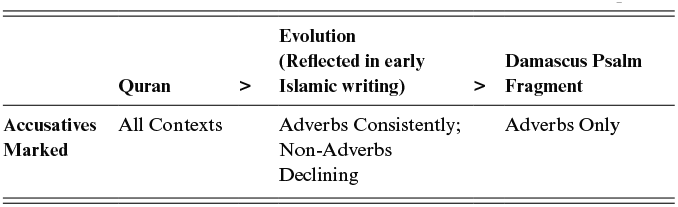
This evolved picture of pre-Islamic Arabic led to a reanalysis of the evidence from the Hijaz, including the language of the Quran as reflected in the bare consonantal skeleton (Arabic rasm), which likely reflects a local spectrum of dialects with reduced nominal case and verbal mood distinctions, among other differences from the subsequently normed Classical tradition.Footnote 39 Preliminary reevaluations of corpora such as the early inscriptions, early Islamic papyri, and the Christian text known as the Damascus Psalm Fragment suggest that these corpora reflect the spread, and continued evolution, of these Hijazi dialects.Footnote 40 While it is at times difficult to distinguish due to the ambiguities inherent in the early Arabic script, there are clear differences between the early papyri, as well as early inscriptions, not to mention the early Christian Arabic corpora, and Classical Arabic in areas of grammar most saliently associated with Classical Arabic, namely nominal case and verbal mood.Footnote 41 The Damascus Psalm Fragment is especially illuminating, since the Arabic is transliterated in Greek, attesting a dialect with Hijazi features (such as the demonstrative and relative series, etc.), but in which only the accusative is retained, and there only in adverbial contexts.Footnote 42 Based on the cumulative evidence, and incorporating other early Arabic transliterations in Greek, Al-Jallad has convincingly argued that the prestige varieties, which spread into the Levant and became the basis for the writing traditions reflected in the papyri and early manuscripts, were related to these Hijazi dialects, rather than reflecting the archaic register(s) associated with the qaṣı̄dah poetry.Footnote 43 Importantly, the writing traditions reflected in early inscriptions, papyri, and the Damascus Psalm Fragment reflect to varying degrees the continued linguistic evolution of these dialects as spoken varieties. This is not to say that, depending on scribe and context and genre, some were not more archaic than others; rather, it is to suggest that the evidence indicates an openness to integrate innovative, even spoken forms alongside older ones, again depending on author, place, context, and training.
Since the notion of textbook Classical Arabic as a meaningful point of comparison was implicitly critiqued earlier, it is worth considering what Classical Arabic was in the eighth–tenth centuries ce, how it differed from the Hijazi dialects underlying the early Islamic writing traditions, and whether it can be shown to have been relevant to the monastic authors of the early Christian Arabic corpus. First, it should be understood that what I call textbook Classical Arabic here is the result of a long process of selection of a subset of features that are described by the early Arabic grammarians, especially Sibawayh (d. 796 ce/180 ah) and Al-Farra (d. 822 ce/207 ah), who were active in southern Iraq in the eighth/early ninth centuries ce. Both of these scholars documented a tremendous amount of linguistic variation from trusted sources, which included the poetic corpus but also – indeed, especially – input from trusted sources. Contrary to common belief, these scholars did not set out to prescribe a set of norms; the variation they describe was all permitted as what they referred to variously as al-ʿArabiyyah (henceforth ʿArabiyyah) or kalām al-ʿarab.Footnote 44 While Sibawayh, for example, held the belief that all surface realizations of Arabic forms he gathered could be explained by appealing to a single origin (Arabic ʾaṣl), there is no set of features that from the methodological approach of modern historical linguistics would serve to distinguish features considered ʿArabiyyah from other forms of Arabic not considered or included in the grammarians’ corpus of ʿArabiyyah. What does, however, seem clear is that the grammarians allowed tremendous variation, but assumed the presence of archaic nominal case and verbal mood, which was a sine qua non of the qaṣı̄dah poetic corpus, and by which all subsequently canonized reading traditions of the Quran (Arabic qirā ʾāt) recited the Quran. Indeed, what eventually became normative in Classical Arabic seems to reflect the imposition of the case and mood systems on an archaic kind of Hijazi Arabic.Footnote 45 For our purposes, though, what is important is that the grammatical activity contemporary with the composition of the early Christian corpus was tremendously linguistically variegated, distinguished most saliently by archaic nominal case and verbal mood inflection, and there is further little reason a priori to assume that the intellectual tradition that formed the grammatical tradition was considered equally prestigious in chanceries (in which the early Islamic papyri would largely have been composed) or the monasteries in which early Christian texts were produced. Indeed, we can posit more plausibly the opposite: The most relevant linguistic context for Christian monastic authors was the early Islamic Hijaz and Levant, not southern Iraq. Any evidence for the influence of the ʿArabiyyah tradition must be demonstrated based on close analysis of the language of the text, rather than imposed from the outset.Footnote 46 We will consider possible pieces of evidence for nascent influence thereof in Sections 2–4.
In light of the foregoing, it is past time for a re-evaluation of both the linguistic nature of the corpus of early Christian texts produced in the monasteries of Palestine, southern Syria, and the Sinai, as well as a recontextualization of the monastic scribal writing culture that produced them. Preliminary studies of several features studied further in this Element have emphasized coherence in the occurrence and distribution of non-ʿArabiyyah nominal case and verbal mood inflection.Footnote 47 This Element will expand upon them, and include another feature – gender and number agreement – from both translations of the Gospels and early original compositions, contextualizing the data from both types of text with other early corpora, including early Islamic papyri and inscriptions, as well as the Quranic Consonantal Text, the reading traditions, and the ʿArabiyyah tradition. The primary linguistic argument of this Element is that the linguistic profile of the early Christian corpus suggests that the target was not Classical Arabic, as has typically been assumed, nor any kind of sub-standard register that was sociolinguistically less prestigious than Classical Arabic.Footnote 48 Instead, Christians made use of relatively archaic and innovative features, depending on the genre. Specifically, I will argue that the theological treatises reflect a relatively more archaic Hijazi Arabic, likely due to its prestige and continued association with the Quran, whereas Gospel translations were intentionally translated with a more vernacularized Arabic. In fact, I contend that this scenario not only accounts for the linguistic data and better fits the broader linguistic milieu better than the traditional paradigm, it also better accords with the scribal and intellectual context of the Christian monasteries of late antiquity and early Islam.
The monasteries of Palestine, especially Mar Chariton and Mar Sabas, were centers of textual production already in late antiquity. These monasteries were inhabited by an ethnically (and linguistically) diverse population of monks who championed the “royal,” that is, Chalcedonian faith as articulated at the Council of Chalcedon (451 ce) and propagated by the Byzantine emperor (hence the moniker “Melkite,” from Aramaic malkā “king”).Footnote 49 The monks who authored various genres of theological and liturgical works in these monasteries wrote primarily in Greek, the primary ecclesiastical language in Palestine, but over time, they also developed a method for writing the local Aramaic vernacular, for which they adapted Syriac letters (and a few Greek letters to represent certain sounds not part of Syriac orthography, such as Greek pi to write /p/).Footnote 50 There are three kinds of evidence for this local Christian variety of Aramaic, which is typically referred to now as Christian Palestinian Aramaic (henceforth CPA), though is still occasionally referred to variously as Palestinian Syriac or Melkite Aramaic: 1) epigraphic inscriptions, 2) early underwritten literary material in palimpsest, and 3) late literary material, most of which dates to the tenth–thirteenth centuries ce.Footnote 51
There are many difficulties involved in interpreting the early material, especially the underwritten literary material, and the field suffers from the lack of reliable editions of many texts; however, for our purposes, the important point is that the Palestinian monks wrote theological and texts of broader theological and liturgical significance in Greek, but developed a means for writing the local vernacular, especially for biblical translations and other liturgical texts for local, lay usage, and did so by adopting a regionally prestigious script and writing tradition and adapting it to local purposes.Footnote 52 This newly created writing tradition, though most probably created in the monasteries for the benefit of local lay communities, became associated with the expression of a local Christian identity across Palestine and beyond.Footnote 53
With the arrival of Muslim rule in the seventh century ce, the Arabicization of the local population – well underway by the eighth century ceFootnote 54 – as well as the shift in focus in the monasteries away from issues in the Byzantine empire and increasingly to ones defined by Christianity under Islam,Footnote 55 we must recognize another shift that impacts how we read early Christian literature: a shift in literary culture, from that of late antiquity, in which Greek was used to write genres associated with theology and ecclesiastical leadership on the one hand, and Christian Palestinian Aramaic used to write a local vernacular for lay purposes, to one in which both categories of literature would naturally be written in the same language, namely Arabic. Despite the demographic changes that occurred over time, from a more cosmopolitan makeup in late antiquity to a (possibly) more local one in the Islamic period,Footnote 56 there is nevertheless a long and local institutional history of adapting supra-regional writing traditions to the needs of the community. As already noted, I will argue in Sections 2–4 that the data suggest that theological treatises reflect a relatively less vernacular, more archaic Arabic, likely in imitation of Quranic language, whereas the Gospel manuscripts – with liturgical divisions that suggest they were produced for local usage, whether lay or monastic (or both) – reflect a more parochial, vernacular style. It is my contention that this difference was intentional, and reflects a continuation of the flexibility and adaptiveness that had long characterized the monasteries of Palestine. Instead of two languages – Greek and CPA – for the different genres, there were now different varieties of one language, Arabic, written via the conventions of the early Islamic Arabic writing tradition.
Ultimately, we will see that, grammatically at least, there are significant differences in the realizations of the features examined between the manuscripts of the corpus, which argues against the notion of a lingua franca. At the same time, the linguistic variation attested in the Christian manuscripts fits well synchronically with the other attested corpora, especially contemporary papyri and inscriptions. I argue that the current formulation of Middle Arabic is largely inapplicable to the language of these texts; there is little evidence that we should think of these varieties as being perceived as sociolinguistically inferior to any other register, at least by the communities that produced and consumed them. Whether theological treatise or biblical translation, language which in the mind of the author was appropriate to each was used. I do, however, appeal to the older definition of Middle Arabic, namely as a historical phase, which here is made with reference to attested corpora, modern dialects, and a reconstructed Proto-Arabic, which of course is not assumed to be Classical Arabic, since, as already discussed, there was no such single variety, and the each of the variants attested in the ʿArabiyyah tradition themselves are historically middle relative to Proto-Arabic (with a few exceptions; see, e.g., Sections 2 and 3). In so arguing, I propose to more fully integrate the writing culture(s) reflected in the Christian manuscripts into the wider landscape of early Islam, and, equally as important, to restore agency to the monastic authors by highlighting their creativity and competency at composing Arabic.Footnote 57
Before beginning our study, I will first review the corpus included, the features to be studied, and provide an overview of the methodological approach for the quantification and study of these features.
1.2 Manuscripts
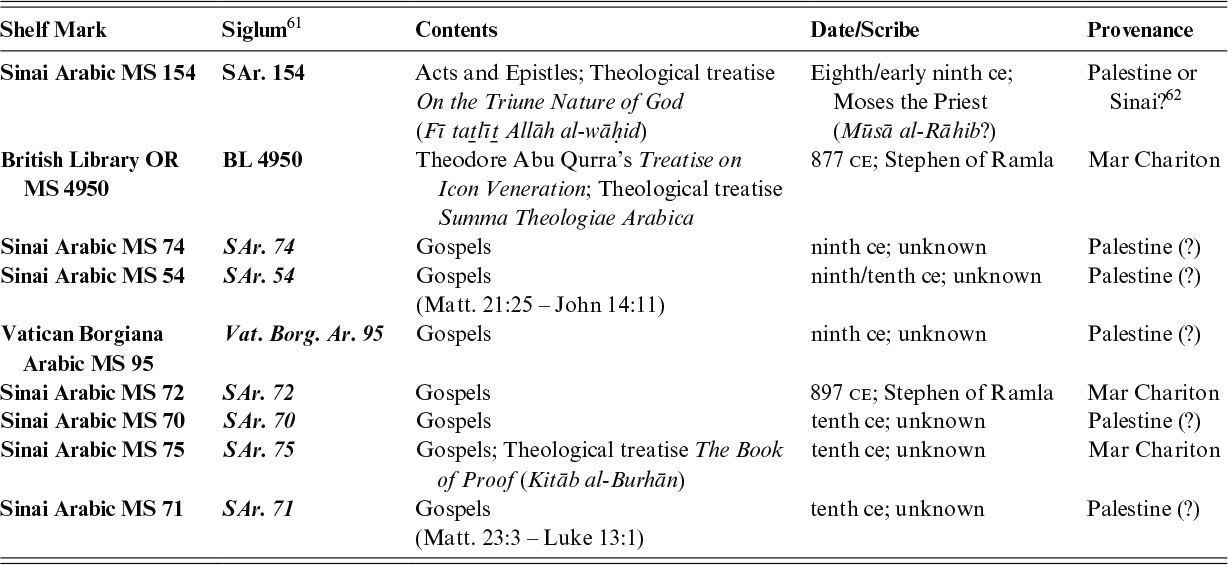
In his grammar, Blau included a list of several dozen manuscripts from which he drew, and many more could be added to a list of early Christian manuscripts in Arabic.Footnote 58 Thankfully, many (though not all) Christian Arabic manuscripts have been, or are in the process of being, digitized and made freely available to the public.Footnote 59 However, one of the main contentions of this Element is that, in order to get a fine-grained and, ultimately, accurate picture of the nature of the language in a manuscript or corpus, quantitative analysis is required. Such quantitative analysis is, however, quite time-consuming in the absence of reliable software to tag and transcribe large data sets. For that reason, I have chosen a representative sample of early Christian Arabic manuscripts to serve as a micro-corpus. In order to interrogate many of the assumptions about the nature of the Arabic in the Christian corpus detailed earlier, I have chosen to include two original compositions – the early theological treatises referred to as Summa Theologiae Arabica, witnessed in BL 4950 and St. Andrews 14, as well as On the Triune Nature of God, found in SAr. 154 – along with portions of seven translations of the Gospels. The primary reasons for choosing this collection of manuscripts are, first, that they are among the earliest manuscripts that are sufficiently long so as to afford a large number of tokens for each linguistic feature, and second, that they are all the products of the same Palestinian/southern Syrian monastic milieu. Additionally, they are each digitally available.Footnote 60 A full list of the manuscripts can be found in Table 1.
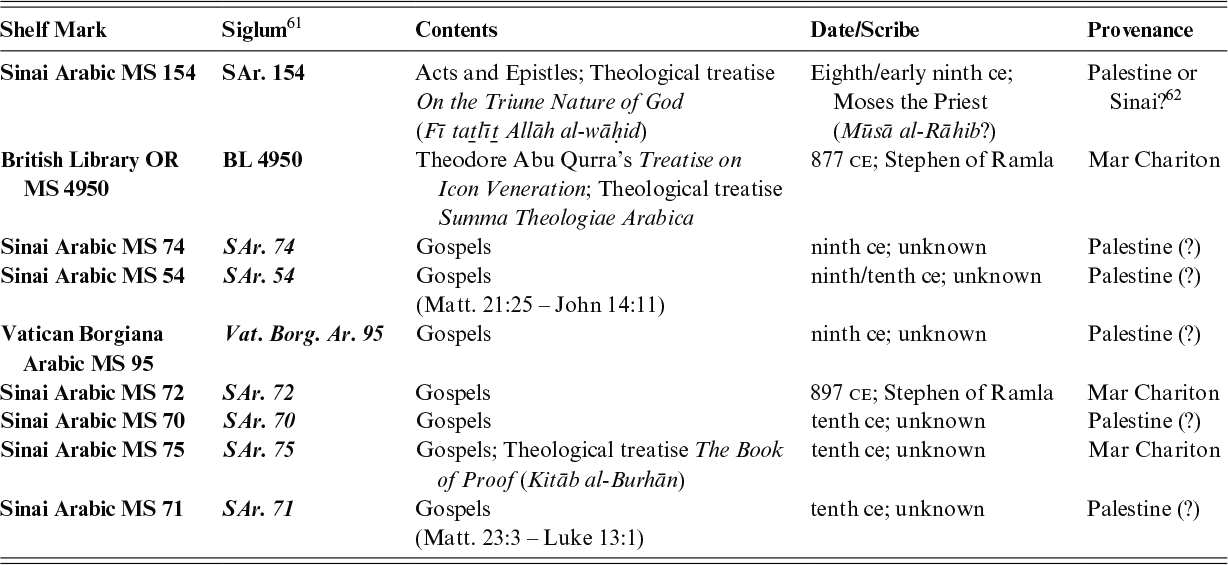
Table 1 Long description
Table catalogs Arabic Christian manuscripts using five columns: shelf mark, siglum, contents, date or scribe, and provenance. Entries include manuscripts from the Sinai collection, the British Library, and the Vatican. The contents consist primarily of Gospels, theological treatises, epistles, and devotional works. Most manuscripts date from the eighth to tenth centuries CE, with some attributed to the scribe Stephen of Ramla. Provenance is mainly identified as Palestine, Mar Chariton, or uncertain, enabling comparison of manuscript origins, chronology, and textual contents.
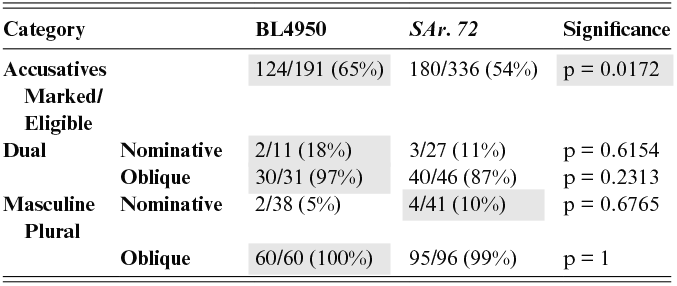
The Gospel manuscripts represent witnesses to three different translation families, which correspond to Hikmet Kashouh’s Family A (SAr. 74, 54, 72, 71, and Vat. Borg. Ar. 95), C (SAr. 75),Footnote 63 and D (SAr. 70).Footnote 64 Other than SAr. 72, which based on the colophon was copied in 897 ce by Stephen of Ramla (who also produced BL 4950, and possibly also St. Andrews 14), the other Gospel manuscripts can only be dated via paleography.Footnote 65 In general, it seems that, of the Gospel manuscripts, SAr. 75, 70, and 71 are slightly later than SAr. 74, 54, Vat. Borg. Ar. 95, and SAr. 72, though this is based on linguistic considerations to be discussed in the following sections of the Element. Finally, while the authorship of the Summa Theologiae Arabica is debated, several scholars, including Joshua Blau and Sidney Griffith,Footnote 66 have put forward compelling arguments for Stephen of Ramla’s authorship. Regardless of whether or not he was the author, it is clear that scribes exercised significant freedom to adjust the grammar of the texts they copied to their own grammatical sensibilities, and so I will rely on a comparison of SAr. 72 and BL 4950 as a proxy for genre-related differences (along with comparisons between the Gospel MSS and the theological treatise called here On the Triune Nature of God, attested in SAr. 154).Footnote 67
1.3 Features, Methodology, and Limitations
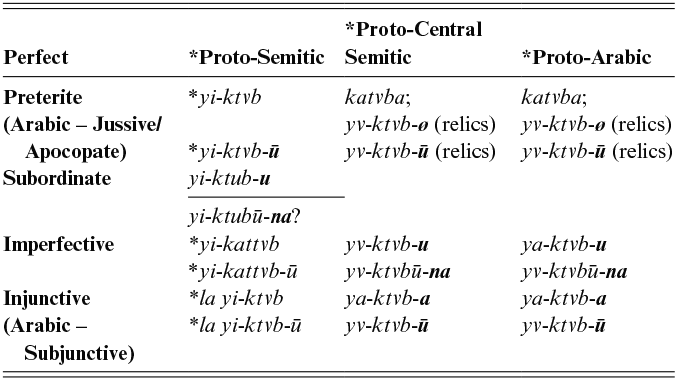
A full grammatical description with quantitative analysis is far beyond the scope of this Element (indeed, of a single monograph of whatever length). The focus in what follows will be on three features: nominal case (Section 2), verbal mood (Section 3), and gender and number agreement (Section 4). These features were chosen because, more than any others, their non-Classical distributions in the Christian manuscripts (and other Middle Arabic corpora) have traditionally served as the central evidence for the rupture between pre-Islamic Arabic on the one hand, and Islamic Arabic – medieval and modern – on the other. Indeed, scholars have almost ubiquitously seen these features as having been completely lost already by the time of the composition of these manuscripts, and non-Classical occurrences in each category have been universally interpreted as pseudo-corrections. As I will show, it is in categories such as these that quantitative analysis, combined with insights from the pre- and early Islamic corpora, is most revelatory of patterns that have heretofore gone undetected. Further, I situate the diachronic analysis of these features in relationship to Proto-Arabic based on comparative Semitic evidence, and by combining all potentially relevant Arabic data into the analysis, rather than relying merely on textbook Classical Arabic as the historical point of departure.
It is worth noting briefly here what this study is and what it is not. This study aims to investigate the distribution of certain morpho-syntactic features – nominal case, verbal mood, and gender/number agreement – and will argue that, for each, the distribution can be meaningfully explained within the broader milieux of early Islamic period Arabic corpora and connected with the development of Arabic, from the Proto-Arabic period to the present. Further, I argue that differences between the theological treatises on the one hand, and the Gospel MSS on the other, point to register differences that reflect a continuation of the pre-Islamic monastic writing culture reviewed earlier. This study is not an attempt at a full grammatical treatment of any particular MS included herein, and, crucially, is not an attempt to sketch the grammar of any of the Arabic Gospel families listed earlier. Such a task is a desideratum but would require establishing a stemma of the MSS for each family, and therefore remains beyond the scope of the present work. Thus, while at a few points in this Element I speculate about possible reasons for differences between individual MSS within a family, it should be born in mind that, without such a full documentation of the variation within each Arabic Gospel family, these remain tentative. Finally, while I adduce evidence for register differences between Gospel MSS on the one hand and theological treatises on the other, the relatively small number of MSS, and the still uncertain question of the authorship of the Summa Theologiae Arabica, render the findings here preliminary until the full range of texts of each genre can be studied and integrated into the conversation.
For each manuscript included, I manually counted and collected all relevant features from approximately the first 25% of the folia from each manuscript, with the exception of SAr. 70, of which only approximately 10% of the manuscript was included in this study. For each feature, the relevant examples were collected, entered into a spreadsheet, and each relevant aspect of the form tagged. In what follows, the data will be presented and discussed. In some cases, statistical analyses, especially Chi-Squared and Fisher’s Exact tests were used to establish statistical significance. Chi-Squared and Fisher’s Exact tests are both statistical tests that test categorical data to determine whether the patterns are due to chance or association between the categories and variables. Both tests function similarly, but chi-squared are typically used for larger data sets (where the counts in each cell of a 2x2 table are all >5), whereas Fisher’s Exact is, as the name suggests, more precise, but also typically used for small data sets (<5). In what follows, anytime the count in a cell is less than five, I use a Chi-Squared test; when they are all greater, I use a Fisher’s Exact test. The results are expressed as a p-value (where the value is any number between 0 and 1), which is the probability of observing the attested data if the null hypothesis, which is a starting assumption of there being no effect between the variables, were true. A small p value, here anything < .05 (i.e., where the likelihood of the observed data at least as extreme as the attested data if the null hypothesis were true being less than 5%) is considered statistically significant. We are now ready to move to a study of the main features considered in this Element, beginning with nominal case.
2 Nominal Case Inflection
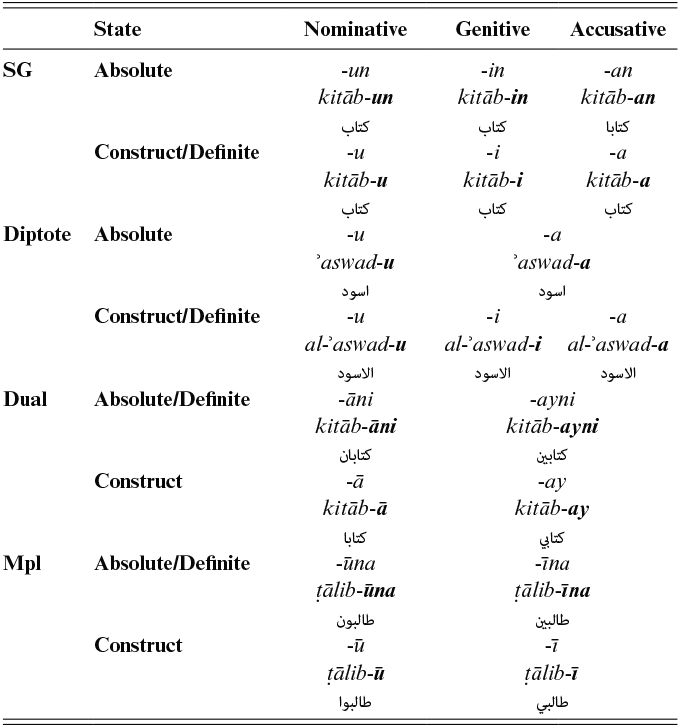
Based on both Arabic-internal and comparative Semitic data, it is clear that nominal case in Proto-Arabic was manifested by a set of word-final vowels.Footnote 68 On singular and many broken plural patterns, three cases were morpho-syntactically marked: nominative, genitive, and accusative. In these contexts, case was marked morphologically by a short vowel suffixed to the noun or adjective: -u for nominative, -i for genitive, and -a for accusative. This three-way inflectional paradigm is often referred to in Semiticist and Arabist literature as “triptotic.” Some nominal patterns, including broken/internal plural ones (e.g., faʿālil, faʿālı̄l, ʾafʿilāʾ, etc), along with a few others (e.g., elatives ʾafʿal and faʿlāʾ) only inflect morphologically for two cases – nominative (marked by -u) and oblique (marked by -a) – when indefinite. This two-way distinction is referred to as “diptotic” inflection. Additionally, the dual and sound plural endings each attest a kind of diptotic inflection, inflecting for nominative and oblique. In the dual and sound masculine plural, however, the vowel is long (nominative -ū and oblique -ı̄ for sound masculine plural), or long and a diphthong (nominative -ā and oblique -ay). Case marking in Arabic is referred to as ʾiʿrāb (lit. “making Arabic”).Footnote 69
In addition to the case morpheme, unbound nouns, that is, nouns that do not stand in construct with a following noun and which do not have a suffixed pronoun, are marked as absolute by a final -n suffixed to the case vowel. This morpheme is referred to as “nasalization” in Semiticist literature, and tanwı̄n in Arabic (lit. “nūnification” or more idiomatically, “adding a nūn”). Note that, while tanwı̄n is retained in the dual and sound masculine plural when the noun is made morphologically definite by the addition of the definite article, the addition of the latter on triptotic singular and broken plural nouns results in the dropping of tanwı̄n. Tanwı̄n is also absent on diptotic singular and broken plural nouns. The full paradigm reconstructible to Proto-Arabic, and which will constitute the point of departure for our subsequent discussion, is as follows (Table 2). Note that, in addition to transcription, the examples are given in Arabic script in accordance with the writing practice attested in the Christian Arabic manifestation of the Hijazi writing tradition.Footnote 70
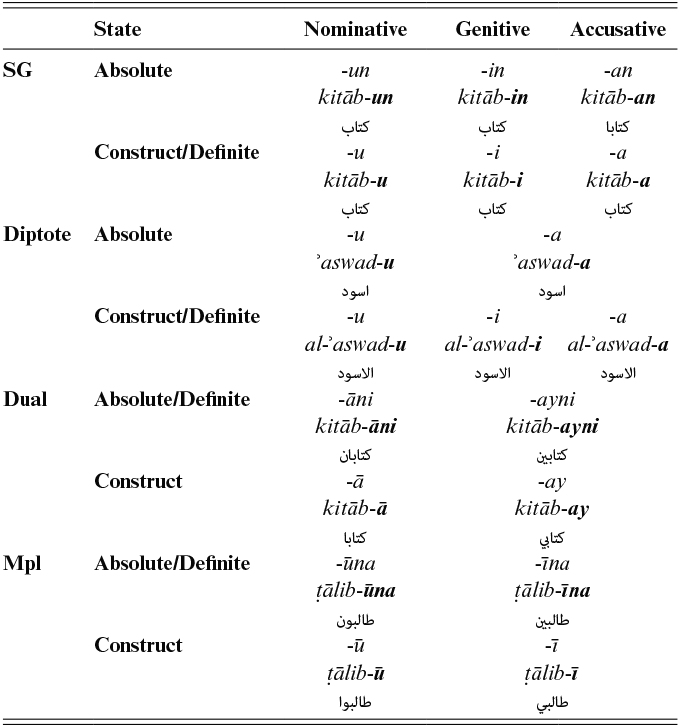
Table 2 Long description
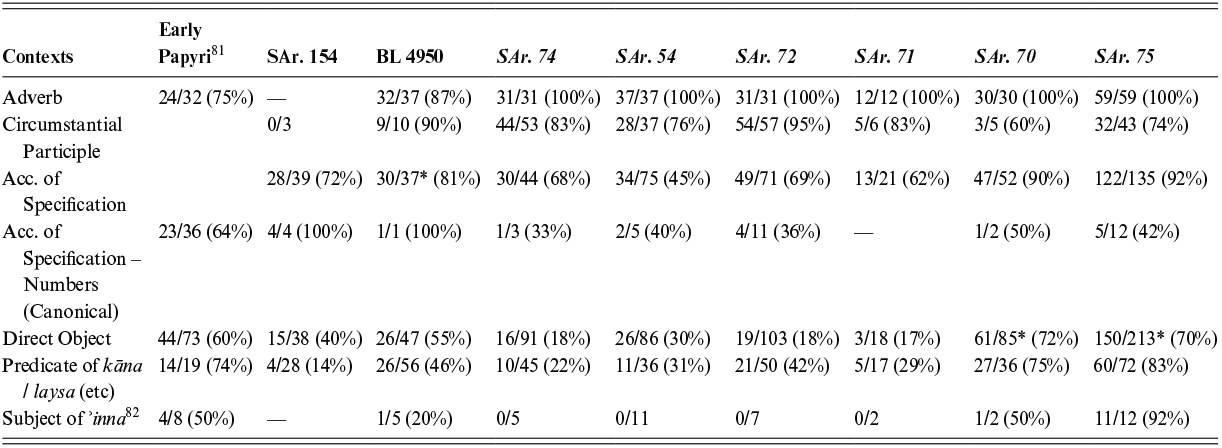
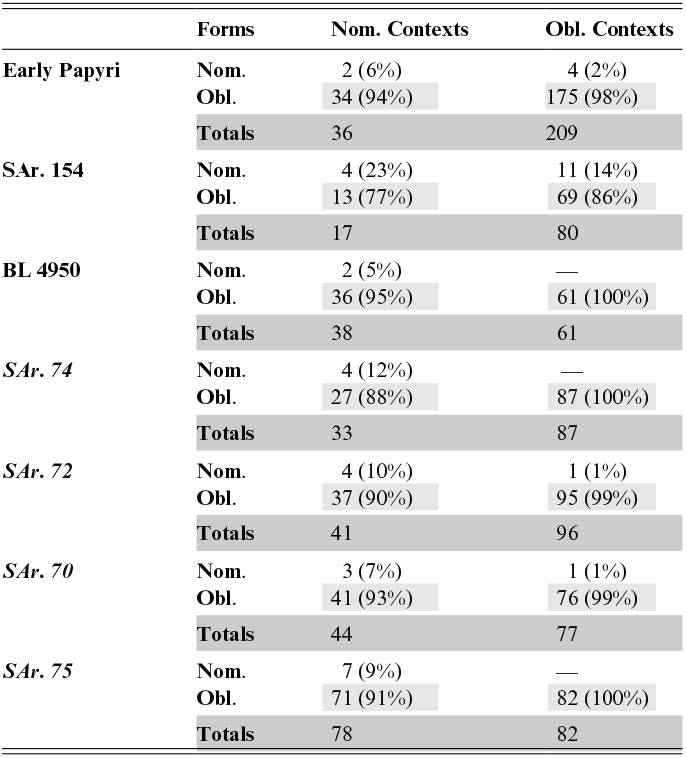
Table presenting occurrence frequencies and percentages for six grammatical contexts across Early Papyri 81 and eight manuscript sources (SAr. 154, BL 4950, and SAr. 74–75). Contexts include adverbs, circumstantial participles, accusatives of specification, canonical number expressions, direct objects, and predicates of kāna/laysa. Adverbs consistently show high rates, reaching 100% in most SAr manuscripts. Direct-object frequencies vary substantially, ranging from about 17% to 72%. Accusatives of specification generally fall between 45% and 92%, while predicates of kāna/laysa range from 14% to 83%. Some cells contain no data or are marked with dashes or asterisks.
The epigraphic evidence, especially provided by the inscriptions in the Safaitic and Nabataean scripts, demonstrates that this case system had been reduced to varying degrees in the pre-Islamic dialects. Virtually all inscriptions attest the loss of tanwı̄n. The breakdown of case in Nabataean varieties of Arabic can be seen across the history of the inscriptions, with a still-functional system attested in the Arabic portions of the En Avdat inscription from southern Palestine (late first/early second ce), whereas later inscriptions, such as the Namarah inscription in southern Syria (328 ce) and JSNab17 in NW Arabic (267 ce) lack it.Footnote 71 The inscriptions of the Safaitic corpus attest a case system in which only the accusative has been retained, but the loss of word-final short high vowels has led to the loss of the nominative and genitive cases.Footnote 72 While some scholars have considered the loss of case here due to their peripheral status, there is in fact good evidence that, by the sixth century ce, Hijazi dialects had a similarly reduced case system. Indeed, the Quranic consonantal text, and the Hijazi writing tradition, suggest that tanwı̄n had been lost, and only an indefinite triptotic accusative remained (realized -ā in all positions).Footnote 73 Hijazi-like Arabic seems to have spread in the Levant in the early Islamic period and formed the basis of early Islamic writing, both Arabic script and Greek script.Footnote 74 Importantly, numerous bits of evidence from primary and secondary sources dating to the first Islamic centuries suggest that varieties in which case was either reduced from the Proto-Arabic system reconstructed earlier, or entirely caseless ones, were not only common but also prestigious in their own right. Any study of the evidence for case in an early corpus should therefore begin with a thorough analysis of the evidence, and we must allow for the possibility of reconstructing a partial case system, or, if diglossia existed, between High and Low varieties in both of which case was, to varying degrees, non-Classical. This is the methodological assumption on which the following discussion will proceed.
Due to the lack of vocalization in the manuscripts here under study, not all possible manifestations of morpho-syntactic case are visible in early Arabic Hijazi-based writing. Our discussion as follows will thus be limited to an analysis of the following: Section 2.1 distribution of the tanwı̄n ʾalif; Section 2.2 inflection al-ʾasmāʾ al-ḫamsah “the five nouns”; Section 2.3 inflection of al-ʾasmāʾ al-mamdūdah “āʾ-final nouns” + PN suffix; Section 2.4 Dual inflection; and Section 2.5 sound masculine plural inflection. For each section, the data from the corpus of manuscripts will be presented and contextualized where possible with any relevant data from, for example, the Quran, early papyri, Quranic reading traditions, the ʿArabiyyah, as well as later medieval and modern phenomena. Section 2.6 will present an overview of the system as attested in the corpus from both synchronic and diachronic perspectives.
2.1 Tanwīn ʾAlif on Triptotic Nouns
Of the triptotic case endings, only the indefinite/absolute accusative is reflected in the consonantal writing of the Hijazi writing tradition, in which it is written with an ʾalifا, with the exception of nouns ending in *-at, spelled ت\ه.Footnote 75 The accusative in Semitic occurs on objects and for a wide range of adverbial usages as well,Footnote 76 and this broad usage is characteristic of the accusative in the pre- and early Islamic Arabic corpora, including the Safaitic corpus, the Quran, Quranic reading traditions, and the ʿArabiyyah, and virtually all of these contexts trigger tanwıˉn ʾalif in the early Christian corpus, though not consistently, and not at the same rate. Contrary to the impression one gets from Blau,Footnote 77 the vast majority of the time, tanwıˉn ʾalif occurs in canonically accusative contexts in these early MSS. However, there is significant variation as to how frequently indefinite nouns in accusative contexts are marked. In Table 3, the data for each of the MSS is provided,Footnote 78 along with data for the early Islamic papyri.Footnote 79 Note that, in the first column, the numerator represents the number of occurrences of tanwıˉn ʾalif that occur in canonically accusative contexts out of the total number of occurrences of tanwıˉn ʾalif; in the second column, the numerator represents the number of nouns occurring in accusative contexts out of the total number of eligible nouns in accusative contexts. Thus, for SAr. 154, 52 out of 72 (72%) occurrences of nouns marked with tanwıˉn ʾalif are in canonically accusative contexts, whereas only 151 out of 221 (68%) eligible nouns in accusative contexts are marked.
| Tanwīn ʾAlif in Acc. Contexts | Acc. Contexts w/ Tanwı̄n ʾAlif | |
|---|---|---|
| Early Papyri | 151/158 (96%) | 151/221 (68%) |
| SAr. 154 | 52/72 (72%) | 52/114 (46%) |
| BL 4950 | 124/131 (95%) | 124/191 (65%) |
| SAr. 74 | 132/139 (95%) | 132/280 (47%) |
| SAr. 54 | 140/150 (93%) | 140/297 (47%) |
| SAr. 72 | 180/188 (95%) | 180/336 (54%) |
| SAr. 70 | 183/201 (91%) | 184/236 (78%) |
| SAr. 75 | 475/584 (81%) | 475/617 (77%) |
| SAr. 71 | 37/37 (100%) | 37/75 (49%) |
From the data presented in Table 3 it is clear that the overwhelming majority of the time tanwıˉn ʾalif is used to mark nouns, it marks nouns in canonically accusative roles. However, accusative nouns are not marked at the same rate across MSS. The Gospel MSS of Family A, along with the theological treatise On the Triune Nature of God in SAr. 154, mark fewer than half of eligible accusatives, but the treatise Summa Theologiae Arabic in BL 4950, as well as the Gospel MSS SAr. 70 and SAr. 75, mark them well over half of the time. This latter group of MSS patterns in general with the early Arabic papyri from the first century and a half of the Islamic period.Footnote 80
These numbers alone do not tell the whole story, however. Not all accusative roles are marked with equal frequency. In Table 4, the numbers and percentage of eligible nouns marked with tanwı̄n ʾalif according to syntactic context is provided, again compared with data from the early papyri.
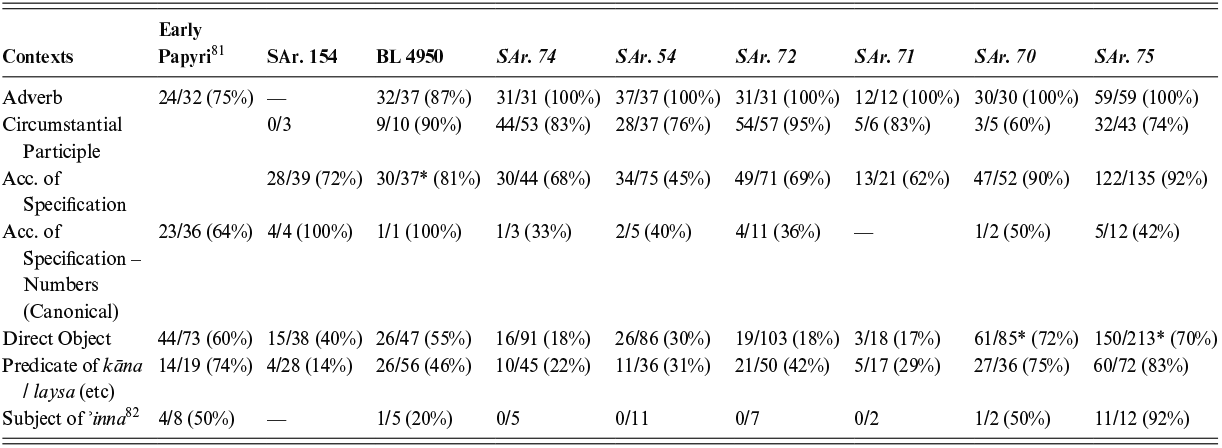
Table 4 Long description
Table illustrating a simplified noun-declension system with columns for nominative, genitive, and accusative cases and rows for definite and indefinite forms. In the definite row, a single form, al-baytu (the house), spans all three cases, indicating no case distinction. In the indefinite row, baytu (a house) spans the nominative and genitive columns, showing that these cases share the same form. The accusative column contains the distinct form baytā, also meaning a house. The table demonstrates a reduced case system in which some traditional case distinctions have merged.
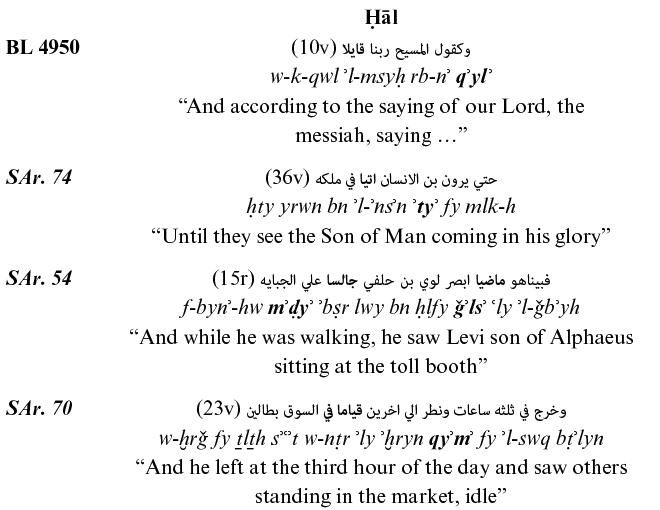
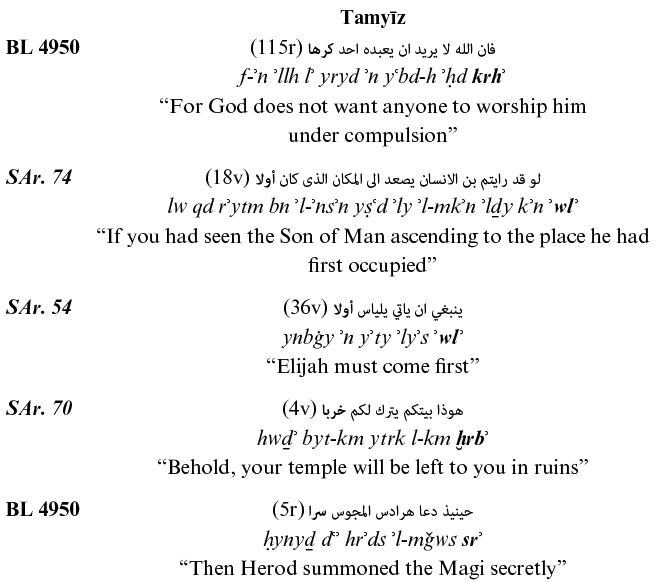
Generic adverbs are ubiquitously written with tanwıˉn ʾalif across the corpus. The main exception is the adverb *ʾah.yānan “sometimes,” in BL 4950, which is frequently unmarked, for example, f. 11v احيان بالعز واحيان بالضعف “sometimes by strength and sometimes by weakness.” Other adverbial functions, such as participles functioning as predicates to a verb indicating simultaneous action (Arabic h.āl), as well as nouns functioning to specify various information related to the verbal predication (Arabic tamyı̄z) are very commonly marked accusative in these MSS:
| Ḥāl | |
| BL 4950 | (10v) وكقول المسيح ربنا قايلا |
| w-k-qwl ʾl-msyḥ rb-nʾ qʾylʾ | |
| “And according to the saying of our Lord, the messiah, saying …” | |
| SAr. 74 | (36v) حتي يرون بن الانسان اتيا في ملكه |
| ḥty yrwn bn ʾl-ʾnsʾn ʾtyʾ fy mlk-h | |
| “Until they see the Son of Man coming in his glory” | |
| SAr. 54 | (15r) فبيناهو ماضيا ابصر لوي بن حلفي جالسا علي الجبايه |
| f-bynʾ-hw mʾḍyʾ ʾbṣr lwy bn ḥlfy ǧʾlsʾ ʿly ʾl-ǧbʾyh | |
| “And while he was walking, he saw Levi son of Alphaeus sitting at the toll booth” | |
| SAr. 70 | (23v) وخرج في ثلثه ساعات ونطر الي اخرين قياما في السوق بطالين |
| w-ḫrǧ fy ṯlṯh sʾʿʾt w-nṭr ʾly ʾḫryn qyʾmʾ fy ʾl-swq bṭʾlyn | |
| “And he left at the third hour of the day and saw others standing in the market, idle” |
| Tamyı̄z | |
| BL 4950 | (115r) فان الله لا يريد ان يعبده احد كرها |
| f-ʾn ʾllh lʾ yryd ʾn yʿbd-h ʾḥd krhʾ | |
| “For God does not want anyone to worship him under compulsion” | |
| SAr. 74 | (18v) لو قد رايتم بن الانسان يصعد الى المكان الذى كان أولا |
| lw qd rʾytm bn ʾl-ʾnsʾn yṣʿd ʾly ʾl-mkʾn ʾlḏy kʾn ʾwlʾ | |
| “If you had seen the Son of Man ascending to the place he had first occupied” | |
| SAr. 54 | (36v) ينبغي ان ياتي يلياس أولا |
| ynbġy ʾn yʾty ʾlyʾs ʾwlʾ | |
| “Elijah must come first” | |
| SAr. 70 | (4v) هوذا بيتكم يترك لكم خربا |
| hwḏʾ byt-km ytrk l-km ḫrbʾ | |
| “Behold, your temple will be left to you in ruins” | |
| BL 4950 | (5r) حينيذ دعا هرادس المجوس سرا |
| ḥynyḏdʿʾ hrʾds ʾl-mǧws srʾ | |
| “Then Herod summoned the Magi secretly” |
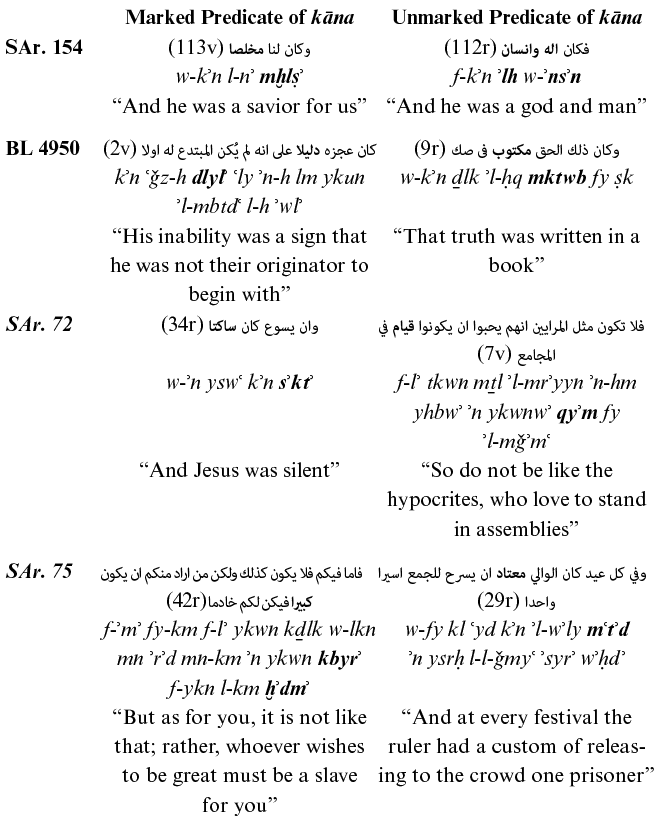
Other functions, however, are less commonly marked, though these show a greater degree of variability depending on the MS. For example, direct objects are marked rather infrequently, especially in the translation reflected in the MSS witnesses to Kashouh’s Gospel Family A, but SAr. 70 and SAr. 75 both mark them more frequently (though not ubiquitously). Finally, it is noteworthy to point out that predicates of *kāna and like verbs (Arabic ʾaḫawāt kāna, “the sisters of kāna”) are relatively rarely marked, again with the exception of SAr. 70 and SAr. 75, and subjects *ʾinna are only marked with regularity in SAr. 75:
| Marked Predicate of kāna | Unmarked Predicate of kāna | |
| SAr. 154 | (113v) وكان لنا مخلصا | (112r) فكان اله وانسان |
| w-kʾn l-nʾ mḫlṣʾ | f-kʾn ʾlh w-ʾnsʾn | |
| “And he was a savior for us” | “And he was a god and man” | |
| BL 4950 | (2v) كان عجزه دليلا على انه لم يُكن المبتدع له اولا | (9r) وكان ذلك الحق مكتوب فى صك |
| kʾn ʿǧz-h dlylʾ ʿly ʾn-h lm ykun ʾl-mbtdʿ l-h ʾwlʾ | w-kʾn ḏlk ʾl-ḥq mktwb fy ṣk | |
| “His inability was a sign that he was not their originator to begin with” | “That truth was written in a book” | |
| SAr. 72 | (34r) وان يسوع كان ساكتا | فلا تكون مثل المرايين انهم يحبوا ان يكونوا قيام في(7v) المجامع |
| w-ʾn yswʿ kʾn sʾktʾ | f-lʾ tkwn mṯl ʾl-mrʾyyn ʾn-hm yhbwʾ ʾn ykwnwʾ qyʾm fy ʾl-mǧʾmʿ | |
| “And Jesus was silent” | “So do not be like the hypocrites, who love to stand in assemblies” | |
| SAr. 75 | فاما فيكم فلا يكون كذلك ولكن من اراد منكم ان يكون (42r) كبيرا فيكن لكم خادما | وفي كل عيد كان الوالي معتاد ان يسرح للجمع اسيرا(29r) واحدا |
| f-ʾmʾ fy-km f-lʾ ykwn kḏlk w-lkn mn ʾrʾd mn-km ʾn ykwn kbyrʾ f-ykn l-km ḫʾdmʾ | w-fy kl ʿyd kʾn ʾl-wʾly mʿtʾd ʾn ysrḥ l-l-ǧmyʿ ʾsyrʾ wʾḥdʾ | |
| “But as for you, it is not like that; rather, whoever wishes to be great must be a slave for you” | “And at every festival the ruler had a custom of releasing to the crowd one prisoner” |
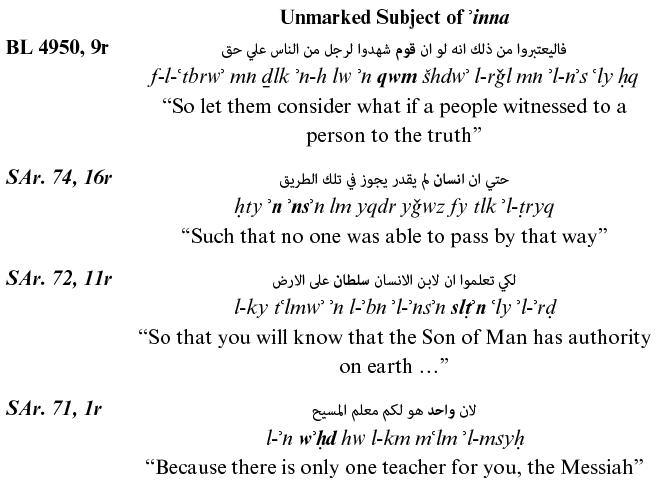
| Unmarked Subject of ʾinna | |
| BL 4950, 9r | فاليعتبروا من ذلك انه لو ان قوم شهدوا لرجل من الناس علي حق |
| f-l-ʿtbrwʾ mn ḏlk ʾn-h lw ʾn qwm šhdwʾ l-rǧl mn ʾl-nʾs ʿly ḥq | |
| “So let them consider what if a people witnessed to a person to the truth” | |
| SAr. 74, 16r | حتي ان انسان لم يقدر يجوز في تلك الطريق |
| ḥty ʾnʾnsʾn lm yqdr yǧwz fy tlk ʾl-ṭryq | |
| “Such that no one was able to pass by that way” | |
| SAr. 72, 11r | لكي تعلموا ان لابن الانسان سلطان على الارض |
| l-ky tʿlmwʾ ʾn l-ʾbn ʾl-ʾnsʾn slṭʾn ʿly ʾl-ʾrḍ | |
| “So that you will know that the Son of Man has authority on earth …” | |
| SAr. 71, 1r | لان واحد هو لكم معلم المسيح |
| l-ʾn wʾḥd hw l-km mʿlm ʾl-msyḥ | |
| “Because there is only one teacher for you, the Messiah” |
Thus, while the triptotic case system in the corpus mostly reflects an accusative/non-accusative one, not all canonically accusative roles were marked equally.
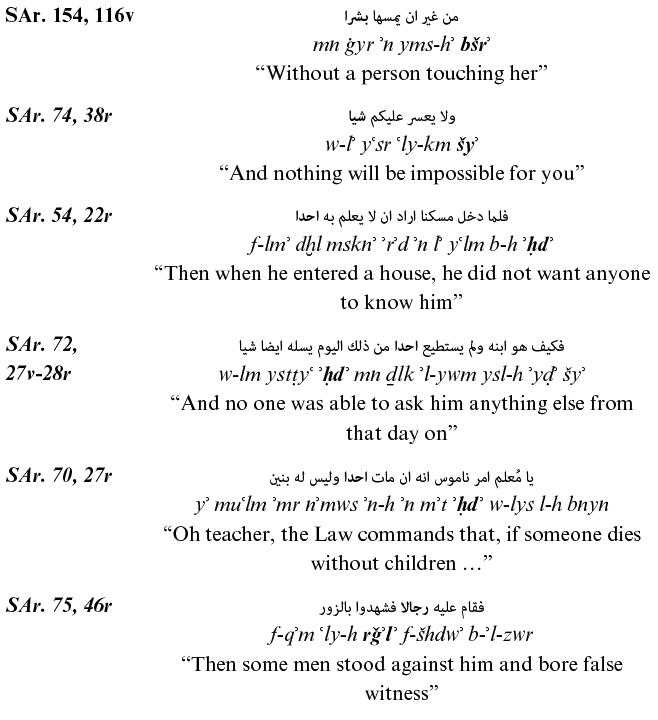
Despite the majority of tanwı̄n ʾalif spellings occurring in canonically accusative contexts, a minority of such spellings occur in non-accusative contexts in all but one MS (SAr. 71).Footnote 83 Virtually every instance of non-accusative tanwı̄n ʾalif across the MSS of the corpus involve one or a combination of the following contexts.
1) Single Member of a Group (most frequently human, i.e., ʾaḥad, raǧul, bašar, etc):

SAr. 154, 116v من غير ان يمسها بشرا mn ġyr ʾn yms-hʾ bšrʾ “Without a person touching her” SAr. 74, 38r ولا يعسر عليكم شيا w-lʾ yʿsr ʿly-km šyʾ “And nothing will be impossible for you” SAr. 54, 22r فلما دخل مسكنا اراد ان لا يعلم به احدا f-lmʾ dḫl msknʾ ʾrʾd ʾn lʾ yʿlm b-h ʾḥdʾ “Then when he entered a house, he did not want anyone to know him” SAr. 72,
27v-28rفكيف هو ابنه ولم يستطيع احدا من ذلك اليوم يسله ايضا شيا w-lm ystṭyʿ ʾḥdʾ mn ḏlk ʾl-ywm ysl-h ʾyḍʾ šyʾ “And no one was able to ask him anything else from that day on” SAr. 70, 27r يا مُعلم امر ناموس انه ان مات احدا وليس له بنين yʾ muʿlm ʾmr nʾmws ʾn-h ʾn mʾt ʾḥdʾ w-lys l-h bnyn “Oh teacher, the Law commands that, if someone dies without children …” SAr. 75, 46r فقام عليه رجالا فشهدوا بالزور f-qʾm ʿly-h rǧʾlʾ f-šhdwʾ b-ʾl-zwr “Then some men stood against him and bore false witness”
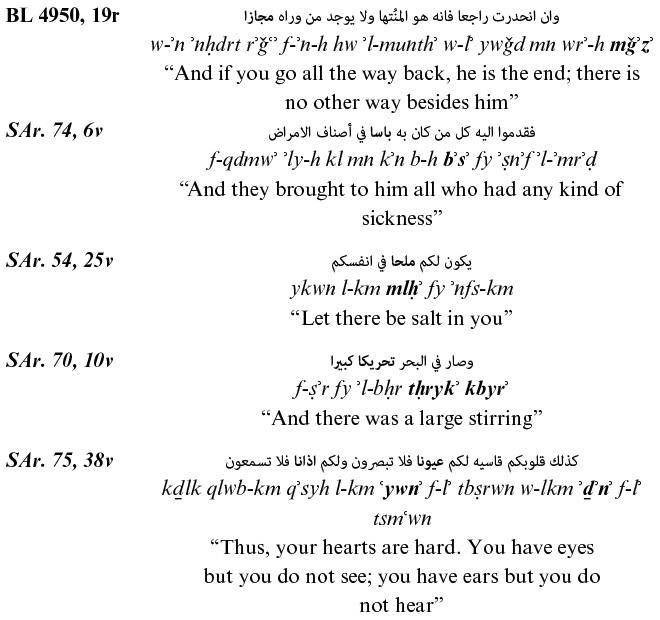
2) Subjects of Existential (including possessive) Predication, especially when backed subjects of kān / ṣār
BL 4950, 19r وان انحدرت راجعا فانه هو المنُتها ولا يوجد من وراه مجازا w-ʾn ʾnḥdrt rʾǧʿʾ f-ʾn-h hw ʾl-munthʾ w-lʾ ywǧd mn wrʾ-h mǧʾzʾ “And if you go all the way back, he is the end; there is no other way besides him” SAr. 74, 6v فقدموا اليه كل من كان به باسا في أصناف الامراض f-qdmwʾ ʾly-h kl mn kʾn b-h bʾsʾ fy ʾṣnʾf ʾl-ʾmrʾḍ “And they brought to him all who had any kind of sickness” SAr. 54, 25v يكون لكم ملحا في انفسكم ykwn l-km mlḥʾ fy ʾnfs-km “Let there be salt in you” SAr. 70, 10v وصار في البحر تحريكا كبيرا f-ṣʾr fy ʾl-bḥr tḥrykʾ kbyrʾ “And there was a large stirring” SAr. 75, 38v كذلك قلوبكم قاسيه لكم عيونا فلا تبصرون ولكم اذانا فلا تسمعون kḏlk qlwb-km qʾsyh l-km ʿywnʾ f-lʾ tbṣrwn w-lkm ʾḏʾnʾ f-lʾ tsmʿwn “Thus, your hearts are hard. You have eyes but you do not see; you have ears but you do not hear”
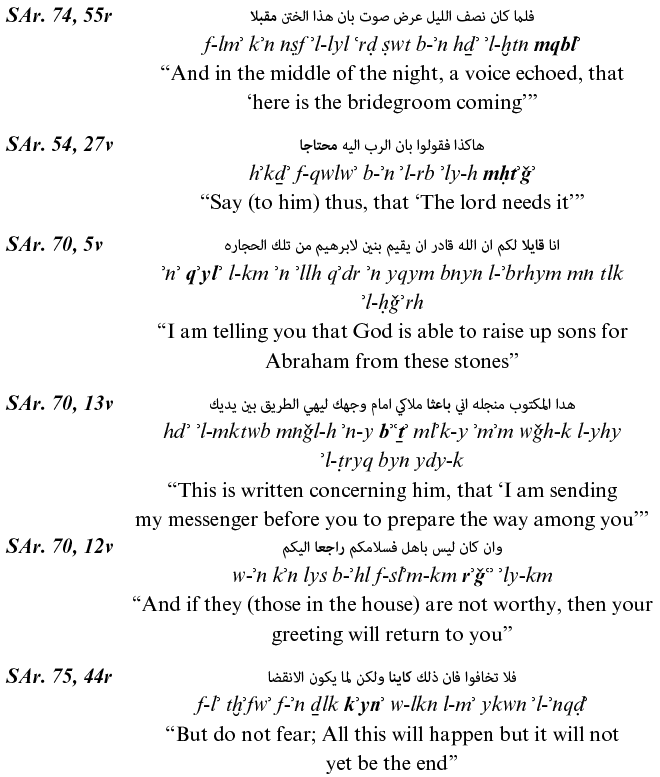
3) Participles as Verbal Predicates (especially when followed by either the direct object – but not a pronominal suffix – or indirect object):
SAr. 74, 55r فلما كان نصف الليل عرض صوت بان هذا الختن مقبلا f-lmʾ kʾn nṣf ʾl-lyl ʿrḍ ṣwt b-ʾn hḏʾ ʾl-ḫtn mqblʾ “And in the middle of the night, a voice echoed, that ‘here is the bridegroom coming’” SAr. 54, 27v هاكذا فقولوا بان الرب اليه محتاجا hʾkḏʾ f-qwlwʾ b-ʾn ʾl-rb ʾly-h mḥtʾǧʾ “Say (to him) thus, that ‘The lord needs it’” SAr. 70, 5v انا قايلا لكم ان الله قادر ان يقيم بنين لابرهيم من تلك الحجاره ʾnʾ qʾylʾ l-km ʾn ʾllh qʾdr ʾn yqym bnyn l-ʾbrhym mn tlk ʾl-ḥǧʾrh “I am telling you that God is able to raise up sons for Abraham from these stones” SAr. 70, 13v هدا المكتوب منجله اني باعثا ملاكي امام وجهك ليهي الطريق بين يديك hdʾ ʾl-mktwb mnǧl-h ʾn-y bʾʿṯʾ mlʾk-y ʾmʾm wǧh-k l-yhy ʾl-ṭryq byn ydy-k “This is written concerning him, that ‘I am sending my messenger before you to prepare the way among you’” SAr. 70, 12v وان كان ليس باهل فسلامكم راجعا اليكم w-ʾn kʾn lys b-ʾhl f-slʾm-km rʾǧʿʾ ʾly-km “And if they (those in the house) are not worthy, then your greeting will return to you” SAr. 75, 44r فلا تخافوا فان ذلك كاينا ولكن لما يكون الانقضا f-lʾ tḫʾfwʾ f-ʾn ḏlk kʾynʾ w-lkn l-mʾ ykwn ʾl-ʾnqḍʾ “But do not fear; All this will happen but it will not yet be the end”
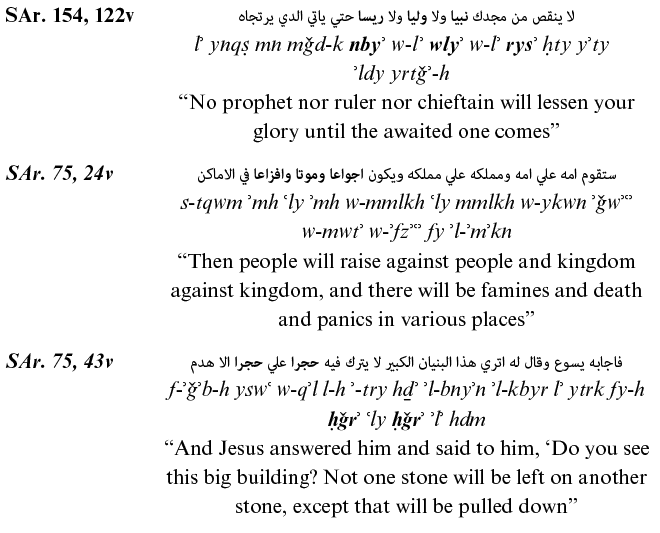
4) Series of Nouns (typically connected by a conjunction (N wa-(lā) N)):
SAr. 154, 122v لا ينقص من مجدك نبيا ولا وليا ولا ريسا حتي ياتي الدي يرتجاه lʾ ynqṣ mn mǧd-k nbyʾ w-lʾ wlyʾ w-lʾ rysʾ ḥty yʾty ʾldy yrtǧʾ-h “No prophet nor ruler nor chieftain will lessen your glory until the awaited one comes” SAr. 75, 24v ستقوم امه علي امه ومملكه علي مملكه ويكون اجواعاوموتاوافزاعا في الاماكن s-tqwm ʾmh ʿly ʾmh w-mmlkh ʿly mmlkh w-ykwn ʾǧwʾʿʾ w-mwtʾ w-ʾfzʾʿʾ fy ʾl-ʾmʾkn “Then people will raise against people and kingdom against kingdom, and there will be famines and death and panics in various places” SAr. 75, 43v فاجابه يسوع وقال له اتري هذا البنيان الكبير لا يترك فيه حجرا علي حجرا الا هدم f-ʾǧʾb-h yswʿ w-qʾl l-h ʾ-try hḏʾ ʾl-bnyʾn ʾl-kbyr lʾ ytrk fy-h ḥǧrʾ ʿly ḥǧrʾ ʾlʾ hdm “And Jesus answered him and said to him, ‘Do you see this big building? Not one stone will be left on another stone, except that will be pulled down”
Additionally, across the manuscripts it is common for examples from Categories 1–3 (“Single Member,” “Subjects of Existential Predication,” and “Participles as Verbs”) to occur on nouns when followed by adnominal attributes such as attributive adjectives, prepositional phrases, and relative clauses. In most manuscripts, when a noun is followed by an adjective that is eligible to be written with tanwı̄n ʾalif in the writing tradition (i.e., one that does not end in tāʾ marbūṭah or an ʾalif), the adjective is likewise marked with tanwı̄n ʾalif. However, in SAr. 154, several examples occur in which only the noun is marked, but not the adjective. Examples of both include:
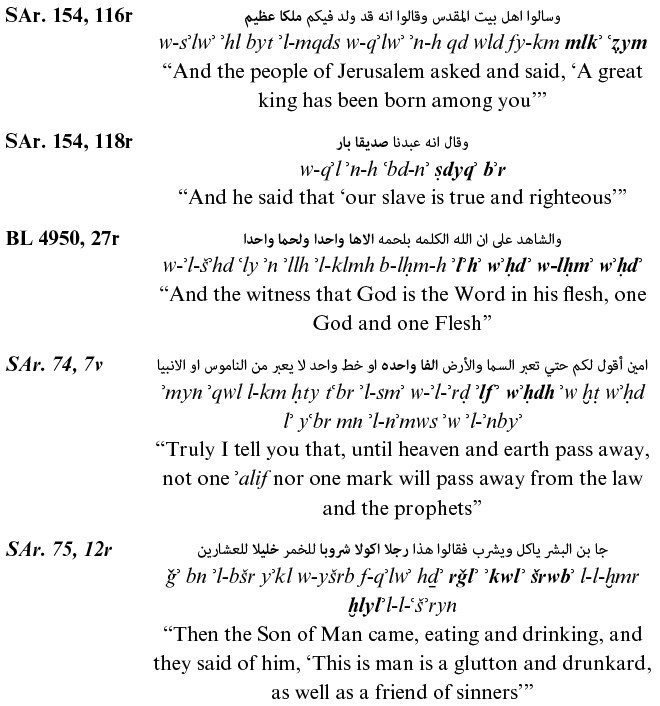
| SAr. 154, 116r | وسالوا اهل بيت المقدس وقالوا انه قد ولد فيكم ملكا عظيم |
| w-sʾlwʾ ʾhl byt ʾl-mqds w-qʾlwʾ ʾn-h qd wld fy-km mlkʾ ʿẓym | |
| “And the people of Jerusalem asked and said, ‘A great king has been born among you’” | |
| SAr. 154, 118r | وقال انه عبدنا صديقا بار |
| w-qʾl ʾn-h ʿbd-nʾ ṣdyqʾ bʾr | |
| “And he said that ‘our slave is true and righteous’” | |
| BL 4950, 27r | والشاهد على ان الله الكلمه بلحمه الاها واحدا ولحما واحدا |
| w-ʾl-šʾhd ʿly ʾn ʾllh ʾl-klmh b-lḥm-h ʾlʾhʾ wʾḥdʾ w-lḥmʾ wʾḥdʾ | |
| “And the witness that God is the Word in his flesh, one God and one Flesh” | |
| SAr. 74, 7v | امين أقول لكم حتي تعبر السما والأرض الفا واحده او خط واحد لا يعبر من الناموس او الانبيا |
| ʾmyn ʾqwl l-km ḥty tʿbr ʾl-smʾ w-ʾl-ʾrḍ ʾlfʾ wʾḥdh ʾw ḫṭ wʾḥd lʾ yʿbr mn ʾl-nʾmws ʾw ʾl-ʾnbyʾ | |
| “Truly I tell you that, until heaven and earth pass away, not one ʾalif nor one mark will pass away from the law and the prophets” | |
| SAr. 75, 12r | جا بن البشر ياكل ويشرب فقالوا هذا رجلااكولاشروبا للخمر خليلا للعشارين |
| ǧʾ bn ʾl-bšr yʾkl w-yšrb f-qʾlwʾ hḏʾ rǧlʾ ʾkwlʾ šrwbʾ l-l-ḫmr ḫlylʾl-l-ʿšʾryn | |
| “Then the Son of Man came, eating and drinking, and they said of him, ‘This is man is a glutton and drunkard, as well as a friend of sinners’” |
It is not clear that noun + adnominal is a separate category in most MSS, but it appears to be one in SAr. 154, since there are five examples that do not fit into any of these categories but consist of a noun followed by adnominal attributes. The diachronic implications of this will be discussed later.
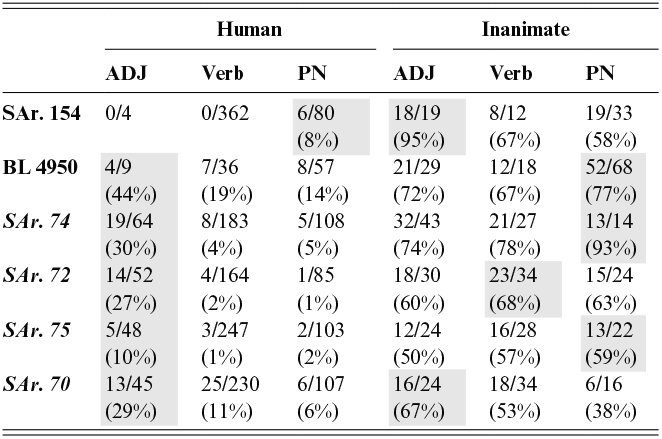
While these categories tend to recur across the MSS, they are not equally represented in each MSS. Category 1 (“Single Member”) is ubiquitous across MSS, though some, such as SAr. 154, are characterized by more examples than others. The other categories are more variable; SAr. 154, for example, lacks any examples of subjects of existential predication marked with tanwı̄n ʾalif, whereas this is common in the other MSS, and is especially common in SAr. 75. Finally, SAr. 70 attests a proportionately large (6/13–46%) number of participles functioning as verbal predicates that are marked with tanwı̄n ʾalif, which is unattested in SAr. 154 and BL 4950, and rare in, for example, SAr. 75. Data for each MS can be found in Table 5. Note that the data for SAr. 75 are difficult to quantify due to the fact that non-accusative usages of tanwı̄n ʾalif are so numerous that each category overlaps significantly. For example, 7/53 (13%) of the examples of subjects of existential predication marked with tanwı̄n ʾalif involve nouns belonging to Category 1 (“Single Member”). Thus, the statistics for SAr. 75 are inflated since a single example is included in the data for more than one category.
| MS | Single Member | Subject of Existential | Participle as Verb | N wa(-lā) N |
|---|---|---|---|---|
| SAr. 154 | 8 | — | — | 3 |
| BL 4950 | 5 | 1 | — | — |
| SAr. 74 | 3 | 2 | 2 | — |
| SAr. 54 | 4 | 4 | 1 | — |
| SAr. 72 | 6 | 2 | — | — |
| SAr. 70 | 5 | 2 | 6 | — |
| SAr. 75 | 59 | 53 | 1 | 11 |
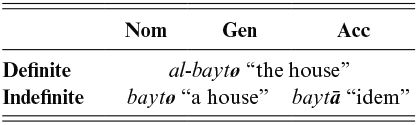
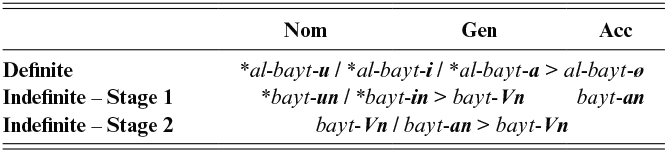
So how can we account for the distribution of accusative and non-accusative functions marked with tanwı̄n ʾalif in these MSS? One possibility is that the case system attested in these MSS reflects an organic evolution of the Hijazi one, reflected in the Quranic consonantal text, where tanwı̄n had been lost along with final high vowels, resulting in an indefinite accusative/non-accusative system (Table 6).
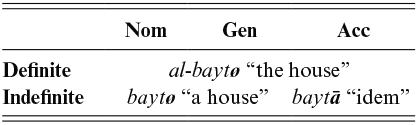
Table 6 Long description
Table tracing the reduction of case distinctions for the noun bayt (house) across nominative, genitive, and accusative cases. In the definite state, the original forms al-bayt-u, al-bayt-i, and al-bayt-a merge into a single form, al-bayt-ø. For indefinite nouns, an intermediate stage shows nominative and genitive forms merging into bayt-Vn while the accusative bayt-an remains distinct. In the final stage, bayt-an also merges with bayt-Vn, resulting in the complete loss of case distinctions in the indefinite state.
It is fairly simple to account for the extension of the accusative to mark several of the non-canonical functions marked with tanwı̄n ʾalif. For example, marking subjects of existential predication with the accusative can be understood as a relatively straightforward reanalysis. The syntactic subject in this case is indefinite, and thus usually backed, following another constituent – often a prepositional phrase – which is the typical position of predicates. Semantically, too, the subjects of existential predications behave more like predicates. Other usages, however, such as with single members of a group (Category 1) are less easily explained in this scenario. The example from BL 4950, given earlier, is illustrative in this regard:

| BL 4950, 19r | وان انحدرت راجعا فانه هو المنُتها ولا يوجد من وراه مجازا |
| w-ʾn ʾnḥdrt rʾǧʿʾ f-ʾn-h hw ʾl-munthʾ w-lʾ ywǧd mn wrʾ-h mǧʾzʾ | |
| “And if you go all the way back, he is the end; there is no other way besides him” |
It is possible to interpret the prepositional phrase mn wrʾ-h “besides him,” as the subject of wǧd, and consequently mǧʾzʾ “way” as the predicate. There are, in fact, parallels in the Quran – and disagreements over case inflection therein – to the same constructions. For example, Q6:23 reads:
ثُمَّ لَم تَكُنْ فِتْنَتهُم إِلَّا أَنْ قَالُوا وَاللهِ رَبِّنَا مَا كُنَّا مُشْرِكِينَ
ṯumma lam takun fitnatV-hum ʾillā ʾan qālū wallāhi rabbi-nā mā kunnā mušrikı̄na
“Then they will not have a plea other than, ‘By God our Lord, we were not polytheists!’”
The noun fitnah “argument, plea,” is read either as nominative fitnatu-hum (by Ḥafṣ ʿan ʿĀṣim, among others) making the phrase ʾillā ʾan qālū, “but that they say …” the predicate, or as accusative fitnata-hum (for example by both of Nāfiʿ’s two canonical transmitters), in which case ʾllā ʾan qālū is the predicate.Footnote 84 The ambiguity in these constructions could rather easily led to speakers of varieties with functional accusative to reanalyze them all as predicates, rather than subjects, and mark them accusative even in a living system.
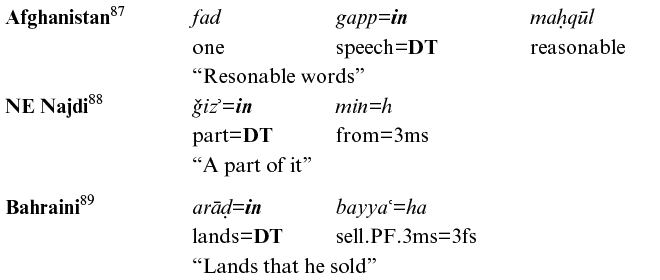
However, the distribution of tanwı̄n ʾalif in the Christian MSS is most closely paralleled in the majority of these contexts by another phenomenon, namely “dialectal tanwı̄n.” The morpheme dubbed dialectal tanwı̄n, which occurs in medieval written and modern spoken corpora, refers to the combination of a non-inflecting vowel (of various phonetic realizations) and a final /n/, henceforth represented generically as -Vn, that is suffixed to indefinite nouns.Footnote 85 While significant variation occurs from dialect to dialect, the following contexts account for the vast majority of the data.Footnote 86
1) Noun + Attribute
By far the most common context across dialects is when a noun is followed by some kind of adnominal attribute. Most commonly this is an attributive adjective, but in some dialects it can include a prepositional phrase or asyndetic relative clause.
AfghanistanFootnote 87 fad gapp=in maḥqūl one speech=DT reasonable “Resonable words” NE NajdiFootnote 88 ǧizʾ=in min=h part=DT from=3ms “A part of it” BahrainiFootnote 89 arāḍ=in bayyaʿ=ha lands=DT sell.PF.3ms=3fs “Lands that he sold”
2) Participles as Verbal Predicates
AndalusiFootnote 90 haléft cáyl=en izm allah swear.PF.2ms say.PART.ms=DT name God “Did you swear, saying ‘by God’?” N. Najdi
(Rwalah)Footnote 91ana māni mwarrdt=in al=faras I NEG.1cs water.PART.fsg=DT Def=horse “I am not watering the horse” SE Najdi
(Āl Murrah)Footnote 92māni mkallif=in nafs=i ašrab NEG.1cs undertake.PART.msg=DT self=1cs drink.IMPF.1cs “I am not going to undertake the burden of drinking”
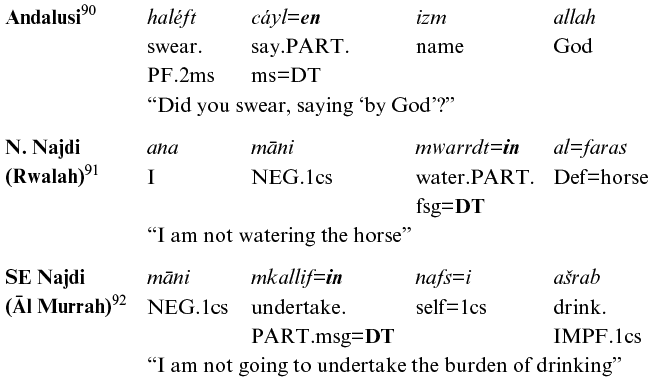
This usage of tanwı̄n is limited in the modern dialects mostly to peninsular varieties, where it is however nearly as common as nouns followed by attributes (Category 1).Footnote 93 For example, my comparison of tanwı̄n in Categories 1 (“Noun + Attribute”) and 2 (“Participles as Verbs”) in three Najdi corpora produced the following data (Table 7).Footnote 94
| Corpus | N + ADN | Participles |
|---|---|---|
| C. Najdi (Ingham Reference Ingham1994) | 7 | 8 |
| Rwalah (Ingham Reference Ingham1995) | 19 | 26 |
| Āl Murrah (Ingham Reference Ingham1986) | 26 | 17 |
| Totals | 52 | 51 |
In dialects with this usage of tanwı̄n, it is most commonly found on participles that are followed either by a non-pronominal direct object, or otherwise an indirect object,Footnote 95 though this is not always the case, as the following example demonstrates:Footnote 96

| w=wāḥd=in | min | il=ʿiyāl | ǧāy=in | u=damm=ih | yiṣub |
| And=one=DT | of | Def= children | come.PART. ms=DT | And=blood =3ms | flow.IMPF.3ms |
| “And one of the children coming, bleeding all over the place” | |||||
Whenever a pronominal object is suffixed to the participle, the tanwı̄n is dropped. In other dialects, stretching across the eastern peninsula and into southern Iraq, a number of dialects attest a suffixed -Vn(n) on participles only when a pronominal object is suffixed; otherwise, no tanwı̄n occurs:Footnote 97

| Bahraini | With PN Suffix | Without PN Suffix |
| kātib | kātb=inn=ah | |
| write.PART.3ms | write.PART.3ms=INF=3ms | |
| “having written” | “having written it” |
Some scholars have connected this morpheme with tanwīn,Footnote 98 but more recently others have rejected this connection on the grounds that it is precisely in this context – with a suffixed pronoun – that tanwı̄n, a marker of unboundness, would not have occurred.Footnote 99 However, the same is true of the nasal suffixed to the sound masculine plural, which was historically the same morpheme (tanwı̄n) and behaved similarly, being omitted in construct or with a pronominal suffix, for example, ṭālibı̄=h(v) “requesting (mpl) it (ms).”Footnote 100 However, in every dialect the non-construct form has been generalized to every context, for example, ṭālibı̄n-uh “idem.” In absence of another compelling alternative, therefore, it is preferable to connect this infixed morpheme -Vn(n) on participles with tanwı̄n. Thus, modern dialects attest participles as verbal predicates with tanwı̄n, either when followed by a non-pronominal object or only when followed by one. Close juncture once again plays a significant role in its retention.Footnote 101
3) Generic Members of a Group
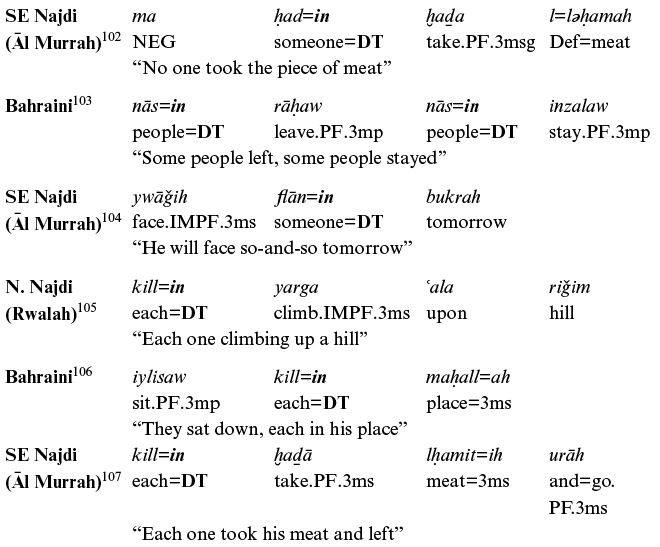
| SE Najdi (Āl Murrah)Footnote 102 | ma | ḥad=in | ḫaḏa | l=ləḥamah |
| NEG | someone=DT | take.PF.3msg | Def=meat | |
| “No one took the piece of meat” | ||||
| BahrainiFootnote 103 | nās=in | rāḥaw | nās=in | inzalaw |
| people=DT | leave.PF.3mp | people=DT | stay.PF.3mp | |
| “Some people left, some people stayed” | ||||
| SE Najdi (Āl Murrah)Footnote 104 | ywāǧih | flān=in | bukrah | |
| face.IMPF.3ms | someone=DT | tomorrow | ||
| “He will face so-and-so tomorrow” | ||||
| N. Najdi (Rwalah)Footnote 105 | kill=in | yarga | ʿala | riǧim |
| each=DT | climb.IMPF.3ms | upon | hill | |
| “Each one climbing up a hill” | ||||
| BahrainiFootnote 106 | iylisaw | kill=in | maḥall=ah | |
| sit.PF.3mp | each=DT | place=3ms | ||
| “They sat down, each in his place” | ||||
| SE Najdi (Āl Murrah)Footnote 107 | kill=in | ḫaḏā | lḥamit=ih | urāh |
| each=DT | take.PF.3ms | meat=3ms | and=go.PF.3ms | |
| “Each one took his meat and left” | ||||
The occurrence of tanwı̄n on nouns from (ma)ḥad “(no) one,” šayʾ “something,” etc., is common across the modern corpora. This is not always a separate category, since many of these can occur in, for example, Category 1 (“N + Attribute”). These are still disproportionately marked. For example, in the corpus of Najdi texts in Ingham,Footnote 108 I counted examples of each of these words marked with tanwı̄n, and tallied them up. The data are presented in Table 8.
| Corpus | (ʾa)ḥad | wāḥid | ʾinsān | nās | *raǧul | *šayʾ | *kull | *baʿḍ | *fulān | Total |
|---|---|---|---|---|---|---|---|---|---|---|
| C. Najdi | 1 | 1 | — | 1 | — | 3 | — | — | — | 6 |
| Rwalah | — | 2 | — | — | 1 | 1 | 4 | 2 | — | 10 |
| Āl Murrah | 4 | — | 1 | 2 | 5 | 1 | 1 | — | 1 | 15 |
Observationally, it seems that, in some dialects at least (such as, e.g., the Najdi dialects), the use of tanwı̄n on (a)ḥad “someone,” is more common when it is negated, that is, ma ḥadin “no one,” although this differs from dialect to dialect.
4) Adverbs
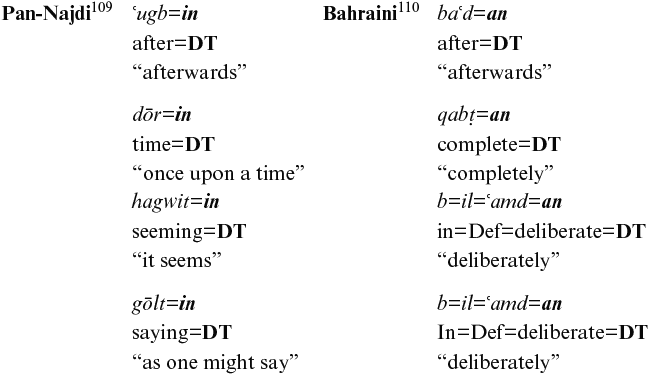
| Pan-NajdiFootnote 109 | ʿugb=in | BahrainiFootnote 110 | baʿd=an |
| after=DT | after=DT | ||
| “afterwards” | “afterwards” | ||
| dōr=in | qabṭ=an | ||
| time=DT | complete=DT | ||
| “once upon a time” | “completely” | ||
| hagwit=in | b=il=ʿamd=an | ||
| seeming=DT | in=Def=deliberate=DT | ||
| “it seems” | “deliberately” | ||
| gōlt=in | b=il=ʿamd=an | ||
| saying=DT | In=Def=deliberate=DT | ||
| “as one might say” | “deliberately” |
It can be tricky to determine whether these adverbs are genuine dialecticisms versus borrowings from standard Arabic. The Bahraini data, for example, could be interpreted as reflecting a borrowed adverbial morpheme -an. It should be noted, though, that in many cases, the dialectal forms were recorded in the speech of older, even illiterate speakers, where the influence of educated Arabic is unlikely (e.g., Bahrain bil=ʿamd=an “deliberately” and aqallat=an “at least”).Footnote 111 Furthermore, this phenomenon seems to be older than mass literacy and electronic media, lending further weight to the idea of dialectal retention, rather than MSA borrowing. For example, Bruno Meissner reports that in fellāḥı̄ poetry he recorded in Iraq in the late nineteenth century, reflexes of dialectal tanwı̄n were typically -in, but in accusative (adverbial) contexts, were realized -an.Footnote 112 The distinction between older dialectal adverbs versus MSA borrowings is clearer still in Najdi varieties, where tanwı̄n on borrowings is realized -an, for example, tagrı̄b=an “approximately” and ǧamı̄ʿ=an “collectively,” whereas dialectal adverbs are realized with dialectal tanwı̄n -in, for example, hagwit=in “it seems,” and mbaććir=in “early.”
I have argued elsewhere that the attestations of dialectal tanwı̄n are most parsimoniously explained historically as the result of the breakdown and loss of nominal case, no doubt due to several factors, including the loss of word-final short vowels, which would have eliminated triptotic case on definite nouns, as well as a loss of phonemic distinction between vowels preceding tanwı̄n.Footnote 113 This process seems to have involved two stages: the first led to a merger of high vowels, to /in/ or perhaps /ən/, written agnostically in the following as -Vn, which resulted in an accusative/non-accusative distinction. Eventually, in most dialects, the merger became total, with all instances of tanwı̄n realized the same (Table 9).
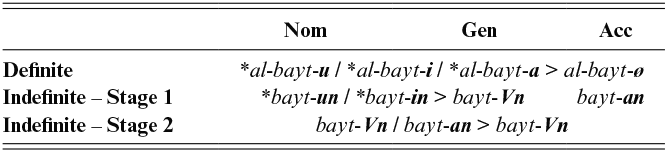
Table 9 Long description
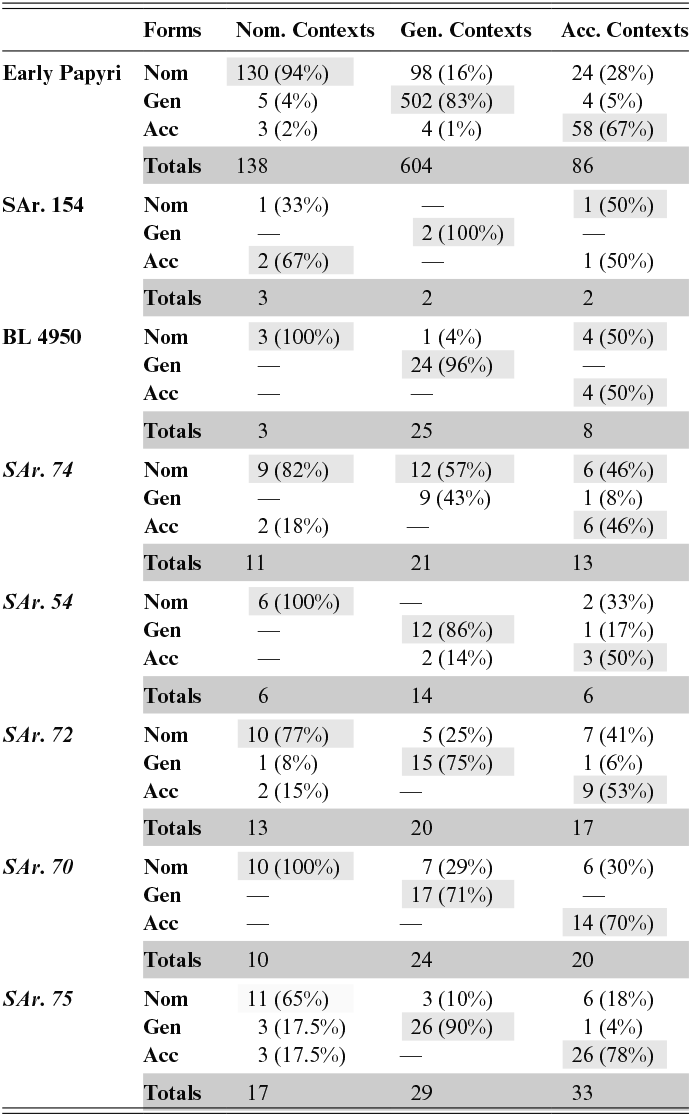
Table cross-tabulating noun forms (nominative, genitive, and accusative) against grammatical contexts for Early Papyri and SAr. 154. In Early Papyri, genitive forms dominate genitive contexts (502 occurrences, 83%), while nominative forms dominate nominative contexts (130, 94%) and accusative forms dominate accusative contexts (58, 67%). Totals are 138 nominative, 604 genitive, and 86 accusative contexts. In SAr. 154, nominative contexts contain one nominative form (33%) and two accusative forms (67%). Genitive contexts contain two genitive forms (100%), and the single accusative context is divided equally between nominative and accusative forms (50% each).
The important point here is that, as case broke down, the now-unified morpheme -Vn was largely reanalyzed as marking nominal forms in specific functions and contexts, regardless of case, though the accusative remained distinct longest. The significant degree of overlap in the distribution of tanwı̄n ʾalif in the Christian corpus and tanwı̄n in the modern dialects make a relationship likely. The Christian data could reflect varieties at either Stage 1 or Stage 2 (or somewhere in between). If so, they would reflect a more archaic point in the evolution along the path from Proto-Arabic case to the modern dialects with dialectal tanwı̄n.
There are, however, several important differences between the distribution of tanwı̄n in the Christian and modern dialectal corpora that complicate such straightforward reconstruction. First and foremost, the absence in most MSS (with the exception of SAr. 154) of the most typical context in which modern tanwı̄n occurs – a noun followed by an adjective wherein the noun is marked with tanwı̄n but the adjective lacks it – is significant, since it is generally believed that the development of the “indefinite specific” association of dialectal tanwı̄n presupposes a pausal loss of tanwı̄n (Table 10).Footnote 114
| Noun + Adjective | Noun in Pause | |
|---|---|---|
| Indefinite – Stage 3 | bint-Vn zaynat-Vn “a beautiful girl” | bint-Vn “a girl” |
| Indefinite – Stage 4 | bint-Vn zayna-ø “a beautiful girl” | bint-ø “a girl” |
Once stage two has occurred, and only indefinite nouns that are specified somehow by an adnominal marked with tanwı̄n, the morpheme was then reanalyzed as an indefinite specific marker. Therefore, the lack of this distribution in most of the Christian texts removes what has appeared to be an important step in the development of this meaning for tanwı̄n.
While this remains a compelling explanation, there are modern dialects in which the semantics of “indefinite specific” obtain, but where both noun and adjective are marked with tanwı̄n:
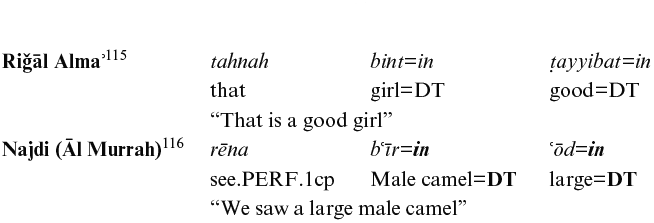
| Riǧāl AlmaʾFootnote 115 | tahnah | bint=in | ṭayyibat=in |
| that | girl=DT | good=DT | |
| “That is a good girl” | |||
| Najdi (Āl Murrah)Footnote 116 | rēna | bʿı̄r=in | ʿōd=in |
| see.PERF.1cp | Male camel=DT | large=DT | |
| “We saw a large male camel” | |||
And in fact, as we saw earlier, many modern dialects attest dialectal tanwı̄n on nouns outside of the confines of close juncture, such as (a)ḥad – the quintessential examples of this indefinite specific meaning – as well as adverbs. Perhaps whatever led to this semantic reanalysis was not predicated on a pausal distribution. Alternatively, the pausal distribution occurred and led to the reanalysis of the morpheme as an indefinite specific marker, but was re-introduced even in pausal position.
The data are therefore compatible with a scenario in which Christian authors used tanwı̄n ʾalif to write tanwı̄n where it occurred in their dialects, in which, just as in the ancestors of the modern dialects, morpho-syntactic case had broken down due to the loss of word-final short vowels, and the loss of phonemicity when followed by tanwı̄n. The main difference between the Christian varieties and the modern dialects in this scenario is the degree to which tanwı̄n still occurred to mark accusatives, which is much more common in the Christian texts than in modern corpora.
While there is much to commend this interpretation, it must be admitted that this difference could instead reflect a diglossic situation, wherein the Christian authors spoke varieties with tanwı̄n with a distribution more-or-less identical to the modern dialects, but wrote in a mix of their local dialects and another register that possessed a functional accusative case. However, the evidence suggests the other register was not a Classical-like one but rather was Old Hijazi. As we have already seen, the frequency of accusative marking, and indeed the tendency to mark certain canonically accusative roles relative to others, in the Christian MSS matches the trends in the early papyri from the very beginning of the Islamic period.Footnote 117 Further, as Al-Jallad showed,Footnote 118 a distinct cluster of Hijazi dialects, related to the variety reflected in early Arabic orthography,Footnote 119 and the Quranic Consonantal Text,Footnote 120 was adopted as a spoken variety in the ʾUmayyad period, and likely constituted the general target of the written register of the Levant as well. Thus, the papyrological and early Christian MSS, combined with the evidence from the Psalm Fragment, suggest together that the Hijazi dialects that provided the grammatical framework for early Islamic-era writing, continued to evolve, including the accusative/non-accusative case system, wherein adverbs were most robustly still marked accusative, while other accusatives were marked with relatively lower frequency. Eventually, descendants of Hijazi dialects lost accusative marking completely, though remnants of it are retained precisely in frozen adverbs, for example, marḥaba “hello,” etc.Footnote 121
In addition to the evidence from the distribution of the accusative on triptotic nouns, there is supporting evidence from the other categories of case marking that bear on the discussion. We now turn to each of these categories in turn.
2.2 Inflection of the al-ʾAsmāʾ al-Ḫamsah (“the Five Nouns”)
The so-called “five nouns” (Arabic al-ʾasmāʾ al-ḫamsah) inflect triptotically but, when in construct, this inflection is realized as a long vowel that is written even in unvocalized contexts. For example, the word ʾabun “a father (nom.),” where case inflection is expressed morpho-syntactically by the short u vowel would be written اب, with no representation of the case vowel consonantally. However, either ʾabū-hā “her father (nom.) or ʾabū fulān “the father of so-and-so (nom.)” – both of which manifest case inflection via long vowels – would be written ابوها and ابو فلان respectively in the consonantal spellings of the early Islamic period. A recent study of the early papyri by Kootstra-FordFootnote 122 found that the early papyri by and large inflect as expected based on the Proto-Arabic reconstruction, as well as inflection attested in the Quran, though the nominative form is likely in the process of generalization. Stokes studied the same category in the Gospel MSS studied here and identifies the same trends.Footnote 123 Table 11 presents data from the early papyri, based on Koostra’s study, as well as an updated analysis of the Gospel MSS, and now including SAr. 154 and BL 4950 as well.
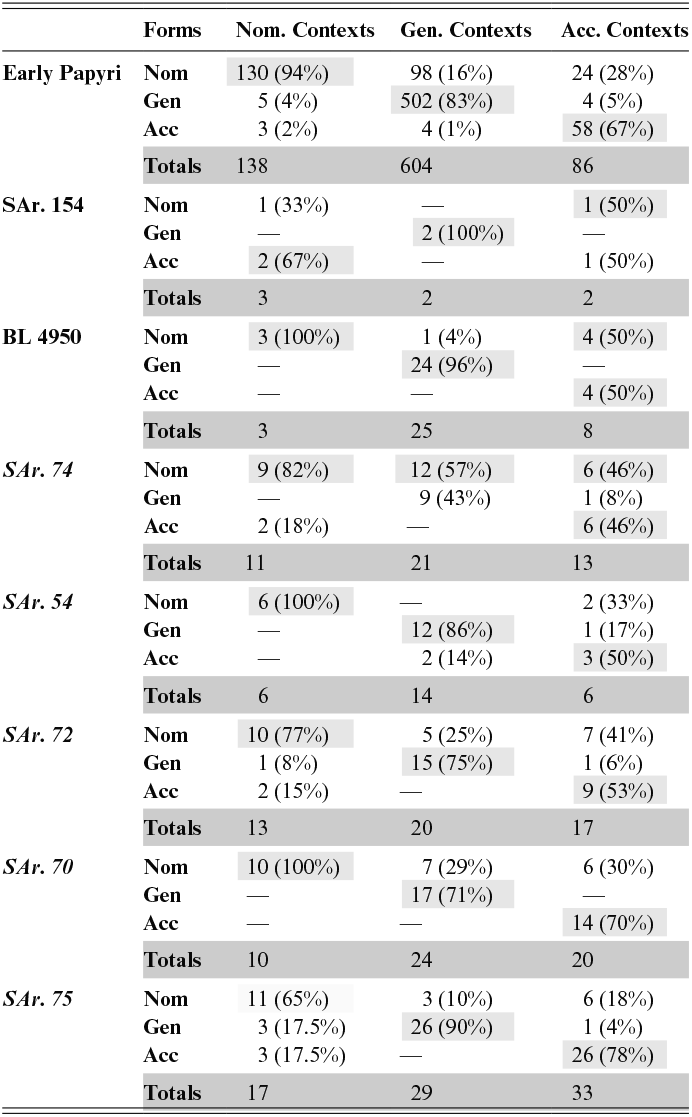
Table 11 Long description
Table showing the distribution of three spelling variants across nominative, genitive, and accusative contexts in manuscripts SAr. 154 and BL 4950. In SAr. 154, the third spelling accounts for all nominative contexts (4, 100%) and most genitive contexts (13, 65%), while the second spelling occurs in seven genitive contexts (35%) and both accusative contexts (2, 100%). In BL 4950, the third spelling dominates nominative contexts (4 of 5, 80%) and appears in six genitive contexts (46%), while the second spelling occurs in seven genitive contexts (54%). Totals are 4 nominative, 20 genitive, and 2 accusative contexts for SAr. 154, and 5 nominative and 13 genitive contexts for BL 4950.
As can be seen, the majority of examples inflect as expected, but with evidence of the generalization of nominative forms. This is seen statistically, and indeed in SAr. 74 the nominative form is the most likely to occur in each of the three syntactic contexts. As with tanwı̄n ʾalif (Section 2.1), there is a slight increase in the inflection of the accusative in accusative contexts in SAr. 70 and SAr. 75, both of which attest accusative forms 70+% of the time, and indeed are almost identical to the corpus of papyri studied by Kootstra.Footnote 124
2.3 Inflection of al-ʾAsmāʾ al-Mamdūdah (Āʾ-Final Nouns) + PN Suffix
Nominal forms that in Classical Arabic end in -āʾ originally terminated in a sequence of long ā and a final glide, that is, *-āy or *-āw (and in rare cases *-āʾ).Footnote 125 When in construct or with a suffixed pronoun, this sequence in the orthography of the Quran is spelled either with ʾalif + homorganic glide, indicating case, or simply with ʾalif regardless of case.Footnote 126 Thus, ǧazāʾuhum “their (nom) recompense” is spelled both جزاوهم at Q17:98, but ǧazāʾuhū “his (nom) recompense” is spelled جزاه at Q4:93. Likewise, duʿāʾihim “their (gen) prayer” is spelled دعايهم at Q46:5, but bi-duʿāʾika “in (my) supplication to you” is spelled بدعاك at Q19:4. Accusatives are only spelled with a single ʾalif. Thus, the accusative spelling is also an alternative spelling possibility of nominative and genitive forms, without necessarily indicating the absence of case.Footnote 127 As we can see in Table 12, both glides and glideless spellings occur across the Christian MSS, though with a distribution that requires further discussion.Footnote 128
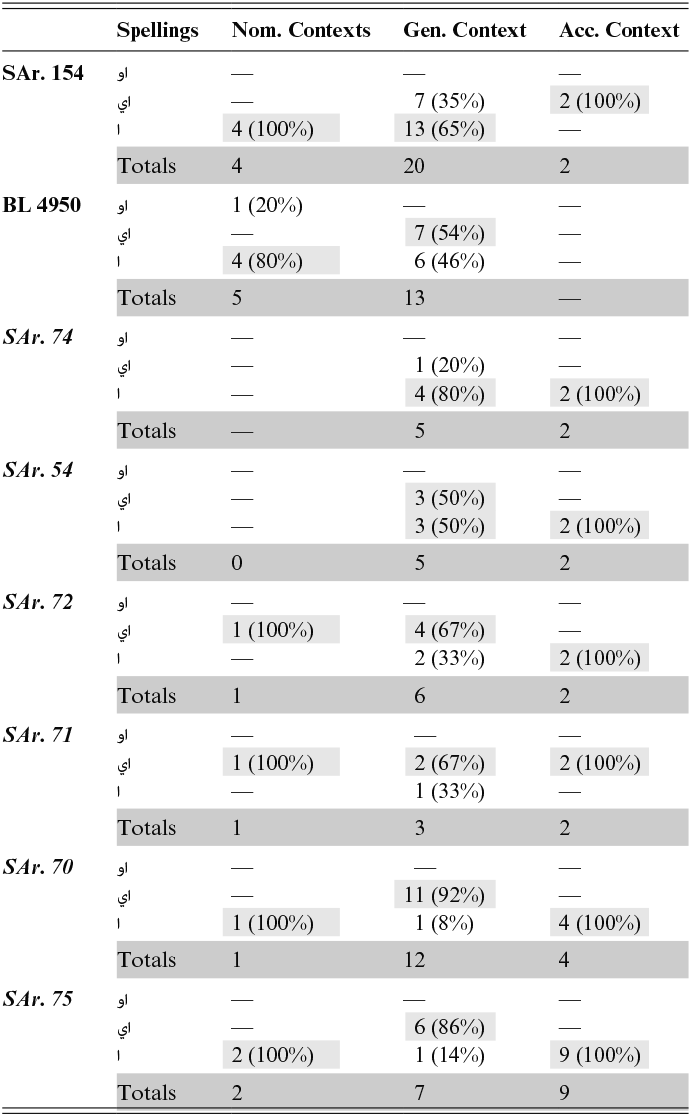
Table 12 Long description
Table cross-tabulating nominative and oblique forms against nominative and oblique grammatical contexts in manuscripts SAr. 154, BL 4950, SAr. 74, SAr. 54, SAr. 72, SAr. 70, and SAr. 75. Oblique forms are the majority in nearly all manuscripts and dominate oblique contexts, accounting for roughly 75–97% of occurrences. Nominative forms occur less frequently, ranging from about 3% to 29% depending on manuscript and context. Context totals range from 33 occurrences in SAr. 154 to 150 in SAr. 75. The table highlights the strong preference for oblique forms across the dataset.
The historical nominative spelling او only occurs once, in BL 4950; otherwise, only the glideless spelling and the historical genitive spelling اي occur, though both occur in each syntactic context, depending on the MS. Stokes put forward two possible interpretations to account for the use of اي in any context.Footnote 129 One is that اي here is connected to the frequent use of the same digraph as a hybrid spelling of glottal stop in the presence of /i/ or /ay/, even when no long ā was historically present.Footnote 130 This is most well-known from the spelling of *miʾah as مايه, but was widespread early on, especially in Quranic MSS, for example in: *šiʾta “you wanted” spelled شايت at Q18:77 and *šayʾ “thing” spelled شاي at Q18:23. The alternative is that it reflects the same merger mentioned earlier of case vowels *u,*i,*a to a high vowel close to (or equivalent with) /i/.Footnote 131 Given the data and discussion in Section 2.1, I suggest that the latter is the primary explanation. Interesting in this regard is the fact that, in some MSS (e.g., SAr. 72), only genitive and nominative contexts attest اي spellings, but accusative contexts attest only ا, whereas in others (e.g., SAr. 71), each of the three contexts attest اي:
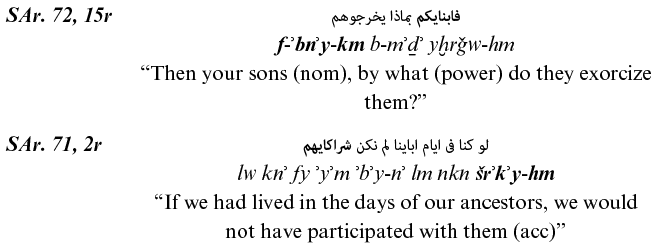
| SAr. 72, 15r | فابنايكم بماذا يخرجوهم |
| f-ʾbnʾy-km b-mʾḏʾ yḫrǧw-hm | |
| “Then your sons (nom), by what (power) do they exorcize them?” | |
| SAr. 71, 2r | لو كنا فى ايام اباينا لم نكن شراكايهم |
| lw knʾ fy ʾyʾm ʾbʾy-nʾ lm nkn šrʾkʾy-hm | |
| “If we had lived in the days of our ancestors, we would not have participated with them (acc)” |
Based on many modern dialects with tanwı̄n, it seems that high vowels merged first, followed subsequently by the final merger of accusative and non-accusative in most, though not all, dialects. In Christian MSS with a distinction between accusative and non-accusative contexts could reflect such a continued distinction, whereas the others reflect the final stage in which the realization of case vowels had completely merged:

| Non-Acc | Acc | |
| Stage 1 (SAr. 72) | *ʾābāʾi-hum | *ʾābāʾa-hum |
| Stage 2 (SAr. 71) | > ʾābāʾi-hum | |
In any event, the lack of nominative spellings in most MSS, coupled with the trend towards a generalization of the اي spelling, argues against pseudo-correction. I suggest that, when considered together, the evidence for triptotic case inflection points toward a system in the process of evolution from the Proto-Arabic one to the caseless modern dialectal tanwı̄n distribution. The question remains, however, whether the accusative functions reflect the retention of that case in living dialects of the scribes, or rather the interaction with a prestige variety. Before concluding, evidence from the categories of dual and sound masculine plural inflection must be considered.
2.4 Dual Inflection
Unlike the triptotic categories just discussed, dual inflection has mostly broken down relative to the Proto-Arabic inflectional system, with the oblique generalized to virtually every case. This pattern holds across the MSS, although once again SAr. 70 and SAr. 75 show an uptick in nominative inflection relative to the other MSS. The data for the corpus are provided in Table 13.
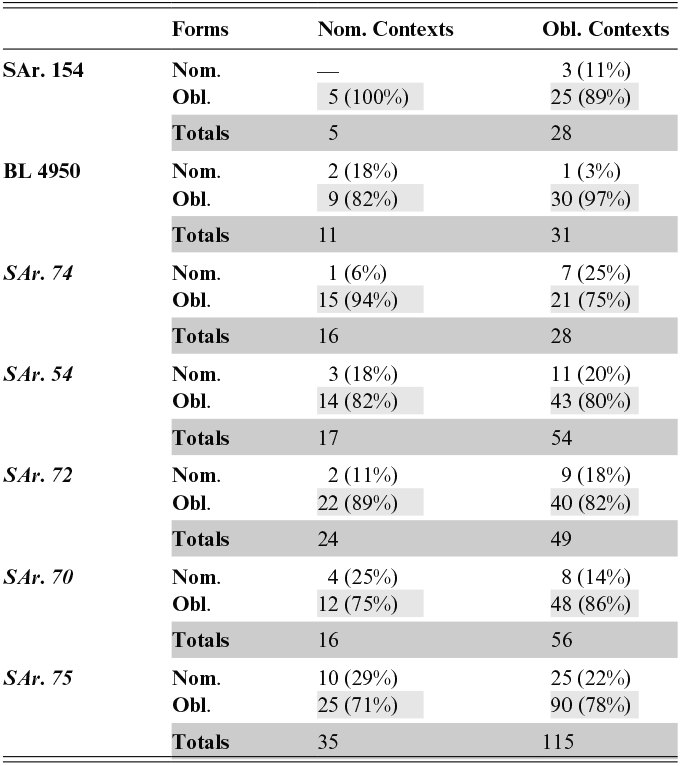
Table 13 Long description
Table cross-tabulating nominative and oblique forms against nominative and oblique contexts in Early Papyri, SAr. 154, BL 4950, SAr. 74, SAr. 72, SAr. 70, and SAr. 75. Oblique forms account for the vast majority of occurrences, typically exceeding 90% in both context types. Nominative forms are relatively rare, ranging from about 0% to 23% depending on manuscript and context. Early Papyri contain 36 nominative and 209 oblique contexts, while manuscript totals range from 97 contexts in SAr. 154 to 160 in SAr. 75. The table demonstrates the strong predominance of oblique forms throughout the corpus.
As we can see, most dual forms attested oblique inflection. In a minority of cases across the MSS, nominative forms occur, but these virtually always consist of the number اثنان ʾṯnʾn “two,” either on its own or as the first in the compound اثنا عشر ʾṯnʾ ʿšr “twelve.” Note the following examples:
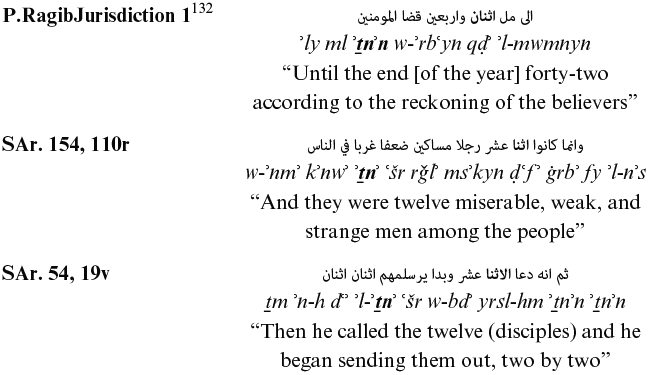
| P.RagibJurisdiction 1Footnote 132 | الى مل اثنان واربعين قضا المومنين |
| ʾly ml ʾṯnʾn w-ʾrbʿyn qḍʾ ʾl-mwmnyn | |
| “Until the end [of the year] forty-two according to the reckoning of the believers” | |
| SAr. 154, 110r | وانما كانوا اثنا عشر رجلا مساكين ضعفا غربا في الناس |
| w-ʾnmʾ kʾnwʾ ʾṯnʾ ʿšr rǧlʾ msʾkyn ḍʿfʾ ġrbʾ fy ʾl-nʾs | |
| “And they were twelve miserable, weak, and strange men among the people” | |
| SAr. 54, 19v | ثم انه دعا الاثنا عشر وبدا يرسلمهم اثنان اثنان |
| ṯm ʾn-h dʿʾ ʾl-ʾṯnʾ ʿšr w-bdʾ yrsl-hm ʾṯnʾn ʾṯnʾn | |
| “Then he called the twelve (disciples) and he began sending them out, two by two” |
The same phenomenon is attested in the early Arabic papyri from the seventh to the eighth centuries ce, where 36/40 (90%) of attested dual forms occur in the oblique form; only four nominative forms occur, and each of the four occur in oblique contexts.Footnote 133 Thus, the oblique form has been generalized to most contexts. The four exceptions are all the number “two,” written اثنان despite being in oblique position. Outside of this form, the fact that the dual suffix is consistently oblique, rather than randomly nominative or oblique, argues against pseudo-correction and points toward a variety or register (or varieties/registers) that lacked this aspect of Proto-Arabic case inflection. The archaic nominative for compounds of “two” reflect, I suggest, archaic relics, perhaps related to the common phrases of which it was a part (i.e., “the twelve” referring to the disciples; see further later). However, the increase in Proto-Arabic case inflection in SAr. 70 and SAr. 75, two of the later MSS, could indicate the increasing influence of a register with a more archaic pattern of case inflection.
2.5 Sound Masculine Plural Inflection
Sound masculine plural inflection in the Christian corpus reflects a generalized oblique in most contexts. As the data in Table 14 show, this is consistent across the manuscripts, and once again the Christian data align very closely with the trends evident in the corpus of early Islamic papyri.
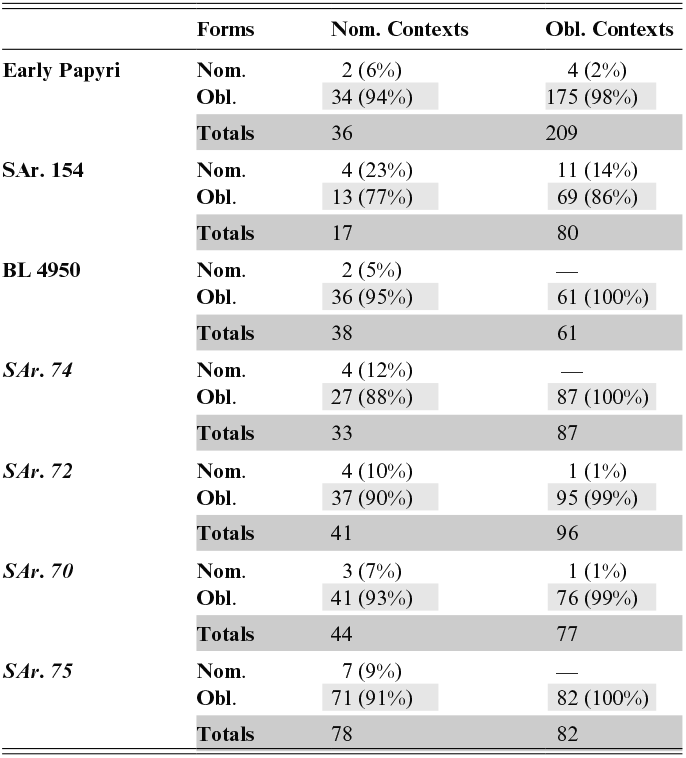
Table 14 Long description
Single-row comparison table illustrating the historical development of accusative marking. Three columns represent the Quran, an intermediate stage labeled “Evolution (Reflected in early Islamic writing),” and the Damascus Psalm Fragment. Under “Accusatives Marked,” the Quran shows marking in all contexts. The intermediate stage shows accusative marking retained consistently in adverbs while declining in non-adverbial contexts. The Damascus Psalm Fragment represents the final stage, where accusative marking is preserved only in adverbs. Greater-than symbols between columns indicate the direction of linguistic change over time.
Note: Data for papyri based once again on Kootstra-Ford, “Case inflection in the papyri,” 110–111.
Similar to the phenomenon of the generalized nominative of the numeral “two,” several MSS attest a generalized nominative form, regardless of syntax. This is especially the case in SAr. 154, where the oblique is attested everywhere except with the word hawāriyyūn “disciples,” which is always nominative.
As with the dual, the near-ubiquity of oblique forms and the lack of random nominative spellings, argue against the idea that scribes were attempting to write a variety in which the Proto-Arabic inflection was the norm. Unlike the trend with dual inflection, however, there was no uptick in nominative inflection in SAr. 70 and SAr. 75. The frozen nominative forms seem likeliest to be relics from a period during which sound masculine plural case inflection was still living. The fact that it was retained on words that were surely common, such as “disciples” here (and “the twelve” in the case of the dual) is reminiscent of the retention of archaic forms in English, as in, for example, “brethren” (instead of brothers) especially in religious contexts.
2.6 Discussion
Tanwı̄n ʾalif in the early Christian corpus studied here largely functions to mark accusative roles, with a minority in each MS marking a set of functions in non-accusative contexts as well, which recur consistently (though at different rates) across the MSS. While these have traditionally been considered pseudo-corrections due to Classical influence, it was argued earlier based on MS-internal evidence that pseudo-correction is unlikely to account for most of these non-accusative functions. Specifically, it was noted that the purported triggers (i.e., the presence of the particle *ʾinna, as well as kāna and similar verbs) relatively rarely (if ever) trigger tanwı̄n ʾalif in these cases. At the same time, due to the high degree of overlap between the non-accusative functions of tanwı̄n ʾalif on the one hand, and dialectal tanwı̄n in medieval and modern spoken Arabic on the other, it is quite probable that these reflect living usages of tanwı̄n in the dialects of the southern Levant at the time.
The question remains, however, whether all functions in which tanwı̄n ʾalif occur in the Christian corpus reflected this living usage, or primarily those in which parallels in the modern dialects also occur. While the most common syntagm in which dialectal tanwı̄n occurs in the modern dialects is on a noun when followed by an attributive adjective, a number of dialects attest it in a broader set of contexts, including adverbs. Intriguingly, it is sometimes the case that clearly non-standard adverbs attest -an, whereas non-adverbial functions with tanwı̄n attest -in, which appears to reflect an intermediate stage in which high vowels have merged but remained distinct from the low vowel, which continues the accusative (Indefinite – Stage 1). Elsewhere, dialectal adverbs are marked with -in (Indefinite – Stage 2). In both kinds of dialects, adverbs borrowed more recently from Standard Arabic are marked with -an. Returning to the Christian Arabic corpus, it is very possible to interpret the evidence as reflecting an earlier stage in the development of the system reflected in modern dialects, namely Indefinite – Stage 1 but where the accusative case remained more broadly functional longer than non-accusative cases, thought it was even there increasingly limited to adverbs.
While this scenario accounts for most of the data, several aspects of the data nevertheless hint at the presence of a diglossic situation. The most compelling of these pieces of linguistic evidence are 1) an increase in the inflection of the dual in the later MSS SAr. 70 and SAr. 75, and 2) an increase in non-adverbial accusative functions marked with tanwı̄n ʾalif, again in SAr. 70 and SAr. 75 (Table 15).
| MS | Direct Object | Predicate of kān (etc.) | Subject of *ʾinna | Dual Nominative |
|---|---|---|---|---|
| Papyri | 60% | 74% | 50% | 0% |
| SAr. 154 | 40% | 14% | — | 0% |
| BL 4950 | 55% | 46% | 20% | 18% |
| SAr. 74 | 18% | 22% | 0% | 6% |
| SAr. 54 | 30% | 31% | 0% | 18% |
| SAr. 72 | 18% | 42% | 0% | 11% |
| SAr. 71 | 17% | 29% | 0% | N/A |
| SAr. 70 | 72% | 75% | 50% | 25% |
| SAr. 75 | 70% | 83% | 92% | 29% |
In addition to the linguistic data, in the present scenario in which ʾalif was used to write tanwı̄n, the mere writing of this manifestation of tanwı̄n would reflect a kind of diglossia. Classical orthography, of course, adopts the same principle – using ا to write accusative an in pre-pausal position – but a clear difference: The ʾalif tanwı̄n was used to write only accusatives, which is the function it marked in the grammar of the Quran, which ultimately formed the basis of Classical orthography. If indeed the reconstruction of a dialectal tanwı̄n-like phonetic development had occurred in the varieties attested in the Christian corpus, then underlying in being written also with ʾalif tanwı̄n shows a modification of a writing tradition that was prestigious enough to use without modification. Otherwise, the Christian scribes might simply have spelled nouns with a dialectal tanwı̄n-like in (whatever its exact phonetic realization) with final ن. That they did not suggests either an equivalence between Hijazi accusative ā and tanwı̄n, perhaps due to the fact that accusative -an was still distinct and functional, or otherwise that scribes were increasingly aware of the ʿArabiyyah tradition, which attested tanwı̄n and made use of the ʾalif tanwı̄n to write it (albeit only in accusative contexts). If awareness of tanwı̄n and Classical orthographic patterns was indeed becoming widespread, it might have been in the context of Quranic recitation, rather than, for example, qaṣı̄dah poetry or the like. In any event, the difference between tanwı̄n in the ʿArabiyyah tradition and the varieties of Christian scribes could have prompted various approaches to using ʾalif tanwı̄n, from a fairly conservative approach (reflected perhaps in SAr. 154 and BL 4950), and more liberal ones, reflected especially in SAr. 75, where ʾalif tanwı̄n is used abundantly for both accusative and nominative contexts.
Given these data, and in light of the foregoing discussion, how might we conceptualize the nature of the diglossic context in which these MSS were composed? I suggest that a likely scenario involves a situation in which adverbs and the non-accusative usages of tanwı̄n ʾalif in the MSS reflect the living system, more or less identical to the Najdi-like modern dialects with dialectal tanwı̄n. The use of tanwı̄n ʾalif to mark canonically accusative roles, such as direct objects, predicates of kān, etc., on the other hand, reflect an acrolect associated with the Hijazi dialects that stood behind the early Islamic writing tradition, reflected in the early papyri and inscriptions.Footnote 134 Importantly, comparison with early papyri suggests that the writing system, while perhaps conservative relative to the spoken Hijazi dialects adopted by many in the Levant in the ʾUmayyad period, nevertheless reflected an evolution of the kind of Hijazi variety based on early Islamic writing in the Quranic Consonantal Text, which retained accusative inflection on indefinite nouns in all canonically accusative positions. The Damascus Psalm Fragment, which attests indefinite accusative (without tanwı̄n) only on frozen adverbs, sits at the other end of the spectrum of Hijazi varieties (Table 16).
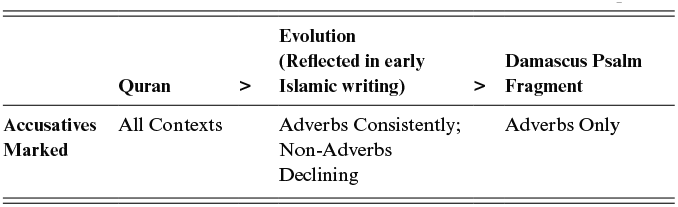
Table 16 Long description
Table comparing accusative marking between BL4950 and SAr. 72, with p-values indicating statistical significance. Overall, BL4950 marks 124 of 191 eligible accusatives (65%), compared with 180 of 336 (54%) in SAr. 72 (p = 0.0172). For dual forms, nominatives are marked in 18% and 11% of cases, while oblique forms are marked in 97% and 87%, respectively. For masculine plurals, nominative marking is low (5% and 10%), whereas oblique marking is nearly universal at 100% and 99%. Most subgroup comparisons are not statistically significant.
It is possible, then, that Christian authors wrote in a mix of their dialectal Arabic, with dialectal tanwı̄n, and the kind of evolved Hijazi Arabic typical of early Islamic writing.
If this diglossic scenario is correct, then what do we make of SAr. 70 and SAr. 75? While it is possible that these scribes were attempting to write a more archaic Hijazi variety, perhaps imitating the Quran more explicitly, there is another possibility that should be considered. It appears that, by the late ninth and into the tenth centuries ce, the case system typical of the qaṣı̄dah poetic corpus had become more widely prestigious, and indeed was associated not only with poetry but also Quranic recitation as well.Footnote 135 The increase in canonically accusative roles in SAr. 70 and SAr. 75 could, therefore, reflect an increasing awareness of – and interaction with – this emerging prestige register. Indeed, the practice of the scribe responsible for SAr. 75 to mark a wide range of nominative and accusative functions with tanwı̄n ʾalif can be interpreted not as reflecting ignorance of standard orthography and grammar, but rather an early attempt to use Hijazi writing practice, which had developed to write a variety that lacked nominative and genitive indefinite case + tanwı̄n, with the only orthographic tool for marking tanwı̄n at all, namely tanwı̄n ʾalif.
Finally, it is worth pointing out that a comparison between theological treatises and early gospels suggests a register difference, reflecting perhaps a different approach to composing these two different genres. Note, for example, that SAr. 154 and BL 4950 both attest noticeable higher rates of marking non-adverbial accusatives than the early gospels. It is in fact in the marking of non-adverbial accusatives that we notice a difference between two texts copied by the same scribe, BL 4950 and SAr. 72, both copied by Stephen of Ramla (Table 17).
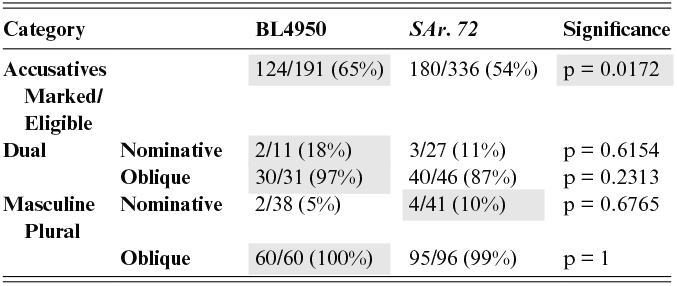
Table 17 Long description
Comparative linguistic table showing reconstructed perfect and imperfect verb forms in Proto-Semitic, Proto-Central Semitic, and Proto-Arabic. Rows include preterite (Arabic jussive/apocopate), subordinate forms, imperfective forms, and injunctive forms (Arabic subjunctive). The table traces changes in verbal morphology, highlighting retained forms, relic forms, and altered endings such as -u, -ū, -a, and -na. Proto-Central Semitic and Proto-Arabic generally preserve several Proto-Semitic patterns while simplifying or reanalyzing others. Boldface emphasizes endings considered characteristic or diagnostic for particular stages of development.
Note that there is a statistically significant increase in accusatives marked with tanwı̄n ʾalif in BL 4950 relative to the gospel MS SAr. 72. Dual nominative inflection is likewise more common in the former than the latter, although the difference was far from significant. Thus, I tentatively suggest that the early gospel MSS, written for local communities of monks and lay congregations, were intentionally written in a register close to the spoken one, whereas the theological treatises targeted a higher Hijazi register, although one still not distant from the spoken language. Finally, SAr. 70 and SAr. 75 interacted with a more archaic register, possibly the newly emerging ʿArabiyyah, at least in terms of case marking. Nevertheless, even those scribes freely incorporated local, non-ʿArabiyyah features. There is no reason to assume that the manifestations of case reflect an attempt to write totally in a written, non-local register; instead, I argue that authors combined features from different registers in proportions reflecting their audiences and purposes. We will see similar trends in verbal mood, to which we now turn.
3 Verbal Mood Inflection
Based on evidence from Akkadian (East Semitic) as well as the Modern South Arabian and Ethio-Semitic languages (West Semitic), it is clear that Proto-Semitic possessed two finite verbal forms, one with gemination of the middle consonant yi-kattvb, which marked non-past events, and another without such gemination yi-ktvb, often dubbed the preterite, which marked past events.Footnote 136 Subordinate verbs were marked by a suffixed -u when ending in a consonant, and possibly, -na when ending in a vowel.Footnote 137 The only mood distinguished morphologically was the imperative; otherwise, mood was determined syntactically or by prefix.Footnote 138 Arabic, along with a sub-group of other languages including Hebrew, Aramaic, Ugaritic, and Sabaic, is characterized by a significant innovation vis-a-vis this Proto-Semitic verbal system, wherein the historical preterite form was adopted as the new imperfective verb. This preterite form was augmented by two vowels to distinguish mood, so that yaqtul-u / yaqtulū-na marked the indicative and yaqtul-a / yaqtulū functioned to mark subordinate verbs, as well as (in Ugaritic) and injunctive, and in Arabic, a subjunctive.Footnote 139 The development from the Proto-Semitic verbal tense-aspect-mood system to that characterized by Arabic et al, which together are called Central Semitic languages, is shown in Table 18.Footnote 140
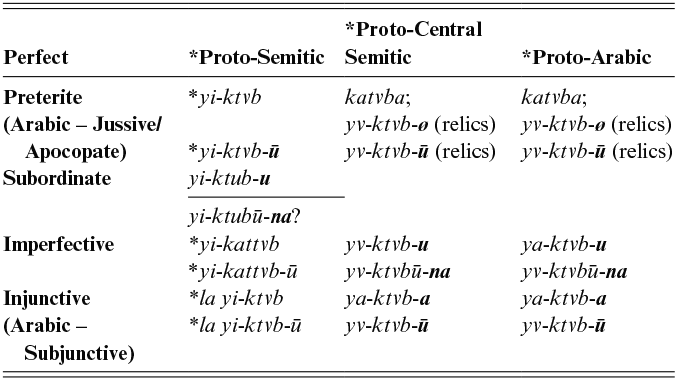
Table 18 Long description
Table organizing Arabic verb conjugations by grammatical person and number (third masculine singular, second feminine singular, and third masculine plural), root type (strong, II-Y/W, and III-Y/W), and mood (indicative, subjunctive, and jussive/apocopate). Strong roots generally retain the same stem across moods, while weak roots show vowel or final-consonant changes, especially in jussive forms. For the second feminine singular and third masculine plural, indicative forms end in -n, whereas subjunctive and jussive forms share a reduced ending without -n. The table highlights systematic mood-related changes and the distinct behavior of weak roots.
This morpho-syntactic modal system is attested in the ʿArabiyyah tradition from which Classical and Modern Standard Arabic were drawn and, based on the comparative data, can be easily reconstructed to Proto-Arabic. Thus, the ancestors of all subsequent varieties of Arabic, including the ancestors of the modern dialects, come ultimately from an ancestor characterized by this system. Unfortunately, a comprehensive and historically sensitive syntax of the Classical Arabic corpus remains a desideratum of the field. As it stands now, the distribution of modal forms is typically held to be syntactically determined, with subjunctive and jussive/apocopate forms triggered by either context or a prefix (presented in Table 19), whereas speaker attitude/stance is generally held to play little role in which form is used, only syntax.
| Mood | Contexts | Prefix |
|---|---|---|
| Subjunctive | Following ʾan; Following lan | li- (intentive or purposive) |
| Jussive/Apocopate | Protasis / Apodosis of Conditional Sentences; Following lam(mā) | (fa)-li (indirect commands) |
However, while the contexts in which the jussive/apocopate forms in the ʿArabiyyah seem to have been relatively consistent, the same context could trigger either indicative and subjunctive, depending on modal significance, a fact that should, I argue, impact the analysis of various phenomena attested in the Christian corpus. For example, while typically the subordinating particle ʾan does indeed trigger the subjunctive, early on an imperfective could be indicative or subjunctive, depending on the semantics of the sentence: If purposive, then the subjunctive was used; otherwise, the indicative could occur:

| أُريدُ أَنْ أَنَامَ | أَعْلَمُ أَنْ يَنَامُ |
| ʾurı̄du ʾan ʾanāma | ʾaʿlamu ʾan yanāmu |
| “I want to sleep” | “I know that he is sleeping” |
A similar distinction is true of other particles, for example, for ḥattā “until (that).”Footnote 141 Occasionally, the dynamics of syntactic versus modal considerations led to disagreements in grammatical sensibilities. One place where such disagreement is amply attested is in the Quranic reading traditions (qirāʾāt). Although the canonical readers are canonical in part due to their faithfulness to the ʿUtˍmaˉnic recension and thus do not disagree over the modal inflection of 2fsg and 3/2mpl forms, which are indicated in the consonantal text, there is nevertheless disagreement over whether verbal forms that can be read either indicative or subjunctive. The most famous such case is the reading of كن فكون “be! And it will be” (Q2:117, Q3:59, Q19:35), the second verb of which is typical read as indicative, that is, kun fa-yakūnu, but is read by Ibn ʿAmir as subjunctive, that is, kun fa-yakūna. The formal debate among grammarians and readers was over whether the fa- here is the so-called fa al-sababiyyah, “the causal fa,” which introduces the subjunctive, or not.Footnote 142 However, the underlying distinction is clearly over whether the subsequent action was contingent, and thus subordinate, or not.
There are other examples in which the modal distinction of a particular verse was interpreted differently by different readers, despite the syntax being clear.Footnote 143 This disagreement shows up in manuscripts, and editions based thereon, of other texts as well. For example, in Al-Sarı̄ʿ’s edition of Al-Farrāʾ’s (d. 824 ce/209 ah) Kitāb fı̄h Luġāt al-Qurʾān,Footnote 144 the editor regularly standardizes the verbal mood of the manuscript on which his edition is based. For example, on page 8, the manuscript has the following:
فكَرِهوا أن يفتَحوا الياءَ، فَتصِحَّ الواوُ، فتكونُ في بعضِه واوًا، وفي بعضِه ياءً
fa-karihū ʾan yaftaḥū l-yāʾa f-taṣiḥḥa l-wāwu fa-takūnu fı̄ baʿḍi-hı̄ wāwan wa-fı̄ baʿḍi-hı̄ yāʾan
“For they disliked to put fatḥah before the wāw [of the root wǧl in imperfect forms like **yawǧal], since the wāw is correct, with the result that in some [conjugations] there was would a wāw, and in some others it would be yāʾ”
Al-Sarı̄ʿ, however, changes the indicative to subjunctive, that is, فتكونَ fa-takūna, interpreting the meaning as subordinate, as the previous verb taṣiḥḥa. It is likely that the indicative was the result of a phenomenon noted by scholars such as Ibn Khalawayh (d. 980 ce/370 ah), wherein the more coordinations occur, the greater the tendency for “the Arabs” (al-ʿarab) to revert to indicative.Footnote 145 Thus, even within the ʿArabiyyah and associated traditions, mood and speaker attitude played roles more significant than is typically recognized.
Outside of the ʿArabiyyah, the morphological distinction between moods broke down gradually, at least in part prompted and aided by the same loss of final short vowels that affected the nominal case system (see Section 2). In Safaitic, for example, the loss of word-final high vowels led to the merger of the indicative and jussive forms, at least for the strong verb, while the subjunctive remained marked by final -a.Footnote 146 The evidence from the Quranic Consonantal text suggests a system in which modal distinction was lost on the strong verb when ending in a short vowel (e.g., 3/2ms, 1cs, etc.), as well as weak verbs; the same indicative/non-indicative distinction reconstructible for Proto-Arabic continued (Table 20).
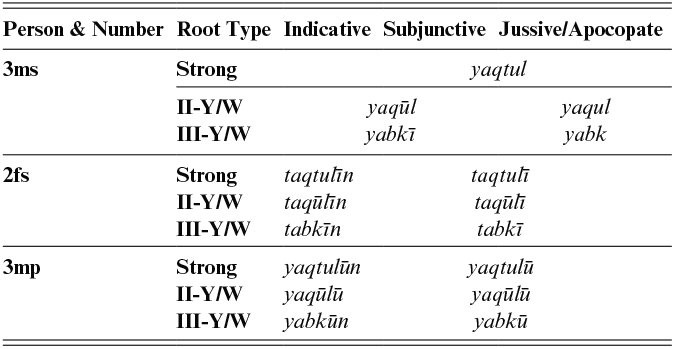
Table 20 Long description
Table organizing Arabic verb conjugations by grammatical person and number (third masculine singular, second feminine singular, and third masculine plural), root type (strong, II-Y/W, and III-Y/W), and mood (indicative, subjunctive, and jussive/apocopate). Strong roots generally retain the same stem across moods, while weak roots show vowel or final-consonant changes, especially in jussive forms. For the second feminine singular and third masculine plural, indicative forms end in -n, whereas subjunctive and jussive forms share a reduced ending without -n. The table highlights systematic mood-related changes and the distinct behavior of weak roots.
Note: Based on discussions in Stokes and Van Putten, “Case in the Quranic Consonantal Text,” and expanded further in Van Putten, Quranic Arabic, 182–192.
In such a system, the primary inflection categories for roots ending in a consonant are with weak verbs, whether long (historically indicative and subjunctive) or short (historically jussive/apocopate) form. For roots ending in a long vowel, the alternation was between the form with and without the nasal, that is, indicative versus non-indicative. The development from a Quranic distribution to the modern dialects, then, eventually involved two generalizations: the long form of weak roots in most (not all!)Footnote 147 dialects, and the generalization of either the form with or without nasal on 2fs and 3/2mp forms (Table 21).
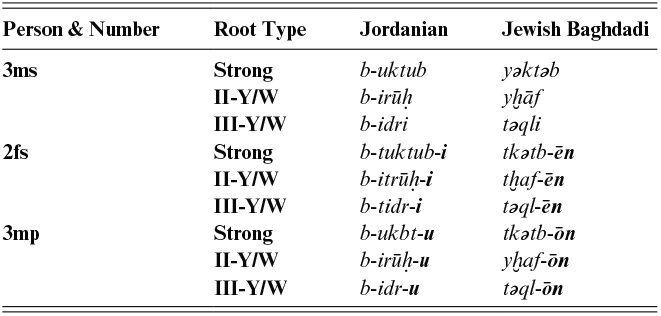
Table 21 Long description
Table cross-tabulating indicative and non-indicative forms against indicative and non-indicative contexts in eight manuscripts: SAr. 154, BL 4950, SAr. 74, Vat. Borg. Ar. 95, SAr. 72, SAr. 71, SAr. 70, and SAr. 75. Indicative contexts are dominated by indicative forms, typically accounting for 82–91% of occurrences. Non-indicative contexts generally favor non-indicative forms, ranging from 39% to 73% depending on the manuscript. Total observations range from 88 in BL 4950 to 479 in SAr. 75. The table also highlights the strongest correspondence between grammatical context and verb form, indicating a consistent relationship across the corpus.
Note: Jordanian based on Herin and Al-Wer, Grammar of Jordanian Arabic, §3.4. Jewish Baghdadi based on Mansour, “Baghdad Arabic Jewish,” 237–239. Note that the reflexes of the vowels of the 2fs and 3mp reflect *ay > ē and *aw > ō, perhaps by way of the generalization of the forms of the III-Y/W roots, or otherwise a secondary diphthongization.
However, the details of that process are so far unknown. Modal distinctions now are accomplished through a number of elements, including syntax and, in many dialects, verbal prefixes.Footnote 148
In the remainder of this section, I will review the evidence for those modal distinctions that are detectable in the unvocalized Arabic orthography of the early Islamic period. This includes: 1) indicative versus non-indicative inflection on 2fs and 2/3mp forms (Section 3.1), and 2) long versus short spellings of jussives/apocopates, as well as, with 2ms, imperatives of II-Y/W and III-Y/W weak roots (Section 3.2). The discussion will begin with a breakdown of the data by comparing attested forms and in which syntactic contexts. The basis of comparison will be the Proto-Arabic system, and the syntactic contexts identified earlier based on the ʿArabiyyah, as well as Quranic, early Islamic papyri and inscriptions, and modern dialectal evidence. Section 3.3 will discuss the data from both synchronic and diachronic perspectives.
3.1 Indicative versus Non-indicative Inflection
Each of the MSS in the corpus under investigation attests both indicative and non-indicative forms, the vast majority of which occur where expected based on the Proto-Arabic system described earlier. However, in each MS there is at least a minority of morphological forms that occur outside what can be considered canonically indicative and non-indicative contexts. Before analyzing the data, it is worth distinguishing the present approach from the regnant paradigm on which subsequent studies have been based. BlauFootnote 149 and HopkinsFootnote 150 both treat verbal mood as essentially binary; that is, either reflecting a Classical-like inflection, or rather the total generalization of one or the other forms. Blau specifically believed that the total breakdown of mood had occurred already in the early Islamic period, before these MSS were composed. Thus, for Blau, non-Classical instances of indicative versus non-indicative are seen as reflecting a dialect when these line up with such a scenario; otherwise, he considers them pseudo-corrections. The premise here and throughout is different. My assumption is rather that it is a priori likely that, in the evolution from Proto-Arabic mood to the distribution attested in the modern dialects there were stages in which mood was retained, but in ways that presage the ultimate generalization of one or the other mood. Further, there is no reason to expect it to have happened already. Therefore, the best way to proceed is to fully document the data, including quantitative and qualitative analyses, and rely on all Arabic and typological evidence to determine whether the data can be fitted into that general pattern of evolution. Only if they cannot should we appeal to pseudo-correction, especially when, as has already been noted in Sections 1 and 2, there is little evidence for the existence and ubiquity of a standardized norm. It is on this basis that the data are presented and analyzed hereafter.
The data and discussion in Section 3.1 complement and expand on that presented by Stokes.Footnote 151 Specifically, the data from the Gospel MSS are updated based on differing interpretations of some examples, and both SAr. 154 and BL 4950 are added. These combined data are presented in Table 22.
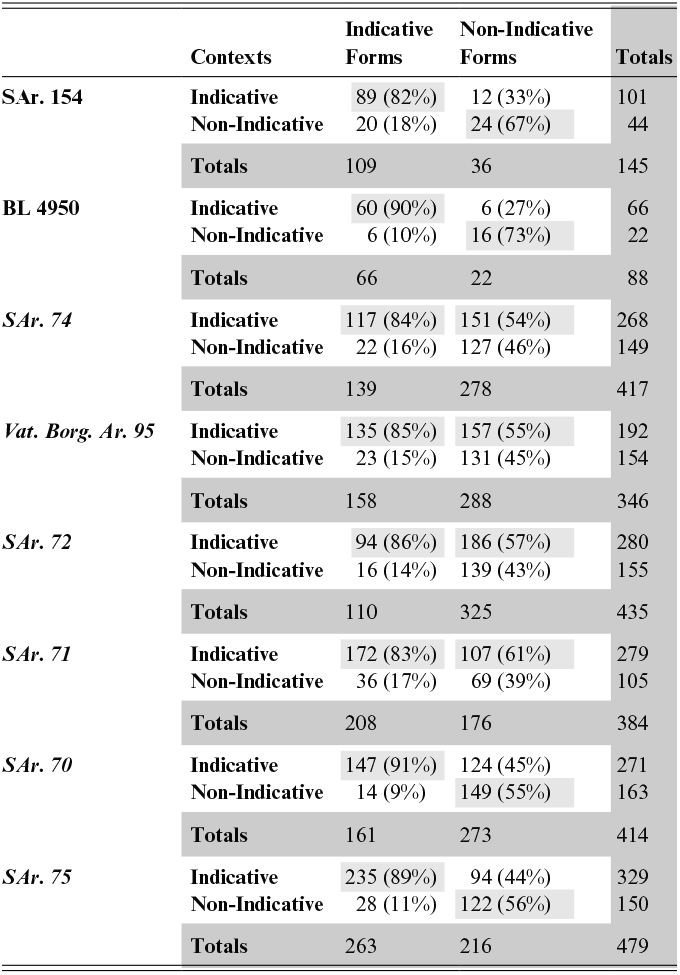
Table 22 Long description
Table showing the distribution of indicative and non-indicative imperfect verb forms across eight manuscripts and eight syntactic environments: main verbs, kān/ṣār/badaʾa plus imperfect, future with sa(wfa), circumstantial clauses, syndetic and asyndetic relative clauses, interrogatives, and negated imperfects. Early manuscripts such as SAr. 154 and BL 4950 generally show high proportions of indicative forms, often exceeding 90% in main and relative clauses. Later manuscripts display greater variation, with non-indicative forms frequently predominating in future, interrogative, and negated constructions. Totals for individual constructions range from a single example to more than 120 occurrences, revealing differing degrees of mood marking across contexts and manuscript traditions.
The most salient and important point to make based on these data is that, in general, the non-indicative occurring in canonically indicative contexts is much more common than indicative forms in non-indicative contexts. Indeed, in half of the MS, the non-indicative form is the most common one, regardless of syntactic context. On the other hand, there is no MS in which indicative forms are more common than non-indicative ones in non-indicative contexts. Thus, against Blau,Footnote 152 the gospel MSS from Kashouh’s Family A do not reflect a generalized indicative; in fact, the opposite process appears to be in progress.
The distribution of non-indicative forms is not even across syntactic context. In some contexts, there is variation from MS to MS, whereas, in others, the trend toward one or the other modal form is consistent. I have included in Table 23 a breakdown of modal forms by the major contexts that I consider to be uncontroversially indicative from the perspective of the Proto-Arabic system reconstructed earlier. I have thus omitted a small number of examples from each MS which are debatable, and it is for that reason that the numbers in the following tables (both Tables 23 and 24) do not always equal the total from Table 22.
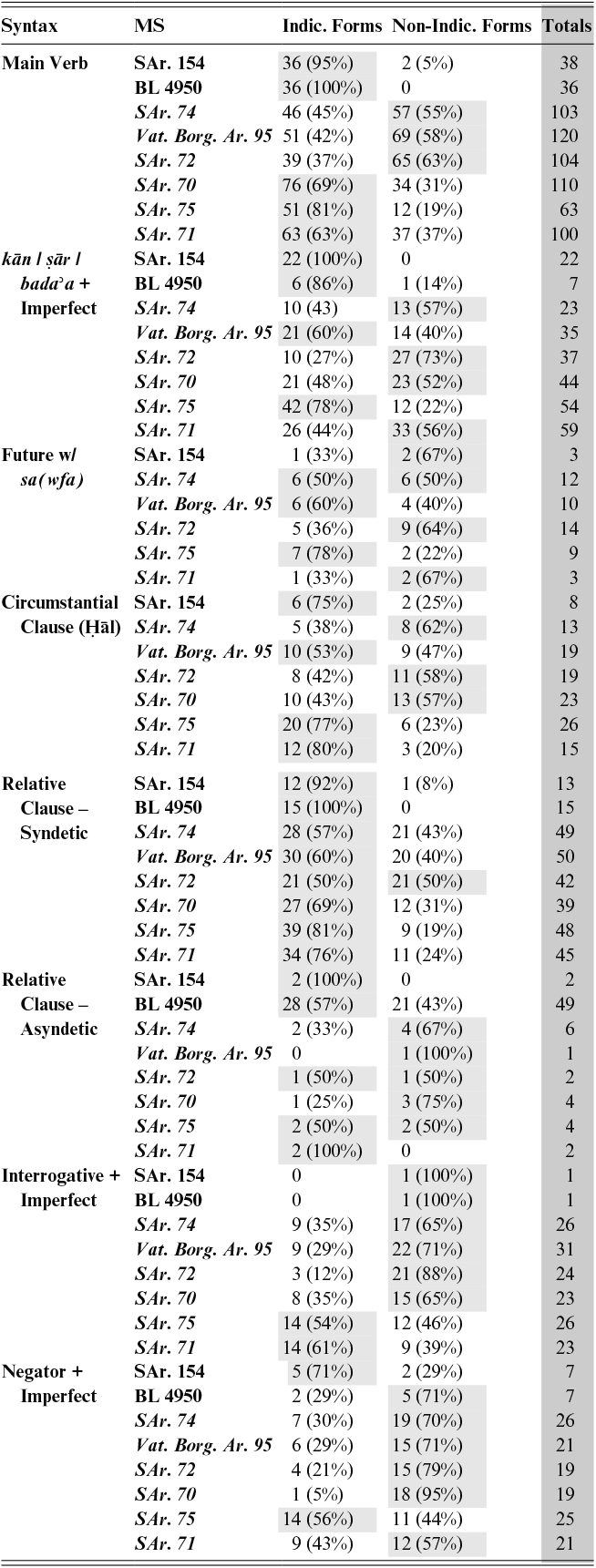
Table 23 Long description
Table showing distributions of indicative and non-indicative imperfect verb forms across subordinate constructions in eight manuscripts. Contexts include complements with and without ʾan, purposive clauses introduced by li, likay, ʾallā, and li-ʾallā, negated imperatives with lā, and clauses introduced by ḥattā. Non-indicative forms dominate most environments, often accounting for 75–97% of occurrences, particularly in complements, purposive clauses, and negated imperatives. Some manuscripts, especially SAr. 154 and SAr. 71, retain higher proportions of indicative forms in selected constructions. Sample sizes vary from a single occurrence to more than 30 examples per context.
Despite the variation in terms of the percent of each form in the various contexts, a spectrum nevertheless emerges with syndetic relative clauses the likeliest to trigger indicative modal forms on one end, and interrogative and negated verbal clauses on the other, likeliest to trigger non-indicative forms.
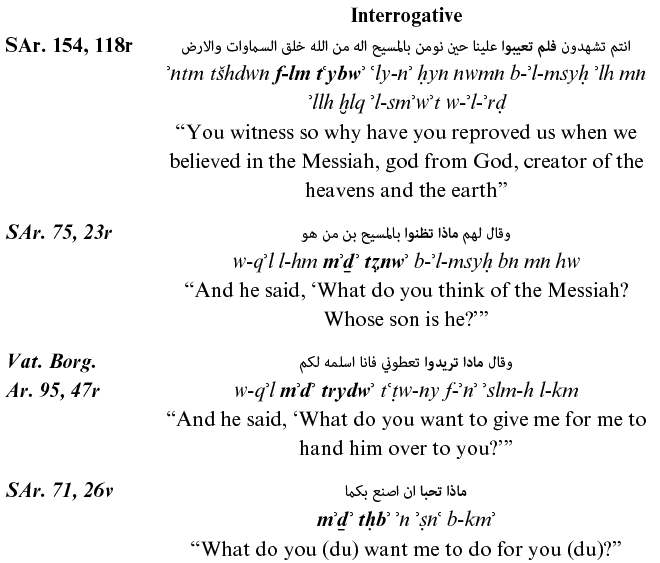
| Interrogative | |
| SAr. 154, 118r | انتم تشهدون فلم تعيبوا علينا حين نومن بالمسيح اله من الله خلق السماوات والارض |
| ʾntm tšhdwn f-lmtʿybwʾ ʿly-nʾ ḥyn nwmn b-ʾl-msyḥ ʾlh mn ʾllh ḫlq ʾl-smʾwʾt w-ʾl-ʾrḍ | |
| “You witness so why have you reproved us when we believed in the Messiah, god from God, creator of the heavens and the earth” | |
| SAr. 75, 23r | وقال لهم ماذاتظنوا بالمسيح بن من هو |
| w-qʾl l-hm mʾḏʾtẓnwʾ b-ʾl-msyḥ bn mn hw | |
| “And he said, ‘What do you think of the Messiah? Whose son is he?’” | |
| Vat. Borg. Ar. 95, 47r | وقال ماداتريدوا تعطوني فانا اسلمه لكم |
| w-qʾl mʾdʾtrydwʾ tʿṭw-ny f-ʾnʾ ʾslm-h l-km | |
| “And he said, ‘What do you want to give me for me to hand him over to you?’” | |
| SAr. 71, 26v | ماذاتحبا ان اصنع بكما |
| mʾḏʾtḥbʾ ʾn ʾṣnʿ b-kmʾ | |
| “What do you (du) want me to do for you (du)?” |
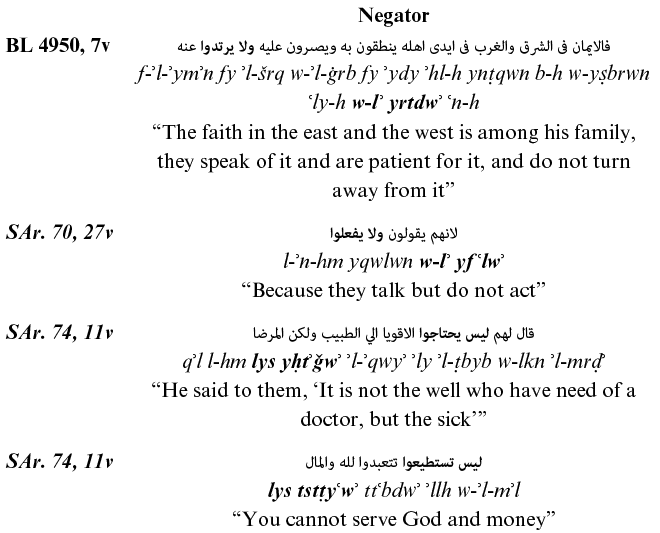
| Negator | |
| BL 4950, 7v | فالايمان فى الشرق والغرب فى ايدى اهله ينطقون به ويصىرون عليه ولايرتدوا عنه |
| f-ʾl-ʾymʾn fy ʾl-šrq w-ʾl-ġrb fy ʾydy ʾhl-h ynṭqwn b-h w-yṣbrwn ʿly-h w-lʾ yrtdwʾ ʿn-h | |
| “The faith in the east and the west is among his family, they speak of it and are patient for it, and do not turn away from it” | |
| SAr. 70, 27v | لانهم يقولون ولايفعلوا |
| l-ʾn-hm yqwlwn w-lʾ yfʿlwʾ | |
| “Because they talk but do not act” | |
| SAr. 74, 11v | قال لهم ليسيحتاجوا الاقويا الي الطبيب ولكن المرضا |
| qʾl l-hm lys yḥtʾǧwʾ ʾl-ʾqwyʾ ʾly ʾl-ṭbyb w-lkn ʾl-mrḍʾ | |
| “He said to them, ‘It is not the well who have need of a doctor, but the sick’” | |
| SAr. 74, 11v | ليستستطيعوا تتعبدوا لله والمال |
| lyststṭyʿwʾ ttʿbdwʾ ʾllh w-ʾl-mʾl | |
| “You cannot serve God and money” |
The greatest variation is in the various main verb (and circumstantial) contexts. In the theological treatises SAr. 154 and BL 4950, main verb contexts are overwhelmingly indicative, as expected. This is also true of SAr. 75. In the other gospel MSS, the split is roughly even. The inclusion of a preceding perfective such as kān, ṣār, and so on, has been hypothesized to increase the likelihood of the non-indicative occurring, and indeed there is a general decline in the number of indicative forms when preceded by a perfective, thereby creating a past habitual or inchoative meaning:
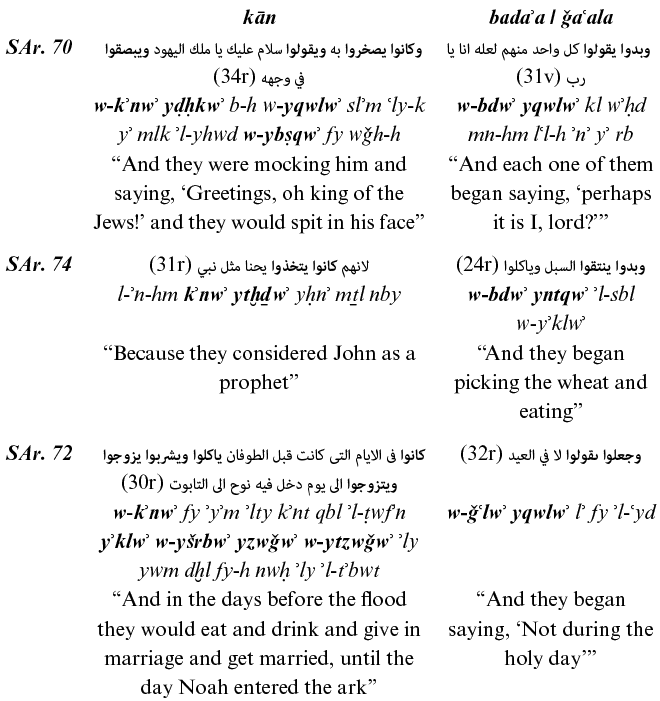
| kān | badaʾa/ǧaʿala | |
| SAr. 70 | وكانوايصخروا به ويقولوا سلام عليك يا ملك اليهود ويبصقوا(34r) في وجهه | وبدوايقولوا كل واحد منهم لعله انا يا(31v) رب |
| w-kʾnwʾ yḍḥkwʾ b-h w-yqwlwʾ slʾm ʿly-k yʾ mlk ʾl-yhwd w-ybṣqwʾ fy wǧh-h | w-bdwʾ yqwlwʾ kl wʾḥd mn-hm lʿl-h ʾnʾ yʾ rb | |
| “And they were mocking him and saying, ‘Greetings, oh king of the Jews!’ and they would spit in his face” | “And each one of them began saying, ‘perhaps it is I, lord?’” | |
| SAr. 74 | (31r) لانهم كانوايتخذوا يحنا مثل نبي | (24r) وبدواينتقوا السبل وياكلوا |
| l-ʾn-hm kʾnwʾ ytḫḏwʾ yḥnʾ mṯl nby | w-bdwʾ yntqwʾ ʾl-sbl w-yʾklwʾ | |
| “Because they considered John as a prophet” | “And they began picking the wheat and eating” | |
| SAr. 72 | كانوا فى الايام التى كانت قبل الطوفان ياكلواويشربوايزوجوا(30r) ويتزوجوا الى يوم دخل فيه نوح الى التابوت | (32r) وجعلواىقولوا لا في العيد |
| w-kʾnwʾ fy ʾyʾm ʾlty kʾnt qbl ʾl-ṭwfʾn yʾklwʾw-yšrbwʾ yzwǧwʾ w-ytzwǧwʾ ʾly ywm dḫl fy-h nwḥ ʾly ʾl-tʾbwt | w-ǧʿlwʾ yqwlwʾ lʾ fy ʾl-ʿyd | |
| “And in the days before the flood they would eat and drink and give in marriage and get married, until the day Noah entered the ark” | “And they began saying, ‘Not during the holy day’” |
The future tense, when marked by sa(wfa), often patterns more or less with other non-past main verbs. However, when main clause verbs are categorized by tense, those referencing the future are indicative less often than verbs with present/contemporaneous time reference:Footnote 153
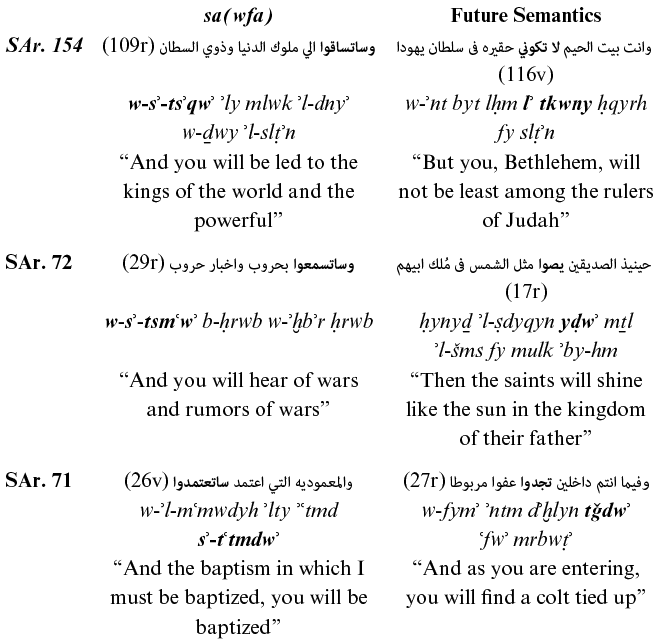
| sa(wfa) | Future Semantics | |
| SAr. 154 | (109r) وساتساقوا الي ملوك الدنيا وذوي السطان | وانت بيت الحيم لاتكوني حقيره فى سلطان يهودا(116v) |
| w-sʾ-tsʾqwʾ ʾly mlwk ʾl-dnyʾ w-ḏwy ʾl-slṭʾn | w-ʾnt byt lḥm lʾ tkwny ḥqyrh fy slṭʾn | |
| “And you will be led to the kings of the world and the powerful” | “But you, Bethlehem, will not be least among the rulers of Judah” | |
| SAr. 72 | (29r) وساتسمعوا بحروب واخبار حروب | حينيذ الصديقين يصوا مثل الشمس فى مُلك ابيهم(17r) |
| w-sʾ-tsmʿwʾ b-ḥrwb w-ʾḫbʾr ḥrwb | ḥynyḏ ʾl-ṣdyqyn yḍwʾ mṯl ʾl-šms fy mulk ʾby-hm | |
| “And you will hear of wars and rumors of wars” | “Then the saints will shine like the sun in the kingdom of their father” | |
| SAr. 71 | (26v) والمعموديه التي اعتمد ساتعتمدوا | (27r) وفيما انتم داخلين تجدوا عفوا مربوطا |
| w-ʾl-mʿmwdyh ʾlty ʾʿtmd sʾ-tʿtmdwʾ | w-fymʾ ʾntm dʾḫlyn tǧdwʾ ʿfwʾ mrbwṭʾ | |
| “And the baptism in which I must be baptized, you will be baptized” | “And as you are entering, you will find a colt tied up” |
The earlier distribution is, I argue, indicative of a system in which syntax is still by and large determinative of the modal form used, but where modal distinctions that reflect “the grammaticalization of speakers’ (subjective) attitudes and opinions” above an action or event (Palmer Reference Palmer1986: 16).Footnote 154 It is also clear, however, that the process of the generalization of the non-indicative modal form to all contexts is underway.Footnote 155 At the risk of oversimplification, we can note that the contexts in which the indicative forms occur in these MSS most consistently are those in which speaker certainty about the event are highest, for example in syndetic relative clauses that modify a definite head, and the contexts in which they least consistently occur are those with lowest speaker certainty, namely interrogative and negated clauses. Buttressing this analysis are not only the typological parallels, but, importantly, modern dialectal ones. In those dialects that have a morphological means of expressing modal distinction – typically by the use of a prefix on indicative forms and the lack of one to indicate the subjunctive – these latter contexts are precisely those canonically indicative contexts where the bare, non-indicative imperfective is frequently found.Footnote 156 Note the following examples in interrogative contexts:
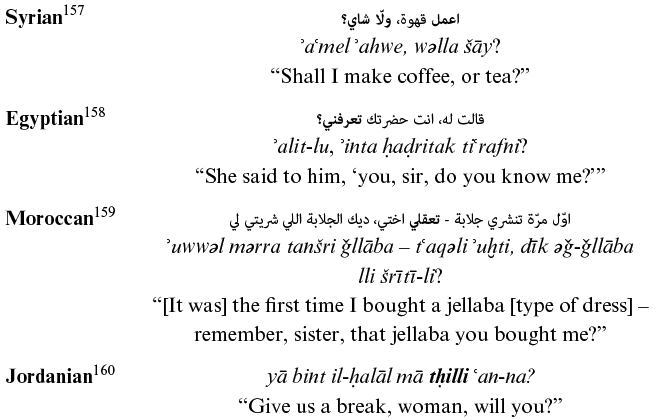
| SyrianFootnote 157 | اعمل قهوة، ولّا شاي؟ |
| ʾaʿmel ʾahwe, wəlla šāy? | |
| “Shall I make coffee, or tea?” | |
| EgyptianFootnote 158 | قالت له، انت حضرتك تعرفني؟ |
| ʾalit-lu, ʾinta ḥaḍritak tiʿrafni? | |
| “She said to him, ‘you, sir, do you know me?’” | |
| MoroccanFootnote 159 | اوّل مرّة تنشري جلابة - تعقلي اختي، ديك الجلابة اللي شريتي لي |
| ʾuwwəl mərra tanšri ǧllāba – tʿaqəli ʾuḫti, dı̄k əǧ-ǧllāba lli šrı̄tı̄-li? | |
| “[It was] the first time I bought a jellaba [type of dress] – remember, sister, that jellaba you bought me?” | |
| JordanianFootnote 160 | yā bint il-ḥalāl mā tḥilli ʿan-na? |
| “Give us a break, woman, will you?” |
In each case, some modal nuance is involved, whether expressing a wish on the part of the speaker, or a lack of commitment to the event due to considerations such as politeness, and, as in the case of the Egyptian and Moroccan examples, are related dynamics at play with verbs of knowing, remembering, thinking, and so on.Footnote 161
The variation in the modal form of main clause verbs, which seems to correlate, albeit inconsistently, with tense, is likewise paralleled by various modern dialectal phenomena. Cross-linguistically, both the futureFootnote 162 and past habituals (though not, typologically, past progressives) are marked with non-indicative forms.Footnote 163 Here again, modern dialects provide parallels. The future in these dialects is expressed with the bare imperfective, rather than the indicative, though this is often related to the grammaticalization of the future marker. Interestingly, imperfectives expressing past habitual and progressive, often involve the bare imperfect:Footnote 164
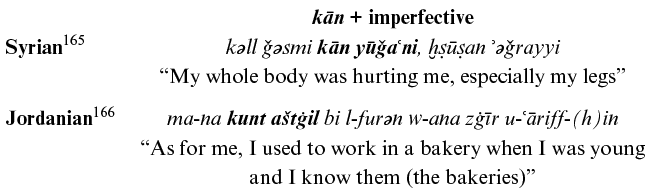
| kān+ imperfective | |
| SyrianFootnote 165 | kəll ǧəsmi kānyūǧaʿni, ḫṣūṣan ʾəǧrayyi |
| “My whole body was hurting me, especially my legs” | |
| JordanianFootnote 166 | ma-na kuntaštġil bi l-furən w-ana zġı̄r u-ʿāriff-(h)in |
| “As for me, I used to work in a bakery when I was young and I know them (the bakeries)” |
In dialects of northern Jordan, the bare imperfect is used as a past progressive even when not following kān:
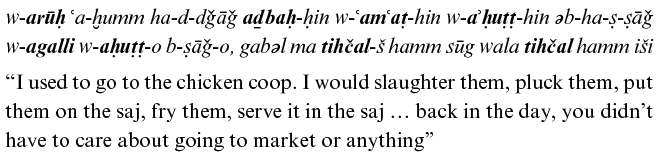
| w-arūḥ ʿa-ḫumm ha-d-dǧāǧ aḏbaḥ-ḥin w-ʿamʿaṭ-hin w-aʾḥuṭṭ-hin əb-ha-ṣ-ṣāǧ w-agalli w-aḥuṭṭ-o b-ṣāǧ-o, gabəl ma tihčal-š hamm sūg wala tihčal hamm iši |
| “I used to go to the chicken coop. I would slaughter them, pluck them, put them on the saj, fry them, serve it in the saj … back in the day, you didn’t have to care about going to market or anything” |
I argue, then, that while the observations of BlauFootnote 167 et al that non-indicatives tend to follow perfectives is correct, it is not for the reason they claim, namely, the influence of the nūn-less plural on the suffix conjugation. Instead, it is because of this tendency for imperfectives with past tense reference to be non-indicative. To be clear, there are obviously differences between the ancient and modern corpora, and indeed each corpus exhibits internal variation. The present argument is merely that both reflect the same trends, though with different morphological components (i.e., historical indicative/non-indicative or bare + bi-marked imperfective).
Indicative forms in canonically non-indicative contexts, though relatively uncommon, nevertheless do also occur. Unlike the case with non-indicatives, however, in virtually every MS these constitute a minority. The data are provided in Table 24.
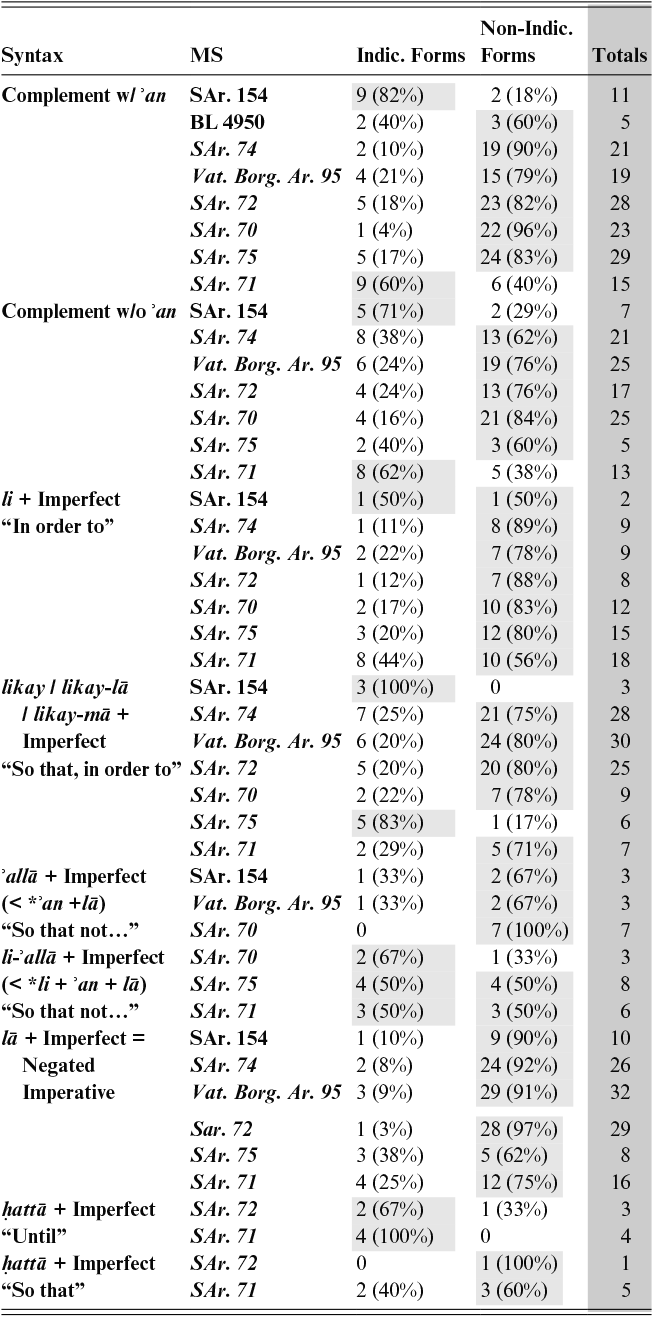
Table 24 Long description
Table presenting frequencies and percentages of preserved forms in jussive and imperative constructions for II-Y/W and III-Y/W weak-root verbs across eight manuscripts. Jussive II-Y/W roots show higher rates, ranging from 25% to 85%, while III-Y/W roots are consistently lower, ranging from 0% to 37%. Imperative II-Y/W forms also show relatively high retention, reaching 100% in SAr. 75, whereas imperative III-Y/W forms range from 0% to 50%. BL 4950 and SAr. 75 display some of the highest retention rates overall. Highlighted cells emphasize the generally stronger preservation of II-Y/W root patterns compared with III-Y/W roots.
Several of these categories reflect variation that is, in fact, at home in the ʿArabiyyah itself. For example, as noted earlier, the particle ʾan can trigger either the indicative or subjunctive, depending on the semantics and speaker attitude. The examples from the Christian MSS in which the indicative occurs frequently aligns with this distinction:
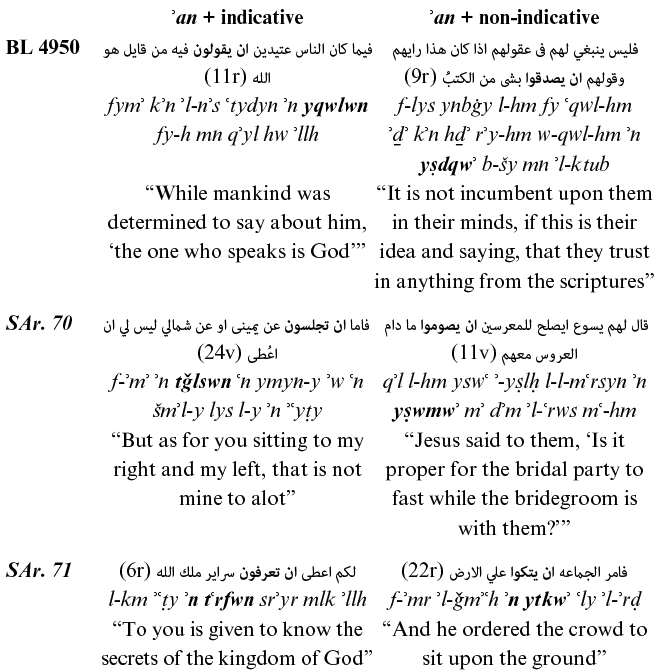
| ʾan+ indicative | ʾan+ non-indicative | |
| BL 4950 | فيما كان الناس عتيدين انيقولون فيه من قايل هو (11r) الله | فليس ينبغي لهم فى عقولهم اذا كان هذا رايهم (9r) وقولهم انيصدقوا بشى من الكتبُ |
| fymʾ kʾn ʾl-nʾs ʿtydyn ʾn yqwlwn fy-h mn qʾyl hw ʾllh | f-lys ynbġy l-hm fy ʿqwl-hm ʾḏʾ kʾn hḏʾ rʾy-hm w-qwl-hm ʾn yṣdqwʾ b-šy mn ʾl-ktub | |
| “While mankind was determined to say about him, ‘the one who speaks is God’” | “It is not incumbent upon them in their minds, if this is their idea and saying, that they trust in anything from the scriptures” | |
| SAr. 70 | فاما ان تجلسون عن يمينى او عن شمالي ليس لي ان (24v) اعُطى | قال لهم يسوع ايصلح للمعرسين ان يصوموا ما دام (11v) العروس معهم |
| f-ʾmʾ ʾn tǧlswn ʿn ymyn-y ʾw ʿn šmʾl-y lys l-y ʾn ʾʿyṭy | qʾl l-hm yswʿ ʾ-yṣlḥ l-l-mʿrsyn ʾn yṣwmwʾ mʾ dʾm ʾl-ʿrws mʿ-hm | |
| “But as for you sitting to my right and my left, that is not mine to alot” | “Jesus said to them, ‘Is it proper for the bridal party to fast while the bridegroom is with them?’” | |
| SAr. 71 | (6r) لكم اعطى ان تعرفون سراير ملك الله | (22r) فامر الجماعه ان يتكوا علي الارض |
| l-km ʾʿṭy ʾntʿrfwn srʾyr mlk ʾllh | f-ʾmr ʾl-ǧmʾʿh ʾnytkwʾ ʿly ʾl-ʾrḍ | |
| “To you is given to know the secrets of the kingdom of God” | “And he ordered the crowd to sit upon the ground” |
Another context where the variation in Christian MSS is paralleled by variation in the early ʿArabiyyah tradition is following the particle ḥattā, which when functioning as a conjunction meaning “until” can be followed by the indicative as well as the subjunctive, especially in SAr. 72:
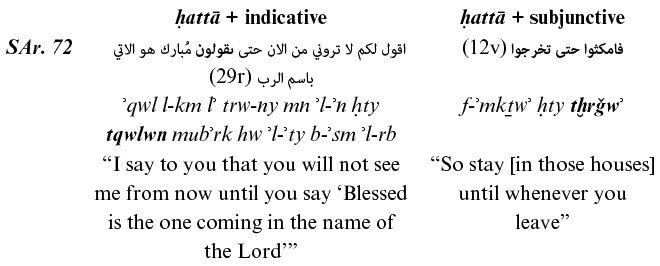
| ḥattā+ indicative | ḥattā+ subjunctive | |
| SAr. 72 | اقول لكم لا تروني من الان حتى ىقولون مُبارك هو الاتي (29r) باسم الرب | (12v) فامكثوا حتى تخرجوا |
| ʾqwl l-km lʾ trw-ny mn ʾl-ʾn ḥty tqwlwn mubʾrk hw ʾl-ʾty b-ʾsm ʾl-rb | f-ʾmkṯwʾ ḥty tḫrǧwʾ | |
| “I say to you that you will not see me from now until you say ‘Blessed is the one coming in the name of the Lord’” | “So stay [in those houses] until whenever you leave” |
In these two examples, the difference seems to be speaker attitude toward the event, since in the first, a definitive event is expected (those seeing the Son of Man when he comes), whereas the other is undefined, translated “whenever.” The same distribution is attested for li-kay-mā, which, as in the ʿArabiyyah, can trigger either the indicative or subjunctive:
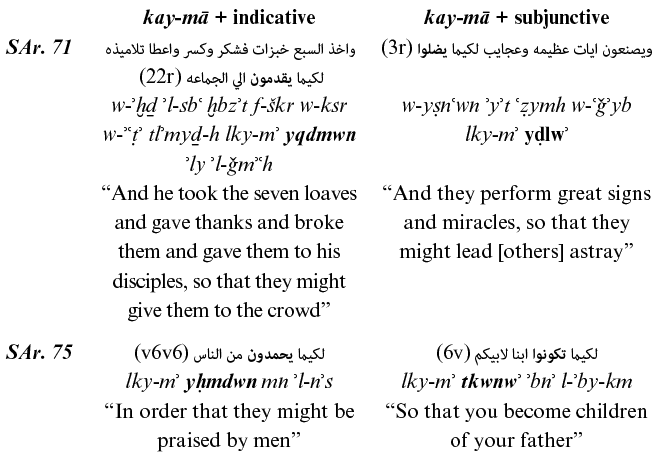
| kay-mā+ indicative | kay-mā+ subjunctive | |
| SAr. 71 | واخذ السبع خبزات فشكر وكسر واعطا تلاميذه (22r) لكيما يقدمون الي الجماعه | (3r) ويصنعون ايات عظيمه وعجايب لكيما يضلوا |
| w-ʾḫḏ ʾl-sbʿ ḫbzʾt f-škr w-ksr w-ʾʿṭʾ tlʾmyḏ-h lky-mʾ yqdmwn ʾly ʾl-ǧmʾʿh | w-yṣnʿwn ʾyʾt ʿẓymh w-ʿǧʾyb lky-mʾ yḍlwʾ | |
| “And he took the seven loaves and gave thanks and broke them and gave them to his disciples, so that they might give them to the crowd” | “And they perform great signs and miracles, so that they might lead [others] astray” | |
| SAr. 75 | (v6v6) لكيما يحمدون من الناس | (6v) لكيما تكونوا ابنا لابيكم |
| lky-mʾ yḥmdwn mn ʾl-nʾs | lky-mʾ tkwnwʾ ʾbnʾ l-ʾby-km | |
| “In order that they might be praised by men” | “So that you become children of your father” |
The variation in the Christian MSS in these contexts especially is explicable within the kind of variation that is hinted at in the corpora and grammatical discussions that formed the basis of the ʿArabiyyah.
The indicative modal form also occurs in a minority of cases where the evidence from the ʿArabiyyah, as well as the modern dialects, unanimously points toward the non-indicative as the typical modal form. These contexts include li + subjunctive as a purposive (“let …”), (li-)ʾallā + subjunctive to express negative purpose “so that not.” A large number of the verbs involved are from III-Y/W roots (including *III-ʾ that like merged with the former category):
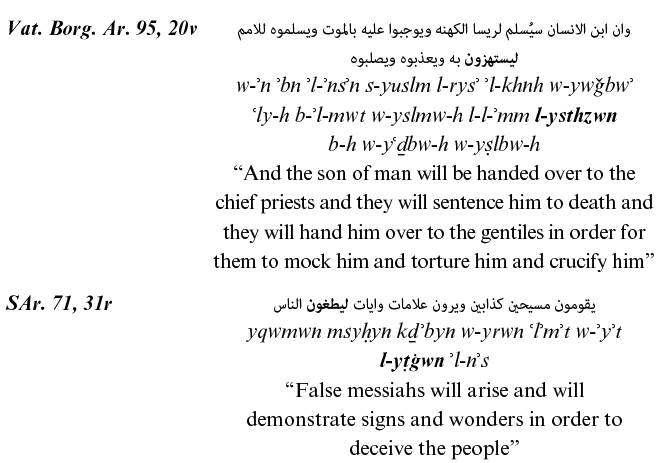
| Vat. Borg. Ar. 95, 20v | وان ابن الانسان سيُسلم لريسا الكهنه ويوجبوا عليه بالموت ويسلموه للامم ليستهزون به ويعذبوه ويصلبوه |
| w-ʾn ʾbn ʾl-ʾnsʾn s-yuslm l-rysʾ ʾl-khnh w-ywǧbwʾ ʿly-h b-ʾl-mwt w-yslmw-h l-l-ʾmm l-ysthzwn b-h w-yʿḏbw-h w-yṣlbw-h | |
| “And the son of man will be handed over to the chief priests and they will sentence him to death and they will hand him over to the gentiles in order for them to mock him and torture him and crucify him” | |
| SAr. 71, 31r | يقومون مسيحين كذابين ويرون علامات وايات ليطغون الناس |
| yqwmwn msyḥyn kḏʾbyn w-yrwn ʿlʾmʾt w-ʾyʾt l-yṭġwn ʾl-nʾs | |
| “False messiahs will arise and will demonstrate signs and wonders in order to deceive the people” |
The same is frequently the case with verbs that follow lā and express the negative imperative:Footnote 168
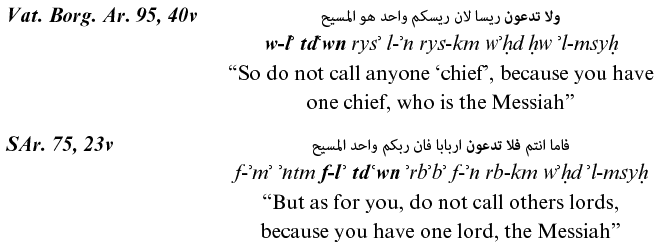
| Vat. Borg. Ar. 95, 40v | ولاتدعون ريسا لان ريسكم واحد هو المسيح |
| w-lʾ tdʿwn rysʾ l-ʾn rys-km wʾḥd ḥw ʾl-msyḥ | |
| “So do not call anyone ‘chief’, because you have one chief, who is the Messiah” | |
| SAr. 75, 23v | فاما انتم فلاتدعون اربابا فان ربكم واحد المسيح |
| f-ʾmʾ ʾntm f-lʾ tdʿwn ʾrbʾbʾ f-ʾn rb-km wʾḥd ʾl-msyḥ | |
| “But as for you, do not call others lords, because you have one lord, the Messiah” |
It is possible that III-Y/W roots for some reason tended to attract historical indicative morphology, regardless of syntax. Finally, instances of li + subjunctive that attest the indicative mood often involve non-initial verbs in a series where each carries a purposive intent but only the first verb is explicitly marked with li:
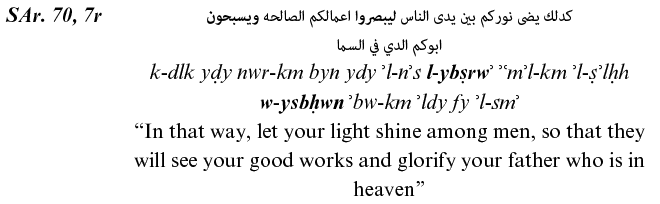
| SAr. 70, 7r | كدلك يضى نوركم بين يدى الناس ليبصروا اعمالكم الصالحه ويسبحون ابوكم الدي في السما |
| k-dlk yḍy nwr-km byn ydy ʾl-nʾs l-ybṣrwʾ ʾʿmʾl-km ʾl-ṣʾlḥh w-ysbḥwn ʾbw-km ʾldy fy ʾl-smʾ | |
| “In that way, let your light shine among men, so that they will see your good works and glorify your father who is in heaven” |
This is reminiscent of the tendency, noted explicitly by Ibn Khalawayh (and cited earlier), for verbs in a series of conjoined ones farther from the initial verb to revert to the indicative, despite the same modal meaning.
In sum, I argue that the data from the corpus can be most parsimoniously seen as reflecting a living stage in the development from the Proto-Arabic modal system to the one attested in those modern dialects in which the historical non-indicative has been generalized to every context. While this process is underway, both modal and, in the case of III-Y/W roots, morphological factors still affected the distribution of indicative versus non-indicative in many contexts. The modal considerations specifically have parallels in modern dialects that possess a (historically different) means of distinguishing indicative and non-indicative moods. However, another aspect of the synchronic description of the modal system, namely the status of the jussive/apocopate, constitutes an important part of the diachronic analysis of the modal system attested in the corpus.
3.2 Apocopate and Imperative Inflection
The Arabic jussive/apocopate reflects the Proto-Semitic perfect, and indeed this is reflected in the fact that it is primarily used after lam(mā) to negate the past tense, as well as conditional/irrealis contexts, and in 3rd person volitional contexts. Due to the nature of Arabic orthography, the jussive/apocopate is only distinguishable from the subjunctive on verbs from II-Y/W and III-Y/W roots, where, due to a historical rule that dispreferred overlong syllables (CVVC), forms like *yaqūl and *yamšiy reduced to yaqul and yamši, respectively. These were spelled short (i.e., يقل and يمش) in the Hijazi writing system that spread due to its use in the Quran and became the system used to write Arabic in the early Islamic empire thereafter. Scholars of early Arabic have long noted the existence of both short and long spellings of these roots in jussive contexts, with both يقل and يقول as well as يمش and يمشي occurring. Scholars have ubiquitously held that the long forms reflect the underlying loss of the jussive/apocopate as a distinct form, with short spellings reflecting historical ones and long spellings living ones.Footnote 169 However, other than Blau’s impression that short spellings are more common with imperatives than jussives/apocopates, only one attempt to quantify and analyze the distribution of long versus short spellings has yet been undertaken.Footnote 170 The discussion here builds on that one, adding data and further integrating the jussive/apocopate category into the synchronic and diachronic analysis of the modal system of the early Christian Arabic corpus.
Both short and long spellings of jussives/apocopates as well as imperatives occur in each of the MSS included in the present corpus. In some MSS, short spellings are in general more common, but in others the long spellings are more common. The data for the whole corpus are given in Table 25.
| Short Spellings | Long Spellings | Totals | |
|---|---|---|---|
| SAr. 154 | 23 (51%) | 30 (49%) | 53 |
| BL 4950 | 36 (71%) | 15 (29%) | 51 |
| SAr. 74 | 10 (15%) | 56 (85%) | 66 |
| Vat. Borg. Ar. 95 | 15 (25%) | 47 (75%) | 62 |
| SAr. 72 | 37 (49%) | 39 (51%) | 76 |
| SAr. 70 | 22 (48%) | 26 (52%) | 48 |
| SAr. 71 | 30 (68%) | 14 (32%) | 44 |
| SAr. 75 | 56 (68%) | 27 (32%) | 83 |
The MSS were overall split, with four MSS attesting long spellings in general more frequently than short spellings, and the other four the opposite. There is, however, an interesting distinction early on between the theological treatises from the eighth and ninth centuries ce on the one hand, and the early Gospel MSS, like SAr. 74, Vat. Borg Ar. 95, and even SAr. 72 and SAr. 70 on the other. There is an uptick in short spellings in SAr. 71 and SAr. 75, likely two of the later MSS composed.
As we have already noted, Blau offered the impressionistic claim that imperatives were relatively more likely to attest short spellings than jussives/apocopates.Footnote 171 Stokes showed that this was true for some, though not all MSS.Footnote 172 The data broken down to compare imperatives versus jussives/apocopates for the corpus is provided in Table 26, including updated data for the MSS included by Stokes,Footnote 173 as well as, for the first time, data for SAr. 154 and BL 4950.
| Imperatives | Jussives/Apocopates | |
|---|---|---|
| SAr. 154 | 3/3 (100%) | 18/45 (40%) |
| BL 4950 | 4/5 (80%) | 31/46 (67%) |
| SAr. 74 | 8/35 (23%) | 10/66 (15%) |
| Vat. Borg. Ar. 95 | 11/34 (32%) | 15/62 (24%) |
| SAr. 72 | 13/38 (34%) | 37/76 (47%) |
| SAr. 70 | 12/24 (50%) | 22/48 (46%) |
| SAr. 71 | 4/10 (40%) | 30/44 (68%) |
| SAr. 75 | 27/40 (68%) | 56/83 (68%) |
Blau’s impression is shown to hold true for five of the eight manuscripts, though SAr. 72 and SAr. 71 both attest the opposite, and SAr. 75 is basically equally likely to spell weak verbs short in each context. Here again, the early theological treatises SAr. 154 and BL 4950, attest a much more Quranic trend than the Gospel MSS, and indeed both attest a higher percentage of short spellings of imperatives than is attested even in the latest Gospel MSS, which, as we have seen, tend to use short spellings more frequently than the early Gospel MSS do.
The data can be meaningfully broken down in two further ways. First, it should be noted that, within jussive contexts, short versus long spellings are significantly more likely in some more than others. Data for two syntagms in particular, namely (fa-)li + jussive “let …” as well as following lam + jussive to negate the past, are provided in Table 27.
| (fa-)li | After lam | |
|---|---|---|
| SAr. 154 | — | 18/43 (42%) |
| BL 4950 | — | 32/46 (70%) |
| SAr. 74 | — | 2/28 (7%) |
| Vat. Borg. Ar. 95 | — | 4/27 (15%) |
| SAr. 72 | 6/6 (100%) | 14/32 (45%) |
| SAr. 70 | 3/3 (100%) | 7/20 (35%) |
| SAr. 71 | 2/2 (100%) | 21/30 (70%) |
| SAr. 75 | 3/3 (100%) | 22/33 (67%) |
While the first syntagm occurs only in half of the eight MSS, where it occurs, it is ubiquitously written short, whereas following lam the jussive/apocopate form is written short only to varying degrees.
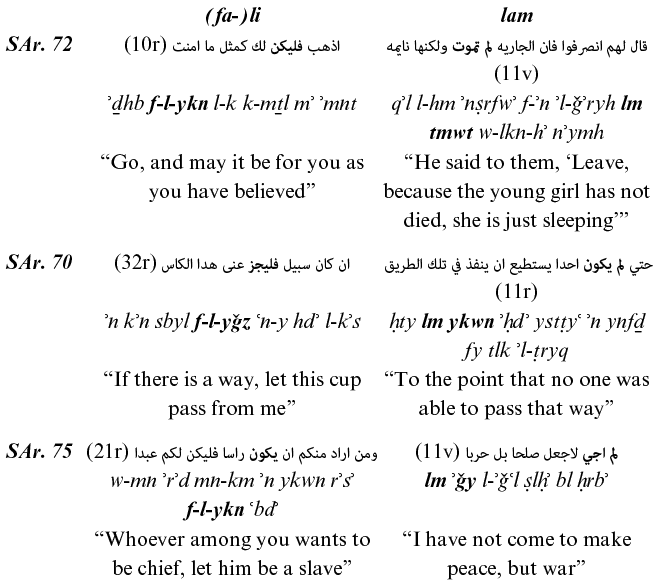
| (fa-)li | lam | |
| SAr. 72 | (10r) اذهب فليكن لك كمثل ما امنت | قال لهم انصرفوا فان الجاريه لمتموت ولكنها نايمه(11v) |
| ʾḏhb f-l-ykn l-k k-mṯl mʾ ʾmnt | qʾl l-hm ʾnṣrfwʾ f-ʾn ʾl-ǧʾryh lmtmwt w-lkn-hʾ nʾymh | |
| “Go, and may it be for you as you have believed” | “He said to them, ‘Leave, because the young girl has not died, she is just sleeping’” | |
| SAr. 70 | (32r) ان كان سبيل فليجز عنى هدا الكاس | حتي لميكون احدا يستطيع ان ينفذ في تلك الطريق(11r) |
| ʾn kʾn sbyl f-l-yǧz ʿn-y hdʾ l-kʾs | ḥty lmykwn ʾḥdʾ ystṭyʿ ʾn ynfḏ fy tlk ʾl-ṭryq | |
| “If there is a way, let this cup pass from me” | “To the point that no one was able to pass that way” | |
| SAr. 75 | (21r) ومن اراد منكم ان يكون راسا فليكن لكم عبدا | (11v) لماجي لاجعل صلحا بل حربا |
| w-mn ʾrʾd mn-km ʾn ykwn rʾsʾ f-l-ykn ʿbdʾ | lmʾǧy l-ʾǧʿl ṣlḥʾ bl ḥrbʾ | |
| “Whoever among you wants to be chief, let him be a slave” | “I have not come to make peace, but war” |
Second, and more significantly, root type strongly correlates with the tendency to spell a form short versus long, as can be seen in the data in Table 28.
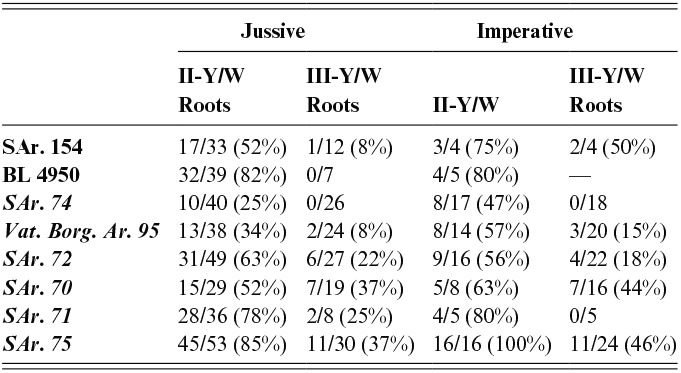
Table 28 Long description
Table presenting three agreement classes organized by singular, dual, and plural forms and associated semantic fields. Class I includes biologically masculine humans and uses masculine singular, dual, and plural agreement. Class II includes biologically feminine humans, nonhuman animates, and inanimates and uses feminine singular, dual, and plural agreement. Class III includes nonhuman animates and inanimates, taking masculine singular and dual agreement but feminine plural agreement for individuated plurals. Across all classes, unindividuated broken plurals with adjectives take feminine singular agreement. The table highlights interactions between grammatical agreement and semantic categories.
As we can see, II-Y/W roots are in every MS and both major syntactic categories are likelier than III-Y/W roots to be spelled short:
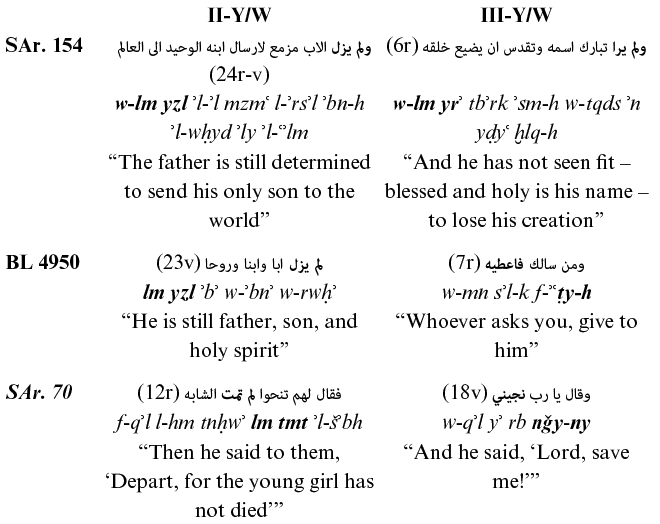
| II-Y/W | III-Y/W | |
| SAr. 154 | ولميزل الاب مزمع لارسال ابنه الوحيد الى العالم(24r-v) | (6r) ولميرا تبارك اسمه وتقدس ان يضيع خلقه |
| w-lm yzl ʾl-ʾl mzmʿ l-ʾrsʾl ʾbn-h ʾl-wḥyd ʾly ʾl-ʿʾlm | w-lm yrʾ tbʾrk ʾsm-h w-tqds ʾn yḍyʿ ḫlq-h | |
| “The father is still determined to send his only son to the world” | “And he has not seen fit – blessed and holy is his name – to lose his creation” | |
| BL 4950 | (23v) لميزل ابا وابنا وروحا | (7r) ومن سالك فاعطيه |
| lm yzl ʾbʾ w-ʾbnʾ w-rwḥʾ | w-mn sʾl-k f-ʾʿṭy-h | |
| “He is still father, son, and holy spirit” | “Whoever asks you, give to him” | |
| SAr. 70 | (12r) فقال لهم تنحوا لمتمت الشابه | (18v) وقال يا رب نجيني |
| f-qʾl l-hm tnḥwʾ lm tmt ʾl-šʾbh | w-qʾl yʾ rb nǧy-ny | |
| “Then he said to them, ‘Depart, for the young girl has not died’” | “And he said, ‘Lord, save me!’” |
This tendency is not restricted to the Christian corpus, but is also evident in contemporary inscriptions, including both epigraphic and commissioned ones. Note the following pairs in the Dome of the Rock inscription:
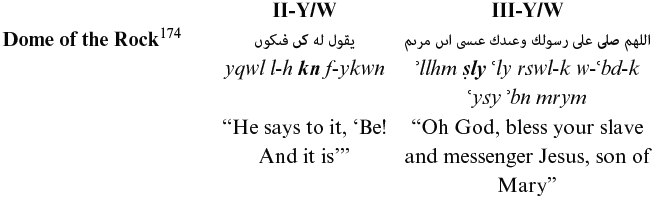
| II-Y/W | III-Y/W | |
| Dome of the RockFootnote 174 | يقول له كں فىكوں | اللهم صلى على رسولك وعىدك عىسى اىں مرىم |
| yqwl l-h kn f-ykwn | ʾllhm ṣly ʿly rswl-k w-ʿbd-k ʿysy ʾbn mrym | |
| “He says to it, ‘Be! And it is’” | “Oh God, bless your slave and messenger Jesus, son of Mary” |
The same distribution is widely attested in epigraphic inscriptions from the first centuries of the Islamic period. Note the following pairs from inscriptions documented in modern Ṣuwaydah, Saudi Arabia:Footnote 175
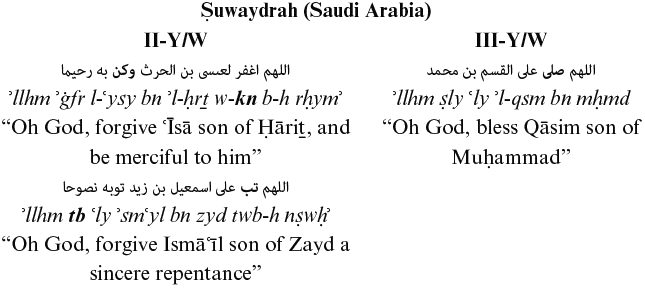
| Ṣuwaydrah (Saudi Arabia) | |
| II-Y/W | III-Y/W |
| اللهم اغفر لعىسى بن الحرث وكن به رحيما | اللهم صلى على القسم بن محمد |
| ʾllhm ʾġfr l-ʿysy bn ʾl-ḥrṯ w-kn b-h rḥymʾ | ʾllhm ṣly ʿly ʾl-qsm bn mḥmd |
| “Oh God, forgive ʿĪsā son of Ḥāriṯ, and be merciful to him” | “Oh God, bless Qāsim son of Muḥammad” |
| اللهم تب على اسمعيل بن زيد توبه نصوحا | |
| ʾllhm tb ʿly ʾsmʿyl bn zyd twb-h nṣwḥʾ | |
| “Oh God, forgive Ismāʿı̄l son of Zayd a sincere repentance” | |
The earliest Christian corpora, such as SAr. 154 and BL 4950, can be read in the light of this trend. It is worth noting, however, that in the theological treatises SAr. 154 and BL 4950, which appear rather conservative in the spelling of short forms relative to the early Gospel MSS, the vast majority of the short spellings consist of spellings of two roots: kwn “to be,” and zwl “to cease.” Indeed, BL 4950 only attests short spellings of these two roots; otherwise, long spellings are attested. In SAr. 154, the only short spellings of II-Y/W roots are of kwn, all others spelled long. There are two ways this can be interpreted. Either it reflects a living situation in which archaic reflexes of certain commonly occurring words were retained longer than less common ones, or it is rather an example of a historical spelling of certain such commonly occurring words.
We can interpret the jussive/apocopate data as reflecting a stage in the evolution from the Proto-Arabic system and the situation attested in most modern dialects, where the jussive is not a distinct morpho-syntactic category. Its loss was not uniform, however; rather, it remained distinct longer based on syntax – retained longer in imperative contexts as well as in (fa-)li + imperfective contexts, but already well on its way out when followed by lam – as well as root type, being retained with II-Y/W roots longer than III-Y/W ones. This trend was apparently widespread in the eighth to tenth centuries ce, as suggested by the inscriptional evidence. This stage is anterior to the one reflected in some SW Arabian and Sinai dialects, which are among the few modern ones that retain some reflex of the apocopate, regularly in imperative contexts and, in Sinai at least, in the 2ms conjugation of the imperfective as well.
3.3 Overview and Discussion
Summing up the evidence reviewed earlier, several aspects of the distribution of the modal forms deserve emphasis. First and foremost, the majority of indicative forms occur in expected syntactic contexts across the corpus. Of the two, the non-indicative is far likelier than the indicative to occur in contexts that are, from the perspective of the Proto-Arabic system and based on comparative Semitic evidence, non-canonical. While it is not always possible to determine all factors that led a writer to use non-indicative over indicative, it seems that genuine modal significance led to its use in contexts expressing, for example, the future, as well as interrogative and negated contexts, where speaker attitude toward the factuality of the event is lowest. On the other hand, indicatives where we would expect non-indicatives occur mostly where either there was variation between the two moods based on semantics (also involving speaker attitude toward the event), or otherwise involving a certain class of roots, namely III-Y/W. Finally, the jussive as a distinct morphological category is, at least insofar as the orthography indicates, still a category, but it is losing ground to the non-jussive form, which is further along in jussive contexts such as following lam, as well as with III-Y/W roots.
Due to the mostly explicable synchronic distribution, I argue that the system broadly reflected in the corpus reflects a more-or-less living system that can be plotted on the cline of evolution that must be posited to have occurred in the ancestors those modern dialects that generalized, at least in the 2fs and 3/2mp, the non-indicative, and which generalized the long form of the jussive of II-Y/W and III-Y/W weak roots. Based on the discussion in Section 2 about nominal case, it is likely that the loss of short vowels had created a distribution like that of the Quran, and therefore while syntactic and modal distinctions continued to play roles in the distribution of the 2fs and 2/3mp, the generalization of the (in this case) non-indicative was likely facilitated by the loss of distinction elsewhere. Even in those dialects that generalized the historical indicative forms likely passed through a similar phase. As we saw, archaic retentions of the jussive/apocopate short form, mostly in the imperative, continue until today. At the end of the spectrum, urban Levantine reflects varieties that have generalized the historical non-indicative as well as the long form of II-Y/W and III-Y/W roots to all positions, whereas Iraqi and Peninsular dialects reflect the historical indicative along with the long form of II-Y/W and III-Y/W roots (Table 29).
| *Proto-Arabic | *Quranic/Hijazi | *Christian Corpus | Najdi/Sinai | Levantine | Iraqi/Peninsular | |
|---|---|---|---|---|---|---|
| SG Indicative/Subjunctive | yaktubu/yaktuba | yaktub | yaktub | yvktvb | yvktub | yvktub |
| PL Indicative/Subjunctive | yaktubūna/yaktubū | yaktubūn/yaktubū | yaktubūn > yaktubū | yvktvbūn | yvktubu | yvktubūn |
| SG Jussive (II-Y/W & III-Y/W) | yaqul/yamši | yaqul/yamš | yaqul ~ yaqūl/yamš > yamšı̄ | y(v)qūl/yvmšı̄ | y(v)ʾūl/yimši | y(v)qūl/yvmši |
| MSG Imperative | qul/vmši | qul/vmš | qul ~ qūl / vmš > vmšı̄ | (u)gul / imš | ʾūl/imši | qūl/imši |
Note: In this table, the symbol />/ indicates a shift-in-progress toward the latter form; the symbol /~/ indicates the co-existence of both forms without implying a shift, and /v/ indicates a vowel without committing to a specific realization, since their existence and phonetic realization differ within and across dialects.
Insofar as there is evidence for diglossia, it seems to me mostly restricted to the category of jussives, where we saw that in some of the later MSS, especially SAr. 71 and SAr. 75, there was an increase in short spellings when imperatives and jussives were considered together relative to the earlier MSS, especially the earlier Gospel MSS. Additionally, if the consistent spelling of kwn and zwl in SAr. 154 and BL 4950 do not reflect living archaic retentions, then they could suggest interaction with a written register or tradition in a way that did not correspond to a distinction present in living language. Otherwise, however, the data and trends across the corpus are remarkably consistent and do not indicate varying competencies or interactions with multiple varieties. Instead, as with nominal case, I argue that the grammar reflects a writing practice shaped by the continuing evolution of Arabic dialects in the early Islamic period. The topic of Section 4, gender and number agreement, likewise fits in with nominal case and verbal mood.
4 Gender and Number Agreement
The phenomena associated with gender and number agreement are on the one hand widely discussed in scholarship on the early Christian corpus,Footnote 176 as well as the early papyri.Footnote 177 However, these discussions are again based on the assumption that standardized Classical Arabic was the target, which biases the aspects of the topic that are discussed, and presents these differences between the Christian corpus and standardized Classical Arabic as departures from pre- and early Islamic Arabic. Work on gender and number agreement over the past few decades,Footnote 178 advanced especially in the recent monograph by Bettega and D’Anna,Footnote 179 which treats the poetic and Quranic corpora, grammarians’ discussions, as well as virtually every modern dialect, has demonstrated in many ways Classical Arabic (and its modern descendent, Modern Standard Arabic) is the “odd man out,” certainly among the ancient corpora, including its most salient features, such as obligatory FSG agreement with non-inanimate nouns.Footnote 180
The result of this crescendo of interest in the topic has been the explication of a more complex and dynamic system of agreement between PL nouns and their modifiers. Whereas in Classical Arabic, PL agreement is restricted mostly to human nouns, and the choice between PL types – MPL or FPL – reflects the gender of the humans involved, in the ancient and modern corpora mentioned earlier, both PL and SG agreement are possible, with the choice depending on factors ranging from animacy to individuation and saliency.Footnote 181 Additionally, the choice of PL is more complex as well. Bettega and D’Anna combine close study of the ancient corpora with an exhaustive overview of patterns attested in those modern dialects that continue to distinguish gender in the plural, to argue that Proto-Arabic nouns should be reconstructed with three “gender” classes (at least as regards agreement) (Table 30).
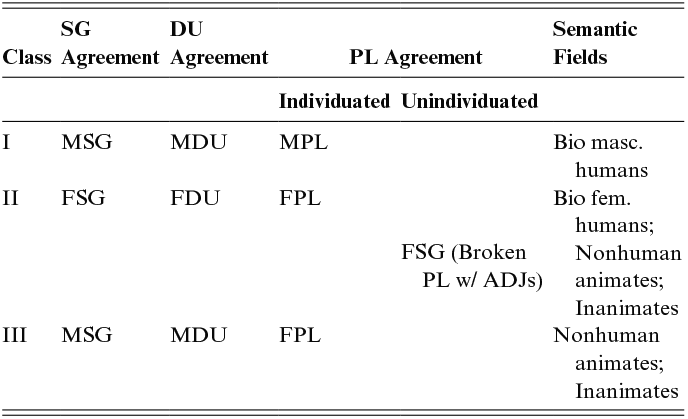
Table 30 Long description
Table classifying agreement patterns into two classes. Class I takes masculine singular (MSG) agreement, whereas Class II takes feminine singular (FSG) agreement. For plural nouns, both classes share the same pattern: individuated plurals take a common plural agreement form, while unindividuated plurals take feminine singular (FSG) agreement. The semantic field for both classes is “all nouns,” indicating that the distinction is based on agreement behavior rather than noun meaning. The table summarizes a simplified agreement system contrasting singular gender agreement with shared plural patterns.
Note: Based on Bettega and D’Anna, Gender and Number Agreement, 162, table 2.27.
MPL agreement was originally restricted to biologically masculine human groups, though, as Hanistch shows, already in the Quran there are signs of the spread of MPL agreement to, for example, divine beings and even inanimates.Footnote 182 FPL agreement, however, where retained can occur with two different classes of nouns: those that trigger feminine agreement in the SG and DU (Class II), as well as a large number of nouns that trigger masculine agreement in the SG and DU, but feminine in the PL (Class III). This latter class does not exist in Classical Arabic, since nonhuman animates and inanimates typically trigger obligatory FSG, but it has been retained until the present in those modern dialects with gender distinction in the PL. Most modern dialects, though, attest a single PL form, reflecting the generalization of the historically the MPL (in verbs and PNs; ADJs typically attest BPLs) as the common PL for all nouns (Table 31).
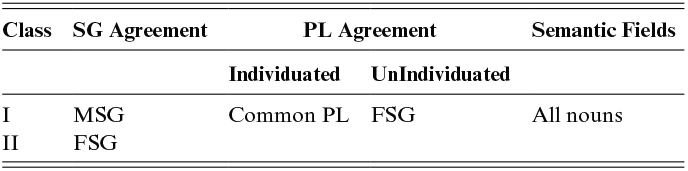
Table 31 Long description
Data table presents frequencies and percentages for human and inanimate referents across six manuscripts: SAr. 154, BL 4950, SAr. 74, SAr. 72, SAr. 75, and SAr. 70. Columns are grouped into Human and Inanimate categories, each subdivided into adjective (ADJ), verb, and proper noun (PN). Human verb and PN percentages are generally low, ranging from 0% to 19%, while human ADJ values range from 0% to 44%. Inanimate categories show consistently higher percentages, with ADJ values from 50% to 95%, verb values from 53% to 78%, and PN values from 38% to 93%. Overall, inanimate referents exhibit substantially higher proportions than human referents across all manuscripts.
Note: Based on Bettega and D’Anna, Gender and Number Agreement, 134, table 2.21. Elsewhere, (Gender and Number Agreement, 135, table 2.22), they provide another paradigm for those dialects in which FSG agreement is not typical of unindividuated nouns, and thus have only PL agreement for any PL noun. This is most likely a subsequent development from the system presented here, and thus will not be separately presented or discussed.
The foregoing work largely concerns post-nominal agreement, but the other salient aspect of Classical Arabic vis-a-vis modern dialectal Arabic is obligatory singular verbal agreement with plural subjects, where the evidence from the poetry and Quran do line up with what became standard Classical. BlauFootnote 183 and HopkinsFootnote 184 emphasize the widespread occurrence of plural agreement in these corpora, but do so impressionistically, though even in modern dialects, SG agreement is quite common in the modern dialects.Footnote 185
So far, close analysis of Arabic corpora without assuming a default of Classical Arabic include the qaṣı̄dah poetic corpus, the Quran, and modern dialects; with one exception,Footnote 186 however, medieval Middle Arabic corpora have not been thus treated. But Middle Arabic is, linguistically, a negatively defined category – anything that is not Classical Arabic – with considerable variation across MSS and corpora. The question, then, is not to what degree does the system attested in a particular MS differ from Classical Arabic, but in what ways, and how in relation to the rather clear patterns detected in both ancient and modern corpora. Any purported influence of Classical Arabic must likewise be demonstrated through close analysis of a MS (and then corpus), not assumed. In Section 4.1, the discussion, which builds and expands on Stokes’ paper,Footnote 187 will concentrate on several features post-nominal agreement: 1) The PL agreement type triggered by PL nouns (i.e., the existence and state of the three classes discussed earlier); 2) Factors affecting FSG versus PL agreement with PL nouns; 3) Agreement patterns with DU nouns. In Section 4.2, some brief data and remarks will establish the patterns of pre-nominal agreement, and consider whether there is evidence of diglossia in the differences across the MSS. An overview and diachronic discussion will conclude the Section 4.3.
4.1 Post-Nominal Agreement
The majority of cases of agreement in Arabic in general, and in the present corpus, occurs when the modifier follows the noun with which it agrees. This can therefore be considered the canonical position and indeed, as we will see, attests more variation than pre-nominal agreement (largely restricted to verbal predicates) does. The main sources of synchronic variation with post-nominal agreement, and simultaneously the categories most relevant to diachronic analysis of the corpus, are the kind of PL agreement attested with PL nouns (i.e., which nouns trigger MPL, FPL, or BPL agreement; Section 4.1.1), the dynamics at play in determining whether PL or FSG agreement occurs with a PL noun (Section 4.1.2), and then what kind of agreement DU nouns trigger (Section 4.1.3). Throughout the section, reference will be made to nouns based on animacy divided into the following categories: human PL, human collectives, divine beings, animals, and inanimates. These categories are largely uncontroversial, except perhaps for human collectives, which includes nouns such as šaʿb “people,” nās “idem,” ǧamāʿah / ǧamāʿāt / ǧumūʿ (etc) “crowd(s),” and ʾumam “peoples, nations,” among others.
4.1.1 FPL versus MPL with PL Nouns
In the corpus, as in all other known varieties of Arabic, groups of MPL humans (Bettega and D’Anna’s Class I) trigger either MPL or BPL agreement. The main sources of variation relate to Classes II and III, and especially the latter. The crux of the question is whether or not FPL agreement is common with PL nouns that are not biologically feminine. Early on, it is still a common option for inanimate nouns; indeed, in SAr. 154, it is only attested modifying inanimate nouns. In the Gospel MSS, however, it is fairly rare with inanimate nouns (Table 32).
| Human PL | Human Coll. | Divine | Animal | Inanimate | |
|---|---|---|---|---|---|
| SAr. 154 | — | — | — | — | 6/6 (100%) |
| BL 4950 | 4/9 (44%) | — | — | — | 5/9 (56%) |
| SAr. 74 | 41/41 (100%) | — | — | — | — |
| SAr. 72 | 36/68 (53%) | 29/68 (43%) | — | 1/68 (2%) | 2/68 (2%) |
| SAr. 75 | 52/67 (78%) | 11/67 (16%) | — | — | 4/67 (6%) |
| SAr. 70 | 43/51 (84%) | 5/51 (10%) | 1/51 (2%) | — | 2/51 (4%) |
In the Gospel MSS, FPL with inanimates occurs when either the inanimate nouns involved act with agency in a human-like way, often serving as models of what to do or not to do, or otherwise serve metonymically as representations of the populations:
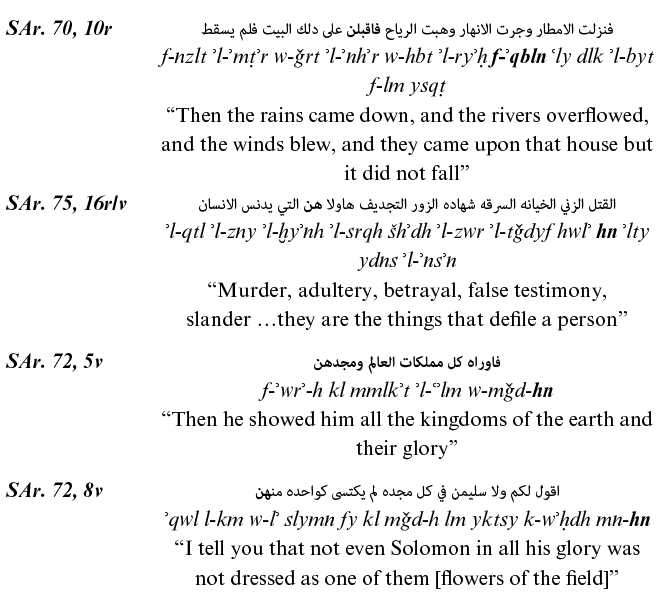
| SAr. 70, 10r | فنزلت الامطار وجرت الانهار وهبت الرياح فاقبلن على دلك البيت فلم يسقط |
| f-nzlt ʾl-ʾmṭʾr w-ǧrt ʾl-ʾnhʾr w-hbt ʾl-ryʾḥ f-ʾqbln ʿly dlk ʾl-byt f-lm ysqṭ | |
| “Then the rains came down, and the rivers overflowed, and the winds blew, and they came upon that house but it did not fall” | |
| SAr. 75, 16r/v | القتل الزني الخيانه السرقه شهاده الزور التجديف هاولا هن التي يدنس الانسان |
| ʾl-qtl ʾl-zny ʾl-ḫyʾnh ʾl-srqh šhʾdh ʾl-zwr ʾl-tǧdyf hwlʾ hn ʾlty ydns ʾl-ʾnsʾn | |
| “Murder, adultery, betrayal, false testimony, slander …they are the things that defile a person” | |
| SAr. 72, 5v | فاوراه كل مملكات العالم ومجدهن |
| f-ʾwrʾ-h kl mmlkʾt ʾl-ʿʾlm w-mǧd-hn | |
| “Then he showed him all the kingdoms of the earth and their glory” | |
| SAr. 72, 8v | اقول لكم ولا سليمن في كل مجده لم يكتسى كواحده منهن |
| ʾqwl l-km w-lʾ slymn fy kl mǧd-h lm yktsy k-wʾḥdh mn-hn | |
| “I tell you that not even Solomon in all his glory was not dressed as one of them [flowers of the field]” |
The latter context is likely a retention of the system Bettega and D’Anna reconstruct for Old Arabic; otherwise, though, inanimates trigger either FSG or, with ADJs, BPL agreement. It thus seems that while there are some remnants of Class III still attested in the Christian corpus, what is a robust class in the poetic corpus, the Quran, and gender-distinguishing modern dialects is evident in the early theological treatises, but largely absent in Gospels, as it is in modern dialects that lack gender agreement distinction in the PL.
The most common category of nouns that trigger FPL across the Gospel MSS is human biologically female ones:
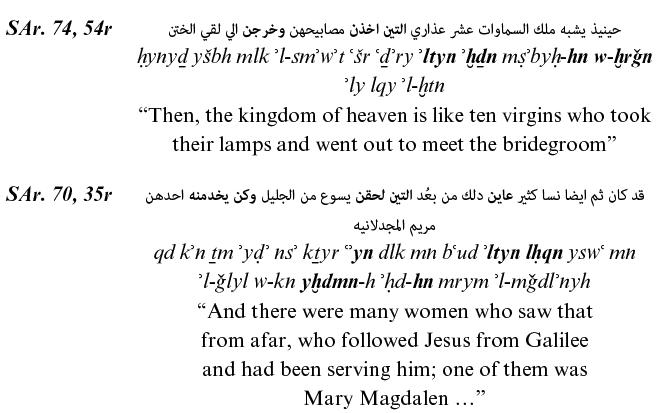
| SAr. 74, 54r | حينيذ يشبه ملك السماوات عشر عذاري التيناخذن مصابيحهنوخرجن الي لقي الختن |
| ḥynyḏ yšbh mlk ʾl-smʾwʾt ʿšr ʿḏʾry ʾltynʾḫḏn mṣʾbyḥ-hnw-ḫrǧn ʾly lqy ʾl-ḫtn | |
| “Then, the kingdom of heaven is like ten virgins who took their lamps and went out to meet the bridegroom” | |
| SAr. 70, 35r | قد كان ثم ايضا نسا كثير عاين دلك من بعُد التينلحقن يسوع من الجليل وكنيخدمنه احدهن مريم المجدلانيه |
| qd kʾn ṯm ʾyḍʾ nsʾ kṯyr ʿʾyn dlk mn bʿud ʾltynlḥqnyswʿ mn ʾl-ǧlyl w-knyḫdmn-h ʾḥd-hn mrym ʾl-mǧdlʾnyh | |
| “And there were many women who saw that from afar, who followed Jesus from Galilee and had been serving him; one of them was Mary Magdalen …” |
Even here, however, agreement is not completely consistent. In a minority of cases, agreement with human females is MPL, rather than FPL:
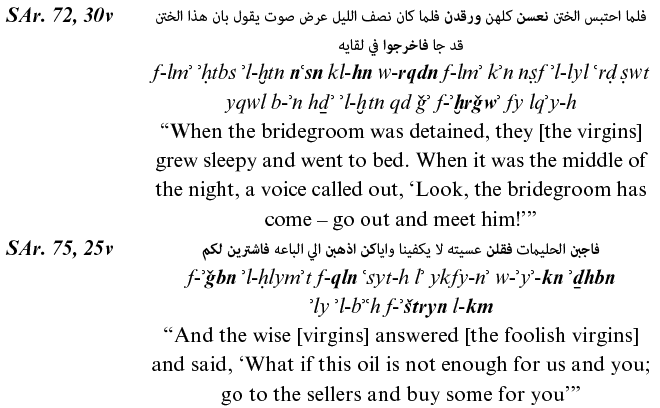
| SAr. 72, 30v | فلما احتبس الختن نعسن كلهنورقدن فلما كان نصف الليل عرض صوت يقول بان هذا الختن قد جا فاخرجوا في لقايه |
| f-lmʾ ʾḥtbs ʾl-ḫtn nʿsn kl-hn w-rqdn f-lmʾ kʾn nṣf ʾl-lyl ʿrḍ ṣwt yqwl b-ʾn hḏʾ ʾl-ḫtn qd ǧʾ f-ʾḫrǧwʾ fy lqʾy-h | |
| “When the bridegroom was detained, they [the virgins] grew sleepy and went to bed. When it was the middle of the night, a voice called out, ‘Look, the bridegroom has come – go out and meet him!’” | |
| SAr. 75, 25v | فاجبن الحليمات فقلن عسيته لا يكفينا واياكناذهبن الي الباعه فاشترينلكم |
| f-ʾǧbn ʾl-ḥlymʾt f-qln ʿsyt-h lʾ ykfy-nʾ w-ʾyʾ-knʾḏhbn ʾly ʾl-bʾʿh f-ʾštryn l-km | |
| “And the wise [virgins] answered [the foolish virgins] and said, ‘What if this oil is not enough for us and you; go to the sellers and buy some for you’” |
In what is likely the earliest Gospel MS, SAr. 74, this minority is in fact quite significant; elsewhere it is smaller, but still notable, as the data in Table 33 show.
| FPL Agreement | MPL Agreement | BPL Agreement | |
|---|---|---|---|
| SAr. 154 | N/A | N/A | N/A |
| BL 4950 | 3/4 (75%) | 1/4 (25%) | — |
| SAr. 74 | 41/69 (59%) | 28/69 (41%) | — |
| SAr. 72 | 31/38 (82%) | 2/38 (5%) | 5/38 (13%) |
| SAr. 75 | 36/48 (75%) | 5/48 (10%) | 7/48 (15%) |
| SAr. 70 | 37/49 (76%) | 9/49 (18%) | 3/49 (6%) |
There are two primary factors that seem to make MPL likelier than FPL agreement with feminine human PL nouns, both of which are evident in the earlier examples. First, distance from the head noun increases the likelihood of a shift to MPL agreement. Second, a switch from third to second person increases the likelihood. Note further the following examples:
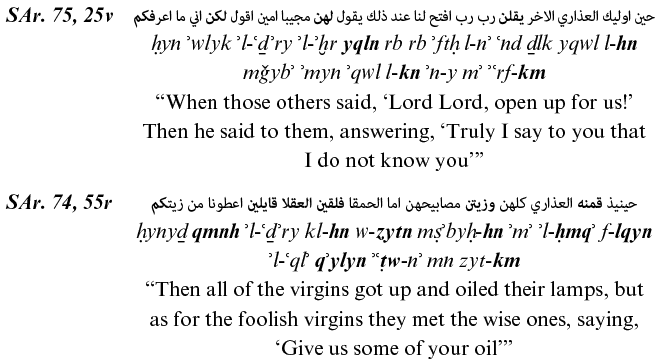
| SAr. 75, 25v | حين اوليك العذاري الاخر يقلن رب رب افتح لنا عند ذلك يقول لهن مجيبا امين اقول لكن اني ما اعرفكم |
| ḥyn ʾwlyk ʾl-ʿḏʾry ʾl-ʾḫr yqln rb rb ʾftḥ l-nʾ ʿnd ḏlk yqwl l-hn mǧybʾ ʾmyn ʾqwl l-kn ʾn-y mʾ ʾʿrf-km | |
| “When those others said, ‘Lord Lord, open up for us!’ Then he said to them, answering, ‘Truly I say to you that I do not know you’” | |
| SAr. 74, 55r | حينيذ قمنه العذاري كلهنوزيتن مصابيحهن اما الحمقا فلقينالعقلاقايلين اعطونا من زيتكم |
| ḥynyḏ qmnh ʾl-ʿḏʾry kl-hn w-zytn mṣʾbyḥ-hn ʾmʾ ʾl-ḥmqʾ f-lqyn ʾl-ʿqlʾ qʾylyn ʾʿṭ-nʾ mn zyt-km | |
| “Then all of the virgins got up and oiled their lamps, but as for the foolish virgins they met the wise ones, saying, ‘Give us some of your oil’” |
In sum, FPL agreement with inanimates is still robust in SAr. 154 and BL 4950, but in the Gospels is mainly restricted to PL nouns with human female referents, and even the latter triggers MPL agreement instead of FPL, depending on type of modifier and the distance from the head the modifier occurs.
While FPL agreement is often significantly different from the other pre- and early Islamic corpora, FSG with PL nouns of any animacy type is more widely attested. We turn now to a close study and comparison of this phenomenon in the early Christian corpus.
4.1.2 FSG versus PL Agreement with PL Nouns
Both FSG and PL agreement occur in the Christian corpus with PL nouns across the hierarchy of animacy, to use Corbett’s term.Footnote 188 FSG agreement is, however, significantly less common the higher up the hierarchy – with humans at the top – the noun falls. This is in fact the norm across all pre-modern Arabic corpora (as well as modern dialects).Footnote 189 The data for the Christian corpus are included in Table 34, with the data – compiled from Bettega and D’Anna’s study of the muʿallaqāt and Quran included for comparison.Footnote 190
| Human | Human Coll. | Divine | Animal | Inanimate | |
|---|---|---|---|---|---|
| Muʿallaqāt | 4/78 (5%) | — | — | 18/45 (40%) | 59/96 (62%) |
| Quran | 15/59 (25%) | — | — | 11/26 (42%) | 339/454 (75%) |
| SAr. 154 | 0/44 | 6/107 (6%) | 0/6 | 1/3 (33%) | 49/68 (73%) |
| BL 4950 | 12/57 (21%) | 12/54 (22%) | 13/25 (52%) | — | 103/130 (79%) |
| SAr. 74 | 4/237 (2%) | 29/126 (23%) | 17/32 (53%) | 14/40 (35%) | 69/91 (76%) |
| SAr. 72 | 1/195 (<1%) | 19/116 (16%) | 3/12 (25%) | 6/18 (33%) | 64/98 (65%) |
| SAr. 75 | 1/277 (<1%) | 9/130 (7%) | 0/15 | 9/22 (41%) | 54/87 (62%) |
| SAr. 70 | 25/296 (9%) | 21/97 (22%) | 7/17 (41%) | 16/19 (84%) | 53/90 (59%) |
Several aspects of these data are interesting and deserve remark. First, with one exception, the early Christian corpus patterns exactly as the muʿallaqāt and Quranic corpora, with inanimates most likely to trigger FSG and human PL nouns least likely. The exception – SAr. 70 – attests a greater likelihood for animal nouns to trigger FSG even more than inanimates, though inanimates are second likeliest thereafter. At the same time, no obligatory FSG agreement with inanimates is attested. While most MSS are significantly less likely to attest FSG agreement with human PL nouns than, say, the Quran, they are all approximately equally likely to use FSG or not with inanimates.
While in some instances the same noun is attested with FSG agreement in one place and PL agreement in another with no detectable differences in syntax or semantics, there are nevertheless several factors that do appear to correlate with increased likelihood in each category – especially those higher on the animacy hierarchy – to trigger FSG versus PL agreement. First and foremost is what scholars often refer to as individuation: When the plurality of the group, seen as a group of individuals or wherein the members of the group are particularly salient, PL agreement is the norm, whereas when the group as a whole is in focus, with little to no focus on the specific individuals making up the group, FSG is more typical.Footnote 191 Note the following pairs:
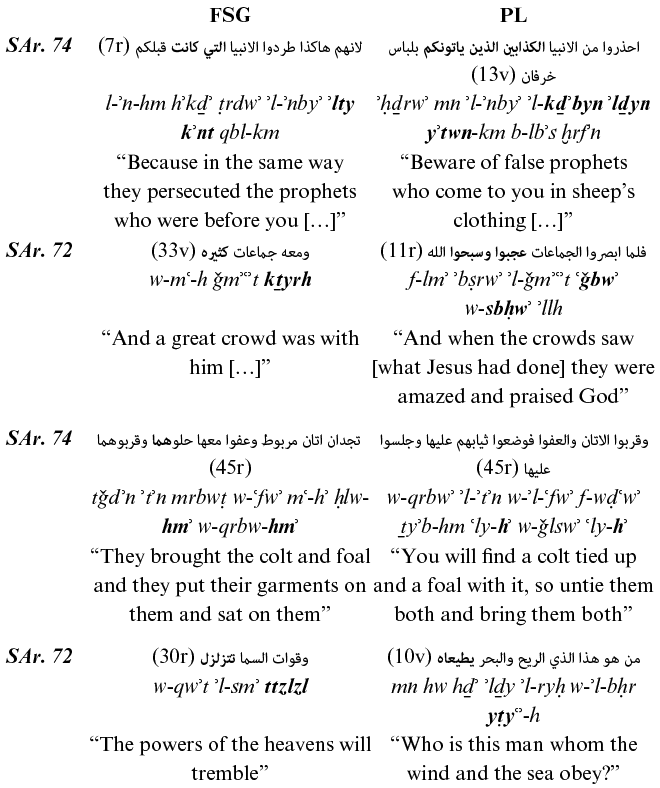
| FSG | PL | |
| SAr. 74 | (7r) لانهم هاكذا طردوا الانبيا التيكانت قبلكم | احذروا من الانبيا الكذابينالذينياتونكم بلباس (13v) خرفان |
| l-ʾn-hm hʾkḏʾ ṭrdwʾ ʾl-ʾnbyʾ ʾltykʾnt qbl-km | ʾḥḏrwʾ mn ʾl-ʾnbyʾ ʾl-kḏʾbynʾlḏynyʾtwn-km b-lbʾs ḫrfʾn | |
| “Because in the same way they persecuted the prophets who were before you […]” | “Beware of false prophets who come to you in sheep’s clothing […]” | |
| SAr. 72 | (33v) ومعه جماعات كثيره | (11r) فلما ابصروا الجماعات عجبواوسبحوا الله |
| w-mʿ-h ǧmʾʿʾt kṯyrh | f-lmʾ ʾbṣrwʾ ʾl-ǧmʾʿʾt ʿǧbwʾ w-sbḥwʾ ʾllh | |
| “And a great crowd was with him […]” | “And when the crowds saw [what Jesus had done] they were amazed and praised God” | |
| SAr. 74 | تجدان اتان مربوط وعفوا معها حلوهما وقربوهما(45r) | وقربوا الاتان والعفوا فوضعوا ثيابهم عليها وجلسوا (45r) عليها |
| tǧdʾn ʾtʾn mrbwṭ w-ʿfwʾ mʿ-hʾ ḥlw-hmʾ w-qrbw-hmʾ | w-qrbwʾ ʾl-ʾtʾn w-ʾl-ʿfwʾ f-wḍʿwʾ ṯyʾb-hm ʿly-hʾ w-ǧlswʾ ʿly-hʾ | |
| “They brought the colt and foal and they put their garments on them and sat on them” | “You will find a colt tied up and a foal with it, so untie them both and bring them both” | |
| SAr. 72 | (30r) وقوات السما تتزلزل | (10v) من هو هذا الذي الريح والبحر يطيعاه |
| w-qwʾt ʾl-smʾ ttzlzl | mn hw hḏʾ ʾlḏy ʾl-ryḥ w-ʾl-bḥr yṭyʿʾ-h | |
| “The powers of the heavens will tremble” | “Who is this man whom the wind and the sea obey?” |
Another important factor involves the type of modifier – whether verb, PN, or ADJ – which interacts with animacy in the corpus in noteworthy ways. Whereas Bettega and D’Anna found that, in the ancient corpora, PNs were most likely to attest FSG agreement and ADJs least likely,Footnote 192 regardless of animacy, the Christian corpus attests a mixed profile, as can be seen in Table 35.
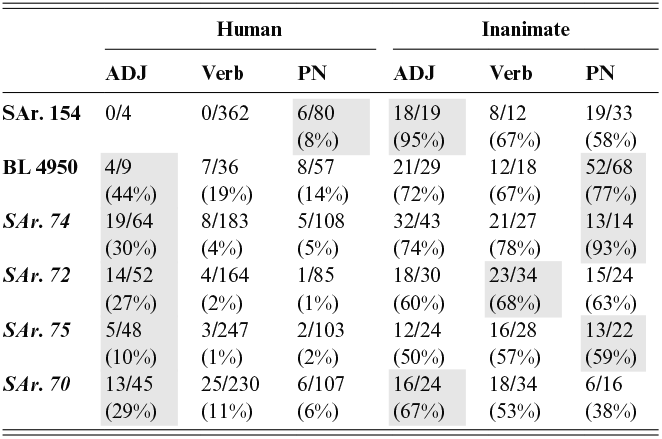
Table 35 Long description
Data table summarizes grammatical agreement patterns across three singular agreement classes. Columns present singular class, semantic category, dual agreement, and plural agreement divided into individuated and unindividuated forms. Class I (MSG) corresponds to human males, with dual agreement shifting to MPL and plural agreement typically MPL. Class II (FSG) includes human females, nonhuman animates, and inanimates, with dual agreement shifting to plural and plural agreement favoring FPL over MPL. Class III (MSG) includes nonhuman animates and inanimates, with dual agreement shifting to MPL and plural agreement typically MPL or BPL. Unindividuated plural referents generally favor FSG agreement, especially as animacy decreases.
With human nouns, FSG agreement occurs with ADJs much more frequently than with either verbs or PNs in every MS. However, with inanimate nouns, four of the six (67%) MSS documented here attest either verbs or PNs having greater likelihood of FSG agreement. Thus, with human nouns, the ancient pattern had been flipped, whereas with inanimate nouns it was still operative. Interestingly, the pattern found in the Christian MSS for human nouns – wherein ADJs are by far likelier to attest FSG agreement than verbs or PNs – is the most common pattern in modern dialects.Footnote 193 The Christian data, then, reflect an intermediate paradigm between the ancient and modern varieties previously documented.
Finally, when FSG agreement with human (and, in this case, divine) nouns occurs, the morphology of the PL form of the noun itself plays an important role in determining the likelihood of FSG versus PL agreement. In most cases, FSG agreement occurs with nouns whose PL is broken (Arabic ǧamʿ al-taksı̄r), rather than sound (Arabic al-ǧamʿ al-sālim) (Table 36).
| BPL | MPL | FPL | |
|---|---|---|---|
| SAr. 154 | N/A | N/A | N/A |
| BL 4950 | 8 (67%) | 4 (33%) | — |
| SAr. 74 | 21/21 (100%) | — | — |
| SAr. 72 | 4/4 (100%) | — | — |
| SAr. 75 | 1/1 (100%) | — | — |
| SAr. 70 | 29/31 (94%) | 1/31 (3%) | 1/31 (3%) |
This distribution is in line with other corpora, including the poetic and Quranic corpora, as well as modern ones.Footnote 194
Thus, the category of FSG agreement with PL nouns is robust, though with some significant differences between the poetic and Quranic corpora on the one hand, and the Christian corpus on the other. Further, animacy – and especially the human versus nonhuman distinction – appears to be more decisive in the Christian corpus on the whole than in the ancient data, though again, with some significant variation across the corpus. I will argue that both can be meaningfully plotted on a spectrum of evolution from the Old (if not Proto-) Arabic system to the modern dialectal one. However, another aspect of agreement, one that separates the pre-modern and modern varieties of Arabic, is worth discussing, which is the status of DU agreement with DU nouns.
4.1.3 Dual Agreement
Unlike PL and FSG agreement, DU agreement in Arabic is limited to pre-modern corpora.Footnote 195 In the Christian corpus, DU nouns regularly, though not ubiquitously, trigger DU agreement with modifiers. It is more common in every MS, although, as with the categories discussed previously, there is variability across MSS, as we can see in Table 37.
| DU | PL | SG | |
|---|---|---|---|
| SAr. 154 | 21/23 (92%) | — | 2/23 (8%) |
| BL 4950 | 41/49 (84%) | 2/49 (4%) | 6/49 (12%) |
| SAr. 74 | 71/113 (63%) | 39/113 (35%) | 3/113 (2%) |
| SAr. 72 | 76/103 (74%) | 24/103 (23%) | 3/103 (3%) |
| SAr. 75 | 113/132 (86%) | 19/132 (14%) | — |
| SAr. 70 | 111/127 (87%) | 12/127 (10%) | 4/127 (3%) |
Several facets of the data are interesting. First, the theological treatises SAr. 154 and BL 4950 both attest DU agreement very consistently, but at rates roughly consistent with some of the later Gospel MSS, such as SAr. 75 and SAr. 70. The difference between them, however, is that SAr. 154 and BL 4950 alternate with SG agreement, whereas the Gospel MSS in general alternate between DU and PL agreement. That is, when DU nouns trigger non-DU agreement, the Gospels prefer PL agreement instead of (F)SG. Additionally, DU agreement across modifier type is not equally distributed; rather, most MS attest a consistent order from most to least likely, with PNs most like in all but one MS (Table 38).
| ADJ | Verb | PN | |
|---|---|---|---|
| SAr. 154 | 1/1 (100%) | 11/13 (85%) | 9/9 (100%) |
| BL 4950 | 4/5 (80%) | 5/5 (100%) | 32/37 (87%) |
| SAr. 74 | 4/7 (57%) | 34/74 (46%) | 36/49 (74%) |
| SAr. 72 | 4/6 (67%) | 35/53 (66%) | 36/43 (84%) |
| SAr. 75 | 9/11 (82%) | 56/70 (80%) | 47/50 (94%) |
| SAr. 70 | 6/9 (67%) | 58/68 (85%) | 47/48 (98%) |
Interestingly, verbs are, with the exception of BL 4950, the least likely to attest DU agreement, which could perhaps be due to their connection to saliency and the trend toward individuation, triggering a PL rather than DU agreement pattern.
Once again, the distance of the modifier from the head noun plays a role in the occurrence of DU versus non-DU agreement, as the following examples show:
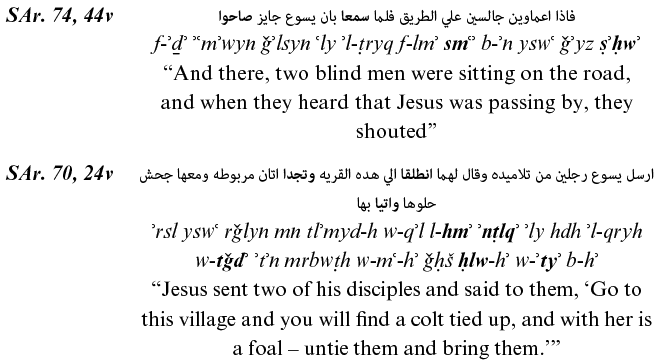
| SAr. 74, 44v | فاذا اعماوين جالسين علي الطريق فلما سمعا بان يسوع جايز صاحوا |
| f-ʾḏʾ ʾʿmʾwyn ǧʾlsyn ʿly ʾl-ṭryq f-lmʾ smʿʾ b-ʾn yswʿ ǧʾyz ṣʾḥwʾ | |
| “And there, two blind men were sitting on the road, and when they heard that Jesus was passing by, they shouted” | |
| SAr. 70, 24v | ارسل يسوع رجلين من تلاميده وقال لهماانطلقا الي هده القريه وتجدا اتان مربوطه ومعها جحش حلوها واتيا بها |
| ʾrsl yswʿ rǧlyn mn tlʾmyd-h w-qʾl l-hmʾ ʾnṭlqʾ ʾly hdh ʾl-qryh w-tǧdʾ ʾtʾn mrbwṭh w-mʿ-hʾ ǧḥš ḥlw-hʾ w-ʾtyʾ b-hʾ | |
| “Jesus sent two of his disciples and said to them, ‘Go to this village and you will find a colt tied up, and with her is a foal – untie them and bring them.’” |
The impact of distance has already been noted as significant in changes in verbal mood as well (Section 3.1) and continues to be an important factor in modern dialectal agreement patterns.Footnote 196
Before summarizing the synchronic picture of gender and number agreement in the Christian corpus, as well as situating it more fully in the diachronic development of Arabic, we first briefly review the topic of pre-nominal verbal agreement.
4.2 Pre-nominal Agreement
In his grammar of early Christian Arabic, Blau reports a “marked tendency” for verbs preceding their subjects to attest strict number agreement, such that PL subjects trigger PL verbal agreement in this syntagm as well.Footnote 197 Instances of SG agreement are, according to Blau, at least “partly through the influence of CA [=Classical Arabic].”Footnote 198 The impression is thus of a corpus characterized by PL agreement when the subject is PL, but with a minority of cases where the scribal author was “influenced” by Classical Arabic and inflected the verb SG. However, quantitative data show that this is not accurate, as we can see in Table 39.
| SG | PL | Totals | |
|---|---|---|---|
| SAr. 154 | 52 (93%) | 4 (7%) | 56 |
| BL 4950 | 41 (93%) | 3 (7%) | 44 |
| SAr. 74 | 48 (63%) | 28 (37%) | 76 |
| SAr. 72 | 52 (44%) | 66 (56%) | 118 |
| SAr. 75 | 111 (82%) | 24 (18%) | 135 |
| SAr. 70 | 104 (83%) | 21 (17%) | 125 |
In five of the six (83%) of the MSS, SG agreement is more common – typically by far – than PL agreement; only in SAr. 72 is PL agreement more common. In her study of the syntax of four modern dialects, Brustad notes the same trend – SG verbal agreement the norm with PL subjects, though with PL agreement relatively frequent as well – in the modern dialects,Footnote 199 and Bettega and D’Anna apply a statistical analysis to data sets from modern dialects with findings that corroborate Brustad’s impression.Footnote 200 The Christian data thus fit well within this spectrum. At the same time, there is a clear two-way distinction between the theological treatises on the one hand, which attest overwhelmingly SG agreement, and the Gospel MSS, which attest both SG and PL agreement. Within the Gospel MSS, the earlier two – SAr. 74 and SAr. 72 – are almost split evenly (SG agreement in SAr. 74 slightly likelier and PL agreement in SAr. 72 slightly likelier), whereas the latter two MSS – SAr. 75 and SAr. 70 – sit between the treatises and the earlier Gospels.
The primary source of variation between SG and PL agreement in this regard is the animacy of the subject, with PL agreement a feature associated with human (and, in this case, divine) subjects, and SG agreement virtually ubiquitous across the MSS. In Table 40, the numbers and percentages of PL agreement by animacy category are provided to illustrate the trend across the MSS of the corpus.
| Human PL | Human Coll. | Divine | Animal | Inanimate | |
|---|---|---|---|---|---|
| SAr. 154 | 3/30 (10%) | 0/6 | 0/5 | 0/1 | 1/13 (8%) |
| BL 4950 | 2/17 (12%) | — | 1/5 (20%) | — | 0/18 |
| SAr. 74 | 20/34 (59%) | 7/15 (47%) | 1/4 (25%) | 0/4 | 0/19 |
| SAr. 72 | 62/84 (74%) | 4/12 (33%) | 0/1 | 0/3 | 0/18 |
| SAr. 75 | 20/87 (23%) | 3/15 (20%) | 1/2 (50%) | 0/5 | 0/26 |
| SAr. 70 | 20/75 (27%) | 1/21 (5%) | 0/4 | 0/2 | 0/23 |
With one exception, human PL nouns account for the statistically largest number of PL verbs. Thus, SG versus PL agreement with pre-nominal verbs seems primarily determined by animacy, though it is more helpful to categorize the pattern as human-like versus nonhuman like, the former including human PL and collective as well as divine beings, and the latter including animals and inanimates.
4.3 Overview and Discussion
The gender and number agreement patterns attested in the early Christian corpus studied here fit well within what is known from the pre- and early Islamic corpora of the poetry and Quran, as well as the modern gender-distinguishing dialects, in several ways. First and foremost, the Christian MSS attest both FSG and PL agreement with PL nouns, human, nonhuman animate, and inanimate. As elsewhere, FSG agreement, especially with animate nouns, correlates with a reduced saliency and lack of individuation, whereas PL agreement tends to indicate the opposite. At the same time, animacy is clearly increasingly relevant to the question of FSG versus PL agreement, with PL agreement occurring in such cases when the nouns involved are either metonymically representative of humans (e.g., cities representing populations), or otherwise where actions are especially salient, often metaphorically reflecting human obedience and disobedience. The pattern of obligatory FSG agreement with inanimates is not attested in any of the MSS.
At the same time, there are significant differences between the ancient and modern corpora and the Christian corpus. Most salient is the fact that FPL agreement is largely restricted to human female PL nouns; Bettega and D’Anna’s Class III is therefore largely absent in the Christian corpus. Verbal and PN agreement with nonhuman feminine groups is almost always MPL, and ADJ agreement is typically either MPL or BPL. This is a significant departure from the systems of the poetry, Quran, and modern gender-distinguishing dialects. Additionally, DU agreement, while still common, is not ubiquitous. Here there is a split in the corpus between the theological treatises (SAr. 154 and BL 4950), where non-DU agreement is most commonly SG, and the Gospel MSS, where non-DU agreement is most commonly PL. Finally, verbal agreement when occurring before the subject is, with one exception (SAr. 72), more often SG than PL. However, in this way the general pattern in the MSS is in line with modern dialects and against the ancient corpora, in which pre-nominal verbs are ubiquitously SG.
I contend that the data can be most parsimoniously interpreted as reflecting a living system, in transition from the Old Arabic one reconstructed by Bettega and D’Anna to one reflected in the modern dialects that lack gender distinction, in which there is a common PL, typically the historical MPL (along with BPL with ADJs). As with nominal case and verbal mood, then, the Christian agreement data are consistent with historically middle stage in this development and can be represented with reference to Tables 30 and 31, as in Table 41.
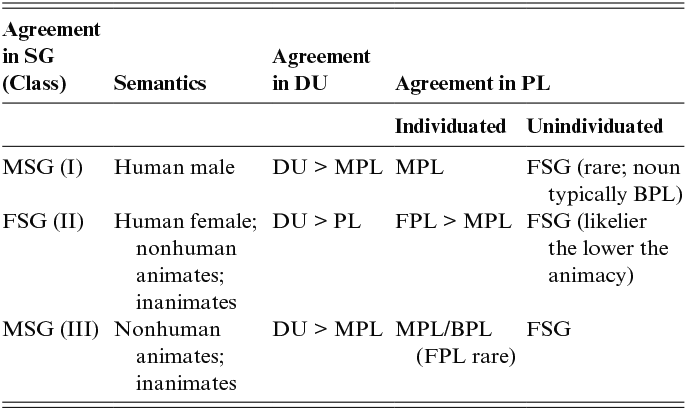
Table 41 Long description
Data table summarizes grammatical agreement patterns across three singular agreement classes. Columns present singular class, semantic category, dual agreement, and plural agreement divided into individuated and unindividuated forms. Class I (MSG) corresponds to human males, with dual agreement shifting to MPL and plural agreement typically MPL. Class II (FSG) includes human females, nonhuman animates, and inanimates, with dual agreement shifting to plural and plural agreement favoring FPL over MPL. Class III (MSG) includes nonhuman animates and inanimates, with dual agreement shifting to MPL and plural agreement typically MPL or BPL. Unindividuated plural referents generally favor FSG agreement, especially as animacy decreases.
Note: As before, the symbol />/ indicates diachronic evolution towards the following category.
The fact that FSG agreement to mark unindividuated nouns is apparently becoming less common the higher on the animacy hierarchy a particular noun falls is relevant. Bettega and D’Anna identify two different systems attested in modern dialects that lack gender distinction in the PL, one in which FSG still occurs as a mark of unindividuated nouns (Type B; pg. 134) and another in which no such usage occurs (Type C; pg. 135). It is possible that the Christian data indicate a development toward this latter type, wherein nonhuman nouns get distributed across Classes I and II but where the only difference is between the agreement in the SG; agreement in the PL is ubiquitously a common PL (historically the MPL). This is impossible to determine, but the data could indicate this kind of trajectory.
Despite the fact that the data by and large comport with a still-living system and can be plotted as suggested earlier, it is also clear, as we have seen in several places earlier, that the theological treatises differ in important ways from the Gospels. There are three aspects of gender and number agreement where this distinction is especially prominent. First, FPL agreement with inanimates is still regular in SAr. 154 and BL 4950, whereas it is relatively rare in the Gospel MSS. Second, agreement with DU nouns is either DU or SG in the theological treatises, whereas it is typically either DU or PL in the Gospel MSS. Third and finally, pre-nominal verbal agreement is much more common – indeed, virtually ubiquitous – in the treatises than in the Gospel MSS.
So, what do we make of these differences? At least as regards the FPL and pre-nominal verbal agreement, the system is closer to the ancient evidence of the poetic and Quranic corpora than the Gospels. It is possible, then, that the authors of these treatises were aiming at a more archaic register, at least in terms of agreement. If the hypothesis, adhered to here and throughout, that the early prestige Arabic was Hijazi, such an archaic system would have been associated with the language associated with the Quran. A closer approximation of the language associated with the Quran in theological treatises fits well with other aspects of these texts, including not only intellectual engagement, but also the frequent references to the Quran (especially in SAr. 154),Footnote 201 and the use of Quranic lexicon.Footnote 202 And as we saw in Sections 2 and 3, the grammars of both nominal case and verbal mood are more archaic than that of the Gospels.
If the grammar of agreement in the treatises does not reflect merely a different living variety, also perhaps Hijazi but more conservative than in the Gospels, it could reflect a degree of diglossia, in which the treatises were aimed at an audience familiar with the Quran and would therefore benefit from a less contemporary style than the Gospels. It should be emphasized, though, that this was not binary – even the treatises attest features that are in line with the Gospels, and which reflect a trajectory that moves from the poetry through the Quran and on to the modern dialects. Conversely, but importantly, the differences between the treatises and Gospels, and the aspects that are more archaic, are not ones that characterize later textbook Classical Arabic; in fact, if anything, it is further from them than the Gospel data (at least in terms of FSG agreement patterns are concerned). Thus, the diglossic situation, if accurately detected here, would reflect one in which the acrolect was Hijazi, not Classical Arabic (at least, not in the way typically reified in treatments of Middle Arabic).
5 Conclusion
This study has attempted to demonstrate the importance of the linguistic study and analysis of early Christian literature in Arabic, arguing that such an undertaking illuminates not only an important period in the development of the Arabic language, but also adds greatly to our collective understanding of the social, institutional, and intellectual life of Christians in the early Islamic period.
In terms of the linguistic profile of the Arabic attested in the various manuscripts studied, we saw that the three features studied – nominal case, verbal mood, and gender and number agreement – have parallels in other contemporary corpora, especially inscriptions and papyri, but also in the ʿArabiyyah and Quranic reading traditions as well. To account for the features and their distribution historically, we relied on both internal and comparative Semitic data to propose developments from Proto-Arabic, showing that in virtually every instance, a plausible evolutionary path from Proto-Arabic to the modern dialectal situation is forthcoming. By considering the Christian corpora in the context of the latest research on the pre- and early Islamic era, we can reject the notion of a single, prescribed Classical Arabic target, replacing it with a paradigm that highlights a dynamic process by which scribal authors selected different linguistic (and orthographic) forms, depending primarily on the type of text. When composing theological treatises, likely aimed at broad Christian audiences intended to be rhetorically effective, and often to refute Islamic challenges to the Christian faith, authors adopted more archaic language associated with the Quran and its recitation. However, even the more conservative texts nevertheless attest forms that were, from the perspective of the Quran, innovative, but which were widespread in inscriptions and papyri and apparently considered completely acceptable. In their rendering of sacred texts for local lay communities, where communicating the biblical message in a way that still reflected the underlying text, scribes intentionally target a register much closer to the vernacular.
The primary locus of early Christian literary production was the monastery, especially the Melkite monasteries of Palestine, southern Syria, and, eventually, St. Catherine’s in the Sinai as well. While their status as centers of scribal activity has long been known and noted, this study has argued that a continuity in scribal culture crucial to understanding the nature of the early Christian literature in Arabic has not been properly noted. In the pre-Islamic period of late antiquity, these monasteries largely produced theology in Greek, the ecclesiastical language of the Byzantine empire. Beginning in the fifth century ce, though, monks adopted and adapted the Syriac script and writing conventions to represent a local vernacular form of Aramaic for the benefit of the local, largely rural, Aramaic-speaking communities. With the arrival of Islam, however, a unification of the ecclesiastical and vernacular languages occurred: Both were now Arabic. And while the arrival of Islam wrought many changes in the monasteries of Palestine, including demographic ones, this institutional tradition continued. I suggest that, here again, assumptions about what kind of Arabic one would write in the Arabic script have obscured this important reality.
Christian authors were not peripheral to, or downstream of, developments in the writing of early Islamic Arabic. Instead, they were fully integrated in the writing culture of the Umayyad and early Abbasid periods. They wrote by and large in the kinds of Arabic in which others of their time and geography wrote, with the same kinds of orthographic and grammatical variation. But unlike the scribal chanceries associated with the empire, or the local scribe hired to compose a personal letter or economic receipt, scribes in monasteries were involved in composing literature for multiple communities, diverse genres, and for numerous purposes. To do so, they drew on an institutional culture of adapting broader writing traditions for these purposes in creative and dynamic ways. Indeed, I hope to have made the case that language deserves a place alongside theology, philosophy, and translation, in the study of Arab Christian communities and their literatures.
Acknowledgments
Scholarship is not a solo venture, and I would not have been able to write this book were it not for the many mentors, colleagues, friends, and family who have supported me over the years. Lamentably, there is not space to list them all here. I want first to thank Garrick Allen for the invitation to contribute this volume to the series and for his encouragement along the way. Parts of the data and research for this project were supported by a Donald D. Harrington Faculty Fellows Program at the University of Texas at Austin, which I was awarded during the 2023–2024 academic year. Among the many mentors and colleagues whose scholarship, engagement, and support have played a role in the research presented in this book, I especially thank Ahmad Al-Jallad, Marijn van Putten, Na’ama Pat-El, John Huehnergard, Kristen Brustad, Ben Kantor, Luca D’Anna, and Simone Bettega. I would also like to recognize the outstanding scholars in the field of Christian Arabic studies, from whom I continue to learn so much, especially Sidney H. Griffith, Alexander Treiger, Samuel Noble, Juan Pedro Monferrer-Sala, Hikmet Kashouh, Peter Tarras, Miriam Lindgren Hjälm, Vevian Farok Zaki, and Ronny Vollandt. Closer to home, Harrison Meadows and Rick Tyler have encouraged me and supported me, both as a scholar and as a person who has a life and value outside of what I publish. My wife Rachel walked with me through the journey of this book, as she has for sixteen years (and counting), with grace and patience. Finally, I dedicate this book to the two lights of my life, my two favorite people on earth, Luke and Juliette. Nothing I do is as fun, as rewarding, as challenging, or as important as being your dad. I am so glad I am yours.
Garrick V. Allen
University of Glasgow
Garrick V. Allen (PhD St Andrews, 2015) is Professor of Divinity and Biblical Criticism at the University of Glasgow. He is the author of multiple articles and books on the New Testament, early Jewish and Christian literature, and ancient and medieval manuscript traditions, including Manuscripts of the Book of Revelation: New Philology, Paratexts, Reception (Oxford University Press, 2020) and Words Are Not Enough: Paratexts, Manuscripts, and the Real New Testament (Eerdmans, 2024). He is the winner of the Manfred Lautenschlaeger Award for Theological Promise and the Paul J. Achetemeier Award for New Testament Scholarship.
About the Series
This series sets new research agendas for understanding early Christian literature, exploring the diversity of Christian literary practices through the contexts of ancient literary production, the forms of literature composed by early Christians, themes related to particular authors, and the languages in which these works were written.