





1. INTRODUCTION
The speech of homosexual men and women remains markedly understudied within the discipline of language variation and change, where heterosexuality has been largely presented as the default norm (Queen, Reference Queen, Chambers and Schilling2013: 371). The participation of women in language change has long been a central theoretical focus in variationist sociolinguistics. From as early as 1905, female speakers have been shown to lead language change and, in some cases, to be as much as a generation ahead of men in the adoption of innovative linguistic features (Gauchat, Reference Gauchat1905). Labov (Reference Labov1990) formalized the description of women’s linguistic behaviour in the form of three data-driven principles which, when considered together, give rise to the so-called ‘gender paradox’: ‘women deviate less than men from linguistic norms when they are overtly prescribed, but more than men when the deviations are not prescribed’ (Labov, Reference Labov2001: 93; see Cheshire, Reference Cheshire, Chambers, Trudgill and Schilling-Estes2002, for criticism), but the extent to which queer men and women participate in mainstream language change remains, to a certain extent, a mystery. There is some evidence to suggest that gay men participate in on-going sound change more readily than straight men (Munson et al., Reference Munson, McDonald, DeBoe and White2006) and that lesbians demonstrate more resistance to change than heterosexual women (Pierrehumbert et al., Reference Pierrehumbert, Bent, Munson, Bradlow and Bailey2004). The focus of these analyses, however, was not on the participation of sexual minorities in mainstream language change; rather, these studies conjectured that this was the case on the basis of production and perception analyses.
This article will begin to interrogate the validity of these claims and to advance data-driven principles, like those advanced to account for the behaviour of women, for the linguistic behaviour of sexual minorities. It will examine the participation of straight and queer men and women in the ongoing counter-clockwise nasal vowel chain shift in Parisian French, whereby /ɛ̃/ is subject to backing and lowering, /ɑ̃/ to backing and raising, and /ɔ̃/ to raising, becoming very close. The article begins by outlining the relevant theoretical concepts from variationist sociolinguistics and by surveying the findings of research on queer speech (Section 2), before examining the wealth of research on the French nasal vowels (Section 3), focusing in particular on evidence for systemic chain shifts and the acoustic characteristics of the nasal vowels. The sampling techniques, data elicitation, and corpus construction protocols are detailed in Section 4, including the acoustic and statistical analyses employed. The results (Section 5) present regression analyses of both the /ɛ̃/-/œ̃/ merger in Parisian French and, of course, of the progression of the counter-clockwise nasal vowel chain shift. The final section synthesizes the results, discussing mechanisms that govern the systemic sound change in question, and advancing preliminary data-driven principles regarding the behaviour of queer men and women in situations of change from below.
2. THEORETICAL BACKGROUND
Labov (1972; Reference Labov2001) distinguishes between two processes of language change, namely, ‘change from below’ and ‘change from above’. Linguistic changes from below are initiated by language internal factors, such as paradigm simplification, and the change is initially restricted to a subset of the speech community (e.g., the merger of /a/ and /ɑ/ to /a/ is a well-established feature of supralocal French which began as a change from below; Armstrong and Pooley, Reference Armstrong and Pooley2010: 107). Linguistic changes from above, on the other hand, involve the adoption from elsewhere of linguistic features that carry overt or covert prestige (e.g. the adoption of supralocal [ʁ] in southern regional French; Armstrong and Pooley, Reference Armstrong and Pooley2010: 189). Changes from above are therefore externally motivated, whereas changes from below are, at least initially, internally motivated. The processes are not entirely independent (see Hawkey, Reference Hawkey2016 for discussion). For example, /ɔ/-fronting to [œ] originated as a change from below in français populaire, or the speech of the urban proletariat in Paris (Martinet, Reference Martinet1958). This change from below then became well established in the speech of Parisians from other social classes, thus gaining covert prestige as a non-standard feature of Parisian French. This prestige motivated its adoption, as a change from above, elsewhere: throughout the supralocal area (Armstrong and Low, Reference Armstrong and Low2008) and in southern regional French (Mooney, Reference Mooney2016a).
Labov (1990; Reference Labov2001) advanced data-driven principles to account for the linguistic behaviour of male and female speakers. In situations of change from above, women are said to favour the use of incoming prestige variants more than men (Labov, Reference Labov2001: 274) but, in situations of change from below, women favour the use of innovative, non-standard forms more than men (Labov, Reference Labov2001: 292). In both situations of change, women have been shown to be more progressive than men, accelerating the adoption of the new variant in the speech community. Since changes from above often involve the adoption of supralocal variants, or those that are perceived to be more ‘standard’, women’s progressiveness has often been interpreted as their orientation to linguistic variants that carry prestige due to wider currency and use. On the other hand, in situations of change from below, women demonstrate seemingly paradoxical behaviour by orienting themselves towards the proliferation of innovative, non-standard forms. This apparent inconsistency in women’s orientation to prestige has been labelled the ‘gender paradox’ by Labov: ‘Women deviate less than men from linguistic norms when they are overtly prescribed, but more than men when the deviations are not prescribed’ (2001: 293). While there is a wealth of cross-linguistic data that confirms these principles advanced by Labov, the shift in focus of variationist theory over time has called into question the significance of such findings in isolation. For example, Eckert (Reference Eckert2008) notes that the replication of the ‘gender pattern’ does not tell us anything about the behaviours and ideologies that underpin this behaviour: ‘This generalisation […] says nothing about […] what kinds of meaning people attach to the conservative and innovative variant, who does and does not fit the pattern and why’ (2008: 455). In short, Labov’s findings are based on divisions involving (binary) biological sex and he uses the term ‘gender’ to acknowledge that these differences are socially, rather than biologically motivated.
Queen (Reference Queen, Chambers and Schilling2013: 368) uses the term ‘gender’ as an umbrella term for ‘sex, gender, sexuality, and sexual identity’, not to imply that they are interchangeable terms, but to acknowledge (at least some of) the complex interacting factors at play when analysing gender identity. The study reported in this article aims, while adopting a relatively traditional Labovian variationist methodology, to incorporate information on the sexual identity of speakers so as to advance a more nuanced understanding of gender and sex-differential linguistic behaviour. Traditional variationist studies including sexuality or sexual identity as an independent variable in their analyses are few and far between. This is primarily because heterosexuality has long been considered as the default norm: ‘heterosexuality [is] taken for granted in virtually all of the work […] that dealt with language and gender’ (Queen, Reference Queen, Chambers and Schilling2013: 371). Where there have been studies of non-heterosexual speakers, these have primarily focused on gay men, on how they sound and speak (Cameron and Kulick, Reference Cameron and Kulick2003: 74), and on the gay-specific words they use or have used.
In the last two decades of the twentieth century, there was a tendency to examine gay male speech using exclusively conversational and discourse analysis frameworks (Queen, Reference Queen2007: 316). More recently, there have been studies of gay and lesbian speech in the discipline of sociophonetics, a branch of variationist sociolinguistics. The primary focus of these studies has been to address two widely held assumptions about the speech of queer people. First, the familiar linguistic stereotype, called ‘the voice’, that gay men sound different from straight men. Secondly, that homosexual speech behaviour constitutes an approximation of opposite sex norms: ‘homosexual men are thought to talk like women, and lesbians, to the extent that they are imagined to talk in a particular way at all, are believed to talk like men’ (Cameron and Kulick, Reference Cameron and Kulick2003: 74). As such, many studies have focused primarily on the phonetic correlates of ‘sounding gay’ (Podesva and Kajino, Reference Podesva, Kajino, Ehrlich, Meyerhoff and Holmes2014: 105), on comparing the speech of gay men with that of straight women and men (Munson and Babel, Reference Munson and Babel2007: 416), and on comparing the speech of lesbians with straight and bisexual women (Waksler, Reference Waksler2001). While many studies have identified to some extent the phonetics correlates of ‘the voice’ for gay men (see Smyth and Rogers, Reference Smyth and Rogers2002: 299), such as pitch, vowel clarity, fricative frequencies, etc., there is little mention in these studies of how gay men and lesbians behave in situations of language change: ‘there is a dire need for embedding research on the phonetic correlates of sounding gay in larger-scale community studies’ (Podesva and Kajino, Reference Podesva, Kajino, Ehrlich, Meyerhoff and Holmes2014: 110). Where linguistic changes in progress have been considered, the participation of sexual minorities in ongoing change was not the primary focus of the study. For example, Munson et al. (Reference Munson, McDonald, DeBoe and White2006) found that gay men had lower, retracted /ɛ/, and fronter /u/ than straight men in English, therefore using more advanced variants in an ongoing change in progress: ‘We might conjecture from this that gay men are participating in this ongoing change more readily than straight men’ (2006: 430). Pierrehumbert et al. (Reference Pierrehumbert, Bent, Munson, Bradlow and Bailey2004) have also noted that lesbian speakers appear to demonstrate a resistance to ongoing change. In both case, these points are raised as an aside, and both studies raise questions that this analysis of Parisian French nasal vowels will begin to address.
3. LINGUISTIC BACKGROUND
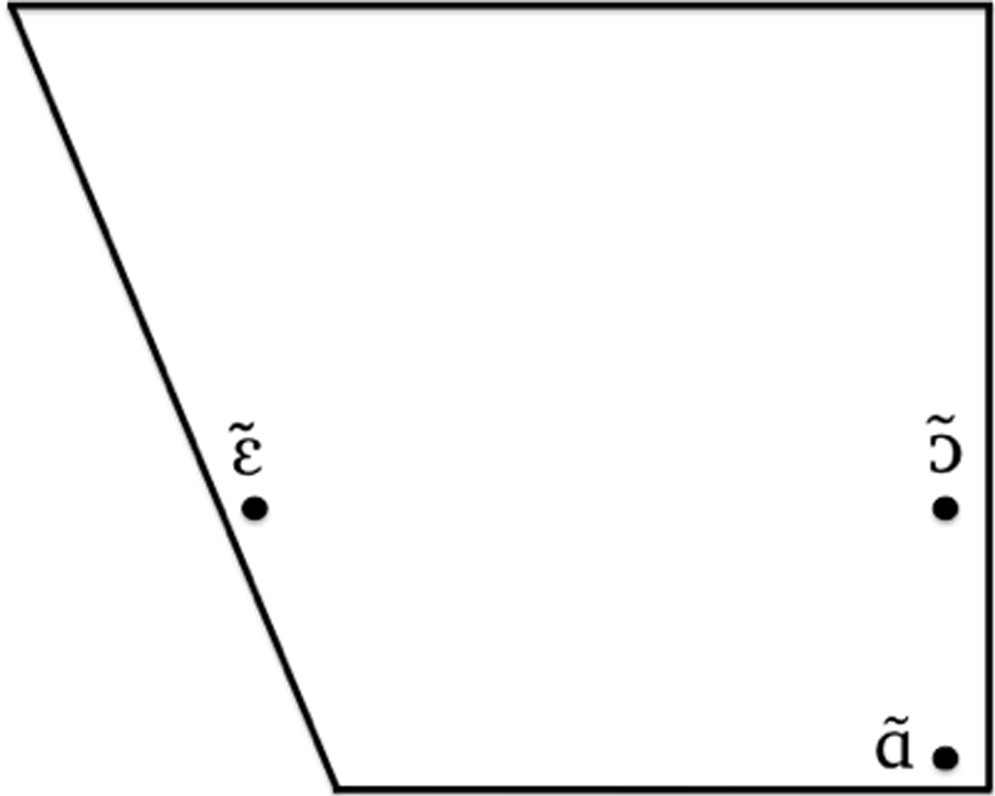
The phonological system of the prescriptive norm, standard French, distinguishes four nasal vowel phonemes (/ɛ̃/, /œ̃/, /ɑ̃/ and /ɔ̃/). The standard spoken norm, also known as supralocal French, contrasts only three nasal vowels (/ɛ̃/, /ɑ̃/ and /ɔ̃/) (see Figure 1) due to the merger of /ɛ̃/ and /œ̃/ to /ɛ̃/ (Pooley, Reference Pooley2006: 368). This means that the words brun (‘brown’) /bʁœ̃/ and brin (‘sprig’) /bʁɛ̃/ are both pronounced [bʁɛ̃] by the majority of speakers in northern France. This merger of the front nasal vowels constitutes a change from below which originated in Parisian French and diffused, as a change from above, throughout the supralocal area as part of the process of dialect levelling (see Mooney, Reference Mooney2016b: 332-334).
Supralocal French nasal vowels.
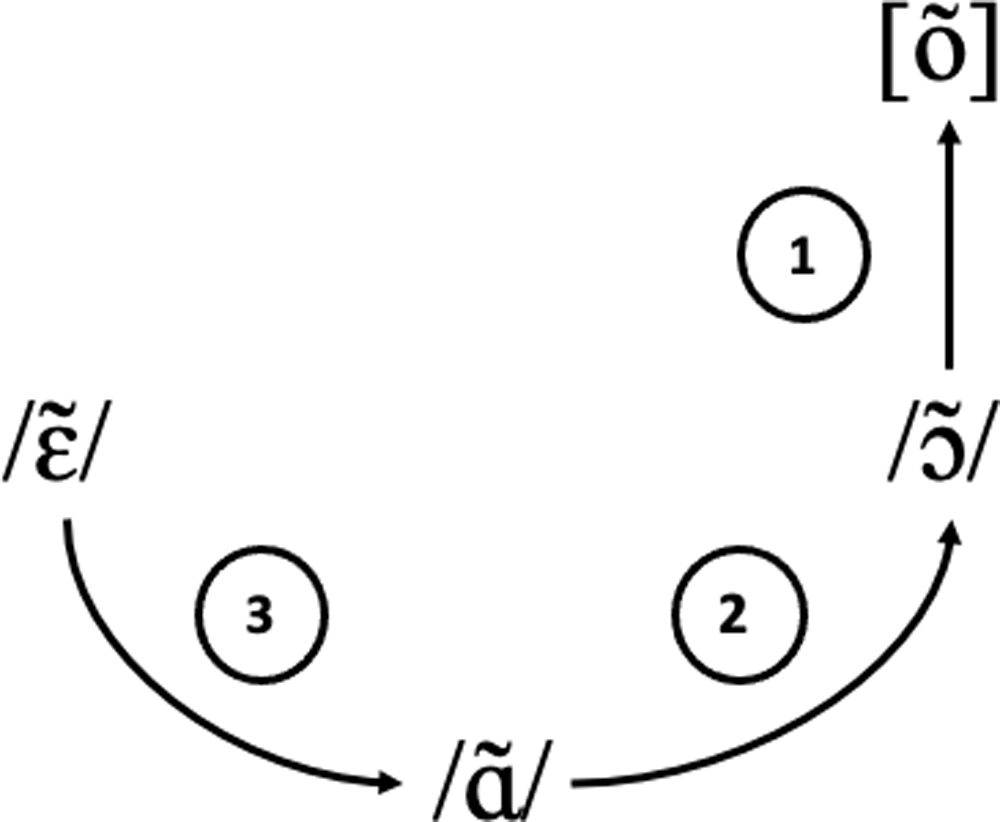
Additionally, in contemporary Parisian French, these three nasal vowels appear to be undergoing a counterclockwise chain shift (see Figure 2; Mettas, Reference Mettas1973; Walter, Reference Walter and van Deyck1994; Hansen, Reference Hansen1998, Reference Hansen2001) in which /ɛ̃/ approaches /ɑ̃/, /ɑ̃/ approaches /ɔ̃/, and /ɔ̃/ becomes very rounded and close, e.g., bain (‘bath’) /bɛ̃/ →[bɑ̃], banc (‘bench’) /bɑ̃/ →[bɔ̃], bon (‘good’) /bɔ̃/ →[bõ]. The chain shift taking place in Parisian French constitutes a change from below in progress. Hansen (Reference Hansen2001) notes that the shift is being led by intermediate variants in certain contexts and that it was nowhere near complete in the early noughties. Hansen identified two structural, language internal, factors accelerating the chain shift (2001: 45): variants occurring in stressed position (final syllable of the rhythmic group) were more advanced than variants occurring in unstressed environments (see Mettas, Reference Mettas1973; Fónagy, Reference Fónagy1989); within rhythmic groups, variants occuring in final syllables of polysyllabic words also exhibited more evidence for change in progress (see Léon, Reference Léon1983; Malderez, Reference Malderez1991).
Chain shift in Parisian French.

Hansen notes that the counter-clockwise movement of this shift contrasts with the ‘rotation […] observée pour les voyelles du français canadien qui vont vers l’avant’ (2001: 45), e.g., bain /bɛ̃/ →[be˜], banc /bɑ̃/ →[bɛ̃], bon /bɔ̃/ →[bɑ̃]) (cf. Carignan, Reference Carignan, Lee and Zee2011). Mooney (Reference Mooney2016b) has also identified a nasal vowel shift in the regional French of Béarn, southwestern France, where the youngest generation have been shown to lead three systematic ongoing changes in the nasal vowel system: /ɑ̃/-backing; /ɔ̃/-centralisation, and /œ̃/-fronting. This push chain shift is argued to have been initiated by the individual adoption of one supralocal feature, /ɑ̃/-backing, in regional French, with /ɔ̃/ and /œ̃/ moving forward in the vowel space to preserve the functional integrity of the four term nasal vowel system in southern regional French.
In addition to the studies cited above, there have, of course, been a large number of studies focusing on the phonological status and phonetic quality of the (European) French nasal vowels. These studies are largely based on laboratory speech and provide a wealth of descriptive detail on the nasal vowels, examining them from a variety of perspectives: speech perception (Delvaux et al., Reference Delvaux, Demolin, Soquet and Kingston2004; Woehrling and Boula de Mareüil, Reference Woehrling and Boula de Mareüil2006; Delvaux, Reference Delvaux2009); articulatory phonetics (Maeda, Reference Maeda, Hardcastle and Marchal1990; Teston and Demolin, Reference Teston and Demolin1997; Montagu, Reference Montagu2004; Delvaux et al., Reference Delvaux, Metens and Soquet2002; Delvaux et al., Reference Delvaux, Demolin, Harmegnies and Soquet2008; Carignan, Reference Carignan2013); acoustic phonetics (Longchamp, Reference Longchamp1979; Maeda, Reference Maeda1982, Reference Maeda, Huffman and Krakow1993; Montagu, Reference Montagu2007); phonology (Durand, Reference Durand1988, Reference Durand, Baronian and Martineau2009; Delais-Roussarie and Durand, Reference Delais-Roussarie and Durand2003; Durand and Eychenne, Reference Durand and Eychenne2011). In the fields of articulatory and acoustic phonetics, there is much emphasis placed on the mapping of articulatory gestures onto acoustic cues for nasalization and thus many of the studies cited above fall into both categories.
3.1. Acoustic characteristics of nasal vowels
The first two formant frequencies are commonly held, in acoustic phonetic studies of oral vowels, to have general non-linear articulatory correlates : F1 exhibits an inverse correlation with vowel height; F2 exhibits a positive correlation with vowel frontness/backness. It is worth noting, here, that filtering through the nasal cavity can distort somewhat the reliability of interpreting formant values in these articulatory terms; velopharyngeal (VP) coupling can cause formant value changes that are not due to the configuration of the oral cavity, including the tongue (Carignan et al. Reference Carignan, Shosted, Fu, Liang and Sutton2013; Carignan, Reference Carignan2014: 24; Carignan, Reference Carignan, Vietti, Spreafico, Mereu and Galatà2018b: 19-20): ‘the inferred shape of the acoustically excited tract is obscured by the acoustic effects of nasalisation’ (Carignan et al., Reference Carignan, Shosted, Fu, Liang and Sutton2015: 34). Additionally, formant measurements above F2 may not be wholly reliable because F3 is severely affected by nasalization (Maeda, Reference Maeda, Huffman and Krakow1993: 151; De Mareüil et al., Reference De Mareüil, Adda-Decker and Woehrling2007): ‘due to nasal zeroes, F3 can be divided into two peaks of lesser intensity and/or shift towards higher frequencies’ (Delvaux et al., Reference Delvaux, Metens and Soquet2002: 2). For this reason, F3 is not included in the analysis in Sections 4 and 5.
The effects of VP coupling on formant frequencies is relatively well documented. Carignan (Reference Carignan, Vietti, Spreafico, Mereu and Galatà2018b: 23) notes, for example, that VP coupling tends to result in a general increase in F1 for close vowels, a decrease in F1 for open vowels, and to a decrease in F2 for non-front vowels. When measuring formant frequencies for nasal vowels on the basis of information in the waveform and spectrogram, however, it is not possible to know whether these values are the result of tongue height and retraction or an acoustic consequence of nasalization. There are other articulatory gestures, such as pharyngeal contriction and lip rounding/protrusion (Maeda, Reference Maeda, Huffman and Krakow1993: 165), that can also affect formant values: ‘a constriction in the lower pharynx is correlated with an increase in F1, while expansion is correlated with a decrease in F1; lip rounding and/or protrusion is correlated with a decrease in all formants’ (Carignan, Reference Carignan2014: 24).
For /ɛ̃/, F1 values have been shown to be the result of tongue height, not nasalization (Carignan, Reference Carignan, Vietti, Spreafico, Mereu and Galatà2018b: 26), and pharyngeal constriction, while F2 is the result of VP coupling, tongue backing, and velic lowering (Carignan, Reference Carignan2014: 31; Carignan et al., Reference Carignan, Shosted, Fu, Liang and Sutton2015: 49). For /ɑ̃/, F1 values have been shown to be the result of VP coupling, lip rounding, and lower pharyngeal expansion, while F2 is the result of VP coupling, tongue backing, lip rounding, and velic lowering (Carignan, Reference Carignan2014: 31; Carignan et al., Reference Carignan, Shosted, Fu, Liang and Sutton2015: 49). For /ɔ̃/, F1 values were due to lip rounding, pharyngeal constriction and tongue height, while F2 was due to tongue backing, lip rouding, and velic lowering (Carignan, Reference Carignan2014: 31; Carignan et al., Reference Carignan, Shosted, Fu, Liang and Sutton2015: 49). The overall effect of articulatory gestures in addition to VP coupling appears to be that they enhance the effect of nasalization on F1 and F2 (Carignan, Reference Carignan2014: 31-32; Carignan et al., Reference Carignan, Shosted, Fu, Liang and Sutton2015: 49), in that they involve a general decrease in F2, an increase in F1 for /ɛ̃/ and /ɔ̃/, and an F1 decrease for /ɑ̃/.
The acoustic consequences of nasalization that result in the F1 and F2 values for /ɛ̃/, /ɑ̃/, and /ɔ̃/, as well as the enhancement of these acoustic consequences using other articulatory gestures, resembles the counter-clockwise chain shift for /ɛ̃/ and /ɑ̃/ schematized in Figure 2: an increase in F1 (lowering) and a decrease in F2 (backing) for /ɛ̃/; a decrease in both F2 and F1 (backing and raising) for /ɑ̃/ (Carignan, Reference Carignan2018a: 2598). Nasalization results in an increase in F1 for /ɔ̃/, or vowel lowering, which is not consistent with the systemic shift outlined in Figure 2 (Carignan, Reference Carignan2014 24). Carignan (Reference Carignan, Vietti, Spreafico, Mereu and Galatà2018b: 23-24) notes, however, that it is reasonable to question whether the acoustic consequences of nasalization, and associated articulatory gestures, might be perceived as changes in vowel quality, perhaps initiating the systemic chain shift. This argument is advanced within the framework of Ohala’s (Reference Ohala, Breivik and Ernst1989) ‘hidden variation theory’, sometimes referred to as the ‘listener oriented approach to sound change’: ‘sound change is seen to take place when the listener reinterprets secondary acoustic cues that are present in the signal as important for parsing and producing the segment’ (Mooney and Hawkey, Reference Mooney and Hawkey2019: 289). In the case of the nasal vowels, the acoustic effects of nasalization may have been misinterpreted as a systemic shift in vowel quality, which was perhaps ‘triggered by the inherent consequence of VP coupling on the acoustic realization of /ɛ̃/’ (Carignan, Reference Carignan2014: 31). If this is the case, we can note additionally that lingual and pharyngeal articulatory configurations may also contribute to the percept of shifting vowel quality and thus be involved (Carignan et al., Reference Carignan, Shosted, Fu, Liang and Sutton2015: 47). Since the raising of /ɔ̃/ is not consistent with the acoustic effects of nasalization, Carignan (Reference Carignan2014: 31, 2015: 36) argues that this may simply be a functional reaction of the raising of /ɑ̃/ towards /ɔ̃/. In sum, Carignan (Reference Carignan2018a: 2598) has argued convincingly that psycho-acoustic pressure on the vowel space as a consequence of nasalization and its associated articulatory gestures may have acted as a trigger for the initial shift in vowel quality, potentially influencing subsequent shifts in the nasal vowel system in Parisian French.
4. METHODOLOGY
This section outlines the methodological approach adopted for the study of the Parisian nasal vowel chain shift, including participant sampling, corpus construction, variable circumscription, data processing, and data analysis.
4.1. Participant Sampling
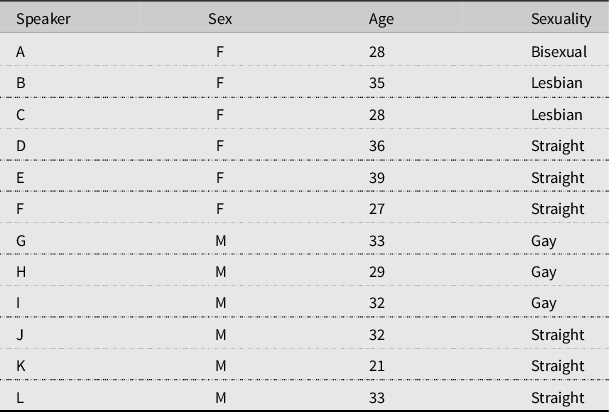
The primary method of recruiting participants was using the ‘friend-of-a-friend’ technique, also known as ‘snowball’ sampling (Milroy and Gordon, Reference Milroy and Gordon2003: 32). This involved using the researcher’s own networks of friends in Paris and subsequently asking participants to suggest other friends that might be willing to be involved. The participants in this study are profiled in Table 1: there are twelve participants in total, equally distributed by sex [male; female] and sexuality [straight; queer]. The categories of ‘queer’ and ‘straight’ were used primarily for the practical purpose of recruiting speakers. The use of these etic categories is not essentialist in intention and I acknowledge the inevitable variability within these categories. Indeed, Speaker A, for example, self-identifies as ‘bisexual’. For the purpose of this study, the queer-straight binary distinction is a necessary first step in moving away from a focus on normative heterosexuality in language variation and change studies.
Participants: sex, age, and self-identified sexuality
The ethnicity and socio-economic class of all speakers in this study is broadly ‘white middle class’. Socio-economic class was, however, not measured explicitly; it was not self-reported and was simply intuited by the author. In western countries, predominantly white speakers in the lower middle class have been consistently shown to lead mainstream language change (see Labov, Reference Labov2001). It is worth noting that Labov’s initial findings were based on a formalized measurement of class in North America and that these categories do not necessarily map onto the socio-economic sub-divisions proposed by the Institut National de la Statistique et des Études Économiques (INSEE) (Pooley, 2000). In any case, the ethnicity and socio-economic status of participants in this study have been held constant in the sample frame in order to minimize the influence on speech production of other social factors, which may interact with sex and sexuality; future studies will integrate ethnic minorities and a larger socio-economic sample. The sampling method targeted participants that were 20-40 years old, with the aim of avoiding the transition from adolescence to adulthood, a period of linguistic development that is characterized by high levels of linguistic variation and change in the direction of more standard linguistic forms (Cukor-Avila and Bailey, Reference Cukor-Avila, Bailey, Chambers and Schilling2013). The researcher was also in this age group, facilitating the friend-of-a-friend recruitment technique and having the added benefit of reducing potential socio-situational variation in the speech of participants in response to the researcher’s relative age.
4.2. Linguistic variables and corpus construction
The primary aim of this study is to examine evidence for participation in the Parisian counter-clockwise nasal vowel chain shift: /ɛ̃/ → /ɑ̃/ → /ɔ̃/ → [õ]. A precursor to this shift, however, is checking that the participants involved also demonstrate evidence in their speech for the well-established merger of /ɛ̃/ and /œ̃/ to /ɛ̃/, since /œ̃/ has not been shown to participate in the chain shift as an independent phoneme. As such, this study aimed to examine: (i) evidence for the well-established merger of /ɛ̃/ and /œ̃/; (ii) evidence for the linguistic change in the formant values (F1, F2) of the three Parisian nasal vowel phonemes /ɛ̃/, /ɑ̃/, and /ɔ̃/.
Informants in this study took part in (i) a reading passage task, and (ii) a wordlist task. The reading passage was adapted from Hansen (Reference Hansen1998: 155), including words containing the four standard French nasal vowel phonemes (/ɛ̃/, /œ̃/, /ɑ̃/ and /ɔ̃/). In the reading passage, presented in Appendix 1, the words have been emboldened and italicized, and the phoneme of interest is noted in brackets after each word; this formatting was, of course, removed when presented to participants. The text contained 28 nasal vowel tokens, distributed as follows: 6 tokens of /ɛ̃/; 2 tokens of /œ̃/; 11 tokens of /ɑ̃/; 9 tokens of /ɔ̃/. For /ɛ̃/, /ɑ̃/ and /ɔ̃/, tokens occurred in open final syllables (_#), closed final syllables (_C#), and open medial syllables (_σC). /œ̃/ only occurred in open final syllables in the text.
The wordlist task included 95 words presented in the carrier phrase ‘Dites MOT pour moi’; the voiceless plosives preceding ([t]) and following ([p]) the target word assisted in the accurate segmentation of the vowel produced when it occurred at a word boundary. The wordlist used included all four standard French nasal vowel phonemes in three syllable types: (i) open final syllables (_#); (ii) closed final syllables (_C#); open medial syllables (_σC). The full wordlist can be consulted in Appendix 1; this was presented to participants in pseudo-randomized order, by aligning the words with a series of random numbers in Excel, using the =RAND() function, and then by sorting the list in numberical order. The distribution of the vowel tokens by syllable type in the reading passage and wordlist are presented in Table 2. A total of 123 words were included in both tasks; both tasks were included in the analysis and no distinction was made between data from the reading passage or wordlist in the statistical analyses outlined in Section 4.4. The use of two tasks simply aimed to maximize the number of tokens in the study and, as both tasks elicit read speech, their use is not intended to be a proxy for style.
Distribution of phonemes in the reading passage and wordlist tasks

4.3. Acoustic analysis
The reading and wordlist tasks were recorded in person using a sampling rate of 44.1 kHz and a 16-bit PCM sample size. The analysis began by manually labelling 1476 tokens of the nasal vowels for vowel onset and offset in Praat (Boersma, Reference Boersma2001; Boersma and Weenink, Reference Boersma and Weenink2012) text grids, across the twelve speakers selected for analysis, before measuring manually the first two formant frequencies, F1 and F2 at the vowel midpoint. These formants were estimated in Praat using the LPC (Linear Predictive Coding) algorithm, with a maximum of 4,000 Hz for male speakers and 4,500 Hz for female speakers. These formant ceilings are lower than the usual formant ceilings of 5000 Hz and 5500 Hz in order to increase the sensitivity of the LPC algorithm; this adjustment was necessary as the automatic detection of F1 and F2 for nasal vowels can be particularly problematic for back vowels, where the values for F1 and F2 are close together. Carignan (2014: 26, Reference Carignan, Vietti, Spreafico, Mereu and Galatà2018b: 22) notes that adjusting the formant ceiling in this way for nasal vowels avoids multiple LPC estimate errors. For this reason, all values were extracted manually at the midpoint, therefore ensuring that the measurements taken were for estimations of the correct formant frequencies; outliers were double-checked against the spectrogram for the token in question. In total, 15 tokens were excluded from the analysis as it was not possible to reliably read the formant estimations, either due to low amplitude in the signal or extraneaous noise, leaving 1461 tokens of the nasal vowels in total. In some instances, and in particular where the nasal vowels preceded a plosive consonant, a co-articulatory nasal consonant of short duration and low amplitude was produced during the vowel-plosive transition; these consonants were always excluded from the vowel offset label.
4.4. Statistical analysis
Before analysing evidence for the nasal vowel chain shift, the /ɛ̃/∼/œ̃/ merger was first investigated. This involved submitting raw data (F1 and F2 in Hz) for both vowels to statistical analysis for each of the twelve speakers individually, in order to examine the degree of vowel overlap between the traditional phonemic categories of /ɛ̃/ and /œ̃/. Many methods have been proposed to examine overlap in the study of vowel splits and mergers; see Nycz and Hall-Lew (Reference Nycz and Hall-Lew2013) for discussion of Euclidean distance, mixed model regression, spectral overlap, and the Pillai-Bartlett trace. Following Nycz (Reference Nycz2013), the ‘mixed model regression’ technique was used in the present study: for each vowel pair analysed, and for each speaker, a mixed-effects regression analysis was undertaken in the R environment using the Rbrul text-based interface (Johnson, Reference Johnson2008, Reference Johnson2009). The models were constructed as follows: F1 or F2 as the dependent variable; the lexical item in which the vowel occurred was included as a random effect, ‘word’; phonological environment (preceding and following) and the historically appropriate ‘phoneme’ were included as fixed effects. These analyses aimed explicitly to assess the extent to which ‘phoneme’ may predict formant values after phonological context has been taken into account, thus establishing concrete evidence for or against the /ɛ̃/∼/œ̃/ merger for individual speakers.
Subsequently, the F1 and F2 data for all speakers were normalized using the Lobanov (Reference Lobanov1971) normalization method to enable reliable statistical comparison which takes account of anatomical differences which may be related to speaker sex and age. Following normalization, the full normalized data set was submitted to statistical analysis in Rbrul. The statistical modelling technique used was mixed-effects linear regression for continuous variables which included F1 or F2 as the dependent variable, ‘speaker’ and ‘word’ as random effects to take account of variation introduced by inter-speaker differences and differing lexical items, as well as a variety of fixed-effect predictors, depending on the hypothesis being tested: phoneme, syllable type, preceding phoneme, following phoneme, speaker sex (M or F), speaker sexuality (straight or queer), and speaker year of birth. The ‘syllable type’ factor group contained the following factors: (i) open final syllables (_#); (ii) closed final syllables (_C#); open medial syllables (_σC). The factors of the ‘preceding phoneme’ and ‘following phoneme’ factor groups are not evenly distributed in terms of context; these factor groups have been included, however, in the statistical models in Section 5, as they may account for some of the variation observed. This will ensure that any significant results reported for the other independent variables are reliable predictors over and above the variation that is accounted for by the preceding or following phoneme. When preceding and/or following phoneme are themselves returned as significant by the modelling process, we must treat these effects with caution as the factors are not evenly distributed in such a way that we can reliably investigate the influence of preceding or following phoneme on vowel quality. The number of tokens per cell (or factor) is thus much more evenly distributed for ‘syllable type’ than for the phonological context factor groups.
It must also be noted that ‘syllable type’ cannot be included in regression models alongside ‘preceding phoneme’ and ‘following phoneme’ as, due to the nature of the reading and wordlist tasks, syllable type is at least partially multicollinear with phonological environment; they are correlated with each other. For example, final open syllables (_#) always correspond to following phoneme /p/, from the word pour in the carrier phrase and word initial tokens always correspond to preceding phoneme /t/, from the word dites in the carrier phrase. Additionally, certain syllabic contexts co-occur, to some extent, with particular combinations of preceding and following phonemes, as a result of the restricted range of lexical items included in the reading passage and wordlist tasks. For example, for the word sainte, the syllable type _C# has preceding /s/ and following /t/ for all speakers. Interdependencies such as these between independent variables should never be considered together (Tagliamonte and Baayen, Reference Tagliamonte and Baayenm2012: 24–25) because unsolvable computational problems often arise resulting in various kinds of error messages from the variable rule programme. As such, separate models using ‘syllable type’ on one hand, and preceding and following phonological environment on the other, were performed; the models that accounted for the most variance in the data set are reported in Section 5. For all statistical tests, two alpha levels for statistical significance were used in the regression analyses: significant (p < .05); highly significant (p < .01).
5. RESULTS
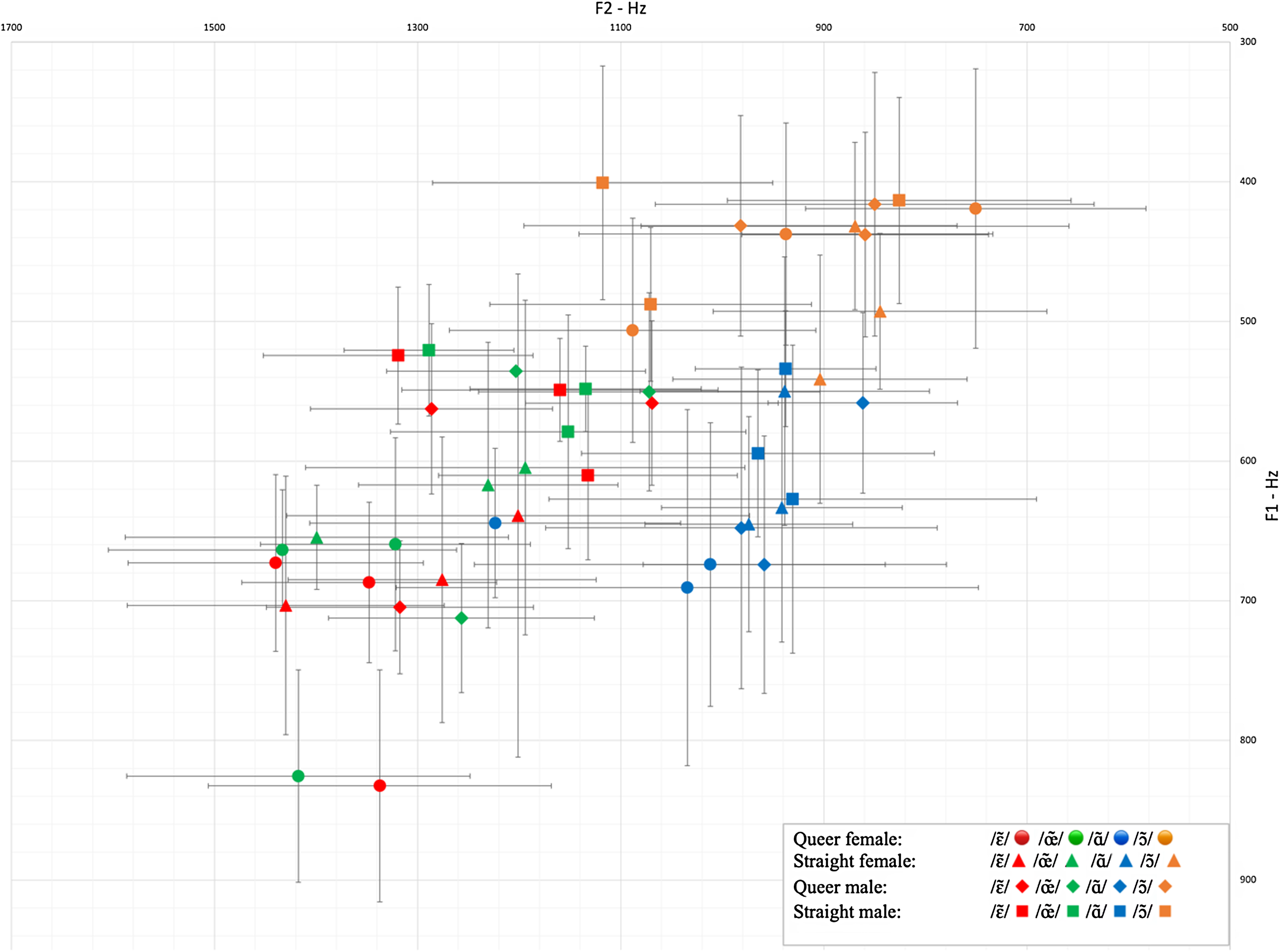
The sociolinguistic distribution, by sex and sexuality, of the vowel tokens extracted for analysis are presented in Table 3; in total, 1461 tokens of the nasal vowels were submitted to acoustic analysis. The normalized F1 and F2 z-score data for all speakers is presented in Figure 3; raw Hz means and standard deviations, distinguished by speaker sex and sexuality, can additionally be consulted in Figure A1 in Appendix 1.
Token counts for French nasal vowels by ‘sex’ and ‘sexuality’

All speakers: normalized F1 and F2 z-scores for all nasal vowels, with 95% confidence intervals.
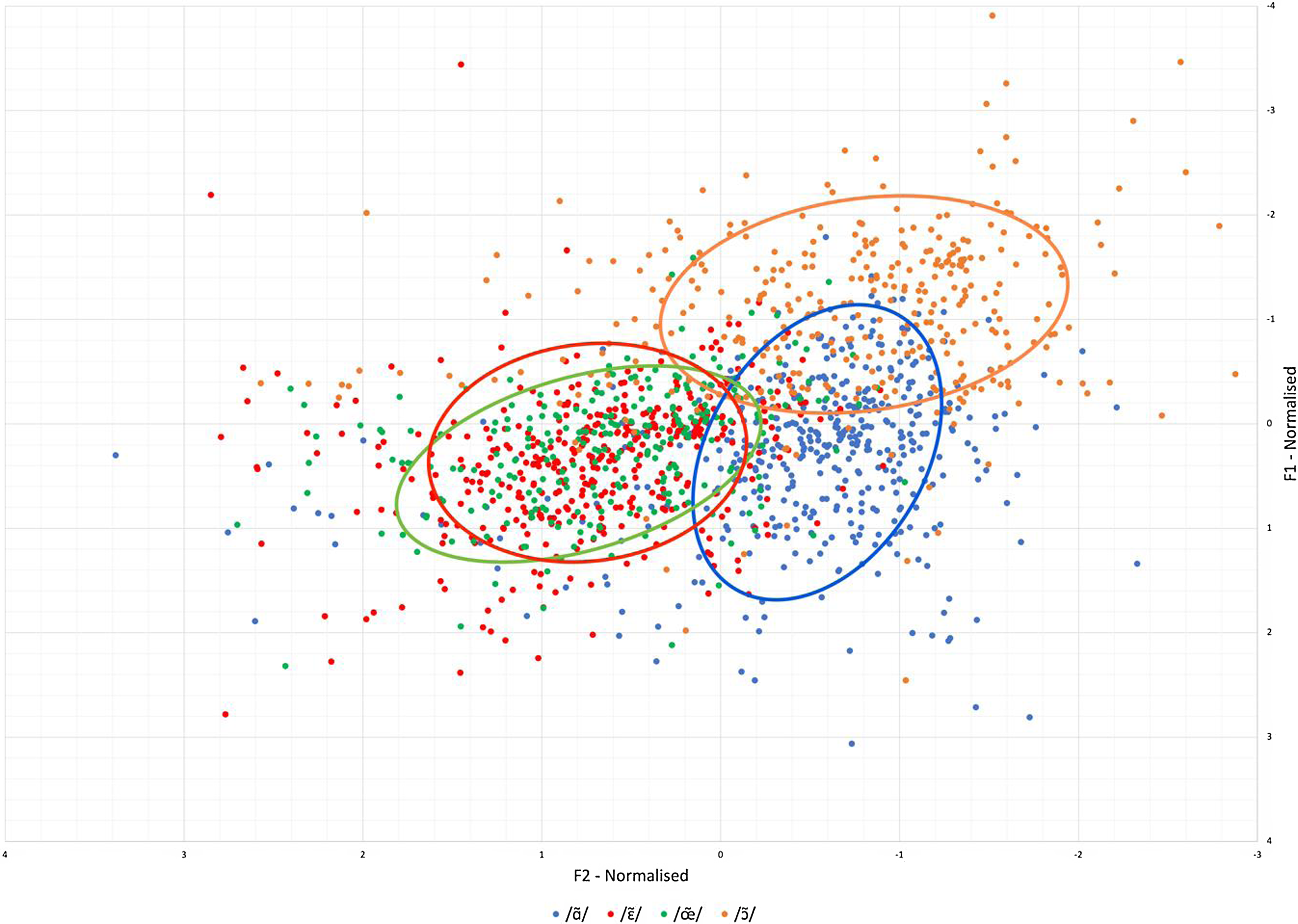
This section first examines evidence in the raw (Hz) data for the merger of the front unrounded and rounded nasal vowels, /ɛ̃/ and /œ̃/, to /ɛ̃/, before investigating evidence for ongoing sound change in the nasal vowel system as part of a counter-clockwise nasal vowel chain shift in Parisian French: /ɛ̃/ → /ɑ̃/ → /ɔ̃/ → [õ].
5.1. Front nasal vowel merger /ɛ̃/∼/œ̃/
Table 4 presents the results of the mixed-model regression vowel overlap analysis of the raw (Hz) data for F1 and F2, performed for individual speakers on the /ɛ̃/ and /œ̃/ vowels. Non-significant p-values indicate that there is no significant difference in the phonetic realisation of /ɛ̃/ and /œ̃/, and that they are thus represented by a merged phonetic and phonological category, /ɛ̃/. This is the case for both formants for all queer female speakers (A, B, and C), all straight female speakers (D, E, and F), for two queer male speakers (G and I), and for two straight male speakers (J and L); ten of the twelve speakers in the sample therefore show no evidence for the phonetic separation of /ɛ̃/ and /œ̃/.
Individual speakers (raw data): Vowel overlap results for front nasal vowels (F1 and F2), with Weber fractions (Δ)

One queer male speaker (H) has F1 values for /ɛ̃/ and /œ̃/ that are returned by the regression analysis as significantly different (p = .02). Another straight male speaker (K) has both F1 and F2 values for /ɛ̃/ and /œ̃/ that are significantly different (p = .02 for F1; p = .01 for F2). For Speaker H, the mean F1 difference is 8 Hz; for Speaker K the mean F1 difference is 185 Hz and the mean F2 difference is 20 Hz. Labov (Reference Labov2001: 415) suggests that hearers can distinguish phonetic differences as small as 75-100 Hz on the F2 dimension, but that below 200 Hz, tokens are usually perceived as the same (Labov, Reference Labov2001: 378). Rosner and Pickering (Reference Rosner and Pickering1994: 55) propose a method for establishing ‘just noticeable differences’ phonetically, suggesting a Weber fraction of greater than .05 as the maximal baseline for a noticeable phonetic difference. Weber’s Law states that the size of the just noticeable difference is a constant proportion of the original stimulus size and Weber fractions are used to numerically represent this relationship. The Weber fraction (Δ) is (Fa – Fb)/Fb, where F = formant value; this fraction indicates likely false positive results, where the regression analysis has returned a significant p-value for an /ɛ̃/∼/œ̃/ phonetic distinction, but where the mean phonetic difference is not actually noticeable. For Speaker H, Δ = .02 for F1 and, for Speaker K, Δ = .32 for F1 and Δ = .02 for F2. The mean difference of 8 Hz for Speaker H’s F1 values for /ɛ̃/ and /œ̃/ is therefore unlikely to be a noticeable difference, indicating that they too seem to have a merged phonetic and phonological category for /ɛ̃/ and /œ̃/. Equally, the 20 Hz difference on the F2 dimension for Speaker K is below the threshold for being a just noticeable difference. Speaker K’s mean F1 difference, between /ɛ̃/ and /œ̃/, of 185 Hz is associated with a Weber fraction value of .32, indicating that this significant difference is indeed noticeable. For Speaker K, they produce /ɛ̃/ vowels with significantly higher F1 values than for /œ̃/, indicating that /ɛ̃/ is significantly lower in the acoustic vowel space than /œ̃/.
The Weber fraction analysis thus detected false positive p-values for Speaker H (F1) and Speaker K (F2). It is also necessary to examine any potentially false negative p-values, or phonetic differences that are returned as non-significant by the regression analysis but for which the mean Hz difference is related to a Weber fraction greater than .05. A Weber fraction greater than .05 indicates that the mean difference for /ɛ̃/ and /œ̃/ between F1 or F2 is likely to be perceptible or, at least, that it is above the maximum threshold for just noticeable differences. That said, while a mean difference between /ɛ̃/ and /œ̃/ may be noticeable, a non-significant p-value associated with this mean difference indicates that the observed mean difference is likely due to chance. There are three mean F1 differences and two mean F2 differences in Table 4 for which Δ > .05, and for which p > .05: Speaker D (F1: Δ = .06; p = .1), Speaker E (F1: Δ = .11; p = .4), Speaker F (F1: Δ = .07; p = .5), Speaker C, (F2: Δ = .07; p = .8), Speaker I (F2: Δ = .07; p = .2). For these five speakers, the Weber fractions indicate that the mean difference can technically be heard, but the associated p-values do not indicate that this noticeable difference is predictable, given the data observed. In the cases above, where false positives were detected for Speakers H and K, the mean difference was not due to chance, but it was also not great enough to be perceived.
In sum, the mixed-model regression analysis of vowel overlap and the establishment of Weber fractions for just noticeable differences suggests that, with the exception of F1 for Speaker K, a straight male speaker, all other speakers (11/12) show evidence for the merger of /ɛ̃/ and /œ̃/ to /ɛ̃/, indicating that their phonological inventory is characteristic of the typical three-term Parisian nasal vowel system: /ɛ̃/, /ɑ̃/ and /ɔ̃/. For Speaker K, the youngest of the straight male speakers at 21 years of age, /ɛ̃/ is realised phonetically as significantly lower than /œ̃/ in the acoustic vowel space. This speaker is originally from Metz, Moselle, which is in the supralocal area as defined by Pooley (Reference Pooley2006: 385), though it borders an area where supralocal ‘divergent forms’ occur variably (2006: 385) and, because of his age, his period of residence is Paris is reduced, perhaps explaining his resistance to this widespread supralocal merger on the F1 dimension.
5.2. Counter-clockwise nasal vowel chain shift
The results presented in Section 5.1 indicate that, across the sample, the phonological inventory of the speakers involves phonetic distinctions between three, not four, nasal vowel phonemes: /ɛ̃/, /ɑ̃/ and /ɔ̃/. This section considers evidence for progression of the counter-clockwise nasal vowel shift in Parisian French by examining F1 and F2 data for all three vowels, noting that the original data set has been recoded such that /ɛ̃/ now represents a merged phoneme, containing all data originally coded separately for /ɛ̃/ and /œ̃/. This includes /ɛ̃/ data for Speaker K (see Section 5.1).
As discussed in Section 3, the nasal vowel chain shift in Parisian French involves the lowering and backing of /ɛ̃/, the backing and raising of /ɑ̃/, and the raising of /ɔ̃/, such that: /ɛ̃/ → /ɑ̃/ → /ɔ̃/ → [õ]. In acoustic terms, the following diagnostics for the progression of these systematic linguistic changes are as follows:
-
(i) /ɛ̃/-lowering: higher F1 values;
-
(ii) /ɛ̃/-backing: lower F2 values;
-
(iii) /ɑ̃/-raising: lower F1 values;
-
(iv) /ɑ̃/-backing: lower F2 values;
-
(v) /ɔ̃/-raising: lower F1 values.
These diagnostics imply that lowering and backing for a given vowel are completely distinct processes, but this is not necessarily the case. Before examining evidence for the diagnostics (i) – (v), it is first necessary to investigate Hansen’s claim that the change in progress is more advanced in final (stressed) syllables (2001: 45). For all three nasal vowels, mixed-effect regression models were performed of F1 and F2 (separately) as the dependent variable, ‘speaker’ and ‘word’ as random effects, and the following fixed effects: ‘speaker sex’, ‘speaker sexuality’, ‘speaker year of birth’, and ‘syllable type’. For all regression models, syllable type was returned as a non-significant predictor of F1 and F2 (p > .05), indicating that there is no significant distinction in formant values between tokens in final, stressed position (both open and closed), and those in medial position. As syllable type and phonological environment are partially multicollinear (see Section 4.4), the remainder of the mixed-effects regression models presented in this section exclude ‘syllable type’ as an independent variable and instead include ‘preceding phonological environment’ and ‘following phonological environment’ in the analyses.
Beginning with F1 values for /ɛ̃/, in order to investigate evidence for (i) /ɛ̃/-lowering, normalized data for all speakers was submitted to mixed-effect regression analysis, the results of which are presented in Table 5. F1 was included as the dependent variable, ‘speaker’ and ‘word’ as random effects, and the following fixed-effect independent variables: ‘speaker sex’ [male; female], ‘speaker sexuality’ [straight; queer], ‘speaker year of birth’ [continuous], ‘preceding phoneme’ [various], and ‘following phoneme’ [various]. The aim of this model, and indeed the subsequent models, is to ascertain the extent to which the social factors of sex and sexuality can predict the formant values observed when phonological context (preceding and following phonemes) has been taken into account. As such, significant results for ‘preceding phoneme’ and ‘following phoneme’ will be reported, when relevant, but will not form part of the main argument.
All speakers (normalized data): Regression analysis of F1 values for /ɛ̃/ (merged), with ‘speaker’ and ‘word’ as random effects

Note: Non-significant factor groups were: preceding phoneme (p = .08), speaker sexuality (p = .09), speaker year of birth (p = .34), and following phoneme (p = 1.0).
The regression analysis of F1 values for /ɛ̃/ returned speaker sex as a significant predictor (see Table 5). Female speakers, both straight and queer, are shown to have significantly higher F1 values than male speakers, both straight and queer. Therefore, female speakers demonstrate more evidence for (i) /ɛ̃/-lowering than males speakers, and thus more evidence for progression of this sound change. Considering the data for male and female speakers separately, no significant predictors were returned for male speakers but, for female speakers, preceding phoneme was a significant predictor (p = .01), such that the progression of the sound change was shown to be more probable following /s/, /v/, /l/, and /p/.
The /ɛ̃/ regression analysis of F2 values returned sex, sexuality, and year of birth as non-significant, indicating that none of the social factors considered were predictors of (ii) /ɛ̃/-backing. Phonological environment was, however, shown to have a significant effect of (ii) /ɛ̃/-backing. For following phoneme (p = .00), lower F2 values were realized before labials (/m/ and /p/) and apical consonants (/t/, /z/, /d/), and before a pause (_#), and for preceding phoneme (p = .00), lower F2 values were realized following labials (/f/, /v/, /m/, /p/), apicals (/ʒ/, /t/, /s/), and /ʁ/.
Table 6 considers evidence for (iii) /ɑ̃/-raising. F1 values for /ɑ̃/ are shown to be significant predicted by speaker sex, with male speakers having significantly higher F1 values than female speakers. Lower F1 values indicate /ɑ̃/ vowels that are more close or higher in the vowel space, thus showing that female speakers demonstrate more evidence for the sound change.
All speakers (normalized data): Regression analysis of F1 values for /ɑ̃/, with ‘speaker’ and ‘word’ as random effects
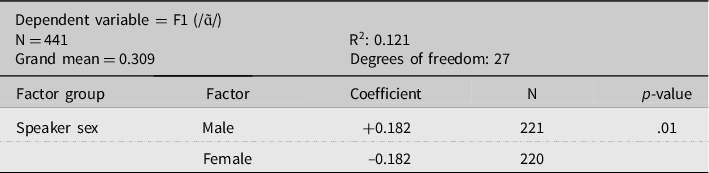
Note: Non-significant factor groups were: speaker year of birth (p = .11). preceding phoneme (p = .14), following phoneme (p = .15), and speaker sexuality (p = .36).
Considering the /ɑ̃/ data for male and female speakers separately, year of birth was returned as a significant predictor of F1 (see Table 7), such that the higher the year of birth, the lower the F1 value. For every year increase, F1 values reduce by 0.044. This is a relatively small effect but it suggests that, for male speakers (both straight and queer), younger speakers show more evidence for the ongoing sound change (iii) /ɑ̃/-raising. For female speakers, sex, sexuality, and year of birth were returned as non-significant predictors of F1, indicating that none of the social factors considered were predictors of (iii) /ɑ̃/-raising. /ɑ̃/-raising was, however, shown to be favoured, for female speakers, when the vowel precedes /s/ and /b/ (p = .04) and when the vowel follows /m/, /d/, /ʃ/, /ʁ/, /l/, and /j/ (p = .02).
Male speakers (normalized data): Regression analysis of F1 values for /ɑ̃/, with ‘speaker’ and ‘word’ as random effects
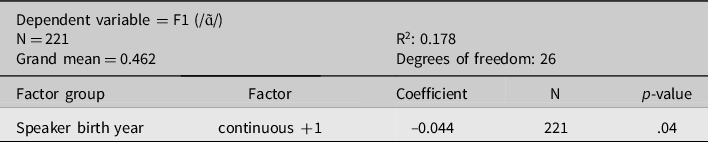
Note: Non-significant factor groups were: following phoneme (p = .14), preceding phoneme (p = .69), and speaker sexuality (p = .73).
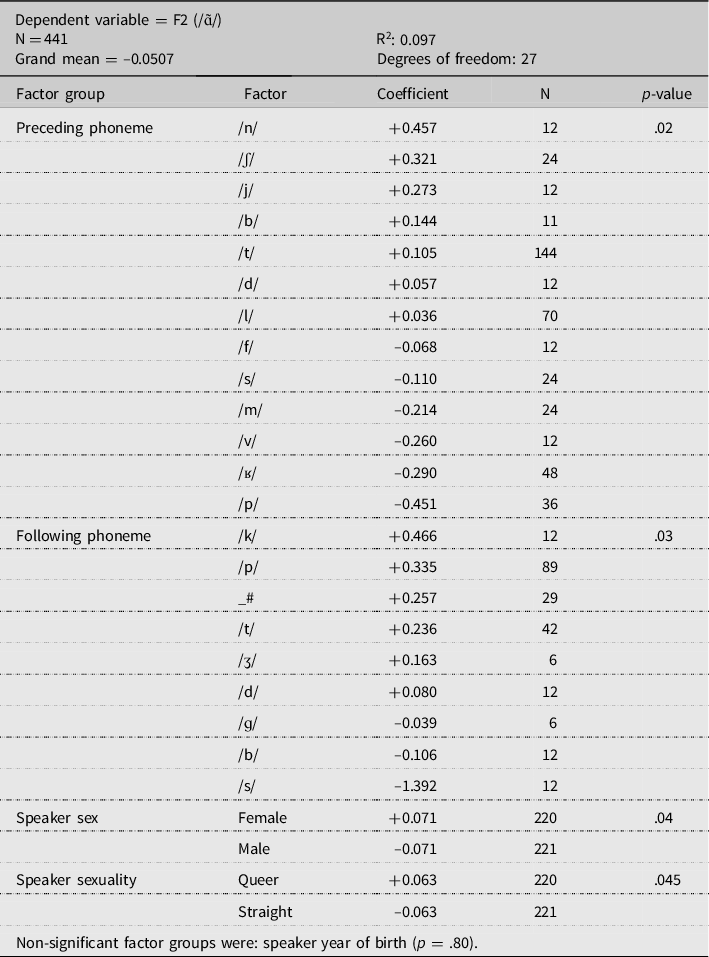
The /ɑ̃/ regression model for F2 is presented in Table 8; this analysis shows that (iv) /ɑ̃/-backing is significantly favoured by sex, sexuality, preceding phoneme, and following phoneme. Female speakers have significantly higher F2 values than male speakers and queer speakers have significantly higher F2 values than straight speakers, but the magnitude of the effect is small in both cases, showing very weak effects. In order to probe deeper into the sex and sexuality effects, female and male speakers were considered separately, as were straight and queer speakers. When female speakers’ F2 values were modelled separately, speaker sexuality was returned as a significant result (p = .01), such that queer women (+0.129) had higher F2 values than straight women (–0.129). When queer speaker’s F2 values were modelled separately, speaker sex was returned as a significant result (p = .01), such that queer women (+0.118) had higher F2 values than queer men (0.118). The models considering only male speakers and only straight speakers did not show any equivalent effects. In sum, since /ɑ̃/-backing involves F2-lowering, straight women and queer men showed more robust evidence for the ongoing change than queer women. Additionally, the /ɑ̃/ regression model for F2 showed that the /ɑ̃/-backing change is significantly favoured by preceding /n/, /ʃ/, /j/, /b/, /t/, /d/, and /l/ and by following /k/, /p/, pauses (_#), /t/, /ʒ/, and /d/.
All speakers (normalized data): Regression analysis of F2 values for /ɑ̃/, with ‘speaker’ and ‘word’ as random effects
For the back rounded nasal vowel /ɔ̃/, the regression model for F1 is presented in Table 9, where speaker sexuality and following phoneme are returned as significant predictors of F1; lower F1 values are indicative of (v) /ɔ̃/-raising. Regarding sexuality, straight speakers (male and female) are shown to have much higher F1 values than queer speakers (male and female), and the magnitude of this effect is substantial (±0.243). Queer speakers are shown, therefore, to exhibit more advanced variants of this change, /ɔ̃/-raising, in their speech. Additionally, higher vowels are favoured by certain plosive consonants (/p/, /d/, /ɡ/, and /b/). The analysis of F2 values for /ɔ̃/ revealed there to be no effect of social factors on vowel pronunciation.
All speakers (normalized data): Regression analysis of F1 values for /ɔ̃/, with ‘speaker’ and ‘word’ as random effects

Note: Non-significant factor groups were: preceding phoneme (p = .06), speaker year of birth (p = .72), and speaker sex (p = .95).
To revisit the diagnostics (i) – (v) for the counter-clockwise nasal vowel chain shift in Parisian French, we can summarize the findings in Section 5 as follows:
-
(i) /ɛ̃/-lowering change is led by both straight and queer female speakers;
-
(ii) /ɛ̃/-backing change is favoured in certain phonological environments;
-
(iii) /ɑ̃/-raising change is led by both straight and queer female speakers and by younger male speakers;
-
(iv) /ɑ̃/-backing change is led by straight women and queer men;
-
(v) /ɔ̃/-raising change is led by queer women and queer men.
6. DISCUSSION
The Parisian nasal vowel shift involves the counter-clockwise rotation of three vowels. This rotation is systemic and functional in nature in that the movement of one vowel encourages the movement of the other vowels in the chain. In a push chain shift, the first stage of the change involves the encroachment of the first vowel to move on the phonetic space of the second vowel, which then moves away to preserve phonemic contrasts in the vocalic system, and so on. In a pull chain shift, the movement of the first vowel in the chain creates an open space in the system, which the second vowel then occupies.
Figure 4 presents a schematic model of the Parisian nasal vowel shift as a push chain: stage 1 involves the lowering and backing of /ɛ̃/; stage 2 involves the backing and raising of /ɑ̃/; stage 3 involves the raising of /ɔ̃/. In this scenario, the first stage of the change, is led by female speakers (both straight and queer): this is primarily true for /ɛ̃/-lowering, with backing favoured by specific phonological environments. This finding aligns with Labov’s principle of linguistic change which accounts for the behaviour of women in situations of change from below: women have been show repeatedly to be more progressive and innovative than men when sound changes are internally motivated. The second stage of the chain shift is also led by female speakers (both straight and queer), but younger male speakers (of both sexualities) may also be involved. The backing of /ɑ̃/ (stage 2) has been shown to be led primarily by straight women and queer men. Labov’s data-driven principles that account for the linguistic behaviour of women often emphasize that women are prestige-oriented in their linguistic choices, in particular in situations of stable sociolinguistic variation and change from above. The pervasive nature of this behaviour has, over time, led to a situation where the use of a certain linguistic variants by women can cause the feature to become imbued with prestige, simply because women have chosen to use it (Milroy et al., Reference Milroy, Milroy, Hartley and Walshaw1994: 351; Cheshire, Reference Cheshire, Chambers, Trudgill and Schilling-Estes2002: 429-430). It may be the case, therefore, that younger male speakers and queer men orient to this covert prestige in stage 2, adopting the /ɑ̃/-raising and /ɑ̃/-backing changes independently of the systemic rotation. The adoption of individual elements of a chain shift in a somewhat off-the-shelf fashion has, for example, been noted in Michigan for the Northern Cities Shift (NCS) and constitutes a ‘disconnection of [the] components’ (Wagner et al., Reference Wagner, Mason, Nesbitt, Pevan and Savage2016: 177) of the systemic rotation of the vowels. The final stage of the change, which involves the raising of /ɔ̃/, is led by queer speakers, both men and women. In the push chain scenario, participation in stage 3 demonstrates linguistic behaviour that is particularly progressive in nature, indicating that queer men and queer women are spearheading the final stage of the systemic change. In sum, the findings considered here permit the tentative advancement of the following testable data-driven principles:
-
1. In situations of change from below, queer women pattern with straight women in using a higher frequency of innovative forms than men.
-
2. In situations of change from below, when queer women pattern with men, it is with queer, not straight, men.
-
3. In situations of change from below, queer men and women appear to be particularly progressive in the final stages of the change, using a higher frequency of innovative variants than straight men and women.
Parisian nasal vowel chain shift (push chain).

Figure 5 presents a schematic representation of the Parisian nasal vowel shift as a pull chain: stage 1 involves the raising of /ɔ̃/; stage 2 involves the backing and raising of /ɑ̃/, to fill the space previously occupied by /ɔ̃/; stage 3 involves the lowering and backing of /ɛ̃/, to fill the space formerly occupied by /ɑ̃/. This chain shift is widely considered to be a push chain, especially since the raising of /ɔ̃/ is not consistent with the acoustic effects of nasalization, Carignan (Reference Carignan2014: 31, 2015: 36); as such, there is no acoustic motivation for stage 1 of the pull chain. Additionally, the account of a push chain identified above is more probable given the information we already have on the progressive behaviour of women in situations of language change. Nonetheless, in a pull chain scenario, queer people (both men and women) would be seen to initiate the systemic change, demonstrating innovation in the raising of /ɔ̃/ to [õ] at stage 1. As a functional reaction to the raising of /ɔ̃/, /ɑ̃/ backs and raises into the free phonetic space created: stage 2 of the change would involve backing by straight women and queer men, and raising of the vowel would be led led by women (straight and queer) and younger men. The actors involved in stage 1, queer men and women, would also therefore be shown to be progressive in actioning the direct response to the movement of /ɔ̃/: queer men favouring the backing of /ɑ̃/ and queer women favouring the raising of /ɑ̃/. Straight women are, however, shown to lead both backing and raising of /ɑ̃/ at stage 2. If this was a pull chain, the behaviour of straight women may be a response to the innovation demonstrated by queer speakers at stage 1, though we may also expect them to adopt the stage 1 change at a higher rate, the raising of /ɔ̃/. The final stage of the change in the pull chain scenario would be led by women (both straight and queer). In this scenario, we might wonder why straight women would follow the example of queer people of both sexes? The pull-chain scenario would, at the very least, presuppose that straight women have enough contact with queer people to acquire the change. This makes the pull chain scenario less likely when compared with the linguistic behaviour identified above for the push chain, in addition to the potential ‘trigger’ for the systemic change identified by Carignan, (Reference Carignan2014: 31), notably the effect of VP coupling on the acoustic realization of /ɛ̃/.
Parisian nasal vowel chain shift (pull chain).
What is clear from this data overall, is that women are always involved in all stages of the change. Straight and queer women pattern together at stages 1 and 2 in the push chain scenario: this behaviour strongly refutes any dated anecdotal arguments which suppose, for example, that lesbians’ linguistic behaviour approximates opposite sex norms, notably that of straight men. When the linguistic behaviour of queer women does pattern with men, it is with gay men. Together these queer allies unite, either to push the final stage of the systemic change forward (in the push chain scenario) or potentially as innovators (in the less likely pull chain scenario).
7. CONCLUSION
This study constitutes the first step in a research project which aims to provide a data-driven account of the way sexual minorities engage in mainstream language change. Analysing self-identified heterosexual speakers alongside their queer counterparts had the dual aim of documenting the progression of the Parisian nasal vowel chain shift, while also providing a baseline against which to compare evidence for the relevant changes in the speech of the queer participants. The sample considered in this article confirms established theoretical constructs in variationist sociolinguistics regarding the linguistic behaviour of women in situations of language change: women are instrumental in driving forward the changes from below considered here. The nuance afforded by the sampling technique adopted in this study, however, is that we can begin to look within the category of ‘woman’, at least in terms of how these women self-identify regarding their sexuality. Queer women and straight women demonstrate, on the whole, very similar linguistic behaviour; this refutes, to some extent, Pierrehumbert et al.’s (Reference Pierrehumbert, Bent, Munson, Bradlow and Bailey2004) suggestion that lesbians may demonstrate resistance to ongoing sound change. This similarity in the speech of queer and straight women may be due to the fact that queer women ‘are more likely to identify with than against their gender group’ (Cameron and Kulick, Reference Cameron and Kulick2003: 96), whereas as hegemonic masculinity tends to represent a norm that gay men identify against (Cameron and Kulick, Reference Cameron and Kulick2003: 96). Indeed, the gay men in this study sometimes pattern with straight women, during the intermediate stages of the systemic change, and sometimes pattern with queer women, in the final stages of the push chain. This confirms Munson et al.’s conjecture that gay men participate ‘in ongoing sound change more readily than straight men’ (2007: 430). What is striking from the overall results presented here is that straight men, at least in this small sample, are the most conservative of the groups considered in terms of driving this change from below forward. The frequent observation that men are more conservative and conforming in situations of change from below (e.g., Labov, Reference Labov2001: 93) appears only to apply to straight-identified men.
Funding acknowledgments
British Academy Small Research Grant SRG2021/210244
Competing interests declaration
I have no competing interests to declare.
Appendix 1
-
(i) Reading passage task:
Allez, mais vous mentez (/ɑ̃/)! Vous ne faites pas assez d’exercices. Sans attendre (/ɑ̃/) que le remords vous ronge (/ɔ̃/), mettez ce bonnet brun (/œ̃/) de laine sur vos cheveux blonds (/ɔ̃/). En route ! Et essayez d’ atteindre (/ɛ̃/) ce petit pont (/ɔ̃/). Pincez (/ɛ̃/) bien les lèvres qu’aucune plainte (/ɛ̃/) de douleur ne s’échappe ; faites les plein (/ɛ̃/) : respirez à fond (/ɔ̃/). Épongez (/ɔ̃/) votre front (/ɔ̃/). Plus vous montez (/ɔ̃/), plus la plante (/ɑ̃/) de vos pieds devient le plomb (/ɔ̃/). Pensez (/ɑ̃/) bien que la marche, c’est commun (/œ̃/) ! Beaucoup le pratiquent. Maintenant (/ɑ̃/), plus rien (/ɛ̃/) ne vous arrête. Et c’est en riant (/ɑ̃/) que vous arrivez au sommet, sans trop savoir comment (/ɑ̃/), et fière comme un paon (/ɑ̃/). C’est un succès franc (/ɑ̃/). Maintenons (/ɔ̃/) ce plan (/ɑ̃/). Continuez ces activités physiques durant quelques semaines et cela deviendra un brin (/ɛ̃/) moins difficile. Vous ne vous ferez plus de cheveux blancs (/ɑ̃/).
-
(ii) Wordlist task:


All speakers: raw Hz F1 and F2 means and standard deviations by speaker sex and speaker sexuality.


 Open access

