




We loaded up our 4 × 4 trucks in Hilo and embarked on the five-hour drive to our project site at the heiau (temple for worship) of Ahu a ʻUmi in Kona. This was the inaugural cohort of our Wahi Kūpuna Internship Program (WKIP), and we were not sure what to expect. The drive itself up the mountain was an adventure as we transitioned between different ecological zones of the forest from the skyscraping ʻōhiʻa (Metrosideros polymorpha) and koa (Acacia koa) trees till we hit the “barren” ancient ‘aʻā (stony lava) flows that surrounded us. We skirted along the slope of Hualālai mountain with Mauna Loa mountain to our right and Mauna Kea mountain in front of us, looking around in amazement, wondering just how our kūpuna (ancestors) thrived in such a rough and unforgiving landscape. We became anxious as we followed an unmarked road across smooth undulating pahoehoe lava blanketed with reddish cinder rocks from Hualālai. As our convoy of trucks slowly made its way to an isolated puʻu (hill) located in the middle of Hualālai and Mauna Loa, wahi kūpuna (ancestral sites) started to appear all around us. We finally reached our campsite at the base of Puʻu Kea, a tall hill covered with a thick grove of native trees, and reflected that this wahi pana (storied landscape) would have been an important land marker for our kūpuna.
After unloading our camp gear, we headed to Ahu a ‘Umi. Pūkiawe (Leptecophylla tameiameiae) and ‘aʻaliʻi (Dodonea viscosa) shrubs appeared as green dots sprinkled on the reddish rocky landscape with old ʻōhiʻa trees growing within crevices, lava fractures, and in small kipuka (clearing in the lava field). The heiau slowly rose from the horizon, indicated by a large ʻōhiʻa situated in an area absent of trees. Above us the cloud systems from the southwest and northeast converged with Ahu a ‘Umi in the center. At around 5,200 feet above sea level, the land was uncomfortably silent and absent of life.
While none of us in our young hui (group) were proficient in cultural protocols, we knew we needed to set our intentions by honoring our kūpuna (ancestors) and asking for guidance before any of our work here began. One of the haumāna (students), Iolani Kaʻuhane, took on this kuleana (role, responsibility) and led us in an ‘awa ceremony that he learned from his kumu (teacher, mentor). After our protocols we sat there in the silence, not quite knowing what to do next. This integration of culture into archaeological fieldwork was new to all of us, and we were learning and figuring things out along the way. But we stood on the fact that we all felt pono (proper, right, goodness) in our naʻau (gut) and had good intentions of why we were there and what we were about to embark on.
As we walked around the heiau and admired the master craftsmanship of the large stone enclosure and massive ahu (altar, shrine), we did not pull out our GPS’, camera’s, or notebooks right away. We took the time to feel the wahi (place) and acknowledge the pure ingenuity of our kūpuna. The foundation stones of the structures contained massive pāhoehoe (smooth lava) blocks quarried from nearby outcrops. After over 400 years, the heiau that the famous chief ʻUmi a Līloa built to unite the moku (geographical districts) of Hawaiʻi Island was still standing, still present. Evidence of historic modifications and impacts from converting the heiau to a goat corral for historical ranching operations was hard to ignore, however, the sheer volume of rocks still present and the immense size of the heiau spoke to the fact that our ancestors achieved a monumental undertaking by constructing this heiau in such a remote landscape.
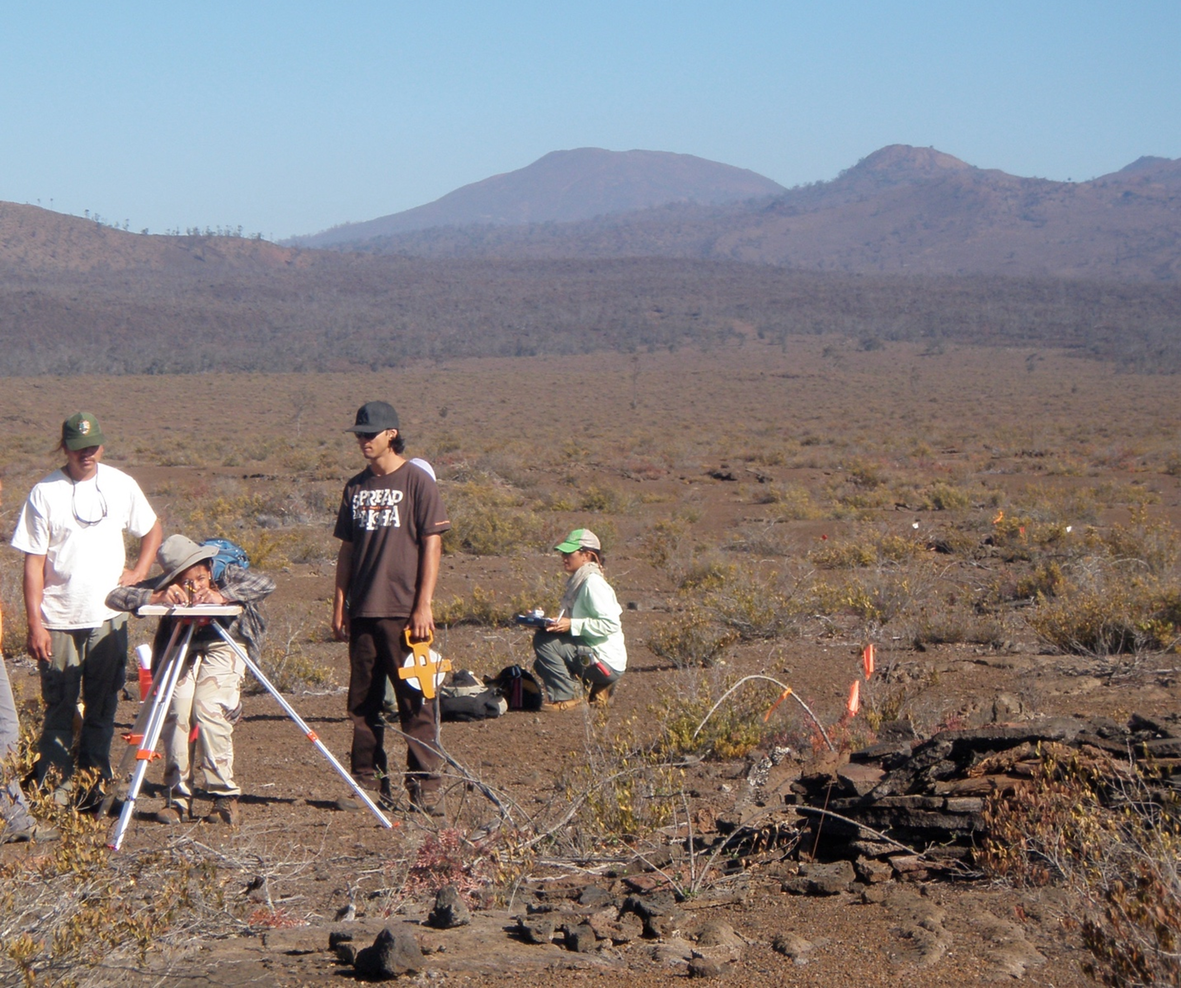
That night, back at our camp at Puʻu Kea, we kept warm by huddling around a campfire while the cold fog air rolled in. We enjoyed each other’s fellowship and shared our personal experiences of the day with one another. For the very first time in a long time, or maybe ever, we had a hui of Kānaka ʻŌiwi (Native Hawaiians) together, in the field, engaging archaeology through our own lens. Though we did not fully realize it or have a name for it then, this was the beginning of Huliauapaʻa, a time of transformation. We were building the kahua, or foundation, that would serve as the platform from which we would launch our efforts to change cultural resource management for years to come (Figure 1).
The first cohort of WKIP interns plane table mapping cultural features at Ahu a ʻUmi Heiau and the surrounding landscape (photo courtesy of Huliauapaʻa).

1. Indigenous public humanities in Hawaiʻi and the role of Huliauapaʻa
In Hawaiʻi, Indigenous public humanities are grounded in the values, histories, and epistemologies of Kānaka ʻŌiwi (Native Hawaiian) communities, where cultural heritage is not only a subject of inquiry but a living practice of identity, responsibility, and stewardship. Unlike conventional public humanities, which often emphasize access and interpretation of cultural materials for broad public engagement, Indigenous public humanities in Hawaiʻi center on ancestral relationships to land (ʻāina), culture (moʻomeheu), and community (kaiāulu). Huliauapaʻa embodies this approach by activating place-based knowledge to support community-led stewardship and education efforts grounded at our wahi kūpuna (ancestral places and resources). Through partnerships, training programs, and community research initiatives, Huliauapaʻa helps to sustain and revitalize Indigenous knowledge systems, illustrating how cultural heritage is both the foundation and future of Hawaiʻi’s public humanities.
2. Huliauapaʻa
Huliauapa‘a is a non-profit organization dedicated to growing Hawai‘i’s communities through culturally based dimensions of innovative learning, leadership development, and collaborative networking in wahi kūpuna stewardship. Since 2010, Huliauapaʻa has been at the forefront of efforts to decolonize and reshape the fields of archaeology and anthropology, and the industry of cultural resource management (CRM) in Hawaiʻi.
One of Huliauapaʻa’s core initiatives is the WKIP, which is designed to align with the University of Hawai‘i (UH) system’s educational pipeline and career pathway in CRM-related fields. The program’s primary goal is to help develop a pool of homegrown students prepared to pursue careers in the CRM. Huliauapa‘a envisions a future where a dedicated group of professionals, rooted in both academic training and cultural knowledge, can effectively steward Hawaiʻi’s cultural heritage while working in close relationship with the communities they serve and come from.
Huliauapa‘a’s WKIP is built on a progressive teaching and mentoring philosophy that challenges the constraints and limitations of a conventional classroom-based education. Instead, it provides an authentic and immersive experience for students in the natural environment through its summer internship program. This experiential and place-based approach encourages learning through all the senses and fosters a deeper understanding of wahi kūpuna and cultural landscapes. By focusing on issues and research topics grounded in students’ home communities, the program empowers them to develop leadership skills and contribute to solving challenges that directly affect their ʻohana (families), kaiāulu (communities), and ʻāina (places).
Underlying the WKIP’s educational philosophy is a commitment to social justice and cultural resistance—acknowledging the lived struggles of our haumāna while equipping them with the tools to enact meaningful change in their communities and within the field of heritage management itself.
3. Hawai‘i’s historic preservation challenges
Hawaiʻi faces longstanding challenges in historic preservation and the CRM field that has been left unaddressed for decades. Despite having an incredibly rich landscape full of important historical places and material culture, cultural resources here have been destroyed at an alarming rate. Economic development has driven land transformation in our islands with little concern about the memory of our past and aspects of our cultural identity that is being lost.Footnote 1 It is a systemic problem that has many layers to it, but at its core is the issue of native Hawaiians and local kamaʻāina not having a role in determining the fate of our own resources or shaping the outcomes of development that is happening in our own communities. The erasure of Indigenous voices from CRM and Historic Preservation decision-making has left critical stewardship roles in the hands of individuals with little connection to or understanding of Hawaiian culture, history, or landscapes.
Native Hawaiians and kama‘āina have historically been missing in this professional field. Often our people have been relegated to being research informants and people consulted in the compliance process and development mitigation. Meanwhile, outsiders from the other states with little experience of Hawaiian history, culture, and practices fill these positions. As a result, historic preservation in Hawai‘i has been reliant upon a workforce that is largely not from Hawai‘i and somewhat transient with people vacating key positions after short tenures. Currently, only four native Hawaiians have their PhDs in Anthropology, with a specialization in Archaeology, and it was not until 2013, that the first native Hawaiian-owned CRM firm was established in Hawai‘i.Footnote 2 These statistics underscore a critical gap in representation, despite Native Hawaiians being uniquely positioned to steward ancestral sites with cultural integrity and sensitivity.
Several factors contribute to this underrepresentation, including a legacy of mistrust between Native communities and archaeologists, the lack of culturally grounded mentorship, minimal access to field training, and a widespread unawareness of CRM as a viable career path. Additionally, one of the main challenges of recruiting and retaining native Hawaiians and local kama‘āina has been the curriculum and knowledge being taught at the University. In the past, the field has been defined in a way not consistent with indigenous values nor has it been inclusive in thinking of ways in which to empower native communities in the protection of their own heritage. The majority of the Anthropology and Archaeology professors at UH are not from Hawaiʻi, and only 2 out of 20 current professors in these fields at UH Mānoa and UH Hilo are Native Hawaiian.Footnote 3
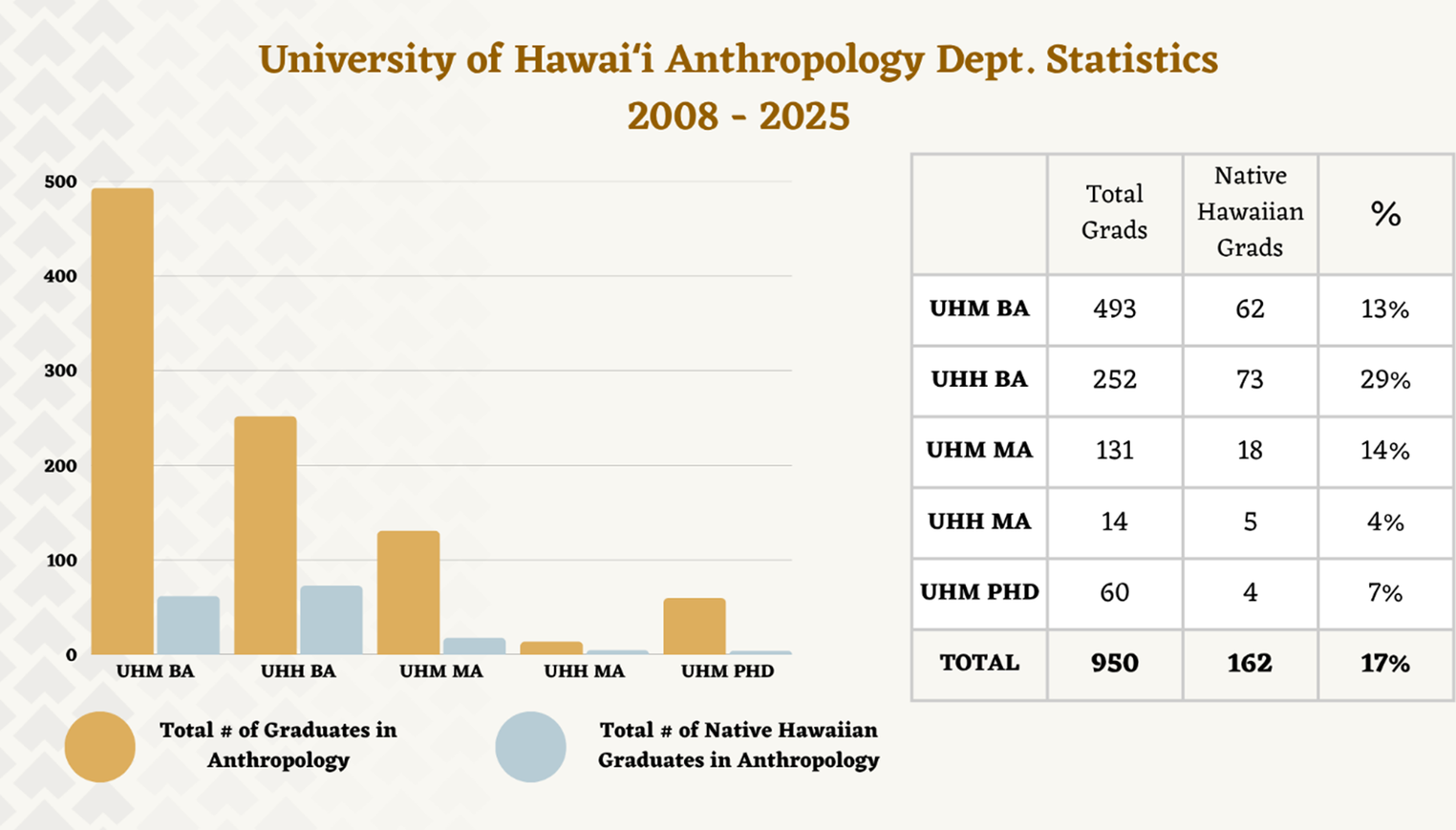
The current statistics of native Hawaiians in Anthropology at UH Mānoa and UH Hilo also reflect the fact that the University has not been able to figure out ways to engage and retain native Hawaiian students. The following data is provided by the Institutional Research and Analysis Office of the University of Hawaiʻi System, illustrating the total number of Anthropology graduates from 2008 to 2024 and the percentage of them that are native Hawaiian (Figure 2).
University of Hawaiʻi System Anthropology Department student statistics (data courtesy of UH).

3.1. Need for an ʻŌiwi worldview in academia and professional industries
Huliauapaʻa’s WKIP partners with the University of Hawai‘i (UH) system to create educational pipelines that support Native Hawaiian and kamaʻāina students pursuing careers in CRM. Collaborations with programs such as the Kamakakūokalani Center for Hawaiian Studies at UH Mānoa and the Department of Anthropology at UH Hilo have enabled students to earn college credit through immersive, field-based learning. These partnerships align with UH’s strategic vision of becoming a Hawaiian Place of Learning (HPL), a commitment that includes fostering Hawaiian values such as aloha (compassion), mālama (care), and kuleana (responsibility).
While the HPL concept is often limited to the university campus, it must also extend to community organizations and cultural practitioners as legitimate sources of knowledge. Institutions like Huliauapaʻa play a crucial role in fulfilling UH’s mission by providing culturally grounded training that bridges academic study with place-based stewardship. To meaningfully increase native Hawaiian participation in anthropology, archaeology, and heritage fields, academic institutions must work hand-in-hand with community organizations that make these disciplines relevant to Hawaiian worldviews.
Additionally, “increased involvement of Native Hawaiians and kamaʻāina in the fields of CRM can reshape the way archaeology is conducted and perceived in Hawaiʻi. CRM work carried out by and for the benefit of the Hawaiian community can ensure the appropriate protection and preservation of traditional Hawaiian cultural sites and practices.”Footnote 4 A culturally rooted approach promotes an understanding of the interconnectedness between environmental health and cultural well-being. Thus, future CRM professionals must be equipped not only with technical expertise but also with a deep cultural foundation, and an understanding that cultural sites are living entities imbued with mana, not merely remnants of the past.
4. Huliau: A time of change
In the mid-2000’s a handful of ʻŌiwi archaeologists and anthropologists came together to explore ways to reimagine the future of archaeology in Hawai‘i. Years of navigating challenges in academia and the CRM industry made it clear that a paradigm shift was needed. The goal was to develop a culturally grounded, community-centered approach to archaeology, one that centered Hawaiian knowledge systems and empowered local communities in heritage stewardship.
Our vision was to build a clear ala loa, or path towards creating local kiaʻi (stewards, guardians) of our wahi kūpuna. It was important for a critical mass of native Hawaiians and kama‘āina to be trained and educated in both archaeology and Indigenous knowledge so they could take on this important kuleana.
This vision led to the formation of Huliauapaʻa in 2010. The organization’s name reflects its mission: The term huliau meant “transformation,” and “a pa‘a” referred to our commitment to see it through “until achieved.” The name was appropriate because it served as a reminder of the organization’s promise to help transform cultural resource management to include our native communities and integrate our indigenous ways of knowing and being into training and education. Our organization became the vehicle to launch different programmatic initiatives that would help reshape the landscape of cultural resource management in Hawai‘i.
4.1. Creating the WKIP
The WKIP was the first major initiative of Huliauapaʻa. This summer program was launched through the support and funding of Kamehameha Schools (KS) with the aim to recruit local kamaʻāina and native Hawaiians to participate in an immersive summer field school held in different locations on KS lands. This place-based internship aimed to provide transformational experiences needed to pique their interest and inspire students to pursue academic and professional pathways in cultural resource management.
The WKIP follows a logic model that recognizes the need to strengthen Hawaiʻi’s communities by restoring their relationship with ʻāina, wahi kūpuna, and the cultural knowledge and practices grounded to place. The first step toward this goal was to build a critical mass of locally rooted resource managers through a robust educational pipeline in partnership with institutions in the University of Hawaiʻi (UH) system.Footnote 5
Important changes were already happening at the University of Hawai‘i that would help make this vision a reality. In 2007, the UH Mānoa Department of Anthropology launched its Applied Archaeology track, designed for Native Hawaiians and local kama‘āina, seeking careers in historic preservation and CRM outside of academia. In 2014, UH Hilo’s Anthropology Department established the Heritage Management Program, further expanding opportunities for Hawaiʻi Island students and community members to step into leadership roles within consulting firms, community organizations, and government agencies. Likewise, the Hawaiian Studies program at UH Mānoa created a Mālama ʻĀina (Land Stewardship) concentration, appealing to a growing pool of students interested in cultural stewardship careers.
In support of this trend, the first WKIP was developed in 2010 with logistical support from the Pacific Internship Program for Exploring Science (PIPES), an organization with similar goals in training local students for careers in natural resource management. The WKIP partnered with Garcia and Associates, a CRM firm that provided the technical training needed as Huliauapaʻa was developing its own organization and curriculum.
Launching WKIP was a major milestone, as it became the first professional training program in CRM specifically dedicated to Native Hawaiian and local undergraduate and graduate students studying Anthropology, Archaeology, Hawaiian Studies, Geography, History, and related fields. The program quickly found success through its innovative integration of ʻōiwi cultural values with Western scientific methods. Interns were encouraged to honor their ancestral knowledge, beliefs, and practices while engaging in cultural resource and ʻāina-based research. This synergy laid the foundation for a new model of CRM education, one rooted in cultural identity, community relationships, and ethical stewardship.
4.2. Program goals, objectives, and learning outcomes
The WKIP aims to cultivate leaders and advocates in Hawaiʻi’s CRM field by training Native Hawaiians and local kama‘āina in both the cultural and technical sides of CRM, so they can have a strong cultural foundation, elevate their kuleana (responsibilities and rights) to our ʻāina (lands) and kaiāulu (communities), obtain higher education degrees, and gain practical professional skillsets. To achieve this goal, the WKIP is grounded by five core developmental objectives:
-
1. Cultural Development: Create learning environments that bridge the worldviews of ʻŌiwi culture and Western science, empowering interns to integrate Hawaiian knowledge systems into CRM work. This is achieved through conducting cultural protocols to guide our work; utilizing our ʻike kūpuna (ancestral knowledge); and the re-centering of archaeology within culturally relevant and community-rooted frameworks.
-
2. Community Development: Collaborate with ʻohana, community groups, kiaʻi, and cultural practitioners from our project areas. This is accomplished by teaching the haumāna to conduct ethically sound research by seeking permission, learning from kūpuna and kamaʻāina, and reciprocating through the sharing of research outcomes in meaningful ways.
-
3. Technical Development: Provide hands-on training and job-ready skills in the field, lab, and office to ensure interns can be competitive in the job market. This objective is accomplished by training the haumāna in ethnohistorical research, ethnographic interviewing, ʻāina field methods, and technical writing.
-
4. Academic Development: Support interns with educational guidance, mentorship, and curriculum so they successfully complete their selected academic program. This is carried out by offering the interns college credits and helping them complete an original research project that contributes to both their academic advancement and the communities they serve.
-
5. Professional Development: Offer exposure to a wide range of perspectives and career paths within CRM by facilitating networking opportunities with professionals, agencies, and cultural practitioners. This is achieved through site visits with different resource managers at various agencies and various levels of management.
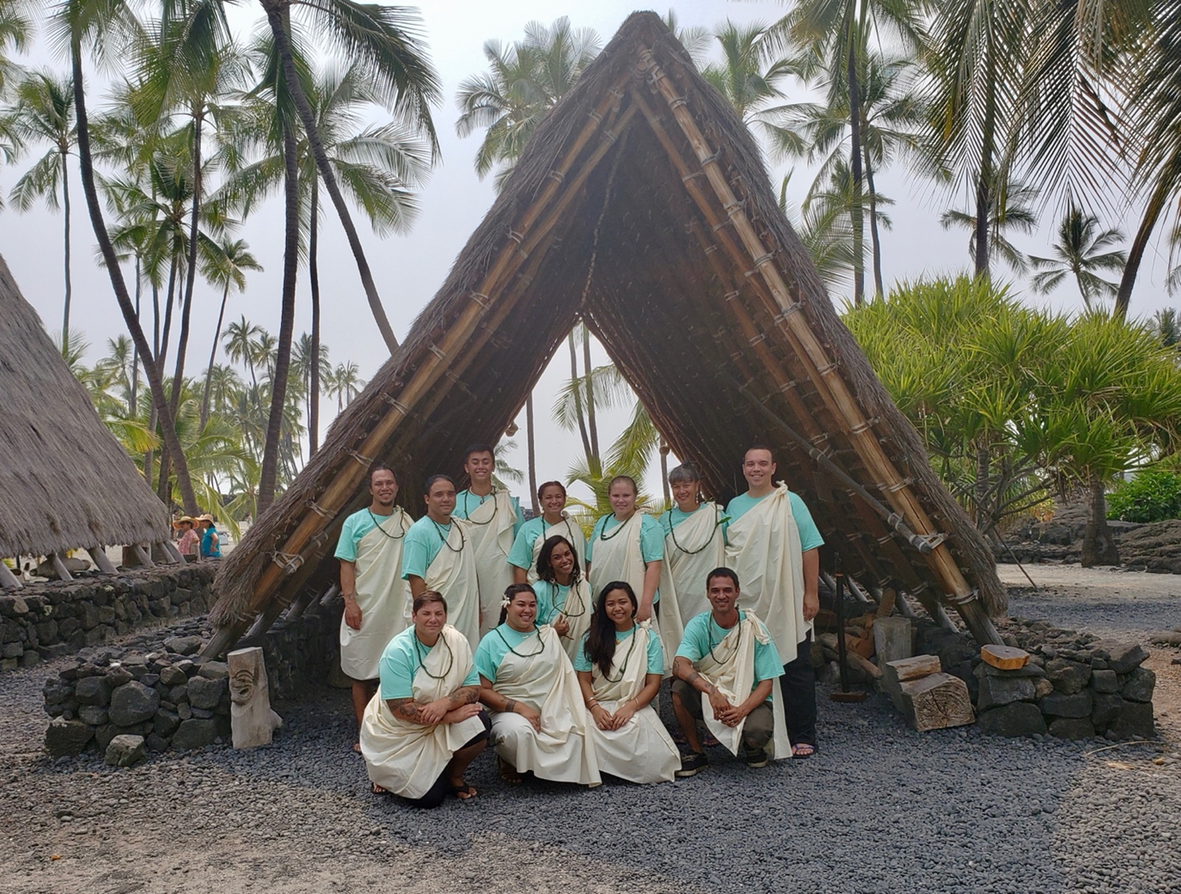
The skillsets the haumāna obtain through participating in the WKIP are ultimately aimed at reconnecting them to the ʻāina and wahi kūpuna and instilling a sense of kuleana to properly care for these places, as a foundation of Kānaka ʻŌiwi identity (Figure 3). By taking a holistic and Indigenous approach to cultural heritage stewardship, the WKIP challenges the notion that archaeological sites are static relics of the past. The WKIP cultivates a paradigm that views wahi kūpuna as living, vibrant cultural landscapes—worthy of understanding, revitalization, and continued care.
Kumu (teachers) and haumāna (interns) at their WKIP hōʻike (community showcase) presentation at Puʻuhonua o Hōnaunau (photo courtesy of Huliauapaʻa).

5. Integrated hybrid knowledge systems
5.1. Interdisciplinary approaches
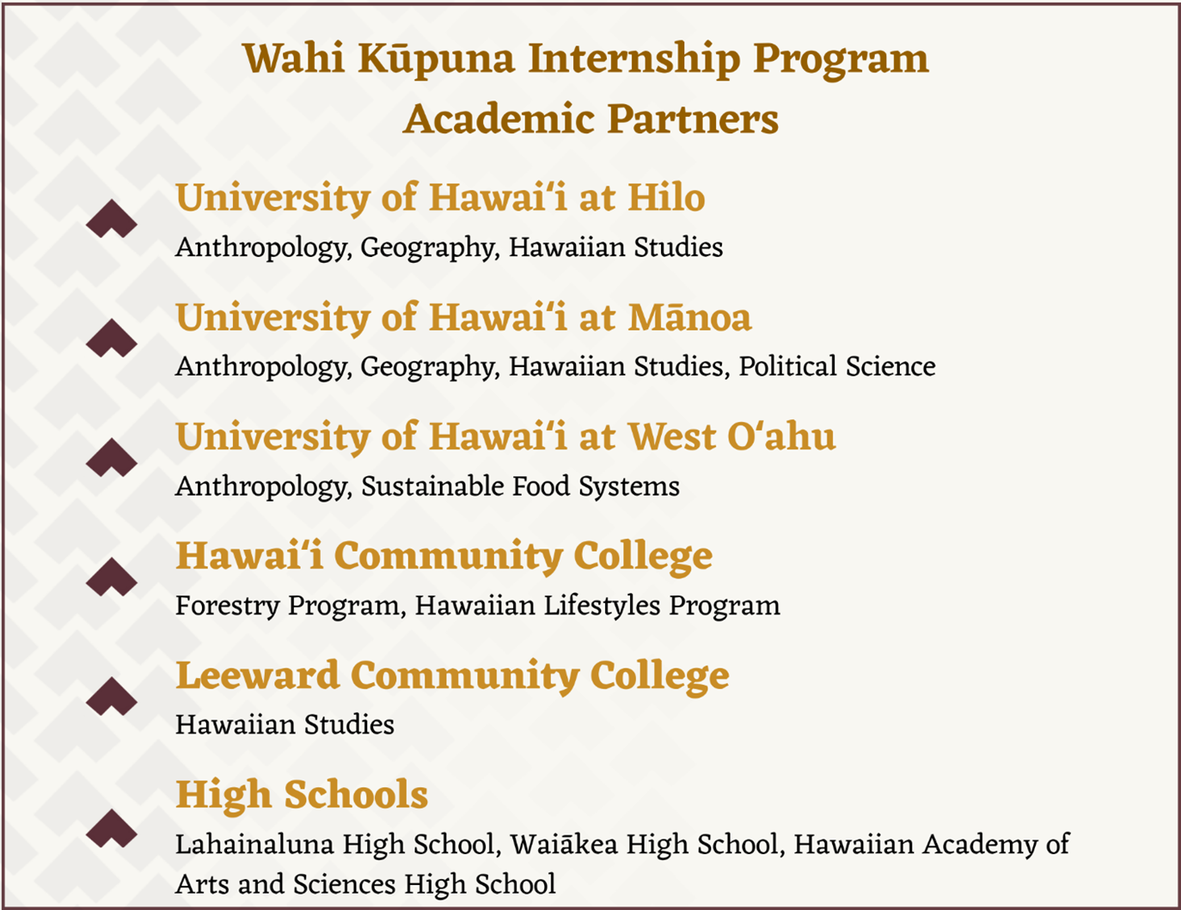
The WKIP embraces a multidisciplinary approach to cultural heritage stewardship, integrating diverse methodologies and knowledge systems into its curriculum. In its early years, the program began to braid together Hawaiian cultural knowledge and Western scientific methods, primarily through the fields of Hawaiian Studies and Archaeology. Over time, this integration expanded to include a broader range of disciplines committed to the protection and stewardship of cultural resources. This evolution is reflected in WKIP’s growing network of partnerships with various departments across the University of Hawaiʻi system, enabling haumāna to earn college credit while participating in culturally grounded, community-based research (Figure 4).
Academic partnerships Huliauapaʻa has developed since 2010 (figure courtesy of Huliauapaʻa).

This blending of Indigenous and Western epistemologies, or integrated hybrid knowledge systems, resonates with the multidisciplinary nature of our ancestors’ ʻike kūpuna (ancestral knowledge) embedded in their traditional occupations (ʻoihana). WKIP centers Hawaiian ways of knowing, spirituality, and intergenerational knowledge transmission by placing ʻike kūpuna at the heart of both content and pedagogy. In doing so, the program affirms the cultural and spiritual significance of Hawaiʻi’s sacred sites and landscapes.
At its core, the WKIP is guided by a Hawaiian worldview—from its protocols for entering and engaging with ʻāina and community, to how knowledge is collected, interpreted, and shared. Each cohort begins with a foundation in cultural protocols and ancestral values, which inform every stage of the learning process. Haumāna are introduced to multiple ways of understanding and engaging with place, including:
-
• Ethnohistorical research, utilizing moʻolelo (stories), mele (chants and songs), ʻōlelo noʻeau (proverbs), historical narratives, and land tenure documents to trace ancestral relationships with place and document changes over time;
-
• ʻĀina-based field methods, involving observation and documentation of the material record—cultural sites, landscapes, and artifacts that reflect centuries of land use;
-
• Community consultation and ethnographic engagement, where haumāna listen to and document the living memory and perspectives of kūpuna and community members with intimate connections to the land.
Rather than isolating these methodologies, the WKIP weaves them together into a holistic framework that respects the strengths of each. This integrative approach moves beyond conventional archaeological practice, fostering a model of heritage stewardship that is relational, grounded, and culturally affirming.
5.2. Pedagogical framework
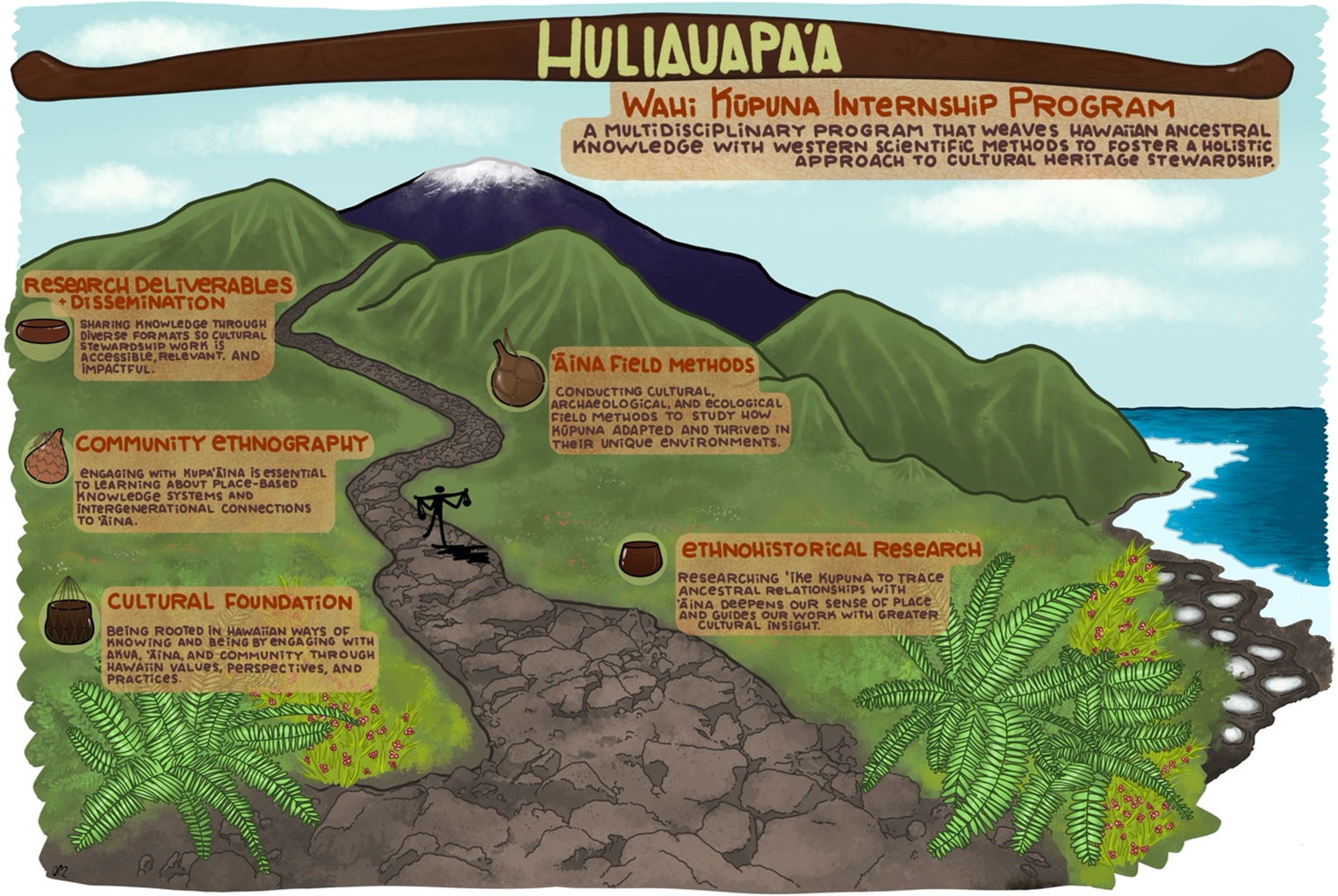
The WKIP is guided by a multidisciplinary pedagogical framework structured around six core curriculum modules (Figure 5):
-
1. Kuana ʻIke (Cultural Foundation)
-
2. Ethnohistorical Research
-
3. Community Consultation and Ethnography
-
4. ʻĀina Field Methods
-
5. Research Writing and Deliverables
-
6. Research Dissemination
The six primary modules of the Wahi Kūpuna Internship Program (figure courtesy of Huliauapaʻa).

These modules form the foundation of WKIP’s integrated learning model, which emphasizes immersive, ʻāina-based education. Interns live, learn, and work together as a cohort in the communities and landscapes where their research is conducted. They engage in shared daily practices—conducting protocol, camping, cooking, and participating in cultural and field activities—as a means of building pilina (relationships) with one another and with place.
Following the intensive summer immersion, haumāna continue into the academic year at a partner institution within the University of Hawaiʻi system. During this phase, students complete individual research papers and present their findings at professional or academic conferences. These culminating experiences not only reinforce academic skills but also ensure that students return knowledge to the communities they engaged with.
Each curriculum module supports specific competencies and values, from cultural grounding and critical analysis to communication and community accountability. The methods and competencies of these six primary curriculum modules are further explained in detail below.
5.3. Module 1: Kuana ʻike (cultural perspectives)
The first and foundational component of the WKIP is Kuana ʻIke, or cultural perspective, which grounds students in ʻike kupuna, ancestral knowledge systems and values. It develops cultural knowledge and its application and prioritizes an innate embodiment of aloha ʻāina as essential to working with ʻāina, wahi kūpuna, and kānaka. Key competencies developed by students through this method include demonstrating and understanding pono lawena (appropriate mannerisms and behaviors) and protocols for working with and at wahi kūpuna; active kilo (observation and monitoring) of the environment and hōʻailona (environmental signs); and a reflection of these processes and outcomes.
To build these competencies, haumāna are expected to (1) learn and memorize specific oli, pule, and mele; (2) teach an aʻo aku/aʻo mai (teach and learn) activity to their cohort; (3) participate in daily piko (centering and reflection) rituals each morning and afternoon; and (4) engage in kilo ʻāina (keen observations of the environment that inform their relationship to place).
5.4. Module 2: Ethnohistorical research
This module trains students in ethnohistorical research methods that support understanding land tenure systems, cultural landscapes, and historical relationships between people and place. This research is conducted before commencing any fieldwork on the ʻāina to lay a foundation for understanding the unique histories of places. Students gain competencies in:
-
• Identifying and querying the different types of Hawaiian historical resources in both Hawaiian language and English, and their importance to understanding land today.
-
• Navigating and interpreting historical maps in Hawaiʻi, where to find them, how to analyze them, and how to use them in land research.
-
• Understanding the Māhele (1848 land privatization process) and how to efficiently locate and search Māhele records for historical information on the land and peoples connections to particular places.
To meet these competencies, haumāna (1) visit digital and physical archives and repositories to gather stories, legends, songs, proverbs, and accounts; (2) analyze and ground truth historic maps; and (3) translate and analyze a Land Commission Award (LCA) in early land privatization documents and conduct a first-person oration of their LCA claimant on the ʻāina at the actual location of the parcel.
5.5. Module 3: Community ethnography
Engaging with and learning directly from kūpuna and kamaʻāina is essential to understanding place-based knowledge systems and intergenerational relationships with ʻāina. This module emphasizes ethical and reciprocal community engagement as central to responsible CRM. Core competencies include:
-
• Understanding the significance of community ethnography and consultation in cultural and land research.
-
• Applying culturally appropriate practices for scoping, gaining consent, interviewing, summarizing, getting approvals, and sharing intellectual property back to participants.
To build these skills, haumāna (1) study the ethics and protocols of engaging with communities; (2) conduct the full interview process from developing interview themes and questions, coordinating and conducting interviews (ask appropriate and informed questions, take notes, listen, engage, etc.), to drafting summaries and securing participant approvals; and (3) present makana (gifts) and final reports to participants as part of the return of ʻike.
5.6. Module 4: ʻĀina (land-based) field methods
ʻĀina-based field methods, in conjunction with ethnohistorical research and community ethnography, offer tools to understand how kūpuna survived, thrived, and adapted to their environments. This module incorporates archaeological, ecological, and cultural approaches to document and interpret wahi kūpuna in ways that are respectful, non-invasive, and grounded in community values.
Typical archaeological field methods are taught including pedestrian surveying, tape and compass mapping, photo and GPS documentation. In addition, we have expanded our field methods to include natural and marine resource field techniques such as intertidal surveys, observing and documenting weather patterns, and including data on the flora and fauna identified in the field. These skills are now evolving towards a more integrated community-based resource management approach. Haumāna develop competencies in:
-
• Understanding the colonial history of archaeology in Hawaiʻi and its transformation through Indigenous-led stewardship.
-
• Identifying archaeological site types, understanding their functions, conducting field methods, and integrating culturally sensitive approaches in this work.
-
• Collecting and processing field data with community relevance and accessibility in mind.
To develop these competencies, haumāna participate in lectures and discussions that reflect on the historical and current state of CRM in Hawaiʻi; conduct intensive fieldwork while learning an array of field methods; and post-process and synthesize data into resources that are valued by communities.
5.7. Modules 5 and 6: Research writing/deliverables and dissemination
These final modules prepare haumāna to articulate their findings through technical writing and public presentation. Students craft original research papers or other forms of community deliverables that weave together ethnohistorical, ethnographic, and archaeological data to support culturally grounded research rooted in place-based knowledge.
Competencies include (1) proficiency in technical research writing conventions and citation practices and (2) the ability to tailor research for different audiences while maintaining cultural integrity and academic rigor.
Together, these six modules comprise an immersive and culturally grounded pedagogy that centers Indigenous knowledge systems and prioritizes the return of ʻike to ʻāina and community.
6. Program achievements
The WKIP’s educational approach is grounded in a “critical pedagogy of place,” an approach that centers ʻāina-based fieldwork to foster deeper understanding of the reciprocal relationships between land, people, and community. The WKIP model strives to raise homegrown students that will stay in or return to their communities to be active stewards and contributors.
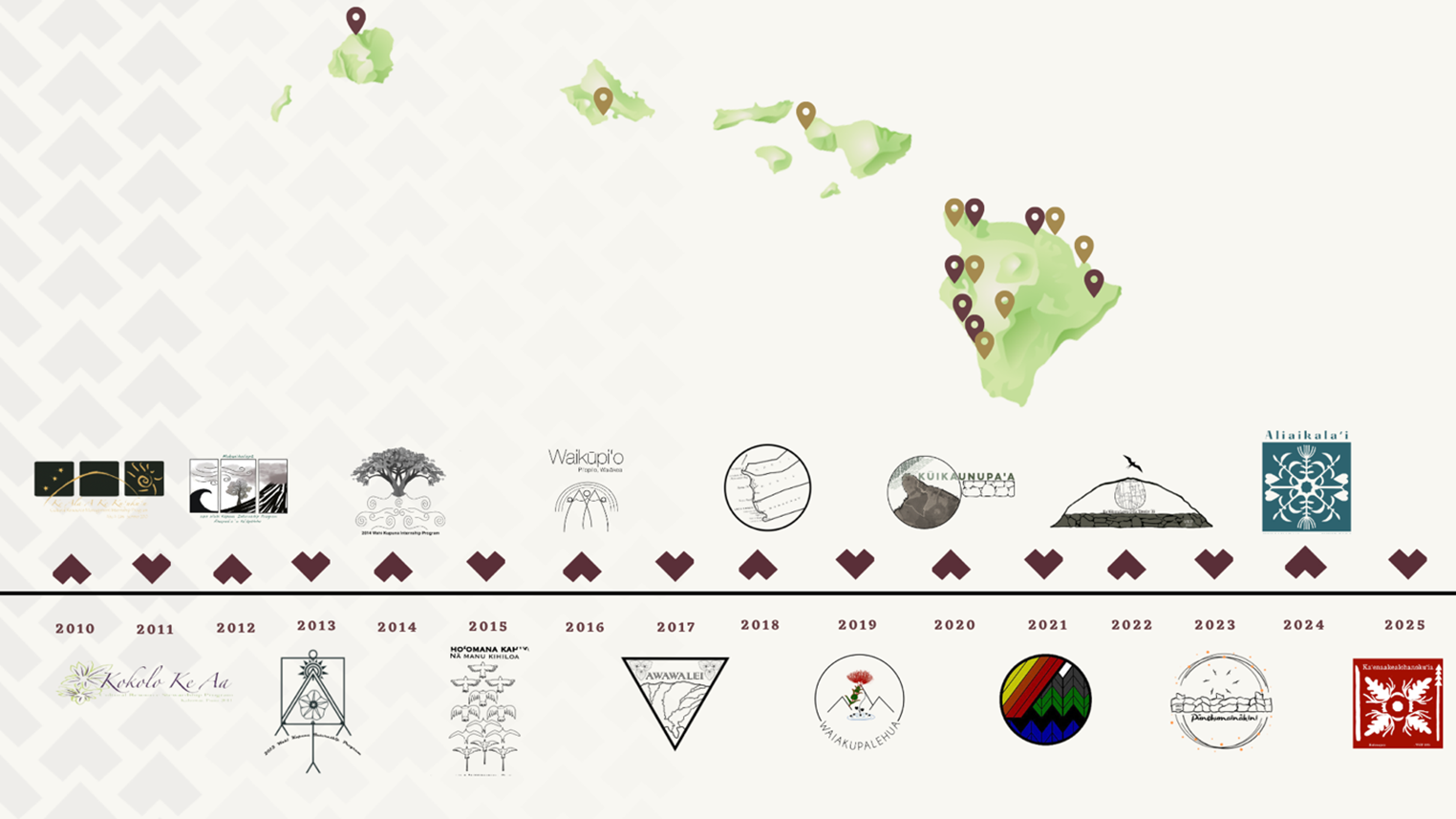
Since its inception in 2010, the WKIP has been hosted in locations across the pae ʻāina, including every moku (district) on Hawaiʻi Island, Waiawa on Oʻahu, Waipā on Kauaʻi, and, in 2025, Lahaina, Maui (Figure 6). Over the past 15 years, the program has had a demonstrable impact on its haumāna, the CRM field, and the many communities with whom it has partnered.
The WKIPs geographical reach and cohorts from 2010 to 2025 (figure courtesy of Huliauapaʻa).

6.1. Haumāna outcomes and impacts
The WKIP encourages and empowers Native Hawaiian students to engage in cultural heritage stewardship with both professionalism and cultural grounding. Students leave the program with a strong pilina (connection, relationship) to the ʻāina they work in and the communities they work with. They gain a strong sense of kuleana (responsibility) to continue to mālama (care for, steward) these places and to perpetuate the moʻolelo to keep the stories of the land alive. Haumāna understand that while CRM can be a contentious field, it is their kuleana to take on roles of stewarding Hawaiʻi’s wahi kupuna, and that their participation is vital in shaping decisions that directly affect Hawaiʻi’s ʻāina and kaiāulu (communities).
Over the years, many students have described their experience in WKIP as one of profound personal transformation and ancestral reconnection. Whether conducting fieldwork in ancestral landscapes for the first time, learning and practicing oli (chants), identifying archaeological features, or presenting their research at professional conferences, interns engage in a holistic educational process that is both rigorous and meaningful. In addition, this culturally grounded foundation serves as a kahua, or foundation, for continued work in heritage stewardship and beyond.
Below are reflections from several WKIP alumni that illustrate the depth and impact of their experiences:
Every time any of our community participants came along with us or talked with us, I learned something new that was not only applicable to the history of the area that were in, but to my own life as well. It was such a great experience being able to hear their stories being told live rather than having to read it in a report or book. Each of them brought a new and great aspect to the program, and their enthusiasm to have us there doing work just made everything so much more worthwhile. I believe that having them around and being able to converse with them and listen to them really made a difference with this program and gaining a relationship with the land that we were working on.
—Kauʻilani Rivera, 2012 WKIP Intern
I learned a lot about different types of mapping and the importance of protocols and how important it is for people who do archaeology type work to involve the community not just speak with them. In order to do something here in these islands, regardless of what it is you need to understand the place you are doing it in and what your reason is for doing it.
—Kama Kaʻaikaula, 2017 WKIP Intern
This program allowed me the space and time to intimately connect to one of Hawaiʻi’s most significant wahi pana, Ahu a ‘Umi, by integrating Native Hawaiian and Western scientific methodologies through a community-based approach. I felt deeply connected with my ancestors conducting cultural protocols and ensuring respect guided the archaeological work. I discovered the benefits of archaeology by training my eyes to identify cultural sites. I began to understand archaeology’s role in native Hawaiian issues regarding cultural landscapes, historic properties, and the lack of community involvement as well as the urgent need for more native Hawaiians and local archaeologists. More importantly this program brought clarity to my passion and career choices I never knew existed.
—ʻIolani Kaʻuhane, 2010 WKIP Intern
6.2. Academia outcomes and impacts
The WKIP has played a critical role in expanding pathways for Native Hawaiian and kamaʻāina students to pursue higher education and careers in resource management. Since 2010, Huliauapaʻa has mentored 81 students across the paeʻāina. Each of these haumāna is from Hawaiʻi, rooted in place, and committed to contributing to their home communities. Among them, 40 have either earned or are actively pursuing associate’s and bachelor’s degrees; 25 are in the process of completing or have already received master’s degrees; 2 are enrolled in doctoral programs; and 1 has earned a Ph.D. While these numbers may appear modest, they represent a significant shift in a field where, historically, only a handful of Native Hawaiians and local kamaʻāina held degrees.
A key factor in this success has been WKIP’s strong academic collaborations, particularly with faculty from the University of Hawaiʻi at Hilo’s Anthropology Department. Professors Dr. Peter Mills and Dr. Kathy Kawelu (a board member of Huliauapaʻa) have and guidance over the years have been integral to the success of the WKIP as Huliauapaʻa works closely with them to mentor our shared haumāna to make sure they accomplish their goals and graduate with their degrees.
Dr. Kawelu has observed firsthand the impact WKIP has had on her department and the broader field:
The UH-Hilo Anthropology students who participate in the WKIP come back to our department filled with passion and excitement for the discipline, and eager to find ways to move on to the next level of engagement, whether that’s graduate school or finding a CRM job. In total we’ve had 20 UH-Hilo students enter the internship program over the years. Two interns entered the UH-Hilo M.A. program in Heritage Management, one earning her degree in 2017, and the other began her graduate work in the fall of 2019. Three other interns were accepted into graduate programs at other institutions. Eight other Anthropology majors are currently working for cultural resource management firms.
Dr. Kawelu further reflects on WKIP’s broader influence:
The WKIP has been THE driving force behind the increased numbers of kanaka in the field of heritage management here in Hawai‘i. There is no other program that has explicitly focused on, and dedicated resources to, the recruitment and training of kanaka and kama‘āina in stewardship. Through its development of curriculum tailored to place-based learning and community interests, the WKIP is able to show students the importance and relevance of cultural resource management. In this program students practice the community-based approaches they learn about in their academic programs, making tangible connections to the ‘āina and kūpuna.
The emphasis on nurturing and developing a cultural foundation on which to build disciplinary competency, has served to assure students leery of archaeology that this scientific tool can be used to benefit kanaka. By prioritizing Hawaiian culture, people, and practice, the WKIP has accomplished something more challenging than attracting kanaka to heritage management, which is retaining those individuals within the field.
In addition, WKIP maintains a strong academic partnership with the University of Hawaiʻi at Mānoa’s Hawaiian Studies Department, particularly through Dr. Kekuewa Kikiloi (a Board member of Huliauapaʻa) and Dr. Noelani Puniwai. This relationship has been instrumental in encouraging haumāna to engage with cultural heritage stewardship from a position of Indigenous agency. By integrating Hawaiian Studies and CRM practice, students are supported in navigating the field’s colonial past while envisioning and building a future rooted in self-determination.
6.3. CRM industry outcomes and impacts
Beyond academic advancement in the disciplines of Archaeology, Anthropology, and Hawaiian Studies, the WKIP is playing a transformative role in reshaping Hawaiʻi’s CRM industry. By growing the number of native Hawaiians and kamaʻāina working in the field, the WKIP is helping to diversify the workforce and shift the industry’s values toward more culturally grounded and community-based practices.
Through partnerships with organizations such as Nohopapa Hawaiʻi, Kamehameha Schools, the Office of Hawaiian Affairs, and UH Mānoa, WKIP graduates are afforded workforce development opportunities to gain continued hands-on experiences in the profession.
Our vision is to grow Huliauapaʻa and other like-minded organizations with a critical mass of trained wahi kūpuna stewards who are grounded in both Indigenous knowledge and professional practice. By modeling and advancing integrated, community-based approaches to CRM, we aim to raise the standard for cultural resource work in Hawaiʻi—encouraging others in the field to align their practices with more ethical, place-based, and culturally respectful methodologies.
Increased participation of native Hawaiians in CRM is reshaping the way cultural resource management is perceived and practiced. CRM work carried out by and for the benefit of the Hawaiian community serves to help ensure the appropriate protection and preservation of traditional Hawaiian cultural sites and practices. As more native Hawaiians become involved in CRM, it becomes a tool for cultural perpetuation and self-determination. Research led by and for native Hawaiians helps reclaim wahi kūpuna and reestablish cultural practices tied to these storied places.
Developing a robust network of local, culturally grounded professionals is essential to reforming CRM in Hawaiʻi. Native Hawaiian and kamaʻāina cultural resource practitioners can bridge traditional knowledge systems with contemporary scientific methods to help forge a culturally appropriate and scientifically grounded process to effectively mālama (steward) Hawai‘i’s heritage. In doing so, they are not only preserving tangible sites, but also restoring relationships to place and reinvigorating community stewardship.
6.4. Community outcomes and impacts
At the core of the WKIP is a community-based approach to research that centers trust, reciprocity, and empowerment. Community members guide and co-design the programs research focus to ensure the work is valuable and will directly benefit their needs and desires.
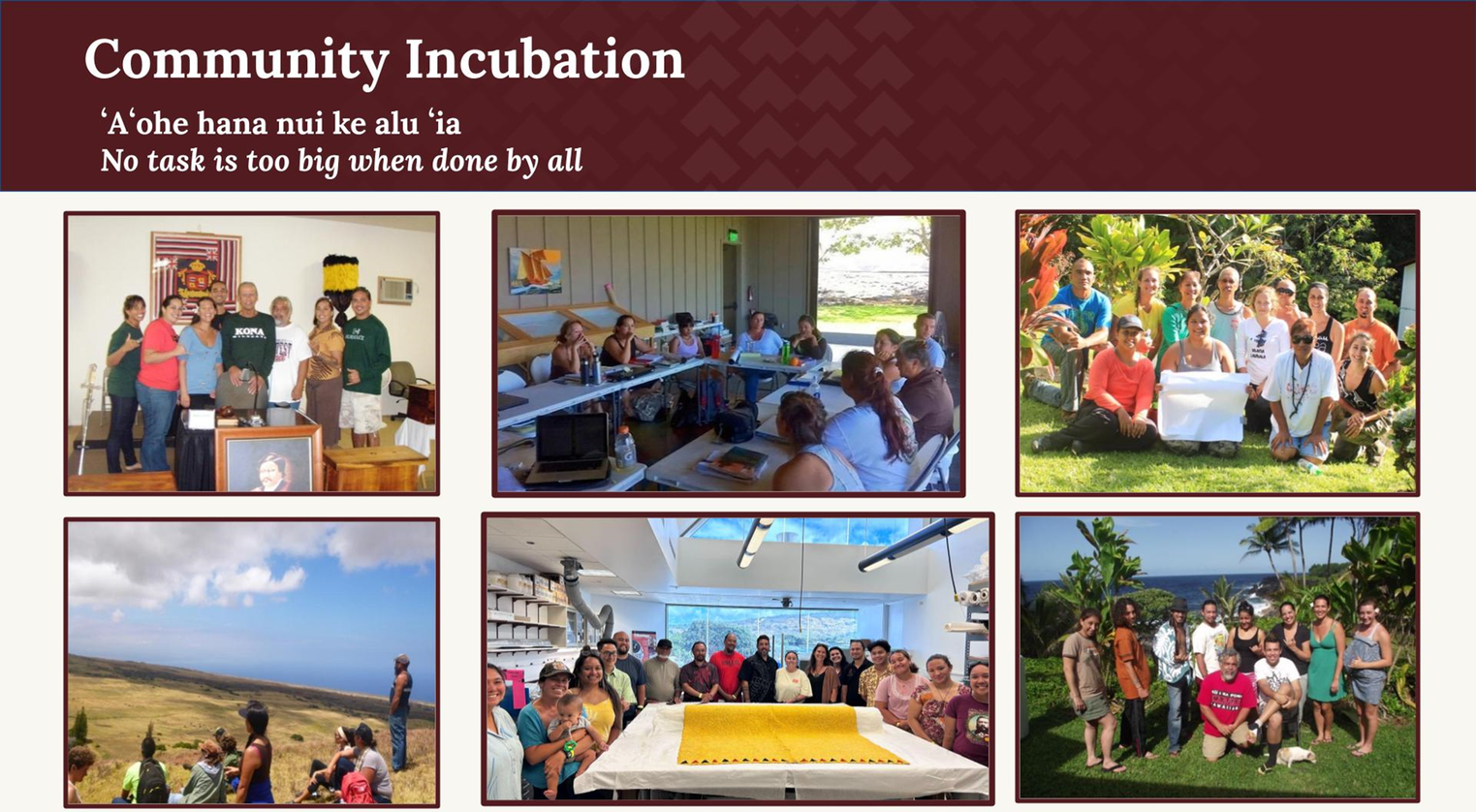
In addition, after fieldwork has been completed, WKIP interns share their findings at a community hō‘ike (showcase of acquired knowledge), providing families and local residents with an opportunity to learn about the research and engage in dialogue. These moments of knowledge sharing deepen pilina (relationships) and ensure that the work we do has a lasting impact in place (Figure 7).
ʻOhana (family) and community groups that the WKIP has collaborated with since 2010 (photo courtesy of Huliauapaʻa).

In 2015, the WKIP partnered with the non-profit organization huiMAU in Hāmākua Hikina. Executive Director, Dr. Noʻeau Peralto described the partnership as a pivotal moment for their community’s journey in land stewardship:
The Wahi Kūpuna Internship Program was an important catalyst for change in our community. Prior to conducting the WKIP in our wahi, most considered our ʻāina to be devoid of any cultural sites or sacred landscapes, due to the impacts of over a century of sugar plantation agriculture. What we came to find was that though the landscape had been highly impacted, the erasure was never complete. Beyond the few cultural features that remain on the ʻāina, the moʻolelo, mele, inoa ʻāina that layer the landscape with meaning and mana remain abundant throughout the historical records left for us by our kūpuna. It was through this process of remembering our wahi kūpuna that we began re-membering ourselves as part of an extensive genealogy of Kānaka who love, care for, and give mana to this place.
On a practical level, the work conducted during the WKIP laid the foundation for our organization to engage more deeply in the stewardship of our wahi kūpuna. With no prior archeological work done in our area, the surveys and ethnohistoric research conducted by WKIP interns and staff at our wahi were critical to building our organization’s capacity to steward this wahi kūpuna long-term.
On a broader scale, the overall WKIP experience in our area opened our naʻau to seeing further, looking deeper, beyond what the eyes can see today, to unveil the essence of places that inspired our kupuna to construct sacred spaces within them. This WKIP, summed up to me, was about looking past the physical structures to see the wahi, the ʻāina, the kai, the lani, to try to understand the cultural context in which our kupuna shaped their landscapes, and to find ourselves in that continuum to rebirth those living sacred landscapes in our own context today.
One of WKIP’s greatest strengths lies in its commitment to building and sustaining relationships with local stewards, cultural practitioners, and organizations rooted in place. Every summer the program partners with new community hui to conduct site-specific research. Students are taught to practice culturally appropriate engagement by always beginning by seeking permission and guidance from kūpuna and kamaʻāina.
This is then reciprocated by sharing our field work and research findings with our community partners, not just in the forms of scientific reports, scholarly articles, and academic jargon, but in ways that are meaningful and useful to them (maps, educational curriculum, presentations, videos, story maps, and websites).
This approach was also highlighted by Akoni Nelson, a lineal descendant from Keʻei and Hōnauau, Hawaiʻi Island, where the 2018 WKIP cohort was based. Akoni shared that collaborating with Huliauapaʻa through the WKIP had a valuable impact on his community and the wahi pana (storied places) they care for:
The program utilized protocols that the community is accustomed to which provided a comfortable space for collaboration at a deeper level than just interviews. By providing a ‘safe space’ to collaborate, it enabled the program participants to develop unique ways in doing their work within our community that was sensitive to our regional practices. Overall, the Wahi Kūpuna Internship Program has inspired ways on how we can ensure that stewardship of our wahi pana is perpetual which indicates that our practices are alive. Most important, it provided technical information of our wahi kūpuna and on some occasions, it proved indifferent to mainstream literature and historic reports written without the inclusion of oral histories and practices of the region.
Developing partnerships with communities who share Huliauapaʻa’s values, principles, and vision regarding preservation and land management remains a cornerstone of our work. Fostering and sustaining these relationships not only support the success of the WKIP but also strengthen a growing network of individuals and organizations committed to the respectful and effective stewardship of Hawaiʻi’s cultural landscapes.
7. A living culture: Using the past to restore and revitalize
By cultivating indigenous and community-based approaches in CRM, we are actively decolonizing the field by asserting that Kānaka ʻŌiwi remain deeply connected to the lands of our kūpuna (ancestors). Our culture is not static, it is a living, breathing, and evolving culture. We restore ancient loʻi terraces (wetland taro) and loko iʻa (fishponds) to feed and nurture our people. We restack pōhaku (stones) along our ancient trails to connect our communities. We construct new ahu (alters) to worship the reciprocal relationships with our akua (elemental forms and spirits).
Through Huliauapaʻa and a growing network of like-minded organizations seeking to reshape heritage management in Hawaiʻi, we are shifting perspectives to do away with the old model that cultural (archaeological) sites are ancient relics of the past and instilling a new paradigm that views these wahi kūpuna as vital, storied places, and sites of identity, practice, and spiritual continuity.
We are selecting tools from western science and making them our own—for our purposes and for our benefit. For Huliauapaʻa, stewardship is not just about preserving places, structures, and artifacts—it’s about revitalizing our ancestral connections and restoring the life force, or mana, to places that continue to shape who we are as a people. This means not just documenting and surveying, but taking heritage stewardship a step further to restore the tangible remains of wahi kūpuna and returning stewards to these places once again. Through this process, we re-establish moʻokūʻauhau (genealogical continuity) between us as descendants with that of our ancestors, through the rebuilding of these places and practices again.
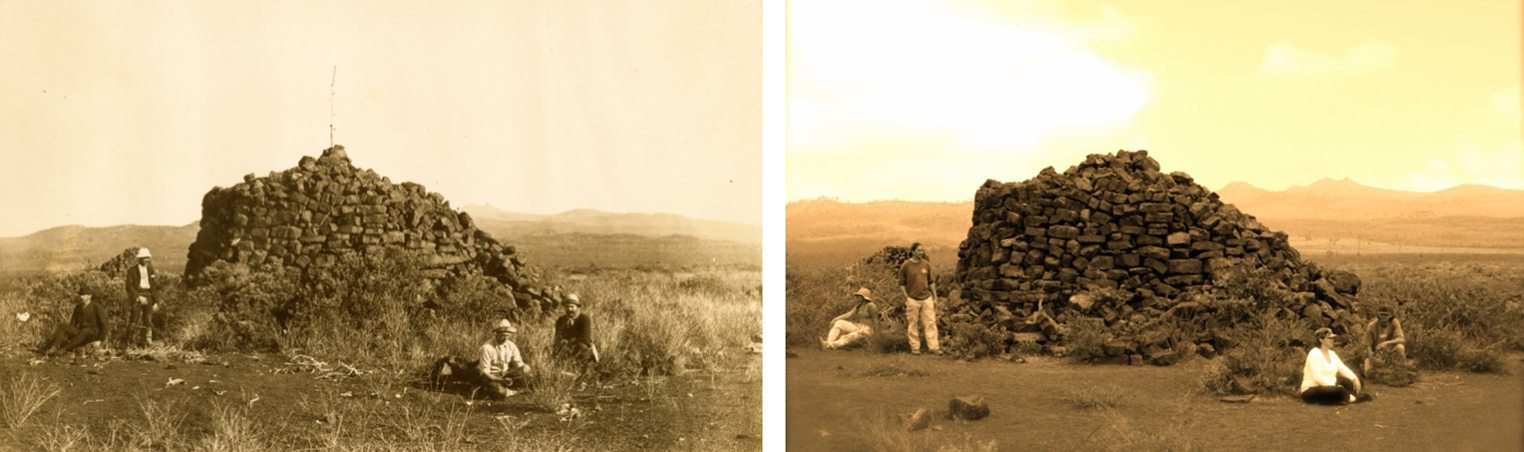
Ahu a ʻUmi is considered a piko or spiritual center of our lāhui, not only because of its geographical location in the middle of great mountains of Mauna Kea, Mauna Loa, and Hualālai, but also because the intention behind building it was to center and connect our people, as ʻUmi-a-Līloa constructed it to unite the six moku (land districts) of Hawaiʻi Island (Figure 8).
1890 photo of Hawaiian informants at Ahu a ʻUmi (left, courtesy of Bishop Museum) and 2010 photo of Native Hawaiian interns at Ahu a ʻUmi during the first WKIP (right, courtesy of Steve Eminger).

In 2010, four Kānaka ʻŌiwi students from the inaugural WKIP cohort helped document Ahu a ʻUmi for the first time in nearly a century.Footnote 6 Not only did we archaeologically map this site, but we began to uncover, remember, and retell the stories of ʻUmi a Līloa, thus bringing mana back to this aliʻi (chief) and the landscape that had been void of our people for so many decades. The sounds of our oli (chants) and pule (prayers) in this sacred space could be heard by our kūpuna once again, and for us that was more important than any scientific data that could be “excavated and uncovered.”
Kānaka ʻŌiwi are still here today, and are still caring for our wahi kūpuna, using aspects of archaeology, anthropology, and other western disciplines as tools for indigenous resurgence. We are taking back control of researching and restoring our sacred sites, and retelling our ancient histories, all while helping to grow the next generation of stewards.
Through these efforts, we are reconnecting to our wahi kūpuna, strengthening our cultural identities, and on an ala loa paʻa (a firm and enduring path), toward the resurgence of our Hawaiian nation and the restoration of pono (balance, righteousness) in our homeland.
Acknowledgements
The authors would like to thank Kamehameha Schools, NaKupuna Foundation, Nohopapa Hawaiʻi, LLC, and the National Science Foundation Center for Braiding Indigenous Knowledges and Science.
Author contribution
Conceptualization: K.L.U., K.Ki., K.Ke., D.C.; Data curation: L.M.; Writing - original draft: I.K.; Methodology: K.Ka.

 Open access

