




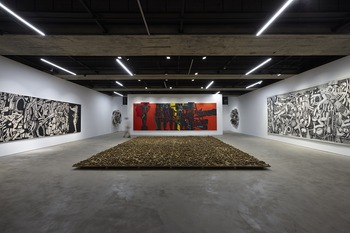
The exhibition False Witnesses (Shuhud al-Zur) by Dia al-Azzawi at Saleh Barakat Gallery in Beirut, from September 11 to October 31, 2025, is the kind of show one usually would only see at a museum (Figures 1, 2). It consists of several large-scale works that invite an almost immersive viewing experience, in which seeing requires physical movement and the artwork dominates the perceptual space of the viewer. The works offer a critical reflection on power and violence in Iraq over the past two decades.
View of the main part of the exhibition, with Paradise of the Forgotten on the back wall. Photo courtesy of Mansour Dib.

View of the main part of the exhibition facing False Witnesses. Photo courtesy of Mansour Dib.

Azzawi belongs to a cohort of Iraqi intellectuals who came of age in the political euphoria that followed Gamal Abdul Nasser’s nationalization of the Suez Canal in 1956, became disillusioned with politics in the aftermath of a coup by the Baʿath Party in 1963, and rediscovered politics in the form of the Palestinian liberation movement at the end of the 1960s, when the figure of the fidāʾī (freedom fighter) emerged in the vacuum left by the defeat of the Arab states in the Six Day War of 1967. Over the 1970s, much of his work as an artist centered on the Palestinian struggle—drawings, paintings, and prints made not in the mode of activism but in the mode of tragedy, as the liberation movement suffered defeat after defeat and refugee camps in Jordan and Lebanon became the sites of massacres. In that context, Azzawi forged a practice in which the artwork was brought into a particular relation with politics that he recently described at a public conversation held at the American University of Beirut (AUB): “I wanted as much as possible to document, though not directly, what was happening in the region so that years later it would have a value as an indictment of that time.”Footnote 1 In 1976, he emigrated to London, and over the 1980s his art became more experimental, formalistic, and inward-looking. But the Gulf War in 1991 drew Azzawi’s practice back into relation with politics. He began a multiformat body of work characterized by monochromatic tones that he named Bilad al-Sawad, or Land of Darkness, and that he would continue through the American invasion in 2003.Footnote 2 Some of the work shown at Saleh Barakat Gallery is a continuation of Land of Darkness, as Mysa Kafil-Hussein, who works in Azzawi’s studio, notes in the catalog.Footnote 3 And yet other work reflects a shift in pictorial construction.
The title of the exhibition, as Kafil-Hussein explains, is taken from a poem by the poet Yusuf al-Sayigh (1930–2005), “Was It Not Possible?” (Ama Kan Yumkin). For over five decades, Azzawi has worked from text, and especially poetry by a wide range of Arab writers, but he has worked from the poetry of no Arab writer more than al-Sayigh. “False Witnesses” names the political class, American and Iraqi, who, before the invasion of Iraq and after, have lied in ways that have led to the destruction of the country. False Witnesses is also the title of a painting that thematizes how Iraq has become a victim of its rulers (Figure 3). This painting demonstrates, along with others in the show, an interest in the margins of pictorial surface: on the left a martyred figure intended as a representation of Iraq stands atop a pedestal, set apart from a throng of figures at the center. A plume of smoke rises from the martyr’s body, whose torture is recorded not only in the noose and the arrows piercing its chest but in the smoky orange cut into its side from the left. The throng of figures are rendered as black silhouettes contoured by colored lines that act like an indictment (particularly the white lines at the center). Horizontal bodies float in the right-hand margin indicating the dead. The placement of martyred Iraq and the shadowy throng of “false witnesses” against a red ground, which feels constituted less by light than by heat and is interrupted by a crevice of molten yellow, imparts to the scene an eschatological mood—it puts one in mind of the crucifixion of Mansur al-Hallaj (whose divan Azzawi illustrated)—that transforms what is an image of a political reality into the announcement of a future reckoning.
Dia al-Azzawi, False Witnesses (شهود الزور), 2019. Acrylic on canvas, 270 x 880 cm. (Tetraptych, each panel 270 x 200 cm). Photo courtesy of Anthony Dawton and Mohammed Al Shammarey.

Across the gallery, mirroring its red ground and silhouetted figures, stands Paradise of the Forgotten (Figure 4). It is the most haunting painting by Azzawi that I have seen in fifteen years of studying his practice, because in it the protestors murdered during the October Revolution in Iraq look back on the living from a place beyond the grave. In October 2019, a wave of mass protests swept Iraq, and continued for months, denouncing corruption, sectarianism, unemployment, and the intervention of Iran in the affairs of the country. But the protests were met by violence. In the painting, Azzawi wanted, as Kafil-Hussein writes, to create “a testimony to the unlawful murders of hundreds of brave and hopeful Iraqis across the country.”Footnote 4 It is constructed as a cortege of figures rendered in black silhouette and contoured with red line. Rarely in Azzawi’s paintings are human figures so clearly delineated and presented in their physical integrity. Against the glowing red ground, they acquire a certain fullness—in contrast to the figures at the center of False Witnesses whose black silhouettes pull them further into the shadows (this recession is an effect, I think, of the way Azzawi uses the margins in that painting; in the counterpoint between the figure of martyred Iraq and the agents of its destruction gathered in the middle, martyred Iraq comes forward as they recede). At the center of Paradise is affixed a figure made from resin. In her catalog notes, Kafil-Hussein informs us that it represents Safaʾ al-Saray,
a 26-year-old protestor who was killed after a tear gas canister struck him in the head on October 28, 2019. The young al-Saray, born and raised in Baghdad, became an icon of the uprising and a source of inspiration for his fellow Iraqi protestors, many of whom accompanied his enshrouded body to Jewad Selim’s Freedom monument [a 50-meter-long frieze designed by the Iraqi artist to commemorate the 1958 revolution erected on two pillars in Baghdad’s al-Tahrir Square]. Here al-Saray welcomes his fellow martyrs of the uprising and their families to paradise.Footnote 5
The names of all 704 killed protestors are inscribed on the back of the painting along with the date of their death.
Dia al-Azzawi, Paradise of the Forgotten (جنة المغيبين), 2023. Acrylic on canvas and polyester resin sculpture, 170 x 960 cm. Photo courtesy of Anthony Dawton and Mohammed Al Shammery.

The painting deploys several elements that act as an iconography of the martyr: rows of handprints across the top, ceramic doves placed on the floor at the foot of the canvas, and the presence of palm fronds behind the figures. Used in funerals in southern Iraq, the palm fronds announce these figures as poor Shiʿa, an important part of their identity and in understanding Azzawi’s critique. Azzawi described the October Revolution publicly at AUB:
It was the first time I saw artists—young men and women, children—drawing pictures in the street demanding their right to live a decent life. The powers that were benefiting from the regime, stealing from the country, felt threatened and murdered them. Of the 730 young people I personally documented, ninety percent were Shiʿa, and they were killed by the rich Shiʿa. They are the poor of Baghdad. The confrontation between the two, which reflects the extent to which the political situation is broken, between the young who want to live a good life and the ruling class that wants to hold on to its power and wealth led to the murder … the painting is a document that will remain a total indictment on the regime.Footnote 6
Azzawi also has sustained and preserved that act of protest performed by the poor Shiʿa in three large wall-mounted sculptures entitled October Rose (Figure 2; on the walls in the back of the gallery). The iconography of the martyr within the popular culture of Iraq is a resource that Azzawi has drawn upon repeatedly over decades, especially the icon of the flower. In part October Rose belongs to that iconography. But it is also an iconography of Azzawi’s own making. When Azzawi started to spend time in Qatar in the 1990s, he became fascinated with the stone formation found in the desert called the desert rose. Its “petals” suggested a certain way of carving planes into an object that he would explore over the years in different materials and countless variations. But in this show, he has repurposed the desert rose into an icon of the martyr. As Kafil-Hussein writes, it is “created in the memory of the dead, allowing them to rise up and blossom as a rose in the physical world but with the protection of a hard metal shell.”Footnote 7 The metal surface is also reflective, so that the rose, in its multiple surfaces, mirrors back to the viewer an image of their world: the significance of this reflection remains a question, whether it enables the viewer to see themselves in the martyr, or the martyr turning the gaze of the viewer back upon the present.
If Paradise of the Forgotten is a portrait of the slain protestors, Hidden Wishes is a portrait of their killers: the unidentified groups “hired to kill their own people, hiding behind the façade of national and sectarian unity while feigning innocence,” as Kafil-Hussein writes (Figure 5).Footnote 8 These “mercenaries” appear on the margins of the painting in a kind of clearing or outside, where they act as forces compressing the dense field of intersecting forms between them. The presence of faces and hands suggests wounded body parts pockmarked by bullet-holes, although the shapes are largely indiscernible. It is a compositional technique Azzawi has worked with for years and that first appeared in his 1983 work Sabra and Shatila Massacre (1983), where reacting to news reports of the massacre of two Palestinian refugee camps in Beirut, Azzawi had filled four large sheets with drawings that creating a worldless field of bodies and objects. But here the presence of the figures on the sides introduces a kind of buckling, a collapse of space, a contraction of volumes. The monochromatic canvas is inflected by subtle agitations of color that act like stirrings of life among the dead.
Dia al-Azzawi, Hidden Wishes (رغبات مضمرة), 2019. Acrylic and oil pastel on canvas, 200 x 900 cm. (Triptych, each panel 200 x 300 cm). Photo courtesy of Anthony Dawton and Mohammed Al Shammery.

Hanging on the opposite wall is Mosul: Panorama of Destruction, a tapestry made from a 2017 black and white drawing reacting to the destruction of Mosul by the Islamic State in 2014 (Figure 6). In a way, the work renews the compositional technique first introduced in Sabra and Shatila Massacre: the pictorial field has in a sense collapsed in on itself such that orientation becomes impossible; there is no obvious point of entry nor passage from one element to the next. And yet the piece is more indexical than Azzawi’s works tend to be, with objects (crushed bicycle, gutted buildings, toppled artifacts) appearing like possessions amid the rubble. At the same time, the conversion of hatching into stitches intensifies the materiality of the image, every black line becomes heavier and the ground more textured, with the effect of returning the picture from its referentiality to its insistent presence before the viewer.
Dia al-Azzawi, Mosul: Panorama of Destruction (موصل: مشهد الدمار), 2017/2022. Cotton, acrylic, cool and Trevira CS thread, 280 x 1000 cm. Produced by Factum Arte, 2022. Photo courtesy of Anthony Dawton and Mohammed Al Shammery.

At the center of the gallery is Ruins of Two Cities: Mosul and Aleppo (2020), which takes the long view by placing the destruction of Mosul and Aleppo on the scale of human history, in which cities rise and fall with the rhythms of civilization (Figures 1, 2). Between a sculpture and an installation, it is a model of a ruined city presented as it might be excavated centuries in the future. Low walls mark off dwelling spaces that open onto one another and onto streets, but their multiplication across a vast area—8 meters by 6 meters—creates a field of destroyed structures, punctuated by collapsed minarets and domes, across which the eye roams. Azzawi studied archaeology at the University of Baghdad in the 1960s, and he worked for years on excavations and installing museum displays, including at the museum in Mosul. Although the work was cast in resin, it has a clay appearance, suggesting that Azzawi might have conceived of the ruined cities of Mosul and Aleppo from within an archaeological imaginary.
Two paintings in the show engage with a project at Columbia University, called the Gulf 2000 Project, that mapped the ethnic and sectarian composition of Iraq in ways that invited a division of the country along ethnic and confessional lines. In both Map of Baghdad before 2003 and Map of Baghdad after 2003, Azzawi uses black to separate colored spaces and to govern their relationship with each other (Figures 7, 8). The paintings problematize the method of mapping itself—beloved by architects and urban planners and integrated into our daily lives in the form of infographics—by raising the question of how analytic tools can flatten experience just as the managed distribution of color in the painting, each assigned to a place, mutes the kind of interactions that have characterized Azzawi’s work since at least the early 1990s.
Dia al-Azzawi, Map of Baghdad before 2003 (خارطة بغداد قبل عام ٢٠٠٣), 2023. Acrylic on canvas, 270 x 400 cm. Photo courtesy of Anthony Dawton and Mohammed Al Shammery.

Dia al-Azzawi, Map of Baghdad after 2003 (خارطة بغداد بعد عام ٢٠٠٣), 2023. Acrylic on canvas, 270 x 800 cm. (Diptych, each panel 270 x 400 cm). Photo courtesy of Anthony Dawton and Mohammed Al Shammery.

The show was originally supposed to open in October 2023 and was postponed following the outbreak of the war in Gaza. The upper level of the gallery displays work—charcoal on paper—that Azzawi made as an emotional reaction to the attack on hospitals during the early days of the Gaza war. However, as he clarified in the public conversation at AUB,
Up until now I am still thinking about what work I could possibly produce on this catastrophe that has taken place, a catastrophe which is not only human but also the moral scandal of the West, of the country where I live, the big lies they tell about being interested in dogs and animals, the freedom of opinion … Now in the demonstrations you see English people, not Arabs, and older [being arrested], even retired officers, and that is evidence of the scandal of this false society that we trusted and considered to be the future but in reality we cannot have confidence in a society of lies whose interest it is to destroy this country or that.Footnote 9





 Open access

