

Women have considerable purchasing power due to economic growth and increases in the female employment rate. Women control or influence 85% of overall US spending power (Palmer, Reference Palmer2018), and the pattern is the same in China. According to the China Stock Market & Accounting Research (CSMAR) database, women contribute to 66.4% of Chinese economic growth and control 75% of household expenditures. Female consumption will reach 4.5 trillion RMB ($0.7 trillion) in 2019.
Additionally, the Chinese population has been reported to have a preference for expensive products. For example, Chinese consumers are the driving force of the global luxury market, with 32–40% of the market share (Zargani, Reference Zargani2018). With regard to daily consumption, the sales of higher priced, high-end yogurt increased to a 70% share of the market despite the decline in overall yogurt sales in the first half of 2019 (RIES & RIES, 2019). Such phenomena have been observed with many other products and have been collectively labeled conspicuous consumption (Veblen, Reference Veblen1899). Thus, it is important to investigate the factors that influence the decisions of female consumers, especially in terms of conspicuous consumption.
Conspicuous consumption occurs when consumers exhibit a willingness to pay a higher price for a functionally equivalent good. Such products often involve considerations beyond quality, such as the desire to fulfil motivations for status and prestige (Sundie et al., Reference Sundie, Kenrick, Griskevicius, Tybur, Vohs and Beal2011). Therefore, conspicuous consumption can boost self-esteem, express identity and signal status (Wang & Griskevicius, Reference Wang and Griskevicius2013).
A factor that inevitably influences women is the menstrual cycle (MC). The literature demonstrates that women tend to experience negative emotions during days of low fertility (Lee, So-Kum Tang, & Chong, Reference Lee, So-Kum Tang and Chong2009; Yu, Zhu, Li, Oakley, & Reame, Reference Yu, Zhu, Li, Oakley and Reame1996), and they tend to feel more positive and have higher self-evaluation on high-fertility days (Röder, Brewer, & Fink, Reference Röder, Brewer and Fink2009; Schwarz & Hassebrauck, Reference Schwarz and Hassebrauck2008). Studies also provide evidence that the MC influences economic decision making (Durante, Griskevicius, Hill, Perilloux, & Li, Reference Durante, Griskevicius, Hill, Perilloux and Li2011).
The MC is emotionally related, and in periods of high fertility, women engage in higher self-evaluation due to their higher ability to reproduce (Röder et al., Reference Röder, Brewer and Fink2009). Thus, females in the low-fertility phase may feel less pride, a positive self-conscious emotion that involves and depends on self-evaluation (Tracy & Robins, Reference Tracy and Robins2007a, Reference Tracy, Robins, Sedikides and Spence2007b). Moreover, as conspicuous consumption can boost self-esteem, we predict that women in periods of low fertility may be more prone to conspicuous consumption as a way to compensate for low self-worth. Furthermore, based on China’s unique background, we presume that being an only child will moderate the mediating effect because only children are a family’s major concern (Tsui & Rich, Reference Tsui and Rich2002) and thus they may have greater security and confidence (Blake, Reference Blake1981), and their pride may not be influenced by decreases in fertility. Hence, the MC will not change their preference for conspicuous consumption.
Our research contributes to both evolutionary psychology and marketing research by extending studies of how the MC affects conspicuous consumption. Moreover, unlike former studies that focused on the increase of positive emotion in the high-fertility phase, we presume that women feel less proud during the low-fertility phase, which mediates the MC effect on conspicuous consumption. Most importantly, we focus on the moderation effect of being an only child, which may be unique to Chinese society. That is, an acquired factor could moderate the way in which an innate factor, the MC, influences women’s behavior. This perspective provides insights that can be applied in future studies and has important implications for marketers.
Theoretical background and hypotheses
The menstrual cycle
The MC spans approximately 28 days and is based on a cyclical pattern. It can be divided into the menstrual phase (days 1 to 4 in a 28-day cycle), the follicular phase (usually days 5 to 14) and the luteal phase (days 15 to 28), due to the fluctuation of estrogen and luteinizing hormone (Mihm, Gangooly, & Muttukrishna, Reference Mihm, Gangooly and Muttukrishna2011; Saad & Stenstrom, Reference Saad and Stenstrom2012). Women are only fertile when ovulation occurs (around days 8–15; Wilcox, Dunson, & Baird, Reference Wilcox, Dunson and Baird2000). On those high-fertility days, the chance of becoming pregnant from a single act of sexual intercourse increases substantially (Durante & Arsena, Reference Durante and Arsena2015).
The MC influences women both physiologically and psychologically. Women have reported fatigue, abdominal pain, loss of control, and poor attention and memory during the premenstrual (7 days before menstruation) and menstrual phases (Lee et al., Reference Lee, So-Kum Tang and Chong2009; Reed, Levin, & Evans, Reference Reed, Levin and Evans2008). They also experience more depression and irritability in the menstrual phase, and they experience negative emotions in both the premenstrual and menstrual phases (Yu et al., Reference Yu, Zhu, Li, Oakley and Reame1996). In contrast, on high-fertility days, they feel sexier and more charming and attractive to men, which leads to higher self-evaluation (Röder et al., Reference Röder, Brewer and Fink2009; Schwarz & Hassebrauck, Reference Schwarz and Hassebrauck2008). This process indicates that the MC is related to the emotions, especially emotions that are attached to the “self”.
Moreover, the MC has an impact on women’s decision making (Durante, Rae, & Griskevicius, Reference Durante, Rae and Griskevicius2013; Lazzaro, Rutledge, Burghart, & Glimcher, Reference Lazzaro, Rutledge, Burghart and Glimcher2016). The literature has explored how the MC influences females’ decision making, mostly based on an evolutionary theoretical approach (Durante & Griskevicius, Reference Durante and Griskevicius2016); that is, natural selection will biologically shape individuals’ behavior for reproductive fitness aimed at passing genes on to future generations (Durante & Griskevicius, Reference Durante and Griskevicius2016; Saad, Reference Saad2017). For example, on high-fertility days, women prefer partners who are more masculine and attractive and have more facial symmetry, to obtain genetic benefits for their offspring (Faraji-Rad, Moeini-Jazani, & Warlop, Reference Faraji-Rad, Moeini-Jazani and Warlop2013; Gangestad, Garver-Apgar, Simpson, & Cousins, Reference Gangestad, Garver-Apgar, Simpson and Cousins2007). They also tend to consume more appearance-related products and dress in sexier outfits to compete with attractive rivals in their fertile phase (Durante, Li, & Haselton, Reference Durante, Li and Haselton2008; Saad & Stenstrom, Reference Saad and Stenstrom2012). In addition, they show strong disease-avoidance and exhibit more prosocial behavior, to obtain potential pregnancy in the luteal phase (Fleischman & Fessler, Reference Fleischman and Fessler2011; Stenstrom, Saad, & Hingston, Reference Stenstrom, Saad and Hingston2018).
Conspicuous consumption
Purchasing expensive goods and services has been labeled conspicuous consumption, which is defined as attaining and exhibiting costly items to demonstrate one’s wealth and status (Sundie et al., Reference Sundie, Kenrick, Griskevicius, Tybur, Vohs and Beal2011). Veblen (Reference Veblen1899) first coined this term over a century ago in his classic theory of the leisure class; thus, the effect was also collectively referred to as Veblen effects, which are said to exist when consumers exhibit a willingness to pay a higher price for a functionally equivalent good (Bagwell & Bernheim, Reference Bagwell and Bernheim1996).
Those higher priced products must possess functionality that justifies the additional cost, which often involves considerations beyond the product’s quality, such as the desire to fulfill social motivations for status and prestige (Sundie et al., Reference Sundie, Kenrick, Griskevicius, Tybur, Vohs and Beal2011). Those who seek status can improve their status through the material display of wealth. There is no particular reason to believe that wealth is most effectively signaled by paying excessive prices for conspicuous goods (Bagwell & Bernheim, Reference Bagwell and Bernheim1996). In addition, high prices can be perceived as a positive indicator suggesting a certain degree of prestige (Lichtenstein, Ridgway, & Netemeyer, Reference Lichtenstein, Ridgway and Netemeyer1993).
Hence, conspicuous consumption can boost self-esteem, express identity and signal status (Wang & Griskevicius, Reference Wang and Griskevicius2013). Consumers in low-power situations (Rucker & Galinsky, Reference Rucker and Galinsky2009, Reference Rucker and Galinsky2012) or those who feel a lack of self-worth (Sivanathan & Pettit, Reference Sivanathan and Pettit2010) rely on the use of conspicuous products to alter their status. As Frank (Reference Frank2000) showed, the need to improve one’s self-worth is the main reason that financially constrained individuals buy conspicuous goods beyond what they can reasonably afford (Sivanathan & Pettit, Reference Sivanathan and Pettit2010). In this regard, conspicuous consumption can be seen as a way to compensate — that is, to make up for one’s low self-worth or lack of self-esteem (Podoshen & Andrzejewski, Reference Podoshen and Andrzejewski2012).
Menstrual cycle, pride and conspicuous consumption
The MC is emotionally related; however, studies have mostly focused on the increase in negative emotion while neglecting the decrease in positive emotion in the low-fertility period. Women in the high-fertility period feel more attractive and have a higher evaluation of themselves due to their high ability to reproduce (Röder et al., Reference Röder, Brewer and Fink2009; Schwarz & Hassebrauck, Reference Schwarz and Hassebrauck2008). Conversely, they may have a lower evaluation of themselves in the low-fertility period, which causes a decline in feelings of pride.
Pride is a positive self-conscious emotion that involves and depends on self-evaluation (Tracy & Robins, Reference Tracy and Robins2007a, Reference Tracy, Robins, Sedikides and Spence2007b). When individuals perceive that their behavioral results meet their internalized standards or goals, the positive feeling that results from this perception is pride. Therefore, from an evolutionary perspective, we presume that women in the low-fertility period feel less pride than those in the high-fertility phase, due to their low ability to reproduce. As a self-conscious emotion, pride can motivate social behavior and affect decision making (Williams & Desteno, Reference Williams and Desteno2008).
Conspicuous consumption is motivated by the desire to boost self-esteem, express identity and signal status (Wang & Griskevicius, Reference Wang and Griskevicius2013), which can work in a compensatory manner to restore self-worth (Rucker & Galinsky, Reference Rucker and Galinsky2009, Reference Rucker and Galinsky2012). If individuals have a low self-evaluation and experience a low level of pride, they may consume conspicuous products to compensate, which is the same as a black person’s need to signal worthiness through conspicuous consumption when experiencing racism (Lamont & Molnár, Reference Lamont and Molnár2001). Thus, we predict that women in the low-fertility phase feel less pride and are more prone to conspicuous consumption, as pride mediates the relationship between the MC and conspicuous consumption.
Hypothesis 1 (H1): Women in the low-fertility period are more inclined toward conspicuous consumption than those in the high-fertility period.
Hypothesis 2 (H2): Women in low-fertility periods feel less proud.
Hypothesis 3 (H3): The relationship between the MC and the pursuit of conspicuous consumption is mediated by the extent of the pride women feel.
The boundary condition of being an only child
Although the MC’s effect on conspicuous consumption may be mediated by pride, are there any special female groups that are not affected by such an effect? Based on the background of the growth of Chinese female consumers, we postulated that China’s history and related policies may have a special impact on women’s consumer behavior. A family planning policy has been implemented in China since 1978, and women born after the policy was introduced are mostly only children. The literature has shown that millennials (born between 1982 and 2000) have the largest spending power of any generation (Schroeder, Reference Schroeder2017); thus, only children represent the majority of female consumers, and their unique consumption pattern should be explored.
Women from one-child families are the major concern of their family, which may change the traditional belief that females are inferior to boys and that girls should marry, give birth to the next generation and support elderly family members. Parents have higher parental educational expectations for their only child and will invest in them regardless of the child’s sex. In addition, more parent-child interaction can occur, and there are more financial resources for the child, all of which facilitate the cognitive and intellectual development of such children (Tsui & Rich, Reference Tsui and Rich2002). Studies have shown that female only children have better educational and occupational achievements and higher socioeconomic status than children with siblings (Bauer, Feng, Riley, & Xiaohua, Reference Bauer, Feng, Riley and Xiaohua1992; Claudy, Farrel, & Dayton, Reference Claudy, Farrel and Dayton1979), which can cause them to display different behavioral patterns and characteristics from women with siblings (Tsui & Rich, Reference Tsui and Rich2002).
Parents of only children may be more responsive to their needs, which produces a greater sense of security and confidence (Blake, Reference Blake1981). Additionally, only children are no longer raised with the idea that women’s duty is to give birth to the next generation and look after elderly family members (Tsui & Rich, Reference Tsui and Rich2002). Thus, we assume that the feeling of pride among women who are only children will not be affected by the decrease in fertility and that their preference for conspicuous products will not be affected by the MC phase. Thus, being an only child moderates the mediating effect of pride.
Hypothesis 4 (H4): Being an only child will moderate the mediating effect of pride.
Overview of the study
We test our hypotheses in three studies. Study 1 is a preliminary study in which we seek to gain an overview of the relationship between the MC and conspicuous consumption. In Study 2, we let participants shop online to observe how the MC affects participants’ choices for conspicuous products, whether pride mediates this effect and the impact of being an only child. In Study 3, we manipulate the participants’ feelings of pride with emotional priming. Using this design, we expect to find specific interactions among the MC, pride and whether the individual is an only child with regard to conspicuous consumption to further validate our hypotheses.
Study 1
Study 1 sought to obtain an overview about how the MC phase impacts women’s preferences for conspicuous consumption. The female participants’ MC phases were assessed through the reverse-cycle day (RCD) method (Gangestad & Thornhill, Reference Gangestad and Thornhill1998; Saad & Stenstrom, Reference Saad and Stenstrom2012), and they revealed how much money they would spend on certain items compared to their peers, which indicated prestige and a display of wealth (Sundie et al., Reference Sundie, Kenrick, Griskevicius, Tybur, Vohs and Beal2011; Wang & Griskevicius, Reference Wang and Griskevicius2013). We hypothesized that women in the low-fertility phase would spend more money compared to those in the high-fertility phase.
Participants
We used G-power 3.1 to conduct an a priori analysis of power for an analysis of variance (ANOVA) for three conditions using a power of 0.80, moderate effect size η2 = 0.25 and an alpha of .05, which resulted in a required sample size of 111 (Faul, Erdfelder, Lang, & Buchner, Reference Faul, Erdfelder, Lang and Buchner2007). However, classic power analyses tend to be too optimistic (McShane & Böckenholt, Reference McShane and Böckenholt2014); therefore, we collected as much data as possible. Two hundred and twelve female participants were recruited online via Sojump (http://www.wjx.cn), which is similar to Mechanical Turk or Qualtrics and is a well-known online platform for launching nationwide electronic surveys in China. Eight subjects were excluded for having irregular MCs, and 15 were dropped during fertility measurement; thus, 189 participants remained for the final analysis (M age = 23.24, SD = 2.98, range 18–33 years). All valid participants had regular MCs (M cycle = 29.73, SD = 2.45), none were taking hormonal contraception or were pregnant, and all were willing to take part in the study and provided written consent. The study was approved by the ethics committee of the university.
Procedure
As a cover story, we told the participants that the study was being conducted to investigate the impact of the MC on mood and other characteristics. First, they were asked to provide information about their current menstrual status, emotional state and other information. Then, they were asked to respond to certain products in terms of how much they would spend on the product compared to their peers (Sundie et al., Reference Sundie, Kenrick, Griskevicius, Tybur, Vohs and Beal2011; Wang & Griskevicius, Reference Wang and Griskevicius2013). After that, the participants were paid (¥2) and thanked for their participation.
Measurements
Fertility
We determined fertility through the RCD method in all of our three studies (Gangestad & Thornhill, Reference Gangestad and Thornhill1998; Saad & Stenstrom, Reference Saad and Stenstrom2012). The RCD method was used to estimate the phase of menstruation in which a woman is most likely to be fertile by counting back from the day of the onset of the following menstrual period. MC phase estimates were computed based on the following information: “Are you experiencing menstruation today?” If not, the following questions were asked: (1) “When did your last menstrual day begin?” (2) “How long is your menstrual cycle?” (3) “How many days do you menstruate?” and (4) “When do you believe your next menstrual day will begin?” Fertility is high around days 9–15 of the cycle and low around days 1–8 and days 16–28 (Wilcox et al., Reference Wilcox, Dunson and Baird2000). The cycle was then broken up into the menstrual phase (d 1–5), fertile phase (d 9–15), and luteal phase (d 18–28). Days 6–8, 16 and 17 were dropped because they cannot be reliably assigned to the phases without hormonal assays (Haselton & Gangestad, Reference Haselton and Gangestad2006; Miller, Tybur, & Jordan, Reference Miller, Tybur and Jordan2007). The menstrual phase and luteal phase were considered to be the low-fertility phase, and the fertile phase was considered to be the high-fertility phase.
Emotions
The Emotion Report Form (Kemp & Kopp, Reference Kemp and Kopp2011) was used to measure emotion. The participants were asked to rate on a 7-point scale how they felt with regard to the following MC-related emotions: sadness, disgust, anger, pride, peace, and anxiety. Higher scores represent stronger feelings of specific emotions.
Conspicuous consumption
To assess desire for conspicuous consumption, the participants were asked to respond to items focused on spending relative to their peers: “Compared to your peers, how much money would you spend on …?” (Sundie et al., Reference Sundie, Kenrick, Griskevicius, Tybur, Vohs and Beal2011; Wang & Griskevicius, Reference Wang and Griskevicius2013). The participants indicated how much they would spend on 10 products that most people need to purchase in their daily lives: dinner with friends, sportswear, cell phone, sunglasses, toothpaste, tissue, planning a trip, snacks, computer accessories. The responses were provided on a 7-point scale (1 = much less than the average, 4 = about average, 7 = much more than the average). The 10 items were combined into a conspicuous spending index for the dependent measure (α = .78).
Results
According to RCD measurements, there were 60 (31.7%) participants in the menstrual phase, 62 (32.8%) in the fertile phase and 67 (35.4%) in the luteal phase. ANOVA results indicated that conspicuous spending differed across the MC phase, F(2,186) = 16.29, p < .001, η2 = .149. The participants in the menstrual phase (M menstrual = 3.97, SD = .62, p < .001) and luteal phase (M luteal = 3.90, SD = .66, p < .001) spent significantly more than those in the fertile phase (M fertile = 3.30, SD = .84).
We ran further tests to investigate whether the MC affected the participants’ emotional state. The results showed that the participants in different phases differed significantly in feelings of pride, F(2,186) = 5.58, p = .003, η2 = .060. There were no differences in sadness, F(2,186) = .005, p = .99, ns; disgust, F(2,186) = .60, p = .55, ns; anger, F(2,186) = 1.21, p = .30, ns; peace, F(2,186) = 1.01, p = .37, ns; or anxiety F(2,186) = 1.58, p = .21, ns. However, those in the fertile phase (M fertile = 3.50, SD = 1.53) were prouder than those in the menstrual phase (M menstrual = 2.68, SD = 1.33, p = .001) and those in the luteal phase (M luteal = 2.96, SD = 1.15, p = .022).
Correlation analyses between our variables (shown in Table 1) indicated that fertility was positively related to pride (β = .24, p = .001) and negatively related to conspicuous consumption (β = −.35, p < .001). Pride was negatively associated with conspicuous consumption (β = −.50, p < .001).
Descriptive statistics and intercorrelations between variables in Study 1
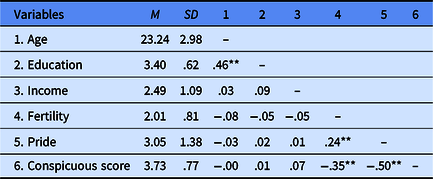
Note: N = 270, *p < .05, **p < .01, ***p < .001.
We next performed a mediation analysis using model 4 of PROCESS following the bootstrapping procedures outlined by Hayes (Reference Hayes2013) to investigate whether pride mediated the relationship between the MC phase and conspicuous consumption. The bootstrap analysis indicated that both the mediator variable model, F(2, 186) = 11.36, R 2 = .06, p = .004, and the dependent variable model, F(3, 185) = 32.34, R 2 = .34, p < .001, were significant after controlling for income. Specifically, fertility positively predicted pride (β = .41, p = .001), while pride negatively predicted conspicuous consumption (β = −.25, p < .001). The direct effect of fertility on conspicuous consumption was still significant (β = −.23, p < .001). The indirect effect of fertility on conspicuous consumption through the hypothesized mediator, pride, was significant (ab = −.10, SE = .04; 95% CI [−.19, −.04]) based on 5,000 bootstrap samples, suggesting mediation.
Discussion
In Study 1, we first investigated how the MC influences the participants’ conspicuous consumption tendencies and feelings of pride. We found that the participants in the high-fertility phase were less prone to conspicuous choices (H1) and experienced more feelings of pride (H2) than those in the low-fertility phase. Furthermore, pride mediated the relationship between the MC and conspicuous consumption. The hypothesized mediation effect was initially tested.
Study 2
In Study 1, we established that women in the low-fertility phase felt less proud and preferred conspicuous consumption as per our original hypotheses, and the mediating effect was initially tested. However, the conspicuous consumption tendency was tested by examining the respondents’ willingness to pay certain amounts of money. To simulate real conspicuous consumption, we allowed the participants to choose from conspicuous or inconspicuous products by online shopping to further examine how the MC affects conspicuous consumption, as well as the mediating effect of pride and the impact of being an only child.
Participants
An a priori analysis of power for an ANOVA for six conditions using a power of 0.80, moderate effect size η2 = 0.25 and an alpha of .05 resulted in a required sample size of 158 (Faul et al., Reference Faul, Erdfelder, Lang and Buchner2007). Three hundred female students from a comprehensive university in southern China were recruited for course credit and monetary compensation. Nine participants were excluded for having irregular MCs, and 21 were excluded during fertility measurement; thus 270 participants remained for the final analysis (M age = 22.68, SD = 3.12, range 16–36 years). All valid subjects claimed to have regular MCs (M cycle = 29.00, SD = 2.74), and none were taking hormonal contraception or were pregnant. All participants provided written consent, and the study was approved by the ethics committee of the university.
Procedure
Upon arriving at the laboratory, as a cover story, the participants were told that the study was being conducted to investigate their shopping behavior. The study consisted of two parts: first, the participants were asked to provide information including the status of their MC, their emotions, and whether they were only children; then they were instructed to engage in an online shopping task designed for the study.
During the online shopping task, the participants were given a virtual 10,000 yuan (approximately $1,560) to spend as they saw fit across five categories of goods (electronics, household appliances, sports accessories, toiletries, and snacks, each containing four types of paired goods) in an online store. Each of the categories was sequentially presented to the participants. To test the participants’ conspicuous consumption tendencies, there was no reminder of how much they had spent. After completing the task, the participants were once again debriefed and thanked.
Pretest
Before the study began, we performed a pretest to define the materials used in the study. Based on the assumption that Velben effects are defined as a willingness to pay a higher price for functionally equivalent goods (Bagwell & Bernheim, Reference Bagwell and Bernheim1996), we conducted a pretest to select 20 paired versions of an inconspicuous product (sold at a price equal to general cost) as well as a conspicuous product (sold at a price far above marginal cost).
To simulate a real shopping environment, 20 types of product in five categories, mostly sold on Taobao.com, were selected (electronics, household appliances, sports accessories, toiletries, and snacks), each of which included four products (e.g., the electronics category included an electric cooker, a blender, a soybean milk machine and a small oven). Ten participants (M age = 22.3, SD = .68) were invited to estimate the general price and a price that would be considered too high for each product. Two brands of each product with relatively comparable value and familiarity to the participants were then selected. One was labeled with the general price as an inconspicuous product and the other was labeled with the “too high” price as a conspicuous product to ensure that the paired products would be equally familiar but possessed different conspicuous characteristics.
Measurements
Emotions
As in Study 1, we used the Emotion Report Form to assess the participants’ emotional state (sadness, disgust, anger, pride, peace, and anxiety).
Conspicuous consumption
The number of conspicuous products chosen by the participants during online shopping served as an indicator of conspicuous consumption, and the number of inconspicuous products served as an indicator of inconspicuous consumption.
Results
According to the RCD results, 86 (31.8%) participants were in the menstrual phase (42 only children, 44 with siblings); 88 (32.6%) participants were in the fertile phase (40 only children, 48 with siblings); and 96 (35.6%) participants were in the luteal phase (44 only children, 52 with siblings). The participants’ conspicuous (the number of conspicuous products bought by the participants) and inconspicuous (the number of inconspicuous products bought by the participants) scores were then calculated. We first performed an ANOVA to determine whether the participants in different MC phases differed in terms of conspicuous consumption tendencies. The results showed that the participants differed significantly in their conspicuous consumption scores, F(2, 267) = 7.44, p = .001, η2 = .053, whereas no difference was found in their inconspicuous consumption scores, F(2, 267) = 1.28, p = .28, ns. The participants in the menstrual phase (M menstrual = 3.67, SD = 2.38, p = .004) and those in the luteal phase (M luteal = 3.89, SD = 2.28, p < .001) chose significantly more conspicuous products than those in the fertile phase (M fertile = 2.74, SD = 1.61), which further verified hypothesis 1.
Again, the participants in the menstrual (M menstrual = 2.92, SD = 1.22 p = .011) and luteal phases (M luteal = 2.73, SD = 1.30, p < .001) felt less pride than those in the fertile phase (M fertile = 3.39, SD = 1.10, F(2,267) = 7.06, p = .001, η2 = .05), as per H2. The participants in different MC phases showed no difference in sadness, F(2,267) = .52, p = .60, ns; disgust, F(2,267) = .59, p = .56, ns; anger, F(2,267) = 1.45, p = .24, ns; peace, F(2,267) = .16, p = .86, ns; or anxiety, F(2,267) = .74, p = .48, ns. Before beginning the mediation test, we conducted correlation analyses between our variables. The results are shown in Table 2. Fertility was positively related to pride (β = .15, p = .012) and negatively related to conspicuous consumption (β = −.17, p = .004); pride was negatively associated with conspicuous consumption (β = −.34, p < .001).
Descriptive statistics and intercorrelations between variables in Study 2
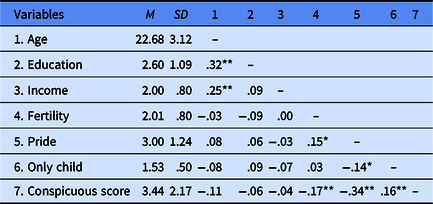
Note: N = 270, *p < .05, **p < .01, ***p < .001.
We next performed a mediation analysis using model 4 of PROCESS following the bootstrapping procedures outlined by Hayes (Reference Hayes2013). The bootstrap analysis indicated that both the mediator variable model, F(1, 268) = 6.42, R 2 = .02, p = .012, and the dependent variable model, F(2, 267) = 19.97, R 2 = .13, p < .001, were significant. Specifically, fertility positively predicted pride, β = .24, p = .012, and pride negatively predicted conspicuous consumption, β = −.56, p < .001. The direct effect of fertility on conspicuous consumption was still significant (β = −.34, p = .031). The indirect effect of fertility on conspicuous consumption through the hypothesized mediator, pride, was significant (ab = −.13, SE = .06; 95% CI = [−.27, −.04]) based on 5,000 bootstrap samples, suggesting mediation, which supports H3.
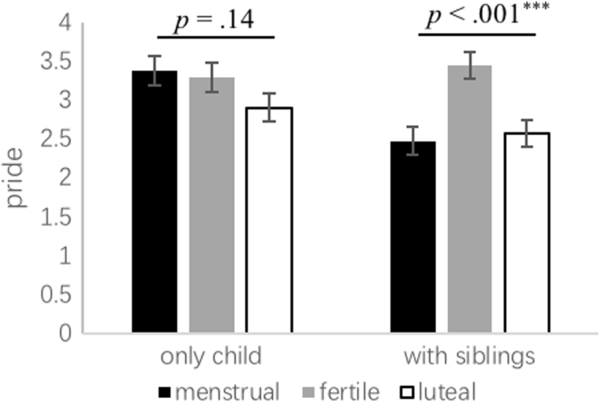
To verify the conditional effect of being an only child, we ran a 3 (menstrual, fertile and luteal) × 2 (only child, with siblings) ANOVA on pride. The results showed that the interaction was significant, F(2,264) = 4.35, p = .014, η2 = .032. The simple effect results revealed that the participants who were an only child and those with siblings differed in the extent of pride in different phases. Those who were only children showed no difference in pride across phases (M menstrual = 3.38, SD = 1.17; M fertile = 3.30, SD = 1.14; M luteal = 2.91, SD = 1.44), F(2, 264) = 1.95, p = .14, ns, while participants with siblings felt different in terms of pride in different MC phases, F(2, 264) = 9.86, p < .001, η2 = .069. Those participants felt more pride in the fertile phase (M fertile = 3.46, SD = 1.07) than in the menstrual phase (M menstrual = 2.48, SD = 1.11, p < .001) and luteal phase (M luteal = 2.58, SD = 1.16, p < .001), as shown in Figure 1.
The interaction between MC and whether being an only child on pride.
Note: Error bars represent one SD error above and below the mean.*p < .05, **p < .01, *** p < .001.
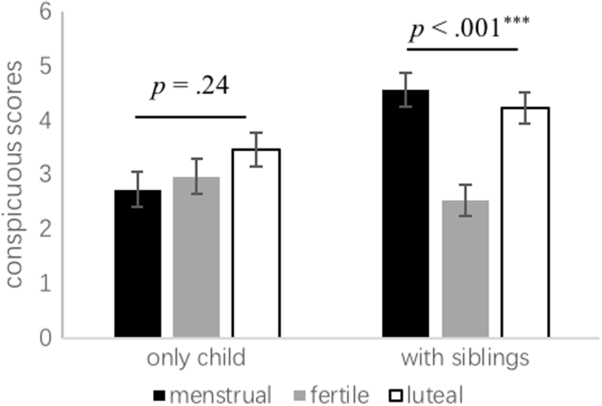
Furthermore, being an only child affects the relationship between the MC and conspicuous consumption. The interaction between the MC and being an only child in terms of the conspicuous consumption score was significant, F(2,264) = 6.58, p = .002, η2 = .047. The simple effect results showed that the participants who were only children showed no difference in their preference for the conspicuous products (M menstrual = 2.74, SD = 1.62; M fertile = 2.97, SD = 1.73; M luteal = 3.48, SD = 1.62), F(2,264) = 1.46, p = .24, ns. Although the participants with siblings differed in terms of conspicuous consumption, F(2, 264) = 13.21, p < .001, η2 = .091, they preferred conspicuous products more in the menstrual phase (M menstrual = 4.57, SD = 2.65, p < .001) and luteal phase (M luteal = 4.23, SD = 2.69, p < .001) than in the fertile phase (M fertile = 2.54, SD = 1.49), as shown in Figure 2.
The interaction between MC and whether being an only child on conspicuous score.
Thus, we conducted a moderated mediating analysis using model 8 of PROCESS following the bootstrapping procedures outlined by Hayes (Reference Hayes2013). The results showed that both the mediator variable model, F(3, 266) = 7.21, R 2 = .08, p < .001, and the dependent variable model, F(4, 265) = 13.64, R 2 = .17, p < .001, were significant. The interaction effect between the MC and being an only child was significant on both the pride (β = .54, p = .003) and conspicuous consumption scores (β = −.89, p = .004). The direct effect was conditional on whether the participants were only children (β = .10, p = .64, ns) or had siblings (β = −.79, p < .001). The indirect effect of pride was also conditional on whether the respondent was an only child (ab = .02, SE = .06, 95% CI [−.10, .15]) or had siblings (ab = −.23, SE = .07, 95% CI = [−.41, −.11]) based on 5,000 bootstrap samples. The mediating effect of pride was conditional on the subject being an only child; that is, the mediating effect was not significant for the participants who were only children but significant for the participants who had siblings.
Discussion
In this study, we verified our hypothesis that participants in different MC phases differ in their preference for conspicuous products and their feelings of pride. More specifically, the participants in the low-fertility phase were more inclined toward conspicuous consumption and felt less pride as their feelings of pride mediated the relationship between the MC and conspicuous consumption. Individuals in the low-fertility phase felt less pride; thus, they preferred conspicuous products. Being an only child moderated the mediation effect. The mediation occurred only in those with siblings, and not in the only child group, which may be because only children have a greater sense of security and confidence; thus, their feelings of pride will not be influenced by fertility. We manipulated the participants’ pride to further verify the moderated mediation effect in Study 3.
Study 3
In Study 3, we manipulated the participants’ feelings of pride to determine whether pride can change participants’ preference for conspicuous consumption. If the participants in the low-fertility period prefer conspicuous products because they feel less pride, then making them feel pride might attenuate their preference for conspicuous consumption. In addition, we assumed that the pride priming effect was conditional, which is effective for the participants who have siblings but not for those who are only children.
Participants
An a priori analysis of power for an ANOVA for 12 conditions using a power of 0.80, moderate effect size η2 = 0.25 and an alpha of .05 resulted in a required sample size of 158 (Faul et al., Reference Faul, Erdfelder, Lang and Buchner2007). Four hundred and sixty-eight female students from a comprehensive university in southern China were recruited in exchange for course credit and monetary compensation. We excluded 11 participants who had irregular MCs and 29 participants during fertility measurement; thus, in the final analysis, 428 participants remained (M age = 24.32, SD = 4.76, range 18–49 years). All participants had a regular MC (M cycle = 29.86, SD = 5.06); none were taking hormonal contraception or were pregnant; and they were willing to take part in the study and signed the experiment agreement. The study was approved by the ethics committee of the university.
Procedure
The study was conducted in three parts. First, the participants were asked to provide information about their MC and whether they had siblings. Next, they were randomly assigned to different emotional manipulation conditions (pride vs. neutral). They were asked to evaluate the level of pride they felt upon finishing the emotional priming. In the third part, the participants were asked to perform an online shopping task as in Study 2. Finally, all participants were thanked and briefed.
Measurements
Emotions
We primed the participants’ emotions by asking them to recall events that had occurred in the past and to input the events into a computer with a keyboard. In the pride priming condition, the participants were asked: “Please recall an event that recently occurred that made you feel proud. When and where did that occur? Who was with you when it occurred? Please recall it carefully and enter the event details in the textbox on the screen.” In the neutral emotional priming group, the participants were asked: “Please recall several of the most routine events that occur in your daily life. Recall them carefully and enter the events in the textbox on the screen” (Wilcox, Kramer, & Sen, Reference Wilcox, Kramer and Sen2010).
Manipulation check
The participants were asked to evaluate on a 7-point scale the extent of pride they felt upon finishing the emotional priming (from 1 = not proud at all to 7 = very proud) to ascertain whether the manipulation was successful.
Conspicuous consumption
As in Study 2, the participants’ choices during the online shopping indicated their preference for conspicuous consumption.
Results
The participants in the pride priming condition (M pride = 4.96, SD = 1.58) felt significantly more pride than those in the neutral emotional condition (M neutral = 3.72, SD = 1.63), t(426) = 8.02, p < .001, Cohen’s d = .77. The participants in the pride priming condition were successfully primed with pride compared with the median value of the scale, t(213) = 8.98, p < .001, whereas the participants in the nonpriming condition did not feel particularly proud compared with the median value of the scale, t(213) = −2.47, p = .014, which indicated that the emotion priming was successful.
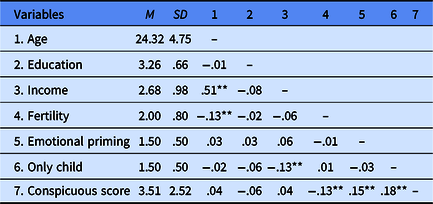
According to the RCD results, among our 428 valid participants, 137 (32.0%) were in the menstrual phase (69 only child, 68 with siblings); 137 (32.0%) were in the fertile phase (68 only child, 69 with siblings); and 154 (36.0%) were in the luteal phase (75 only child, 79 with siblings). The correlations among the variables are shown in Table 3.
Descriptive statistics and intercorrelations among the variables in Study 3
Note: N = 428, *p < .05, **p < .01, ***p < .001.
Descriptive statistics of conspicuous consumption scores in different conditions in Study 3
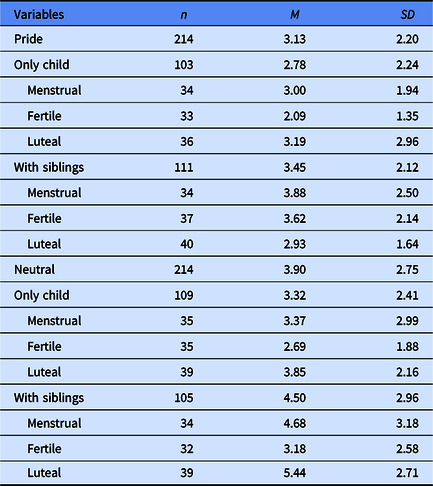
We then performed a 2 (emotional priming: pride vs. neutral) × 3 (fertility: menstruation, fertile vs. luteal) × 2 (only child vs. with siblings) three-way ANOVA on the conspicuous consumption score to investigate the relationship between our variables the descriptive statistics of conspicuous consumption scores in different conditions is presented in Table 4. The ANOVA results showed that the three-way interaction was significant, F(2, 416) = 3.29, p = .038, η2 = .016. The descriptive statistics of each condition are shown in Table 3. The three-way interaction was not significant for the inconspicuous consumption score, F(2, 416) = .87, p = .42, ns.
The main effect of pride priming, F(1,416) = 10.39, p = .001, η2 = .024, MC, F(2,416) = 6.63, p = .001, η2 = .031, and being an only child, F(1,416) = 15.83, p < .001, η2 = .037, on the conspicuous consumption scores were all significant. When primed with pride, individuals (M pride = 3.13, SD = 2.20) were less inclined toward conspicuous consumption than those in a neutral emotional state (M neutral = 3.90, SD = 2.75, p = .001). The participants in the menstrual phase (M menstrual = 3.73, SD = 2.74, p = .004) and luteal phase (M luteal = 3.86, SD = 2.57, p = .001) consumed significantly more conspicuous products than those in the fertile phase (M fertile = 2.91, SD = 2.09). Additionally, those who were only children (M only child = 3.06, SD = 2.34) consumed fewer conspicuous products than those with siblings (M with siblings = 3.96, SD = 2.61, p < .001).
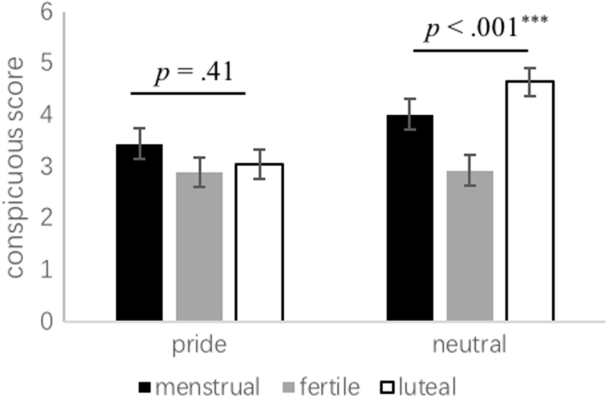
The interaction between emotional priming and fertility on conspicuous scores was significant, F(2,422) = 3.85, p = .022, η2 = .018. The simple effect results showed that, when primed with pride, the participants in different MC phases showed no difference in conspicuous scores (M menstrual = 3.44, SD = 2.26; M fertile = 2.90, SD = 1.95; M luteal = 3.05, SD = 2.35) F(2,422) = .90, p = .41, ns; while in the neutral emotion group, the participants in different MC phases differed in their conspicuous consumption scores, F(2,422) = 8.98, p < .001, η2 = .041. Those in the fertile phase (M fertile = 2.93, SD = 2.23) consumed fewer conspicuous products than those in the menstrual phase (M menstrual = 4.01, SD = 3.13, p = . 01) and luteal phase (M luteal = 4.64, SD = 2.56, p < .001), exhibiting a pattern similar to that found in Study 2 (Figure 3). This finding further proved that pride plays a mediating role between MC and conspicuous consumption.
The interaction between MC and emotional priming on conspicuous score.
However, the interaction between emotional priming and fertility was significant only for the participants with siblings, F(2,210) = 6.57, p = .002, η2 = .059, and it was not significant for the participants who were only children, F(2, 206) = .07, p = .93, ns. More specifically, the participants in different MC phases showed no difference in their conspicuous consumption preference when in the pride-only child condition, F(2,100) = 2.40, p = .10, ns; the neutral-only child condition, F(2,106) = 2.20, p = .12, ns; and the pride-with-siblings condition, F(2,108) = 2.10, p = .13, ns. However, in the neutral-with-siblings condition, the participants in different MC phases differed in their conspicuous consumption preference, F(2,102) = 5.62, p = .005, η2 = .099, and the participants in the fertile phase (M fertile = 3.19, SD = 2.58) consumed significantly less conspicuous products than those in the menstrual (M menstrual = 4.68, SD = 3.17, p = .035) and luteal phases (M luteal = 5.44, SD = 2.71, p = .001), as shown in Figure 4. These findings further verified the moderating effect of being an only child.
The three-way interaction effect on conspicuous scores.

Discussion
As we found in Study 2, the participants in the low-fertility period consumed more conspicuous products. However, after manipulating the participants’ feeling of pride in Study 3, we found that priming individuals in the low-fertility period to feel pride attenuated their preference for conspicuous consumption, which further verifies the mediating role of pride. However, the attenuated effect was found only in those who have siblings, but it was not significant in those who were only children, which further verified the moderating role of being an only child.
General discussion
In this study, we aimed to investigate how women differ in their conspicuous consumption preferences during different MC phases. From an evolutionary perspective, we hypothesized that women in the low-fertility phase (menstrual phase and luteal phase) would feel less pride and show greater preference for conspicuous consumption choices than women in the high-fertility phase (fertile phase), with pride mediating the relationship between the MC and conspicuous consumption. Furthermore, we hypothesized that being an only child would moderate the mediation effect.
By asking the participants to indicate how much money they would spend on certain items compared to their peers (Study 1) or to shop online (Study 2), we found that women in the low-fertility phase showed a greater preference for conspicuous consumption. Meanwhile, the participants in the low-fertility phase felt less pride than those in the high-fertility phase. The extent of pride mediated the MC effect on conspicuous consumption. Additionally, the mediating effect was significant for the participants with siblings, but it was not significant for the participants who were only children, as being an only child functioned as a moderator to the mediation effect.
To further verify our hypotheses, we manipulated pride through emotional priming (Study 3) to find specific interactions among the MC, emotional priming and being an only child. The results showed that when primed with pride, the effect of the MC on conspicuous consumption disappeared, which further verifies the mediating effect of pride. Additionally, the effect of pride priming on the MC and conspicuous consumption was conditional on whether the participants were only children, which further verifies the moderator effect of being an only child, as per H4.
Based on our findings, we believe that women in the low-fertility phase prefer conspicuous products due to the evolutionary drive. Natural selection can biologically shape individuals’ behavior in terms of reproductive fitness to pass on better genes to future generations (Durante & Griskevicius, Reference Durante and Griskevicius2016). When females are low in their ability to reproduce, they may have lower self-evaluation (Röder et al., Reference Röder, Brewer and Fink2009). Meanwhile, pride is a positive self-emotion that involves and depends on self-evaluation (Tracy & Robins, Reference Tracy and Robins2007a, Reference Tracy, Robins, Sedikides and Spence2007b). When women feel low in self-evaluation in the low-fertility phase, they may feel less pride than those in the high-fertility phase.
Conspicuous consumption is motivated to boost self-esteem, express identity and signal status (Wang & Griskevicius, Reference Wang and Griskevicius2013), and it can serve as compensation for low self-esteem or low power states. When women exhibit low self-evaluation and experience lower levels of pride, they tend to consume conspicuous products as a compensatory measure to restore the power state from low to high. Pride mediates the relationship between the MC and conspicuous consumption.
However, as a special case, being the only child in the family can buffer women’s preference for conspicuous products when they are in low-fertility periods. Interestingly, as a result of a national policy, this phenomenon might be relatively unique to Chinese society. Being an only child may create a greater sense of security and confidence (Blake, Reference Blake1981); individuals may not feel as easily threatened; thus, when they are in their low-fertility period, they will not need to consume conspicuous products as a compensatory behavior.
Theoretical and practical implications
The key contribution of our research involves three aspects. First, we contribute to evolutionary psychology by examining how the MC impacts conspicuous consumption. Although a previous study revealed the relationship between fertility and attention to conspicuous consumption (Lens, Driesmans, Pandelaere, & Janssens, Reference Lens, Driesmans, Pandelaere and Janssens2012), few studies have investigated how the MC impacts actual conspicuous consumption. Additionally, unlike the former studies that have focused on the positive consequence results from high ability to produce in the high-fertility stage (Röder et al., Reference Röder, Brewer and Fink2009), we revealed that women feel less proud during the low-fertility phase, which mediates the MC effect on conspicuous consumption.
Second, we provide a better understanding of women’s consumer behavior in terms of both biological and acquired factors. The unique consumption patterns of women should be identified, as women are the main consumption force all over the world (Palmer, Reference Palmer2018). Additionally, as the Chinese people are reported to favor high-priced products, much of female consumption is not necessary but it is conspicuous. It is very important for companies and retailers to focus on factors that influence female conspicuous consumption. In this article, we found that a biological factor, specifically the MC, can influence conspicuous consumption. Additionally, the growth environment, an acquired factor, can moderate the effect, which provides new insights for future studies that can be applied to marketing.
Last but not least, our study reveals that being an only child buffers women’s preference for conspicuous products when they are in the low-fertility period. Female only children are no longer raised with the idea that women’s duty is to give birth to the next generation (Tsui & Rich, Reference Tsui and Rich2002). Besides, they are the major concern of the family, which may create a greater sense of security and confidence and thus will not be as easily threatened by low fertility (Tsui & Rich, Reference Tsui and Rich2002). This finding supports the view that the one-child policy has some benefits despite its adverse impact, especially for girls. This policy can improve the welfare of women in China. Furthermore, the demographic variable of being an only child can influence females’ conspicuous consumption choices, and marketers should take this factor into account to attract more customers.
This study’s findings have several practical implications that can be applied to marketing. The results indicate that premenstrual and menstrual women are more inclined toward conspicuous consumption. Thus, through an app that helps women record and track MCs, commodities with different conspicuous natures can be promoted in different menstrual phases, which may increase the probability of a purchase. Additionally, marketers should pay attention to the shopping atmosphere, as pride priming can influence customers’ preference for conspicuous products – if the shopping environment can invoke feelings of pride, then the purchase likelihood of a conspicuous product may decrease.
Limitations and future research
Our studies were conducted in China, and the results may be culture-specific and not easily transferred to women from other cultural and educational backgrounds. The one-child policy has had a specific impact on Chinese families that may be difficult for foreign audiences to understand. Future studies may focus on the similarities and differences between Chinese and other cultural backgrounds. For example, female students with or without siblings in America or Europe could be compared to explore the similarities and differences in their preferences for conspicuous consumption in different MC phases.
Additionally, we used the RCD method to assert the MC phase in our studies, which may be inaccurate due to hormone fluctuations. Future studies could be improved with hormone measurements to obtain accurate fertility phases. We also conducted our research over a single MC; further studies could be improved by using daily report methods to track changes in participants’ preferences for conspicuous consumption and feelings of pride over two or more complete MCs to further validate our research results.
We use the statement “only children have greater security and confidence” to explain the moderated mediating effect of being an only child and pride between the menstrual phase and conspicuous preference, but there are competitive models. The parental investment theory proposes that women must resist the temptation of satisfying their own conspicuous consumption during the low-fertility phase to fulfil the needs of an often helpless infant or egocentric young child (Bjorklund & Kipp, Reference Bjorklund and Kipp1996), which predicts opposing results for how women address conspicuous consumption during the low-fertility phase. However, our experimental samples were mostly young and unmarried; women with children and those without children may exhibit different conspicuous tendencies that are worth further exploration.
Acknowledgments
The authors acknowledge the helpful input of the editor, associate editor. The authors thank Qing-Shan Hui for his valuable suggestions during revision; Hai-long Sun, Guan-xing Xiong and Xiao-Tian Wang for writing advices; Hao Ding, Kun Gai, Chun-Xia Chen for their assistance with data collection and the participants in Jinan University.
Financial support
This research was partially supported by the National Natural Science Foundation of China (Nos. 71571087, 71971099, 71801110,7170111). Natural Science Foundation of Guangdong Province (2017A03038013); MOE (Ministry of Education in China) Project of Humanities and Social Sciences (No. 18YJC630268); China Postdoctoral Science Foundation (No. 2018M633270); the Science and Technology Planning Project of Guangdong Province (Grant: 2014B040404072).


 Open access

