




The renowned poet and gastronome Su Shi 蘇軾 (1037–1101) once rhapsodized about eating pufferfish at a banquet. When asked how it tasted, he cried out: “It is just to die for!”Footnote 1 This exclamation evokes the uniqueness of the pufferfish as a delicious yet fatal dish. “Pufferfish” is a common name for nearly two hundred species under the family Tetraodontidae. Many of them have a high concentration of the lethal tetrodotoxin in their ovary, liver, and skin. In modern-day East Asia, the pufferfish retains the aura of a risky treat that demands specialized culinary training and license to prepare. Incidents of pufferfish poisoning have been reported annually.Footnote 2 The reputation of pufferfish’s flavor, however, had a peculiar history in premodern China. Whereas early medieval records uniformly warned against consuming this fish, writers since the tenth century increasingly endorsed it as a southern regional flavor. How did the pufferfish emerge from an ancient killer to acquire its prestige as a delicacy? This paper traces this metamorphosis in correlation to demographic and geographical reconfigurations from the tenth to the early twelfth century. It was a process in which the northern and southern culinary traditions confronted and negotiated with each other across literary, medical, and miscellaneous genres. Alongside it, distinctive strands of historical encounters, experiences, and materialities were coalesced into the very name hetun 河豚 (“river-piglet”), which came to connote at once danger and delicacy.
Previous scholars have examined the literary representations of pufferfish in East Asia. Hsieh Chung-chih 謝忠志 and Chunghao Pio Kuo have traced the multivalent motif of the pufferfish in the Ming (1368–1644) and modern Japan back to Song China (960–1279).Footnote 3 Others like Kakehi Fumio 筧文生 and Jonathan Chaves have focused on poetic depictions of the pufferfish and literary exchanges between Song literati.Footnote 4 While poetry was a major medium whereby pufferfish lore was constructed and transmitted, a sole focus on it yields a monotonous view, as poets tended to replicate and circulate the same linguistic repertoire. These scholarly insights invite further exploration of the changing social, cultural, and political contexts that heightened Chinese writers’ attention to pufferfish.
The imbrication of gastronomic writing, spatial movement of regional products, and the intellectual project of collecting and classifying natural knowledge in the Song has been of recent scholarly interest.Footnote 5 In particular, seafood became prominent due to advances in water transportation and the fascination for southern flavors. Its shifting cultural stature bespoke the imperial reach into the south and the naturalization of its “exoticness.” Peripatetic scholar-officials serving regional administrations valued local knowledge about sea products and organized and publicized it through their writings in various genres. The pufferfish was a peculiar example of these trends. It was listed as a tuchan 土產 (“local product”) in Zhejiang and Jiangsu gazetteers since the Southern Song.Footnote 6 Yet before, and even after, it came to be celebrated by the rising southern gastronomes, it provoked contention in literary and medical discourses for its toxins. This paper draws on poetry, bencao 本草 (“materia medica,” “pharmacopoeia”), and biji 筆記 (“brush notes,” “miscellany”) to elucidate the multifaceted perceptions of the pufferfish and their gradual amalgamation from the tenth to the early twelfth century. It foregrounds the fluidity and interplay of different genres in constructing, contesting, and conglomerating natural knowledge of southern products.
I begin by pinpointing the tenth century as a critical moment when the pufferfish’s image diverged from a lethal fish into a Wu 吳 (lower Yangzi River, around Jiangsu and Zhejiang) regional and seasonal specialty, alongside the appearance of the popular name hetun. The second section zooms in on a moralizing poem in the early eleventh century that established the literary topos of the pufferfish as a wicked creature to be treated with special means. Despite this poem being a political allegory, its depiction of the pufferfish’s morphological idiosyncrasies implied certain piscine lore that circulated in the lower Yangzi region. The third section turns to biji in which the authors documented their observations of southeastern coastal inhabitants’ consumption of and attitudes toward pufferfish. These empirically-oriented accounts illuminated diverse types and representations of pufferfish from different culinary traditions, all grouped under the uniform category of hetun. I conclude with the medicalization of the pufferfish in the specialized field of bencao. Song pharmacologists eventually synthesized previous records about pufferfish into a single hetun, which signified a deadly delicacy that downplayed historical or regional specificities.
“River-piglet” from the South
The tenth century marked a pivotal point in the textual documentation of the pufferfish, its general reputation then shifted from that of a dangerous killer to an alluring treat. Involved in this transformation were the narrowing of its unruly nomenclature into one unified name and the perception of its consumption as a regional practice of the lower Yangzi area, especially among the Wu people. The modern Chinese term for the pufferfish, hetun, first appeared in a regional bencao treatise compiled in the Wu-Yue 吳越 Kingdom (902–978) and gradually became popular in other genres. There were earlier terms such as gui 鮭 and houtai 鯸鮐, which were textual, phonetic, or regional variants.Footnote 7 Extant records of the pufferfish from the early medieval period were brief accounts of its fatal toxins that endangered consumers, without commenting on its taste. In works ranging from mytho-geographical, philosophical, and medical treatises, writers came to understand the specific poisonous parts of the pufferfish and dissuaded people from consuming it. For instance, the Sui physician Chao Yuanfang 巢元方 (fl. 610) admonished: “This [houtai] fish’s liver and roe inside the abdomen are heavily poisonous and cannot be eaten. Eating them often results in death.”Footnote 8
Some remarked on the taste and regionality of the pufferfish, hinting at a distinctive culinary culture in the lower Yangzi area. An early example was Liu Kui’s 劉逵 (fl. ca. 295) commentary on Zuo Si’s 左思 (ca. 250–305) poem, “Rhapsody of the Wu Capital” (“Wudu fu” 吳都賦). In the poem Zuo catalogued houtai as one submarine specialty of the Wu state capital, Jianye 建業 (in Jiangsu). Liu described the physicality and toxicity of the fish, but ended with a gastronomic statement: “Steaming and boiling it, it is luscious. Yuzhang (in Jiangxi) people treasure it.”Footnote 9 Duan Chengshi 段成式 (803–863) noted one antidote to houyi 鯸鮧 fish poisoning as local lore in the lower Yangzi: “Ai (common mugwort, Artemisia vulgaris) could dispel its toxins. When people from the Yangzi and Huai rivers eat this fish, they must pair it with ai.”Footnote 10 Both records portrayed pufferfish consumption as a rather common practice in southeastern localities, where the locals were not worried about its poisonous effects. As northern intellectuals documenting southern customs, Liu and Duan revealed a rather special geo-cultural realm in the lower Yangzi area. There developed a unique perception of the pufferfish as a common fish for consumption despite its toxicity, and the locals had their own ways of preparing and detoxifying it.
While these earlier records came from northern writers’ possible travel writings or hearsay, a tenth-century account produced in Wu accorded with their perception of the pufferfish as a regional and seasonal treat. This was an essay written by a certain Mao Sheng 毛勝, an official in the Wu-Yue Kingdom. Mao assumed the title of the imperial lord of the sea and conferred bureaucratic titles to local marine species based on their characteristics. The entry about the pufferfish records:
令黃薦可, 爾澤嫩可貴, 然失於經治, 敗傷厥毒, 故世以醇疵隱士為爾之目, 特授三德尉兼春榮小供奉。Footnote 11
Decree: Huang Jianke [literally, “Huang, the one acceptable for recommendation”], you are lustrous, delicate, and praiseworthy. However, those who miss the regulation and treatment would be harmed by your toxins. Therefore, people address you as the “recluse of a mellow flaw.” I bestow upon you the special title of the Third Commandant of Virtue, along with the Dainty Attendant of the Spring Splendor.
The contemporaneous scholar Tao Gu 陶穀 (903–970) incorporated Mao’s essay into his own miscellany, the Qing yi lu 清異錄 (Record of the pure and the extraordinary), and described the motivation for Mao’s composition as to playfully document the Wu-Yue “sea products” (haiwu 海物) as regional specialties not found elsewhere. Mao’s entry foregrounded the peculiar paradox of the pufferfish being at once luscious and poisonous, which distinguished it from other marine creatures. For this reason its title was “specially bestowed” (teshou 特授), whereas all others were “appropriately bestowed” (yishou 宜授). The pufferfish’s distinctiveness was also reflected in the necessity of its “regulation and treatment” (jingzhi 經治) to neutralize the toxins. Unlike Liu Kui and Duan Chengshi, Mao did not explain the precise mechanism but suggested only that the fish was an offering (gongfeng 供奉) in the spring. For a Wu local like Mao, the knowledge of proper preparation might have been implicit and need not be explicitly stated.
This brief survey from the early medieval period to the early tenth century reveals a layered and evolving perception of the pufferfish as a Wu regional specialty. On one hand, writers acknowledged its fatal toxins and many warned against its consumption, sustaining its image as a dangerous killer. On the other hand, some recognized the regionality of pufferfish consumption in the lower Yangzi area and recorded special methods of preparing and detoxifying pufferfish, treating it as a rather common food item with a delicate flavor to pursue, not to avoid. They painted a different image of the pufferfish and carved out a distinctive Wu gastronomic culture. The paradox inherent in the pufferfish as a dangerous treat manifested itself in the encounter between the outsiders and insiders to this regional culture. The close association between the pufferfish and the Wu area continued to transform how writers perceived the fish in the centuries to come, as the cultural center gradually shifted southward populated by more southern intellectuals.
Poeticization and politicization of a wicked creature
The fame of the pufferfish spread widely in eleventh-century literati circles thanks to a pioneering poem by Mei Yaochen 梅堯臣 (1002–1060) which imposed moral gravity on the fish and denounced its consumption as a deviant southern custom. Modern scholars unanimously quote Mei’s poem as evidence of the paradoxical, if not pejorative, attitude Chinese literati held towards the pufferfish. They interpret it as a political allegory within the specific context of early Song (960–1279) political reform and emergent factionalism, in which Mei seized on the danger of the pufferfish to denounce the equally dangerous factionalism. Nonetheless, the power of the metaphor is rooted in Mei’s vivid and precise delineation of the fish’s morphological and gastronomical traits. Attending to the intertextual complexity and geographical allusions, I suggest that Mei embedded his thorough portrayal of the fish not only in state politics within the northern capital but also in the confrontation between northern and southern culinary customs.
Mei Yaochen’s poem, “Conversing with Guests about Eating Pufferfish at Fan Raozhou’s Banquet” (“Fan Raozhou zuo zhong ke yu shi hetun yu” 范饒州坐中客語食河豚魚), was likely the first and the most famous literary work on the pufferfish that contended that it was a wicked southern creature.Footnote 12 It was one of several of Mei’s poems about animals, interweaving morphological descriptions with didactic messages.

Long description
The table contains four columns. The first column marks line numbers at intervals of 4. The second column contains the original Chinese characters, and the third and fourth columns provide the English translation.
* Lines 1 to 2: Bamboo shoots sprout from spring islets, Willow down flies over spring banks.
* Lines 3 to 4: This is the time for pufferfish, Their price exceeds other fish and shrimp.
* Lines 5 to 6: Its form is already grotesque, its venom unsurpassed.
* Lines 7 to 8: A bristling belly like a huge boar, enraged eyes like the frog of Wu.
* Lines 9 to 10: Cooking it, if you miss the way, It will become the sword Moye entering your throat.
* Lines 11 to 12: If you would thus lose your body, What need is there to sate your teeth?
* Lines 13 to 14: When I questioned the southerners, Biased to defend it, they boasted about it again and again.
* Lines 15 to 16: They all said that its exquisite flavor has no limits. Who said that people who died from it are as copious as hemp?
* Lines 17 to 18: My words could not get them to bend. Sighing in vain, I reflected upon myself.
* Lines 19 to 20: When Tuizhi came to Chaoyang, He initially recoiled at eating snakes.
* Lines 21 to 22: When Zihou stayed in Liuzhou, He willingly ate toads.
* Lines 23 to 24: These two creatures are both abominable, Yet there is no mishap to life.
* Lines 25 to 26: This flavor of the pufferfish has no compare, But within it lurked disasters without bound.
* Lines 27 to 28: In supreme beauty, malice is also matched. Such words are truly praiseworthy.
Mei wrote this poem in 1037 at a banquet convened by Fan Zhongyan 范仲淹 (989–1052) in Jiangxi. Scholars have analyzed it as an argument against political cliques and highlighted the pun of dang 黨 (“biased,” “partisan,” line 14). In 1036, Fan Zhongyan was exiled to Raozhou (in Jiangxi) after he had accused the then-councilor Lü Yijian 呂夷簡 (979–1044) of political favoritism and denounced his leading role in a party of self-serving oligarchs. Fan himself, however, also assumed the leadership of an opposing reformist party that endeavored to restore good government.Footnote 16 The intellectual historian Liu Zijian 劉子健 (1919–1993) opined that Mei analogized pufferfish to factionalism, both seemingly desirable but actually devastating.Footnote 17 The merit of Mei’s poem, therefore, lies in the double entendre: literally, he castigates succumbing to gustatory desire that risks one’s life; allegorically, he insinuates that both Lü and Fan have fallen prey to the allure of factionalism to achieve their political agenda at the expense of imperial stability. Other scholars are less conclusive about the specific target of this poem but concur that Mei skillfully employed the pufferfish’s characteristics to discourse on politics and human relationships, leaving open multiple interpretations.Footnote 18
This credible political reading risks relegating the pufferfish to a sheer metaphor of absolute poison. Despite the overwhelming censure, two points shed light on a different kind of politics related to Mei’s ambivalence toward southern culinary customs: the geographical allusions and the detail about proper preparation. Considering the Wu origin of the pufferfish, the power of Mei’s allusions comes to the fore. Mei deploys parallel images, the “huge boar” and the “frog of Wu,” to picture pufferfish pejoratively and justifies such depictions through classical references (lines 5–8). Instead of tun 豚 (“piglets,” often reared in one’s household), Mei analogizes the fish to shi 豕 (“boars,” often wild and mature) associated with the Wu area that connote voracity.Footnote 19 The frog of Wu also conjures up the gastronomic image of the southern habit of eating frogs.Footnote 20 Mei interrogates the “southerners” in Jiangxi who would risk their life for just a bite (line 13). Though Mei was from Xuancheng (in Anhui), he aligns himself with the northern literati Han Yu and Liu Zongyuan, who were exiled to the far south but were judicious about assimilating local customs (lines 19–22). Mei’s discussion of consuming pufferfish, snakes, and toads renders his poem a point of disagreement between the northern orthodoxy and its perceived moral deviance of the south. Although the pufferfish was itself poisonous, Mei’s real target was the heedless southern consumers who craved excessive taste at the expense of their lives.
Was the pufferfish really so devastating then? Writing a poem in the ancient style, as this piece was often acclaimed to be, Mei Yaochen could not but saturate it with moral suasion. His close comrade Ouyang Xiu 歐陽修 (1007–1072) highly commended his depiction.Footnote 21 Later poets, notably Su Shi and Fan Chengda 范成大 (1126–1193), also wrote pufferfish poems modeled after Mei’s and perpetuated the creature’s infamously dangerous allure. Those gourmets who lavished encomia on its alleged taste tended to overlook the importance of cooking. Though Mei portrayed the fish as e 惡 (“malicious,” line 27), he also briefly mentioned that it became deadly if one did not prepare it correctly (lines 9–10), hinting at the proper way of rendering it safe for consumption. Mei did not elaborate on the method, but he could have gained this tip from his experience living in Jiangxi or heard about it elsewhere in the south. Considering the similar note about jingzhi 經治 that Mao Sheng had specified, it was likely that some culinary knowledge about pufferfish preparation and consumption was circulating around Mei’s time, which was to be documented in greater detail by later authors.
The regionality and diversity of pufferfish in biji
Mei Yaochen’s apprehension about careless consumers endangered by pufferfish was not merely a rhetorical or political pronouncement of his own but shared by biji writers throughout the eleventh century. The quest for authentic piscine knowledge prompted them to enquire into the taxonomy and toxicity of the pufferfish beyond what had previously been written about it. In their miscellaneous jottings, they weighed their personal observations and experiences against transmitted lore and attempted to establish themselves as reliable sources of natural knowledge. In different ways, they responded to contemporary hearsay about pufferfish being a dangerous and decadent food by delving into the diversity of Wu culinary customs. Whereas poetry presented the pufferfish as a uniform topic with conventionalized symbolisms, biji illuminated variegated encounters with different pufferfishes, be it horrific, celebratory, or mundane. As a result of the literati effort to taxonomize, these distinctive everyday experiences were conflated into the single category of pufferfish that hid their diversity.
The Hangzhou literatus Shen Gua 沈括 (1032–1096), steeped in the literate and material culture of Wu, set out to clarify and explicate the regional perceptions of pufferfish. He signaled a more complex world of pufferfish than Mei Yaochen’s moralizing poem could suggest. In his late years of retirement, Shen Gua devoted himself to writing the Mengxi bitan 夢溪筆談 (Brush talks at Dream Brook) in pursuit of reliable knowledge through means such as observation and reasoning.Footnote 22 There he included a discussion of pufferfish in an attempt to correct an official medical compendium (to be discussed in the next section). He opened with a general statement: “Wu people are addicted to hetun fish. In cases where they come upon the toxic ones, they often kill people. This should be a serious warning.”Footnote 23 The rest of this entry reveals that the “hetun fish” was a category neither self-evident nor homogeneous:
規魚, 浙東人所呼。又有生海中者, 腹上有刺, 名海規。吹肚魚, 南人通言之, 以其腹脹如吹也。
Gui [literally, “compass”] fish is what Eastern Zhejiang people call it [the pufferfish].Footnote 24 There are also those from the sea, with spiky abdomen,Footnote 25 named “sea-compass fish.” “Belly-blowing” fish is what southerners call all of them, because their bellies are bloated as if having been blown.
The variation in nomenclature pointed not only to different regional designations but possibly also to distinctive species from different waters. Their morphological resemblance, namely, the puffed body, became the defining trait whereby Shen Gua categorized them altogether as hetun.
The Jiangsu literatus Zhang Lei 張耒 (1054–1114) left a detailed and revealing record of how Wu people consumed pufferfish, further suggesting that different kinds of pufferfish, some highly poisonous and others less so, were readily subsumed under the name hetun, resulting in seemingly incongruent descriptions. A rather conventional scholar-official, Zhang devoted his biji, the Mingdao zazhi 明道雜志 (Mingdao miscellany), mostly to issues related to language, writing, art, and scholarly learning, but also showed keen interest in peculiar phenomena of the world.Footnote 26 He sampled local anecdotes while serving in Zhejiang and Anhui, presenting layered perceptions of pufferfish:
河豚魚, 水族之奇味也。而世傳以爲有毒, 能殺人。中毒則覺脹, 亟取不絜食乃可解, 不爾必死。余時守丹陽及宣城, 見土人户食之。其烹煑亦無法, 但用簍蒿、荻筍、菘菜三物, 云最相宜。用菘以滲其膏耳, 而未嘗見死者。或云土人習之, 故不傷, 是大不然。蘇子瞻是蜀人, 守揚州;晁無咎濟州人, 作倅。河豚出時, 毎日食之, 二人了無所覺, 但愛其珍美而已。Footnote 27
The pufferfish is a marvelously tasty aquatic animal. Transmitted lore says that it is toxic and can kill people. Once poisoned, one would feel bloated. If they eat some unclean food right away, the poison can be dissipated,Footnote 28 otherwise they will definitely die. I was once the prefect in Danyang (in Zhejiang) and Xuancheng (in Anhui) and saw local families eat pufferfish. They did not have a particular way of cooking it but simply used mugwort, bamboo shoots, and cabbage, saying that they best complemented each other. They used cabbage to strain its fat. Never have I seen one who died from it. Some say that the locals are used to it and thus are not harmed. This is not the case at all. Su Shi from the Shu region (in Sichuan) was the prefect in Yangzhou (in Jiangsu). Chao Wujiu (Chao Buzhi 晁補之, 1053–1110) from Jizhou (in Shandong) was the auxiliary in Yangzhou. When pufferfish came out, the two ate it every day and did not sense anything. They simply relished its delicious flavor.
The thrust of Zhang’s documentation was the conundrum of the pufferfish’s alleged toxicity. He sought to dispel the rumors with his own experience of living in the southeast and learning about local culinary customs. He began by asserting that the pufferfish is a marvelous dish (qiwei 奇味) that the locals in two southeastern towns had no problem consuming, contrary to contemporary rumors that dismissed it as a dangerous killer. He then refuted a second claim about how the locals were not harmed by the fish because they had become accustomed to it. Two non-locals daily delighted in the fish without risking their lives.
Apart from fulfilling his own intellectual agenda, Zhang Lei also tapped into common knowledge of preparing and consuming pufferfish in Wu, which previous writers had broached only briefly. As part of their culinary heritage, the local families had “no specific method” (wufa 無法) and “simply only used” (danyong 但用) three kinds of plants. Mugwort had long been a traditional ingredient in fish stew among people living to the east of the Yangzi River.Footnote 29 They were said to excel in the cooking technique of “blending and harmonizing” (tiaohe 調和) and be able to properly season fish stew with mugwort.Footnote 30 Boiled bamboo shoots were a remedy for fish poisoning,Footnote 31 as known from contemporary medical and botanical lore. However, it is unclear whether the practice of making stew with them originated from such medicinal awareness. More probably, the locals did so because the plants and the fish were mutually enhancing (xiangyi 相宜) in a gastronomic sense. Cabbage (i.e., bok choy 白菜) was a southern plant known to neutralize fishiness.Footnote 32 This concoction suggests that Wu locals might not have been too worried about the fish toxin. They simply followed their regional tradition in cooking the fish with suitable plants for a fine combination of flavors.
Were Wu pufferfish benign to consume, or were Wu people negligent of the danger? In fact, the locals had their own ways for differentiating between different species and thus avoiding the poisonous ones:
南人言魚無頰無鱗與目能開闔及作聲者有毒, 而河豚備此五者, 故人畏之。而此魚自有二種, 色淡黑有文點謂之班子, 云能毒人, 而土人亦不甚以捕也。
Southerners say that those fish without cheeks and scales, whose eyes can open and close, and who can make sounds, are poisonous. Pufferfish embody these five attributes, so people stay away from them. Now there are two kinds of pufferfish: those that are slightly dark and have speckles are called “the spotted ones.” It is said that they can poison people. The locals also do not catch them.
Southerners relied on orally transmitted sensory knowledge to discern poisonous fish. For them, pufferfish was only one among many types of fish that fulfilled the five criteria to be categorized as poisonous. Based on observations of their morphology, they designated them with the nickname “the spotted ones.” For southerners, Zhang’s account implied, there was not an overarching category of hetun denoting a dangerous fish but different types of pufferfish bearing distinctive traits, some poisonous and others not.
Zhang Lei continued to describe how Wu people transformed pufferfish into splendid fare and treated fish poisoning in a motley of portrayals of possibly different species. The people of Wu extolled pufferfish as a symbol of hospitality at spring banquets. The art of cooking lay in two temporal aspects. It was only in mid-spring that they could obtain quality fish. They cooked fish stew in the morning and warmed it up twice, for the consummate flavor, before serving it to guests. Nonetheless, Wu locals were far from being oblivious of its danger but dealt with it in various ways. Some said that pufferfish roe was highly poisonous and cannot be eaten. They adopted prophylactic means of adding Chinese olives to the fish stew to neutralize the toxins. Others proposed expedient measures, such as anti-toxin decoctions and pills, after having been poisoned. Still others joked about eating human feces in order to spew the poison up. Notably, these therapeutic options targeted not specifically pufferfish poisoning but were general remedies to fish poisoning (yudu 魚毒) recorded in contemporary bencao. Zhang’s account showed a rather mundane, gastronomic view of pufferfish as a common food item. Wu people did not view it as uniformly dangerous but tailored their treatment of different varieties of pufferfish by their individual traits.
A generation later, several other Wu writers weighed in on the discussion, accentuating the multiplicity and transformability of pufferfish. Via the emerging genre of shihua 詩話 (“remarks on poetry”),Footnote 33 they critiqued Mei Yaochen for his poetic representation of the fish’s biological habits.Footnote 34 The most detailed critique came from the Suzhou 蘇州 literatus Ye Mengde 葉夢得 (1077–1148), a relatively lesser-known “bystander” in the Northern Song literary scene who strove to showcase his personal knowledge.Footnote 35 Ye wrote his shihua entry on pufferfish in the spirit of biji and probed beyond the parameter of poetic craft into natural knowledge entitled only to Wu locals:
歐陽文忠公記梅聖俞河豚詩:「『春州生荻芽, 春岸飛楊花。』破題兩句, 已道盡河豚好處。」謂河豚出於暮春, 食柳絮而肥, 殆不然。今浙人食河豚始於上元前, 常州江陰最先得。方出時, 一尾至直千錢, 然不多得, 非富人大家預以金噉漁人未易致。二月後, 日益多, 一尾纔百錢耳。柳絮時, 人已不食, 謂之斑子, 或言其腹中生蟲, 故惡之, 而江西人始得食。蓋河豚出於海, 初與潮俱上, 至春深, 其類稍流入于江。公, 吉州人, 故所知者江西事也。Footnote 36
Sir Ouyang Wenzhong (Ouyang Xiu) remarked on Mei Shengyu’s poem on the pufferfish: “‘Bamboo shoots sprout from spring islets, / Willow flowers fly over spring banks.’ These two beginning lines already fully express the fineness of pufferfish.” He meant that pufferfish come out in late spring and grow fat feeding on willow catkins. This is probably not the case. Nowadays Zhe (Zhejiang) people start to eat pufferfish before the Upper Prime Festival (the fifteenth day of the first month). Changzhou and Jiangyin are the places where people first obtain pufferfish. When pufferfish have just come out, one is even worth a thousand coins. However, they are not abundant. Only the wealthy and distinguished families who bribe fishermen in advance can acquire them. After two months, their number multiplies day by day. One is worth merely a hundred coins. When the time of willow catkins comes around, people have already stopped eating them, calling them the “spotted ones.” Some say that worms grow in the fish’s belly, so they abhor it. Only from this time on do Jiangxi people get to eat it. This is because pufferfish first come out from the sea and flow upstream with the tide. As spring approaches its end, some of them flow into the Yangzi River. Sir Ouyang was from Jizhou (in Jiangxi), so what he knew was things from Jiangxi.
Ye’s commentary was evidence of broadened criteria of poetic criticism.Footnote 37 Whereas Ouyang Xiu highlighted compositional craft and moral gravity, Ye valued empirical accuracy and examined poetic portrayals against real-world instantiations. Nonetheless, Ye’s last comment about Ouyang’s limited knowledge suggests that the issue was more about one’s epistemological finitude. Ye’s rather pedantic commentary resonated with Zhang Lei in illuminating the variety of pufferfish. Pufferfish had a peculiar migratory pattern that critically affected consumers’ perception and enjoyment of it. Because they flowed upstream from the sea into the Yangzi River, people living closer to the coast, such as in Changzhou, could enjoy the freshest batches. Those from inland areas like Jizhou were left with nearly inedible ones (Figure 1). Ye recognized that since each writer was writing from different places, their experiences with pufferfish were all geographically contingent and thus limited. Between seasons, pufferfish’s physiology might also change and that lent itself to varied perceptions.
Map of Yangzi River. ChinaXmap 5.0 Five Dynasties and Song. Harvard World Map. https://worldmap.maps.arcgis.com/home/webmap/viewer.html?webmap=490e1faedc944e5eaf838de1f2c0fa23.Footnote 39

Figure 1. Long description
A geographical map displays the lower reaches of the Yangzi River as a bold blue line flowing from the West toward the East China Sea.
* Along the river path in the Northwest and Central areas, blue circular markers identify the cities of Yangzhou, Danyang, and Changzhou.
* South of the river, additional markers indicate Xuancheng and Suzhou.
* A very large, semi-transparent blue circle covers the Southeast portion of the landmass, labeled Wuyue Region. This region encompasses several smaller cities including Hangzhou, Shaoxing, Ningbo, and Wenzhou.
* In the far Southwest corner of the map, a separate blue marker identifies Jizhou.
* Background labels for modern cities such as Nanjing, Shanghai, and Hefei are visible in smaller grey text.
* A scale bar in the bottom left indicates 100 kilometers.
* The East China Sea is located to the East of the coastline.
Ye offered alternative insights about the taste and toxicity of pufferfish as related to seasonality and regionality.Footnote 38 There was a limited time window for consuming fresh and fatty fish, hence the drastic price decrease over the course of spring. The rarity and temporality of fresh pufferfish, more than its touted taste, enabled a tacit commercial network between fishermen and consumers. There was a curious silence on the toxicity of pufferfish but a recurrence of the phenomenon of vernacular naming. Zhe locals stayed away from what they called the “spotted ones” not explicitly because it was deemed poisonous, as in Zhang Lei’s account, but because it would not taste good. They explained some pufferfish’s speckled pattern as the result of worms growing in their bellies. Their attitude of wu 惡 (“hate,” “fear”) thus derived more from the perceived staleness than danger. Ye’s commentary suggested that in the southeastern area along the Yangzi River, consumers’ perception of pufferfish greatly varied by geography and temporality.
These diffusive, if not contradictory, depictions of the pufferfish revealed its diversity, shaded by their shared designation hetun. They also related to profound changes in Northern Song epistemic cultures: further decentralization in intellectual output and an emphasis on empirical and experiential knowledge.Footnote 40 Miscellany authors became increasingly self-conscious in documenting their observations from “hearing and seeing” (wenjian 聞見) to verify and revise canonical textual knowledge. The prosperity of biji as a scholarly endeavor enabled a new literati culture, where individual writers called attention to the granularity of the phenomenal world and displayed their erudition in miscellaneous knowledge.Footnote 41 In biji accounts of Wu culinary customs, pufferfish was not one uniform category but a plurality of fishes bearing similar morphology. Some were benign and tasty, others grotesque and demanded careful treatment. Wu people devised various ways of detoxification and sought antidotes based on both local traditions and sensory experiences. Biji authors endeavored to preserve these regionally and historically specific encounters and yet could not but group them all as “pufferfish.” Once the pufferfish’s reputation spread more widely, these heterogenous strands of experiences came to be subsumed under the single popular name hetun, evoking a lethal but delicious fish.
Medicalization of a deadly delicacy
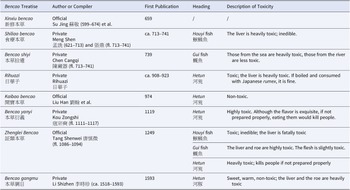
The pufferfish’s paradoxical reputation gradually infiltrated the bencao, which were specialized catalogues of medicinal substances. Song official bencao eventually medicalized and codified the name hetun. The Tang Xinxiu bencao 新修本草 (Newly revised materia medica, 659), the first state-sponsored bencao, contained no entry about pufferfish under any of its known variant names. In the eighth century, pufferfish appeared in private medical treatises as houyi fish 鯸鮧魚 and gui fish 䲅魚, both described as heavily poisonous. The name hetun made its debut in the Rihuazi 日華子 (Sir Sun-Brilliance), a Wu-Yue regional bencao,Footnote 42 also as a lethal fish. The Song official bencao, which culminated in the Chongxiu zhenghe jingshi zhenglei beiyong bencao 重修政和經史證類備用本草 (Revised Zhenghe-reign materia medica prepared for usage, verified and classified from the classics and histories, 1249; hereafter Zhenglei bencao), listed pufferfish in three entries: gui fish, houyi fish, and hetun. Whereas the first two replicated previous bencao to emphasize only the toxicity, the third unprecedentedly juxtaposed it with the supreme taste (Table 1). The intrusion of the vocabulary of sensual taste showed the hybridity of Chinese pharmacology in incorporating knowledge from different realms. It also reflected further and firmer sedimentation of pufferfish’s gastronomic fame.
Entries of pufferfish in bencao treatises. Source: Bencao gangmu, 8: 44.318a–319b.Footnote 43

Table 1. Long description
The table consists of five columns: Bencao Treatise, Author or Compiler, First Publication, Heading, and Description of Toxicity.
* Xinxiu bencao by Su Jing et al. (Official), 659. Heading and Toxicity are listed as forward slash.
* Shiliao bencao by Meng Shen and Zhang Ding (Private), circa 713 to 741. Heading: Houyi fish. Toxicity: The liver is heavily toxic; inedible.
* Bencao shiyi by Chen Cangqi (Private), 739. Heading: Gui fish. Toxicity: Those from the sea are heavily toxic, those from the river are less toxic.
* Rihuazi by Rihuazi (Private), circa 908 to 923. Heading: Hetun. Toxicity: Toxic; the liver is heavily toxic. If boiled and consumed with Japanese rumex, it is fine.
* Kaibao bencao by Liu Han et al. (Official), 974. Heading: Hetun. Toxicity: Non-toxic.
* Bencao yanyi by Kou Zongshi (Private), 1119. Heading: Hetun. Toxicity: Highly toxic. Although the flavor is exquisite, if not prepared properly, eating them would kill people.
* Zhenglei Bencao by Tang Shenwei (Official), 1249. This entry has three sub-headings:
1. Houyi fish: Toxic; inedible; the liver is fatally toxic.
2. Gui fish: The liver and roe are highly toxic. The flesh is slightly toxic.
3. Hetun: Heavily toxic; kills people if not prepared properly.
* Bencao gangmu by Li Shizhen (Private), 1593. Heading: Hetun. Toxicity: Sweet, warm, non-toxic; the liver and the roe are heavily toxic.
Why would a lethal substance devoid of therapeutic value enter the bencao tradition in the first place? The dialectical concept of du 毒, as both “poison” and “potency” to be carefully leveraged,Footnote 44 was not applicable, because pufferfish’s du was understood by Song pharmacologists as sheer harm without medical utility.Footnote 45 The pufferfish should, therefore, have been an outlier in the bencao paradigm. The Rihuazi compiler might have included it to warn against its toxins and publicize antidotes:
河㹠, 有毒, 又云胡夷魚。涼, 有毒。煮和禿菜食, 良。毒以蘆根及橄欖等解之。肝有大毒。又為 魚, 規魚, 吹肚魚也。Footnote
46
魚, 規魚, 吹肚魚也。Footnote
46
Hetun, poisonous, also known as houyi fish. Cold, poisonous. If you boil and eat it with the tu plant (Japanese rumex), it is fine. Relieve its poisoning with reed roots and Chinese olives. Its liver is heavily toxic. It is also known as hui fish, gui fish, and belly-blowing fish.
Like all previous records, the Rihuazi stressed the toxicity of the pufferfish, especially its liver, but also offered two recipes. The use of reed roots and Chinese olives as antidotes to fish poisoning might have been Wu local lore, as it had previously been recorded by the Zhejiang pharmacologist Chen Cangqi 陳藏器 (fl. 687–757).Footnote 47
In the late tenth century, a textual misidentification occurred in the first Song official medical compendium, the Kaibao chongding bencao 開寶重定本草 (Revised materia medica of the Kaibao reign era, 974; hereafter Kaibao bencao), which documented hetun 河㹠 as non-toxic. To some extent, this incident was a byproduct of the Song imperial expansion into the south. Confronted with the political fragmentation of the Five Dynasties and Ten Kingdoms (907–979), early Song rulers endeavored to consolidate their sovereignty and integrate the southern regimes and their intellectual legacy through massive state-commissioned compilations.Footnote 48 The Kaibao bencao absorbed the Tang precedent, regional bencao, as well as other miscellaneous sources, resulting in a drastic increase in the total number of recorded drugs.Footnote 49 Adopting an accretional format, the compilers at court incorporated the hetun, a Wu specialty. However, likely because of the convoluted nomenclature and piscine taxonomy, they confounded different species and labeled hetun as non-toxic, having a sweet taste and warm thermo-influence (xing 性), and even with health benefits.Footnote 50 This issue led to extensive textual calibration from later biji writers, who then firmly fixed hetun as a deadly delicacy in the bencao.
Two main figures contributed to this textual rectification: Shen Gua and Kou Zongshi 寇宗奭 (fl. 1111–1118). In Shen’s entry about pufferfish, he deployed his own Wu knowledge and pointed out the issue of identifying pufferfish from the description in the Kaibao bencao. Around the lower Yangzi region, he implied, hetun and hui fish were likely similar species with different names depending on the specific locality. The compilers of the Kaibao bencao from the northern capital might have confounded the two in an attempt to incorporate hetun into the official pharmacology.
The later pharmacologist Kou Zongshi strove to update the medical record of pufferfish as well, with greater impact on the bencao documentation of it as a dangerous but delicious food. Similar to Shen Gua, Kou was also a peripatetic civil servant, though much more obscure, who recorded his empirical findings along his travels. Different from Shen the polymath, Kou was known mostly for his pharmacological manual, the Bencao yanyi 本草衍義 (Elucidated meaning of materia medica, 1119). In this work, Kou solicited information from a variety of sources, proffered his personal argumentation, and critiqued previous Song medical encyclopedias.Footnote 51 In his entry about pufferfish, he stressed the fish’s delicate flavor and suggested a high demand for it. Compared to earlier pharmacologists, his attitude toward pufferfish was less fearful:
河㹠, 經言無毒, 此魚實有大毒。味雖珍, 然脩治不如法, 食之殺人, 不可不慎也。厚生者不食亦好。蘇子美云:河豚於此時, 貴不數魚蝦。此即詩家鄙諷之言, 未足全信也。然此物多怒, 觸之則怒氣滿腹, 翻浮水上, 漁人就以物撩之, 遂為人獲。橄欖並蘆根汁解其毒。Footnote 52
Hetun. The Classic records that they are nontoxic, but this fish is in fact highly toxic. Although the flavor is delectable, if the preparation does not follow the proper method, eating them would kill people. One must be cautious. For those who cherish their lives, it is fine to not eat them. Su Zimei (Su Shunqin 蘇舜欽, 1008–1048) said: “This is the time for pufferfish, / Its price exceeds other fish and shrimp.”Footnote 53 These are satirical words from poets and cannot be fully relied upon. This creature is easily irritated. When touched, anger fills its belly. Turning over, it floats above the water. Fishermen pull it up with something and thus catch it. Chinese olives along with the fluid of reed roots relieve its poison.
In addition to pointing out the misidentification of the Kaibao bencao, Kou recycles prior information, yet with a softened tone. He repeats the importance of proper preparation. However, though he also warns that eating pufferfish can kill people, he advises caution (shen 慎) rather than abstinence. His comment, “For those who cherish their lives, it is fine to not eat them,” implies that consuming pufferfish was relatively ordinary for certain people other than the very prudent. Moreover, it had apparently become a common practice to catch pufferfish by Kou’s time. Fishermen developed an efficient method for doing so based on the fish’s biological and morphological traits: its body became bloated when excited. While compilers of earlier bencao such as the Rihuazi emphasized the fatal toxins, Kou does not prescribe an absolute eschewal from pufferfish consumption. Rather, he recognizes the popularity and the demand and only recommends caution.
Kou Zongshi was also the first medical writer to juxtapose pufferfish’s toxicity with its taste, as a result of genre interplay among medical, literary, and miscellaneous sources. Though Kou misattributed Mei Yaochen’s poem and relegated it to mere “satirical words,” he had clearly consulted it and was aware of pufferfish’s touted supreme taste. This heightened attention to sensual flavor also signaled a subtle change in the bencao repertoire: the vocabulary of gustatory flavor blended with the pharmacological flavor. In its conventional format, a bencao entry would begin with defining a substance’s wei 味 (“flavor”) as a medicinal quality. Even though this quality employed the same linguistic terms as the wuwei 五味 (“five flavors”: sweet, sour, salty, bitter, and pungent), it was differentiated from culinary taste. In a medical context, the wei of a substance was believed to stimulate the movement of one’s qi 氣 and thereby exerted an effect on one’s body.Footnote 54 The Kaibao bencao had defined the medicinal flavor of the pufferfish as sweet and warm (wei gan wen 味甘溫). However, Kou’s statement “although the flavor is exquisite” referred to the sensual taste, now factored into the overall assessment of pufferfish as a pharmacological object. His attention to pufferfish’s taste and his softened tone toward its consumption were likely informed by regional lore assembled and transmitted in different sources.
Kou Zongshi’s account had an enduring legacy in anchoring the fatal toxicity and the supreme flavor to hetun. His Bencao yanyi became a frequent source of citation in Southern Song medical and literary works and later appended to the comprehensive Zhenglei bencao, printed and disseminated publicly. His specific entry of pufferfish also officially established hetun as not just deadly but also a delicacy. In the sixteenth century, the naturalist Li Shizhen 李時珍 (1518–1593) would attempt to explicate the name hetun by analogizing pufferfish to a suckling piglet: “Tun refers to its delicious flavor.”Footnote 55 He imagined pufferfish as delicious pork from the river. The phonetic designation tun had been represented through variant graphs like tun 㹠 and tun 魨.Footnote 56 It was probably because of the reputation of pufferfish’s sensual taste, as evinced in Kou’s account, that Li eventually settled on hetun 河豚 and offered a gastronomic etymology. The process whereby variant names were eventually narrowed into one bespoke not only the lexicographical imperative to cleanse the nomenclature but also a profound change in the perception of the pufferfish from a dangerous killer to an alluring delight.
Conclusion
How did the pufferfish acquire its reputation as a deadly delicacy in middle period China? This process was, first and foremost, involved in the demographic and political reconfigurations of the tenth century and the concomitant interactions between the northern and southern gastronomic traditions. The Northern Song state emerged from the interregnum and endeavored to consolidate its regime through incorporating southern scholarship and material culture. Whereas early medieval records warned against pufferfish, sources from the Wu-Yue Kingdom highlighted its status as a regional and seasonal specialty. Northern Song imperial compilers’ effort to synthesize this natural knowledge raised the visibility of pufferfish as a Wu product, publicizing its taste, traits, and treatment. The pufferfish garnered further attention because of its controversial toxins. In the subsequent century, writers responded differently to hearsay about its danger, informed by their own individual concerns. Those who aligned themselves more with northern customs were wary about it, while others with lived experience in the south updated their perceptions with personal observations of Wu culinary traditions. Through the versatile venue of biji, literati authors foregrounded the diverse Wu perceptions of pufferfish as a delicious food item. Its paradoxical fame as risky food was thus born from the confrontation and negotiation between the orthodox prudence and abstinence toward taste and the regional culinary traditions that favored fresh seafood.
Tracing the transformation of the pufferfish from a dangerous killer to an alluring treat, this study also shows the interplay between literature, medicine, and geographical and natural knowledge across genres in middle period Chinese history. Written texts were major media whereby information and knowledge of the pufferfish were preserved and circulated. Therefore, shifting nomenclature and semantic accretion played an important role in shaping perceptions of the pufferfish. The name hetun rose from Wu-Yue regional lore and became popular enough to outshine other variants due greatly to Northern Song poetry that aestheticized and politicized the pufferfish as a multivalent symbol. Once its controversial reputation as a Wu specialty spread widely, curious biji authors sought to collect traces of everyday encounters from different localities to confirm or contest contemporary hearsay, unraveling when confronted with the diversity of pufferfish varieties in local culinary traditions. They came to use the mesmerizing name hetun to subsume a diverse range of experiences, some mutually reinforcing and others self-contradicting, with regards to the pufferfish’s taste and toxicity. Song pharmacologists consulted and incorporated various sources of medical knowledge and eventually medicalized the pufferfish in the official bencao as a poisonous yet delicious fish, despite a lack of medicinal value. Throughout the course of the eleventh and early twelfth century, the regional and historical specificities of pufferfish were amalgamated into one single category hetun that codified a deadly delicacy, whose name and image remain evocative till this day.
Competing Interests
The author declares none.


 Open access

