


In August 2012, a revised version of Leonardo Da Vinci’s Vitruvian Man appeared on the front cover of The Economist. Each of his limbs imitated the perfect geometry of the original, but this man was composed entirely of bacteria: head, fingers, forearms, shoulders, and calves were replaced by colourful, hairy microbes. The title ‘Microbes Maketh Man’ announced the issue’s editorial focus on the human microbiome – the hundreds of species of bacteria that populate the human body.Footnote 1 Jon Berkeley’s image takes this quite literally: inscribed in the familiar square and circle of the fifteenth-century drawing, his microbial man is a quasi-surrealist assemblage of beautiful proportions (Figures 1 and 2). He is also a profoundly alienating vision: a blank face that does not return our gaze. The composite image renews Da Vinci’s vision of the human body as a microcosm,Footnote 2 but this microcosm is a world ruled by microbes, and the world it evokes is an Earth system engaged in accelerating ecological change.
Leonardo Da Vinci, Vitruvian Man, c. 1492.


Berkeley’s Microbial Man embodies an awareness of other scales which is specific to the early twenty-first century, and which has far-reaching epistemological and ontological consequences. In this chapter, I map out the scientific, theoretical, and cultural context of this multi-scalar view of life. Section 1.1 examines its development in science and philosophy. Section 1.2 presents a critical overview of the terminology used in contemporary theory to conceptualise interdependence between scales, in order to situate the key terms I employ in the rest of this book. Finally, Section 1.3 outlines the rhetoric and tropes that support a multi-scalar view of life in early twenty-first-century popular science, and argues that the role of figurative thought in our relation to unfamiliar scales is both cognitive and heuristic. Throughout this exposition, I point the reader forwards to the following chapters, so that this chapter provides an overview both of the discursive context of the fiction I will study – what Roland Barthes would call the logosphere – and of the critical role played by fiction in this discursive landscape.Footnote 3
1.1 Multi-scalar Life in Contemporary Science and Philosophy
Reading the relation between science and literature as one of influence, which simply ‘flows from science into literature’, does not do justice to the complexity of the rhetorical field in which both participate.Footnote 4 As N. Katherine Hayles has theorised, culture circulates through science no less than science circulates through culture. For Hayles, ‘[t]he heart that keeps this circulatory system flowing is narrative – narratives about culture, narratives within culture, narratives about science, narratives within science’.Footnote 5 As I outline the rise of multi-scalar thought in contemporary science and philosophy, I will draw attention to the role of narrative in this epistemic shift, and to the ways in which fictional narratives are acting as critical forces in this discursive field. I will also emphasise the tropes on which these narratives rely, which tend to follow complex trajectories between art, philosophy, and science.
1.1.1 Microbiology: Symbiosis and Collective Evolution
In 1868, Charles Darwin invited his reader to see each living creature as composed of cells, and thus ‘as a microcosm – a little universe, formed of a host of self-propagating organisms, inconceivably minute and as numerous as the stars in heaven’.Footnote 6 The trope of the human body as a microcosm was already present in ancient Greek philosophy and was revived in the Renaissance, but Darwin foresaw the radical transformation this image would undergo in evolutionary biology. Twentieth-century work on symbiosis, aided by advances in microscopy and the rise of computational biology, confirmed his intuition by writing microbes into the picture. In 1986, when microbiologist Lynn Margulis and science writer Dorion Sagan returned to Darwin’s trope in Microcosmos: Four Billion Years of Microbial Evolution, they argued that the microbial perspective de-centres man in the story of evolution: humanity is only ‘one among other microbial phenomena’, no better than a ‘glorified sludge’ who turns out to be a ‘parasite of the microcosm’.Footnote 7 In this narrative, ‘egocentric man’ makes a late appearance as ‘the result of aeons of microbial recombination’.Footnote 8 For Margulis and Sagan, this was a paradigm shift set to defeat neo-Darwinism’s insistence on the survival of the fittest, replacing it with a theory of evolution based on cooperation and mutual dependence.
Throughout Microcosmos, symbiosis connects radically different scales of life: ‘Beneath our superficial differences we are all of us walking communities of bacteria. The world shimmers, a pointillist landscape made of tiny living beings. Giant redwoods and whales, mosquitoes and mushrooms are intricate symbiotic networks, modular manifestations of the nucleated cell. By such proxies microbes found their way onto dry land.’Footnote 9 In this depiction, the evolution of any supposedly higher form of life is in reality driven by bacterial agency. The Gaia hypothesis, which was formulated by James Lovelock with the help of Margulis’s microbiological perspective, is presented as a conclusion to the journey described by Microcosmos: in this hypothesis, all life on earth, on every scale, functions in autopoietic interaction with inorganic environments as a single, self-regulating system. In a sense, the image of Gaia comes from literary culture, as it was the novelist William Golding who suggested the name of the goddess Gaia to Lovelock. And although the Gaia hypothesis was not warmly welcomed by mainstream science, it was an environmental allegory that caught the ecological imagination of its time. While the expression Gaia theory is now preferred to the narrow Gaia hypothesis, the allegory continues to shape contemporary ecological rhetoric.
To readers of the twenty-first century, Margulis and Sagan’s invitation to ecological humility may seem to have fallen on deaf ears. But Microcosmos correctly predicted a turn in evolutionary biology towards collective forms of evolution, and much of the book’s multi-scalar rhetoric – particularly the microcosmic and Gaian view, and the reversibility of parasitism – has resurfaced in recent popular biology. New data analysis technology and DNA (deoxyribonucleic acid) sequencing techniques fuelled the rise of genome analysis, leading first to the Human Genome Project, concluded in 2003, and then to the rise of microbiome science, which examines microbial populations through genomic data. As enthusiasm has grown for microbiome studies and the microbial human, many recent popular biology books, articles, and exhibitions have emphasised the reversal of anthropocentric perspectives, questioned accepted notions of agency, and used microcosmic metaphors to describe the human body as a landscape, city, park, or zoo. The microbial perspective has reframed the microcosm trope as an ecological metaphor, where the body is an ecosystem within ecosystems.
Symbiosis is the structuring concept of this multi-scalar view of evolution. The term was first used in the nineteenth century to describe a close association between two biological organisms, which could be parasitic (to the detriment of one associate), mutualistic (to the advantage of both), or commensalist (benefiting one without harming the other). In the second half of the twentieth century, theories of symbiogenesis gave the concept of symbiosis a new, multi-scalar dynamic, shifting its focus to microscopic evolution. A key example of symbiogenesis is endosymbiosis, the idea that eukaryotic cells – cells which have a nucleus – evolved out of the absorption of one kind of single-celled organism by another. Crucially for my study, microbiome studies and theories of symbiogenesis are narrative interventions in evolutionary theory: they shift agency away from the usual suspects, towards unexpected actants. Once we start viewing organisms as multi-scalar teams, the evolutionary story is considerably modified: it becomes a ‘story of collectives’ involving interactions between many actors who give each other ‘a leg up’.Footnote 10
The multi-scalar view of evolution is thus a narrative shift, rhetorically supported by metaphors and allegories – Gaia, the microcosm, and the parasite – all three of which are key tropes in the poetics I explore in this book. In Chapter 2, I examine the critical role of the microcosm in environmental fiction written around the turn of the century by Amitav Ghosh, Leslie Marmon Silko, and A. S. Byatt, where large-scale upheaval is explored through smaller-scale landscapes and bodies. This figure recurs so often in the following chapters, particularly in my reading of novels by Richard Powers, Jeff VanderMeer, Ali Smith, and T. C. Boyle, that it seems set to be a key trope in twenty-first-century ecofiction. I read these microcosms as ecopolitical tropes, through which these fictions develop and question a Gaian imaginary. As for the parasite, this biological concept is inherited from classical Greek and Roman theatre, so that the imagination of parasitism is never purely scientific. As Gillian Beer demonstrated in her influential study of Darwin’s plots in nineteenth-century fiction, literature tends to reactivate the latent ambiguity of scientific concepts that were metaphorical to begin with.Footnote 11 Twentieth-century science fiction in particular has acted as a site of critical reflection about parasitism as ambiguous relationality: David Lanford and Brian M. Stableford note that the genre started exploring parasitism as positive symbiosis as early as in the 1950s.Footnote 12 The novels I examine in this book give this imaginary of symbiosis a new multi-scalar direction. In Chapter 3, I show that Jeanette Winterson’s The Stone Gods (2007) and Jeff VanderMeer’s Southern Reach trilogy (2014) frame the experience of Gaian symbiosis within an Anthropocene awareness of dispersed agency. In Chapter 5, I examine how Greg Bear’s Darwin’s Radio (Reference Bear1999) and David Mitchell’s The Bone Clocks (2014) use parasitic poetics to question immunological ideologies of the self and the state. Because they portray symbiosis as a trans-scalar relation, these novels shift this century’s emergent symbiopolitics towards ecopolitical and immunopolitical questions.
1.1.2 Biomedicine: Postgenomic Networks and Dis-embedded Vitality
While the twentieth century has been called the ‘century of the gene’,Footnote 13 the biomedical paradigms of the twenty-first century have reframed genetic mechanisms within complex networks that involve multiple different scales. The century’s first two decades witnessed a surge in genomic science, including the first sequencing of a human genome in 2003. In this period discussed by many philosophers and historians as ‘post’-genomic, DNA sequencing forms a part of a much larger picture of development and health. With the help of computational data analysis, postgenomic science situates the informational content of genes in the context of many other factors of transcription, regulation, and expression. As philosopher of science Evelyn Fox Keller explains, the genome is considered no longer a ‘collection of genes initiating causal chains leading to the formation of traits’ but ‘a device for regulating the production of specific proteins in response to the constantly changing signals it receives from its environment’.Footnote 14
In order to understand the interdependence of genetic expression and environment, biologists have emphasised the necessity of thinking across scales. The embryologist C. H. Waddington, who coined the term ‘epigenetics’ in 1942, described biological development through the metaphorical image of a landscape, where the embryo’s development was figured by a river channelled into certain paths by surrounding mountains.Footnote 15 The term epigenetic has since been narrowed to signify alterations in gene expression, and in particular inheritable traits that are not coded in DNA. But Waddington’s multi-scalar images were influential in the rise of developmental systems biology, where, as Susan Oyama explains,
Movement among scales, both of magnitude and time, is important: from interactions of molecules inside cells to those between persons, from the brief periods involved in the action of a hormone in the nervous system to changing relations among conspecifics over the life span, from the short-term dynamics of a population or organisms in a habitat to the slow procession of generations through evolutionary time.Footnote 16
For instance, an aggressive encounter between animals may modify the expression of certain genes, or a slow process, such as climate change, may affect a rapid process, such as metabolism, leading in turn to evolutionary changes. To be complete, Oyama insists, the picture of life must be multi-scalar, so that the ‘stunningly oversimplified distinction between genes and environment resolves into a heterogeneous and equally stunning array of processes, entities, and environments – chemical and mechanical, micro- and macroscopic, social and geological’.Footnote 17 In other words, developmental biology considerably complexifies biological determinism by spreading it across scales.
The contrast is striking, however, between developmental biology and socio-economic views of the postgenomic body. Like Oyama, philosophers of biology tend to present postgenomic science as a rebuttal of twentieth-century reductionism, because it foregrounds the interdependence of embedded processes occurring at different scales. By contrast, sociologist Nikolas Rose points out that contemporary biomedicine effects a ‘dis-embedding’ of vitality, which decomposes the body into ‘a series of distinct and discrete objects, that can be stabilized, frozen, banked, stored, accumulated, exchanged, traded across time, across space, across organs and species, across diverse contexts and enterprises, in the service of bioeconomic objectives’.Footnote 18 According to Rose, twenty-first-century biomedicine accelerates the molecularisation of life begun in the twentieth century, and its interventions go hand in hand with the extraction of ‘biovalue’ from the vital properties of living processes.Footnote 19 As biotechnology develops, so do new economic areas such as pharmacogenomics, where the pharmaceutical industry investigates risk assessment and therapy based on genomic specificity. Risk management becomes increasingly predictive, framed by ever-increasing genetic screening. This allows new biomedical technologies to engage in a rhetoric of optimisation, where susceptibility to disease and self-enhancement encourage a focus on individual health management in an emergent ‘economy of hope’.Footnote 20
In fictional portrayals of biomedicine, this divergence between developmental and bioeconomic perspectives stands out in the contrast between recent novels by Margaret Drabble and Don DeLillo. Drabble’s fiction focuses on developmental biology and reflects the twenty-first century’s shift from gene-centred models to postgenomic uncertainties. Her first novel to engage in detail with genetic science, The Peppered Moth (2000), sets up an analogy between a young woman’s attempt to escape her social origins and the evolutionary mutation of the peppered moth. The novel plays with this parallel in order to contrast genetic (and social) determinism with epigenetic (and feminist) hope. In her later novel The Pure Gold Baby (2013), Drabble returns to this developmental theme with a stronger emphasis on the uncertainty of genetic science. The novel follows the life of an anthropologist whose daughter is diagnosed with a rare genetic condition. The condition is never named, and the prognosis is unclear. As it moves through the decades, from the 1970s to the 2000s, The Pure Gold Baby registers British society’s evolving relation to special needs, from institutionalisation to care in the community, and the effects of this shifting environment. Both novels explore developmental landscapes, but, between the two, the role of biomedicine shifts from explanatory paradigm to open question.
While Drabble uses biological discourse to examine the intertwining of self and environment, DeLillo satirises biomedicine’s attempts at disentangling them. In Zero K (Reference DeLillo2016), the narrator Jeffrey watches first his stepmother, then his father prepare for an artificial death that will allow the preservation of their bodies until future nanotechnology gives them a second life. Built in a desert, the medical facility resembles a monastic space in which each visitor is isolated in a cell, waiting for science to transfer them to cryonic preservation pods. Screens surround the soon-to-be-deceased with haunting scenes of unidentified ‘planetary woe’ that leave Jeffrey horrified and perplexed, wondering whether he is watching ‘a disease, a virus, long ranks of slow-moving men and women, […] something spread by insects or vermin and carried on airborne dust, dead-eyed individuals, in the thousands now, walking at a stricken pace that resembled forever’ (120). To escape from this vision, which is reminiscent of T. S. Eliot’s Wasteland, the wealthy clients are offered complete detachment by the medical facility’s rhetoric: ‘[y]ou are about to become’, they are promised, ‘a single life in touch only with yourself’.Footnote 21 The tautological promise reflects an impoverished subjectivity, where the wealthy characters’ horizon is limited to the perpetuation of physical identity. Disentangled, the self becomes a discrete unit that can be extracted from the environment – a capitalist ideal that Sherryl Vint calls ‘the market human’.Footnote 22 Zero K thus registers a recoil from entanglement on all scales, from the microbial to the planetary.
What Drabble’s and DeLillo’s novels bring into sharp focus is a divergence between two biomedical views of life. Both are multi-scalar, but whereas shifts between scales are connective moves in the developmental biology explored by Drabble, they constitute extractive moves in the medical biocapitalism satirised by DeLillo. In Chapters 3 and 5, I track this critical relation to extraction in a dystopian strand of early twenty-first-century fiction, where multi-scalar poetics work against the biocapitalist dis-embedding of vitality. Winterson’s The Stone Gods plays the trope of the planet as beloved body against a vision of the future where humanity repeats the same environmental destruction over and over again. VanderMeer’s Southern Reach trilogy pits a late capitalist landscape against a rebellious location where bodies cannot be distinguished from their environment. Bear’s Darwin’s Radio contrasts the bioeconomy of pharmaceutical research, focused on immunity, with a philosophy of vulnerability that embraces genomic mutability. And Mitchell’s The Bone Clocks offers a memorable parable of early twenty-first-century extractivism, in a fantastic battle between parasites and symbionts. Because they construe multi-scalar awareness as relational ontology, these novels question the very possibility of dis-embedded life.
1.1.3 Anthropology: Relational Fields and Multispecies Landscapes
In the first two decades of this century, the drive towards ‘repopulating the social sciences with nonhuman beings’Footnote 23 has produced new conceptualisations of landscapes as shared, multi-scalar spaces. Anthropology beyond the human, as Eduardo Kohn describes it in How Forests Think (2013), is attempting to ‘open’ the human to non-anthropocentric readings of environment.Footnote 24 Kohn argues that humans share representation, both iconic and indexical, with all other living selves, whether these be animal, insectile, or bacterial. Semiotic approaches to more-than-human landscapes have also been developed by Anna Tsing and Tim Ingold, who both view narrative as the epistemic form best suited to grasp landscapes as living entanglements. Multispecies ethnography has thus emerged as a key field for investigations into the agency of other-than-humans, on all scales, including fungi and microbes.Footnote 25
In The Mushroom at the End of the World: On the Possibility of Life in Capitalist Ruins (2015), Tsing argues that capitalist landscapes are discreetly structured by assemblages of different species, ‘an open-ended entanglement of ways of being’ where ‘indeterminacy matters’.Footnote 26 Her investigations focus on the economies and social practices that surround matsutake, a valuable mushroom reputed to be the first life form to have reappeared in Hiroshima after the bomb. Tsing narrates mushroom gathering in diverse wooded environments, including Oregon, Yunnan, and Japan, focusing on the ‘nonscalable’ forest economies that exist ‘in the ruins of scalable industrial forestry’.Footnote 27 These matsutake economies allow her to outline alternatives to the scalability of capitalist logic, pitting ‘fungi-forming forest traffic’ against ‘the continual, never-finished cutting off of entanglement’ performed by commoditisation.Footnote 28 For Tsing, fungi become both a model and a symbol of multi-scalar entanglement. She suggests that mycorrhizal connections draw evolutionary theory away from the mathematical models of twentieth-century biology, towards narrative, because co-evolution depends on encounters. This leads her to call for a narrative multispecies ecology based on ‘arts of noticing’, attentive to histories of encounter and to ‘other kinds of stories – including adventures of landscapes’.Footnote 29
These calls for new stories participate in a broader reflection on narrative in the social sciences, where scholars such as Philippe Descola and Bruno Latour have also emphasised the need for new ‘characters’ or ‘actors’ in anthropology, sociology, and political philosophy. For my literary perspective, the key question is to what extent fiction participates in this narrative shift. Novelist Olga Tokarczuk, for instance, used terms very similarly to Tsing’s in her Reference Tokarczuk2019 Nobel acceptance speech, to defend a model of writing based on tenderness: a ‘way of looking that shows the world as being alive, living, interconnected, cooperating with, and codependent on itself’, instead of ‘an object that can be cut into pieces, used up and destroyed’.Footnote 30 The main character of Tokarczuk’s novel Drive Your Plow Over the Bones of the Dead (Reference Tokarczuk2009) pushes this ‘tender’ view to an extreme when she decides to avenge the animals of the forest because they have ‘no voice in parliament’ – an image which pays tribute to Latour’s philosophy.Footnote 31 This narrator pays attention to every living being, including the invisible beetle larvae who, she notes, have ‘entrusted their lives to the trees, without imagining that these huge, immobile Creatures are essentially very fragile’.Footnote 32 In many ways, Tokarczuk’s narration is a lesson in what Tsing calls arts of noticing.
All the novels that I examine in this book develop forms of multi-scalar attention, and many of their focalisers are adepts of the careful observation of life defended by Tsing and Tokarczuk. Anthropology’s rewriting of landscape as relational field is particularly helpful in understanding the microcosmic landscapes that I analyse in Chapter 2. Here I read two ecofiction classics, Amitav Ghosh’s The Hungry Tide (2004) and Leslie Marmon Silko’s Gardens in the Dunes (1999), as early experiments in these multi-scalar arts of noticing. I group them with A. S. Byatt’s short story ‘A Stone Woman’ (2003) because all three anticipate Tsing’s call for adventures of landscapes – which they predate by ten to fifteen years – by placing landscapes in the position of protagonists. I conceptualise this treatment of landscape with the help of Ingold’s theory of environment, where relational fields make up the ‘mesh’ of the land.Footnote 33 Ingold argues that storytelling is best able to capture a processual view of the world, where things ‘are their stories, identified not by fixed attributes but by their paths of movement in an unfolding field of relations’.Footnote 34 Narrative can thus resist what he calls the logic of inversion, which misrepresents human agency as the central determinant of events. Although I do not suggest that Ingold directly influenced the fiction I examine, this anthropological framework helps me to bring out a common epistemic trend in Ghosh’s, Silko’s, and Byatt’s multi-scalar poetics of landscape, and to pinpoint the problematic role of the microcosm trope in these stories. If the microcosmic view entails the possibility of zooming out to another scale, then what happens to non-scalable entanglements? How can a landscape be both a uniquely knotted web of relations and an allegory for the world?
1.1.4 Planetary Perspectives: Earth System Science, Multi-scalar Narrative, and Anthropocene Awareness
In the 2010s and early 2020s, a growing interest in Earth system science (ESS) stimulated reflection on scale and narrative across the humanities. Driven by the rise of computer science, and particularly of computer modelling and simulations since the 1970s and 1980s, ESS analyses the atmosphere, hydrosphere, lithosphere, cryosphere, and biosphere as interacting components of a single living system. Historian Dipesh Chakrabarty, one of the earliest and most influential voices to tackle the narrative implications of ESS, has described the resulting need for a new ‘regime of historicity’ that integrates the incompatible scales of planet, species, individual life, and human society.Footnote 35 Approaching climate change from a postcolonial angle, Chakrabarty notes that ‘the current conjuncture of globalisation and global warming leaves us with the challenge of having to think of human agency over multiple and incommensurable scales at once’.Footnote 36 This new, multi-scalar perspective, which is temporal as well as spatial, affects both the historical narratives studied by Chakrabarty and the fictional narratives that I examine in this book.
The challenge identified by Chakrabarty is arguably that of any ecological narrative: ecology, as Timothy Morton points out, is ‘the thinking of beings on a number of different scales, none of which has priority over the other’.Footnote 37 But Chakrabarty’s conceptualisations of multi-scalar narrative are predicated on the new relation to the planet produced by contemporary climate science and geopolitics. They draw from a context of critical thought marked by the planetary turn, and from the current in contemporary philosophy that opposes the planet to the globe. This current follows Gayatri Spivak’s proposal that the ‘other space’ of the planet might provide an ethical structure of awareness that challenges the homogenisation of globalisation.Footnote 38 Amy J. Elias and Christian Moraru describe the resulting interest in planetarity as a conception of ‘the planet as a living organism, as a shared ecology, and as an incrementally integrated system both embracing and rechanneling the currents of modernity’.Footnote 39 Planetarity thus becomes a new axial dimension through which contemporary artists perceive their aesthetic practices, particularly those practices that explore webs of relations between living bodies – what Elias and Moraru call bioconnective aesthetics. This planetary turn is a key aspect of contemporary multi-scalar poetics. In different ways, the novels and short stories I examine in this book all experiment with the spatial and temporal scales demanded by planetarity, through living landscapes (Chapter 2), diffuse agency (Chapter 3), trans-scalar encounters with other species (Chapter 4), evolutionary timescales (Chapter 5), and Anthropocene awareness (Chapters 3, 4, 5, and 6).
Although the concept of the Anthropocene, an epoch in which humanity acts as a major geological factor and environmental force, is not endorsed by geologists, the ‘pseudo-geological’ concept remains a key term for early-twenty-first-century environmental thought and poses its own specific scalar challenges to narration.Footnote 40 If Anthropocene awareness ‘marks humanity’s confrontation with itself as a trans-scalar entity’,Footnote 41 can all aesthetic forms engage with this concept? According to Ghosh, the Anthropocene presents a form of scalar resistance to the realist novel. Other scholars, however, have emphasised realist as well as non-realist fiction’s capacity to engage with interdependence and discontinuities between scales. Adam Trexler notes the emergence of ‘Anthropocene realism’ in novels of the early 2010s and praises the novel’s capacity for complicating the oppositional politics of climate change debate.Footnote 42 In their review of climate change fiction, Stef Craps and Rick Crownshaw defend fiction’s capacity to engage with the Anthropocene through ‘textual dislocation’ across a variety of modes and genres.Footnote 43 Pieter Vermeulen goes further to suggest that the Anthropocene exerts a ‘genre-bending’ effect on literature, where existing templates are recombined to acknowledge the disruption of our frameworks of perception and thought.Footnote 44 Vermeulen points out that scalar experiments are putting pressure on realist forms and temporalities, reading, for instance, DeLillo’s Point Omega as a novel which juxtaposes the mesoscale of human life with both the deep time of geology and what DeLillo calls ‘submicroscopic moments’.Footnote 45 From an eco-narratological perspective, Marco Caracciolo argues that the multiplication of narrative tempos can engage the reader in a multi-scalar environmental imagination.Footnote 46 Following Vermeulen and Caracciolo, I examine multi-scalar poetics as a means of destabilising perception and engaging with the epistemological instability of Anthropocene awareness, through multi-scalar temporalities (Chapters 2, 4, and 5), the redistribution of agency (Chapter 3), and multi-scalar focalisation (Chapter 6).
The epistemological challenges posed by planetarity and the Anthropocene, like those posed by contemporary evolutionary theory, are fundamentally narrative because they question our usual syntax. Chakrabarty describes human agency in the Anthropocene as a form of action that defies transitive grammar: ‘A geophysical force – for that is what in part we are in our collective existence – is neither subject nor an object’.Footnote 47 Bruno Latour develops a similarly syntactical reflection, asserting that the ‘drama of geohistory’ unfolding before us forces us to register a shift in the Earth’s position, from object to subject.Footnote 48 For Latour, the conceptual shift allowed by the Gaia hypothesis is a transformation of the grammar of action: every living agent is involved in ‘waves of action, which respect no borders and, even more importantly, never respect any fixed scale’.Footnote 49 These waves of action are the ‘true actors’ of a living Earth. Thinking with Gaia, as Latour puts it, thus confirms the erasure of boundaries between organisms and environments performed by symbiogenesis and epigenetics. Comparing the redistribution of agency produced by ESS to that produced by Louis Pasteur’s work on microbes, Latour asserts that the Earth system view is as disruptive as the microbial. It is also intimately connected to it, since the Gaia hypothesis relies heavily on microbiology. What Ghosh names the ‘reversed perspective’Footnote 50 of Anthropocene is thus inseparable from the ‘reversal of perspective’Footnote 51 called for by contemporary microbiology. As the humanities and the life sciences redistribute agency across scales, distinctions between actors and environments are weakened, and transitive narratives destabilised. The narrative fiction examined in this book brings this destabilisation into sharp focus, and attempts to reimagine response-ability in this context.
I view this epistemic and ethical shift as a collaborative process that is enabled by the reader as well as by the fictional text. Timothy Clark has theorised that the Anthropocene makes us aware of the anachronistic scale framing of our habitual modes of thought, and therefore of many works of fiction. Against these limitations, he argues that alternative modes of reading can perform an unframing that will ironise a text, revealing, for instance, a broader destructive dynamic beneath a sympathetic action, or dehumanising events by questioning their attribution to intentional human agency. In one reading experiment, Clark applies this to an early twentieth-century short story by Australian writer Henry Lawson, so as to reinterpret the European invasion of Australia as the ‘action of a kind of cross-species entity – that of “human + cattle + innumerable forms of microorganism”’.Footnote 52 Clark thus entrusts the reader with the task of multi-scalar framing and the search for scale effects, phenomena that are ‘invisible at the normal levels of perception but only emerge as one changes the spatial and temporal scale at which the issues are framed’.Footnote 53 My study, however, locates this process of reframing and ironising in contemporary fiction’s multi-scalar poetics as well as in the act of reading. Unlike Lawson’s short story, which was written in 1901, the stories I examine integrate Anthropocene awareness into their very composition. This fiction highlights disjunctions between scales and draws attention to scale effects, which trigger tragic realisation in Winterson’s The Stone Gods and Powers’s The Overstory (2018) (discussed here in Chapters 3 and 4), but remain invisible to the focalisers imagined by Margaret Atwood, T. C. Boyle, and Ali Smith (Chapter 6). This ironic reframing of everyday life is a multi-scalar practice which requires the reader’s collaboration. In Chapter 6 and in the Conclusion to this book, I situate it in a relational field created by the act of reading as well as by narrative focalisation.
1.2 Theoretical Concepts for Multi-scalar Life
Several keywords recur in the epistemological shifts I have presented so far: multi-scalar life has been discussed as system, network, assemblage, enmeshed or entangled depending on the speaker’s figurative preference. As these terms circulate between the natural sciences and the humanities, I will briefly outline their distinct theoretical backgrounds and the different models of life they bring into play when I use them in the following chapters.
1.2.1 Systems and Processes
In the life sciences of the early twenty-first century, a growing emphasis on systems has shifted attention away from individuals. The success of the Human Genome Project played an important part in this shift, as it accelerated the development of computational tools necessary to systems analysis and modelling, such as high-throughput technology platforms that generate large datasets. The rise of systems biology contrasts with the reductionism that characterised many successful areas of research in the second half of the twentieth century. This holistic trend is also visible in transdisciplinary fields such as ESS, which integrates biology with other hard sciences, or developmental systems theory, which brings together biology and psychology. While those fields posit explicitly that an isolated organism cannot be an object of study, others, such as microbiology, increasingly use the system as a model for the organism: the human body, for instance, is recast as an ecosystem of microscopic life. A parallel shift from individuals to systems can be noted in conservation discourse: in 2013, the International Union for Conservation of Nature, which had been publishing a Red List of Threatened Species since 1964, started building a Red List of Ecosystems. As Heise has shown, this type of project moves narratives of extinction away from the proxy logic of endangered species discourse, towards more epic and encyclopaedic forms.Footnote 54 Taking a more radical ontological stand, DiCaglio argues that the very concept of individuality should be questioned as ‘an underlying scalism’ of humanist subjectivity.Footnote 55
As the individual recedes, processes come to the fore as a key object of study. Modifications are made to the syntax of evolutionary theory, where some researchers have proposed that interaction patterns rather than organisms become the unit of natural selection, because ‘it’s the song, not the singer’ that counts.Footnote 56 Alternatives to the tree of life model, in particular network tools, are being developed to represent the multi-scalar interactions that underlie natural selection.Footnote 57 Those shifts are feeding a ‘process turn’ in the philosophy of biology,Footnote 58 where calls for processual epistemologies have been made for a wide array of objects of biological study, including ecosystems, cancer, and epigenetics. Daniel J. Nicholson and John Dupré argue that one of the strong arguments for processual ontology is ecological interdependence, not only between organisms of similar scale but also within the multi-scalar collective formed by any multicellular organism with its microbial partners – the collection of symbionts that together constitute a holobiont. From the point of view of processual ontology, organisms are ‘fundamentally relational entities that affect and are affected by their environment, within which they are firmly embedded, and which is itself constituted by numerous other processes’.Footnote 59 Biological ‘things’ become, upon inspection, ‘specific temporal stages of stabilised biological processes’: whether or not they appear as thing-like will depend on the timescale at which we examine them.Footnote 60 Like systemic thought, processual epistemology focuses on the relations linking different forms of life. But in the philosophy of science, the process is often preferred to the system as a less unified model of agency. For Latour, for instance, Gaia theory frames organisms and environments as one indivisible process, but Gaia is the ‘anti-system’, since it is ‘made up of agents that are not prematurely unified in a single acting totality’.Footnote 61
The process turn in the philosophy of biology has strengthened calls for process-based approaches in the humanities. When Nicholson and Dupré state that what we perceive as biological things are ‘temporary eddies in the continuous flow of process’, they draw on the same Bergsonian metaphor as anthropologist Tim Ingold, who seeks to replace the world of objects with a world of ‘formative and transformative processes’.Footnote 62 Processual philosophy of biology thus resonates with early twentieth-century philosophies of process, as well as with contemporary work on perceptions of the environment and relational ontology. Karen Barad’s influential philosophy of agency, for instance, views agency no longer as a property of individuals but as an ongoing ‘ebb and flow’, where matter becomes ‘not a thing but a doing, a congealing of agency’.Footnote 63 Rather than seeing scales as nested within each other, Barad emphasises the ‘agential enfolding of different scales through one another’.Footnote 64 Through this intra-action, the scales of individual bodies, regions, nations, or the globe produce one another. The concept of intra-action is anchored in quantum physics rather than in the life sciences. But Barad’s theory has inspired other multi-scalar concepts which draw directly on biology, particularly Stacy Alaimo’s trans-corporeality, which theorises the posthuman subject as entangled with biological, economic, political, and technological processes.Footnote 65 Posthumanism itself, in many ways, is an experiment in multi-scalar framing since it views the subject as traversed and constituted by a network of nonhuman life forms. Processual biology, with its dilution of the individual into relations and systems, thus feeds into what Rosi Braidotti calls the project of becoming-posthuman: a political project which acknowledges ‘the collective nature and outward-bound direction of what we still call the self’.Footnote 66
In the following chapters, I examine works of fiction that have participated in, and sometimes anticipated, this philosophical shift of focus from biological individuals to living processes. This shift, I argue, transforms the key narrative categories of setting (Chapter 2), agency (Chapter 3), and self (Chapter 5). My readings are inspired by linguists and narratologists who have theorised the processual view. In an influential paper on ‘green grammar’ published in 1996, Andrew Goatly suggested that transitive grammar too often enforces a ‘division into Agentive Participants, Affected Participants, and Circumstances’,Footnote 67 failing to take into account the interrelatedness of participants, and artificially separating agents from participants construed as passive. Because resulting narratives tend to be anthropocentric and to misrepresent the environment as powerless or unaffected, Goatly proposes a number of strategies through which syntax might better reflect an ecological, process-based view of the world: for instance, by using a Location Circumstance as Subject. More recently, Caracciolo has extended Goatly’s proposals from the scale of single sentences to that of narrative structure. For Caracciolo, these strategies can be observed in contemporary novels that question anthropocentrism, for instance by proposing models of causality that involve both subject and object in the process, or by promoting processes or places to the role of the main actant of the story.Footnote 68
The studies I propose in Chapters 2, 3, 4, and 5 are in step with Caracciolo’s line of questioning. However, I analyse these shifts as part of a multi-scalar aesthetics which does not only reflect ‘green’ concerns. This aesthetics is a ‘bio’-poetics that involves but is not reducible to ‘eco’-poetics. I suggest that these narrative bio-poetics draw out the ethical difficulty inherent in processual ontology: if humans are no longer separate from their environment, how can they endorse responsibility for the vulnerability of processes and systems of which they are a part? This difficulty is evident in the somewhat paradoxical title – Facing Gaia (2015) – that Latour chose for his lecture series. How can the ethical relation of ‘facing’ vulnerable life be carried out from within an ontology based on intransitivity and entangled process? Narrative fiction, I suggest, is an aesthetic medium that has a unique heuristic potential to engage with this problem.
1.2.2 Assemblage, Network, and Meshwork
Inspired by Gilles Deleuze and Félix Guattari’s concept of agencement, assemblage has been theorised by Manuel DeLanda as an emergent whole whose properties cannot be explained by the properties of component parts.Footnote 69 The heterogeneity of assemblage is of particular interest to new materialist philosophers who situate agency in complex interactions of human and nonhuman actors – as Jane Bennett does in her theory of vibrant materiality – and to theorists of multi-scalar agency. Derek Woods emphasises that assemblage, because it traverses scale domains, helps us to draw agency away from the human species. Whereas Chakrabarty, as I have noted, asserts that the Anthropocene requires thinking of human agency as working across scales, Woods counters that terraformers are combinations of humans and nonhumans at many scales, from nitrogen molecules to oil refineries: when ESS refers to humanity as a geophysical force, this force is in fact ‘the emergent property of operations in discontinuous scale domains’.Footnote 70 From this perspective, the word Anthropocene, ‘ironically, names the disempowerment of human beings in relation to terraforming assemblages that draw much of their agency from nonhumans’.Footnote 71
In this book, I refer to assemblage theory rather than actor network theory (ANT), which Latour conceived as a sociology of associations, and which also theorises agency across scales, including both human and other actors as nodes in the network. As Martin Müller points out, both assemblage thought and ANT produce a crumpled, topological approach to space (because distance is measured by how closely connected different nodes are) and to scale, which no longer pre-exists the making of connections: ‘[t]he global, the national and the local are all effects of more or less dense connections’.Footnote 72 But researchers defending assemblage thinking tend to present it as a more flexible view of relations than ANT: anthropologist Anna Tsing views assemblage as ‘an open-ended entanglement of ways of being’ which can integrate indeterminacy,Footnote 73 while geographer Colin McFarlane argues that assemblage ‘points to reassembling and disassembling, to dispersion and transformation, processes often overlooked in network accounts’.Footnote 74 This flexibility and indeterminacy make assemblage the most productive term for my analysis, particularly for the reflection on agency that I set out in Chapter 3, where it helps me to read the way control slips away from humans in Winterson’s and VanderMeer’s dystopian futures. When I use the term ‘network’, I therefore use it in a broader sense than Latour, to refer to interconnected entities or systems. It is helpful, however, to bear in mind that when the term appears in critical theory, it often evokes Latour’s approach, whereas it has no such connotation in the natural sciences.Footnote 75
Twenty-first-century ecocritics and anthropologists have added meshwork to this terminological constellation. Both Morton and Ingold use this term to refer to ecological interdependence. Morton approaches ecology from a deconstructive angle: just as language is ‘a strange infinite network without inside or outside’ where signs depend on other signs, life forms ‘are made up of other life forms (the theory of symbiosis)’ and ‘derive from other life forms (evolution)’.Footnote 76 For Morton, life forms thus constitute a mesh whose multi-scalar nature defies thought: not only is the mesh huge but its relations of differences play out on infinitely small scales since ‘[t]here is no human-flavoured DNA, no daffodil-flavoured DNA’.Footnote 77 Looking at the mesh, rather than at an aestheticised fantasy of Nature, implies looking at different spatial and temporal scales simultaneously. One of the most productive aspects of Morton’s concept for my study is the sense of entrapment that it adds to ecological interconnectedness: the mesh as ‘a complex situation or series of events in which a person is entangled’,Footnote 78 which inspires Morton’s dark ecology. In Chapter 6, I examine contemporary fiction’s treatment of this darkness and of the difficulties of a multi-scalar ecological perspective. However, when I use the term ‘mesh’ in the following chapters, I refer to the narrower definition proposed by Ingold. Whereas Morton’s mesh connects all living and non-living things, Ingold gives the term a more circumscribed, biological, and topological meaning. In Ingold’s anthropological approach to landscape as embodied experience, the mesh is a way of describing the environment as a fluid space, constituted by living lines of movement and paths of becoming. From this perspective, life itself is ‘an unfolding of the entire meshwork of paths in which beings are entangled’, and landscape is ‘woven from the lines of growth and movement of inhabitants’.Footnote 79 Ingold uses the word to counter representations of environments as networks of connections between points, preferring to view them as a mesh where ‘[e]very strand is a way of life, and every knot a place’.Footnote 80 In Chapters 2 and 3, I use Ingold’s terminology to analyse multi-scalar narrations of landscape and agency.
A final note on ‘entanglement’ itself: images of knots and tangles, such as Haraway’s string figures or Tsing’s mycelial webs, have spread so rapidly in the environmental humanities that their clarity is at times questionable. While many of these terms arguably function better as metaphors than as models, I think their epistemological role should not be underestimated. These metaphors tend to operate on two levels, acting as representations of the interrelations between life forms and of our way of thinking about these interrelations. Haraway argues that making-with is the definition of biological life and the only practical way forward in the context of ecological catastrophe: Navajo weaving and coral reefs appear in her writing alongside ‘tentacularity’ and other ‘string figures’, as examples of collaborations between life forms as well as ‘a way to think-with a host of companions’.Footnote 81 Similarly, Tsing uses a life form – fungi – as a political and epistemological model. Because they resist commodification, scalability, containment, and land privatisation, the mycelial webs of fungal bodies provide a metaphor for resilience and for the alternative ‘politics of more-than-human entanglements’ that Tsing seeks to build.Footnote 82 Like Haraway, Tsing emphasises the narratological potential of biological forms, suggesting that fungal-like patchiness might shape new narratives of collaborative survival. Rather than a rigorous set of concepts, this terminology of entanglement is an invitation to figurative and narrative thought. It constitutes an attempt to change the story told about humans and other life forms, and perhaps, as Tsing suggests, to resist ‘the unfortunate wall we have built between concepts and stories’.Footnote 83
1.3 Trans-scalar Rhetoric and Multi-scalar Tropes in Popular Science
Before turning to fiction, I would like to emphasise how much thinking across scales has become a part of contemporary culture through the influence of popular science. Drawing from works of popular biology and ecology, nature writing, political rhetoric, and media coverage of biomedical and environmental issues, the rest of this chapter outlines some of the most salient features of this contemporary imaginary of life. I distinguish here between trans-scalar rhetoric, which emphasises the necessity of thinking across scales to connect them together, and multi-scalar tropes such as metaphor and synecdoche, which substitute one scale of life for another. As substitutions between scales have come under considerable criticism in recent theoretical work, the final section of this chapter asks how figurative poetics help, or hinder, trans-scalar thought.
1.3.1 Trans-scalar Rhetoric: Double Zooms, Global Footprints, and Deep Time
With each bite of food we take, our human bodies engage with the billions of microbes living in our gut and with the web of food production systems shaping our global footprints. Invitations to see, and thus to think, different scales simultaneously have become widespread in biological and environmental rhetoric. Popular science books and exhibitions dedicated to the microbial world invite us to see our bodies as walking communities or collectives. Some of these terms are metaphors drawn from the workplace, depicting microbes as colleagues and team-players, but others are drawn from ecology and are used literally, when the body, for instance, is described as an ecosystem. Book and exhibition titles typically promise a radical shift in perspective: Ed Yong’s I Contain Multitudes: The Microbes within Us and a Grander View of Life (2016), for instance, hints at a paradoxical sublime contained within the body.Footnote 84 This view connects micro and macro perspectives in an epistemic move that I will refer to as the double zoom: as Yong explains, if we want to grasp the symbiotic view of evolution, ‘[w]e need to zoom out to the entire animal kingdom, while zooming in to see the hidden ecosystems that exist in every creature’.Footnote 85 Similarly, in 2015, the ‘Invisible You: The Human Microbiome’ exhibition organised by the environmental Eden Project centre in England ended with an invitation to ‘scale back up’ to the ‘macrobiome’ and to view humans as guests or parasites in a Gaia-like system. ‘You are one of the 7 billion living in a giant macrobiome’, the viewer was told; ‘How will you treat your host?’Footnote 86 To figure this type of multi-scalar perspective, microbiologist Eric Bapteste suggests that the image of a macroscope is more appropriate than the microscope: through the macroscope of ecosystems analysis, we perceive multi-scalar networks of interactions.Footnote 87
Telescoping images – where different levels of organisation are linked through a chain of diagrams representing different scales – are one of the most common types of figures in biology textbooks.Footnote 88 The double zoom, however, performs a more distinctive connection by asking the viewer to scale up and down at the same time. Its frequent appearance in recent popular biology reflects an increasing emphasis on the interdependence of microbiological, zoological, and environmental questions, and the corresponding ecologisation of biological discourse. Titles from the ‘Small Friends Books’ series, a young-readers collection created by the arts–science collective Scale Free Network, are a good illustration of this trend. In Zobi and the Zoox: A Story of Coral Bleaching (2018),Footnote 89 the reader follows the discoveries of Zobi the bacterium, who realises that the coral polyp she inhabits is weakened by a warming ocean, and can only survive if she feeds ammonia to the algae that also live on the coral. In this fashion, each book in the Small Friends series tells a story on several scales: their narrative structure is similar to a Bildungsroman but multi-scalar collectives, rather than individuals, are the heroes. The illustrations emphasise this trans-scalar dynamic by playing with the biology textbook technique of blowing up one part of the picture in a circle to give more detail. Each blow-up reveals new team players in the story, who were not visible at the previous scale (Figure 3).
A. Wild, A. Reed, B. Barr and G. Crocetti, Zobi and the Zoox: A Story of Coral Bleaching (CSIRO Publishing – Commonwealth Scientific and Industrial Research Organisation, 2018), pp. 22–3.

Figure 3 Long description
The text in the left-hand image indicates that the coral polyp is threatened by algae. The text in the right-hand image indicates that a swarm of hungry microbes is invading the polyp, and that the two friendly bacteria want to help it.
The double zoom plays a key role in the rhetoric of environmental crisis. Writing in 2008 for The Guardian about the collapse of bee populations, Slavoj Žižek noted the perceptual disjunction required to imagine it correctly as ‘no big bang, just a small-level interruption with devastating global consequences’.Footnote 90 On a more upbeat note, DisneyNature’s Wings of Life (2011), a documentary about pollinators, promises the viewer an encounter with the ‘unsung heroes of our planet’.Footnote 91 Such superpositions of scale are central to current ecological discourse focused on global issues like climate change or biodiversity loss, which typically exhorts us to visualise the individual at the same time as the species, or the local alongside the planetary. Clark notes a corresponding derangement of our sense of scale, obvious in injunctions such as ‘[t]o save the planet, chow down on a caterpillar’, and symptomatic of what he calls Anthropocene disorders.Footnote 92 Perhaps the most familiar instance of trans-scalar rhetoric today is the calculation of global footprints, which link the behaviour of an individual to the impact of a species. This rhetoric, too, is deeply troubling because it constructs a form of trans-scalar agency that several humanities scholars have interpreted as a form of uncanny haunting. Morton describes this ecological awareness as a sense of ‘existing on more than one scale at once’, in a strange loop in which the detective (the individual) is also the criminal (the human species as a force acting on a planetary scale). For Clark, human agency becomes ‘displaced from within by its own act’: if we consider characters in works of fiction on the scale of cumulative planetary footprints, this reframing will allow ‘destructive doubles’ to appear, resulting in ‘a peculiar kind of Gothic, a doppelganger narrative’.Footnote 93 In a recent essay, Daisy Hildyard has argued along similar lines that our sense of embodiment is undergoing profound modifications: she proposes that we perceive, beyond the body we think we live in, a ‘second body’ of global connections and impact.Footnote 94 The rhetoric of unsustainability is populated by such haunting doubles.
This sense of haunting, invisible scales is strengthened by the increasingly popular concept of deep time, which refers to the timescale of geology. Recent book titles such as Robert MacFarlane’s Underland: A Deep Time Journey (Reference MacFarlane2019) and Helen Gordon’s Notes from Deep Time: A Journey through Our Past and Future Worlds (2021) signal a growing interest in geological temporalities, in what their publishers categorise as ‘nature’ or ‘travel’ writing. Within literary studies, Wai Chee Dimock has called for an approach to literature based on deep time as the basis for a multicultural framework that might escape nationalist ideologies.Footnote 95 Anthropologist Vincent Ialenti even presents deep time as a mental exercise, inviting readers of the BBC Futures website, in an article published during the Covid-19 pandemic, to picture the distant past and futures of landscapes in order to experience soothing, ‘deep time rejuvenation’.Footnote 96 But the contemporary rhetoric of deep time is more often focused on the long-term destructive effects of our current lifestyle. Both Ialenti and MacFarlane have published vivid accounts of nuclear waste burial sites, reading them as locations that make the imagination of nonhuman timescales urgent political work.Footnote 97 Deep time thus provides a conceptual tool for tackling the representational challenge of slow violence.
Fiction is acutely sensitive to these haunting scales and to the derangements of scale identified by Clark. On one level, this means that fiction is operating as a form of environmental communication tool. For instance, the temporal poetics I analyse in Chapters 3 and 4 rise to the challenge of rendering visible the invisible ‘landscapes of temporal overspill’ produced by slow violence.Footnote 98 However, if we step back a little from this political endeavour, we can see that this fiction is also turning double zoom rhetoric into a site of ontological and ethical disturbance. The strand of ecofiction represented in this book by Bear, VanderMeer, Powers, Boyle, and Wright does not simply draw attention to the planetary effects of microscopic actors such as fungal spores, viruses, or tree pollen. These stories highlight an ontological disturbance of the human mesoscale, and turn this disturbance into an occasion for ethical questioning, where human characters must position themselves in relation to entire species and ecosystems.
1.3.2 Multi-scalar Tropes and the Epistemic Role of Figurative Language
As I have emphasised, literature does not simply echo a scientific rhetoric of scale. Many of the multi-scalar tropes I have discussed so far, such as Gaia or the parasite, are mythological or artistic figures that entered scientific discourse for a specific epistemic purpose, but then caught the public imagination as an appropriate figure for a particular situation, so that their popular meaning shifted again. Some tropes, like the microcosm, have such a long artistic and philosophical history that their appropriation by biology is only a late development in their rhetorical life. To understand recent ecofiction’s variations on this trope, we need to bear in mind not only the scientific definition of an ecological microcosm as a small-scale model of ecological principles but also the importance of the trope in Renaissance art, as well as literary critic Kenneth Burke’s eulogy of the microcosm as the ‘noblest’ form of synecdoche in his influential essay ‘Four Master Tropes’ (Reference Burke1941).Footnote 99 Reading multi-scalar tropes entails paying attention to the rhetorical life of epistemic figures and to how one trope might morph into another.
In the following chapters, I argue that fiction is not simply borrowing but creating multi-scalar tropes whose potential is both cognitive and heuristic. In line with the conceptual view of metaphor set out by George Lakoff and Mark Johnson, I suggest that these tropes play a vital cognitive role in our interpretation of experience.Footnote 100 They can, for instance, help readers to grasp a sense of invisible biological determinisms playing themselves out on scales both microscopic and planetary. In this regard, the mysterious tower at the heart of VanderMeer’s Southern Reach trilogy is one of the most memorable tropes I study in this book. VanderMeer’s tower is a breathing, living, spiral-shaped space with fungal writing on its wall. When they enter it, the characters paradoxically have to climb down into the earth, and are contaminated by a fungus which starts to rewrite their DNA. From a spatial point of view, the tower draws on the physical association, theorised by Lakoff and Johnson, of downwards movement with danger or illness, but disturbs this association by placing it in a tower, a space that should lead upwards. It also literalises several scientific tropes: both the idea of ‘deep’ time and the image of DNA as ‘writing’ inside us are activated by this Gaian organism. VanderMeer’s tower is not a simple literary translation of scientific knowledge; it is a complex thought experiment, which troubles the subject’s relation to its environment and questions the idea of agency. This is why I suggest that we read multi-scalar poetics as not only cognitive but also heuristic moves that put pressure on inherited categories such as landscape, species, or self, and ask the reader to re-evaluate them.
To understand VanderMeer’s tower as an intervention in a rhetorical field that extends beyond fiction, we need to understand how tropes such as the genetic ‘code’ or ‘deep’ time are used in contemporary biological and geological discourse. The importance of figurative language for scientific thought has long been recognised, although the emphasis has mostly been on metaphor, after philosophers Max Black and Mary Hesse first theorised the heuristic value of metaphor in theory formation in the 1960s.Footnote 101 In an overview of existing research published in 2022, Andrew S. Reynolds proposes that four functions stand out for metaphor in science: a heuristic role, which is to suggest further models or hypotheses; a cognitive role, because it helps us to understand phenomena; a technological role, which is to bring about material change in the objects under study; and a pedagogical or rhetorical role as a tool for communication with non-scientists.Footnote 102 That last point is particularly important for my study because it is usually popular science, rather than scientific theory itself, that structures the cultural rhetorical field of which literature and philosophy are a part. When fiction activates scientific tropes, they are generally the tropes used by science journalism. This means that when I examine, for instance, the footprint as a figure for agency, it brings with it the discursive matrix of popular science rather than specialised publications. As a scientific trope, the trope can refer to resource consumption and waste assimilation requirements – the ecological footprint – or to tons of carbon dioxide produced – the carbon footprint. But in mainstream journalism, the footprint has come to function as a shorthand for all types of anthropogenic ecological change.Footnote 103
I draw attention to the importance of this kind of shorthand or proxy in journalism, popular science books, and political rhetoric because science communication tends to rely on tropes as epistemic shortcuts to convey imperceptible scales. In the following chapters, I ask how fiction works with and against this discursive field, activating tropes both as tools and as epistemic obstacles, and often both simultaneously. Tropes, as Susan Squier suggests, also engage us affectively and kinetically.Footnote 104 The footprint is not just an epistemic tool but a trigger for environmental guilt. And when VanderMeer takes the reader down into a tower that is also a dark hole, the movement awakens memories of Lewis Carroll’s rabbit-hole, and Alice’s scale-bending adventures in Wonderland. These kinetic and affective dynamics are not separable from the epistemic dimension of a figure but combine with it to produce the trope’s heuristic affordance.
1.3.3 The Question of Analogy: Metaphor versus Synecdoche
1.3.3.1 Metaphor: Body-Landscapes, Organicism, and Technomorphism
In Sightlines (2012), a collection of essays describing encounters with windswept landscapes and wildlife, Kathleen Jamie includes an account of her visit to a pathology laboratory. Peering at a stomach lining through a microscope, she describes the microscopic view through a multi-scalar metaphor: ‘You might imagine you were privy to the secrets of the universe, some mystical union between body and earth, but I dare say it’s to do with our eyes. Hunter-gatherers that we are, adapted to look out over savannahs, into valleys from hillsides. Scale up the absurdly small until it looks like landscape, then we can do business.’Footnote 105 Jamie muses on the similarities between inner and outer environments, until the anatomical journey begins to resemble a piece of nature writing. When she finally spots the Helicobacter pylori bacteria she has been searching for, ‘grazing’ in the valley, she notes that the scene reminds her of ‘a Sunday-night wildlife documentary’.Footnote 106 The human body has become a landscape, a legitimate object of nature writing.
The body as landscape revives Da Vinci’s depiction of the human body as a microcosm to be mapped, and is a common trope in contemporary popular biology. Neuroscience in the late twentieth and early twenty-first centuries presented the brain as science’s ‘last frontier’Footnote 107 and unmapped continent – a metaphor which has, more recently, also been applied to the microbiome. The most frequent analogy through which neurons are visualised in popular science is that of the forest. The Renaissance analogy between body and land is receiving fresh impetus from such models, and from microbiology’s conceptualisation of the body as an ecosystem. Giulia Enders’ bestselling Gut: The Inside Story of Our Body’s Most Under-Rated Organ (2014) contains a chapter titled ‘I Am an Ecosystem’, which describes the human gut as a ‘zoo’ or ‘forest’.Footnote 108 In I Contain Multitudes, Yong uses a whole range of similarly geographical metaphors, describing the human body as an ‘island’ and a ‘world on legs’ containing varied ‘landscapes’ and ‘terroirs’.Footnote 109 All these analogies between scales make it easy to forget that the very idea of an internal environment is a metaphor, first proposed by French naturalist Claude Bernard in 1867. Bernard’s concept shaped many fantasies of interior journeys in twentieth-century science fiction, including Richard Fleischer’s film The Fantastic Voyage (1966), as well as the frequent ‘Gulliver trope’ in popular microbiology, where microscopic environments are described as if they were landscapes viewed by a shrunken human observer.Footnote 110
Microcosmic descriptions of the body in popular biology are matched, in popular ecology, by the resurgence of organic figurations of landscape, including that of Gaia. Looking back at twentieth-century science communication, Derek Woods points out that a number of technomorphic metaphors were proposed for the ecosystem, including terraria, supercomputers, and digital networks. Woods refers to this kind of trope, which substitutes ‘one object for another across at least a degree of magnitude’, as scala.Footnote 111 The twentieth-century shift of ecosystem discourse towards technological scala, Woods argues, was a move away from imagining the ecosystem as superorganism – partly to avoid the ambiguity of this figure, which had engendered debates over its possible literal interpretation. But the superorganism returned, notably in the form of the Gaia hypothesis, and began to coexist alongside technological images in certain popular science works: Dorion Sagan’s Biospheres: Metamorphosis of Planet Earth (1990), for instance, naturalises technology into a form of reproduction for Gaia.Footnote 112 In this strand of ecological science writing, the very distinction between organic and technological metaphors is weakened by ‘a more capacious definition of technology, one that includes the structures and symbiotic relations established by nonhuman life forms’.Footnote 113 Organicism returns in technological and cybernetic form.
Many of the metaphors through which ecology, virology, neurology, and microbiome studies have been popularised thus encourage anthropomorphic views of the biosphere, as well as geomorphic views of the body. The fiction I examine in this book tends to problematise these analogical imaginaries. Gaian imaginaries are ironised by VanderMeer’s and Winterson’s geopoetics. Boyle satirises the metaphor of the biosphere-as-terrarium, while Wright mischievously warps the analogical connection between brains and landscapes. Because these novels engage ironically with familiar ecological tropes, they allow other rhetorical moves to come into focus.
1.3.3.2 Synecdoche: Alephs, Polar Bears, and Carbon Footprints
In ‘The Aleph’ (1945), Jorge Luis Borges describes a poet who can imagine all places on Earth thanks to a small sphere which contains all other points within it. The aleph, as David Farrier remarks, anticipates the Anthropocene’s derangements of scale.Footnote 114 But I find that the scale-bending it performs also anticipates the importance of synecdoche for twenty-first-century planetary imaginaries. If we glance at recent titles on popular science shelves, it seems that alephs are spreading. In the introductory chapter to The Planet in a Pebble (2010), Jan Zalasiewicz invites his readers to consider any ordinary pebble as a ‘capsule of stories’,Footnote 115 whose deceptive size hides the gigantic histories of geology. In the Scale Free Network’s The Forest in the Tree: How Fungi Shape the Earth (2020), illustrations emphasise visual similarities between fungal webs and the trees they connect, portraying fungal threads like branches.Footnote 116 Synecdoche connects those two scales, as it does in The Moon in the Nautilus Shell: Nature in the Twenty-First Century (2012), where Daniel Botkin argues that new tropes are needed to help us move away from conventional views of the environment as a stable context disturbed by human intervention. To shift this perspective, Botkin uses the image of the nautilus fossil: because the speed at which the nautilus grew its shell depended on the tide, a fossilised shell can be used to calculate the length of lunar revolutions. These fossils show, surprisingly, that the moon took only 9 days to revolve 420 million years ago. For Botkin this reading represents a truer, more dynamic view of the environment, making the nautilus a perfect synecdoche for inconstant nature.
There is a promise of magic in all those titles, an echo of William Blake’s ‘Auguries of Innocence’ (c. 1803) and of the world seen in a grain of sand.Footnote 117 There is also a hint of microcosmic poetics, the pars totalis charm of miniature worlds hidden in small objects that even look like planets or forests. But the dominant logic is pars pro toto, used to imagine vast scales: the pebble as planet, the fossilised shell as nature, the fungi as forest, and the forest as Earth. From the composition of a pebble, Zalasiewicz extracts information that leads to ancient landscapes, treating each molecule as a ‘traveller’ with ‘exotic stories to tell’ of organic life as well as mineral formation.Footnote 118 His pebble, like the aleph, plays with the reader’s sense of physical and temporal scale: ‘the size of this story-capsule’, he notes, ‘is deceptive’, since it contains both ‘Earth’s formation’ and ‘Earth’s Future’.Footnote 119
Synecdoche plays a key role in environmental rhetoric because it anchors the daunting scales of ecological menace in the smaller scale of graspable objects and relatable individuals. Its importance is particularly obvious in journalism surrounding climate change: as Mark P. Moore points out, ‘ironies of climate change demand synecdochic constructions, because everyone is a part of it’.Footnote 120 These constructions are visual as well as verbal: mainstream media reporting tends to rely on visual synecdoche, which Saffron O’Neill defines as ‘a type of visual shorthand, used within a particular culture to immediately signify to the reader a particular set of ideas about climate change’.Footnote 121 In a study of climate change reporting in British and American newspapers between 2001 and 2009, O’Neill shows that, as visual coverage increased, the dominant synecdoches changed over the decade: ice imagery declined in frequency, while smokestacks and wind turbines increased. This visual discourse circulates between different media: the frequent appearance of the smokestack, for instance, followed Al Gore’s use of this image for the cover of The Inconvenient Truth in both its DVD and book versions in 2006. The iconic polar bear continues to function as a synecdoche for a number of planetary issues in the media, in environmental organisations’ material, and in commercials. On the one hand, it constitutes a visual shorthand for an environment transformed by global heating. On the other, polar bears have become a flagship species, and thus a synecdoche, for conservation in the context of climate change.
Environmental synecdoche thus tends to link one part to several wholes. Heise and Moore point out that conflicting representations emerge from different groups involved in conservation: a bear or an owl do not have the same synecdochic meanings for an indigenous tribe, a representative of the timber industry, or an environmental organisation. But a form of semiotic slippage also seems fundamentally inherent to ecological synecdoche: one small-scale image tends to evoke a nexus of interconnected large-scale problems. The expression ‘carbon footprint’, for instance, combines several tropological substitutions: carbon stands in for greenhouse gases, which is itself a trope for a group of emissions of which carbon is only a part. The footprint is a metaphor for environmental impact, but is now used in a broad range of meanings beyond carbon, so that our footprints, as rhetorician Nathaniel Rivers argues, ‘stand in for all the other ways we impact the earth’.Footnote 122 Synecdoche, then, may overlap with metaphor to point to complex ecopolitical relations between different scales of life.
1.3.4 The ‘Danger’ of Figurative Thought: Scale Variance versus Scalar Collapse
During the past decade, scalability has been the focus of much critical work. Woods identifies this trend as an emerging ‘scale critique’, which revolves around the opposition between scale invariance – the assumption that principles that apply on one scale of analysis are equally valid on another – and scale variance. Questioning ‘the nested dolls, Leibnizean ponds, and worlds-in-a-grain-of-sand of Romantic scale aesthetics’, the awareness of scale variance allows scale critique to emphasise ‘disjunctures and incommensurable differences among scales’.Footnote 123 For Woods, this distinction is essential to realise that the subject of the Anthropocene is not a species but an assemblage, a concept which ‘avoids reinscribing, through trans-scalar analogy, the (human) organism at the scale of society’.Footnote 124 Rather than reading the Anthropocene as a scaling up of the human subject, acknowledging scale variance allows us to question human-centred views of agency and to understand scale effects.
Scale variance is similar to what Tsing calls ‘nonscalability’ and Latour ‘anti-zoom’. In her anthropological approach to capitalism, Tsing defines scalability as ‘the ability to expand – and expand, and expand – without rethinking basic elements’,Footnote 125 and contrasts this epistemology with the non-scalable, site-specific relations revealed by the matsutake economy. Latour views the problem of multi-scalar ecological thought through the optical metaphor of the zoom: the illusion of unhindered movement suggested by this image hides the fact that any movement towards larger scales, such as the planetary, requires modelisation and the arrangement of datasets. This fantasy of smooth switches between scales hides the reality that ‘there is no zoom, though there is a rich history of zoom effects’.Footnote 126 Where Woods borrows his concept from mathematics, and Tsing uses the language of engineering and economy, Latour frames the problem in aesthetic terms. All three signal the importance of perceiving epistemic disjunctions between scales.
I find that a significant strand of recent fiction is exploring scale variance, non-scalability, and anti-zoom aesthetics in order to question what Zach Horton calls ‘scalar collapse’, the process by which ‘Western thought tends to collapse the difference between scales in the process of connecting them’.Footnote 127 The representation of the atom as a miniature solar system is one form of scalar collapse. The superorganism, which hovers behind Gaia or the scaled-up human subject of the Anthropocene, is another. The widespread use of such analogies tends to distract us from their politics: for Horton, they carry a form of pan-scalar humanism, inherited from the Enlightenment, ‘a tradition that tames the alterity of different scales by relativising it, binding unfamiliar scales to the familiar ones of the human’.Footnote 128 The key question is how access to different scales ‘is mediated in ways that engage or occlude scalar difference’.Footnote 129 Following this critical insight, we need to ask what politics are constructed, or resisted, by multi-scalar poetics.
Figurative thought itself becomes problematic from the perspective of scale variance. Woods, Horton, DiCaglio, and Latour emphasise that multi-scalar tropes run the risk not only of hiding the epistemic constructions that allow the switch from one scale to another but of subsuming the parts of a problem into a totality. In a detailed account of Lovelock’s struggle with the Gaia metaphor, Latour identifies this as a recurrent danger: ‘Whether we are dealing with the idea of the Anthropocene, the theory of Gaia, the notion of a historical actor such as Humanity, or Nature taken as a whole, the danger is always the same: the figure of the Globe authorizes a premature leap to a higher level by confusing the figures of connection with those of totality.’Footnote 130 Figures inspired by ESS thus threaten to bring back holistic and organicist views of ‘Nature’. The problem, for Latour, is inextricable, since metaphors are constantly circulating between sociology and biology:
All the sciences, natural or social, are haunted by the specter of the “organism,” which always becomes, more or less surreptitiously, a “superorganism” – that is, a dispatcher to whom the task – or rather the holy mystery – of successfully coordinating the various parts is attributed. Now the problem Lovelock saw very well is that, in the literal sense, in the objects that he studied, there are neither parts nor a whole.Footnote 131
Because they leap from one level to another, all multi-scalar tropes are potentially suspect. Nevertheless, Latour chooses to work with Gaia against the Globe, to replace the distanced, global view with a commitment to understanding the entanglements of Terrestrial agencies.
Despite the ‘danger’, it seems that we cannot imagine multi-scalar life without figurative thought. In the following chapters, I argue that contemporary fiction experiments with multi-scalar rhetoric not only to connect different scales of life but to create productive frictions between different scales of perception. I analyse synecdoche alongside two other rhetorical strategies that emphasise disjunctions between scales: metalepsis, where different narrative levels contaminate each other without blending into each other, and scalar irony, which is produced by tensions between different scales of perception. The necessary yet problematic ‘leap’ from one level to another is the fundamental gesture of these poetics. Alongside synecdoche, and against the scalar collapse of metaphor and allegory, metalepsis and irony are devices that emphasise such leaps, and thereby question the relations and hierarchies between scales.
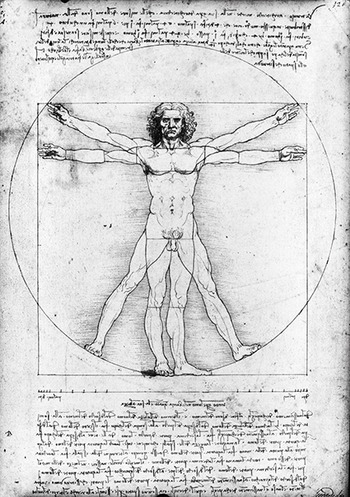
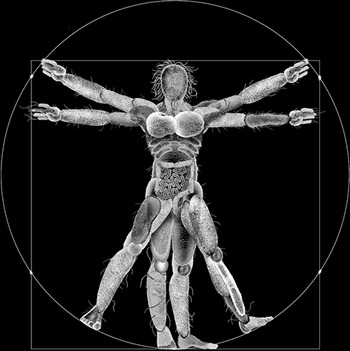
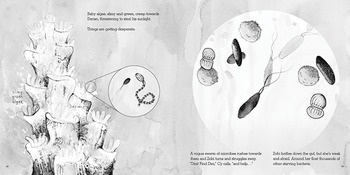

 Open access