

The acquisition and processing of relative clauses (RCs) is a perennial topic in psycholinguistic studies of syntax (e.g., Gibson, Reference Gibson1998; Kidd, Reference Kidd2011; MacDonald, Reference MacDonald2013). Consider sentences (1) and (2).
(1) The chicken [that __ kissed the mouse]
(2) The mouse [that the chicken kissed __]
Sentence (1) is a subject RC, because the head noun the chicken occupies the subject role in the RC (in brackets). Sentence (2) is an object RC because the head noun the mouse occupies the RC object role. These two RC types have been studied most frequently in the literature; as they both describe the same transitive event, differences in their processing are assumed to reflect fundamental properties of syntactic processing (though see Gennari, & MacDonald, Reference Gennari and MacDonald2008). As such, their study has been argued to bear upon fundamental theoretical issues concerning the acquisition and processing of grammar. Notably, the broad theoretical debate concerns the relative ease with which the two structures are acquired and processed, and the types of explanations that provide the best fit to the data.
The results from a range of acquisition and adult processing studies have been mostly uniform: with some qualifications (e.g., Diessel & Tomasello, Reference Diessel and Tomasello2000; Kidd, Brandt, Lieven, & Tomasello, Reference Kidd, Brandt, Lieven and Tomasello2007; Mak, Vonk, & Schriefers, Reference Mak, Vonk and Schriefers2002; Wells, Christiansen, Race, Acheson, & MacDonald, Reference Wells, Christiansen, Race, Acheson and MacDonald2009), subject RCs are earlier acquired and are easier to process than object RCs. This effect is fairly consistent across a range of populations (e.g., mono- and multilingual, neurotypical and atypical), age groups (children, young and older adults), and methodologies (e.g., naturalistic speech, comprehension, and production). However, what is not entirely clear is whether it holds crosslinguistically. While the subject advantage is robust in commonly studied languages, such as English (Kidd & Bavin, Reference Kidd and Bavin2002), German (Brandt, Kidd, Lieven, & Tomasello, Reference Brandt, Kidd, Lieven and Tomasello2009), and Italian (Adani, Reference Adani2011), in addition to Hebrew (Arnon, Reference Arnon2010; Friedman, Belletti, & Rizzi, Reference Friedmann, Belletti and Rizzi2009), several counterexamples of an object advantage or null effects have been reported in morphologically rich languages such as Basque (Carreiras, Duñabeitia, Vergara, de la Cruz-Pavía, & Laka, Reference Carreiras, Duñabeitia, Vergara, de La Cruz-Pavía and Laka2010; Gutierrez-Mangado, Reference Gutierrez-Mangado2011), Finnish (Kirjavainen, Kidd, & Lieven, Reference Kirjavainen, Kidd and Lieven2017; Kirjavainen & Lieven, Reference Kirjavainen, Lieven and Kidd2011), Japanese (Ozeki & Shirai, Reference Ozeki, Shirai, Matsumoto, Oshima, Robinson and Sells2007a; Suzuki, Reference Suzuki2011), and Quechua (Courtney, Reference Courtney2006, Reference Courtney and Kidd2011). In this study we focus on one language that has produced notably inconsistent results across studies but which is a particularly important language for deciding between two classes of theories: Mandarin. We ask two research questions. First, is there a subject–object asymmetry in Mandarin-speaking children’s comprehension of RCs, and how can the data be best explained by psycholinguistic theory? Second, does RC acquisition differ across monolingual and Mandarin–English bilinguals, whose two languages provide optimal conditions for syntactic transfer?
RC Acquisition in Mandarin
Mandarin RCs have the typologically rare combination of subject–verb–object (SVO) word order and prenominal RCs (Dryer, Reference Dryer, Haspelmath, Dryer, Gil and Comrie2005). This makes Mandarin (and other languages such as Cantonese; Chan, Yang, Chang, & Kidd, Reference Chan, Yang, Chang and Kidd2018) an interesting point of comparison to traditionally-studied European languages because, unlike in languages like English, in Chinese languages structural and linear constraints on interpretation are not confounded (Chan, Matthews, & Yip, Reference Chan, Matthews, Yip and Kidd2011). Structurally, there appears to be, all things being equal, a general preference across most languages studied to relativize on subjects, which is captured in many theoretical accounts (e.g., Bornkessel-Scheslewsky & Scheslewsky, Reference Bornkessel-Schlesewsky and Schlesewsky2009; Friedmann et al., Reference Friedmann, Belletti and Rizzi2009; Keenan & Comrie, Reference Keenan and Comrie1977; Vasishth, Chen, Li, & Guo, Reference Vasishth, Chen, Li and Guo2013), and which can in broad theoretical terms be explained as arising from subject prominence (O’Grady, Reference O’Grady and Kidd2011). In European languages this is compounded by word order cues, where the preference to put subjects early in the sentence results in cue convergence (e.g., English subject RCs follow SVO word order, whereas object RCs have the rare OSV word order). However, in Mandarin, word order constraints pull in the opposite direction. Consider sentences (3) and (4), Mandarin subject and object RCs, respectively (numbers denote tones).

The underscore gap in (3) and (4) denotes the role that the head noun occupies within the RC. Mandarin object RCs as in (4) follow the canonical SVO word order, and thus the linear distance between the head and the gap is shorter for object than for subject RCs. Therefore, theories that predict complexity effects based on linear distance or a canonical word order preference predict an object advantage for Mandarin (Diessel, Reference Diessel2007; Gibson, Reference Gibson1998; Hsiao & Gibson, Reference Hsiao and Gibson2003). In contrast, theories that predict complexity effects based on hierarchical structure (Friedmann et al., Reference Friedmann, Belletti and Rizzi2009; Lin & Bever, Reference Lin, Bever, Baumer, Montero and Scanlon2006) or parsing preferences induced from distributional analyses of the input predict a subject advantage (Vasishth et al., Reference Vasishth, Chen, Li and Guo2013; Yun, Chen, Hunter, Whitman, & Hale, Reference Yun, Chen, Hunter, Whitman and Hale2015).
To date, the acquisition data are mixed. In a study of longitudinal naturalistic speech, Chen and Shirai (Reference Chen and Shirai2015) reported that object RCs are more frequent in the input and are acquired earlier than subject RCs. In the earliest stages of development (average mean length of utterance = 2.1), the children almost exclusively produced object RCs as isolated NPs (e.g., sentence [5]), and continued to produce numerically more object RCs as their ability to relativize different elements in the matrix clause expanded. The authors interpreted the developmental trajectory to be consistent with the usage-based approach (Diessel, Reference Diessel2007), arguing that the word order overlap between object RCs modifying an isolated NP (sentence [5]) and simple SVO clauses (sentence [6]) enable children to bootstrap into the grammar of RCs (see Yip & Matthews, Reference Yip and Matthews2007).
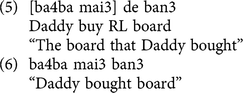
These data are important because they show that one potentially important determinant of acquisition, frequency (Ambridge, Kidd, Rowland, & Theakston, Reference Ambridge, Kidd, Rowl and Theakston2015), strongly supports the early acquisition of object RCs. However, one possibility that Chen and Shirai’s (Reference Chen and Shirai2015) analyses did not account for is the specificity of the frequency effect. Across languages it is not uncommon for object RCs to be frequent in the input but highly restricted in their distributional properties. Specifically, object RCs overwhelmingly have inanimate head nouns and frequently have discourse-old subjects (e.g., the board you bought; see more crosslinguistic examples from Fox & Thompson, Reference Fox and Thompson1990, featuring English; Mak et al., Reference Mak, Vonk and Schriefers2002, featuring Dutch and German; Ozeki & Shirai, Reference Ozeki and Shirai2007b, featuring Japanese; Zubin, Reference Zubin and Givon1979, featuring German; for examples from child language, see Diessel, Reference Diessel, Givon and Shibatani2009, featuring English; Kidd et al., Reference Kidd, Brandt, Lieven and Tomasello2007, featuring English and German; Kirjavainen et al., Reference Kirjavainen, Kidd and Lieven2017, featuring Finnish). The same is true for Mandarin (Lin, Reference Lin and Jing-Schmidt2011). It is possible that the restricted nature of early object RCs does not translate to an overall object preference when cues such as animacy are neutralized in experimental conditions.
The experimental evidence is inconclusive. Studies using production methodologies have reported a subject advantage (Cheng, Reference Cheng1995; Hsu, Hermon, & Zukowski, Reference Hsu, Hermon and Zukowski2009; Hu, Gavarró, & Guasti, Reference Hu, Gavarro and Guasti2016a), an object advantage (Ning & Liu, Reference Ning and Liu2009), or no difference (Su, Reference Su2004; for an overview of the early research, see Chan et al., Reference Chan, Matthews, Yip and Kidd2011). This paper concentrates on comprehension, where the past results are similarly inconsistent. Some of the inconsistency is potentially due to methodological problems concerning how best to test knowledge of RCs. For instance, many early studies tested children’s knowledge of RCs without presenting the structures in a supporting discourse context (e.g., Chang, Reference Chang1984; Lee, Reference Lee and Lee1992), which is problematic because RCs have clear discourse functions (for discussion see Corrêa, Reference Corrêa1995; Hamburger & Crain, Reference Hamburger, Crain and Kuczaj1982). More recent studies have corrected this problem to varying degrees. Hu, Gavarró, Vernice, and Guasti (Reference Hu, Gavarró, Vernice and Guasti2016b) tested 3- to 8-year-old Mandarin-speaking children’s knowledge of subject and object RCs using picture-referent selection. Children saw pictures of reversible actions (e.g., cat hitting dog, dog hitting cat) and were asked to identify the referent that corresponded to the head noun (e.g., for the object RC which one is the dog that the cat hits, the correct referent is the cat who is hitting the dog). Thus the pictures served as a referential context. The results revealed a clear subject preference, in which children showed comparative difficulty with object RCs up until the age of 7 years. Using a slightly different methodology with a sample of 3- to 6-year-olds, He, Xu, and Ji (Reference He, Xu and Ji2017) reported the opposite effect. In their study, children saw two pictures of complex scenes involving three animals (e.g., a dog chasing a rabbit that bumps into a goat, a rabbit bumping into a goat while chasing a rabbit), and were required to choose the picture that matched test sentences manipulated for embeddedness and extraction (e.g., the rabbit that the dog chased encountered the goat).
The differences between the results once again are likely to reflect methodological choices. One general problem with both studies is that it is unclear how sensitive children of different ages are to nonlinguistic referential contexts (i.e., pictures), and whether they can use these to restrict reference (Bavin, Kidd, Prendergast, & Baker, Reference Bavin, Kidd, Prendergast and Baker2016; Choi & Trueswell, Reference Choi and Trueswell2010; Kidd, Stewart, & Serratrice, Reference Kidd, Stewart and Serratrice2011; Snedeker & Trueswell, Reference Snedeker and Trueswell2004; Trueswell, Sekerina, Hill, & Logrip, Reference Trueswell, Sekerina, Hill and Logrip1999). As pointed out by Corrêa (Reference Corrêa1995), the functionally appropriate use of a restrictive RC presupposes the introduction of the head referent in prior discourse, and so the prior work on Mandarin has tested children’s knowledge in the absence of felicitous contexts (but see Chan et al., Reference Chan, Chen, Matthews and Yip2017). In addition, while Hu et al. required children to choose the correct token of the head referent, He et al. (Reference He, Xu and Ji2017) only required children to choose the correct picture (see also Jia & Paradis, Reference Jia and Paradis2018, who reported no preference). This is problematic, as it makes it possible for children to choose the correct picture even though they may have interpreted the picture incorrectly (Adani, Reference Adani2011; Arnon, Reference Arnon2005). Hu et al.’s data suggest this is likely: they found that the most common error children made when interpreting object RCs was to point to the RC subject in the correct picture (i.e., choosing the mouse in laoshu qing de gongji, “the chicken that the mouses kisses”), suggesting that the children may be interpreting the SVO sequence as a simple main clause (see also Hu, Reference Hu2014).
In sum, Mandarin is an important language in debates regarding the acquisition and processing of RCs because its typological uniqueness allows the opposing prediction of two classes of theories to be tested: those that predict a subject advantage (e.g., Friedmann et al., Reference Friedmann, Belletti and Rizzi2009; Keenan & Comrie, Reference Keenan and Comrie1977; Lin & Bever, Reference Lin, Bever, Baumer, Montero and Scanlon2006; Vasishth et al., Reference Vasishth, Chen, Li and Guo2013) versus those that predict an object advantage (e.g., Diessel, Reference Diessel2007; Gibson, Reference Gibson1998). In acquisition, the naturalistic data suggest a clear early emergence of object RCs, although these are more than likely restricted in function. In contrast, the experimental literature has produced a range of contradictory results. In the current study we revisit Mandarin-speaking children’s comprehension of subject and object RCs, with the aim of resolving the apparent inconsistencies in the past empirical literature. We tested two populations of children: (a) monolingual children acquiring Mandarin in China, and (b) Mandarin–English bilingual children acquiring their two languages in Australia. Mandarin–English bilingual children are an interesting focus of study for an additional reason: as both languages have canonical SVO word order but different head-directionality, the combination of the two languages provides the potential for crosslinguistic transfer of syntactic processing strategies, to which we now turn.
Crosslinguistic Transfer in English–Chinese Bilinguals
Crosslinguistic transfer of syntactic processing strategies occurs in both children and adults (e.g., children: Döpke, Reference Döpke1998; Foroodi-Nejad & Paradis, Reference Foroodi-Nejad and Paradis2009; Kidd, Chan, & Chiu, Reference Kidd, Chan and Chiu2015; Yip & Matthews, Reference Yip and Matthews2000; adults: Hartsuiker, Pickering, & Veltkamp, Reference Hartsuiker, Pickering and Veltkamp2004; Kidd, Tennant, & Nitschke, Reference Kidd, Tennant and Nitschke2015; Meijer & Fox Tree, Reference Meijer and Fox Tree2003), and is particularly revealing about (a) the sources of information children use to acquire structure, and (b) the representational architecture of the linguistic system as a whole. Müller (Reference Müller1998) hypothesized that crosslinguistic transfer occurs in cases where learners are confronted with ambiguous input. Specifically, if structure X in Language A allows (or potentially allows) multiple structural analyses, but in Language B the structure overlaps with and matches only one of these possible analyses, then transfer from Language B to Language A is predicted. Mandarin object RCs present one such case. Consider again sentence (4), rewritten as (7).

As pointed out by Diessel (Reference Diessel2007) and Chen and Shirai (Reference Chen and Shirai2015), in Mandarin there is structural overlap between object RCs and simple SVO main clauses, which differ only by the presence of the unstressed relative marker de. In English, the only possible interpretation is a simple transitive clause. Therefore, following Müller (Reference Müller1998), Mandarin object RCs are a candidate case for negative crosslinguistic transfer in Mandarin–English bilinguals.
Several recent studies have studied crosslinguistic transfer in Chinese–English bilinguals. Jia and Paradis (Reference Jia and Paradis2018) tested 28 Mandarin–English bilingual children (M age = 8 years; 0 months [8;0], range 6;0–9;8) and 15 monolingual Mandarin-speaking children (M age = 7;1, range: 6;8– 7;4) on tests of RC comprehension and elicited production. The monolingual children outperformed the bilingual children on the production task, producing significantly more subject and object RC targets (no comparisons across the two structure types were reported). Comprehension was measured using picture selection of reversible actions, and in contrast to the production data, the two groups did not differ in their comprehension of subject and object RCs and did not differ from each other. However, as stated above, picture selection may mask error patterns specific to Chinese, and so these data should be considered preliminary. The authors reported data consistent with crosslinguistic transfer. In the production task the bilingual children produced a small number of ungrammatical head-initial RCs (8%), which likely reflects the use of an English relativization strategy. The comprehension task also tested ungrammatical head-initial RCs, which followed English word order. Both groups performed well on subject RCs (approx. 90%), suggesting they used their knowledge of SVO word order to interpret the sentences. In contrast, both groups experienced greater difficulty with the head-initial object RCs (bilinguals: 65%, monolinguals: 56%), with the bilingual group responding significantly faster than the monolingual children, potentially because head-initial RCs that follow OSV word order is a more available parsing strategy to them compared to the monolingual children.
Two other studies have investigated crosslinguistic transfer in multilingual Cantonese-speaking children. Although Mandarin and Cantonese are closely related but distinct languages, the Cantonese data are highly relevant. Kidd et al. (Reference Kidd, Chan and Chiu2015a) investigated RC comprehension in 5- to 9-year-old monolingual Cantonese-speaking children and vocabulary-matched 5- to 12-year-old Cantonese–English bilingual children growing up in Australia. Like Mandarin, Cantonese has SVO canonical word order and head-final RCs. The authors tested two prominent Cantonese relativization strategies. Cantonese has one RC structure that is formally similar to Mandarin de RCs, which we call ge3 RCs, as in (8).

Cantonese also has a more commonly used relativisation strategy, classifier (CL) RCs, which provide an interesting comparison to ge3 RCs because CL RCs have the exact same surface structure as simple SVO clauses. Consider (9) and (10):
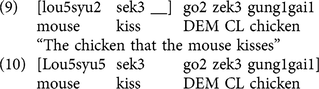
Based on Müller’s (Reference Müller1998) crosslinguistic transfer hypothesis, Kidd et al. (Reference Kidd, Chan and Chiu2015a) predicted that English–Cantonese children would have difficulty processing Cantonese RCs because of the word order overlap between simple SVO clauses in both English and Cantonese, on the one hand, and Cantonese object RCs, on the other. The children were tested on a referent selection task in which the children were required to identify the correct token of the head referent from two pictures depicting reversible actions (à la Hu et al., Reference Hu, Gavarró, Vernice and Guasti2016b). Their hypothesis was supported: the bilingual children’s poor performance on object RCs was the only result that distinguished the two groups. Of note, the bilingual children had particular difficulty with CL relatives, which are completely isomorphic with simple SVO clauses. For both ge3 and CL object RCs, the bilingual children tended to make what Kidd et al. called “head” errors, where they incorrectly selected the RC subject of the correct picture (e.g., the mouse in sentence [9]). The authors argued that this result could reflect the tendency for the bilingual children to interpret object RCs as simple SVO clauses, or alternatively as a noun modifying construction where the agent serves as a semantic head. There were suggestions in the data that bilingual children’s performance was moderated by the relative dominance in their two languages, although low participant numbers (N = 20) meant that the dominance analyses were speculative.
Chan, Chen, Matthews, and Yip (Reference Chan, Chen, Matthews and Yip2017) reported data from a study comparing 4-year-old monolingual Cantonese- and Mandarin-speaking children to age-matched Cantonese–English–Mandarin trilingual 4-year-olds, using the same picture referent selection task as Kidd et al. (Reference Kidd, Chan and Chiu2015a). The authors found that, in comparison to the monolingual Cantonese children, who showed a numerical object RC advantage, the trilingual children had difficulty processing object RCs, and consistent with Kidd et al. made a significant number of head noun assignment errors. That is, the trilinguals had more difficulty with head noun assignment relative to their monolingual peers. The authors hypothesized that this was due to negative transfer from English to Cantonese, because the Cantonese object CL RCs tested overlap not only with the SVO transitive constructions in Cantonese and English but also with English subject RCs (also SVO), with English RCs clearly allowing only a head-initial analysis. Overlap with English head-initial subject RCs could have motivated a head-initial analysis in multilinguals with intensive exposure to English, especially because the Cantonese (head-final) object CL RCs tested lack an overt relative marker, making head noun assignment especially vulnerable to negative transfer.
On the other hand, the Chan et al. (Reference Chan, Chen, Matthews and Yip2017) study also reported that, despite the close typological proximity between Mandarin and Cantonese, the monolingual Mandarin children showed a subject RC advantage, as did the trilingual children when tested in Mandarin. Both groups made a significant number of head errors. These Mandarin results support theories that predict a subject RC advantage, although the universality of the preference is questioned by the Cantonese monolingual data (see Chan et al., Reference Chan, Yang, Chang and Kidd2018). Chan et al. (Reference Chan, Chen, Matthews and Yip2017) argued for a complex pattern of crosslinguistic transfer in their trilingual sample. They attributed the trilinguals’ subject preference in Cantonese to be due to negative transfer from English, as in Kidd et al. (Reference Kidd, Chan and Chiu2015a). The children’s weakest language was Mandarin, having only around 200 min of exposure to the language each week. Despite this fact, the children performed as well as the Mandarin monolingual children, and their performance in Mandarin was equivalent to their performance in Cantonese. Chan et al. attributed this result to positive transfer from Cantonese to Mandarin, suggesting that the close correspondence between RC structures in the two languages boosted the trilinguals’ performance in Mandarin.
The Current Study
Chinese is an important language in debates regarding RC acquisition and processing, with several theories making opposing predictions. Accordingly, the current study addresses several research questions. First, we investigated whether there is a subject or an object advantage in children acquiring Mandarin as a first language, and how this bears upon psycholinguistic theory. Past research in this domain has suffered from inconsistencies that may be in part due to a range of methodological limitations, which in our study were rectified. In theoretical terms, one class of theories predicts a subject advantage (e.g., Friedmann et al., Reference Friedmann, Belletti and Rizzi2009; Lin & Bever, Reference Lin, Bever, Baumer, Montero and Scanlon2006; Vasishth et al., Reference Vasishth, Chen, Li and Guo2013; Yun et al., Reference Yun, Chen, Hunter, Whitman and Hale2015), whereas another class predicts an object advantage (e.g., Diessel, Reference Diessel2007; Gibson, Reference Gibson, Miyashita, Marantz and O’Neil2000), with each individual theory often having very different conceptual and epistemological commitments leading to those predictions. Here we take a theory-testing approach, first aiming to establish the nature of the empirical effect, thereby establishing support for one class of theories or the other, and then we consider likely theoretical interpretations of the effect. Second, following Kidd et al. (Reference Kidd, Chan and Chiu2015a) and Chan et al. (Reference Chan, Chen, Matthews and Yip2017), we investigated whether Mandarin–English bilinguals show crosslinguistic transfer from English to Mandarin, such that they have particular difficulty with Mandarin object RCs and interpret them with the error pattern consistent with an English-based head-initial SVO analysis. Third and finally, we also modeled individual differences in the children’s comprehension, testing how the children’s language experience, as measured by their Mandarin vocabulary (monolinguals and bilinguals) and bilingual language dominance, predicted comprehension accuracy.
Method
Participants
One hundred and fourteen (N = 114) children participated. The bilingual group consisted of 55 (N = 55, 19 males, 36 females) children aged between 4;5 and 10;10 years, who were recruited from language schools and community groups in Canberra, Australia. Due to their large age range, the bilingual sample was divided into two age groups via a median split. The younger group (4;5–7;2, M = 6;1, SD = 0;10) comprised 8 boys and 20 girls. The older group (7;3–10;10, M = 8;9, SD = 1;1) comprised 11 boys and 16 girls. Fifty-nine (N = 59, 37 males, 22 females) language-matched monolingual Mandarin-speaking children, recruited from a kindergarten in Shenzhen, China, served as a comparison group. These children were born in Mainland China, spoke Mandarin at home, and their primary medium of instruction at school was Mandarin. To facilitate comparisons with the two bilingual age groups, the monolingual sample was also divided into two age groups. The younger group (4;3–4;9, M = 4;6, SD = 0;2) comprised 19 boys and 10 girls. The older group (5;4–5;10, M = 5;6, SD = 0;2) comprised 18 boys and 12 girls. All children were typically developing, spoke only Mandarin at home as verified through school records, and had not been diagnosed with developmental delay or cognitive impairments.
The English and Mandarin (for monolingual and bilingual children) versions of the Peabody Picture Vocabulary Inventory—4th edition (PPVT-4, Dunn & Dunn, Reference Dunn and Dunn2007) were used to assess the children’s English and Mandarin vocabulary knowledge (see Materials section for details). Table 1 lists the children’s English and Mandarin PPVT-4 scores.
Children’s English and Mandarin PPVT-4 scores
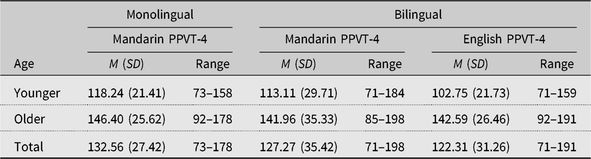
PPVT-4, Peabody Picture Vocabulary Test (4th edition).
The groups did not differ in their Mandarin vocabulary: young, t (55) = 0.75, p = .46, d = 0.2; old, t (55) = 0.63, p = .53, d = 0.17.Footnote 1 Therefore, both the young and the old age groups were language matched across the monolingual and bilingual groups, although they differed in age. In addition, the two bilingual groups did not differ overall in their Mandarin and English vocabulary: young, t (27) = 1.55, p = .13, d = 0 .3; old, t (26) = 0.07, p = .94, d = 0.01.
The bilingual children’s parents/guardians completed a demographics questionnaire used by Kidd et al. (Reference Kidd, Chan and Chiu2015a). The questionnaire measured: (a) if the child was born or had lived in Chinese-speaking regions (e.g., China, Singapore, or Hong Kong), (b) the average number of hours per week the child spends in English- and Mandarin- speaking environments, (c) the child’s frequency of speaking English and Mandarin at home (5-point Likert scale, 1 = never and 5 = all the time), and (d) the child’s parent-rated abilities to understand spoken English and Mandarin (7-point Likert scale, 1 = poor and 7 = excellent). Table 2 shows the number of months that the children lived in Chinese-speaking regions and their percentage of hours per week spent in each language environment.
Number of months that the children lived in Chinese-speaking regions and their percentage of hours per week spent in each language environment
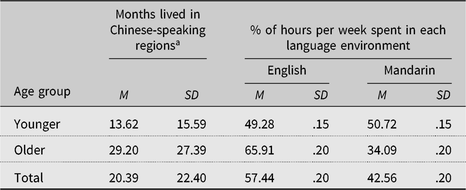
a n = 13 for younger children, and n = 10 for older children.
Approximately half of the younger children (15/28, 46.4%) and just over a third of the older children (10/27, 37%) had spent time living in a Chinese-speaking country or region. The length of time varied considerably (young: 1–48 months; old: 1–72 months). Although the older group had on average spent more time in Chinese-speaking environments, the two groups did not statistically differ on this variable, t (13.42) = 1.61, p = .131, d = 0.7. The younger bilingual children spent an equal amount of time in Mandarin- and English-speaking environments, t (27) = 0.25, p = .8, d = 0.05, whereas the older bilingual children spent significantly more time in English-speaking environments, t (26) = 4.08, p < .001, d = 0.78.
Table 3 shows the parent-rated frequency of speaking each language at home (5-point Likert scale, 1 = never and 5 = all the time), as well as the children’s parent-rated abilities to understand each spoken language (7-point Likert scale, 1 = poor and 7 = excellent).
Children’s frequency of speaking each language at home, and their parent-rated abilities to understand each spoken language

a Mdn, median.
Parents rated Mandarin as spoken more often than English at home (Z = 2.44, p = .015). However, this result was carried by the younger group (young: Z = 3.16, p = .002; old: Z = 0.46, p = .65). In addition, the parents rated their children’s ability in English to be better than in Mandarin (Z = 2.5, p = .012), with this result carried by the older group (young: Z = 0.61, p = .54; old: Z = 2.58, p = .01).
Materials and procedure
The children’s vocabulary was assessed using the PPVT-4 (Dunn & Dunn, Reference Dunn and Dunn2007), and their RC comprehension was tested using picture selection (Kidd et al., Reference Kidd, Chan and Chiu2015a). Two female researchers tested the children. The bilingual children were tested by a trilingual speaker of Mandarin, Cantonese, and English (Hong Kong native); the monolingual children by a native speaker of Mandarin. The bilingual children were tested in a university child language laboratory, or in a quiet area in the child’s language school, home, or church. The monolingual children were tested in a quiet room in their school. The children first completed the PPVT-4, and then the RC comprehension test. The order of testing language for the bilingual children was counterbalanced: half of the children first completed the PPVT-4 and the RC test in English and then in Mandarin, and half vice versa. The experimenter greeted the bilingual children in the language in which they were first tested. After they were tested in their first language, the experimenters switched to the other language and instructed the child that they would speak Mandarin or English from now on. Each task is described in turn.
PPVT-4
The PPVT-4 (Dunn & Dunn, Reference Dunn and Dunn2007) was used to assess the children’s Mandarin and English vocabulary knowledge, serving as an objective proxy measure for language experience. The test comprises two parallel forms: PPVT-4-A and PPVT-4-B. There is no published Mandarin version of the test; therefore we translated both A and B forms into Mandarin (for details of the translation see Tsoi, Reference Tsoi2016). Each form of the PPVT-4 comprises 228 items, grouped into 19 sets. The sets are ordered by increasing difficulty (i.e., the easiest words are in Set 1). During the test, children were presented with an array of four pictures. The experimenter then read out a word that corresponded to one of the pictures, and the child was asked to point to the picture that represents the target word. Testing was discontinued when children answer eight or more items incorrectly in a set. Each child’s score was calculated by subtracting the total number of errors from the total number of answers. Hence, the total maximum score was 228. As the Mandarin version is not standardized, raw scores were used in our analyses.
The PPVT-4 was administered according to the standard procedure for the test. To measure the monolingual children’s Mandarin vocabulary, either the A or B version of the PPVT-4 was used. Opposite versions of the PPVT were used to measure the bilingual children’s Mandarin and English vocabulary. For example, the experimenter used the Mandarin PPVT-A and the English PPVT-B form to test a child, and vice versa.
Test of RC comprehension
RC comprehension was tested using picture referent selection. Four parallel forms of the RC test were constructed. Each form had an English and a Mandarin version. Each bilingual child completed one English and one Mandarin version of the test; monolingual children completed only one Mandarin version. Each form contained 34 sentences, which included 2 practice trials and 32 test sentences (16 test sentences, including 8 subject and 8 object RCs, and 16 fillers). RC test sentences contained one of four verbs: feed, hug, kiss, and push. The verbs were presented an equal number of times, with each verb appearing in four RCs (twice in subject RCs and twice in object RCs). The test sentences were controlled for length in words/characters. English RCs contained 9 words (10 to 13 syllables, M = 11). Mandarin RCs contained 9 to 10 monosyllabic characters (M = 9 characters). All RCs used only animate head nouns and animate RC-internal NPs. The animacy of the head referent moderates the complexity associated with children’s object RC comprehension (Brandt et al., Reference Brandt, Kidd, Lieven and Tomasello2009), which is likely due to the fact that object RCs with inanimate heads are more frequent and are therefore easier to process (Kidd et al., Reference Kidd, Brandt, Lieven and Tomasello2007). Our use of animate head nouns therefore removes one cue that Mandarin-speaking children could use to process RCs. We take up the issue of animacy in the Discussion.
Table 4 listed examples of test items. Filler sentences were simpler structures (intransitive and transitive sentences). All sentences (i.e., practice, test, and filler) were prerecorded by native speakers of either English or Mandarin (for full list of test sentences see Appendix A).
Examples of test sentences for each condition

Each test sentence was associated with two pictures, each consisting of the same two animals performing reversible actions (e.g., horse hugging pig, pig hugging horse; see Figure 1). There were 16 animals in total (horse, pig, rabbit, sheep, cat, duck, monkey, dog, mouse, chicken, tiger, giraffe, lion, elephant, bear, and cow).
Sample picture for the RC “Where is the horse that is hugging the pig?”

The test of RC comprehension was presented on a laptop computer using Microsoft Powerpoint. The test began with two practice trials, the function of which was to introduce the child to the nature of the task. As each picture was presented, an audio recording of a sentence that described the picture automatically played. All items followed the following procedure. One picture was shown and described (e.g., “Here, the horse is hugging the pig”). Next, the other picture from the picture pair was shown with its accompanying audio (e.g., “Here, the pig is hugging the horse”). For the test RC structures, these background scenes created a felicitous discourse context within which the test structures could be processed as noun modifying constructions, which better reveal children’s RC knowledge (Corrêa, Reference Corrêa1995; Kidd & Bavin, Reference Kidd and Bavin2002). On the third slide, both pictures were presented side by side, accompanied by the target sentence (e.g., “Where is the horse that is hugging the pig?”). The child’s task was to identify the character denoted by the head noun (i.e., the correct horse). The position of the target character was counterbalanced across items. The order of whether the target character appeared in the first or second background scene was also counterbalanced.
Coding and analyses
The RC test responses were coded as follows: (a) Correct; (b) Head error: if the child pointed to the correct picture but the incorrect character (i.e., pointing to the leftmost pig in panel C of Figure 2); (c) Reversal error: if the child pointed to the incorrect picture but the correct character (i.e., pointing to the rightmost horse in Panel C of Figure 2); (d) Other error: if the child pointed to the incorrect picture and the incorrect character (i.e., pointing to the rightmost pig in Panel C of Figure 2).
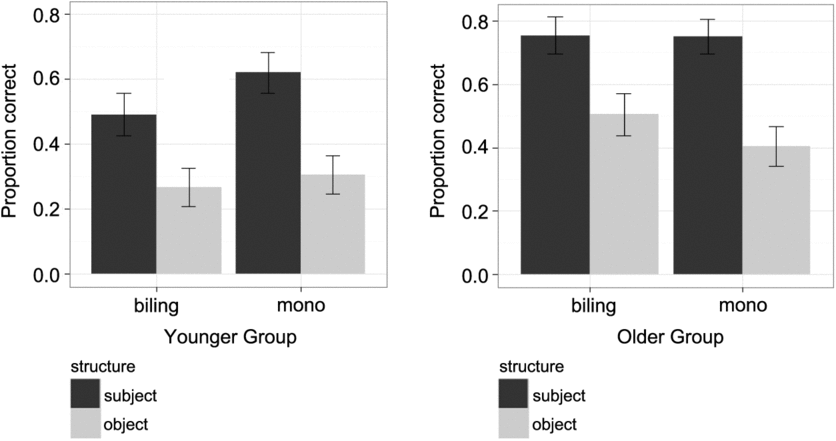
Bilinguals’ and monolinguals’ mean proportion of correct responses (and standard errors) for Mandarin subject and object RCs by age group.
Results
Comprehension of Mandarin RCs
The means and standard errors for the monolingual and bilingual children’s comprehension of Mandarin subject and object RCs are shown in Figure 2. Figure 2 shows that younger children were less accurate overall than were older children. Across all groups, children were more accurate in their comprehension of subject in comparison to object RCs.
Our first set of analyses addressed Research Question 1: Is there a subject–object asymmetry in children’s comprehension of Mandarin RCs, and does this differ according to language group? The data were analysed using generalized linear mixed-effects models, which were calculated using the lme4 package (version 1.1-18-1) for linear mixed effects (Bates, Maechler, Bolker, & Walker, Reference Bates, Maechler, Bolker and Walker2015) in R (version 3.5.1; R Core Team, 2017). Structure (subject RCs vs. object RCs), language group (monolingual vs. bilingual), and age group (young vs. old) were included as fixed effects, and participants and items as random effects. Random slopes for repeated-measures variables were also specified. We built a null model containing the maximally specified combination of random effects and slopes (Barr, Levy, Scheepers, & Tily, Reference Barr, Levy, Scheepers and Tily2013), but random slopes for language group and age group for the random effect of items were removed because of lack of model convergence. The null model contained random effects for participants and items, and the by-participants random slope for structure. Fixed effect terms were then added to the model one at a time, and their contribution was tested by comparing the new model to the null using the anova function. Nonsignificant terms were dropped. The inclusion of the fixed effects of structure, χ2 = 40.8, df = 1, p < .001, and age, χ2 = 19.81, df = 1, p < .001, improved model fit, confirming that children were more accurate on subject RCs overall, and that accuracy on both structures improved with age. The details of the final model are shown in Table 5.
Fixed effects from final overall model of children’s RC comprehension

Note: Structure represents subject versus object RCs. Age group represents old versus young. LogLik = −1050.2. Number of observations = 1,824. *p < .001.
Comprehension of English RCs
Figure 3 shows bilingual children’s accuracy on the English RCs by age group. The young bilingual children had difficulty with English object RCs relative to subject RCs, whereas there was little difference between the two structures in the older age group. The data were modeled in the same manner as the Mandarin accuracy data. The null model contained random effects for participants and items, and random by-participant slope for the fixed effect of structure. The main effect of structure did not significantly add to the model, χ2 = 2.55, df = 1, p = .11, whereas the main effect of age, χ2 = 12.31, df = 1, p < .001, and the Structure × Age interaction did, χ2 = 18.33, df = 2, p < .001. The interaction was driven by the fact that the younger group showed the subject–object asymmetry, β = 2.48, SE(β) = .54, z = 4.59, p < .001, whereas the older children did not, β = –0.15, SE(β) = .88, z = –0.17, p = .86.
Bilingual children’s mean proportion of correct responses (and standard errors) for English subject and object RCs by age group.

Error analyses
Analyses of Mandarin errors
Children’s errors provide valuable additional insights into the processes underlying acquisition. In particular, in addressing our second research question, we predicted that bilingual children would make more head errors on Mandarin object RCs if they were affected by crosslinguistic influence from English. Head errors were the most common (monolinguals: 32.42%, bilinguals: 31.36%), with fewer reversal (monolinguals: 4.98%, bilinguals: 8.64%) and other errors (monolinguals: 10.49%, bilinguals: 9.77%). Only head and reversal errors were analyzed, as they are readily interpretable responses. Figure 4 shows the children’s head errors by age and language group; Figure 5 shows the children’s reversal errors.
Bilinguals’ and monolinguals’ mean proportion of head errors (and standard errors) for Mandarin subject and object RCs by age group.

Bilinguals’ and monolinguals’ mean proportion of reversal errors (and standard errors) for Mandarin subject and object RCs by age group.
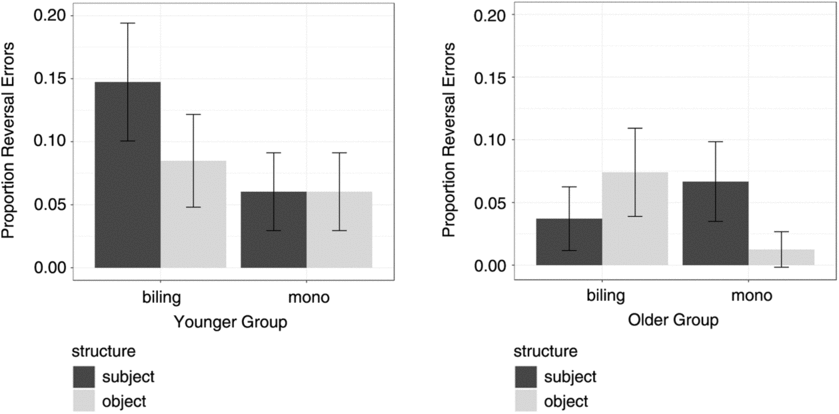
All groups made more head errors on object RCs, children’s reversal errors varied across the groups, although large standard errors suggest that this variation was not systematic. Each error type was analyzed using the same strategy as was used for the correct responses. For head errors, the null model contained random effects of participants and items and the random slope of structure across participants. There were two significant fixed effects; namely, there was a significant main effect of structure, χ2 = 77.15, df = 1, p < .001, showing that children made significant more head errors on object RCs than on subject RCs overall, β = –3.77, SE(β) = .40, z = –9.46, p < .001, and a significant main effect of age group, χ2 = 6.61, df = 1, p = .01, showing that younger children made more head errors overall, β = 0.63, SE(β) = .24, z = 2.59, p = .001.
For the reversal errors, the null model contained random effects of participants and items and the random slope of structure across participants. There was a significant main effect for group, χ2 = 4.33, df = 1, p = .037, showing that monolinguals made fewer reversal errors than the bilinguals, β = –0.59, SE(β) = .28, z = –2.09, p = .037. There was also a significant main effect for age group, χ2 = 12.12, df = 1, p < .001, showing that children made fewer reversal errors as they got older, β = 1.05, SE(β) = .31, z = 3.41, p < .001. No other effects were significant.
Analysis of English errors
The most common error that the bilingual children made in English was once again the head error (18.86%), followed by reversal errors (4.32%) and other errors (1%). Figure 6 shows the children’s head and reversal errors by structure and age group.
Bilingual children’s (a) head errors and (b) reversal errors by structure and age group in English.
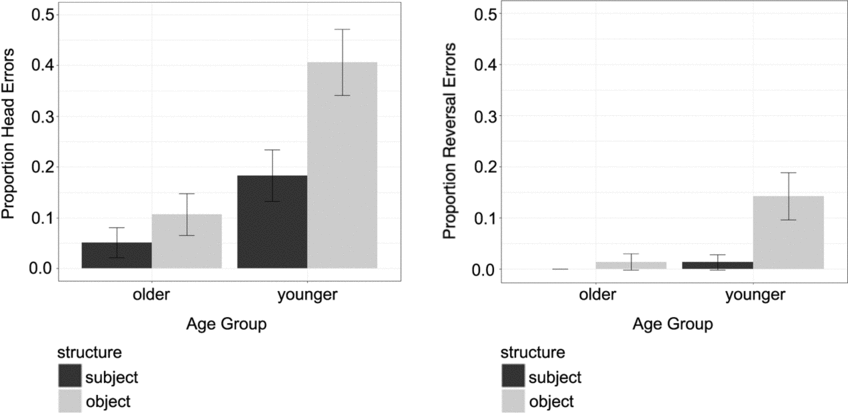
The younger children made more head and reversal errors than the older children overall, but were particularly likely to make them on object RCs. The null model for head errors contained random effects for participants and items and by-participant slope for the fixed effect of structure. The main effect of structure did not significantly add to the model, χ2 = 0.61, df = 1, p = .44, whereas the main effect of age did, χ2 = 14.06, df = 1, p < .001, confirming that younger children made more head errors than the older children overall, β = 3.43, SE(β) = .86, z = 4.004, p < .001. The Structure × Age interaction was significant, χ2 = 7.12, df = 2, p = .028, which was driven by the fact that the younger children made significantly more head errors on object than on subject RCs, β = –1.33, SE(β) = .53, z = –2.51, p = .012, whereas there was no difference for the older children, β = 0.32, SE(β) = .86, z = 0.37, p = .71. We did not analyze the reversal errors because most cells contained very low numbers, with most of these errors being made by young children on object RCs.
Individual differences analyses
We have observed a robust subject RC preference in both groups, which was driven by the fact that children made a significant number of head errors for object RCs. Recall that head errors in Chinese object RCs occur when children select the RC subject as opposed to the head noun. In this instance, they are choosing the agent of the sentence rather than the patient. Kidd et al. (Reference Kidd, Chan and Chiu2015a) and Chan et al. (Reference Chan, Chen, Matthews and Yip2017) suggested that the preponderance of head errors in Cantonese–English bilinguals (as opposed to monolinguals, who made the error less often) could be due to the surface structure overlap between Cantonese object RCs and simple transitive clauses, both of which in Chinese are SVO, and English SVO transitives and subject RCs.
The current data from Mandarin show that, in comparison to the Cantonese data, head errors are common in both monolingual and bilingual children, and therefore in Mandarin they cannot be due to crosslinguistic transfer alone, at least as we have analyzed them at the group level. While the groups looked very similar in their performance, their different language experience could mean that these similarities mask different underlying processes. In our next set of analyses, we investigated whether individual differences in each group’s experience with their language(s) affected their comprehension. Table 6 shows the simple bivariate correlations between Mandarin vocabulary, age (in months), bilingual dominance, and subject and object RC accuracy.Footnote 2 Dominance was operationalized by computing a difference score, subtracting the bilingual children’s Mandarin PPVT score from their English PPVT score, and converting the difference to a z score.
Simple bivariate correlations between Mandarin vocabulary, age (in months), bilingual dominance, and subject and object RC accuracy for monolingual and bilingual children

aN = 59. bN = 55. *p < .05. **p < .01. ***p < .001.
Table 6 shows a slightly different pattern of correlations for the monolingual and bilingual children. In the monolingual children, subject RC but not object RC accuracy was significantly associated with both age and vocabulary size, whereas in the bilingual children, age and vocabulary were positively associated with both structures. In addition, bilingual dominance was negatively associated with object RC accuracy, but not subject RC accuracy. Note the negative correlation indicates that children who were more English dominant were less accurate on Mandarin object RCs (for scatterplots see Appendix B).
We followed up these correlational analyses with mixed-models analyses. We analyzed each language group (monolingual vs. bilingual) separately, for the following reasons. It proved very difficult to model the full data set with additional variables such as vocabulary size. A large component of this was our age group measure. Dividing the two language groups meant that we could do away with the age group variable, and instead model the data with continuous variables of age (in months) and language experience (as measured by the PPVT).
We modeled the monolingual group’s accuracy data using the continuous variables of vocabulary and age (in months), which were converted to z scores therefore zero-centred to reduce collinearity. Only the main effect of age, χ2 = 4.69, df = 1, p = .03, improved model fit over and above structure and the random effects structure, with children becoming more accurate with age, β = 0.28, SE(β) = .13, z = 2.21, p = .027. Thus, although the simple correlations suggested that the children’s performance on subject RCs was associated with both age and vocabulary, these specific effects did not survive more in-depth scrutiny.
For the bilingual children, we investigated whether individual differences in two independent measures of linguistic experience affected children’s comprehension: (a) Mandarin vocabulary, and (b) dominance (in addition to age). Mandarin vocabulary and age were z-transformed and therefore zero-centred. Including random slopes in the analyses meant that many models containing higher order interaction terms did not converge. We therefore modeled the data without random slopes, and modeled the influence of Mandarin vocabulary and dominance on children’s performance separately.
When Mandarin vocabulary was included as a predictor there were significant main effects of structure, β = 1.2, SE(β) = .18, z = 6.83, p < .001, and vocabulary, β = 0.9, SE(β) = .22, z = 4.12, p < .001, and a three-way Structure × Age × Vocabulary interaction, β = 0.44, SE(β) = .17, z = 2.55, p = .012. The top panels of Figure 7 plot this interaction, with age represented by the two groups formed via the median split. As can be seen, whereas Mandarin vocabulary is positively related to the older children’s comprehension of both subject and object RCs, it is only positively related to the younger children’s comprehension of object RCs.
Scatterplots depicting the relationship between Mandarin vocabulary and subject and object RC accuracy (upper panels) by age, and the relationship between language dominance and subject and object RC accuracy (lower panels) by age.
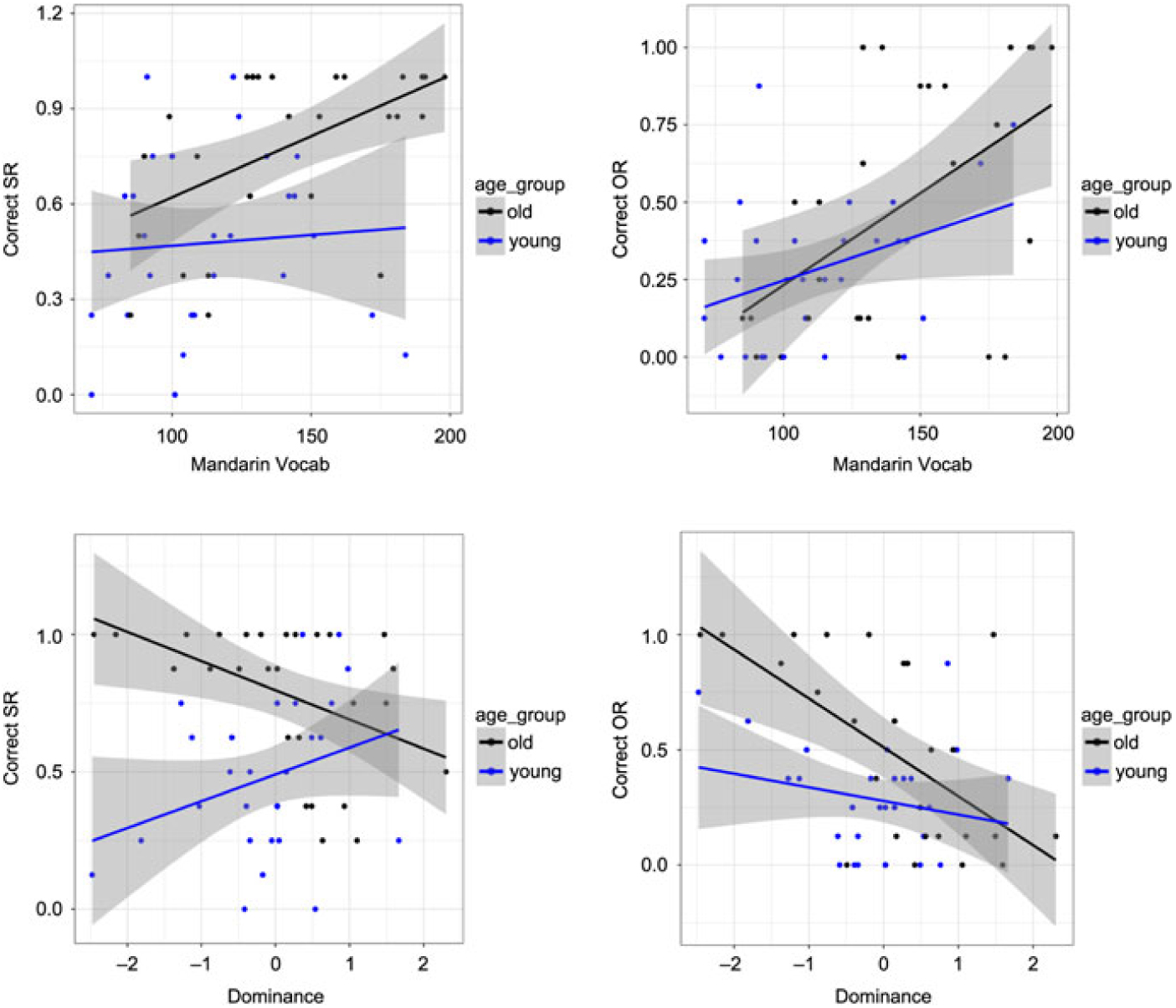
A similar effect was found when we replaced vocabulary with dominance as a predictor variable. There were significant main effects of structure, β = 1.58, SE(β) = .2, z = 7.72, p < .001, age, β = 0.73, SE(β) = .2, z = 3.65, p < .001, and dominance, β = –0.79, SE(β) = .2, z = –3.85, p < .001, and a significant three-way Structure × Age × Dominance interaction, β = –0.74, SE(β) = .23, z = –3.2, p = .001. The lower panels of Figure 7 plot the interaction, which shows a uniformly negative relationship between dominance and comprehension accuracy for both subject and object RCs in the older children, but either weaker patterns of association (object RCs) or the opposite pattern in the younger children (subject RCs).
We cannot compare the models using log-likelihood ratio tests because they are not nested, so we instead compared model fit using their Bayesian information criteria (BIC). The BIC is a measure of information loss, and so a lower BIC is indicative of better model fit. Following Kass and Rafferty’s (Reference Kass and Raftery1995) criteria, a difference in BICs of 0–2 is “not worth more than a bare mention,” a difference of 2–6 is positive evidence in favor of the model with the lower BIC, a difference between 6 and 10 is strong evidence, and a difference over 10 is very strong evidence. The model containing Mandarin vocabulary as a predictor had a BIC of 1,045.1, whereas the model with dominance as a predictor had a BIC of 1,038.1. Thus, there is difference of 7 in favor of the model containing dominance, and thus there is strong evidence in favor of this model than the one containing Mandarin vocabulary.
Crosslinguistic transfer at the individual level
In our final analyses we modeled individual differences in the bilingual children’s head errors. Specifically, if the bilingual children’s head errors are related to crosslinguistic influence, we should expect that head error rate to be related to the children’s individual pattern of dominance, such that children who are more English dominant make a greater amount of head errors in object RCs. We used the same analysis strategy followed in the previous individual differences analysis of the bilingual children’s accuracy. The results revealed significant main effects of structure, β = –2.97, SE(β) = .31, z = –9.63, p < .001, age, β = –0.72, SE(β) = .17, z = –4.14, p < .001, dominance, β = 0.67, SE(β) = .18, z = 3.7, p < .001, and a significant three-way Structure × Age × Dominance interaction, β = 0.87, SE(β) = .28, z = 3.09, p = .002. Follow-up analyses of object RCs showed that head errors significantly decreased with age, β = –0.91, SE(β) = .28, z = –3.24, p = .001, and significantly increased with greater English dominance, β = 0.86, SE(β) = .24, z = 3.02, p = .003. For subject RCs, there was a significant main effect of dominance, β = 0.90, SE(β) = .44, z = 2.64, p = .04, which was subsumed by an Age × Dominance interaction, β = 1.4, SE(β) = .53, z = 2.64, p = .008. As in the accuracy data (Table 6), the interaction was driven by the fact that English dominance was significantly and positively associated with head errors for subject RCs in the older children (Spearman’s ρ = .51, p = .007) but not the younger children (Spearman’s ρ = .02, p = .92).Footnote 3 However, this result is not particularly meaningful, as only 6 out of 27 children in the older group made any head errors on subject RCs.
Discussion
We investigated monolingual Mandarin-speaking and bilingual Mandarin–English children’s comprehension of subject and object RCs. Chinese languages are important in theoretical debates regarding the acquisition and processing of RCs because the typologically rare combination of head-final RCs and SVO canonical word order allows the predictions of several theoretical approaches to be tested in a manner not possible with typically studied European languages. Namely, one class of theories predicts a subject advantage, which is attributable to differences in either formal syntactic complexity (Friedmann et al., Reference Friedmann, Belletti and Rizzi2009; Lin & Bever, Reference Lin, Bever, Baumer, Montero and Scanlon2006) or structural frequency (Vasisth et al., Reference Vasishth, Chen, Li and Guo2013; Yun et al., Reference Yun, Chen, Hunter, Whitman and Hale2015). In contrast, another class of theories predict an object advantage attributable to properties of the surface structure, namely, the linear filler-gap distance (Gibson, Reference Gibson1998) or the similarity between Mandarin object RCs and canonical word order (Diessel, Reference Diessel2007). Accordingly, our first research question asked how our monolingual and bilingual children processed Mandarin subject and object RCs. The combination of English and Mandarin in our bilingual sample also enabled us to test for the presence of crosslinguistic transfer, which has been demonstrated in Cantonese–English bilinguals (Kidd et al., Reference Kidd, Chan and Chiu2015a). Therefore, our second research question asked whether bilinguals would make more errors on object RCs because crosslinguistic transfer from English could lead them to interpret object RCs as simple transitives or as head-initial RCs.
The answer to our first question was overwhelmingly clear: both the monolinguals and the bilinguals in both age groups performed significantly better on subject than on object RCs, supporting theories that predict a subject advantage. Given that several theoretical approaches predict a subject advantage, it is important to consider whether we can distinguish between them. The major division between the theoretical approaches concerns the degree to which they explain syntactic processing as dependent on formal structural knowledge versus experience-induced parsing routines. On the one hand, formal approaches explain the subject–object asymmetry in Mandarin as reflecting differences in processing hierarchical structures (Friedmann et al., Reference Friedmann, Belletti and Rizzi2009; Lin & Bever, Reference Lin, Bever, Baumer, Montero and Scanlon2006), attributing the complexity effect to the fact that it is more costly to process object RCs because they have a longer structural–hierarchical filler-gap distance and/or involve structural intervention effects, whereby the RC subject intervenes between the head noun and the gap (for specific Mandarin examples, see Chan et al., Reference Chan, Chen, Matthews and Yip2017). On the other hand, experience-based accounts argue that the subject preference derives from a probabilistically-oriented parsing mechanism that derives syntactic predictions from input distributions (e.g., Levy, Reference Levy2008; Vasishth et al., Reference Vasishth, Chen, Li and Guo2013; Yun et al., Reference Yun, Chen, Hunter, Whitman and Hale2015). As such, the two explanations differ according to whether they attribute the subject advantage to a deep property of formal syntactic machinery or to language-specific input distributions.
The acquisition data alone cannot yet decide between the two explanations, but there are multiple sources of evidence that point to experience-based approaches having greater explanatory value. The crucial difference in the predictions of the two approaches is that, whereas the formal approach predicts across the board difficulty for object RCs, the experience-based approach does not. Therefore, demonstrations of processing or acquisition difficulty for either structural type that is predicted by input distributions constitutes evidence in support of the experience-based approach. Hsiao and MacDonald (Reference Hsiao and MacDonald2013) and Vasishth et al. (Reference Vasishth, Chen, Li and Guo2013) have reported analyses of written corpora that show that subject RCs are more frequent than object RCs. In addition, Vasishth et al. showed that sentence strings following the surface structure pattern of subject RCs (V–NP–de–NP) are also more frequent than strings following the object RC surface structure pattern (NP–V–de–NP). Thus, corpus data point toward a subject advantage. Computational models of sentence parsing either learn from (Hsiao & MacDonald, Reference Hsiao and MacDonald2013) or instantiate these frequency distributions (Yun et al., Reference Yun, Chen, Hunter, Whitman and Hale2015), and therefore make incremental predictions about sentence difficulty. Behavioral data bear out some of these predictions, such as the fact that the subject preference is modulated by whether the RC modifies the main clause subject or object (Jäger, Chen, Li, Lin, & Vasishth, Reference Jäger, Chen, Li, Lin and Vasishth2015), specific distributions of animate versus inanimate nouns (Wu, Kaiser, & Andersen, Reference Wu, Kaiser and Andersen2012), and that complexity effects arise for each structure at different points in a sentence (Mansbridge, Tamaoka, Xiong, & Verdonschot, Reference Mansbridge, Tamaoka, Xiong and Verdonschot2017).
Our data do not allow us to scrutinize online complexity effects; however, two lines of evidence suggest that distributional information influences acquisition. The first concerns the input. Following suggestions from an anonymous reviewer, we extracted all subject and object RC-like structures in the input to children from all morphologically tagged Mandarin corpora on CHILDES (MacWhinney, Reference MacWhinney2000; approximately 380,000 words in total).Footnote 4 The structures were “RC-like” in that they had the same surface structure as Mandarin subject [V–N–de–(N)] and object [N–V–de–(N)] RCs, but due to the plurifunctionality of de as a modification marker may not be RCs. Consistent with Vasishth et al. (Reference Vasishth, Chen, Li and Guo2013), we found that subject RC-like sequences were three times more frequent than object-like RC sequences (1430 vs. 473). When we restrict our analysis to true RCs only, we see the opposite effect: object RCs are more frequent than subject RCs (95 vs. 26). Consistent with similar analyses in other languages (Diessel, Reference Diessel, Givon and Shibatani2009; Kidd et al., Reference Kidd, Brandt, Lieven and Tomasello2007; Kirjavainen et al., Reference Kirjavainen, Kidd and Lieven2017), the majority of the object RCs had inanimate head nouns (90 inanimate vs. 5 animate), whereas animacy in subject RC head nouns was more balanced (16 inanimate vs. 10 animate).
These input data provide a potential explanation for the difference between Chen and Shirai’s (Reference Chen and Shirai2015) data and what appears to be a subject preference in experimental work. If Mandarin-speaking children are acquiring object RCs first then early in development, they are homing in on the distributions of the specific structures, which are likely used to talk about inanimate entities. In contrast, two features of experimental studies point to difficulties with object RCs. First, all experimental studies to date have tested object RCs with animate heads, which are infrequent. In comprehension the high preponderance of head errors appears to be due to the tendency to identify early appearing animate nouns as agents and topics. In Mandarin this results in correct thematic role assignment (see below), but an ultimately incorrect interpretation of the function of the structure, which is to topicalize the patient. Second, because Mandarin RCs are head-final and because de is plurifunctional, the identity of test sentences as RCs is not obvious until the end of the sentence. Thus, the specific distributional frequencies of Mandarin RCs may be less relevant than the general RC-like frequencies, which favor subject RC analyses. That is, following experience-based accounts of Mandarin language processing that make structural predictions based on distributional frequencies (e.g., Vasisth et al., Reference Vasishth, Chen, Li and Guo2013; Yun et al., Reference Yun, Chen, Hunter, Whitman and Hale2015), children have more exposure to V–N–de–(N) sequences that have the same form–function mapping of nouns to argument roles, making them easier to process. In contrast, the object-like RC pattern competes with frequent SVO transitives, which appears to garden path the children into producing head errors, to which we now turn.
Although there were slight differences in design, the large number of head errors in object RC trials in both of our Mandarin-speaking groups was consistent with a similar study with monolinguals conducted by Hu et al. (2016; see also Hu & Guasti, Reference Hu and Guasti2017). This pattern of errors is significantly different in children acquiring languages with postnominal RCs (e.g., Catalan: Gavarró, Adani, Ramon, Rusiñol, & Sanchez, Reference Gavarró, Adani, Ramon, Rusiñol and Sánchez2012; Italian: Adani, Reference Adani2011; Persian: Rahmany, Marefat, & Kidd, Reference Rahmany, Marefat and Kidd2011; Hebrew: Arnon, Reference Arnon2005), where children typically make more reversal errors.Footnote 5 In any one language the two error types no doubt reflect different processes: a head error reflects incorrect identification of the head noun, whereas a reversal error reflects incorrect thematic role assignment. However, crosslinguistically this complementary distribution of head and reversal errors could reflect the same underlying process: the tendency to identify the first noun as agent/topic (Bates & MacWhinney, Reference Bates, MacWhinney, MacWhinney and Bates1989; Bornkessel-Scheslewsky & Scheslewsky, Reference Bornkessel-Schlesewsky and Schlesewsky2009; or “subject prominence,” Kim & O’Grady, Reference Kim and O’Grady2016; O’Grady, Reference O’Grady and Kidd2011). Thus, head errors in Mandarin are common because the structure competes with a simple and preferred SVO transitive analysis. In contrast, in a language like Italian a preference to assign agency early emerges as a reversal error because there is no surface structure overlap with canonical word order. Adani’s (Reference Adani2011) Italian data are instructive here, because her study manipulated word order. When object RCs had OSV word order (e.g., il cavallo che stanno i leoni inseguendo “the horse that the lions are chasing”), children made an average of 16.8% reversal errors versus 6.4% head errors. However, as Italian allows postverbal subjects, she also tested children on OVS RCs (e.g., il cavallo che stanno insequendo i leoni), where reversal errors jumped to an average of 44% and head errors were virtually nonexistent (1%). Thus, when children heard a NVN sequence, they had a preference to interpret them as SVO.Footnote 6 In Italian this results in incorrect thematic role assignment and therefore a reversal error, whereas in Mandarin it results in correct thematic role assignment but a failure to interpret the structure as a “head-final” RC.
Thus there is evidence in the adult language processing and crosslinguistic child language acquisition data to argue that object RC difficulty is significantly influenced by individual properties of the target language. While some processing preferences such as the tendency to assume early occurring nouns as agents may be core properties of the parsing system (moderated by NP typicality, e.g., animacy), structure-specific and more general word order regularities that differ across languages will influence acquisition and processing in a language-specific manner. Determining exactly which aspects of input distributions affect acquisition is a priority. While theoretical approaches like usage-based theory identify a key role for input distributions in acquisition, the data suggest that previous proposals made within usage-based accounts have been too simplistic. Diessel’s (Reference Diessel2007) proposal that the overlap between simple transitives and object RCs in Chinese facilitates acquisition of object RCs in Chinese does not capture the full extent of the data. Instead, frequency information at multiple levels of granularity appear to play a role. While it appears that object RCs are first acquired (Chen & Shirai, Reference Chen and Shirai2015), these are likely restricted in form and function. The emergence of a subject preference that is modulated by several language-specific characteristics appears an outcome of a complex interplay between syntax–semantics correlations (e.g., distribution of animacy in syntactic roles), the specific distribution of RC types, and the distribution of related and competing structures in the input. A comprehensive account of RC acquisition in Chinese thus requires studies that triangulate and integrate corpus, experimental, and computational approaches.
Turning now to our second question, we observed results consistent with crosslinguistic transfer from English to Mandarin at the individual but not the group level. In particular, we found that dominance patterns significantly predicted the bilingual children’s accuracy and head error rates. The models that included dominance fit better than models containing Mandarin vocabulary as a predictor, suggesting that the children’s combined knowledge of their two languages affected their comprehension of Mandarin RCs. Thus we can conclude that relative strength in Mandarin ensures correct comprehension, but comparative English dominance makes children vulnerable to making head errors.
These relationships were strongest in the older children (see Figure 7), despite the fact that the two age groups did not differ in the distribution of dominance scores,Footnote 7 and at the group level the older children had higher vocabularies in both languages. What we may be observing here is a more general effect of the community language on the older children. According to their parental ratings, the older children spent significantly more time in English-speaking than Mandarin-speaking environments, whereas this was not the case for the younger children. The older group was also more cognitively and linguistically mature than the younger group, and their superior accuracy is likely due to their ability to negotiate syntactic complexity accordingly (e.g., Kidd & Arciuli, Reference Kidd and Arciuli2016, showed that English-speaking children’s comprehension of object RCs was predicted by a combination of statistical learning, working memory, and vocabulary). Even though the older children were more accurate overall in comprehending the test sentences, greater exposure to the community language may promote greater competition between English and Mandarin processing strategies in children who are more English dominant. That is, consistent with work conducted within the Competition Model (Bates & MacWhinney, Reference Bates, MacWhinney, MacWhinney and Bates1989), there may be intensification of cue strength in the English-dominant children across development, such that a developmental outcome of the combination of their two languages leads to a stronger preference to interpret the first noun as an agent/head noun (Chan et al., Reference Chan, Chen, Matthews and Yip2017; Reyes & Hernandez, Reference Reyes and Hernández2006). In contrast, the more Mandarin-dominant children would have a greater expectation that noun modifying constructions in Mandarin are head-final.
One outstanding issue this study highlights is the apparent difference in RC acquisition between Mandarin- and Cantonese-acquiring children. Using the same referent selection method as used in the current study, both Kidd et al. (Reference Kidd, Chan and Chiu2015a) and Chan et al. (Reference Chan, Chen, Matthews and Yip2017) found that Cantonese-speaking monolingual children show a nonsignificant object advantage in acquisition, and thus make fewer head errors. Both studies tested CL RCs, as in sentence (9), rewritten as (11) below.

As discussed above, object CL RCs are isomorphic to simple SVO sentences. While this appeared to present problems to the bilingual children in Kidd et al. (Reference Kidd, Chan and Chiu2015a), they presumably do not present too much of a problem to monolingual Cantonese-speaking children. The reason for this may be closely linked to the distributional properties of CL RCs. In an eye-tracking study, Chan et al. (Reference Chan, Yang, Chang and Kidd2018) reported a significant object-over-subject advantage in 4-year-old monolingual Cantonese-speaking children’s online processing of CL RCs, and a significant subject-over-object advantage for ge3 RCs (sentence [12]). A corpus analysis showed that CL RCs more often modify objects, whereas ge3 RCs are vanishingly rare in the input (no examples were attested). Thus, the input provides good evidence for an object RC analysis for CL RCs despite the structural ambiguity and may enable children to override a preference to analyze the first noun as the sentential topic. However, although ge3 provides an informative cue as a relative marker, the rarity of ge3 RC in child-directed speech suggests that it is late acquired and ge3 may not be a strong enough cue for young children to use. Syntactically, ge3 behaves more like Mandarin de (Cheung & Li, Reference Cheung and Li2015), although de is much more common in the input, with our own and several other corpus analyses showing that subject-like RC patterns are more frequent (Hsiao & MacDonald, Reference Hsiao and MacDonald2013; Vasishth et al., Reference Vasishth, Chen, Li and Guo2013). Thus one difference across the two Chinese languages could be due to language-specific features of the input distribution that interact with more general processing preferences linked to subject prominence. In Cantonese one relativization strategy (CL RCs) pulls in the direction of object RCs and one does not (ge3), and in Mandarin the relativization strategy studied (de) pulls in the direction of subject RCs.
Some methodological limitations merit comment. We operationalized dominance based on the bilingual children’s vocabulary scores in their two languages. One particular advantage of using a vocabulary inventory instead of a test of grammar is that the results are directly comparable because they test children’s linguistic knowledge for the same concepts in their two languages, whereas tests of grammar across languages will naturally differ. However, while standardized tests like the PPVT-4 are considered measures of general verbal ability and are therefore correlated with children’s syntactic knowledge (e.g., see Kidd & Arciuli Reference Kidd and Arciuli2016), it is typically assumed that the lexical and grammatical systems are at least partially separate. Therefore, future studies could operationalize dominance based on measures of grammar in addition to vocabulary (for discussions on measuring language dominance see papers in Silva-Corvalan & Treffers-Daller, Reference Silva-Corvalán, Treffers-Daller, Silva-Corvalán and Treffers-Daller2016). One additional limitation concerns our bilingual group. Because they were living in Australia, it is possible that our data are not generalizable to Mandarin–English bilinguals living in predominantly Mandarin-speaking societies (e.g., Mainland China, Taiwan). It would be very interesting to compare the current data to a Mandarin–English bilingual group living in those countries where Mandarin is the community language, and those places where Mandarin is used with high or increasing frequency (e.g., Singapore, Hong Kong).
Conclusions
We investigated monolingual Mandarin-speaking and Mandarin–English bilingual children’s comprehension of Mandarin subject and object RCs. Past research on monolingual acquisition has produced an inconsistent pattern of results, which we have argued is for a large part due to methodological problems. There is also very little data on the topic from multilingual children (though see Chan et al., Reference Chan, Chen, Matthews and Yip2017; Jia & Paradis, Reference Jia and Paradis2018). Our results suggest that, for the comprehension of transitive RCs containing two animate nouns, there is a reliable subject RC preference in both monolingual and bilingual Mandarin-speaking children, which we have argued reflects a general preference to process early occurring nouns as agents and language-specific distributional frequencies that favor relativization on subjects. Future experimental research is required to determine whether and how this preference in comprehension is modulated by other factors (e.g., animacy or individual variability in cognitive skill), and whether the same factors influence production. We also reported that the bilinguals’ comprehension was significantly affected by their Mandarin vocabulary and their dominance pattern between their two languages, suggesting that, while the monolingual and bilingual groups performed similarly on the comprehension task, their underlying parsing system may weigh cues to comprehension in a qualitatively different manner.
Author ORCIDs
Evan Kidd 0000-0003-4301-2290, Angel Chan 0000-0002-9547-0210
Acknowledgments
This research was supported by Australian Research Council Grant CE140100041 (to E.K.). We thank the children, families, and school/community groups who participated in the research, and Sharon Unsworth, Annie Tremblay, and three anonymous reviewers for helpful suggestions.
Appendix A Test Sentences
English Test Sentences
Subject RCs
1. Where is the horse that is hugging the pig?
2. Where is the monkey that is feeding the dog?
3. Where is the duck that is pushing the mouse?
4. Where is the rabbit that is feeding the chicken?
5. Where is the giraffe that is hugging the lion?
6. Where is the lion that is pushing the bear?
7. Where is the pig that is feeding the horse?
8. Where is the chicken that is pushing the rabbit?
9. Where is the dog that is hugging the pig?
10. Where is the giraffe that is feeding the lion?
11. Where is the monkey that is hugging the cow?
12. Where is the dog that is pushing the monkey?
13. Where is the mouse that is kissing the chicken?
14. Where is the elephant that is kissing the tiger?
15. Where is the rabbit that is kissing the sheep?
16. Where is the lion that is kissing the bear?
Object RCs
1. Where is the rabbit that the sheep is pushing?
2. Where is the cat that the duck is feeding?
3. Where is the sheep that the cat is hugging?
4. Where is the tiger that the horse is pushing?
5. Where is the elephant that the bear is feeding?
6. Where is the cow that the giraffe is hugging?
7. Where is the mouse that the chicken is hugging?
8. Where is the giraffe that the cow is feeding?
9. Where is the tiger that the elephant is hugging?
10. Where is the bear that the elephant is pushing?
11. Where is the cat that the duck is pushing?
12. Where is the sheep that the cat is feeding?
13. Where is the dog that the pig is kissing?
14. Where is the cow that the monkey is kissing?
15. Where is the mouse that the duck is kissing?
16. Where is the horse that the tiger is kissing?
Mandarin Test Sentences (With Translation)
Subject RCs

Object RCs

Appendix B
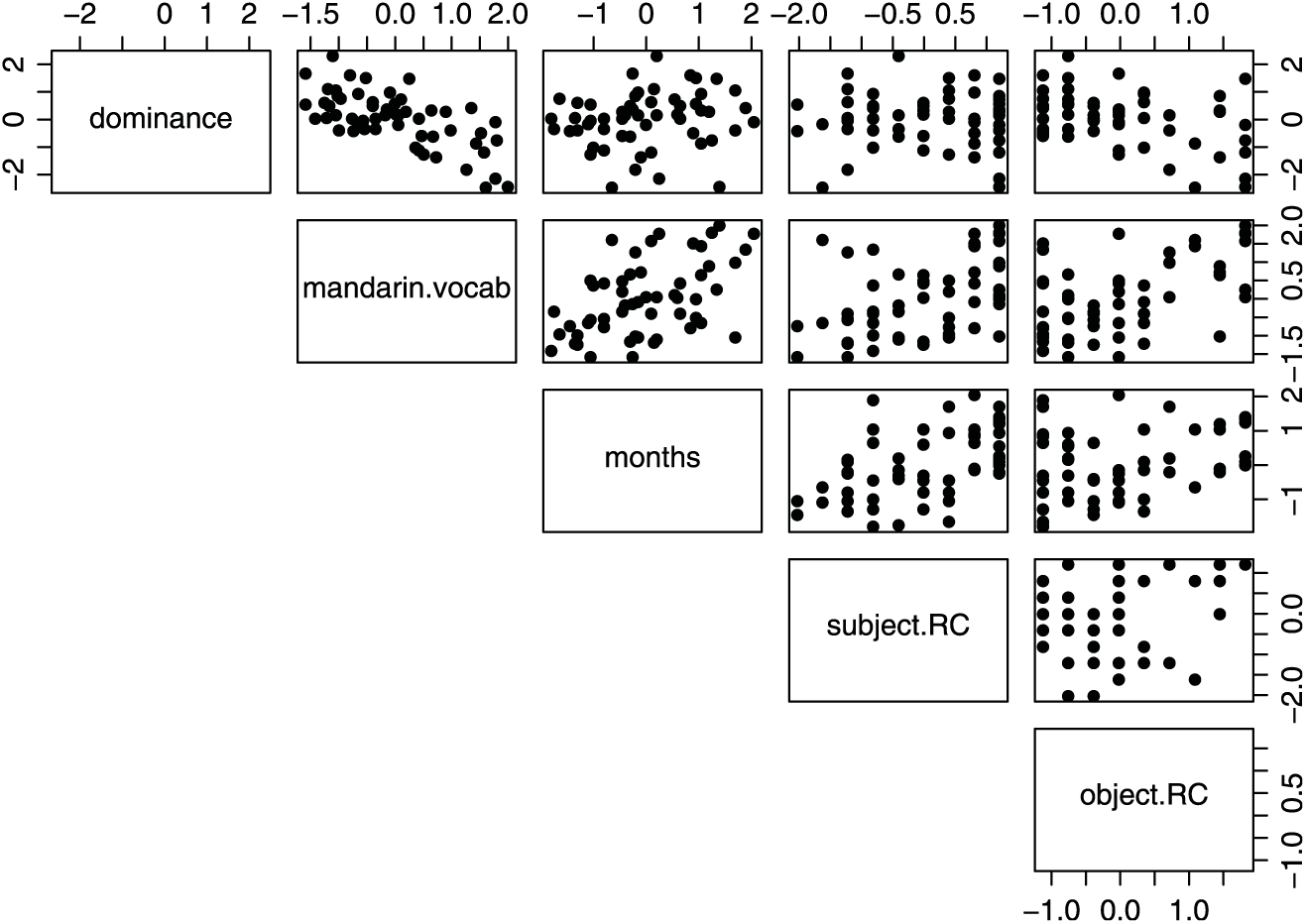
Scatter plots depicting relationships between z-normalized measures of dominance, Mandarin vocabulary, object RC accuracy, subject RC accuracy, and age (in months) for the bilingual children (N = 55).


 Open access

