





The acquisition of tense and aspect has been studied in a range of language acquisition contexts, such as in child second language (L2) acquisition (e.g., Andersen & Shirai, Reference Andersen and Shirai1994; Lee, Reference Lee2001; Weist et al., Reference Weist, Wysocka and Lyytinen1991), adult L2 acquisition (e.g., Bardovi-Harlig, Reference Bardovi-Harlig2000; Bardovi-Harlig & Comajoan-Colomé, Reference Bardovi-Harlig and Comajoan-Colomé2020; Kumpf, Reference Kumpf, Eckman, Bell and Nelson1984), and early bilingual education (e.g., Andreou & Tsimpli, Reference Andreou and Tsimpli2017; Blom et al., Reference Blom, Chondrogianni, Marinis and Vasić2016; Gusewski & Rojas, Reference Gusewski and Rojas2017). Despite the wide range in the learner population, research design and instrumentation, and L1–L2 combinations in the acquisition of L2 tense and aspect, relatively little research has been undertaken with respect to child L2 development of tense and aspect morphology in relation to discourse structures, such as narratives, as a linguistic environment. Much of the research on child L2 acquisition has employed research instruments to tap into learners’ knowledge of L2 tense and aspect by eliciting learner production at the level of a phrase or sentence to describe pictures (e.g., Andreou & Tsimpli, Reference Andreou and Tsimpli2017; Blom et al., Reference Blom, Chondrogianni, Marinis and Vasić2016; Gusewski & Rojas, Reference Gusewski and Rojas2017; Lee, Reference Lee2001). Comparatively little research examined child L2 acquisition of tense and aspect marking produced in the context of an extended discourse, such as oral narrative.
In consideration of the gap identified in the literature, this study investigated the development of English tense and aspect in the oral narratives produced by Cantonese-L1 and Spanish-L1 children who were enrolled in transitional bilingual programs in the United States. The distribution patterns of L2 English tense and aspect markers in the children’s oral narratives were examined in relation to narrative grounding, such as foreground and background, the universal properties of narrative (Hopper, Reference Hopper and Givón1979). Extending the previous literature—which is largely based on case studies (e.g., Kumpf, Reference Kumpf, Eckman, Bell and Nelson1984; Lee, Reference Lee2001) or one-shot cross-sectional comparisons of learners’ use of verbal morphology (e.g., Andreou & Tsimpli, Reference Andreou and Tsimpli2017; Bardovi-Harlig, Reference Bardovi-Harlig1995; Blom et al., Reference Blom, Chondrogianni, Marinis and Vasić2016)—this study employed a longitudinal research design by eliciting oral stories based on a wordless picture book, Frog, Where Are You? (Mayer, Reference Mayer1969) from kindergarten through Grade 2 for 38 children. In the following sections, the relevant literature concerning L2 development of tense and aspect and the relationship between verbal morphology and narrative organization is reviewed.
Literature review
Tense and aspect in language acquisition
Tense and aspect characterize the event conveyed by the predicate. Tense situates events or activities in time with respect to the moment of speaking and a reference point whereas aspect refers to the internal temporal composition of a situation (Comrie, Reference Comrie1976). A series of studies in L1 acquisition (e.g., Antinucci & Miller, Reference Antinucci and Miller1976; Berman & Slobin, Reference Berman and Slobin1994) have documented the developmental patterns of grammatical aspect such that L1 learners initially produce perfective forms more frequently than imperfective forms. This observation could be attributable to the claim that children are not cognitively ready to conceive events in terms of time reference but can only encode reference to the here and now (see Antinucci & Miller, Reference Antinucci and Miller1976; Weist et al. Reference Weist, Wysocka and Lyytinen1991 for the defective tense hypothesis). The earlier acquisition of the perfective aspect over the imperfective form has also been observed in L2 acquisition (Bardovi-Harlig, Reference Bardovi-Harlig2000; Kang et al., Reference Kang, Kim and Christianson2019; Shirai & Andersen, Reference Shirai and Andersen1995).
Early verbal morphology in L1 and L2 acquisition is primarily guided by aspectual characteristics of the verbs or predicates, or the situation they describe, as stipulated in the aspect hypothesis (Andersen & Shirai, Reference Andersen and Shirai1994; Andreou & Tsimpli, Reference Andreou and Tsimpli2017; Bardovi-Harlig, Reference Bardovi-Harlig1995, Reference Bardovi-Harlig2000; Kang et al., Reference Kang, Kim and Christianson2019; Shirai & Andersen, Reference Shirai and Andersen1995). The lexical aspect is categorized into four distinct types in light of durativity and telicity: accomplishment, achievement, activity, and stative (Vendler, Reference Vendler1967). In line with the aspect hypothesis, Andreou and Tsimpli (Reference Andreou and Tsimpli2017), for instance, reported that three groups of 8- to 12-year-olds (Greek monolingual, Greek-German bilingual, and Greek-English bilingual) showed their preference for perfective aspect with accomplishment and achievement predicates although a difference was observed in the three groups when it came to the use of imperfective forms. Compared to monolingual Greek children and Greek-German bilingual children, Greek-English bilingual children had problems with the use of imperfective forms in conjunction with activity and state predicates. The distributional differences in the production of imperfectives between Greek-German and Greek-English children were taken as evidence for the cross-linguistic influences. The finding that monolingual Greek children and Greek-German children showed similar results in the frequency of use of imperfective verb forms was taken to suggest that cross-linguistic influence is facilitated by the fact that German lacks morphological aspect while English makes a progressive distinction.
In addition to the primacy of aspect in early verbal morphology, cross-linguistic influences have drawn much attention in the language acquisition literature (Andreou & Tsimpli, Reference Andreou and Tsimpli2017; Blom et al., Reference Blom, Chondrogianni, Marinis and Vasić2016; van Dijk et al., Reference Van Dijk, Van Wonderen, Koutamanis, Kootstra, Dijkstra and Unsworth2021). Blom et al. (Reference Blom, Chondrogianni, Marinis and Vasić2016), for instance, examined the child L2 acquisition of verbal morphology by comparing accuracy and error patterns in verbal agreement markings in L2 Dutch versus L2 Greek between two groups of children whose L1 was Turkish. While the Greek L2 children showed higher accuracy and more frequent use of first person compared to third person, the Dutch L2 children demonstrated the reverse. The observed differences between the two groups were attributed to differences in phonological properties of the target language. For Dutch, phonological factors predicted higher accuracy of the unmarked first person singular than the phonologically marked second/third person singular and plural. The Greek L2 children, on the other hand, showed differences between first/third person and the second person. This finding was interpreted as evidence for the interaction of universal predictions about the morphological acquisition and L2 properties in accounting for cross-linguistic differences in the acquisition of different target languages.
In a recent meta-analysis of experimental studies on child bilingualism of various language combinations, Van Dijk et al (Reference Van Dijk, Van Wonderen, Koutamanis, Kootstra, Dijkstra and Unsworth2021) reported a significant small to moderate average effect size of cross-linguistic influence. Their study further uncovered that language dominance, referred to as societal language, was a significant predictor of cross-linguistic influence although the type of structural overlap between bilingual children’s languages, language domain, and children’s age were not. Of note is that cross-linguistic influence was stronger from children’s dominant language into their non-dominant language than vice versa. In other words, the effect of cross-linguistic difference was significant only in the production of children’s non-dominant language, but not in that of children’s dominant language.
Another related issue addressed in the literature concerns the effects of research methods and tasks on obtained results in the acquisition and use of L2 tense and aspect. Previous studies on child acquisition of L2 tense and aspect have tended to use naturally occurring data or elicited production (e.g., Andreou & Tsimpli, Reference Andreou and Tsimpli2017; Berman & Slobin, Reference Berman and Slobin1994; Blom et al., Reference Blom, Chondrogianni, Marinis and Vasić2016; Lee, Reference Lee2001). Andreou and Tsimpli (Reference Andreou and Tsimpli2017), for example, adopted a retell task to elicit the oral production of perfective and imperfective aspect in Greek among three groups of 8- to 12-year-old children: Greek-German and Greek-English bilingual children and Greek monolingual children. After listening to the story played with pictures on the computer screen, the children were asked to retell the story and their recorded stories with no picture stimuli were analyzed in terms of verbal morphology in relation to lexical semantics. Lee (Reference Lee2001) also used pictures to elicit L2 learners’ production of tense and aspect forms in a longitudinal study on two L1 Korean learners of L2 English (14 years and 10 years at the time of the first visit) over the course of two years.
While the naturalistic production data and the picture description tasks were effective for understanding learners’ spontaneous capacity to describe events and situations, the utterances from these sources tend to be limited to isolated phrases and sentences, especially those at a young age. Although the previous research employed narrative discourse as an instrument to elicit learners’ spontaneous production of verb forms, comparatively little research has considered discourse organization as a potential factor that shapes the choices and distribution of verbal morphology. Among the few studies that used extended discourse production are a collection of studies (e.g., Berman & Slobin, Reference Berman and Slobin1994; Strömqvist & Verhoeven, Reference Strömqvist and Verhoeven2004) that relied on a wordless story book, Frog, Where Are You? (Mayer, Reference Mayer1969) to elicit learner production. Despite the variation in focus, most of the studies included in these collections illustrate the development of linguistic means to relate events and organize them into coherent structures at the levels of episode, scene, and overall plot in a narrative. In the following section, an overview of the literature regarding narrative organization is provided in relation to the use and development of verbal morphology.
Narrative organization in the distribution of verbal morphology: The discourse hypothesis
While much research has examined learners’ use of tense and aspect markers influenced by cross-linguistic differences (e.g., Andreou & Tsimpli, Reference Andreou and Tsimpli2017; Blom et al., Reference Blom, Chondrogianni, Marinis and Vasić2016; van Dijk et al., Reference Van Dijk, Van Wonderen, Koutamanis, Kootstra, Dijkstra and Unsworth2021) or the inherent nature of a verb or predicate (Andersen & Shirai, Reference Andersen and Shirai1994; Bardovi-Harlig, Reference Bardovi-Harlig1995, Reference Bardovi-Harlig2000; Bardovi-Harlig & Comajoan-Colomé, Reference Bardovi-Harlig and Comajoan-Colomé2020; Salaberry & Comajoan-Colomé, Reference Salaberry and Comajoan-Colomé2013), relatively little research has linked the use of such marking to discourse organization. A functionalist line of scholarship (e.g., Berman & Slobin, Reference Berman and Slobin1994; Hopper, Reference Hopper and Givón1979; Slobin & Bocaz, Reference Slobin and Bocaz1988; Strömqvist & Verhoeven, Reference Strömqvist and Verhoeven2004) put forward that a differentiation of tense and aspect marking is associated with a distinction between plot-advancing foreground events and commentary and evaluative background information in narrative. While perfective forms of a verb are more likely to occur in foregrounded clauses, imperfective forms tend to occur in backgrounded clauses.
Among the factors that influence the distribution of verbal morphology is narrative discourse as a linguistic context in which learners must (learn to) use verbs and predicates. Discourse organization that entails foreground and background has been studied as a potential factor in learners’ grammatical aspect choices. Whereas a foreground clause normally conveys new information, helping to develop a storyline, the background does not typically carry main events; instead, it provides supplementary information that elaborates on the events given in the foreground (Bardovi-Harlig, Reference Bardovi-Harlig2000; Comajoan-Colomé, Reference Comajoan-Colomé, Salaberry and Comajoan-Colomé2013; Hopper, Reference Hopper and Givón1979; Slobin & Bocaz, Reference Slobin and Bocaz1988). It has further been documented that “the most basic narratives by lower-level learners” largely consist of foreground, with little or no background information (Bardovi-Harlig, Reference Bardovi-Harlig2000, p. 281). Backgrounding tends to occupy the beginning of a text by means of the past progressive and other non-simple past forms, whereas foregrounding advances a storyline with simple past forms (Hopper, Reference Hopper and Givón1979). A narrative is interwoven with a series of foregrounded clauses in the perfective, with intermixed background clauses in the imperfective, providing information about characters, setting of a situation, and a narrator’s perspective on the situation, sometimes not known to characters (Comajoan-Colomé, Reference Comajoan-Colomé, Salaberry and Comajoan-Colomé2013; Slobin & Bocaz, Reference Slobin and Bocaz1988). Proficient language users tend to use the simple past for foregrounding a story while relying on varied forms of tense aspect markers for backgrounding that include the past progressive and other non-simple past forms, as well as the simple past.
The acquisition of the grammar of narrative would require the learner to be able to identify the plot-advancing line of the story and to link the semantic task to map the foreground onto linguistic forms. The learner would also have to add background information by choosing to use imperfective verb forms. Foreground and background in narrative are “not given by the pictures but are constructed by the narrator” (Berman & Slobin, Reference Berman and Slobin1994, p. 7). Although the pictures in Frog, Where Are You? (Mayer, Reference Mayer1969) are presented in a standardized manner on the basis of an objective logic of events and situations, the learner would have to seek grammatical means to encode the plotline of the story and decide on linguistic means for differentiating background situations from foreground. They are also driven by narrators’ perspectives, by which the narrator guides the listening in a subjective interpretation of the chain of events, with increasing attention to certain points. Previous studies (e.g., Shapiro & Hudson, Reference Shapiro and Hudson1991; Slabakova & Montrul, Reference Slabakova, Montrul, Liceras, Zobl and Goodluck2007; Uccelli, Reference Uccelli2009) show that picture-elicited stories are told in the past tense to convey that the events have already taken place while the present tense is reserved for the narrator’s commentary, and that the emergence of past tense in learners’ picture-elicited narratives is taken as evidence for language development. For instance, Shapiro and Hudson (Reference Shapiro and Hudson1991) compared English-speaking preschoolers and first graders in terms of linguistic complexity and found that first graders showed more frequent use of past tense forms than preschoolers in storytelling elicited through pictures. Elicited production of language at the level of the extended discourse may help assess the language production directly from a narrator.
While much research has examined the acquisition of tense and aspect markers in adult L2 learning (e.g., Bardovi-Harlig, Reference Bardovi-Harlig1995, Reference Bardovi-Harlig2000; Bardovi-Harlig & Comajoan-Colomé, Reference Bardovi-Harlig and Comajoan-Colomé2020; Salaberry & Comajoan-Colomé, Reference Salaberry and Comajoan-Colomé2013), scant research exists with respect to young learners’ learning of tense and aspect marking. To expand the scholarship in this area, the current study examined young learners of L2 English enrolled in dual language programs in the United States whose language learning trajectories are distinct from the learner populations widely studied in the L2 literature. Transitional bilingual programs are often populated by children who were exposed to their L2s during early childhood and those who were exposed to more than one language from birth (see Hammer et al., Reference Hammer, Hoff, Uchikoshi, Gillanders, Castro and Sandilos2014 for an overview). A growing body of literature has documented the varied aspects of language and literacy development unique to such learners, including grammatical development. Although much research has supported the conceptualization that dual language learners operate using two independent systems (see Hammer et al., Reference Hammer, Hoff, Uchikoshi, Gillanders, Castro and Sandilos2014), relatively little is known with respect to the fine-grained nature of L2 developmental trajectories, such as the development of the L2 tense and aspect system in relation to narrative organization. The following section describes the research questions and data collection and analysis in detail.
The study
Considering that much research has already been undertaken with respect to the role of inherent predicate-level semantics in the distribution of verbal morphology, this study solely focused on the intersections of verbal morphology and narrative grounding (e.g., background and foreground) at the extended level of discourse, adopting the discourse hypothesis (Andersen & Shirai, Reference Andersen and Shirai1994; Bardovi-Harlig, Reference Bardovi-Harlig2000). To this end, the study compared the two groups of Cantonese-English and Spanish-English bilingual children.
These groups were chosen for several reasons. Firstly, they were chosen as both Cantonese and Spanish have rich systems when it comes to aspect marking, compared to English, their shared L2. Cantonese lacks grammaticalized tense, but is rich in aspectual marking (Yap et al., Reference Yap, Chu, Yiu, Wong, Kwan, Matthews and Shirai2009). When it comes to grammatical aspect, Cantonese has a range of perfective and imperfective aspect markers, including perfective and imperfective progressive that can be attached to an array of verbs in the language (Matthews & Yip, Reference Matthews and Yip1994; Yap et al., Reference Yap, Chu, Yiu, Wong, Kwan, Matthews and Shirai2009). Spanish also has a rich system of aspect marking that includes progressive and perfect (i.e., completeness of an event or activity), as well as an obligatory distinction in the past tense between perfective (presenting an event as a bounded entity) and imperfective aspect (describing an event as an entity with iterativity) (see Slobin & Bocaz, Reference Slobin and Bocaz1988; Uccelli, Reference Uccelli2009). Secondly, bilingual children, including Cantonese and Spanish–English speakers, represent an increasing share of the population in the United States. The most spoken home language for bilingual children from immigrant households is Spanish (59%) (Park et al., Reference Park, Zong and Batalova2018), and Asians, including Cantonese-speaking immigrants, are the fastest-growing ethnic group in the United States (Budiman & Ruiz, Reference Budiman and Ruiz2021). As such, understanding the English development of these children is crucial for their linguistic and academic achievement and future career success.
In addition to the richness of aspect marking in the learners’ respective L1, Cantonese and Spanish, the dominance of the L2 English may affect the degree of cross-linguistic differences. Considering the fact that the children in this study were born in the United States and had been using English as the medium of schooling, the dominant language for these children would have become English, the societal language at the time of data collection (see Polinsky & Kagan, Reference Polinsky and Kagan2007). As Van Dijk and colleagues (Reference Van Dijk, Van Wonderen, Koutamanis, Kootstra, Dijkstra and Unsworth2021) reported in a meta-analysis that the presence and strength of cross-linguistic influences are affected only when language transfer takes place from a dominant language into a less-dominant language. It is therefore predicted that the effects of L1 Cantonese and L1 Spanish properties on L2 English in the domain of tense and aspect are minimal, if present, in the case of Cantonese- and Spanish-speaking bilingual children in this study.
The current study examined the distributional patterns of tense–aspect morphology in relation to narrative grounding in young learners’ oral narratives, addressing the following research questions:
-
1. How is the distribution of tense and aspect morphology related to narrative organization in young L2 learners’ oral narratives in English?
-
2. What developmental trajectories do young learners demonstrate in the use of verbal morphology from kindergarten through Grade 2 in relation to narrative discourse?
Participants
Thirty-eight children who spoke either Cantonese or Spanish as their home language (22 Cantonese and 16 Spanish; 21 boys and 17 girls) enrolled in transitional bilingual programs in three schools in an urban school district in Northern California were evaluated. District demographics and school data indicated that 75% or more of the students in these schools qualified for free or reduced-price lunch, an indicator of socio-economic status in the United States, which suggests that most children in this study were from low-income households. The three schools were chosen because they offered both Cantonese–English and Spanish–English transitional bilingual programs that transitioned children into mainstream classes by third grade. All children were enrolled in transitional bilingual programs in which they were provided instruction in their home language (Cantonese or Spanish) as they acquired English. In kindergarten, children had 90% of their instruction in their home language and 10% in English. By the end of second grade, children in the Spanish programs had 60–80% of their instruction in English, with the remaining instruction time in their home language. Children in the Cantonese programs tended to have more English instructional time, amounting to 90% time in English and the remaining time in Cantonese. The children were recruited in the fall of kindergarten and followed longitudinally for 3 years.
Most of the parents were first-generation immigrants, although most of the children were born in the United States. All children had either Cantonese or Spanish as their home language and were identified as English learners on the California English Language Development Test (CELDT). The children were first exposed to English at age 2.8 years old on average. Although there was no significant difference between the groups, the mean age of first exposure to English was 2.6 years for the L1 Cantonese children and 3.1 years for the L1 Spanish children. On average, at the beginning of kindergarten, both L1 Cantonese- and L1 Spanish-speaking children scored more than one standard deviation below the published means on the Peabody Picture Vocabulary Test-3 (Dunn & Dunn, Reference Dunn and Dunn1997) that measures their receptive English vocabulary. By second grade, their scores increased and were around one standard deviation below the published means. There were no differences between the groups on their English receptive vocabulary scores at the start of kindergarten, t (36) = −1.06, p = .30, and in the spring of second grade, t (36) = −2.01, p = .05. The mean age when they were assessed in kindergarten was 64 months, in Grade 1 was 80 months, and in Grade 2 was 92 months. Based on parental questionnaire answers, there were no significant differences in maternal education between the Cantonese–English and Spanish–English groups, t (35) = 1.40, p = .17. On average, the mothers had some high school education. Additionally, based on parental questionnaire answers, there were no significant differences between the groups in terms of the age of English acquisition, t (33) = −1.19, p = .24.
Data collection and coding
English narratives were elicited through a wordless picture book, Frog, Where are You?, (Mayer, Reference Mayer1969), which is a widely used measure for children’s oral proficiency (e.g., Miller et al., Reference Miller, Heilmann, Nockerts, Iglesias, Fabiano and Francis2006). The oral elicitation task was administered individually to all children in a quiet space at school each year in the fall of kindergarten, spring of Grade 1, and spring of Grade 2. The children were asked to look at the pictures in the book and then tell a story in English to a native-English-speaking assessor. The children were encouraged to look at the pictures while they told their stories. All narratives were audio-recorded and later transcribed and verified by native-English-speaking research assistants. A sample of three narrative segments produced by a Spanish-English bilingual child at the three points of time is presented in Appendix.
The oral narratives were analyzed, with an emphasis on verb predicates in relation to narrative organization. First, each occurrence of a verbal predicate was coded in terms of grounding: background and foreground. Following the distinction between the two stipulated in the literature (Bardovi-Harlig, Reference Bardovi-Harlig1995, Reference Bardovi-Harlig2000; Comajoan-Colomé, Reference Comajoan-Colomé, Salaberry and Comajoan-Colomé2013; Dry, Reference Dry1983; Hopper, Reference Hopper and Givón1979; Slobin & Bocaz, Reference Slobin and Bocaz1988), clauses that moved the storyline forward with new, salient information were coded as “foreground.” By contrast, clauses that carried additional, non-salient information used to support the storyline were marked as “background.” The coding of grounding was carried out on the basis of the meanings and functions of each clause in connection with the storyline, independent of verbal morphology or syntactic structure of a clause as a main or subordinate clause (see Comajoan-Colomé, Reference Comajoan-Colomé, Salaberry and Comajoan-Colomé2013). Contrary to the main story presented in chronological order in the foreground, all the information needed to understand the story—such as description, generalization, and other additional details about events, scenes, and characters in the story—was regarded as background (see Slobin & Bocaz, Reference Slobin and Bocaz1988). Coding background and foreground in children’s narratives were relatively clear-cut as the narratives were produced through the picture book and there was no intervention from the research assistant as the interlocutor. A coding example of foreground and background with the examples from a bilingual child’s narratives at kindergarten, Grade 1, and Grade 2 is given in Appendix.
Next, each verb was coded either as past or non-past tense, and then the verbs were coded further for verbal morphology, such as the simple past, past progressive, and pluperfect for past forms and the present, base, zero-progressive, present perfect, present progressive, and other for non-past forms, as summarized in Table 1.
Coding categories for verb tense forms
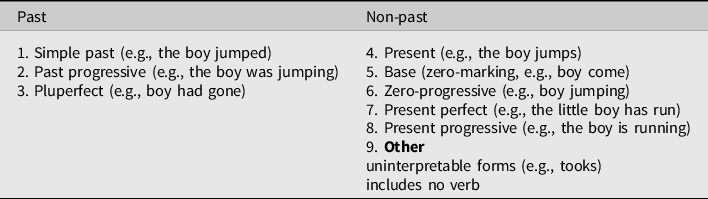
Following the coding scheme used in Bardovi-Harlig’s (Reference Bardovi-Harlig1995, Reference Bardovi-Harlig2001) works, care was taken in analyzing the occurrences of verb forms guided by the research questions. In coding and calculating the distribution of the appropriate use of the past tense, verbs were first split into regular verbs (e.g., jump/jumped, walk/walked) and irregular verbs (e.g., come/came, run/ran). Propositions that required but lacked verbs were coded as “no verb” (e.g., the boy happy) and counted as either foreground or background depending on the meaning of the phrase. Verbs that have the same form for the past and base were excluded from the sample (e.g., hit, put, let). However, when these verbs were inflected (e.g., the boy puts his boots on), they were coded accordingly (e.g., simple present for “puts”).
When a learner repeated the identical form of a verb, it was counted only once to avoid inflating the number of propositions in the oral narratives (e.g., the boy jumped, the little boy jumped). When a verb form was repeated but not in the same form, the ratio of forms was calculated. For instance, when a learner produced, “the boy came, the boy come, the boy comes,” the total number of verbs was 1.0 and the ratios for the simple past (e.g., “came”), simple present (e.g., “comes”), and uninflected base forms (e.g., “come”) were 0.33 each. Learner production of modal verbs (e.g., can, could, should) was excluded from the analysis. Finally, the overgeneralized use of the past tense morpheme for an irregular verb (e.g., the boy finded the dog) was coded as simple past. Any utterances that were not directly relevant to the storyline were excluded from the analysis, such as “the end” at the end of the children’s story productions, the children’s questions, and their responses to the research assistants’ requests for elaboration. All the verbs produced by a total of 38 children over 3 time points were coded by 2 trained research assistants. When disagreement occurred between the two, Kang reviewed and decided on coding. The inter-coder reliability was calculated using Cohen’s kappa. For grounding, it was .73, and for the verbal morphology, it was .96.
Results
The oral narratives based on the wordless picture book Where Are You, Frog? (Mayer, Reference Mayer1969) in three points in time showed variation in length across time and individual learners. Table 2 presents the descriptive statistics of the raw occurrences of past and non-past forms used in the foreground and background of the oral narratives produced across kindergarten, Grade 1, and Grade 2. Overall, an increase in the occurrences of verbs was observed over time, which suggests that children produced longer stories as they developed. Children in kindergarten employed non-past tense forms more frequently than past tense forms, regardless of grounding, when telling picture-elicited stories. The use of past tense forms was more frequent than that of non-past tense forms in Grades 1 and 2. This finding could, in part, be attributable to the classification of non-inflected base forms as a non-past tense form.
Means and standard deviations at all time points for tense and aspect use by grounding
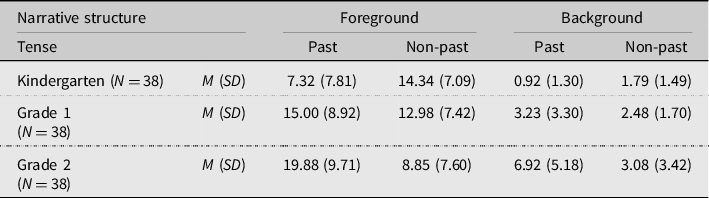
To examine the relative occurrences of verb forms in each grounding in relation to the total numbers of verb forms, the counts of verb forms in the foreground and background per grade level were standardized, as given in Table 3. The learners yielded 890 verbs for the foreground function and 123 verbs for the background of a story in kindergarten, 1,100 and 245 for the foreground and background respectively in Grade 1, and 1,110 and 394 for the foreground and background respectively in Grade 2. As they develop linguistically and cognitively, children appear to produce more verbs regardless of the grounding. Moreover, the proportion of verbs that conveyed the background information increased over time from 12% in kindergarten to 18% in Grade 1 and 26% in Grade 2. This finding suggests that children tend to provide more commentary and evaluative details when telling a story as they become more proficient in the target language.
Distribution of verbal morphology in narratives across grade levels
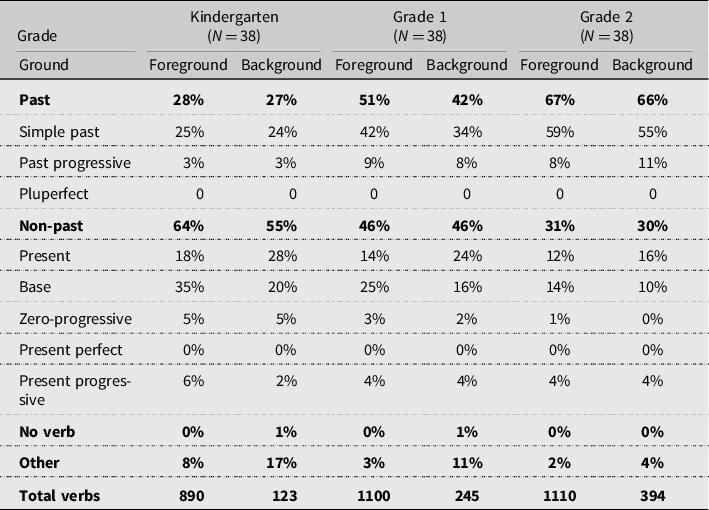
The categories of past and non-past verb forms were divided into distinct tense–aspect forms: simple past, past progressive, and pluperfect for past forms and base, present progressive, progressive, and present perfect for non-past forms. Overall, whereas the use of non-past tense forms decreased, the use of past tense forms proportionally increased over time. Of interest is that as learners developed their proficiency in English, they showed more uses of the simple past forms in telling a story but fewer uses of the base or simple present forms. That is, during the early developmental phases, such as kindergarten, the learners employed non-inflected base forms more frequently than the simple present or simple past. In contrast to the notable occurrences of the progressive aspect, including the present and past progressive, no use of past, present, or pluperfect forms was observed in the learners’ oral narratives.
In addition to the linguistic nature of verb forms, grounding as a linguistic environment influenced the distribution of tense and aspect forms in the current study. Across the grade levels, the learners yielded more foreground information than background information in telling stories based on the wordless picture book. As they developed proficiency in English, their stories contained more verbs and more details. Of further note is that the learners’ stories contained proportionally more background information as they produced longer stories with more verbs, as reflected by 394 verbs used in the background in Grade 2, a significant increase from the 245 verbs used in Grade 1, as shown in Table 3. Despite the notable increase in the number of verbs used to provide background information, relatively little change was observed in the number of verbs employed to advance storylines: 1,100 verbs in Grade 1 to 1,110 verbs in Grade 2.
As learners produced longer stories with more verbs, their use of the simple past and past progressive increased, as shown in Table 3. Moreover, the simple past was used more frequently in the foreground than in the background (25% versus 24% in kindergarten, 42% versus 34% in Grade 1, and 59% versus 55% in Grade 2). By contrast, the use of the simple present was less frequent in the foreground than in the background (18% versus 28% in kindergarten, 14% versus 24% in Grade 1, and 12% versus 16% in Grade 2). Although their frequency of use decreased over time, non-inflected base forms were found in the foreground more frequently than in the background across the grade levels.
Because the data were collected from L2 learners whose L1s were Cantonese (N = 16) and Spanish (N = 22), independent samples t-tests were used to compare the two groups of learners in terms of their use of past and non-past tense forms in kindergarten, Grade 1, and Grade 2 in relation to narrative organization (foreground and background). The results of normal Q–Q plots and the Shapiro–Wilk test show the normality of the proportions of past and non-past tense forms in relation to grounding across kindergarten, Grade 1, and Grade 2. The assumption of homogeneity of variance was also checked, using Levene’s test of equality of variances. The significance values were greater than 0.05, which suggests equal variances, meeting the assumption of homogeneity of variances, in most of 12 cases, except for the three cases: the non-past tense forms in the foreground during kindergarten (p = .01); the non-past tense forms in the foreground in Grade 2 (p = .02); and the past tense forms in the foreground in Grade 2 (p = .02). To accommodate unequal variances, Welch t-tests were performed on the above three cases (Field, Reference Field2013).
After checking the assumptions of normality and equal variances, nine independent samples t-tests and three modified Welch t-tests for the comparison of groups with unequal variances were performed: 2 grounding options, 3 grade levels, and 2 tense forms. The results of the t-tests indicate no significant differences between the Cantonese- and Spanish-L1 groups in the use of past and non-past tense forms regardless of grounding in kindergarten and Grade 2 and in past and non-past tense forms in the foreground in Grade 1. The significant difference between the two L1 groups of children was only observed for the use of past and non-past tense forms in the background in Grade 1 (p = .10 and p < .05).
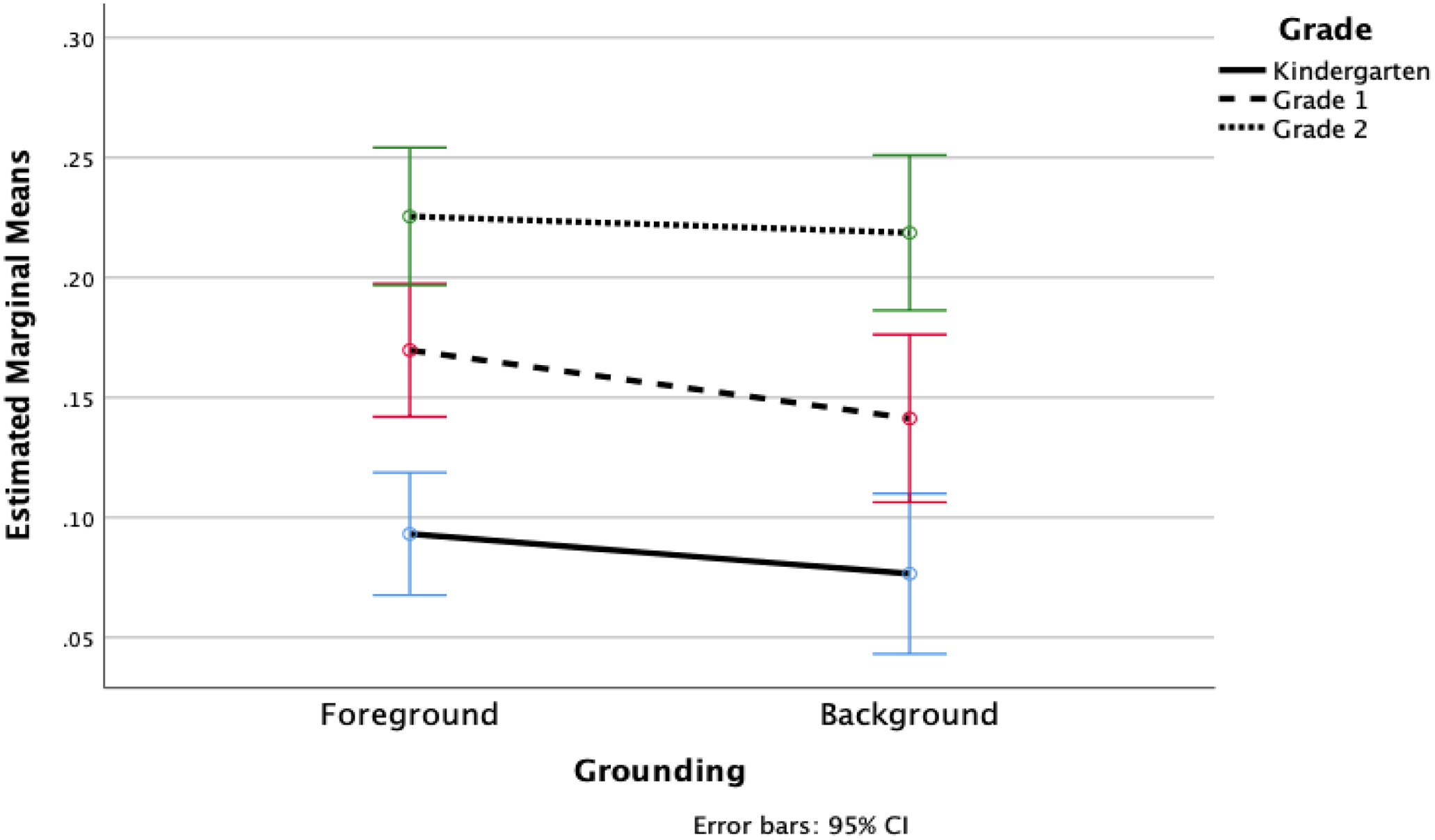
To examine changes in the use of past and non-past forms throughout kindergarten, Grade 1, and Grade 2 in relation to the narrative organization (foreground and background), 2-way repeated measure ANOVAs were conducted. With grade level and grounding as within-subject variables, 2-way ANOVAs with repeated measures were performed on the uses of past and non-past forms as dependent variables. For the 2-way repeated measure ANOVAs with the past tense forms of the simple past, past progressive, and pluperfect, Mauchly’s test reveals that the assumptions of sphericity for the grade-level factor (X 2[2] = .92, p = .22) and the interaction of grade and grounding (X 2[2] = .93, p = .28) were met. The sphericity for the grounding factor was not considered because sphericity typically holds for factors with only 2 levels. There was a significant main effect of grade level, with a large effect size (F[2, 74] = 38.16, p = < .001, η p 2 = .62). Post hoc testing using the Bonferroni correction indicated significant differences in the use of past tense forms across the 3 points in time at the 0.5 level, suggesting an increase in the use of past tense forms from kindergarten to Grade 1 and Grade 2.
The main effect of grounding on the use of past tense forms was also statistically significant (F[1, 37] = 4.95, p = .03, η 2 p = .12), such that participants used more past tense forms in the foreground than in the background, as illustrated in Figure 1. However, the interaction between grade level and grounding was not statistically significant (F[2, 74] = .67, p = .51). More frequent use of past tense forms in the foreground than in the background was observed throughout the 3 points in time.
Estimated Marginal Means of Past Tense Forms by Grounding across Kindergarten through Grade 2.
Another 2-way ANOVA with repeated measures was conducted on the ratios of non-past tense forms in the foreground and background at each grade level as dependent variables. The non-significant result of Mauchly’s test for the grade-level factor showed that the condition of sphericity was satisfied (X 2[2] = .97, p = .53). By contrast, the result of Mauchly’s test of sphericity for the interaction between grade level and grounding suggests violation of the assumption of sphericity (X 2[2] = .77, p = .01). To resolve this problem, the Huynh-Feldt correction was used to adjust the degree of freedom for the tests of significance.
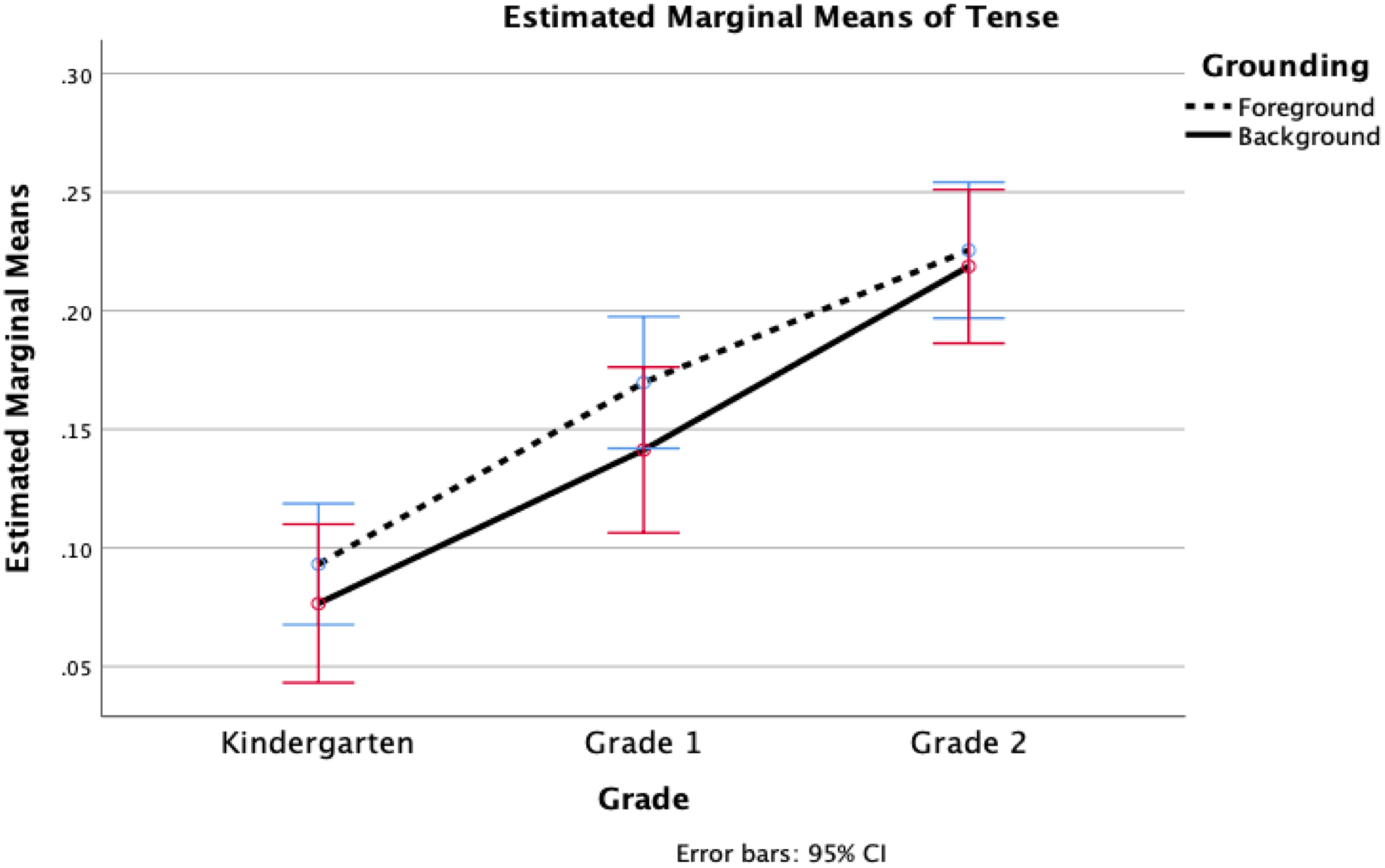
There was a significant main effect of grade level on the use of non-past tense forms (F[2, 74] = 15.20, p = .00, η p 2 = .42). The results of post hoc testing with the Bonferroni correction demonstrate that whereas the mean difference in the use of non-past tense forms between kindergarten and Grade 1 was not statistically significant (p = .13), the differences between kindergarten and Grade 2 and between Grade 1 and Grade 2 were significant (p < .001). As shown in Figure 2, as they developed proficiency, the learners exhibited less frequent use of non-past tense forms, although the difference was not always statistically significant. There was a non-significant main effect of grounding on the use of non-past tense forms (F[1, 37] = 3.35, p = .08).
Estimated Marginal Means of Non-Past Tense Forms by Grounding across Kindergarten through Grade 2.
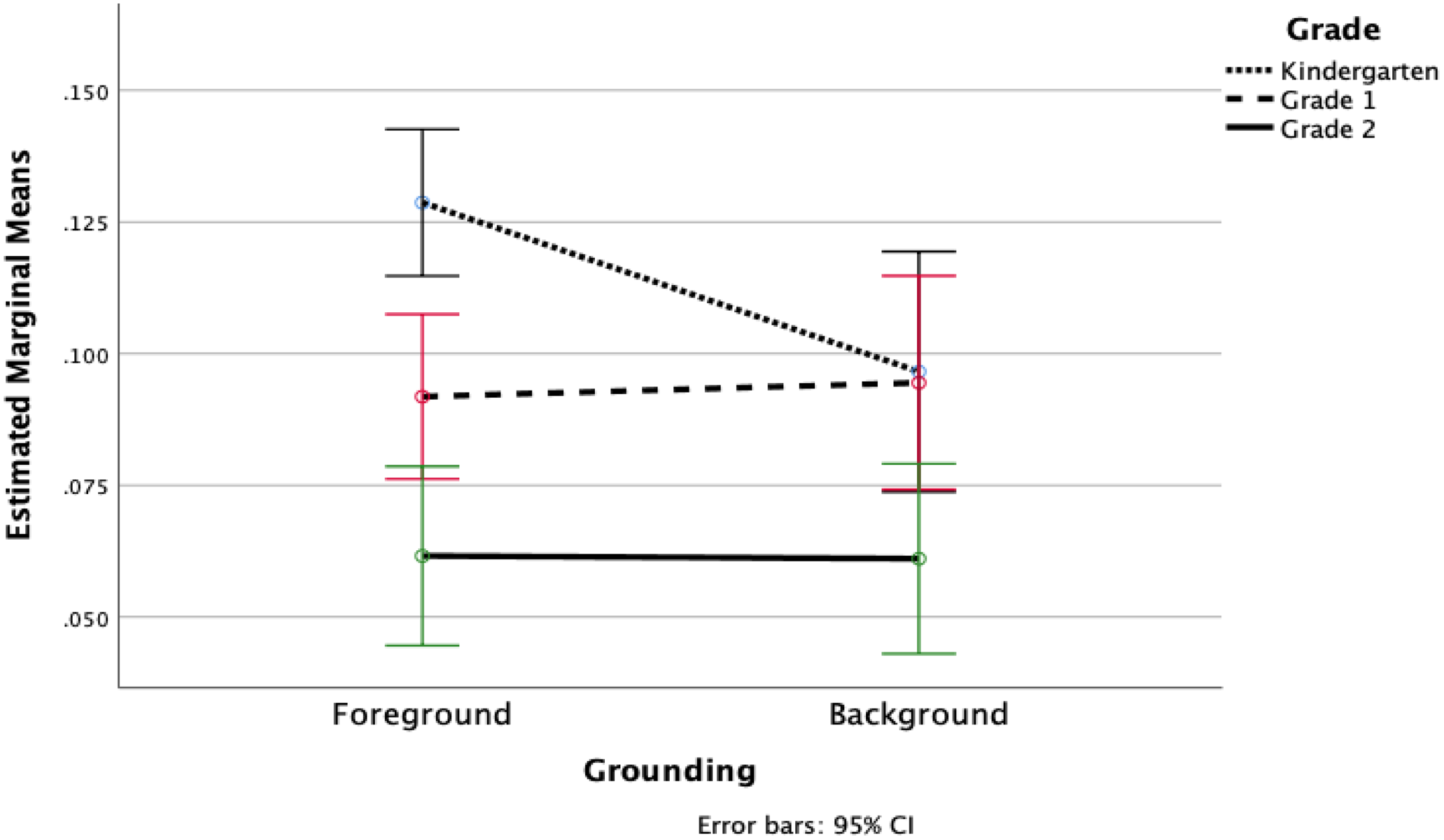
The results of a repeated measures ANOVA with a Huynh-Feldt correction show a statistically significant interaction between grade level and grounding (F[1.70, 62.80] = 5.10, p = .01, η p 2 = .85). This effect indicates that the profile of ratios across the grade levels was different for the foreground and background, as shown in Figure 3. The significant interaction between grade level and grounding was further examined by testing the simple main effects of grounding for each grade level. Paired sample t-tests were run to determine whether there was a statistically significant mean difference in the use of non-past tense forms between foreground and background at each grade level. The mean differences between foreground and background in the use of non-past tense forms at Grade 1 and Grade 2 were not statistically different. When they were in kindergarten, however, learners used more non-past tense forms in the foreground (0.128 ± 0.04) than in the background (0.096 ± 0.07), with a statistically significant difference of 0.032 ([95% CI, 0.010 to 0.053], t[37] = 3.06, p < .002).
Estimated Marginal Means of Non-Past Tense Forms by Grounding.
Discussion
The goal of the current study was to examine the developmental trajectory of L2 English tense and aspect in relation to narrative organization (foregrounding and backgrounding) in the context of child L2 acquisition. The findings of this study illustrate that young learners’ use of tense and aspect forms in L2 English oral narratives is influenced by discourse organization. The foreground was associated with more frequent use of the simple past than the background in oral narratives across grade levels, kindergarten through Grade 2. Whereas the use of the simple past did not necessarily mark the foreground, the simple past emerged as the dominant form in the foreground in Grade 1, when learners used the past in contexts where past forms were required, and it became dominant in Grade 2. In the background, on the other hand, it took longer for the past forms to catch up with the non-past forms. The simple past emerged as a dominant form in the background in Grade 2.
Grade level, or L2 proficiency level, was also shown to play a part in shaping the distribution of verbal morphology in child L2 acquisition. In other words, the delineation of grounding changed as learners became more proficient in the L2 tense aspect sphere. As demonstrated in varied proportions of marking of the foreground over the background by the learners at varying proficiency levels in Bardovi-Harlig’s (Reference Bardovi-Harlig1992, Reference Bardovi-Harlig1995) studies and Flashner’s (Reference Flashner, Dechert and Raupach1989) work, the current study illuminates the role that grade level, or L2 proficiency level, plays in determining the distribution of tense aspect marking in L2 narratives. Kindergarteners, relatively low proficiency level learners, began to use past forms in the foreground while employing simple present forms more frequently than other forms in the background. When the same children produced oral narratives in Grade 2, they showed frequent uses of simple past tense forms in the foreground while employing diverse forms, including simple present, present progressive, and past progressive forms, in the background.
Our findings lend support for the discourse hypothesis (Andersen & Shirai, Reference Andersen and Shirai1994; Bardovig-Harlig, Reference Bardovi-Harlig1995, Reference Bardovi-Harlig2000; Bardovi-Harlig & Comajoan-Colomé, Reference Bardovi-Harlig and Comajoan-Colomé2020) in that the distributions of tense and aspect forms are shaped by the narrative organization (foreground and background). The oral narratives across kindergarten, Grade 1, and Grade 2 indicate more frequent use of past forms in the foreground than in the background and greater variance of verb use in the background than in the foreground. Distinct from the previous research on the first emergence of the simple past in the foreground (e.g., Bardovi-Harlig, Reference Bardovi-Harlig1995, Reference Bardovi-Harlig2000), the current study instead shows more frequent use of non-inflected base forms and less frequent use of “other” forms in the foreground than in the background. In Grade 2, the simple past became the dominant tense in the background at 55% use, which suggests that the simple past dominated the background in a later period. Yet the use of the simple past in the background was not as frequent as that in the foreground at 59% use, attributed to the more frequent use of other past tense forms, such as the past progressive at 11% use in the background relative to 8% use in the foreground in Grade 2.
Of note is that the adult L2 learners in Bardovi-Harlig’s (Reference Bardovi-Harlig1995, Reference Bardovi-Harlig2000) studies showed more frequent use of present/past perfect and past progressive forms in the background than in the foreground. The children in the current study, on the other hand, showed no use of present/past perfect markers in their oral narratives. The literature has reported that children experience more difficulties using present perfect verbs than other verb forms due to considerable linguistic and cognitive complexity associated with the present perfect (see Johnson, Reference Johnson1985; Theakston & Lieven, Reference Theakston and Lieven2005). The absence of present and past perfect forms in the children’s narratives supports the earlier research on the relative difficulty of present and past perfect forms over present and past progressive forms. This additional finding suggests that while they demonstrated their understanding of different verb forms in relation to grounding in storytelling from kindergarten to Grade 2, the children chose to use progressive forms, staying away from perfect forms.
Of further interest is that the two groups of Cantonese-English and Spanish-English bilingual children showed little or no difference in the distribution of L2 English tense and aspect forms in relation to grounding across the developmental stages, kindergarten, Grade 1, and Grade 2. The only disparity between the two groups of children was observed in the distribution of past and non-past forms in Grade 1. This finding may have derived from the rich aspect-related marking systems available in Cantonese and Spanish (Matthews & Yip, Reference Matthews and Yip1994; Slobin & Bocaz, Reference Slobin and Bocaz1988; Uccelli, Reference Uccelli2009; Yap et al., Reference Yap, Chu, Yiu, Wong, Kwan, Matthews and Shirai2009). No significant difference between the two groups of bilingual children was observed in the initial stage, kindergarten in this study in which L1 effects are presumed to be stronger than advanced stages. The relative absence of cross-linguistic differences in this study, especially in the initial stage of development, is rather divergent from the previous research on the effects of L1 properties on L2 learning trajectories and outcomes (Andreou & Tsimpli, Reference Andreou and Tsimpli2017; Blom et al., Reference Blom, Chondrogianni, Marinis and Vasić2016). As reported in Van Dijk et al.’s (Reference Van Dijk, Van Wonderen, Koutamanis, Kootstra, Dijkstra and Unsworth2021) meta-analysis such that the effects of L1 properties on L2 learning tend to fade away when the L2 becomes a dominant language for learners, the current findings on the lack of cross-linguistic differences may suggest that English might have taken over as the dominant language and transfer, if ever, might have taken place from a less dominant language, Cantonese and Spanish to a more dominant language, English. Considering that the children were using English as the medium of schooling at the time of data collection, the dominant language of the two groups of children in this study would have become L2 English, as noted in the literature (e.g., Polinsky & Kagan, Reference Polinsky and Kagan2007), which led us to treat the Cantonese- and Spanish-speaking learners as one group. Possible effects of L1 differences may have been cancelled out in the distribution of verbal morphology in the learners’ dominant language, L2 English.
The results of this longitudinal study help expand the knowledge base on L2 acquisition of tense and aspect. The previous literature in this area has largely focused on cross-sectional designs (e.g., Andreou & Tsimpli, Reference Andreou and Tsimpli2017; Blom et al., Reference Blom, Chondrogianni, Marinis and Vasić2016 for children; Bardovi-Harlig, Reference Bardovi-Harlig1995, Reference Bardovi-Harlig2000; Kang et al., Reference Kang, Kim and Christianson2019 for adult L2 learners) or small-scale case studies (e.g., Lee, Reference Lee2001 for children; Flashner, Reference Flashner, Dechert and Raupach1989; Housen, Reference Housen, Vet and Vetters1994 for adults). The current findings based on the oral narratives elicited from the same children over the course of 3 years are, by and large, consistent with the previous findings derived from a comparison of L2 learners of different proficiency levels (Bardovi-Harlig, Reference Bardovi-Harlig1995, Reference Bardovi-Harlig2000). Although the background is associated with some degree of diversity in tense and aspect, with simple past co-occurring with base and present tense forms, the foreground exhibits simple past and base forms almost exclusively, especially in kindergarten. The later stages of development, such as Grade 2, show greater diversity in tense and aspect in the background, with the past progressive used in the background in addition to the simple past, base, and present tense forms.
These findings suggest competition between forms from the perspective of narrative, as noted in adult L2 learners’ developmental patterns (Bardovi-Harlig, Reference Bardovi-Harlig1995, Reference Bardovi-Harlig2000), as well as in L1 acquisition (Shapiro & Hudson, Reference Shapiro and Hudson1991). In the foreground, the essential competition between forms is between the simple past and base forms, especially during the earlier stages of L2 development. However, as learners develop their proficiency and grapple with tense–aspect morphology, young learners’ preference for simple past over other inflected forms is demonstrated regardless of background or foreground as a linguistic environment, in part because narrative production is elicited through pictures, and the stories can be easily interpreted as completed (see Slabakova & Montrul, Reference Slabakova, Montrul, Liceras, Zobl and Goodluck2007; Shapiro & Hudson, Reference Shapiro and Hudson1991; Uccelli, Reference Uccelli2009).
Conclusions
Using a longitudinal design, the current study examined the developmental patterns of L2 English tense and aspect in relation to narrative organization from kindergarten through Grade 2. Irrespective of their L1, Cantonese- and Spanish-speaking children exhibited the significant role of narrative organization in the L2 development of English tense and aspect. The simple past emerged as a dominant form in the foreground earlier than in the background. The grade level also proved to influence the distribution of tense and aspect marking in L2 narrative. Whereas children in kindergarten began to show past tense forms in the foreground, those in Grade 2 exhibited frequent use of past tense forms in the foreground and background. The current findings enhance the validity of the discourse hypothesis within a different learner group using a different research design and method: the elicited oral narratives of young learners enrolled in dual language programs across kindergarten, Grade 1, and Grade 2.
Despite the merits of this study, it is worthwhile to mention the potential caveats, which may provide direction for future research in this area. First, the current design has no oral narrative data from a comparison or control group composed of English monolingual children in kindergarten, Grade 1, and Grade 2. It would have been of interest to compare the performance of the children learning English as an additional language against that of English monolingual children. Another related missing piece in the current study is the participating children’s performance in Cantonese or Spanish. It is crucial to test the validity of the discourse hypothesis in the context of bilingual children’s use of tense and aspect systems in the two languages. Lastly, considering the focus on narrative organization and grade level in the current study, the next step in the investigation will be to analyze the children’s narrative data in terms of the lexical aspect, as Bardovig-Harlig (Reference Bardovi-Harlig2000) analyzed adult L2 learners. It would be of significance to examine how the inherent semantic nature of lexical verbs used by children over time shapes the distribution of tense and aspect markers, depending on the linguistic environment, foreground, and background.
Acknowledgements
We thank Mayu Lindblad and Claire Kang for their assistance with the data coding.
Appendix
Examples of coding foreground and background in a child’s narratives at kindergarten, grade 1, and grade 2 kindergarten

Grade 1

Grade 2


 Open access

