





Introduction
Major Depressive Disorder (MDD) accounts for one of the largest shares of the world’s burden of disease (Kessler et al., Reference Kessler, Bromet, de Jonge, Shahly and Wilcox2017; Liu et al., Reference Liu, He, Yang, Feng, Zhao and Lyu2020; Smith et al., Reference Smith, McLean, Martin, Martin, Guthrie, Gunn and Mercer2014). The lifetime and one-year prevalence rates of MDD in adolescence are 19% and 7.5%, respectively (Avenevoli et al., Reference Avenevoli, Swendsen, He, Burstein and Merikangas2015; Shorey, Ng, & Wong, Reference Shorey, Ng and Wong2022). MDD in adolescents increases the odds of developing subsequent depression in adulthood by around 2.7 times and often predicts poor quality of life in adulthood (Clayborne, Varin, & Colman, Reference Clayborne, Varin and Colman2019; Johnson et al., Reference Johnson, Dupuis, Piche, Clayborne and Colman2018; Zisook et al., Reference Zisook, Lesser, Stewart, Wisniewski, Balasubramani, Fava and Rush2007). Recently, there is accumulating evidence that depressive symptoms can occur in individuals who do not have an MDD diagnosis – a phenomenon that is called subthreshold depression (‘SD’), an umbrella term for sub-syndromal, sub-clinical, and mini depression (Bertha & Balázs, Reference Bertha and Balázs2013). Although the definition of SD varies by number, frequency, and duration of symptoms (Carrellas, Biederman, & Uchida, Reference Carrellas, Biederman and Uchida2017), most studies define SD as the presence of two to four depressive symptoms lasting for two weeks or longer (Noyes et al., Reference Noyes, Munoz, Khalid-Khan, Brietzke and Booij2022; Rodríguez, Nuevo, Chatterji, & Ayuso-Mateos, Reference Rodríguez, Nuevo, Chatterji and Ayuso-Mateos2012). Even though SD is not a formal psychiatric diagnosis according to current classifications of disease and diagnostic manuals such as ICD-11 and DSM-5, studies suggested that SD in adolescence is as impairing as MDD and would increase the chance of developing MDD in adulthood by 2.95 times when compared with healthy controls (‘HC’) (review by Zhang et al., Reference Zhang, Peng, Song, Long, Wang, Zhang and Lee2023; see also Carrellas et al., Reference Carrellas, Biederman and Uchida2017; Kwok et al., Reference Kwok, So, Chan, Tsoi, Ma, Wong and Leung2025; Noyes et al., Reference Noyes, Munoz, Khalid-Khan, Brietzke and Booij2022). However, the phenomenological and etiological continuum of SD and MDD is still unclear.
The alteration in day-to-day affective experiences is central to the spectrum of depression. Previous research has suggested that individuals with depression had significantly greater intensity of negative affect when compared with healthy controls (Sheeber et al., Reference Sheeber, Allen, Leve, Davis, Shortt and Katz2009). In the last two decades, the advent of the experience sampling method (ESM) has expanded the repertoire of assessing affective experiences from mean levels only to the entire affective dynamics, encompassing the trajectories, patterns, and regularities when emotions fluctuate across time, their underlying processes, and downstream consequences (Kuppens, Stouten, & Mesquita, Reference Kuppens, Stouten and Mesquita2009; Kuppens & Verduyn, Reference Kuppens and Verduyn2015; Sander, Grandjean, & Scherer, Reference Sander, Grandjean and Scherer2005). As a structured diary in the respondent’s living environment that captures subjective moment-to-moment experiences (Kramer et al., Reference Kramer, Simons, Hartmann, Menne-Lothmann, Viechtbauer, Peeters and Wichers2014; Myin-Germeys et al., Reference Myin-Germeys, Oorschot, Collip, Lataster, Delespaul and Van Os2009, Reference Myin-Germeys, Kasanova, Vaessen, Vachon, Kirtley, Viechtbauer and Reininghaus2018), ESM covers the following additional parameters of affective dynamics: (i) affective variability, the range or amplitude of an individual’s level of affect across time (Koval, Pe, Meers, & Kuppens, Reference Koval, Pe, Meers and Kuppens2013; Peeters et al., Reference Peeters, Berkhof, Delespaul, Rottenberg and Nicolson2006); (ii) affective inertia, the auto-correlation coefficient of how affect self-predicts over time (Kuppens, Allen, & Sheeber, Reference Kuppens, Allen and Sheeber2010); and (iii) affective reactivity, the change of an individual’s PA or NA level in response to a valenced external stimulus, such as pleasurable or stressful daily events (Bylsma, Morris, & Rottenberg, Reference Bylsma, Morris and Rottenberg2008; So et al., Reference So, Chau, Chung, Leung, Chong, Chang and Sommer2023).
Mean levels of PA and NA are well-researched among adults and adolescents with clinical depression. For example, in a review of 102 ESM studies with a sample size of 19,928, Reitsema, Jeronimus, van Dijk, and de Jonge (Reference Reitsema, Jeronimus, van Dijk and de Jonge2022) suggested that adolescents with MDD often experienced a lower mean level of positive affect (PA) and a higher mean level and variability of negative affect (NA) when compared with HC. However, other parameters of affective dynamics are less studied, usually involving adults only. For affective variability, higher NA variability was consistently found in MDD than HC (Lamers et al., Reference Lamers, Swendsen, Cui, Husky, Johns, Zipunnikov and Merikangas2018; Nelson, Klumparendt, Doebler, & Ehring, Reference Nelson, Klumparendt, Doebler and Ehring2020; Panaite, Rottenberg, & Bylsma, Reference Panaite, Rottenberg and Bylsma2020; Thompson, Bailen, & English, Reference Thompson, Bailen and English2021), but evidence for PA variability was mixed (Mukherjee, Lee, & Almeida, Reference Mukherjee, Lee and Almeida2023; Nelson et al., Reference Nelson, Klumparendt, Doebler and Ehring2020; Thompson et al., Reference Thompson, Bailen and English2021). For inertia, ESM studies suggested no significant difference in PA inertia between MDD and HC (Heininga et al., Reference Heininga, Dejonckheere, Houben, Obbels, Sienaert, Leroy and Kuppens2019; Lamers et al., Reference Lamers, Swendsen, Cui, Husky, Johns, Zipunnikov and Merikangas2018; Nelson et al., Reference Nelson, Klumparendt, Doebler and Ehring2020; Panaite et al., Reference Panaite, Rottenberg and Bylsma2020; Thompson et al., Reference Thompson, Mata, Jaeggi, Buschkuehl, Jonides and Gotlib2012, Reference Thompson, Bailen and English2021), whereas NA inertia may or may not be higher in MDD than HC (Kuppens et al., Reference Kuppens, Allen and Sheeber2010; Lamers et al., Reference Lamers, Swendsen, Cui, Husky, Johns, Zipunnikov and Merikangas2018; Nelson et al., Reference Nelson, Klumparendt, Doebler and Ehring2020; Panaite et al., Reference Panaite, Rottenberg and Bylsma2020; Thompson et al., Reference Thompson, Bailen and English2021).
For affective reactivity, there is evidence that adults with MDD are more reactive to event-related pleasure/stress than HC in terms of increases in both PA and NA (Bylsma, Taylor-Clift, & Rottenberg, Reference Bylsma, Taylor-Clift and Rottenberg2011; Mukherjee et al., Reference Mukherjee, Lee and Almeida2023; Thompson et al., Reference Thompson, Mata, Jaeggi, Buschkuehl, Jonides and Gotlib2012). In particular, there is ESM evidence that MDD groups are more susceptible to the ‘mood-brightening effect’ (Peeters et al., Reference Peeters, Nicolson, Berkhof, Delespaul and deVries2003) than HC, where patients are prone to reduced NA upon experiencing event-related pleasure even after baseline affect is controlled for (Bylsma et al., Reference Bylsma, Taylor-Clift and Rottenberg2011; Heininga et al., Reference Heininga, Van Roekel, Ahles, Oldehinkel and Mezulis2017; Khazanov, Ruscio, & Swendsen, Reference Khazanov, Ruscio and Swendsen2019; Thompson et al., Reference Thompson, Mata, Jaeggi, Buschkuehl, Jonides and Gotlib2012). While these findings appear to suggest that exposure to event-related pleasure may be helpful for mood uplift, non-ESM, lab-based studies reported that adults with MDD displayed reduced reactivity to emotional cues when compared with HC, a phenomenon later coined as Emotional Context Insensitivity (ECI) (Rottenberg, Gross, & Gotlib, Reference Rottenberg, Gross and Gotlib2005). A recent systematic review also pointed out that adolescents with depression, when compared with HC, experienced higher levels of consummatory anhedonia (Beames et al., Reference Beames, Uyttebroek, Edwards, Eisele, Kemme, Collier and Myin-Germeys2025). Therefore, whether individuals with MDD are more or less reactive to external affective stimuli remains inconclusive. More importantly, the above findings may not be generalizable to adolescents as the latter may have unique affective dynamics (Rice et al., Reference Rice, Riglin, Lomax, Souter, Potter, Smith and Thapar2019; Wight, Sepúlveda, & Aneshensel, Reference Wight, Sepúlveda and Aneshensel2004). The unique dynamics may be exacerbated by the earlier maturation of limbic regions than the prefrontal cortex, which may create greater emotional reactivity but a comparatively underdeveloped capacity for emotion regulation (Caballero, Granberg, & Tseng, Reference Caballero, Granberg and Tseng2016; Somerville, Reference Somerville2016; Young, Sandman, & Craske, Reference Young, Sandman and Craske2019). Capturing their affective reactivity can aid understanding of the underlying factors of their affective profile, such as stress sensitivity, which has been shown to be highly correlated with depressive symptoms severity in adolescents (Wichers et al., Reference Wichers, Peeters, Geschwind, Jacobs, Simons, Derom and Van Os2010).
To date, there have been no ESM studies that directly compared any of the above affective dynamic parameters across adolescents with MDD, SD, and HC. Some adult studies, using ESM, have compared anecdotal aspects of affective dynamics across groups along the clinical spectrum of depression. Compared with HC, adults with SD (Song et al., Reference Song, Niu, Admon, Long, Li, Peng and Zhang2024) and minor depression (Bylsma et al., Reference Bylsma, Taylor-Clift and Rottenberg2011) displayed lower levels of PA and higher levels of NA. As for variability, a graded difference with MDD being the strongest, followed by remitted MDD (individuals experiencing at least two depressive episodes) and HC were observed for NA but not PA (Thompson et al., Reference Thompson, Bailen and English2021), echoing the positive correlation between severity of depressive symptoms and affective variability (van Roekel et al., Reference van Roekel, Bennik, Bastiaansen, Verhagen, Ormel, Engels and Oldehinkel2016). In terms of inertia, SD displayed higher PA inertia but similar NA inertia to HC (Song et al., Reference Song, Niu, Admon, Long, Li, Peng and Zhang2024). For affective reactivity, Bylsma et al. (Reference Bylsma, Taylor-Clift and Rottenberg2011) reported that individuals with minor depression had higher NA reactivity to positive events than HC, but did not differ from MDD or HC on PA reactivity to event-related pleasure/stress and NA reactivity to event-related stress. Hence, the current lack of ESM studies that directly compared affective dynamic parameters across adolescents with MDD, SD, and HC presented a critical research gap that could potentially inform early interventions targeting adolescents’ affective dynamics.
The present study aims to examine affective experiences along the clinical spectrum of depression by comparing a broader spectrum of affective dynamic parameters (levels of magnitude, affective variability, inertia, and reactivity) of both positive and negative affect in the flow of daily life across three groups of adolescents: MDD, SD, and HC. The grouping was carefully determined by the Diagnostic Interview Schedule for Children (“DISC-5”) (Shaffer et al., Reference Shaffer, Fisher, Lucas, Dulcan and Schwab-Stone2000). We hypothesized graded group differences in affective dynamics as follows:
-
1. The level of PA will be the lowest in the MDD group, followed by SD, and then HC; NA will be the highest in the MDD group, followed by SD, and then HC.
-
2. There will be heightened NA variability in the MDD group, followed by SD, and then HC.
-
3. There will be heightened PA and NA inertia in the MDD group, followed by SD, and then HC.
-
4. There will be heightened NA reactivity to event-related pleasure in the MDD group, followed by SD, and then HC.
Method
This project was approved by the Joint Chinese University of Hong Kong – New Territories East Clinical Ethics Committee (Ref. No: 2021.711). The study complied with the ethical standards of the relevant national and institutional committees on human experimentation and the Declaration of Helsinki of 1975, as revised in 2008. Written informed consent was obtained from all adolescent participants and their carers.
Sample
The sample consisted of three groups of adolescents (age 12–18) with the following inclusion criteria:
-
1. Major Depressive Disorder (MDD): adolescents meeting the DSM-5 diagnostic criteria of current MDD (in the past year).
-
2. Subthreshold Depression (SD): adolescents presenting with two or more depressive symptoms, one of which is depressed mood or anhedonia for at least 2 weeks, while the entire symptom profile does not reach MDD.
-
3. Healthy Control (HC): adolescents without psychiatric diagnoses in the past year and do not meet the criteria for SD.
Across groups, adolescents with a diagnosis of severe mental disorders (i.e. schizophrenia and bipolar disorder), intellectual disability, brain injury, or any organic disease were excluded. The sample came from multiple sources, including an epidemiologic study in Hong Kong named ‘The Hong Kong Child and Adolescent Psychiatric Epidemiologic Survey: Age 6 to 17’ (Chan et al., Reference Chan, Wong, Hussain, Tsoi, Ma, Chau and Leung2025; Chau et al., Reference Chau, Hussain, Chan, Wong, Zhang, Feng and Leung2023). Other sources included clinicians’ referrals from child and adolescent psychiatric services of local hospitals, private psychiatric and clinical psychology clinics, and teachers’ referrals from secondary schools in Hong Kong. Regular contact between the research team and clinicians and responsible staff from the school was maintained. For clinics, only participants deemed eligible by the clinician were referred to the research team.
Sample size calculation
The summary-statistics-based approach of power calculation for multi-level models has been adopted (Murayama, Usami, & Sakaki, Reference Murayama, Usami and Sakaki2022). Taking reference from the t-value and level-2 sample size from a similar study that compared affective dynamics between MDD, remitted MDD, and healthy controls using 2 weeks of ESM (Thompson et al., Reference Thompson, Bailen and English2021), a medium effect size has been obtained for the subsequent G*Power analysis (f = 0.25, power = 0.8, alpha = 0.05). Results indicated that 53 participants per group, a total of 53*3 = 159 participants, would achieve a similar effect size for the current study.
Measures
Diagnostic interview schedule for children, version 5
Diagnostic Interview Schedule for Children, Version 5 (DISC-5) is a highly structured interview assessing adolescents’ psychiatric diagnoses in the past 12 months based on the DSM-5 criteria (Shaffer et al., Reference Shaffer, Fisher, Lucas, Dulcan and Schwab-Stone2000). In our study, two versions of DISC-5 were administered by trained research staff to the adolescents (self-report) and the carer (as informant), respectively. Any item was considered positive when endorsed by either the adolescent or the carer (Shaffer et al., Reference Shaffer, Fisher, Lucas, Dulcan and Schwab-Stone2000).
ESM
ESM was conducted individually by each participant on their mobile phone or an iPod Touch borrowed from our team with the app ‘PIEL Survey’ installed (Jessup, Bian, Chen, & Bundy, Reference Jessup, Bian, Chen and Bundy2012). The app generated beep signals randomly at an estimated interval of 60 minutes across 14 days: 5 beeps on weekdays (5-10 pm) and 10 beeps on weekends (12nn–10 pm). Participants were encouraged to respond to the survey as soon as possible after the signal (and before the survey disappeared from view after 6 minutes) (Heller, Fox, & Davidson, Reference Heller, Fox and Davidson2019; Lamers et al., Reference Lamers, Swendsen, Cui, Husky, Johns, Zipunnikov and Merikangas2018). The same 20-item survey was repeated throughout the 14-day assessment. Each survey took around 1–2 minutes to complete. The momentary items inquire the subjects’ levels of positive and negative affect, depressive symptoms, and contextual information (e.g. ‘where are you right now’). The participant’s activity experienced before the beep was probed by the question: “What was the main activity you have engaged since the last beep?.” It was followed by two questions about the pleasure and stress associated with that activity respectively: “How much pleasure did you feel in that activity?,” and “How much stress did you feel in that activity?.” Each question was rated on a 0–100 slider scale.
Other measures
Information on participants’ gender, date of birth, and contact was gathered. Participants then filled in The Center for Epidemiological Studies Depression Scale for Children (CES-DC; Shahid, Wilkinson, Marcu, & Shapiro, Reference Shahid, Wilkinson, Marcu and Shapiro2011) and The Social Readjustment Rating Scale (SRRS; Holmes & Rahe, Reference Holmes and Rahe1967). The 20-item CES-DC assesses the frequency of depressive symptoms in the past week, rated on a 0–3 scale. SRRS assesses the occurrence and impact of any significant events that occurred in the past 6 months on a 1–7 scale. Both scales have been applied locally with satisfactory internal validity (Li, Chung, & Ho, Reference Li, Chung and Ho2010; Wan & Leung, Reference Wan and Leung2010).
Procedure
Upon written consent, a graduate-level psychologist administered the DISC-5 interview to the adolescent and the carer separately. The adolescent completed the questionnaires independently. Subsequently, the research worker installed the ESM app for the adolescent and guided its use through practices. The ESM assessment began on the next day for 14 days. In the first few days, the research worker contacted the participant to make sure that they were on task. They also performed regular check-ins with the participant to encourage completion and to provide technical support when needed. Upon completing the procedures, participants were remunerated $300 HKD (~$38 USD) as a token of thanks.
Statistical analysis
Analysis was conducted with the GAMLj package in Jamovi (The jamovi project, 2025) and the lmerTest package in R (Bates, Mächler, Bolker, & Walker, Reference Bates, Mächler, Bolker and Walker2015; Kuznetsova, Brockhoff, & Christensen, Reference Kuznetsova, Brockhoff and Christensen2017).
Levels of PA and NA
The circumplex model of affect posits valence and intensity as the underlying neurophysiological mechanisms across all affective states (Larsen & Diener, Reference Larsen and Diener1987; Posner, Russell, & Peterson, Reference Posner, Russell and Peterson2005). This formed the basis for our differentiation of PA and NA items and for rating the items based on affective intensity. Momentary levels of PA and NA were calculated by averaging the three PA items (happy, relaxed, and contented) and the three NA items (irritated, low, and nervous), respectively, for each time point. The items were chosen as they were easy to understand, able to be captured in the moment (Fritz et al., Reference Fritz, Piccirillo, Cohen, Frumkin, Kirtley, Moeller and Bringmann2024) and have been used in our previous studies (So et al., Reference So, Chung, Tse, Chan, Chong, Hung and Sommer2021, Reference So, Chau, Chung, Leung, Chong, Chang and Sommer2023). To test Hypothesis 1, momentary levels of PA and NA were compared across groups using two separate multi-level models. The fixed effect of group and a random intercept for each subject were included to examine the effect of group on the levels of PA and NA, while accounting for repeated measurements within individuals.
Affective variability
Affective variability represents the person-specific dispersion in affect amplitude across the entire measurement period, which was operationalized as the average within-person standard deviation of affective levels, calculated separately for PA and NA (Koval et al., Reference Koval, Pe, Meers and Kuppens2013; Larsen & Diener, Reference Larsen and Diener1987; Trull, Lane, Koval, & Ebner-Priemer, Reference Trull, Lane, Koval and Ebner-Priemer2015). Higher affective variability suggests more marked overall fluctuations in that affect. To test Hypothesis 2, the within-person standard deviation of affect was averaged within each group and then compared across groups using ANOVA.
Affective inertia
Affective inertia was operationalized, separately for PA and NA, as the person-specific auto-regressive slope in a multilevel model, in which the intensity rating of an affective state at time t-1 predicted the intensity rating of that state at time t (Kuppens et al., Reference Kuppens, Allen and Sheeber2010; Suls, Green, & Hillis, Reference Suls, Green and Hillis1998). Higher affective inertia suggests that the previous moment’s affect predicts the current moment’s affect to a greater extent.
To test hypothesis 3, two first-order autoregressive models with REML estimation for PA and NA inertia were separately conducted (Nelson et al., Reference Nelson, Klumparendt, Doebler and Ehring2020). The equations are as follows:
Level 1:
 $$ {Affect}_{(t)_{ij}}={\beta}_{0_j}+{\beta}_{1_j}\times {Affect}_{{\left(t-1\right)}_{ij}}+{r}_{ij} $$
Level 2:
 $$ {\beta}_{0j}={\gamma}_{00}+{\gamma}_{01}\times \left({SD}_j\right)+{\gamma}_{02}\times \left({MDD}_j\right)+{u}_{0j} $$
 $$ {\beta}_{1j}={\gamma}_{10}+{\gamma}_{11}\times \left({SD}_j\right)+{\gamma}_{12}\times \left({MDD}_j\right)+{u}_{0j} $$
(i indexes each time point for repeated measures; j indexes each individual subject).
At level 1, $ {\beta}_{1j} $
represents the auto-regressive slope of how
$ {\beta}_{1j} $
represents the auto-regressive slope of how $ {affect}_t $
is predicted by
$ {affect}_t $
is predicted by $ {affect}_{\left(t-1\right)} $
in each person. At level 2,
$ {affect}_{\left(t-1\right)} $
in each person. At level 2, $ {\gamma}_{10} $
represents the auto-regressive slope of HC,
$ {\gamma}_{10} $
represents the auto-regressive slope of HC, $ {\gamma}_{11} $
represents the difference of the slopes between HC and SD, and
$ {\gamma}_{11} $
represents the difference of the slopes between HC and SD, and $ {\gamma}_{12} $
represents the difference of the slopes between HC and MDD. A significant positive
$ {\gamma}_{12} $
represents the difference of the slopes between HC and MDD. A significant positive $ {\gamma}_{11} $
suggests that SD shows significantly higher inertia than HC, while a significant positive
$ {\gamma}_{11} $
suggests that SD shows significantly higher inertia than HC, while a significant positive $ {\gamma}_{12} $
suggests that MDD shows significantly higher inertia than HC.
$ {\gamma}_{12} $
suggests that MDD shows significantly higher inertia than HC.
Affective reactivity
Affective reactivity was operationalized as the current level of affect regressed on the lagged effect of event-related pleasure or stress (Bylsma et al., Reference Bylsma, Taylor-Clift and Rottenberg2011). Higher affective reactivity suggests that an individual has a bigger change in affect after event-related pleasure/stress.
To test hypothesis 4, four multi-level models with REML estimation for PA and NA reactivity to event-related pleasure/stress were separately conducted (i.e. PA reactivity to pleasure, PA reactivity to stress, NA reactivity to pleasure, NA reactivity to stress) (Mukherjee et al., Reference Mukherjee, Lee and Almeida2023). The equations are as follows:
Level 1:
 $$ {Affect}_{ij}={\beta}_{0_j}+{\beta}_{1_j}\times {Event}_{ij}+{r}_{ij} $$
Level 2:
 $$ {\beta}_{0j}={\gamma}_{00}+{\gamma}_{01}\times \left({SD}_j\right)+{\gamma}_{02}\times \left({MDD}_j\right)+{u}_{0j} $$
 $$ {\beta}_{1j}={\gamma}_{10}+{\gamma}_{11}\times \left({SD}_j\right)+{\gamma}_{12}\times \left({MDD}_j\right)+{u}_{0j} $$
(i indexes each time point for repeated measures; j indexes each individual subject).
At level 1, $ {\beta}_{1j} $
represents the reactivity of how
$ {\beta}_{1j} $
represents the reactivity of how $ {Affect}_{ij} $
is predicted by the impact of the event,
$ {Affect}_{ij} $
is predicted by the impact of the event, $ {Event}_{ij} $
in each person. At level 2,
$ {Event}_{ij} $
in each person. At level 2, $ {\gamma}_{10} $
represents the reactivity of HC,
$ {\gamma}_{10} $
represents the reactivity of HC, $ {\gamma}_{11} $
represents the difference in reactivity between HC and SD, and
$ {\gamma}_{11} $
represents the difference in reactivity between HC and SD, and $ {\gamma}_{12} $
represents the difference in reactivity between HC and MDD. A significant positive
$ {\gamma}_{12} $
represents the difference in reactivity between HC and MDD. A significant positive $ {\gamma}_{11} $
suggests that SD shows significantly higher reactivity than HC, while a significant positive
$ {\gamma}_{11} $
suggests that SD shows significantly higher reactivity than HC, while a significant positive $ {\gamma}_{12} $
suggests that MDD shows significantly higher reactivity than HC.
$ {\gamma}_{12} $
suggests that MDD shows significantly higher reactivity than HC.
As an exploratory analysis, we also tested the correlation between the CES-DC score and the affective dynamic variables. A separate sensitivity analysis was also conducted including participants with compliance rates of 30% or above (see Supplementary Appendix B).
Results
This sample consisted of 66 participants with MDD, 35 with SD, and 88 healthy controls (HC). A total of 8,821 ESM observations were obtained. The overall ESM compliance rate was 51.53%.
Sample characteristics
Demographic characteristics of the sample are presented in Table 1. Chi-squared test of independence indicated significant gender differences between groups (χ2(2, N = 189) = 21.60, p < .001), with MDD having a higher proportion of females than SD and HC. The average age of the three groups was 14.72. Across groups, there was a significant age difference (F(2, 94.31) = 4.68, p = .012), with MDD being older than HC (p = .006).
Demographics and key variables across groups

All the MDD participants, and none of the SD and HC groups, met the DISC-5 criteria for MDD. As shown in Table 1, the CES-D score was significantly different across groups (F(2, 88.89) = 65.14, p < .001), with MDD being higher than SD (d = 1.14, p < .001), and SD in turn higher than HC (d = 1.98, p < .001). The SRRS impact score also differed across groups (F(2, 94.67) = 12.91, p < .001), with MDD being higher than both SD (d = 0.90, p < .001) and HC (d = 0.95, p < .001).
Comparisons of ESM affective dynamics across groups
Group comparison on levels of PA and NA (hypothesis 1)
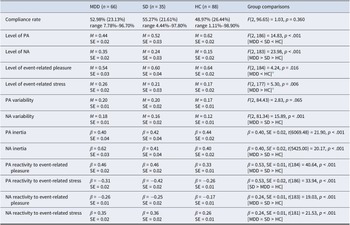
As shown in Table 2, there was a significant group difference on PA (F(2, 186) = 14.83, p < .001) in a graded manner, with MDD displaying a lower level than SD (d = 0.42, p = .048), and then HC (difference from SD: d = 0.47, p = .020). The PA levels between MDD and SD became non-significant after controlling for the effects of age and gender (p = 0.084). There was a significant group difference on NA (F(2, 183) = 23.98, p < .001) in a graded manner, with MDD displaying a higher level than SD (d = 0.64, p = .002), and then HC (difference from SD: d = 0.47, p = .015). The group difference remained significant after controlling for the effects of age and gender.
Group comparisons on ESM measures

a In these two pair-wise comparisons, SD was not significantly different from either MDD or HC.
Group comparison on affective variability (hypothesis 2)
PA variability did not differ significantly across groups (F(2, 84.43) = 2.83, p = .065). There was a significant group difference on NA variability (F(2, 81.34) = 15.89, p < .001), with both MDD (d = 0.82, p < .001) and SD (d = 0.25, p = .015) displaying greater variability than HC, while MDD and SD did not differ from each other. The group comparisons on NA variability remained significant after controlling for the effects of age and gender.
Group comparison on affective inertia (hypothesis 3)
Overall, there was a significant main effect of lagged PA in predicting current PA (β = 0.40, SE = 0.02, t(6069.48) = 21.90, p < .001), but this effect did not differ across groups (interaction effect p > .050).
Overall, there was a significant main effect of lagged NA in predicting current NA (β = 0.40, SE = 0.02, t(5425.00) = 20.17, p < .001). This effect differed across groups, with MDD displaying greater inertia than both SD (β = 0.21, SE = 0.03, t(6133.00) = 8.19, p < .001) and HC (β = 0.22, SE = 0.02, t(5722.00) = 8.75, p < .001), but no difference between SD and HC. The group comparisons on NA inertia remained significant after controlling for the effects of age and gender.
Group comparison on affective reactivity to event-related pleasure/stress (hypothesis 4)
There were significant group differences on event-related pleasure (F(2, 184) = 4.24, p = .016) and stress (F(2, 177) = 5.30, p = .006) respectively. Pairwise-comparisons revealed that MDD reported lower event-related pleasure (d = 0.48, p = .005) and higher event-related stress (d = 0.46, p = .002) than HC, whereas SD was not significantly different from either MDD or HC. The differences remained significant after controlling for the effects of age and gender.
Across groups (n = 189), level of PA was positively predicted by event-related pleasure (F(1, 8800) = 1783.28, p < .001) and negatively predicted by event-related stress (F(1, 8768) = 749.69, p < .001), whereas level of NA was positively predicted by event-related stress (F(1, 8790) = 1128.01, p < .001) and negatively predicted by event-related pleasure (F(1, 8783) = 654.99, p < .001).
Group comparisons revealed that both MDD and SD displayed more marked PA reactivity to event-related pleasure than HC (ps < .001), while they themselves had comparable PA reactivity to pleasure. PA reactivity to event-related stress was more marked in SD than MDD (p < .001), and then HC (difference with MDD: p = .010). For NA reactivity, both MDD and SD were more reactive than HC to event-related pleasure/stress (ps < .001), with MDD and SD not differing from each other. All group comparisons on affective reactivity to event-related pleasure/stress remained significant after controlling for the effects of age and gender.
Exploratory and sensitivity analyses
There were significant correlations between CES-DC score and NA inertia (p < 0.001), PA variability (p < 0.01) and NA variability (p < 0.001). Other variables of affective dynamics were not correlated with the CES-DC score.
All results remained significant after filtering out participants with compliance rate less than 30% (see Supplementary Appendix B).
Discussion
This study is the first ESM investigation to compare adolescents along the clinical spectrum of depression, with groups clearly categorized using structured diagnostic interviews. The stringent group classification enabled the first systematic comparison of affective dynamics across adolescents with varying levels of depressive symptomatology. The use of a 14-day ESM protocol that spans both weekdays and weekends allowed us to capture the naturalistic fluctuations in affect and their associated daily-life experiences. This enhances the ecological validity of our findings and offers a more comprehensive view of affective dynamics across groups.
As hypothesized, we found graded differences in overall levels of affect, with MDD reporting the lowest level of PA and the highest level of NA, followed by SD and then HC. This is in line with previous research (Nelson et al., Reference Nelson, Klumparendt, Doebler and Ehring2020; Thompson et al., Reference Thompson, Bailen and English2021) and meta-analysis (Houben, Van Den Noortgate, & Kuppens, Reference Houben, Van Den Noortgate and Kuppens2015), which found the intensity of subjectively experienced affect as proportionate to clinician-rated severity of depression. Since our study did not impose a ‘significant distress or impairment’ recruitment criterion on SD, we were able to capture a more diverse SD group, which, despite not being MDD-diagnosed, already displayed affective abnormalities. Together with previous studies, our data suggest that adolescents with SD are not emotionally healthy; they already experience increased low mood and reduced positive affect that set them apart from healthy controls, albeit in milder magnitude than their diagnosed counterparts. These adolescents may benefit from early detection and active monitoring to prevent further progression into a more severe state.
While overall levels of affect were consistently different across groups (with PA and NA presenting in opposite directions), affective variability and inertia differed across groups only for NA and not PA, suggesting a valence-specific pattern. In particular, SD presented a level of NA variability comparable with MDD, but distinct from HC. This finding replicated an earlier study involving adults with MDD, remitted MDD, and HC (Thompson et al., Reference Thompson, Bailen and English2021), but extended its applicability to adolescents with SD for the first time. On the contrary, SD displayed a level of NA inertia more similar to HC, both less marked than MDD. What differentiates between affective variability and inertia is that the former is an overall range of affective levels over the entire assessment period, whereas the latter represents the immediate moment-to-moment movements in affect. Put together, our findings suggested that although adolescents with SD could reach a level of negative affect as intense as MDD in some moments, their negative affect did not stay stagnant for as long as MDD, and on average, their overall affectivity was less negative (and more positive) than MDD. Their quicker rebound from NA may point to their greater emotional flexibility and more adaptive use of emotion regulation strategies when compared with MDD (Schäfer, Naumann, Holmes, Tuschen-Caffier, & Samson, Reference Schäfer, Naumann, Holmes, Tuschen-Caffier and Samson2017). These nuanced similarities and differences between clinical and subthreshold depression also challenge the traditional approach that emphasizes overall affective intensity in mood disorders, but underscore the importance of understanding affective dynamics in a more comprehensive way by considering both levels and patterns of changes/fluctuations in predicting depressive symptom severity and outcomes such as psychological well-being and suicidal risks (Eldesouky, Thompson, Oltmanns, & English, Reference Eldesouky, Thompson, Oltmanns and English2018; Koval, Sütterlin, & Kuppens, Reference Koval, Sütterlin and Kuppens2016; Thompson, Berenbaum, & Bredemeier, Reference Thompson, Berenbaum and Bredemeier2011). ESM, as a multi-dimensional assessment of subjective affect experiences under naturalistic circumstances, may be useful for facilitating accurate and sensitive early identification of depression among adolescents. The early identification may lead to treatments that aim at further consolidating their emotion regulation strategies, such as cognitive appraisal and problem solving to preserve their emotional flexibility (Lakhtakia, Smith, Mohr, & Stamatis, Reference Lakhtakia, Smith, Mohr and Stamatis2024).
Our study also examined how the three groups reacted to event-related pleasure and stress. As hypothesized, adolescents with MDD experienced a lower level of event-related pleasure than HC, while SD experienced a level of event-related pleasure similar to both MDD and HC. Interestingly, SD reported similar PA and NA reactivity to event-related pleasure to MDD, both at a level stronger than that of HC. This contrast highlights that SD, in the face of a comparable level of event-related pleasure to HC, already responded with a rise in PA and a drop in NA as strongly as MDD. While the drop in NA in MDD after event-related pleasure, as hypothesized, replicated the mood-brightening effect (Bylsma et al., Reference Bylsma, Taylor-Clift and Rottenberg2011), our study is the first to extend the applicability of the mood-brightening effect to SD. This suggests that while depression may be more intuitively related to event-related stress, the amplified affective reactivity following event-related pleasure is as clinically relevant. For event-related stress, MDD reported a higher overall level compared with HC, as hypothesized, while that in SD was not significantly different from either group. Compared to MDD, SD reported comparable NA reactivity to event-related stress but surprisingly greater PA reactivity, both at a level greater than that of HC. This suggests that under stress, the levels of PA in SD are especially fragile and easily disrupted, indicating an even greater stress sensitivity in SD than MDD. This phenomenon may underscore the clinical significance of the preservation of PA in event-related stress in SD. Treatments that target this phenomenon, such as behavioral activation or stress management, may be especially relevant and useful for SD. This is supported by a recent meta-analysis that reported a larger treatment effect of behavioral activation in adolescents with SD than MDD (Huang et al., Reference Huang, Luo, Luo, Zhang, Chen, Luo and Zhou2026). Taken together, our findings suggest that affective reactivity to event-related pleasure in SD closely parallels MDD, or exceeds that in MDD for event-related stress. Future longitudinal studies could delineate how altered affective reactivity in SD signals progression towards MDD (or even bipolar disorder) to serve as a modifiable intervention target.
Despite the strengths of this study, the limitation of imbalanced sample sizes across the three groups should be noted. Further, our study included a sample with a wide range of ESM compliance rates, with an average overall rate of around 51%. Although our rate is on the low side compared with other ESM studies, our younger sample age, longer sampling duration and higher frequency of data entries may act as contributing factors. However, the correlations between individual compliance rates and the estimates of affective reliability, inertia, and reactivity were non-significant. Future studies should aim for a more balanced sampling across groups and further enhance ESM completion to strengthen the reliability and validity of findings. Further, as our study is cross-sectional, it may be difficult to distinguish adolescents experiencing a first depressive episode from those with a longer or recurrent depressive history. The limitations of a restricted range of items in measuring affect, potential self-report bias, unmeasured treatment and medication effects and the lack of lived experience expertise may also highlight the need for a more comprehensive and longitudinal research in the future.
In summary, this study demonstrates the significance of moving beyond intensity to understand affective experiences in terms of dynamics. Adolescents with SD, compared with MDD, experienced NA that was similarly expansive but less stagnant from one moment to the next. They were also similarly reactive to event-related stress and pleasure. Future research should investigate their emotional sensitivity and flexibility to inform treatment strategies for SD.
Supplementary material
The supplementary material for this article can be found at http://doi.org/10.1017/S0033291726104346.
Acknowledgements
The authors are grateful to Dr. Prudence Fisher, Associate Professor of Clinical Psychiatric Social Work, Department of Psychiatry, Columbia University College of Physicians and Surgeons for her generous provision of DISC-5 as the main diagnostic tool of our study. Dr Anson Chau is acknowledged for his statistical advice.
Funding statement
This study was supported by the Health and Medical Research Fund (no. MHS-P1 (Part 1) and 18190771), Health Bureau, the Government of Hong Kong SAR, China. The funder has no role in the conduct or publication of the study.
Competing interests
The authors declare none.



 Open access

