





‘Gender diverse’ is a term that describes people whose gender differs from what was assigned to them at birth (Coleman et al., Reference Coleman, Radix, Bouman, Brown, de Vries, Deutsch, Ettner, Fraser, Goodman, Green, Hancock, Johnson, Karasic, Knudson, Leibowitz, Meyer-Bahlburg, Monstrey, Motmans, Nahata, Nieder and Arcelus2022; Thorne et al., Reference Thorne, Yip, Bouman, Marshall and Arcelus2019; see Text Box 1 for definitions of relevant terms). Gender diverse people have become increasingly visible in recent years, prompting growing societal awareness and debate. There are some published data suggesting a genetic contribution to gender diversity (Polderman et al., Reference Polderman, Kreukels, Irwig, Beach, Chan, Derks, Esteva, Ehrenfeld, Heijer, Posthuma, Raynor, Tishelman and Davis2018), but the relative contribution of genetic and environmental factors remains unclear.
Terminology*
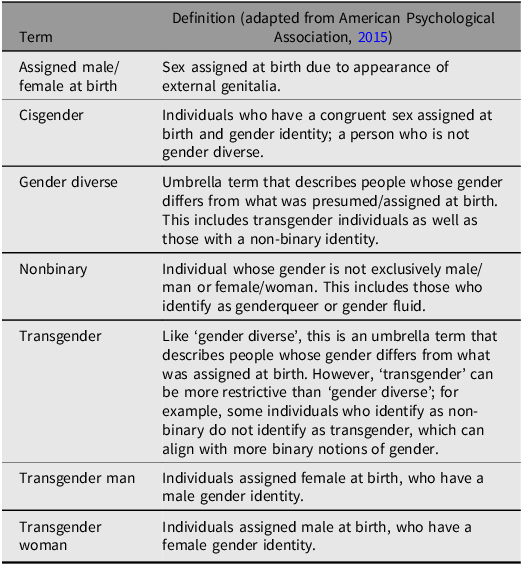
Note:
* Terminology in this area continues to evolve. For example, in the past, the terms such as ‘transexual’, ‘male-to-female (MTF)’, and ‘female-to-male (FTM)’ were commonly used but these are no longer considered acceptable.
Twin registries have long provided a powerful avenue for exploring the relative contributions of genetic and environmental factors to a range of complex human traits. However, twin registries have seldom contributed insights into gender diversity, mostly because details about sex and gender are not systematically separated, making it impossible to accurately identify transgender participants.
Several non-registry-based twin studies have provided heritability estimates for gender diversity (Bailey et al., Reference Bailey, Dunne and Martin2000; Burri et al., Reference Burri, Cherkas, Spector and Rahman2011; Diamond, Reference Diamond2013; Heylens et al., Reference Heylens, De Cuypere, Zucker, Schelfaut, Elaut, Vanden Bossche and De Baere2012; Karamanis et al., Reference Karamanis, Karalexi, White, Frisell, Isaksson, Skalkidou and Papadopoulos2022; Polderman et al., Reference Polderman, Kreukels, Irwig, Beach, Chan, Derks, Esteva, Ehrenfeld, Heijer, Posthuma, Raynor, Tishelman and Davis2018; Sasaki et al., Reference Sasaki, Ozaki, Yamagata, Takahashi, Shikishima, Kornacki, Nonaka and Ando2016). Most have findings suggesting a genetic influence; however, they all have methodological limitations. For instance, ascertainment bias in published summaries of prior case reports reflecting past preferential reporting of concordant twins (Diamond, Reference Diamond2013; Heylens et al., Reference Heylens, De Cuypere, Zucker, Schelfaut, Elaut, Vanden Bossche and De Baere2012). A gender-specific issue is the use of childhood gender-related behavior (Sasaki et al., Reference Sasaki, Ozaki, Yamagata, Takahashi, Shikishima, Kornacki, Nonaka and Ando2016) or previous access to gender-affirming interventions (Karamanis et al., Reference Karamanis, Karalexi, White, Frisell, Isaksson, Skalkidou and Papadopoulos2022) as imprecise proxy surrogates for gender identity.
National recommendations for collecting basic demographic information now include comprehensive gender data, achieved by a simple two-step approach that allows the self-reporting of both birth-assigned sex and gender identity (Australian Bureau of Statistics, 2020). Incorporating this into twin registries should be relatively straightforward. If this were to happen, some of the biases in past twin studies of gender diversity would be largely overcome. For example, self-reported gender identity would overcome the imprecision of proxy indicators and general twin surveys would be less prone to ascertainment bias. In this way, twin registry-based studies implementing the now recommended two-step collection of gender data are enabled to support transgender health research, particularly to advance knowledge of genetic and environmental influences.
Responding to the above considerations, Twins Research Australia (TRA), a national twin research institute headquartered at the University of Melbourne (Murphy et al., Reference Murphy, Lam, Cutler, Tyler, Calais-Ferreira, Li, Little, Ferreira, Craig, Scurrah and Hopper2019), introduced the two-step approach to their 2023 survey. We describe here the data obtained from these questions and demonstrate some of their potential utility.
Methods
Participants were recruited through the ‘Twins Health Behaviours and Screening Questionnaire (HBQ)’, which comprised general questions about healthcare service usage and screening behaviour for the national cancer screening programs (colorectal, breast and cervical cancer). The 2023 survey incorporated for the first time questions on gender identity, which comprised the two-step approach sourced from the Australian Bureau of Statistics (2020).
1. At birth you were recorded as:
Male
Female
Another term (please specify) — free text box available.
Prefer not to answer
2. How do you describe your gender?
Man or male
Woman or female
Non-binary
I use a different term (please specify) — free text box available.
Prefer not to answer
Administered by Twins Research Australia, the HBQ survey utilized the TRA database of almost 75,000 twins to recruit participants, with 16,380 (8190 twin pairs) aged 18−88 years invited to participate. TRA members were initially contacted via email with an invitation to participate, with nonresponders sent follow-up email (or SMS) reminders after 7 days. Zygosity data were obtained from twins’ self-reported TRA records, as determined during their initial registration process when individuals are given a range of responses to choose from (DNA testing, blood tests, opposite-sex status, or the Peas-In-A-Pod questionnaire).
Responses were reported as prevalence estimates and concordance proportions. The subsequent analysis included the Gibbs chi-square test to evaluate the null hypothesis that concordance proportions are equal between MZ and DZ twin pairs, tetrachoric correlations, and relevant 95% confidence intervals (CI), and utilized the Sib-pair genetic analysis package (Duffy, Reference Duffy2020).
The Twins Research Australia study was approved by The University of Melbourne’s Office of Research Ethics and Integrity (Ref: 2023-26857-42474-4).
Results
Responses were received from 4475 of those invited (27.3%). They comprised 1862 paired and 751 unpaired responses. The mean age of responders was 52.2 years (SD 15.3), with 77.1% birth-assigned females and 22.9% birth-assigned males.
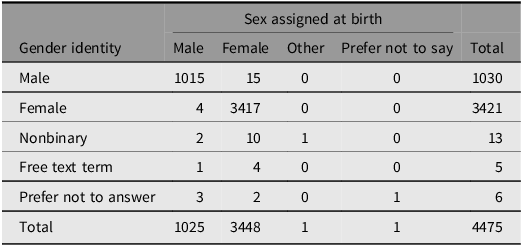
Among the 4475 respondents, all but six (99.9%) provided a response to the gender identity questions. Of the remaining 4469, 36 (0.8%, 95% CI [0.5, 1.1]) provided responses indicating gender diversity (15 transgender men [0.34%], 4 transgender women [0.09%], 12 nonbinary individuals [0.27%] and 5 entering their own free text descriptor of gender [0.11%]) (Table 1).
Summary of responses for gender identity and sex assigned at birth
Gender identity data from both co-twins were obtained for 1862 pairs, among which 27 (1.45%) included at least one gender diverse twin. Among the responding pairs, 1334 (71.6%) were monozygous, 522 (28.0%) were dizygous, 6 (0.3%) unknown; 331 (17.8%) were assigned male-male, 1365 (73.3%) female-female, 165 (8.9%) male-female, and 1 (0.05%) unknown.
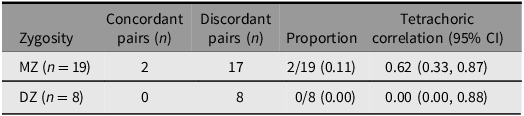
Among the 27 pairs with at least one gender diverse twin, the age distribution was younger than for the overall cohort (mean 40.8 years; SD 16.4). 19 were monozygous (2 concordant for gender diversity) and 8 were dizygous (all discordant). Three (11.1%) were assigned male-male; 19 (70.4%) female-female, among whom 2 were concordant for gender diversity, and 5 (18.5%) male-female (Table 2). The Gibbs chi-square test yielded a likelihood ratio test statistic of 1.47, with an associated p value of .225.
Concordance proportions for gender diversity, separated by zygosity and birth assigned sex
Discussion
In this study, we implemented for the first time a two-step approach for collecting gender identity data from our 2023 national twin registry survey. Feasibility was demonstrated by the high completion rate for the two added questions (99.9%). The approach taken could be more accurate, efficient, and cost-effective than a survey specific to gender identity, as it simply requires the questions to be nested in existing and/or planned survey questionnaires, obviating any need to survey specifically for gender diversity. Looking ahead, this report also demonstrates the simplicity and utility of incorporating a standardised two-step process for collecting gender identity data in other twin registry surveys.
Data on gender diversity from twin registries can advance understanding of the relative contributions of genetic and environmental determinants of gender diversity. In our study, among twins where at least one identified as trans, concordance was observed in 2 of 19 monozygous and 0 of 8 dizygous pairs. Although slightly lower than most reported concordance rates in the literature (21.0−39.1% in monozygotic twins and 0.0−11.5% in dizygotic twins (Diamond, Reference Diamond2013; Heylens et al., Reference Heylens, De Cuypere, Zucker, Schelfaut, Elaut, Vanden Bossche and De Baere2012; Polderman et al., Reference Polderman, Kreukels, Irwig, Beach, Chan, Derks, Esteva, Ehrenfeld, Heijer, Posthuma, Raynor, Tishelman and Davis2018; Sasaki et al., Reference Sasaki, Ozaki, Yamagata, Takahashi, Shikishima, Kornacki, Nonaka and Ando2016), the data align with the general trend of higher rates of concordance in MZ twins when compared to DZ twins. The tetrachoric correlations show a moderate to strong positive association in MZ twins (0.62, 95% CI [0.33, 0.87]). However, in DZ twins, the 95% CI is too wide (0.00, 0.88) to draw meaningful conclusions from the correlation value (0.00). Interestingly, although our study is underpowered (p = .23), our results do not align with recent findings from Karamanis et al. (Reference Karamanis, Karalexi, White, Frisell, Isaksson, Skalkidou and Papadopoulos2022), who observed a higher concordance rate in opposite-sex twins (37%) compared to same-sex twins (0%).
Although our small sample size limits the statistical power of these data, its methodological approach offers two key advantages over previous studies that have investigated gender diversity in twins. Twin registry-based ascertainment of twin pairs (with at least one gender diverse twin) is an important methodological advance on many of the earlier reports, as it helps reduce the aforementioned biases. Looking ahead, in the event that other twin registries internationally may be able to incorporate this two-step approach for gendered data collection, it will create future opportunities for collaborative data pooling with resultant gains in statistical power.
Our use of a population-based cohort has also yielded an independent population-based estimate of the frequency of gender diversity among adults in Australia, which is only now incorporating questions about gender identity into the national census. The recent Standards of Care for the Health of Transgender and Gender Diverse People (Version 8, 2022) report population estimates ranging between 0.3% to 4.5% (Coleman et al., Reference Coleman, Radix, Bouman, Brown, de Vries, Deutsch, Ettner, Fraser, Goodman, Green, Hancock, Johnson, Karasic, Knudson, Leibowitz, Meyer-Bahlburg, Monstrey, Motmans, Nahata, Nieder and Arcelus2022). The population estimate of 0.8% (95% CI [0.5, 1.1]) calculated in our study falls within the lower end of this range, which is consistent with other reports indicating that higher estimates of gender diversity are typically observed in younger cohorts (Coleman et al., Reference Coleman, Radix, Bouman, Brown, de Vries, Deutsch, Ettner, Fraser, Goodman, Green, Hancock, Johnson, Karasic, Knudson, Leibowitz, Meyer-Bahlburg, Monstrey, Motmans, Nahata, Nieder and Arcelus2022; Eisenberg et al., Reference Eisenberg, Gower, McMorris, Rider, Shea and Coleman2017; Johns et al., Reference Johns, Lowry, Andrzejewski, Barrios, Demissie, McManus, Rasberry, Robin and Underwood2019; Marino et al., Reference Marino, Werner-Seidler, Maston, Lin, Perry, Bista, Davies, Christensen and Skinner2024; Strauss et al., Reference Strauss, Lin, Winter, Waters, Watson, Wright Toussaint and Cook2020). In this regard, it is likely relevant to note that our cohort was relatively old, with a mean age of 52.2 years. Interestingly, our estimate of 0.8% is directly comparable to the recent estimate made by the Australian Bureau of Statistics in their report Estimates and characteristics of LGBTI+ populations in Australia, which found that approximately 0.9% of Australian adults are gender diverse (Australian Bureau of Statistics, 2022). In this way, our findings also demonstrate the utility of including gender-related questions in twin registries to generate population estimates of gender diversity. In time, the inclusion of gender-related questions will likely also yield additional valuable health data, particularly for following health outcomes among gender diverse people.
Data availability statement
The datasets used and/or analysed during the current study available from the corresponding author on reasonable request.
Acknowledgments
This research was facilitated through access to Twins Research Australia (TRA), a national resource administered by the University of Melbourne that has been supported by the National Health and Medical Research Council since 1981 (most recently through a Centre of Research Excellence Grant, 2015-2022). KCP wishes to acknowledge the support of an NHMRC Investigator Fellowship (GNT2027186). The authors also wish to acknowledge the statistical support of David Duffy. Finally, this work greatly benefited from the advice and direction of our esteemed colleague and collaborator, John Hopper, who died unexpectedly in 2024. He had been the Director of the Twins Research Australia/Australian Twin Registry for nearly 35 years, and his work transformed understanding of the genetic and environmental factors influencing human health globally.
Funding
Ken Pang wishes to acknowledge funding support from the NHMRC (GNT 2006529 and 2027186).
Competing interests
The authors declare that they have no conflict of interest.


 Open access

