

The COVID-19 vaccination campaign was one of the most significant global policy interventions in recent history. Governments had to rapidly mobilize resources, negotiate vaccine procurement, and implement mass distribution strategies to reach their entire populations. While vaccination performance varied widely across countries, scholarly attention to the factors explaining these differences has been limited. In particular, the role of political regimes and the variation within them has been underexplored.
This article examines the rollout of COVID-19 vaccines in Central America, a subregion that shares a geopolitical context but displays notable divergences in regime types and state capacity. The region includes Costa Rica, one of Latin America’s most consolidated welfare states, as well as Guatemala and Honduras, two of its most exclusionary ones (Sánchez-Ancochea and Martínez Franzoni Reference Sánchez-Ancochea and Martínez Franzoni2015).
Focusing on state capacity and political regimes, we ask the following questions: Why did some countries achieve greater vaccination success? Did authoritarian regimes perform as well as democratic ones in delivering key social interventions during crises? And what explains variation among authoritarian regimes? To address these questions, we compare vaccination trajectories across the six Central American countries, linking outcomes to state capacity. We then focus on El Salvador and Nicaragua to explore contrasting dynamics in non-democratic countries.
We advance three main arguments. First, institutional capacity is crucial in explaining cross-national variation; countries with weaker legacies struggled to promote vaccination. Second, political regime type alone did not determine success; notably, two authoritarian governments performed on par with the most effective democratic countries. Third, differences between authoritarian regimes are best explained by presidential decision-making.
Our article contributes to the literature on policymaking in times of crises. As the world faces frequent and overlapping shocks, understanding how states respond has become more urgent (Tooze Reference Tooze2025). It is particularly important to examine the politics of social interventions under authoritarianism, an area still underexplored. While much attention has focused on democratic responses, state-led social policy in authoritarian settings in the Global South remain understudied (Carothers and Press Reference Carothers and Press2022; Programa Estado de la Nación, RedICA 2023). Our findings help fill this gap in the comparative social policy research.
The article proceeds as follows. We discuss the relevant literature, then outline our methodological approach, and present a comparative analysis of vaccination performance across six Central American countries, with a detailed focus on El Salvador and Nicaragua and their shifting trajectories over time. We conclude by summarizing key findings and reflecting on the broader implications for research on social policy under authoritarian rule.
Social interventions in times of crisis in different political contexts
The literature on natural disasters offers a valuable starting point for understanding policy responses to major shocks. For instance, Gil (Reference Gil2022) analyzed the aftermath of the 1939 earthquake in Chile, identifying it as a critical juncture that led to the creation of two key state institutions—CORFO (Production Development Corporation) and CRA (Reconstruction and Assistantship Corporation). These institutions would later play fundamental roles in shaping national development. Gil’s (Reference Gil2022, 789) analysis underscores the importance of preexisting institutions, arguing that “reconstruction challenges can only provide opportunity to states that have the minimal capacities to be able to capitalize on them.”
Expanding on the Chilean case, Gil and Atria (Reference Gil and Atria2022) study how earthquakes influenced the state’s fiscal capacity. They show that taxation often increased through two mechanisms: first, the immediate need for reconstruction, which compelled states to mobilize additional resources, and second, crises that tended to evoke narratives of national solidarity and patriotism, which can facilitate policy change. This dynamic mirrors the rally around the flag effect observed during the COVID-19 pandemic (Pignataro Reference Pignataro2021).
Previous studies have emphasized the crucial role of state capacity, understood as the ability to implement policy objectives (Thies Reference Thies2010; Skocpol Reference Skocpol, Evans, Rueschemeyer and Skocpol1985). Following Soifer (Reference Soifer2008), we can distinguish between three dimensions of state capacity—administrative, coercive, and extractive—all of which shaped the effectiveness of vaccination campaigns. Extractive capacity enabled states to mobilize financial and material resources; coercive capacity was relevant for enforcing compliance with public health mandates; and administrative capacity reflected the state’s ability to implement and coordinate policy across its territory. High-capacity states such as Costa Rica combined these dimensions effectively, leveraging institutional embeddedness and logistical coordination to respond swiftly—an advantage that most other Central American countries lacked.
Despite its strengths, the literature on responses to crises often overlooks how political regimes shape both the trajectory and outcomes of policy responses to shocks. In contrast, research on social policy places significant emphasis on the role of political regimes. In particular, democracies are seen as fostering two favorable conditions for the expansion of social policy. Over the long term, they enable citizens, civil society organizations, and political parties to mobilize in pursuit of social benefits. In the short run, electoral competition creates incentives for governments to introduce or expand social programs (Arza et al. Reference Arza, Castiglioni, Franzoni, Niedwiecki, Pribble and Sánchez-Ancochea2022; de la O Reference De la O2015; Garay Reference Garay2017; Holland Reference Holland2017; Huber and Stephens Reference Huber and Stephens2012). Whether democracy is necessary for effective emergency interventions remains an open question. Public health measures during crises depend primarily on the state’s ability to rapidly mobilize and distribute resources, which need not be stronger in democracies than in autocracies.Footnote 1
The complex relationship between political regime and crisis is evident in the varied responses to the COVID-19 pandemic. While some studies find no systematic differences in policy outcomes between dictatorships and democracies (Bosancianu et al. Reference Bosancianu, Hilbig, Humphreys, Sampada, Lieber and Scacco2020; Cassan and Van Steenvoort Reference Cassan and Van Steenvoort2021), others report greater variability (Edgell et al. Reference Edgell, Lachapelle, Lührmann and Maerz2021). An econometric analysis by Ha et al. (Reference Ha, Knox and Janenova2024) shows that authoritarian regimes had lower infection and mortality rates than democratic ones. While they acknowledge that this may be partly due to underreporting, they also highlight the role of decision-making structures and higher compliance levels.
In the Latin American context, the literature on policy responses to the pandemic tends to highlight the role of state capacity while giving little attention to political regime type. For instance, in their analysis of the adoption of emergency cash transfers, Blofield et al. (Reference Blofield, Pribble and Giambruno2023) focus exclusively on democratic regimes. They find that, where fiscal space was available, divided governments—those in which control of the executive and legislative was split—performed better than unified ones. This outcome stemmed from inter-branch competition.Footnote 2 As they explain: “Divided government produced competition between the executive and legislative branches, with each side seeking to outperform the other in a game of credit-claiming. As a result, divided government, in combination with relatively easy access to resources, produced a stronger cash transfer policy response to the COVID-19 crisis” (Blofield et al. Reference Blofield, Pribble and Giambruno2023, 2).
There is significant room to examine how authoritarian regimes in Latin America responded to the COVID-19 crisis. Studying these responses is especially relevant given the region’s recent democratic erosion. At the turn of the twenty-first century, nearly all countries in the region were classified as electoral democracies. However, by 2023, Latin America had seen a notable rise in autocratization, with countries like El Salvador, Nicaragua, and Venezuela exhibiting sharp declines in democratic quality. The region, once seen as a beacon of third-wave democratization, now shows multiple cases of democratic erosion and hybrid regime consolidation (V-Dem 2023). This trend not only alters the institutional environment in which public policies are designed and implemented but also reshapes the logics of legitimacy and political accountability, particularly during moments of crisis such as the COVID-19 pandemic.
Autocratic leadership is typically characterized by centralized decision-making, limited deliberation, minimal input from subordinates, and a strong emphasis on control, obedience, and top-down communication. In such contexts, crisis responses are shaped primarily by the preferences, priorities, and behavior of the president. In the absence of institutional counterweights—such as independent legislatures, judicial oversight, or a free press—presidents in autocratic regimes can act with considerable discretion. This can facilitate swift policy implementation when state capacity and political will are present. However, it also results in highly volatile performance, as outcomes hinge more on the leader’s personal commitment than on institutionalized policy frameworks. In such settings, even previously declared commitments may be easily reversed or abandoned when political interest or incentives wane.
In summary, this literature review leads us to formulate three hypotheses:
H1: State capacity helps explain cross-national differences in vaccination performance.
H2: Political regime is not a decisive factor in shaping vaccination outcomes during emergencies.
H3: Among the more authoritarian regimes, presidential preferences account for variations in performance over time.
In the sections that follow, we assess the performance of six Central American countries in terms of COVID-19 vaccination coverage during and after the peak of the emergency. Our analysis focuses on policy outputs, with particular attention to coverage. We also conduct a closer examination of Nicaragua and El Salvador to explore variation within authoritarian regimes and empirically test the three hypotheses outlined earlier.
Methodology
Our research design involves a comparative analysis of country-level vaccination performance, focusing specifically on the period following the arrival of the first vaccines. While the processes of vaccine negotiation and acquisition are undoubtedly important and warrant further investigation, they fall outside the scope of this article. Similarly, we do not provide a detailed analysis of the types of vaccines used in each country, although there is notable variation in this regard.Footnote 3
Panama relied on just two vaccines (Oxford/AstraZeneca, Pfizer/BioNTech). Costa Rica followed with three (Oxford/AstraZeneca, Pfizer/BioNTech and Moderna). El Salvador and Guatemala each used four types, including Oxford/AstraZeneca and Pfizer/BioNTech. In addition, Guatemala used Sputnik and Moderna, while El Salvador incorporated Chinese-manufactured vaccines (Sinopharm/Beijing and Sinovac). Nicaragua had the most diverse portfolio, employing nine different vaccines: Abdala, Johnson & Johnson, Moderna, Oxford/AstraZeneca, Pfizer/BioNTech, Sinopharm/Beijing, Soberana02, Sputnik Light, Sputnik V.
To finance vaccine procurement and distribution, the countries in our study relied on a combination of extraordinary budget allocations and international donations. In some cases, donations accounted for a significant share of vaccine supply—28 percent in El Salvador and 44 percent in Guatemala, for example. As we demonstrate in the empirical section, the availability of financial resources did not represent a binding constraint on vaccine rollout in any of the countries analyzed.
Instead, we focus on factors that explain differences in vaccine implementation. These were substantial across the sample. For instance, by October 2022, Costa Rica had administered 92 percent of the doses received (Comisión Nacional de Emergencias Costa Rica 2022). In contrast, Guatemala had administered only 28 percent of its available vaccine stock by December 2022.Footnote 4
The distinction between the emergency and postemergency phases of the pandemic is based on the heightened sense of urgency triggered by elevated mortality rates.Footnote 5 This urgency is captured by excess mortality, which measures the gap between the number of deaths actually recorded and the number expected based on historical trends. The highest level was reported in Nicaragua in August 2020, at 57 percent. In 2021, excess mortality remained high across the region, even in the presence of vaccines: 39 percent in Nicaragua, 27 percent in Guatemala, and 19 percent in Panama as of October 2021.Footnote 6
By 2022, excess mortality levels had declined and stabilized in all countries except Costa Rica, which had maintained very low excess mortality throughout the period anyway. Figure 1 illustrates this trend: For each country, the first bar reflects the spike in excess mortality, while the second shows its subsequent decline.
Excess Mortality in Central America, 2020–2022.
Source: One World in Data

Figure 1. Long description
A line graph titled ‘Excess Mortality in Central America, 2020–2022’ displays the percentage change in excess mortality for five countries: Nicaragua, Guatemala, Panama, El Salvador, and Costa Rica. The x-axis represents the timeline from January 5, 2020, to December 31, 2022, while the y-axis shows the percentage change ranging from negative thirty percentage to positive sixty percentage. Nicaragua experiences a significant spike in excess mortality around August 8, 2020, reaching over fifty percentage before gradually declining. Guatemala and Panama show moderate increases, peaking around February 24, 2021, and maintaining relatively stable levels thereafter. El Salvador and Costa Rica exhibit smaller fluctuations, with El Salvador showing a slight increase and Costa Rica remaining relatively stable throughout the period. All values are approximated.
The empirical analysis compares country performance across two distinct phases of the COVID-19 vaccination campaign: the initial rollout in 2021 and the subsequent expansion in 2022, when second doses and booster shots were introduced.
We define these phases as follows:
-
• Emergency phase: This period is marked by a heightened sense of urgency due to high excess mortality and increased pressure on public health systems. It corresponds to the initial arrival and administration of vaccines. We assess performance based on each country’s ability to reach at least 70 percent of the population with the first dose—in line with the World Health Organization’s (WHO 2021) recommendation. In the Central American context, this phase spans the second half of 2021.
-
• Postemergency phase: This stage began once excess mortality stabilized, and countries transitioned towards consolidating immunity. Empirically, it refers to the period when second doses were administered and booster campaigns began. Here, we evaluate performance on the basis of coverage with a least two doses, focusing on data from 2022.
Sources
Statistical analysis of countries’ immunization performance relied on data from One World in Data (OWD), which compiles vaccination statistics reported by national governments to the WHO. While the authoritarian nature of some governments may raise concerns about transparency, the available figures remain sufficiently robust for comparative analysis.
In El Salvador, for example, the government imposed a seven-year embargo on all information related to the Vaccination Plan.Footnote 7 In addition, the so-called Ley Alabí—named after then minister of health Francisco Alabí—shielded public officials from any investigation regarding pandemic-related procurements (Diario Oficial de la República de El Salvador 2021). Despite these limitations, triangulation with vaccine arrival records compiled by the Central American Institute of Fiscal Studies (ICEFI, by its Spanish initials) supports the credibility of the reported data (ICEFI 2022a, 2022b). In Nicaragua, likewise, independent analysts have deemed the government’s data credible.Footnote 8
The comparison between El Salvador and Nicaragua draws on documentary analysis of primary sources, particularly official press releases issued by the respective presidents and ministries of health. These communications span the period from 2020 to 2022. In total, we reviewed 108 official press releases from El Salvador and 376 from Nicaragua.Footnote 9 Notably, in El Salvador, the frequency of press releases declined sharply after October 2021, whereas in Nicaragua it continued at a steady pace well into 2022.
Control variables
The six Central American countries analyzed in this study differ in both their sectoral institutional capacity and their political regime type, offering a valuable opportunity to examine how these factors influence performance. The countries can be grouped into two categories based on their state capacity, including their historical investment in the health sector before the COVID-19 pandemic. Costa Rica, Panama, El Salvador, and Nicaragua are countries with strong public health capacity, and Guatemala and Honduras are characterized by weak health-sector capacity. These categories reflect prepandemic conditions and serve as a baseline for assessing policy performance during the COVID-19 crisis.
Table 1 presents three indicators that support this classification. The first is public health spending as a percentage of gross domestic product (GDP), which serves as a proxy for a state’s funding capacity before the pandemic. While high spending alone does not guarantee effective outcomes, it is a necessary condition for the provision of adequate health care services, including large-scale vaccination campaigns. The second indicator is the proportion of births attended by skilled health personnel, which acts as a proxy for the operational capacity of health systems to deliver essential services during socially significant moments. Finally, we include an index of the strength of vaccination systems, which incorporates countries’ national immunization schedules in 2020, vaccination coverage rates (VCRs) from 2019, and management elements such as the existence of expert advisory boards for vaccination-related decision-making (Urueña et al. Reference Urueña, Rombini, Mauas and García Rojas2023).
Central America: Sectoral state capacity

Note: The vaccination ranking is based on six domains that included 149 variables, with each category receiving a value of 1 point, and the total score being a maximum of 400 points. Domains are vaccination in the first year of life; vaccination from second year of life to school entry; vaccination in adolescents, pregnancy, adults, and elderly; vaccination against influenza; vaccination in special populations; and programmatic aspects (Urueña et al. Reference Urueña, Rombini, Mauas and García Rojas2023).
Source: Urueña et al. (Reference Urueña, Rombini, Mauas and García Rojas2023); World Health Organization (2025).
Costa Rica, Panama, Nicaragua, and El Salvador display significantly higher values across all three indicators than Honduras and Guatemala. Costa Rica performs consistently well on all measures. Nicaragua stands out for its level of spending, while El Salvador ranks highest in the proportion of births attended by skilled health personnel. Regarding vaccination systems, Costa Rica and Panama are regional leaders, followed by Nicaragua and El Salvador. By contrast, Guatemala performs particularly poorly across all three indicators.
In terms of political regime, we rely on the V-Dem Liberal Democracy Index (V-Dem 2022), supplemented by secondary literature (Table 2). In 2021, Costa Rica was classified as a liberal democracy, Panama and Guatemala as electoral democracies, El Salvador and Honduras as electoral autocracies, and Nicaragua as a closed autocracy. In terms of trajectory, there were significant differences between El Salvador, which was undergoing a rapid move toward authoritarian rule with a fast concentration of power by the executive (Meléndez-Sánchez Reference Meléndez-Sánchez2021), and Honduras, which celebrated competitive elections in November 2021.Footnote 10

In summary, the six cases under study display considerable variation in both policy legacies and political regimes, providing a rich basis for comparative analysis. As discussed previously, we expect countries with strong state capacity to demonstrate superior performance. By contrast, countries with weak state capacity are less likely to mount adequate responses because of limited institutional and personnel capacities, which pose significant institutional constraints. However, consistent with our theoretical framework, we do not anticipate a systematic advantage for democratic regimes over authoritarian ones in terms of vaccination performance.
Vaccination against COVID-19 in Central America
In this section, we present comparative evidence across the six Central American countries, highlighting key differences in vaccination performance during and after the emergency phase. We then turn to a more detailed analysis of El Salvador and Nicaragua—two authoritarian regimes with strong sectoral state capacity—examining both their commonalities and the divergent trajectories they followed over time.
Vaccine rollout and policy legacies
Table 3 presents vaccination performance at two key points: the emergency phase, marked by high excess mortality, and the postemergency phase, when mortality levels declined. The analysis focuses on coverage with the first and second doses, which together formed the core of the initial COVID-19 vaccination schedule.
Performance in terms of immunity in Central America, 2021–2022

Source: Data from One World Data, which uses WHO data (accessed in August 2023).
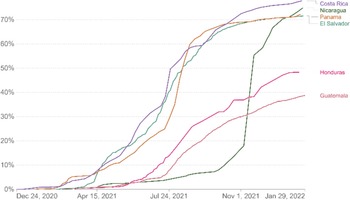
To complement Table 3, Figures 2 and 3 display the same data in visual form, allowing for a clearer understanding of temporal trends and comparative trajectories across countries.
Share of the Population who Received at Least One Dose of the COVID-19 Vaccine in Central America, 2020–2022.
Source: One World in Data

Figure 2. Long description
The line graph illustrates the percentage of the population in Central America who received at least one dose of the COVID-19 vaccine over time. The x-axis represents the timeline from December 24, 2020, to January 29, 2022, while the y-axis shows the percentage of the population vaccinated, ranging from 0 to 70 percent. The graph includes data lines for six countries: Costa Rica, Nicaragua, Panama, El Salvador, Honduras, and Guatemala. Costa Rica shows the highest vaccination rate, reaching approximately 70 percent by January 29, 2022. Nicaragua and Panama follow closely, with rates around 65 to 70 percent. El Salvador’s vaccination rate is slightly lower, reaching around 60 percent. Honduras and Guatemala have lower vaccination rates, with Honduras around 40 percent and Guatemala around 30 percent by the end of the period. All values are approximated.
Share of the Population who Completed the Initial COVID-19 Vaccination Protocol, 2022–2023.
Source: One World in Data

Figure 3. Long description
The line graph illustrates the share of the population who completed the initial COVID-19 vaccination protocol in six countries over the period from May 2, 2022, to June 2, 2023. The countries included are Nicaragua, Costa Rica, Panama, El Salvador, Honduras, and Guatemala. Nicaragua shows the highest percentage, starting around 80 percent and gradually increasing to just above 90 percent. Costa Rica follows closely, starting slightly below 80 percent and reaching around 85 percent. Panama and El Salvador have similar trajectories, starting around 60 percent and stabilizing just below 70 percent. Honduras starts around 50 percent and remains relatively flat, ending slightly above 50 percent. Guatemala starts around 30 percent and shows a gradual increase to just below 40 percent. All values are approximated.
Table 3 shows that four countries—Costa Rica, Panama, El Salvador, and Nicaragua—surpassed the WHO’s recommended 70 percent threshold for first-dose vaccination coverage. Costa Rica and Panama reached this milestone in October 2021; El Salvador in November 2021; and Nicaragua in January 2022. However, when considering full vaccination with two doses, only Costa Rica, Nicaragua, and Panama met the 70 percent target (WHO 2021). El Salvador made strong progress initially, reaching 60 percent coverage fifty-two days earlier than Costa Rica. Nevertheless, it ultimately fell short of the WHO benchmark for full vaccination. In contrast, Nicaragua—despite a late start in 2021—went on to surpass both Costa Rica and Panama in two-dose coverage.
These variations align closely with differences in state capacity summarized in the methodology section. Costa Rica and Panama, with the highest public health expenditures and strong immunization systems, were able to effectively coordinate and deliver vaccines across their territories. In both countries, their respective health-care systems reflected decades of investment in administrative state capacity, including well-funded public institutions, reliable service delivery mechanisms, and relatively high levels of institutional trust. By contrast, Guatemala and Honduras—ranked lowest across all three indicators in Table 2—demonstrated clear signs of low state capacity, resulting in lower vaccine uptake and higher inequality in coverage.
In fact, the latter two countries failed to reach the recommended vaccination thresholds. In Honduras, fewer than two-thirds of the population received a first dose, and only 56 percent completed the two-dose schedule. The situation was even more concerning in Guatemala, where the vaccination campaign effectively stalled after reaching just 50 percent of the population with a first dose and only 40 percent with two doses.
We draw on the Guatemalan case to illustrate how weak policy legacies constrain a country’s response capacity. Low state capacity was evident both in the procurement process of vaccines and in the territorial rollout. The government’s approach to securing vaccine access was marked by inconsistencies and delays. Until April 2021, Guatemala relied exclusively on the COVID-19 Vaccine Global Access (COVAX) initiative, a mechanism designed to cover only about 20 percent of a country’s vaccination needs (García Reference García2021). This overreliance revealed a weak institutional capacity to negotiate and diversify vaccine procurement.
At that time, the National Advisory Council on Immunization Practices (CONAPI by its Spanish acronym) recommended the acquisition of three vaccines with demonstrated efficacy and broad international acceptance: Pfizer, Moderna, and AstraZeneca (Slowing and Chávez Reference Slowing and Chávez2022, 24). However, the Guatemalan government disregarded these technical recommendations and opted instead to exclusively purchase the Sputnik V vaccine, which had not been approved by the WHO. The purchase was made through a private intermediary distributor, which was expected to deliver 16 million doses before October 2021 (Slowing and Chávez Reference Slowing and Chávez2022).
The details surrounding the Sputnik V purchase were marked by a lack of transparency. Despite the government paying 50 percent of the contract upfront, it failed to secure a delivery schedule (Román Reference Román2020). Three months after the contract was signed, only 2.25 percent of the purchased doses had been delivered (la Jornada 2021). The procurement process was so poorly managed that the government was ultimately forced to renegotiate the contract, reducing the total number of doses to half the original amount. In July 2021, the General Comptroller’s Office filed a complaint against the minister of health, and civil society organizations mobilized to demand the president’s resignation. Human Rights Watch (2022) raised concerns about corruption and the lack of transparency in the implementation of the National Vaccination Plan, signaling broader doubts about the effectiveness of the country’s pandemic response.
The vaccination rollout in Guatemala was also marked by stark inequalities across socioeconomic and ethnic lines. The data shows a clear gradient: The more vulnerable the population is, the lower the vaccination coverage. More than 70 percent of Guatemalans in the wealthiest group received at least one dose, and more than 60 percent completed the two-dose schedule. In sharp contrast, fewer than 40 percent of the most vulnerable individuals received a first dose, and only 25 percent received both doses.
The slow and uneven pace of the vaccine rollout in Guatemala had significant operational consequences. By early 2022, 7.7 million vaccine doses had expired, underscoring the inefficiency of the distribution process and the failure to reach broad segments of the population (Reina et al. Reference Reina, Slowing and Chávez2023). As the campaign progressed, vaccination efforts increasingly relied on private and semiprivate spaces, including shopping malls and universities, which had the infrastructure to serve large numbers of people (Slowing and Chávez Reference Slowing and Chávez2022, 31). However, these efforts remained concentrated in urban centers and did not extend to rural and indigenous areas, where vaccination rates remained disproportionally low. This spatial bias further compounded existing inequalities and revealed limits in state outreach in marginalized territories.
The comparison between the six countries confirms two of our initial hypotheses. First, political regime type did not determine vaccine performance. Authoritarian regimes such as El Salvador and Nicaragua outperformed more democratic countries like Guatemala. In fact, both achieved levels of vaccination coverage comparable to Costa Rica and Panama, two countries recognized for their long-standing democracies and stronger welfare states. Rather than regime type, the key determinant appears to be the state’s capacity to mobilize resources, coordinate implementation, and reach its population effectively. As the Guatemalan case illustrates, weak state capacity not only hindered vaccine distribution but also deepened harmful spatial and social inequalities.
Alternative explanations
A common assumption is that such cross-national variation in vaccination performance stems from disparities in vaccine supply (Ferranna Reference Ferranna2024). However, Table 4, which presents the number of vaccines received and administered by each country by December 2021, challenges this explanation. For example, El Salvador’s superior performance over Costa Rica during most of 2021 cannot be attributed to greater access to vaccines. By year’s end, Costa Rica still held a substantial stock of unused vaccines, indicating that its slower pace was constrained by other factors. Conversely, El Salvador’s subsequent slowdown was not caused by supply shortages either: By December 2021, the government had administered only 29 percent of the vaccines it had in stock. Guatemala’s case further reinforces this point: by December 2021, Guatemala had received over twenty-five million doses, yet administered only 25 percent, a stark indication of implementation failure. In contrast to El Salvador’s strongly personalized approach and Nicaragua’s reliance on existing health infrastructure, Guatemala lacked a coherent leadership strategy. This aligns with existing literature that characterizes Guatemala’s executive power as constrained by entrenched patronage networks, systemic corruption, and limited policy implementation capacity (Schwartz Reference Schwartz2023).
Vaccines received versus vaccines administered in Central America, by December 2021

Note: Data on vaccine availability for Costa Rica and Guatemala are based on official sources compiled by Valeria Morales (Reference Morales Rivera2024) as part of her doctoral research. For El Salvador, data were obtained from official sources compiled by ICEFI (2022a). Information on doses administered across all countries is sourced from Our World in Data (OWD), accessed November 7, 2023.
These findings suggest that availability was not a binding constraint, strengthening the argument that state capacity played a decisive role in shaping vaccination outcomes.
Another possible explanation, vaccine hesitancy, also proves inadequate. Although regional studies on vaccine hesitancy in Central America are limited (see Gonçalves et al. Reference Gonçalves Bruna, Matos, Ferreira, Itagyba, Moço and Marcia Thereza Couto2023), the available national-level research does not identify it as a prominent obstacle to vaccine uptake (e.g., Reyes and Martínez Folgar Reference Reyes and Martínez Folgar2022; ICEFI 2022a). Moreover, there is no evidence to believe that hesitancy varied significantly across Central American countries. Instead, the variation in vaccination performance appears to be driven by logistical bottlenecks and weak health systems rather than by citizen resistance.
Diversity within authoritarian regimes
There is limited research on how authoritarian regimes perform during crises. This section helps address this gap by comparing El Salvador and Nicaragua, two countries whose vaccination outcomes diverged significantly across different phases of the pandemic. El Salvador initially led the region in vaccination. By July 2021, it had vaccinated 21 percent of its population, compared to just 2 percent in Nicaragua (see Figures 2 and 3). However, this trend reversed in the postemergency period: El Salvador’s campaign lost momentum while Nicaragua accelerated, eventually surpassing El Salvador in overall coverage.
In the discussion, we highlight the role of autocratic leadership across stages of crisis response. We also consider the role of state capacity in both countries and how the two governments framed it in the process of vaccination. This section thus complements our earlier analysis by showing how state capacity intersected with decision-making to shape outcomes under authoritarianism.
El Salvador
When the mass vaccination campaign was launched, El Salvador had just held legislative and local elections (Zemmouche Reference Zemmouche2021). With President Bukele and his party securing a landslide victory, electoral pressures no longer shaped the government’s behavior. The vaccination effort was highly centralized and visibly led by the executive, particularly by the president and the Ministry of Health. The campaign featured prominently in two nationwide presidential addresses (in November 2020 and February 2021), thirty-one press releases from the President’s Office, and seventy from the Ministry of Health. Across these communications, Bukele was mentioned 451 times (as “Nayib,” “President” or “Bukele”), while Minister of Health Francisco Albí was referenced 188 times (as “Alabí” or “Minister”).
It was also President Bukele who publicly announced in February 2021 that vaccines would be universal, free of charge, and voluntary (Presidencia de la República de El Salvador 2020, 2021). Throughout the year, he continued to play a prominent role, urging the population to get vaccinated and citing scientific evidence in support of the campaign (Presidencia de la República de El Salvador 2020; Gobierno de El Salvador 2021a).
Meanwhile, Minister of Health Francisco Alabí was responsible for operationalizing the campaign. He oversaw vaccine procurement, communicated the rollout strategy, and, as a physician, personally administered the first vaccine dose (Presidencia de la República de El Salvador 2020). Notably, both the minister of health and the minister of defense were present at the airport to receive the first shipment of vaccines, underscoring the president’s framing of the vaccination effort as a top national priority (Gobierno de El Salvador 2021b).
When vaccines arrived in El Salvador in February 2021, the government framed the rollout within a foundational narrative that rejected the country’s existing sectoral capacities. President Bukele emphatically claimed that he had inherited a broken public health system and that everything had to be built from scratch. This rhetoric positioned the vaccination campaign not as a continuation of institutional strengths but as a rupture with the past, reinforcing the president’s broader political discourse of renewal and break with previous administrations:
Not only is the fact that we acquired vaccines, we brought vaccines, we secured the vaccines, we undertook negotiations to make sure that the vaccines arrived as soon as possible, but we also, as you can see, had to develop a complete logistic [because] the health system that we inherited was awful, it was rather sad… You saw the so-called cold chains, the so cold chains that the previous government had in rotten refrigerators, literally rotten refrigerators…. I sometimes ask: didn’t they ever go to the hospital, did they never go to a health unit, didn’t they see that the refrigerators were rotten … ? Without a pandemic, our patients slept on the floor … [policymakers] could not even deal with dengue, a lot of people died because of dengue. (Presidencia de la República de El Salvador 2021)
We prepared a center to protect the vaccines that guarantees the correct treatment of the cold chains, something that had been forgotten by previous governments. (Gobierno de El Salvador 2021a)
Following President Bukele’s orders, the CENABI [Biological National Centre] has been remodeled because previous administrations had abandoned it. (Gobierno de El Salvador 2021b)
Vaccination efforts in El Salvador were centralized around the newly opened Hospital El Salvador, which the government promoted as the “largest hospital in Latin America.” The facility was presented as capable of administering ten thousand of the thirty thousand daily doses (Ministerio de Salud 2021b; Gobierno de El Salvador 2021c, 2021d). This mega-hospital was portrayed as the cornerstone of the government’s strategy to reach the scale of immunization required to control the pandemic (Ministerio de Salud 2021b).
Beyond the hospital, the government claimed to have established 162 immunization centers across the country, including newly constructed facilities, and renovated health-care units and hospitals. Access to these sites was managed through an appointment system coordinated by a dedicated call center (Gobierno de El Salvador 2021d). Official discourse emphasized that these centers—described as previously “rotten and falling apart”—had been transformed into modern facilities used by both poor and wealthy citizens, reinforcing the campaign’s universal framing.
Despite the government’s rhetoric, institutional legacies actually played a significant role in shaping El Salvador’s vaccination rollout. In January 2021, the minister of health announced that two thousand community health teams were already prepared to operate COVID-19 vaccination modules across the country (Gobierno de El Salvador 2021e). This infrastructure had not been created overnight, nor as a direct response to the pandemic. Instead, it was the product of over a decade of health-care reform aimed at expanding primary care and strengthening basic health services nationwide.
The impact of these earlier reforms on state capacity is evident in prepandemic health indicators. For example, infant vaccination rates for pentavalent and MMR increased significantly between 2008 and 2016—from 89 percent to 94 percent and from 84 percent to 95 percent, respectively (Hernández Reyes, Reference Hernández Reyes2018). These improvements suggest that, even under a highly centralized and personalized vaccination campaign, pre-existing institutional capacities and prior investments in public health infrastructure facilitated the rapid scale-up of COVID-19 immunization.
After a strong start during the initial phase of the vaccination campaign, El Salvador’s government gradually lost interest in the process from October 2021 onward. Official communication on vaccination declined sharply: press releases on the topic became scarce, with few issued during 2022. Vaccination coverage also stagnated: between December 2021 and March 2022, only 2 percent of the population received a dose, and between March and July, the increase was just 0.87 percent. The final government report on progress toward completing the initial two-dose schedule was issued in July 2022, and the mega-vaccination center in the Hospital El Salvador was closed the following month. Progress on booster doses was similarly sluggish. Between January and October, the share of the population receiving a third dose rose modestly—from 16 percent to 36 percent—after which public data reporting ceased (One World in Data 2023).
Why did progress slow down so significantly? A key factor was the shift in presidential priorities. In an electoral authoritarian regime like El Salvador’s, where formal democratic institutions coexist with a highly concentrated executive power and weakened or nonexistent checks and balances, policy priorities are shaped by the president’s need to sustain popular legitimacy. President Bukele, leading a populist administration highly attuned to public opinion, redirected his attention to the population’s primary concern: insecurity. On March 26, 2022, the country experienced its most violent day on record, with sixty-two people murdered (El Faro 2022). In response, the government declared a state of emergency that launched a high-profile “war on gangs,” a campaign that, despite the violation of human rights, garnered broad public support (Amnesty International 2022).
From that moment forward, the administration reoriented its political messaging, administrative capacity, and public spending toward security, sidelining the vaccination campaign, which no longer provided the same political payoff. Despite declining homicide rates, the state of emergency has been renewed thirty-six times—eighteen within the period examined here—demonstrating how the regime politicized and extended its security agenda. In this context, the decline in vaccination performance cannot be attributed solely to insecurity, but rather to the strategic recalibration of a populist, centralizing regime that prioritized emotionally resonant, high-visibility interventions to maintain political dominance.
The government’s crackdown on youth gangs not only diverted attention and resources away from public health efforts but also became a central pillar of President Bukele’s popular support and legitimacy (IUDOP-UCA 2023). According to data from the University Institute of Public Opinion (IUOPD) at the Central American University, public approval of the state of emergency was strikingly high: The average citizen rating was 7.99 out of 10 in April–May 2022, and remained nearly unchanged at 7.92 in March 2023.
In response to criticism regarding the discontinuation of the COVID-19 vaccination campaign, the Salvadoran government advanced three main arguments. First, it claimed that the majority of the population was already vaccinated—an assertion that was contradicted by available data. Second, the government maintained that vaccines continued to be accessible nationwide, twenty-four hours a day, through Fosalud’s active service health units (Lozano Reference Lozano2022). However, this claim was contested by the Medical Association, which reported shortages of vaccines at these facilities.
Third, the Bukele administration argued that COVID-19 vaccines were included in the 2023 national vaccination plan—an inclusion acknowledged by international actors such as UNICEF but not reflected in the numbers (UNICEF 2023). Despite this formal inclusion, official statistics showed no significant increase in vaccine uptake (Ministerio de Salud de El Salvador 2023).
Nicaragua
In contrast to El Salvador, the Nicaraguan government placed little initial emphasis on vaccination. During the first half of 2021, it continued to downplay the severity of the pandemic while simultaneously repressing independent medical professionals and community-based organizations critical of its response (Schwartz and Thaler Reference Schwartz, Thaler, Ringe and Rennó2023). During this phase, President Daniel Ortega adopted a strategy of natural herd immunity, allowing the virus to spread with minimal restrictions. This approach was outlined in the government’s “White Book” (Presidencia de la República de Nicaragua 2020), which also downplayed the importance of mass vaccination. In March 2021, Vice President Murillo publicly confirmed that vaccination would be entirely voluntary (Ministerio de Salud de Nicaragua 2021). As a result of this initial policy approach, vaccine uptake remained low in the early months of 2021.
In the final quarter of 2021, however, President Ortega and Vice President Murillo shifted their strategy and significantly accelerated the vaccination campaign. This change was prompted by rising excess mortality and the upcoming national elections in November. In September, Nicaragua received a major shipment of 1.5 million vaccine doses—twice the amount it had received up to that point (EFE 2021). Prior to this shift, vaccinations were mostly administered in public hospitals, where citizens endured long wait times. Beginning in early November, the government expanded the campaign by mobilizing the country’s 1,087 health posts and centers to increase access (Confidencial 2021).
In a move reminiscent of the Sandinista-era health campaigns of the 1980s, when health areas were first established (Muñoz Reference Muñoz1988), the government launched mobile vaccination brigades composed of health personnel. These teams conducted vaccination house-to-house, at bus stops, markets, and other public spaces, significantly expanding outreach and accessibility.
As a result, vaccination rates rose dramatically: coverage jumped from under 10 percent in late August to over 70 percent in January 2022 and 87 percent by June 2022. Even in the postemergency phase, Nicaragua continued to outperform its regional peers. By October 2023, 42 percent of the population was reported to have received a third dose, six percentage points higher than in El Salvador.
The effort was led by Vice President Rosario Murillo,Footnote 11 whose presence dominated the public discourse. In the primary sources examined, Murillo was mentioned 1,540 times (as “Rosario,” “Murillo,” “vice president” or “compañera”), while Daniel Ortega appeared 671 times (as “Daniel,” “Ortega,” “president” or “compañero”).
The Nicaraguan government consistently framed the campaign as evidence of its state capacity. The campaign’s framing emphasized the mobilization of pre-existing institutional resources, such as the national digital health information system, which tracked individuals’ vaccination status in real time (Ministerio de Salud de Nicaragua 2022). This continuity with previous institutional investments became a defining feature of both the country’s vaccination rollout and its public messaging: “Nicaragua already has experience with very important programs of immunization and that meant a process of preparation beforehand, meeting all the required measures, including preparing the personnel that is going to give [the vaccines], all hygienic and sanitary issues…. The vaccines are managed by the Ministry of Health, in the vaccine banks of the Ministry of Health, that has all the needed conditions for the maintenance of the vaccine” (Murillo Reference Murillo2021).
Additionally, the Nicaraguan government used the vaccination campaign as a vehicle to reinforce political legitimacy and bolster public support—combining a routinized administrative style with the highly personalized approach also seen in El Salvador. Official communications from the Ministry of Health consistently highlighted “the good government presided over by President Ortega and Comrade Rosario Murillo.” Press releases frequently included statements from hospital and health center directors that echoed this narrative of gratitude and loyalty to the country’s top leadership. These messages often featured quotes from both health officials and vaccinated individuals expressing appreciation not only for the service provided but for the political leadership behind it. For instance, Dr. Ligia Aragón of the Epidemiology Department of Managua’s SILAIS (Integrated Healthcare System) stated, “Thanks to God and to our Good Government presided by President Daniel Ortega and Comrade Rosario, we are attending these patients” (Sandino 2021).
Discussion
The previous section has drawn on diverse empirical evidence to examine our three hypotheses. The comparison across the six Central American countries confirmed the importance of state capacity in the health sector in explaining differences in vaccination performance. Following our framework, we understand this capacity as being shaped by policy legacies, namely, the long-term institutional and investment trajectory that influences a state’s ability to deliver services. In this sense, Honduras and Guatemala lacked the institutional readiness and infrastructure needed to meet the vaccination levels recommended by the WHO.
We used Guatemala as a case study to illustrate the mechanisms behind this outcome. In particular, differences in state capacity between rural and urban areas proved critical. The limited reach of the public health system in rural areas constrained Guatemala’s ability to expand vaccination coverage. Low-income groups, especially indigenous people, were disproportionately affected by these structural gaps. We are not suggesting that Guatemala’s failure can be exclusively explained by structural factors. Political decisions also mattered: for example, the problems with the purchase of vaccinations were likely connected to government corruption. State capacity interacts with political actions and deserves close attention.
The Central American experience also confirms that regime type did not determine vaccination outcomes. El Salvador and Nicaragua, both authoritarian regimes, achieved results comparable to Costa Rica and Panama, two countries with strong democratic institutions and robust welfare legacies. Contrary to patterns observed during more stable periods, in times of crisis, the key challenge lies in the swift mobilization and distribution of resources, an area where authoritarian regimes, if endowed with sufficient state capacity, can perform effectively.
One explanation that must be rejected is that authoritarian regimes achieved high vaccination rates through coercion. In El Salvador, for instance, the deepening of authoritarian practices—marked most clearly by the March 2022 state of emergency—coincided with a sharp decline in vaccination efforts, not an intensification. The use of force or repression did not sustain vaccination momentum, undermining the claim that coercion alone explains performance.
Our final hypothesis concerned the difference in performance between authoritarian regimes. We explored this question, seldom addressed in the literature, by comparing El Salvador and Nicaragua over time. Our analysis shows that a decisive factor lies in political leadership and, specifically, the preferences and strategic priorities of autocrats. In El Salvador, the vaccination campaign advanced rapidly in its early stages, driven by President Bukele’s active leadership and full mobilization of the state apparatus. However, as excess mortality declined and the urgency of the crisis waned, the government’s focus shifted. The state of exception emerged, and the “war on gangs” became the new policy priority, serving as a means for Bukele, a populist leader, to secure continued popular support.
By contrast, Nicaragua’s early response to the pandemic was marked by official denial. The government discouraged protective measures and delayed the vaccination effort. However, as the human and economic toll of the pandemic grew more visible—and as global data exposed the country’s lag—the administration, led by Vice President Murillo, strategically reversed course. This pivot should not be seen as a purely technocratic correction but as part of an authoritarian legitimation strategy. The government sought to regain credibility by demonstrating its capacity to deliver results, drawing on a long-standing public health infrastructure rooted in community networks and territorial control. The vaccination campaign became a vehicle for projecting state capacity, rebuilding domestic legitimacy, and reasserting political control. Unlike in El Salvador, where shifting priorities derailed the vaccination effort, Nicaragua’s shift represented a calculated recommitment once it became politically advantageous.
The cases of El Salvador and Nicaragua also reinforce the idea that policy implementation under autocratic regimes tends to be more volatile and contingent. In the absence of institutional constraints, policymaking becomes highly personalized and subject to abrupt shifts, as leaders recalibrate priorities based on political expediency rather than institutional continuity or long-term planning.
We are not suggesting that in other Central American countries, presidential preferences did not play any role. Yet democratic institutions, party systems, and external actors significantly mediated executive influence. As a result, presidential preferences were less important in shaping social policy than in El Salvador and Nicaragua, where institutional checks were weak or absent (Mainwaring and Shugart Reference Mainwaring and Mathew1997; Haggard and Kaufman Reference Haggard and Kaufman2008; Levitsky and Way Reference Levitsky and Way2010).
We can synthesize the findings across the six countries in one sentence: institutional capacity, regime type, and political leadership proved prominent. Institutional capacity proved the most stable and predictive factor across contexts. Regime type, while important for understanding longer-term accountability structures, did not systematically explain performance in this crisis. Instead, the presence or absence of strong, personalized leadership was often decisive, particularly in autocratic settings. The interaction among these three logics shaped the trajectory and volatility of vaccination campaigns, underscoring the need for multi-dimensional frameworks when analyzing policy responses in moments of crisis.
Summary and implications
This article has examined vaccine rollout during a time of crisis across six Central American countries. We demonstrated the importance of the preexisting public health infrastructure, the ability to mobilize resources swiftly, and the strategic use of vaccination campaigns to rebuild or consolidate political legitimacy. The pattern identified reinforces the utility of the indicators in Table 2 as a proxy for state capacity: countries with low values across all three dimensions consistently struggled to meet the WHO benchmarks, confirming the explanatory power of sectoral legacies in shaping vaccination outcomes. We challenge the assumption that democracy inherently ensures better pandemic responses. They also highlight the role of presidential priorities in explaining vaccine performance in authoritarian countries.
Our findings have broader implications. Crises can create windows of opportunity for high-impact social interventions, even under weak legacies and authoritarian rule. However, our analysis also shows that such interventions tend to be fragile and volatile when they rely primarily on political leadership rather than institutionalized frameworks.
This raises important questions for future research. As democratic backsliding intensifies and global crises grow more frequent, it is crucial to deepen our understanding of how autocratic regimes engage with social policy: under what conditions they prioritize welfare interventions, and how policy commitments evolve across time and sectors. While political science has developed robust frameworks for analyzing democratic welfare expansion in democracies, the social policy dynamics of contemporary authoritarianism remain significantly undertheorized. Unfortunately, research on the motivation of autocratic leaders is often constrained by data availability and limited access to policymakers. Without these constraints, we could have further explored the drivers of the policy swings that we observed in El Salvador and Nicaragua.
Finally, this article underscores the need to examine not only how much gets done during a crisis, but also what sustains or undermines progress once the crisis fades. In the absence of institutional accountability, even the most ambitious interventions risk dissipating before they become firmly embedded.




 Open access

